Name: Sana Samad

Partners: Su Hong and Dong Hyun

Date of experiment: Wednesday September 29th 2010

                      Factors that affect the cooling rate of water


Aim: How can the size of the container’s mouth effect the cooling rate of water?

Hypothesis: Our hypothesis was that the wider the container’s mouth is the faster the water
will cool down. This was our hypothesis because if the container’s opening is large more
water is exposed to the air, whereas if the container is small less water is exposed to the air
and so it will be hard to cool down that amount of water.

Variables:

       Input variable: Size of container’s mouth

       Output variable: temperature of water every minute

       Control variables:

                 Control variable 1: Amount of water: I will keep it constant by using the
                             same amount of water for the different beakers.

                 Control variable 2: Size of container: I will keep it constant by using the
                             same size of container

                 Control variable 3: Starting temperature of water: I will keep it constant by
                             having the same 90 degrees starting temperature of water for all
                             the beakers

                 Control variable 4: Material of container: I will keep it constant by using the
                             same type of material.


Materials:

             •   1 Bunsen burner
             •   1 thermometer
             •   1 100ml beaker
             •   1250ml beaker
             •   1 500ml beaker
             •   1 stop watch
             •   1 retort stand
             •   1 clamp
             •   1 boss head
             •   1 gauze mat
             •   1 tripod
             •   1 lighter
•   1 heat mat


Diagram:
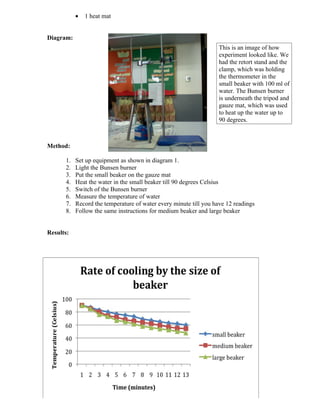
                                                                   This is an image of how
                                                                   experiment looked like. We
                                                                   had the retort stand and the
                                                                   clamp, which was holding
                                                                   the thermometer in the
                                                                   small beaker with 100 ml of
                                                                   water. The Bunsen burner
                                                                   is underneath the tripod and
                                                                   gauze mat, which was used
                                                                   to heat up the water up to
                                                                   90 degrees.


Method:

      1.   Set up equipment as shown in diagram 1.
      2.   Light the Bunsen burner
      3.   Put the small beaker on the gauze mat
      4.   Heat the water in the small beaker till 90 degrees Celsius
      5.   Switch of the Bunsen burner
      6.   Measure the temperature of water
      7.   Record the temperature of water every minute till you have 12 readings
      8.   Follow the same instructions for medium beaker and large beaker


Results:
SMALL BEAKER                       MEDIUM BEAKER

Time         Temperatures         Time        Temperatures
(Minutes)    (Degrees Celsius)    (Minutes)   (Degrees Celsius)
0            90                   0           90
1            87                   1           85
2            83                   2           80
3            80                   3           74
4            77                   4           72
5            75                   5           68
6            73                   6           66
7            69                   7           64
8            67                   8           62
9            65                   9           59.5
10           63                   10          57
11           62                   11          55
12           60                   12          54.5


 LARGE BEAKER


 Time         Temperatures
 (Minutes)    (Degrees Celsius)
 0            90
 1            85
 2            76
 3            73
 4            67
 5            65
 6            61.5
 7            58
 8            56
 9            54
 10           52.5
 11           50
 12           48
Conclusion:


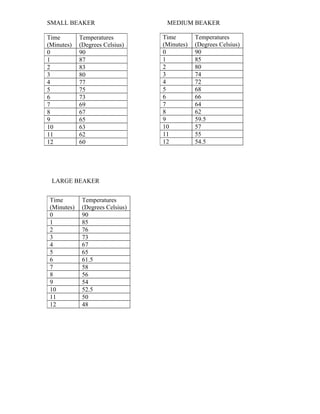
        If you look at our data tables for the three different beakers you can see that the
beaker with the largest mouth had the water cooled down the quickest. This was because the
beaker had a large mouth and so more water was exposed to the air for cooling it down
whereas for the medium and small beaker their mouth was not big enough and so the water
took a bit long to cool down. The data table for the waters temperature in the small beaker
decreased an average of 2.5 degrees each minute, for the medium beaker the waters
temperature decreased every 2.96 degrees and for the large beaker it decreased 3.67 degrees
every minute. Our hypothesis was proven right. The larger the container’s mouth was the
faster the water cooled down

        I think that the data we have collected in this experiment is not that reliable because
for the small beaker the results were pretty consistent, for the medium beaker there was a
jump where there was a difference of 5 degrees but the for the large beaker one of the
difference between the temperature of water was 11 degrees. That was a bit shocking and I
think that was because we were not very accurate in our readings of the temperature.

       Sometimes when we use to heat up the water, we use to loose track of the time and
the water would heat up till 92 degrees instead of 90 degrees and that was a bit hard to
maintain. At the end our hypothesis was right the larger the containers mouth the faster the
water-cools down.


Evaluation:

        I think our method was reliable because we specifically noted down every step that
would be taken in order to do this experiment. Most of the results that we got from our
experiment could be trusted but I would not call them reliable because the results we got
from the large beaker had inconsistent differences. Some of the things that could be
improved would be that from next time we could start reading the temperature of the water
before the minute occurred, because sometimes the temperature was still decreasing and we
recorded it. Another difficulty was that since the clamp was in our way we could not see the
thermometer’s number clearly and so we had to adjust it during our experiment was going
on, which is why sometimes the thermometer was lifted from the water and so it was exposed
to the air, and because of that the temperature went down quickly. So then by the time we put
the thermometer back, the temperature was a bit messed-up. Thus from next we should try
doing it carefully. One of the strengths of this experiment was that we as a group were
prepared, we all did our jobs like recording, using the stop-watch, setting-up equipment and
all of us had down that well.
Sana's lab report

Sana's lab report

  • 1.
    Name: Sana Samad Partners:Su Hong and Dong Hyun Date of experiment: Wednesday September 29th 2010 Factors that affect the cooling rate of water Aim: How can the size of the container’s mouth effect the cooling rate of water? Hypothesis: Our hypothesis was that the wider the container’s mouth is the faster the water will cool down. This was our hypothesis because if the container’s opening is large more water is exposed to the air, whereas if the container is small less water is exposed to the air and so it will be hard to cool down that amount of water. Variables: Input variable: Size of container’s mouth Output variable: temperature of water every minute Control variables: Control variable 1: Amount of water: I will keep it constant by using the same amount of water for the different beakers. Control variable 2: Size of container: I will keep it constant by using the same size of container Control variable 3: Starting temperature of water: I will keep it constant by having the same 90 degrees starting temperature of water for all the beakers Control variable 4: Material of container: I will keep it constant by using the same type of material. Materials: • 1 Bunsen burner • 1 thermometer • 1 100ml beaker • 1250ml beaker • 1 500ml beaker • 1 stop watch • 1 retort stand • 1 clamp • 1 boss head • 1 gauze mat • 1 tripod • 1 lighter
  • 2.
    1 heat mat Diagram: This is an image of how experiment looked like. We had the retort stand and the clamp, which was holding the thermometer in the small beaker with 100 ml of water. The Bunsen burner is underneath the tripod and gauze mat, which was used to heat up the water up to 90 degrees. Method: 1. Set up equipment as shown in diagram 1. 2. Light the Bunsen burner 3. Put the small beaker on the gauze mat 4. Heat the water in the small beaker till 90 degrees Celsius 5. Switch of the Bunsen burner 6. Measure the temperature of water 7. Record the temperature of water every minute till you have 12 readings 8. Follow the same instructions for medium beaker and large beaker Results:
  • 3.
    SMALL BEAKER MEDIUM BEAKER Time Temperatures Time Temperatures (Minutes) (Degrees Celsius) (Minutes) (Degrees Celsius) 0 90 0 90 1 87 1 85 2 83 2 80 3 80 3 74 4 77 4 72 5 75 5 68 6 73 6 66 7 69 7 64 8 67 8 62 9 65 9 59.5 10 63 10 57 11 62 11 55 12 60 12 54.5 LARGE BEAKER Time Temperatures (Minutes) (Degrees Celsius) 0 90 1 85 2 76 3 73 4 67 5 65 6 61.5 7 58 8 56 9 54 10 52.5 11 50 12 48
  • 4.
    Conclusion: If you look at our data tables for the three different beakers you can see that the beaker with the largest mouth had the water cooled down the quickest. This was because the beaker had a large mouth and so more water was exposed to the air for cooling it down whereas for the medium and small beaker their mouth was not big enough and so the water took a bit long to cool down. The data table for the waters temperature in the small beaker decreased an average of 2.5 degrees each minute, for the medium beaker the waters temperature decreased every 2.96 degrees and for the large beaker it decreased 3.67 degrees every minute. Our hypothesis was proven right. The larger the container’s mouth was the faster the water cooled down I think that the data we have collected in this experiment is not that reliable because for the small beaker the results were pretty consistent, for the medium beaker there was a jump where there was a difference of 5 degrees but the for the large beaker one of the difference between the temperature of water was 11 degrees. That was a bit shocking and I think that was because we were not very accurate in our readings of the temperature. Sometimes when we use to heat up the water, we use to loose track of the time and the water would heat up till 92 degrees instead of 90 degrees and that was a bit hard to maintain. At the end our hypothesis was right the larger the containers mouth the faster the water-cools down. Evaluation: I think our method was reliable because we specifically noted down every step that would be taken in order to do this experiment. Most of the results that we got from our experiment could be trusted but I would not call them reliable because the results we got from the large beaker had inconsistent differences. Some of the things that could be improved would be that from next time we could start reading the temperature of the water before the minute occurred, because sometimes the temperature was still decreasing and we recorded it. Another difficulty was that since the clamp was in our way we could not see the thermometer’s number clearly and so we had to adjust it during our experiment was going on, which is why sometimes the thermometer was lifted from the water and so it was exposed to the air, and because of that the temperature went down quickly. So then by the time we put the thermometer back, the temperature was a bit messed-up. Thus from next we should try doing it carefully. One of the strengths of this experiment was that we as a group were prepared, we all did our jobs like recording, using the stop-watch, setting-up equipment and all of us had down that well.