Sampling Design
Sampling is the process of selecting a
small number of elements from a larger
defined target group of elements such
that the information gathered from the
small group will allow judgments to be
made about the larger groups.
Sampling
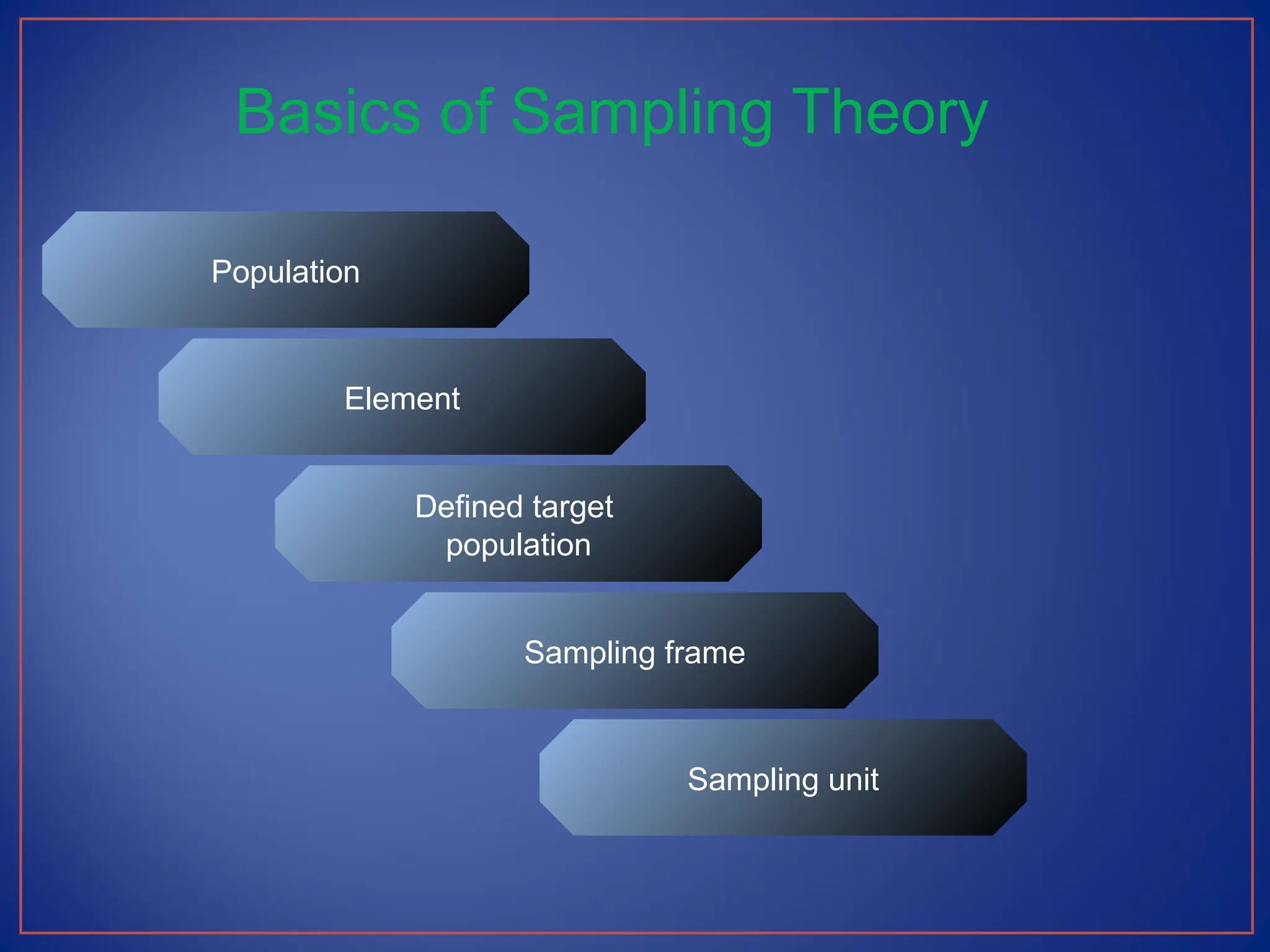
Population
Element
Defined target
population
Sampling frame
Sampling unit
Basics of Sampling Theory
Sampling Error
Sampling error is any type of bias
that is attributable to mistakes in either
drawing a sample or determining the
sample size
The Sampling Design Process
Define the Population
Determine the Sampling Frame
Select Sampling Technique(s)
Determine the Sample Size
Execute the Sampling Process
Defining Population of Interest
• Population of interest is entirely dependent on
Management Problem, Research Problems, and
Research Design.
• Some Bases for Defining Population
•Geographic Area
•Demographics
•Usage/Lifestyle
•Awareness
/ Sampling unit
Sampling Frame
• A list of population elements (people,
companies, houses, cities, etc.) from which
units to be sampled can be selected.
• Difficult to get an accurate list.
• Sample frame error occurs when certain
elements of the population are accidentally
omitted or not included on the list.
Sampling Methods
Probability
sampling
Nonprobabilit
y
sampling
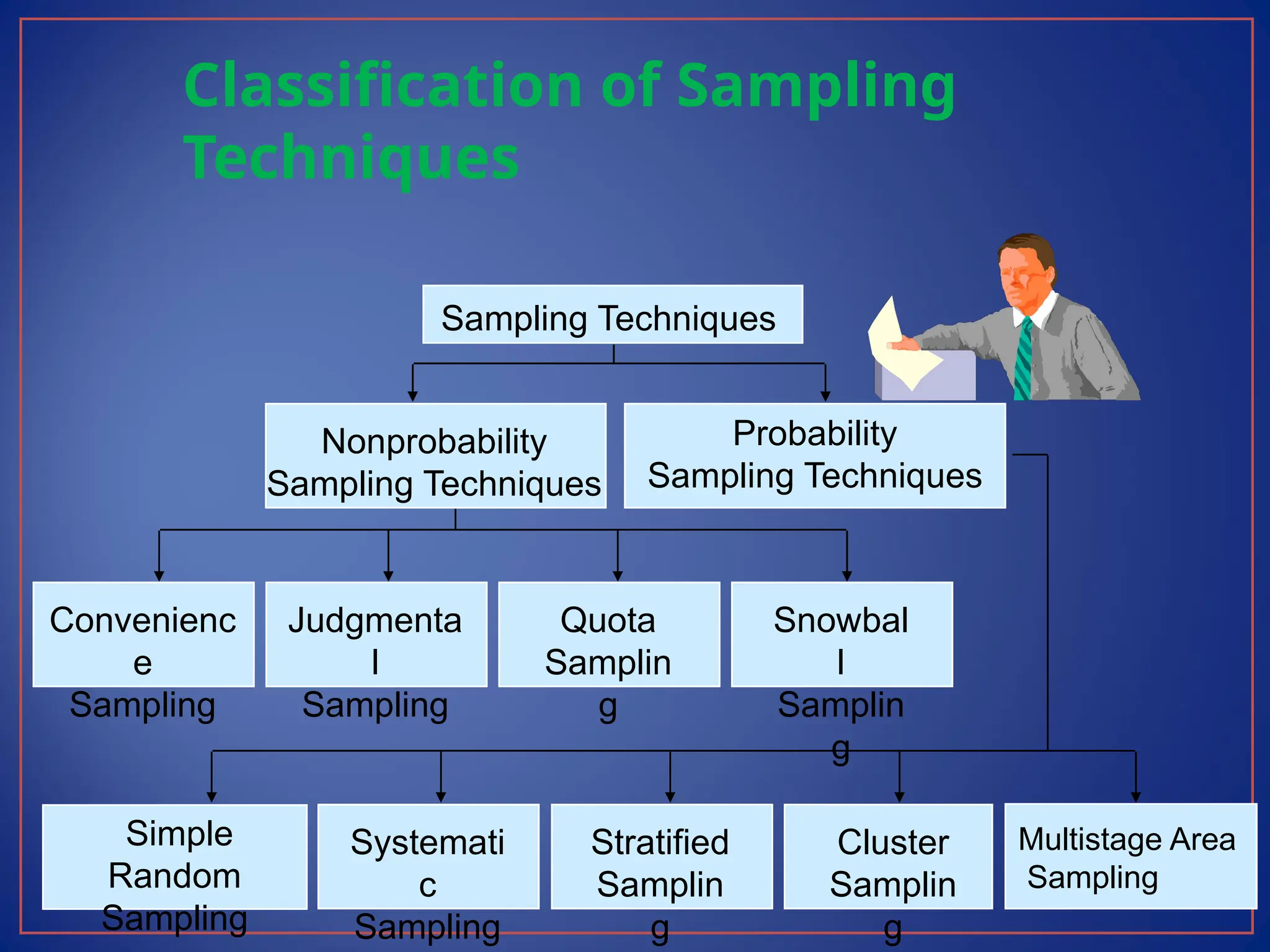
Classification of Sampling
Techniques
Sampling Techniques
Nonprobability
Sampling Techniques
Probability
Sampling Techniques
Convenienc
e
Sampling
Judgmenta
l
Sampling
Quota
Samplin
g
Snowbal
l
Samplin
g
Multistage Area
Sampling
Systemati
c
Sampling
Stratified
Samplin
g
Cluster
Samplin
g
Simple
Random
Sampling
Probability Sampling Techniques
Simple Random Sampling
Simple random sampling is a
method of probability sampling
in which every unit has an equal
nonzero chance of being
selected
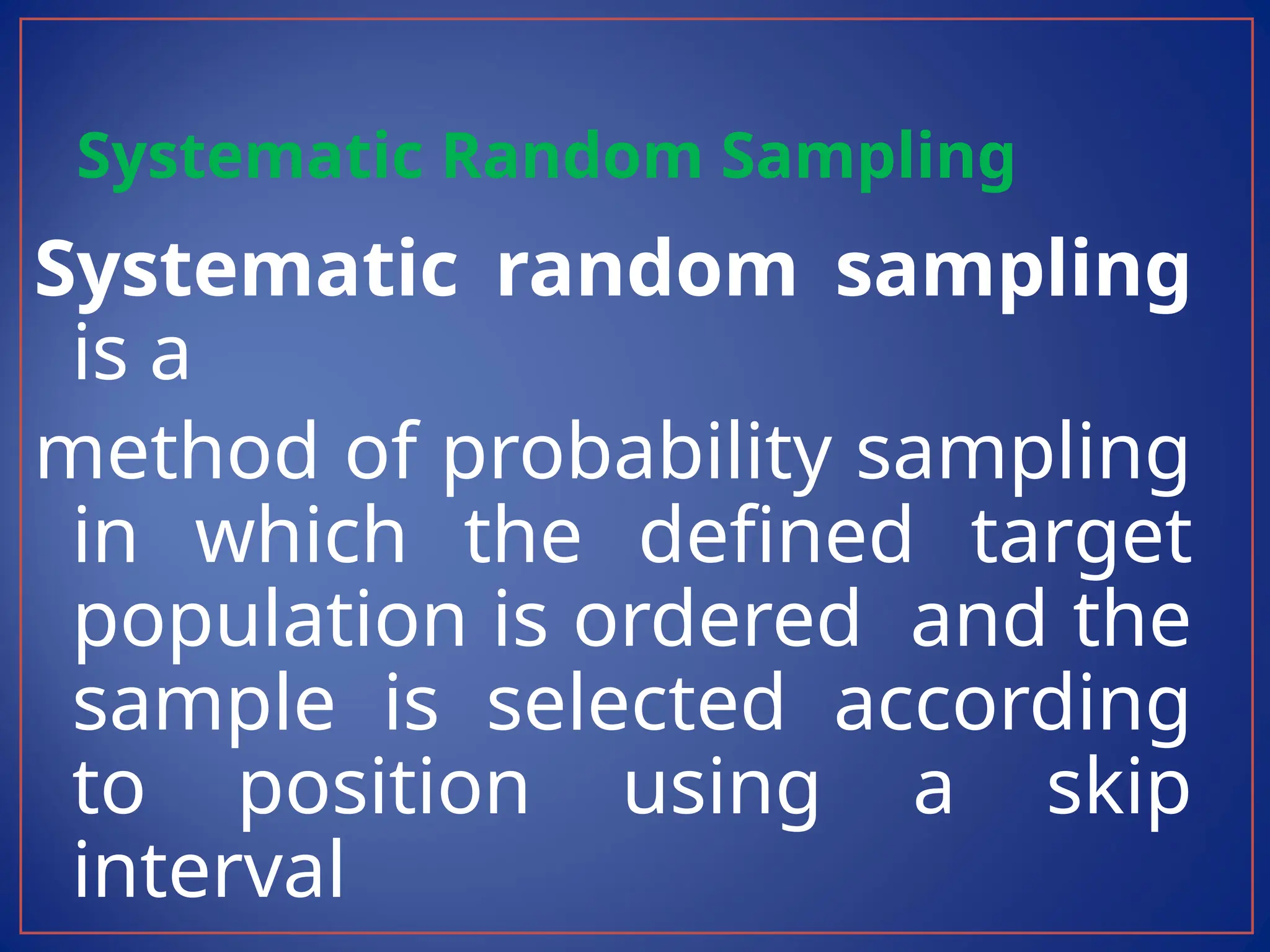
Systematic Random Sampling
Systematic random sampling
is a
method of probability sampling
in which the defined target
population is ordered and the
sample is selected according
to position using a skip
interval
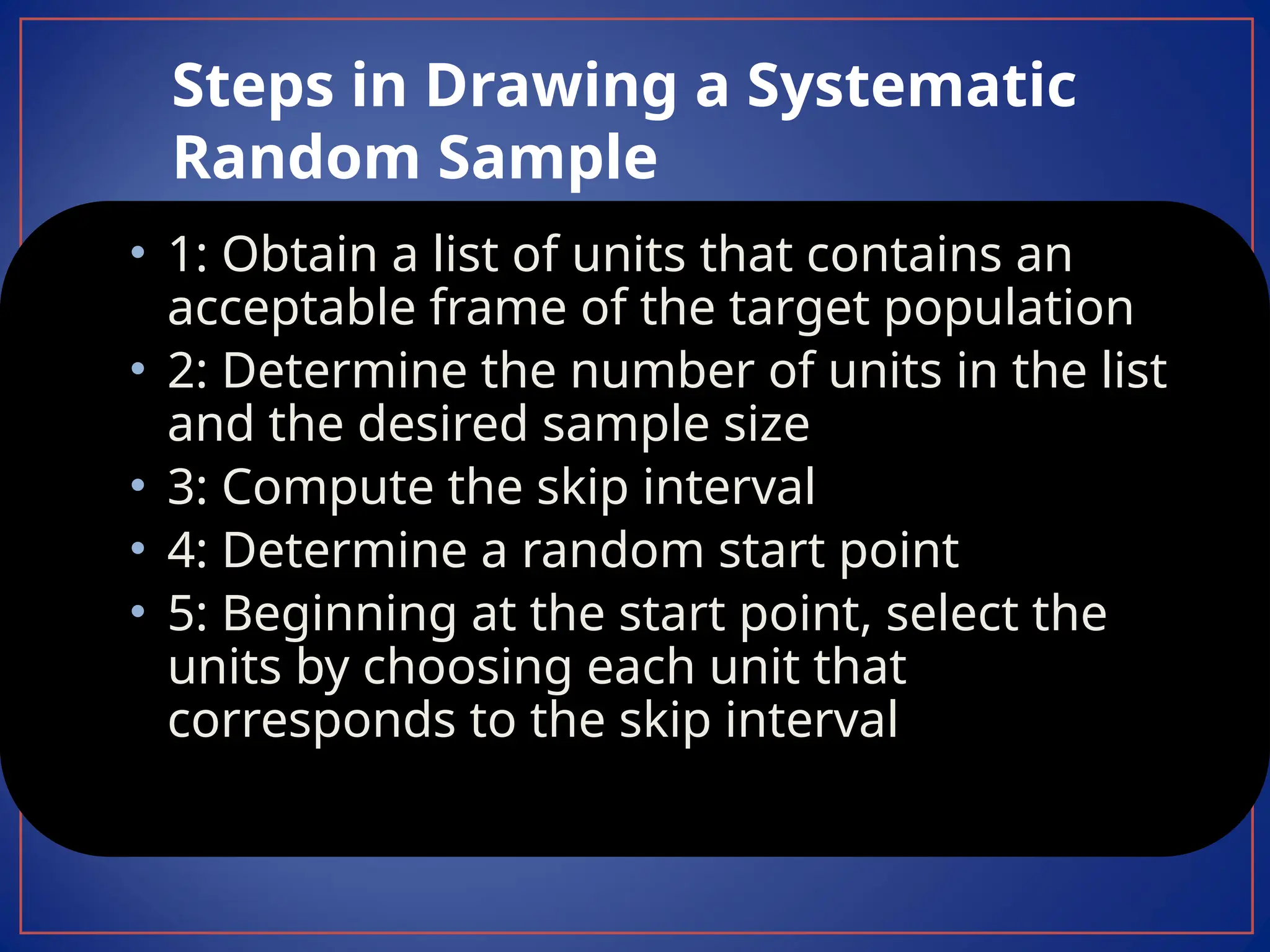
Steps in Drawing a Systematic
Random Sample
• 1: Obtain a list of units that contains an
acceptable frame of the target population
• 2: Determine the number of units in the list
and the desired sample size
• 3: Compute the skip interval
• 4: Determine a random start point
• 5: Beginning at the start point, select the
units by choosing each unit that
corresponds to the skip interval
Stratified random sampling
Stratified random sampling is a
method of probability sampling in
which the population is divided into
different subgroups and samples are
selected from each
Steps in Drawing a Stratified
Random Sample
• 1: Divide the target population into homogeneous
subgroups or strata
• 2: Draw random samples from each stratum
• 3: Combine the samples from each stratum into a
single sample of the target population
Cluster sampling
• Cluster sampling is a probability
sampling technique where researchers
divide the population into multiple
groups (clusters) for research.
Researchers then select random groups
with a simple random or systematic
random sampling technique for data
collection and data analysis.
Cluster Sampling can be :
• Single-stage cluster sampling:
• sampling is done just once. Eg. An NGO wants to
create a sample of girls across five neighboring towns
to provide education. Using single-stage sampling,
the NGO randomly selects towns (clusters) to form a
sample and extend help to the girls deprived of
education in those towns.
• Two-stage cluster sampling:
• Here, instead of selecting all the elements of a cluster,
only a handful of members are chosen from each
group by implementing systematic or simple random
sampling. An example of two-stage cluster sampling –
A business owner wants to explore the performance
of his/her plants that are spread across various parts
of the Country. The owner creates clusters of the
Multiplestage Area Sampling
:
•Multiple-stage cluster sampling takes a step or a few
steps further than two-stage sampling.
•For conducting effective research across multiple
geographies, one needs to form complicated clusters
that can be achieved only using the multiple-stage
sampling technique. An example of Multiple stage
sampling by clusters – An organization intends to
survey to analyze the performance of smartphones
across India. They can divide the entire country’s
population into cities
Thank
You

Sampling Design Module 2 in research process.pptx

  • 1.
  • 2.
    Sampling is theprocess of selecting a small number of elements from a larger defined target group of elements such that the information gathered from the small group will allow judgments to be made about the larger groups. Sampling
  • 3.
  • 4.
    Sampling Error Sampling erroris any type of bias that is attributable to mistakes in either drawing a sample or determining the sample size
  • 5.
    The Sampling DesignProcess Define the Population Determine the Sampling Frame Select Sampling Technique(s) Determine the Sample Size Execute the Sampling Process
  • 6.
    Defining Population ofInterest • Population of interest is entirely dependent on Management Problem, Research Problems, and Research Design. • Some Bases for Defining Population •Geographic Area •Demographics •Usage/Lifestyle •Awareness / Sampling unit
  • 7.
    Sampling Frame • Alist of population elements (people, companies, houses, cities, etc.) from which units to be sampled can be selected. • Difficult to get an accurate list. • Sample frame error occurs when certain elements of the population are accidentally omitted or not included on the list.
  • 8.
  • 9.
    Classification of Sampling Techniques SamplingTechniques Nonprobability Sampling Techniques Probability Sampling Techniques Convenienc e Sampling Judgmenta l Sampling Quota Samplin g Snowbal l Samplin g Multistage Area Sampling Systemati c Sampling Stratified Samplin g Cluster Samplin g Simple Random Sampling
  • 10.
    Probability Sampling Techniques SimpleRandom Sampling Simple random sampling is a method of probability sampling in which every unit has an equal nonzero chance of being selected
  • 11.
    Systematic Random Sampling Systematicrandom sampling is a method of probability sampling in which the defined target population is ordered and the sample is selected according to position using a skip interval
  • 12.
    Steps in Drawinga Systematic Random Sample • 1: Obtain a list of units that contains an acceptable frame of the target population • 2: Determine the number of units in the list and the desired sample size • 3: Compute the skip interval • 4: Determine a random start point • 5: Beginning at the start point, select the units by choosing each unit that corresponds to the skip interval
  • 13.
    Stratified random sampling Stratifiedrandom sampling is a method of probability sampling in which the population is divided into different subgroups and samples are selected from each
  • 14.
    Steps in Drawinga Stratified Random Sample • 1: Divide the target population into homogeneous subgroups or strata • 2: Draw random samples from each stratum • 3: Combine the samples from each stratum into a single sample of the target population
  • 15.
    Cluster sampling • Clustersampling is a probability sampling technique where researchers divide the population into multiple groups (clusters) for research. Researchers then select random groups with a simple random or systematic random sampling technique for data collection and data analysis.
  • 16.
    Cluster Sampling canbe : • Single-stage cluster sampling: • sampling is done just once. Eg. An NGO wants to create a sample of girls across five neighboring towns to provide education. Using single-stage sampling, the NGO randomly selects towns (clusters) to form a sample and extend help to the girls deprived of education in those towns. • Two-stage cluster sampling: • Here, instead of selecting all the elements of a cluster, only a handful of members are chosen from each group by implementing systematic or simple random sampling. An example of two-stage cluster sampling – A business owner wants to explore the performance of his/her plants that are spread across various parts of the Country. The owner creates clusters of the
  • 17.
    Multiplestage Area Sampling : •Multiple-stagecluster sampling takes a step or a few steps further than two-stage sampling. •For conducting effective research across multiple geographies, one needs to form complicated clusters that can be achieved only using the multiple-stage sampling technique. An example of Multiple stage sampling by clusters – An organization intends to survey to analyze the performance of smartphones across India. They can divide the entire country’s population into cities
  • 18.