ENP
ENP
QUESTIONS
QUESTIONS
51-100
51-100
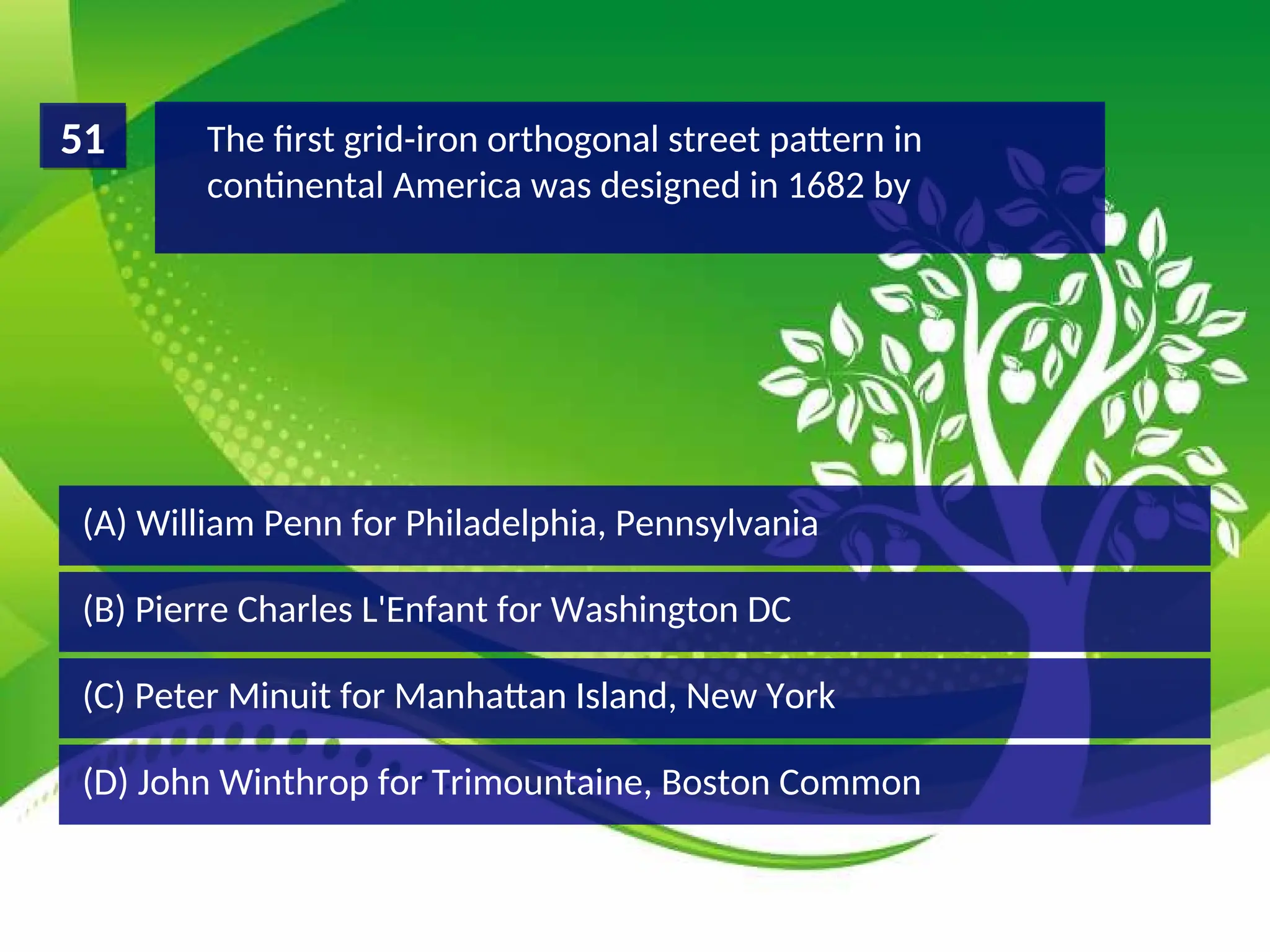
(D) John Winthrop for Trimountaine, Boston Common
(C) Peter Minuit for Manhattan Island, New York
(B) Pierre Charles L'Enfant for Washington DC
(A) William Penn for Philadelphia, Pennsylvania
The first grid-iron orthogonal street pattern in
continental America was designed in 1682 by
51
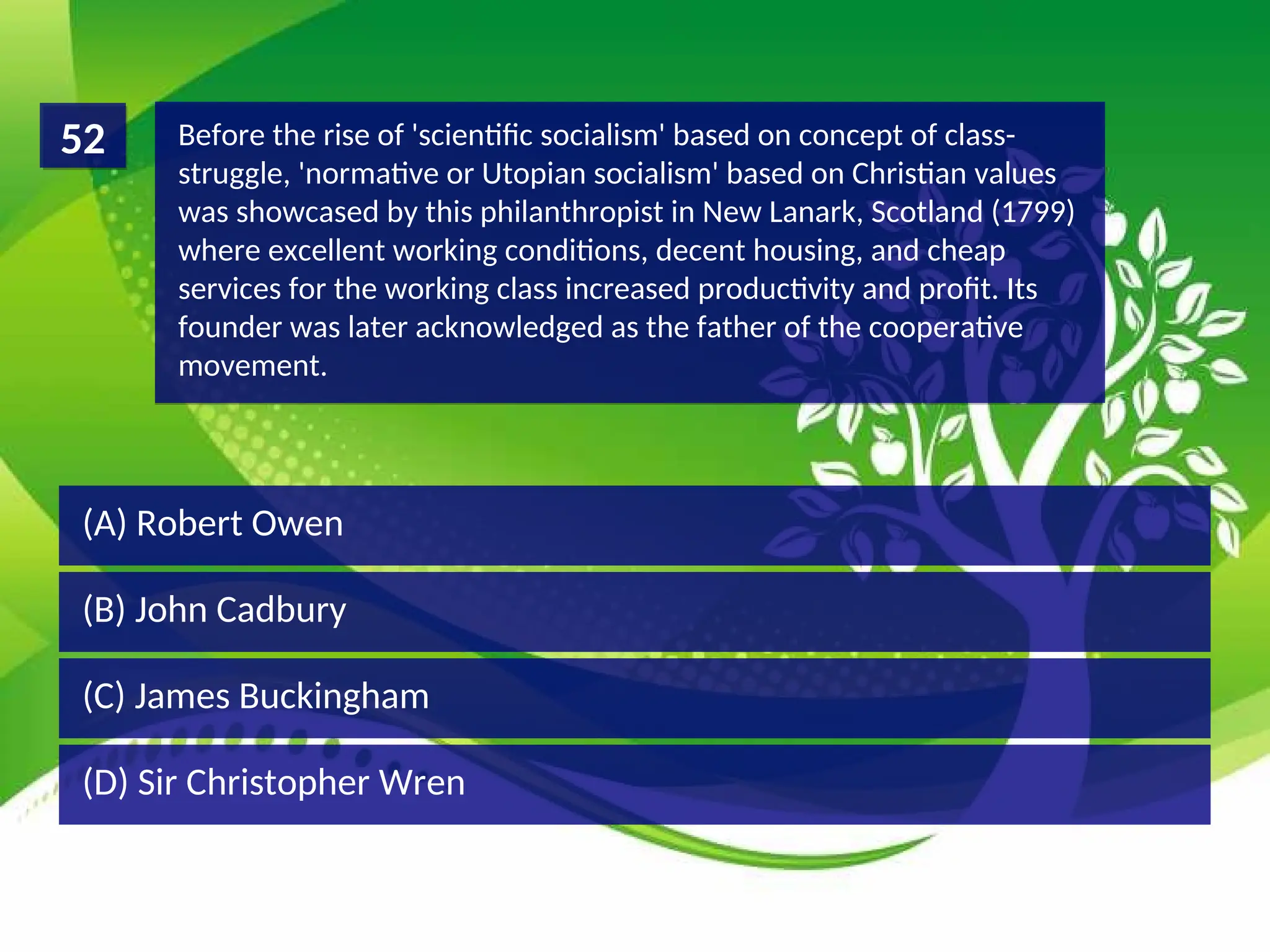
(D) Sir Christopher Wren
(C) James Buckingham
(B) John Cadbury
(A) Robert Owen
Before the rise of 'scientific socialism' based on concept of class-
struggle, 'normative or Utopian socialism' based on Christian values
was showcased by this philanthropist in New Lanark, Scotland (1799)
where excellent working conditions, decent housing, and cheap
services for the working class increased productivity and profit. Its
founder was later acknowledged as the father of the cooperative
movement.
52
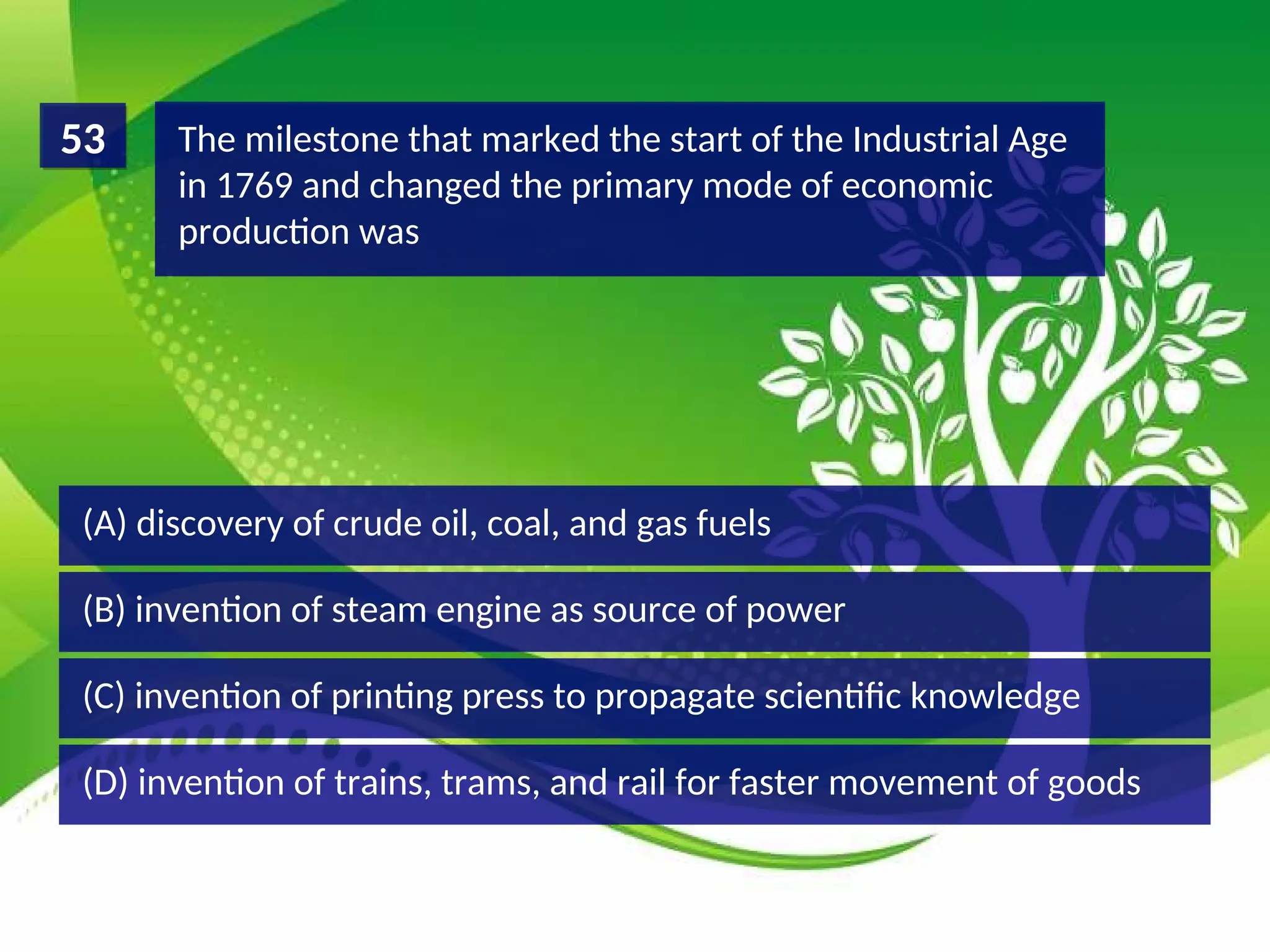
(D) invention of trains, trams, and rail for faster movement of goods
(C) invention of printing press to propagate scientific knowledge
(B) invention of steam engine as source of power
(A) discovery of crude oil, coal, and gas fuels
The milestone that marked the start of the Industrial Age
in 1769 and changed the primary mode of economic
production was
53
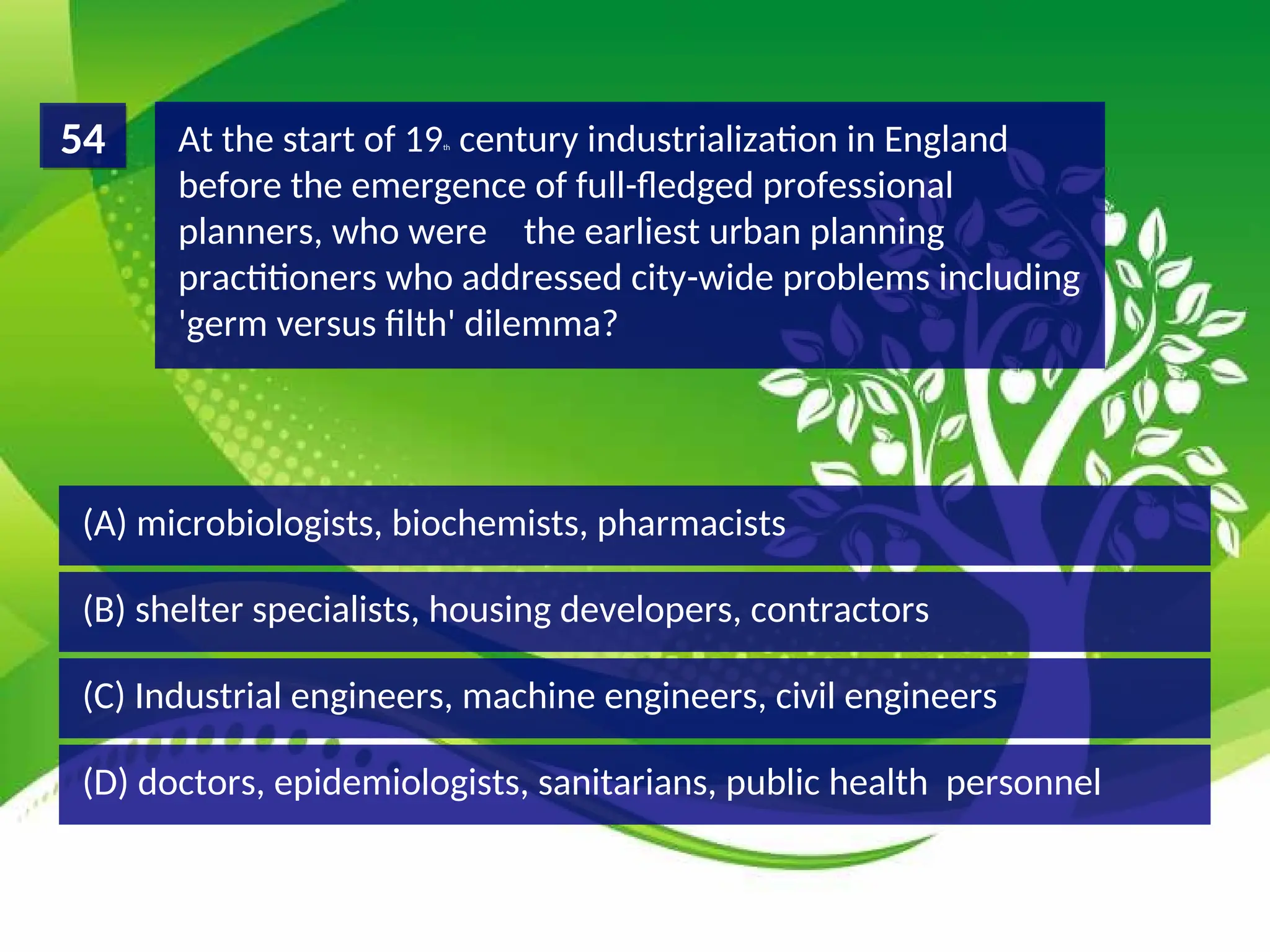
(D) doctors, epidemiologists, sanitarians, public health personnel
(C) Industrial engineers, machine engineers, civil engineers
(B) shelter specialists, housing developers, contractors
(A) microbiologists, biochemists, pharmacists
At the start of 19th century industrialization in England
before the emergence of full-fledged professional
planners, who were the earliest urban planning
practitioners who addressed city-wide problems including
'germ versus filth' dilemma?
54
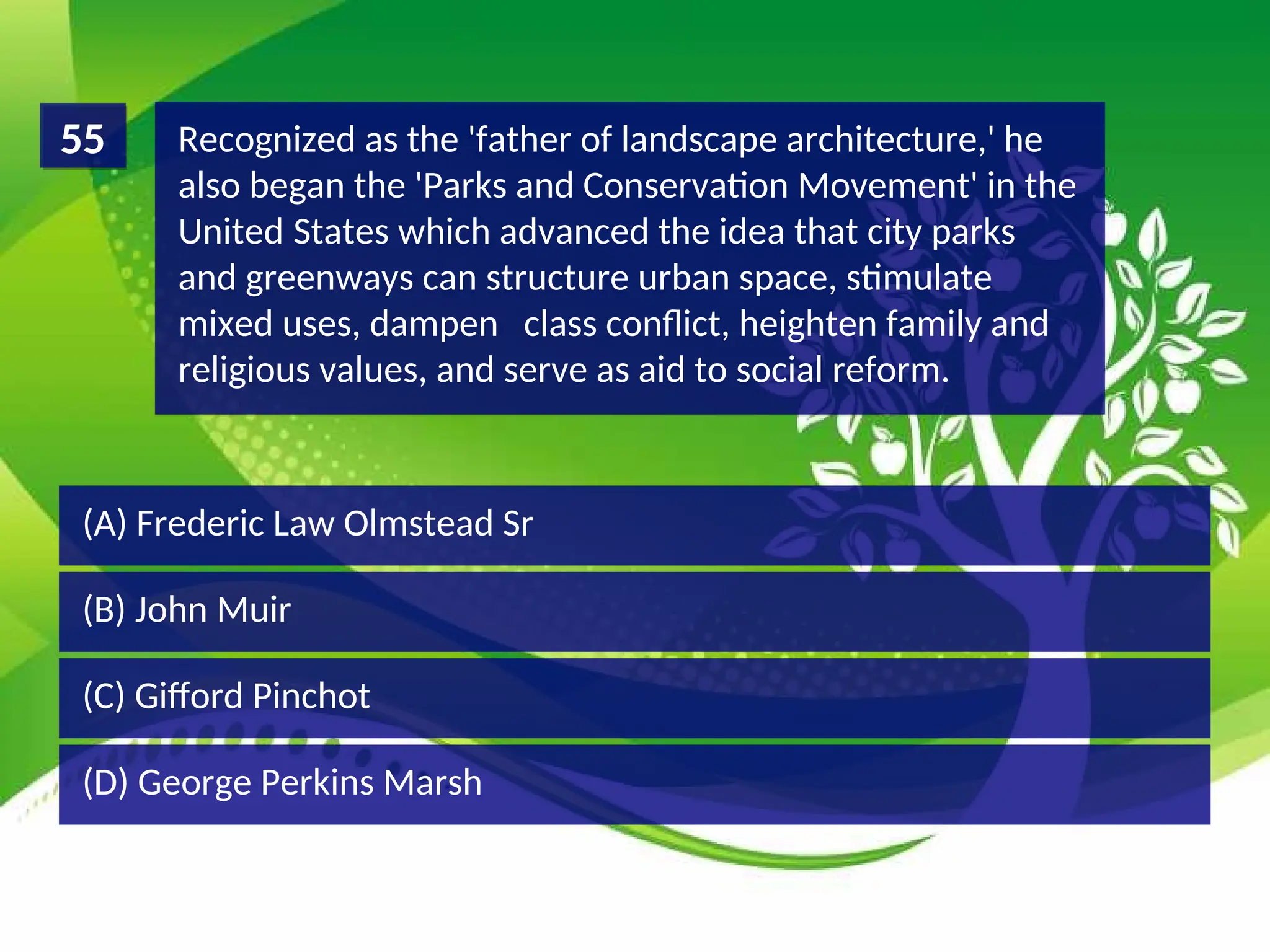
(D) George Perkins Marsh
(C) Gifford Pinchot
(B) John Muir
(A) Frederic Law Olmstead Sr
Recognized as the 'father of landscape architecture,' he
also began the 'Parks and Conservation Movement' in the
United States which advanced the idea that city parks
and greenways can structure urban space, stimulate
mixed uses, dampen class conflict, heighten family and
religious values, and serve as aid to social reform.
55
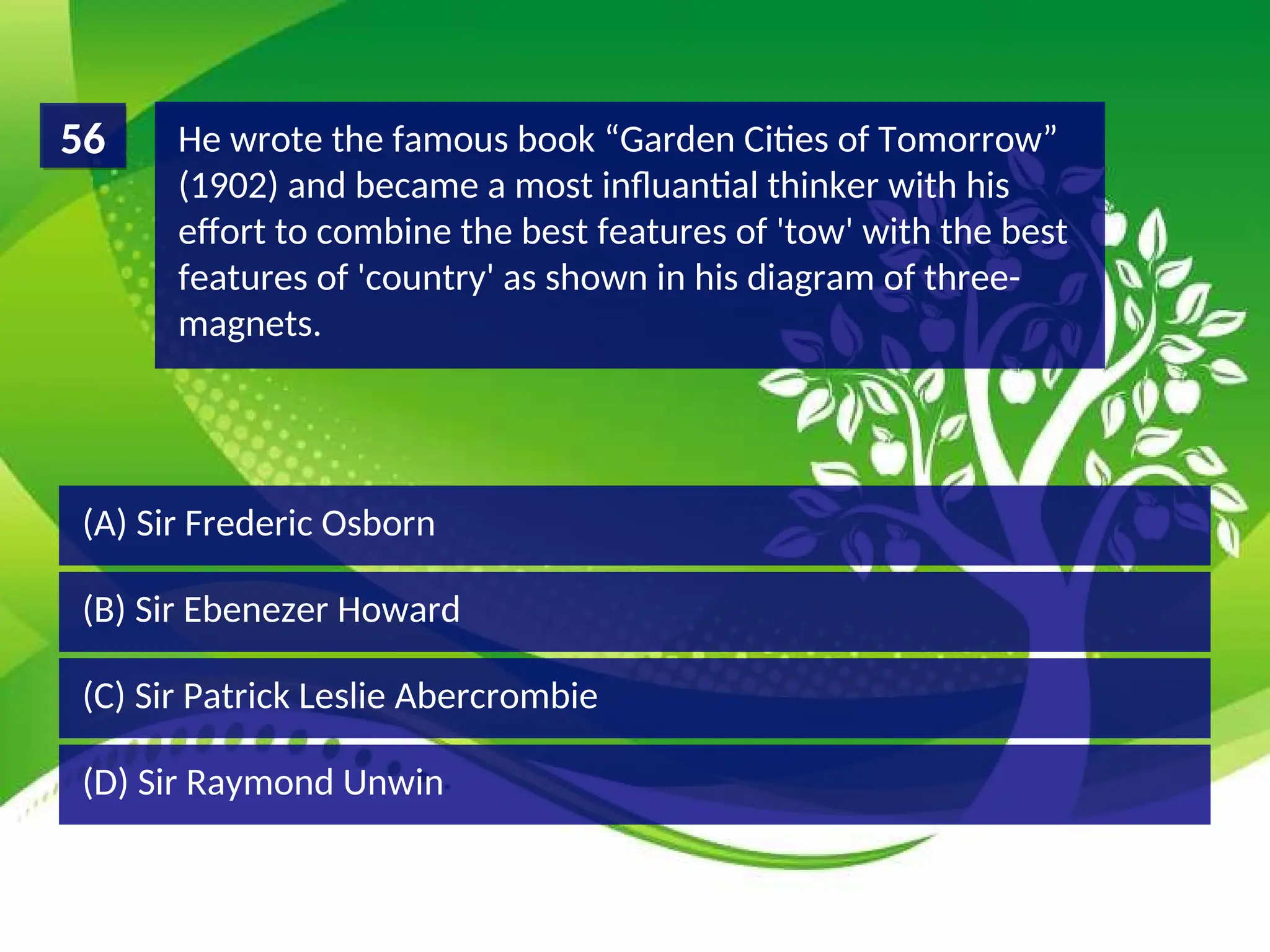
(D) Sir Raymond Unwin
(C) Sir Patrick Leslie Abercrombie
(B) Sir Ebenezer Howard
(A) Sir Frederic Osborn
He wrote the famous book “Garden Cities of Tomorrow”
(1902) and became a most influantial thinker with his
effort to combine the best features of 'tow' with the best
features of 'country' as shown in his diagram of three-
magnets.
56
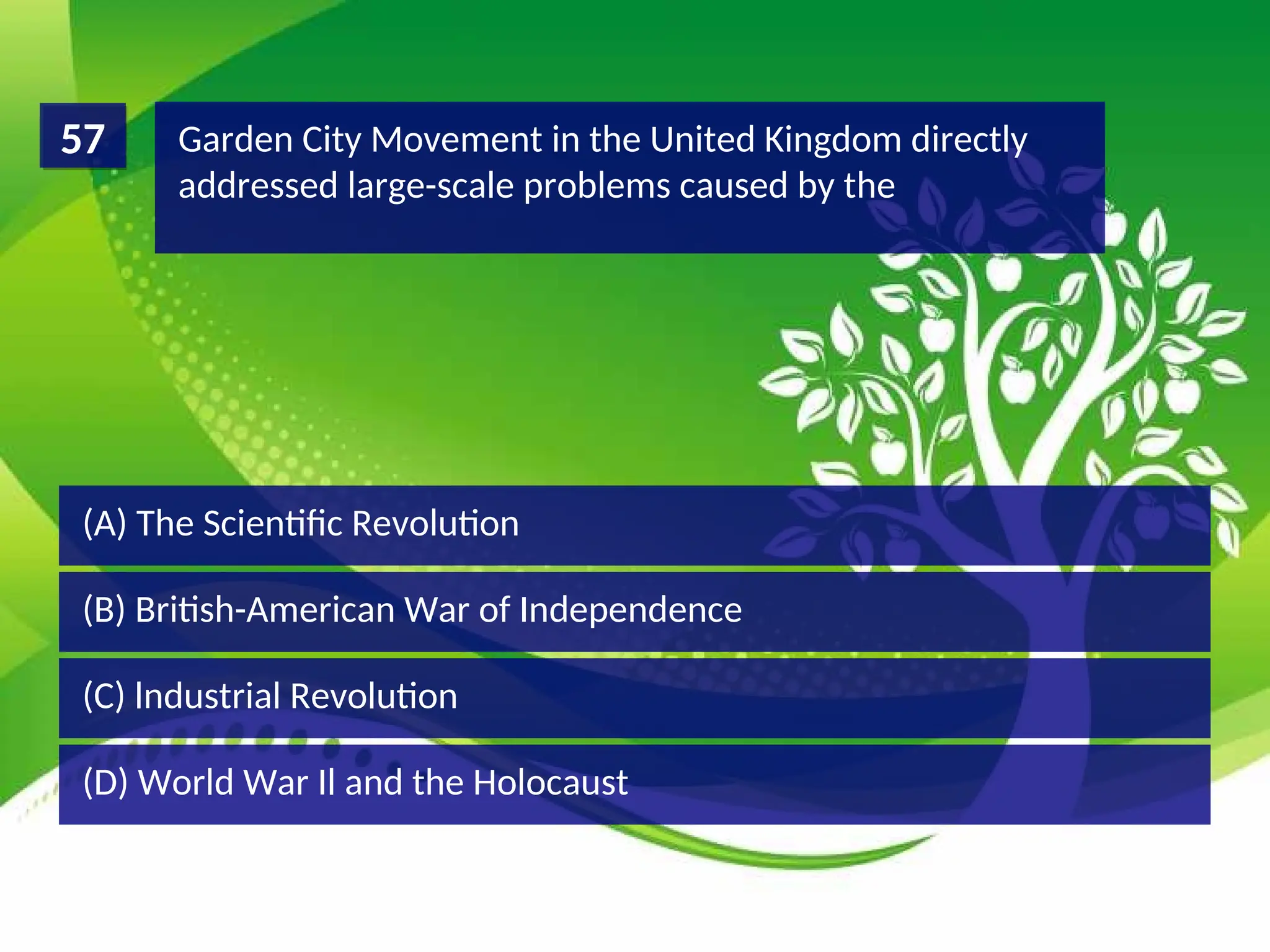
(D) World War Il and the Holocaust
(C) lndustrial Revolution
(B) British-American War of Independence
(A) The Scientific Revolution
Garden City Movement in the United Kingdom directly
addressed large-scale problems caused by the
57
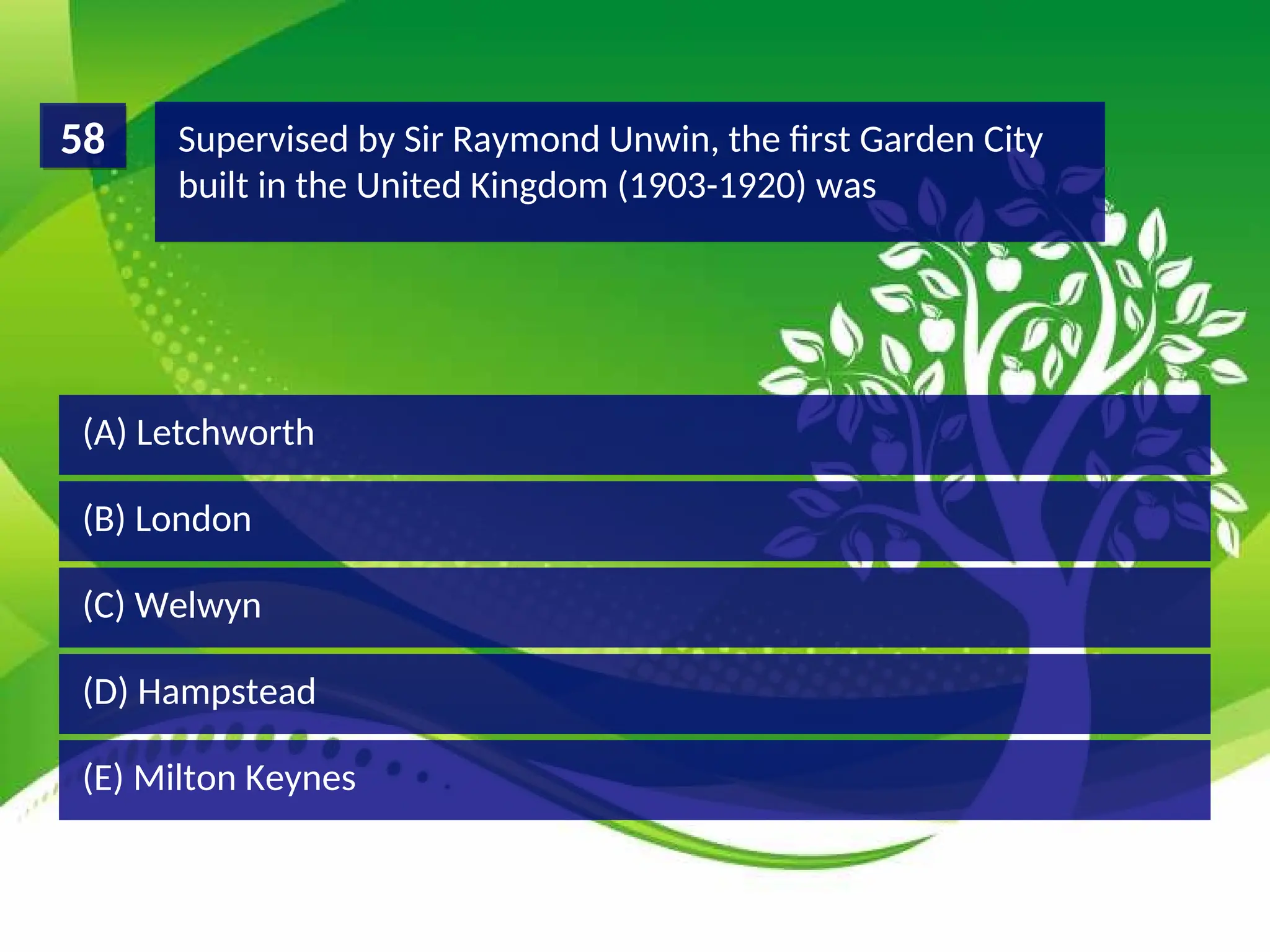
(D) Hampstead
(C) Welwyn
(B) London
(A) Letchworth
Supervised by Sir Raymond Unwin, the first Garden City
built in the United Kingdom (1903-1920) was
58
(E) Milton Keynes
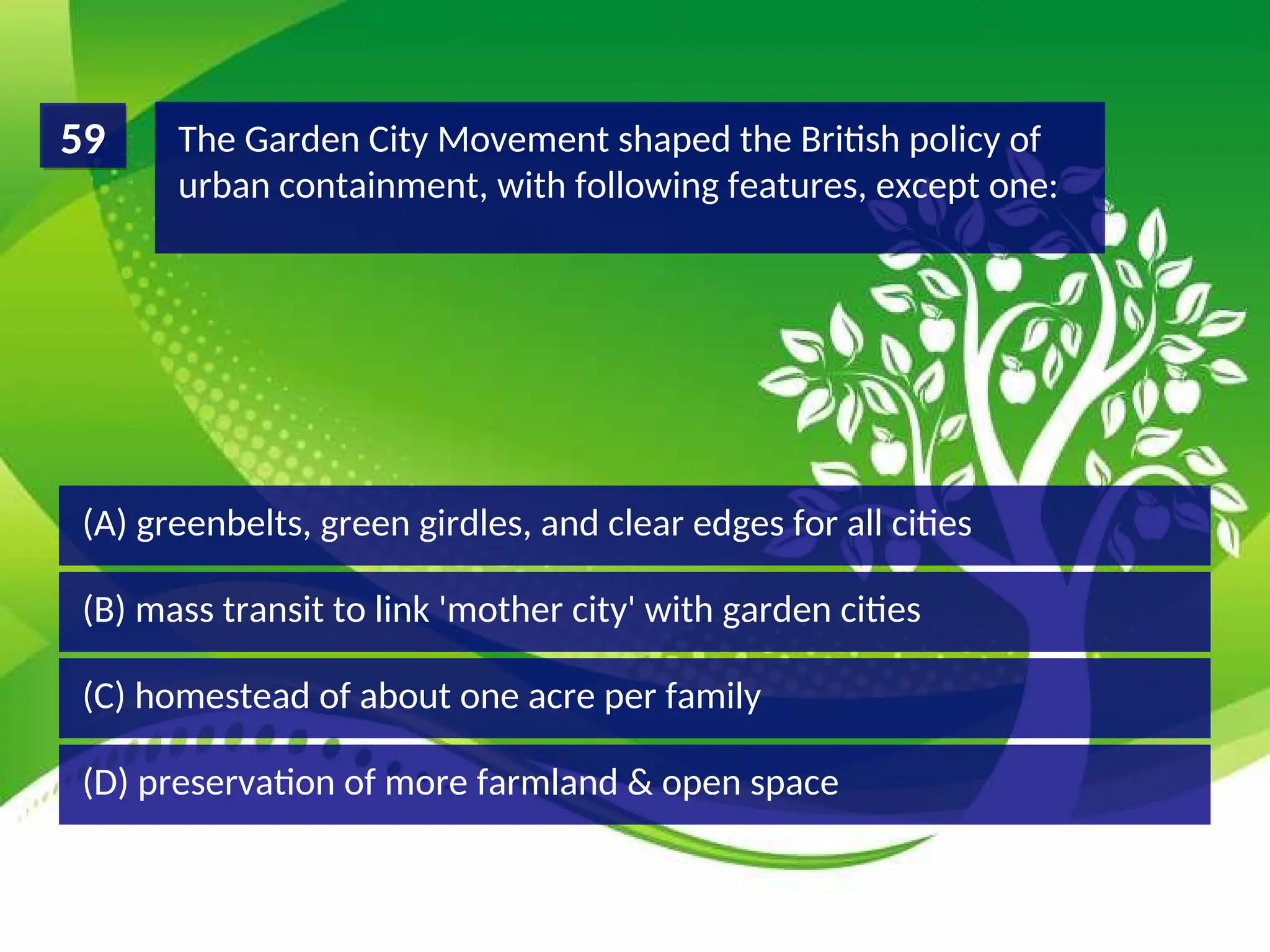
(D) preservation of more farmland & open space
(C) homestead of about one acre per family
(B) mass transit to link 'mother city' with garden cities
(A) greenbelts, green girdles, and clear edges for all cities
The Garden City Movement shaped the British policy of
urban containment, with following features, except one:
59
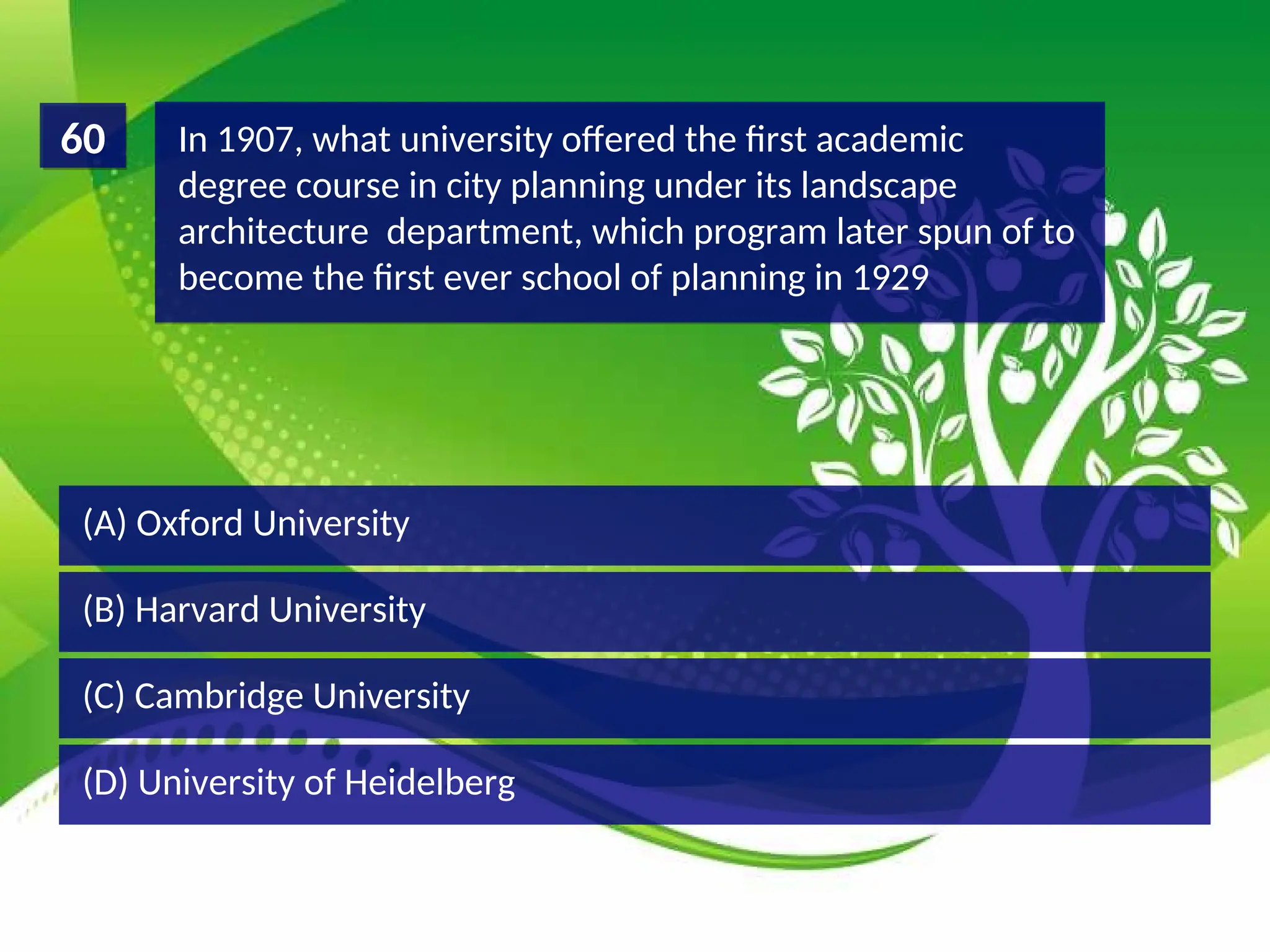
(D) University of Heidelberg
(C) Cambridge University
(B) Harvard University
(A) Oxford University
In 1907, what university offered the first academic
degree course in city planning under its landscape
architecture department, which program later spun of to
become the first ever school of planning in 1929
60
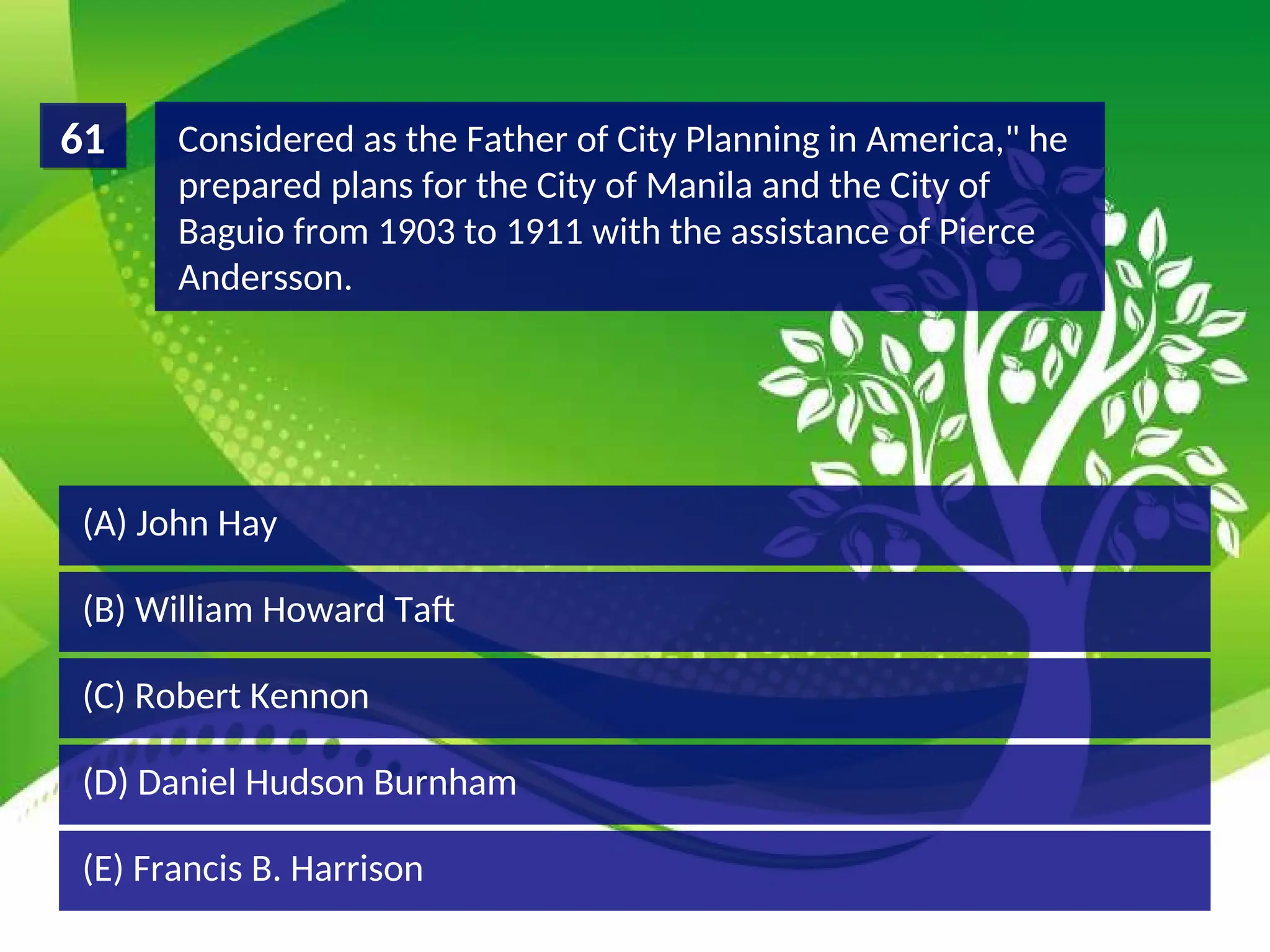
(D) Daniel Hudson Burnham
(C) Robert Kennon
(B) William Howard Taft
(A) John Hay
Considered as the Father of City Planning in America," he
prepared plans for the City of Manila and the City of
Baguio from 1903 to 1911 with the assistance of Pierce
Andersson.
61
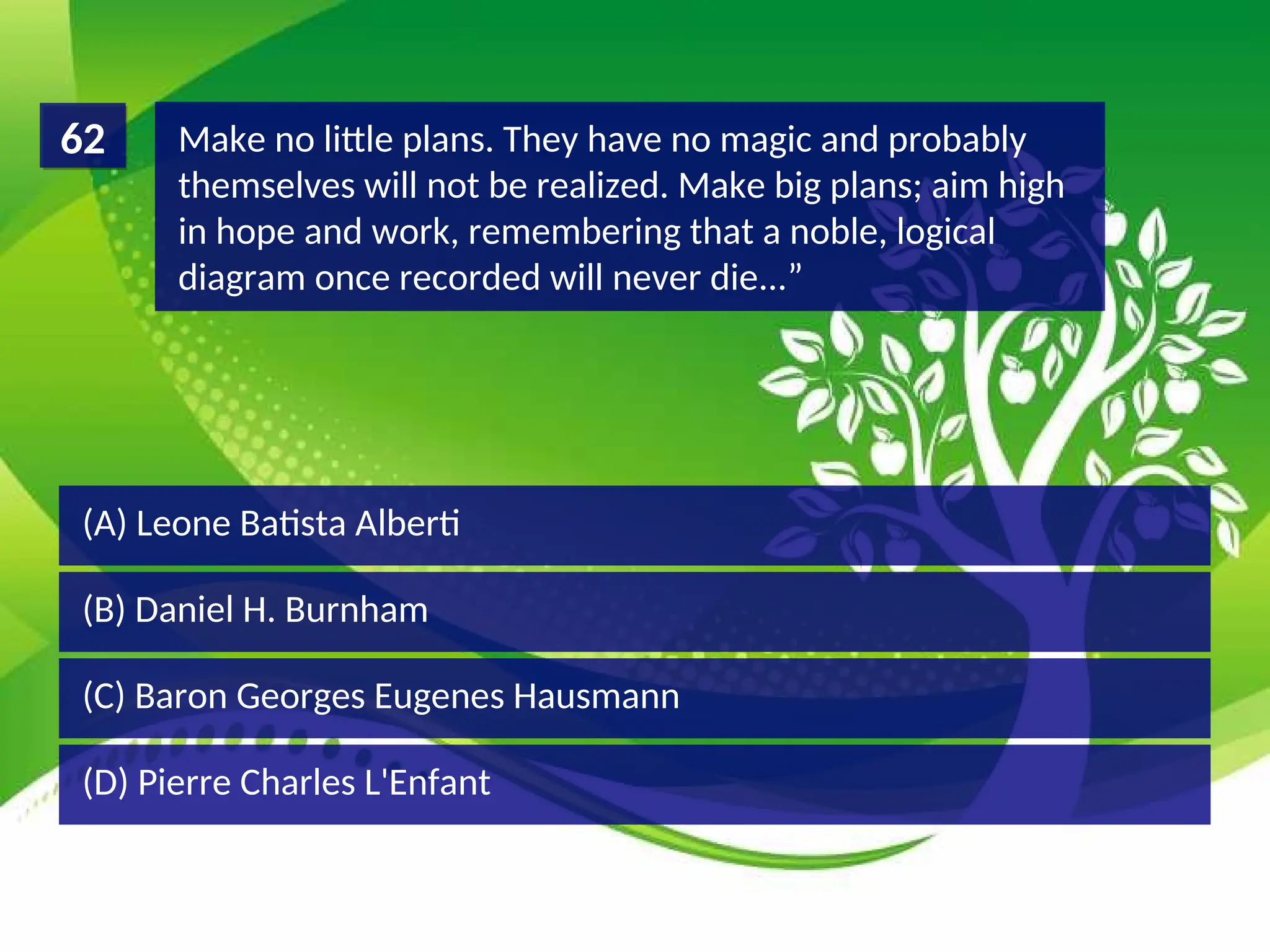
(E) Francis B. Harrison
(D) Pierre Charles L'Enfant
(C) Baron Georges Eugenes Hausmann
(B) Daniel H. Burnham
(A) Leone Batista Alberti
Make no little plans. They have no magic and probably
themselves will not be realized. Make big plans; aim high
in hope and work, remembering that a noble, logical
diagram once recorded will never die...”
62
(D) Napoleon Bonaparte
(C) Theodore Roosevelt
(B) George Washington
(A) Winston Churchill
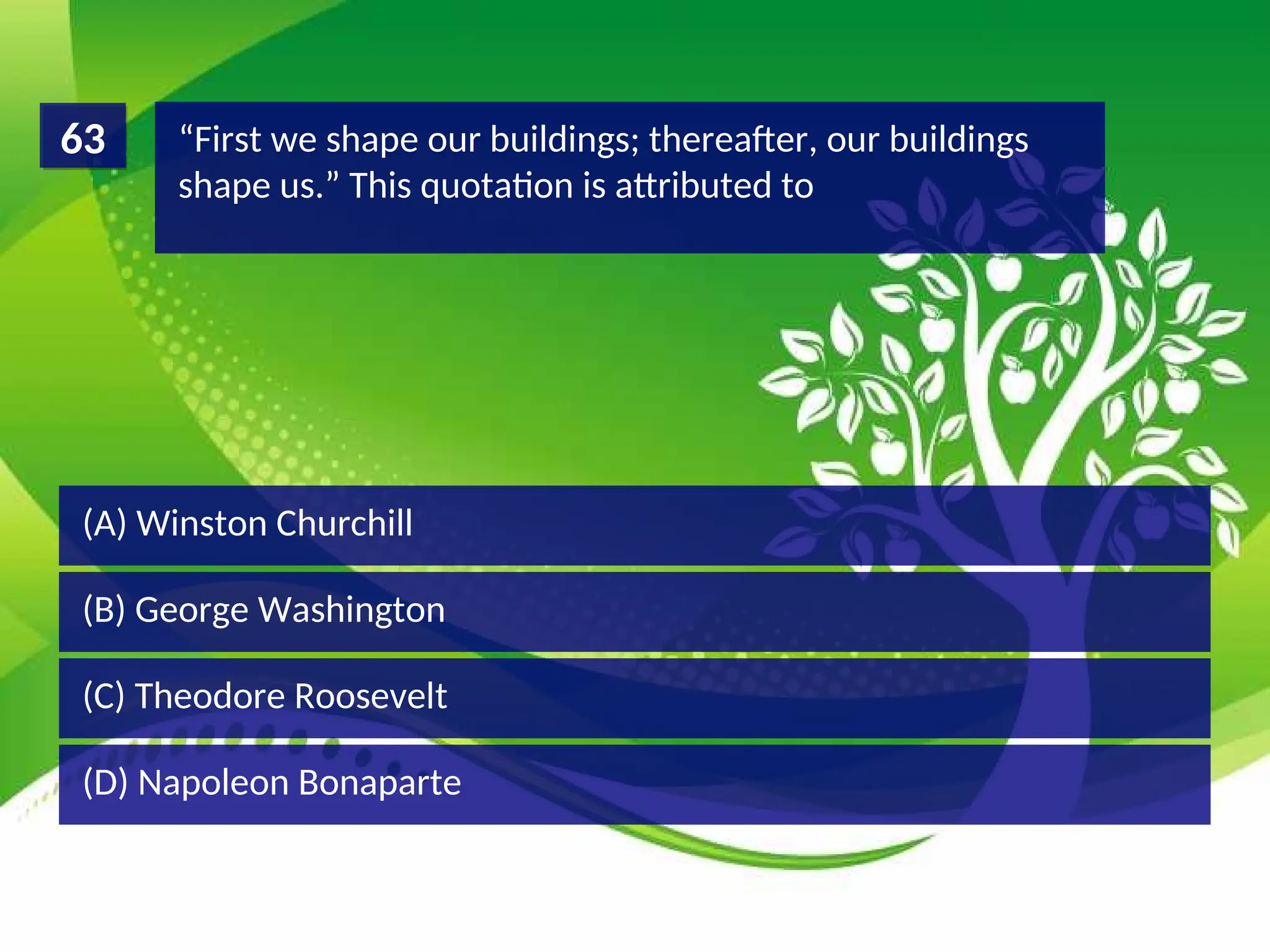
“First we shape our buildings; thereafter, our buildings
shape us.” This quotation is attributed to
63
(D) New Towns Movement
(C) City Efficient Movement
(B) City Functional Movement
(A) City Beautiful Movement
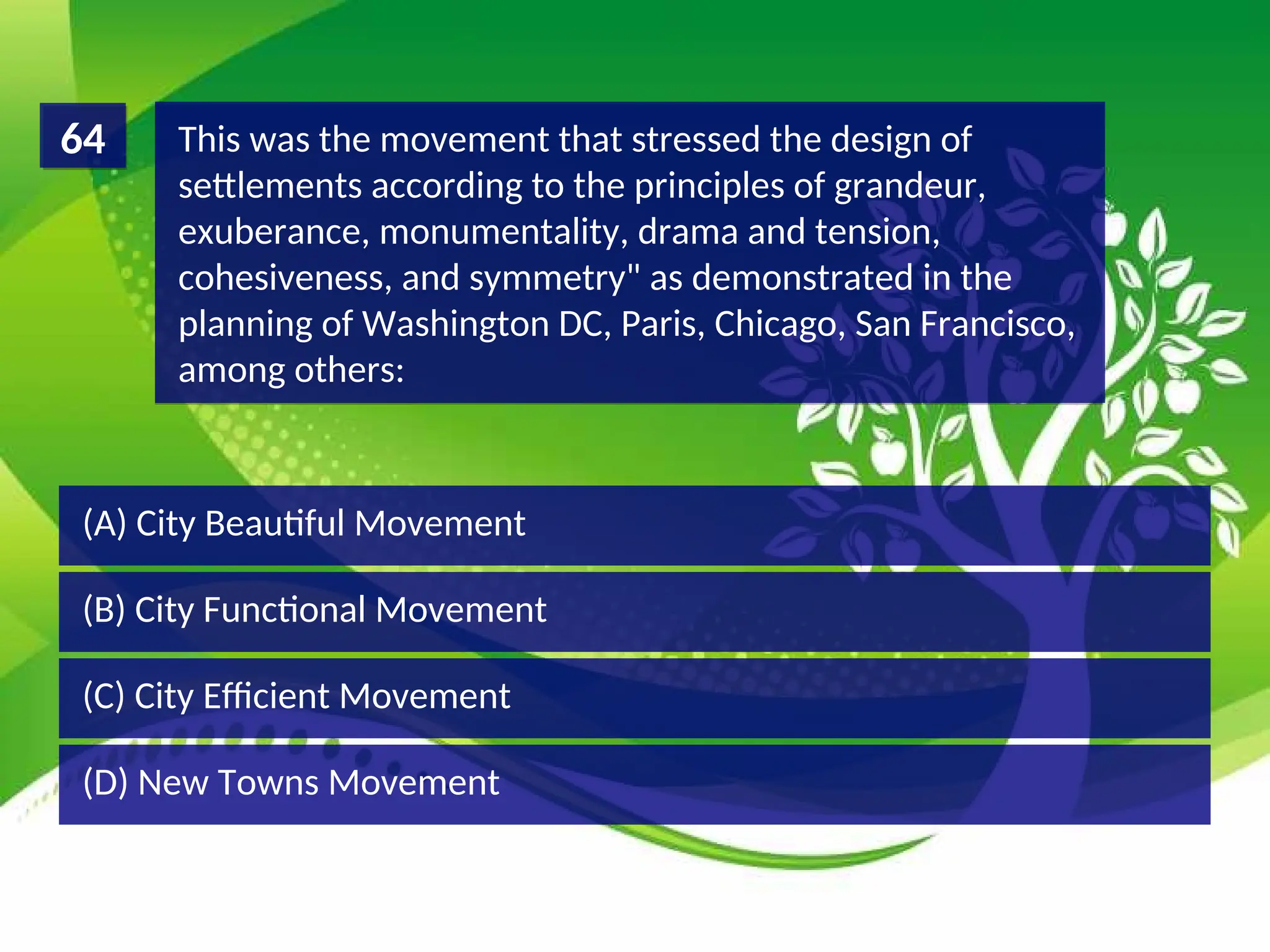
This was the movement that stressed the design of
settlements according to the principles of grandeur,
exuberance, monumentality, drama and tension,
cohesiveness, and symmetry" as demonstrated in the
planning of Washington DC, Paris, Chicago, San Francisco,
among others:
64
(D) Regional City Movement
(C) City Efficient Movement
(B) City Functional Movement
(A) City Beautiful Movement
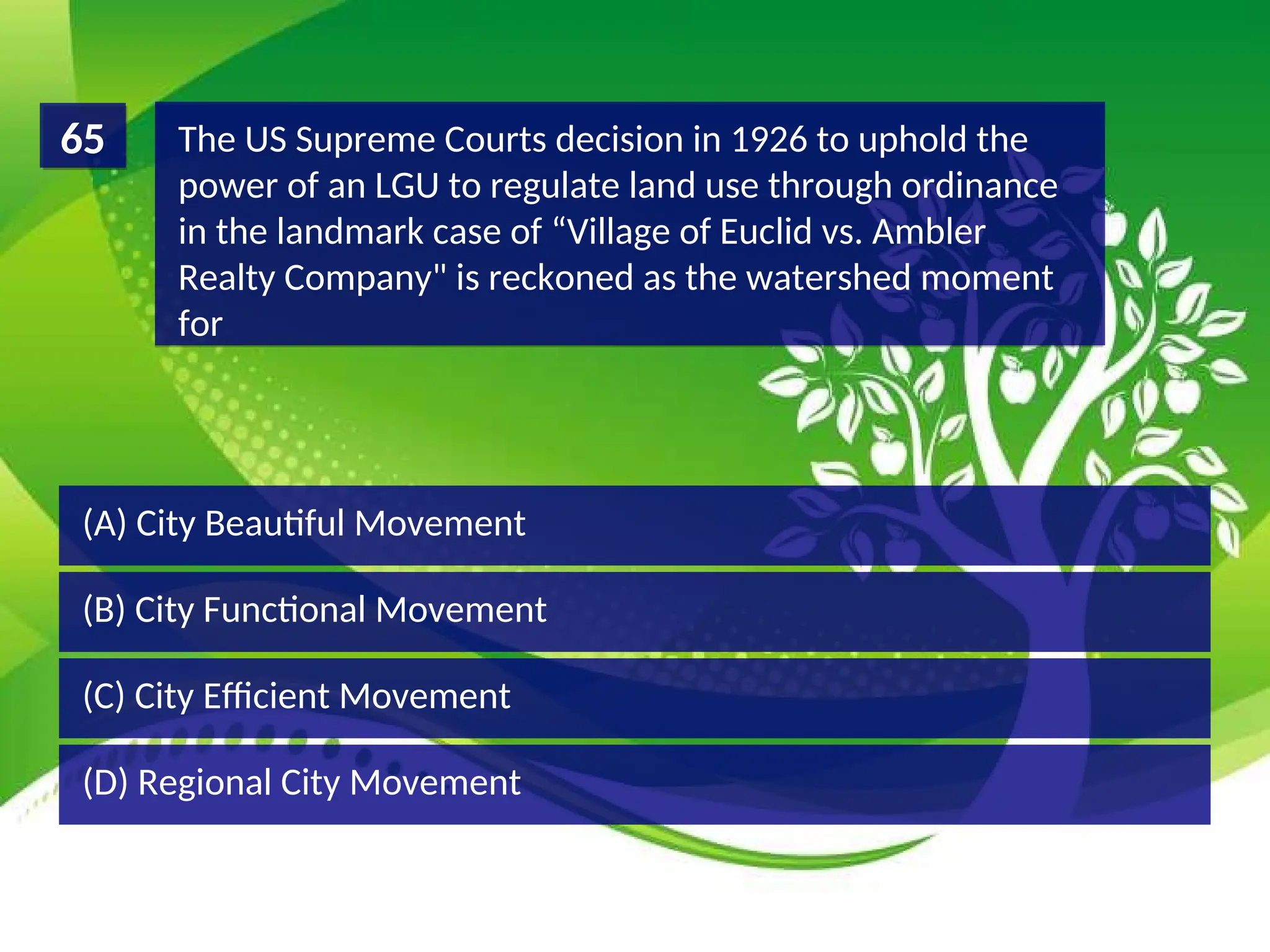
The US Supreme Courts decision in 1926 to uphold the
power of an LGU to regulate land use through ordinance
in the landmark case of “Village of Euclid vs. Ambler
Realty Company" is reckoned as the watershed moment
for
65
(D) Oscar Niemeyer
(C) Lucio Costa
(B) lldefons Cerda
( A) Camilo Sitte
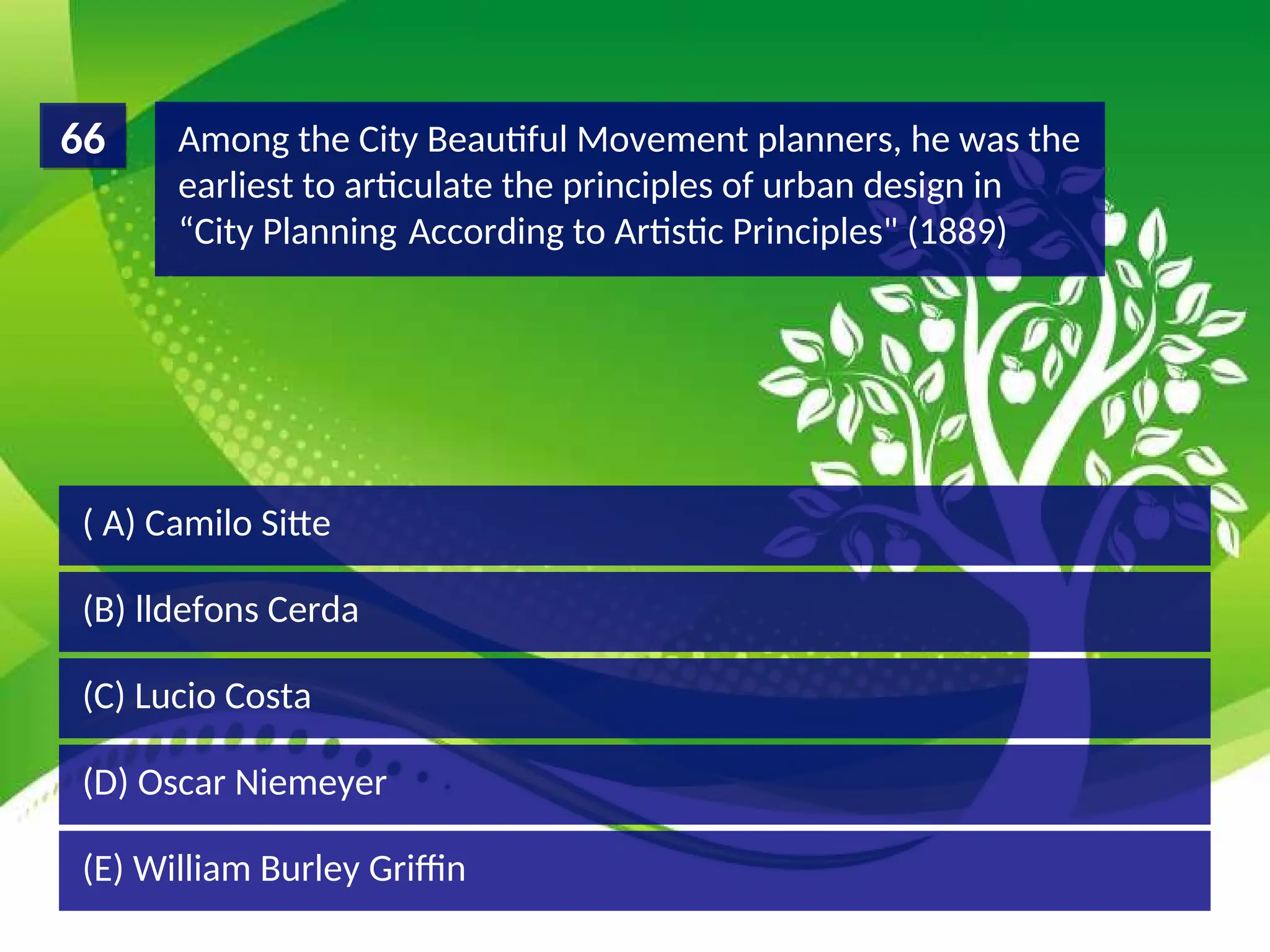
Among the City Beautiful Movement planners, he was the
earliest to articulate the principles of urban design in
“City Planning According to Artistic Principles" (1889)
66
(E) William Burley Griffin
(D) Thomas Sharp
(C) Aldo Rossi
(B) Le Corbusier
(A) Gordon Cullen
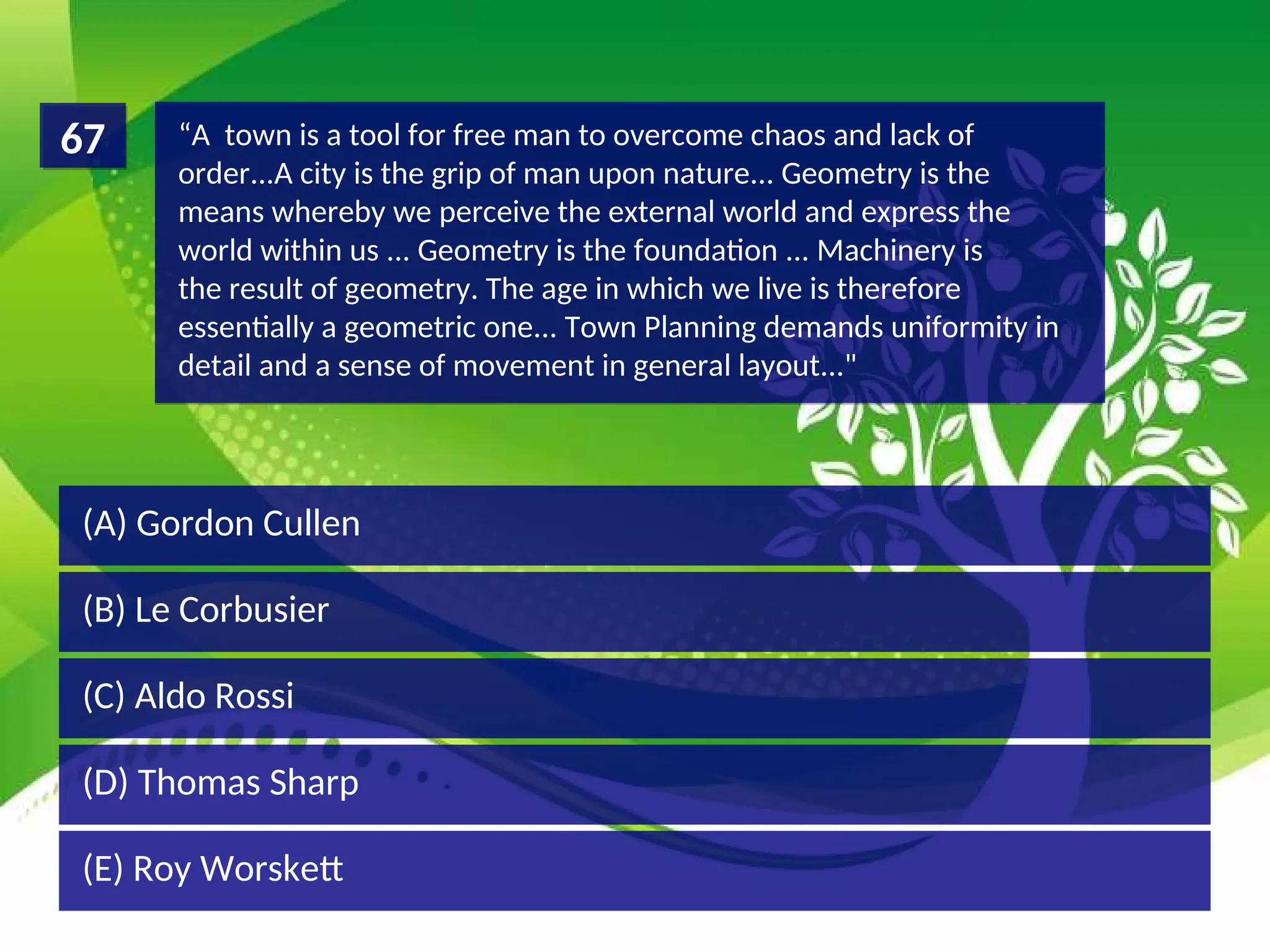
“A town is a tool for free man to overcome chaos and lack of
order...A city is the grip of man upon nature... Geometry is the
means whereby we perceive the external world and express the
world within us ... Geometry is the foundation ... Machinery is
the result of geometry. The age in which we live is therefore
essentially a geometric one... Town Planning demands uniformity in
detail and a sense of movement in general layout..."
67
(E) Roy Worskett
(D) capture the retail market which justifies why prices are necessarily
high in central locations or CBDs
(C) increase the public’s enjoyment of environmental amenities and
viewscapes from varying heights
(B) increase city density by building high on a small part of land
(A) use high-rise structures to improve safety of people and security of
vital institutions
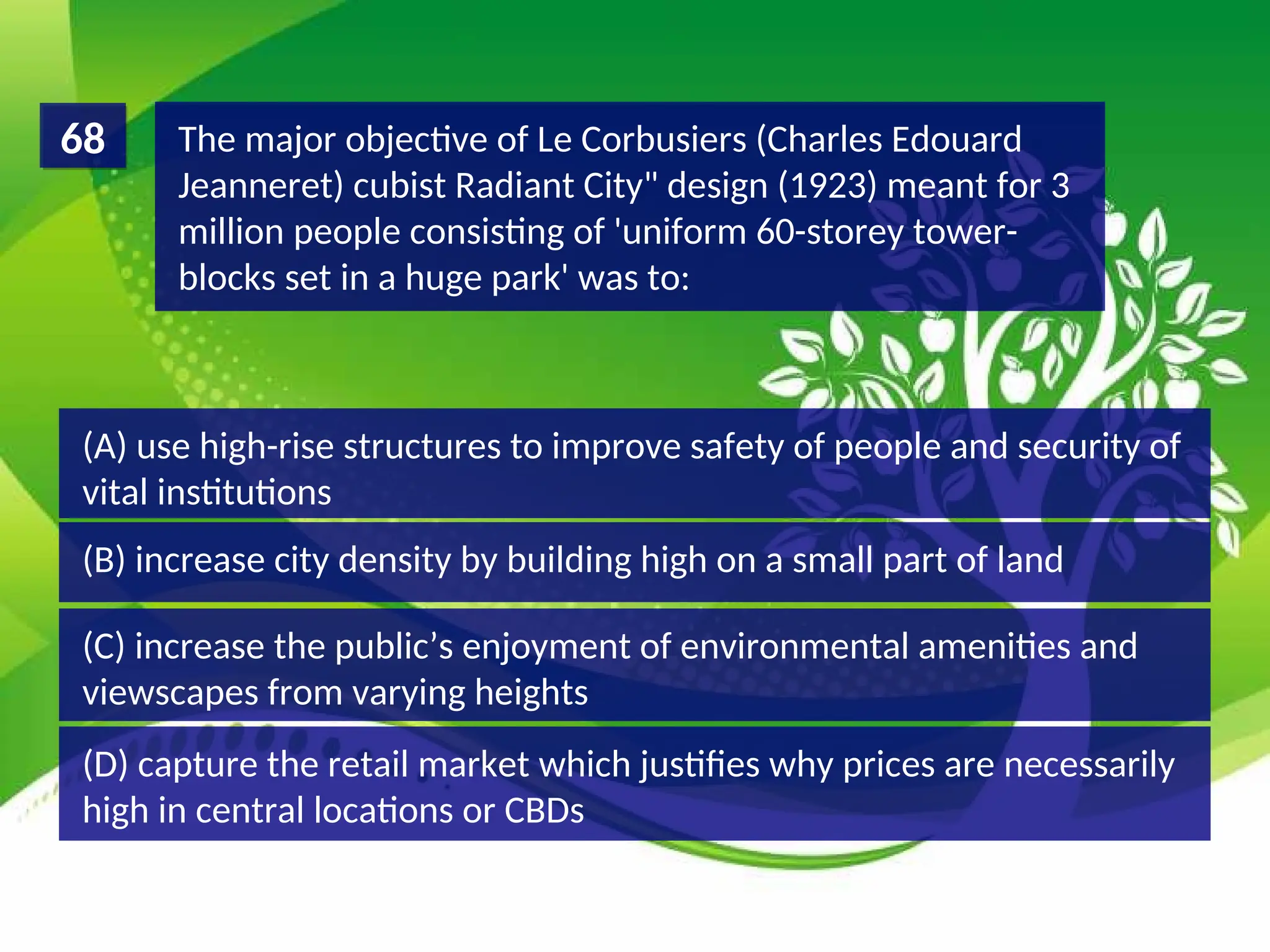
The major objective of Le Corbusiers (Charles Edouard
Jeanneret) cubist Radiant City" design (1923) meant for 3
million people consisting of 'uniform 60-storey tower-
blocks set in a huge park' was to:
68
(D) Rejection of historic precedents as inspiration for overall design
(C) Goal to decongest the city by increasing congestion at its core.
(B) Devoid of thorough studies on demographic, social, economic, and
transport aspects
(A) Architectural determinism or the belief that physical design and
visual aesthetics are sufficient to address the basic problems of
population.
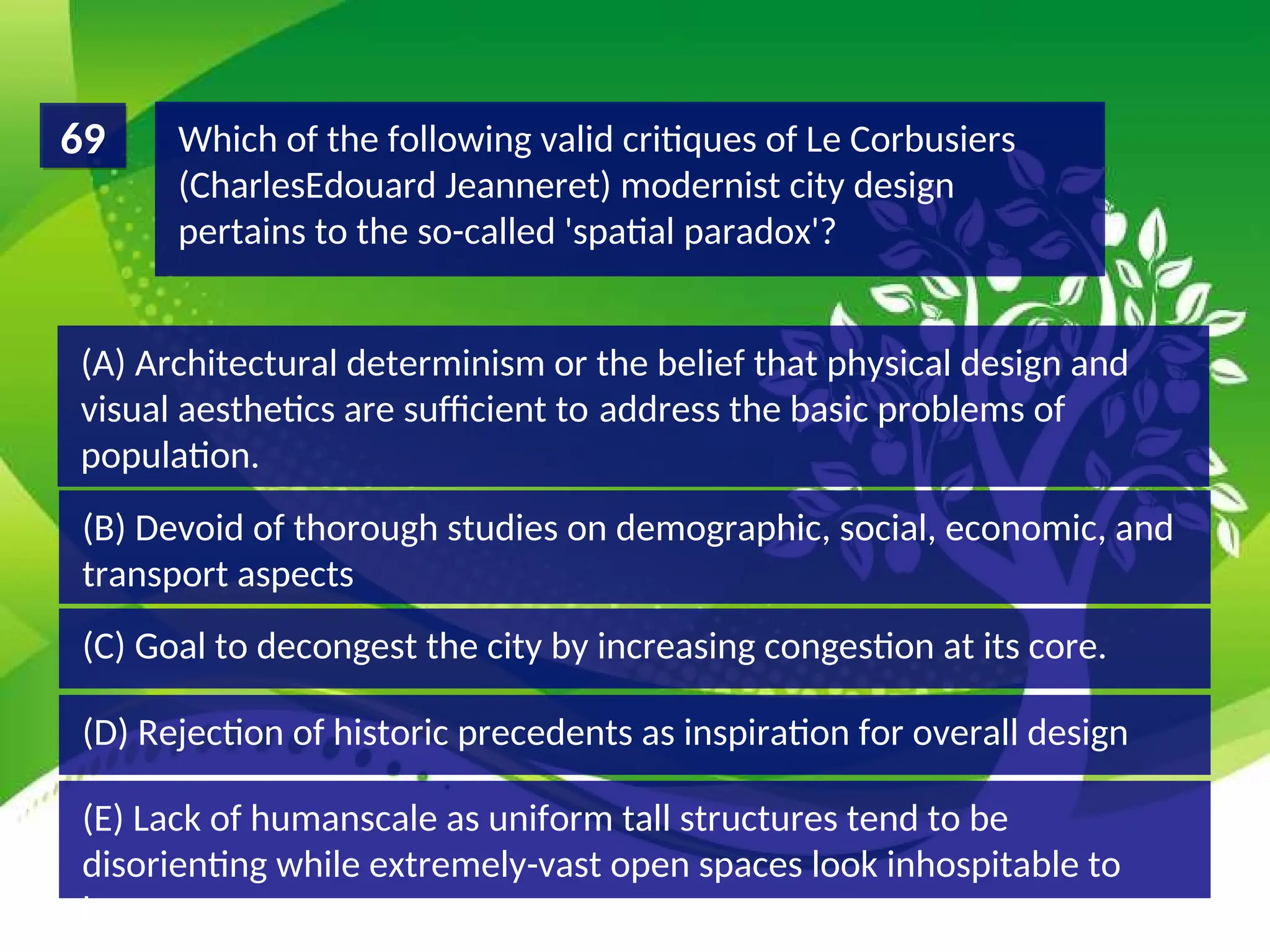
Which of the following valid critiques of Le Corbusiers
(CharlesEdouard Jeanneret) modernist city design
pertains to the so-called 'spatial paradox'?
69
(E) Lack of humanscale as uniform tall structures tend to be
disorienting while extremely-vast open spaces look inhospitable to
humans
(D) Ciudad Larga
(C) Ciudad Lineal
(B) Ciudad Elongada
(A) Ciudad Conectada
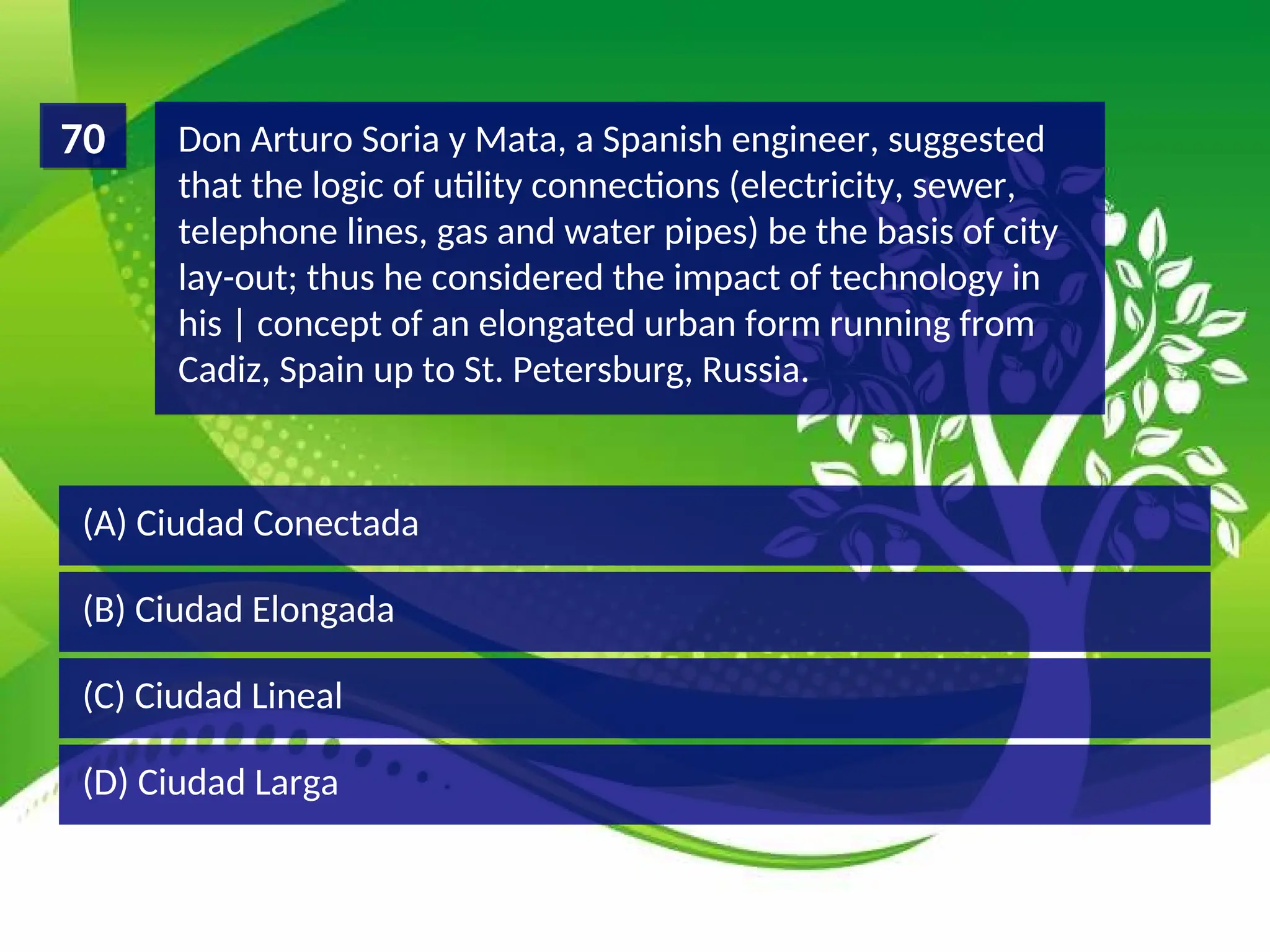
Don Arturo Soria y Mata, a Spanish engineer, suggested
that the logic of utility connections (electricity, sewer,
telephone lines, gas and water pipes) be the basis of city
lay-out; thus he considered the impact of technology in
his | concept of an elongated urban form running from
Cadiz, Spain up to St. Petersburg, Russia.
70
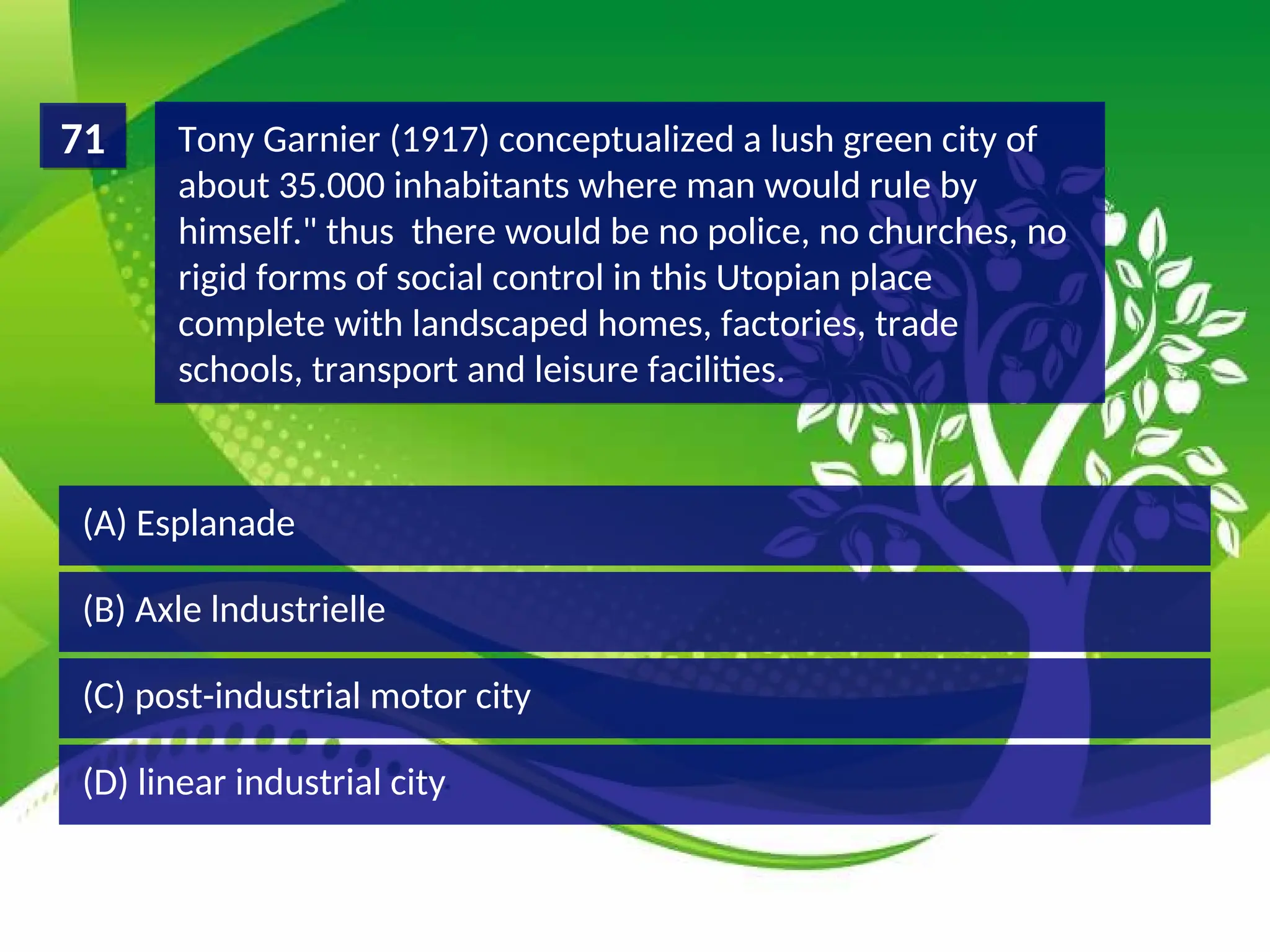
(D) linear industrial city
(C) post-industrial motor city
(B) Axle lndustrielle
(A) Esplanade
Tony Garnier (1917) conceptualized a lush green city of
about 35.000 inhabitants where man would rule by
himself." thus there would be no police, no churches, no
rigid forms of social control in this Utopian place
complete with landscaped homes, factories, trade
schools, transport and leisure facilities.
71
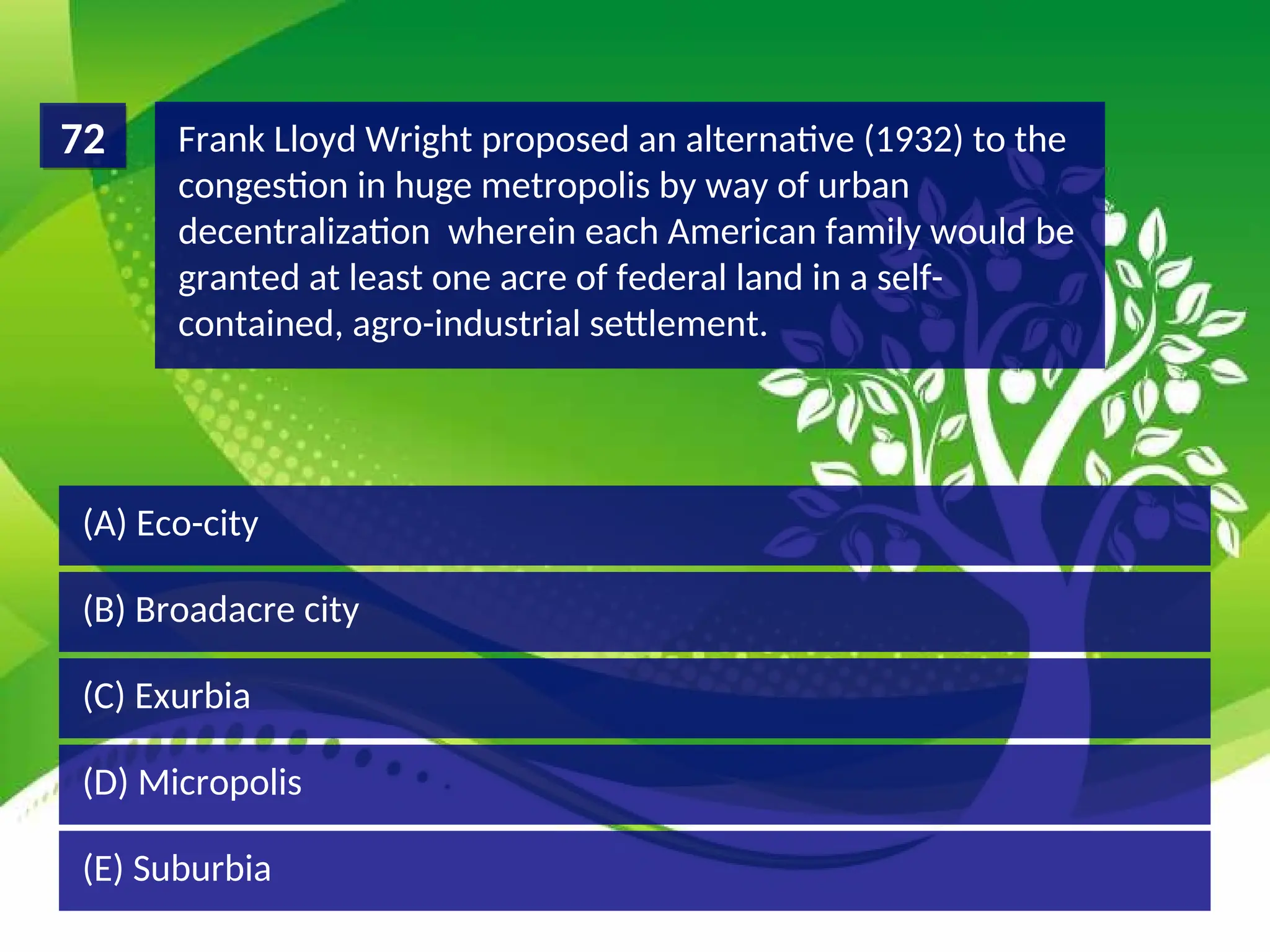
(D) Micropolis
(C) Exurbia
(B) Broadacre city
(A) Eco-city
Frank Lloyd Wright proposed an alternative (1932) to the
congestion in huge metropolis by way of urban
decentralization wherein each American family would be
granted at least one acre of federal land in a self-
contained, agro-industrial settlement.
72
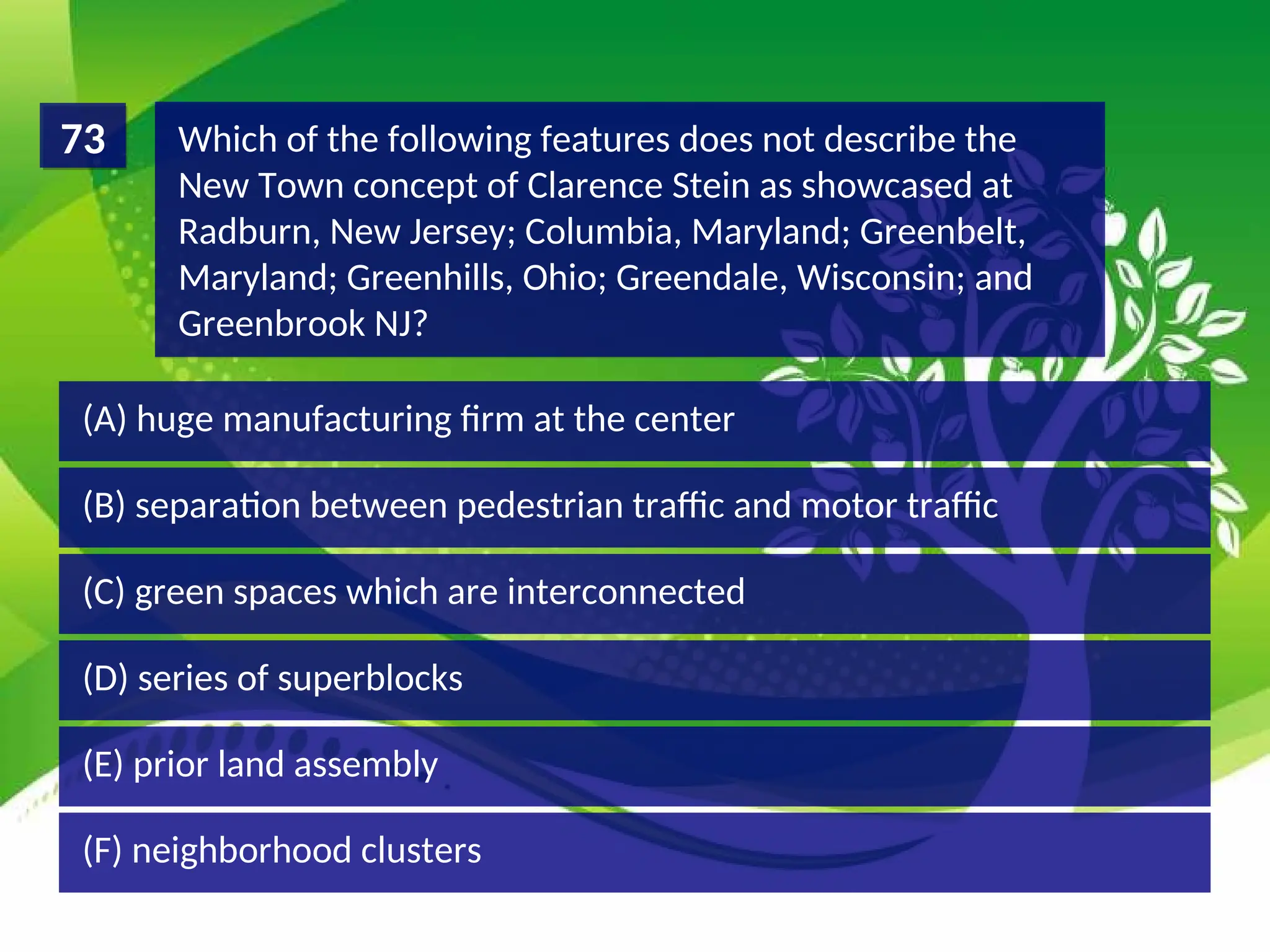
(E) Suburbia
(D) series of superblocks
(C) green spaces which are interconnected
(B) separation between pedestrian traffic and motor traffic
(A) huge manufacturing firm at the center
Which of the following features does not describe the
New Town concept of Clarence Stein as showcased at
Radburn, New Jersey; Columbia, Maryland; Greenbelt,
Maryland; Greenhills, Ohio; Greendale, Wisconsin; and
Greenbrook NJ?
73
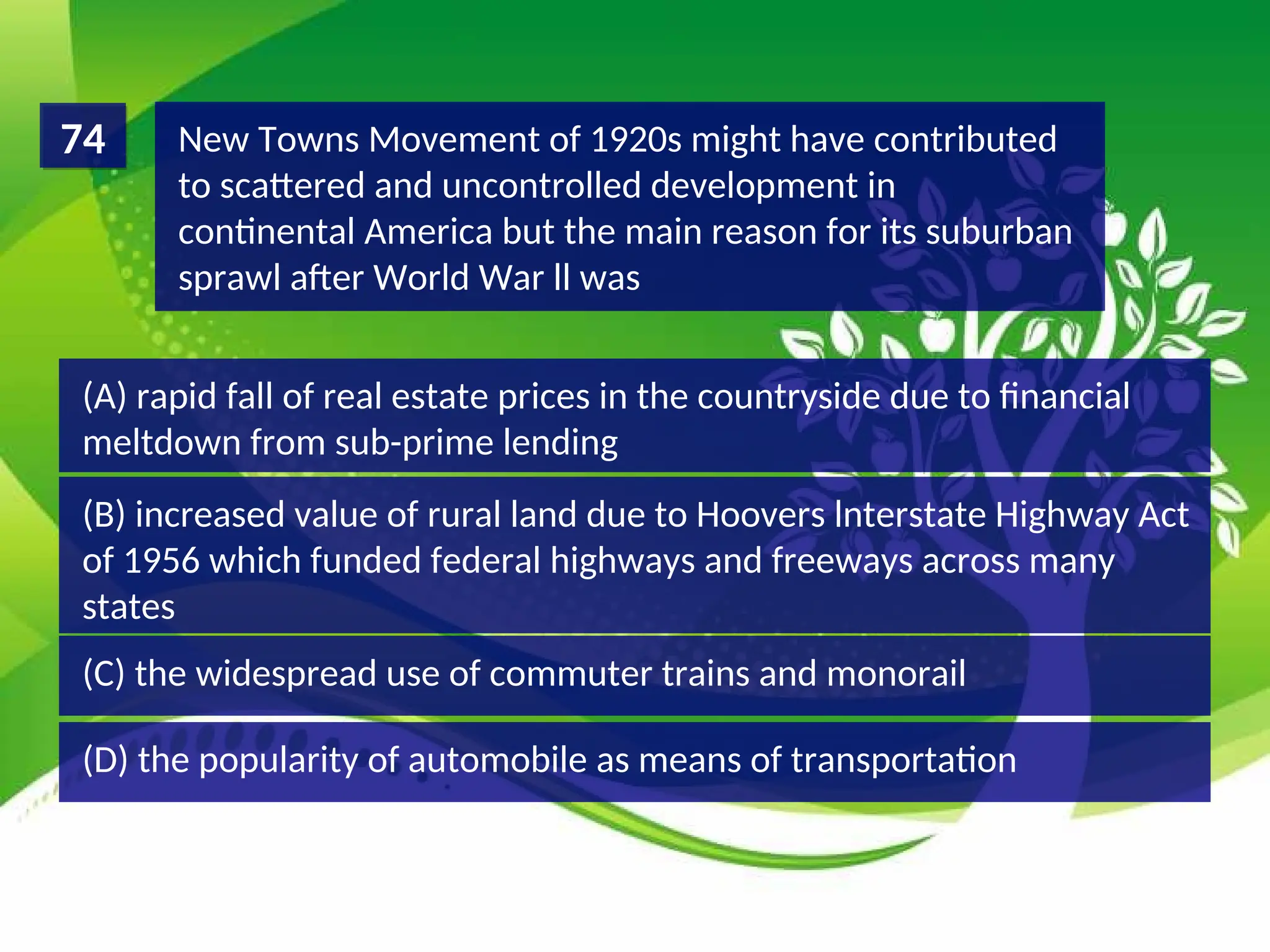
(F) neighborhood clusters
(E) prior land assembly
(D) the popularity of automobile as means of transportation
(C) the widespread use of commuter trains and monorail
(B) increased value of rural land due to Hoovers lnterstate Highway Act
of 1956 which funded federal highways and freeways across many
states
(A) rapid fall of real estate prices in the countryside due to financial
meltdown from sub-prime lending
New Towns Movement of 1920s might have contributed
to scattered and uncontrolled development in
continental America but the main reason for its suburban
sprawl after World War ll was
74
(D) Pericles
(C) Geddes
(B) Herodotus
(A) Demogriphus
The planner who said that survey is a requisite for
planning in the famous framework Survey-Analysis Plan
was
75
(D) Clarence McKay
(C) Clarence Thomas
(B) Clarence Stein
(A) Clarence Perry
He proposed the neighborhood unit (1929) as a self-
contained 'garden suburb' bounded by major streets,
with shops at intersections and a school in the middle;
its size would be defined by schools catchment area with
a radius of quarter mile or 402 meters. This incorporated
Garden City ideas and attempted at some kind of sociai
engineering.
76
(D) changing values, mindsets, habits, and behaviors of people towards
desired societal goals
(C) implementing service-oriented social programs to marginalized
social sectors
(B) manipulating age, sex, ethnicity, and other demographic factors of
social groups
(A) designing and building social facilities and infrastructure for the
public
'Social Engineering' refers to
77
(D) Barry Parker
(C) Lewis Mumford
(B) Sir Patrick Geddes
(A) Sir Patrick Leslie Abercrombie
A Scottish biologist who authored the masterpiece
entitled “Cities in Evolution” (1915) and who coined the
terms 'folk-work-place,' 'city-region' and 'conurbation' is
acknowledged as the 'father of regional planning'
78
(D) Charles Abrams
(C) Lewis Mumford
(B) Sir Patrick Geddes
(A) Sir Patrick Leslie Abercrombie
He led the crafting of the regional Greater London Plan of
1944, he designed some of 30 post-war New Towns
approved by the British Pariament, including Doncaster
area and East Kent, in which he used open space as
structuring element
79
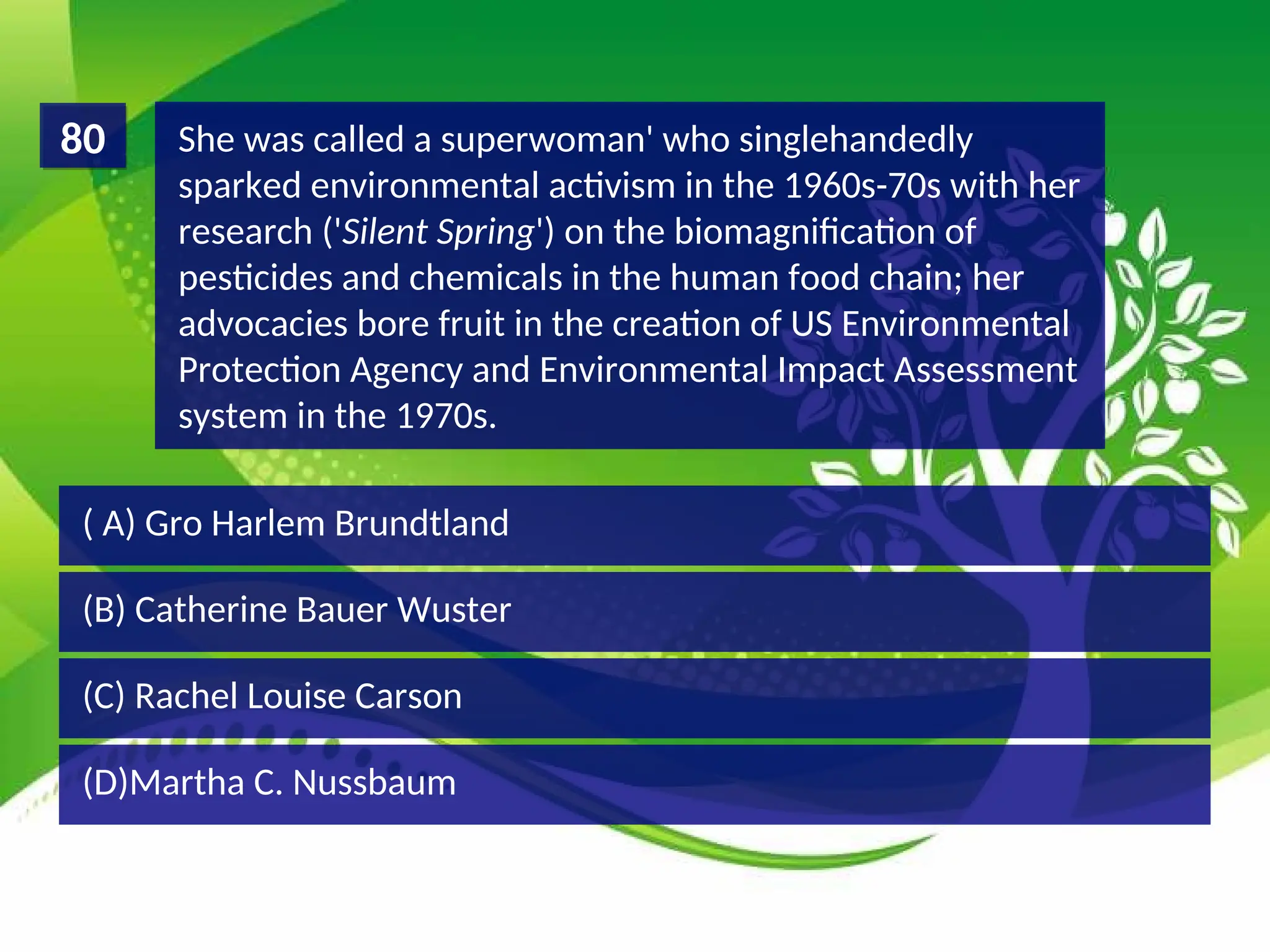
(D)Martha C. Nussbaum
(C) Rachel Louise Carson
(B) Catherine Bauer Wuster
( A) Gro Harlem Brundtland
She was called a superwoman' who singlehandedly
sparked environmental activism in the 1960s-70s with her
research ('Silent Spring') on the biomagnification of
pesticides and chemicals in the human food chain; her
advocacies bore fruit in the creation of US Environmental
Protection Agency and Environmental Impact Assessment
system in the 1970s.
80
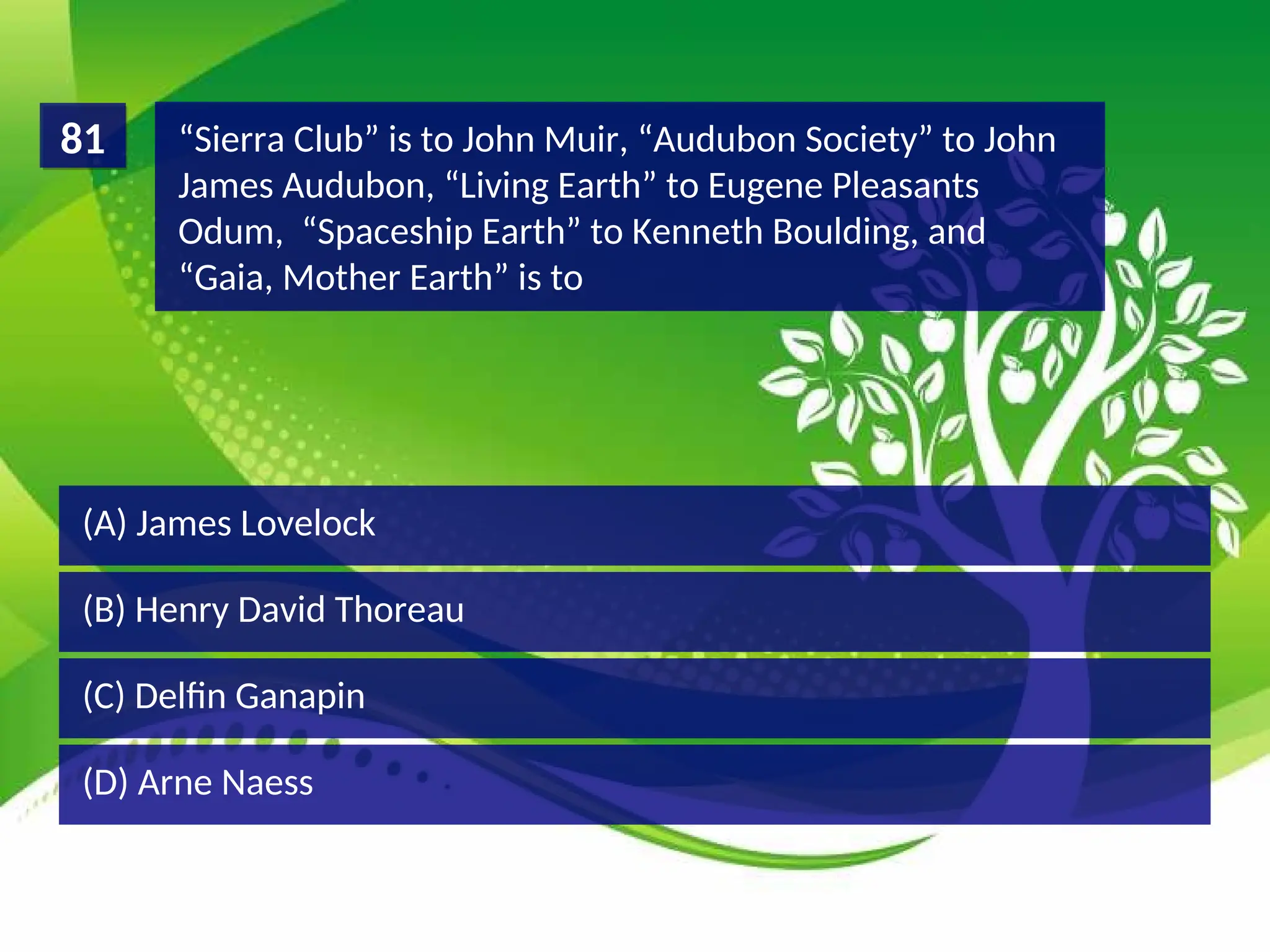
(D) Arne Naess
(C) Delfin Ganapin
(B) Henry David Thoreau
(A) James Lovelock
“Sierra Club” is to John Muir, “Audubon Society” to John
James Audubon, “Living Earth” to Eugene Pleasants
Odum, “Spaceship Earth” to Kenneth Boulding, and
“Gaia, Mother Earth” is to
81
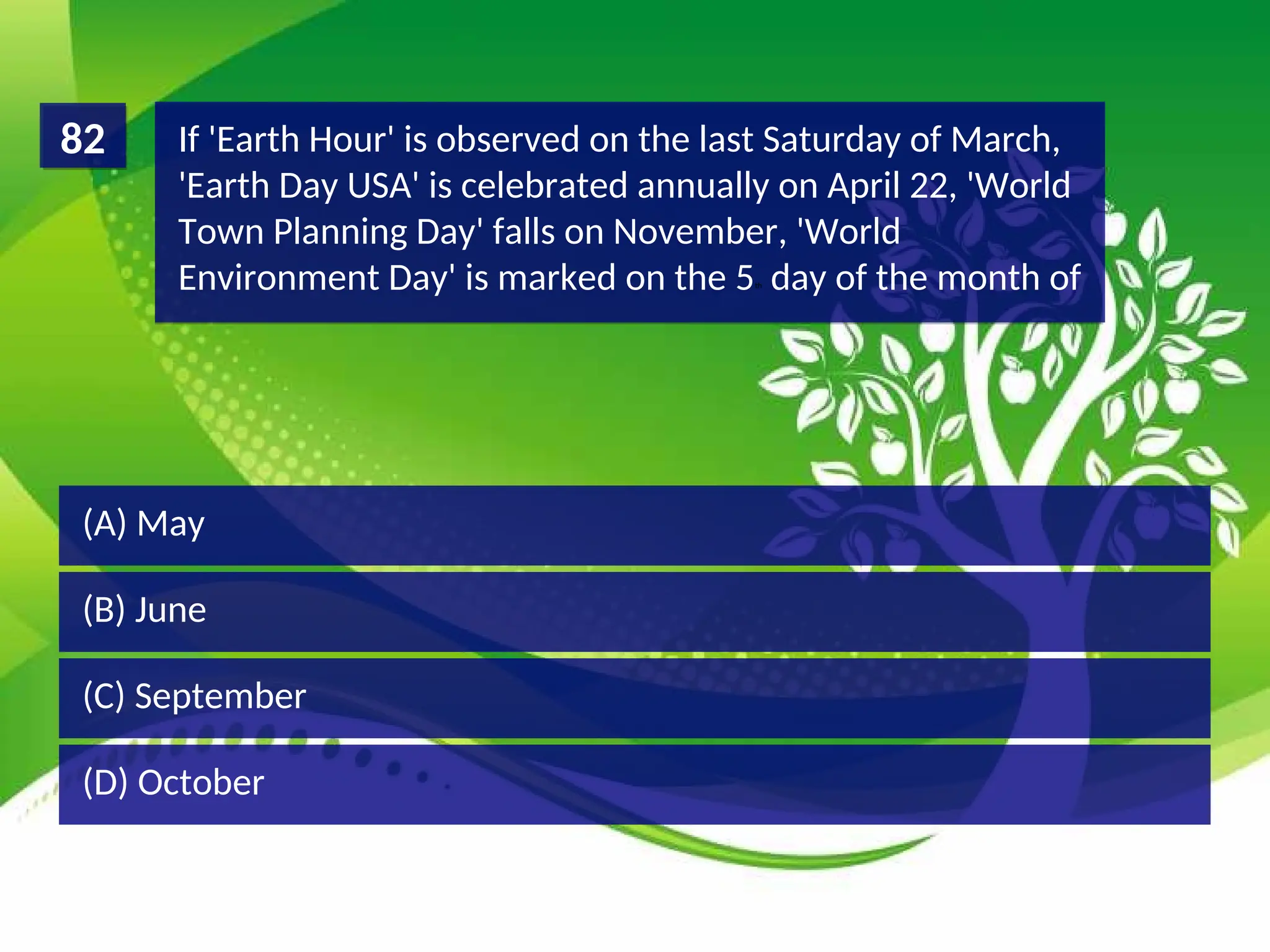
(D) October
(C) September
(B) June
(A) May
If 'Earth Hour' is observed on the last Saturday of March,
'Earth Day USA' is celebrated annually on April 22, 'World
Town Planning Day' falls on November, 'World
Environment Day' is marked on the 5th day of the month of
82
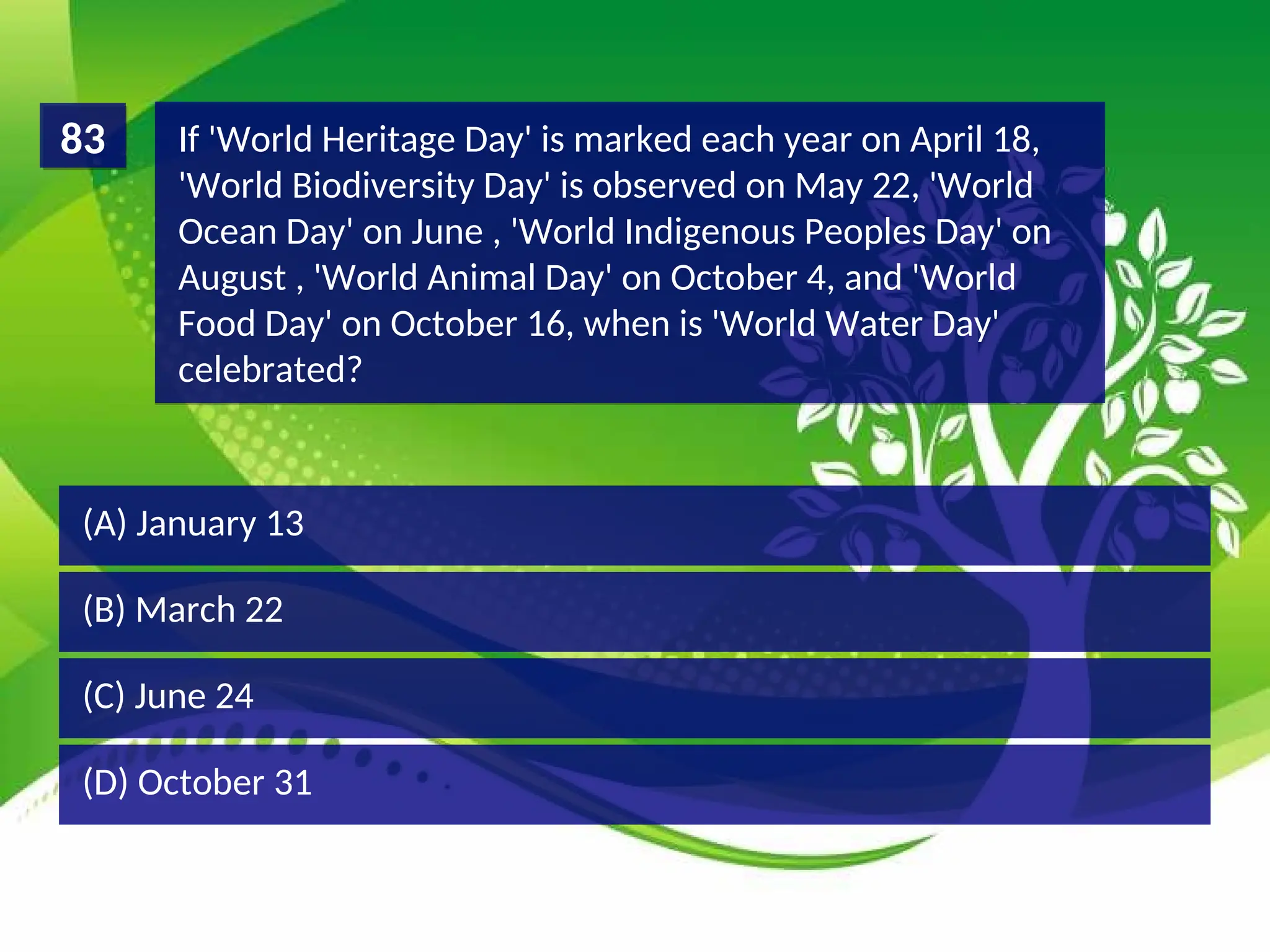
(D) October 31
(C) June 24
(B) March 22
(A) January 13
If 'World Heritage Day' is marked each year on April 18,
'World Biodiversity Day' is observed on May 22, 'World
Ocean Day' on June , 'World Indigenous Peoples Day' on
August , 'World Animal Day' on October 4, and 'World
Food Day' on October 16, when is 'World Water Day'
celebrated?
83
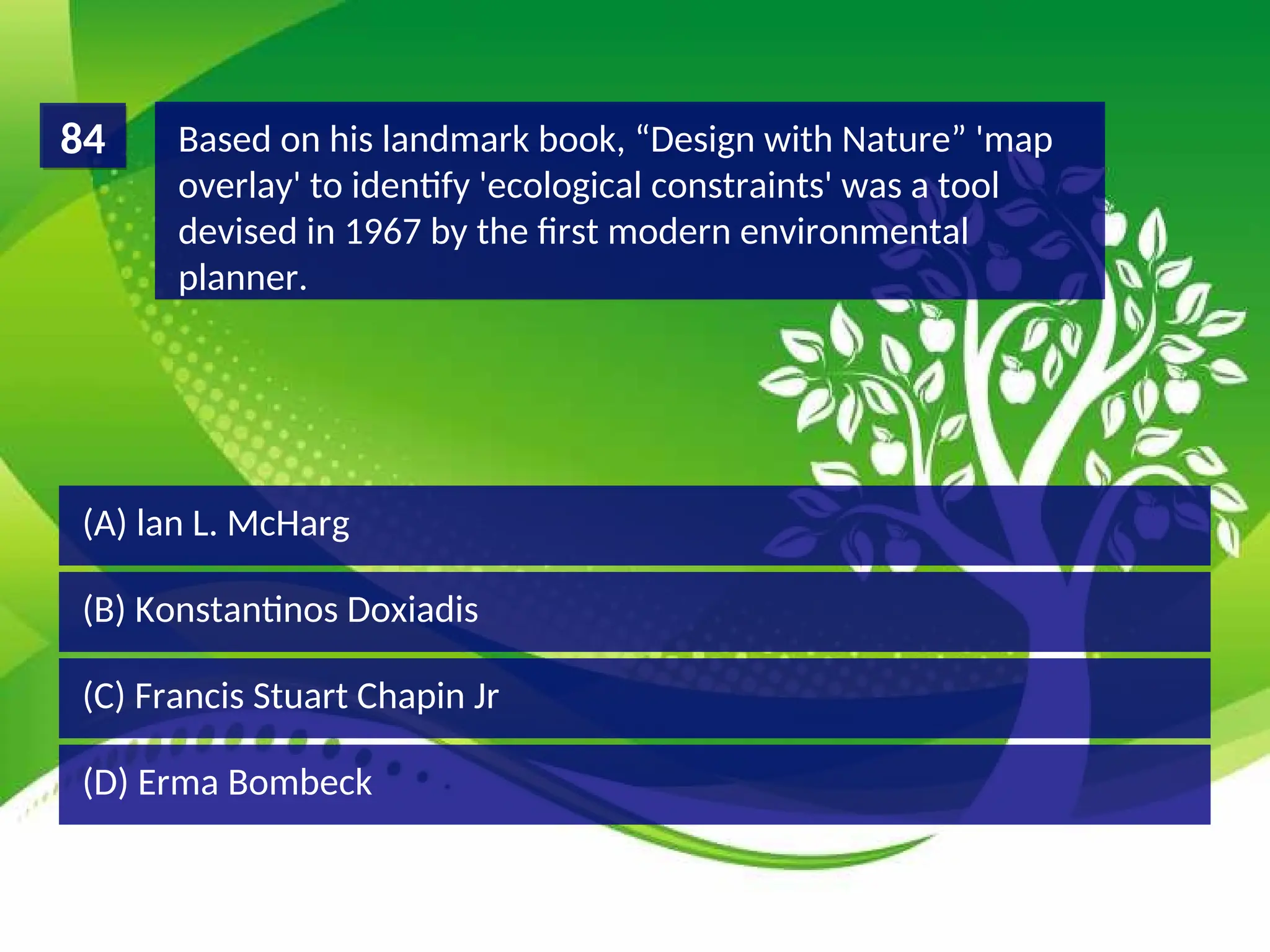
(D) Erma Bombeck
(C) Francis Stuart Chapin Jr
(B) Konstantinos Doxiadis
(A) lan L. McHarg
Based on his landmark book, “Design with Nature” 'map
overlay' to identify 'ecological constraints' was a tool
devised in 1967 by the first modern environmental
planner.
84
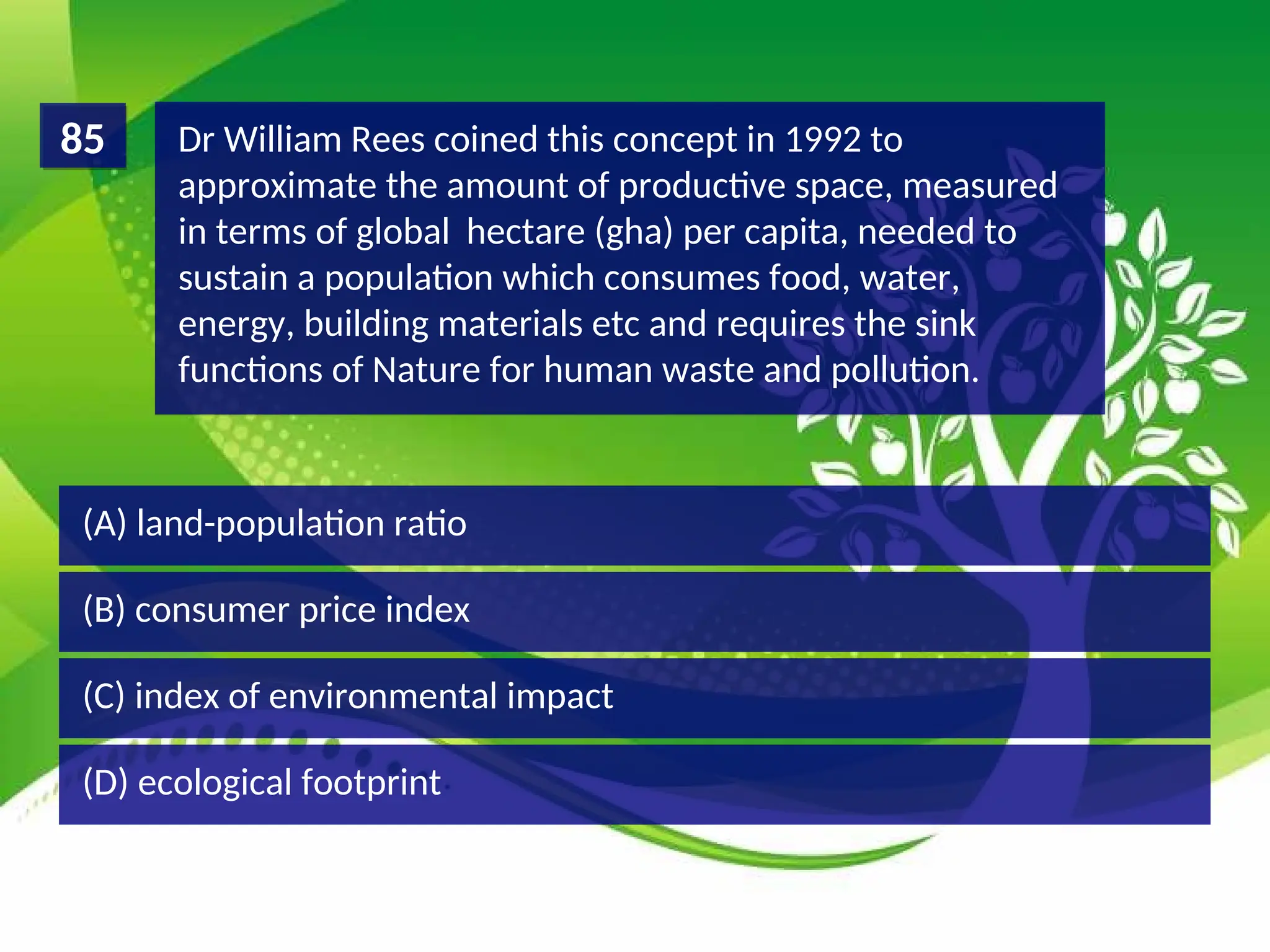
(D) ecological footprint
(C) index of environmental impact
(B) consumer price index
(A) land-population ratio
Dr William Rees coined this concept in 1992 to
approximate the amount of productive space, measured
in terms of global hectare (gha) per capita, needed to
sustain a population which consumes food, water,
energy, building materials etc and requires the sink
functions of Nature for human waste and pollution.
85
(D) Aldo Leopold
(C) Henry Wright
(B) Ralph Waldo Emerson
(A) Karol Wojtyla or 'John Paul II'
Considered as the father of wildlife ecology, he
advocated in 1948 a “personal land ethic” for humans to
become 'stewards of the land' and member-citizens of
land-community rather than its conquerors or
dominators.
86
(D) urban renewal
(C) infill and densification
(B) urban restructuring
(A) land readjustment
This started as a US federal program in 1949 which aimed
to rehabilitate the outworn or decaying sections of any
town by extending fund assistance to LGUs to undertake
improvements in streetscapes, parks, greenways,
housing, community centers, etc based on anticipation
that future tax revenues from real estate will pay for
present costs.
87
(D) Robert Moses
(C) Robert Murray Haig
(B) Fiorello La Guardia
(A) William Levitt
As chief planner of New York City, he collaborated with
Thomas Adams in the crafting of the “Regional Plan of
New York and its Environs 1922-1931;” he also conceived,
and executed public works costing $27 billion between
1924 and 1968 and was responsible for virtually every
parkway, expressway, and public housing project in New
York metropolitan area.
88
(E) Warren Buffett
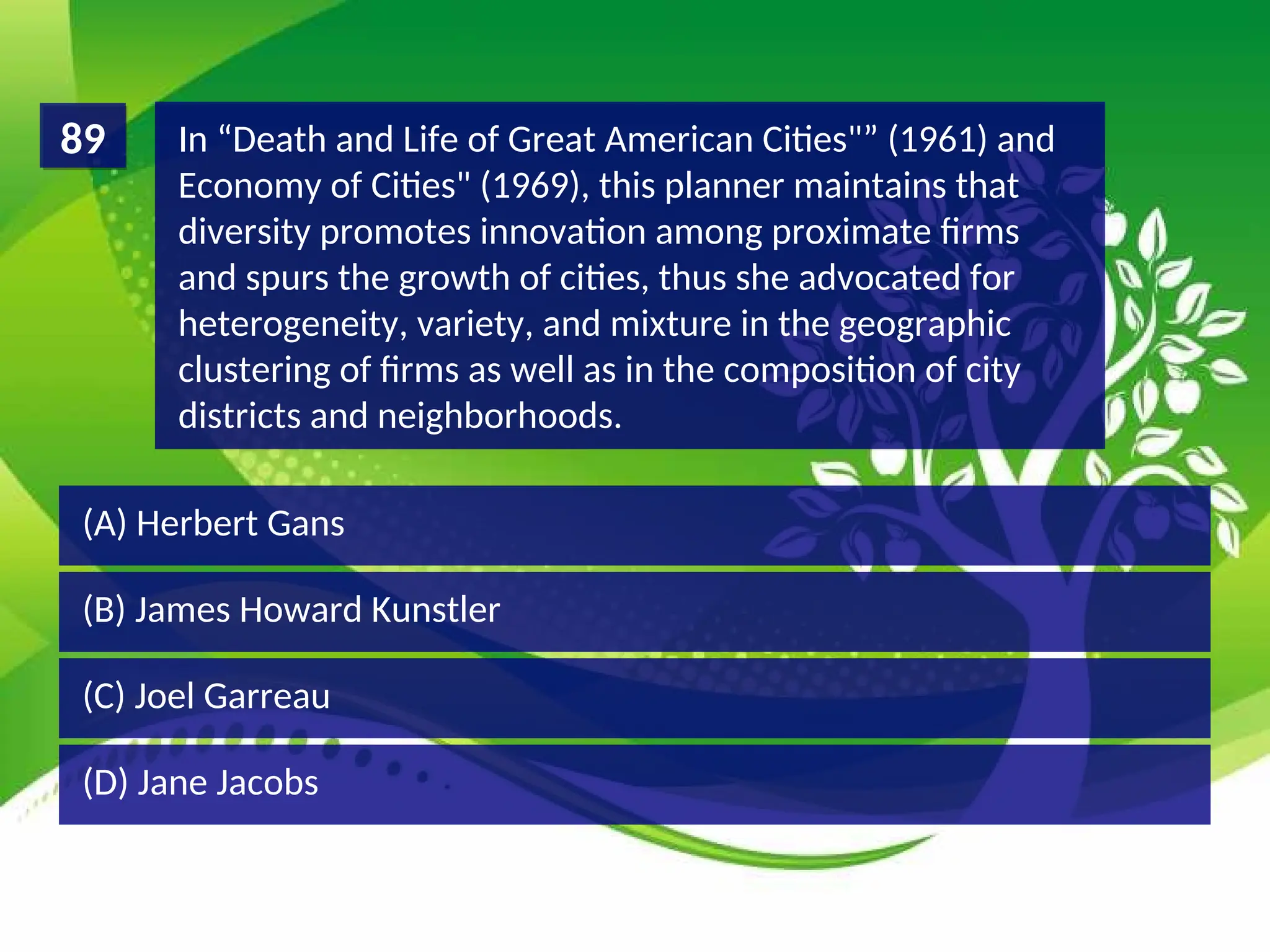
(D) Jane Jacobs
(C) Joel Garreau
(B) James Howard Kunstler
(A) Herbert Gans
In “Death and Life of Great American Cities"” (1961) and
Economy of Cities" (1969), this planner maintains that
diversity promotes innovation among proximate firms
and spurs the growth of cities, thus she advocated for
heterogeneity, variety, and mixture in the geographic
clustering of firms as well as in the composition of city
districts and neighborhoods.
89
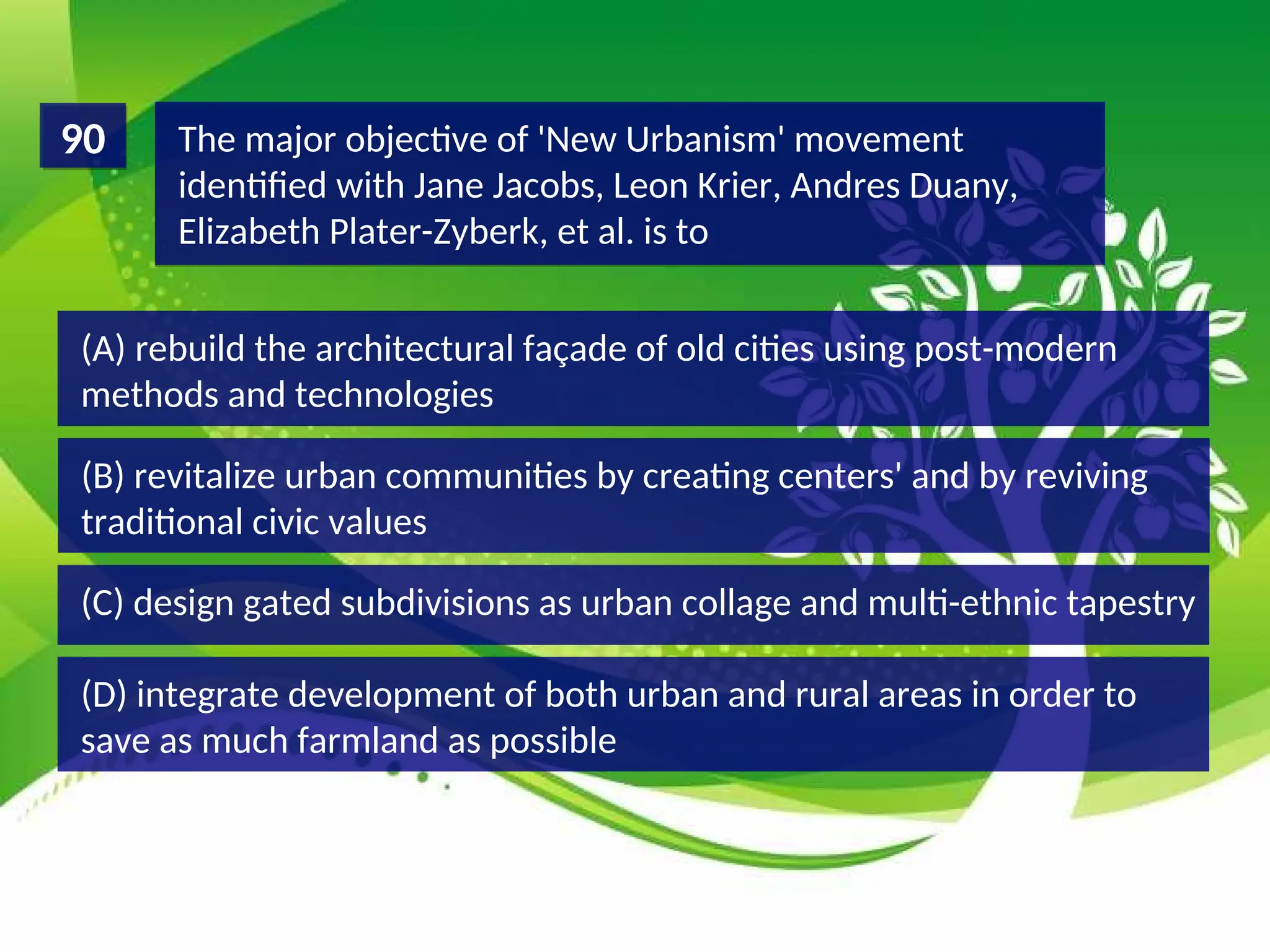
(D) integrate development of both urban and rural areas in order to
save as much farmland as possible
(C) design gated subdivisions as urban collage and multi-ethnic tapestry
(B) revitalize urban communities by creating centers' and by reviving
traditional civic values
(A) rebuild the architectural façade of old cities using post-modern
methods and technologies
The major objective of 'New Urbanism' movement
identified with Jane Jacobs, Leon Krier, Andres Duany,
Elizabeth Plater-Zyberk, et al. is to
90
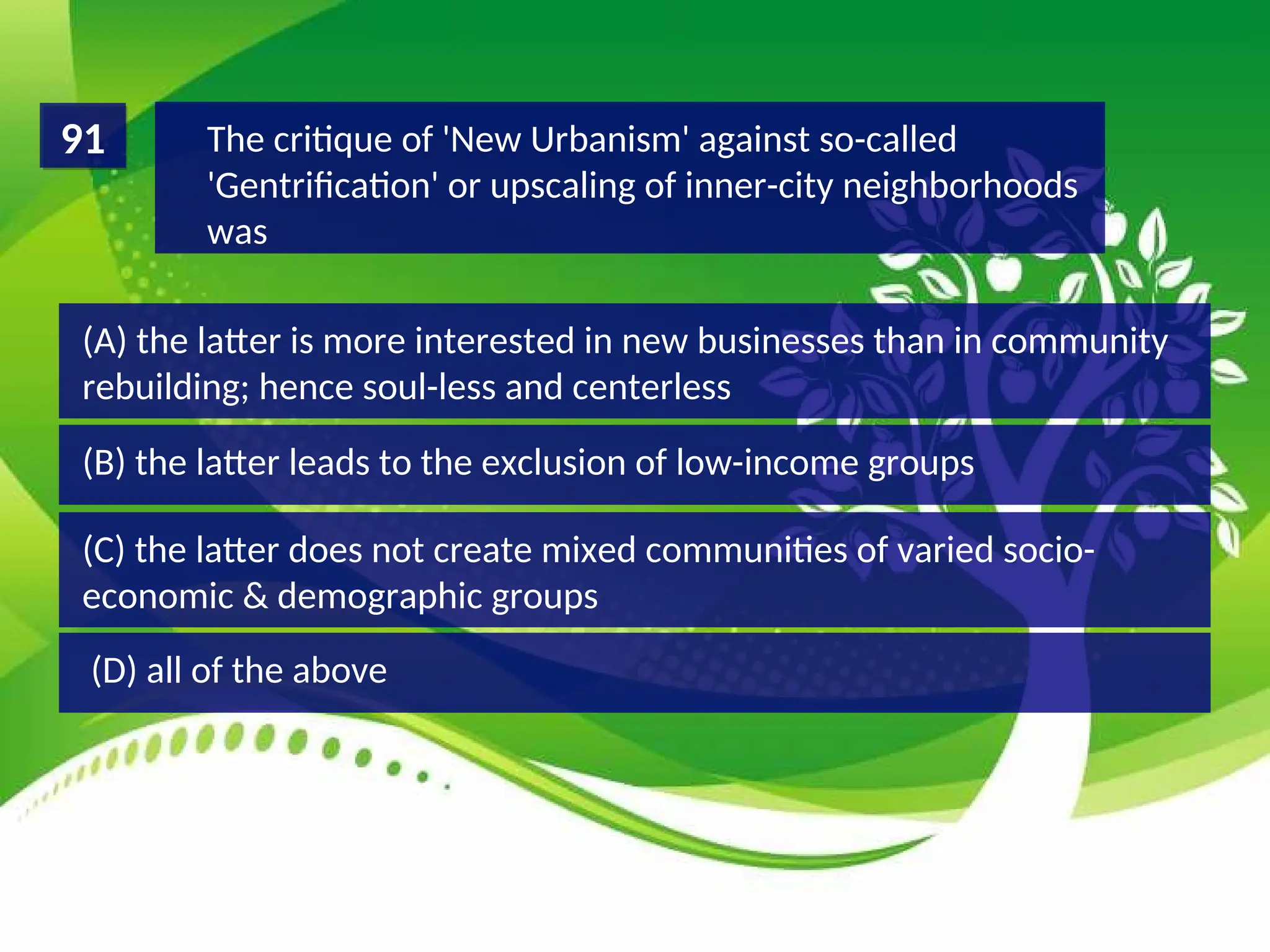
(D) all of the above
(C) the latter does not create mixed communities of varied socio-
economic & demographic groups
(B) the latter leads to the exclusion of low-income groups
(A) the latter is more interested in new businesses than in community
rebuilding; hence soul-less and centerless
The critique of 'New Urbanism' against so-called
'Gentrification' or upscaling of inner-city neighborhoods
was
91
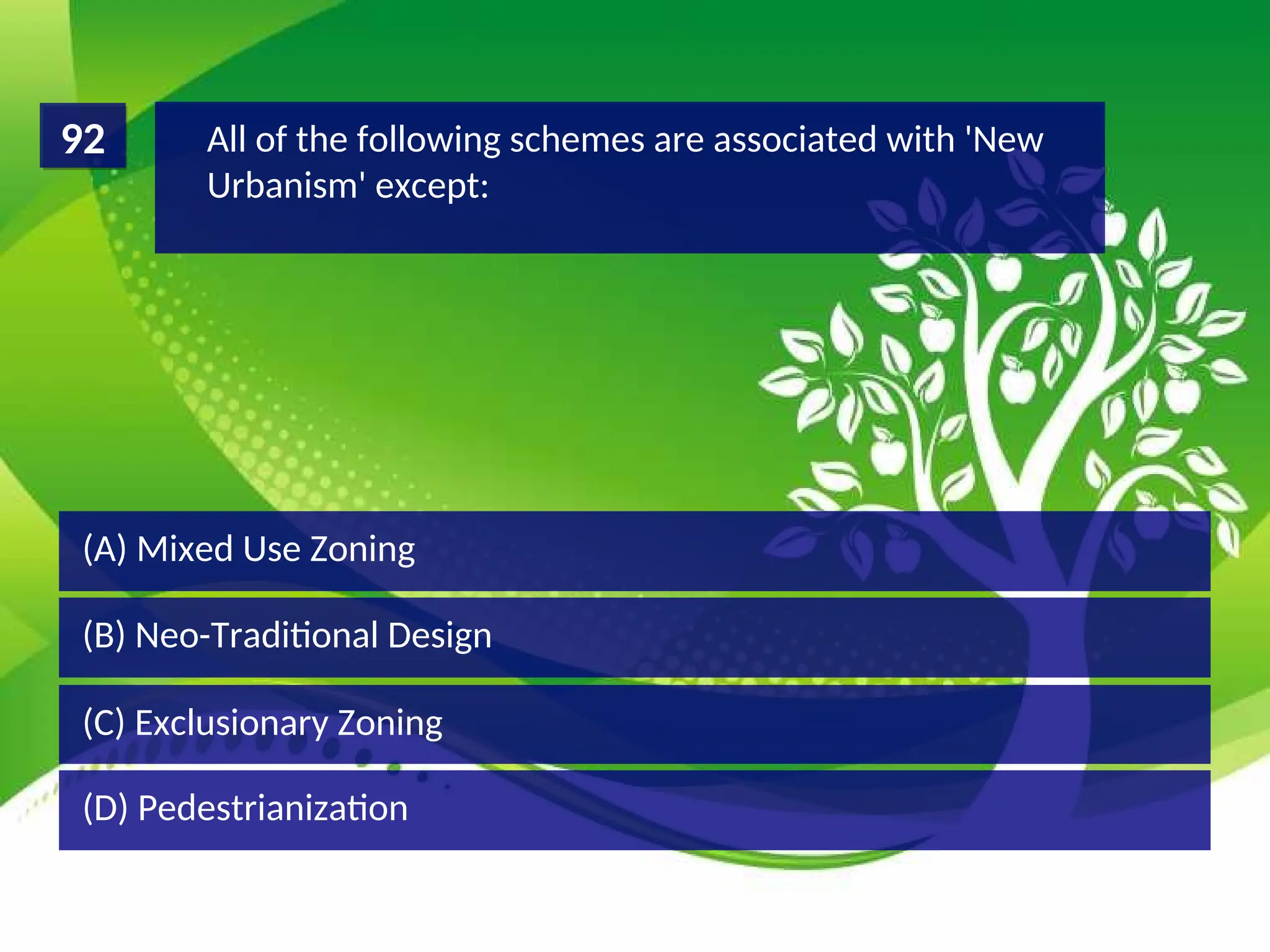
(D) Pedestrianization
(C) Exclusionary Zoning
(B) Neo-Traditional Design
(A) Mixed Use Zoning
All of the following schemes are associated with 'New
Urbanism' except:
92
(D) TJ Kent, Edwin C. Banfield, Albert Z. Guttenberg
(C) Robert Moses, William Levitt, Richard King Mellon
(B) Jane Jacobs, Kevin Lynch, William H. Whyte
(A) David Harvey, Manuel Castells, Ray Pahl
The following planners were most concerned about
“human scale and the social usage of urban space”
93
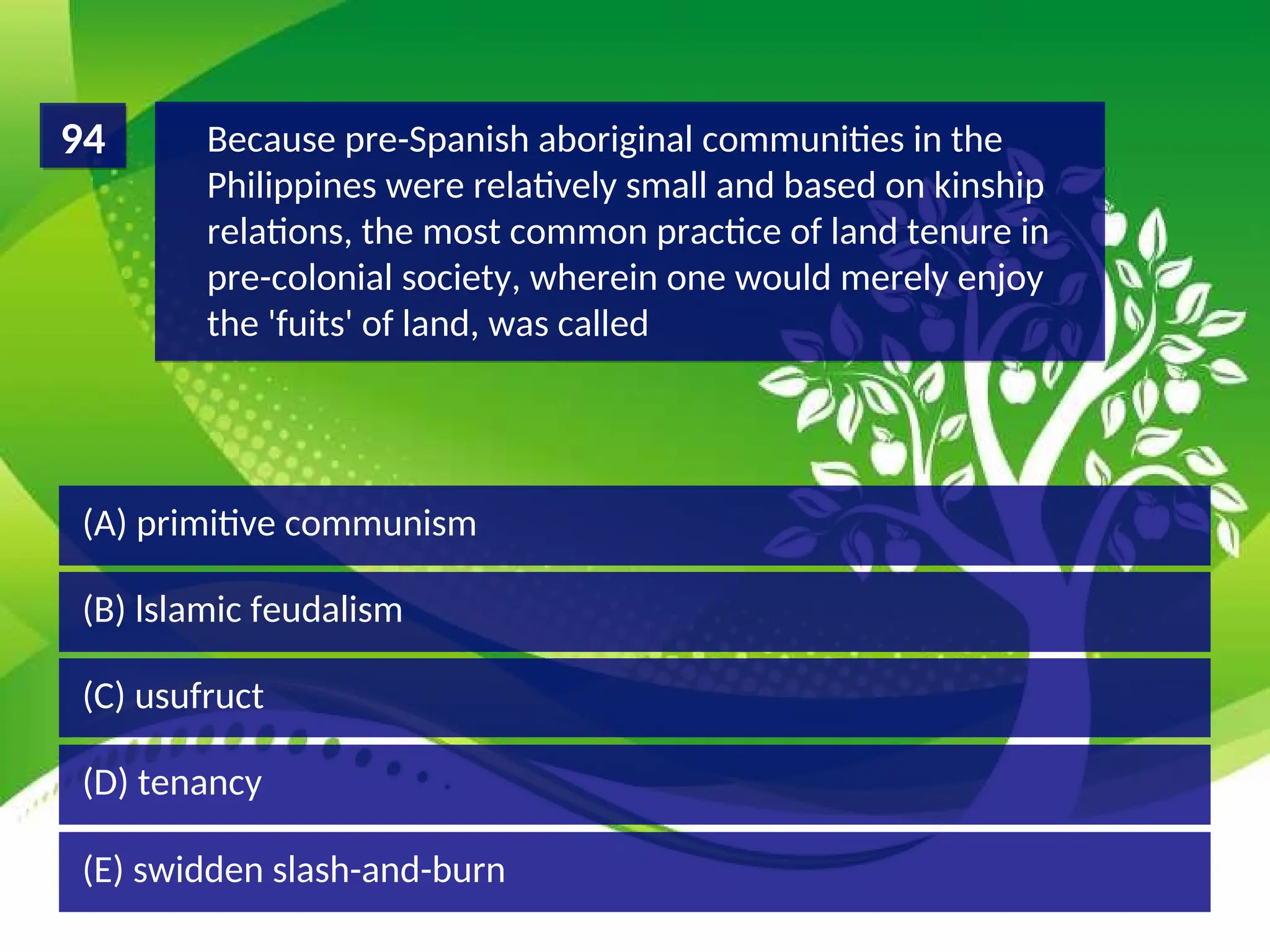
(D) tenancy
(C) usufruct
(B) lslamic feudalism
(A) primitive communism
Because pre-Spanish aboriginal communities in the
Philippines were relatively small and based on kinship
relations, the most common practice of land tenure in
pre-colonial society, wherein one would merely enjoy
the 'fuits' of land, was called
94
(E) swidden slash-and-burn
(D) Evangelizacion
(C) Reduccion
(B) Presidio y Fortaleza
(A) El Alcance del Campanario
This was the Spanish spatial strategy of forming dense
settlements from scattered dwellings for purposes of
greater military defense and political control literally
bringing together dispersed population within hearing
distance of | church bells – which policy was applied on
most Spanish colonies from 16th
to 18th
centuries.
95
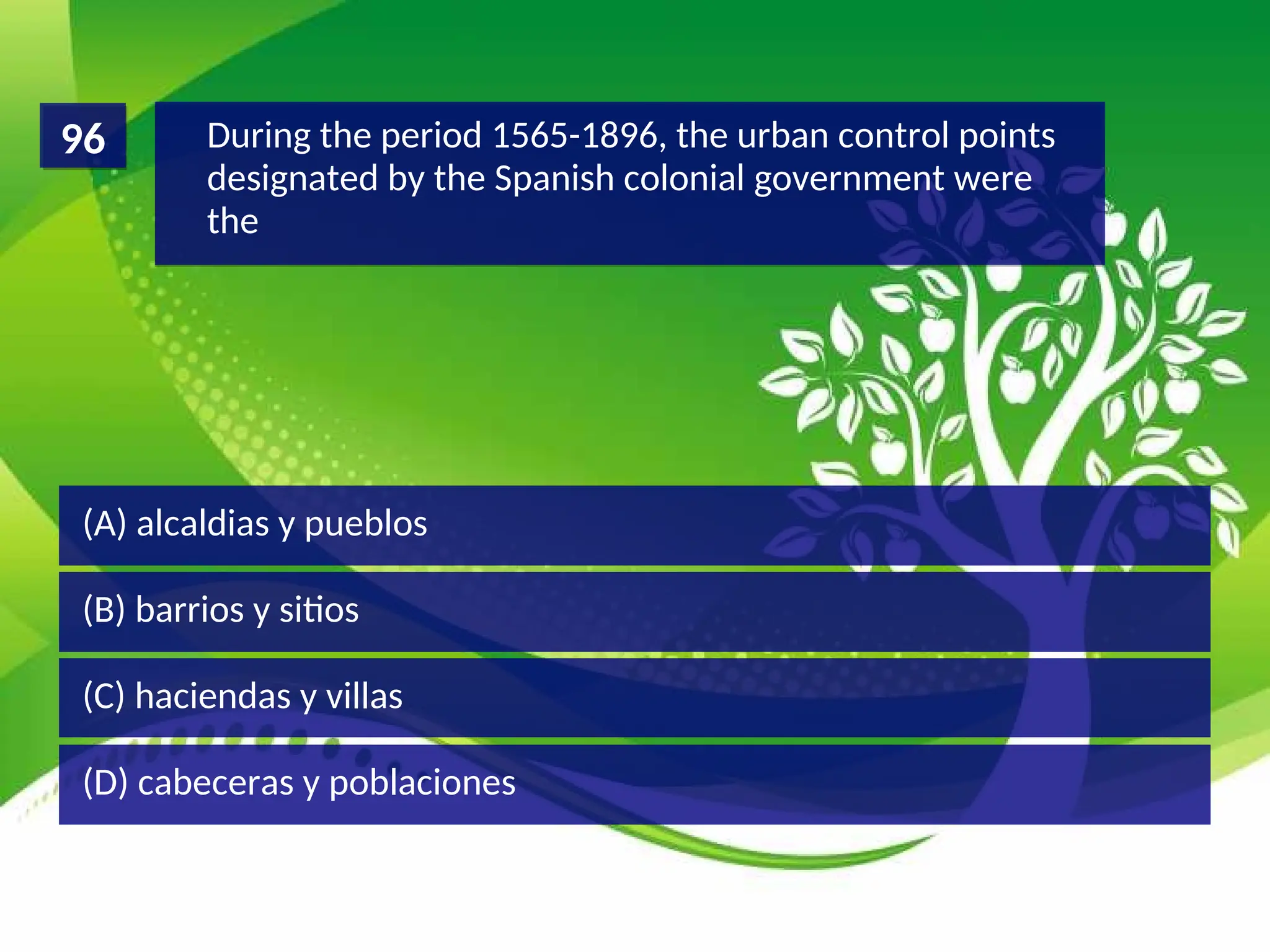
(D) cabeceras y poblaciones
(C) haciendas y villas
(B) barrios y sitios
(A) alcaldias y pueblos
During the period 1565-1896, the urban control points
designated by the Spanish colonial government were
the
96
(D) houses of peninsulares, insulares, creoles, mestizos, principales and
ilustrados
(C) church, town hall, school, public market
(B) governors mansion, bishops palace, generals manor, hacenderos
villa, military garrison
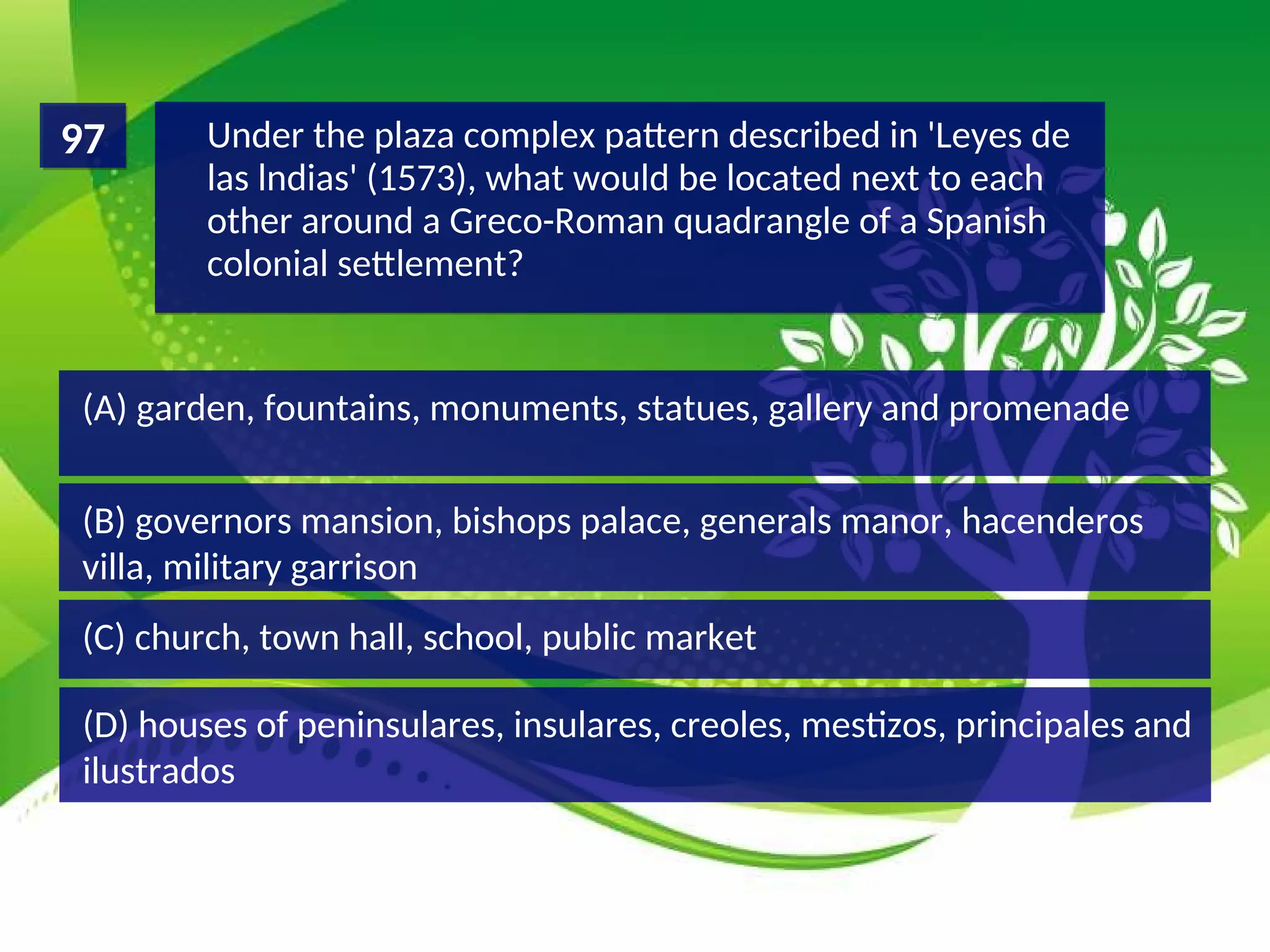
(A) garden, fountains, monuments, statues, gallery and promenade
Under the plaza complex pattern described in 'Leyes de
las lndias' (1573), what would be located next to each
other around a Greco-Roman quadrangle of a Spanish
colonial settlement?
97
(D) 'townships'
(C) 'haciendas'
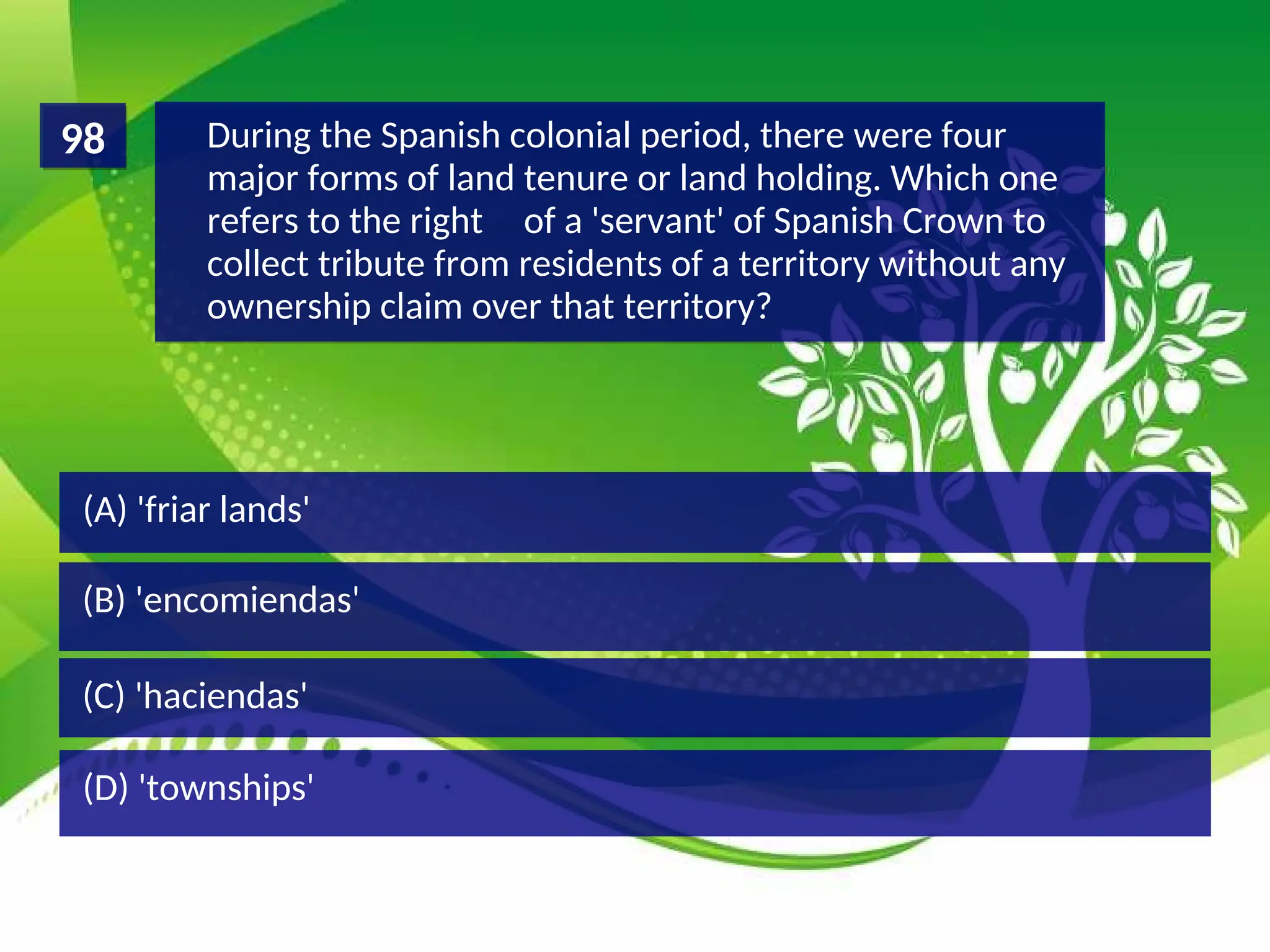
(B) 'encomiendas'
(A) 'friar lands'
During the Spanish colonial period, there were four
major forms of land tenure or land holding. Which one
refers to the right of a 'servant' of Spanish Crown to
collect tribute from residents of a territory without any
ownership claim over that territory?
98
(D) Samar lsland
(C) Mindanao
(B) Palawan
(A) Negros lsland
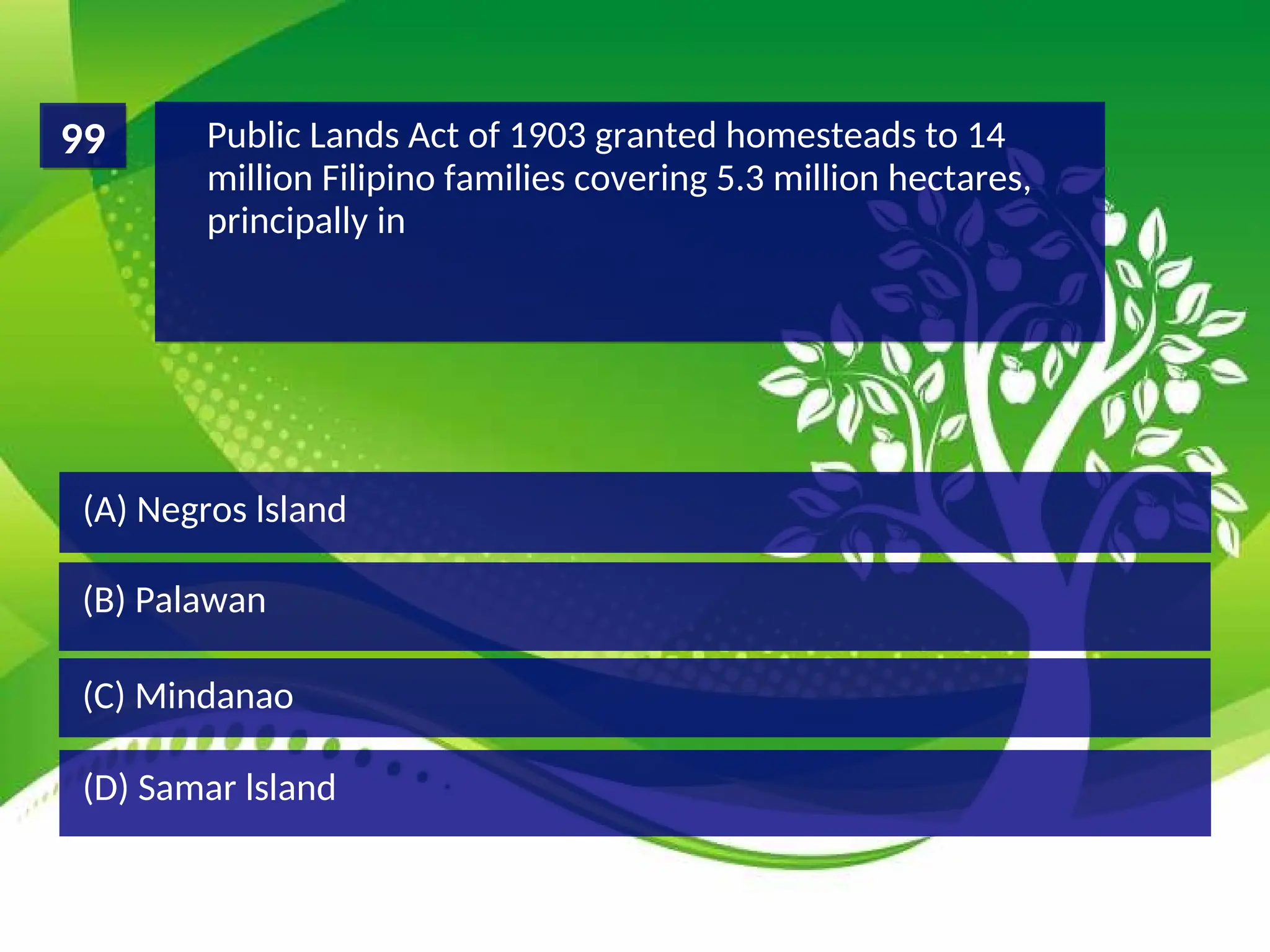
Public Lands Act of 1903 granted homesteads to 14
million Filipino families covering 5.3 million hectares,
principally in
99
(D) British
(C) Japanese
(B) American
(A) Spanish
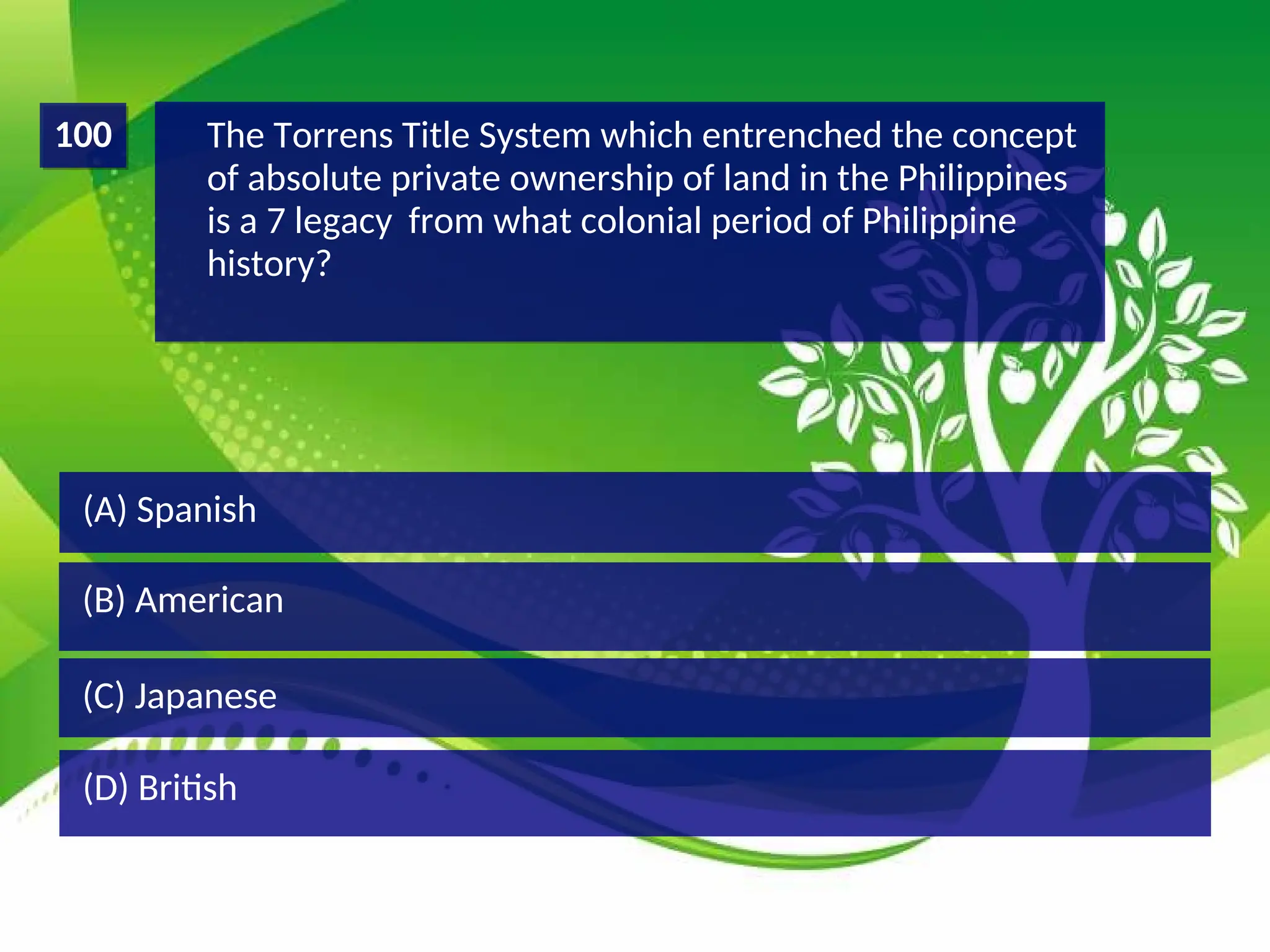
The Torrens Title System which entrenched the concept
of absolute private ownership of land in the Philippines
is a 7 legacy from what colonial period of Philippine
history?
100
sample review materials for EnP board exam.ppt

sample review materials for EnP board exam.ppt

  • 1.
  • 2.
    (D) John Winthropfor Trimountaine, Boston Common (C) Peter Minuit for Manhattan Island, New York (B) Pierre Charles L'Enfant for Washington DC (A) William Penn for Philadelphia, Pennsylvania The first grid-iron orthogonal street pattern in continental America was designed in 1682 by 51
  • 3.
    (D) Sir ChristopherWren (C) James Buckingham (B) John Cadbury (A) Robert Owen Before the rise of 'scientific socialism' based on concept of class- struggle, 'normative or Utopian socialism' based on Christian values was showcased by this philanthropist in New Lanark, Scotland (1799) where excellent working conditions, decent housing, and cheap services for the working class increased productivity and profit. Its founder was later acknowledged as the father of the cooperative movement. 52
  • 4.
    (D) invention oftrains, trams, and rail for faster movement of goods (C) invention of printing press to propagate scientific knowledge (B) invention of steam engine as source of power (A) discovery of crude oil, coal, and gas fuels The milestone that marked the start of the Industrial Age in 1769 and changed the primary mode of economic production was 53
  • 5.
    (D) doctors, epidemiologists,sanitarians, public health personnel (C) Industrial engineers, machine engineers, civil engineers (B) shelter specialists, housing developers, contractors (A) microbiologists, biochemists, pharmacists At the start of 19th century industrialization in England before the emergence of full-fledged professional planners, who were the earliest urban planning practitioners who addressed city-wide problems including 'germ versus filth' dilemma? 54
  • 6.
    (D) George PerkinsMarsh (C) Gifford Pinchot (B) John Muir (A) Frederic Law Olmstead Sr Recognized as the 'father of landscape architecture,' he also began the 'Parks and Conservation Movement' in the United States which advanced the idea that city parks and greenways can structure urban space, stimulate mixed uses, dampen class conflict, heighten family and religious values, and serve as aid to social reform. 55
  • 7.
    (D) Sir RaymondUnwin (C) Sir Patrick Leslie Abercrombie (B) Sir Ebenezer Howard (A) Sir Frederic Osborn He wrote the famous book “Garden Cities of Tomorrow” (1902) and became a most influantial thinker with his effort to combine the best features of 'tow' with the best features of 'country' as shown in his diagram of three- magnets. 56
  • 8.
    (D) World WarIl and the Holocaust (C) lndustrial Revolution (B) British-American War of Independence (A) The Scientific Revolution Garden City Movement in the United Kingdom directly addressed large-scale problems caused by the 57
  • 9.
    (D) Hampstead (C) Welwyn (B)London (A) Letchworth Supervised by Sir Raymond Unwin, the first Garden City built in the United Kingdom (1903-1920) was 58 (E) Milton Keynes
  • 10.
    (D) preservation ofmore farmland & open space (C) homestead of about one acre per family (B) mass transit to link 'mother city' with garden cities (A) greenbelts, green girdles, and clear edges for all cities The Garden City Movement shaped the British policy of urban containment, with following features, except one: 59
  • 11.
    (D) University ofHeidelberg (C) Cambridge University (B) Harvard University (A) Oxford University In 1907, what university offered the first academic degree course in city planning under its landscape architecture department, which program later spun of to become the first ever school of planning in 1929 60
  • 12.
    (D) Daniel HudsonBurnham (C) Robert Kennon (B) William Howard Taft (A) John Hay Considered as the Father of City Planning in America," he prepared plans for the City of Manila and the City of Baguio from 1903 to 1911 with the assistance of Pierce Andersson. 61 (E) Francis B. Harrison
  • 13.
    (D) Pierre CharlesL'Enfant (C) Baron Georges Eugenes Hausmann (B) Daniel H. Burnham (A) Leone Batista Alberti Make no little plans. They have no magic and probably themselves will not be realized. Make big plans; aim high in hope and work, remembering that a noble, logical diagram once recorded will never die...” 62
  • 14.
    (D) Napoleon Bonaparte (C)Theodore Roosevelt (B) George Washington (A) Winston Churchill “First we shape our buildings; thereafter, our buildings shape us.” This quotation is attributed to 63
  • 15.
    (D) New TownsMovement (C) City Efficient Movement (B) City Functional Movement (A) City Beautiful Movement This was the movement that stressed the design of settlements according to the principles of grandeur, exuberance, monumentality, drama and tension, cohesiveness, and symmetry" as demonstrated in the planning of Washington DC, Paris, Chicago, San Francisco, among others: 64
  • 16.
    (D) Regional CityMovement (C) City Efficient Movement (B) City Functional Movement (A) City Beautiful Movement The US Supreme Courts decision in 1926 to uphold the power of an LGU to regulate land use through ordinance in the landmark case of “Village of Euclid vs. Ambler Realty Company" is reckoned as the watershed moment for 65
  • 17.
    (D) Oscar Niemeyer (C)Lucio Costa (B) lldefons Cerda ( A) Camilo Sitte Among the City Beautiful Movement planners, he was the earliest to articulate the principles of urban design in “City Planning According to Artistic Principles" (1889) 66 (E) William Burley Griffin
  • 18.
    (D) Thomas Sharp (C)Aldo Rossi (B) Le Corbusier (A) Gordon Cullen “A town is a tool for free man to overcome chaos and lack of order...A city is the grip of man upon nature... Geometry is the means whereby we perceive the external world and express the world within us ... Geometry is the foundation ... Machinery is the result of geometry. The age in which we live is therefore essentially a geometric one... Town Planning demands uniformity in detail and a sense of movement in general layout..." 67 (E) Roy Worskett
  • 19.
    (D) capture theretail market which justifies why prices are necessarily high in central locations or CBDs (C) increase the public’s enjoyment of environmental amenities and viewscapes from varying heights (B) increase city density by building high on a small part of land (A) use high-rise structures to improve safety of people and security of vital institutions The major objective of Le Corbusiers (Charles Edouard Jeanneret) cubist Radiant City" design (1923) meant for 3 million people consisting of 'uniform 60-storey tower- blocks set in a huge park' was to: 68
  • 20.
    (D) Rejection ofhistoric precedents as inspiration for overall design (C) Goal to decongest the city by increasing congestion at its core. (B) Devoid of thorough studies on demographic, social, economic, and transport aspects (A) Architectural determinism or the belief that physical design and visual aesthetics are sufficient to address the basic problems of population. Which of the following valid critiques of Le Corbusiers (CharlesEdouard Jeanneret) modernist city design pertains to the so-called 'spatial paradox'? 69 (E) Lack of humanscale as uniform tall structures tend to be disorienting while extremely-vast open spaces look inhospitable to humans
  • 21.
    (D) Ciudad Larga (C)Ciudad Lineal (B) Ciudad Elongada (A) Ciudad Conectada Don Arturo Soria y Mata, a Spanish engineer, suggested that the logic of utility connections (electricity, sewer, telephone lines, gas and water pipes) be the basis of city lay-out; thus he considered the impact of technology in his | concept of an elongated urban form running from Cadiz, Spain up to St. Petersburg, Russia. 70
  • 22.
    (D) linear industrialcity (C) post-industrial motor city (B) Axle lndustrielle (A) Esplanade Tony Garnier (1917) conceptualized a lush green city of about 35.000 inhabitants where man would rule by himself." thus there would be no police, no churches, no rigid forms of social control in this Utopian place complete with landscaped homes, factories, trade schools, transport and leisure facilities. 71
  • 23.
    (D) Micropolis (C) Exurbia (B)Broadacre city (A) Eco-city Frank Lloyd Wright proposed an alternative (1932) to the congestion in huge metropolis by way of urban decentralization wherein each American family would be granted at least one acre of federal land in a self- contained, agro-industrial settlement. 72 (E) Suburbia
  • 24.
    (D) series ofsuperblocks (C) green spaces which are interconnected (B) separation between pedestrian traffic and motor traffic (A) huge manufacturing firm at the center Which of the following features does not describe the New Town concept of Clarence Stein as showcased at Radburn, New Jersey; Columbia, Maryland; Greenbelt, Maryland; Greenhills, Ohio; Greendale, Wisconsin; and Greenbrook NJ? 73 (F) neighborhood clusters (E) prior land assembly
  • 25.
    (D) the popularityof automobile as means of transportation (C) the widespread use of commuter trains and monorail (B) increased value of rural land due to Hoovers lnterstate Highway Act of 1956 which funded federal highways and freeways across many states (A) rapid fall of real estate prices in the countryside due to financial meltdown from sub-prime lending New Towns Movement of 1920s might have contributed to scattered and uncontrolled development in continental America but the main reason for its suburban sprawl after World War ll was 74
  • 26.
    (D) Pericles (C) Geddes (B)Herodotus (A) Demogriphus The planner who said that survey is a requisite for planning in the famous framework Survey-Analysis Plan was 75
  • 27.
    (D) Clarence McKay (C)Clarence Thomas (B) Clarence Stein (A) Clarence Perry He proposed the neighborhood unit (1929) as a self- contained 'garden suburb' bounded by major streets, with shops at intersections and a school in the middle; its size would be defined by schools catchment area with a radius of quarter mile or 402 meters. This incorporated Garden City ideas and attempted at some kind of sociai engineering. 76
  • 28.
    (D) changing values,mindsets, habits, and behaviors of people towards desired societal goals (C) implementing service-oriented social programs to marginalized social sectors (B) manipulating age, sex, ethnicity, and other demographic factors of social groups (A) designing and building social facilities and infrastructure for the public 'Social Engineering' refers to 77
  • 29.
    (D) Barry Parker (C)Lewis Mumford (B) Sir Patrick Geddes (A) Sir Patrick Leslie Abercrombie A Scottish biologist who authored the masterpiece entitled “Cities in Evolution” (1915) and who coined the terms 'folk-work-place,' 'city-region' and 'conurbation' is acknowledged as the 'father of regional planning' 78
  • 30.
    (D) Charles Abrams (C)Lewis Mumford (B) Sir Patrick Geddes (A) Sir Patrick Leslie Abercrombie He led the crafting of the regional Greater London Plan of 1944, he designed some of 30 post-war New Towns approved by the British Pariament, including Doncaster area and East Kent, in which he used open space as structuring element 79
  • 31.
    (D)Martha C. Nussbaum (C)Rachel Louise Carson (B) Catherine Bauer Wuster ( A) Gro Harlem Brundtland She was called a superwoman' who singlehandedly sparked environmental activism in the 1960s-70s with her research ('Silent Spring') on the biomagnification of pesticides and chemicals in the human food chain; her advocacies bore fruit in the creation of US Environmental Protection Agency and Environmental Impact Assessment system in the 1970s. 80
  • 32.
    (D) Arne Naess (C)Delfin Ganapin (B) Henry David Thoreau (A) James Lovelock “Sierra Club” is to John Muir, “Audubon Society” to John James Audubon, “Living Earth” to Eugene Pleasants Odum, “Spaceship Earth” to Kenneth Boulding, and “Gaia, Mother Earth” is to 81
  • 33.
    (D) October (C) September (B)June (A) May If 'Earth Hour' is observed on the last Saturday of March, 'Earth Day USA' is celebrated annually on April 22, 'World Town Planning Day' falls on November, 'World Environment Day' is marked on the 5th day of the month of 82
  • 34.
    (D) October 31 (C)June 24 (B) March 22 (A) January 13 If 'World Heritage Day' is marked each year on April 18, 'World Biodiversity Day' is observed on May 22, 'World Ocean Day' on June , 'World Indigenous Peoples Day' on August , 'World Animal Day' on October 4, and 'World Food Day' on October 16, when is 'World Water Day' celebrated? 83
  • 35.
    (D) Erma Bombeck (C)Francis Stuart Chapin Jr (B) Konstantinos Doxiadis (A) lan L. McHarg Based on his landmark book, “Design with Nature” 'map overlay' to identify 'ecological constraints' was a tool devised in 1967 by the first modern environmental planner. 84
  • 36.
    (D) ecological footprint (C)index of environmental impact (B) consumer price index (A) land-population ratio Dr William Rees coined this concept in 1992 to approximate the amount of productive space, measured in terms of global hectare (gha) per capita, needed to sustain a population which consumes food, water, energy, building materials etc and requires the sink functions of Nature for human waste and pollution. 85
  • 37.
    (D) Aldo Leopold (C)Henry Wright (B) Ralph Waldo Emerson (A) Karol Wojtyla or 'John Paul II' Considered as the father of wildlife ecology, he advocated in 1948 a “personal land ethic” for humans to become 'stewards of the land' and member-citizens of land-community rather than its conquerors or dominators. 86
  • 38.
    (D) urban renewal (C)infill and densification (B) urban restructuring (A) land readjustment This started as a US federal program in 1949 which aimed to rehabilitate the outworn or decaying sections of any town by extending fund assistance to LGUs to undertake improvements in streetscapes, parks, greenways, housing, community centers, etc based on anticipation that future tax revenues from real estate will pay for present costs. 87
  • 39.
    (D) Robert Moses (C)Robert Murray Haig (B) Fiorello La Guardia (A) William Levitt As chief planner of New York City, he collaborated with Thomas Adams in the crafting of the “Regional Plan of New York and its Environs 1922-1931;” he also conceived, and executed public works costing $27 billion between 1924 and 1968 and was responsible for virtually every parkway, expressway, and public housing project in New York metropolitan area. 88 (E) Warren Buffett
  • 40.
    (D) Jane Jacobs (C)Joel Garreau (B) James Howard Kunstler (A) Herbert Gans In “Death and Life of Great American Cities"” (1961) and Economy of Cities" (1969), this planner maintains that diversity promotes innovation among proximate firms and spurs the growth of cities, thus she advocated for heterogeneity, variety, and mixture in the geographic clustering of firms as well as in the composition of city districts and neighborhoods. 89
  • 41.
    (D) integrate developmentof both urban and rural areas in order to save as much farmland as possible (C) design gated subdivisions as urban collage and multi-ethnic tapestry (B) revitalize urban communities by creating centers' and by reviving traditional civic values (A) rebuild the architectural façade of old cities using post-modern methods and technologies The major objective of 'New Urbanism' movement identified with Jane Jacobs, Leon Krier, Andres Duany, Elizabeth Plater-Zyberk, et al. is to 90
  • 42.
    (D) all ofthe above (C) the latter does not create mixed communities of varied socio- economic & demographic groups (B) the latter leads to the exclusion of low-income groups (A) the latter is more interested in new businesses than in community rebuilding; hence soul-less and centerless The critique of 'New Urbanism' against so-called 'Gentrification' or upscaling of inner-city neighborhoods was 91
  • 43.
    (D) Pedestrianization (C) ExclusionaryZoning (B) Neo-Traditional Design (A) Mixed Use Zoning All of the following schemes are associated with 'New Urbanism' except: 92
  • 44.
    (D) TJ Kent,Edwin C. Banfield, Albert Z. Guttenberg (C) Robert Moses, William Levitt, Richard King Mellon (B) Jane Jacobs, Kevin Lynch, William H. Whyte (A) David Harvey, Manuel Castells, Ray Pahl The following planners were most concerned about “human scale and the social usage of urban space” 93
  • 45.
    (D) tenancy (C) usufruct (B)lslamic feudalism (A) primitive communism Because pre-Spanish aboriginal communities in the Philippines were relatively small and based on kinship relations, the most common practice of land tenure in pre-colonial society, wherein one would merely enjoy the 'fuits' of land, was called 94 (E) swidden slash-and-burn
  • 46.
    (D) Evangelizacion (C) Reduccion (B)Presidio y Fortaleza (A) El Alcance del Campanario This was the Spanish spatial strategy of forming dense settlements from scattered dwellings for purposes of greater military defense and political control literally bringing together dispersed population within hearing distance of | church bells – which policy was applied on most Spanish colonies from 16th to 18th centuries. 95
  • 47.
    (D) cabeceras ypoblaciones (C) haciendas y villas (B) barrios y sitios (A) alcaldias y pueblos During the period 1565-1896, the urban control points designated by the Spanish colonial government were the 96
  • 48.
    (D) houses ofpeninsulares, insulares, creoles, mestizos, principales and ilustrados (C) church, town hall, school, public market (B) governors mansion, bishops palace, generals manor, hacenderos villa, military garrison (A) garden, fountains, monuments, statues, gallery and promenade Under the plaza complex pattern described in 'Leyes de las lndias' (1573), what would be located next to each other around a Greco-Roman quadrangle of a Spanish colonial settlement? 97
  • 49.
    (D) 'townships' (C) 'haciendas' (B)'encomiendas' (A) 'friar lands' During the Spanish colonial period, there were four major forms of land tenure or land holding. Which one refers to the right of a 'servant' of Spanish Crown to collect tribute from residents of a territory without any ownership claim over that territory? 98
  • 50.
    (D) Samar lsland (C)Mindanao (B) Palawan (A) Negros lsland Public Lands Act of 1903 granted homesteads to 14 million Filipino families covering 5.3 million hectares, principally in 99
  • 51.
    (D) British (C) Japanese (B)American (A) Spanish The Torrens Title System which entrenched the concept of absolute private ownership of land in the Philippines is a 7 legacy from what colonial period of Philippine history? 100