For more PBL resources visit bie.org © 2 0 1 5 B U C K I N S T I T U T E F O R E D U C A T I O N
P R O J E C T D E S I G N : O V E R V I E W page 1
Name of Project: Healthy	
  Lifestyle:	
  Are	
  We	
  Really	
  What	
  We	
  Eat? Duration: 4	
  weeks
Subject/Course: ELA: Writing Teacher(s): Shalini	
  Patel Grade Level: 1st
Other subject areas to be included, if any:
Science/Health and Math
Key Knowledge and
Understanding
(CCSS or other standards)
CCSS.ELA-­‐LITERACY.W.1.2	
  http://www.corestandards.org/ELA-­‐Literacy/W/1/2/	
  
Write	
  informative/explanatory	
  texts	
  in	
  which	
  they	
  name	
  a	
  topic,	
  supply	
  some	
  facts	
  about	
  the	
  topic,	
  and	
  provide	
  some	
  sense	
  of	
  closure.	
  
CCSS.ELA-­‐LITERACY.W.1.8	
  http://www.corestandards.org/ELA-­‐Literacy/W/1/8/	
  
With	
  guidance	
  and	
  support	
  from	
  adults,	
  recall	
  information	
  from	
  experiences	
  or	
  gather	
  information	
  from	
  provided	
  sources	
  to	
  answer	
  a	
  question.	
  
CCSS.ELA-­‐LITERACY.W.1.6	
  http://www.corestandards.org/ELA-­‐Literacy/W/1/6/	
  
With	
  guidance	
  and	
  support	
  from	
  adults,	
  use	
  a	
  variety	
  of	
  digital	
  tools	
  to	
  produce	
  and	
  publish	
  writing,	
  including	
  in	
  collaboration	
  with	
  peers.	
  
CCSS.ELA-­‐LITERACY.SL.1.3	
  http://www.corestandards.org/ELA-­‐Literacy/SL/1/3/	
  
Ask	
  and	
  answer	
  questions	
  about	
  what	
  a	
  speaker	
  says	
  in	
  order	
  to	
  gather	
  additional	
  information	
  or	
  clarify	
  something	
  that	
  is	
  not	
  understood.	
  
CCSS.ELA-­‐LITERACY.SL.1.4	
  http://www.corestandards.org/ELA-­‐Literacy/SL/1/4/	
  
Describe	
  people,	
  places,	
  things,	
  and	
  events	
  with	
  relevant	
  details,	
  expressing	
  ideas	
  and	
  feelings	
  clearly.	
  
CCSS.MATH.CONTENT.2.MD.D.10	
  http://www.corestandards.org/Math/Content/2/MD/D/10/	
  
Draw	
  a	
  picture	
  graph	
  and	
  a	
  bar	
  graph	
  (with	
  single-­‐unit	
  scale)	
  to	
  represent	
  a	
  data	
  set	
  with	
  up	
  to	
  four	
  categories.	
  Solve	
  simple	
  put-­‐together,	
  take-­‐apart,	
  and	
  
compare	
  problems	
  using	
  information	
  presented	
  in	
  a	
  bar	
  graph.
Success Skills
(to be taught and
assessed)
Critical Thinking/Problem Solving Self-Management
Collaboration Other: Communication NGSS-­‐K-­‐2-­‐ETS1-­‐1	
  
Asking	
  questions,	
  making	
  observations,	
  and	
  gathering	
  information	
  are	
  
helpful	
  in	
  thinking	
  about	
  problems.	
  
X	
  
Project Summary
(include student role,
issue, problem or
challenge, action taken,
and purpose/beneficiary)
The	
  first	
  graders	
  will	
  investigate	
  the	
  age-­‐old	
  adage:	
  You	
  are	
  what	
  you	
  eat.	
  They	
  will	
  learn	
  about	
  how	
  to	
  promote	
  a	
  healthy	
  lifestyle	
  for	
  
themselves,	
  their	
  families,	
  and	
  the	
  community.	
  Students	
  will	
  begin	
  by	
  thinking	
  about	
  what	
  it	
  means	
  to	
  be	
  healthy	
  and	
  think	
  about	
  things	
  that	
  
they	
  do	
  to	
  be	
  healthy.	
  As	
  part	
  of	
  their	
  investigation,	
  students	
  will	
  conduct	
  interviews	
  with	
  their	
  parents	
  to	
  learn	
  about	
  what	
  their	
  families	
  do	
  
to	
  stay	
  healthy.	
  They	
  will	
  also	
  learn	
  from	
  local	
  experts	
  (a	
  pediatrician,	
  a	
  yoga	
  instructor,	
  a	
  psychiatrist,	
  and	
  a	
  nutritionist)	
  about	
  staying	
  
active.	
  The	
  students	
  then	
  will	
  create	
  a	
  Healthy	
  Eating	
  and	
  Fitness	
  Menu	
  for	
  the	
  local	
  gym	
  in	
  addition	
  to	
  short	
  commercials	
  about	
  what	
  they	
  
learned	
  about	
  nutrition	
  and	
  exercise,	
  which	
  they	
  will	
  share	
  with	
  the	
  other	
  students	
  in	
  the	
  school	
  and	
  community.	
  
Driving Question How	
  do	
  healthy	
  habits	
  help	
  me,	
  and	
  my	
  family,	
  grow	
  stronger	
  and	
  live	
  longer?	
  
For more PBL resources visit bie.org © 2 0 1 5 B U C K I N S T I T U T E F O R E D U C A T I O N
Entry Event Day	
  1	
  –	
  The	
  students	
  will	
  watch	
  a	
  video	
  about	
  healthy	
  food.	
  This	
  will	
  help	
  to	
  set	
  the	
  idea	
  for	
  the	
  unit.	
  	
  
Day	
  2	
  –	
  Students	
  will	
  have	
  a	
  discussion	
  about	
  making	
  healthy	
  choices.	
  They	
  begin	
  the	
  conversation	
  by	
  examining	
  a	
  picture	
  of	
  two	
  cereal	
  
boxes.	
  One	
  of	
  the	
  boxes	
  should	
  be	
  a	
  sugar-­‐filled	
  cereal	
  with	
  a	
  picture	
  of	
  a	
  character	
  on	
  it.	
  Another	
  box	
  of	
  cereal	
  should	
  be	
  a	
  healthy	
  cereal	
  
with	
  a	
  plain	
  cover	
  with	
  no	
  characters.	
  	
  
Take	
  a	
  poll	
  by	
  having	
  students	
  place	
  a	
  sticky	
  dot	
  under	
  the	
  cereal	
  box	
  they	
  would	
  rather	
  buy	
  and	
  eat.	
  After	
  everyone	
  has	
  voted,	
  begin	
  a	
  class	
  
discussion	
  posing	
  questions	
  about	
  their	
  choice	
  of	
  cereal:	
  Have	
  you	
  ever	
  eaten	
  either	
  cereal	
  before?	
  How	
  do	
  you	
  know	
  if	
  the	
  cereal	
  is	
  
healthy?	
  	
  Would	
  you	
  try	
  the	
  one	
  you	
  did	
  not	
  choose?	
  Why	
  or	
  why	
  not?	
  
Pose	
  the	
  Driving	
  Question,	
  How	
  do	
  healthy	
  habits	
  help	
  me,	
  and	
  my	
  family,	
  grow	
  stronger	
  and	
  live	
  longer?	
  Elicit	
  student	
  questions	
  about	
  and	
  
responses	
  to	
  the	
  DQ.	
  Chart	
  the	
  responses	
  on	
  a	
  KWL	
  chart	
  for	
  students	
  to	
  refer	
  to	
  throughout	
  the	
  unit.	
  	
  
Products Individual:
Informational	
  Book	
  
Healthy	
  Menu
Specific content and skills to be assessed:
Writing	
  an	
  informational	
  book	
  
Math/Science	
  –	
  observation	
  and	
  gathering	
  data/graphing	
  the	
  healthy	
  
foods	
  that	
  they	
  ate	
  according	
  to	
  the	
  food	
  groups.	
  
Communication:	
  Family	
  Interview
Team (Teams of 4):
Team	
  Healthy	
  Menu	
  
Commercial
Specific content and skills to be assessed:
Writing	
  of	
  menu	
  (list)	
  
Communicating	
  the	
  ideas	
  that	
  the	
  students	
  learned	
  about	
  healthy	
  
living.
For more PBL resources visit bie.org © 2 0 1 5 B U C K I N S T I T U T E F O R E D U C A T I O N
P R O J E C T D E S I G N : O V E R V I E W page 3
Making Products Public
(include how the
products will be made
public and who students
will engage with
during/at end of project)
As	
  part	
  of	
  their	
  investigative	
  work,	
  students	
  will	
  learn	
  from	
  community	
  experts	
  (a	
  pediatrician,	
  a	
  yoga	
  instructor,	
  a	
  psychiatrist,	
  and	
  a	
  
nutritionist)	
  during	
  the	
  unit.	
  The	
  nutritionist	
  will	
  provide	
  feedback	
  on	
  the	
  menu	
  midway	
  through	
  the	
  project.	
  At	
  the	
  end	
  of	
  the	
  project,	
  
students	
  will	
  share	
  their	
  menus	
  with	
  a	
  local	
  gym	
  and	
  short	
  commercials	
  with	
  other	
  students	
  and	
  the	
  community.	
  
Resources Needed On-site people, facilities:
Computer	
  lab	
  and	
  tech	
  support	
  
Equipment:
I-­‐Pad	
  or	
  tablet/recording	
  device	
  
Materials:
Technology	
  to	
  record	
  the	
  commercial,	
  flyer/poster	
  paper	
  to	
  create	
  the	
  menus,	
  pyramid	
  food	
  guide,	
  and	
  books	
  about	
  nutrition.	
  
Community Resources:
We	
  will	
  need	
  to	
  contact	
  the	
  local	
  gym	
  to	
  see	
  if	
  they	
  will	
  display	
  the	
  menus.	
  We	
  will	
  need	
  a	
  pediatrician,	
  a	
  yoga	
  instructor,	
  a	
  psychiatrist,	
  and	
  a	
  
nutritionist	
  to	
  come	
  in	
  to	
  the	
  classroom	
  to	
  work	
  with	
  the	
  students.	
  
Reflection Methods
(how individual, team,
and/or whole class will
reflect during/at end of
project)
Journal/Learning Log
X	
  
Focus Group
Whole-Class Discussion
X	
  
Fishbowl Discussion
Survey Other: Peer	
  Feedback
X	
  
Notes:
For more PBL resources visit bie.org © 2 0 1 5 B U C K I N S T I T U T E F O R E D U C A T I O N
P R O J E C T D E S I G N : S T U D E N T L E A R N I N G G U I D E
Project: Healthy	
  Lifestyle:	
  Are	
  We	
  Really	
  What	
  We	
  Eat?
Driving Question: How	
  do	
  healthy	
  habits	
  help	
  me,	
  and	
  my	
  family,	
  grow	
  stronger	
  and	
  live	
  longer?
Final Product(s)
Presentations,
Performances, Products
and/or Services
Learning Outcomes/Targets
knowledge, understanding & success skills needed by
students to successfully complete products
Checkpoints/Formative Assessments
to check for learning and ensure
students are on track
Instructional Strategies for All Learners
provided by teacher, other staff, experts; includes
scaffolds, materials, lessons aligned to learning
outcomes and formative assessments
(individual and
team)
Healthy	
  Menu	
  
(Individual)	


I	
  can	
  create	
  a	
  menu	
  to	
  
share	
  my	
  ideas	
  about	
  a	
  
healthy	
  lifestyle.	
  
(W.1.6)	


Short	
  Commercial	
  
(Team)	
  
Anchor	
  Learning	
  
Target	


I	
  can	
  communicate	
  
what	
  I	
  have	
  learned	
  
about	
  healthy	
  
lifestyles	
  to	
  an	
  
audience.	
  
(SL.1.3	
  and	
  1.4)	
  
I	
  can	
  write	
  an	
  informational	
  text	
  to	
  explain	
  what	
  my	
  
family	
  does	
  to	
  stay	
  healthy.	
  
(W.1.2,	
  W.1.8,	
  ETS1-­‐1)	
  
1.	
  Questions	
  for	
  the	
  family	
  interview	


2.	
  Outline	
  of	
  the	
  interview	


3.	
  Teacher	
  conferencing	
  during	
  writing	
  
*Teacher-­‐led	
  lesson	
  on	
  interview	
  questions	
  
*Parents	
  can	
  record	
  their	
  responses	
  
*Writer’s	
  Workshop	
  and	
  conferencing	
  (conferencing	
  
will	
  support	
  the	
  teacher	
  in	
  pulling	
  groups	
  for	
  small	
  
group	
  instruction	
  based	
  on	
  need)	
  
*Small	
  group	
  instruction	
  to	
  support	
  with	
  writing	
  the	
  
informational	
  text	
  based	
  on	
  area	
  of	
  need	
  
*Pediatrician	
  speaks	
  to	
  the	
  class	
  about	
  what	
  families	
  
can	
  do	
  to	
  be	
  healthy	
  and	
  answers	
  student	
  questions	
  
I	
  can	
  identify	
  the	
  5	
  main	
  food	
  groups	
  and	
  ways	
  to	
  
maintain	
  a	
  healthy	
  lifestyle	
  through	
  eating	
  and	
  
exercise.	
  
(ETS1-­‐1,	
  2MD.D.10)	
  
1.	
  Food	
  Journal	


2.	
  Graph	
  of	
  the	
  Food	
  Journal	


3.	
  Small	
  group	
  activity	
  –	
  food	
  sort	
  	
  
*Students	
  can	
  draw	
  pictures	
  to	
  represent	
  their	
  food	
  
*Word	
  Banks	
  
*Small	
  group	
  activity	
  –	
  Students	
  sort	
  foods	
  into	
  
groups	
  and	
  explain	
  their	
  reasoning;	
  explain	
  if	
  a	
  food	
  is	
  
healthy	
  or	
  not	
  and	
  their	
  reasoning	
  
*Teacher	
  read-­‐aloud	
  on	
  healthy	
  eating	
  (e.g.,	
  Good	
  
Enough	
  to	
  Eat	
  by	
  Lizzy	
  Rockwell)	
  
*Nutritionist	
  speaks	
  to	
  the	
  class	
  about	
  healthy	
  recipes	
  
and	
  eating	
  habits;	
  answers	
  students	
  questions	
  
I	
  can	
  make	
  a	
  list	
  of	
  healthy	
  foods	
  to	
  eat	
  for	
  a	
  day	
  and	
  
exercise	
  to	
  share	
  with	
  a	
  public	
  audience	
  by	
  creating	
  a	
  
visual	
  aid.	
  
(W.1.6,	
  W.1.2)	
  
1.	
  Food	
  Journal	


2.	
  Information	
  from	
  the	
  nutritionist	
  and	
  her	
  feedback	


3.	
  Drafts	
  of	
  menus	
  (reviewed	
  by	
  the	
  nutritionist	
  &	
  
teacher)	
  
*Students	
  can	
  draw	
  pictures	
  to	
  represent	
  their	
  food	
  
*Word	
  Banks	
  
*Small	
  group	
  instruction	
  to	
  support	
  creating	
  the	
  
menus	
  
*PE	
  lesson	
  on	
  various	
  cardiovascular	
  exercises	
  and	
  
yoga	
  led	
  by	
  the	
  yoga	
  instructor	
  
*Examination	
  of	
  sample	
  menus	
  
I	
  can	
  communicate	
  my	
  ideas	
  and	
  work	
  with	
  my	
  team	
  
to	
  create	
  a	
  commercial.	
  
(SL.1.3,	
  SL.	
  1.4)	
  
1.	
  Weekly	
  video	
  journals	


2.	
  Peer	
  feedback	
  on	
  storyboard	
  for	
  the	
  commercial	


3.	
  Teacher	
  Observations	
  
*Practice	
  recording	
  on	
  the	
  iPad/tablet	
  
*Teacher	
  feedback	
  
*Examination	
  of	
  commercials	
  
*Teacher	
  modeling	
  of	
  storyboarding;	
  small	
  group	
  
instruction	
  to	
  support	
  as	
  needed	
  

Sample project

  • 1.
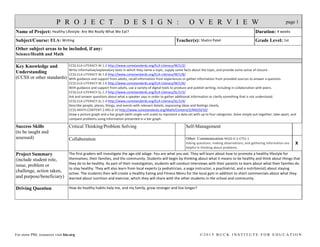
    For more PBLresources visit bie.org © 2 0 1 5 B U C K I N S T I T U T E F O R E D U C A T I O N P R O J E C T D E S I G N : O V E R V I E W page 1 Name of Project: Healthy  Lifestyle:  Are  We  Really  What  We  Eat? Duration: 4  weeks Subject/Course: ELA: Writing Teacher(s): Shalini  Patel Grade Level: 1st Other subject areas to be included, if any: Science/Health and Math Key Knowledge and Understanding (CCSS or other standards) CCSS.ELA-­‐LITERACY.W.1.2  http://www.corestandards.org/ELA-­‐Literacy/W/1/2/   Write  informative/explanatory  texts  in  which  they  name  a  topic,  supply  some  facts  about  the  topic,  and  provide  some  sense  of  closure.   CCSS.ELA-­‐LITERACY.W.1.8  http://www.corestandards.org/ELA-­‐Literacy/W/1/8/   With  guidance  and  support  from  adults,  recall  information  from  experiences  or  gather  information  from  provided  sources  to  answer  a  question.   CCSS.ELA-­‐LITERACY.W.1.6  http://www.corestandards.org/ELA-­‐Literacy/W/1/6/   With  guidance  and  support  from  adults,  use  a  variety  of  digital  tools  to  produce  and  publish  writing,  including  in  collaboration  with  peers.   CCSS.ELA-­‐LITERACY.SL.1.3  http://www.corestandards.org/ELA-­‐Literacy/SL/1/3/   Ask  and  answer  questions  about  what  a  speaker  says  in  order  to  gather  additional  information  or  clarify  something  that  is  not  understood.   CCSS.ELA-­‐LITERACY.SL.1.4  http://www.corestandards.org/ELA-­‐Literacy/SL/1/4/   Describe  people,  places,  things,  and  events  with  relevant  details,  expressing  ideas  and  feelings  clearly.   CCSS.MATH.CONTENT.2.MD.D.10  http://www.corestandards.org/Math/Content/2/MD/D/10/   Draw  a  picture  graph  and  a  bar  graph  (with  single-­‐unit  scale)  to  represent  a  data  set  with  up  to  four  categories.  Solve  simple  put-­‐together,  take-­‐apart,  and   compare  problems  using  information  presented  in  a  bar  graph. Success Skills (to be taught and assessed) Critical Thinking/Problem Solving Self-Management Collaboration Other: Communication NGSS-­‐K-­‐2-­‐ETS1-­‐1   Asking  questions,  making  observations,  and  gathering  information  are   helpful  in  thinking  about  problems.   X   Project Summary (include student role, issue, problem or challenge, action taken, and purpose/beneficiary) The  first  graders  will  investigate  the  age-­‐old  adage:  You  are  what  you  eat.  They  will  learn  about  how  to  promote  a  healthy  lifestyle  for   themselves,  their  families,  and  the  community.  Students  will  begin  by  thinking  about  what  it  means  to  be  healthy  and  think  about  things  that   they  do  to  be  healthy.  As  part  of  their  investigation,  students  will  conduct  interviews  with  their  parents  to  learn  about  what  their  families  do   to  stay  healthy.  They  will  also  learn  from  local  experts  (a  pediatrician,  a  yoga  instructor,  a  psychiatrist,  and  a  nutritionist)  about  staying   active.  The  students  then  will  create  a  Healthy  Eating  and  Fitness  Menu  for  the  local  gym  in  addition  to  short  commercials  about  what  they   learned  about  nutrition  and  exercise,  which  they  will  share  with  the  other  students  in  the  school  and  community.   Driving Question How  do  healthy  habits  help  me,  and  my  family,  grow  stronger  and  live  longer?  
  • 2.
    For more PBLresources visit bie.org © 2 0 1 5 B U C K I N S T I T U T E F O R E D U C A T I O N Entry Event Day  1  –  The  students  will  watch  a  video  about  healthy  food.  This  will  help  to  set  the  idea  for  the  unit.     Day  2  –  Students  will  have  a  discussion  about  making  healthy  choices.  They  begin  the  conversation  by  examining  a  picture  of  two  cereal   boxes.  One  of  the  boxes  should  be  a  sugar-­‐filled  cereal  with  a  picture  of  a  character  on  it.  Another  box  of  cereal  should  be  a  healthy  cereal   with  a  plain  cover  with  no  characters.     Take  a  poll  by  having  students  place  a  sticky  dot  under  the  cereal  box  they  would  rather  buy  and  eat.  After  everyone  has  voted,  begin  a  class   discussion  posing  questions  about  their  choice  of  cereal:  Have  you  ever  eaten  either  cereal  before?  How  do  you  know  if  the  cereal  is   healthy?    Would  you  try  the  one  you  did  not  choose?  Why  or  why  not?   Pose  the  Driving  Question,  How  do  healthy  habits  help  me,  and  my  family,  grow  stronger  and  live  longer?  Elicit  student  questions  about  and   responses  to  the  DQ.  Chart  the  responses  on  a  KWL  chart  for  students  to  refer  to  throughout  the  unit.     Products Individual: Informational  Book   Healthy  Menu Specific content and skills to be assessed: Writing  an  informational  book   Math/Science  –  observation  and  gathering  data/graphing  the  healthy   foods  that  they  ate  according  to  the  food  groups.   Communication:  Family  Interview Team (Teams of 4): Team  Healthy  Menu   Commercial Specific content and skills to be assessed: Writing  of  menu  (list)   Communicating  the  ideas  that  the  students  learned  about  healthy   living.
  • 3.
    For more PBLresources visit bie.org © 2 0 1 5 B U C K I N S T I T U T E F O R E D U C A T I O N P R O J E C T D E S I G N : O V E R V I E W page 3 Making Products Public (include how the products will be made public and who students will engage with during/at end of project) As  part  of  their  investigative  work,  students  will  learn  from  community  experts  (a  pediatrician,  a  yoga  instructor,  a  psychiatrist,  and  a   nutritionist)  during  the  unit.  The  nutritionist  will  provide  feedback  on  the  menu  midway  through  the  project.  At  the  end  of  the  project,   students  will  share  their  menus  with  a  local  gym  and  short  commercials  with  other  students  and  the  community.   Resources Needed On-site people, facilities: Computer  lab  and  tech  support   Equipment: I-­‐Pad  or  tablet/recording  device   Materials: Technology  to  record  the  commercial,  flyer/poster  paper  to  create  the  menus,  pyramid  food  guide,  and  books  about  nutrition.   Community Resources: We  will  need  to  contact  the  local  gym  to  see  if  they  will  display  the  menus.  We  will  need  a  pediatrician,  a  yoga  instructor,  a  psychiatrist,  and  a   nutritionist  to  come  in  to  the  classroom  to  work  with  the  students.   Reflection Methods (how individual, team, and/or whole class will reflect during/at end of project) Journal/Learning Log X   Focus Group Whole-Class Discussion X   Fishbowl Discussion Survey Other: Peer  Feedback X   Notes:
  • 4.
    For more PBLresources visit bie.org © 2 0 1 5 B U C K I N S T I T U T E F O R E D U C A T I O N P R O J E C T D E S I G N : S T U D E N T L E A R N I N G G U I D E Project: Healthy  Lifestyle:  Are  We  Really  What  We  Eat? Driving Question: How  do  healthy  habits  help  me,  and  my  family,  grow  stronger  and  live  longer? Final Product(s) Presentations, Performances, Products and/or Services Learning Outcomes/Targets knowledge, understanding & success skills needed by students to successfully complete products Checkpoints/Formative Assessments to check for learning and ensure students are on track Instructional Strategies for All Learners provided by teacher, other staff, experts; includes scaffolds, materials, lessons aligned to learning outcomes and formative assessments (individual and team) Healthy  Menu   (Individual)     I  can  create  a  menu  to   share  my  ideas  about  a   healthy  lifestyle.   (W.1.6)       Short  Commercial   (Team)   Anchor  Learning   Target     I  can  communicate   what  I  have  learned   about  healthy   lifestyles  to  an   audience.   (SL.1.3  and  1.4)   I  can  write  an  informational  text  to  explain  what  my   family  does  to  stay  healthy.   (W.1.2,  W.1.8,  ETS1-­‐1)   1.  Questions  for  the  family  interview     2.  Outline  of  the  interview     3.  Teacher  conferencing  during  writing   *Teacher-­‐led  lesson  on  interview  questions   *Parents  can  record  their  responses   *Writer’s  Workshop  and  conferencing  (conferencing   will  support  the  teacher  in  pulling  groups  for  small   group  instruction  based  on  need)   *Small  group  instruction  to  support  with  writing  the   informational  text  based  on  area  of  need   *Pediatrician  speaks  to  the  class  about  what  families   can  do  to  be  healthy  and  answers  student  questions   I  can  identify  the  5  main  food  groups  and  ways  to   maintain  a  healthy  lifestyle  through  eating  and   exercise.   (ETS1-­‐1,  2MD.D.10)   1.  Food  Journal     2.  Graph  of  the  Food  Journal     3.  Small  group  activity  –  food  sort     *Students  can  draw  pictures  to  represent  their  food   *Word  Banks   *Small  group  activity  –  Students  sort  foods  into   groups  and  explain  their  reasoning;  explain  if  a  food  is   healthy  or  not  and  their  reasoning   *Teacher  read-­‐aloud  on  healthy  eating  (e.g.,  Good   Enough  to  Eat  by  Lizzy  Rockwell)   *Nutritionist  speaks  to  the  class  about  healthy  recipes   and  eating  habits;  answers  students  questions   I  can  make  a  list  of  healthy  foods  to  eat  for  a  day  and   exercise  to  share  with  a  public  audience  by  creating  a   visual  aid.   (W.1.6,  W.1.2)   1.  Food  Journal     2.  Information  from  the  nutritionist  and  her  feedback     3.  Drafts  of  menus  (reviewed  by  the  nutritionist  &   teacher)   *Students  can  draw  pictures  to  represent  their  food   *Word  Banks   *Small  group  instruction  to  support  creating  the   menus   *PE  lesson  on  various  cardiovascular  exercises  and   yoga  led  by  the  yoga  instructor   *Examination  of  sample  menus   I  can  communicate  my  ideas  and  work  with  my  team   to  create  a  commercial.   (SL.1.3,  SL.  1.4)   1.  Weekly  video  journals     2.  Peer  feedback  on  storyboard  for  the  commercial     3.  Teacher  Observations   *Practice  recording  on  the  iPad/tablet   *Teacher  feedback   *Examination  of  commercials   *Teacher  modeling  of  storyboarding;  small  group   instruction  to  support  as  needed