Hour After Hour
First Grade Mathematics Lesson
Lesson Information
• Objective: Students will be able to tell and
  illustrate time by the hour./ Students will
  understand the movement of the minute hand in
  relation to the hour hand.
• Essential Questions: Why is it important that we
  can properly read and understand time?
• Lesson Type: Direct Instruction
• Cognitive Level: Knowledge, Comprehension,
  Application, Analysis
• Affective Level: Receiving phenomena, Responding
  to phenomena
• Psychomotor Level: Perception, Set, Guided
  Response
• Multiple Intelligence: Bodily/Kinesthetic,
  Verbal/Linguistic, Music/Rhythmic, Visual/Spatial
Technology                     Materials
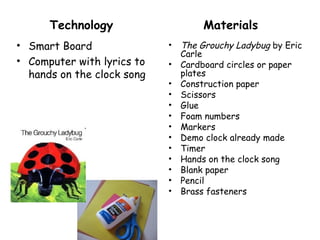
• Smart Board               •   The Grouchy Ladybug by Eric
                                Carle
• Computer with lyrics to   •   Cardboard circles or paper
  hands on the clock song       plates
                            •   Construction paper
                            •   Scissors
                            •   Glue
                            •   Foam numbers
                            •   Markers
                            •   Demo clock already made
                            •   Timer
                            •   Hands on the clock song
                            •   Blank paper
                            •   Pencil
                            •   Brass fasteners
Standard Addressed
            Measurement

• M1M2. Students will develop an
  understanding of the measurement of time.
   – a. Tell time to the nearest hour and half hour
     and understand the movement of the minute
     hand and how it relates to the hour hand.
Introduction
• Introduce the book The Grouchy Ladybug and ask
  the class if they know what the book is about. Find
  out what the class knows about time.
• Explain the importance of the small and large hands
  on a clock.
• Using the computer and Smart Board, display the
  lyrics to the hands on the clock song. Read the
  lyrics and sing the song as a class.
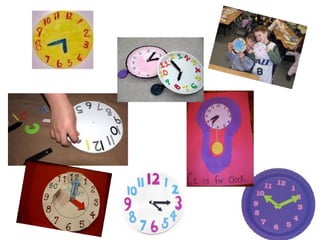
• Inform the students that they will be making their
  very own clocks and show the demo clock that has
  been pre-made before class.
• Pass cardboard circle, large and small clock hands
  pattern, glue, scissors, markers, and foam numbers
  out to each student.
• Have the students create their own correct clock.
Guided Practice
• Read The Grouchy Ladybug to the
  students.
• Using their homemade clocks, have the
  students move the hands to show the
  correct time that is shown.
• Leave plenty of time for the students to
  see the clock in the book.
• Ask questions regarding the book and
  time so check for understanding.
Independent Activities

Pass out a piece of paper to each
student and explain that you are going
to set a timer that will randomly go off
at different times. Explain that you
want everyone to write down what time
the clock says each time the timer goes
off.
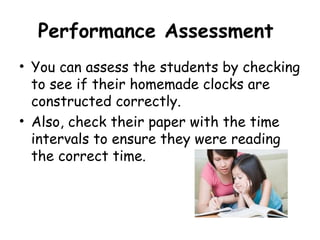
Performance Assessment
• You can assess the students by checking
  to see if their homemade clocks are
  constructed correctly.
• Also, check their paper with the time
  intervals to ensure they were reading
  the correct time.
Closure
• Have the students turn in their papers with
  each time interval on it.
• Review the times by asking the students
  questions to get them thinking, such as “what
  time is it when the long hand is on the one and
  the short hand is on the twelve?”
• Allow the students to use their homemade
  clocks to figure out the answers
• Review the essential questions by asking and
  explaining why telling time is important.
Questions or Suggestions??
References
Fraley, M. & Boyd, R. (2011). Telling time (by
  the hour). Retrieved from
  http://www.lessonplanspage.com/MathTime.htm

Banks, G. & Matterson, E. (n.d.) Telling time,
  clocks. Retrieved on July 11, 2011 from
  http://www.canteach.ca/elementary/songspoems
Sample Presentation: Math

Sample Presentation: Math

  • 2.
    Hour After Hour FirstGrade Mathematics Lesson
  • 3.
    Lesson Information • Objective:Students will be able to tell and illustrate time by the hour./ Students will understand the movement of the minute hand in relation to the hour hand. • Essential Questions: Why is it important that we can properly read and understand time? • Lesson Type: Direct Instruction • Cognitive Level: Knowledge, Comprehension, Application, Analysis • Affective Level: Receiving phenomena, Responding to phenomena • Psychomotor Level: Perception, Set, Guided Response • Multiple Intelligence: Bodily/Kinesthetic, Verbal/Linguistic, Music/Rhythmic, Visual/Spatial
  • 4.
    Technology Materials • Smart Board • The Grouchy Ladybug by Eric Carle • Computer with lyrics to • Cardboard circles or paper hands on the clock song plates • Construction paper • Scissors • Glue • Foam numbers • Markers • Demo clock already made • Timer • Hands on the clock song • Blank paper • Pencil • Brass fasteners
  • 5.
    Standard Addressed Measurement • M1M2. Students will develop an understanding of the measurement of time. – a. Tell time to the nearest hour and half hour and understand the movement of the minute hand and how it relates to the hour hand.
  • 6.
    Introduction • Introduce thebook The Grouchy Ladybug and ask the class if they know what the book is about. Find out what the class knows about time. • Explain the importance of the small and large hands on a clock. • Using the computer and Smart Board, display the lyrics to the hands on the clock song. Read the lyrics and sing the song as a class. • Inform the students that they will be making their very own clocks and show the demo clock that has been pre-made before class. • Pass cardboard circle, large and small clock hands pattern, glue, scissors, markers, and foam numbers out to each student. • Have the students create their own correct clock.
  • 8.
    Guided Practice • ReadThe Grouchy Ladybug to the students. • Using their homemade clocks, have the students move the hands to show the correct time that is shown. • Leave plenty of time for the students to see the clock in the book. • Ask questions regarding the book and time so check for understanding.
  • 9.
    Independent Activities Pass outa piece of paper to each student and explain that you are going to set a timer that will randomly go off at different times. Explain that you want everyone to write down what time the clock says each time the timer goes off.
  • 10.
    Performance Assessment • Youcan assess the students by checking to see if their homemade clocks are constructed correctly. • Also, check their paper with the time intervals to ensure they were reading the correct time.
  • 11.
    Closure • Have thestudents turn in their papers with each time interval on it. • Review the times by asking the students questions to get them thinking, such as “what time is it when the long hand is on the one and the short hand is on the twelve?” • Allow the students to use their homemade clocks to figure out the answers • Review the essential questions by asking and explaining why telling time is important.
  • 12.
  • 13.
    References Fraley, M. &Boyd, R. (2011). Telling time (by the hour). Retrieved from http://www.lessonplanspage.com/MathTime.htm Banks, G. & Matterson, E. (n.d.) Telling time, clocks. Retrieved on July 11, 2011 from http://www.canteach.ca/elementary/songspoems