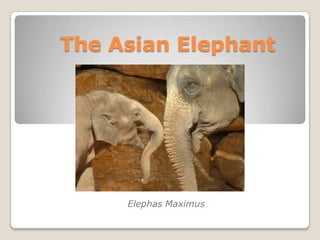
The Asian Elephant


     Elephas Maximus
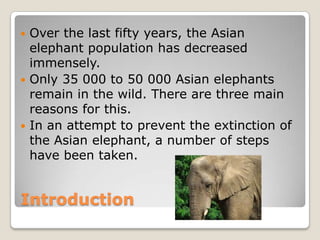
 Over the last fifty years, the Asian
  elephant population has decreased
  immensely.
 Only 35 000 to 50 000 Asian elephants
  remain in the wild. There are three main
  reasons for this.
 In an attempt to prevent the extinction of
  the Asian elephant, a number of steps
  have been taken.


Introduction
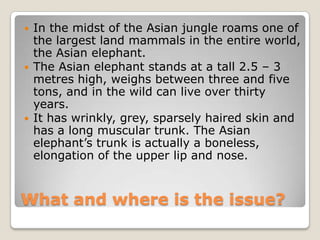
   In the midst of the Asian jungle roams one of
    the largest land mammals in the entire
    world, the Asian elephant.
   The Asian elephant stands at a tall 2.5 – 3
    metres high, weighs between three and five
    tons, and in the wild can live over thirty
    years.
   It has wrinkly, grey, sparsely haired skin and
    has a long muscular trunk. The Asian
    elephant’s trunk is actually a
    boneless, elongation of the upper lip and
    nose.

What and where is the issue?
 An elephant draws nearly fifty gallons of
  water up into its trunk every day and then
  squirts it either onto itself or into its
  mouth.
 Over the last fifty years the elephant
  population has decreased immensely.
 Only 35 000 to 50 000 Asian elephants
  remain in the wild over a range of thirteen
  countries.


What and where is the issue?
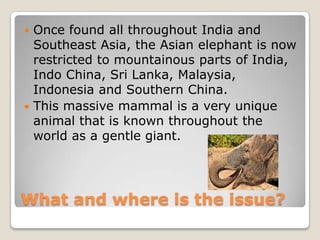
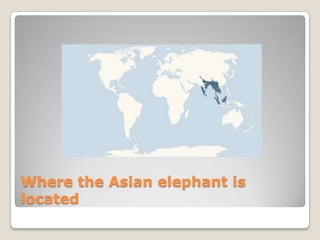
 Once found all throughout India and
  Southeast Asia, the Asian elephant is now
  restricted to mountainous parts of
  India, Indo China, Sri
  Lanka, Malaysia, Indonesia and Southern
  China.
 This massive mammal is a very unique
  animal that is known throughout the
  world as a gentle giant.


What and where is the issue?
Where the Asian elephant is
located
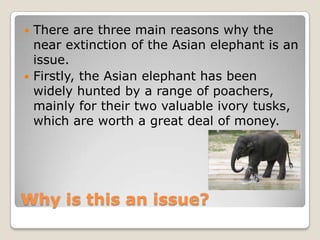
 There are three main reasons why the
  near extinction of the Asian elephant is an
  issue.
 Firstly, the Asian elephant has been
  widely hunted by a range of
  poachers, mainly for their two valuable
  ivory tusks, which are worth a great deal
  of money.


Why is this an issue?
   Secondly, the loss of habitat due to
    deforestation has caused many elephants to
    live in cramped conditions with less food and
    water than they are used to.
   Lastly, the loss of the habitat has caused a lot
    of elephants to leave their jungle and to
    wander into private farm property and start
    eating crops. When the farmers see this they
    usually shoot the elephant, causing it to run
    away and then slowly die.


Why is this an issue?
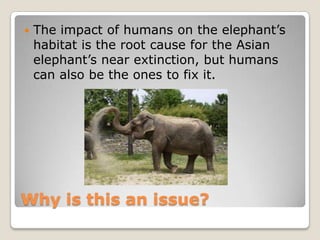
   The impact of humans on the elephant’s
    habitat is the root cause for the Asian
    elephant’s near extinction, but humans
    can also be the ones to fix it.


Why is this an issue?
   In an attempt to prevent the extinction of the
    Asian elephant a number of steps have been
    taken.
   Firstly, the Asian elephant has been declared
    an endangered species and is therefore
    protected from hunting and poaching.
   Secondly, there has been a ban implemented
    on international ivory trading and those
    disregarding the ban risk fines or even
    imprisonment. Any ivory found is destroyed
    by the authorities so it cannot be traded.

What is being done to fix the
problem?
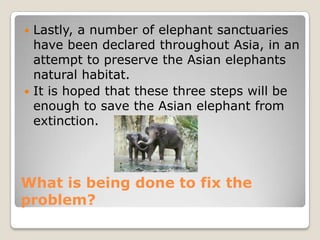
 Lastly, a number of elephant sanctuaries
  have been declared throughout Asia, in an
  attempt to preserve the Asian elephants
  natural habitat.
 It is hoped that these three steps will be
  enough to save the Asian elephant from
  extinction.


What is being done to fix the
problem?
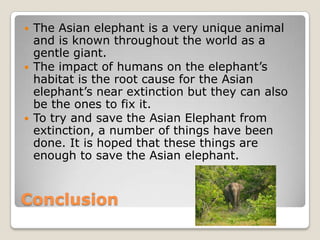
   The Asian elephant is a very unique animal
    and is known throughout the world as a
    gentle giant.
   The impact of humans on the elephant’s
    habitat is the root cause for the Asian
    elephant’s near extinction but they can also
    be the ones to fix it.
   To try and save the Asian Elephant from
    extinction, a number of things have been
    done. It is hoped that these things are
    enough to save the Asian elephant.


Conclusion
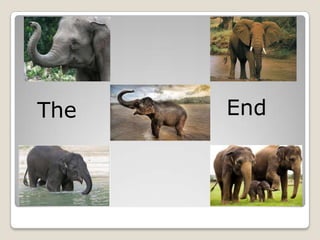
The   End

Sample powerpoint pres

  • 1.
    The Asian Elephant Elephas Maximus
  • 2.
     Over thelast fifty years, the Asian elephant population has decreased immensely.  Only 35 000 to 50 000 Asian elephants remain in the wild. There are three main reasons for this.  In an attempt to prevent the extinction of the Asian elephant, a number of steps have been taken. Introduction
  • 3.
    In the midst of the Asian jungle roams one of the largest land mammals in the entire world, the Asian elephant.  The Asian elephant stands at a tall 2.5 – 3 metres high, weighs between three and five tons, and in the wild can live over thirty years.  It has wrinkly, grey, sparsely haired skin and has a long muscular trunk. The Asian elephant’s trunk is actually a boneless, elongation of the upper lip and nose. What and where is the issue?
  • 4.
     An elephantdraws nearly fifty gallons of water up into its trunk every day and then squirts it either onto itself or into its mouth.  Over the last fifty years the elephant population has decreased immensely.  Only 35 000 to 50 000 Asian elephants remain in the wild over a range of thirteen countries. What and where is the issue?
  • 5.
     Once foundall throughout India and Southeast Asia, the Asian elephant is now restricted to mountainous parts of India, Indo China, Sri Lanka, Malaysia, Indonesia and Southern China.  This massive mammal is a very unique animal that is known throughout the world as a gentle giant. What and where is the issue?
  • 6.
    Where the Asianelephant is located
  • 7.
     There arethree main reasons why the near extinction of the Asian elephant is an issue.  Firstly, the Asian elephant has been widely hunted by a range of poachers, mainly for their two valuable ivory tusks, which are worth a great deal of money. Why is this an issue?
  • 8.
    Secondly, the loss of habitat due to deforestation has caused many elephants to live in cramped conditions with less food and water than they are used to.  Lastly, the loss of the habitat has caused a lot of elephants to leave their jungle and to wander into private farm property and start eating crops. When the farmers see this they usually shoot the elephant, causing it to run away and then slowly die. Why is this an issue?
  • 9.
    The impact of humans on the elephant’s habitat is the root cause for the Asian elephant’s near extinction, but humans can also be the ones to fix it. Why is this an issue?
  • 10.
    In an attempt to prevent the extinction of the Asian elephant a number of steps have been taken.  Firstly, the Asian elephant has been declared an endangered species and is therefore protected from hunting and poaching.  Secondly, there has been a ban implemented on international ivory trading and those disregarding the ban risk fines or even imprisonment. Any ivory found is destroyed by the authorities so it cannot be traded. What is being done to fix the problem?
  • 11.
     Lastly, anumber of elephant sanctuaries have been declared throughout Asia, in an attempt to preserve the Asian elephants natural habitat.  It is hoped that these three steps will be enough to save the Asian elephant from extinction. What is being done to fix the problem?
  • 12.
    The Asian elephant is a very unique animal and is known throughout the world as a gentle giant.  The impact of humans on the elephant’s habitat is the root cause for the Asian elephant’s near extinction but they can also be the ones to fix it.  To try and save the Asian Elephant from extinction, a number of things have been done. It is hoped that these things are enough to save the Asian elephant. Conclusion
  • 13.
    The End