Endangered species
By Nektaria Kanta
Contents
1. What is the meaning of “endangered species”?
2. Which are the animals that are being threatened
with extinction?
3. Why are these species in danger?
4. Why is this problem so crucial?
5. What can be done so that these animals do not get
extinct?
What is the meaning of “endangered species”?
Endangered is called every kind of living organism, which is being
threatened with extinction in the foreseeable future. The species in danger
are divided into three subcategories: the ones who are critically
endangered, the species that are just endangered and, last but not least,
the ones that are prone to extinction.
Which are the animals that are being threatened with
extinction?
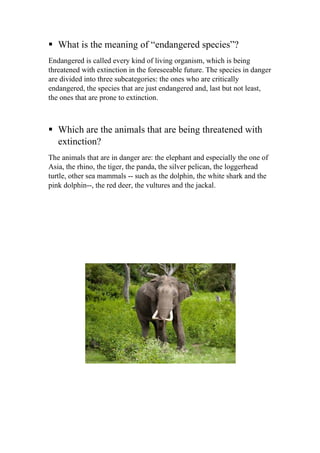
The animals that are in danger are: the elephant and especially the one of
Asia, the rhino, the tiger, the panda, the silver pelican, the loggerhead
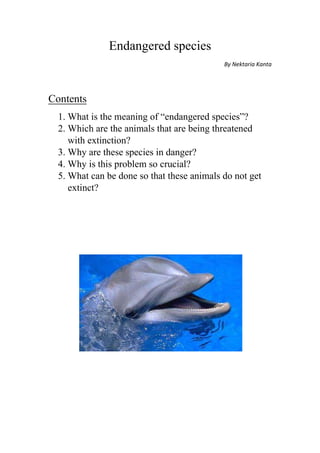
turtle, other sea mammals -- such as the dolphin, the white shark and the
pink dolphin--, the red deer, the vultures and the jackal.
Why are these species in danger?
Humans are responsible to a great extent when animals become
threatened, endangered, or extinct. Below are some reasons why animals
become endangered:
Destruction of Habitat
Valuable habitat -- in other words the natural environment of a living
organism -- is being destroyed by humans, when they fill wetlands, build
water barriers in rivers and do deforestation to construct buildings, roads
and other developments.
Pollution
Oil spills, acid rain and water pollution have been destructive for many
kinds of fish and birds. As far as the oil spills are concerned, a tanker can
transfer more than 450000 tons of petroleum. If the ship sinks, the oil will
spread over the surface of the sea, creating immediately huge oil spills.
The oil kills fish and seabirds, because it adheres to their scales and
wings. Thus, the repercussion of a major oil spill is that the fish and the
birds cannot move and breathe and, therefore, they suffer to death.
Hunting and Fishing
Many animals are over-hunted because their meat, fur and other parts are
in high demand. Some of them are:
• Asian elephants are one of the most endangered species. They are
mainly hunted for their tusks, their meat and their skin.
• Rhinocerosesare also in high demand, especially by the people of
Southeast Asia, Vietnam. These people believe that rhino horn’s
consumption cures everything from cancer to hangovers and that’s
why rhino horn was reported to be selling for $65,000 per 2.2
pounds in 2012, which makes it more expensive by weight than gold,
diamonds or cocaine.
• The tiger population had been hunted by humans until there were only
just 5,000 to 7,000 individuals worldwide by the late 1990s. Although
this number was thought to be dangerously low then, by 2014 it had
halved. According to some estimates, there are fewer than 2.500
mature tigers that currently remain in the wild.
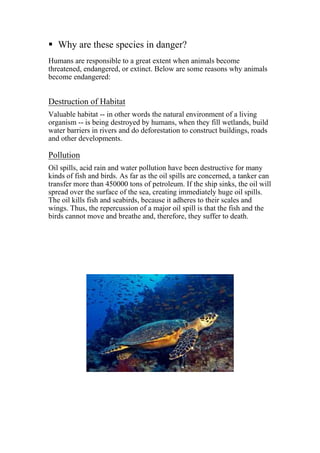
• Turtles have also been excessively hunted. The tropical turtle with the
beautiful yellow-and-brown shell that provides the product known as
tortoiseshell is the people’s most popular target.
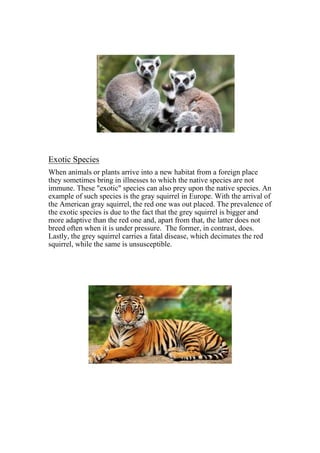
• There are no mammals on earth more endangered than lemurs, but still
humans are hunting them. These big-eyed primates are only found on
the island of Madagascar and over 90% of all species are considered
vulnerable, endangered or critically endangered.
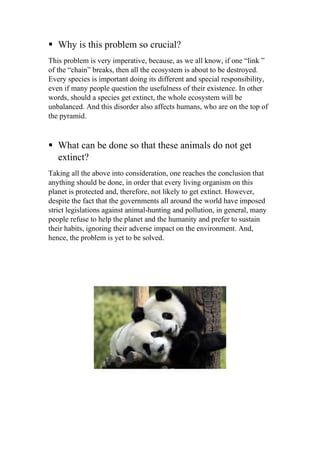
• Giant panda. When one makes an allusion to the species conservancy,
the giant panda is the most characteristic symbol. Although the fact
that its numbers are steadily increasing, the giant pandas remain few
and far between and still very endangered.
• At last, the gorilla that is the greatest of our fellow great apes is
slaughtered by humans.
Although the prohibitions and the restrains that have been imposed on
animal-hunting, the people maintain their attitude towards these innocent
species.
Exotic Species
When animals or plants arrive into a new habitat from a foreign place
they sometimes bring in illnesses to which the native species are not
immune. These "exotic" species can also prey upon the native species. An
example of such species is the gray squirrel in Europe. With the arrival of
the American gray squirrel, the red one was out placed. The prevalence of
the exotic species is due to the fact that the grey squirrel is bigger and
more adaptive than the red one and, apart from that, the latter does not
breed often when it is under pressure. The former, in contrast, does.
Lastly, the grey squirrel carries a fatal disease, which decimates the red
squirrel, while the same is unsusceptible.
Why is this problem so crucial?
This problem is very imperative, because, as we all know, if one “link ”
of the “chain” breaks, then all the ecosystem is about to be destroyed.
Every species is important doing its different and special responsibility,
even if many people question the usefulness of their existence. In other
words, should a species get extinct, the whole ecosystem will be
unbalanced. And this disorder also affects humans, who are on the top of
the pyramid.
What can be done so that these animals do not get
extinct?
Taking all the above into consideration, one reaches the conclusion that
anything should be done, in order that every living organism on this
planet is protected and, therefore, not likely to get extinct. However,
despite the fact that the governments all around the world have imposed
strict legislations against animal-hunting and pollution, in general, many
people refuse to help the planet and the humanity and prefer to sustain
their habits, ignoring their adverse impact on the environment. And,
hence, the problem is yet to be solved.

Endangered species 2

  • 1.
    Endangered species By NektariaKanta Contents 1. What is the meaning of “endangered species”? 2. Which are the animals that are being threatened with extinction? 3. Why are these species in danger? 4. Why is this problem so crucial? 5. What can be done so that these animals do not get extinct?
  • 2.
    What is themeaning of “endangered species”? Endangered is called every kind of living organism, which is being threatened with extinction in the foreseeable future. The species in danger are divided into three subcategories: the ones who are critically endangered, the species that are just endangered and, last but not least, the ones that are prone to extinction. Which are the animals that are being threatened with extinction? The animals that are in danger are: the elephant and especially the one of Asia, the rhino, the tiger, the panda, the silver pelican, the loggerhead turtle, other sea mammals -- such as the dolphin, the white shark and the pink dolphin--, the red deer, the vultures and the jackal.
  • 3.
    Why are thesespecies in danger? Humans are responsible to a great extent when animals become threatened, endangered, or extinct. Below are some reasons why animals become endangered: Destruction of Habitat Valuable habitat -- in other words the natural environment of a living organism -- is being destroyed by humans, when they fill wetlands, build water barriers in rivers and do deforestation to construct buildings, roads and other developments. Pollution Oil spills, acid rain and water pollution have been destructive for many kinds of fish and birds. As far as the oil spills are concerned, a tanker can transfer more than 450000 tons of petroleum. If the ship sinks, the oil will spread over the surface of the sea, creating immediately huge oil spills. The oil kills fish and seabirds, because it adheres to their scales and wings. Thus, the repercussion of a major oil spill is that the fish and the birds cannot move and breathe and, therefore, they suffer to death.
  • 4.
    Hunting and Fishing Manyanimals are over-hunted because their meat, fur and other parts are in high demand. Some of them are: • Asian elephants are one of the most endangered species. They are mainly hunted for their tusks, their meat and their skin. • Rhinocerosesare also in high demand, especially by the people of Southeast Asia, Vietnam. These people believe that rhino horn’s consumption cures everything from cancer to hangovers and that’s why rhino horn was reported to be selling for $65,000 per 2.2 pounds in 2012, which makes it more expensive by weight than gold, diamonds or cocaine. • The tiger population had been hunted by humans until there were only just 5,000 to 7,000 individuals worldwide by the late 1990s. Although this number was thought to be dangerously low then, by 2014 it had halved. According to some estimates, there are fewer than 2.500 mature tigers that currently remain in the wild. • Turtles have also been excessively hunted. The tropical turtle with the beautiful yellow-and-brown shell that provides the product known as tortoiseshell is the people’s most popular target. • There are no mammals on earth more endangered than lemurs, but still humans are hunting them. These big-eyed primates are only found on the island of Madagascar and over 90% of all species are considered vulnerable, endangered or critically endangered. • Giant panda. When one makes an allusion to the species conservancy, the giant panda is the most characteristic symbol. Although the fact that its numbers are steadily increasing, the giant pandas remain few and far between and still very endangered. • At last, the gorilla that is the greatest of our fellow great apes is slaughtered by humans. Although the prohibitions and the restrains that have been imposed on animal-hunting, the people maintain their attitude towards these innocent species.
  • 5.
    Exotic Species When animalsor plants arrive into a new habitat from a foreign place they sometimes bring in illnesses to which the native species are not immune. These "exotic" species can also prey upon the native species. An example of such species is the gray squirrel in Europe. With the arrival of the American gray squirrel, the red one was out placed. The prevalence of the exotic species is due to the fact that the grey squirrel is bigger and more adaptive than the red one and, apart from that, the latter does not breed often when it is under pressure. The former, in contrast, does. Lastly, the grey squirrel carries a fatal disease, which decimates the red squirrel, while the same is unsusceptible.
  • 6.
    Why is thisproblem so crucial? This problem is very imperative, because, as we all know, if one “link ” of the “chain” breaks, then all the ecosystem is about to be destroyed. Every species is important doing its different and special responsibility, even if many people question the usefulness of their existence. In other words, should a species get extinct, the whole ecosystem will be unbalanced. And this disorder also affects humans, who are on the top of the pyramid. What can be done so that these animals do not get extinct? Taking all the above into consideration, one reaches the conclusion that anything should be done, in order that every living organism on this planet is protected and, therefore, not likely to get extinct. However, despite the fact that the governments all around the world have imposed strict legislations against animal-hunting and pollution, in general, many people refuse to help the planet and the humanity and prefer to sustain their habits, ignoring their adverse impact on the environment. And, hence, the problem is yet to be solved.