Saltcheck
Christian McHugh
Linkedin: https://www.linkedin.com/in/christian-mchugh-a9a79949/
Github: mchugh19
Agenda
Tool Selection
Saltstack Background/Architecture
Problem Statement
Saltcheck Solution
Tool Selection
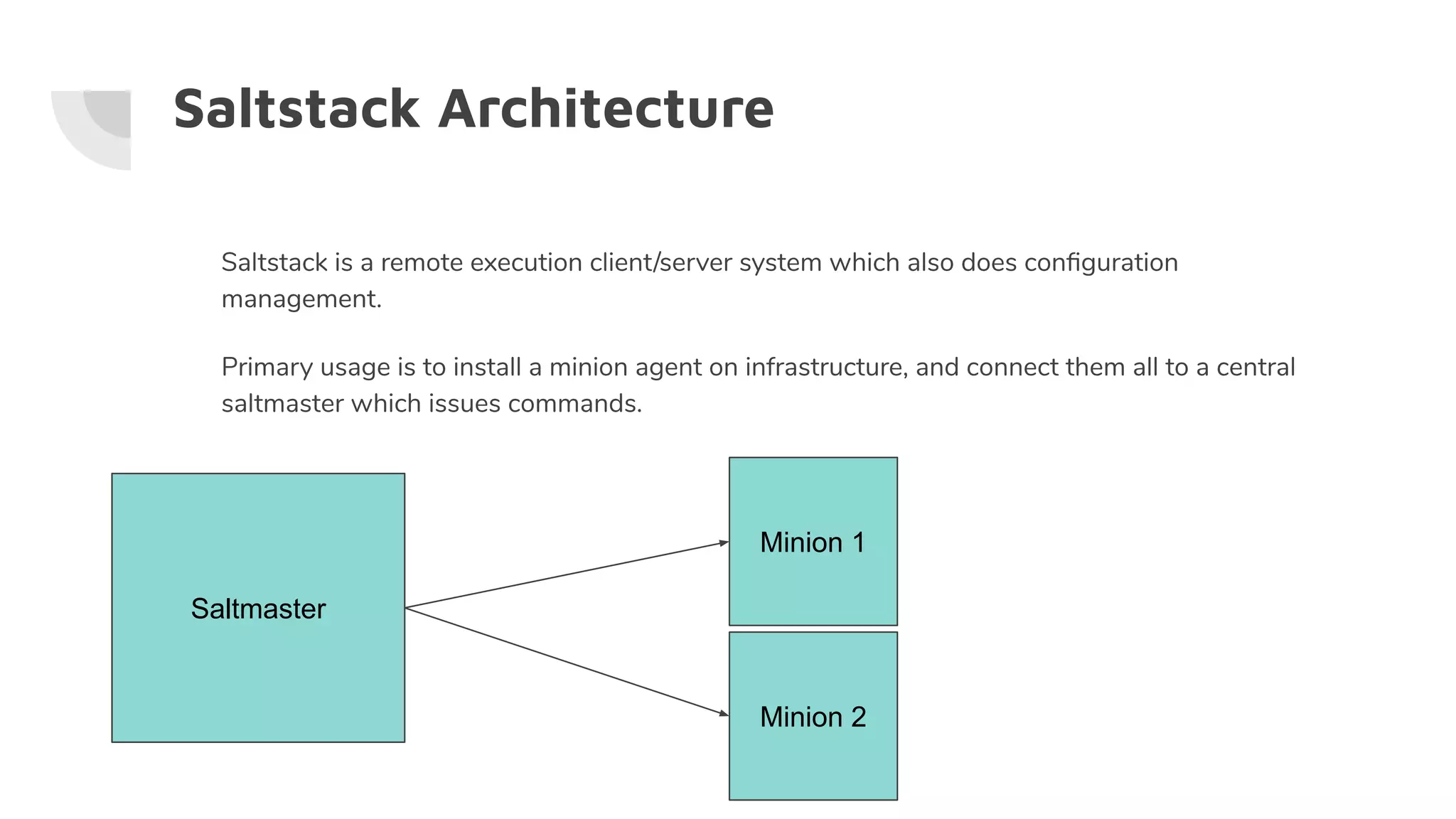
Saltstack Architecture
Saltstack is a remote execution client/server system which also does configuration
management.
Primary usage is to install a minion agent on infrastructure, and connect them all to a central
saltmaster which issues commands.
Saltmaster
Minion 1
Minion 2
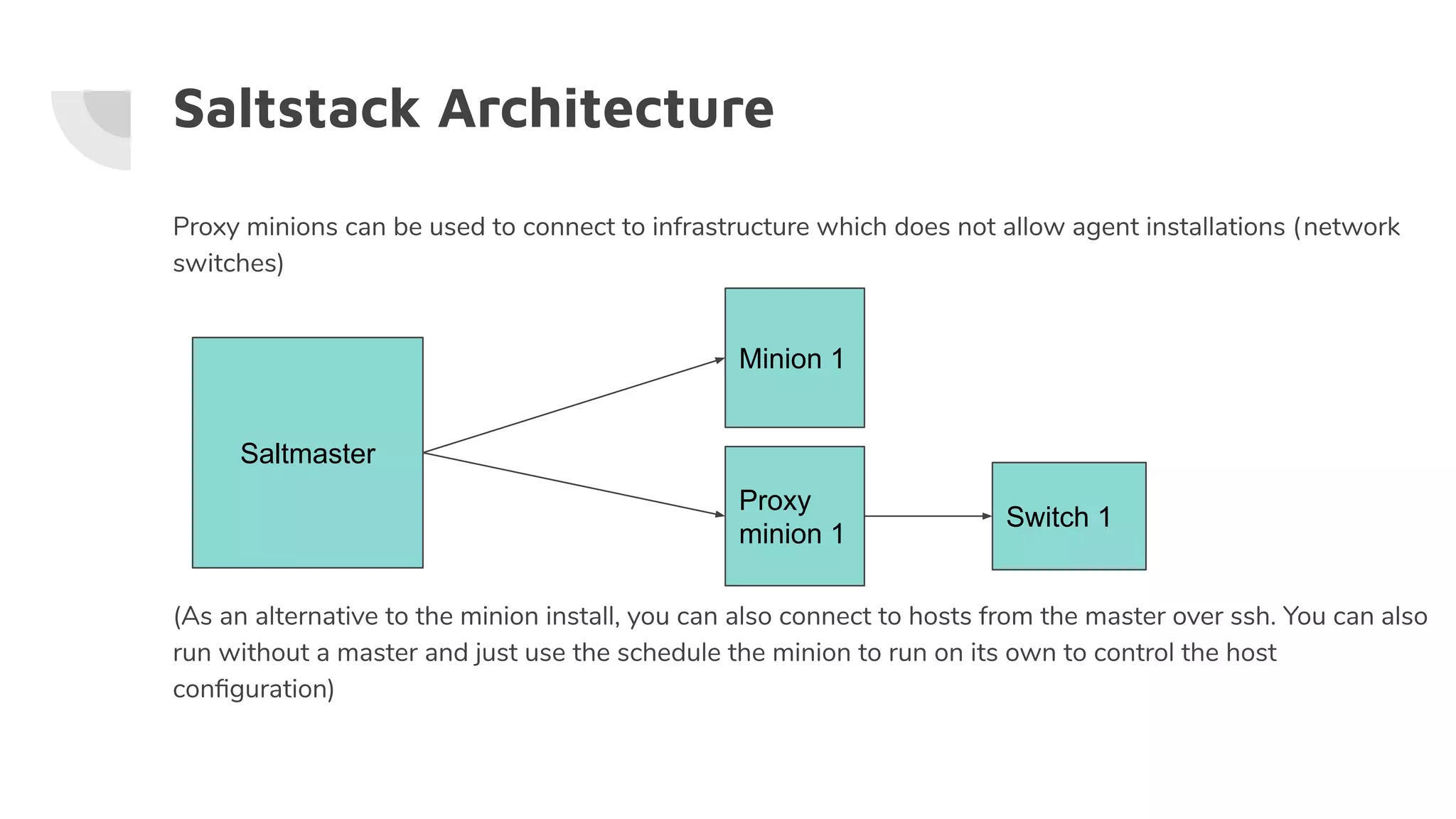
Saltstack Architecture
Proxy minions can be used to connect to infrastructure which does not allow agent installations (network
switches)
Saltmaster
Minion 1
Proxy
minion 1
Switch 1
(As an alternative to the minion install, you can also connect to hosts from the master over ssh. You can also
run without a master and just use the schedule the minion to run on its own to control the host
configuration)
Saltstack Architecture
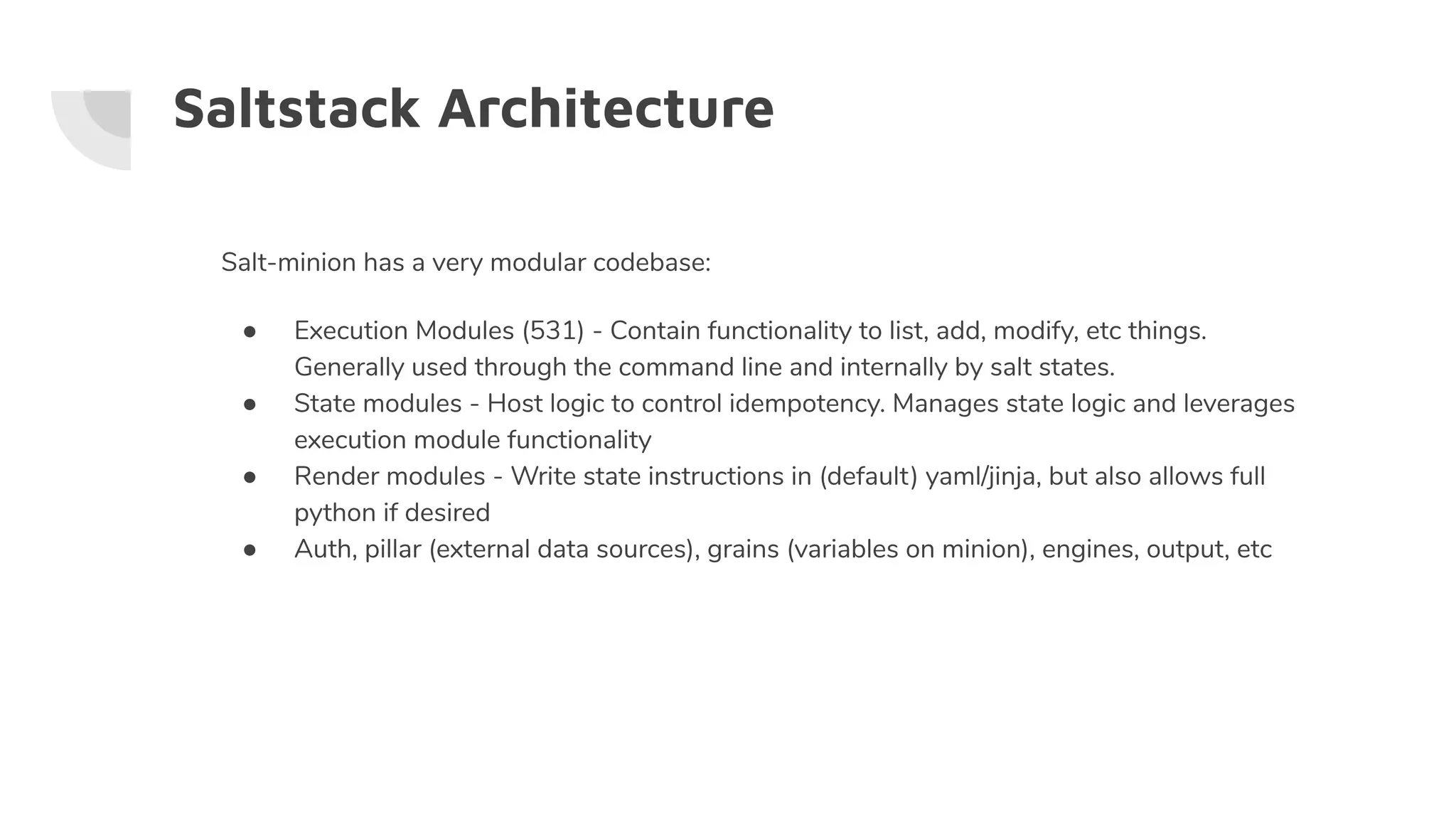
Salt-minion has a very modular codebase:
● Execution Modules (531) - Contain functionality to list, add, modify, etc things.
Generally used through the command line and internally by salt states.
● State modules - Host logic to control idempotency. Manages state logic and leverages
execution module functionality
● Render modules - Write state instructions in (default) yaml/jinja, but also allows full
python if desired
● Auth, pillar (external data sources), grains (variables on minion), engines, output, etc
Saltstack Architecture: yaml/jinja
/etc/http/conf/http.conf:
file.managed:
- source: salt://apache/http.conf
- user: root
- group: root
- mode: 644
{% set motd = ['/etc/motd'] %}
{% if grains['os'] == 'Debian' %}
{% set motd = ['/etc/motd.tail', '/var/run/motd'] %}
{% endif %}
{% for motdfile in motd %}
{{ motdfile }}:
file.managed:
- source: salt://motd
{% endfor %}
Saltcheck
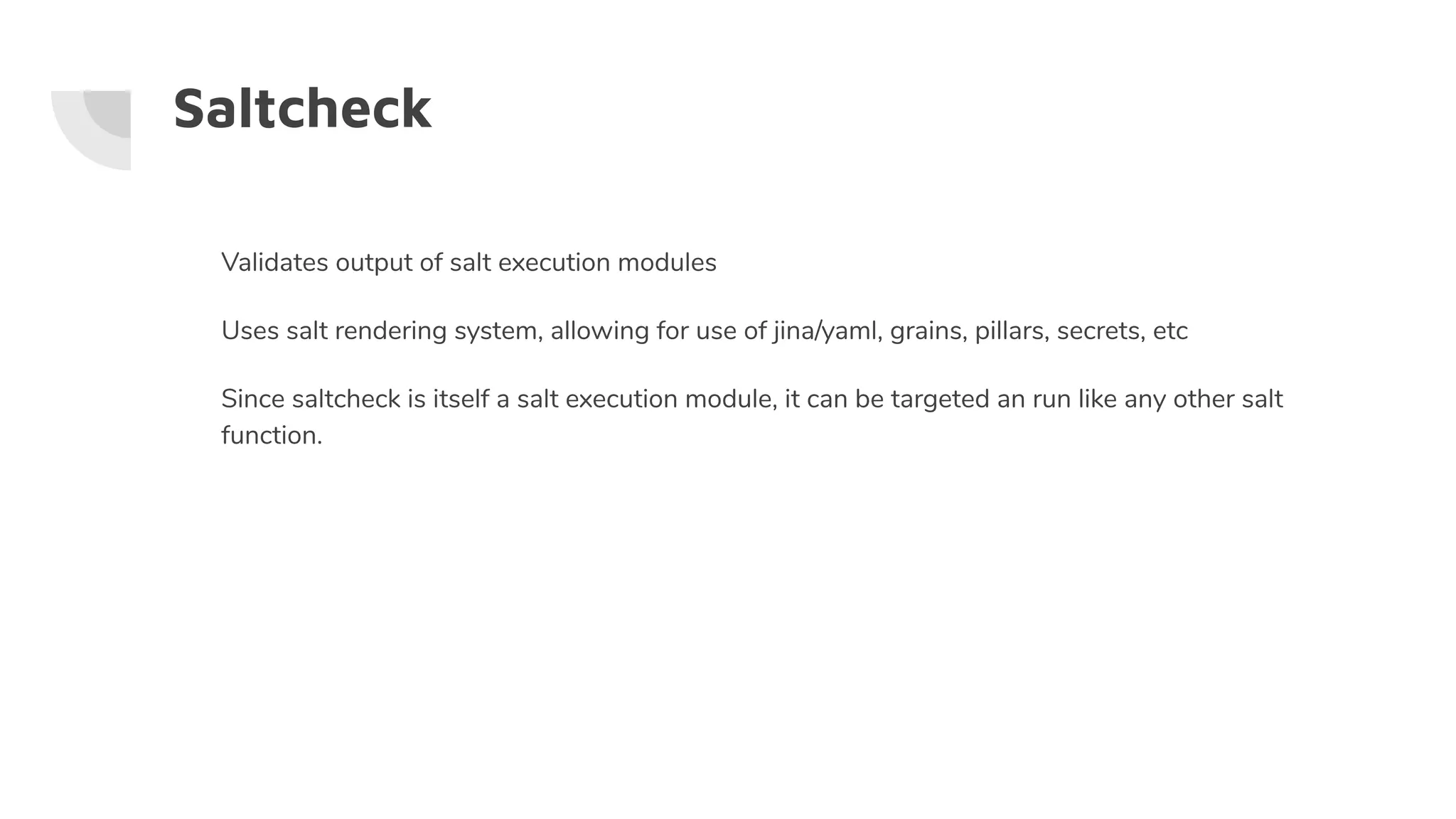
Validates output of salt execution modules
Uses salt rendering system, allowing for use of jina/yaml, grains, pillars, secrets, etc
Since saltcheck is itself a salt execution module, it can be targeted an run like any other salt
function.
Saltcheck
Salt execution module: salt ‘*’ saltcheck.run_highstate_tests
package_latest:
module_and_function: pkg.upgrade_available
args:
- apache2
assertion: assertFalse
{% for package in ["apache2", "openssh"] %}
test_{{ package }}_latest:
module_and_function: pkg.upgrade_available
args:
- {{ package }}
assertion: assertFalse
{% endfor %}
Problem description
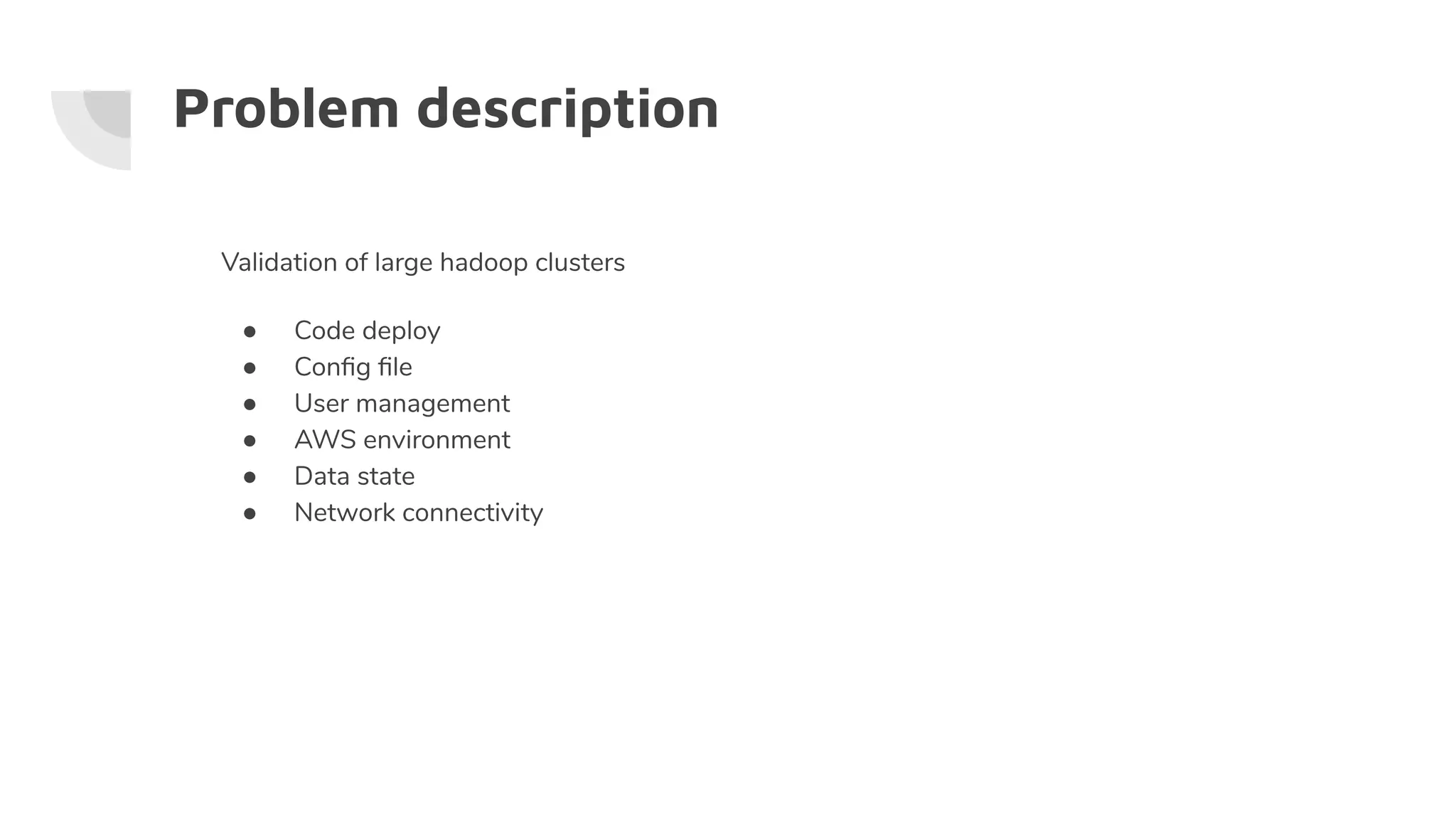
Validation of large hadoop clusters
● Code deploy
● Config file
● User management
● AWS environment
● Data state
● Network connectivity
Saltcheck Example: code deploy
{% set refdata_version = salt['pillar.get']('Refdata_tag:version') %}
{% set oozie_version = salt['grains.get']('ec2_tags:OOZIE_VERSION') %}
{% set prime_version = salt['grains.get']('ec2_tags:PRIME_RELEASE') %}
validate_refdata_jars:
module_and_function: hadoop.dfs_present
args:
- /refData/oozie-automation/{{ refdata_version }}_{{ prime_version
}}/oozie/workflows/refdata-config-{{ prime_version }}.jar
assertion: assertTrue
…
Saltcheck Example: config files
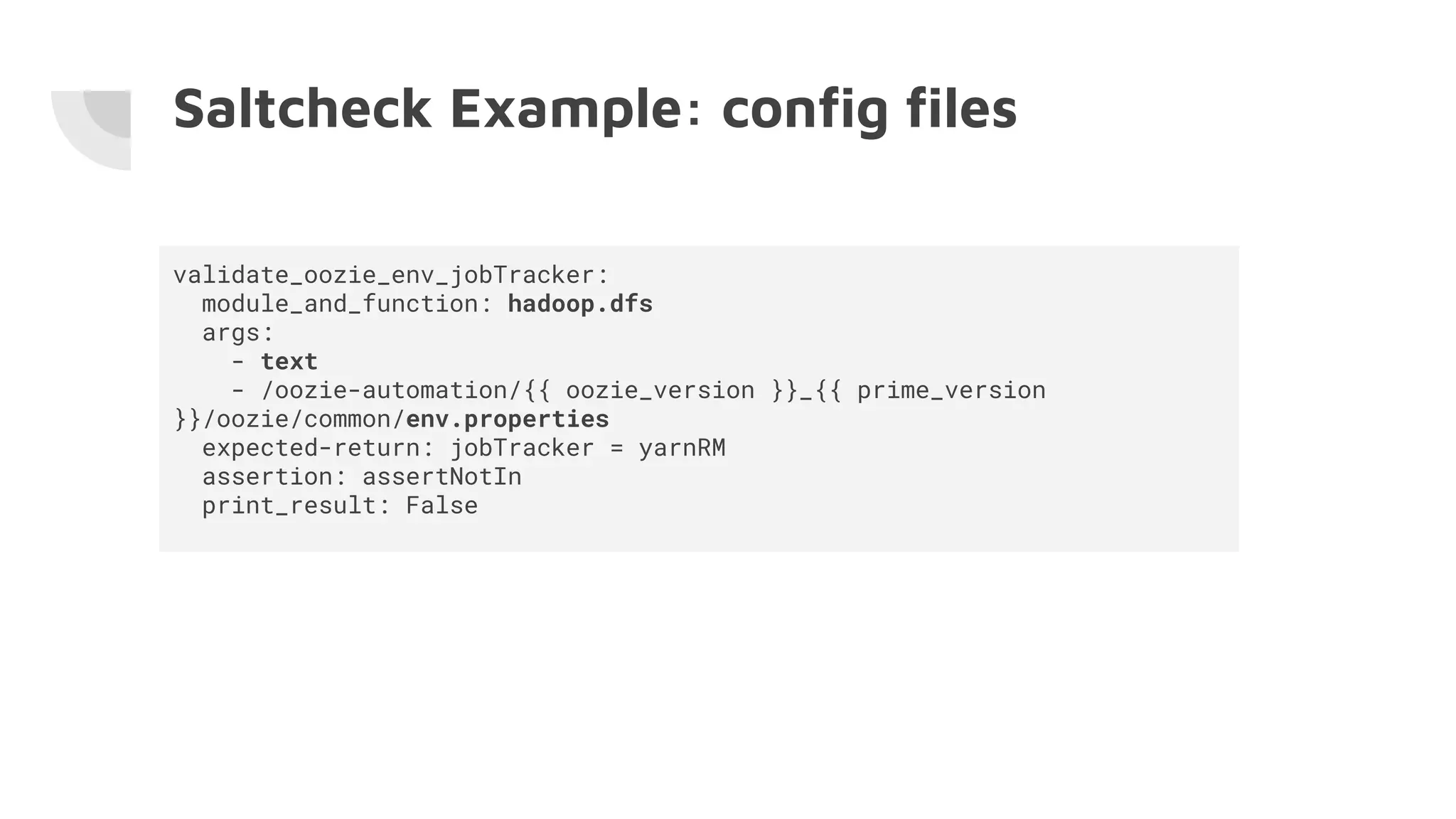
validate_oozie_env_jobTracker:
module_and_function: hadoop.dfs
args:
- text
- /oozie-automation/{{ oozie_version }}_{{ prime_version
}}/oozie/common/env.properties
expected-return: jobTracker = yarnRM
assertion: assertNotIn
print_result: False
Saltcheck Example: user management
{% for usr,data in salt['pillar.get']('users').iteritems() %}
validate_user_{{ usr }}:
module_and_function: user.info
assertion_section: shell
args:
- {{ usr }}
assertion: assertEqual
expected-return: /bin/bash
check_ssh_key_{{ usr }}:
module_and_function: ssh.check_key
args:
- {{ usr }}
- {{ data.key }}
- ssh-rsa
- ''
- ''
assertion: assertEqual
expected-return: exists
{% endfor %}
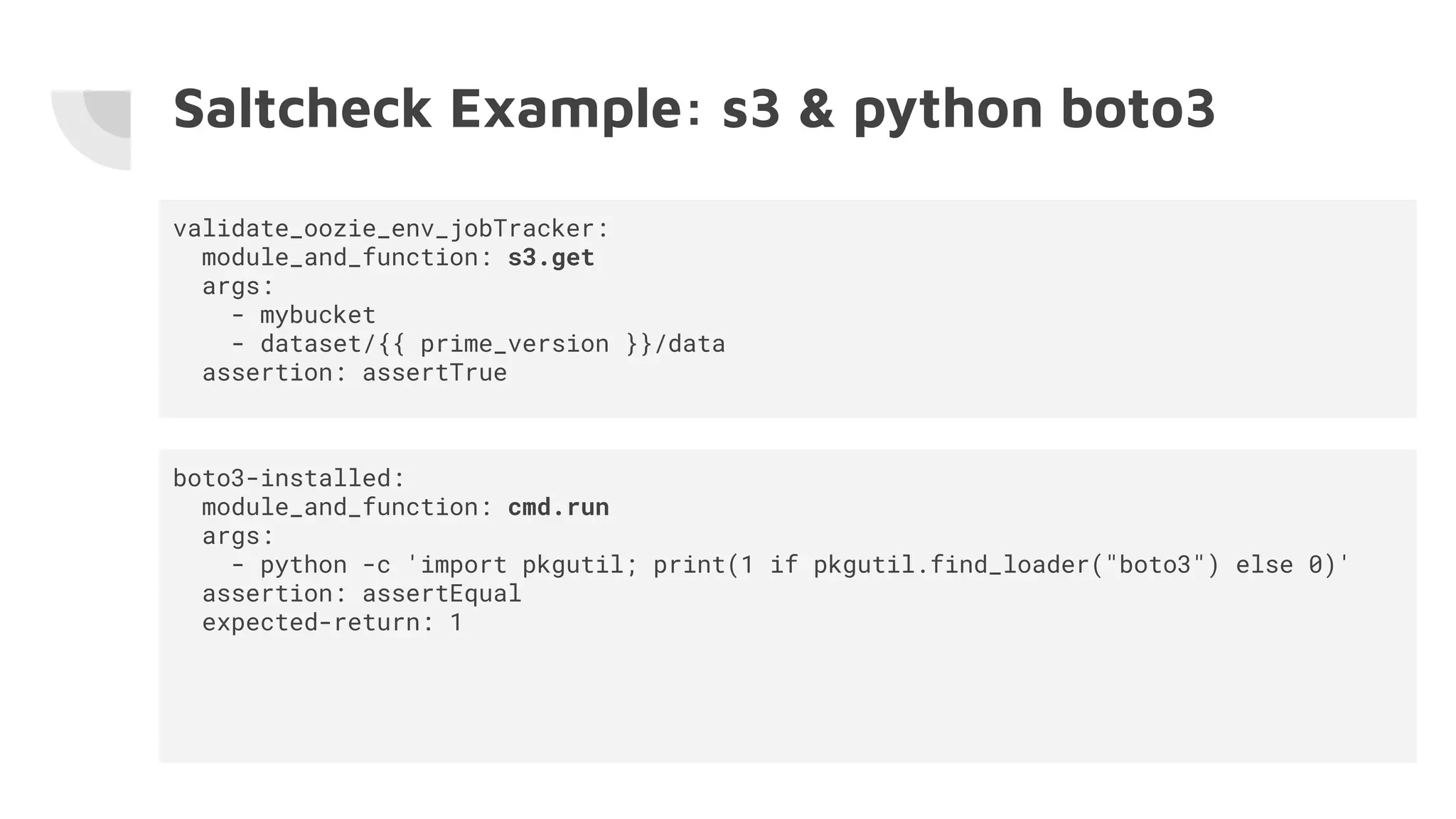
Saltcheck Example: s3 & python boto3
validate_oozie_env_jobTracker:
module_and_function: s3.get
args:
- mybucket
- dataset/{{ prime_version }}/data
assertion: assertTrue
boto3-installed:
module_and_function: cmd.run
args:
- python -c 'import pkgutil; print(1 if pkgutil.find_loader("boto3") else 0)'
assertion: assertEqual
expected-return: 1
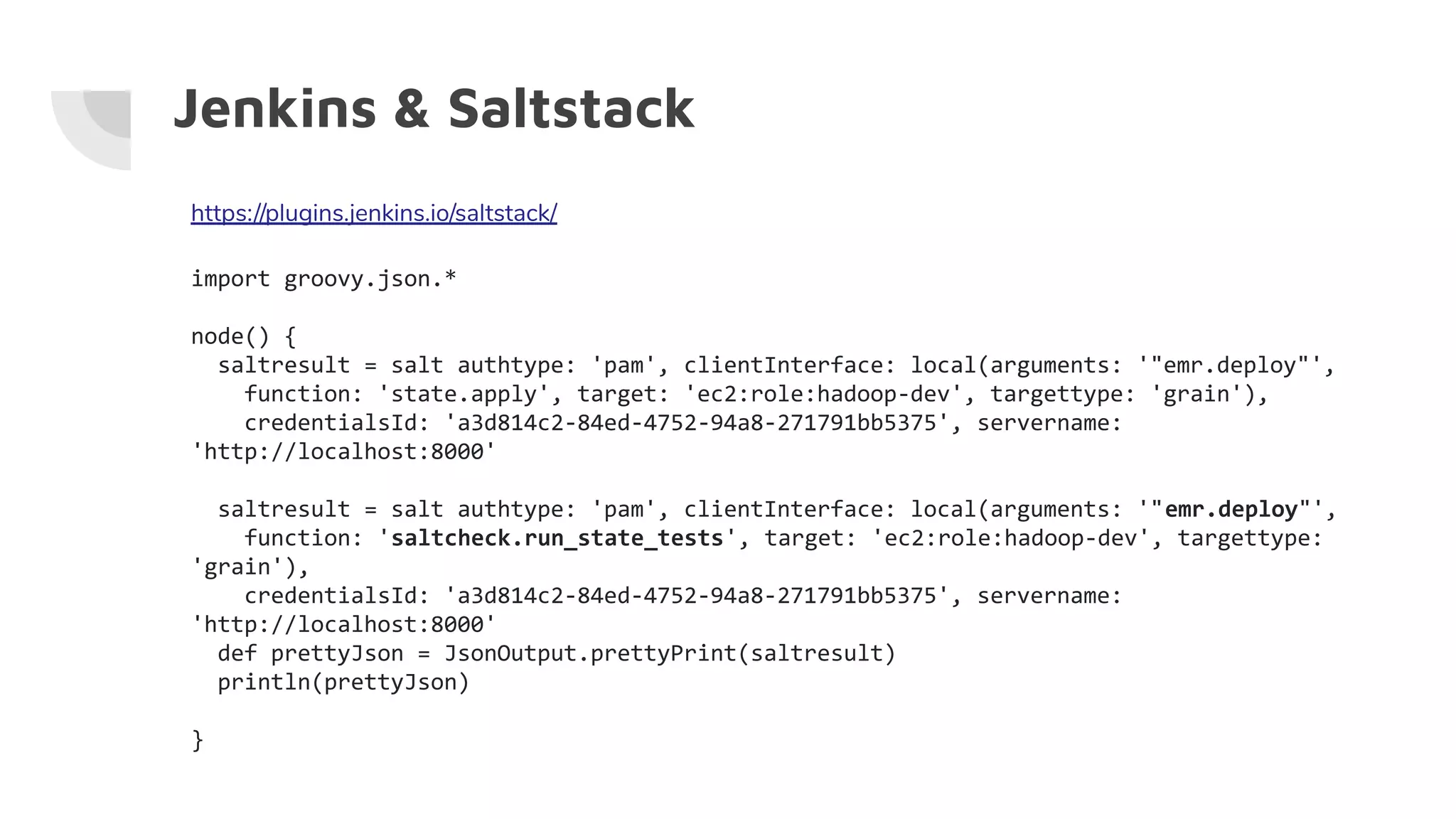
Jenkins & Saltstack
https://plugins.jenkins.io/saltstack/
import groovy.json.*
node() {
saltresult = salt authtype: 'pam', clientInterface: local(arguments: '"emr.deploy"',
function: 'state.apply', target: 'ec2:role:hadoop-dev', targettype: 'grain'),
credentialsId: 'a3d814c2-84ed-4752-94a8-271791bb5375', servername:
'http://localhost:8000'
saltresult = salt authtype: 'pam', clientInterface: local(arguments: '"emr.deploy"',
function: 'saltcheck.run_state_tests', target: 'ec2:role:hadoop-dev', targettype:
'grain'),
credentialsId: 'a3d814c2-84ed-4752-94a8-271791bb5375', servername:
'http://localhost:8000'
def prettyJson = JsonOutput.prettyPrint(saltresult)
println(prettyJson)
}
Tool Summary
Saltcheck is able to use Salt’s remote execution capabilities and modules to talk to a wide
variety of infrastructure. All while utilizing the same familiar markup, and data backends.
For teams using Salt, saltcheck allows for knowledge reuse and shareable patterns
Tool Sprawl
Teams have limited resources and capacity for yet another thing
IT trends toward specialization, be aware of the load put on your teams
Thank you

Saltcheck: a tool in the salt toolbox

  • 1.
  • 2.
  • 3.
  • 4.
    Saltstack Architecture Saltstack isa remote execution client/server system which also does configuration management. Primary usage is to install a minion agent on infrastructure, and connect them all to a central saltmaster which issues commands. Saltmaster Minion 1 Minion 2
  • 5.
    Saltstack Architecture Proxy minionscan be used to connect to infrastructure which does not allow agent installations (network switches) Saltmaster Minion 1 Proxy minion 1 Switch 1 (As an alternative to the minion install, you can also connect to hosts from the master over ssh. You can also run without a master and just use the schedule the minion to run on its own to control the host configuration)
  • 6.
    Saltstack Architecture Salt-minion hasa very modular codebase: ● Execution Modules (531) - Contain functionality to list, add, modify, etc things. Generally used through the command line and internally by salt states. ● State modules - Host logic to control idempotency. Manages state logic and leverages execution module functionality ● Render modules - Write state instructions in (default) yaml/jinja, but also allows full python if desired ● Auth, pillar (external data sources), grains (variables on minion), engines, output, etc
  • 7.
    Saltstack Architecture: yaml/jinja /etc/http/conf/http.conf: file.managed: -source: salt://apache/http.conf - user: root - group: root - mode: 644 {% set motd = ['/etc/motd'] %} {% if grains['os'] == 'Debian' %} {% set motd = ['/etc/motd.tail', '/var/run/motd'] %} {% endif %} {% for motdfile in motd %} {{ motdfile }}: file.managed: - source: salt://motd {% endfor %}
  • 8.
    Saltcheck Validates output ofsalt execution modules Uses salt rendering system, allowing for use of jina/yaml, grains, pillars, secrets, etc Since saltcheck is itself a salt execution module, it can be targeted an run like any other salt function.
  • 9.
    Saltcheck Salt execution module:salt ‘*’ saltcheck.run_highstate_tests package_latest: module_and_function: pkg.upgrade_available args: - apache2 assertion: assertFalse {% for package in ["apache2", "openssh"] %} test_{{ package }}_latest: module_and_function: pkg.upgrade_available args: - {{ package }} assertion: assertFalse {% endfor %}
  • 10.
    Problem description Validation oflarge hadoop clusters ● Code deploy ● Config file ● User management ● AWS environment ● Data state ● Network connectivity
  • 11.
    Saltcheck Example: codedeploy {% set refdata_version = salt['pillar.get']('Refdata_tag:version') %} {% set oozie_version = salt['grains.get']('ec2_tags:OOZIE_VERSION') %} {% set prime_version = salt['grains.get']('ec2_tags:PRIME_RELEASE') %} validate_refdata_jars: module_and_function: hadoop.dfs_present args: - /refData/oozie-automation/{{ refdata_version }}_{{ prime_version }}/oozie/workflows/refdata-config-{{ prime_version }}.jar assertion: assertTrue …
  • 12.
    Saltcheck Example: configfiles validate_oozie_env_jobTracker: module_and_function: hadoop.dfs args: - text - /oozie-automation/{{ oozie_version }}_{{ prime_version }}/oozie/common/env.properties expected-return: jobTracker = yarnRM assertion: assertNotIn print_result: False
  • 13.
    Saltcheck Example: usermanagement {% for usr,data in salt['pillar.get']('users').iteritems() %} validate_user_{{ usr }}: module_and_function: user.info assertion_section: shell args: - {{ usr }} assertion: assertEqual expected-return: /bin/bash check_ssh_key_{{ usr }}: module_and_function: ssh.check_key args: - {{ usr }} - {{ data.key }} - ssh-rsa - '' - '' assertion: assertEqual expected-return: exists {% endfor %}
  • 14.
    Saltcheck Example: s3& python boto3 validate_oozie_env_jobTracker: module_and_function: s3.get args: - mybucket - dataset/{{ prime_version }}/data assertion: assertTrue boto3-installed: module_and_function: cmd.run args: - python -c 'import pkgutil; print(1 if pkgutil.find_loader("boto3") else 0)' assertion: assertEqual expected-return: 1
  • 15.
    Jenkins & Saltstack https://plugins.jenkins.io/saltstack/ importgroovy.json.* node() { saltresult = salt authtype: 'pam', clientInterface: local(arguments: '"emr.deploy"', function: 'state.apply', target: 'ec2:role:hadoop-dev', targettype: 'grain'), credentialsId: 'a3d814c2-84ed-4752-94a8-271791bb5375', servername: 'http://localhost:8000' saltresult = salt authtype: 'pam', clientInterface: local(arguments: '"emr.deploy"', function: 'saltcheck.run_state_tests', target: 'ec2:role:hadoop-dev', targettype: 'grain'), credentialsId: 'a3d814c2-84ed-4752-94a8-271791bb5375', servername: 'http://localhost:8000' def prettyJson = JsonOutput.prettyPrint(saltresult) println(prettyJson) }
  • 16.
    Tool Summary Saltcheck isable to use Salt’s remote execution capabilities and modules to talk to a wide variety of infrastructure. All while utilizing the same familiar markup, and data backends. For teams using Salt, saltcheck allows for knowledge reuse and shareable patterns
  • 17.
    Tool Sprawl Teams havelimited resources and capacity for yet another thing IT trends toward specialization, be aware of the load put on your teams
  • 18.