Stefanović Miloš MH-150210
Contents:
1. History
2. Chemistry
3. Production
4. Salt in food
5. Salt in agriculture
6. Diet and helth
History:
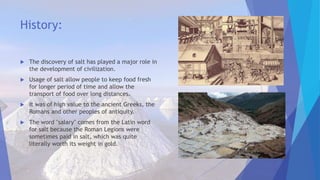
 The discovery of salt has played a major role in
the development of civilization.
 Usage of salt allow people to keep food fresh
for longer period of time and allow the
transport of food over long distances.
 It was of high value to the ancient Greeks, the
Romans and other peoples of antiquity.
 The word "salary" comes from the Latin word
for salt because the Roman Legions were
sometimes paid in salt, which was quite
literally worth its weight in gold.
Chemistry:
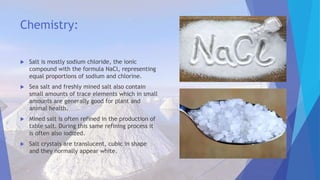
 Salt is mostly sodium chloride, the ionic
compound with the formula NaCl, representing
equal proportions of sodium and chlorine.
 Sea salt and freshly mined salt also contain
small amounts of trace elements which in small
amounts are generally good for plant and
animal health.
 Mined salt is often refined in the production of
table salt. During this same refining process it
is often also iodized.
 Salt crystals are translucent, cubic in shape
and they normally appear white.
Production:
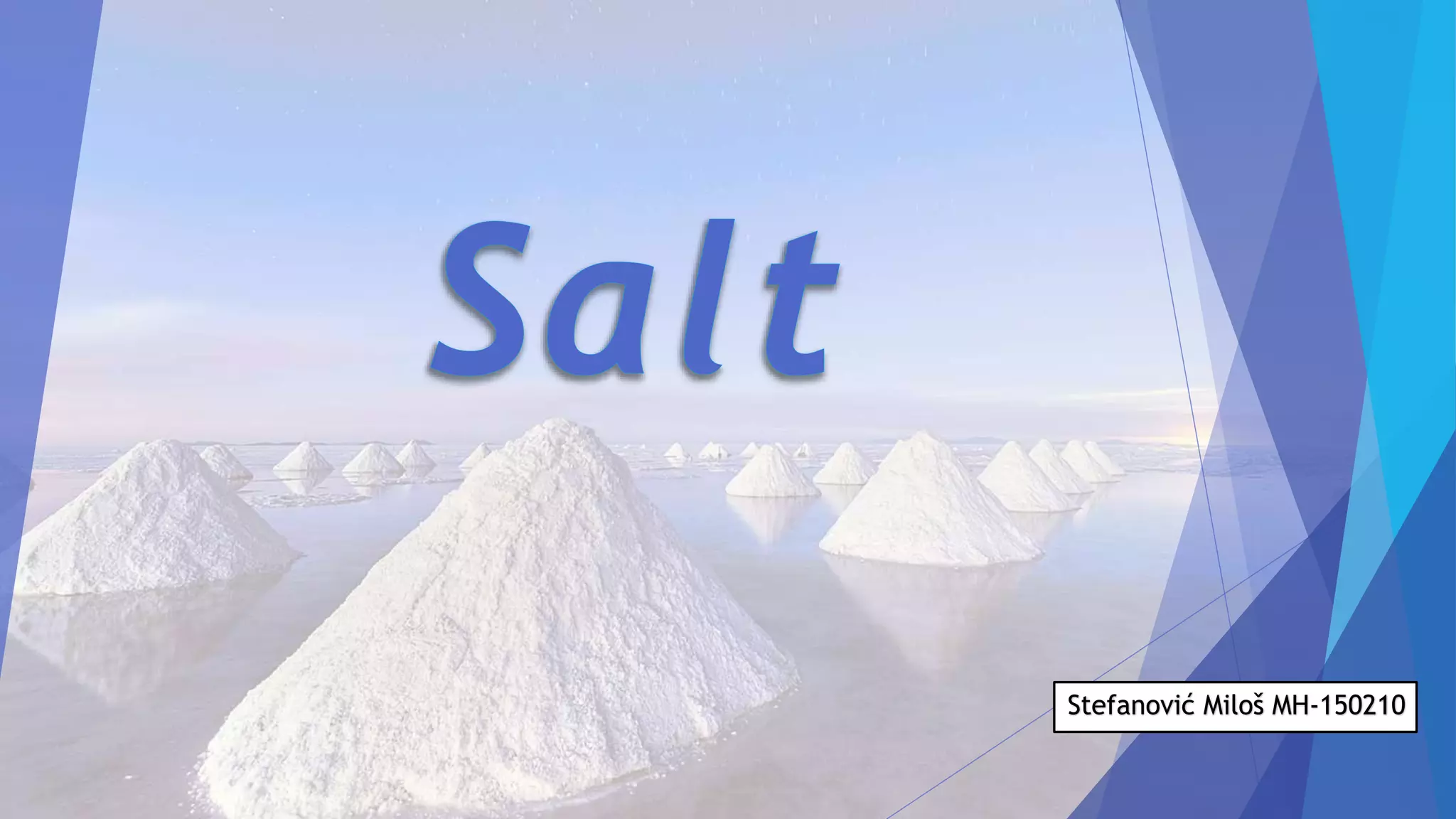
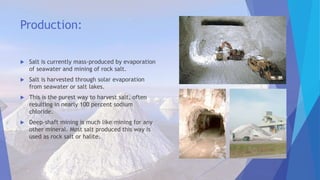
 Salt is currently mass-produced by evaporation
of seawater and mining of rock salt.
 Salt is harvested through solar evaporation
from seawater or salt lakes.
 This is the purest way to harvest salt, often
resulting in nearly 100 percent sodium
chloride.
 Deep-shaft mining is much like mining for any
other mineral. Most salt produced this way is
used as rock salt or halite.
Salt in food:
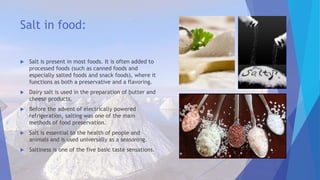
 Salt is present in most foods. It is often added to
processed foods (such as canned foods and
especially salted foods and snack foods), where it
functions as both a preservative and a flavoring.
 Dairy salt is used in the preparation of butter and
cheese products.
 Before the advent of electrically powered
refrigeration, salting was one of the main
methods of food preservation.
 Salt is essential to the health of people and
animals and is used universally as a seasoning.
 Saltiness is one of the five basic taste sensations.
Salt in agriculture:
 In many dairy industries, salt is added to cheese as a
color, fermentation, and texture-control agent. The
dairy subsector includes companies that manufacture
creamery butter, condensed and evaporated milk, frozen
desserts, ice cream, natural and processed cheese, and
specialty dairy products.
 In canning, salt is primarily added as a flavor enhancer
and preservative.
 It is used as a carrier for other ingredients, dehydrating
agent, enzyme inhibitor and tenderizer. In baking, salt is
added to control the rate of fermentation in bread
dough.
 It also is used to strengthen the gluten (the elastic
protein-water complex in certain doughs) and as a flavor
enhancer, such as a topping on baked goods.
Diet and health:
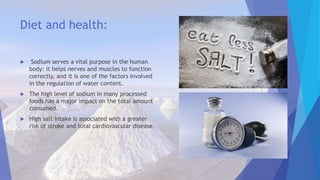
 Sodium serves a vital purpose in the human
body: it helps nerves and muscles to function
correctly, and it is one of the factors involved
in the regulation of water content.
 The high level of sodium in many processed
foods has a major impact on the total amount
consumed.
 High salt intake is associated with a greater
risk of stroke and total cardiovascular disease.
Summary:
 Common salt is a mineral composed primarily of sodium chloride (NaCl). Salt is
one of the oldest of food seasonings, and salting is an important method of food
preservation. The harvest of salt in China dates back to at least 6000 BC, making
it one of the oldest verifiable salt works. Salt is essential to the health of people
and animals and is used universally as a seasoning. It is used in cooking, is added
to manufactured foodstuffs and is often present on the table at mealtimes for
individuals to sprinkle on their own food. Saltiness is one of the five basic taste
sensations. Iodized salt, containing potassium iodide, has significantly reduced
disorders of iodine deficiency. Salt is used in many food industries for
preservations, flavour enhancer, dehydrating, seasoning, etc. Sodium helps
nerves and muscles to function correctly and it involve in the regulation of water
content in organism, but high salt intake can be bad for health.
Literature:
 https://en.wikipedia.org
 http://healthyeating.sfgate.com
 http://chemistry.elmhurst.edu
 http://wikinfo.wikia.com

Salt

  • 1.
  • 2.
    Contents: 1. History 2. Chemistry 3.Production 4. Salt in food 5. Salt in agriculture 6. Diet and helth
  • 3.
    History:  The discoveryof salt has played a major role in the development of civilization.  Usage of salt allow people to keep food fresh for longer period of time and allow the transport of food over long distances.  It was of high value to the ancient Greeks, the Romans and other peoples of antiquity.  The word "salary" comes from the Latin word for salt because the Roman Legions were sometimes paid in salt, which was quite literally worth its weight in gold.
  • 4.
    Chemistry:  Salt ismostly sodium chloride, the ionic compound with the formula NaCl, representing equal proportions of sodium and chlorine.  Sea salt and freshly mined salt also contain small amounts of trace elements which in small amounts are generally good for plant and animal health.  Mined salt is often refined in the production of table salt. During this same refining process it is often also iodized.  Salt crystals are translucent, cubic in shape and they normally appear white.
  • 5.
    Production:  Salt iscurrently mass-produced by evaporation of seawater and mining of rock salt.  Salt is harvested through solar evaporation from seawater or salt lakes.  This is the purest way to harvest salt, often resulting in nearly 100 percent sodium chloride.  Deep-shaft mining is much like mining for any other mineral. Most salt produced this way is used as rock salt or halite.
  • 6.
    Salt in food: Salt is present in most foods. It is often added to processed foods (such as canned foods and especially salted foods and snack foods), where it functions as both a preservative and a flavoring.  Dairy salt is used in the preparation of butter and cheese products.  Before the advent of electrically powered refrigeration, salting was one of the main methods of food preservation.  Salt is essential to the health of people and animals and is used universally as a seasoning.  Saltiness is one of the five basic taste sensations.
  • 7.
    Salt in agriculture: In many dairy industries, salt is added to cheese as a color, fermentation, and texture-control agent. The dairy subsector includes companies that manufacture creamery butter, condensed and evaporated milk, frozen desserts, ice cream, natural and processed cheese, and specialty dairy products.  In canning, salt is primarily added as a flavor enhancer and preservative.  It is used as a carrier for other ingredients, dehydrating agent, enzyme inhibitor and tenderizer. In baking, salt is added to control the rate of fermentation in bread dough.  It also is used to strengthen the gluten (the elastic protein-water complex in certain doughs) and as a flavor enhancer, such as a topping on baked goods.
  • 8.
    Diet and health: Sodium serves a vital purpose in the human body: it helps nerves and muscles to function correctly, and it is one of the factors involved in the regulation of water content.  The high level of sodium in many processed foods has a major impact on the total amount consumed.  High salt intake is associated with a greater risk of stroke and total cardiovascular disease.
  • 9.
    Summary:  Common saltis a mineral composed primarily of sodium chloride (NaCl). Salt is one of the oldest of food seasonings, and salting is an important method of food preservation. The harvest of salt in China dates back to at least 6000 BC, making it one of the oldest verifiable salt works. Salt is essential to the health of people and animals and is used universally as a seasoning. It is used in cooking, is added to manufactured foodstuffs and is often present on the table at mealtimes for individuals to sprinkle on their own food. Saltiness is one of the five basic taste sensations. Iodized salt, containing potassium iodide, has significantly reduced disorders of iodine deficiency. Salt is used in many food industries for preservations, flavour enhancer, dehydrating, seasoning, etc. Sodium helps nerves and muscles to function correctly and it involve in the regulation of water content in organism, but high salt intake can be bad for health.
  • 10.
    Literature:  https://en.wikipedia.org  http://healthyeating.sfgate.com http://chemistry.elmhurst.edu  http://wikinfo.wikia.com