The Sales Organization
The Sales Organization 2
Objectives
 Role of a Sales Organization
 Basis for Designing a Sales Organization
 Types of Organizations
 Types of Sales Force Structure
 Sales Culture
The Sales Organization 3
Role of a Sales Organization
 Permit development of specialists
 Achievement of company objectives
 Achieve coordination and balance
 Economize executive time
The Sales Organization 4
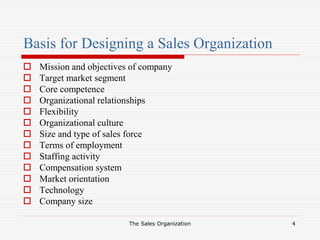
Basis for Designing a Sales Organization
 Mission and objectives of company
 Target market segment
 Core competence
 Organizational relationships
 Flexibility
 Organizational culture
 Size and type of sales force
 Terms of employment
 Staffing activity
 Compensation system
 Market orientation
 Technology
 Company size
The Sales Organization 5
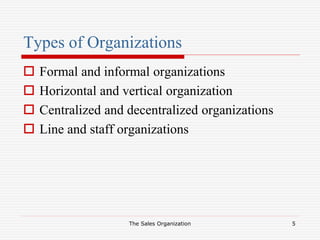
Types of Organizations
 Formal and informal organizations
 Horizontal and vertical organization
 Centralized and decentralized organizations
 Line and staff organizations
The Sales Organization 6
Formal Organizations
 Advantages
 Clear-cut reporting system
 Easier evaluation of sales performance
 Structured and defined format to perform every task
 Clearly defined policies, procedures and hierarchy
 Disadvantages
 Extensive departmentalization
 Rigidity in reporting relationship
 Lesser personal contact between superiors and subordinates
The Sales Organization 7
Informal Organizations
 Advantages
 Allows informal groups within an organization
including personnel from different departments
allow proper interaction on various tasks
 Develop positive norms and values
 Disadvantages
 May not support the goals and objectives
established by organization
 May lead to informal leaders having unhealthy
control over group members
The Sales Organization 8
Vertical Organization Structure
 Traditional management structure
 Basis of control is authority
 More hierarchy levels
 Narrow span of control
 Advantages
 Work is first organized on basis of functions then on departments
then on tasks
 Lesser possibility of information loss down the hierarchy
 Less chance of duplication of authority
 Disadvantages
 Many hierarchical levels - more additional staff
 Complicated communication objectives, policies and plans
The Sales Organization 9
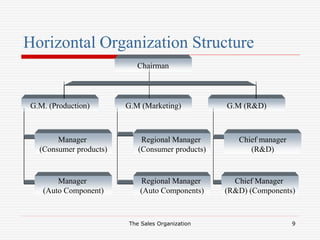
Horizontal Organization Structure
Chairman
G.M. (Production) G.M (Marketing) G.M (R&D)
Manager
(Consumer products)
Regional Manager
(Consumer products)
Chief manager
(R&D)
Manager
(Auto Component)
Regional Manager
(Auto Components)
Chief Manager
(R&D) (Components)
The Sales Organization 10
Horizontal Organization Structure
 Advantages
 Less number of hierarchical levels
 Faster response to market changes
 Facilitates teamwork and collaboration
 Improve decision-making
 Disadvantages
 Loss of competitiveness
 Not suited for all operations
 Require investment to train employees
The Sales Organization 11
Line Organization Structure
 Advantages
 Less expensive
 Facilitates easier coordination of activities
 Helps in quick decision making
 Prevents conflicts
 Disadvantages
 Inappropriate decisions by manager may lack self
perspective
 Inherent complexity
The Sales Organization 12
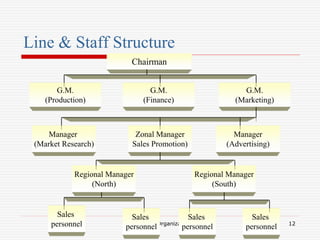
Line & Staff Structure
Chairman
G.M.
(Production)
G.M.
(Finance)
G.M.
(Marketing)
Manager
(Market Research)
Regional Manager
(South)
Regional Manager
(North)
Zonal Manager
Sales Promotion)
Manager
(Advertising)
Sales
personnel
Sales
personnel
Sales
personnel
Sales
personnel
The Sales Organization 13
Line & Staff Structure
 Advantages
 Quality of Decisions
 Most suitable for organization having few products
 Disadvantages
 Conflict in objectives of life and staff personnel
 Lack of coordination
The Sales Organization 14
Types of Sales Force Structure
 Product-based sales force structure
 Geographic-based sales force structure
 Customer-based sales force structure
 Combination-based sales force structure
The Sales Organization 15
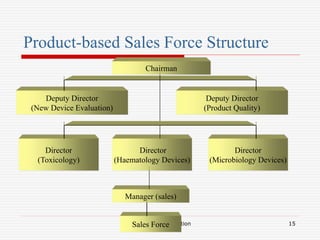
Product-based Sales Force Structure
Chairman
Deputy Director
(New Device Evaluation)
Deputy Director
(Product Quality)
Director
(Toxicology)
Director
(Haematology Devices)
Director
(Microbiology Devices)
Manager (sales)
Sales Force
The Sales Organization 16
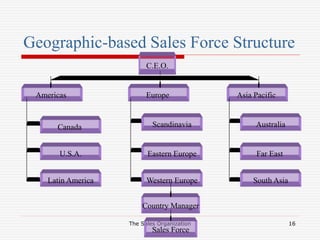
Geographic-based Sales Force Structure
C.E.O.
Americas Europe Asia Pacific
Canada
U.S.A.
Latin America Western Europe
Eastern Europe
Scandinavia
South Asia
Far East
Australia
Sales Force
Country Manager
The Sales Organization 17
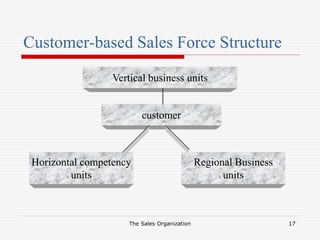
Customer-based Sales Force Structure
Vertical business units
customer
Horizontal competency
units
Regional Business
units
The Sales Organization 18
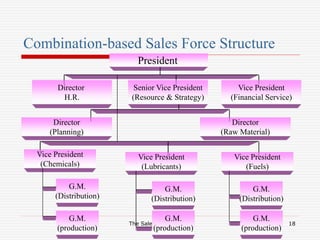
Combination-based Sales Force Structure
President
Senior Vice President
(Resource & Strategy)
Director
H.R.
Vice President
(Financial Service)
Director
(Planning)
Director
(Raw Material)
Vice President
(Chemicals)
Vice President
(Lubricants)
Vice President
(Fuels)
G.M.
(Distribution)
G.M.
(production)
G.M.
(production)
G.M.
(Distribution)
G.M.
(production)
G.M.
(Distribution)
The Sales Organization 19
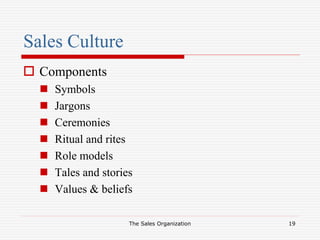
Sales Culture
 Components
 Symbols
 Jargons
 Ceremonies
 Ritual and rites
 Role models
 Tales and stories
 Values & beliefs
The Sales Organization 20
Stages in Formation of Sales Culture in an
Organization
Organization takes steps
To modify or create
A better culture
Symbols, tales and stories,
Ceremonies, routine activities,
role models, language, values
And beliefs.
The learnt culture
Becomes a routine
Behavior
For a sales personnel
These are
Imbibed by
Sales
Personnel
Meaning are
Interpreted by sales
Personnel.
Interpretation are
Evaluated
By sales
personnel
The Sales Organization 21
Role of Sales Culture in Developing a Sound
Sales Organization
 The success of sales culture depends on
 Strength of sales culture
 Direction or fit of sales culture
The Sales Organization 22
Summary
 Role of a Sales Organization
 Basis for Designing a Sales Organization
 Types of Organizations
 Types of Sales Force Structure
 Sales Culture
Thank you

Sales Organisation.ppt

  • 1.
  • 2.
    The Sales Organization2 Objectives  Role of a Sales Organization  Basis for Designing a Sales Organization  Types of Organizations  Types of Sales Force Structure  Sales Culture
  • 3.
    The Sales Organization3 Role of a Sales Organization  Permit development of specialists  Achievement of company objectives  Achieve coordination and balance  Economize executive time
  • 4.
    The Sales Organization4 Basis for Designing a Sales Organization  Mission and objectives of company  Target market segment  Core competence  Organizational relationships  Flexibility  Organizational culture  Size and type of sales force  Terms of employment  Staffing activity  Compensation system  Market orientation  Technology  Company size
  • 5.
    The Sales Organization5 Types of Organizations  Formal and informal organizations  Horizontal and vertical organization  Centralized and decentralized organizations  Line and staff organizations
  • 6.
    The Sales Organization6 Formal Organizations  Advantages  Clear-cut reporting system  Easier evaluation of sales performance  Structured and defined format to perform every task  Clearly defined policies, procedures and hierarchy  Disadvantages  Extensive departmentalization  Rigidity in reporting relationship  Lesser personal contact between superiors and subordinates
  • 7.
    The Sales Organization7 Informal Organizations  Advantages  Allows informal groups within an organization including personnel from different departments allow proper interaction on various tasks  Develop positive norms and values  Disadvantages  May not support the goals and objectives established by organization  May lead to informal leaders having unhealthy control over group members
  • 8.
    The Sales Organization8 Vertical Organization Structure  Traditional management structure  Basis of control is authority  More hierarchy levels  Narrow span of control  Advantages  Work is first organized on basis of functions then on departments then on tasks  Lesser possibility of information loss down the hierarchy  Less chance of duplication of authority  Disadvantages  Many hierarchical levels - more additional staff  Complicated communication objectives, policies and plans
  • 9.
    The Sales Organization9 Horizontal Organization Structure Chairman G.M. (Production) G.M (Marketing) G.M (R&D) Manager (Consumer products) Regional Manager (Consumer products) Chief manager (R&D) Manager (Auto Component) Regional Manager (Auto Components) Chief Manager (R&D) (Components)
  • 10.
    The Sales Organization10 Horizontal Organization Structure  Advantages  Less number of hierarchical levels  Faster response to market changes  Facilitates teamwork and collaboration  Improve decision-making  Disadvantages  Loss of competitiveness  Not suited for all operations  Require investment to train employees
  • 11.
    The Sales Organization11 Line Organization Structure  Advantages  Less expensive  Facilitates easier coordination of activities  Helps in quick decision making  Prevents conflicts  Disadvantages  Inappropriate decisions by manager may lack self perspective  Inherent complexity
  • 12.
    The Sales Organization12 Line & Staff Structure Chairman G.M. (Production) G.M. (Finance) G.M. (Marketing) Manager (Market Research) Regional Manager (South) Regional Manager (North) Zonal Manager Sales Promotion) Manager (Advertising) Sales personnel Sales personnel Sales personnel Sales personnel
  • 13.
    The Sales Organization13 Line & Staff Structure  Advantages  Quality of Decisions  Most suitable for organization having few products  Disadvantages  Conflict in objectives of life and staff personnel  Lack of coordination
  • 14.
    The Sales Organization14 Types of Sales Force Structure  Product-based sales force structure  Geographic-based sales force structure  Customer-based sales force structure  Combination-based sales force structure
  • 15.
    The Sales Organization15 Product-based Sales Force Structure Chairman Deputy Director (New Device Evaluation) Deputy Director (Product Quality) Director (Toxicology) Director (Haematology Devices) Director (Microbiology Devices) Manager (sales) Sales Force
  • 16.
    The Sales Organization16 Geographic-based Sales Force Structure C.E.O. Americas Europe Asia Pacific Canada U.S.A. Latin America Western Europe Eastern Europe Scandinavia South Asia Far East Australia Sales Force Country Manager
  • 17.
    The Sales Organization17 Customer-based Sales Force Structure Vertical business units customer Horizontal competency units Regional Business units
  • 18.
    The Sales Organization18 Combination-based Sales Force Structure President Senior Vice President (Resource & Strategy) Director H.R. Vice President (Financial Service) Director (Planning) Director (Raw Material) Vice President (Chemicals) Vice President (Lubricants) Vice President (Fuels) G.M. (Distribution) G.M. (production) G.M. (production) G.M. (Distribution) G.M. (production) G.M. (Distribution)
  • 19.
    The Sales Organization19 Sales Culture  Components  Symbols  Jargons  Ceremonies  Ritual and rites  Role models  Tales and stories  Values & beliefs
  • 20.
    The Sales Organization20 Stages in Formation of Sales Culture in an Organization Organization takes steps To modify or create A better culture Symbols, tales and stories, Ceremonies, routine activities, role models, language, values And beliefs. The learnt culture Becomes a routine Behavior For a sales personnel These are Imbibed by Sales Personnel Meaning are Interpreted by sales Personnel. Interpretation are Evaluated By sales personnel
  • 21.
    The Sales Organization21 Role of Sales Culture in Developing a Sound Sales Organization  The success of sales culture depends on  Strength of sales culture  Direction or fit of sales culture
  • 22.
    The Sales Organization22 Summary  Role of a Sales Organization  Basis for Designing a Sales Organization  Types of Organizations  Types of Sales Force Structure  Sales Culture
  • 23.