Sales and PsychologyPresented By 08-SE-59
A person's buying choices are influenced by four major psychological factors:Motivation
Perception
Learning
Attitudes and Beliefs.MotivationA motive (or drivel) is a need that is sufficiently pressing to direct the person to seek satisfaction.
An aging baby boomer who buys a sporty BMW 330Ci convertible might explain that he simply likes the feel of the wind in his thinning hair. At a deeper level, he may be trying to impress others with his success.Marketers use touchy-feely approaches to dig deeply into consumer psyches. E.g. think about brands as if they were your friends. Imagine you could talk to your TV dinner. What would he say? And what would you say to him?.... Now, think of your shampoo at an animal, Would it be a panda or a lion? A snake or a wooly worm?
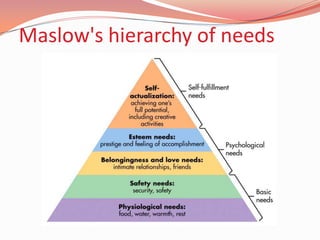
Maslow's hierarchy of needs
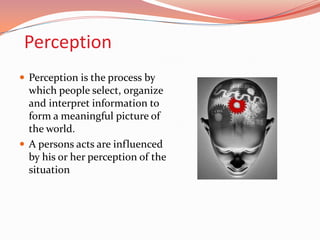
PerceptionPerception is the process by which people select, organize and interpret information to form a meaningful picture of the world.A persons acts are influenced by his or her perception of the situation
Perceptual ProcessesSelective attentionSelective distortionSelective retention
Selective AttentionThe tendency for people to screen out most of the information to which they are exposed.Marketers must work especially hard to attract the consumer's attention.
Selective Distortion Selective distortion describes the tendency of people to interpret information in a way that will support what they already believe.Marketers must try to understand the mind-sets of consumers and how these will affect interpretations of advertising and sales information.
Selective RetentionTendency of a customer to remember good points made about a brand they favor and to forget good points made about competing brands.That is why, marketers use so much drama and repetition in sending messages to their market.
LearningLearning describes changes in an individual's behavior arising from experience.
A drive is a strong internal stimulus that calls for action.
A drive becomes a motive when it is directed toward a particular stimulus object. For example, a person's drive for self-actualization might motivate him or her to look into buying a digital cameraBeliefsA descriptive thought that a person has about something. May be based on real knowledge, opinion or faith.These beliefs make up product and brand images that affect buying behavior and ultimately sales too.

Sales And Psycology

  • 1.
  • 2.
    A person's buyingchoices are influenced by four major psychological factors:Motivation
  • 3.
  • 4.
  • 5.
    Attitudes and Beliefs.MotivationAmotive (or drivel) is a need that is sufficiently pressing to direct the person to seek satisfaction.
  • 6.
    An aging babyboomer who buys a sporty BMW 330Ci convertible might explain that he simply likes the feel of the wind in his thinning hair. At a deeper level, he may be trying to impress others with his success.Marketers use touchy-feely approaches to dig deeply into consumer psyches. E.g. think about brands as if they were your friends. Imagine you could talk to your TV dinner. What would he say? And what would you say to him?.... Now, think of your shampoo at an animal, Would it be a panda or a lion? A snake or a wooly worm?
  • 7.
  • 8.
    PerceptionPerception is theprocess by which people select, organize and interpret information to form a meaningful picture of the world.A persons acts are influenced by his or her perception of the situation
  • 9.
  • 10.
    Selective AttentionThe tendencyfor people to screen out most of the information to which they are exposed.Marketers must work especially hard to attract the consumer's attention.
  • 11.
    Selective Distortion Selectivedistortion describes the tendency of people to interpret information in a way that will support what they already believe.Marketers must try to understand the mind-sets of consumers and how these will affect interpretations of advertising and sales information.
  • 12.
    Selective RetentionTendency ofa customer to remember good points made about a brand they favor and to forget good points made about competing brands.That is why, marketers use so much drama and repetition in sending messages to their market.
  • 13.
    LearningLearning describes changesin an individual's behavior arising from experience.
  • 14.
    A drive isa strong internal stimulus that calls for action.
  • 15.
    A drive becomesa motive when it is directed toward a particular stimulus object. For example, a person's drive for self-actualization might motivate him or her to look into buying a digital cameraBeliefsA descriptive thought that a person has about something. May be based on real knowledge, opinion or faith.These beliefs make up product and brand images that affect buying behavior and ultimately sales too.