06/14/2025
BAC 101 Culinary Foundation Level 1 1
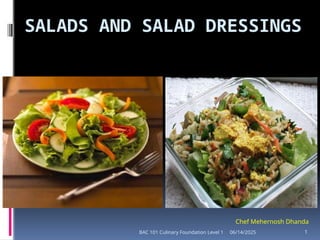
SALADS AND SALAD DRESSINGS
Chef Mehernosh Dhanda
2
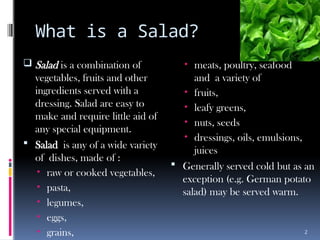
What is a Salad?
 Salad is a combination of
vegetables, fruits and other
ingredients served with a
dressing. Salad are easy to
make and require little aid of
any special equipment.
 Salad is any of a wide variety
of dishes, made of :
• raw or cooked vegetables,
• pasta,
• legumes,
• eggs,
• grains,
• meats, poultry, seafood
and a variety of
• fruits,
• leafy greens,
• nuts, seeds
• dressings, oils, emulsions,
juices
 Generally served cold but as an
exception (e.g. German potato
salad) may be served warm.
3
Origin & History
 The word "salad" originates from
the French salade of the same meaning, from
the Latin salata (salty) & from sal (salt).
 Ancient Greeks & Romans consumed salads
 John Evelyn’s book Acetaria: A Discourse on
Sallets, 1699, speaks of the importance of
salads in daily diet
4
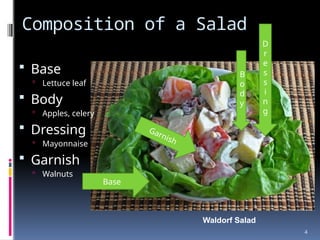
Composition of a Salad
 Base
 Lettuce leaf
 Body
 Apples, celery
 Dressing
 Mayonnaise
 Garnish
 Walnuts
Base
B
o
d
y
D
r
e
s
s
i
n
g
Garnish
Waldorf Salad
5
Classification of Salads According to
their Functions in the Meal
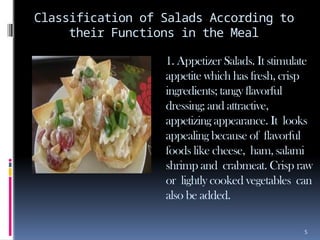
1. Appetizer Salads. It stimulate
appetite which has fresh, crisp
ingredients; tangy flavorful
dressing; and attractive,
appetizing appearance. It looks
appealing because of flavorful
foods like cheese, ham, salami
shrimp and crabmeat. Crisp raw
or lightly cooked vegetables can
also be added.
6
Classification of Salads According to
their Functions in the Meal
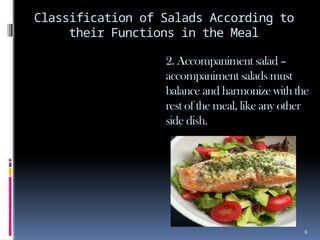
2. Accompaniment salad –
accompaniment salads must
balance and harmonize with the
rest of the meal, like any other
side dish.
7
Classification of Salads According to
their Functions in the Meal
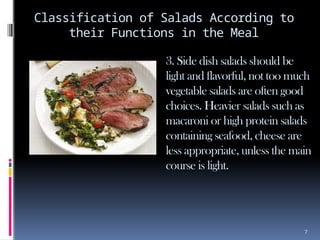
3. Side dish salads should be
light and flavorful, not too much
vegetable salads are often good
choices. Heavier salads such as
macaroni or high protein salads
containing seafood, cheese are
less appropriate, unless the main
course is light.
8
Classification of Salads According to
their Functions in the Meal
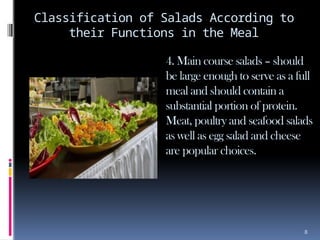
4. Main course salads – should
be large enough to serve as a full
meal and should contain a
substantial portion of protein.
Meat, poultry and seafood salads
as well as egg salad and cheese
are popular choices.
9
Classification of Salads According to
their Functions in the Meal
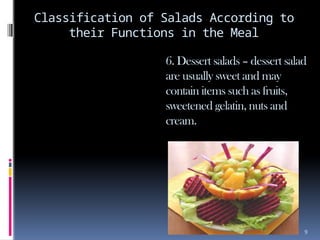
6. Dessert salads – dessert salad
are usually sweet and may
contain items such as fruits,
sweetened gelatin, nuts and
cream.
10
Classification of Salads According to
their Functions in the Meal
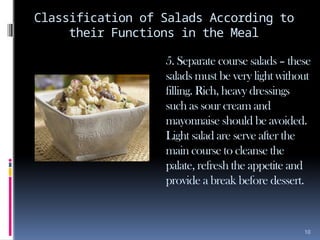
5. Separate course salads – these
salads must be very light without
filling. Rich, heavy dressings
such as sour cream and
mayonnaise should be avoided.
Light salad are serve after the
main course to cleanse the
palate, refresh the appetite and
provide a break before dessert.
11
Classification of Salads According to
Ingredients Used
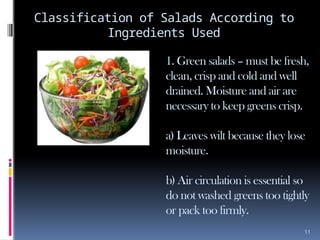
1. Green salads – must be fresh,
clean, crisp and cold and well
drained. Moisture and air are
necessary to keep greens crisp.
a) Leaves wilt because they lose
moisture.
b) Air circulation is essential so
do not washed greens too tightly
or pack too firmly.
12
Classification of Salads According to
Ingredients Used
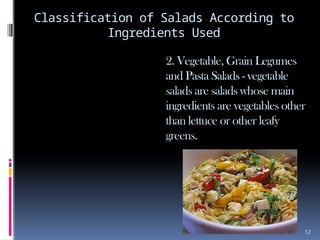
2. Vegetable, Grain Legumes
and Pasta Salads - vegetable
salads are salads whose main
ingredients are vegetables other
than lettuce or other leafy
greens.
13
Classification of Salads According to
Ingredients Used
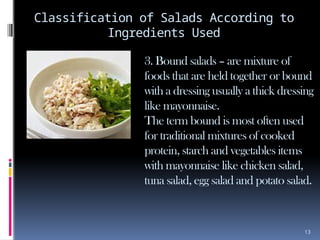
3. Bound salads – are mixture of
foods that are held together or bound
with a dressing usually a thick dressing
like mayonnaise.
The term bound is most often used
for traditional mixtures of cooked
protein, starch and vegetables items
with mayonnaise like chicken salad,
tuna salad, egg salad and potato salad.
14
Classification of Salads According to
Ingredients Used
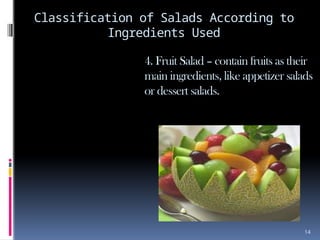
4. Fruit Salad – contain fruits as their
main ingredients, like appetizer salads
or dessert salads.
15
Classification of Salads According to
Ingredients Used
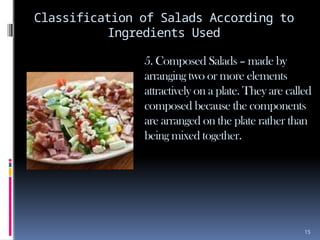
5. Composed Salads – made by
arranging two or more elements
attractively on a plate. They are called
composed because the components
are arranged on the plate rather than
being mixed together.
16
Classification of Salads According to
Ingredients Used
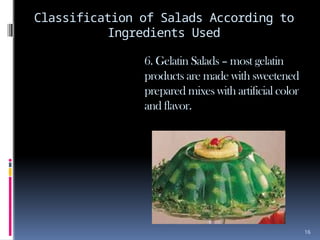
6. Gelatin Salads – most gelatin
products are made with sweetened
prepared mixes with artificial color
and flavor.
17
Classification of Salads According to
Ingredients Used
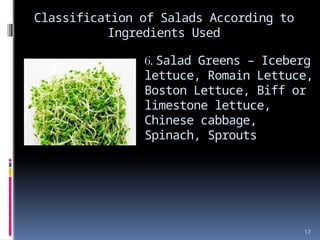
6. Salad Greens – Iceberg
lettuce, Romain Lettuce,
Boston Lettuce, Biff or
limestone lettuce,
Chinese cabbage,
Spinach, Sprouts
06/14/2025
BAC 101 Culinary Foundation Level 1 18
Commonly used Greens
Lettuces
 Boston
 Iceberg
 Leaf
 Romaine
 Baby lettuce
 Micro greens
Chicory
 Belgian endive
 Curly endive
 Escarole
 Radicchio
06/14/2025
BAC 101 Culinary Foundation Level 1 19
Other Salad Greens
 Arugula
 Dandelion
 Mâche
 Sorrel
 Spinach
 Sprouts
 Watercress
 Edible flowers
 Fresh herbs
06/14/2025
BAC 101 Culinary Foundation Level 1 20
Purchasing
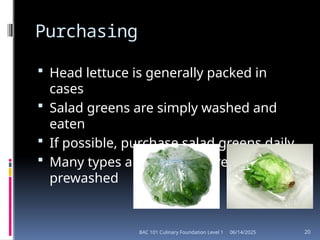
 Head lettuce is generally packed in
cases
 Salad greens are simply washed and
eaten
 If possible, purchase salad greens daily
 Many types are available precut and
prewashed
06/14/2025
BAC 101 Culinary Foundation Level 1 21
Storage of salad greens
 Store in the original protective cartons
 Store at temperature between 34°F and 38°F
 Do not store close to apples and tomatoes
 Do not wash until needed
 Some are heartier and can be kept for a
week
 Others are more delicate and need to
be consumed in a few days
 Wrap in kitchen paper & keep.. It stays
longer.
06/14/2025
BAC 101 Culinary Foundation Level 1 22
Salad Dressings
 Vinaigrette dressing
 Also known as basic French dressing
 Standard ratio 3 parts oil to 1 part vinegar
 This ratio may be adjusted depending on the types of
oils and vinegars used
 Different types and combinations of oils and vinegars
can create many flavor variations
 Substituting the vinegar with other acid ingredients
can add to flavor combinations
 Other flavoring agents such as herbs, spices, garlic or
sugar can be added to enhance flavor
06/14/2025
BAC 101 Culinary Foundation Level 1 23
Salad Dressings
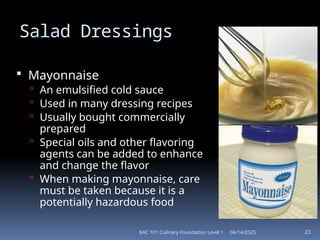
 Mayonnaise
 An emulsified cold sauce
 Used in many dressing recipes
 Usually bought commercially
prepared
 Special oils and other flavoring
agents can be added to enhance
and change the flavor
 When making mayonnaise, care
must be taken because it is a
potentially hazardous food
06/14/2025
BAC 101 Culinary Foundation Level 1 24
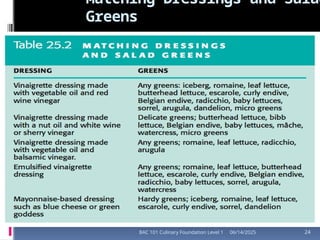
Matching Dressings and Salad
Greens
06/14/2025
BAC 101 Culinary Foundation Level 1 25
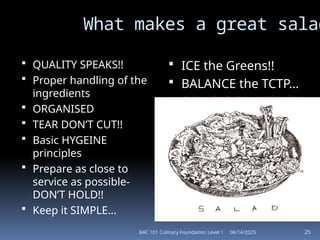
What makes a great salad
 QUALITY SPEAKS!!
 Proper handling of the
ingredients
 ORGANISED
 TEAR DON’T CUT!!
 Basic HYGEINE
principles
 Prepare as close to
service as possible-
DON’T HOLD!!
 Keep it SIMPLE...
 ICE the Greens!!
 BALANCE the TCTP…
taste, color, texture, portion size
06/14/2025
BAC 101 Culinary Foundation Level 1 26
Thank You

Salad types , characteristics and description.pptx

  • 1.
    06/14/2025 BAC 101 CulinaryFoundation Level 1 1 SALADS AND SALAD DRESSINGS Chef Mehernosh Dhanda
  • 2.
    2 What is aSalad?  Salad is a combination of vegetables, fruits and other ingredients served with a dressing. Salad are easy to make and require little aid of any special equipment.  Salad is any of a wide variety of dishes, made of : • raw or cooked vegetables, • pasta, • legumes, • eggs, • grains, • meats, poultry, seafood and a variety of • fruits, • leafy greens, • nuts, seeds • dressings, oils, emulsions, juices  Generally served cold but as an exception (e.g. German potato salad) may be served warm.
  • 3.
    3 Origin & History The word "salad" originates from the French salade of the same meaning, from the Latin salata (salty) & from sal (salt).  Ancient Greeks & Romans consumed salads  John Evelyn’s book Acetaria: A Discourse on Sallets, 1699, speaks of the importance of salads in daily diet
  • 4.
    4 Composition of aSalad  Base  Lettuce leaf  Body  Apples, celery  Dressing  Mayonnaise  Garnish  Walnuts Base B o d y D r e s s i n g Garnish Waldorf Salad
  • 5.
    5 Classification of SaladsAccording to their Functions in the Meal 1. Appetizer Salads. It stimulate appetite which has fresh, crisp ingredients; tangy flavorful dressing; and attractive, appetizing appearance. It looks appealing because of flavorful foods like cheese, ham, salami shrimp and crabmeat. Crisp raw or lightly cooked vegetables can also be added.
  • 6.
    6 Classification of SaladsAccording to their Functions in the Meal 2. Accompaniment salad – accompaniment salads must balance and harmonize with the rest of the meal, like any other side dish.
  • 7.
    7 Classification of SaladsAccording to their Functions in the Meal 3. Side dish salads should be light and flavorful, not too much vegetable salads are often good choices. Heavier salads such as macaroni or high protein salads containing seafood, cheese are less appropriate, unless the main course is light.
  • 8.
    8 Classification of SaladsAccording to their Functions in the Meal 4. Main course salads – should be large enough to serve as a full meal and should contain a substantial portion of protein. Meat, poultry and seafood salads as well as egg salad and cheese are popular choices.
  • 9.
    9 Classification of SaladsAccording to their Functions in the Meal 6. Dessert salads – dessert salad are usually sweet and may contain items such as fruits, sweetened gelatin, nuts and cream.
  • 10.
    10 Classification of SaladsAccording to their Functions in the Meal 5. Separate course salads – these salads must be very light without filling. Rich, heavy dressings such as sour cream and mayonnaise should be avoided. Light salad are serve after the main course to cleanse the palate, refresh the appetite and provide a break before dessert.
  • 11.
    11 Classification of SaladsAccording to Ingredients Used 1. Green salads – must be fresh, clean, crisp and cold and well drained. Moisture and air are necessary to keep greens crisp. a) Leaves wilt because they lose moisture. b) Air circulation is essential so do not washed greens too tightly or pack too firmly.
  • 12.
    12 Classification of SaladsAccording to Ingredients Used 2. Vegetable, Grain Legumes and Pasta Salads - vegetable salads are salads whose main ingredients are vegetables other than lettuce or other leafy greens.
  • 13.
    13 Classification of SaladsAccording to Ingredients Used 3. Bound salads – are mixture of foods that are held together or bound with a dressing usually a thick dressing like mayonnaise. The term bound is most often used for traditional mixtures of cooked protein, starch and vegetables items with mayonnaise like chicken salad, tuna salad, egg salad and potato salad.
  • 14.
    14 Classification of SaladsAccording to Ingredients Used 4. Fruit Salad – contain fruits as their main ingredients, like appetizer salads or dessert salads.
  • 15.
    15 Classification of SaladsAccording to Ingredients Used 5. Composed Salads – made by arranging two or more elements attractively on a plate. They are called composed because the components are arranged on the plate rather than being mixed together.
  • 16.
    16 Classification of SaladsAccording to Ingredients Used 6. Gelatin Salads – most gelatin products are made with sweetened prepared mixes with artificial color and flavor.
  • 17.
    17 Classification of SaladsAccording to Ingredients Used 6. Salad Greens – Iceberg lettuce, Romain Lettuce, Boston Lettuce, Biff or limestone lettuce, Chinese cabbage, Spinach, Sprouts
  • 18.
    06/14/2025 BAC 101 CulinaryFoundation Level 1 18 Commonly used Greens Lettuces  Boston  Iceberg  Leaf  Romaine  Baby lettuce  Micro greens Chicory  Belgian endive  Curly endive  Escarole  Radicchio
  • 19.
    06/14/2025 BAC 101 CulinaryFoundation Level 1 19 Other Salad Greens  Arugula  Dandelion  Mâche  Sorrel  Spinach  Sprouts  Watercress  Edible flowers  Fresh herbs
  • 20.
    06/14/2025 BAC 101 CulinaryFoundation Level 1 20 Purchasing  Head lettuce is generally packed in cases  Salad greens are simply washed and eaten  If possible, purchase salad greens daily  Many types are available precut and prewashed
  • 21.
    06/14/2025 BAC 101 CulinaryFoundation Level 1 21 Storage of salad greens  Store in the original protective cartons  Store at temperature between 34°F and 38°F  Do not store close to apples and tomatoes  Do not wash until needed  Some are heartier and can be kept for a week  Others are more delicate and need to be consumed in a few days  Wrap in kitchen paper & keep.. It stays longer.
  • 22.
    06/14/2025 BAC 101 CulinaryFoundation Level 1 22 Salad Dressings  Vinaigrette dressing  Also known as basic French dressing  Standard ratio 3 parts oil to 1 part vinegar  This ratio may be adjusted depending on the types of oils and vinegars used  Different types and combinations of oils and vinegars can create many flavor variations  Substituting the vinegar with other acid ingredients can add to flavor combinations  Other flavoring agents such as herbs, spices, garlic or sugar can be added to enhance flavor
  • 23.
    06/14/2025 BAC 101 CulinaryFoundation Level 1 23 Salad Dressings  Mayonnaise  An emulsified cold sauce  Used in many dressing recipes  Usually bought commercially prepared  Special oils and other flavoring agents can be added to enhance and change the flavor  When making mayonnaise, care must be taken because it is a potentially hazardous food
  • 24.
    06/14/2025 BAC 101 CulinaryFoundation Level 1 24 Matching Dressings and Salad Greens
  • 25.
    06/14/2025 BAC 101 CulinaryFoundation Level 1 25 What makes a great salad  QUALITY SPEAKS!!  Proper handling of the ingredients  ORGANISED  TEAR DON’T CUT!!  Basic HYGEINE principles  Prepare as close to service as possible- DON’T HOLD!!  Keep it SIMPLE...  ICE the Greens!!  BALANCE the TCTP… taste, color, texture, portion size
  • 26.
    06/14/2025 BAC 101 CulinaryFoundation Level 1 26 Thank You