St. Patrick’s Day Traditions
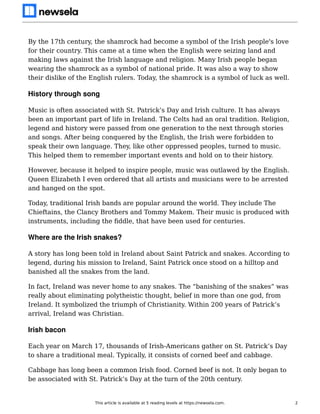
Performers dressed as leprechauns. Photo by Susanty Bong for Getty Images.
St. Patrick’s Day is an Irish holiday known for parades, shamrocks and
leprechauns. While some of these symbols originated long ago in Ireland, others
began in America.
Symbol of national pride
The shamrock was considered a holy plant because it symbolized the rebirth of
spring. When Saint Patrick arrived in Ireland in the year A.D. 431, stories say that
he used the three leaves of the shamrock to teach people about Christianity.
The shamrock was also called the “seamroy” by the Celts. These were a group of
people who settled in Ireland thousands of years ago.
By History.com, adapted by Newsela staff on 03.16.17
Word Count 574
Level 870L
This article is available at 5 reading levels at https://newsela.com. 1
By the 17th century, the shamrock had become a symbol of the Irish people's love
for their country. This came at a time when the English were seizing land and
making laws against the Irish language and religion. Many Irish people began
wearing the shamrock as a symbol of national pride. It was also a way to show
their dislike of the English rulers. Today, the shamrock is a symbol of luck as well.
History through song
Music is often associated with St. Patrick’s Day and Irish culture. It has always
been an important part of life in Ireland. The Celts had an oral tradition. Religion,
legend and history were passed from one generation to the next through stories
and songs. After being conquered by the English, the Irish were forbidden to
speak their own language. They, like other oppressed peoples, turned to music.
This helped them to remember important events and hold on to their history.
However, because it helped to inspire people, music was outlawed by the English.
Queen Elizabeth I even ordered that all artists and musicians were to be arrested
and hanged on the spot.
Today, traditional Irish bands are popular around the world. They include The
Chieftains, the Clancy Brothers and Tommy Makem. Their music is produced with
instruments, including the fiddle, that have been used for centuries.
Where are the Irish snakes?
A story has long been told in Ireland about Saint Patrick and snakes. According to
legend, during his mission to Ireland, Saint Patrick once stood on a hilltop and
banished all the snakes from the land.
In fact, Ireland was never home to any snakes. The “banishing of the snakes” was
really about eliminating polytheistic thought, belief in more than one god, from
Ireland. It symbolized the triumph of Christianity. Within 200 years of Patrick’s
arrival, Ireland was Christian.
Irish bacon
Each year on March 17, thousands of Irish-Americans gather on St. Patrick’s Day
to share a traditional meal. Typically, it consists of corned beef and cabbage.
Cabbage has long been a common Irish food. Corned beef is not. It only began to
be associated with St. Patrick’s Day at the turn of the 20th century.
This article is available at 5 reading levels at https://newsela.com. 2
Irish immigrants living in New York City substituted corned beef for their
traditional dish of Irish bacon. They did this to save money. They learned about
the cheaper meat from their Jewish neighbors.
Celtic fairies
The original Irish name for these little men of folklore is “lobaircin.” It means
“small-bodied fellow.”
Belief in leprechauns probably stems from the Celtic belief in fairies. These were
tiny men and women who could use their magical powers to serve good or evil. In
Celtic folktales, leprechauns were cranky souls who mended shoes. Leprechauns
were minor figures in Celtic folklore. They were known for their trickery. They
often used this sneaky nature to protect hidden pots of gold.
This article is available at 5 reading levels at https://newsela.com. 3

Saint patrick's Day Traditions

  • 1.
    St. Patrick’s DayTraditions Performers dressed as leprechauns. Photo by Susanty Bong for Getty Images. St. Patrick’s Day is an Irish holiday known for parades, shamrocks and leprechauns. While some of these symbols originated long ago in Ireland, others began in America. Symbol of national pride The shamrock was considered a holy plant because it symbolized the rebirth of spring. When Saint Patrick arrived in Ireland in the year A.D. 431, stories say that he used the three leaves of the shamrock to teach people about Christianity. The shamrock was also called the “seamroy” by the Celts. These were a group of people who settled in Ireland thousands of years ago. By History.com, adapted by Newsela staff on 03.16.17 Word Count 574 Level 870L This article is available at 5 reading levels at https://newsela.com. 1
  • 2.
    By the 17thcentury, the shamrock had become a symbol of the Irish people's love for their country. This came at a time when the English were seizing land and making laws against the Irish language and religion. Many Irish people began wearing the shamrock as a symbol of national pride. It was also a way to show their dislike of the English rulers. Today, the shamrock is a symbol of luck as well. History through song Music is often associated with St. Patrick’s Day and Irish culture. It has always been an important part of life in Ireland. The Celts had an oral tradition. Religion, legend and history were passed from one generation to the next through stories and songs. After being conquered by the English, the Irish were forbidden to speak their own language. They, like other oppressed peoples, turned to music. This helped them to remember important events and hold on to their history. However, because it helped to inspire people, music was outlawed by the English. Queen Elizabeth I even ordered that all artists and musicians were to be arrested and hanged on the spot. Today, traditional Irish bands are popular around the world. They include The Chieftains, the Clancy Brothers and Tommy Makem. Their music is produced with instruments, including the fiddle, that have been used for centuries. Where are the Irish snakes? A story has long been told in Ireland about Saint Patrick and snakes. According to legend, during his mission to Ireland, Saint Patrick once stood on a hilltop and banished all the snakes from the land. In fact, Ireland was never home to any snakes. The “banishing of the snakes” was really about eliminating polytheistic thought, belief in more than one god, from Ireland. It symbolized the triumph of Christianity. Within 200 years of Patrick’s arrival, Ireland was Christian. Irish bacon Each year on March 17, thousands of Irish-Americans gather on St. Patrick’s Day to share a traditional meal. Typically, it consists of corned beef and cabbage. Cabbage has long been a common Irish food. Corned beef is not. It only began to be associated with St. Patrick’s Day at the turn of the 20th century. This article is available at 5 reading levels at https://newsela.com. 2
  • 3.
    Irish immigrants livingin New York City substituted corned beef for their traditional dish of Irish bacon. They did this to save money. They learned about the cheaper meat from their Jewish neighbors. Celtic fairies The original Irish name for these little men of folklore is “lobaircin.” It means “small-bodied fellow.” Belief in leprechauns probably stems from the Celtic belief in fairies. These were tiny men and women who could use their magical powers to serve good or evil. In Celtic folktales, leprechauns were cranky souls who mended shoes. Leprechauns were minor figures in Celtic folklore. They were known for their trickery. They often used this sneaky nature to protect hidden pots of gold. This article is available at 5 reading levels at https://newsela.com. 3