


Presented By
HOMOEOPATHIC POSOLOGY (POSOLOGY =STUDY OF LAW OF DOSAGE.)
LAWS APPLIED IN  POSOLOGY  Law of dosage.
LAWS APPLIED IN  POSOLOGY  Law of quantity
LAWS APPLIED IN  POSOLOGY  Law of quality
LAWS APPLIED IN  POSOLOGY  Law of Repetition -Proving -Cure
DOSE Quantity of particular  medicine administered  to particular individual at a time
TYPES Physiological dose. Pathological  dose. Toxic dose. Lethal dose. Therapeutic dose.
MINIMUM DOSE Least quantity of any substance  required to affect a change in nature. Also known as sub physiological  dose.
§  280-  Minimum dose is defined as the quantity of medicine required to produce a scarcely perceptible  homeopathic aggravation. Stuart  close – A dose which is not capable of producing symptoms when used therapeutically .
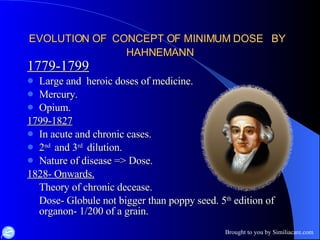
EVOLUTION OF   CONCEPT OF MINIMUM   DOSE  BY  HAHNEMANN 1779-1799 Large and  heroic doses of medicine. Mercury. Opium. 1799-1827 In acute and chronic cases. 2 nd  and 3 rd  dilution. Nature of disease => Dose. 1828- Onwards. Theory of chronic decease. Dose- Globule not bigger than poppy seed. 5 th  edition of organon- 1/200 of a grain.
OBSERVATIONS. Medicines exhibited greater strength when given in dilutions than in dry state. Greater power when given in divided doses than given at once. Increasing power of a medicine by a thorough admixture of vehicle by means of succession.
To evade persecussion of apothecaries who tried legal proceeding against Hahnemann for invading up on their privileges for dispensing medicine. To avoid aggravation of disease when given in large doses.
WHY DOSE SHOLD BE MINIMUM Disease producing agent+Drug. To reduce the aggravation. Arnold-schutz- minimum dose  stimulates medium of inhibits maximum destroys.
GUIDELINES BY DIFFERENT AUTHORS. HAHNEMANN. §279  –  The dose of homeopathically selected remedy can never be prepared so small that it shall not be stronger than natural disease.
§ 280 - let them learn from the mathematicians how true is that a substance divided into so many parts still contains its smallest part and the smallest part does not cease to have some substance.
§ 281 - Every patient ever so robust  will be effected by small conceivable dose.
Exception to infinitesimal dose § 282- when 3 great miasms while they still efflorescence on skin require from very beginning large doses of their specific remedies of higher and higher dynamisation daily.
STUART CLOSE 3 necessary requirements for the action of infinitesimal  dose. Development of special virtues of medicine by dynamisation . Increased susceptibility to medicinal impression produced by the decease . Selection of symptomatically similar remedy.
H.A.  ROBERT  3 fundamental laws  Law of least action and quality . Law of quantity and dose. Law of quality.
Infinitismal dose is one which is so small as not to produce too much aggravation of the symptoms  already present and never large enough to produce new symptoms .
CARROL DUNHAM  Favours  infinitesimal dose and at the same time states that there are many evidences in chronic disease that many medicines have acted in very large doses.
RICHARD HUGHS Unquestionable  result with 6 th  ,12 th  an 30 th  dilution .No practical knowledge of 200 th .
J.T.KENT There is difference in the activities of a given remedy in 30 th  and 10M up on the same constitution. Very high potencies seldom  require  repetition  in c/c disease. In severe a/c disease several doses in quick succession . It is better to begin lower and go higher  and higher.
HOMOEOPATHIC POSOLOGY STUDY OF INFINITESIMAL DOSE Study of preparation of infinitesimal dose Application of infinitesimal dose Study of repetition of the dose
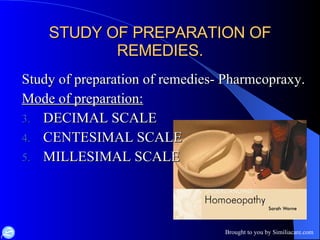
STUDY OF PREPARATION OF REMEDIES. Study of preparation of remedies- Pharmcopraxy. Mode of preparation: DECIMAL SCALE CENTESIMAL SCALE MILLESIMAL SCALE
Decimal scale. Herring  introduced decimal scale. 1 part by weight of crude drug +9 part by weight of S.M- triturating for 1 hour. 1 part of drug succesed with 9 part of alcohol- 1 st  potency.
Centesimal scale Introduced by  Hahnemann . 1 part of Crud drug + 99 parts of S.M.Triturating  for 1 hr. or 1 part of drug successed  with 99 parts of alcohol.
Millesimal scale. Introduced in the 6 th  edition of organon.  § 270 In western world denoted as  1/0,2/0 India Bangladesh  0/1,0/2 or m/1,m/2
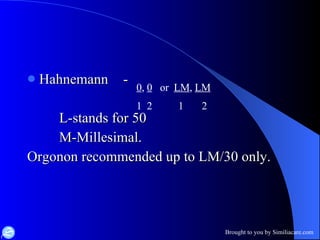
Hahnemann - L-stands for 50 M-Millesimal. Orgonon recommended up to LM/30 only. 0 ,  0   or  LM ,  LM 1  2  1  2
KORSAKOVIAN  METHOD Single phial system. Succession  Communication via infection
MIXED HAHNEMANNIAN & KORSAKOVIAN Begin with Hahenemannian mode of preparation up to 6 c or 30 c. Then use single phial method.
JENICHEN’S POTENCIES. As much vehicle as required to prepare 30 th  dilution is taken. One drop of M.T is put in to it, 10 succession- 1 st  dilution. Sufficient succession is given continuously until the desired potency is reached.
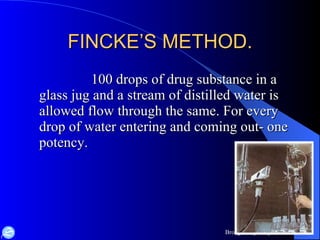
FINCKE’S METHOD. 100 drops of drug substance in a glass jug and a stream of distilled water is allowed flow through the same. For every drop of water entering and coming out- one potency.
SKINNER’S METHOD Skinner developed a method of potentisation which was some what similar to fincke’s method.
Q- Potency. Used to designate 50 millesimal potency.
APPLICATION OF INFINITESIMAL DOSE. Selection of potency and dose Route of administration of remedy Notion of quantity Notion of quality
SELECTION OF POTENCY AND DOSE
SUSCEPTIBILITY
FACTORS MODIFYING SUCCEPTIBILITY Age: Greatest -Young vigorous person   Children Diminishes with age. Children particularly sensitive during development.
Constitution  & temparament. High potencies Nervous Sanguine Aco,Hyos,N.M - Choleric N.V, Staph, Lyco Intelligent Quick to act & react Aurum, Tarent C.C- Zealous Impulsive
Lower potencies Torpid Phlegmatic Coarse fibred Sluggish Idiots imbecile, deaf and Dump.
Habit and environment. Susceptibility is increased by intelluctual occupation. - High potency. Greater Muscular power and Sedantary habit. - Low potency. Occupation Exposure to tobaco, chemicals, perfumes, brewers, druggist, distillary. - Low Potency.
Pathological conditions. Functional Structural   Reversible   Irreversible. Terminal condition - Material doses Long exhausting chronic disease  - Low potency
Seat of Disease. If vital organs are structurally destructed,  - low potency. eg; Chonic valvular heart diesease. Skin,CNS,Metabolic. - High potency.
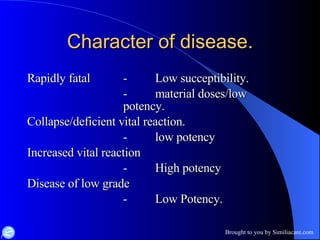
Character of disease. Rapidly fatal  - Low succeptibility. - material doses/low  potency. Collapse/deficient vital reaction. - low potency Increased vital reaction - High potency Disease of low grade - Low Potency.
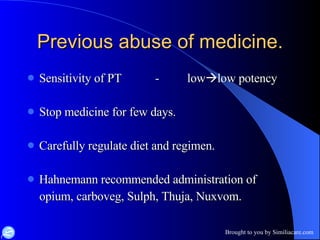
Previous abuse of medicine. Sensitivity of PT  - low  low potency Stop medicine for few days. Carefully regulate diet and regimen. Hahnemann recommended administration of opium, carboveg, Sulph, Thuja, Nuxvom.
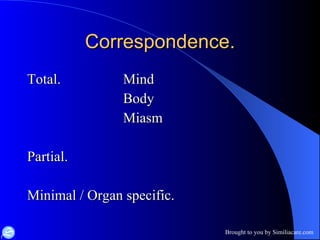
Correspondence. Total. Mind Body Miasm Partial. Minimal / Organ specific.
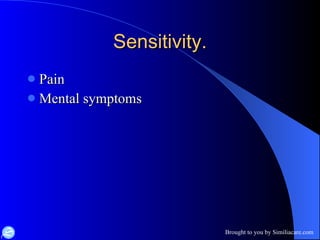
Sensitivity. Pain Mental symptoms
Miasm. Psora Sycotic Syphilitic Tubercular
Nature of drug selected. Superficially acting drug Deep acting drug Nosodes Antimiasmatic drug
Route of Administration. Pharmaconomy §284-6 th  edition Tongue, mouth stomach Olfaction Inhalation Inunction Moderate doses to nursing mother
Ext. Aplication not advisable. §197 Premature disappearance of local symptom.
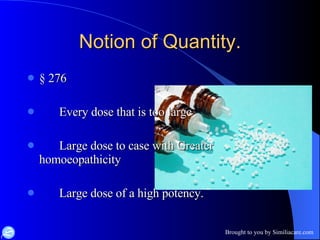
Notion of Quantity. § 276 Every dose that is too large Large dose to case with Greater  homoeopathicity Large dose of a high potency.
§ 285 Sugar globule of the size of poppy  seeds. A drop of medicine sufficient to  medicate 300 such globule.
Notion of Quality. § 272. Globule mixed with S.M and dissolved in water, stirred every time before administration. Quality increases, the greater quantity of fluid in which it is dissolved. Quality is increased when the succeeding doses are changed slightly every time.
Repetition. Pharmacopollaxy. § 247 At an interval of 14,12,10,8,7 days - Chronic. Every 24, 12, 8, 4 hours - in acute. Every hours; Every 5 minutes -very acute.
Kent. Series in degrees 30,200,1M,10M,50M,CM Very high potencies seldom require  repetition in chronic cases.
Boreland. In acute disease Low potency - Diminish the severity diminish the mortality cannot cut short the  duration. High potency - Can cut short or abort  the disease.
Potency Low - Below 30 th   Medium - 30-200 High - 1 M and above.
Voison. Low potencies - organotropic Medium potencies - Influence the  function. High potencies - Penetrate the  psyche.
GENERAL OBSERVATIONS Law of similars is the primary law of cure Correct remedy will act curatively in any potency A correct potency will act more gently.
Diseases with specific pathology – 12x-200 Cases with known malignancy –initially potencies below 200 Suspected malignancy – first prescription below 1M
Abundance of clear mental symptoms-high potency Acute cases- strong defense mechanism-200 and above Exception-in old chronically weakened- preferably 200
Nature of the remedy Kali carb-in gout Sulph.,sil,tub,phos – in TB Psor.- in asthma High potencies of Lach,Aur,Medo,Ars.
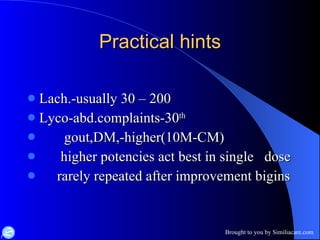
Practical hints Lach.-usually 30 – 200 Lyco-abd.complaints-30 th gout,DM,-higher(10M-CM) higher potencies act best in single  dose rarely repeated after improvement bigins
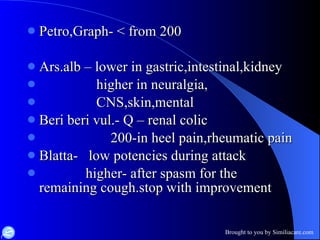
Petro,Graph- < from 200 Ars.alb – lower in gastric,intestinal,kidney higher in neuralgia, CNS,skin,mental Beri beri vul.- Q – renal colic 200-in heel pain,rheumatic pain Blatta-  low potencies during attack higher- after spasm for the  remaining cough.stop with improvement
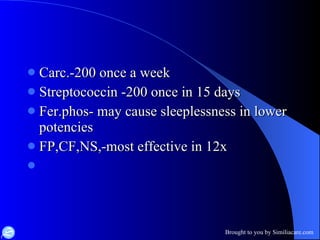
Carc.-200 once a week Streptococcin -200 once in 15 days Fer.phos- may cause sleeplessness in lower potencies FP,CF,NS,-most effective in 12x
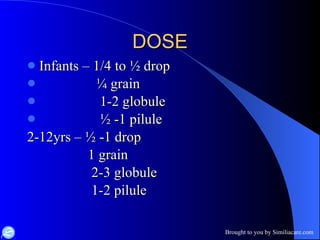
DOSE Infants – 1/4 to ½ drop ¼ grain  1-2 globule ½ -1 pilule 2-12yrs – ½ -1 drop 1 grain 2-3 globule 1-2 pilule
Above 12 yrs.- ½- 1 drop  1 grain 4-5 globules 2-3 pilules J.H.CLARK – 1drop of Q(unless otherwise  mentioned) W.I.Pierce- well selected remedy fails to act jump to a higher potency drop suddenly to lower and back to original
GARTH BORICKE- poly chrests-wider range of action in high potency Low potencies tend to limit the therapeutic sphere of a drug RAWAT- Indiscriminate use of only one potency-failures
REPETITION Impresibility of the patient Nature of disease Potency selected
Perceptible & continuous improvement-contra indicates repetition Repeat when the beneficial effects ceases Change remedy when improvement ceases and symptoms have altered.
Remedy reaction No change Remedy wrong  Potency wrong Slow acting remedy Patient sluggish in reaction
steady improvement with no < Correct remedy No organic change
Short & strong < followed by slow&sure recovery Corect remedy Vigerous reaction No structural change
Long & severe < followed by slow &sure recovery Correct remedy Organic changes Vital reaction low Curable
Improvement limited Correct remedy Vital organs affected much After major surgeries Careful repetition at infrequent intervals
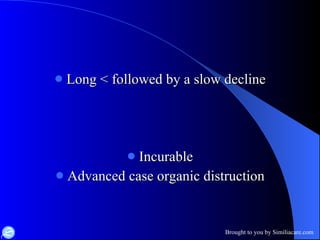
Long < followed by a slow decline Incurable Advanced case organic distruction
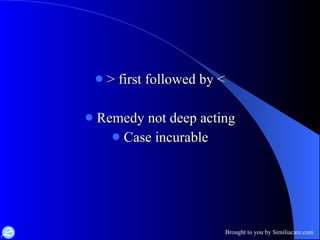
> first followed by < Remedy not deep acting Case incurable
Thanks DR.K.C.PRASOBH KUMAR 9447053428 NATIONAL TRAINER- I H K
Thank You

Sahya Part 13

  • 1.
  • 2.
    HOMOEOPATHIC POSOLOGY (POSOLOGY=STUDY OF LAW OF DOSAGE.)
  • 3.
    LAWS APPLIED IN POSOLOGY Law of dosage.
  • 4.
    LAWS APPLIED IN POSOLOGY Law of quantity
  • 5.
    LAWS APPLIED IN POSOLOGY Law of quality
  • 6.
    LAWS APPLIED IN POSOLOGY Law of Repetition -Proving -Cure
  • 7.
    DOSE Quantity ofparticular medicine administered to particular individual at a time
  • 8.
    TYPES Physiological dose.Pathological dose. Toxic dose. Lethal dose. Therapeutic dose.
  • 9.
    MINIMUM DOSE Leastquantity of any substance required to affect a change in nature. Also known as sub physiological dose.
  • 10.
    § 280- Minimum dose is defined as the quantity of medicine required to produce a scarcely perceptible homeopathic aggravation. Stuart close – A dose which is not capable of producing symptoms when used therapeutically .
  • 11.
    EVOLUTION OF CONCEPT OF MINIMUM DOSE BY HAHNEMANN 1779-1799 Large and heroic doses of medicine. Mercury. Opium. 1799-1827 In acute and chronic cases. 2 nd and 3 rd dilution. Nature of disease => Dose. 1828- Onwards. Theory of chronic decease. Dose- Globule not bigger than poppy seed. 5 th edition of organon- 1/200 of a grain.
  • 12.
    OBSERVATIONS. Medicines exhibitedgreater strength when given in dilutions than in dry state. Greater power when given in divided doses than given at once. Increasing power of a medicine by a thorough admixture of vehicle by means of succession.
  • 13.
    To evade persecussionof apothecaries who tried legal proceeding against Hahnemann for invading up on their privileges for dispensing medicine. To avoid aggravation of disease when given in large doses.
  • 14.
    WHY DOSE SHOLDBE MINIMUM Disease producing agent+Drug. To reduce the aggravation. Arnold-schutz- minimum dose stimulates medium of inhibits maximum destroys.
  • 15.
    GUIDELINES BY DIFFERENTAUTHORS. HAHNEMANN. §279 – The dose of homeopathically selected remedy can never be prepared so small that it shall not be stronger than natural disease.
  • 16.
    § 280 -let them learn from the mathematicians how true is that a substance divided into so many parts still contains its smallest part and the smallest part does not cease to have some substance.
  • 17.
    § 281 -Every patient ever so robust will be effected by small conceivable dose.
  • 18.
    Exception to infinitesimaldose § 282- when 3 great miasms while they still efflorescence on skin require from very beginning large doses of their specific remedies of higher and higher dynamisation daily.
  • 19.
    STUART CLOSE 3necessary requirements for the action of infinitesimal dose. Development of special virtues of medicine by dynamisation . Increased susceptibility to medicinal impression produced by the decease . Selection of symptomatically similar remedy.
  • 20.
    H.A. ROBERT 3 fundamental laws Law of least action and quality . Law of quantity and dose. Law of quality.
  • 21.
    Infinitismal dose isone which is so small as not to produce too much aggravation of the symptoms already present and never large enough to produce new symptoms .
  • 22.
    CARROL DUNHAM Favours infinitesimal dose and at the same time states that there are many evidences in chronic disease that many medicines have acted in very large doses.
  • 23.
    RICHARD HUGHS Unquestionable result with 6 th ,12 th an 30 th dilution .No practical knowledge of 200 th .
  • 24.
    J.T.KENT There isdifference in the activities of a given remedy in 30 th and 10M up on the same constitution. Very high potencies seldom require repetition in c/c disease. In severe a/c disease several doses in quick succession . It is better to begin lower and go higher and higher.
  • 25.
    HOMOEOPATHIC POSOLOGY STUDYOF INFINITESIMAL DOSE Study of preparation of infinitesimal dose Application of infinitesimal dose Study of repetition of the dose
  • 26.
    STUDY OF PREPARATIONOF REMEDIES. Study of preparation of remedies- Pharmcopraxy. Mode of preparation: DECIMAL SCALE CENTESIMAL SCALE MILLESIMAL SCALE
  • 27.
    Decimal scale. Herring introduced decimal scale. 1 part by weight of crude drug +9 part by weight of S.M- triturating for 1 hour. 1 part of drug succesed with 9 part of alcohol- 1 st potency.
  • 28.
    Centesimal scale Introducedby Hahnemann . 1 part of Crud drug + 99 parts of S.M.Triturating for 1 hr. or 1 part of drug successed with 99 parts of alcohol.
  • 29.
    Millesimal scale. Introducedin the 6 th edition of organon. § 270 In western world denoted as 1/0,2/0 India Bangladesh 0/1,0/2 or m/1,m/2
  • 30.
    Hahnemann - L-standsfor 50 M-Millesimal. Orgonon recommended up to LM/30 only. 0 , 0 or LM , LM 1 2 1 2
  • 31.
    KORSAKOVIAN METHODSingle phial system. Succession Communication via infection
  • 32.
    MIXED HAHNEMANNIAN &KORSAKOVIAN Begin with Hahenemannian mode of preparation up to 6 c or 30 c. Then use single phial method.
  • 33.
    JENICHEN’S POTENCIES. Asmuch vehicle as required to prepare 30 th dilution is taken. One drop of M.T is put in to it, 10 succession- 1 st dilution. Sufficient succession is given continuously until the desired potency is reached.
  • 34.
    FINCKE’S METHOD. 100drops of drug substance in a glass jug and a stream of distilled water is allowed flow through the same. For every drop of water entering and coming out- one potency.
  • 35.
    SKINNER’S METHOD Skinnerdeveloped a method of potentisation which was some what similar to fincke’s method.
  • 36.
    Q- Potency. Usedto designate 50 millesimal potency.
  • 37.
    APPLICATION OF INFINITESIMALDOSE. Selection of potency and dose Route of administration of remedy Notion of quantity Notion of quality
  • 38.
  • 39.
  • 40.
    FACTORS MODIFYING SUCCEPTIBILITYAge: Greatest -Young vigorous person Children Diminishes with age. Children particularly sensitive during development.
  • 41.
    Constitution &temparament. High potencies Nervous Sanguine Aco,Hyos,N.M - Choleric N.V, Staph, Lyco Intelligent Quick to act & react Aurum, Tarent C.C- Zealous Impulsive
  • 42.
    Lower potencies TorpidPhlegmatic Coarse fibred Sluggish Idiots imbecile, deaf and Dump.
  • 43.
    Habit and environment.Susceptibility is increased by intelluctual occupation. - High potency. Greater Muscular power and Sedantary habit. - Low potency. Occupation Exposure to tobaco, chemicals, perfumes, brewers, druggist, distillary. - Low Potency.
  • 44.
    Pathological conditions. FunctionalStructural Reversible Irreversible. Terminal condition - Material doses Long exhausting chronic disease - Low potency
  • 45.
    Seat of Disease.If vital organs are structurally destructed, - low potency. eg; Chonic valvular heart diesease. Skin,CNS,Metabolic. - High potency.
  • 46.
    Character of disease.Rapidly fatal - Low succeptibility. - material doses/low potency. Collapse/deficient vital reaction. - low potency Increased vital reaction - High potency Disease of low grade - Low Potency.
  • 47.
    Previous abuse ofmedicine. Sensitivity of PT - low  low potency Stop medicine for few days. Carefully regulate diet and regimen. Hahnemann recommended administration of opium, carboveg, Sulph, Thuja, Nuxvom.
  • 48.
    Correspondence. Total. MindBody Miasm Partial. Minimal / Organ specific.
  • 49.
  • 50.
    Miasm. Psora SycoticSyphilitic Tubercular
  • 51.
    Nature of drugselected. Superficially acting drug Deep acting drug Nosodes Antimiasmatic drug
  • 52.
    Route of Administration.Pharmaconomy §284-6 th edition Tongue, mouth stomach Olfaction Inhalation Inunction Moderate doses to nursing mother
  • 53.
    Ext. Aplication notadvisable. §197 Premature disappearance of local symptom.
  • 54.
    Notion of Quantity.§ 276 Every dose that is too large Large dose to case with Greater homoeopathicity Large dose of a high potency.
  • 55.
    § 285 Sugarglobule of the size of poppy seeds. A drop of medicine sufficient to medicate 300 such globule.
  • 56.
    Notion of Quality.§ 272. Globule mixed with S.M and dissolved in water, stirred every time before administration. Quality increases, the greater quantity of fluid in which it is dissolved. Quality is increased when the succeeding doses are changed slightly every time.
  • 57.
    Repetition. Pharmacopollaxy. §247 At an interval of 14,12,10,8,7 days - Chronic. Every 24, 12, 8, 4 hours - in acute. Every hours; Every 5 minutes -very acute.
  • 58.
    Kent. Series indegrees 30,200,1M,10M,50M,CM Very high potencies seldom require repetition in chronic cases.
  • 59.
    Boreland. In acutedisease Low potency - Diminish the severity diminish the mortality cannot cut short the duration. High potency - Can cut short or abort the disease.
  • 60.
    Potency Low -Below 30 th Medium - 30-200 High - 1 M and above.
  • 61.
    Voison. Low potencies- organotropic Medium potencies - Influence the function. High potencies - Penetrate the psyche.
  • 62.
    GENERAL OBSERVATIONS Lawof similars is the primary law of cure Correct remedy will act curatively in any potency A correct potency will act more gently.
  • 63.
    Diseases with specificpathology – 12x-200 Cases with known malignancy –initially potencies below 200 Suspected malignancy – first prescription below 1M
  • 64.
    Abundance of clearmental symptoms-high potency Acute cases- strong defense mechanism-200 and above Exception-in old chronically weakened- preferably 200
  • 65.
    Nature of theremedy Kali carb-in gout Sulph.,sil,tub,phos – in TB Psor.- in asthma High potencies of Lach,Aur,Medo,Ars.
  • 66.
    Practical hints Lach.-usually30 – 200 Lyco-abd.complaints-30 th gout,DM,-higher(10M-CM) higher potencies act best in single dose rarely repeated after improvement bigins
  • 67.
    Petro,Graph- < from200 Ars.alb – lower in gastric,intestinal,kidney higher in neuralgia, CNS,skin,mental Beri beri vul.- Q – renal colic 200-in heel pain,rheumatic pain Blatta- low potencies during attack higher- after spasm for the remaining cough.stop with improvement
  • 68.
    Carc.-200 once aweek Streptococcin -200 once in 15 days Fer.phos- may cause sleeplessness in lower potencies FP,CF,NS,-most effective in 12x
  • 69.
    DOSE Infants –1/4 to ½ drop ¼ grain 1-2 globule ½ -1 pilule 2-12yrs – ½ -1 drop 1 grain 2-3 globule 1-2 pilule
  • 70.
    Above 12 yrs.-½- 1 drop 1 grain 4-5 globules 2-3 pilules J.H.CLARK – 1drop of Q(unless otherwise mentioned) W.I.Pierce- well selected remedy fails to act jump to a higher potency drop suddenly to lower and back to original
  • 71.
    GARTH BORICKE- polychrests-wider range of action in high potency Low potencies tend to limit the therapeutic sphere of a drug RAWAT- Indiscriminate use of only one potency-failures
  • 72.
    REPETITION Impresibility ofthe patient Nature of disease Potency selected
  • 73.
    Perceptible & continuousimprovement-contra indicates repetition Repeat when the beneficial effects ceases Change remedy when improvement ceases and symptoms have altered.
  • 74.
    Remedy reaction Nochange Remedy wrong Potency wrong Slow acting remedy Patient sluggish in reaction
  • 75.
    steady improvement withno < Correct remedy No organic change
  • 76.
    Short & strong< followed by slow&sure recovery Corect remedy Vigerous reaction No structural change
  • 77.
    Long & severe< followed by slow &sure recovery Correct remedy Organic changes Vital reaction low Curable
  • 78.
    Improvement limited Correctremedy Vital organs affected much After major surgeries Careful repetition at infrequent intervals
  • 79.
    Long < followedby a slow decline Incurable Advanced case organic distruction
  • 80.
    > first followedby < Remedy not deep acting Case incurable
  • 81.
    Thanks DR.K.C.PRASOBH KUMAR9447053428 NATIONAL TRAINER- I H K
  • 82.