Safety Moment
SIMOPS
(Simultaneous operations)
Scenario
• You are in charge of an unmanned wellhead platform
• A drilling rig will be coming alongside in a few months
to carry out simultaneous operations
• What additional hazards might be introduced as a
result of the two installations working together?
• What aspects of your operation might change as a
result of the two installations coming together?
SIMOPS
DISCUSS
Let’s look at a real event
A normally unmanned wellhead
platform with a jack-up drill rig in
attendance
• Wellhead platform (WHP) – normal
production and operations
• Jack-up drill rig – work over
operations in progress
• An operator on the WHP was
routinely venting gas from a well
through the cold flare
DISCUSS
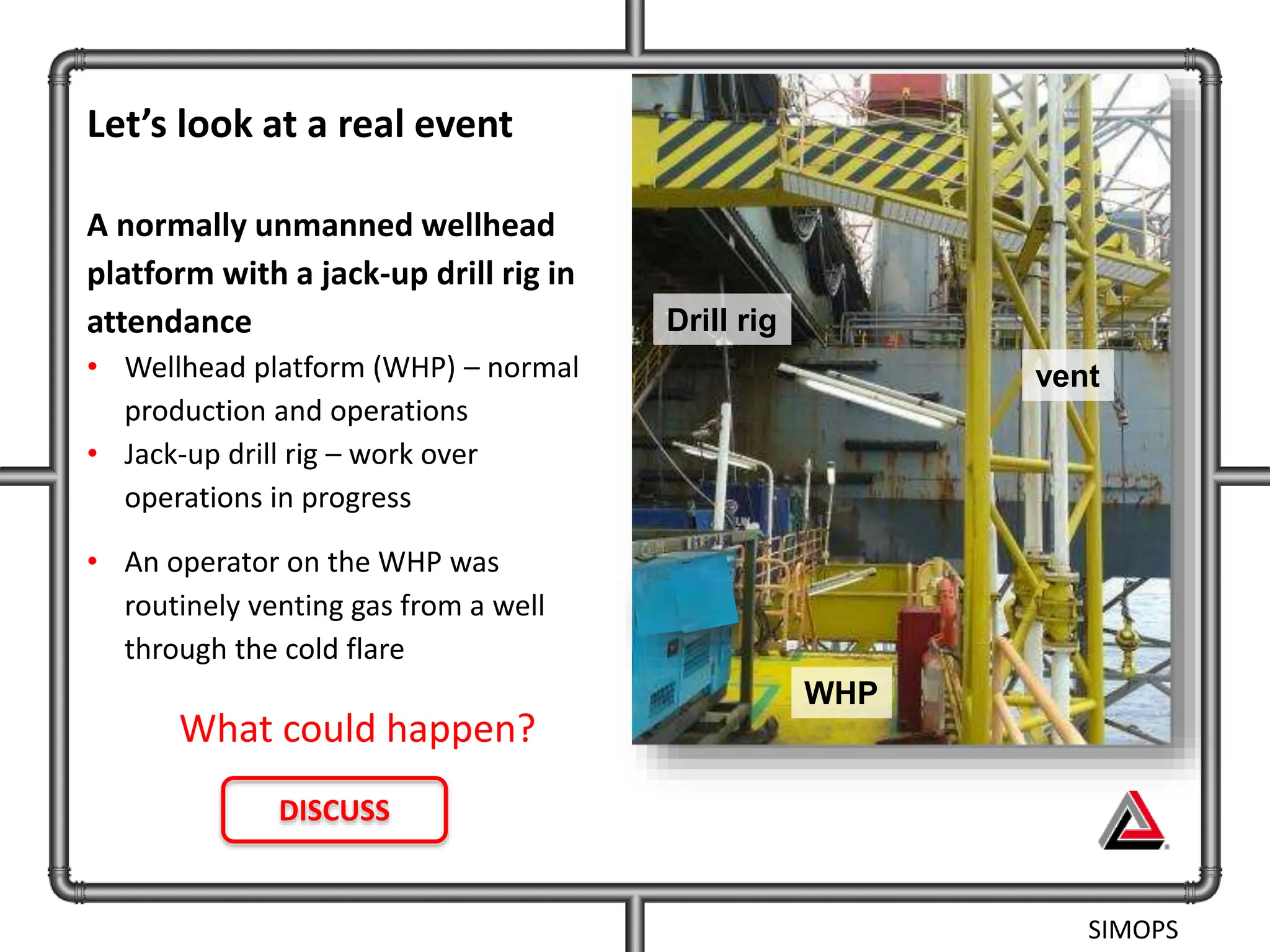
Drill rig
WHP
vent
SIMOPS
What could happen?
• On the WHP, a well had stopped
flowing and was shut-in
• To restart the well an operator was
asked to vent the topside’s gas from
the shut-in well – this routine
procedure did not normally need a
Permit to Work.
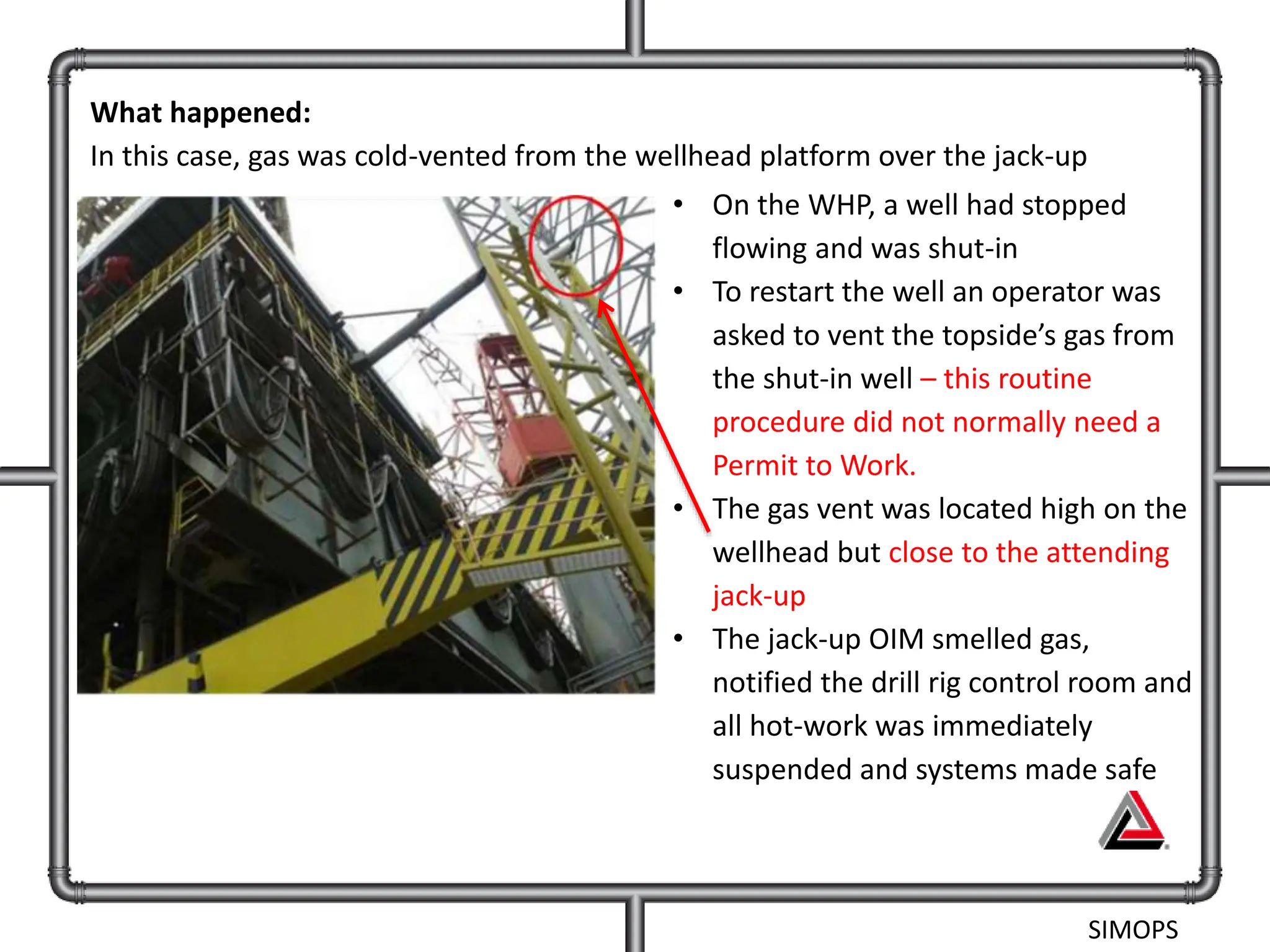
• The gas vent was located high on the
wellhead but close to the attending
jack-up
• The jack-up OIM smelled gas,
notified the drill rig control room and
all hot-work was immediately
suspended and systems made safe
What happened:
In this case, gas was cold-vented from the wellhead platform over the jack-up
SIMOPS
What behaviours and steps could prevent this
from occurring?
DISCUSS
Fortunately the gas did not find an ignition source, no harm occurred
and a potential major accident was prevented
SIMOPS
Factors which led to this incident:
• Risk assessment not included for all activities
• Routine operations were progressed without considering the presence of the
jack-up drilling rig working over the installation
• Simultaneous operations procedures were not adequately documented,
understood or observed
• People were complacent in performing routine hazardous operations
Help and Advice
SIMOPS: Two or more of the following activities: production, drilling, completion,
workover, wireline (except routine operations) and major construction operations
During SIMOPS, it is vital that hazards are assessed and the joint safety needs are
considered for all operations to avoid a hazard on one installation having an impact
on the other(s)
Ensure effective communications are established between control of work
authorities
SIMOPS
Which of the 7Cs are involved in this safety alert?
• Change management
• Communication
• Complacency
• Control of work
• Competence
• Culture
• Commitment
Did this presentation result in discussion that could lead to creating
another alert to share with industry? Please contact :
info@stepchangeinsafety.net
SIMOPS

Safety-Moment-SIMOPS-gas-venting.pptx

  • 1.
  • 2.
    Scenario • You arein charge of an unmanned wellhead platform • A drilling rig will be coming alongside in a few months to carry out simultaneous operations • What additional hazards might be introduced as a result of the two installations working together? • What aspects of your operation might change as a result of the two installations coming together? SIMOPS DISCUSS
  • 3.
    Let’s look ata real event A normally unmanned wellhead platform with a jack-up drill rig in attendance • Wellhead platform (WHP) – normal production and operations • Jack-up drill rig – work over operations in progress • An operator on the WHP was routinely venting gas from a well through the cold flare DISCUSS Drill rig WHP vent SIMOPS What could happen?
  • 4.
    • On theWHP, a well had stopped flowing and was shut-in • To restart the well an operator was asked to vent the topside’s gas from the shut-in well – this routine procedure did not normally need a Permit to Work. • The gas vent was located high on the wellhead but close to the attending jack-up • The jack-up OIM smelled gas, notified the drill rig control room and all hot-work was immediately suspended and systems made safe What happened: In this case, gas was cold-vented from the wellhead platform over the jack-up SIMOPS
  • 5.
    What behaviours andsteps could prevent this from occurring? DISCUSS Fortunately the gas did not find an ignition source, no harm occurred and a potential major accident was prevented SIMOPS
  • 6.
    Factors which ledto this incident: • Risk assessment not included for all activities • Routine operations were progressed without considering the presence of the jack-up drilling rig working over the installation • Simultaneous operations procedures were not adequately documented, understood or observed • People were complacent in performing routine hazardous operations Help and Advice SIMOPS: Two or more of the following activities: production, drilling, completion, workover, wireline (except routine operations) and major construction operations During SIMOPS, it is vital that hazards are assessed and the joint safety needs are considered for all operations to avoid a hazard on one installation having an impact on the other(s) Ensure effective communications are established between control of work authorities SIMOPS
  • 7.
    Which of the7Cs are involved in this safety alert? • Change management • Communication • Complacency • Control of work • Competence • Culture • Commitment Did this presentation result in discussion that could lead to creating another alert to share with industry? Please contact : info@stepchangeinsafety.net SIMOPS

Editor's Notes

  • #3 For additional hazards, consider: Lifeboats, evacuations routes, firewater, vents, emergency shutdown, control of work, emergency disconnects, lifting operations, helicopter operations
  • #4 The drill rig is grey The wellhead platform is yellow The vent is the vertical white pipe in the yellow vent stack
  • #7 The definition of SIMOPS comes from: API RP 54: Recommended Practice for Occupational Safety for Oil and Gas Well Drilling and Servicing Operations, Third Edition, August 1999 (2007)