HYDROGEN SULFIDE (H2
S) TRAINING COURSE
Hydrogen
Sulfide Training
1
HYDROGEN SULFIDE (H2
S) TRAINING COURSE
2
HYDROGEN SULFIDE (H2
S) TRAINING COURSE
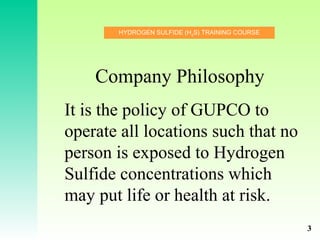
Company Philosophy
It is the policy of GUPCO to
operate all locations such that no
person is exposed to Hydrogen
Sulfide concentrations which
may put life or health at risk.
3
HYDROGEN SULFIDE (H2
S) TRAINING COURSE
It is your responsibility to be aware
of the properties and toxicity of H2S
gas.
You must be able to recognize its
presence and know how to protect
yourself from its lethal effects.
You are responsible for you own
safety.
4
HYDROGEN SULFIDE (H2
S) TRAINING COURSE
Training and Competency
ALL personnel, whether regularly assigned
or employed on an unscheduled basis shall
be informed of the hazards of H2S.
All staff who will be required to enter a H2S
area as part of their normal work will be
trained to a level of competence in line with
the risks involved.
5
HYDROGEN SULFIDE (H2
S) TRAINING COURSE
Hydrogen Sulfide
• H2S gas is commonly measured in
parts per million (ppm)
• How much is a ppm?
1 drop of water in a bathtub.
1 meter or 1 step in 1000 kms
• 1% H2S gas is equal to 10,000 ppm
• In the Ras Shukheir area, concentrations
of over 3000 ppm have been recorded.
6
HYDROGEN SULFIDE (H2
S) TRAINING COURSE
H2S is a Poisonous Gas
• The effects of exposure can range from minor
discomfort to death.
• It is not enough to be able to recognize the gas and
know where it is likely to occur.
• You need to know how much it takes to harm you
and to know specific locations where a release
may occur.
• Your first response is to get out of the area,
upwind or cross wind from the release.
7
HYDROGEN SULFIDE (H2
S) TRAINING COURSE
Classification of H2S Areas
• There are 2 Classifications of H2S areas in the Ras
Shukheir facility.
• Sweet or non-sour: Areas where concentrations of
H2S in the process stream and equipment are
below 10 ppm.
• H2S areas or sour: Areas where the concentration
of the process stream and equipment are over 10
ppm.
• The Off Shore Central Production area is
considered a H2S area. Sweet platforms are
October , July, Ramadon. 8
HYDROGEN SULFIDE (H2
S) TRAINING COURSE
Physical Properties of H2S
 Color – H2S is colorless, it is invisible. You cannot rely on your eyes
to detect its presence. This is another hazard of working around areas
that contain H2S gas.
 Odor – H2S has a distinctive, offensive smell, similar to “rotten eggs”.
This is why is it sometimes called “Sour gas”. At concentrations of
100 ppm it will paralyze your sense of smell which can make it fatal to
rely on your nose as a detection device.
 Vapor Density – Hydrogen Sulfide gas is HEAVIER THAN AIR. In
highly concentrated mixtures it will tend to settle in low lying areas
like pits, cellars, or tanks. In lower concentrations it will be mixed
with other gases and move with the gas.
 H2S can travel in any direction, depending on pressure, temperature or
swirling winds.
9
HYDROGEN SULFIDE (H2
S) TRAINING COURSE
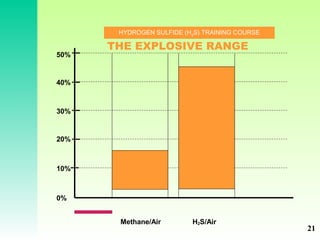
Explosive Limits – Flammable Range
H2S gas when mixed with air will explode. It has a wide
explosive range (4.3 – 44%) which is very wide when
compared with other gases.
Flammability – H2S burns with a distinctive blue flame
which produces Sulphur Dioxide (SO2). This hazardous
gas irritates the eyes and lungs, and can be potentially
fatal. ANY EXPOSURE TO SO2 SHOULD BE
AVOIDED.
Solubility – H2S gas dissolves in liquids, which means
that it can be present in any container or vessel used
to carry or hold well fluids including oil, water,
emulsion and sludge. H2S will be released when this
liquid is agitated, depressured, or heated.
Physical Properties of H2S Gas
1 10
HYDROGEN SULFIDE (H2
S) TRAINING COURSE
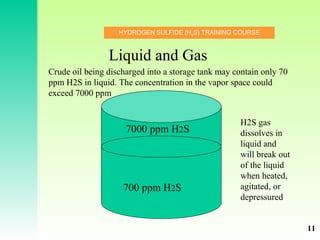
Liquid and Gas
Crude oil being discharged into a storage tank may contain only 70
ppm H2S in liquid. The concentration in the vapor space could
exceed 7000 ppm
700 ppm H2S
7000 ppm H2S
H2S gas
dissolves in
liquid and
will break out
of the liquid
when heated,
agitated, or
depressured
11
HYDROGEN SULFIDE (H2
S) TRAINING COURSE
Attacks most metals, especially in the presence
of water, forming sulfides which are usually
insoluble precipitates.
Dissolves in water forming a weak acid
(hydrosulfuric acid).
These 6 physical properties of H2S gas help
provide a good picture of it’s characteristics. This
information will help you avoid being exposed.
Physical Properties of H2S Gas
12
HYDROGEN SULFIDE (H2
S) TRAINING COURSE
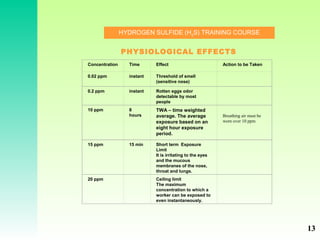
20 ppm Ceiling limit
The maximum
concentration to which a
worker can be exposed to
even instantaneously.
15 ppm 15 min Short term Exposure
Limit
It is irritating to the eyes
and the mucous
membranes of the nose,
throat and lungs.
10 ppm 8
hours
TWA – time weighted
average. The average
exposure based on an
eight hour exposure
period.
Breathing air must be
worn over 10 ppm
0.2 ppm instant Rotten eggs odor
detectable by most
people
Concentration Time Effect Action to be Taken
0.02 ppm instant Threshold of smell
(sensitive nose)
PHYSIOLOGICAL EFFECTS
13
HYDROGEN SULFIDE (H2
S) TRAINING COURSE
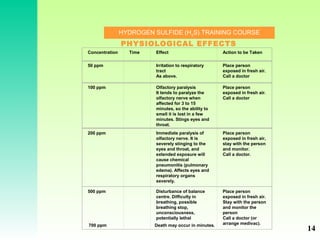
500 ppm Disturbance of balance
centre. Difficulty in
breathing, possible
breathing stop,
unconsciousness,
potentially lethal
Place person
exposed in fresh air.
Stay with the person
and monitor the
person
Call a doctor (or
arrange medivac).
200 ppm Immediate paralysis of
olfactory nerve. It is
severely stinging to the
eyes and throat, and
extended exposure will
cause chemical
pneumonitis (pulmonary
edema). Affects eyes and
respiratory organs
severely.
Place person
exposed in fresh air,
stay with the person
and monitor.
Call a doctor.
100 ppm Olfactory paralysis
It tends to paralyze the
olfactory nerve when
affected for 3 to 15
minutes, so the ability to
smell it is lost in a few
minutes. Stings eyes and
throat.
Place person
exposed in fresh air.
Call a doctor
50 ppm Irritation to respiratory
tract
As above.
Place person
exposed in fresh air.
Call a doctor
Concentration Time Effect Action to be Taken
PHYSIOLOGICAL EFFECTS
700 ppm Death may occur in minutes.
14
HYDROGEN SULFIDE (H2
S) TRAINING COURSE
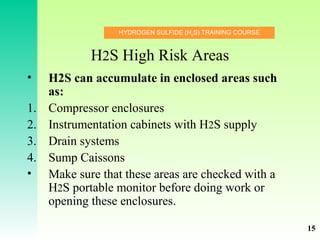
H2S High Risk Areas
• H2S can accumulate in enclosed areas such
as:
1. Compressor enclosures
2. Instrumentation cabinets with H2S supply
3. Drain systems
4. Sump Caissons
• Make sure that these areas are checked with a
H2S portable monitor before doing work or
opening these enclosures.
15
HYDROGEN SULFIDE (H2
S) TRAINING COURSE
Common H2S Leak Areas
• Vent lines
• Relief valves
• Sample points
• Drains
• Flanges
• Seals
• Packings
• Fittings
• Valves
• Turbines
16
HYDROGEN SULFIDE (H2
S) TRAINING COURSE
How H2S Affects You
• When H2S is inhaled, it passes directly through
the lungs into the bloodstream. To protect itself
the body breaks down the gases into a harmless
compound.
• If you breath in more than the body can break
down, it builds up in the blood and you will go
unconscious.
• The areas of the brain which control breathing
become paralyzed, the lungs stop working and the
person is asphyxiated
17
HYDROGEN SULFIDE (H2
S) TRAINING COURSE
 Fixed Gas Detection – not used at R/S
 Portable Gas Detection – Industrial Scientific
and Triple plus - measure O2, LEL, and H2S.
 Area Gas Detectors – Crowcom detectors
 Personal Gas Monitors – Gasman 11, alarms at
5 ppm and 10 ppm. Only monitors for H2S
 Chemical Detector Tubes – used by the Lab
technicians
Testing for H2S Gas
Detection Systems
18
HYDROGEN SULFIDE (H2
S) TRAINING COURSE
Pre-Use Gas Detector Checks
• Select the correct gas detector for the job
• Check that the detector is within the calibration
date
• Ensure that it is in good shape, no damage
• Check that the battery life is sufficient
• Check that the sensor head membranes are clean
and not blocked
• Check the detector zeros in a clean environment
LEL=0%, H2S=0, Oxygen=20.9%
19
HYDROGEN SULFIDE (H2
S) TRAINING COURSE
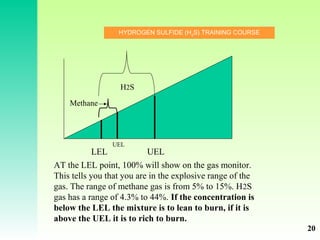
LEL UEL
AT the LEL point, 100% will show on the gas monitor.
This tells you that you are in the explosive range of the
gas. The range of methane gas is from 5% to 15%. H2S
gas has a range of 4.3% to 44%. If the concentration is
below the LEL the mixture is to lean to burn, if it is
above the UEL it is to rich to burn.
H2S
Methane
UEL
20
HYDROGEN SULFIDE (H2
S) TRAINING COURSE
THE EXPLOSIVE RANGE
0%
20%
30%
40%
50%
10%
Methane/Air H2S/Air
21
HYDROGEN SULFIDE (H2
S) TRAINING COURSE
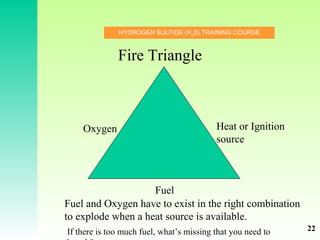
Fire Triangle
Fuel
Oxygen Heat or Ignition
source
Fuel and Oxygen have to exist in the right combination
to explode when a heat source is available.
If there is too much fuel, what’s missing that you need to 22
HYDROGEN SULFIDE (H2
S) TRAINING COURSE
Respiratory Protective Equipment
 SCBA - 30 minute, Self Contained Breathing
Apparatus
 SABA – Supplied Air Breathing Apparatus
 10 Minute Escape Packs
 Compressed Airline Breathing Apparatus –
cascade system used with wireline and well
servicing operations.
 Note: It is your responsibility to familiarize
yourself with the SCBA at your location.
23
HYDROGEN SULFIDE (H2
S) TRAINING COURSE
Components of SCBA
• Air Supply – air cylinder, cylinder valve, cylinder
pressure gauge.
• Regulator Assembly – high pressure system,
pressure regulator, bypass/purge valve, pressure
gauge, low pressure alarm.
• Face piece Assembly – face piece, low pressure
hose, nose cup, exhalation valve, head harness.
• Harness Assembly
24
HYDROGEN SULFIDE (H2
S) TRAINING COURSE
Instructions for Donning SCBA
• Prepare Equipment – check cylinder pressure, face
piece, and harness.
• Put on Cylinder – adjust and tighten straps.
• Put on Face piece – Tighten straps starting at the
chin first.
• Negative Pressure Test – Block face piece opening
and breath in to check for seal and breath out to
check exhalation valve.
• Connect Air – Open cylinder, connect regulator,
and breath.
25
HYDROGEN SULFIDE (H2
S) TRAINING COURSE
Cleaning and Maintenance
• Immediately after use, Breathing Air equipment must be
cleaned and properly stored. The face piece must be
sanitized with a commercial disinfectant that is approved
for use by the manufacturer.
• Inspections should be done at a minimum once per week
and cover:
1. Checking the pressure of the cylinder
2. Condition of breathing hose
3. Condition of mask, straps fully extended and pulled over
the front of the mask
4. Mask protected in a plastic bag
5. All parts are clean and in good condition.
26
HYDROGEN SULFIDE (H2
S) TRAINING COURSE
Rescue Procedures
• Step 1 – Evacuate Immediately – if there is an release of
H2S you must evacuate the areas immediately, moving upwind or
crosswind and to a higher location.
• Step 2 – Sound the Alarm – notify the control room that
there is a H2S release and where. Ask for help.
• Step 3 – Assess the Situation – quickly assess if there are
other hazards that could put you at risk. (explosive mixture)
• Step 4 – Protect yourself by putting on SCBA –
Always don breathing air before attempting a rescue. Use SCBA packs
and never escape packs for performing a rescue.
27
HYDROGEN SULFIDE (H2
S) TRAINING COURSE
Rescue Procedure
• Step 5 – Rescue the victim – You may rescue by
yourself if you know help is coming. Move victim upwind
to fresh air.
• Step 6 – Revive the Victim – assess the victim
for vital signs. If not breathing artificial respiration must
be started.
• Step 7 – Get Medical Aid – All H2S victims
require medical attention. Never leave the victim alone.
28
HYDROGEN SULFIDE (H2
S) TRAINING COURSE
Rescue Techniques
• Collar Drag – 1 person rescue
1. Place victim on their back.
2. Unzip victim’s coveralls 15-20 cm.
3. Roll up the collar of the victim’s coveralls so
you can get a firm grip.
4. Lift victim to semi-sitting position.
5. Support the victim’s head on your forearms.
6. Drag victim to a safe area.
29
HYDROGEN SULFIDE (H2
S) TRAINING COURSE
Rescue Techniques
• Two-Arm Drag
1. Place the victim on their back.
2. Squat behind the victim.
3. Lift the victim to a semi-sitting position, while
supporting the head and neck.
4. Use your thigh or knee to support the victim’s back.
5. Put your arms under the victim’s armpits.
6. Cross the victim’s arms and get a firm hold on the
victims wrists.
7. Lift victim up against your chest as you stand using your
legs to lift.
8. Drag the victim to a safe area. 30
HYDROGEN SULFIDE (H2
S) TRAINING COURSE
Rescue Techniques
• Two-Rescuer Drag
1. Place the victim on their back and unzip their coveralls
15-20 cm.
2. Lift and prop the victim into a semi-sitting position.
3. Rescuers stand on each side of the victim, facing away
from the victim’s feet.
4. Rescuers place their closest hand inside the victim’s
collar getting a firm grip of the coveralls.
5. Working together, drag the victim to safety, supporting
the victim’s neck with your forearms and the collar of
the victim’s coveralls.
31
HYDROGEN SULFIDE (H2
S) TRAINING COURSE
Rescue Techniques
• Two-Rescuer Carry or Lift
1. Place the victim on their back.
2. One rescuer goes to the victim’s head and supports the head and
neck.
3. The other rescuer squats at the victim’s feet, grips the victim’s
wrist(s) and slowly pulls the victim into a sitting position.
4. The rescuer at the head then squats behind the victim, reaches under
the armpits and grasps the victims wrist(s).
5. The rescuer at the feet crosses the victim’s legs at the ankles and
prepares to lift.
6. Together, the rescuers lift the victim evenly.
7. Facing forward, they carry the victim to a safe area.
32
HYDROGEN SULFIDE (H2
S) TRAINING COURSE
Rescue Breathing
1. Determine unresponsiveness
2. Open the airway.
3. Give 2 slow breaths
4. Check for a pulse
5. If no pulse, begin chest compressions. 15
compressions and 2 slow breaths.
6. After 4 cycles or 1 minute, check pulse again.
Note: you should be trained in CPR before
administering.
33
HYDROGEN SULFIDE (H2
S) TRAINING COURSE
Breaking Containment
Examples of breaking containment:
1. Launching and receiving pigs.
2. De-pressuring equipment to atmosphere
3. Wireline lubricator rig up
4. Orifice plate changes
5. Pipe repairs
6. Gas/liquid sampling
7. Compressor maintenance (replacing valves)
34
HYDROGEN SULFIDE (H2
S) TRAINING COURSE
Breaking Containment
• The following conditions must exist before
breaking containment in a sour or H2S area
classification.
1. H2S concentration must be known
2. PTW, risk assessment, pre-job must be held
3. Personal H2S monitors must be worn
4. Wind direction must be known
5. No other workers in the vicinity
6. Equipment must be isolated, drained, depressured
7. SCBA is to be kept on hand.
35
HYDROGEN SULFIDE (H2
S) TRAINING COURSE
Breaking Containment
If H2S concentration is over 100 ppm.
1. Workers must wear breathing air before
breaking containment and until the atmosphere
is proved to be below 10 ppm.
2. Safety standby positioned in case of emergency
3. At no time are workers allowed to work in
atmospheres over 10 ppm.
36
HYDROGEN SULFIDE (H2
S) TRAINING COURSE
Boarding Platforms and Satellites
• When concentrations of H2S in the gas
stream are between 10 – 500 ppm.
1. H2S Procedure must be followed as well as Breaking Containment
Guidelines.
2. Satellites will be equipped with 4 emergency escape packs and 1
SCBA.
3. Boats to approach from downwind side with portable H2S detector
turned on.
4. If any levels detected then no boarding will take place until the OIM
is contacted.
5. Boats to be equipped with with 2 – 30 minute SCBA, 1 portable
detector, and personal H2S monitors for each worker boarding the
platform.
37
HYDROGEN SULFIDE (H2
S) TRAINING COURSE
Boarding Platforms and Satellites
1. By Helicopter, observe the platform for any
abnormal conditions.
2. Workers to wear personal H2S monitors making
note of wind direction and any abnormal
conditions.
3. If H2S detected, move upwind or crosswind
from the leak. The R/S emergency # must be
contacted 2800.
4. A Safety Standby Man is required for work done
under breathing air in atmospheres over 100
ppm. 38
HYDROGEN SULFIDE (H2
S) TRAINING COURSE
Boarding Platforms and Satellites
• Additional requirements for platforms over 500
ppm H2S. (Edfu, M20).
1. Minimum 3 personnel to board the satellite platform.
One person to serve as safety stand-by.
2. 4 escape packs, and 3 SCBA’s and 2 spare bottles stored
on platform.
3. Boat equipped with 3-SCBA’s, portable gas detector and
personal H2S monitors for all workers. Spare air bottles
should also be available.
4. Area must be checked with a portable H2S detector by
the safety man before work is to begin.
39
HYDROGEN SULFIDE (H2
S) TRAINING COURSE
Safety Standby
• To be used as an observer and back-up during
specific work procedures. Not part of the work
crew, only concerned with safety of workers.
• Must have knowledge of:
1. Site specific job procedures
2. Operating procedures for the safety equipment.
3. How to communicate to the supervisor
4. Trained in First Aid, CPR, H2S, and Rescue
procedures.
5. Mandatory when workers are under mask in
atmospheres greater than 100 ppm. 40
HYDROGEN SULFIDE (H2
S) TRAINING COURSE
Safety Standby
• Duties to include
1. Rescue
2. Fire watch
3. Atmosphere monitoring
4. Ensure air supply is workers using SABA
5. Provide communication
6. Attend the pre-job meeting
7. In the event of an emergency will activate the 7 step
rescue plan
Give examples of where you would require a safety standby.
41
HYDROGEN SULFIDE (H2
S) TRAINING COURSE
Emergency Evacuation
• The normal muster point for an uncontrolled
release of H2S gas will be the Helideck.
• Remember that there may be a greater risk of
explosion if there is an uncontrolled release of gas.
• Never walk through a gas cloud to get to the
muster point as YOU may be the source of
ignition.
• If a hazard such as a gas leak is blocking the
access to the muster point, an alternate muster
location must be communicated by the OIM or
lead operator. 42
HYDROGEN SULFIDE (H2
S) TRAINING COURSE
Examples of Breaking Containment
• Pigging – as a class, discuss what the
procedure should be to pig the 12” line from
Edfu to Morgan 36. List the steps to do this
job. The line contains 800 ppm H2S.
43
HYDROGEN SULFIDE (H2
S) TRAINING COURSE
Example
• Follow pigging procedure for launching pig.
• PTW and a pre-job meeting.
• 2 men working under mask with a safety standby.
• Assure valves are swung to receive pig at Morgan 36.
• Personal H2S monitors, portable gas monitor, 3 SCBA,
radio with extra battery.
• 3 operators, all clean shaven.
• Depressure the pig trap, purge with sea water, drain, open
vents. Trap should still be opened under mask with
workers staying up wind or crosswind.
• How about receiving the pig at Morgan 36. What would be
different? 44
HYDROGEN SULFIDE (H2
S) TRAINING COURSE
Questions and Exam
• Any questions?
• Closed book exam. The exam should take
no longer than 30 minutes.
• A H2S training certificate will be issued
after receiving a mark of 80% or more.
• Please print your name on the exam clearly.
45
HYDROGEN SULFIDE (H2
S) TRAINING COURSE
Training Agenda
• Class size should be limited to 16.
• 2 different styles of SCBA, 2 portable gas detectors,
sample gas, 2 personal H2S monitors. Students should
demonstrate use.
• LEL and UEL should be explained in detail using
drawings.
• All student should demonstrate donning SCBA, masks
should be wiped clean after every use.
• The rescue techniques should be demonstrated and the 7
step rescue plan should be demonstrated.
• Test can be corrected in class.
• Estimated time of course – 4-5 hours.
46

h2 s-training-slides-english

  • 1.
    HYDROGEN SULFIDE (H2 S)TRAINING COURSE Hydrogen Sulfide Training 1
  • 2.
    HYDROGEN SULFIDE (H2 S)TRAINING COURSE 2
  • 3.
    HYDROGEN SULFIDE (H2 S)TRAINING COURSE Company Philosophy It is the policy of GUPCO to operate all locations such that no person is exposed to Hydrogen Sulfide concentrations which may put life or health at risk. 3
  • 4.
    HYDROGEN SULFIDE (H2 S)TRAINING COURSE It is your responsibility to be aware of the properties and toxicity of H2S gas. You must be able to recognize its presence and know how to protect yourself from its lethal effects. You are responsible for you own safety. 4
  • 5.
    HYDROGEN SULFIDE (H2 S)TRAINING COURSE Training and Competency ALL personnel, whether regularly assigned or employed on an unscheduled basis shall be informed of the hazards of H2S. All staff who will be required to enter a H2S area as part of their normal work will be trained to a level of competence in line with the risks involved. 5
  • 6.
    HYDROGEN SULFIDE (H2 S)TRAINING COURSE Hydrogen Sulfide • H2S gas is commonly measured in parts per million (ppm) • How much is a ppm? 1 drop of water in a bathtub. 1 meter or 1 step in 1000 kms • 1% H2S gas is equal to 10,000 ppm • In the Ras Shukheir area, concentrations of over 3000 ppm have been recorded. 6
  • 7.
    HYDROGEN SULFIDE (H2 S)TRAINING COURSE H2S is a Poisonous Gas • The effects of exposure can range from minor discomfort to death. • It is not enough to be able to recognize the gas and know where it is likely to occur. • You need to know how much it takes to harm you and to know specific locations where a release may occur. • Your first response is to get out of the area, upwind or cross wind from the release. 7
  • 8.
    HYDROGEN SULFIDE (H2 S)TRAINING COURSE Classification of H2S Areas • There are 2 Classifications of H2S areas in the Ras Shukheir facility. • Sweet or non-sour: Areas where concentrations of H2S in the process stream and equipment are below 10 ppm. • H2S areas or sour: Areas where the concentration of the process stream and equipment are over 10 ppm. • The Off Shore Central Production area is considered a H2S area. Sweet platforms are October , July, Ramadon. 8
  • 9.
    HYDROGEN SULFIDE (H2 S)TRAINING COURSE Physical Properties of H2S  Color – H2S is colorless, it is invisible. You cannot rely on your eyes to detect its presence. This is another hazard of working around areas that contain H2S gas.  Odor – H2S has a distinctive, offensive smell, similar to “rotten eggs”. This is why is it sometimes called “Sour gas”. At concentrations of 100 ppm it will paralyze your sense of smell which can make it fatal to rely on your nose as a detection device.  Vapor Density – Hydrogen Sulfide gas is HEAVIER THAN AIR. In highly concentrated mixtures it will tend to settle in low lying areas like pits, cellars, or tanks. In lower concentrations it will be mixed with other gases and move with the gas.  H2S can travel in any direction, depending on pressure, temperature or swirling winds. 9
  • 10.
    HYDROGEN SULFIDE (H2 S)TRAINING COURSE Explosive Limits – Flammable Range H2S gas when mixed with air will explode. It has a wide explosive range (4.3 – 44%) which is very wide when compared with other gases. Flammability – H2S burns with a distinctive blue flame which produces Sulphur Dioxide (SO2). This hazardous gas irritates the eyes and lungs, and can be potentially fatal. ANY EXPOSURE TO SO2 SHOULD BE AVOIDED. Solubility – H2S gas dissolves in liquids, which means that it can be present in any container or vessel used to carry or hold well fluids including oil, water, emulsion and sludge. H2S will be released when this liquid is agitated, depressured, or heated. Physical Properties of H2S Gas 1 10
  • 11.
    HYDROGEN SULFIDE (H2 S)TRAINING COURSE Liquid and Gas Crude oil being discharged into a storage tank may contain only 70 ppm H2S in liquid. The concentration in the vapor space could exceed 7000 ppm 700 ppm H2S 7000 ppm H2S H2S gas dissolves in liquid and will break out of the liquid when heated, agitated, or depressured 11
  • 12.
    HYDROGEN SULFIDE (H2 S)TRAINING COURSE Attacks most metals, especially in the presence of water, forming sulfides which are usually insoluble precipitates. Dissolves in water forming a weak acid (hydrosulfuric acid). These 6 physical properties of H2S gas help provide a good picture of it’s characteristics. This information will help you avoid being exposed. Physical Properties of H2S Gas 12
  • 13.
    HYDROGEN SULFIDE (H2 S)TRAINING COURSE 20 ppm Ceiling limit The maximum concentration to which a worker can be exposed to even instantaneously. 15 ppm 15 min Short term Exposure Limit It is irritating to the eyes and the mucous membranes of the nose, throat and lungs. 10 ppm 8 hours TWA – time weighted average. The average exposure based on an eight hour exposure period. Breathing air must be worn over 10 ppm 0.2 ppm instant Rotten eggs odor detectable by most people Concentration Time Effect Action to be Taken 0.02 ppm instant Threshold of smell (sensitive nose) PHYSIOLOGICAL EFFECTS 13
  • 14.
    HYDROGEN SULFIDE (H2 S)TRAINING COURSE 500 ppm Disturbance of balance centre. Difficulty in breathing, possible breathing stop, unconsciousness, potentially lethal Place person exposed in fresh air. Stay with the person and monitor the person Call a doctor (or arrange medivac). 200 ppm Immediate paralysis of olfactory nerve. It is severely stinging to the eyes and throat, and extended exposure will cause chemical pneumonitis (pulmonary edema). Affects eyes and respiratory organs severely. Place person exposed in fresh air, stay with the person and monitor. Call a doctor. 100 ppm Olfactory paralysis It tends to paralyze the olfactory nerve when affected for 3 to 15 minutes, so the ability to smell it is lost in a few minutes. Stings eyes and throat. Place person exposed in fresh air. Call a doctor 50 ppm Irritation to respiratory tract As above. Place person exposed in fresh air. Call a doctor Concentration Time Effect Action to be Taken PHYSIOLOGICAL EFFECTS 700 ppm Death may occur in minutes. 14
  • 15.
    HYDROGEN SULFIDE (H2 S)TRAINING COURSE H2S High Risk Areas • H2S can accumulate in enclosed areas such as: 1. Compressor enclosures 2. Instrumentation cabinets with H2S supply 3. Drain systems 4. Sump Caissons • Make sure that these areas are checked with a H2S portable monitor before doing work or opening these enclosures. 15
  • 16.
    HYDROGEN SULFIDE (H2 S)TRAINING COURSE Common H2S Leak Areas • Vent lines • Relief valves • Sample points • Drains • Flanges • Seals • Packings • Fittings • Valves • Turbines 16
  • 17.
    HYDROGEN SULFIDE (H2 S)TRAINING COURSE How H2S Affects You • When H2S is inhaled, it passes directly through the lungs into the bloodstream. To protect itself the body breaks down the gases into a harmless compound. • If you breath in more than the body can break down, it builds up in the blood and you will go unconscious. • The areas of the brain which control breathing become paralyzed, the lungs stop working and the person is asphyxiated 17
  • 18.
    HYDROGEN SULFIDE (H2 S)TRAINING COURSE  Fixed Gas Detection – not used at R/S  Portable Gas Detection – Industrial Scientific and Triple plus - measure O2, LEL, and H2S.  Area Gas Detectors – Crowcom detectors  Personal Gas Monitors – Gasman 11, alarms at 5 ppm and 10 ppm. Only monitors for H2S  Chemical Detector Tubes – used by the Lab technicians Testing for H2S Gas Detection Systems 18
  • 19.
    HYDROGEN SULFIDE (H2 S)TRAINING COURSE Pre-Use Gas Detector Checks • Select the correct gas detector for the job • Check that the detector is within the calibration date • Ensure that it is in good shape, no damage • Check that the battery life is sufficient • Check that the sensor head membranes are clean and not blocked • Check the detector zeros in a clean environment LEL=0%, H2S=0, Oxygen=20.9% 19
  • 20.
    HYDROGEN SULFIDE (H2 S)TRAINING COURSE LEL UEL AT the LEL point, 100% will show on the gas monitor. This tells you that you are in the explosive range of the gas. The range of methane gas is from 5% to 15%. H2S gas has a range of 4.3% to 44%. If the concentration is below the LEL the mixture is to lean to burn, if it is above the UEL it is to rich to burn. H2S Methane UEL 20
  • 21.
    HYDROGEN SULFIDE (H2 S)TRAINING COURSE THE EXPLOSIVE RANGE 0% 20% 30% 40% 50% 10% Methane/Air H2S/Air 21
  • 22.
    HYDROGEN SULFIDE (H2 S)TRAINING COURSE Fire Triangle Fuel Oxygen Heat or Ignition source Fuel and Oxygen have to exist in the right combination to explode when a heat source is available. If there is too much fuel, what’s missing that you need to 22
  • 23.
    HYDROGEN SULFIDE (H2 S)TRAINING COURSE Respiratory Protective Equipment  SCBA - 30 minute, Self Contained Breathing Apparatus  SABA – Supplied Air Breathing Apparatus  10 Minute Escape Packs  Compressed Airline Breathing Apparatus – cascade system used with wireline and well servicing operations.  Note: It is your responsibility to familiarize yourself with the SCBA at your location. 23
  • 24.
    HYDROGEN SULFIDE (H2 S)TRAINING COURSE Components of SCBA • Air Supply – air cylinder, cylinder valve, cylinder pressure gauge. • Regulator Assembly – high pressure system, pressure regulator, bypass/purge valve, pressure gauge, low pressure alarm. • Face piece Assembly – face piece, low pressure hose, nose cup, exhalation valve, head harness. • Harness Assembly 24
  • 25.
    HYDROGEN SULFIDE (H2 S)TRAINING COURSE Instructions for Donning SCBA • Prepare Equipment – check cylinder pressure, face piece, and harness. • Put on Cylinder – adjust and tighten straps. • Put on Face piece – Tighten straps starting at the chin first. • Negative Pressure Test – Block face piece opening and breath in to check for seal and breath out to check exhalation valve. • Connect Air – Open cylinder, connect regulator, and breath. 25
  • 26.
    HYDROGEN SULFIDE (H2 S)TRAINING COURSE Cleaning and Maintenance • Immediately after use, Breathing Air equipment must be cleaned and properly stored. The face piece must be sanitized with a commercial disinfectant that is approved for use by the manufacturer. • Inspections should be done at a minimum once per week and cover: 1. Checking the pressure of the cylinder 2. Condition of breathing hose 3. Condition of mask, straps fully extended and pulled over the front of the mask 4. Mask protected in a plastic bag 5. All parts are clean and in good condition. 26
  • 27.
    HYDROGEN SULFIDE (H2 S)TRAINING COURSE Rescue Procedures • Step 1 – Evacuate Immediately – if there is an release of H2S you must evacuate the areas immediately, moving upwind or crosswind and to a higher location. • Step 2 – Sound the Alarm – notify the control room that there is a H2S release and where. Ask for help. • Step 3 – Assess the Situation – quickly assess if there are other hazards that could put you at risk. (explosive mixture) • Step 4 – Protect yourself by putting on SCBA – Always don breathing air before attempting a rescue. Use SCBA packs and never escape packs for performing a rescue. 27
  • 28.
    HYDROGEN SULFIDE (H2 S)TRAINING COURSE Rescue Procedure • Step 5 – Rescue the victim – You may rescue by yourself if you know help is coming. Move victim upwind to fresh air. • Step 6 – Revive the Victim – assess the victim for vital signs. If not breathing artificial respiration must be started. • Step 7 – Get Medical Aid – All H2S victims require medical attention. Never leave the victim alone. 28
  • 29.
    HYDROGEN SULFIDE (H2 S)TRAINING COURSE Rescue Techniques • Collar Drag – 1 person rescue 1. Place victim on their back. 2. Unzip victim’s coveralls 15-20 cm. 3. Roll up the collar of the victim’s coveralls so you can get a firm grip. 4. Lift victim to semi-sitting position. 5. Support the victim’s head on your forearms. 6. Drag victim to a safe area. 29
  • 30.
    HYDROGEN SULFIDE (H2 S)TRAINING COURSE Rescue Techniques • Two-Arm Drag 1. Place the victim on their back. 2. Squat behind the victim. 3. Lift the victim to a semi-sitting position, while supporting the head and neck. 4. Use your thigh or knee to support the victim’s back. 5. Put your arms under the victim’s armpits. 6. Cross the victim’s arms and get a firm hold on the victims wrists. 7. Lift victim up against your chest as you stand using your legs to lift. 8. Drag the victim to a safe area. 30
  • 31.
    HYDROGEN SULFIDE (H2 S)TRAINING COURSE Rescue Techniques • Two-Rescuer Drag 1. Place the victim on their back and unzip their coveralls 15-20 cm. 2. Lift and prop the victim into a semi-sitting position. 3. Rescuers stand on each side of the victim, facing away from the victim’s feet. 4. Rescuers place their closest hand inside the victim’s collar getting a firm grip of the coveralls. 5. Working together, drag the victim to safety, supporting the victim’s neck with your forearms and the collar of the victim’s coveralls. 31
  • 32.
    HYDROGEN SULFIDE (H2 S)TRAINING COURSE Rescue Techniques • Two-Rescuer Carry or Lift 1. Place the victim on their back. 2. One rescuer goes to the victim’s head and supports the head and neck. 3. The other rescuer squats at the victim’s feet, grips the victim’s wrist(s) and slowly pulls the victim into a sitting position. 4. The rescuer at the head then squats behind the victim, reaches under the armpits and grasps the victims wrist(s). 5. The rescuer at the feet crosses the victim’s legs at the ankles and prepares to lift. 6. Together, the rescuers lift the victim evenly. 7. Facing forward, they carry the victim to a safe area. 32
  • 33.
    HYDROGEN SULFIDE (H2 S)TRAINING COURSE Rescue Breathing 1. Determine unresponsiveness 2. Open the airway. 3. Give 2 slow breaths 4. Check for a pulse 5. If no pulse, begin chest compressions. 15 compressions and 2 slow breaths. 6. After 4 cycles or 1 minute, check pulse again. Note: you should be trained in CPR before administering. 33
  • 34.
    HYDROGEN SULFIDE (H2 S)TRAINING COURSE Breaking Containment Examples of breaking containment: 1. Launching and receiving pigs. 2. De-pressuring equipment to atmosphere 3. Wireline lubricator rig up 4. Orifice plate changes 5. Pipe repairs 6. Gas/liquid sampling 7. Compressor maintenance (replacing valves) 34
  • 35.
    HYDROGEN SULFIDE (H2 S)TRAINING COURSE Breaking Containment • The following conditions must exist before breaking containment in a sour or H2S area classification. 1. H2S concentration must be known 2. PTW, risk assessment, pre-job must be held 3. Personal H2S monitors must be worn 4. Wind direction must be known 5. No other workers in the vicinity 6. Equipment must be isolated, drained, depressured 7. SCBA is to be kept on hand. 35
  • 36.
    HYDROGEN SULFIDE (H2 S)TRAINING COURSE Breaking Containment If H2S concentration is over 100 ppm. 1. Workers must wear breathing air before breaking containment and until the atmosphere is proved to be below 10 ppm. 2. Safety standby positioned in case of emergency 3. At no time are workers allowed to work in atmospheres over 10 ppm. 36
  • 37.
    HYDROGEN SULFIDE (H2 S)TRAINING COURSE Boarding Platforms and Satellites • When concentrations of H2S in the gas stream are between 10 – 500 ppm. 1. H2S Procedure must be followed as well as Breaking Containment Guidelines. 2. Satellites will be equipped with 4 emergency escape packs and 1 SCBA. 3. Boats to approach from downwind side with portable H2S detector turned on. 4. If any levels detected then no boarding will take place until the OIM is contacted. 5. Boats to be equipped with with 2 – 30 minute SCBA, 1 portable detector, and personal H2S monitors for each worker boarding the platform. 37
  • 38.
    HYDROGEN SULFIDE (H2 S)TRAINING COURSE Boarding Platforms and Satellites 1. By Helicopter, observe the platform for any abnormal conditions. 2. Workers to wear personal H2S monitors making note of wind direction and any abnormal conditions. 3. If H2S detected, move upwind or crosswind from the leak. The R/S emergency # must be contacted 2800. 4. A Safety Standby Man is required for work done under breathing air in atmospheres over 100 ppm. 38
  • 39.
    HYDROGEN SULFIDE (H2 S)TRAINING COURSE Boarding Platforms and Satellites • Additional requirements for platforms over 500 ppm H2S. (Edfu, M20). 1. Minimum 3 personnel to board the satellite platform. One person to serve as safety stand-by. 2. 4 escape packs, and 3 SCBA’s and 2 spare bottles stored on platform. 3. Boat equipped with 3-SCBA’s, portable gas detector and personal H2S monitors for all workers. Spare air bottles should also be available. 4. Area must be checked with a portable H2S detector by the safety man before work is to begin. 39
  • 40.
    HYDROGEN SULFIDE (H2 S)TRAINING COURSE Safety Standby • To be used as an observer and back-up during specific work procedures. Not part of the work crew, only concerned with safety of workers. • Must have knowledge of: 1. Site specific job procedures 2. Operating procedures for the safety equipment. 3. How to communicate to the supervisor 4. Trained in First Aid, CPR, H2S, and Rescue procedures. 5. Mandatory when workers are under mask in atmospheres greater than 100 ppm. 40
  • 41.
    HYDROGEN SULFIDE (H2 S)TRAINING COURSE Safety Standby • Duties to include 1. Rescue 2. Fire watch 3. Atmosphere monitoring 4. Ensure air supply is workers using SABA 5. Provide communication 6. Attend the pre-job meeting 7. In the event of an emergency will activate the 7 step rescue plan Give examples of where you would require a safety standby. 41
  • 42.
    HYDROGEN SULFIDE (H2 S)TRAINING COURSE Emergency Evacuation • The normal muster point for an uncontrolled release of H2S gas will be the Helideck. • Remember that there may be a greater risk of explosion if there is an uncontrolled release of gas. • Never walk through a gas cloud to get to the muster point as YOU may be the source of ignition. • If a hazard such as a gas leak is blocking the access to the muster point, an alternate muster location must be communicated by the OIM or lead operator. 42
  • 43.
    HYDROGEN SULFIDE (H2 S)TRAINING COURSE Examples of Breaking Containment • Pigging – as a class, discuss what the procedure should be to pig the 12” line from Edfu to Morgan 36. List the steps to do this job. The line contains 800 ppm H2S. 43
  • 44.
    HYDROGEN SULFIDE (H2 S)TRAINING COURSE Example • Follow pigging procedure for launching pig. • PTW and a pre-job meeting. • 2 men working under mask with a safety standby. • Assure valves are swung to receive pig at Morgan 36. • Personal H2S monitors, portable gas monitor, 3 SCBA, radio with extra battery. • 3 operators, all clean shaven. • Depressure the pig trap, purge with sea water, drain, open vents. Trap should still be opened under mask with workers staying up wind or crosswind. • How about receiving the pig at Morgan 36. What would be different? 44
  • 45.
    HYDROGEN SULFIDE (H2 S)TRAINING COURSE Questions and Exam • Any questions? • Closed book exam. The exam should take no longer than 30 minutes. • A H2S training certificate will be issued after receiving a mark of 80% or more. • Please print your name on the exam clearly. 45
  • 46.
    HYDROGEN SULFIDE (H2 S)TRAINING COURSE Training Agenda • Class size should be limited to 16. • 2 different styles of SCBA, 2 portable gas detectors, sample gas, 2 personal H2S monitors. Students should demonstrate use. • LEL and UEL should be explained in detail using drawings. • All student should demonstrate donning SCBA, masks should be wiped clean after every use. • The rescue techniques should be demonstrated and the 7 step rescue plan should be demonstrated. • Test can be corrected in class. • Estimated time of course – 4-5 hours. 46