





Interactive Safety Simulations
Engagement for
Safety Culture Change
Stephen Knightly
Safety Leaders Summit
The challenge
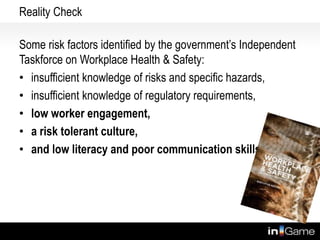
Reality Check
Some risk factors identified by the government’s Independent
Taskforce on Workplace Health & Safety:
• insufficient knowledge of risks and specific hazards,
• insufficient knowledge of regulatory requirements,
• low worker engagement,
• a risk tolerant culture,
• and low literacy and poor communication skills.
High-risk workers
“Vulnerable groups include males, youth, older people, the
self-employed and workers with low literacy and
numeracy skills.“
“There is a lethal nexus between high-risk population groups
and high-risk industries.”
• Independent Taskforce On Workplace Health & Safety
Busy workers
Casual and self-employed workers are also high-risk
But even highly-literate workers have challenges:
• Busy
• Multi-tasking
• Short attention spans
• Trained to want immediate gratification for anything digital
• Facebook and YouTube are your competition
InGame’s New
Zealand examples
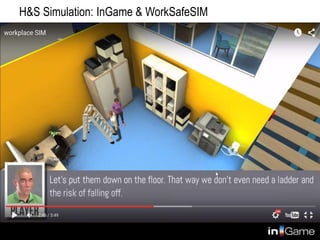
H&S Simulation: InGame & WorkSafeSIM
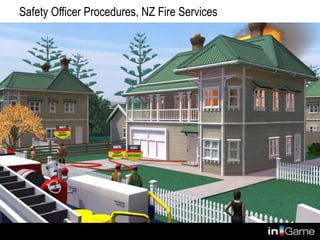
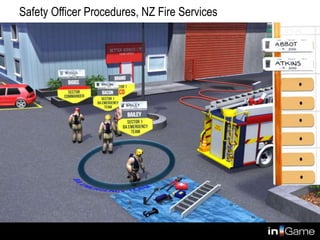
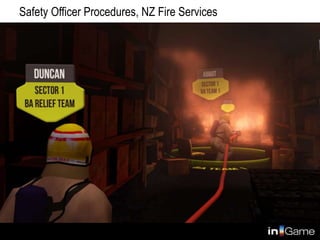
Safety Officer Procedures, NZ Fire Services
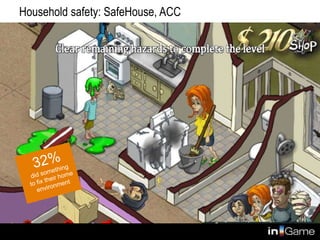
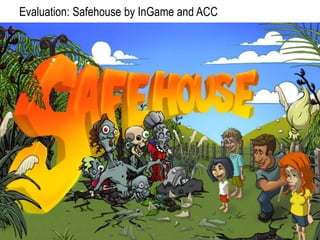
Household safety: SafeHouse, ACC
Falls Prevention for ACC
www.safehouse.co.nz
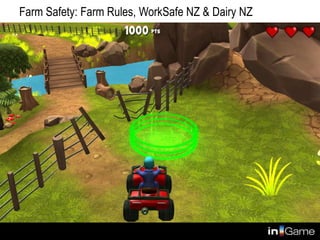
Farm Safety: Farm Rules, WorkSafe NZ & Dairy NZ
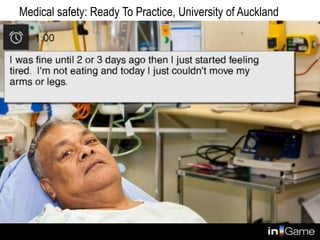
Medical safety: Ready To Practice, University of Auckland
International
Examples
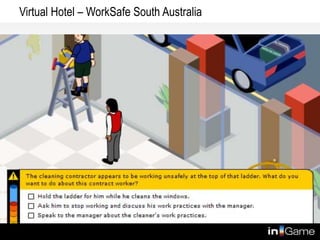
Virtual Hotel – WorkSafe South Australia
Easy to access, scales well
PetroSims
Rehearse high-risk, expensive events
Project Canary (2009), Australian Mining Industry
Apply classroom learning
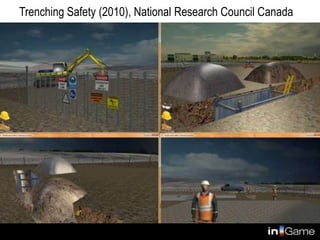
Trenching Safety (2010), National Research Council Canada
3D spatial awareness and familiarisation
Are they Effective?
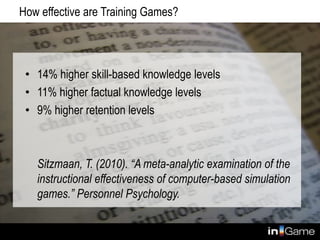
How effective are Training Games?
• 14% higher skill-based knowledge levels
• 11% higher factual knowledge levels
• 9% higher retention levels
Sitzmaan, T. (2010). “A meta-analytic examination of the
instructional effectiveness of computer-based simulation
games.” Personnel Psychology.
How effective are Training Games?
The most frequently outcomes and impacts were
• knowledge acquisition/content understanding and
• affective and motivational outcomes
Connolly, T., Boyle, E., MacArthur, E., Hainey, T. &
Boyle, J., (2012). “A Systematic Literature Review of
Empirical Evidence on Computer Games and Serious
Games.” Computers & Education 59.
Benefits of E-learning and Simulation
• Complete it at your own pace, own time
• Easily accessed online
• Scales well
• Measurable – quizzes to track understanding
• Measurable – track compliance
• Fail safely
• Simulate high-risk inaccessible environments safely
• Rehearse high-risk procedures
• 3D spatial awareness and familiarisation
Evaluation: Safehouse by InGame and ACC
ACC’s Home Safety Serious Game
• Every year, more than 10,000 Kiwis need to take a week or
more off work because of a home fall
• More than one third of the roughly 1.7 million claims ACC
receives every year are for injuries received in and around
the home
• Around 40% of home injuries happen because of falls
• Most falls happen to working age people
www.safehouse.co.nz
Learning Objectives
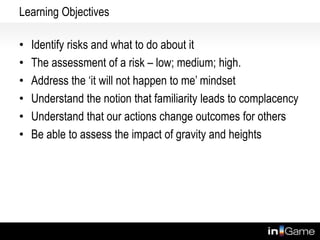
• Identify risks and what to do about it
• The assessment of a risk – low; medium; high.
• Address the ‘it will not happen to me’ mindset
• Understand the notion that familiarity leads to complacency
• Understand that our actions change outcomes for others
• Be able to assess the impact of gravity and heights
But how to get people to volunteer to play
Design Features
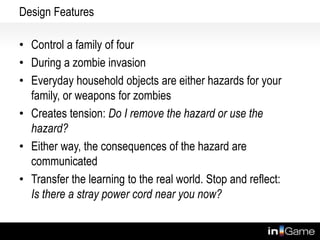
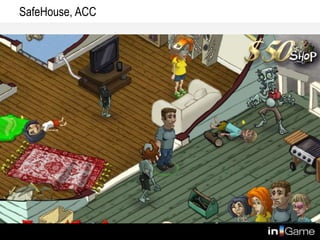
• Control a family of four
• During a zombie invasion
• Everyday household objects are either hazards for your
family, or weapons for zombies
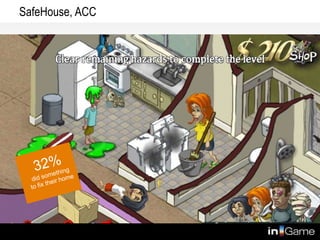
• Creates tension: Do I remove the hazard or use the
hazard?
• Either way, the consequences of the hazard are
communicated
• Transfer the learning to the real world. Stop and reflect:
Is there a stray power cord near you now?
www.safehouse.co.nz
SafeHouse, ACC
Falls Prevention for ACC
www.safehouse.co.nz
SafeHouse, ACC
Falls Prevention for ACC
www.safehouse.co.nz
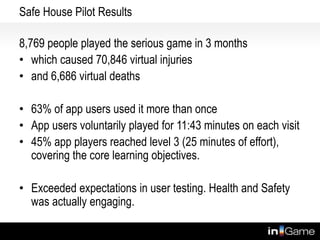
Safe House Pilot Results
8,769 people played the serious game in 3 months
• which caused 70,846 virtual injuries
• and 6,686 virtual deaths
• 63% of app users used it more than once
• App users voluntarily played for 11:43 minutes on each visit
• 45% app players reached level 3 (25 minutes of effort),
covering the core learning objectives.
• Exceeded expectations in user testing. Health and Safety
was actually engaging.
www.safehouse.co.nz
Safety Gamification

Safety Gamification

  • 1.
    Interactive Safety Simulations Engagementfor Safety Culture Change Stephen Knightly Safety Leaders Summit
  • 2.
  • 3.
    Reality Check Some riskfactors identified by the government’s Independent Taskforce on Workplace Health & Safety: • insufficient knowledge of risks and specific hazards, • insufficient knowledge of regulatory requirements, • low worker engagement, • a risk tolerant culture, • and low literacy and poor communication skills.
  • 4.
    High-risk workers “Vulnerable groupsinclude males, youth, older people, the self-employed and workers with low literacy and numeracy skills.“ “There is a lethal nexus between high-risk population groups and high-risk industries.” • Independent Taskforce On Workplace Health & Safety
  • 5.
    Busy workers Casual andself-employed workers are also high-risk But even highly-literate workers have challenges: • Busy • Multi-tasking • Short attention spans • Trained to want immediate gratification for anything digital • Facebook and YouTube are your competition
  • 6.
  • 7.
  • 8.
  • 9.
  • 10.
  • 11.
    Household safety: SafeHouse,ACC Falls Prevention for ACC www.safehouse.co.nz
  • 12.
    Farm Safety: FarmRules, WorkSafe NZ & Dairy NZ
  • 13.
    Medical safety: ReadyTo Practice, University of Auckland
  • 14.
  • 15.
    Virtual Hotel –WorkSafe South Australia Easy to access, scales well
  • 16.
  • 17.
    Project Canary (2009),Australian Mining Industry Apply classroom learning
  • 18.
    Trenching Safety (2010),National Research Council Canada 3D spatial awareness and familiarisation
  • 19.
  • 20.
    How effective areTraining Games? • 14% higher skill-based knowledge levels • 11% higher factual knowledge levels • 9% higher retention levels Sitzmaan, T. (2010). “A meta-analytic examination of the instructional effectiveness of computer-based simulation games.” Personnel Psychology.
  • 21.
    How effective areTraining Games? The most frequently outcomes and impacts were • knowledge acquisition/content understanding and • affective and motivational outcomes Connolly, T., Boyle, E., MacArthur, E., Hainey, T. & Boyle, J., (2012). “A Systematic Literature Review of Empirical Evidence on Computer Games and Serious Games.” Computers & Education 59.
  • 22.
    Benefits of E-learningand Simulation • Complete it at your own pace, own time • Easily accessed online • Scales well • Measurable – quizzes to track understanding • Measurable – track compliance • Fail safely • Simulate high-risk inaccessible environments safely • Rehearse high-risk procedures • 3D spatial awareness and familiarisation
  • 23.
  • 24.
    ACC’s Home SafetySerious Game • Every year, more than 10,000 Kiwis need to take a week or more off work because of a home fall • More than one third of the roughly 1.7 million claims ACC receives every year are for injuries received in and around the home • Around 40% of home injuries happen because of falls • Most falls happen to working age people www.safehouse.co.nz
  • 25.
    Learning Objectives • Identifyrisks and what to do about it • The assessment of a risk – low; medium; high. • Address the ‘it will not happen to me’ mindset • Understand the notion that familiarity leads to complacency • Understand that our actions change outcomes for others • Be able to assess the impact of gravity and heights But how to get people to volunteer to play
  • 26.
    Design Features • Controla family of four • During a zombie invasion • Everyday household objects are either hazards for your family, or weapons for zombies • Creates tension: Do I remove the hazard or use the hazard? • Either way, the consequences of the hazard are communicated • Transfer the learning to the real world. Stop and reflect: Is there a stray power cord near you now? www.safehouse.co.nz
  • 27.
    SafeHouse, ACC Falls Preventionfor ACC www.safehouse.co.nz
  • 28.
    SafeHouse, ACC Falls Preventionfor ACC www.safehouse.co.nz
  • 29.
    Safe House PilotResults 8,769 people played the serious game in 3 months • which caused 70,846 virtual injuries • and 6,686 virtual deaths • 63% of app users used it more than once • App users voluntarily played for 11:43 minutes on each visit • 45% app players reached level 3 (25 minutes of effort), covering the core learning objectives. • Exceeded expectations in user testing. Health and Safety was actually engaging. www.safehouse.co.nz

Editor's Notes

  • #19 http://itcon.org/data/works/att/2011_8.content.08982.pdf National Research Council of Canada, Centre for Computer-assisted Construction Technology;