Stay healthy and avoid injury while
  working long hours on your PC
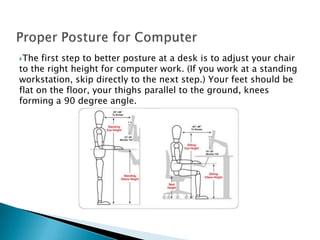
The  first step to better posture at a desk is to adjust your chair
to the right height for computer work. (If you work at a standing
workstation, skip directly to the next step.) Your feet should be
flat on the floor, your thighs parallel to the ground, knees
forming a 90 degree angle.
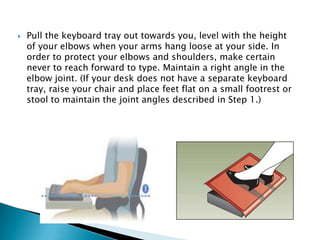
   Pull the keyboard tray out towards you, level with the height
    of your elbows when your arms hang loose at your side. In
    order to protect your elbows and shoulders, make certain
    never to reach forward to type. Maintain a right angle in the
    elbow joint. (If your desk does not have a separate keyboard
    tray, raise your chair and place feet flat on a small footrest or
    stool to maintain the joint angles described in Step 1.)
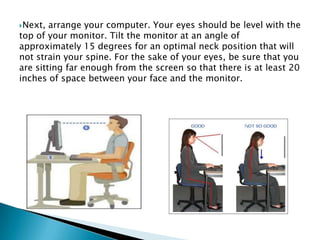
Next,  arrange your computer. Your eyes should be level with the
top of your monitor. Tilt the monitor at an angle of
approximately 15 degrees for an optimal neck position that will
not strain your spine. For the sake of your eyes, be sure that you
are sitting far enough from the screen so that there is at least 20
inches of space between your face and the monitor.
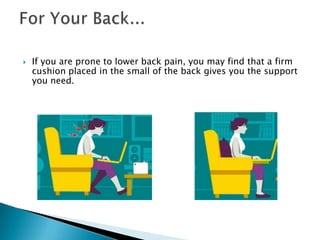
   If you are prone to lower back pain, you may find that a firm
    cushion placed in the small of the back gives you the support
    you need.
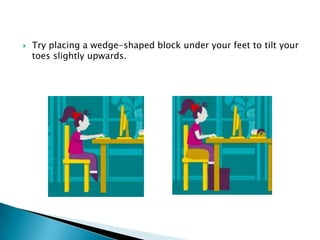
   Try placing a wedge-shaped block under your feet to tilt your
    toes slightly upwards.
   When using the mouse, move from the shoulder
    rather than the wrist.
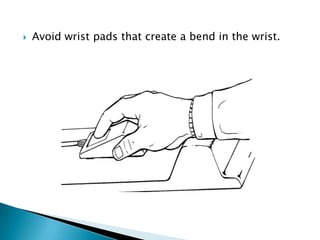
   Avoid wrist pads that create a bend in the wrist.
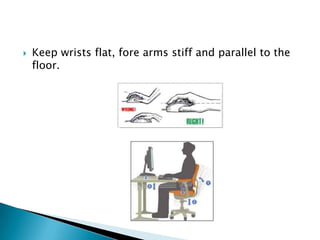
   Keep wrists flat, fore arms stiff and parallel to the
    floor.
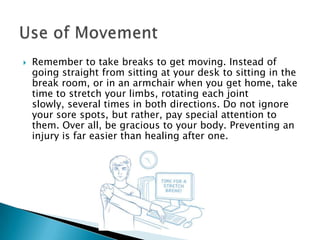
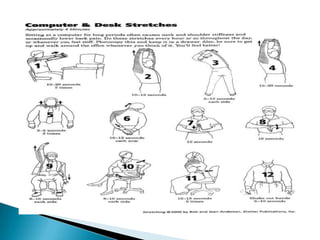
   Remember to take breaks to get moving. Instead of
    going straight from sitting at your desk to sitting in the
    break room, or in an armchair when you get home, take
    time to stretch your limbs, rotating each joint
    slowly, several times in both directions. Do not ignore
    your sore spots, but rather, pay special attention to
    them. Over all, be gracious to your body. Preventing an
    injury is far easier than healing after one.
Safe computing tips

Safe computing tips

  • 1.
    Stay healthy andavoid injury while working long hours on your PC
  • 2.
    The firststep to better posture at a desk is to adjust your chair to the right height for computer work. (If you work at a standing workstation, skip directly to the next step.) Your feet should be flat on the floor, your thighs parallel to the ground, knees forming a 90 degree angle.
  • 3.
    Pull the keyboard tray out towards you, level with the height of your elbows when your arms hang loose at your side. In order to protect your elbows and shoulders, make certain never to reach forward to type. Maintain a right angle in the elbow joint. (If your desk does not have a separate keyboard tray, raise your chair and place feet flat on a small footrest or stool to maintain the joint angles described in Step 1.)
  • 4.
    Next, arrangeyour computer. Your eyes should be level with the top of your monitor. Tilt the monitor at an angle of approximately 15 degrees for an optimal neck position that will not strain your spine. For the sake of your eyes, be sure that you are sitting far enough from the screen so that there is at least 20 inches of space between your face and the monitor.
  • 5.
    If you are prone to lower back pain, you may find that a firm cushion placed in the small of the back gives you the support you need.
  • 6.
    Try placing a wedge-shaped block under your feet to tilt your toes slightly upwards.
  • 7.
    When using the mouse, move from the shoulder rather than the wrist.
  • 8.
    Avoid wrist pads that create a bend in the wrist.
  • 9.
    Keep wrists flat, fore arms stiff and parallel to the floor.
  • 10.
    Remember to take breaks to get moving. Instead of going straight from sitting at your desk to sitting in the break room, or in an armchair when you get home, take time to stretch your limbs, rotating each joint slowly, several times in both directions. Do not ignore your sore spots, but rather, pay special attention to them. Over all, be gracious to your body. Preventing an injury is far easier than healing after one.