SGC Partners, LP Proprietary
A balanced, integrated, and flexible approach
to the
fundamental shift
in
Private Equity:
• Transparency
• Profitability
• Risk
• Leadership
Executive Discussion
2016
SGC Partners, LP Proprietary
Executive Summary
All the efforts of policymakers to institute more regulations has reshaped the private equity landscape adding
yet more pressure on returns. With profit margins squeezed, PEs must focus on operational excellence and
appropriate levels of transparency to achieve and maintain a competitiveadvantage. In the US, the Dodd-Frank
Act introduced the new Form PF reporting requirement under its Title IV, (and AIFMD) reports will be scrutinized
both at national and global levels.
2016 Presidential Election:
Only a few companies are delaying decisions to await the election’s outcome. As a senior vice president of one
companies told us, “As long as the economy keeps moving, it doesn’t matter much who wins.” Regardless of
the outcome, PE firms must become agile to adapt to the new administration.
Transparency and Regulation:
We strongly believe there is a mandate to adapt operating models to respond to increasing demands of
investors and regulators. These models must be balanced, integrated, and above all flex to the appropriate
levels of support for the portfolio and operating partner. Models must include treatment of operational risks, a
refined level of leadership, innovative approaches to portfolio structures, and better use of data and enabling
technologies.
Operational Excellence is Mandatory:
More than ever before, PE firms must become more focused on profitable growth and passionately embrace
their role to become the champions of change. In today’s innovation era, leadership is key; leadership behaviors
once acceptable no longer drive optimal team performance.
At SGC Partners, we are enthusiastic about the future of the private equity industry. We look forward to
continuing to work alongside the industry and support its efforts to enhance well-being for all stakeholders.
Success hinges on the ability to adapt to perpetual change
SGC Partners, LP Proprietary
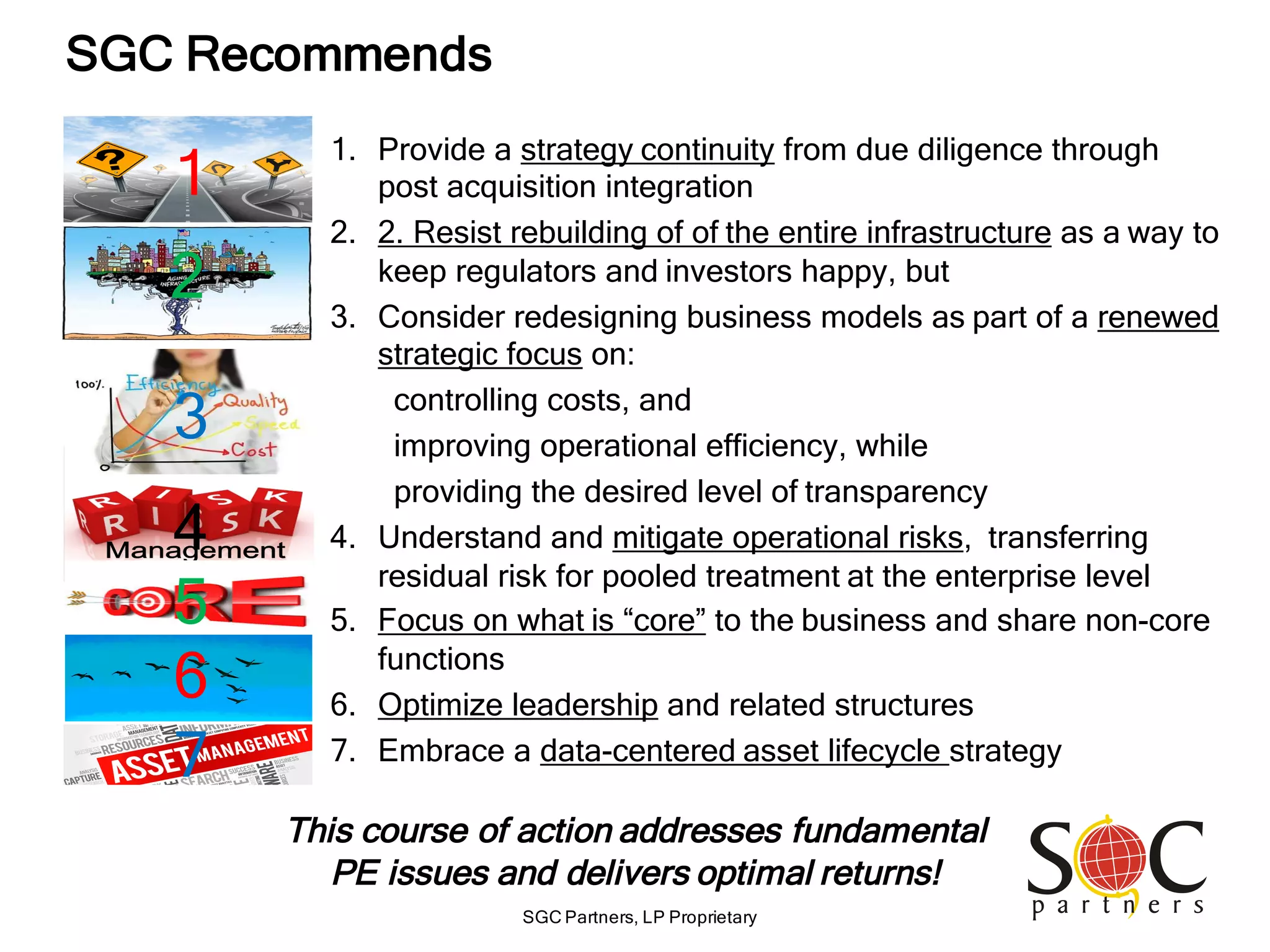
SGC Recommends
1. Provide a strategy continuity from due diligence through
post acquisition integration
2. 2. Resist rebuilding of of the entire infrastructure as a way to
keep regulators and investors happy, but
3. Consider redesigning business models as part of a renewed
strategic focus on:
controlling costs, and
improving operational efficiency, while
providing the desired level of transparency
4. Understand and mitigate operational risks, transferring
residual risk for pooled treatment at the enterprise level
5. Focus on what is “core” to the business and share non-core
functions
6. Optimize leadership and related structures
7. Embrace a data-centered asset lifecycle strategy
This course of action addresses fundamental
PE issues and delivers optimal returns!
1
2
3
4
5
6
7
SGC Partners, LP Proprietary
Recommendation Benefits and Solutions
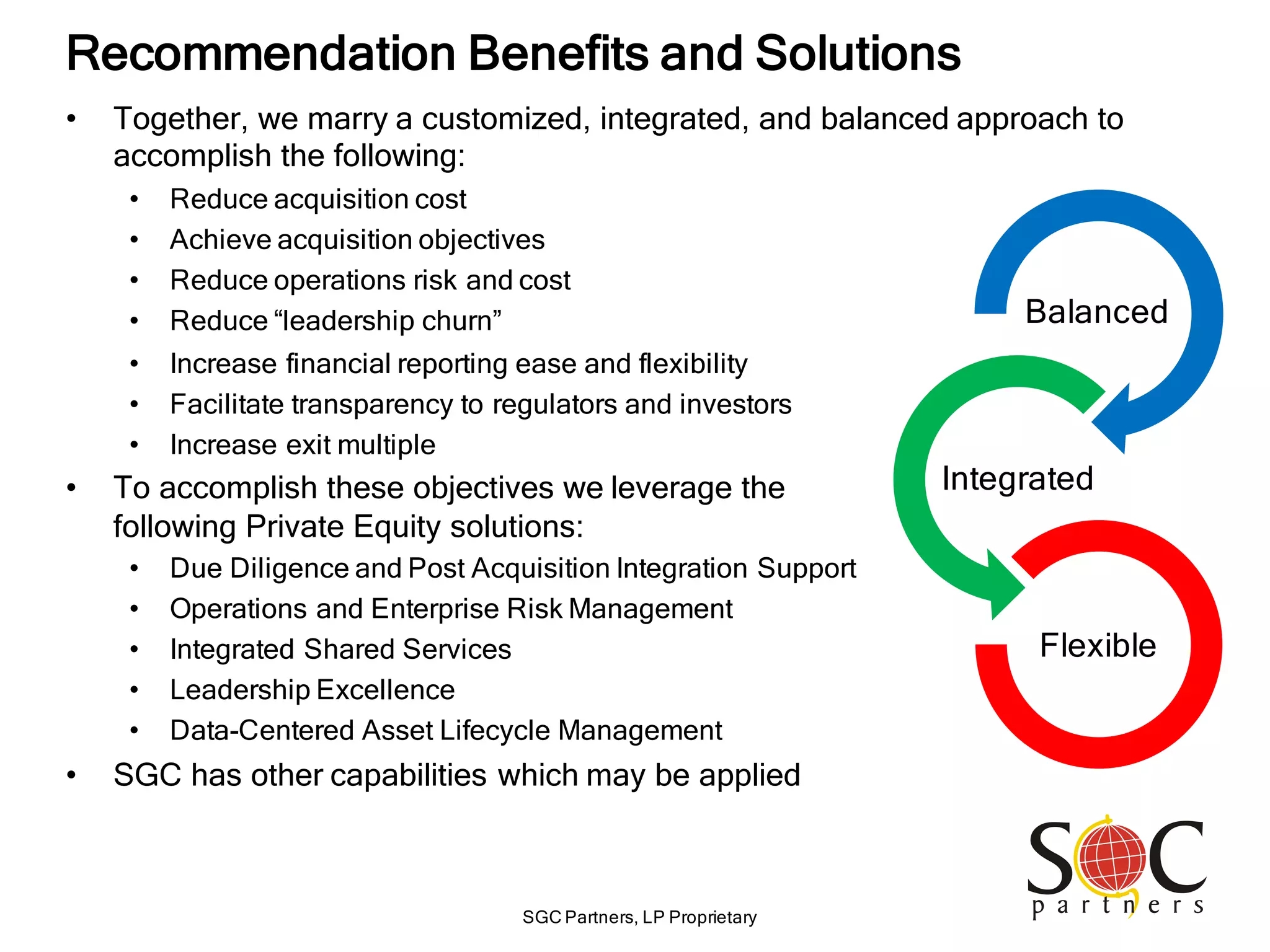
• Together, we marry a customized, integrated, and balanced approach to
accomplish the following:
• Reduce acquisition cost
• Achieve acquisition objectives
• Reduce operations risk and cost
• Reduce “leadership churn” Balanced
Integrated
Flexible
• Increase financial reporting ease and flexibility
• Facilitate transparency to regulators and investors
• Increase exit multiple
• To accomplish these objectives we leverage the
following Private Equity solutions:
• Due Diligence and Post Acquisition Integration Support
• Operations and Enterprise Risk Management
• Integrated Shared Services
• Leadership Excellence
• Data-Centered Asset Lifecycle Management
• SGC has other capabilities which may be applied
SGC Partners, LP Proprietary
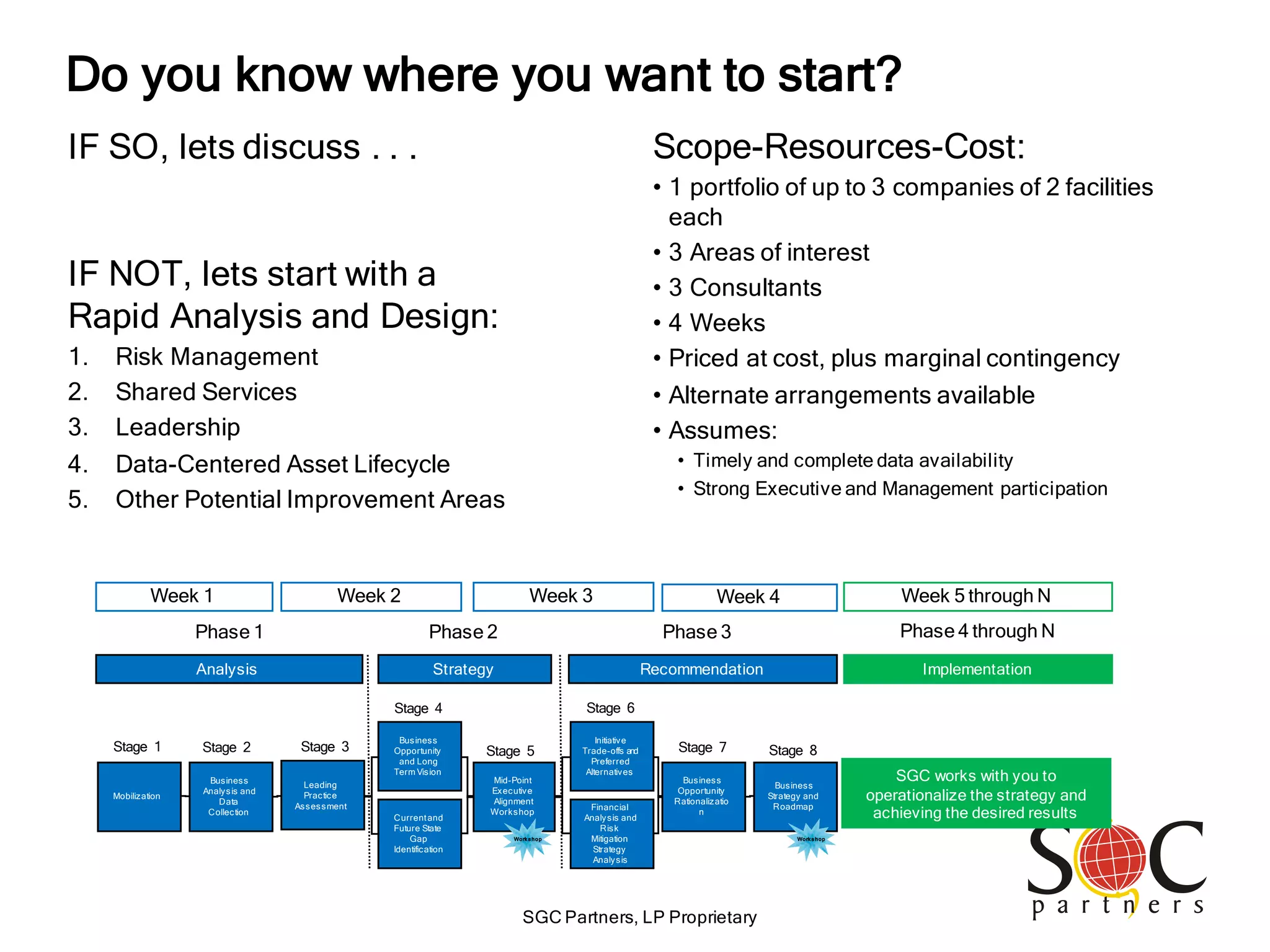
Do you know where you want to start?
IF SO, lets discuss . . .
IF NOT, lets start with a
Rapid Analysis and Design:
1. Risk Management
2. Shared Services
3. Leadership
4. Data-Centered Asset Lifecycle
5. Other Potential Improvement Areas
Scope-Resources-Cost:
• 1 portfolio of up to 3 companies of 2 facilities
each
• 3 Areas of interest
• 3 Consultants
• 4 Weeks
• Priced at cost, plus marginal contingency
• Alternate arrangements available
• Assumes:
• Timely and complete data availability
• Strong Executive and Management participation
Mobilization
Business
Analysis and
Data
Collection
Leading
Practice
Assessment
Analysis
Business
Opportunity
and Long
Term Vision
Mid-Point
Executive
Alignment
Workshop
Strategy
Currentand
Future State
Gap
Identification
Work s hop
Recommendation
Initiative
Trade-offs and
Preferred
Alternatives
Business
Opportunity
Rationalizatio
n
Financial
Analysis and
Risk
Mitigation
Strategy
Analysis
Business
Strategy and
Roadmap
Phase 1 Phase 2 Phase 3
Stage 1 Stage 2 Stage 3
Stage 4
Stage 5
Stage 6
Stage 7 Stage 8
Work s hop
Week 1 Week 2 Week 4Week 3
Implementation
Phase 4 through N
Week 5 through N
SGC works with you to
operationalize the strategy and
achieving the desired results
SGC Partners, LP Proprietary
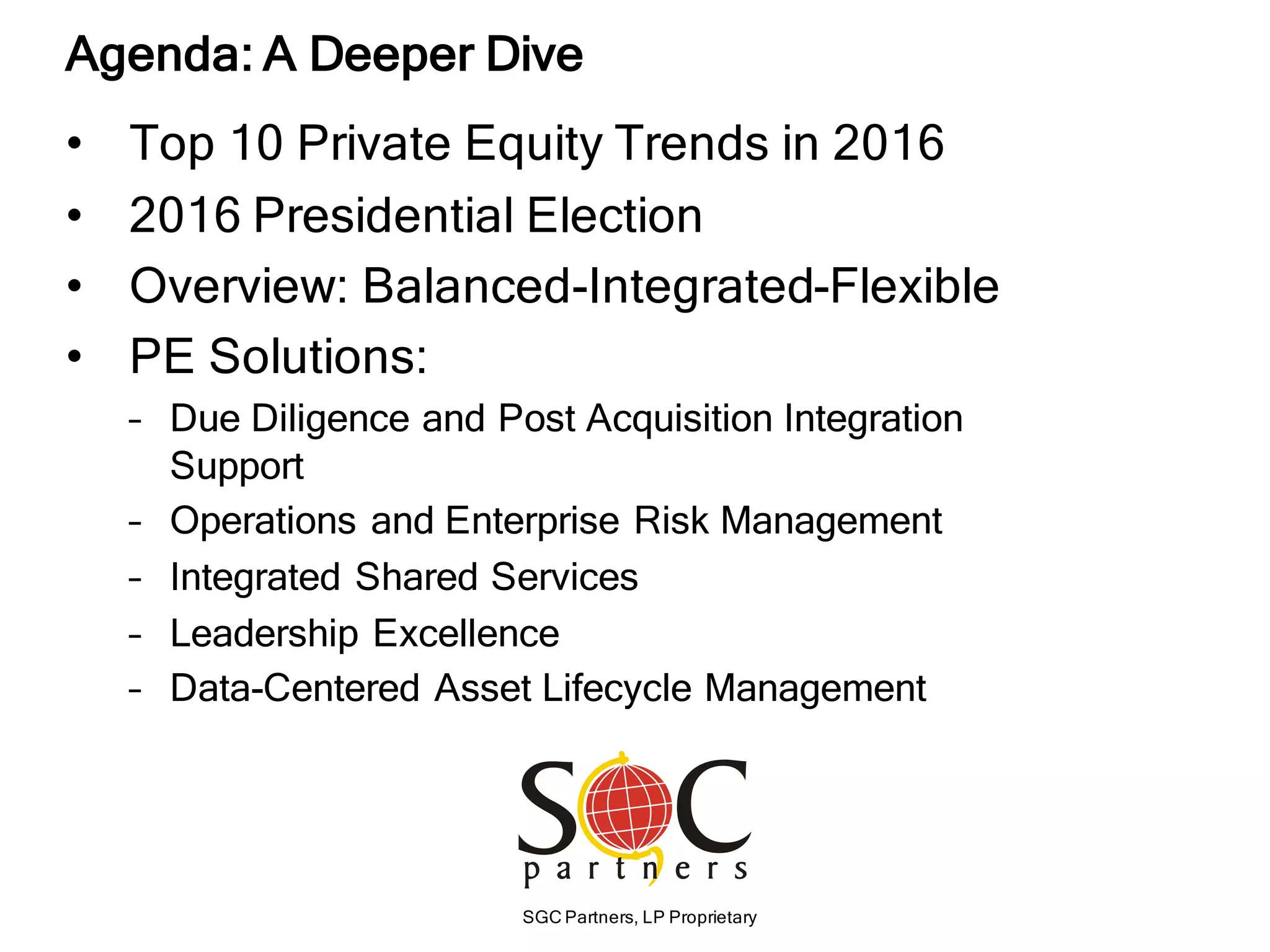
• Top 10 Private Equity Trends in 2016
• 2016 Presidential Election
• Overview: Balanced-Integrated-Flexible
• PE Solutions:
– Due Diligence and Post Acquisition Integration
Support
– Operations and Enterprise Risk Management
– Integrated Shared Services
– Leadership Excellence
– Data-Centered Asset Lifecycle Management
Agenda: A Deeper Dive
SGC Partners, LP Proprietary
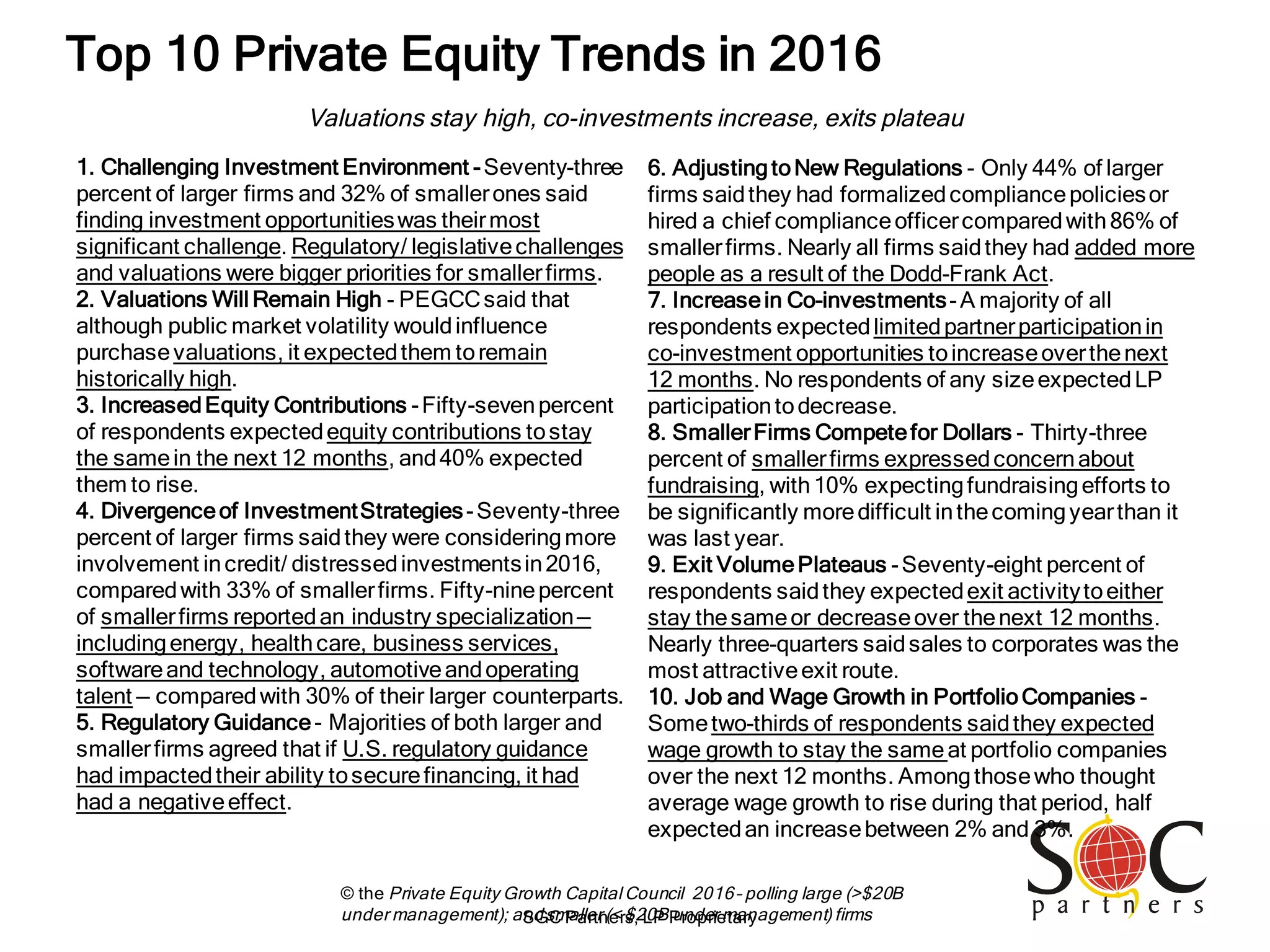
Top 10 Private Equity Trends in 2016
Valuations stay high, co-investments increase, exits plateau
1. Challenging Investment Environment -Seventy-three
percent of larger firms and 32% of smallerones said
finding investment opportunitieswas theirmost
significant challenge. Regulatory/ legislativechallenges
and valuations were bigger priorities for smallerfirms.
2. Valuations Will Remain High - PEGCCsaid that
although public market volatility wouldinfluence
purchasevaluations, it expectedthem toremain
historically high.
3. IncreasedEquity Contributions -Fifty-sevenpercent
of respondents expectedequity contributions tostay
the samein the next 12 months, and40% expected
them to rise.
4. Divergenceof InvestmentStrategies-Seventy-three
percent of larger firms saidthey were consideringmore
involvement incredit/ distressedinvestmentsin2016,
comparedwith 33% of smallerfirms. Fifty-ninepercent
of smallerfirms reportedan industry specialization—
includingenergy, healthcare, business services,
softwareand technology, automotiveandoperating
talent — comparedwith 30% of their larger counterparts.
5. Regulatory Guidance- Majorities of both larger and
smallerfirms agreed that if U.S. regulatory guidance
had impactedtheir ability tosecurefinancing, it had
had a negativeeffect.
6. AdjustingtoNew Regulations - Only 44% of larger
firms saidthey had formalizedcompliancepoliciesor
hired a chief complianceofficercomparedwith86% of
smallerfirms. Nearly all firms saidthey had added more
people as a result of the Dodd-Frank Act.
7. Increasein Co-investments-A majority of all
respondents expectedlimitedpartnerparticipationin
co-investment opportunities toincreaseoverthenext
12 months. No respondents of any sizeexpectedLP
participationtodecrease.
8. SmallerFirms Competefor Dollars - Thirty-three
percent of smallerfirms expressedconcernabout
fundraising, with10% expectingfundraisingefforts to
be significantly moredifficult inthecomingyearthan it
was last year.
9. Exit VolumePlateaus -Seventy-eight percent of
respondents saidthey expectedexit activitytoeither
stay thesameor decreaseover thenext 12 months.
Nearly three-quarters saidsales to corporates was the
most attractiveexit route.
10. Job and Wage Growth in PortfolioCompanies -
Sometwo-thirds of respondents saidthey expected
wage growth to stay the sameat portfolio companies
over the next 12 months. Amongthosewho thought
average wage growth to rise during that period, half
expectedan increasebetween 2% and 3%.
© the Private Equity Growth Capital Council 2016– polling large (>$20B
under management); andsmaller (< $20B under management) firms
SGC Partners, LP Proprietary
?
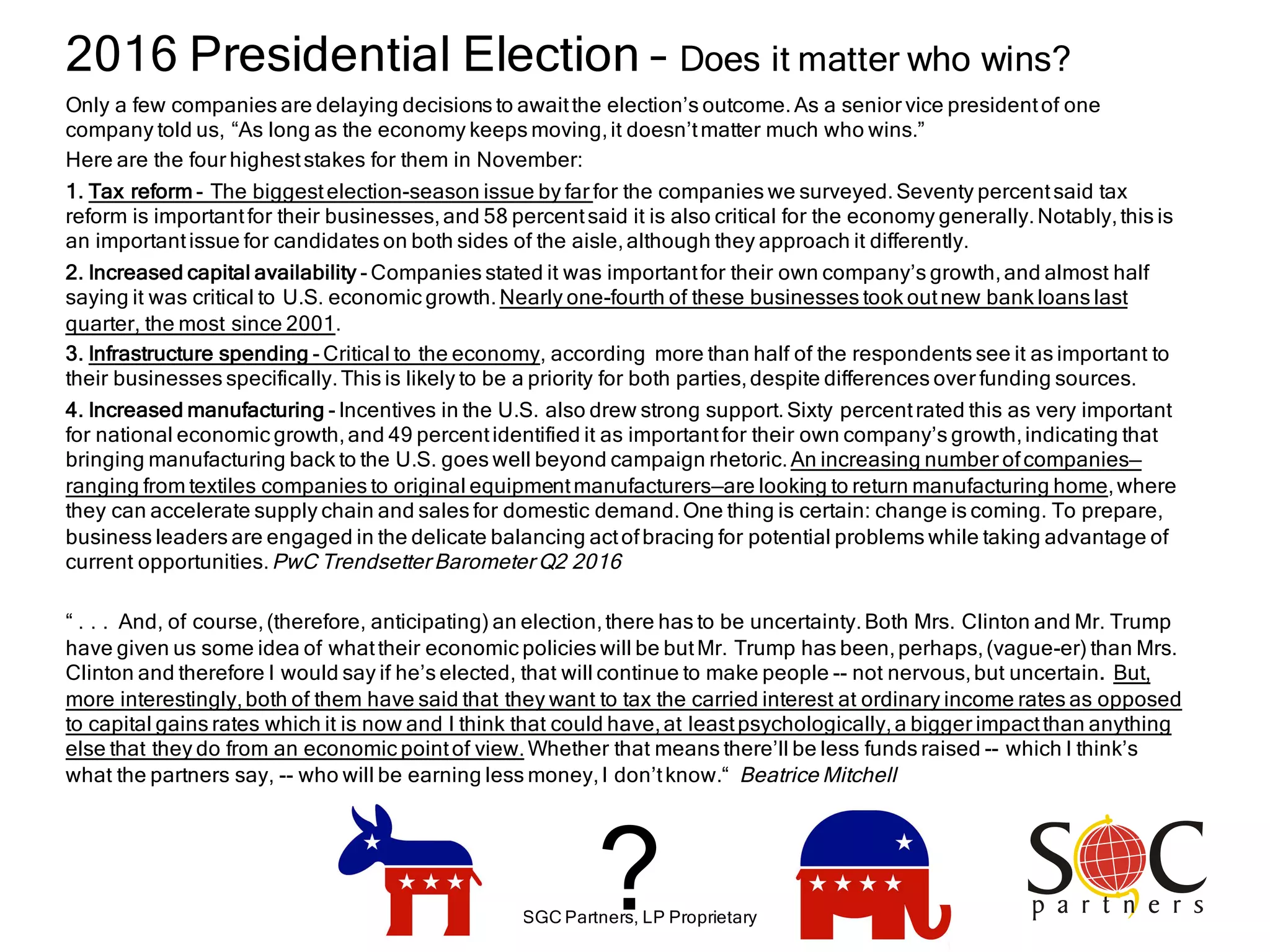
2016 Presidential Election – Does it matter who wins?
Only a few companies are delaying decisions to awaitthe election’s outcome.As a senior vice presidentof one
company told us, “As long as the economy keeps moving,it doesn’tmatter much who wins.”
Here are the four higheststakes for them in November:
1. Tax reform - The biggestelection-season issue by far for the companies we surveyed.Seventy percentsaid tax
reform is importantfor their businesses,and 58 percentsaid it is also critical for the economy generally.Notably,this is
an importantissue for candidates on both sides of the aisle,although they approach it differently.
2. Increased capital availability - Companies stated it was importantfor their own company’s growth,and almost half
saying it was critical to U.S. economic growth.Nearly one-fourth of these businesses took outnew bank loans last
quarter, the most since 2001.
3. Infrastructure spending - Critical to the economy, according more than half of the respondents see it as important to
their businesses specifically.This is likely to be a priority for both parties,despite differences over funding sources.
4. Increased manufacturing - Incentives in the U.S. also drew strong support.Sixty percentrated this as very important
for national economic growth,and 49 percentidentified it as importantfor their own company’s growth,indicating that
bringing manufacturing back to the U.S. goes well beyond campaign rhetoric.An increasing number ofcompanies—
ranging from textiles companies to original equipmentmanufacturers—are looking to return manufacturing home,where
they can accelerate supply chain and sales for domestic demand.One thing is certain: change is coming. To prepare,
business leaders are engaged in the delicate balancing actofbracing for potential problems while taking advantage of
current opportunities.PwC Trendsetter Barometer Q2 2016
“ . . . And, of course,(therefore, anticipating) an election,there has to be uncertainty.Both Mrs. Clinton and Mr. Trump
have given us some idea of whattheir economic policies will be butMr. Trump has been,perhaps,(vague-er) than Mrs.
Clinton and therefore I would say if he’s elected, that will continue to make people -- not nervous,but uncertain. But,
more interestingly,both of them have said that they want to tax the carried interest at ordinary income rates as opposed
to capital gains rates which it is now and I think that could have,at leastpsychologically,a bigger impactthan anything
else that they do from an economic pointof view.Whether that means there’ll be less funds raised -- which I think’s
what the partners say, -- who will be earning less money,I don’tknow.“ Beatrice Mitchell
SGC Partners, LP Proprietary
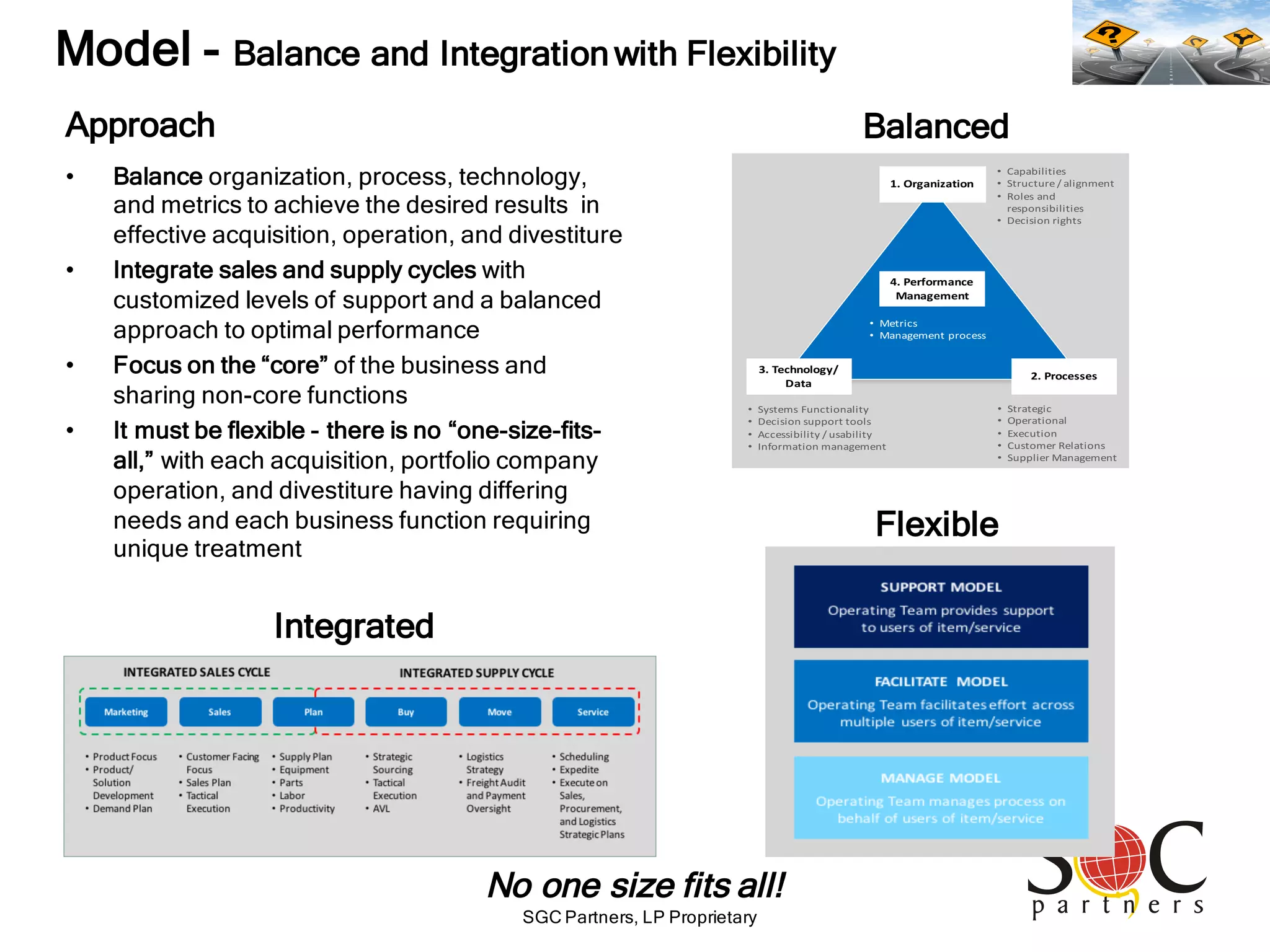
Model - Balance and Integrationwith Flexibility
No one size fits all!
• Balance organization, process, technology,
and metrics to achieve the desired results in
effective acquisition, operation, and divestiture
• Integrate sales and supply cycles with
customized levels of support and a balanced
approach to optimal performance
• Focus on the “core” of the business and
sharing non-core functions
• It must be flexible - there is no “one-size-fits-
all,” with each acquisition, portfolio company
operation, and divestiture having differing
needs and each business function requiring
unique treatment
Approach Balanced
Flexible
Integrated
The image part with relationship ID rId3 was not found in
the file.
The image part with
relationship ID rId3 was not
found in the file.
1.	Organization
3.	Technology/	
Data
2.	Processes
4.	Performance	
Management
• Systems	Functionality
• Decision	support	tools
• Accessibility	/	usability
• Information	management
• Strategic
• Operational
• Execution
• Customer	Relations
• Supplier	Management
• Metrics
• Management	process
• Capabilities
• Structure	/	alignment
• Roles	and	
responsibilities
• Decision	rights
SGC Partners, LP Proprietary
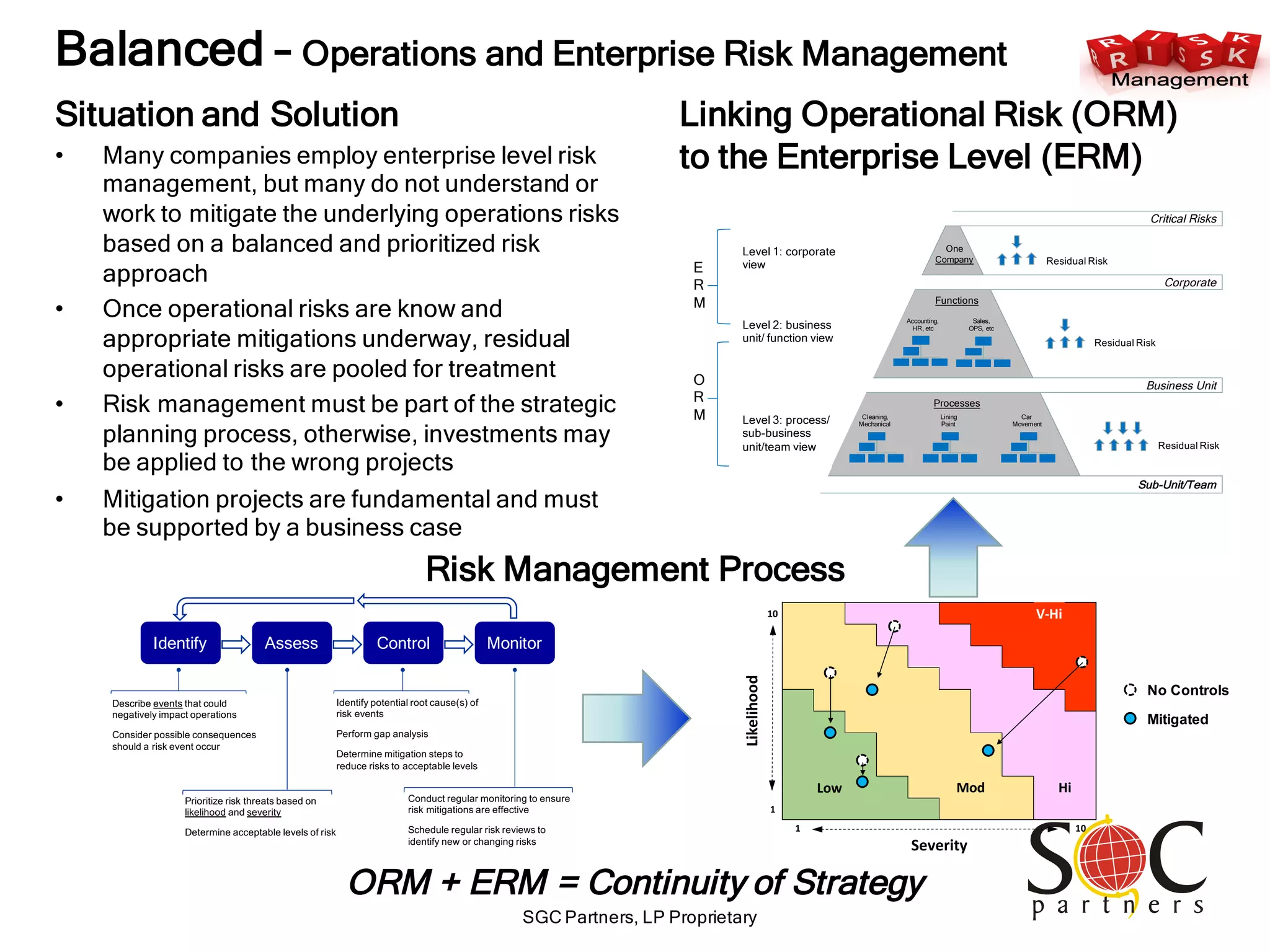
Balanced – Operations and Enterprise Risk Management
• Many companies employ enterprise level risk
management, but many do not understand or
work to mitigate the underlying operations risks
based on a balanced and prioritized risk
approach
• Once operational risks are know and
appropriate mitigations underway, residual
operational risks are pooled for treatment
• Risk management must be part of the strategic
planning process, otherwise, investments may
be applied to the wrong projects
• Mitigation projects are fundamental and must
be supported by a business case
Situation and Solution
Risk Management Process
10 V-Hi
Low
1
1 10
Severity
Likelihood
Mod Hi
No Controls
Mitigated
Identify Assess Control Monitor
Describe events that could
negatively impact operations
Consider possible consequences
should a risk event occur
Prioritize risk threats based on
likelihood and severity
Determine acceptable levels of risk
Identify potential root cause(s) of
risk events
Perform gap analysis
Determine mitigation steps to
reduce risks to acceptable levels
Conduct regular monitoring to ensure
risk mitigations are effective
Schedule regular risk reviews to
identify new or changing risks
Critical Risks
Corporate
One
Company
Sub-Unit/Team
Business Unit
Functions
Processes
E
R
M
O
R
M
Level 1: corporate
view
Level 2: business
unit/ function view
Level 3: process/
sub-business
unit/team view
Accounting,
HR, etc
Sales,
OPS, etc
Cleaning,
Mechanical
Lining
Paint
Car
Movement
Residual Risk
Residual Risk
Residual Risk
ORM + ERM = Continuity of Strategy
Linking Operational Risk (ORM)
to the Enterprise Level (ERM)
SGC Partners, LP Proprietary
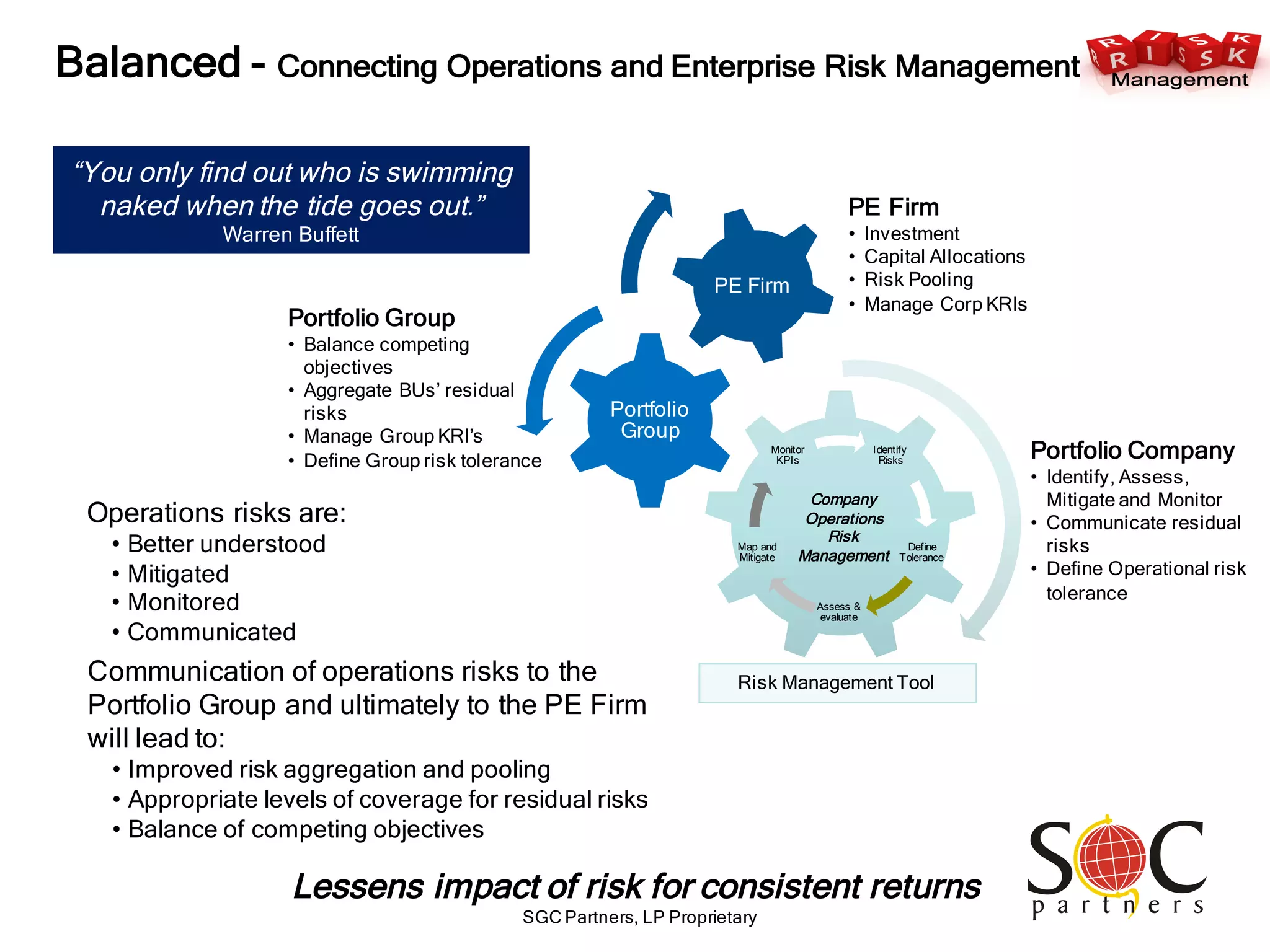
Balanced - Connecting Operations and Enterprise Risk Management
Operations risks are:
• Better understood
• Mitigated
• Monitored
• Communicated
Communication of operations risks to the
Portfolio Group and ultimately to the PE Firm
will lead to:
• Improved risk aggregation and pooling
• Appropriate levels of coverage for residual risks
• Balance of competing objectives
Portfolio
Group
PE Firm
PE Firm
• Investment
• Capital Allocations
• Risk Pooling
• Manage Corp KRIs
Identify
Risks
Define
Tolerance
Assess &
evaluate
Map and
Mitigate
Monitor
KPIs
Company
Operations
Risk
Management
Portfolio Group
• Balance competing
objectives
• Aggregate BUs’ residual
risks
• Manage Group KRI’s
• Define Group risk tolerance Portfolio Company
• Identify, Assess,
Mitigate and Monitor
• Communicate residual
risks
• Define Operational risk
tolerance
Risk Management Tool
“You only find out who is swimming
naked when the tide goes out.”
Warren Buffett
Lessens impact of risk for consistent returns
SGC Partners, LP Proprietary
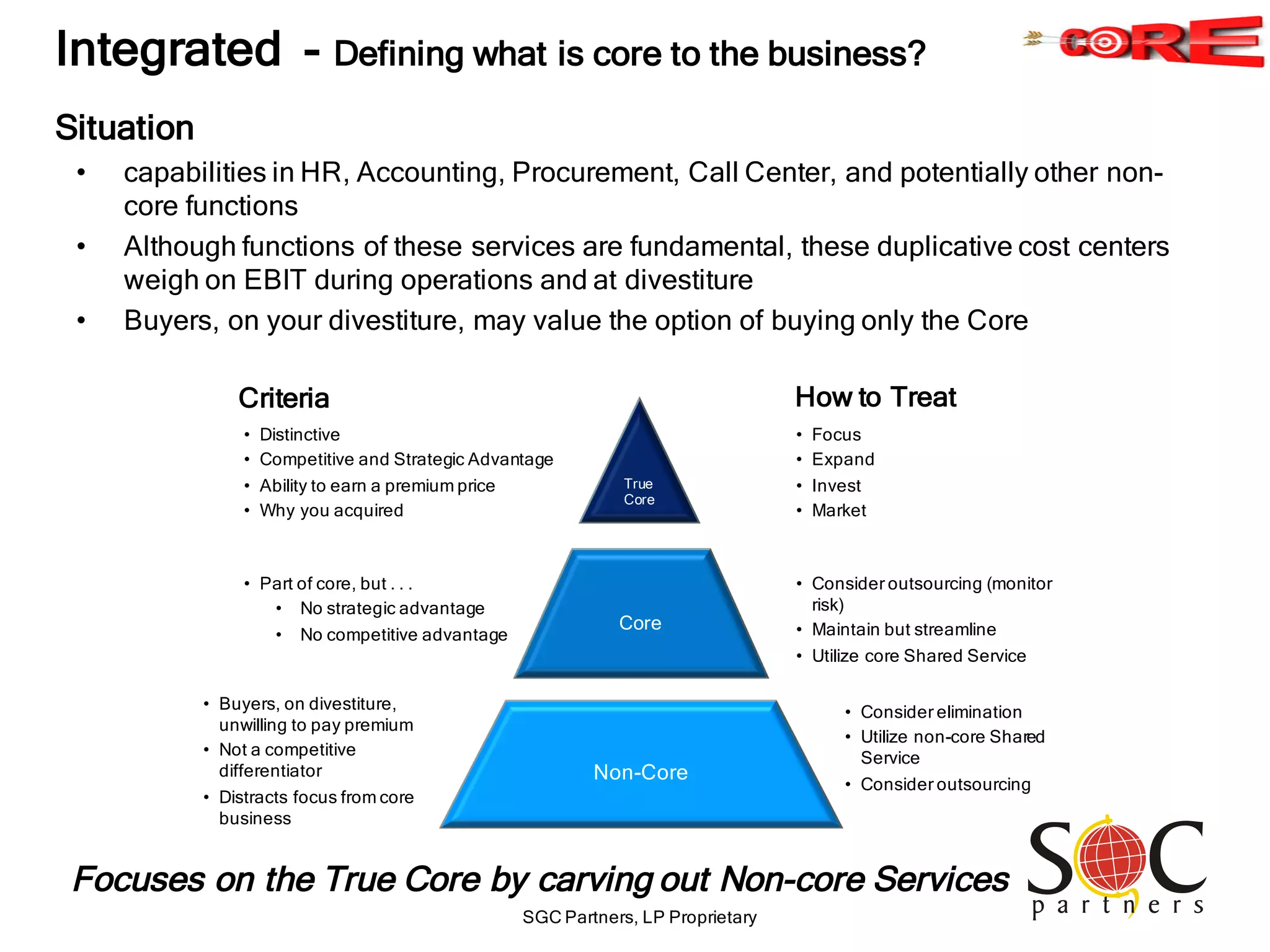
Integrated - Defining what is core to the business?
• capabilities in HR, Accounting, Procurement, Call Center, and potentially other non-
core functions
• Although functions of these services are fundamental, these duplicative cost centers
weigh on EBIT during operations and at divestiture
• Buyers, on your divestiture, may value the option of buying only the Core
Situation
True
Core
Core
Non-Core
Criteria
• Distinctive
• Competitive and Strategic Advantage
• Ability to earn a premium price
• Why you acquired
How to Treat
• Focus
• Expand
• Invest
• Market
• Part of core, but . . .
• No strategic advantage
• No competitive advantage
• Consider outsourcing (monitor
risk)
• Maintain but streamline
• Utilize core Shared Service
• Buyers, on divestiture,
unwilling to pay premium
• Not a competitive
differentiator
• Distracts focus from core
business
• Consider elimination
• Utilize non-core Shared
Service
• Consider outsourcing
Focuses on the True Core by carving out Non-core Services
SGC Partners, LP Proprietary
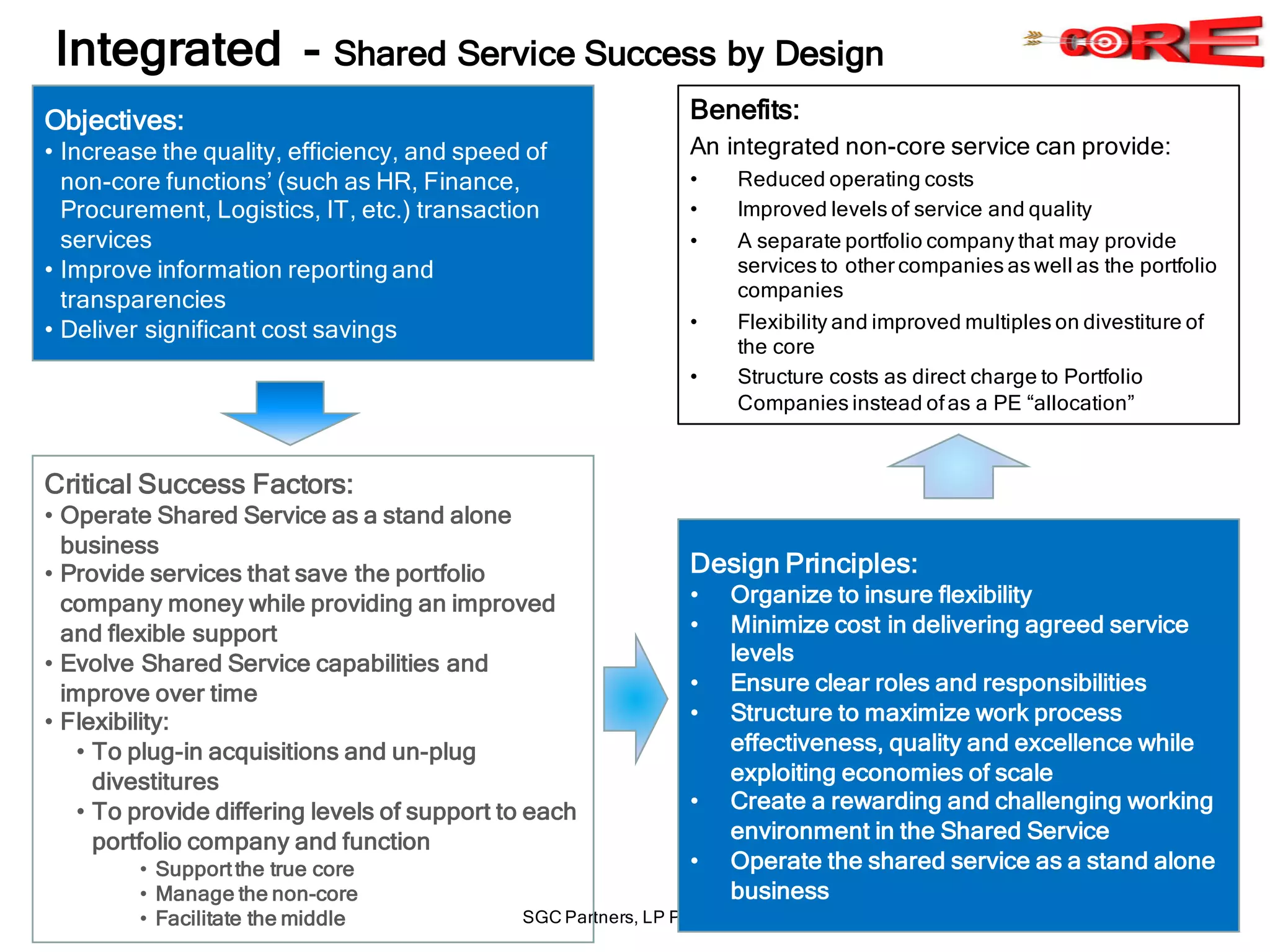
Integrated - Shared Service Success by Design
Objectives:
• Increase the quality, efficiency, and speed of
non-core functions’ (such as HR, Finance,
Procurement, Logistics, IT, etc.) transaction
services
• Improve information reporting and
transparencies
• Deliver significant cost savings
Critical Success Factors:
• Operate Shared Service as a stand alone
business
• Provide services that save the portfolio
company money while providing an improved
and flexible support
• Evolve Shared Service capabilities and
improve over time
• Flexibility:
• To plug-in acquisitions and un-plug
divestitures
• To provide differing levels of support to each
portfolio company and function
• Supportthe true core
• Manage the non-core
• Facilitate the middle
Design Principles:
• Organize to insure flexibility
• Minimize cost in delivering agreed service
levels
• Ensure clear roles and responsibilities
• Structure to maximize work process
effectiveness, quality and excellence while
exploiting economies of scale
• Create a rewarding and challenging working
environment in the Shared Service
• Operate the shared service as a stand alone
business
Benefits:
An integrated non-core service can provide:
• Reduced operating costs
• Improved levels of service and quality
• A separate portfolio company that may provide
services to other companies as well as the portfolio
companies
• Flexibility and improved multiples on divestiture of
the core
• Structure costs as direct charge to Portfolio
Companies instead ofas a PE “allocation”
SGC Partners, LP Proprietary
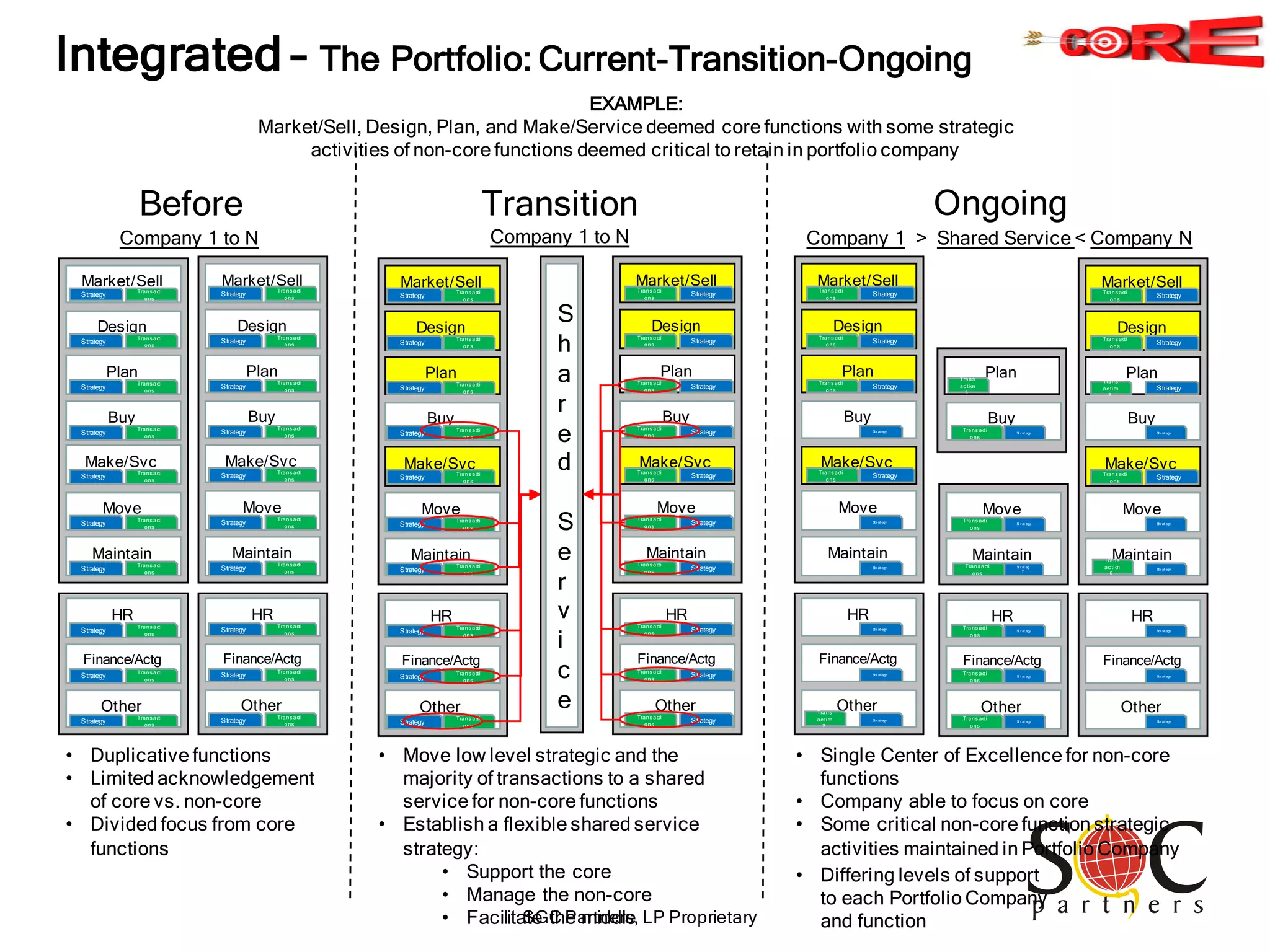
Integrated – The Portfolio: Current-Transition-Ongoing
OngoingBefore
Company 1 to N
• Duplicative functions
• Limited acknowledgement
of core vs. non-core
• Divided focus from core
functions
Company 1 to N
Transition
Company 1 > Shared Service < Company N
EXAMPLE:
Market/Sell, Design, Plan, and Make/Service deemed core functions with some strategic
activities of non-core functions deemed critical to retain in portfolio company
• Move low level strategic and the
majority of transactions to a shared
service for non-core functions
• Establish a flexible shared service
strategy:
• Support the core
• Manage the non-core
• Facilitate the middle
• Single Center of Excellence for non-core
functions
• Company able to focus on core
• Some critical non-core function strategic
activities maintained in Portfolio Company
Market/Sell
Design
Plan
Strategy
Trans acti
ons
Strategy
Trans acti
ons
Strategy
Trans acti
ons
HR
Finance/Actg
Other
Strategy
Trans acti
ons
Strategy
Trans acti
ons
Strategy
Trans acti
ons
Buy
Make/Svc
Move
Maintain
Strategy
Trans acti
ons
Strategy
Trans acti
ons
Strategy
Trans acti
ons
Strategy
Trans acti
ons
S
h
a
r
e
d
S
e
r
v
i
c
e
Market/Sell
Design
Plan
Strategy
Trans acti
ons
Strategy
Trans acti
ons
Strategy
Trans acti
ons
HR
Finance/Actg
Other
Strategy
Trans acti
ons
Strategy
Trans acti
ons
Strategy
Trans acti
ons
Buy
Move
Maintain
Strategy
Trans acti
ons
Strategy
Trans acti
ons
Strategy
Trans acti
ons
Make/Svc
Strategy
Trans acti
ons
Market/Sell
Design
Plan
Strategy
Trans acti
ons
Strategy
Trans acti
ons
Strategy
Trans acti
ons
HR
Finance/Actg
Other
Strategy
Trans acti
ons
Strategy
Trans acti
ons
Strategy
Trans acti
ons
Buy
Move
Maintain
Strategy
Trans acti
ons
Strategy
Trans acti
ons
Strategy
Trans acti
ons
Make/Svc
Strategy
Trans acti
ons
Market/Sell
Design
Plan
Strategy
Trans acti
ons
Strategy
Trans acti
ons
Strategy
Trans acti
ons
HR
Finance/Actg
Other
Strategy
Trans acti
ons
Strategy
Trans acti
ons
Strategy
Trans acti
ons
Buy
Make/Svc
Move
Maintain
Strategy
Trans acti
ons
Strategy
Trans acti
ons
Strategy
Trans acti
ons
Strategy
Trans acti
ons
Market/Sell
Design
Plan
Strategy
Trans acti
ons
Strategy
Trans acti
ons
Strategy
Trans
ac tion
s
HR
Finance/Actg
Other
St r at egy
St r at egy
St r at egy
Buy
Make/Svc
Move
Maintain
St r at egy
Strategy
Trans acti
ons
St r at egy
St r at egy
HR
Finance/Actg
Other
St r at egy
Trans acti
ons
St r at egy
Trans acti
ons
St r at egy
Trans acti
ons
Buy
Move
Maintain
St r at egy
Trans acti
ons
St r at egy
Trans acti
ons
St r at eg
y
Trans acti
ons
Market/Sell
Design
Plan
Strategy
Trans acti
ons
Strategy
Trans acti
ons
Strategy
Trans acti
ons
HR
Finance/Actg
Other
St r at egy
St r at egy
St r at egy
Buy
Make/Svc
Move
Maintain
St r at egy
Strategy
Trans acti
ons
St r at egy
St r at egy
Trans
ac tion
s
Trans
ac tion
s
PlanTrans
ac tion
s
• Differing levels of support
to each Portfolio Company
and function
SGC Partners, LP Proprietary
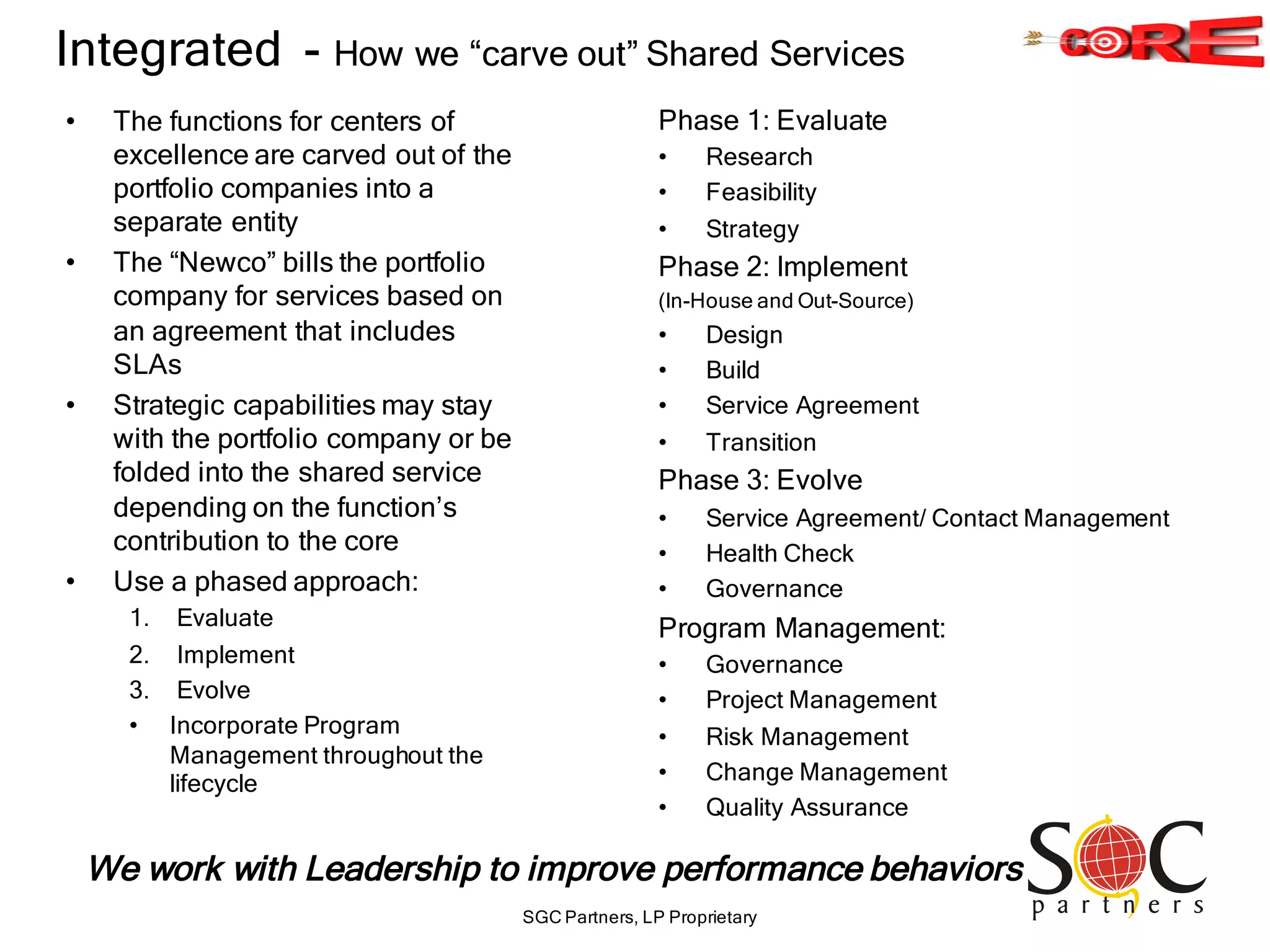
Integrated - How we “carve out” Shared Services
• The functions for centers of
excellence are carved out of the
portfolio companies into a
separate entity
• The “Newco” bills the portfolio
company for services based on
an agreement that includes
SLAs
• Strategic capabilities may stay
with the portfolio company or be
folded into the shared service
depending on the function’s
contribution to the core
• Use a phased approach:
1. Evaluate
2. Implement
3. Evolve
• Incorporate Program
Management throughout the
lifecycle
Phase 1: Evaluate
• Research
• Feasibility
• Strategy
Phase 2: Implement
(In-House and Out-Source)
• Design
• Build
• Service Agreement
• Transition
Phase 3: Evolve
• Service Agreement/ Contact Management
• Health Check
• Governance
Program Management:
• Governance
• Project Management
• Risk Management
• Change Management
• Quality Assurance
We work with Leadership to improve performance behaviors
SGC Partners, LP Proprietary
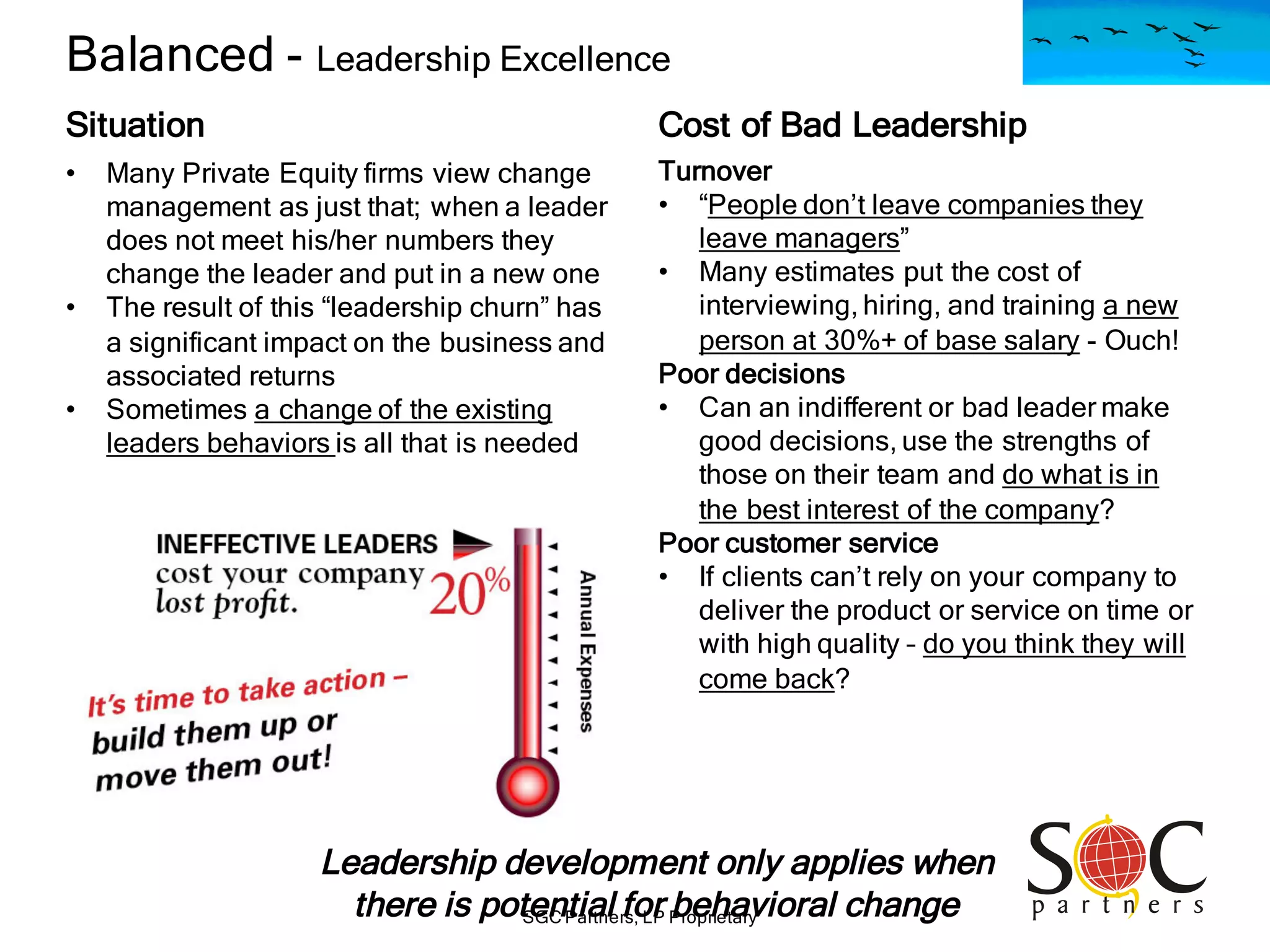
Balanced - Leadership Excellence
Situation
• Many Private Equity firms view change
management as just that; when a leader
does not meet his/her numbers they
change the leader and put in a new one
• The result of this “leadership churn” has
a significant impact on the business and
associated returns
• Sometimes a change of the existing
leaders behaviors is all that is needed
Turnover
• “People don’t leave companies they
leave managers”
• Many estimates put the cost of
interviewing, hiring, and training a new
person at 30%+ of base salary - Ouch!
Poor decisions
• Can an indifferent or bad leader make
good decisions, use the strengths of
those on their team and do what is in
the best interest of the company?
Poor customer service
• If clients can’t rely on your company to
deliver the product or service on time or
with high quality – do you think they will
come back?
Cost of Bad Leadership
Leadership development only applies when
there is potential for behavioral change
SGC Partners, LP Proprietary
Balanced - Leadership Excellence
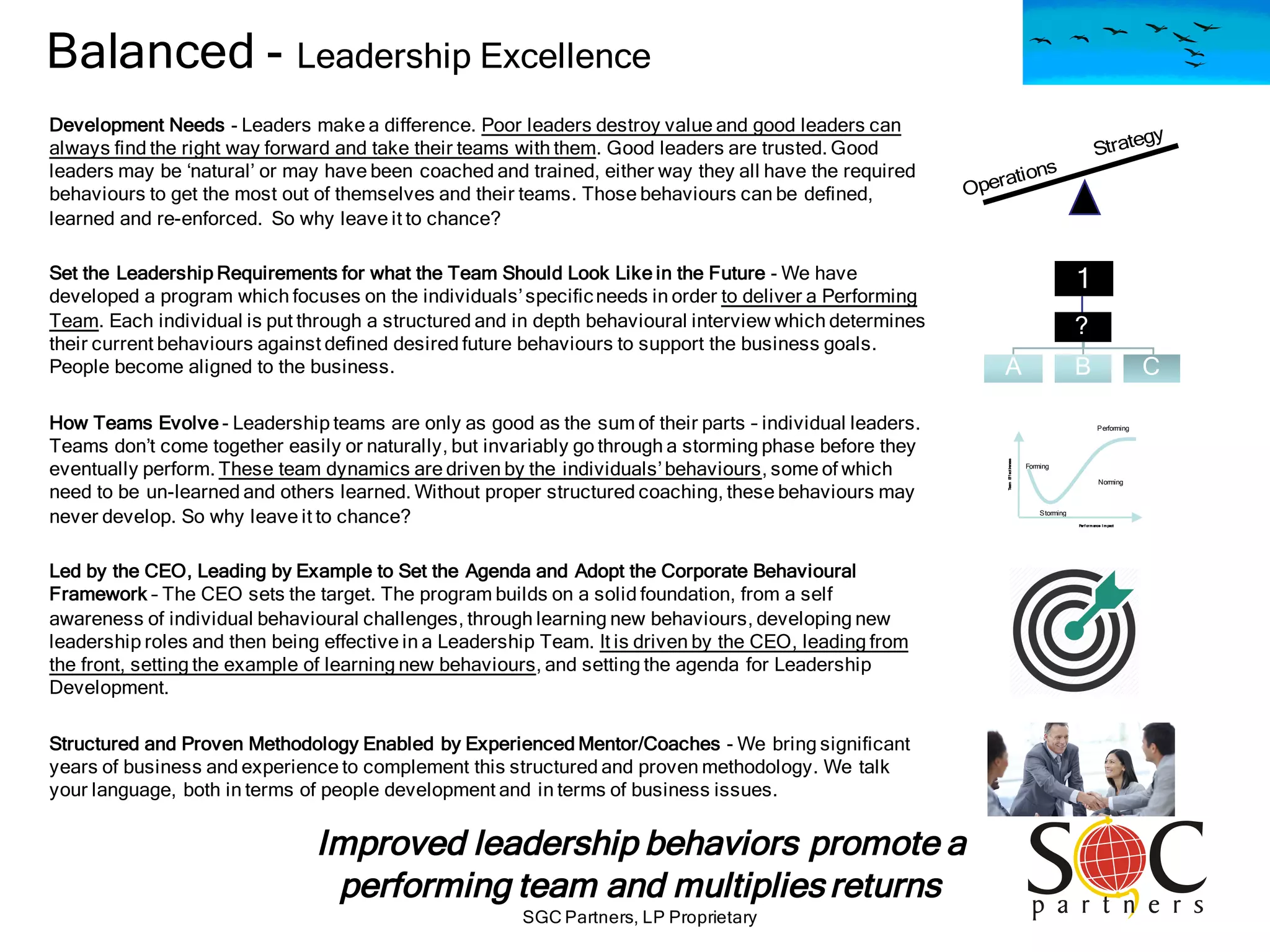
Development Needs - Leaders make a difference. Poor leaders destroy value and good leaders can
always find the right way forward and take their teams with them. Good leaders are trusted. Good
leaders may be ‘natural’ or may have been coached and trained, either way they all have the required
behaviours to get the most out of themselves and their teams. Those behaviours can be defined,
learned and re-enforced. So why leave it to chance?
Set the Leadership Requirements for what the Team Should Look Like in the Future - We have
developed a program which focuses on the individuals’specificneeds in order to deliver a Performing
Team. Each individual is put through a structured and in depth behavioural interview which determines
their current behaviours against defined desired future behaviours to support the business goals.
People become aligned to the business.
How Teams Evolve - Leadership teams are only as good as the sum of their parts – individual leaders.
Teams don’t come together easily or naturally, but invariably go through a storming phase before they
eventually perform. These team dynamics are driven by the individuals’behaviours, some of which
need to be un-learned and others learned. Without proper structured coaching, these behaviours may
never develop. So why leave it to chance?
Led by the CEO, Leading by Example to Set the Agenda and Adopt the Corporate Behavioural
Framework – The CEO sets the target. The program builds on a solid foundation, from a self
awareness of individual behavioural challenges, through learning new behaviours, developing new
leadership roles and then being effective in a Leadership Team. It is driven by the CEO, leading from
the front, setting the example of learning new behaviours, and setting the agenda for Leadership
Development.
Structured and Proven Methodology Enabled by Experienced Mentor/Coaches - We bring significant
years of business and experience to complement this structured and proven methodology. We talk
your language, both in terms of people development and in terms of business issues.
Forming
Storming
Norming
Performing
Per f or m ance I m pact
TeamEffectiveness
?
A B C
1
Improved leadership behaviors promote a
performing team and multipliesreturns
SGC Partners, LP Proprietary
Integrated - Data-Centered Asset Lifecycle Management
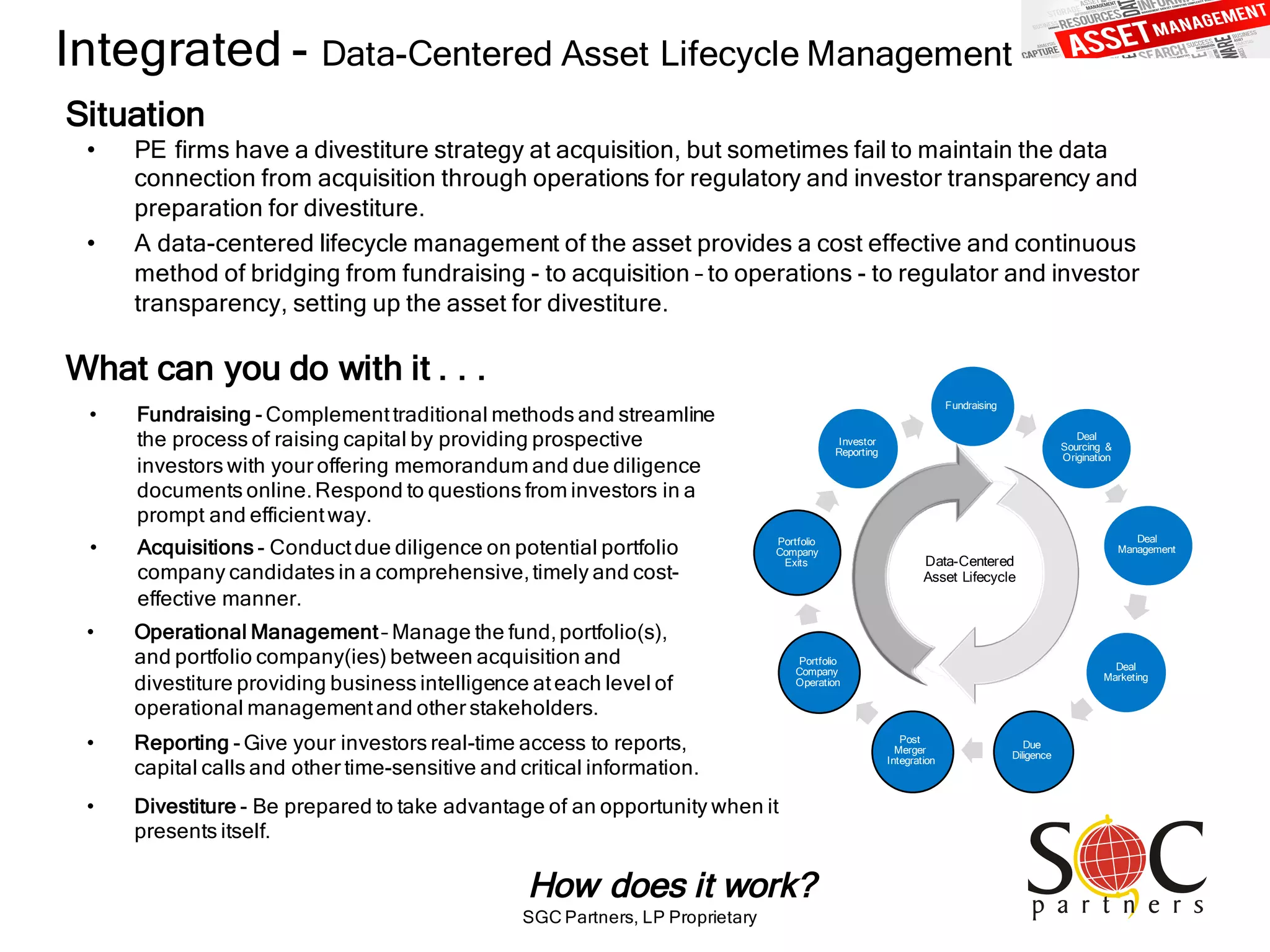
• PE firms have a divestiture strategy at acquisition, but sometimes fail to maintain the data
connection from acquisition through operations for regulatory and investor transparency and
preparation for divestiture.
• A data-centered lifecycle management of the asset provides a cost effective and continuous
method of bridging from fundraising - to acquisition – to operations - to regulator and investor
transparency, setting up the asset for divestiture.
Situation
What can you do with it . . .
• Fundraising - Complementtraditional methods and streamline
the process of raising capital by providing prospective
investors with your offering memorandum and due diligence
documents online.Respond to questions from investors in a
prompt and efficientway.
How does it work?
• Divestiture - Be prepared to take advantage of an opportunity when it
presents itself.
• Reporting - Give your investors real-time access to reports,
capital calls and other time-sensitive and critical information.
• Acquisitions - Conductdue diligence on potential portfolio
company candidates in a comprehensive,timely and cost-
effective manner.
• Operational Management– Manage the fund,portfolio(s),
and portfolio company(ies) between acquisition and
divestiture providing business intelligence ateach level of
operational managementand other stakeholders.
Fundraising
Deal
Sourcing &
Origination
Deal
Management
Deal
Marketing
Due
Diligence
Post
Merger
Integration
Portfolio
Company
Operation
Portfolio
Company
Exits
Investor
Reporting
Data-Centered
Asset Lifecycle
SGC Partners, LP Proprietary
Integrated - Data-Centered Asset Lifecycle Management
How it works . . .
How do we start?
Use administrator tools to
control multiple views for
financial and strategic
buyers
Provide fast, secure
access to information for
potential buyers and third
party participants
worldwide
Provide instant access to
offering memorandum and
fund objectives; achieve
operating leverage as the
firm raises capital
Use administrative reports
for full transparency, down
to the page level, for all
information
Communicate to board
members and LP investors
on fund performance
Have your portfolio assets
ready for immediate action
based on market
conditions
Improve your management
practices and enhance
the value of your assets by
organizing your documents
Use administrator tools to
control setup of new users,
content, structure,
reporting and questions
Track performance,
compliance and
communication regardless
of geographic separation
Create a monthly and
quarterly reporting
structure from each
portfolio company
Use “drag and drop” tools
to finalize the Merrill file
room, folder and index
structure for most efficient
use
Load all portfolio
structures in 30 minutes or
less, using any of 3,000
existing or customized
indexes
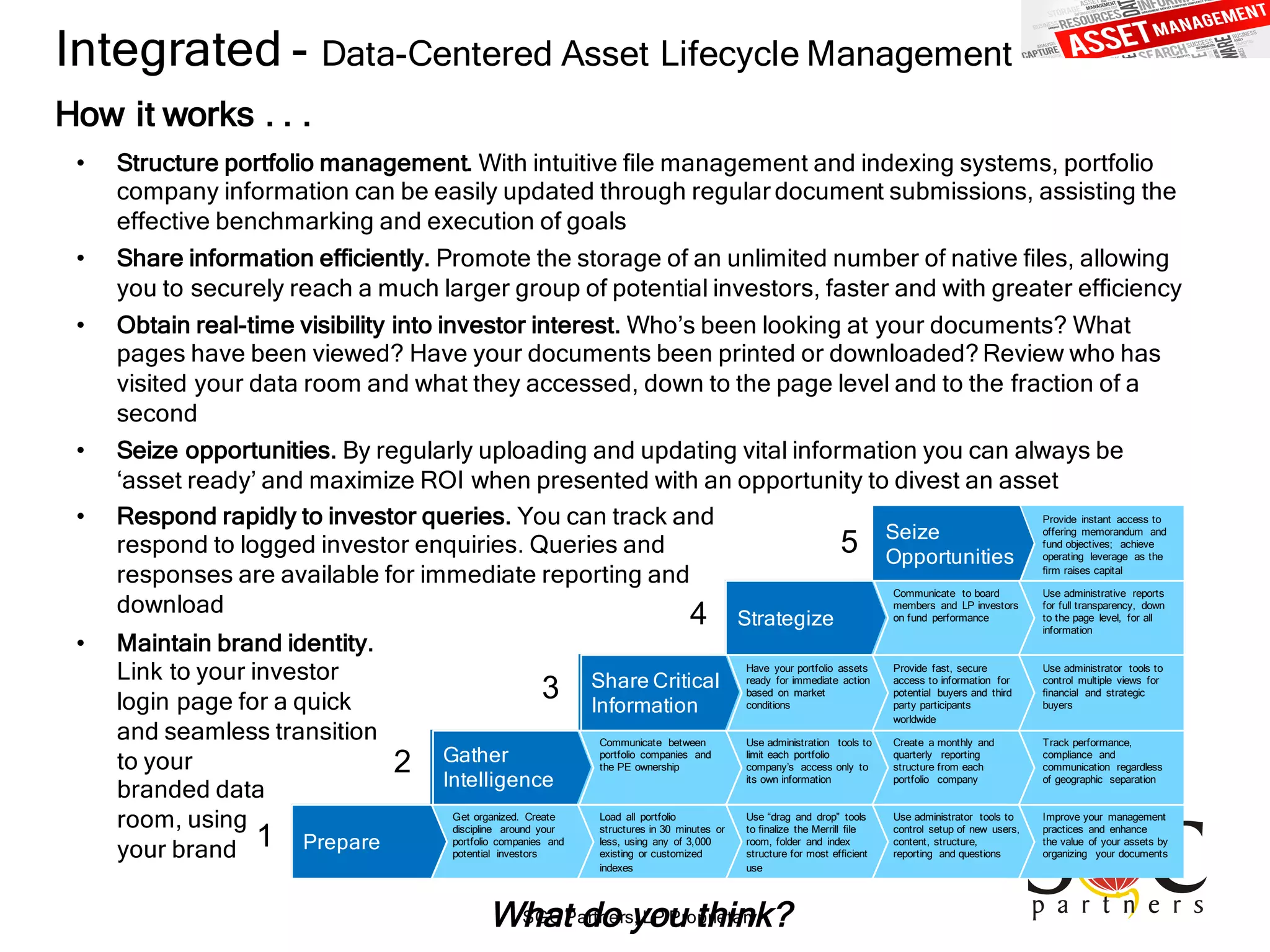
Share Critical
Information
Seize
Opportunities
Use administration tools to
limit each portfolio
company’s access only to
its own information
Strategize
Communicate between
portfolio companies and
the PE ownership
Get organized. Create
discipline around your
portfolio companies and
potential investors
Gather
Intelligence
Prepare1
2
3
4
5
• Structure portfolio management. With intuitive file management and indexing systems, portfolio
company information can be easily updated through regular document submissions, assisting the
effective benchmarking and execution of goals
• Share information efficiently. Promote the storage of an unlimited number of native files, allowing
you to securely reach a much larger group of potential investors, faster and with greater efficiency
• Obtain real-time visibility into investor interest. Who’s been looking at your documents? What
pages have been viewed? Have your documents been printed or downloaded? Review who has
visited your data room and what they accessed, down to the page level and to the fraction of a
second
• Seize opportunities. By regularly uploading and updating vital information you can always be
‘asset ready’ and maximize ROI when presented with an opportunity to divest an asset
• Respond rapidly to investor queries. You can track and
respond to logged investor enquiries. Queries and
responses are available for immediate reporting and
download
• Maintain brand identity.
Link to your investor
login page for a quick
and seamless transition
to your
branded data
room, using
your brand
What do you think?
SGC Partners, LP Proprietary
Next Steps
• Discuss your thoughts related to:
• Your concerns and risks
• Operations and Enterprise Risk Management
• Integrated Shared Services
• Leadership Excellence and Interim Management
• Data-Centered Asset Lifecycle Management
• Operations and Supply Chain
• Your interest in moving forward
Stan Scott
Managing Partner
Email: stan.scott@sgc-partners.com
Office: +1 202 810 9985
Mobile: +1 214 912 8550
Schedule a Call: http://meetme.so/SGCPartners

Fundamental Shift in Private Equity

  • 1.
    SGC Partners, LPProprietary A balanced, integrated, and flexible approach to the fundamental shift in Private Equity: • Transparency • Profitability • Risk • Leadership Executive Discussion 2016
  • 2.
    SGC Partners, LPProprietary Executive Summary All the efforts of policymakers to institute more regulations has reshaped the private equity landscape adding yet more pressure on returns. With profit margins squeezed, PEs must focus on operational excellence and appropriate levels of transparency to achieve and maintain a competitiveadvantage. In the US, the Dodd-Frank Act introduced the new Form PF reporting requirement under its Title IV, (and AIFMD) reports will be scrutinized both at national and global levels. 2016 Presidential Election: Only a few companies are delaying decisions to await the election’s outcome. As a senior vice president of one companies told us, “As long as the economy keeps moving, it doesn’t matter much who wins.” Regardless of the outcome, PE firms must become agile to adapt to the new administration. Transparency and Regulation: We strongly believe there is a mandate to adapt operating models to respond to increasing demands of investors and regulators. These models must be balanced, integrated, and above all flex to the appropriate levels of support for the portfolio and operating partner. Models must include treatment of operational risks, a refined level of leadership, innovative approaches to portfolio structures, and better use of data and enabling technologies. Operational Excellence is Mandatory: More than ever before, PE firms must become more focused on profitable growth and passionately embrace their role to become the champions of change. In today’s innovation era, leadership is key; leadership behaviors once acceptable no longer drive optimal team performance. At SGC Partners, we are enthusiastic about the future of the private equity industry. We look forward to continuing to work alongside the industry and support its efforts to enhance well-being for all stakeholders. Success hinges on the ability to adapt to perpetual change
  • 3.
    SGC Partners, LPProprietary SGC Recommends 1. Provide a strategy continuity from due diligence through post acquisition integration 2. 2. Resist rebuilding of of the entire infrastructure as a way to keep regulators and investors happy, but 3. Consider redesigning business models as part of a renewed strategic focus on: controlling costs, and improving operational efficiency, while providing the desired level of transparency 4. Understand and mitigate operational risks, transferring residual risk for pooled treatment at the enterprise level 5. Focus on what is “core” to the business and share non-core functions 6. Optimize leadership and related structures 7. Embrace a data-centered asset lifecycle strategy This course of action addresses fundamental PE issues and delivers optimal returns! 1 2 3 4 5 6 7
  • 4.
    SGC Partners, LPProprietary Recommendation Benefits and Solutions • Together, we marry a customized, integrated, and balanced approach to accomplish the following: • Reduce acquisition cost • Achieve acquisition objectives • Reduce operations risk and cost • Reduce “leadership churn” Balanced Integrated Flexible • Increase financial reporting ease and flexibility • Facilitate transparency to regulators and investors • Increase exit multiple • To accomplish these objectives we leverage the following Private Equity solutions: • Due Diligence and Post Acquisition Integration Support • Operations and Enterprise Risk Management • Integrated Shared Services • Leadership Excellence • Data-Centered Asset Lifecycle Management • SGC has other capabilities which may be applied
  • 5.
    SGC Partners, LPProprietary Do you know where you want to start? IF SO, lets discuss . . . IF NOT, lets start with a Rapid Analysis and Design: 1. Risk Management 2. Shared Services 3. Leadership 4. Data-Centered Asset Lifecycle 5. Other Potential Improvement Areas Scope-Resources-Cost: • 1 portfolio of up to 3 companies of 2 facilities each • 3 Areas of interest • 3 Consultants • 4 Weeks • Priced at cost, plus marginal contingency • Alternate arrangements available • Assumes: • Timely and complete data availability • Strong Executive and Management participation Mobilization Business Analysis and Data Collection Leading Practice Assessment Analysis Business Opportunity and Long Term Vision Mid-Point Executive Alignment Workshop Strategy Currentand Future State Gap Identification Work s hop Recommendation Initiative Trade-offs and Preferred Alternatives Business Opportunity Rationalizatio n Financial Analysis and Risk Mitigation Strategy Analysis Business Strategy and Roadmap Phase 1 Phase 2 Phase 3 Stage 1 Stage 2 Stage 3 Stage 4 Stage 5 Stage 6 Stage 7 Stage 8 Work s hop Week 1 Week 2 Week 4Week 3 Implementation Phase 4 through N Week 5 through N SGC works with you to operationalize the strategy and achieving the desired results
  • 6.
    SGC Partners, LPProprietary • Top 10 Private Equity Trends in 2016 • 2016 Presidential Election • Overview: Balanced-Integrated-Flexible • PE Solutions: – Due Diligence and Post Acquisition Integration Support – Operations and Enterprise Risk Management – Integrated Shared Services – Leadership Excellence – Data-Centered Asset Lifecycle Management Agenda: A Deeper Dive
  • 7.
    SGC Partners, LPProprietary Top 10 Private Equity Trends in 2016 Valuations stay high, co-investments increase, exits plateau 1. Challenging Investment Environment -Seventy-three percent of larger firms and 32% of smallerones said finding investment opportunitieswas theirmost significant challenge. Regulatory/ legislativechallenges and valuations were bigger priorities for smallerfirms. 2. Valuations Will Remain High - PEGCCsaid that although public market volatility wouldinfluence purchasevaluations, it expectedthem toremain historically high. 3. IncreasedEquity Contributions -Fifty-sevenpercent of respondents expectedequity contributions tostay the samein the next 12 months, and40% expected them to rise. 4. Divergenceof InvestmentStrategies-Seventy-three percent of larger firms saidthey were consideringmore involvement incredit/ distressedinvestmentsin2016, comparedwith 33% of smallerfirms. Fifty-ninepercent of smallerfirms reportedan industry specialization— includingenergy, healthcare, business services, softwareand technology, automotiveandoperating talent — comparedwith 30% of their larger counterparts. 5. Regulatory Guidance- Majorities of both larger and smallerfirms agreed that if U.S. regulatory guidance had impactedtheir ability tosecurefinancing, it had had a negativeeffect. 6. AdjustingtoNew Regulations - Only 44% of larger firms saidthey had formalizedcompliancepoliciesor hired a chief complianceofficercomparedwith86% of smallerfirms. Nearly all firms saidthey had added more people as a result of the Dodd-Frank Act. 7. Increasein Co-investments-A majority of all respondents expectedlimitedpartnerparticipationin co-investment opportunities toincreaseoverthenext 12 months. No respondents of any sizeexpectedLP participationtodecrease. 8. SmallerFirms Competefor Dollars - Thirty-three percent of smallerfirms expressedconcernabout fundraising, with10% expectingfundraisingefforts to be significantly moredifficult inthecomingyearthan it was last year. 9. Exit VolumePlateaus -Seventy-eight percent of respondents saidthey expectedexit activitytoeither stay thesameor decreaseover thenext 12 months. Nearly three-quarters saidsales to corporates was the most attractiveexit route. 10. Job and Wage Growth in PortfolioCompanies - Sometwo-thirds of respondents saidthey expected wage growth to stay the sameat portfolio companies over the next 12 months. Amongthosewho thought average wage growth to rise during that period, half expectedan increasebetween 2% and 3%. © the Private Equity Growth Capital Council 2016– polling large (>$20B under management); andsmaller (< $20B under management) firms
  • 8.
    SGC Partners, LPProprietary ? 2016 Presidential Election – Does it matter who wins? Only a few companies are delaying decisions to awaitthe election’s outcome.As a senior vice presidentof one company told us, “As long as the economy keeps moving,it doesn’tmatter much who wins.” Here are the four higheststakes for them in November: 1. Tax reform - The biggestelection-season issue by far for the companies we surveyed.Seventy percentsaid tax reform is importantfor their businesses,and 58 percentsaid it is also critical for the economy generally.Notably,this is an importantissue for candidates on both sides of the aisle,although they approach it differently. 2. Increased capital availability - Companies stated it was importantfor their own company’s growth,and almost half saying it was critical to U.S. economic growth.Nearly one-fourth of these businesses took outnew bank loans last quarter, the most since 2001. 3. Infrastructure spending - Critical to the economy, according more than half of the respondents see it as important to their businesses specifically.This is likely to be a priority for both parties,despite differences over funding sources. 4. Increased manufacturing - Incentives in the U.S. also drew strong support.Sixty percentrated this as very important for national economic growth,and 49 percentidentified it as importantfor their own company’s growth,indicating that bringing manufacturing back to the U.S. goes well beyond campaign rhetoric.An increasing number ofcompanies— ranging from textiles companies to original equipmentmanufacturers—are looking to return manufacturing home,where they can accelerate supply chain and sales for domestic demand.One thing is certain: change is coming. To prepare, business leaders are engaged in the delicate balancing actofbracing for potential problems while taking advantage of current opportunities.PwC Trendsetter Barometer Q2 2016 “ . . . And, of course,(therefore, anticipating) an election,there has to be uncertainty.Both Mrs. Clinton and Mr. Trump have given us some idea of whattheir economic policies will be butMr. Trump has been,perhaps,(vague-er) than Mrs. Clinton and therefore I would say if he’s elected, that will continue to make people -- not nervous,but uncertain. But, more interestingly,both of them have said that they want to tax the carried interest at ordinary income rates as opposed to capital gains rates which it is now and I think that could have,at leastpsychologically,a bigger impactthan anything else that they do from an economic pointof view.Whether that means there’ll be less funds raised -- which I think’s what the partners say, -- who will be earning less money,I don’tknow.“ Beatrice Mitchell
  • 9.
    SGC Partners, LPProprietary Model - Balance and Integrationwith Flexibility No one size fits all! • Balance organization, process, technology, and metrics to achieve the desired results in effective acquisition, operation, and divestiture • Integrate sales and supply cycles with customized levels of support and a balanced approach to optimal performance • Focus on the “core” of the business and sharing non-core functions • It must be flexible - there is no “one-size-fits- all,” with each acquisition, portfolio company operation, and divestiture having differing needs and each business function requiring unique treatment Approach Balanced Flexible Integrated The image part with relationship ID rId3 was not found in the file. The image part with relationship ID rId3 was not found in the file. 1. Organization 3. Technology/ Data 2. Processes 4. Performance Management • Systems Functionality • Decision support tools • Accessibility / usability • Information management • Strategic • Operational • Execution • Customer Relations • Supplier Management • Metrics • Management process • Capabilities • Structure / alignment • Roles and responsibilities • Decision rights
  • 10.
    SGC Partners, LPProprietary Balanced – Operations and Enterprise Risk Management • Many companies employ enterprise level risk management, but many do not understand or work to mitigate the underlying operations risks based on a balanced and prioritized risk approach • Once operational risks are know and appropriate mitigations underway, residual operational risks are pooled for treatment • Risk management must be part of the strategic planning process, otherwise, investments may be applied to the wrong projects • Mitigation projects are fundamental and must be supported by a business case Situation and Solution Risk Management Process 10 V-Hi Low 1 1 10 Severity Likelihood Mod Hi No Controls Mitigated Identify Assess Control Monitor Describe events that could negatively impact operations Consider possible consequences should a risk event occur Prioritize risk threats based on likelihood and severity Determine acceptable levels of risk Identify potential root cause(s) of risk events Perform gap analysis Determine mitigation steps to reduce risks to acceptable levels Conduct regular monitoring to ensure risk mitigations are effective Schedule regular risk reviews to identify new or changing risks Critical Risks Corporate One Company Sub-Unit/Team Business Unit Functions Processes E R M O R M Level 1: corporate view Level 2: business unit/ function view Level 3: process/ sub-business unit/team view Accounting, HR, etc Sales, OPS, etc Cleaning, Mechanical Lining Paint Car Movement Residual Risk Residual Risk Residual Risk ORM + ERM = Continuity of Strategy Linking Operational Risk (ORM) to the Enterprise Level (ERM)
  • 11.
    SGC Partners, LPProprietary Balanced - Connecting Operations and Enterprise Risk Management Operations risks are: • Better understood • Mitigated • Monitored • Communicated Communication of operations risks to the Portfolio Group and ultimately to the PE Firm will lead to: • Improved risk aggregation and pooling • Appropriate levels of coverage for residual risks • Balance of competing objectives Portfolio Group PE Firm PE Firm • Investment • Capital Allocations • Risk Pooling • Manage Corp KRIs Identify Risks Define Tolerance Assess & evaluate Map and Mitigate Monitor KPIs Company Operations Risk Management Portfolio Group • Balance competing objectives • Aggregate BUs’ residual risks • Manage Group KRI’s • Define Group risk tolerance Portfolio Company • Identify, Assess, Mitigate and Monitor • Communicate residual risks • Define Operational risk tolerance Risk Management Tool “You only find out who is swimming naked when the tide goes out.” Warren Buffett Lessens impact of risk for consistent returns
  • 12.
    SGC Partners, LPProprietary Integrated - Defining what is core to the business? • capabilities in HR, Accounting, Procurement, Call Center, and potentially other non- core functions • Although functions of these services are fundamental, these duplicative cost centers weigh on EBIT during operations and at divestiture • Buyers, on your divestiture, may value the option of buying only the Core Situation True Core Core Non-Core Criteria • Distinctive • Competitive and Strategic Advantage • Ability to earn a premium price • Why you acquired How to Treat • Focus • Expand • Invest • Market • Part of core, but . . . • No strategic advantage • No competitive advantage • Consider outsourcing (monitor risk) • Maintain but streamline • Utilize core Shared Service • Buyers, on divestiture, unwilling to pay premium • Not a competitive differentiator • Distracts focus from core business • Consider elimination • Utilize non-core Shared Service • Consider outsourcing Focuses on the True Core by carving out Non-core Services
  • 13.
    SGC Partners, LPProprietary Integrated - Shared Service Success by Design Objectives: • Increase the quality, efficiency, and speed of non-core functions’ (such as HR, Finance, Procurement, Logistics, IT, etc.) transaction services • Improve information reporting and transparencies • Deliver significant cost savings Critical Success Factors: • Operate Shared Service as a stand alone business • Provide services that save the portfolio company money while providing an improved and flexible support • Evolve Shared Service capabilities and improve over time • Flexibility: • To plug-in acquisitions and un-plug divestitures • To provide differing levels of support to each portfolio company and function • Supportthe true core • Manage the non-core • Facilitate the middle Design Principles: • Organize to insure flexibility • Minimize cost in delivering agreed service levels • Ensure clear roles and responsibilities • Structure to maximize work process effectiveness, quality and excellence while exploiting economies of scale • Create a rewarding and challenging working environment in the Shared Service • Operate the shared service as a stand alone business Benefits: An integrated non-core service can provide: • Reduced operating costs • Improved levels of service and quality • A separate portfolio company that may provide services to other companies as well as the portfolio companies • Flexibility and improved multiples on divestiture of the core • Structure costs as direct charge to Portfolio Companies instead ofas a PE “allocation”
  • 14.
    SGC Partners, LPProprietary Integrated – The Portfolio: Current-Transition-Ongoing OngoingBefore Company 1 to N • Duplicative functions • Limited acknowledgement of core vs. non-core • Divided focus from core functions Company 1 to N Transition Company 1 > Shared Service < Company N EXAMPLE: Market/Sell, Design, Plan, and Make/Service deemed core functions with some strategic activities of non-core functions deemed critical to retain in portfolio company • Move low level strategic and the majority of transactions to a shared service for non-core functions • Establish a flexible shared service strategy: • Support the core • Manage the non-core • Facilitate the middle • Single Center of Excellence for non-core functions • Company able to focus on core • Some critical non-core function strategic activities maintained in Portfolio Company Market/Sell Design Plan Strategy Trans acti ons Strategy Trans acti ons Strategy Trans acti ons HR Finance/Actg Other Strategy Trans acti ons Strategy Trans acti ons Strategy Trans acti ons Buy Make/Svc Move Maintain Strategy Trans acti ons Strategy Trans acti ons Strategy Trans acti ons Strategy Trans acti ons S h a r e d S e r v i c e Market/Sell Design Plan Strategy Trans acti ons Strategy Trans acti ons Strategy Trans acti ons HR Finance/Actg Other Strategy Trans acti ons Strategy Trans acti ons Strategy Trans acti ons Buy Move Maintain Strategy Trans acti ons Strategy Trans acti ons Strategy Trans acti ons Make/Svc Strategy Trans acti ons Market/Sell Design Plan Strategy Trans acti ons Strategy Trans acti ons Strategy Trans acti ons HR Finance/Actg Other Strategy Trans acti ons Strategy Trans acti ons Strategy Trans acti ons Buy Move Maintain Strategy Trans acti ons Strategy Trans acti ons Strategy Trans acti ons Make/Svc Strategy Trans acti ons Market/Sell Design Plan Strategy Trans acti ons Strategy Trans acti ons Strategy Trans acti ons HR Finance/Actg Other Strategy Trans acti ons Strategy Trans acti ons Strategy Trans acti ons Buy Make/Svc Move Maintain Strategy Trans acti ons Strategy Trans acti ons Strategy Trans acti ons Strategy Trans acti ons Market/Sell Design Plan Strategy Trans acti ons Strategy Trans acti ons Strategy Trans ac tion s HR Finance/Actg Other St r at egy St r at egy St r at egy Buy Make/Svc Move Maintain St r at egy Strategy Trans acti ons St r at egy St r at egy HR Finance/Actg Other St r at egy Trans acti ons St r at egy Trans acti ons St r at egy Trans acti ons Buy Move Maintain St r at egy Trans acti ons St r at egy Trans acti ons St r at eg y Trans acti ons Market/Sell Design Plan Strategy Trans acti ons Strategy Trans acti ons Strategy Trans acti ons HR Finance/Actg Other St r at egy St r at egy St r at egy Buy Make/Svc Move Maintain St r at egy Strategy Trans acti ons St r at egy St r at egy Trans ac tion s Trans ac tion s PlanTrans ac tion s • Differing levels of support to each Portfolio Company and function
  • 15.
    SGC Partners, LPProprietary Integrated - How we “carve out” Shared Services • The functions for centers of excellence are carved out of the portfolio companies into a separate entity • The “Newco” bills the portfolio company for services based on an agreement that includes SLAs • Strategic capabilities may stay with the portfolio company or be folded into the shared service depending on the function’s contribution to the core • Use a phased approach: 1. Evaluate 2. Implement 3. Evolve • Incorporate Program Management throughout the lifecycle Phase 1: Evaluate • Research • Feasibility • Strategy Phase 2: Implement (In-House and Out-Source) • Design • Build • Service Agreement • Transition Phase 3: Evolve • Service Agreement/ Contact Management • Health Check • Governance Program Management: • Governance • Project Management • Risk Management • Change Management • Quality Assurance We work with Leadership to improve performance behaviors
  • 16.
    SGC Partners, LPProprietary Balanced - Leadership Excellence Situation • Many Private Equity firms view change management as just that; when a leader does not meet his/her numbers they change the leader and put in a new one • The result of this “leadership churn” has a significant impact on the business and associated returns • Sometimes a change of the existing leaders behaviors is all that is needed Turnover • “People don’t leave companies they leave managers” • Many estimates put the cost of interviewing, hiring, and training a new person at 30%+ of base salary - Ouch! Poor decisions • Can an indifferent or bad leader make good decisions, use the strengths of those on their team and do what is in the best interest of the company? Poor customer service • If clients can’t rely on your company to deliver the product or service on time or with high quality – do you think they will come back? Cost of Bad Leadership Leadership development only applies when there is potential for behavioral change
  • 17.
    SGC Partners, LPProprietary Balanced - Leadership Excellence Development Needs - Leaders make a difference. Poor leaders destroy value and good leaders can always find the right way forward and take their teams with them. Good leaders are trusted. Good leaders may be ‘natural’ or may have been coached and trained, either way they all have the required behaviours to get the most out of themselves and their teams. Those behaviours can be defined, learned and re-enforced. So why leave it to chance? Set the Leadership Requirements for what the Team Should Look Like in the Future - We have developed a program which focuses on the individuals’specificneeds in order to deliver a Performing Team. Each individual is put through a structured and in depth behavioural interview which determines their current behaviours against defined desired future behaviours to support the business goals. People become aligned to the business. How Teams Evolve - Leadership teams are only as good as the sum of their parts – individual leaders. Teams don’t come together easily or naturally, but invariably go through a storming phase before they eventually perform. These team dynamics are driven by the individuals’behaviours, some of which need to be un-learned and others learned. Without proper structured coaching, these behaviours may never develop. So why leave it to chance? Led by the CEO, Leading by Example to Set the Agenda and Adopt the Corporate Behavioural Framework – The CEO sets the target. The program builds on a solid foundation, from a self awareness of individual behavioural challenges, through learning new behaviours, developing new leadership roles and then being effective in a Leadership Team. It is driven by the CEO, leading from the front, setting the example of learning new behaviours, and setting the agenda for Leadership Development. Structured and Proven Methodology Enabled by Experienced Mentor/Coaches - We bring significant years of business and experience to complement this structured and proven methodology. We talk your language, both in terms of people development and in terms of business issues. Forming Storming Norming Performing Per f or m ance I m pact TeamEffectiveness ? A B C 1 Improved leadership behaviors promote a performing team and multipliesreturns
  • 18.
    SGC Partners, LPProprietary Integrated - Data-Centered Asset Lifecycle Management • PE firms have a divestiture strategy at acquisition, but sometimes fail to maintain the data connection from acquisition through operations for regulatory and investor transparency and preparation for divestiture. • A data-centered lifecycle management of the asset provides a cost effective and continuous method of bridging from fundraising - to acquisition – to operations - to regulator and investor transparency, setting up the asset for divestiture. Situation What can you do with it . . . • Fundraising - Complementtraditional methods and streamline the process of raising capital by providing prospective investors with your offering memorandum and due diligence documents online.Respond to questions from investors in a prompt and efficientway. How does it work? • Divestiture - Be prepared to take advantage of an opportunity when it presents itself. • Reporting - Give your investors real-time access to reports, capital calls and other time-sensitive and critical information. • Acquisitions - Conductdue diligence on potential portfolio company candidates in a comprehensive,timely and cost- effective manner. • Operational Management– Manage the fund,portfolio(s), and portfolio company(ies) between acquisition and divestiture providing business intelligence ateach level of operational managementand other stakeholders. Fundraising Deal Sourcing & Origination Deal Management Deal Marketing Due Diligence Post Merger Integration Portfolio Company Operation Portfolio Company Exits Investor Reporting Data-Centered Asset Lifecycle
  • 19.
    SGC Partners, LPProprietary Integrated - Data-Centered Asset Lifecycle Management How it works . . . How do we start? Use administrator tools to control multiple views for financial and strategic buyers Provide fast, secure access to information for potential buyers and third party participants worldwide Provide instant access to offering memorandum and fund objectives; achieve operating leverage as the firm raises capital Use administrative reports for full transparency, down to the page level, for all information Communicate to board members and LP investors on fund performance Have your portfolio assets ready for immediate action based on market conditions Improve your management practices and enhance the value of your assets by organizing your documents Use administrator tools to control setup of new users, content, structure, reporting and questions Track performance, compliance and communication regardless of geographic separation Create a monthly and quarterly reporting structure from each portfolio company Use “drag and drop” tools to finalize the Merrill file room, folder and index structure for most efficient use Load all portfolio structures in 30 minutes or less, using any of 3,000 existing or customized indexes Share Critical Information Seize Opportunities Use administration tools to limit each portfolio company’s access only to its own information Strategize Communicate between portfolio companies and the PE ownership Get organized. Create discipline around your portfolio companies and potential investors Gather Intelligence Prepare1 2 3 4 5 • Structure portfolio management. With intuitive file management and indexing systems, portfolio company information can be easily updated through regular document submissions, assisting the effective benchmarking and execution of goals • Share information efficiently. Promote the storage of an unlimited number of native files, allowing you to securely reach a much larger group of potential investors, faster and with greater efficiency • Obtain real-time visibility into investor interest. Who’s been looking at your documents? What pages have been viewed? Have your documents been printed or downloaded? Review who has visited your data room and what they accessed, down to the page level and to the fraction of a second • Seize opportunities. By regularly uploading and updating vital information you can always be ‘asset ready’ and maximize ROI when presented with an opportunity to divest an asset • Respond rapidly to investor queries. You can track and respond to logged investor enquiries. Queries and responses are available for immediate reporting and download • Maintain brand identity. Link to your investor login page for a quick and seamless transition to your branded data room, using your brand What do you think?
  • 20.
    SGC Partners, LPProprietary Next Steps • Discuss your thoughts related to: • Your concerns and risks • Operations and Enterprise Risk Management • Integrated Shared Services • Leadership Excellence and Interim Management • Data-Centered Asset Lifecycle Management • Operations and Supply Chain • Your interest in moving forward Stan Scott Managing Partner Email: stan.scott@sgc-partners.com Office: +1 202 810 9985 Mobile: +1 214 912 8550 Schedule a Call: http://meetme.so/SGCPartners