3 2 1 
Anna Wzi¹tek-Kubiak 
On Essence and Masurement of Changes 
in Competitiveness of the Accession Countries. 
Critical Review of Literature 
W a r s a w , M a r c h 2 0 0 6
Studies & Analyses No. 321 – On Esence and Masurement of Changes in Competitiveness of the Accession Countries... 
Materials published here have a working paper character. They can be subject to further publication. The views 
and opinions expressed here reflect the author(s) point of view and not necessarily those of CASE. 
The paper was published as a result of the project within the 5th Framework Programme(Ref. HPSE-CT-2002- 
00148) 'Changes in Industrial Competitiveness as a Factor of Integration: Identifying the Challenges of the 
Enlarged Single European Market', funded by the European Community and co-ordinated by the CASE 
Foundation. The authors are solely responsible for the content of the paper. It does not represent the opinion of 
the Community and the Community is not responsible for any use that might be made of data appearing therein. 
Keywords: competitiveness, productivity, transition economies, manufacturing industry, EU integration. 
© CASE – Center for Social and Economic Research, Warsaw 2006 
Graphic Design: Agnieszka Natalia Bury 
DTP: CeDeWu Sp. z o.o. 
ISSN 1506-1701 
ISBN 83-7178-403-1 
EAN 9788371784033 
Publisher: 
CASE – Center for Social and Economic Research 
12 Sienkiewicza, 00-944 Warsaw, Poland 
tel.: (48 22) 622 66 27, 828 61 33, fax: (48 22) 828 60 69 
e-mail: case@case.com.pl 
http://www.case.com.pl/ 
2
Studies & Analyses No. 321 – On Esence and Masurement of Changes in Competitiveness of the Accession Countries... 
Contents 
Abstract . . . . . . . . . . . . . . . . . . . . . . . . . . . . . . . . . . . . . . . . . . . . . . . . . . . . . . . . . . . . . . 5 
Introduction . . . . . . . . . . . . . . . . . . . . . . . . . . . . . . . . . . . . . . . . . . . . . . . . . . . . . . . . . . . . 6 
1. Approaches to competitiveness in literature . . . . . . . . . . . . . . . . . . . . . . . . . . . . . . . . . 7 
2. The macroeconomic approach to competitiveness used for evaluating changes 
in competitiveness of the accession countries, their results and deficiencies. . . . . . . . . 9 
3. Does trade approach to competitiveness reveal its changes? . . . . . . . . . . . . . . . . . . . . . . 10 
4. Micro economic approach to competitiveness . . . . . . . . . . . . . . . . . . . . . . . . . . . . . . . 13 
5. Conclusion . . . . . . . . . . . . . . . . . . . . . . . . . . . . . . . . . . . . . . . . . . . . . . . . . . . . . . . . . . 19 
References . . . . . . . . . . . . . . . . . . . . . . . . . . . . . . . . . . . . . . . . . . . . . . . . . . . . . . . . . . . . 21 
Annex . . . . . . . . . . . . . . . . . . . . . . . . . . . . . . . . . . . . . . . . . . . . . . . . . . . . . . . . . . . . . 25 
3
Studies & Analyses No. 321 – On Esence and Masurement of Changes in Competitiveness of the Accession Countries... 
Anna Wzi¹tek-Kubiak 
Anna Wzi¹tek-Kubiak is professor of economics at the University of Business, the Institute of Economics, the 
Polish Academy of Science, and an associate of the CASE Foundation. Graduated in 1970 from the Gdañsk 
University also received her PhD (in 1973). In 1987 she was qualified as an assistant professor at the 
Department of Foreign Trade of the Warsaw School of Economics (SGH). IN 1998 she received the title of a 
Professor. She has participated in and coordinated numerous research projects, also international, focusing on 
international economics and the development of economies undergoing transformation. She is an author and co-author 
of numerous books and articles, some of which have been published abroad. 
4
Studies & Analyses No. 321 – On Esence and Masurement of Changes in Competitiveness of the Accession Countries... 
Abstract 
Although competitiveness is a world very often used in literature it is seldom to be found in economic 
textbook which prefer the term comparative advantage much narrowly defining formula describing 
international specialization. As Porter underlines comparative advantage and competitiveness (competitive 
advantage) do not overlap because competitiveness is much wider concept. Competitiveness is an 
ambiguous notion. In literature there are many approaches to competitiveness and many ways of defining 
and measuring it. Partly it is a result of the lack of general theory of competitiveness and the fact that this 
category is of business rather than theoretical origins. Paper systematizes and presents results of analysis 
on competitiveness of the accession countries which are based on three approaches to competitiveness: 
macro, micro and trade approach. 
5
Studies & Analyses No. 321 – On Esence and Masurement of Changes in Competitiveness of the Accession Countries... 
Introduction 
Virtually all debates on competitiveness have been conducted using measures of competitiveness 
rather than definitions. Application of different measures is the result of different ways of 
understanding this notion. Ambiguity of competitiveness results from attempts to derive it from 
various theories, which – with the exception of the Austrian school [Kirzner, 1973; 2000] – do not 
consider the dynamics of the process of competition and its effects. Even if it is not exactly true that 
competitiveness “is not a concept invented by theorists but by those with a practical approach, 
connected with creation of politics” [Fagerberg, 1996, p.56] then it is certain that failing to include 
categories of competition as a dynamic process within the mainstream theory helps to increase 
confusion around the subject. This makes it difficult to review literature on competitiveness of the 
accession countries and requires its systematisation. 
Although competitiveness is contained in many theories implicite, there are no theoretical bases 
to analyse it, as there is no formalised theory of competitiveness. Competitiveness is a category used 
more in business and management than in economics. In the former, it has become synonymous to 
competitive advantage, as opposed to comparative advantage, as it is seen in the context of means of 
winning the competition on the microeconomic level. In case of economics, competitiveness is 
understood in various ways. It is limited to signifying growth, or even the economic situation, foreign 
trade performance and efficiency. This category is attached to theories of growth or economic 
development, trade and international economic relations, although none of these theories have ever 
used competitiveness as explanatory variable [Gomory, Baumwall, 2000]. Each of these theories 
marks the boundaries of analysis which are reflected in ways of understanding, methods of research, 
and measurements of competitiveness. They are so strikingly diverse that it often seems that the 
subject of analysis is entirely different, though related by name. 
The aim of the paper is to show main approaches to competitiveness prevailing in the literature, 
their weaknesses and strengths. Focusing on the accession countries we intend to introduce 
systematisation of research on their competitiveness. Presentation of different approaches to 
competitiveness and their measurements allows for in-depth analysis of one of the most fashionable 
notion of the 90s in the European Union. 
Paper contains 5 parts. In the first three main approaches to competitiveness are selected. In part 
from 2 to 4 each of the separated approach is analysed. Conclusions wrap up the paper. 
6
Studies & Analyses No. 321 – On Esence and Masurement of Changes in Competitiveness of the Accession Countries... 
1. Approaches to competitiveness in literature 
Measurements of competitiveness are developed and performed mainly by mainstream economists 
whose basic foundations rest on theories of growth, trade, competition and microeconomics. There 
are at least three major approaches to competitiveness: (1) macro, (2) micro including dynamic 
approach to competition, and (3) trade approach. Some of them are applied for evaluation of the 
changes in competitiveness of the accession countries. 
Ad.1. Defining competitiveness as “the ability of a nation’s economy to make rapid and sustained gains in 
living standard” [The Global Competitiveness…. 1996, p.8], in the macro economic approach 
competitiveness of the countries’ entire economy is evaluated The criterion for grading competitiveness 
is “eight clusters of structural characteristics (…) which are termed the eight factors of competitiveness: 
openness of the economy to international trade and finance, role of the government budget and 
regulation, development of financial markets, quality of infrastructure, quality of technology, quality of 
business management, labour market flexibility and quality of judicial and political institutions” [p.9]. 
Based on indicators commonly used for evaluation of economic development, in this approach 
competitiveness is synonymous with the level and factors of development. The Competitiveness Index 
serves to “assess which countries have the best prospects for economic growth over the period of the 
next five to ten years” [p. 14]. The Growth Index in turn “depends on score on the Competitiveness 
Index and level of per capita income” [p. 19]. The definition of competitiveness as formulated by the 
World Economic Forum is one of variations of the macro approach. Among many others the European 
Commission [200-2004] definition seems especially popular. It defines competitiveness as “the ability of 
an economy to provide its population with high and rising standards of living and high rates of 
employment on a sustainable basis”. So it refers to ”aggregate competitiveness”. 
Ad. 2. In micro approach to competitiveness the framework of microeconomic and competition 
theory is applied. In this approach the subject of analysis is not the national economy but the 
tradable sector and its parts (branches and companies). The non-tradable sector, in which 
competition processes are limited to the domestic market, is thus omitted. Secondly, research is 
limited to analyses of competitiveness of export and productivity of industry. 
In many analyses, competitiveness is directly linked to the process of competition. In terms of ability to 
sell, competitiveness reflects the companies’ ability to compete; that is to retain and strengthen their 
market position. Since on the one hand the effect of competition among players is the “seizure of subject’s 
market by other subjects” [Reynauld, Vidal 1998, s. 59], then the result of competition is the change of 
competitive position on the market [Frischtak 1999, s. 86]. On the other hand, however, a company is 
competitive if it is willing to accept the return available from selling its product at the prevailing market 
price. Uncompetitive companies make inadequate returns and are therefore forced to withdraw from the 
market. Competitiveness is then synonymous with a company’s long-term profit performance and its 
ability to compensate its employees and provide its owners a superior return. Companies whose sales 
bring losses are not competitive. They should be excluded from analyses of competitiveness changes. What 
surprises in actually performed micro approach analyses the competitiveness of the entire export and 
productivity of industry are evaluated, regardless of profitability or non-profitability of their sectors. 
In the microeconomic approach, forms1 and factors2 of competitiveness are defined by forms, 
factors and effects of competition. This includes rivalry in prices, in improved techniques of 
7 
1 Price and non-price competitiveness 
2 Cost and productivity of labour, material, capital, technology
Studies & Analyses No. 321 – On Esence and Masurement of Changes in Competitiveness of the Accession Countries... 
productions for the given market or for the productive resources. On the other hand prices are 
affected by costs, efficiency and productivity of factors of production, these factors are also analysed. 
In Schumpeterian world, the concept of competition is grounded in costs and quality advantage 
which Schumpeter felt is much more important than price competition of transitional theory and is 
the basis for the “creative destruction”. It produces an internal efficiency. On the other hand, results 
of competition (final performance criterion or performance competitiveness), assessment of which is 
based on market share, are also considered. 
Within research on export competitiveness, constant market share and shift and share analysis are 
also used. They constitute a sort of residual approach to competitiveness. In estimating the influence 
of demand and structural factors on changes in market share, competitiveness changes are 
considered as the residual. 
Ad. 3. In the trade approach to competitiveness the subject of research is foreign trade performance, 
especially the structure of exports of a given country. Domestic market sales are not considered. 
The trade approach to competitiveness is based on the classical theories of international trade – 
the Comparative Advantage Theory and the Factor-Proportions Theory. This is why until the mid-nineties 
the concept of “Revealed Comparative Advantage” (RCA), created by Balassa to measure 
specialisation, was often used in this approach. Although since then the RCA has been losing its 
importance as an indicator of competitiveness, and the opinion that it measures specialisation has 
become more generally accepted [OECD from 1996; Audretsch 1993; Porter186; Sheehy 1995; 
Dobrinsky 19953] (annex, table A1) there are still some proponents for using it for evaluating 
changes in competitiveness of the accession countries (Landesmann, Misala). 
Most of the aforementioned approaches to competitiveness are used with valuation of changes in 
competitiveness of the accession countries. However, because of the variation in their internal 
conditions, inherited from the times of planned economy and particularly the very strong 
liberalisation of their economies during transition and their dual character, interpretation of results of 
competitiveness research is much complicated and ambiguous. It follows to say that it requires 
considering factors that only marginally affect competitiveness changes in developed economies, but 
strongly affect the accession countries. 
3 „The concept of “Revealed Comparative Advantage” (RCA), first introduced by Balassa (1965) and further elaborated on in a 
number of studies. (....) The introduction of the “Revealed Comparative Advantage” concept (as opposed to the theoretical 
concept of comparative advantage) was mainly justified by the failure of the traditional theoretical approaches to generate 
quantifiable indicators of comparative advantage which could be used in applied studies” [Dobrinsky 1995, p 88]. 
8
Studies & Analyses No. 321 – On Esence and Masurement of Changes in Competitiveness of the Accession Countries... 
2. The macroeconomic approach to competitiveness used 
for evaluating changes in competitiveness of the accession 
countries, their results and deficiencies. 
Since 1990’s, the economies of the Czech Republic, Hungary and Poland were subject to 
competitiveness assessment by the World Economic Forum. In 1999 Slovakia and Bulgaria joined the 
list of countries whose competitiveness was being evaluated, and in 2001 Lithuania and Latvia were 
further added4. These countries have since kept a far position down the list. 
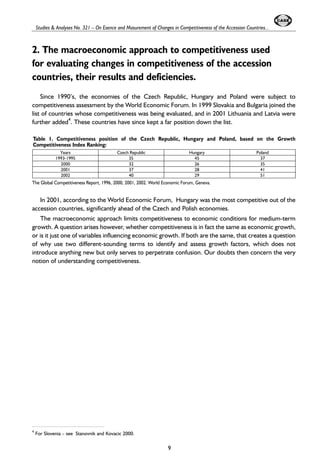
Table 1. Competitiveness position of the Czech Republic, Hungary and Poland, based on the Growth 
Competitiveness Index Ranking: 
Years Czech Republic Hungary Poland 
1993-1995 35 45 37 
2000 32 26 35 
2001 37 28 41 
2002 40 29 51 
The Global Competitiveness Report, 1996, 2000, 2001, 2002. World Economic Forum, Geneva. 
In 2001, according to the World Economic Forum, Hungary was the most competitive out of the 
accession countries, significantly ahead of the Czech and Polish economies. 
The macroeconomic approach limits competitiveness to economic conditions for medium-term 
growth. A question arises however, whether competitiveness is in fact the same as economic growth, 
or is it just one of variables influencing economic growth. If both are the same, that creates a question 
of why use two different-sounding terms to identify and assess growth factors, which does not 
introduce anything new but only serves to perpetrate confusion. Our doubts then concern the very 
notion of understanding competitiveness. 
9 
4 For Slovenia – see Stanovnik and Kovacic 2000.
Studies & Analyses No. 321 – On Esence and Masurement of Changes in Competitiveness of the Accession Countries... 
3. Does trade approach to competitiveness reveal its changes? 
For many years the trade approach was the most popular way of evaluating changes in 
competitiveness of the accession countries. The popularity of this approach resulted from wide 
availability of international trade statistics and the notion that competitiveness is only reflected in 
foreign trade performance. 
In the trade approach, changes in competitiveness of the accession countries were assessed based 
on trade performance with EU countries. Three countries were the main subjects of analysis: the 
Czech Republic, Hungary and Poland (CEE-3). Slovakia and Slovenia (known as CEE-5 when grouped 
together with the CEE-3) and Bulgaria and Romania (CEE-2) (known as CEE-7 together with the 
previous groups) were included less frequently. These analyses were conducted at various times 
between 1989 and 1998 (annex, table A1). Various versions of the RCA index [CUP] were derived in 
the trade approach evaluation of competitiveness. 
When using the RCA index to evaluate competitiveness the intensiveness of use of factors of 
production was frequently analysed. Using the Heckscher-Ohlin model, which suggests that comparative 
advantage tends to be determined by factor proportions, factor content of trade flows of the accession 
countries was estimated [Landesmann, 2000; 2002; Havlik, 2000; Misala, 1996] (Annex table A1). 
Assessments of levels and changes in competitiveness of accession countries conducted during 1988- 
1998 with the use of the RCA index were intended to demonstrate changes in the countries’ 
specialisation on the EU market. If until 1992 the CEECs were highly specialised in comparison with other 
non-EU countries exporting to the EU [Sheehy 1995], and they faced strong competition of the other 
CEECs [Dobrinsky 1995], then with time their specialisation (measured with the RCA index) across-industry 
and across-accession countries has changed. This was demonstrated by a differentiation in 
export specialisation between the various CEECs present on the EU market. However, the results of 
research on the directions and sources of changes in export specialisation conducted using classification 
of industry based on the criterion of factor intensity were not clear-cut. According to Landesmann [2002], 
during 1989-1998 the more advanced of the CEECs changed their specialisation profile. Their large 
specialisation disadvantages in R&D, in skill-intensive and capital-intensive industries – declined, while 
specialisation in labour-intensive branches was substantially reduced. According to Havlik [1998] though, 
the CEE-7 increased its disadvantages in capital intensive and skill-intensive industries over the period of 
1989-1995. These countries are still characterised by comparative disadvantages in R&D and by 
a comparative advantage in the energy-intensive and labour intensive industries. 
Differentiation in export specialisation between the accession countries over time is one aspect 
stressed by all researchers. If however according to Havlik [1998] Hungary’s progress in changing 
directions of specialisations has been the most pronounced of all CEECs, then Polish and Romanian 
specialisation patterns have hardly changed in comparison. In other words, the progress in areas of 
specialisation changes was greater in the Czech Republic and Bulgaria than in Poland. This is 
confirmed by research conducted in Poland during 1992-1995 [Misala 1996]. But Landesmann [2000; 
2002] is of another opinion. While he confirms Hungary’s exceptional progress in specialisation 
changes and notes the substantial progress achieved by the Czech Republic and Slovenia, he believes 
that Bulgaria and Romania seem to be stuck in the specialization profile typical for a less developed 
economy. Poland, according to Landesmann, occupies a position somewhere in between. 
There are six serious objections regarding the use of the RCA index as a tool to measure 
competitiveness of the accession countries. 
10
Studies & Analyses No. 321 – On Esence and Masurement of Changes in Competitiveness of the Accession Countries... 
1. These estimates concern exclusively this part of domestic production, which participates in 
international trade. In this approach one assumes that the level and changes in competitiveness of 
the accession countries’ production are the same on both domestic and foreign markets. They 
therefore exclude most of production confined to the domestic market. In Poland this represents 
around ¾ of the total value of production. Field research on 200 Polish manufacturers, conducted 
between 1990 and 1998, questions the principles of accepting such approach. As opposed to 
companies who sold most of their products on the domestic market, Polish exporters had no 
problems with sustaining a competitive position on both domestic and foreign markets. The 
former systematically worsened their competitive position on the domestic market, and 
developed their export only to a small degree. [Wzi¹tek-Kubiak 2001]. Since the economy is of a 
dual character in at least some accession countries, then the level and changes of competitiveness 
of production on the domestic market differs from the level and changes of competitiveness of 
export [Wzi¹tek-Kubiak 2003]. This questions the validity of assessing the competitiveness of the 
accession countries based on foreign trade results and on the competitiveness of export alone. 
2. Using trade indicators to assess competitiveness of the accession countries one forgets that it is 
possible to export with a loss or with dumping prices. For many years the lack of 
competitiveness of some sectors of the accession countries (such as the coal-mining industry in 
Poland) was accompanied by their strong export specialisation. One cannot treat its stabilisation 
as a symptom of stabilisation of competitiveness. Empirical research shows that part of the 
production potential of the accession countries is uncompetitive. In Poland for example, out of 
108 sectors (3-digit NACE Rev. 1 classification) during the period of 1994-2000 as many as 12 
sectors made losses from sales for a period of over 3 years, and 6 sectors for a period of over 6 
years (out of 7 years during which this research was conducted). Tolerating loss-making export 
for a period of time allows the company to retain specialisation, but that does not mean 
upholding its level of competitiveness. 
3. When researching competitiveness changes with the RCA index one assumes that – as opposed 
to the foreign market – the domestic market is distorted. If that however is true, it means that 
the assessment of competitiveness of the country’s entire production is distorted, and that 
includes export. 
4. Researchers assessing competitiveness with the RCA index do not define the notion of 
competitiveness. They assume that the results of foreign trade reflect changes in competitiveness. 
Neither theoretical research [Wzi¹tek-Kubiak 2001a; 2003] nor empirical research confirm the 
validity of using this assumption not only for the accession countries, but also for most OECD 
countries. When assessing competitiveness changes using the RCA index, one tends to forget that 
Balassa formulated this index to assess specialisation, not competitiveness. According to Balassa, 
“competitiveness means the ability to sell, to compete on the market. But since international 
trade is determined by relative rather than absolute advantages, this concept does not fit well into 
classical comparative-cost theory” [Balassa 1963, p. 29]. Balassa, similarly to Porter, rejects the 
validity of using the theory of international trade to assess competitiveness. Porter introduces the 
notion of competitive advantage, which is principally different from the notion of comparative 
advantage [1986, p. 15,17-18]. The notion of comparative advantage is derived from the theory 
of international trade, which however does not consider the competition processes, and should 
therefore be modified [Gomory and Baumol 2000, p. 4]. In attempts to modify the classical theory 
of trade, Gomory and Baumol stress, “there are in fact inherent conflicts in international trade 
(…). An improvement in the productive capacity of a trading partner that allows it to compete 
effectively with a home country industry, instead of benefiting the public as a whole, may come at 
11
Studies & Analyses No. 321 – On Esence and Masurement of Changes in Competitiveness of the Accession Countries... 
the expense of the home country overall” [p.4]. They were thus the first to introduce processes 
of competition into foreign trade models. 
The inconsistency between changes in competitiveness as measured in unit labour cost, unit total 
cost, productivity, profitability on the one hand and dynamics of exports and RCA on the other, are 
confirmed by empirical research conducted for the OECD countries and for Poland [Wzi¹tek-Kubiak 
2003]. With the exception of Japan’s trade with the US[T ange 1992], very weak (if any) correlation 
was discovered to exist between the performance of exports and the changes in efficiency, profitability, 
and unit total and unit labour costs [Meeusena and Raypa, 2000; Kaldor, 1978; Fagerberg]. 
5. The inconsistency between changes of productiveness and foreign trade performance results, 
among others, from the fact that the latter are influenced by changes in domestic and foreign 
demand, which do not affect changes in productivity. Declining RCA can be a result of an 
increasing supply to the domestic market, which in turn can result from high dynamics of growth 
of domestic demand. A quick rise in internal demand aids “suction” of not only import, but also 
of exportable production and exports by the domestic market. If it is accompanied by a quick 
rise in overall domestic production and the increase of its share of global production, then we 
are dealing with an improvement, rather than deterioration, of competitiveness. This can be 
confirmed by the example of German car manufactures in the years immediately following the 
German unification. “From 1989 to 1990 the RCA index fell from 0.81 to 0.66. At the same time 
total turnover of German car producers increased by around 8%. Thus, the German car sellers 
proved to be internationally competitive when the (repressed until 1989 demand for cars in 
Germany, mainly in the former GDR) expanded” [Dlugosch, Freytag, Kruger 1996, s. 75]. 
Overall cyclical conditions translate into changes of intensiveness of international trade and 
specialisation, but do not influence the assessment changes of production competitiveness, 
which could remain unchanged. This implies a weakening of relationship between changes in 
specialisation and changes in relative productivity. 
6. Government policies also influence inconsistency between changes in export performance and 
competitiveness. Government policies differentiate activities of domestic and foreign companies 
both on local and foreign markets [see Feenstra 1989; Eichengreen, Parry, Caldwell 1988, s. 
319...], influence profits and incomes of local companies [Pearce, Sutton, Batchelor 1985, s. 169; 
Toner, Webster 2000, s. 243], which implies that they “influence the competitiveness of 
domestic companies in comparison with foreign companies” [Martin, Valbonesi 2000, p. 177]. 
Similarly, changes in government policy of a foreign country impact changes in competitiveness 
of local production. Any distortions incorporated into trade flow and trade balance are also 
incorporated into the RCA index. In order to draw correct conclusions, it is necessary to include 
information on the trade policy applied to all industries. Moreover, an implicit assumption of the 
analysis is that the country’s exports are subject to the same level, structure and changes of 
protection in every country of destination. Strong liberalisation of the accession countries, 
particularly Poland and Hungary, meant a very strong drop in effective protection. During 1994- 
1998 effective protection of Polish economy decreased by nearly 70%. By resulting in a fall of 
value added it directly influenced the assessment of changes in competitiveness, and – to a much 
smaller extent – changes in export. Similarly, differentiation of pro-export policies between 
countries aided expansion or preservation of specialisation, which is a process not necessarily 
accompanied by improved competitiveness. 
7. Some statistical problems also arise. The RCA index is sensitive to the level of aggregation 
[Donges and Riedel 1977, p.69]. Too high an aggregation can provide too much information, not 
always of the relevant kind. 
12
Studies & Analyses No. 321 – On Esence and Masurement of Changes in Competitiveness of the Accession Countries... 
4. Micro economic approach to competitiveness 
In microeconomic approach, changes in competitiveness of the accession countries are evaluated 
by (a) relative prices, (b) productivity and (c) market share. 
4a) Relative prices as measure of changes in competitiveness of the accession countries 
Three types of price indicators were used to evaluate the changes in competitiveness of the 
accession countries (annex, table A2): 
a) The unit value of export (nominal sales divided by export volume, expressed in kilograms). This 
indicator is also available for imports. 
b) “Pure” price, free of influence of structural factors. 
c) Combination of unit export value and other indicators. 
The export unit value was evaluated for the period of 1992-1995 Polish exports to Germany as 
compared with German export to the EU [Burzyñski 1997]. For the periods 1989-1991 and 1992- 
1996, this index was for the Polish export to the EU assessed in comparison with intra-EU and extra- 
EU trade [Burzyñski 1998]. In 1993 low export unit value for 17 out of 20 Polish export sectors, as 
compared with Germany’s exports, was interpreted as an indication of lower competitiveness of the 
Polish export. The rise of the export unit value in 17 sectors before 1995 was considered a sign of 
improvement of its competitiveness [Burzyñski 1997]. 
The export unit cost was used for evaluation of changes in competitiveness of Polish export to 
the EU as compared against intra- and extra- EU exports [Burzyñski 1997, 1999]. Whereas during 
1988-1991 this index improved for only 4 out of 20 sectors, from 1992 to 1994 improvement could 
be seen in 15 sectors. During 8 years (1989-1997), the export unit cost changed very little5. Based 
on this it was assumed that the competitiveness of the Polish export had improved only slightly 
[Burzyñski 1999]. 
Using export unit cost as measure of competitiveness is intended for heterogeneous markets and 
differentiated goods. Since all sectors are included in the research, it means that in using the export 
unit cost one does not consider the differences between homogenous and heterogeneous goods. 
Changes in this index can also be the result of changes in the export’s production structure, the 
shifting of export between different market segments that can differ in quality of goods sold 
[Yoshitomi 1996, p. 68 and later]. These changes – as Marsh and Tokarick [1994, s. 10] stress – do 
not have direct association with changes in competitiveness. 
A more precise tool to measure export competitiveness is using the “pure” price factor, as it is not 
influenced by changes in export’s commodity and geographical structure on relative prices. It is a type 
of export unit value weighted by a commodity structure of exports [Burzyñskiego 1997; 
Marczewskiego 1998]. Using Poland as an example, comparing assessments conducted using this 
indicator and the export unit cost6 shows large distortions in values of changes in export 
competitiveness derived by the latter index. 
5 Compared to intra-EU trade the unit value of Polish exports increased in 9 sectors, while compared to extra-EU trade – in 5 
sectors. 
6 During 1992-1994 the rise of competitiveness of the Polish export to Germany measured by export unit cost equalled 1%, but 
only 0.1% when measured using price indicator. 
13
Studies & Analyses No. 321 – On Esence and Masurement of Changes in Competitiveness of the Accession Countries... 
First of all, the interpretation of changes of relative prices of homogeneous and differentiated 
goods varies significantly. 
Secondly, price differences may be the result of many factors, such as variations in quality and the 
specialisation of export. An example of the latter would be a segment of cheaper products for which 
the competitive position of the country’s export could be high. 
Thirdly, price indicators of export competitiveness do not consider the valuation of changes in 
competitiveness of production for the domestic market, including exportable production [Marsh, 
Tokarick 1994]. 
Recognising the aforementioned shortcomings of price indicators when used to measure evaluation 
of changes in competitiveness resulted in combining the export unit value with other indicators. For 
example, aside from the exports unit value Langesmann and Burgstaller [1997] explored the product 
quality segmentation indicator. Showing extremely high price/quality gaps of CEE-7 and very little 
representation in the high quality segments of trade with the EU, Landesmann and Burgstaller noticed 
bifurcation in the trade development of the two groups of CEECs – the “Western” CEECs (Czech. 
Republic, Hungary, Poland, Slovenia) and the “Eastern” CEECs (Bulgaria, Romania and Slovakia). 
When assessing competitiveness of CEE-7 for the period of 1989-1994, next to export and import 
unit value Aiginger [1998] also evaluated indicators of export quality. He revealed price elasticity 
(allowing to distinguish price – and quality-sensitive markets) as well as indicators of heterogeneity 
and fragmentation of markets. Basing on the four abovementioned indicators Aiginger concluded that 
firstly – unit values of exports of the accession countries were very low and did not change over time 
(with the exception of Hungary). Secondly, the sectors with successful price competition and those 
with structural problems were much larger for the CEECs-7 than the corresponding sectors in EU 
countries. “These two differences – small out priced sector, but large structural problem sector – is 
that which is expected for the countries with low wages and insufficient structural change” [p. 109]. 
Thirdly, all accession countries perform well in industries highly sensitive to price, but have an 
extremely high deficit in quality-sensitive industries. They have substantial deficit in moderately 
quality-intensive industries and a large deficit in qualitatively elastic industries. Fourthly, the accession 
countries experience deficit in differentiated industries and enjoy surplus in homogeneous industries. 
A question then arises whether the aforementioned valuations concerned changes in 
competitiveness or rather specialisation of the accession countries. 
4b) Productivity and unit labour costs as indicators of changes in competitiveness of the accession 
countries 
Commonly used indicators of changes in competitiveness are: productivity, wages and unit costs 
including unit labour costs (ULC). Recognising the key role of these indicators in assessing 
competitiveness changes results both from their strong influence on price changes, as well as 
assigning them the principal part in winning the competition. These indicators were explored not only 
for use with evaluation changes in competitiveness [Havlik 2000; 2001], but also for identification of 
determinants of comparative advantage of the accession countries [Landesmann 2000; 2002; 
Wolfmayr-Schnitzer 1998; Havlik 1998] (annex, table A3, A3a) or in other words of specialization. 
Assuming that the dynamics of comparative advantage rely on the process of levelling-out of uneven 
productivity, as well as a wage drift across branches, Landesman [2000; 2002] evaluates the branch 
pattern of productivity, wage and ULC growth of CEE-5 relative to Austria, over the periods of 1991- 
1998 [2002] and 1991-1999 [2000]. Productivity levels were expressed at constant prices, output 
14
Studies & Analyses No. 321 – On Esence and Masurement of Changes in Competitiveness of the Accession Countries... 
levels compared at purchasing power parity rates, while wage levels were compared at current 
exchange rates. A cross-industry and cross-country analysis showed that productivity rate growth was 
more dispersed than wage growth. During the evaluation period, the strongest growth of productivity, 
slowest rise of wages and largest drop in ULC was experienced by Hungary, particularly in the 
electronic equipment and transport industries, leaving behind both Poland and the Czech Republic. On 
the other hand, in 1993 Hungary on average had the highest ULC level in manufacturing, higher than 
that of the Czech Republic, Poland, Slovakia and Romania [Havlik 1998a, p.170]. 
Basing on analyses of factor intensities of EU’s industry Landesmann distinguished 3 groups of 
industries: low-tech, resource-intensive and high-tech. Comparing the initial gap in labour productivity 
and wages and their growth rate, he concluded that the catching-up process in terms of productivity 
levels was relatively faster in the more technologically-sophisticated industries than in the low-tech 
industries of the CEE-5. In his opinion, these countries have the potential to increasingly gain 
comparative advantage in the technologically advanced industries. The principal shortcoming of this type 
of approach is its basic assumption7. Compiling the factor intensities of different industries within the EU 
and defining the R&D intensity as cumulative R&D flows (five years per employee), Landesmann 
assumed that cumulative R&D flow per employee and its branch structure in the EU and the CEECs are 
the same. In reality, not only the R&D level per employee, but the very branch structure of R&D are 
substantially different in the accession countries than in the EU. Many branches of industry that in the 
EU are predominantly high-tech may lean towards a more labour intensive profile in the CEECs. 
Among unit cost measures the most popular are the ULCs (annex, table A3a). The usage of this 
indicator is based on an assumption that a high mobility of capital and materials leads to their prices 
levelling-out on a global scale. However, a relatively low level of workforce mobility causes its price 
not to level out on that scale. This leads to a variation of ULC between different countries and – after 
taking into account the differences in work productivity – also to a variation of ULC itself. 
The most comprehensive evaluation of changes in labour costs and productivity of the CEE-4 (CEE- 
3 and Slovenia) for the period of 1990-1998 was presented by Havlik [2000]. In assessing productivity, 
wages and UCL, while omitting changes in the unit intermediate, unit capital and unit total costs, Havlik 
points out two important issues. Firstly, that the assessment of wage development varies widely 
depending on the type of comparison made. In CEE-3, wages paid in foreign currencies have been 
growing faster than wages paid in domestic currencies. Secondly, the relative unit labour costs 
(compared to Austria) in more sophisticated branches of industry are lower in the accession countries 
than in the EU. Simultaneously there are significant differences in magnitude, direction and dynamics of 
changes between the various accession countries. Since the early 1990s until 1998, the labour cost 
competitiveness, measured by changes in ULC, has deteriorated in the Czech Republic, Poland and 
Slovenia, and improved in Hungary. On the other hand, in 1993 Hungary’s average ULC for most 
manufacturing branches of industry was higher than that of other accession countries. If then Hungary 
has substantially improved its wage competitiveness (measured in ULC), it is still unknown whether at 
the end of the last decade it has achieved a competitive advantage against the other accession countries. 
Different approach to competitiveness measured by productivity (productivity competitiveness) 
was applied by Monnikhof and Ark [2000]. They present relative levels of manufacturing productivity 
between the Czech. Rep., Hungary and Poland on the one hand, and Germany on the other, for 1996 
and treat productivity as an important component of competitiveness. Concentrating on about 200 
products matches of Hungary, the Czech Republic and Poland on the one hand and Germany on the 
7 Production and trade structure analysis is based on the classification method introduced by Legler [1982] building on data from 
Germany which was further elaborated on by others, to discriminate between high-tech and low-tech sectors and the different 
sophistication levels of goods. The classification is based on factor intensities across product groups in developed countries. 
15
Studies & Analyses No. 321 – On Esence and Masurement of Changes in Competitiveness of the Accession Countries... 
other they show the differences in unit value between 12 branches of manufacturing of the three 
accession countries compared to Germany. Quite large differences in relative price levels between 
them8 were accompanied by differences in prices structure between two of the (Poland and the 
Czech Rep.) and Germany. In 1996 for total manufacturing Hungary showed a clear productivity 
advantage. It was strong in 6 branches out of 12 while in the Czech Rep. – in two branches and in 
Poland in one branch of manufacturing. The price structure in Hungary was more alike that of 
Germany than of other two East European countries. Besides Hungary was characterised by 
relatively low price levels in 5 out of 12 branches while Czech in one branch and Poland – in 2 
branches of manufacturing. Making this evaluation Ark states that competitiveness is determined not 
only by productivity but factors such as customisation of products, after-sales services and quality 
aspects [Wagner, Ark 1996, p.4] as well as by costs, especially unit labour costs [Monnikhof and Ark 
2000, p. 14]. So in his opinion price and productivity do not provide a full picture of competitiveness. 
This would also require measures of costs, especially ULC. 
One of the primary deficiencies of the most of cost analysis is not considering the influence of 
other unit cost elements, particularly unit intermediate and unit capital costs [Wzi¹tek-Kubiak, 
Lipowski 2001; Wzi¹tek-Kubiak 2003]. What strongly influenced changes in unit total costs of some 
accession countries was – aside from changes in ULC – also unit intermediate costs, which are nearly 
twice as high as ULC. For example, between 1994 and 2000 Polish manufacturing unit intermediate 
costs increased in a greater number of sectors (three digit NACE Rev. 1) than ULC. In other words, 
companies in some accession countries have greater problems decreasing unit intermediate costs 
than ULC. This in turn demonstrates the validity of additionally researching unit intermediate costs in 
the accession countries, since – as Japan’s example [Tang 1992] proves – they are an important 
element of changes in product competitiveness [see also Kuroda 1996]. 
Another form of an effectiveness-type indicator for assessing export competitiveness is the index 
of relative domestic export prices. It is the relation between export transaction prices and costs of 
production [Marczewski 1998, p. 9-11]. Unit labour costs were assumed to represent domestic 
costs. It has then been assumed that low labour factor mobility – on a global scale – leads to 
preserving differences in labour costs. It follows that unification of prices of materials and production 
factors has occurred also in Poland – up to global levels – labour costs remaining the sole exception. 
However, in many branches of the industry unit labour costs are lower than unit intermediate costs, 
and a differentiation of directions of changes in these costs can be seen. The index of relative 
domestic export prices may, in our opinion, be used to assess changes in competitiveness of export 
of labour-consuming products. 
4c) Changes in market share as measures of changes in competitiveness of the accession countries 
A third method of valuating changes of competitiveness, understood as the result of competition, 
is the research on changes in market shares (annex, table A4). In literature, market share is seen as 
the final performance criterion, which reflects the definition of competitiveness as “capacity to sell at 
a profit” [Artto, 1987, p.47] or to compete in the market [Wzi¹tek-Kubiak 2003]. In this approach, 
changes in participation of accession countries’ export in EU extra-trade are assessed [Sheehy 1995; 
Landesmann 1995; Havlik 2000], less frequently – their share in apparent consumption of the EU 
[Graziani 1995] and in OECD countries’ import [Wolfmayr-Schnitzer 1998]. Changes in share of 
production of the accession countries on their domestic markets [Wzi¹tek-Kubiak, Lipowski 2000; 
8 Relative price levels for total manufacturing was of about 50% of the German level for three accession countries. 
16
Studies & Analyses No. 321 – On Esence and Masurement of Changes in Competitiveness of the Accession Countries... 
Wzi¹tek-Kubiak 2003] are altogether rarely considered, although the need for such research is 
recognised [Durand, Simon, Webb 1992]. Aside from the aforementioned indicators, two other 
valuations of changes in market share of accession countries’ export to the EU have been used: the 
constant market share analysis (CMSA) and shift and share analysis. 
The indicator of share of accession countries’ export in EU imports gained some popularity in 
connection with the EU’s fears of the accession countries’ expansion onto EU markets [Dobrinsky 
1995; Sheehy 1995]. This is why most of these assessments have been conducted in the first half of 
the last decade, such as periods of 1988-1991 [Landesmann 1995], 1989-1992 [Graziani 1995], 
1988-1993 [Sheehy 1995] and 1989-1994 [Wolfmayr-Schnitzer 1998]. Newer assessments have 
been conducted for periods of 1995-1998 (Hunya 2000], 1989-1997 Havlik [2000] and 1989-1998 
[Wzi¹tek-Kubiak, Lipowski 2000] as well as 1994-1999 [Wzi¹tek-Kubiak 2003]. All these 
assessments include the Czech Republic, Hungary and Poland. Bulgaria and Romania are included 
less frequently, and Slovakia, Slovenia and Estonia – very rarely (see annex table A4). Using Poland 
as an example, changes in participation of low – and high-processed products on the domestic 
market were calculated and analysed for years 1994-1999 [Wzi¹tek-Kubiak, Lipowski 2000] and 
changes in production of separate sectors of industry (3-digit NACE Rev. 1) were calculated and 
analysed for years 1994-2000 [Wzi¹tek-Kubiak 2003]. 
The analysis of changes of share of accession countries’ export in EU’s external export was 
combined with assessments of: 
• The influence of foreign direct enterprises on changes in market share [Hunya 2000. 
• Differentiation of adaptation of product structure of accession countries (CEE-3) to changes in 
import demand in the EU and their influence on the aforementioned share in market [Wzi¹tek- 
Kubiak 2000a]. 
• The change in export specialisation of transformation countries [Grazini; Wolfmayer-Schnitzer; 
Landesmann, Sheehy], which was measured by: the quality/price gap [Landesman 1995], 
indicator of ESI [Graziani 1995], structure of exports by factor intensity [Wolfmayr-Schnitzer 
1998] and commodity structure of trade [Sheehy 1995]. 
• The constant market share analysis (CMSA) and shift and share analysis [Halvik 1995; 2000]. 
• Changes in share of locally produced goods on their domestic market, also including changes 
relative to ULC and unit intermediate costs [Wzi¹tek-Kubiak 2003]. 
The aim of research had then been to discover sources of differentiation of changes in market 
shares between accession countries, but also to find the relationship between these changes and 
changes in product specialisation of the accession countries on the EU market. The research showed 
a lack of correlation between changes in market shares and changes in specialisation of the accession 
countries. Simultaneously, analyses of Polish industry, conducted between 1994 and 2000, 
demonstrated that in most branches of the industry (around 60% of sectors) there occurred a 
differentiation of direction of changes between domestic and UE market production. The production’s 
market share was substantially more prone to fall on its domestic market. As research shows, this 
process is connected with differences in liberalisation of some transformation countries’ domestic 
market with respect to UE products, compared with the liberalisation of the UE market with respect 
to products of accession [Wzi¹tek-Kubiak 2003]. 
The results of research on changes in market share as indicators of changes in competitiveness of 
accession countries have been confirmed by CMSA and shift and share market analyses 9annex, table 
A5). According to the latter, the main source of growth of market share for accession countries’ 
export in the EU extra-import was their improvement of competitiveness. 
17
Studies & Analyses No. 321 – On Esence and Masurement of Changes in Competitiveness of the Accession Countries... 
All conducted assessments of changes in market share of transformation countries’ export in the 
EU extra-trade point to this share rising. According to Graziani this growth started in 1990, when 
CEE-3’s export, combined with that of Bulgaria and Romania, constituted only 0.52% of EU’s 
apparent consumption (in comparison to the developing countries’ share, over 5 times as high). Since 
then, this value has significantly increased, at the expense of other countries. However, its growth 
varied substantially among the different accession countries and their particular sectors of industry. In 
this aspect, Hungary progressed most, leaving behind both Poland and the Czech Republic. 
The second method of assessing changes in competitiveness as an effect of competition is to use 
the CMSA and shift and share. 
CMSA breaks down the changes in country’s share in total EU exports into 5 components: scale 
effect, regional effect, commodity composition effect, interaction effect and competition effect. Hoen 
[1998] calculated them for the period of 1985-1995, broken down into three sub-periods. The results 
show that between 1990 and 1995 competition effects were the principal contributors to changes in 
export of the Czech Rep., Hungary, Poland and Slovakia, and there were no significant differences 
among the four countries. The significant impact of competitiveness changes on growth of export of 
some accession countries to the EU is also confirmed by results of calculations preformed by Havlik 
[1995, p. 145], based on the shift and share analysis. They reveal that 85% of the total increment in 
UE imports from the CEE-3 during 1989-1992 and 70% in 1993-1997 was attributed to improved 
competitiveness of these countries’ industries on the EU market. 
18
Studies & Analyses No. 321 – On Esence and Masurement of Changes in Competitiveness of the Accession Countries... 
5. Conclusion 
Research on competitiveness changes of accession countries was conducted within 3 literary 
approaches to competitiveness: macro, micro and trade. Researchers concentrated mainly on 3 
countries – Poland, Hungary and the Czech Republic, while Slovenia, Slovakia, Bulgaria and Romania 
were less often included. The majority of research was conducted for periods before 1995. In most 
evaluations of competitiveness their authors based on few criterions of assessment, out of which the 
one indicator had prime importance. It often occurred that in introducing industry classification based 
on factor intensity, changes in competitiveness of particular sectors were also assessed. However, 
industry was not classified based on the level and changes in productivity of the accession countries. 
1. Research conducted within the macro approach showed that Hungarian economy’s 
competitiveness position was improving against that of Poland and the Czech Republic. It was only 
in the year 2000 that the other accession countries had first been included in the ranking. 
2. In the trade approach the competitiveness of the accession countries was assessed using the RCA 
index, which is also considered an indicator of specialisation. This research was conducted until 
1998, with most assessments concentrating on the period before 1995, and classifies industry 
based on factor intensity. It showed that CEE-3 countries have decreased their competitiveness 
supremacy in labour-consuming products, but were closer to closing the gap in the high-tech 
sector. The continuing differentiation in specialisation (also described as competitiveness) between 
the accession countries, particularly the CEE-3 and CEE-2, has been underlined, as has Hungary’s 
outstanding position in this respect. 
3. In the micro approach assessments of changes in competitiveness of the accession countries have 
been conducted based on the following indicators: (a) price, (b) productivity, wages, ULC and (c) 
market share. 
Using unit values to assess changes in competitiveness, it has been found that the strongest growth 
in terms of export goods occurred in Hungary. It was relatively smaller in the case of the other 
accession countries. This assessment of competitiveness, conducted with the use of unit values of 
exports, was supplemented with other indicators, such as the unit value of imports, trade balance, 
price elasticity and the level of market segmentation. Classification of industry based on factor 
intensity was also used. 
In researching changes in productivity and ULC, a significant drop in ULC, resulting from quick growth 
of productivity in manufacturing, has been found to have occurred in Hungary. In Poland, and particularly 
in the Czech Republic, the ULC worsened. Thus in the period before 1998 Hungary was making up the 
ULC and productivity gap which separated it from Poland and the Czech Republic. With the exception 
of research on Polish industry, changes in unit intermediate, unit total cost and profitability of the 
manufacturing sectors have not been analysed in research on unit cost changes. The research on Polish 
industry proves the strong influence of unit intermediate costs on changes in industry’s competitiveness, 
but also demonstrates the lack of profitability of some sectors of industry in medium-term. 
In market structure assessments authors concentrated on analyses of changes of market share of 
accession countries’ export in EU extra-trade. However, changes in participation of these countries’ 
exports in the total trade of the EU or EU’s apparent consumption have not been evaluated (with the 
exception of Graziani’s research for the year 1990). The majority of research was conducted for 
periods before 1995. In the few valuations concerning years up to 1999 their authors stressed the 
differentiation between market shares of accession countries’ exports in EU’s extra-import. The 
19
Studies & Analyses No. 321 – On Esence and Masurement of Changes in Competitiveness of the Accession Countries... 
biggest improvement in this respect was achieved by Hungary, ahead of Poland, the Czech Republic 
and Slovenia. With the exception of analyses of the Polish industry, changes in local production’s 
domestic market shares were not analysed for the accession countries, and these changes were not 
compared against changes in their export’s participation in EU’s extra-import or changes in 
productivity. With the exception of analyses of the Polish industry, the influence of market 
liberalisation in accession and EU countries on changes in competitiveness values was not considered. 
What was however considered was the influence of foreign investment on differentiations of changes 
in market share for accession countries’ export in EU’s extra-import. 
This research on literature concerning competitiveness of the accession countries demonstrates 
that further research in this area should include assessments of: 
1. Performance competitiveness; mainly assessments of changes in market share of accession 
countries’ export in the apparent consumption and total trade of the EU, as well as changes in 
participation of these countries’ production on their domestic markets. 
2. Factor competitiveness; particularly changes in productiveness, unit labour, unit intermediate and 
total factor productivity – using a subjective approach, that is compared with other countries, 
particularly those that form the EU. 
3. A confrontation of changes in performance and factor competitiveness and an explanation of the 
sources of their differentiation, including the influence of factors unrelated to effectiveness 
4. Factor intensity of particular branches of manufacturing industry in accession countries, in order to 
verify whether it is the same as in the EU. 
On the other hand there is an urgent need to continue theoretical research on relationship 
between competition and competitiveness as well as need to introduce the competition processes 
into the theory of integration. 
20
Studies & Analyses No. 321 – On Esence and Masurement of Changes in Competitiveness of the Accession Countries... 
References 
Aiginger K. [1998], Unit Value to Signal the Quantity Position of CEECs, in: The Competitiveness of Transition 
Economies, OECD, Paris. 
Artto E.W. [1987], Relative total costs – an approach to competitiveness measurement of industries, 
“Management International Review”, vol. 27. 
Audretsch D. [1993], Industrial Policy and International Competitiveness. The Case of Eastern Europe, in: 
European Competitiveness, ed. K. S. Hughes, Cambridge University Press, Cambridge. 
Balassa B. [1963], Recent Developments in the Competitiveness of American Industry and Prospects for the 
Future, Yale University Economic growth Center, Center paper, no. 12. 
Burzyñski W. [1997], Analiza cen uzyskiwanych przez eksporterów polskich i konkurentów z krajów Unii 
Europejskiej na rynku niemieckim w latach 1992-1995 in: Zagraniczna polityka gospodarcza Polski 1996- 
1997, IKC HZ, Warszawa. 
Burzyñski W. [1998], Ceny uzyskiwane przez eksporterów polskich i ich konkurentów z krajów Unii 
Europejskiej i spoza Unii na rynku UE w latach 1988-1998, in : Zagraniczna polityka gospodarcza Polski 1997- 
1998, IKC HZ, Warszawa. 
Burzyñski W. [1999], Ceny uzyskiwane przez eksporterów polskich i ich konkurentów z krajów Unii 
Europejskiej i spoza Unii na rynku UE w latach 1989-1997, in: Zagraniczna polityka gospodarcza Polski 1997- 
1998, IKC HZ, Warszawa. 
Carlin W., Glyn A., van Reenen J. [1997], Quantifying a Dangerous Obsession Competitiveness and Export 
Performance in an OECD Panel Industries, Discussion Paper, nr 1628, CEPR, London. 
CUP [1996], Kszta³towanie siê przewag komparatywnych Polski w oewietle wyników analizy strumieni 
handlowych, Warszawa. 
Dlugosch B., Freytag A., Kruger A. [1996], International Competitiveness and the Balance of Payments. Do 
current account deficit and surpluses matter?, Edward Elgar, Cheltenham. 
Dobrinsky R. [1995], Economic transformation and the changing patterns of European East-West trade, in: 
Transforming Economies and European Integration, ed. R. Dobrinsky, M. Landesmann, Edward Elgar, Aldershot. 
Dollar D., Wolff E. N. [1993], Competitiveness, Convergence and International Specialization, The MIT Press 
Cambridge, Massachusetss, London, England 
Donges J., Riedel J. [1977], The Expansion of Manufactured Exports in Developing Countries. An Empirical 
Assessment of Supply and Demand Issues, „Weltwirtschaftliches Archiv”, vol 113. 
Durand M., Simon J., Webb C. [1992], OECD’s Indicators of International Trade and Competitiveness, OECD 
Economic Department, Working Papers, nr 120. 
Egger P. and K.kratena [2001] A tale of Competition between Eeastern and Soyuthern Europe, WIFO working 
papers. 
Eichengreen B., Parry Ch. W., Caldwell P. [1988], International Competition in the Products of U.S. Basic 
Industries, in: The United States in the World Economy, ed. M. Feldstein, The University of Chicago Press, 
Chicago. 
European Commission [2001], European Competitiveness Report 200-2004, Commission Staff Working Paper, 
Brussels. 
Fagerberg J. [1996], Technology and Competitiveness, “Oxford Review of Economic Policy”, vol. 12, nr 3. 
21
Studies & Analyses No. 321 – On Esence and Masurement of Changes in Competitiveness of the Accession Countries... 
Feenstra R.C. (ed.) [1989], Introduction, in: Trade Policies for International Competitiveness, The University of 
Chicago Press, Chicago 
Freudenberg M., Lemoine F. [1999] Central and Eastern European Countries in the International Division of 
Labour in Europe, CEPII, Paris 
Frischtak C. [1999], Manufacturing, Competitiveness: Concept, Measurement Policies, in: Competition and the 
World Economy UNIDO, ed. F. Sercovich, Ch.Y. Ahn, C. Frischtak, M. Mrak, H. Huegge, W. Peres, S. 
Wangwe, Edward Elgar, Cheltenham. 
Glikman P., Lipowski A. (red.)[2005] Konkurencyjnooeæ i rywalizacja na przyk³adzie polskiego eksportu do Rosji w 
latach 1997-2000, Warszawa. 
Global Competitiveness Report [1996, 2000, 2001, 2002]. World Economic Forum, Geneva 
Gomory R.E., Baumol W.J. [2000] Global Trade and Conflicting National Interests, The MIT Press, Cambridge, 
Massachusetts, London, England. 
Graziani G. [1995] Threats and opportunities for Western European industry, in: Transforming Economies and 
European Integration, ed. R. Dobrinsky, M. Landesmann, Edward Elgar, Aldershot. 
Havlik P. [1995], Trade reorientation and competitiveness in CEECs, in: Transforming Economies and European 
Integration, ed. R. Dobrinsky, M. Landesmann, Edward Elgar, Aldershot. 
Havlik P. [1998], Export Competitiveness of Central and Eastern Europe, w: The Competitiveness of Transition 
Economies, OECD, Paris 
Havlik P. [1998a], Labour Cost Competitiveness of Central and Eastern Europe, in: The Competitiveness of 
Transition Economies, OECD, Paris 
Havlik P. [2000], Trade and Cost Competitiveness in the Czech Republic, Hungary, Poland and Slovenia, The 
World Bank Technical Paper, nr 482, The World Bank, Washington D.C. 
Hine R.C., Padoan P.C. [2001]. External Trade Policy, in: Competitiveness and Cohesion in EU Policies, ed. R. Hall, 
A. Smith, L. Tsoukalis, Oxford University Press, Oxford. 
Hoen H.H. [1998], The Transformation of Economic System in Central Europe, Edward Elgar, Cheltenham, UK. 
Hunya G. [2000] International Competitiveness Impact of FDI in CEECs, The WIIW Research Reports, no 268. 
Jorgenson D.W., Kuroda M. [1996], Productivity and International Competitiveness in Japan and the United States, 
1960-1985, in: Productivity. International Comparisons of Economic Growth, ed. D.W. Jorgenson, The MIT Press, 
Cambridge, Mass. 
Kaldor N., ed. [1978], The Effect of Devaluation on Trade in Manufactures, in: Further Essays on Applied 
Economics, Duckworth, London. 
Kirzner I. [1973] Competition and Entrepreneurship, The University of Chicago Press, Chickago and London. 
Kirzner I. [2000], Competition and the market process some doctrinal milestones, in: The Process of 
Competition, ed. J. Kraff, Edward Elgar, Chaltenham. 
Klepper G., Weiss F.D. [1992], Protection and International Competitiveness: A View form West Germany, in: 
International Productivity and Competitiveness, ed. B. G. Hickman, Oxford University Press, New York, Oxford. 
Kuroda M. [1996] International Competitiveness and Japanese Industries, 1960-1985 in International 
Productivity Differences, ed. K.Wagner and B.van Ark, North-Holland, Elsevier, Amsterdam-Lausanne-New 
York-Oxford-Shannon-Tokyo. 
Landesmann M.B. [1995], The pattern of East-West European integration: catching up or falling behind? in: 
Transforming Economies and European Integration, ed. R. Dobrinsky, M. Landesmann, Edward Elgar, Aldershot. 
Landesmann M.B. [1996], Emerging Patterns of European Industrial Specialization: Implication for Labour 
Market Dynamics in Eastern and Western Europe, WIIW, manuscript, Vienna. 
22
Studies & Analyses No. 321 – On Esence and Masurement of Changes in Competitiveness of the Accession Countries... 
Landesmann M.B. [2002], Trade Integration and Changing Trade Structures of Transition Economies, in: Completing 
Transition: The Main Challenges, ed. G. Tumpel-Gugerell, L. Wolfe, P. Mooslechner, Springer, Verlag, Berlin. 
Landesmann M.B., Burgstaller J. [1997], Vertical Product Differentiation in EU Markets,. The Relative Position 
of East European Producers, WIIW, Research Report, nr 2341, February, Vienna. 
Martin S., Valbonesi P. [2000], State Aid in Context, in: Regulatory Reform and Competitiveness in Europe, ed. G. 
Galli, J. Pelkmans, Edward Elgar, Cheltenham. 
Marsh I.W., Tokarick. S.P. [1994], Competitiveness Indicators. A Theoretical and Empirical Assessment, IMF 
Working Paper, WP/94/29, March. 
Marczewski K. [1998], Kwestia konkurencyjnooeci polskiego eksportu, w: Konkurencyjnooeæ polskiej gospodarki, 
red. J. Winiecki, Zeszyt Towarzystwa Ekonomistów Polskich, z. 1, Warszawa. 
Misala J. [1996], Kszta³towanie siê przewag komparatywnych Polski w oewietle wyników analizy obrotów 
handlowych, in: Zmiany strukturalne w polskiej gospodarce w okresie transformacji w latach 1989-1995, ed. K. 
Gawlikowska-Hueckel, IBnGR, z. 81, Gdañsk-Warszawa. 
Meeusen W., Rayp G. [2000], Patents and Trademarks as Indication of International Competitiveness, in: Competitiveness 
and Value of Intangible Assets, ed. P. Buigues, A. Jacquemin, J.F. Marchipont, Edwards Elgar, Cheltenham. 
Monnikhof E. and B. van Ark [2000], New Estimates of labour productivity in the Manufacturing sectors of 
Czech republic, Hungary and Polad, 1996, Second report for the Countdown project “CEEC’s Catching- 
Up, Comparative Advantages and trade Structure at Industrial Level. 
Muegga H. [1999], Economies in Transition. The Case of Hungary, in: Competition and the World Economy, ed. 
F. Sercovich, Edward Elgar, UNIDO, Chetenham. 
Myant M. (ed.) [1999], Industrial Competitiveness in East – Central Europe, Edward Elgar, Cheltenham. 
OECD [1996], Industry and Technology 1995, Paris. 
Pearce J., Sutton J., Batchelor R. [1985] Protection and Industrial Policy in Europe, Routledge&Kegan Paul Ltd. 
London. 
Porter M.E. [1986], Competition in Global Industries, Harvard Business School Press, Boston. 
Raynauld A., Vidal J. P. [1998], Labour Standards and International Competitiveness. A Comparative Analysis of 
Developing and Industrialized Countries, Edward Elgar, Cheltenham. 
Sheehy J. [1995], Economic interpenetration between the European Union and Central and Eastern Europe, in: 
Transforming Economies and European Integration, ed. R. Dobrinsky, M. Landesmann, Edward Elgar, Aldershot. 
Stanowvnik P and A.Kovacic [2000], Mesuring competitiveness of national economies with emphasis on 
Slovenia, working paper, no 6, Institute for Economic Research, Lubljana, 
Toner K., Webster A. [2000], A comparative analysisi of the incentive effects for investment of Irish and UK policies, 
in: Dimension of Competitiveness, Issues and Policies, ed. L. Lloyd-Reason, S. Walli, Edward Elgar, Chetenham. 
Wagner K. and B. van Ark, eds [1996], International Productivity Differences. Measurement and Explanations, 
North-Holland, Elsevier, Amsterdam-Lausanne-New York-Oxford-Shannon-Tokyo. 
Wolfmayr-Schnitzer Y. [1998], Trade Performance of CEECs According to Technology Classes in: The 
Competitiveness of Transition Economies, OECD, Paris 
World Competitiveness Report, [1994], Geneva, 14 Edition, 
Wzi¹tek-Kubiak A. [2000], Dostosowanie siê eksportu Polski, Czech i Wêgier do zmian importu Unii 
Europejskiej, in: Unia Europejska wobec procesów integracyjnych. Wyzwania dla Polski, WSHiFM, Warszawa. 
Wzi¹tek-Kubiak A., Lipowski A. [2000a], Zmiany konkurencyjnooeci produkcji przemys³owej w latach 1994- 
1998, in: Struktura gospodarki transformuj¹cej siê. Polska 1990-1998 i projekcja do roku 2010, red. A. 
Lipowski, wyd. Ziggurat, Warszawa 
23
Studies & Analyses No. 321 – On Esence and Masurement of Changes in Competitiveness of the Accession Countries... 
Wzi¹tek-Kubiak A. [2001], Restrukturyzacja sektora eksportowego, in: Procesy restrukturyzacji du¿ych 
przedsiêbiorstw w okresie transformacji, ed. E. M¹czyñska, DiG, Warszawa. 
Wzi¹tek-Kubiak A. [2001a], Miêdzynarodowa specjalizacja a konkurencyjnooeæ Ekonomista, no 4. 
Wzi¹tek-Kubiak A. [2003] Zmiany konkurenycjnooeci polskiego przemys³u w latach 1994-2000, Bellona, INE-PAN, 
Warszawa. 
Zeman K., Rodova V., Soucek Z. [1999], Competitiveness in East-Central Europe, in: Industrial Competitiveness 
in East – Central Europe, ed. Myant M., Edward Elgar, Cheltenham. 
Yoshitomi M. [1996], On the changing international competitiveness of Japanese manufacturing since 1985, 
„Oxford Review of Economic Policy” vol. 12, nr 3. 
24
25 
Studies & Analyses No. 321 – On Esence and Masurement of Changes in Competitiveness of the Accession Countries... 
Table A1. RCA in trade between the CEECs and the EU as a measurement of competitiveness of the accession coutries 
Author Countries Years Sectors Measures Results 
Sheehy [1995] 
CEE-3, 
CEE-2 
1988-1992 
Industry 
(NACE 2-digit level) 
RCA called export performance 
ration and export specialization index 
CEE-3 comprises the Czech Republic, Hungary and Poland. 
CEE-5 comprises the Czech Republic, Hungary, Poland, Slovenia and Slovak Republic. 
CEE-2 comprises Bulgaria and Romania. 
a)Very strong specialization of CEECs in comparison with non-EU countries exporting to the EU. 
b) Significant changes in export specialization of CEECs on the EU market. Mineral products, clothing and footwear 
remain a CEECs specialization while specialization in food and wooden products decreased. Specialization increased in 
metal products. 
c) Trade restructuring is very dependent on domestic industrial restructuring. 
Dobrinsky [1995] 
CEE-5 (Poland, 
Czech Rep., 
Hungary, 
Bulgaria, 
Romania) 
1984-1985 
and 
1991-1992 
Manufacturing 
(NACE 3-digit sectors) 
a) RCA as a static measure of speciazalition 
b) ESI – dynamic measure, 
c) concentration of exports index 
a) Export structures of the CEECs are quite similar in many aspect. CEECs face strong competition in the part of the 
other CEECs and protectionist measures on the part of the EU in sectors of absolute competition 
b) CEECs are in not homogenous with respect to their trade performance vis a vis the EEU. 
c) Hungary and the Czech Rep. appeared as the most advanced in the process of their trade restructuring. Bulgaria and 
Poland have highest concentration of exports in sectors with dynamic RCA 
Misala [1996] Poland 1992-195 Polish industry RCA and coverage ratio (CR) 
a) Worsening RCA index for total exports 
b) Improving CR for material-, labour and high-tech-intensive sectors, while worsening for capital-intensive exports 
Havlik [1998] CEE-7 1989-1995 
Manufacturing 
(NACE 3-digit) 
RCA revealing emerging specialization 
pattern versus x-factor-intensities 
a) Most CEECs display highly significant positive correlations between RCA and labour- and energy –intensive industries 
while having comparative disadvantages in skill-, R&D- and capital – intensive industries 
b) Little changes in specialization patterns in the Czech Rep., Slovakia and Slovenia. 
c) Hungary’s trade restructuring the most pronounced of all CEECs while Polish and Romanian specialization patterns 
hardly changed 
Wolfmayr- 
Schintzer 
[1998] 
CEE-7 1989-1994 
Manufacturing 
by technology 
classes classification 
a) RCA index (in trade with OECD) 
as a measure of trade specialization 
b) Share in OECD market 
a) In terms of RCA Poland ranking was behind Hungary, Slovenia and the Czech Rep. but better performs with respect 
to market shares 
b) The Slovak Rep. – extremely high share in the OECD market for human capital intensive industries as Bulgaria and 
Romania do. 
c) Slovenia’s market share – high for medium technology products 
Freudenberg, 
Lemoine [1999] 
CEE-7 
And 
3 Baltic States 
1993-1996 
Industry 
(NACE 2- and 3-digit) 
RCA index and trade balance as 
measures of specialization 
a) CEE – increased their comparative advantage in some tradition industries while sectors which are at the core of 
structural weaknesses are responsible for large and widening structural deficit (like chemicals in Hungary, Czech Rep. 
Slovakia and machinery and equipment in Hungary and Poland 
b) The Baltic states strengthen their comparative advantage in sectors intensive in natural resources. Lithuania and 
Estonia increased comparative disadvantage in engineering industries while Latvia decrease its disadvantages 
Landesmann 
(2000; 2002) 
CEE-7 
compared 
to Greece, 
Portugal, 
Spain, 
Ireland 
and Turkey 
1989-1998 
a) Exports 
of manufactures 
(NACE 2 digit level); 
RCA of trade flows between the CEECs 
and the EU were calculated for 
the representation of the 10,20 or 30 
most x-factor-intensive branches 
(x stands for capital, labour, R&D, 
skill and energy) out of the full sample 
of 3-digit NACE industries 
a) Differentiation among the CEECs in trade performance with the EU. 
b) The more advance of the CEECs change their specialization profile relative to the EU. Specialization in labour-intensive 
branches was substantially reduced while specialization disadvantages in other branches declined substantially. 
Particularly remarkable are the developments in Hungary’s trade structure with the EU. 
c) The CEE-2 specialization profile is typical for less developed economies. Poland occupies a position in between 
Havlik [2000] 
CEE-4 (Poland, 
Czech Rep., 
Hungary, 
Slovenia) 
1989-1997 RCA versus x-factor intensities 
a) 80% of all CEECs‘ industries in 1996-1997 as compared with 1993-1994 experience declining RCA and aggregate 
competitiveness of manufacturing worsened 
b) An improvement of RCA in a small number of industries (more in Poland and less in Hungary and Slovenia). 
c) No apparent general pattern in RCA changes either in the correlation among individual CEECs or in the correlation 
with different x-factor intensities 
d) Most CEECs display highly positive correlations between RCA and labour- and energy-intensive industries, while 
having comparative disadvantages in skill-, R&D-, and capital- intensive industries
26 
Studies & Analyses No. 321 – On Esence and Masurement of Changes in Competitiveness of the Accession Countries... 
Table A2. Price competitiveness of the accession countries 
Author Countries Years Sectors Measures Results 
Landesmann 
(2002) CEE-7 1989-1996 
a) Exports of manufactures 
(NACE 3 digit level) export unit value Very fast catching-up process in export unit values for CEE-5 while CEE-2 lag far behind 
Ladesmann, 
Burgstaller [1997] 
CEE-7 1988-1990, 
1992-1994 
Exports of manufacture 
(at the 8-digit CN) and 3-digit NACE 
Export unit value, product 
quality segmentation 
indicator (high, medium-and 
low-quality) 
a) Extremely high price/quality gaps of CEECs and very little representation in the – high quality 
segments of trade with the EU 
b) Bifurcation in the trade development of the groups of CEECs - the “Western” CEECs 
(the Czech. Rep., Hungary, Poland, Slovenia) and the “Eastern” CEECs (Bulgaria, Romania 
and Slovakia) 
Aiginger K. [1998], CEE-7 1989-1994 Exports of manufactures (SITC 5-8) 
1. exports unit value 
2. revealed prices 
elasticity 
3. market heterogeneity 
and fragmentation 
a) Very low exports unit value of the accession countries 
b) The unit value of exports did not change (with the exception of Hungary) 
c) The sectors with successful price competition is larger for the CEECs, with structural 
problems is the largest, 
d) Positive performance in highly price sensitive industries and an extremely high deficit 
in the quality sensitive industries 
Burzyñki [1997] Poland 1989-1991, 
1992-1998 
Exports of manufactures (at 2-digit CN) 1. Export unit value (EUV) 
2. Export prices indicator 
a) EUV very low in 1993 in 17 out of 20 sections 
b) Increase of EUV in 17 sections 
c) A strong impact of changes in commodity structure of exports on EUV 
Burzyñski [1998, 
1999], 
Poland 1989-1997 Exports of manufactures (at 2-digit CN) Export unit value (EUV) a) Improvement in EUV to 1995 and its stability till 1997
27 
Studies & Analyses No. 321 – On Esence and Masurement of Changes in Competitiveness of the Accession Countries... 
Table A3. Evaluation of changes in competitiveness of the accession countries by measure of productivity 
Author Countries Years Sectors Measures Results 
Landesmann (2002) 
CEE-3 relative 
to Austria 
1991-1998 
5 sectors at the NACE 2-digit 
level (textile, leather, machinery, 
electrical equipment and transport) 
Dynamics of 
productivity expressed 
at constant prices 
(with output levels 
compared at PPP) 
a) Highest for electrical equipment and transport, the lowest for textile and leather products. 
b) Top position of Hungary in terms of dynamics of productivity growth except for leather and textile 
Landesmann (2002) 
CEE-3 relative 
to Austria 
1991-1997 
NACE 2-digit manufacturing 
industries divided into three 
subgroups (low-tech, medium-/high-tech 
and resource-intensive 
initial gap relative 
to Austria and rate 
of decline in the gap 
a) The high-tech industries (which showed the highest initial gap) experienced the highest productivity growth rate. 
b) Low-tech industries which show an initial gap comparable to the hi-tech industries) experienced a very low growth rate 
in the closure the gap for the branches within the group 
c) The resource-intensive branches show the lowest initial gap on average and a relatively high growth rate in the closure 
of the gap 
Landesmann (2000) 
CEE-7 relative 
to Austria 
(Austria 
1996=100) 
1991-1998 
a) 5 sectors at the NACE 2-digit 
level 
b) NACE 2-digit manufacturing 
industries divided into 3 subgroups 
initial gap relative 
to Austria and rate 
of decline in the gap 
a) CEE-5 are catching in productivity levels relatively faster in the technologically more sophisticated industries than 
in the low-tech industries 
b) The rate of closure of a productivity gap would be higher in those industries in which the initial gaps were the greatest. 
c)The impact of FDI across branches 
Havlik [2000] 
CEE-3 
and Slovenia 
1990-1998 Manufacturing (2-digit NACE) productivity 
a) The productivity of manufacturing ranged between one third and one half of the Austrian level depending on the price 
level indicator used 
b) The good productivity performance of Hungary’s manufacturing industry, better than in the Czech Rep. and relatively 
poor standing for Slovenia 
c) Manufacturing industry labour productivity levels for 4 CEECs are roughly the same 
d) Much larger productivity than wage differences across individual manufacturing branches 
e) Large dispersion of manufacturing labour productivity in the Czech Rep., Poland and Slovenia 
Monnikhof, 
Ark [2000] 
Czech Rep., 
Hungary, 
Poland 
Compared 
to Germany 
1996 
About 200 product matches 
within 12 branches 
of manufacturing 
Price competitiveness 
and productivity 
competitiveness 
a) On average, manufacturing process were about half of those in Germany for all three accession countries 
b) The price structure in Hungary was more alike that of Germany than in the other two East European countries 
c) Hungary was characterised by relatively low price levels in out of 12 branches while Czech in one branch and Poland 
– in 2 branches of manufacturing 
d) For total manufacturing Hungary shows a productivity advantage. It is strong in 6 out of 12 branches, while in Czech 
– in two branches and in Poland in one branch of manufacturing 
e) Price and productivity do not provide a full picture of competitiveness. This would also require measures of costs. 
Marczewski [1998] Poland 1994-1997 Industry 
Relative domestic 
export prices (RDEP) 
RDEP decreased in 1994-1997. It increased in 1997 but did not reach 1994 level 
Hunya [2000] 
CEE-3, 
Slovenia 
and Estonia 
1993-1998 manufacturing 
Productivity gap 
between foreign 
investment enterprises 
(FIEs) and domestic 
enteprices (DEs) 
in sales per emloyee 
and sales per assets 
a) Labour productivity in FIEs is on average two times higher than in DEs 
b) Labour productivity gap between FIEs and DEs increased in Hungary and Poland and remained unchanged in the Czech 
Rep. Convergence of labour productivity between DEs and FIEs in Slovenia and Estonia indicate some spill-over effect 
coming from foreign firms 
c) Endowment with capital is higher in the FIEs than in the DEs. However capital productivity is higher in FIEs than in Des 
is in the Czech Rep., Poland and Slovenia. It is especially high in Hungary and significantly lower in Estonia.. 
Hitchen 
and others 
[1995] 
Czech Rep. 
Hungary 
and Germany 
1993 
Sample 
of manufacturing plants Productivity The Czech productivity was 18% of the 1988 West Germany level, while Hungary – 20%
28 
Studies & Analyses No. 321 – On Esence and Masurement of Changes in Competitiveness of the Accession Countries... 
Table A3a. Evaluation of changes in competitiveness of the accession countries by unit labour cost 
Author Countries Years Sectors Measures Results 
Landesmann 
(2002) 
CEE-3 (Poland, Czech Rep. 
Hungary) relative to Austria 
1991-1998 
a) 5 sectors at the 
NACE 2-digit level 
b) NACE 2-digit manufacturing 
divided into 3 subgroups 
(low-tech, medium-/high-tech 
and resource-intensive) 
Dynamics of ULC 
expressed at constant 
prices (with output 
levels compared at PPP) 
a) The initial gap of wages is higher than that of productivity levels in three subgroups 
and much more similar across industries, almost the same in the medium/high-tech 
and resource-intensive industries, and a little lower in the low-tech industries 
b) In the low-tech and resource-intensive industries the wage growth rate is higher than 
the productivity growth. In the medium/high-tech industry the wage growth rate was 
lower than productivity growth 
Landesmann 
(2000) 
CEE-7relative to Austria 1991-1999 
a) 5 sectors at the 
NACE 2-digit level 
ULC 
a) Catching up of wages is much more similar across the branches within the CEE 
opposite to ULC 
Wzi¹tek-Kubiak, 
Lipowski [2000] 
Poland 1994-1998 
High- and low processed 
branches of industry 
at NACE Ref. 1, 3 digit level 
ULC a) ULC increased in most low processed industries 
Wzi¹tek-Kubiak 
[2003] 
Poland 1994-2000 
Industry at NACE 
Ref. 1, 3 digit level 
ULC 
a) ULC decrease in most branches on Polish industry while the unit intermediate cost 
increased in most cases 
Havlik [2000] CEE-3 and Slovenia 1990-1998 Manufacturing 
at NACE 2-digit 
ULC 
a) In most CEECs industrial ULC grew less strongly than in the economy as a whole, 
largely due to much more pronounced productivity improvements in this sector 
b) Rising ULC in the Czech rep. and Poland, moderate growth in Hungary and less 
in Slovenia 
c) The highest total ULC were registered in Slovenia (46% of the Austrian level), 
followed by Poland, Hungary (22-24%) and Czech Rep. (21%). 
Fassman [1996] 
Czech Rep. Compared 
to West Germany and Austria 1993 Industry Aggregate Czech ULC Aggregate Czech ULC was 23% of the West Germany and Austrian level
29 
Studies & Analyses No. 321 – On Esence and Masurement of Changes in Competitiveness of the Accession Countries... 
Table A4. Evaluation of changes in competitiveness of the accession countries by market share 
Author Countries Years Sectors Measures Results 
Sheehy (1995) 
CEE-3 
and CEE-2 1988-1992 Manufacturing 
The shares of CEECs exports 
in EU extra- trade The CEECs export increased its share in extra-EU manufacturing imports from 2,8% to 4,6% 
Landesmann 
(1995) 
CEE-3 1988-1991 Manufacturing Share of CEEE-3 export in 
EC-6 market versus quality/price gaps 
Results were ambiguous as far as levels and trends in quality gap and market share are concerns. 
Increasing quality gap in some branches of industry were accompanied by increasing market 
share 
Havlik [2000] 
CEE-3 
and 
Slovenia 
1989-1997 Manufacturing Share of exports of CEE-4 
in EC(12) extra-trade 
a) Emerging of the new and distinct pattern of trade competitiveness and restructuring of 
CEEC-4 after 1993 as compared to the period before 1993. 
b) Selections of “competitive losers” and “winners”. Clear loser over the whole period were 
parts of the food processing industry in Hungary and Poland. Most recently – clothing, footwear, 
furniture – all industries which were view as highly competitive before 1993 
Wzi¹tek-Kubiak, 
Lipowski [2000] 
Poland 1994-1999 High- and low-process 
branches of industry 
Share in domestic market and 
in the extra-trade of the EU (15) 
a) Stable share of low processed branches in domestic market while decreasing share 
of the most of high-processed branches. 
b) Share of high-processed branches in the extra-import of the EU increased 
Wzi¹tek-Kubiak 
[2003] 
Poland 1994-1999 Profitable in at least 
3 years branches of industry 
Share in domestic market and 
in the extra-trade of the EU (15) 
a) Among 81 profitable branches of industry 10% decreased share in both domestic and the EU 
market while 28% – increased this share. 58% branches decresed its share in domestic market 
while increased – in the EU market 
b) No correlation between changes in market share and changes in productivity
30 
Studies & Analyses No. 321 – On Esence and Masurement of Changes in Competitiveness of the Accession Countries... 
Table A5. Evaluation of changes in competitiveness of the accession countries by constant market share and shift and share analysis 
Author Countries Years Sectors Measures Results 
Havlik (1995) CEE-3 1989-1992 NACE 3-digit data on CEE 
trade with the EU-6 
Shift and share analysis 
Above 80% of export increment in the EU imports from the three CEECs was attributed to the improved 
competitiveness. The biggest competitiveness gains were recorded by Czech Rep (91%), Poland (82,1%), 
and Hungary (79,5%). 
Havlik (2000) 
CEE-3 
and Slovenia 
1993-1997 
NACE 3-digit data on CEE 
trade with the extra 
EU (12) imports 
a) Shift and share analysis 
b) x-factor intensities for most 
competitive industries 
in exports to the EU 
a) About 70% of the CEECs 1993-1997 export increment can be attributed to “competitive gains” 
of market shares in the EU whereas the effect of “general demand growth” was much smaller and the 
“structural effect” was actually negative. 
b) The largest competitive gains were recorded in a heterogeneous mix of industries, but unlike the initial 
period till 1993 a larger number of more sophisticated branches of industry recorded competitive gains 
c) Correlation of x-factor intensities of successful export industries and market share was positive only 
for energy intensive industries in Poland while significant negative correlation of skill intensity and market 
share in Poland and the Czech Rep. 
Hoen [1998] CWW-3 
and Slovakia 
1985-1990, 
1990-1993, 
1993-1995 
Exports of manufacture 
to the EU (SITC 01,1-8) 
Constant market share 
In 1990-1993 above 85% of CEECs exports increment to the EU-6 was result of competition effect. 
In 1993-1995 – over 58%). In 1993-1995 the biggest competition effect was in recorded in Slovakia 
(78%), the smallest – Hungary (58%).

CASE Network Studies and Reports 321 - On Essence and Masurement of Changes in Competitiveness of the Accession Countries. Critical Review of Literature

  • 1.
    3 2 1 Anna Wzi¹tek-Kubiak On Essence and Masurement of Changes in Competitiveness of the Accession Countries. Critical Review of Literature W a r s a w , M a r c h 2 0 0 6
  • 2.
    Studies & AnalysesNo. 321 – On Esence and Masurement of Changes in Competitiveness of the Accession Countries... Materials published here have a working paper character. They can be subject to further publication. The views and opinions expressed here reflect the author(s) point of view and not necessarily those of CASE. The paper was published as a result of the project within the 5th Framework Programme(Ref. HPSE-CT-2002- 00148) 'Changes in Industrial Competitiveness as a Factor of Integration: Identifying the Challenges of the Enlarged Single European Market', funded by the European Community and co-ordinated by the CASE Foundation. The authors are solely responsible for the content of the paper. It does not represent the opinion of the Community and the Community is not responsible for any use that might be made of data appearing therein. Keywords: competitiveness, productivity, transition economies, manufacturing industry, EU integration. © CASE – Center for Social and Economic Research, Warsaw 2006 Graphic Design: Agnieszka Natalia Bury DTP: CeDeWu Sp. z o.o. ISSN 1506-1701 ISBN 83-7178-403-1 EAN 9788371784033 Publisher: CASE – Center for Social and Economic Research 12 Sienkiewicza, 00-944 Warsaw, Poland tel.: (48 22) 622 66 27, 828 61 33, fax: (48 22) 828 60 69 e-mail: case@case.com.pl http://www.case.com.pl/ 2
  • 3.
    Studies & AnalysesNo. 321 – On Esence and Masurement of Changes in Competitiveness of the Accession Countries... Contents Abstract . . . . . . . . . . . . . . . . . . . . . . . . . . . . . . . . . . . . . . . . . . . . . . . . . . . . . . . . . . . . . . 5 Introduction . . . . . . . . . . . . . . . . . . . . . . . . . . . . . . . . . . . . . . . . . . . . . . . . . . . . . . . . . . . . 6 1. Approaches to competitiveness in literature . . . . . . . . . . . . . . . . . . . . . . . . . . . . . . . . . 7 2. The macroeconomic approach to competitiveness used for evaluating changes in competitiveness of the accession countries, their results and deficiencies. . . . . . . . . 9 3. Does trade approach to competitiveness reveal its changes? . . . . . . . . . . . . . . . . . . . . . . 10 4. Micro economic approach to competitiveness . . . . . . . . . . . . . . . . . . . . . . . . . . . . . . . 13 5. Conclusion . . . . . . . . . . . . . . . . . . . . . . . . . . . . . . . . . . . . . . . . . . . . . . . . . . . . . . . . . . 19 References . . . . . . . . . . . . . . . . . . . . . . . . . . . . . . . . . . . . . . . . . . . . . . . . . . . . . . . . . . . . 21 Annex . . . . . . . . . . . . . . . . . . . . . . . . . . . . . . . . . . . . . . . . . . . . . . . . . . . . . . . . . . . . . 25 3
  • 4.
    Studies & AnalysesNo. 321 – On Esence and Masurement of Changes in Competitiveness of the Accession Countries... Anna Wzi¹tek-Kubiak Anna Wzi¹tek-Kubiak is professor of economics at the University of Business, the Institute of Economics, the Polish Academy of Science, and an associate of the CASE Foundation. Graduated in 1970 from the Gdañsk University also received her PhD (in 1973). In 1987 she was qualified as an assistant professor at the Department of Foreign Trade of the Warsaw School of Economics (SGH). IN 1998 she received the title of a Professor. She has participated in and coordinated numerous research projects, also international, focusing on international economics and the development of economies undergoing transformation. She is an author and co-author of numerous books and articles, some of which have been published abroad. 4
  • 5.
    Studies & AnalysesNo. 321 – On Esence and Masurement of Changes in Competitiveness of the Accession Countries... Abstract Although competitiveness is a world very often used in literature it is seldom to be found in economic textbook which prefer the term comparative advantage much narrowly defining formula describing international specialization. As Porter underlines comparative advantage and competitiveness (competitive advantage) do not overlap because competitiveness is much wider concept. Competitiveness is an ambiguous notion. In literature there are many approaches to competitiveness and many ways of defining and measuring it. Partly it is a result of the lack of general theory of competitiveness and the fact that this category is of business rather than theoretical origins. Paper systematizes and presents results of analysis on competitiveness of the accession countries which are based on three approaches to competitiveness: macro, micro and trade approach. 5
  • 6.
    Studies & AnalysesNo. 321 – On Esence and Masurement of Changes in Competitiveness of the Accession Countries... Introduction Virtually all debates on competitiveness have been conducted using measures of competitiveness rather than definitions. Application of different measures is the result of different ways of understanding this notion. Ambiguity of competitiveness results from attempts to derive it from various theories, which – with the exception of the Austrian school [Kirzner, 1973; 2000] – do not consider the dynamics of the process of competition and its effects. Even if it is not exactly true that competitiveness “is not a concept invented by theorists but by those with a practical approach, connected with creation of politics” [Fagerberg, 1996, p.56] then it is certain that failing to include categories of competition as a dynamic process within the mainstream theory helps to increase confusion around the subject. This makes it difficult to review literature on competitiveness of the accession countries and requires its systematisation. Although competitiveness is contained in many theories implicite, there are no theoretical bases to analyse it, as there is no formalised theory of competitiveness. Competitiveness is a category used more in business and management than in economics. In the former, it has become synonymous to competitive advantage, as opposed to comparative advantage, as it is seen in the context of means of winning the competition on the microeconomic level. In case of economics, competitiveness is understood in various ways. It is limited to signifying growth, or even the economic situation, foreign trade performance and efficiency. This category is attached to theories of growth or economic development, trade and international economic relations, although none of these theories have ever used competitiveness as explanatory variable [Gomory, Baumwall, 2000]. Each of these theories marks the boundaries of analysis which are reflected in ways of understanding, methods of research, and measurements of competitiveness. They are so strikingly diverse that it often seems that the subject of analysis is entirely different, though related by name. The aim of the paper is to show main approaches to competitiveness prevailing in the literature, their weaknesses and strengths. Focusing on the accession countries we intend to introduce systematisation of research on their competitiveness. Presentation of different approaches to competitiveness and their measurements allows for in-depth analysis of one of the most fashionable notion of the 90s in the European Union. Paper contains 5 parts. In the first three main approaches to competitiveness are selected. In part from 2 to 4 each of the separated approach is analysed. Conclusions wrap up the paper. 6
  • 7.
    Studies & AnalysesNo. 321 – On Esence and Masurement of Changes in Competitiveness of the Accession Countries... 1. Approaches to competitiveness in literature Measurements of competitiveness are developed and performed mainly by mainstream economists whose basic foundations rest on theories of growth, trade, competition and microeconomics. There are at least three major approaches to competitiveness: (1) macro, (2) micro including dynamic approach to competition, and (3) trade approach. Some of them are applied for evaluation of the changes in competitiveness of the accession countries. Ad.1. Defining competitiveness as “the ability of a nation’s economy to make rapid and sustained gains in living standard” [The Global Competitiveness…. 1996, p.8], in the macro economic approach competitiveness of the countries’ entire economy is evaluated The criterion for grading competitiveness is “eight clusters of structural characteristics (…) which are termed the eight factors of competitiveness: openness of the economy to international trade and finance, role of the government budget and regulation, development of financial markets, quality of infrastructure, quality of technology, quality of business management, labour market flexibility and quality of judicial and political institutions” [p.9]. Based on indicators commonly used for evaluation of economic development, in this approach competitiveness is synonymous with the level and factors of development. The Competitiveness Index serves to “assess which countries have the best prospects for economic growth over the period of the next five to ten years” [p. 14]. The Growth Index in turn “depends on score on the Competitiveness Index and level of per capita income” [p. 19]. The definition of competitiveness as formulated by the World Economic Forum is one of variations of the macro approach. Among many others the European Commission [200-2004] definition seems especially popular. It defines competitiveness as “the ability of an economy to provide its population with high and rising standards of living and high rates of employment on a sustainable basis”. So it refers to ”aggregate competitiveness”. Ad. 2. In micro approach to competitiveness the framework of microeconomic and competition theory is applied. In this approach the subject of analysis is not the national economy but the tradable sector and its parts (branches and companies). The non-tradable sector, in which competition processes are limited to the domestic market, is thus omitted. Secondly, research is limited to analyses of competitiveness of export and productivity of industry. In many analyses, competitiveness is directly linked to the process of competition. In terms of ability to sell, competitiveness reflects the companies’ ability to compete; that is to retain and strengthen their market position. Since on the one hand the effect of competition among players is the “seizure of subject’s market by other subjects” [Reynauld, Vidal 1998, s. 59], then the result of competition is the change of competitive position on the market [Frischtak 1999, s. 86]. On the other hand, however, a company is competitive if it is willing to accept the return available from selling its product at the prevailing market price. Uncompetitive companies make inadequate returns and are therefore forced to withdraw from the market. Competitiveness is then synonymous with a company’s long-term profit performance and its ability to compensate its employees and provide its owners a superior return. Companies whose sales bring losses are not competitive. They should be excluded from analyses of competitiveness changes. What surprises in actually performed micro approach analyses the competitiveness of the entire export and productivity of industry are evaluated, regardless of profitability or non-profitability of their sectors. In the microeconomic approach, forms1 and factors2 of competitiveness are defined by forms, factors and effects of competition. This includes rivalry in prices, in improved techniques of 7 1 Price and non-price competitiveness 2 Cost and productivity of labour, material, capital, technology
  • 8.
    Studies & AnalysesNo. 321 – On Esence and Masurement of Changes in Competitiveness of the Accession Countries... productions for the given market or for the productive resources. On the other hand prices are affected by costs, efficiency and productivity of factors of production, these factors are also analysed. In Schumpeterian world, the concept of competition is grounded in costs and quality advantage which Schumpeter felt is much more important than price competition of transitional theory and is the basis for the “creative destruction”. It produces an internal efficiency. On the other hand, results of competition (final performance criterion or performance competitiveness), assessment of which is based on market share, are also considered. Within research on export competitiveness, constant market share and shift and share analysis are also used. They constitute a sort of residual approach to competitiveness. In estimating the influence of demand and structural factors on changes in market share, competitiveness changes are considered as the residual. Ad. 3. In the trade approach to competitiveness the subject of research is foreign trade performance, especially the structure of exports of a given country. Domestic market sales are not considered. The trade approach to competitiveness is based on the classical theories of international trade – the Comparative Advantage Theory and the Factor-Proportions Theory. This is why until the mid-nineties the concept of “Revealed Comparative Advantage” (RCA), created by Balassa to measure specialisation, was often used in this approach. Although since then the RCA has been losing its importance as an indicator of competitiveness, and the opinion that it measures specialisation has become more generally accepted [OECD from 1996; Audretsch 1993; Porter186; Sheehy 1995; Dobrinsky 19953] (annex, table A1) there are still some proponents for using it for evaluating changes in competitiveness of the accession countries (Landesmann, Misala). Most of the aforementioned approaches to competitiveness are used with valuation of changes in competitiveness of the accession countries. However, because of the variation in their internal conditions, inherited from the times of planned economy and particularly the very strong liberalisation of their economies during transition and their dual character, interpretation of results of competitiveness research is much complicated and ambiguous. It follows to say that it requires considering factors that only marginally affect competitiveness changes in developed economies, but strongly affect the accession countries. 3 „The concept of “Revealed Comparative Advantage” (RCA), first introduced by Balassa (1965) and further elaborated on in a number of studies. (....) The introduction of the “Revealed Comparative Advantage” concept (as opposed to the theoretical concept of comparative advantage) was mainly justified by the failure of the traditional theoretical approaches to generate quantifiable indicators of comparative advantage which could be used in applied studies” [Dobrinsky 1995, p 88]. 8
  • 9.
    Studies & AnalysesNo. 321 – On Esence and Masurement of Changes in Competitiveness of the Accession Countries... 2. The macroeconomic approach to competitiveness used for evaluating changes in competitiveness of the accession countries, their results and deficiencies. Since 1990’s, the economies of the Czech Republic, Hungary and Poland were subject to competitiveness assessment by the World Economic Forum. In 1999 Slovakia and Bulgaria joined the list of countries whose competitiveness was being evaluated, and in 2001 Lithuania and Latvia were further added4. These countries have since kept a far position down the list. Table 1. Competitiveness position of the Czech Republic, Hungary and Poland, based on the Growth Competitiveness Index Ranking: Years Czech Republic Hungary Poland 1993-1995 35 45 37 2000 32 26 35 2001 37 28 41 2002 40 29 51 The Global Competitiveness Report, 1996, 2000, 2001, 2002. World Economic Forum, Geneva. In 2001, according to the World Economic Forum, Hungary was the most competitive out of the accession countries, significantly ahead of the Czech and Polish economies. The macroeconomic approach limits competitiveness to economic conditions for medium-term growth. A question arises however, whether competitiveness is in fact the same as economic growth, or is it just one of variables influencing economic growth. If both are the same, that creates a question of why use two different-sounding terms to identify and assess growth factors, which does not introduce anything new but only serves to perpetrate confusion. Our doubts then concern the very notion of understanding competitiveness. 9 4 For Slovenia – see Stanovnik and Kovacic 2000.
  • 10.
    Studies & AnalysesNo. 321 – On Esence and Masurement of Changes in Competitiveness of the Accession Countries... 3. Does trade approach to competitiveness reveal its changes? For many years the trade approach was the most popular way of evaluating changes in competitiveness of the accession countries. The popularity of this approach resulted from wide availability of international trade statistics and the notion that competitiveness is only reflected in foreign trade performance. In the trade approach, changes in competitiveness of the accession countries were assessed based on trade performance with EU countries. Three countries were the main subjects of analysis: the Czech Republic, Hungary and Poland (CEE-3). Slovakia and Slovenia (known as CEE-5 when grouped together with the CEE-3) and Bulgaria and Romania (CEE-2) (known as CEE-7 together with the previous groups) were included less frequently. These analyses were conducted at various times between 1989 and 1998 (annex, table A1). Various versions of the RCA index [CUP] were derived in the trade approach evaluation of competitiveness. When using the RCA index to evaluate competitiveness the intensiveness of use of factors of production was frequently analysed. Using the Heckscher-Ohlin model, which suggests that comparative advantage tends to be determined by factor proportions, factor content of trade flows of the accession countries was estimated [Landesmann, 2000; 2002; Havlik, 2000; Misala, 1996] (Annex table A1). Assessments of levels and changes in competitiveness of accession countries conducted during 1988- 1998 with the use of the RCA index were intended to demonstrate changes in the countries’ specialisation on the EU market. If until 1992 the CEECs were highly specialised in comparison with other non-EU countries exporting to the EU [Sheehy 1995], and they faced strong competition of the other CEECs [Dobrinsky 1995], then with time their specialisation (measured with the RCA index) across-industry and across-accession countries has changed. This was demonstrated by a differentiation in export specialisation between the various CEECs present on the EU market. However, the results of research on the directions and sources of changes in export specialisation conducted using classification of industry based on the criterion of factor intensity were not clear-cut. According to Landesmann [2002], during 1989-1998 the more advanced of the CEECs changed their specialisation profile. Their large specialisation disadvantages in R&D, in skill-intensive and capital-intensive industries – declined, while specialisation in labour-intensive branches was substantially reduced. According to Havlik [1998] though, the CEE-7 increased its disadvantages in capital intensive and skill-intensive industries over the period of 1989-1995. These countries are still characterised by comparative disadvantages in R&D and by a comparative advantage in the energy-intensive and labour intensive industries. Differentiation in export specialisation between the accession countries over time is one aspect stressed by all researchers. If however according to Havlik [1998] Hungary’s progress in changing directions of specialisations has been the most pronounced of all CEECs, then Polish and Romanian specialisation patterns have hardly changed in comparison. In other words, the progress in areas of specialisation changes was greater in the Czech Republic and Bulgaria than in Poland. This is confirmed by research conducted in Poland during 1992-1995 [Misala 1996]. But Landesmann [2000; 2002] is of another opinion. While he confirms Hungary’s exceptional progress in specialisation changes and notes the substantial progress achieved by the Czech Republic and Slovenia, he believes that Bulgaria and Romania seem to be stuck in the specialization profile typical for a less developed economy. Poland, according to Landesmann, occupies a position somewhere in between. There are six serious objections regarding the use of the RCA index as a tool to measure competitiveness of the accession countries. 10
  • 11.
    Studies & AnalysesNo. 321 – On Esence and Masurement of Changes in Competitiveness of the Accession Countries... 1. These estimates concern exclusively this part of domestic production, which participates in international trade. In this approach one assumes that the level and changes in competitiveness of the accession countries’ production are the same on both domestic and foreign markets. They therefore exclude most of production confined to the domestic market. In Poland this represents around ¾ of the total value of production. Field research on 200 Polish manufacturers, conducted between 1990 and 1998, questions the principles of accepting such approach. As opposed to companies who sold most of their products on the domestic market, Polish exporters had no problems with sustaining a competitive position on both domestic and foreign markets. The former systematically worsened their competitive position on the domestic market, and developed their export only to a small degree. [Wzi¹tek-Kubiak 2001]. Since the economy is of a dual character in at least some accession countries, then the level and changes of competitiveness of production on the domestic market differs from the level and changes of competitiveness of export [Wzi¹tek-Kubiak 2003]. This questions the validity of assessing the competitiveness of the accession countries based on foreign trade results and on the competitiveness of export alone. 2. Using trade indicators to assess competitiveness of the accession countries one forgets that it is possible to export with a loss or with dumping prices. For many years the lack of competitiveness of some sectors of the accession countries (such as the coal-mining industry in Poland) was accompanied by their strong export specialisation. One cannot treat its stabilisation as a symptom of stabilisation of competitiveness. Empirical research shows that part of the production potential of the accession countries is uncompetitive. In Poland for example, out of 108 sectors (3-digit NACE Rev. 1 classification) during the period of 1994-2000 as many as 12 sectors made losses from sales for a period of over 3 years, and 6 sectors for a period of over 6 years (out of 7 years during which this research was conducted). Tolerating loss-making export for a period of time allows the company to retain specialisation, but that does not mean upholding its level of competitiveness. 3. When researching competitiveness changes with the RCA index one assumes that – as opposed to the foreign market – the domestic market is distorted. If that however is true, it means that the assessment of competitiveness of the country’s entire production is distorted, and that includes export. 4. Researchers assessing competitiveness with the RCA index do not define the notion of competitiveness. They assume that the results of foreign trade reflect changes in competitiveness. Neither theoretical research [Wzi¹tek-Kubiak 2001a; 2003] nor empirical research confirm the validity of using this assumption not only for the accession countries, but also for most OECD countries. When assessing competitiveness changes using the RCA index, one tends to forget that Balassa formulated this index to assess specialisation, not competitiveness. According to Balassa, “competitiveness means the ability to sell, to compete on the market. But since international trade is determined by relative rather than absolute advantages, this concept does not fit well into classical comparative-cost theory” [Balassa 1963, p. 29]. Balassa, similarly to Porter, rejects the validity of using the theory of international trade to assess competitiveness. Porter introduces the notion of competitive advantage, which is principally different from the notion of comparative advantage [1986, p. 15,17-18]. The notion of comparative advantage is derived from the theory of international trade, which however does not consider the competition processes, and should therefore be modified [Gomory and Baumol 2000, p. 4]. In attempts to modify the classical theory of trade, Gomory and Baumol stress, “there are in fact inherent conflicts in international trade (…). An improvement in the productive capacity of a trading partner that allows it to compete effectively with a home country industry, instead of benefiting the public as a whole, may come at 11
  • 12.
    Studies & AnalysesNo. 321 – On Esence and Masurement of Changes in Competitiveness of the Accession Countries... the expense of the home country overall” [p.4]. They were thus the first to introduce processes of competition into foreign trade models. The inconsistency between changes in competitiveness as measured in unit labour cost, unit total cost, productivity, profitability on the one hand and dynamics of exports and RCA on the other, are confirmed by empirical research conducted for the OECD countries and for Poland [Wzi¹tek-Kubiak 2003]. With the exception of Japan’s trade with the US[T ange 1992], very weak (if any) correlation was discovered to exist between the performance of exports and the changes in efficiency, profitability, and unit total and unit labour costs [Meeusena and Raypa, 2000; Kaldor, 1978; Fagerberg]. 5. The inconsistency between changes of productiveness and foreign trade performance results, among others, from the fact that the latter are influenced by changes in domestic and foreign demand, which do not affect changes in productivity. Declining RCA can be a result of an increasing supply to the domestic market, which in turn can result from high dynamics of growth of domestic demand. A quick rise in internal demand aids “suction” of not only import, but also of exportable production and exports by the domestic market. If it is accompanied by a quick rise in overall domestic production and the increase of its share of global production, then we are dealing with an improvement, rather than deterioration, of competitiveness. This can be confirmed by the example of German car manufactures in the years immediately following the German unification. “From 1989 to 1990 the RCA index fell from 0.81 to 0.66. At the same time total turnover of German car producers increased by around 8%. Thus, the German car sellers proved to be internationally competitive when the (repressed until 1989 demand for cars in Germany, mainly in the former GDR) expanded” [Dlugosch, Freytag, Kruger 1996, s. 75]. Overall cyclical conditions translate into changes of intensiveness of international trade and specialisation, but do not influence the assessment changes of production competitiveness, which could remain unchanged. This implies a weakening of relationship between changes in specialisation and changes in relative productivity. 6. Government policies also influence inconsistency between changes in export performance and competitiveness. Government policies differentiate activities of domestic and foreign companies both on local and foreign markets [see Feenstra 1989; Eichengreen, Parry, Caldwell 1988, s. 319...], influence profits and incomes of local companies [Pearce, Sutton, Batchelor 1985, s. 169; Toner, Webster 2000, s. 243], which implies that they “influence the competitiveness of domestic companies in comparison with foreign companies” [Martin, Valbonesi 2000, p. 177]. Similarly, changes in government policy of a foreign country impact changes in competitiveness of local production. Any distortions incorporated into trade flow and trade balance are also incorporated into the RCA index. In order to draw correct conclusions, it is necessary to include information on the trade policy applied to all industries. Moreover, an implicit assumption of the analysis is that the country’s exports are subject to the same level, structure and changes of protection in every country of destination. Strong liberalisation of the accession countries, particularly Poland and Hungary, meant a very strong drop in effective protection. During 1994- 1998 effective protection of Polish economy decreased by nearly 70%. By resulting in a fall of value added it directly influenced the assessment of changes in competitiveness, and – to a much smaller extent – changes in export. Similarly, differentiation of pro-export policies between countries aided expansion or preservation of specialisation, which is a process not necessarily accompanied by improved competitiveness. 7. Some statistical problems also arise. The RCA index is sensitive to the level of aggregation [Donges and Riedel 1977, p.69]. Too high an aggregation can provide too much information, not always of the relevant kind. 12
  • 13.
    Studies & AnalysesNo. 321 – On Esence and Masurement of Changes in Competitiveness of the Accession Countries... 4. Micro economic approach to competitiveness In microeconomic approach, changes in competitiveness of the accession countries are evaluated by (a) relative prices, (b) productivity and (c) market share. 4a) Relative prices as measure of changes in competitiveness of the accession countries Three types of price indicators were used to evaluate the changes in competitiveness of the accession countries (annex, table A2): a) The unit value of export (nominal sales divided by export volume, expressed in kilograms). This indicator is also available for imports. b) “Pure” price, free of influence of structural factors. c) Combination of unit export value and other indicators. The export unit value was evaluated for the period of 1992-1995 Polish exports to Germany as compared with German export to the EU [Burzyñski 1997]. For the periods 1989-1991 and 1992- 1996, this index was for the Polish export to the EU assessed in comparison with intra-EU and extra- EU trade [Burzyñski 1998]. In 1993 low export unit value for 17 out of 20 Polish export sectors, as compared with Germany’s exports, was interpreted as an indication of lower competitiveness of the Polish export. The rise of the export unit value in 17 sectors before 1995 was considered a sign of improvement of its competitiveness [Burzyñski 1997]. The export unit cost was used for evaluation of changes in competitiveness of Polish export to the EU as compared against intra- and extra- EU exports [Burzyñski 1997, 1999]. Whereas during 1988-1991 this index improved for only 4 out of 20 sectors, from 1992 to 1994 improvement could be seen in 15 sectors. During 8 years (1989-1997), the export unit cost changed very little5. Based on this it was assumed that the competitiveness of the Polish export had improved only slightly [Burzyñski 1999]. Using export unit cost as measure of competitiveness is intended for heterogeneous markets and differentiated goods. Since all sectors are included in the research, it means that in using the export unit cost one does not consider the differences between homogenous and heterogeneous goods. Changes in this index can also be the result of changes in the export’s production structure, the shifting of export between different market segments that can differ in quality of goods sold [Yoshitomi 1996, p. 68 and later]. These changes – as Marsh and Tokarick [1994, s. 10] stress – do not have direct association with changes in competitiveness. A more precise tool to measure export competitiveness is using the “pure” price factor, as it is not influenced by changes in export’s commodity and geographical structure on relative prices. It is a type of export unit value weighted by a commodity structure of exports [Burzyñskiego 1997; Marczewskiego 1998]. Using Poland as an example, comparing assessments conducted using this indicator and the export unit cost6 shows large distortions in values of changes in export competitiveness derived by the latter index. 5 Compared to intra-EU trade the unit value of Polish exports increased in 9 sectors, while compared to extra-EU trade – in 5 sectors. 6 During 1992-1994 the rise of competitiveness of the Polish export to Germany measured by export unit cost equalled 1%, but only 0.1% when measured using price indicator. 13
  • 14.
    Studies & AnalysesNo. 321 – On Esence and Masurement of Changes in Competitiveness of the Accession Countries... First of all, the interpretation of changes of relative prices of homogeneous and differentiated goods varies significantly. Secondly, price differences may be the result of many factors, such as variations in quality and the specialisation of export. An example of the latter would be a segment of cheaper products for which the competitive position of the country’s export could be high. Thirdly, price indicators of export competitiveness do not consider the valuation of changes in competitiveness of production for the domestic market, including exportable production [Marsh, Tokarick 1994]. Recognising the aforementioned shortcomings of price indicators when used to measure evaluation of changes in competitiveness resulted in combining the export unit value with other indicators. For example, aside from the exports unit value Langesmann and Burgstaller [1997] explored the product quality segmentation indicator. Showing extremely high price/quality gaps of CEE-7 and very little representation in the high quality segments of trade with the EU, Landesmann and Burgstaller noticed bifurcation in the trade development of the two groups of CEECs – the “Western” CEECs (Czech. Republic, Hungary, Poland, Slovenia) and the “Eastern” CEECs (Bulgaria, Romania and Slovakia). When assessing competitiveness of CEE-7 for the period of 1989-1994, next to export and import unit value Aiginger [1998] also evaluated indicators of export quality. He revealed price elasticity (allowing to distinguish price – and quality-sensitive markets) as well as indicators of heterogeneity and fragmentation of markets. Basing on the four abovementioned indicators Aiginger concluded that firstly – unit values of exports of the accession countries were very low and did not change over time (with the exception of Hungary). Secondly, the sectors with successful price competition and those with structural problems were much larger for the CEECs-7 than the corresponding sectors in EU countries. “These two differences – small out priced sector, but large structural problem sector – is that which is expected for the countries with low wages and insufficient structural change” [p. 109]. Thirdly, all accession countries perform well in industries highly sensitive to price, but have an extremely high deficit in quality-sensitive industries. They have substantial deficit in moderately quality-intensive industries and a large deficit in qualitatively elastic industries. Fourthly, the accession countries experience deficit in differentiated industries and enjoy surplus in homogeneous industries. A question then arises whether the aforementioned valuations concerned changes in competitiveness or rather specialisation of the accession countries. 4b) Productivity and unit labour costs as indicators of changes in competitiveness of the accession countries Commonly used indicators of changes in competitiveness are: productivity, wages and unit costs including unit labour costs (ULC). Recognising the key role of these indicators in assessing competitiveness changes results both from their strong influence on price changes, as well as assigning them the principal part in winning the competition. These indicators were explored not only for use with evaluation changes in competitiveness [Havlik 2000; 2001], but also for identification of determinants of comparative advantage of the accession countries [Landesmann 2000; 2002; Wolfmayr-Schnitzer 1998; Havlik 1998] (annex, table A3, A3a) or in other words of specialization. Assuming that the dynamics of comparative advantage rely on the process of levelling-out of uneven productivity, as well as a wage drift across branches, Landesman [2000; 2002] evaluates the branch pattern of productivity, wage and ULC growth of CEE-5 relative to Austria, over the periods of 1991- 1998 [2002] and 1991-1999 [2000]. Productivity levels were expressed at constant prices, output 14
  • 15.
    Studies & AnalysesNo. 321 – On Esence and Masurement of Changes in Competitiveness of the Accession Countries... levels compared at purchasing power parity rates, while wage levels were compared at current exchange rates. A cross-industry and cross-country analysis showed that productivity rate growth was more dispersed than wage growth. During the evaluation period, the strongest growth of productivity, slowest rise of wages and largest drop in ULC was experienced by Hungary, particularly in the electronic equipment and transport industries, leaving behind both Poland and the Czech Republic. On the other hand, in 1993 Hungary on average had the highest ULC level in manufacturing, higher than that of the Czech Republic, Poland, Slovakia and Romania [Havlik 1998a, p.170]. Basing on analyses of factor intensities of EU’s industry Landesmann distinguished 3 groups of industries: low-tech, resource-intensive and high-tech. Comparing the initial gap in labour productivity and wages and their growth rate, he concluded that the catching-up process in terms of productivity levels was relatively faster in the more technologically-sophisticated industries than in the low-tech industries of the CEE-5. In his opinion, these countries have the potential to increasingly gain comparative advantage in the technologically advanced industries. The principal shortcoming of this type of approach is its basic assumption7. Compiling the factor intensities of different industries within the EU and defining the R&D intensity as cumulative R&D flows (five years per employee), Landesmann assumed that cumulative R&D flow per employee and its branch structure in the EU and the CEECs are the same. In reality, not only the R&D level per employee, but the very branch structure of R&D are substantially different in the accession countries than in the EU. Many branches of industry that in the EU are predominantly high-tech may lean towards a more labour intensive profile in the CEECs. Among unit cost measures the most popular are the ULCs (annex, table A3a). The usage of this indicator is based on an assumption that a high mobility of capital and materials leads to their prices levelling-out on a global scale. However, a relatively low level of workforce mobility causes its price not to level out on that scale. This leads to a variation of ULC between different countries and – after taking into account the differences in work productivity – also to a variation of ULC itself. The most comprehensive evaluation of changes in labour costs and productivity of the CEE-4 (CEE- 3 and Slovenia) for the period of 1990-1998 was presented by Havlik [2000]. In assessing productivity, wages and UCL, while omitting changes in the unit intermediate, unit capital and unit total costs, Havlik points out two important issues. Firstly, that the assessment of wage development varies widely depending on the type of comparison made. In CEE-3, wages paid in foreign currencies have been growing faster than wages paid in domestic currencies. Secondly, the relative unit labour costs (compared to Austria) in more sophisticated branches of industry are lower in the accession countries than in the EU. Simultaneously there are significant differences in magnitude, direction and dynamics of changes between the various accession countries. Since the early 1990s until 1998, the labour cost competitiveness, measured by changes in ULC, has deteriorated in the Czech Republic, Poland and Slovenia, and improved in Hungary. On the other hand, in 1993 Hungary’s average ULC for most manufacturing branches of industry was higher than that of other accession countries. If then Hungary has substantially improved its wage competitiveness (measured in ULC), it is still unknown whether at the end of the last decade it has achieved a competitive advantage against the other accession countries. Different approach to competitiveness measured by productivity (productivity competitiveness) was applied by Monnikhof and Ark [2000]. They present relative levels of manufacturing productivity between the Czech. Rep., Hungary and Poland on the one hand, and Germany on the other, for 1996 and treat productivity as an important component of competitiveness. Concentrating on about 200 products matches of Hungary, the Czech Republic and Poland on the one hand and Germany on the 7 Production and trade structure analysis is based on the classification method introduced by Legler [1982] building on data from Germany which was further elaborated on by others, to discriminate between high-tech and low-tech sectors and the different sophistication levels of goods. The classification is based on factor intensities across product groups in developed countries. 15
  • 16.
    Studies & AnalysesNo. 321 – On Esence and Masurement of Changes in Competitiveness of the Accession Countries... other they show the differences in unit value between 12 branches of manufacturing of the three accession countries compared to Germany. Quite large differences in relative price levels between them8 were accompanied by differences in prices structure between two of the (Poland and the Czech Rep.) and Germany. In 1996 for total manufacturing Hungary showed a clear productivity advantage. It was strong in 6 branches out of 12 while in the Czech Rep. – in two branches and in Poland in one branch of manufacturing. The price structure in Hungary was more alike that of Germany than of other two East European countries. Besides Hungary was characterised by relatively low price levels in 5 out of 12 branches while Czech in one branch and Poland – in 2 branches of manufacturing. Making this evaluation Ark states that competitiveness is determined not only by productivity but factors such as customisation of products, after-sales services and quality aspects [Wagner, Ark 1996, p.4] as well as by costs, especially unit labour costs [Monnikhof and Ark 2000, p. 14]. So in his opinion price and productivity do not provide a full picture of competitiveness. This would also require measures of costs, especially ULC. One of the primary deficiencies of the most of cost analysis is not considering the influence of other unit cost elements, particularly unit intermediate and unit capital costs [Wzi¹tek-Kubiak, Lipowski 2001; Wzi¹tek-Kubiak 2003]. What strongly influenced changes in unit total costs of some accession countries was – aside from changes in ULC – also unit intermediate costs, which are nearly twice as high as ULC. For example, between 1994 and 2000 Polish manufacturing unit intermediate costs increased in a greater number of sectors (three digit NACE Rev. 1) than ULC. In other words, companies in some accession countries have greater problems decreasing unit intermediate costs than ULC. This in turn demonstrates the validity of additionally researching unit intermediate costs in the accession countries, since – as Japan’s example [Tang 1992] proves – they are an important element of changes in product competitiveness [see also Kuroda 1996]. Another form of an effectiveness-type indicator for assessing export competitiveness is the index of relative domestic export prices. It is the relation between export transaction prices and costs of production [Marczewski 1998, p. 9-11]. Unit labour costs were assumed to represent domestic costs. It has then been assumed that low labour factor mobility – on a global scale – leads to preserving differences in labour costs. It follows that unification of prices of materials and production factors has occurred also in Poland – up to global levels – labour costs remaining the sole exception. However, in many branches of the industry unit labour costs are lower than unit intermediate costs, and a differentiation of directions of changes in these costs can be seen. The index of relative domestic export prices may, in our opinion, be used to assess changes in competitiveness of export of labour-consuming products. 4c) Changes in market share as measures of changes in competitiveness of the accession countries A third method of valuating changes of competitiveness, understood as the result of competition, is the research on changes in market shares (annex, table A4). In literature, market share is seen as the final performance criterion, which reflects the definition of competitiveness as “capacity to sell at a profit” [Artto, 1987, p.47] or to compete in the market [Wzi¹tek-Kubiak 2003]. In this approach, changes in participation of accession countries’ export in EU extra-trade are assessed [Sheehy 1995; Landesmann 1995; Havlik 2000], less frequently – their share in apparent consumption of the EU [Graziani 1995] and in OECD countries’ import [Wolfmayr-Schnitzer 1998]. Changes in share of production of the accession countries on their domestic markets [Wzi¹tek-Kubiak, Lipowski 2000; 8 Relative price levels for total manufacturing was of about 50% of the German level for three accession countries. 16
  • 17.
    Studies & AnalysesNo. 321 – On Esence and Masurement of Changes in Competitiveness of the Accession Countries... Wzi¹tek-Kubiak 2003] are altogether rarely considered, although the need for such research is recognised [Durand, Simon, Webb 1992]. Aside from the aforementioned indicators, two other valuations of changes in market share of accession countries’ export to the EU have been used: the constant market share analysis (CMSA) and shift and share analysis. The indicator of share of accession countries’ export in EU imports gained some popularity in connection with the EU’s fears of the accession countries’ expansion onto EU markets [Dobrinsky 1995; Sheehy 1995]. This is why most of these assessments have been conducted in the first half of the last decade, such as periods of 1988-1991 [Landesmann 1995], 1989-1992 [Graziani 1995], 1988-1993 [Sheehy 1995] and 1989-1994 [Wolfmayr-Schnitzer 1998]. Newer assessments have been conducted for periods of 1995-1998 (Hunya 2000], 1989-1997 Havlik [2000] and 1989-1998 [Wzi¹tek-Kubiak, Lipowski 2000] as well as 1994-1999 [Wzi¹tek-Kubiak 2003]. All these assessments include the Czech Republic, Hungary and Poland. Bulgaria and Romania are included less frequently, and Slovakia, Slovenia and Estonia – very rarely (see annex table A4). Using Poland as an example, changes in participation of low – and high-processed products on the domestic market were calculated and analysed for years 1994-1999 [Wzi¹tek-Kubiak, Lipowski 2000] and changes in production of separate sectors of industry (3-digit NACE Rev. 1) were calculated and analysed for years 1994-2000 [Wzi¹tek-Kubiak 2003]. The analysis of changes of share of accession countries’ export in EU’s external export was combined with assessments of: • The influence of foreign direct enterprises on changes in market share [Hunya 2000. • Differentiation of adaptation of product structure of accession countries (CEE-3) to changes in import demand in the EU and their influence on the aforementioned share in market [Wzi¹tek- Kubiak 2000a]. • The change in export specialisation of transformation countries [Grazini; Wolfmayer-Schnitzer; Landesmann, Sheehy], which was measured by: the quality/price gap [Landesman 1995], indicator of ESI [Graziani 1995], structure of exports by factor intensity [Wolfmayr-Schnitzer 1998] and commodity structure of trade [Sheehy 1995]. • The constant market share analysis (CMSA) and shift and share analysis [Halvik 1995; 2000]. • Changes in share of locally produced goods on their domestic market, also including changes relative to ULC and unit intermediate costs [Wzi¹tek-Kubiak 2003]. The aim of research had then been to discover sources of differentiation of changes in market shares between accession countries, but also to find the relationship between these changes and changes in product specialisation of the accession countries on the EU market. The research showed a lack of correlation between changes in market shares and changes in specialisation of the accession countries. Simultaneously, analyses of Polish industry, conducted between 1994 and 2000, demonstrated that in most branches of the industry (around 60% of sectors) there occurred a differentiation of direction of changes between domestic and UE market production. The production’s market share was substantially more prone to fall on its domestic market. As research shows, this process is connected with differences in liberalisation of some transformation countries’ domestic market with respect to UE products, compared with the liberalisation of the UE market with respect to products of accession [Wzi¹tek-Kubiak 2003]. The results of research on changes in market share as indicators of changes in competitiveness of accession countries have been confirmed by CMSA and shift and share market analyses 9annex, table A5). According to the latter, the main source of growth of market share for accession countries’ export in the EU extra-import was their improvement of competitiveness. 17
  • 18.
    Studies & AnalysesNo. 321 – On Esence and Masurement of Changes in Competitiveness of the Accession Countries... All conducted assessments of changes in market share of transformation countries’ export in the EU extra-trade point to this share rising. According to Graziani this growth started in 1990, when CEE-3’s export, combined with that of Bulgaria and Romania, constituted only 0.52% of EU’s apparent consumption (in comparison to the developing countries’ share, over 5 times as high). Since then, this value has significantly increased, at the expense of other countries. However, its growth varied substantially among the different accession countries and their particular sectors of industry. In this aspect, Hungary progressed most, leaving behind both Poland and the Czech Republic. The second method of assessing changes in competitiveness as an effect of competition is to use the CMSA and shift and share. CMSA breaks down the changes in country’s share in total EU exports into 5 components: scale effect, regional effect, commodity composition effect, interaction effect and competition effect. Hoen [1998] calculated them for the period of 1985-1995, broken down into three sub-periods. The results show that between 1990 and 1995 competition effects were the principal contributors to changes in export of the Czech Rep., Hungary, Poland and Slovakia, and there were no significant differences among the four countries. The significant impact of competitiveness changes on growth of export of some accession countries to the EU is also confirmed by results of calculations preformed by Havlik [1995, p. 145], based on the shift and share analysis. They reveal that 85% of the total increment in UE imports from the CEE-3 during 1989-1992 and 70% in 1993-1997 was attributed to improved competitiveness of these countries’ industries on the EU market. 18
  • 19.
    Studies & AnalysesNo. 321 – On Esence and Masurement of Changes in Competitiveness of the Accession Countries... 5. Conclusion Research on competitiveness changes of accession countries was conducted within 3 literary approaches to competitiveness: macro, micro and trade. Researchers concentrated mainly on 3 countries – Poland, Hungary and the Czech Republic, while Slovenia, Slovakia, Bulgaria and Romania were less often included. The majority of research was conducted for periods before 1995. In most evaluations of competitiveness their authors based on few criterions of assessment, out of which the one indicator had prime importance. It often occurred that in introducing industry classification based on factor intensity, changes in competitiveness of particular sectors were also assessed. However, industry was not classified based on the level and changes in productivity of the accession countries. 1. Research conducted within the macro approach showed that Hungarian economy’s competitiveness position was improving against that of Poland and the Czech Republic. It was only in the year 2000 that the other accession countries had first been included in the ranking. 2. In the trade approach the competitiveness of the accession countries was assessed using the RCA index, which is also considered an indicator of specialisation. This research was conducted until 1998, with most assessments concentrating on the period before 1995, and classifies industry based on factor intensity. It showed that CEE-3 countries have decreased their competitiveness supremacy in labour-consuming products, but were closer to closing the gap in the high-tech sector. The continuing differentiation in specialisation (also described as competitiveness) between the accession countries, particularly the CEE-3 and CEE-2, has been underlined, as has Hungary’s outstanding position in this respect. 3. In the micro approach assessments of changes in competitiveness of the accession countries have been conducted based on the following indicators: (a) price, (b) productivity, wages, ULC and (c) market share. Using unit values to assess changes in competitiveness, it has been found that the strongest growth in terms of export goods occurred in Hungary. It was relatively smaller in the case of the other accession countries. This assessment of competitiveness, conducted with the use of unit values of exports, was supplemented with other indicators, such as the unit value of imports, trade balance, price elasticity and the level of market segmentation. Classification of industry based on factor intensity was also used. In researching changes in productivity and ULC, a significant drop in ULC, resulting from quick growth of productivity in manufacturing, has been found to have occurred in Hungary. In Poland, and particularly in the Czech Republic, the ULC worsened. Thus in the period before 1998 Hungary was making up the ULC and productivity gap which separated it from Poland and the Czech Republic. With the exception of research on Polish industry, changes in unit intermediate, unit total cost and profitability of the manufacturing sectors have not been analysed in research on unit cost changes. The research on Polish industry proves the strong influence of unit intermediate costs on changes in industry’s competitiveness, but also demonstrates the lack of profitability of some sectors of industry in medium-term. In market structure assessments authors concentrated on analyses of changes of market share of accession countries’ export in EU extra-trade. However, changes in participation of these countries’ exports in the total trade of the EU or EU’s apparent consumption have not been evaluated (with the exception of Graziani’s research for the year 1990). The majority of research was conducted for periods before 1995. In the few valuations concerning years up to 1999 their authors stressed the differentiation between market shares of accession countries’ exports in EU’s extra-import. The 19
  • 20.
    Studies & AnalysesNo. 321 – On Esence and Masurement of Changes in Competitiveness of the Accession Countries... biggest improvement in this respect was achieved by Hungary, ahead of Poland, the Czech Republic and Slovenia. With the exception of analyses of the Polish industry, changes in local production’s domestic market shares were not analysed for the accession countries, and these changes were not compared against changes in their export’s participation in EU’s extra-import or changes in productivity. With the exception of analyses of the Polish industry, the influence of market liberalisation in accession and EU countries on changes in competitiveness values was not considered. What was however considered was the influence of foreign investment on differentiations of changes in market share for accession countries’ export in EU’s extra-import. This research on literature concerning competitiveness of the accession countries demonstrates that further research in this area should include assessments of: 1. Performance competitiveness; mainly assessments of changes in market share of accession countries’ export in the apparent consumption and total trade of the EU, as well as changes in participation of these countries’ production on their domestic markets. 2. Factor competitiveness; particularly changes in productiveness, unit labour, unit intermediate and total factor productivity – using a subjective approach, that is compared with other countries, particularly those that form the EU. 3. A confrontation of changes in performance and factor competitiveness and an explanation of the sources of their differentiation, including the influence of factors unrelated to effectiveness 4. Factor intensity of particular branches of manufacturing industry in accession countries, in order to verify whether it is the same as in the EU. On the other hand there is an urgent need to continue theoretical research on relationship between competition and competitiveness as well as need to introduce the competition processes into the theory of integration. 20
  • 21.
    Studies & AnalysesNo. 321 – On Esence and Masurement of Changes in Competitiveness of the Accession Countries... References Aiginger K. [1998], Unit Value to Signal the Quantity Position of CEECs, in: The Competitiveness of Transition Economies, OECD, Paris. Artto E.W. [1987], Relative total costs – an approach to competitiveness measurement of industries, “Management International Review”, vol. 27. Audretsch D. [1993], Industrial Policy and International Competitiveness. The Case of Eastern Europe, in: European Competitiveness, ed. K. S. Hughes, Cambridge University Press, Cambridge. Balassa B. [1963], Recent Developments in the Competitiveness of American Industry and Prospects for the Future, Yale University Economic growth Center, Center paper, no. 12. Burzyñski W. [1997], Analiza cen uzyskiwanych przez eksporterów polskich i konkurentów z krajów Unii Europejskiej na rynku niemieckim w latach 1992-1995 in: Zagraniczna polityka gospodarcza Polski 1996- 1997, IKC HZ, Warszawa. Burzyñski W. [1998], Ceny uzyskiwane przez eksporterów polskich i ich konkurentów z krajów Unii Europejskiej i spoza Unii na rynku UE w latach 1988-1998, in : Zagraniczna polityka gospodarcza Polski 1997- 1998, IKC HZ, Warszawa. Burzyñski W. [1999], Ceny uzyskiwane przez eksporterów polskich i ich konkurentów z krajów Unii Europejskiej i spoza Unii na rynku UE w latach 1989-1997, in: Zagraniczna polityka gospodarcza Polski 1997- 1998, IKC HZ, Warszawa. Carlin W., Glyn A., van Reenen J. [1997], Quantifying a Dangerous Obsession Competitiveness and Export Performance in an OECD Panel Industries, Discussion Paper, nr 1628, CEPR, London. CUP [1996], Kszta³towanie siê przewag komparatywnych Polski w oewietle wyników analizy strumieni handlowych, Warszawa. Dlugosch B., Freytag A., Kruger A. [1996], International Competitiveness and the Balance of Payments. Do current account deficit and surpluses matter?, Edward Elgar, Cheltenham. Dobrinsky R. [1995], Economic transformation and the changing patterns of European East-West trade, in: Transforming Economies and European Integration, ed. R. Dobrinsky, M. Landesmann, Edward Elgar, Aldershot. Dollar D., Wolff E. N. [1993], Competitiveness, Convergence and International Specialization, The MIT Press Cambridge, Massachusetss, London, England Donges J., Riedel J. [1977], The Expansion of Manufactured Exports in Developing Countries. An Empirical Assessment of Supply and Demand Issues, „Weltwirtschaftliches Archiv”, vol 113. Durand M., Simon J., Webb C. [1992], OECD’s Indicators of International Trade and Competitiveness, OECD Economic Department, Working Papers, nr 120. Egger P. and K.kratena [2001] A tale of Competition between Eeastern and Soyuthern Europe, WIFO working papers. Eichengreen B., Parry Ch. W., Caldwell P. [1988], International Competition in the Products of U.S. Basic Industries, in: The United States in the World Economy, ed. M. Feldstein, The University of Chicago Press, Chicago. European Commission [2001], European Competitiveness Report 200-2004, Commission Staff Working Paper, Brussels. Fagerberg J. [1996], Technology and Competitiveness, “Oxford Review of Economic Policy”, vol. 12, nr 3. 21
  • 22.
    Studies & AnalysesNo. 321 – On Esence and Masurement of Changes in Competitiveness of the Accession Countries... Feenstra R.C. (ed.) [1989], Introduction, in: Trade Policies for International Competitiveness, The University of Chicago Press, Chicago Freudenberg M., Lemoine F. [1999] Central and Eastern European Countries in the International Division of Labour in Europe, CEPII, Paris Frischtak C. [1999], Manufacturing, Competitiveness: Concept, Measurement Policies, in: Competition and the World Economy UNIDO, ed. F. Sercovich, Ch.Y. Ahn, C. Frischtak, M. Mrak, H. Huegge, W. Peres, S. Wangwe, Edward Elgar, Cheltenham. Glikman P., Lipowski A. (red.)[2005] Konkurencyjnooeæ i rywalizacja na przyk³adzie polskiego eksportu do Rosji w latach 1997-2000, Warszawa. Global Competitiveness Report [1996, 2000, 2001, 2002]. World Economic Forum, Geneva Gomory R.E., Baumol W.J. [2000] Global Trade and Conflicting National Interests, The MIT Press, Cambridge, Massachusetts, London, England. Graziani G. [1995] Threats and opportunities for Western European industry, in: Transforming Economies and European Integration, ed. R. Dobrinsky, M. Landesmann, Edward Elgar, Aldershot. Havlik P. [1995], Trade reorientation and competitiveness in CEECs, in: Transforming Economies and European Integration, ed. R. Dobrinsky, M. Landesmann, Edward Elgar, Aldershot. Havlik P. [1998], Export Competitiveness of Central and Eastern Europe, w: The Competitiveness of Transition Economies, OECD, Paris Havlik P. [1998a], Labour Cost Competitiveness of Central and Eastern Europe, in: The Competitiveness of Transition Economies, OECD, Paris Havlik P. [2000], Trade and Cost Competitiveness in the Czech Republic, Hungary, Poland and Slovenia, The World Bank Technical Paper, nr 482, The World Bank, Washington D.C. Hine R.C., Padoan P.C. [2001]. External Trade Policy, in: Competitiveness and Cohesion in EU Policies, ed. R. Hall, A. Smith, L. Tsoukalis, Oxford University Press, Oxford. Hoen H.H. [1998], The Transformation of Economic System in Central Europe, Edward Elgar, Cheltenham, UK. Hunya G. [2000] International Competitiveness Impact of FDI in CEECs, The WIIW Research Reports, no 268. Jorgenson D.W., Kuroda M. [1996], Productivity and International Competitiveness in Japan and the United States, 1960-1985, in: Productivity. International Comparisons of Economic Growth, ed. D.W. Jorgenson, The MIT Press, Cambridge, Mass. Kaldor N., ed. [1978], The Effect of Devaluation on Trade in Manufactures, in: Further Essays on Applied Economics, Duckworth, London. Kirzner I. [1973] Competition and Entrepreneurship, The University of Chicago Press, Chickago and London. Kirzner I. [2000], Competition and the market process some doctrinal milestones, in: The Process of Competition, ed. J. Kraff, Edward Elgar, Chaltenham. Klepper G., Weiss F.D. [1992], Protection and International Competitiveness: A View form West Germany, in: International Productivity and Competitiveness, ed. B. G. Hickman, Oxford University Press, New York, Oxford. Kuroda M. [1996] International Competitiveness and Japanese Industries, 1960-1985 in International Productivity Differences, ed. K.Wagner and B.van Ark, North-Holland, Elsevier, Amsterdam-Lausanne-New York-Oxford-Shannon-Tokyo. Landesmann M.B. [1995], The pattern of East-West European integration: catching up or falling behind? in: Transforming Economies and European Integration, ed. R. Dobrinsky, M. Landesmann, Edward Elgar, Aldershot. Landesmann M.B. [1996], Emerging Patterns of European Industrial Specialization: Implication for Labour Market Dynamics in Eastern and Western Europe, WIIW, manuscript, Vienna. 22
  • 23.
    Studies & AnalysesNo. 321 – On Esence and Masurement of Changes in Competitiveness of the Accession Countries... Landesmann M.B. [2002], Trade Integration and Changing Trade Structures of Transition Economies, in: Completing Transition: The Main Challenges, ed. G. Tumpel-Gugerell, L. Wolfe, P. Mooslechner, Springer, Verlag, Berlin. Landesmann M.B., Burgstaller J. [1997], Vertical Product Differentiation in EU Markets,. The Relative Position of East European Producers, WIIW, Research Report, nr 2341, February, Vienna. Martin S., Valbonesi P. [2000], State Aid in Context, in: Regulatory Reform and Competitiveness in Europe, ed. G. Galli, J. Pelkmans, Edward Elgar, Cheltenham. Marsh I.W., Tokarick. S.P. [1994], Competitiveness Indicators. A Theoretical and Empirical Assessment, IMF Working Paper, WP/94/29, March. Marczewski K. [1998], Kwestia konkurencyjnooeci polskiego eksportu, w: Konkurencyjnooeæ polskiej gospodarki, red. J. Winiecki, Zeszyt Towarzystwa Ekonomistów Polskich, z. 1, Warszawa. Misala J. [1996], Kszta³towanie siê przewag komparatywnych Polski w oewietle wyników analizy obrotów handlowych, in: Zmiany strukturalne w polskiej gospodarce w okresie transformacji w latach 1989-1995, ed. K. Gawlikowska-Hueckel, IBnGR, z. 81, Gdañsk-Warszawa. Meeusen W., Rayp G. [2000], Patents and Trademarks as Indication of International Competitiveness, in: Competitiveness and Value of Intangible Assets, ed. P. Buigues, A. Jacquemin, J.F. Marchipont, Edwards Elgar, Cheltenham. Monnikhof E. and B. van Ark [2000], New Estimates of labour productivity in the Manufacturing sectors of Czech republic, Hungary and Polad, 1996, Second report for the Countdown project “CEEC’s Catching- Up, Comparative Advantages and trade Structure at Industrial Level. Muegga H. [1999], Economies in Transition. The Case of Hungary, in: Competition and the World Economy, ed. F. Sercovich, Edward Elgar, UNIDO, Chetenham. Myant M. (ed.) [1999], Industrial Competitiveness in East – Central Europe, Edward Elgar, Cheltenham. OECD [1996], Industry and Technology 1995, Paris. Pearce J., Sutton J., Batchelor R. [1985] Protection and Industrial Policy in Europe, Routledge&Kegan Paul Ltd. London. Porter M.E. [1986], Competition in Global Industries, Harvard Business School Press, Boston. Raynauld A., Vidal J. P. [1998], Labour Standards and International Competitiveness. A Comparative Analysis of Developing and Industrialized Countries, Edward Elgar, Cheltenham. Sheehy J. [1995], Economic interpenetration between the European Union and Central and Eastern Europe, in: Transforming Economies and European Integration, ed. R. Dobrinsky, M. Landesmann, Edward Elgar, Aldershot. Stanowvnik P and A.Kovacic [2000], Mesuring competitiveness of national economies with emphasis on Slovenia, working paper, no 6, Institute for Economic Research, Lubljana, Toner K., Webster A. [2000], A comparative analysisi of the incentive effects for investment of Irish and UK policies, in: Dimension of Competitiveness, Issues and Policies, ed. L. Lloyd-Reason, S. Walli, Edward Elgar, Chetenham. Wagner K. and B. van Ark, eds [1996], International Productivity Differences. Measurement and Explanations, North-Holland, Elsevier, Amsterdam-Lausanne-New York-Oxford-Shannon-Tokyo. Wolfmayr-Schnitzer Y. [1998], Trade Performance of CEECs According to Technology Classes in: The Competitiveness of Transition Economies, OECD, Paris World Competitiveness Report, [1994], Geneva, 14 Edition, Wzi¹tek-Kubiak A. [2000], Dostosowanie siê eksportu Polski, Czech i Wêgier do zmian importu Unii Europejskiej, in: Unia Europejska wobec procesów integracyjnych. Wyzwania dla Polski, WSHiFM, Warszawa. Wzi¹tek-Kubiak A., Lipowski A. [2000a], Zmiany konkurencyjnooeci produkcji przemys³owej w latach 1994- 1998, in: Struktura gospodarki transformuj¹cej siê. Polska 1990-1998 i projekcja do roku 2010, red. A. Lipowski, wyd. Ziggurat, Warszawa 23
  • 24.
    Studies & AnalysesNo. 321 – On Esence and Masurement of Changes in Competitiveness of the Accession Countries... Wzi¹tek-Kubiak A. [2001], Restrukturyzacja sektora eksportowego, in: Procesy restrukturyzacji du¿ych przedsiêbiorstw w okresie transformacji, ed. E. M¹czyñska, DiG, Warszawa. Wzi¹tek-Kubiak A. [2001a], Miêdzynarodowa specjalizacja a konkurencyjnooeæ Ekonomista, no 4. Wzi¹tek-Kubiak A. [2003] Zmiany konkurenycjnooeci polskiego przemys³u w latach 1994-2000, Bellona, INE-PAN, Warszawa. Zeman K., Rodova V., Soucek Z. [1999], Competitiveness in East-Central Europe, in: Industrial Competitiveness in East – Central Europe, ed. Myant M., Edward Elgar, Cheltenham. Yoshitomi M. [1996], On the changing international competitiveness of Japanese manufacturing since 1985, „Oxford Review of Economic Policy” vol. 12, nr 3. 24
  • 25.
    25 Studies &Analyses No. 321 – On Esence and Masurement of Changes in Competitiveness of the Accession Countries... Table A1. RCA in trade between the CEECs and the EU as a measurement of competitiveness of the accession coutries Author Countries Years Sectors Measures Results Sheehy [1995] CEE-3, CEE-2 1988-1992 Industry (NACE 2-digit level) RCA called export performance ration and export specialization index CEE-3 comprises the Czech Republic, Hungary and Poland. CEE-5 comprises the Czech Republic, Hungary, Poland, Slovenia and Slovak Republic. CEE-2 comprises Bulgaria and Romania. a)Very strong specialization of CEECs in comparison with non-EU countries exporting to the EU. b) Significant changes in export specialization of CEECs on the EU market. Mineral products, clothing and footwear remain a CEECs specialization while specialization in food and wooden products decreased. Specialization increased in metal products. c) Trade restructuring is very dependent on domestic industrial restructuring. Dobrinsky [1995] CEE-5 (Poland, Czech Rep., Hungary, Bulgaria, Romania) 1984-1985 and 1991-1992 Manufacturing (NACE 3-digit sectors) a) RCA as a static measure of speciazalition b) ESI – dynamic measure, c) concentration of exports index a) Export structures of the CEECs are quite similar in many aspect. CEECs face strong competition in the part of the other CEECs and protectionist measures on the part of the EU in sectors of absolute competition b) CEECs are in not homogenous with respect to their trade performance vis a vis the EEU. c) Hungary and the Czech Rep. appeared as the most advanced in the process of their trade restructuring. Bulgaria and Poland have highest concentration of exports in sectors with dynamic RCA Misala [1996] Poland 1992-195 Polish industry RCA and coverage ratio (CR) a) Worsening RCA index for total exports b) Improving CR for material-, labour and high-tech-intensive sectors, while worsening for capital-intensive exports Havlik [1998] CEE-7 1989-1995 Manufacturing (NACE 3-digit) RCA revealing emerging specialization pattern versus x-factor-intensities a) Most CEECs display highly significant positive correlations between RCA and labour- and energy –intensive industries while having comparative disadvantages in skill-, R&D- and capital – intensive industries b) Little changes in specialization patterns in the Czech Rep., Slovakia and Slovenia. c) Hungary’s trade restructuring the most pronounced of all CEECs while Polish and Romanian specialization patterns hardly changed Wolfmayr- Schintzer [1998] CEE-7 1989-1994 Manufacturing by technology classes classification a) RCA index (in trade with OECD) as a measure of trade specialization b) Share in OECD market a) In terms of RCA Poland ranking was behind Hungary, Slovenia and the Czech Rep. but better performs with respect to market shares b) The Slovak Rep. – extremely high share in the OECD market for human capital intensive industries as Bulgaria and Romania do. c) Slovenia’s market share – high for medium technology products Freudenberg, Lemoine [1999] CEE-7 And 3 Baltic States 1993-1996 Industry (NACE 2- and 3-digit) RCA index and trade balance as measures of specialization a) CEE – increased their comparative advantage in some tradition industries while sectors which are at the core of structural weaknesses are responsible for large and widening structural deficit (like chemicals in Hungary, Czech Rep. Slovakia and machinery and equipment in Hungary and Poland b) The Baltic states strengthen their comparative advantage in sectors intensive in natural resources. Lithuania and Estonia increased comparative disadvantage in engineering industries while Latvia decrease its disadvantages Landesmann (2000; 2002) CEE-7 compared to Greece, Portugal, Spain, Ireland and Turkey 1989-1998 a) Exports of manufactures (NACE 2 digit level); RCA of trade flows between the CEECs and the EU were calculated for the representation of the 10,20 or 30 most x-factor-intensive branches (x stands for capital, labour, R&D, skill and energy) out of the full sample of 3-digit NACE industries a) Differentiation among the CEECs in trade performance with the EU. b) The more advance of the CEECs change their specialization profile relative to the EU. Specialization in labour-intensive branches was substantially reduced while specialization disadvantages in other branches declined substantially. Particularly remarkable are the developments in Hungary’s trade structure with the EU. c) The CEE-2 specialization profile is typical for less developed economies. Poland occupies a position in between Havlik [2000] CEE-4 (Poland, Czech Rep., Hungary, Slovenia) 1989-1997 RCA versus x-factor intensities a) 80% of all CEECs‘ industries in 1996-1997 as compared with 1993-1994 experience declining RCA and aggregate competitiveness of manufacturing worsened b) An improvement of RCA in a small number of industries (more in Poland and less in Hungary and Slovenia). c) No apparent general pattern in RCA changes either in the correlation among individual CEECs or in the correlation with different x-factor intensities d) Most CEECs display highly positive correlations between RCA and labour- and energy-intensive industries, while having comparative disadvantages in skill-, R&D-, and capital- intensive industries
  • 26.
    26 Studies &Analyses No. 321 – On Esence and Masurement of Changes in Competitiveness of the Accession Countries... Table A2. Price competitiveness of the accession countries Author Countries Years Sectors Measures Results Landesmann (2002) CEE-7 1989-1996 a) Exports of manufactures (NACE 3 digit level) export unit value Very fast catching-up process in export unit values for CEE-5 while CEE-2 lag far behind Ladesmann, Burgstaller [1997] CEE-7 1988-1990, 1992-1994 Exports of manufacture (at the 8-digit CN) and 3-digit NACE Export unit value, product quality segmentation indicator (high, medium-and low-quality) a) Extremely high price/quality gaps of CEECs and very little representation in the – high quality segments of trade with the EU b) Bifurcation in the trade development of the groups of CEECs - the “Western” CEECs (the Czech. Rep., Hungary, Poland, Slovenia) and the “Eastern” CEECs (Bulgaria, Romania and Slovakia) Aiginger K. [1998], CEE-7 1989-1994 Exports of manufactures (SITC 5-8) 1. exports unit value 2. revealed prices elasticity 3. market heterogeneity and fragmentation a) Very low exports unit value of the accession countries b) The unit value of exports did not change (with the exception of Hungary) c) The sectors with successful price competition is larger for the CEECs, with structural problems is the largest, d) Positive performance in highly price sensitive industries and an extremely high deficit in the quality sensitive industries Burzyñki [1997] Poland 1989-1991, 1992-1998 Exports of manufactures (at 2-digit CN) 1. Export unit value (EUV) 2. Export prices indicator a) EUV very low in 1993 in 17 out of 20 sections b) Increase of EUV in 17 sections c) A strong impact of changes in commodity structure of exports on EUV Burzyñski [1998, 1999], Poland 1989-1997 Exports of manufactures (at 2-digit CN) Export unit value (EUV) a) Improvement in EUV to 1995 and its stability till 1997
  • 27.
    27 Studies &Analyses No. 321 – On Esence and Masurement of Changes in Competitiveness of the Accession Countries... Table A3. Evaluation of changes in competitiveness of the accession countries by measure of productivity Author Countries Years Sectors Measures Results Landesmann (2002) CEE-3 relative to Austria 1991-1998 5 sectors at the NACE 2-digit level (textile, leather, machinery, electrical equipment and transport) Dynamics of productivity expressed at constant prices (with output levels compared at PPP) a) Highest for electrical equipment and transport, the lowest for textile and leather products. b) Top position of Hungary in terms of dynamics of productivity growth except for leather and textile Landesmann (2002) CEE-3 relative to Austria 1991-1997 NACE 2-digit manufacturing industries divided into three subgroups (low-tech, medium-/high-tech and resource-intensive initial gap relative to Austria and rate of decline in the gap a) The high-tech industries (which showed the highest initial gap) experienced the highest productivity growth rate. b) Low-tech industries which show an initial gap comparable to the hi-tech industries) experienced a very low growth rate in the closure the gap for the branches within the group c) The resource-intensive branches show the lowest initial gap on average and a relatively high growth rate in the closure of the gap Landesmann (2000) CEE-7 relative to Austria (Austria 1996=100) 1991-1998 a) 5 sectors at the NACE 2-digit level b) NACE 2-digit manufacturing industries divided into 3 subgroups initial gap relative to Austria and rate of decline in the gap a) CEE-5 are catching in productivity levels relatively faster in the technologically more sophisticated industries than in the low-tech industries b) The rate of closure of a productivity gap would be higher in those industries in which the initial gaps were the greatest. c)The impact of FDI across branches Havlik [2000] CEE-3 and Slovenia 1990-1998 Manufacturing (2-digit NACE) productivity a) The productivity of manufacturing ranged between one third and one half of the Austrian level depending on the price level indicator used b) The good productivity performance of Hungary’s manufacturing industry, better than in the Czech Rep. and relatively poor standing for Slovenia c) Manufacturing industry labour productivity levels for 4 CEECs are roughly the same d) Much larger productivity than wage differences across individual manufacturing branches e) Large dispersion of manufacturing labour productivity in the Czech Rep., Poland and Slovenia Monnikhof, Ark [2000] Czech Rep., Hungary, Poland Compared to Germany 1996 About 200 product matches within 12 branches of manufacturing Price competitiveness and productivity competitiveness a) On average, manufacturing process were about half of those in Germany for all three accession countries b) The price structure in Hungary was more alike that of Germany than in the other two East European countries c) Hungary was characterised by relatively low price levels in out of 12 branches while Czech in one branch and Poland – in 2 branches of manufacturing d) For total manufacturing Hungary shows a productivity advantage. It is strong in 6 out of 12 branches, while in Czech – in two branches and in Poland in one branch of manufacturing e) Price and productivity do not provide a full picture of competitiveness. This would also require measures of costs. Marczewski [1998] Poland 1994-1997 Industry Relative domestic export prices (RDEP) RDEP decreased in 1994-1997. It increased in 1997 but did not reach 1994 level Hunya [2000] CEE-3, Slovenia and Estonia 1993-1998 manufacturing Productivity gap between foreign investment enterprises (FIEs) and domestic enteprices (DEs) in sales per emloyee and sales per assets a) Labour productivity in FIEs is on average two times higher than in DEs b) Labour productivity gap between FIEs and DEs increased in Hungary and Poland and remained unchanged in the Czech Rep. Convergence of labour productivity between DEs and FIEs in Slovenia and Estonia indicate some spill-over effect coming from foreign firms c) Endowment with capital is higher in the FIEs than in the DEs. However capital productivity is higher in FIEs than in Des is in the Czech Rep., Poland and Slovenia. It is especially high in Hungary and significantly lower in Estonia.. Hitchen and others [1995] Czech Rep. Hungary and Germany 1993 Sample of manufacturing plants Productivity The Czech productivity was 18% of the 1988 West Germany level, while Hungary – 20%
  • 28.
    28 Studies &Analyses No. 321 – On Esence and Masurement of Changes in Competitiveness of the Accession Countries... Table A3a. Evaluation of changes in competitiveness of the accession countries by unit labour cost Author Countries Years Sectors Measures Results Landesmann (2002) CEE-3 (Poland, Czech Rep. Hungary) relative to Austria 1991-1998 a) 5 sectors at the NACE 2-digit level b) NACE 2-digit manufacturing divided into 3 subgroups (low-tech, medium-/high-tech and resource-intensive) Dynamics of ULC expressed at constant prices (with output levels compared at PPP) a) The initial gap of wages is higher than that of productivity levels in three subgroups and much more similar across industries, almost the same in the medium/high-tech and resource-intensive industries, and a little lower in the low-tech industries b) In the low-tech and resource-intensive industries the wage growth rate is higher than the productivity growth. In the medium/high-tech industry the wage growth rate was lower than productivity growth Landesmann (2000) CEE-7relative to Austria 1991-1999 a) 5 sectors at the NACE 2-digit level ULC a) Catching up of wages is much more similar across the branches within the CEE opposite to ULC Wzi¹tek-Kubiak, Lipowski [2000] Poland 1994-1998 High- and low processed branches of industry at NACE Ref. 1, 3 digit level ULC a) ULC increased in most low processed industries Wzi¹tek-Kubiak [2003] Poland 1994-2000 Industry at NACE Ref. 1, 3 digit level ULC a) ULC decrease in most branches on Polish industry while the unit intermediate cost increased in most cases Havlik [2000] CEE-3 and Slovenia 1990-1998 Manufacturing at NACE 2-digit ULC a) In most CEECs industrial ULC grew less strongly than in the economy as a whole, largely due to much more pronounced productivity improvements in this sector b) Rising ULC in the Czech rep. and Poland, moderate growth in Hungary and less in Slovenia c) The highest total ULC were registered in Slovenia (46% of the Austrian level), followed by Poland, Hungary (22-24%) and Czech Rep. (21%). Fassman [1996] Czech Rep. Compared to West Germany and Austria 1993 Industry Aggregate Czech ULC Aggregate Czech ULC was 23% of the West Germany and Austrian level
  • 29.
    29 Studies &Analyses No. 321 – On Esence and Masurement of Changes in Competitiveness of the Accession Countries... Table A4. Evaluation of changes in competitiveness of the accession countries by market share Author Countries Years Sectors Measures Results Sheehy (1995) CEE-3 and CEE-2 1988-1992 Manufacturing The shares of CEECs exports in EU extra- trade The CEECs export increased its share in extra-EU manufacturing imports from 2,8% to 4,6% Landesmann (1995) CEE-3 1988-1991 Manufacturing Share of CEEE-3 export in EC-6 market versus quality/price gaps Results were ambiguous as far as levels and trends in quality gap and market share are concerns. Increasing quality gap in some branches of industry were accompanied by increasing market share Havlik [2000] CEE-3 and Slovenia 1989-1997 Manufacturing Share of exports of CEE-4 in EC(12) extra-trade a) Emerging of the new and distinct pattern of trade competitiveness and restructuring of CEEC-4 after 1993 as compared to the period before 1993. b) Selections of “competitive losers” and “winners”. Clear loser over the whole period were parts of the food processing industry in Hungary and Poland. Most recently – clothing, footwear, furniture – all industries which were view as highly competitive before 1993 Wzi¹tek-Kubiak, Lipowski [2000] Poland 1994-1999 High- and low-process branches of industry Share in domestic market and in the extra-trade of the EU (15) a) Stable share of low processed branches in domestic market while decreasing share of the most of high-processed branches. b) Share of high-processed branches in the extra-import of the EU increased Wzi¹tek-Kubiak [2003] Poland 1994-1999 Profitable in at least 3 years branches of industry Share in domestic market and in the extra-trade of the EU (15) a) Among 81 profitable branches of industry 10% decreased share in both domestic and the EU market while 28% – increased this share. 58% branches decresed its share in domestic market while increased – in the EU market b) No correlation between changes in market share and changes in productivity
  • 30.
    30 Studies &Analyses No. 321 – On Esence and Masurement of Changes in Competitiveness of the Accession Countries... Table A5. Evaluation of changes in competitiveness of the accession countries by constant market share and shift and share analysis Author Countries Years Sectors Measures Results Havlik (1995) CEE-3 1989-1992 NACE 3-digit data on CEE trade with the EU-6 Shift and share analysis Above 80% of export increment in the EU imports from the three CEECs was attributed to the improved competitiveness. The biggest competitiveness gains were recorded by Czech Rep (91%), Poland (82,1%), and Hungary (79,5%). Havlik (2000) CEE-3 and Slovenia 1993-1997 NACE 3-digit data on CEE trade with the extra EU (12) imports a) Shift and share analysis b) x-factor intensities for most competitive industries in exports to the EU a) About 70% of the CEECs 1993-1997 export increment can be attributed to “competitive gains” of market shares in the EU whereas the effect of “general demand growth” was much smaller and the “structural effect” was actually negative. b) The largest competitive gains were recorded in a heterogeneous mix of industries, but unlike the initial period till 1993 a larger number of more sophisticated branches of industry recorded competitive gains c) Correlation of x-factor intensities of successful export industries and market share was positive only for energy intensive industries in Poland while significant negative correlation of skill intensity and market share in Poland and the Czech Rep. Hoen [1998] CWW-3 and Slovakia 1985-1990, 1990-1993, 1993-1995 Exports of manufacture to the EU (SITC 01,1-8) Constant market share In 1990-1993 above 85% of CEECs exports increment to the EU-6 was result of competition effect. In 1993-1995 – over 58%). In 1993-1995 the biggest competition effect was in recorded in Slovakia (78%), the smallest – Hungary (58%).