Innovation and the 
Growth of Service Firms: 
The Polish Case
CASE Network Studies & Analyses No.453 – Innovation and the growth of service firms: The ... 
Materials published here have a working paper character. They can be subject to further 
publication. The views and opinions expressed here reflect the author(s) point of view and not 
necessarily those of CASE Network. 
This report was prepared within a project entitled “The Impact of Service Sector Innovation 
and Internationalisation on Growth and Productivity” (SERVICEGAP). SERVICEGAP project 
is funded by the European Commission, Research Directorate General as part of the 7th 
Framework Programme, Theme 8: Socio-Economic Sciences and Humanities (Grant 
Agreement no: 244 552). The opinions expressed are those of the authors only and do not 
represent the European Commission's official position. 
1 
Keywords: Poland, services, innovation, firm growth, quantile regression 
JEL Codes: D22, L25, L80, O33 
© CASE – Center for Social and Economic Research, Warsaw, 2013 
Graphic Design: Agnieszka Natalia Bury 
EAN 9788371785825 
Publisher: 
CASE-Center for Social and Economic Research on behalf of CASE Network 
al. Jana Pawla II 61, office 212, 01-031 Warsaw, Poland 
tel.: (48 22) 206 29 00, 828 61 33, fax: (48 22) 206 29 01 
e-mail: case@case-research.eu 
http://www.case-research.eu
CASE Network Studies & Analyses No.453 – Innovation and the growth of service firms: The ... 
2 
Contents 
Abstract ............................................................................................................ 4 
1. Introduction ............................................................................................ 5 
2. Innovation and firm growth: a review of theoretical and empirical 
arguments and hypothesis development ........................................... 6 
3. Data, methodology, and variables ........................................................ 9 
3.1 Dataset and variables ............................................................................. 9 
3.2 Methodology .......................................................................................... 13 
4. Results .................................................................................................. 14 
5. Conclusions ......................................................................................... 16 
References ..................................................................................................... 17
CASE Network Studies & Analyses No.453 – Innovation and the growth of service firms: The ... 
Krzysztof Szczygielski obtained his PhD in economics from the Warsaw School of 
Economics. He has been with CASE since 2001 working on projects on international 
economics, European integration and innovations. His current research interests include 
problems of public policy, in particular science, technology and innovation policy. Since 2007 
he has been a lecturer at the Lazarski University in Warsaw. In 2009-2010 he was a guest 
researcher at the TIK Institute at the University of Oslo. In 2010 he was awarded the Ministry 
of Science and Higher Education scholarship for outstanding young researchers. 
Wojciech Grabowski graduated from the Warsaw School of Economics and obtained his 
PhD in economics from the University of Lodz. He is a lecturer at the University of Lodz and 
at the Lazarski University in Warsaw. He published more than 20 papers in polish and 
international journals and conference proceedings. His research interests include 
cointegration analysis, stationarity testing, financial crises modeling and limited-dependent 
variables models. 
Richard Woodward is an economist at CASE - the Center for Social and Economic 
Research - in Warsaw and a lecturer in international business at the University of Edinburgh 
Business School. He is the author of numerous publications on privatization in post- 
Communist countries (especially management-employee buyouts) as well as local 
development and SME support in Poland, and is currently researching the innovation 
networks of European enterprises. Some of his recent publications include: "Knowledge-intensive 
entrepreneurship in Central and Eastern Europe: results of a firm-level survey" (with 
Slavo Radosevic and Maja Savic) in F. Malerba (ed.), Knowledge-Intensive Entrepreneurship 
and Innovation Systems: Evidence from Europe, London: Routledge, 2010; "Networking and 
Competitiveness" (with Piotr Wójcik), in I. Hoshi, P.J.J. Welfens, and A. Wziątek-Kubiak 
(eds.), Industrial Competitiveness and Restructuring in Enlarged Europe: How Accession 
Countries Catch Up and Integrate in the European Union, New York and Basingstoke: 
Palgrave Macmillan, 2007, and "The Reform Process in Post-Communist Transition: 
Understanding Reform in Eastern and Central Europe and the Commonwealth of 
Independent States" (with Piotr Kozarzewski), in J.M. Fanelli and G. McMahon (eds.), 
Understanding Market Reforms, Vol. 2: Motivation, Implementation and Sustainability, New 
York and Basingstoke: Palgrave Macmillan, 2006. 
3
CASE Network Studies & Analyses No.453 – Innovation and the growth of service firms: The ... 
4 
Abstract 
Differences in the growth of firms remain a major topic in economics and strategy research. 
In this paper we investigated the link between innovation performance and employment 
growth. First we discuss the problem from the theoretical point of view and then we analyze 
the relationship between innovation performance and the dynamics of employment in the 
Polish service firms in 2004-2009. Firms that introduced new services or marketing 
techniques experienced stronger growth. Process innovations contributed to employment 
reduction. Tellingly, this effect could only be observed in 2008-2009, a subperiod which saw 
the lowest levels of aggregate demand. This conclusion yields support to the presumption 
formulated by Pianta (2005) that the impact of innovation on employment growth depends on 
the macroeconomic situation.
CASE Network Studies & Analyses No.453 – Innovation and the growth of service firms: The ... 
5 
1. Introduction 
The phenomenon of firm growth has attracted the interest of scholars of various social 
sciences subdisciplines. Researchers in Industrial Organization have investigated the issue, 
because of its strong connection to the problem of industry structure (Sutton 1997, Lotti et al. 
2009). Scholars in management science seek to explain the apparent fondness of managers 
for pursuing growth strategies (Mishina et al. 2004, Canals 2001) and the conditions for 
success of this policy (Hutzschenreuter, Horstkotte 2013). On the other hand, the research 
into the relationship between innovation performance and firm growth seems to be still in an 
early phase (cf. Macpherson 2005, Coad and Rao 2008). This study attempts to develop 
further the latter stream of literature. 
We view firm growth as a measure of performance. In this sense our work complements the 
rich CDM literature on the innovation-productivity link, called thus in honor of Crépon, Duguet 
and Mairesse, who developed the approach in their 1998 paper (for a review of the CDM 
literature, see Hall et al., 2010). While growth is usually not an explicit goal of the firm, and is 
not always and everywhere the right strategy to pursue, a long-term lack of growth may be a 
signal of lack of connection to customers and may lead to problems with attracting capital or 
recruiting new talent (Canals 2001). 
Our study uses Polish data, and our measure of growth is employment, which makes the 
paper more relevant from the policy point of view. First, it is important because of the need in 
emerging markets like Poland for catching up and for the entry and growth of new firms in 
industries and sometimes whole sectors that are relatively underdeveloped. Second, given 
that Poland (like all but three of the post-socialist new member states of the European Union) 
is facing double-digit unemployment, research into factors contributing to employment growth 
is a matter of some urgency. 
We analyze the Polish services firms between 2004 and 2009. We have chosen to focus on 
the service sector because it is by far the largest sector in today’s advanced economies but 
has traditionally been under-researched, in comparison to manufacturing, in the literature on 
innovation, and innovation in the sector is relatively poorly understood (Miles, 2007; 
Leiponen, 2012). Thus, while our primary concern is with the relationship between innovation 
and firm growth, we also hope to make a contribution to the literature on innovation in the 
service sector. In particular, the heterogeneity of services, often referred to as an analytical 
problem (Miles 2005), will actually make it possible to look separately at low- and high-tech 
industries.
CASE Network Studies & Analyses No.453 – Innovation and the growth of service firms: The ... 
The rest of the paper is structured as follows. In section 2 we review theoretical approaches 
to the link between innovation and firm growth. Section 3 includes the presentations of our 
dataset and of the methodology adopted, while the empirical results are discussed in section 
4. In Section 5 we offer conclusions. 
6 
2. Innovation and firm growth: a review of 
theoretical and empirical arguments and 
hypothesis development 
In neo-classical economics, the chief reference for studies of firm growth is Gibrat’s Law (cf. 
the review by Sutton 1997, also Lotti et al. 2009). The law states that the firm’s rate of growth 
is independent of its initial size, and numerous models in Industrial Organization have been 
formulated in a way consistent with that hypothesis. One of the arguments made by some of 
these models’ authors is that if firm growth is due to new market opportunities and if the 
probability of catching an emerging opportunity is proportional to firm size, then Gibrat’s Law 
will hold. (It is interesting to note that if firm growth is dependent on taking advantage of new 
market opportunities, then, by implication, it is possible only if the firm makes innovation 
efforts.) Another conclusion from the IO literature is that Gibrat’s Law is unlikely to be 
confirmed unless firm exits are observed and controlled for. Smaller firms are, ceteris paribus, 
more likely to disappear from the market than bigger ones, so those small firms that survive 
show an over-average growth. By implication, if one only observes the same cohort of firms 
over years, then the small ones are likely to excel in growth. Several empirical studies confirm 
this regularity (e.g. Lotti et al. 2009). Audretsch et al. (2004) note that empirical results 
contradicting Gibrat’s Law have generally been found in manufacturing and large-scale 
services such as banking and insurance, and ask whether the case of small-scale services 
might be different. They find that for Dutch hospitality service firms, Gibrat’s Law is confirmed, 
suggesting that for at least part of the service sector the dynamics affecting growth are 
different from those elsewhere in the economy. 
In strategic management, the resource-based school argues that the firm is successful if it is 
able of creating and sustaining some unique capabilities, i.e. resources and competences that 
the competitors find hard to imitate. The resource-based view of the firm begins with Edith 
Penrose’s Theory of the Growth of the Firm (1959) and was further developed by numerous 
contributions, including Wernerfelt (1984), Barney (1991), Conner (1991), and Teece et al.
CASE Network Studies & Analyses No.453 – Innovation and the growth of service firms: The ... 
(1997) and extended by the knowledge-based theory of the firm (Kogut and Zander 1992; 
Grant 1996). Its essence is that a firm’s competitive advantage is based on its intangible 
resources – primarily capabilities, especially those related to learning and innovation. 
There is a large theoretical literature, most of it deriving from Schumpeter, on the relationship 
between technological innovation and firm size. According to the two main theories, either 
growth of the firm results from successful technological innovations, which allow it to acquire 
market share (i.e., innovation precedes, and causes, growth), or innovation is a very costly 
and capital-intensive process which larger firms are better able to afford (i.e., growth 
precedes an increase in innovativeness or R&D intensity). In either case, there should be a 
positive relationship between size and (successful) technological innovation. However, the 
empirical evidence for such a relationship between size and innovativeness or R&D intensity 
is not convincing (see the review of the relevant literature in Subodh 2002). 
Two of the earliest empirical pieces on the link between innovation and firm growth (using 
employment growth as their growth measure) are (Brouwer et al. 1993) and Audretsch 
(1995). The former study found a generally insignificant effect of innovation-related variables 
on employment growth in Dutch manufacturing during the 1980s; the only significant effect 
was that of the growth in R&D intensity, and this effect was negative. Audretsch (who was 
more interested in firm survival than firm growth, though his study deals with both) found 
growth and innovation to be positively related, with growth rates differing across industries 
and tending to be higher in more innovative industries. 
Later studies have contributed more theoretical understanding to the issue. In a review of the 
literature on innovation and employment, Pianta (2006) contrasts the theoretical approaches 
of Keynesians, who see innovation as opening up investment opportunities and therefore 
leading to employment expansion, and (neo-)Schumpeterians, who see it as leading to the 
more complex process of creative destruction. A more detailed exploration of these conflicting 
tendencies began with the literature on the distinction between product and process 
innovation. With regard to product innovation, Utterback and Abernathy (1975) argued that a 
high rate of product innovation would tend to be found in young firms, which are in their rapid 
growth phase. We would thus expect the relationship between product innovation and firm 
growth to be positive (although the direction of causality may not be clear), whereas process 
innovation (in particular automation) is often seen as leading to employment reductions. 
Further exploring the relationship between process innovation and growth, Harrison et al. 
(2008) argue that the effect of process innovation is theoretically ambiguous, depending on 
the net effect of two factors, the displacement effect (in which process innovation displaces 
labor by increasing productivity – the destructive element of creative destruction), and the 
compensation effect (in which cost reductions resulting from process innovation result in price 
7
CASE Network Studies & Analyses No.453 – Innovation and the growth of service firms: The ... 
reductions, which stimulate demand, leading to increased employment – the creative 
element). Examining empirical evidence, they find that employment is positively affected by 
innovation, particularly product innovation, with compensation effects being quite significant 
(they characterize the employment effects of process innovations as negligible). They also 
find that these effects are weaker in the service sector (employment growth is stronger in 
services than in manufacturing, but the proportion of it resulting from product – or rather 
service – innovation is lower), but there is no evidence for displacement effects resulting from 
process innovation. The empirical studies of firm-level panel data reviewed by Pianta (2006) 
have varying results, although there is a tendency for product innovation to be associated 
with better employment results than process innovation. (The employment effect of 
organizational innovation remains largely unresearched.)1 Another important observation by 
Pianta is that ‘aggregate demand and macroeconomic conditions are important’ (p. 590). 
Although he does not refer explicitly to process innovations, they are more likely to be job-reducing 
8 
in the short term if the aggregate demand is stagnant or shrinking. 
The study by Cainelli et al. (2006), which, like ours, is based on CIS data (from Italy), looked 
at sales growth rather than employment growth. They found an endogenous relationship, with 
sales growth in the past leading to greater innovation in the present, and also found that it 
was process innovation, but not product innovations2, that was thus positively affected by 
prior sales growth. They also found that while innovation positively affected productivity, there 
was no effect on sales growth. Further confirming the endogeneity of the relationship, Coad 
and Rao (2010) find a positive but weak effect of R&D spending on subsequent growth of 
sales and employment, but a strong positive effect of sales and employment growth on R&D 
spending. 
It is worth remembering that notions such as product and process innovations have a specific 
meaning in the context of service industries. Services are usually intangible and often 
produced in an interaction with the client. Consequently marketing innovations of service 
firms may have a similar nature as product innovations in manufacturing firms. Empirical 
evidence confirms that marketing and organization innovations are particularly often stressed 
by service firms (cf. the review by Kanerva et al 2006). 
Based on the literature reviewed we can formulate the following hypotheses about the firms 
we observe: 
H1: Small firms are likely to grow at a faster pace 
H2: Firms that introduce product innovations are likely to grow faster 
1 However, as Pianta notes, the net effects of innovation will be visible not at the firm level, but at the industry 
level, as benefits observed at the firm level may be achieved at the cost of competitors. 
2 In this case: the introduction of new services.
CASE Network Studies & Analyses No.453 – Innovation and the growth of service firms: The ... 
9 
H3: The same applies to firms involved in marketing innovations 
H4: The effect of process innovations can be ambiguous. They are more likely to result in 
employment reduction in the time of sluggish growth than in the time of boom 
Finally, bearing in mind that we are investigating developments in a catching-up country, we 
have to take into account the structural change that is taking place in the Polish economy: 
increasing the average level of skills and the capital endowment due to FDI and 
accumulation3. Consequently: 
H5: Firms active in more skill-intensive sectors, such as ICT and finances, are likely to grow 
at a faster pace than firms in less skill-intensive industries. 
3. Data, methodology, and variables 
3.1 Dataset and variables 
We use the data on service firms from the 2006, 2008 and 2009 runs of the Community 
Innovation Survey. In the part of the Polish CIS dedicated to the services sector the coverage 
is approximately 25% of the population. There are 3879 observations for CIS 2006, 4256 for 
CIS 2008 and 4262 for CIS 2009. For the reasons specified in the next section, we compare 
the innovation performance in the period preceding the dates between which the change in 
employment is observed. As a result we are particularly interested in the intersection of the 
datasets: CIS 2006 and 2008 (1684 observations) and 2008 and 2009 (1665 observations). 
The scope of CIS implies that 40 NACE-Rev-2 service industries are represented (out of 103 
3-digit industries in the NACE classification) representing the following broad sectors: 
wholesale trade, transport and storage, ICT, financial and insurance services, and some other 
industries (incl. consulting). For practical reasons we divide the industries into six groups: 
indA Wholesale trade (46) 
indB Transport and post (49, 50, 51, 53) 
indC Storage (52) 
indD Telecommunication and simple ICT, e.g. web-hosting (61, 63, 581) 
indE Finance and insurance (64, 65, 66) 
indF Knowledge-intensive business services (62, 71, 581) 
3 Average growth GDP growth in 1992-2011 in Poland was 4.45% vs 2.08% unweighted OECD average (in 1990- 
1992 Poland was in a recession related to the shock market-oriented reforms). The enrollment rate in tertiary 
education increased from 21.7% in 1991 to 72.4% in 2010, according to World Bank (however at least a part of 
this growth came at the expense of lowering the quality of education).
CASE Network Studies & Analyses No.453 – Innovation and the growth of service firms: The ... 
The division is consistent with the taxonomy proposed by Castellacci (2009): groups A, B and 
C are ‘physical infrastructure services’; group D and E are ‘network infrastructure services’; 
finally group F consists of knowledge-intensive business services. 
A well-known characteristic of the Community Innovation Survey is that the bulk of the 
questionnaire is answered only by firms that introduced product- or process innovation, while 
the general part of the questionnaire, answered by all the firms, is rather short. Consequently, 
we will use the following variables for which we have data for all the companies. All of them 
are dummy variables. 
NEWGOOD - equals 1 for service firms that introduced new products in the form of new 
10 
goods 
NEWSERVICE - equals 1 for service firms that introduced new products in the form of new 
services 
NEWPROCESS - indicates whether the firm introduced process innovations 
NEWORG - indicates whether the firm introduced innovations in firm organization. The 
definition of ‘organizational innovation; is different in CIS-2006 and CIS-2008 
(more restrictive in the latter period), however it will not be a problem for us, since 
we will estimate the influence of this kind of innovation separately for the two 
subperiods. 
NEWMARKT - indicates whether the firm introduced innovations in marketing. Again. The 
definition of marketing innovation changed from CIS-2006 to CIS-2008 
SMALL - equals 1 for firms with less than 50 employees 
GROUP_ FDI – indicates if the firm is a member of group of enterprises (where group is a 
set of firms owned by the same entity or person) and the mother company is 
located outside Poland 
GROUP_ PL - indicates if the firm is a member of group of enterprises (where group is a set 
of firms owned by the same entity or person) and the mother company is located 
in Poland 
Note that the limited information on firm size (the SMALL variable) is caused by the 
confidentiality policy of the Polish Statistical Office, which would not disclose the data on the 
exact number of employees. The distributions of the dummies listed above are presented in 
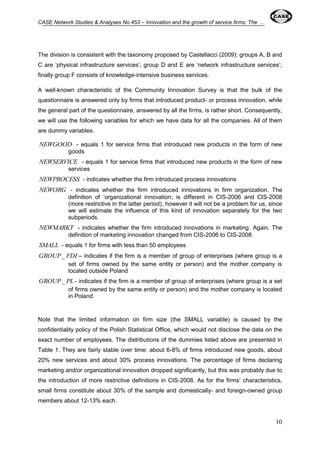
Table 1. They are fairly stable over time: about 6-8% of firms introduced new goods, about 
20% new services and about 30% process innovations. The percentage of firms declaring 
marketing and/or organizational innovation dropped significantly, but this was probably due to 
the introduction of more restrictive definitions in CIS-2008. As for the firms’ characteristics, 
small firms constitute about 30% of the sample and domestically- and foreign-owned group 
members about 12-13% each.
CASE Network Studies & Analyses No.453 – Innovation and the growth of service firms: The ... 
11 
Table 1. The percentage of observations for which the variable is equal 1. 
NEW 
GOOD 
NEW 
SERVICE 
NEW 
PROCESS 
NEWORG 
NEW_ 
MARKT 
SMALL 
GROUP_ 
PL 
GROUP_ 
FDI 
2006* 8.67 22.68 33.08 44.95 31.24 30.88 12.17 13.06 
2008** 6.09 21.56 27.99 27.79 23.34 26.59 12.26 12.26 
* intersection of CIS-2006 and CIS-2008 datasets 
** intersection of CIS-2008 and CIS-2009 datasets 
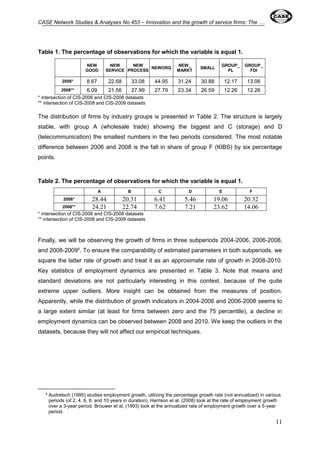
The distribution of firms by industry groups is presented in Table 2. The structure is largely 
stable, with group A (wholesale trade) showing the biggest and C (storage) and D 
(telecommunication) the smallest numbers in the two periods considered. The most notable 
difference between 2006 and 2008 is the fall in share of group F (KIBS) by six percentage 
points. 
Table 2. The percentage of observations for which the variable is equal 1. 
A B C D E F 
2006* 28.44 20.31 6.41 5.46 19.06 20.32 
2008** 24.21 22.74 7.62 7.21 23.62 14.06 
* intersection of CIS-2006 and CIS-2008 datasets 
** intersection of CIS-2008 and CIS-2009 datasets 
Finally, we will be observing the growth of firms in three subperiods 2004-2006, 2006-2008, 
and 2008-20094. To ensure the comparability of estimated parameters in both subperiods, we 
square the latter rate of growth and treat it as an approximate rate of growth in 2008-2010. 
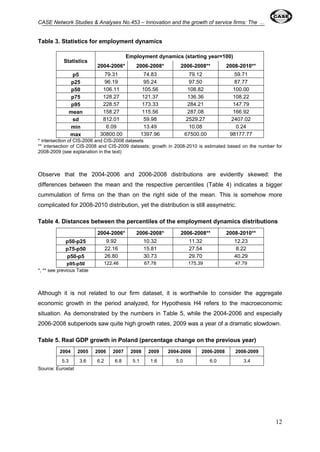
Key statistics of employment dynamics are presented in Table 3. Note that means and 
standard deviations are not particularly interesting in this context, because of the quite 
extreme upper outliers. More insight can be obtained from the measures of position. 
Apparently, while the distribution of growth indicators in 2004-2006 and 2006-2008 seems to 
a large extent similar (at least for firms between zero and the 75 percentile), a decline in 
employment dynamics can be observed between 2008 and 2010. We keep the outliers in the 
datasets, because they will not affect our empirical techniques. 
4 Audretsch (1995) studies employment growth, utilizing the percentage growth rate (not annualized) in various 
periods (of 2, 4, 6, 8, and 10 years in duration). Harrison et al. (2008) look at the rate of employment growth 
over a 3-year period. Brouwer et al. (1993) look at the annualized rate of employment growth over a 5-year 
period.
CASE Network Studies & Analyses No.453 – Innovation and the growth of service firms: The ... 
12 
Table 3. Statistics for employment dynamics 
Statistics 
Employment dynamics (starting year=100) 
2004-2006* 2006-2008* 2006-2008** 2008-2010** 
p5 79.31 74.83 79.12 59.71 
p25 96.19 95.24 97.50 87.77 
p50 106.11 105.56 108.82 100.00 
p75 128.27 121.37 136.36 108.22 
p95 228.57 173.33 284.21 147.79 
mean 158.27 115.56 287.08 166.92 
sd 812.01 59.98 2529.27 2407.02 
min 6.09 13.49 10.08 0.24 
max 30800.00 1397.96 67500.00 98177.77 
* intersection of CIS-2006 and CIS-2008 datasets 
** intersection of CIS-2008 and CIS-2009 datasets; growth in 2008-2010 is estimated based on the number for 
2008-2009 (see explanation in the text) 
Observe that the 2004-2006 and 2006-2008 distributions are evidently skewed: the 
differences between the mean and the respective percentiles (Table 4) indicates a bigger 
cummulation of firms on the than on the right side of the mean. This is somehow more 
complicated for 2008-2010 distribution, yet the distribution is still assymetric. 
Table 4. Distances between the percentiles of the employment dynamics distributions 
2004-2006* 2006-2008* 2006-2008** 2008-2010** 
p50-p25 9.92 10.32 11.32 12.23 
p75-p50 22.16 15.81 27.54 8.22 
p50-p5 26.80 30.73 29.70 40.29 
p95-p50 122.46 67.78 175.39 47.79 
*, ** see previous Table 
Although it is not related to our firm dataset, it is worthwhile to consider the aggregate 
economic growth in the period analyzed, for Hypothesis H4 refers to the macroeconomic 
situation. As demonstrated by the numbers in Table 5, while the 2004-2006 and especially 
2006-2008 subperiods saw quite high growth rates, 2009 was a year of a dramatic slowdown. 
Table 5. Real GDP growth in Poland (percentage change on the previous year) 
2004 2005 2006 2007 2008 2009 2004-2006 2006-2008 2008-2009 
5.3 3.6 6.2 6.8 5.1 1.6 5.0 6.0 3.4 
Source: Eurostat
CASE Network Studies & Analyses No.453 – Innovation and the growth of service firms: The ... 
13 
3.2 Methodology 
Since the distributions of the rates of growth are skewed, the normality assumption of 
standard regression techniques is not met. Consequently we resort to the methodology 
applied in some previous studies of firm growth, i.e. the quantile regression. While the 
estimated parameter of the standard regression of y on x can be interpreted as an effect of 
incremental change in x on the mean of y , the estimate of a quantile regression can be 
thought of as an effect of x on the value of y of the firm which is in the given quantile of the 
distribution of y . In other words, the quantile regression allows for the exogenous variables 
to have a different effects on the endogenous variable, depending on the level of the 
endogenous variable. Indeed, there are reasons to argue that fast growing firms can be 
affected in a specific, and most likely, more positive way by innovation. Thinking along the 
lines of the resource-based-school, it is likely that firms that grow fast, are those that have 
managed to create some unique organizational capabilities. If these capabilities relate to 
learning and managing new projects, or to forming a sound technological base, then such 
firms have a better chance to innovate successfully (cf. Pavitt 1990, Adler and Schenharr 
1990). In particular, the innovations introduced by such firms have a better chance to be 
matched to market needs and organizational practices (Pavitt 2005). 
On the other hand, firms that enjoy high growth might be growing for reasons completely 
unrelated to innovation, such as owners’ strategic decisions or particularly convenient 
developments in firm environment. One can thus argue that the positive effect of innovations 
might be hard to catch empirically for fast growers: it would be more visible for firms for which 
the growth factors unrelated to innovation do not work. 
Another argument refers to the motivation behind the introduction of innovation. For fast 
growing firms, especially the product innovations are likely to reflect firm’s offensive strategy. 
By contrast, for slow growing (or contracting) companies, process innovations may be a way 
of cost cutting and hence result in job losses. 
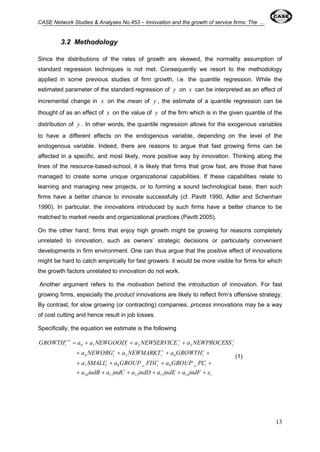
Specifically, the equation we estimate is the following 
     
GROWTH a a NEWGOOD a NEWSERVICE a NEWPROCESS 
0 1 2 3 
    
4 5 6 
    
i 
t 
i 
a NEWORG a NEWMARKT a GROWTH 
t 
i 
t 
i 
t 
i 
t 
i 
t 
i 
t 
i 
t 
i 
t 
i 
t 
i 
a SMALL a GROUP FDI a GROUP PL 
7 8 9 
a indB a indC a indD a indE a indF 
      
10 11 12 13 14 
1 
_ _ 
(1)
CASE Network Studies & Analyses No.453 – Innovation and the growth of service firms: The ... 
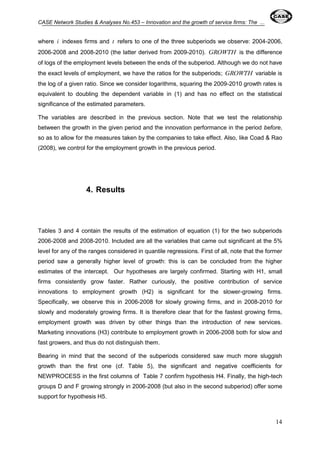
where i indexes firms and t refers to one of the three subperiods we observe: 2004-2006, 
2006-2008 and 2008-2010 (the latter derived from 2009-2010). GROWTH is the difference 
of logs of the employment levels between the ends of the subperiod. Although we do not have 
the exact levels of employment, we have the ratios for the subperiods; GROWTH variable is 
the log of a given ratio. Since we consider logarithms, squaring the 2009-2010 growth rates is 
equivalent to doubling the dependent variable in (1) and has no effect on the statistical 
significance of the estimated parameters. 
The variables are described in the previous section. Note that we test the relationship 
between the growth in the given period and the innovation performance in the period before, 
so as to allow for the measures taken by the companies to take effect. Also, like Coad & Rao 
(2008), we control for the employment growth in the previous period. 
14 
4. Results 
Tables 3 and 4 contain the results of the estimation of equation (1) for the two subperiods 
2006-2008 and 2008-2010. Included are all the variables that came out significant at the 5% 
level for any of the ranges considered in quantile regressions. First of all, note that the former 
period saw a generally higher level of growth: this is can be concluded from the higher 
estimates of the intercept. Our hypotheses are largely confirmed. Starting with H1, small 
firms consistently grow faster. Rather curiously, the positive contribution of service 
innovations to employment growth (H2) is significant for the slower-growing firms. 
Specifically, we observe this in 2006-2008 for slowly growing firms, and in 2008-2010 for 
slowly and moderately growing firms. It is therefore clear that for the fastest growing firms, 
employment growth was driven by other things than the introduction of new services. 
Marketing innovations (H3) contribute to employment growth in 2006-2008 both for slow and 
fast growers, and thus do not distinguish them. 
Bearing in mind that the second of the subperiods considered saw much more sluggish 
growth than the first one (cf. Table 5), the significant and negative coefficients for 
NEWPROCESS in the first columns of Table 7 confirm hypothesis H4. Finally, the high-tech 
groups D and F growing strongly in 2006-2008 (but also in the second subperiod) offer some 
support for hypothesis H5.
CASE Network Studies & Analyses No.453 – Innovation and the growth of service firms: The ... 
15 
Table 6. Results of quantile regression of variable GROWTH [2006-2008] 
p5 p25 p50 p75 p95 
(Intercept) -0.32 *** -0.08264 *** 0.00240 0.12319 *** 0.44629 *** 
GROWTH 
0.03271 0.08409 *** 0.15512 *** 0.23875 *** 0.19132 *** 
[2004-2006] 
NEWSERVICE 0.06204 * 0.01268 0.01392 0.00682 -0.00573 
NEWMARKT 0.05863 ** 0.01590 0.01194 0.04284 ** 0.07026 
SMALL -0.01942 0.06103 *** 0.08886 *** 0.13237 *** 0.27835 *** 
GROUP_FDI 0.04712 * 0.03112 *** 0.01610 0.00216 0.12891 
IND D -0.03977 0.05407 * 0.03842 ** 0.08365 0.14353 
IND F 0.09882 *** 0.05850 *** 0.04408 *** -0.00290 -0.10417 
Note: Numbers of columns are estimated effects of the explanatory variables on the growth of firms for which the 
explained variable is in the range from zero to the respective percentile 
*,**,*** denotes significance at the 1%, 5% and 10% level respectively 
Table 7. Results of quantile regression of variable GROWTH [2008-2010] 
p5 p25 p50 p75 p95 
(Intercept) -0.45092 *** -0.13450 *** -0.02361 *** 0.04806 *** 0.32337 *** 
GROWTH 
-0.14807 0.00248 0.02939 *** 0.13233 *** 0.18829 *** 
[2006-2008] 
NEWSERVICE 0.21322 ** 0.08291 *** 0.01587 *** 0.00014 0.05168 
NEWPROCESS -0.24651 ** -0.04296 ** -0.00457 -0.02288 -0.07849 
SMALL -0.02740 0.00962 0.01783 *** 0.03453 ** 0.12837 ** 
IND D 0.07993 -0.03549 0.00999 0.02085 * 0.04384 
IND F -0.02378 -0.02334 0.00410 0.05447 *** -0.07353 
Note: Numbers of columns are estimated effects of the explanatory variables on the growth of firms for which the 
explained variable is in the range from zero to the respective percentile 
*,**,*** denotes significance at the 1%, 5% and 10% level respectively
CASE Network Studies & Analyses No.453 – Innovation and the growth of service firms: The ... 
16 
5. Conclusions 
Differences in the growth of firms remain a major topic in economics and strategy research. In 
this paper we investigated the link between innovation performance and employment growth. 
First we discussed the problem from the theoretical point of view and argued that several 
models and concepts imply a generally positive link between the two (although the impact of 
process innovation on employment may be ambiguous in short term). Then we analyzed the 
relationship between innovation performance and the dynamics of employment in the Polish 
service firms in 2004-2009. As expected, firms that introduced new services experienced a 
stronger growth. The same applies to marketing innovations which in case of service 
industries can be regarded as complementing new products. Process innovations apparently 
contributed to employment reduction. Tellingly, this effect could only be observed in 2008- 
2009, a subperiod which saw the worst levels of aggregate demand. This conclusion yields 
support to the presumption formulated by Pianta (2005) that the impact of innovation on 
employment growth depends also on the macroeconomic situation.
CASE Network Studies & Analyses No.453 – Innovation and the growth of service firms: The ... 
17 
References 
Audretsch, D. (1995), Innovation, growth and survival. International Journal of Industrial 
Organization, 13(4): 441-457. 
Audretsch, D.B., Klomp, L., Santareli, E., and Thurik, A.R. (2004), Gibrat’s Law: Are the 
Services Different? Review of Industrial Organization, 24(3), 301-324. 
Barney, J.B. (1991), Firm Resources and Sustained Competitive Advantage. Journal of 
Management, 17 (1), 99–120. 
Brouwer, E., Kleinknecht, A., and Reijnen, J.O.N. (1993), Employment Growth and Innovation 
at the Firm Level, Journal of Evolutionary Economics, 3 (2), 153–159. 
Cainelli, G., Evangelista, R., and Savona, M. (2006), Innovation and economic performance 
in services: a firm-level analysis, Cambridge Journal of Economics, 30 (3): 435-458. 
Canals, J. (2001), How to think about corporate growth? European Management Journal, 19 
(6), 587-598. 
Castellacci, F. (2008), Technological paradigms, regimes and trajectories: Manufacturing and 
service industries in a new taxonomy of sectoral patterns of innovation, Research Policy, 
37(10), 978 – 994. 
Coad, A., and Rao, R. (2008), Innovation and firm growth in high-tech sectors: A quantile 
regression approach, Research Policy 37 (4), 633–648. 
Coad, A., and Rao, R. (2010), Firm growth and R&D expenditure, Economics of Innovation 
and New Technology, 19(2), 127-145. 
Conner, K.R. (1991), A Historical Comparison of Resource-Based Theory and Five Schools 
of Thought within Industrial Organization Economics: Do We Have a New Theory of the 
Firm? Journal of Management, 17 (1), 121–154. 
Grant, R.M. (1996), Toward a Knowledge-Based Theory of the Firm, Strategic Management 
Journal, 17 (Winter Special Issue), 109–122.
CASE Network Studies & Analyses No.453 – Innovation and the growth of service firms: The ... 
Hall, B. H., Mairesse, J., and Mohnen, P. (2010), Measuring the returns to R&D, in B.H. Hall 
and N. Rosenberg (eds), Handbook of the Economics of Innovation, volume 2. North- 
Holland: Amsterdam. 
Harrison, R., Jaumandreu, J., Mairesse, J., and Peters, B. (2008), Does innovation stimulate 
employment? A firm-level analysis using comparable micro-data from four European 
countries. NBER Working Paper 14216.National Bureau of Economic Research: 
Cambridge, MA. 
Hutzschenreuter, T. & Horstkotte, J. (2013), Managerial services and complexity in a firm’s 
expansion process: An empirical study of the impact on the growth of the firm, European 
Management Journal 31 (2), 137–151. 
Kanerva, M., Hollanders, H., and Arundel, A. (2006), Can We Measure and Compare 
18 
Innovation in Services? 2006 TrendChart Report. European Commission: Brussels. 
Kogut, B., and Zander, U. (1992), Knowledge of the firm, combinative capabilities, and the 
replication of technology, Organization Science, 3(3), 383-397. 
Leiponen, A. (2012), The benefits of R&D and breadth in innovation strategies: a comparison 
of Finnish service and manufacturing firms, Industrial and Corporate Change, 21(5): 1255- 
1281. 
Lotti, F., Santarelli, E., and Vivarelli, M. (2009), Defending Gibrat’s Law as a long-run 
regularity, Small Business Economics 32 (1), 31–44. 
Macpherson, A. (2005), Learning how to grow: resolving the crisis of knowing, Technovation 
25 (10), 1129–1140. 
Miles, I. (2005), Innovation in Services, in J. Fagerberg, D.C. Mowery, and R.R. Nelson 
(eds), The Oxford Handbook of Innovation, Oxford University Press: Oxford. 
Miles, I. (2007), Research and development (R&D) beyond manufacturing: the strange case 
of services R&D, R&D Management, 37 (3), 249-268. 
Mishina, Y., Pollock, T., Timothy, G., and Porac, J.F. (2004), Are More Resources Always 
Better for Growth? Resource Stickiness in Market and Product Expansion, Strategic 
Management Journal 25 (12), 1179-1197. 
Pavitt, K. (1990), What we know about the strategic management of technology, California 
Management Review, 32(3), 17–26.
CASE Network Studies & Analyses No.453 – Innovation and the growth of service firms: The ... 
Pavitt, K. (1990), Innovation Process, in in J. Fagerberg, D.C. Mowery, and R.R. Nelson 
19 
(eds), The Oxford Handbook of Innovation.Oxford University Press: Oxford. 
Pianta, M. (2006), Innovation and Employment, in J. Fagerberg, D.C. Mowery, and R.R. 
Nelson (eds), The Oxford Handbook of Innovation. Oxford University Press: Oxford. 
Subodh, K. (2002), Market concentration, firm size and innovative activity: A firm-level 
economic analysis of selected Indian industries under economic liberalization, World 
Institute for Development Economics Research, Discussion Paper No. 2002/108, 
November. 
Sutton, J. (1997), Gibrat’s Legacy, Journal of Economic Literature, 35 (1), 40-59. 
Teece, D., Pisano, G., and Shuen, A. (1997), Dynamic capabilities and strategic 
management, Strategic Management Journal, 18 (7), 509–533. 
Utterback, J. M., & Abernathy, W.J. (1975), A Dynamic Model of Product and Process 
Innovation, Omega, 3(6), 639-656. 
Wernerfelt, B. (1984), A resource-based view of the firm, Strategic Management Journal, 
5(2), 171–180.

CASE Network Studies and Analyses 453 - Innovation and the Growth of Service Firms: The Polish Case

  • 1.
    Innovation and the Growth of Service Firms: The Polish Case
  • 2.
    CASE Network Studies& Analyses No.453 – Innovation and the growth of service firms: The ... Materials published here have a working paper character. They can be subject to further publication. The views and opinions expressed here reflect the author(s) point of view and not necessarily those of CASE Network. This report was prepared within a project entitled “The Impact of Service Sector Innovation and Internationalisation on Growth and Productivity” (SERVICEGAP). SERVICEGAP project is funded by the European Commission, Research Directorate General as part of the 7th Framework Programme, Theme 8: Socio-Economic Sciences and Humanities (Grant Agreement no: 244 552). The opinions expressed are those of the authors only and do not represent the European Commission's official position. 1 Keywords: Poland, services, innovation, firm growth, quantile regression JEL Codes: D22, L25, L80, O33 © CASE – Center for Social and Economic Research, Warsaw, 2013 Graphic Design: Agnieszka Natalia Bury EAN 9788371785825 Publisher: CASE-Center for Social and Economic Research on behalf of CASE Network al. Jana Pawla II 61, office 212, 01-031 Warsaw, Poland tel.: (48 22) 206 29 00, 828 61 33, fax: (48 22) 206 29 01 e-mail: case@case-research.eu http://www.case-research.eu
  • 3.
    CASE Network Studies& Analyses No.453 – Innovation and the growth of service firms: The ... 2 Contents Abstract ............................................................................................................ 4 1. Introduction ............................................................................................ 5 2. Innovation and firm growth: a review of theoretical and empirical arguments and hypothesis development ........................................... 6 3. Data, methodology, and variables ........................................................ 9 3.1 Dataset and variables ............................................................................. 9 3.2 Methodology .......................................................................................... 13 4. Results .................................................................................................. 14 5. Conclusions ......................................................................................... 16 References ..................................................................................................... 17
  • 4.
    CASE Network Studies& Analyses No.453 – Innovation and the growth of service firms: The ... Krzysztof Szczygielski obtained his PhD in economics from the Warsaw School of Economics. He has been with CASE since 2001 working on projects on international economics, European integration and innovations. His current research interests include problems of public policy, in particular science, technology and innovation policy. Since 2007 he has been a lecturer at the Lazarski University in Warsaw. In 2009-2010 he was a guest researcher at the TIK Institute at the University of Oslo. In 2010 he was awarded the Ministry of Science and Higher Education scholarship for outstanding young researchers. Wojciech Grabowski graduated from the Warsaw School of Economics and obtained his PhD in economics from the University of Lodz. He is a lecturer at the University of Lodz and at the Lazarski University in Warsaw. He published more than 20 papers in polish and international journals and conference proceedings. His research interests include cointegration analysis, stationarity testing, financial crises modeling and limited-dependent variables models. Richard Woodward is an economist at CASE - the Center for Social and Economic Research - in Warsaw and a lecturer in international business at the University of Edinburgh Business School. He is the author of numerous publications on privatization in post- Communist countries (especially management-employee buyouts) as well as local development and SME support in Poland, and is currently researching the innovation networks of European enterprises. Some of his recent publications include: "Knowledge-intensive entrepreneurship in Central and Eastern Europe: results of a firm-level survey" (with Slavo Radosevic and Maja Savic) in F. Malerba (ed.), Knowledge-Intensive Entrepreneurship and Innovation Systems: Evidence from Europe, London: Routledge, 2010; "Networking and Competitiveness" (with Piotr Wójcik), in I. Hoshi, P.J.J. Welfens, and A. Wziątek-Kubiak (eds.), Industrial Competitiveness and Restructuring in Enlarged Europe: How Accession Countries Catch Up and Integrate in the European Union, New York and Basingstoke: Palgrave Macmillan, 2007, and "The Reform Process in Post-Communist Transition: Understanding Reform in Eastern and Central Europe and the Commonwealth of Independent States" (with Piotr Kozarzewski), in J.M. Fanelli and G. McMahon (eds.), Understanding Market Reforms, Vol. 2: Motivation, Implementation and Sustainability, New York and Basingstoke: Palgrave Macmillan, 2006. 3
  • 5.
    CASE Network Studies& Analyses No.453 – Innovation and the growth of service firms: The ... 4 Abstract Differences in the growth of firms remain a major topic in economics and strategy research. In this paper we investigated the link between innovation performance and employment growth. First we discuss the problem from the theoretical point of view and then we analyze the relationship between innovation performance and the dynamics of employment in the Polish service firms in 2004-2009. Firms that introduced new services or marketing techniques experienced stronger growth. Process innovations contributed to employment reduction. Tellingly, this effect could only be observed in 2008-2009, a subperiod which saw the lowest levels of aggregate demand. This conclusion yields support to the presumption formulated by Pianta (2005) that the impact of innovation on employment growth depends on the macroeconomic situation.
  • 6.
    CASE Network Studies& Analyses No.453 – Innovation and the growth of service firms: The ... 5 1. Introduction The phenomenon of firm growth has attracted the interest of scholars of various social sciences subdisciplines. Researchers in Industrial Organization have investigated the issue, because of its strong connection to the problem of industry structure (Sutton 1997, Lotti et al. 2009). Scholars in management science seek to explain the apparent fondness of managers for pursuing growth strategies (Mishina et al. 2004, Canals 2001) and the conditions for success of this policy (Hutzschenreuter, Horstkotte 2013). On the other hand, the research into the relationship between innovation performance and firm growth seems to be still in an early phase (cf. Macpherson 2005, Coad and Rao 2008). This study attempts to develop further the latter stream of literature. We view firm growth as a measure of performance. In this sense our work complements the rich CDM literature on the innovation-productivity link, called thus in honor of Crépon, Duguet and Mairesse, who developed the approach in their 1998 paper (for a review of the CDM literature, see Hall et al., 2010). While growth is usually not an explicit goal of the firm, and is not always and everywhere the right strategy to pursue, a long-term lack of growth may be a signal of lack of connection to customers and may lead to problems with attracting capital or recruiting new talent (Canals 2001). Our study uses Polish data, and our measure of growth is employment, which makes the paper more relevant from the policy point of view. First, it is important because of the need in emerging markets like Poland for catching up and for the entry and growth of new firms in industries and sometimes whole sectors that are relatively underdeveloped. Second, given that Poland (like all but three of the post-socialist new member states of the European Union) is facing double-digit unemployment, research into factors contributing to employment growth is a matter of some urgency. We analyze the Polish services firms between 2004 and 2009. We have chosen to focus on the service sector because it is by far the largest sector in today’s advanced economies but has traditionally been under-researched, in comparison to manufacturing, in the literature on innovation, and innovation in the sector is relatively poorly understood (Miles, 2007; Leiponen, 2012). Thus, while our primary concern is with the relationship between innovation and firm growth, we also hope to make a contribution to the literature on innovation in the service sector. In particular, the heterogeneity of services, often referred to as an analytical problem (Miles 2005), will actually make it possible to look separately at low- and high-tech industries.
  • 7.
    CASE Network Studies& Analyses No.453 – Innovation and the growth of service firms: The ... The rest of the paper is structured as follows. In section 2 we review theoretical approaches to the link between innovation and firm growth. Section 3 includes the presentations of our dataset and of the methodology adopted, while the empirical results are discussed in section 4. In Section 5 we offer conclusions. 6 2. Innovation and firm growth: a review of theoretical and empirical arguments and hypothesis development In neo-classical economics, the chief reference for studies of firm growth is Gibrat’s Law (cf. the review by Sutton 1997, also Lotti et al. 2009). The law states that the firm’s rate of growth is independent of its initial size, and numerous models in Industrial Organization have been formulated in a way consistent with that hypothesis. One of the arguments made by some of these models’ authors is that if firm growth is due to new market opportunities and if the probability of catching an emerging opportunity is proportional to firm size, then Gibrat’s Law will hold. (It is interesting to note that if firm growth is dependent on taking advantage of new market opportunities, then, by implication, it is possible only if the firm makes innovation efforts.) Another conclusion from the IO literature is that Gibrat’s Law is unlikely to be confirmed unless firm exits are observed and controlled for. Smaller firms are, ceteris paribus, more likely to disappear from the market than bigger ones, so those small firms that survive show an over-average growth. By implication, if one only observes the same cohort of firms over years, then the small ones are likely to excel in growth. Several empirical studies confirm this regularity (e.g. Lotti et al. 2009). Audretsch et al. (2004) note that empirical results contradicting Gibrat’s Law have generally been found in manufacturing and large-scale services such as banking and insurance, and ask whether the case of small-scale services might be different. They find that for Dutch hospitality service firms, Gibrat’s Law is confirmed, suggesting that for at least part of the service sector the dynamics affecting growth are different from those elsewhere in the economy. In strategic management, the resource-based school argues that the firm is successful if it is able of creating and sustaining some unique capabilities, i.e. resources and competences that the competitors find hard to imitate. The resource-based view of the firm begins with Edith Penrose’s Theory of the Growth of the Firm (1959) and was further developed by numerous contributions, including Wernerfelt (1984), Barney (1991), Conner (1991), and Teece et al.
  • 8.
    CASE Network Studies& Analyses No.453 – Innovation and the growth of service firms: The ... (1997) and extended by the knowledge-based theory of the firm (Kogut and Zander 1992; Grant 1996). Its essence is that a firm’s competitive advantage is based on its intangible resources – primarily capabilities, especially those related to learning and innovation. There is a large theoretical literature, most of it deriving from Schumpeter, on the relationship between technological innovation and firm size. According to the two main theories, either growth of the firm results from successful technological innovations, which allow it to acquire market share (i.e., innovation precedes, and causes, growth), or innovation is a very costly and capital-intensive process which larger firms are better able to afford (i.e., growth precedes an increase in innovativeness or R&D intensity). In either case, there should be a positive relationship between size and (successful) technological innovation. However, the empirical evidence for such a relationship between size and innovativeness or R&D intensity is not convincing (see the review of the relevant literature in Subodh 2002). Two of the earliest empirical pieces on the link between innovation and firm growth (using employment growth as their growth measure) are (Brouwer et al. 1993) and Audretsch (1995). The former study found a generally insignificant effect of innovation-related variables on employment growth in Dutch manufacturing during the 1980s; the only significant effect was that of the growth in R&D intensity, and this effect was negative. Audretsch (who was more interested in firm survival than firm growth, though his study deals with both) found growth and innovation to be positively related, with growth rates differing across industries and tending to be higher in more innovative industries. Later studies have contributed more theoretical understanding to the issue. In a review of the literature on innovation and employment, Pianta (2006) contrasts the theoretical approaches of Keynesians, who see innovation as opening up investment opportunities and therefore leading to employment expansion, and (neo-)Schumpeterians, who see it as leading to the more complex process of creative destruction. A more detailed exploration of these conflicting tendencies began with the literature on the distinction between product and process innovation. With regard to product innovation, Utterback and Abernathy (1975) argued that a high rate of product innovation would tend to be found in young firms, which are in their rapid growth phase. We would thus expect the relationship between product innovation and firm growth to be positive (although the direction of causality may not be clear), whereas process innovation (in particular automation) is often seen as leading to employment reductions. Further exploring the relationship between process innovation and growth, Harrison et al. (2008) argue that the effect of process innovation is theoretically ambiguous, depending on the net effect of two factors, the displacement effect (in which process innovation displaces labor by increasing productivity – the destructive element of creative destruction), and the compensation effect (in which cost reductions resulting from process innovation result in price 7
  • 9.
    CASE Network Studies& Analyses No.453 – Innovation and the growth of service firms: The ... reductions, which stimulate demand, leading to increased employment – the creative element). Examining empirical evidence, they find that employment is positively affected by innovation, particularly product innovation, with compensation effects being quite significant (they characterize the employment effects of process innovations as negligible). They also find that these effects are weaker in the service sector (employment growth is stronger in services than in manufacturing, but the proportion of it resulting from product – or rather service – innovation is lower), but there is no evidence for displacement effects resulting from process innovation. The empirical studies of firm-level panel data reviewed by Pianta (2006) have varying results, although there is a tendency for product innovation to be associated with better employment results than process innovation. (The employment effect of organizational innovation remains largely unresearched.)1 Another important observation by Pianta is that ‘aggregate demand and macroeconomic conditions are important’ (p. 590). Although he does not refer explicitly to process innovations, they are more likely to be job-reducing 8 in the short term if the aggregate demand is stagnant or shrinking. The study by Cainelli et al. (2006), which, like ours, is based on CIS data (from Italy), looked at sales growth rather than employment growth. They found an endogenous relationship, with sales growth in the past leading to greater innovation in the present, and also found that it was process innovation, but not product innovations2, that was thus positively affected by prior sales growth. They also found that while innovation positively affected productivity, there was no effect on sales growth. Further confirming the endogeneity of the relationship, Coad and Rao (2010) find a positive but weak effect of R&D spending on subsequent growth of sales and employment, but a strong positive effect of sales and employment growth on R&D spending. It is worth remembering that notions such as product and process innovations have a specific meaning in the context of service industries. Services are usually intangible and often produced in an interaction with the client. Consequently marketing innovations of service firms may have a similar nature as product innovations in manufacturing firms. Empirical evidence confirms that marketing and organization innovations are particularly often stressed by service firms (cf. the review by Kanerva et al 2006). Based on the literature reviewed we can formulate the following hypotheses about the firms we observe: H1: Small firms are likely to grow at a faster pace H2: Firms that introduce product innovations are likely to grow faster 1 However, as Pianta notes, the net effects of innovation will be visible not at the firm level, but at the industry level, as benefits observed at the firm level may be achieved at the cost of competitors. 2 In this case: the introduction of new services.
  • 10.
    CASE Network Studies& Analyses No.453 – Innovation and the growth of service firms: The ... 9 H3: The same applies to firms involved in marketing innovations H4: The effect of process innovations can be ambiguous. They are more likely to result in employment reduction in the time of sluggish growth than in the time of boom Finally, bearing in mind that we are investigating developments in a catching-up country, we have to take into account the structural change that is taking place in the Polish economy: increasing the average level of skills and the capital endowment due to FDI and accumulation3. Consequently: H5: Firms active in more skill-intensive sectors, such as ICT and finances, are likely to grow at a faster pace than firms in less skill-intensive industries. 3. Data, methodology, and variables 3.1 Dataset and variables We use the data on service firms from the 2006, 2008 and 2009 runs of the Community Innovation Survey. In the part of the Polish CIS dedicated to the services sector the coverage is approximately 25% of the population. There are 3879 observations for CIS 2006, 4256 for CIS 2008 and 4262 for CIS 2009. For the reasons specified in the next section, we compare the innovation performance in the period preceding the dates between which the change in employment is observed. As a result we are particularly interested in the intersection of the datasets: CIS 2006 and 2008 (1684 observations) and 2008 and 2009 (1665 observations). The scope of CIS implies that 40 NACE-Rev-2 service industries are represented (out of 103 3-digit industries in the NACE classification) representing the following broad sectors: wholesale trade, transport and storage, ICT, financial and insurance services, and some other industries (incl. consulting). For practical reasons we divide the industries into six groups: indA Wholesale trade (46) indB Transport and post (49, 50, 51, 53) indC Storage (52) indD Telecommunication and simple ICT, e.g. web-hosting (61, 63, 581) indE Finance and insurance (64, 65, 66) indF Knowledge-intensive business services (62, 71, 581) 3 Average growth GDP growth in 1992-2011 in Poland was 4.45% vs 2.08% unweighted OECD average (in 1990- 1992 Poland was in a recession related to the shock market-oriented reforms). The enrollment rate in tertiary education increased from 21.7% in 1991 to 72.4% in 2010, according to World Bank (however at least a part of this growth came at the expense of lowering the quality of education).
  • 11.
    CASE Network Studies& Analyses No.453 – Innovation and the growth of service firms: The ... The division is consistent with the taxonomy proposed by Castellacci (2009): groups A, B and C are ‘physical infrastructure services’; group D and E are ‘network infrastructure services’; finally group F consists of knowledge-intensive business services. A well-known characteristic of the Community Innovation Survey is that the bulk of the questionnaire is answered only by firms that introduced product- or process innovation, while the general part of the questionnaire, answered by all the firms, is rather short. Consequently, we will use the following variables for which we have data for all the companies. All of them are dummy variables. NEWGOOD - equals 1 for service firms that introduced new products in the form of new 10 goods NEWSERVICE - equals 1 for service firms that introduced new products in the form of new services NEWPROCESS - indicates whether the firm introduced process innovations NEWORG - indicates whether the firm introduced innovations in firm organization. The definition of ‘organizational innovation; is different in CIS-2006 and CIS-2008 (more restrictive in the latter period), however it will not be a problem for us, since we will estimate the influence of this kind of innovation separately for the two subperiods. NEWMARKT - indicates whether the firm introduced innovations in marketing. Again. The definition of marketing innovation changed from CIS-2006 to CIS-2008 SMALL - equals 1 for firms with less than 50 employees GROUP_ FDI – indicates if the firm is a member of group of enterprises (where group is a set of firms owned by the same entity or person) and the mother company is located outside Poland GROUP_ PL - indicates if the firm is a member of group of enterprises (where group is a set of firms owned by the same entity or person) and the mother company is located in Poland Note that the limited information on firm size (the SMALL variable) is caused by the confidentiality policy of the Polish Statistical Office, which would not disclose the data on the exact number of employees. The distributions of the dummies listed above are presented in Table 1. They are fairly stable over time: about 6-8% of firms introduced new goods, about 20% new services and about 30% process innovations. The percentage of firms declaring marketing and/or organizational innovation dropped significantly, but this was probably due to the introduction of more restrictive definitions in CIS-2008. As for the firms’ characteristics, small firms constitute about 30% of the sample and domestically- and foreign-owned group members about 12-13% each.
  • 12.
    CASE Network Studies& Analyses No.453 – Innovation and the growth of service firms: The ... 11 Table 1. The percentage of observations for which the variable is equal 1. NEW GOOD NEW SERVICE NEW PROCESS NEWORG NEW_ MARKT SMALL GROUP_ PL GROUP_ FDI 2006* 8.67 22.68 33.08 44.95 31.24 30.88 12.17 13.06 2008** 6.09 21.56 27.99 27.79 23.34 26.59 12.26 12.26 * intersection of CIS-2006 and CIS-2008 datasets ** intersection of CIS-2008 and CIS-2009 datasets The distribution of firms by industry groups is presented in Table 2. The structure is largely stable, with group A (wholesale trade) showing the biggest and C (storage) and D (telecommunication) the smallest numbers in the two periods considered. The most notable difference between 2006 and 2008 is the fall in share of group F (KIBS) by six percentage points. Table 2. The percentage of observations for which the variable is equal 1. A B C D E F 2006* 28.44 20.31 6.41 5.46 19.06 20.32 2008** 24.21 22.74 7.62 7.21 23.62 14.06 * intersection of CIS-2006 and CIS-2008 datasets ** intersection of CIS-2008 and CIS-2009 datasets Finally, we will be observing the growth of firms in three subperiods 2004-2006, 2006-2008, and 2008-20094. To ensure the comparability of estimated parameters in both subperiods, we square the latter rate of growth and treat it as an approximate rate of growth in 2008-2010. Key statistics of employment dynamics are presented in Table 3. Note that means and standard deviations are not particularly interesting in this context, because of the quite extreme upper outliers. More insight can be obtained from the measures of position. Apparently, while the distribution of growth indicators in 2004-2006 and 2006-2008 seems to a large extent similar (at least for firms between zero and the 75 percentile), a decline in employment dynamics can be observed between 2008 and 2010. We keep the outliers in the datasets, because they will not affect our empirical techniques. 4 Audretsch (1995) studies employment growth, utilizing the percentage growth rate (not annualized) in various periods (of 2, 4, 6, 8, and 10 years in duration). Harrison et al. (2008) look at the rate of employment growth over a 3-year period. Brouwer et al. (1993) look at the annualized rate of employment growth over a 5-year period.
  • 13.
    CASE Network Studies& Analyses No.453 – Innovation and the growth of service firms: The ... 12 Table 3. Statistics for employment dynamics Statistics Employment dynamics (starting year=100) 2004-2006* 2006-2008* 2006-2008** 2008-2010** p5 79.31 74.83 79.12 59.71 p25 96.19 95.24 97.50 87.77 p50 106.11 105.56 108.82 100.00 p75 128.27 121.37 136.36 108.22 p95 228.57 173.33 284.21 147.79 mean 158.27 115.56 287.08 166.92 sd 812.01 59.98 2529.27 2407.02 min 6.09 13.49 10.08 0.24 max 30800.00 1397.96 67500.00 98177.77 * intersection of CIS-2006 and CIS-2008 datasets ** intersection of CIS-2008 and CIS-2009 datasets; growth in 2008-2010 is estimated based on the number for 2008-2009 (see explanation in the text) Observe that the 2004-2006 and 2006-2008 distributions are evidently skewed: the differences between the mean and the respective percentiles (Table 4) indicates a bigger cummulation of firms on the than on the right side of the mean. This is somehow more complicated for 2008-2010 distribution, yet the distribution is still assymetric. Table 4. Distances between the percentiles of the employment dynamics distributions 2004-2006* 2006-2008* 2006-2008** 2008-2010** p50-p25 9.92 10.32 11.32 12.23 p75-p50 22.16 15.81 27.54 8.22 p50-p5 26.80 30.73 29.70 40.29 p95-p50 122.46 67.78 175.39 47.79 *, ** see previous Table Although it is not related to our firm dataset, it is worthwhile to consider the aggregate economic growth in the period analyzed, for Hypothesis H4 refers to the macroeconomic situation. As demonstrated by the numbers in Table 5, while the 2004-2006 and especially 2006-2008 subperiods saw quite high growth rates, 2009 was a year of a dramatic slowdown. Table 5. Real GDP growth in Poland (percentage change on the previous year) 2004 2005 2006 2007 2008 2009 2004-2006 2006-2008 2008-2009 5.3 3.6 6.2 6.8 5.1 1.6 5.0 6.0 3.4 Source: Eurostat
  • 14.
    CASE Network Studies& Analyses No.453 – Innovation and the growth of service firms: The ... 13 3.2 Methodology Since the distributions of the rates of growth are skewed, the normality assumption of standard regression techniques is not met. Consequently we resort to the methodology applied in some previous studies of firm growth, i.e. the quantile regression. While the estimated parameter of the standard regression of y on x can be interpreted as an effect of incremental change in x on the mean of y , the estimate of a quantile regression can be thought of as an effect of x on the value of y of the firm which is in the given quantile of the distribution of y . In other words, the quantile regression allows for the exogenous variables to have a different effects on the endogenous variable, depending on the level of the endogenous variable. Indeed, there are reasons to argue that fast growing firms can be affected in a specific, and most likely, more positive way by innovation. Thinking along the lines of the resource-based-school, it is likely that firms that grow fast, are those that have managed to create some unique organizational capabilities. If these capabilities relate to learning and managing new projects, or to forming a sound technological base, then such firms have a better chance to innovate successfully (cf. Pavitt 1990, Adler and Schenharr 1990). In particular, the innovations introduced by such firms have a better chance to be matched to market needs and organizational practices (Pavitt 2005). On the other hand, firms that enjoy high growth might be growing for reasons completely unrelated to innovation, such as owners’ strategic decisions or particularly convenient developments in firm environment. One can thus argue that the positive effect of innovations might be hard to catch empirically for fast growers: it would be more visible for firms for which the growth factors unrelated to innovation do not work. Another argument refers to the motivation behind the introduction of innovation. For fast growing firms, especially the product innovations are likely to reflect firm’s offensive strategy. By contrast, for slow growing (or contracting) companies, process innovations may be a way of cost cutting and hence result in job losses. Specifically, the equation we estimate is the following      GROWTH a a NEWGOOD a NEWSERVICE a NEWPROCESS 0 1 2 3     4 5 6     i t i a NEWORG a NEWMARKT a GROWTH t i t i t i t i t i t i t i t i t i a SMALL a GROUP FDI a GROUP PL 7 8 9 a indB a indC a indD a indE a indF       10 11 12 13 14 1 _ _ (1)
  • 15.
    CASE Network Studies& Analyses No.453 – Innovation and the growth of service firms: The ... where i indexes firms and t refers to one of the three subperiods we observe: 2004-2006, 2006-2008 and 2008-2010 (the latter derived from 2009-2010). GROWTH is the difference of logs of the employment levels between the ends of the subperiod. Although we do not have the exact levels of employment, we have the ratios for the subperiods; GROWTH variable is the log of a given ratio. Since we consider logarithms, squaring the 2009-2010 growth rates is equivalent to doubling the dependent variable in (1) and has no effect on the statistical significance of the estimated parameters. The variables are described in the previous section. Note that we test the relationship between the growth in the given period and the innovation performance in the period before, so as to allow for the measures taken by the companies to take effect. Also, like Coad & Rao (2008), we control for the employment growth in the previous period. 14 4. Results Tables 3 and 4 contain the results of the estimation of equation (1) for the two subperiods 2006-2008 and 2008-2010. Included are all the variables that came out significant at the 5% level for any of the ranges considered in quantile regressions. First of all, note that the former period saw a generally higher level of growth: this is can be concluded from the higher estimates of the intercept. Our hypotheses are largely confirmed. Starting with H1, small firms consistently grow faster. Rather curiously, the positive contribution of service innovations to employment growth (H2) is significant for the slower-growing firms. Specifically, we observe this in 2006-2008 for slowly growing firms, and in 2008-2010 for slowly and moderately growing firms. It is therefore clear that for the fastest growing firms, employment growth was driven by other things than the introduction of new services. Marketing innovations (H3) contribute to employment growth in 2006-2008 both for slow and fast growers, and thus do not distinguish them. Bearing in mind that the second of the subperiods considered saw much more sluggish growth than the first one (cf. Table 5), the significant and negative coefficients for NEWPROCESS in the first columns of Table 7 confirm hypothesis H4. Finally, the high-tech groups D and F growing strongly in 2006-2008 (but also in the second subperiod) offer some support for hypothesis H5.
  • 16.
    CASE Network Studies& Analyses No.453 – Innovation and the growth of service firms: The ... 15 Table 6. Results of quantile regression of variable GROWTH [2006-2008] p5 p25 p50 p75 p95 (Intercept) -0.32 *** -0.08264 *** 0.00240 0.12319 *** 0.44629 *** GROWTH 0.03271 0.08409 *** 0.15512 *** 0.23875 *** 0.19132 *** [2004-2006] NEWSERVICE 0.06204 * 0.01268 0.01392 0.00682 -0.00573 NEWMARKT 0.05863 ** 0.01590 0.01194 0.04284 ** 0.07026 SMALL -0.01942 0.06103 *** 0.08886 *** 0.13237 *** 0.27835 *** GROUP_FDI 0.04712 * 0.03112 *** 0.01610 0.00216 0.12891 IND D -0.03977 0.05407 * 0.03842 ** 0.08365 0.14353 IND F 0.09882 *** 0.05850 *** 0.04408 *** -0.00290 -0.10417 Note: Numbers of columns are estimated effects of the explanatory variables on the growth of firms for which the explained variable is in the range from zero to the respective percentile *,**,*** denotes significance at the 1%, 5% and 10% level respectively Table 7. Results of quantile regression of variable GROWTH [2008-2010] p5 p25 p50 p75 p95 (Intercept) -0.45092 *** -0.13450 *** -0.02361 *** 0.04806 *** 0.32337 *** GROWTH -0.14807 0.00248 0.02939 *** 0.13233 *** 0.18829 *** [2006-2008] NEWSERVICE 0.21322 ** 0.08291 *** 0.01587 *** 0.00014 0.05168 NEWPROCESS -0.24651 ** -0.04296 ** -0.00457 -0.02288 -0.07849 SMALL -0.02740 0.00962 0.01783 *** 0.03453 ** 0.12837 ** IND D 0.07993 -0.03549 0.00999 0.02085 * 0.04384 IND F -0.02378 -0.02334 0.00410 0.05447 *** -0.07353 Note: Numbers of columns are estimated effects of the explanatory variables on the growth of firms for which the explained variable is in the range from zero to the respective percentile *,**,*** denotes significance at the 1%, 5% and 10% level respectively
  • 17.
    CASE Network Studies& Analyses No.453 – Innovation and the growth of service firms: The ... 16 5. Conclusions Differences in the growth of firms remain a major topic in economics and strategy research. In this paper we investigated the link between innovation performance and employment growth. First we discussed the problem from the theoretical point of view and argued that several models and concepts imply a generally positive link between the two (although the impact of process innovation on employment may be ambiguous in short term). Then we analyzed the relationship between innovation performance and the dynamics of employment in the Polish service firms in 2004-2009. As expected, firms that introduced new services experienced a stronger growth. The same applies to marketing innovations which in case of service industries can be regarded as complementing new products. Process innovations apparently contributed to employment reduction. Tellingly, this effect could only be observed in 2008- 2009, a subperiod which saw the worst levels of aggregate demand. This conclusion yields support to the presumption formulated by Pianta (2005) that the impact of innovation on employment growth depends also on the macroeconomic situation.
  • 18.
    CASE Network Studies& Analyses No.453 – Innovation and the growth of service firms: The ... 17 References Audretsch, D. (1995), Innovation, growth and survival. International Journal of Industrial Organization, 13(4): 441-457. Audretsch, D.B., Klomp, L., Santareli, E., and Thurik, A.R. (2004), Gibrat’s Law: Are the Services Different? Review of Industrial Organization, 24(3), 301-324. Barney, J.B. (1991), Firm Resources and Sustained Competitive Advantage. Journal of Management, 17 (1), 99–120. Brouwer, E., Kleinknecht, A., and Reijnen, J.O.N. (1993), Employment Growth and Innovation at the Firm Level, Journal of Evolutionary Economics, 3 (2), 153–159. Cainelli, G., Evangelista, R., and Savona, M. (2006), Innovation and economic performance in services: a firm-level analysis, Cambridge Journal of Economics, 30 (3): 435-458. Canals, J. (2001), How to think about corporate growth? European Management Journal, 19 (6), 587-598. Castellacci, F. (2008), Technological paradigms, regimes and trajectories: Manufacturing and service industries in a new taxonomy of sectoral patterns of innovation, Research Policy, 37(10), 978 – 994. Coad, A., and Rao, R. (2008), Innovation and firm growth in high-tech sectors: A quantile regression approach, Research Policy 37 (4), 633–648. Coad, A., and Rao, R. (2010), Firm growth and R&D expenditure, Economics of Innovation and New Technology, 19(2), 127-145. Conner, K.R. (1991), A Historical Comparison of Resource-Based Theory and Five Schools of Thought within Industrial Organization Economics: Do We Have a New Theory of the Firm? Journal of Management, 17 (1), 121–154. Grant, R.M. (1996), Toward a Knowledge-Based Theory of the Firm, Strategic Management Journal, 17 (Winter Special Issue), 109–122.
  • 19.
    CASE Network Studies& Analyses No.453 – Innovation and the growth of service firms: The ... Hall, B. H., Mairesse, J., and Mohnen, P. (2010), Measuring the returns to R&D, in B.H. Hall and N. Rosenberg (eds), Handbook of the Economics of Innovation, volume 2. North- Holland: Amsterdam. Harrison, R., Jaumandreu, J., Mairesse, J., and Peters, B. (2008), Does innovation stimulate employment? A firm-level analysis using comparable micro-data from four European countries. NBER Working Paper 14216.National Bureau of Economic Research: Cambridge, MA. Hutzschenreuter, T. & Horstkotte, J. (2013), Managerial services and complexity in a firm’s expansion process: An empirical study of the impact on the growth of the firm, European Management Journal 31 (2), 137–151. Kanerva, M., Hollanders, H., and Arundel, A. (2006), Can We Measure and Compare 18 Innovation in Services? 2006 TrendChart Report. European Commission: Brussels. Kogut, B., and Zander, U. (1992), Knowledge of the firm, combinative capabilities, and the replication of technology, Organization Science, 3(3), 383-397. Leiponen, A. (2012), The benefits of R&D and breadth in innovation strategies: a comparison of Finnish service and manufacturing firms, Industrial and Corporate Change, 21(5): 1255- 1281. Lotti, F., Santarelli, E., and Vivarelli, M. (2009), Defending Gibrat’s Law as a long-run regularity, Small Business Economics 32 (1), 31–44. Macpherson, A. (2005), Learning how to grow: resolving the crisis of knowing, Technovation 25 (10), 1129–1140. Miles, I. (2005), Innovation in Services, in J. Fagerberg, D.C. Mowery, and R.R. Nelson (eds), The Oxford Handbook of Innovation, Oxford University Press: Oxford. Miles, I. (2007), Research and development (R&D) beyond manufacturing: the strange case of services R&D, R&D Management, 37 (3), 249-268. Mishina, Y., Pollock, T., Timothy, G., and Porac, J.F. (2004), Are More Resources Always Better for Growth? Resource Stickiness in Market and Product Expansion, Strategic Management Journal 25 (12), 1179-1197. Pavitt, K. (1990), What we know about the strategic management of technology, California Management Review, 32(3), 17–26.
  • 20.
    CASE Network Studies& Analyses No.453 – Innovation and the growth of service firms: The ... Pavitt, K. (1990), Innovation Process, in in J. Fagerberg, D.C. Mowery, and R.R. Nelson 19 (eds), The Oxford Handbook of Innovation.Oxford University Press: Oxford. Pianta, M. (2006), Innovation and Employment, in J. Fagerberg, D.C. Mowery, and R.R. Nelson (eds), The Oxford Handbook of Innovation. Oxford University Press: Oxford. Subodh, K. (2002), Market concentration, firm size and innovative activity: A firm-level economic analysis of selected Indian industries under economic liberalization, World Institute for Development Economics Research, Discussion Paper No. 2002/108, November. Sutton, J. (1997), Gibrat’s Legacy, Journal of Economic Literature, 35 (1), 40-59. Teece, D., Pisano, G., and Shuen, A. (1997), Dynamic capabilities and strategic management, Strategic Management Journal, 18 (7), 509–533. Utterback, J. M., & Abernathy, W.J. (1975), A Dynamic Model of Product and Process Innovation, Omega, 3(6), 639-656. Wernerfelt, B. (1984), A resource-based view of the firm, Strategic Management Journal, 5(2), 171–180.