Assessing the available and accessible evidence:
How personal reputations are determined
and managed online
by Frances VC Ryan
Presentation delivered at the
Information: Interactions and Impact (i³) Conference
24th June 2015, Aberdeen, Scotland
Co-authors: Professor Hazel Hall, Alistair Lawson, and Peter Cruickshank
f.ryan@napier.ac.uk | @cleverfrances | www.JustAPhD.com
1
Let’s chat about …
 Overview
 Domains of study
 Key terms
 Key themes
 Evidence
 The gaps
 Research questions
 Next steps
1 2
What’s it all about?
How online information contributes to the building and assessment
of personal reputations
 How people manage their own personal reputations through their use
of online information
 The means by which people evaluate the personal reputations of
others from the online evidence available to them
– Personal reputation: Private individuals, rather than corporate identity and brand
1 2 3
Where’s the literature found?
(Almost) Everywhere!
 Information science
 Computing
 Employment research
 Human-computer interaction
 Human resources management
 Information systems
 Management and organisational studies
 Marketing
 Media and communication studies
 Physical and mental health
1 2 3 4
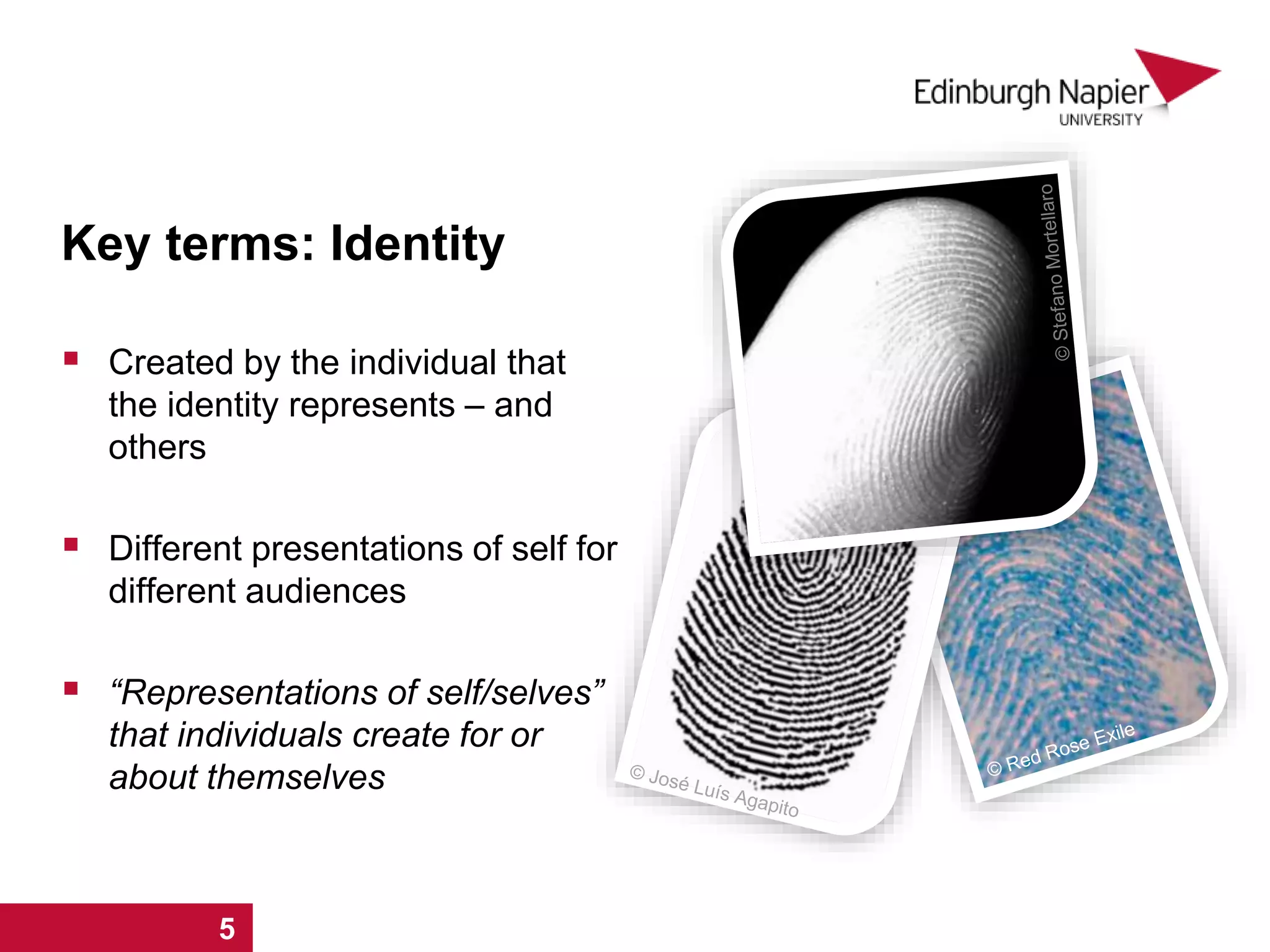
 Created by the individual that
the identity represents – and
others
 Different presentations of self for
different audiences
 “Representations of self/selves”
that individuals create for or
about themselves
Key terms: Identity
1 2 3 4 5
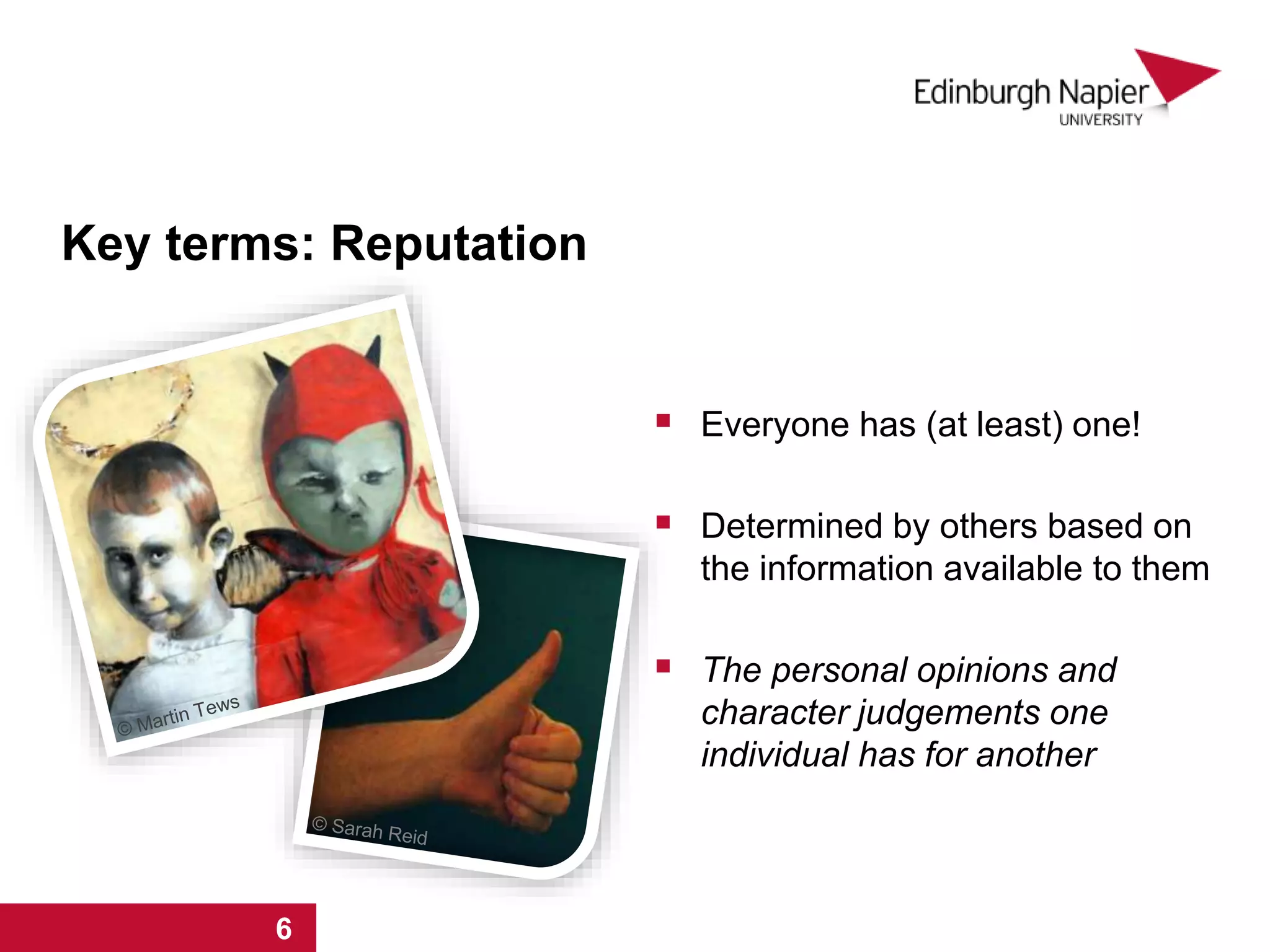
Key terms: Reputation
 Everyone has (at least) one!
 Determined by others based on
the information available to them
 The personal opinions and
character judgements one
individual has for another
1 2 3 4 5 6
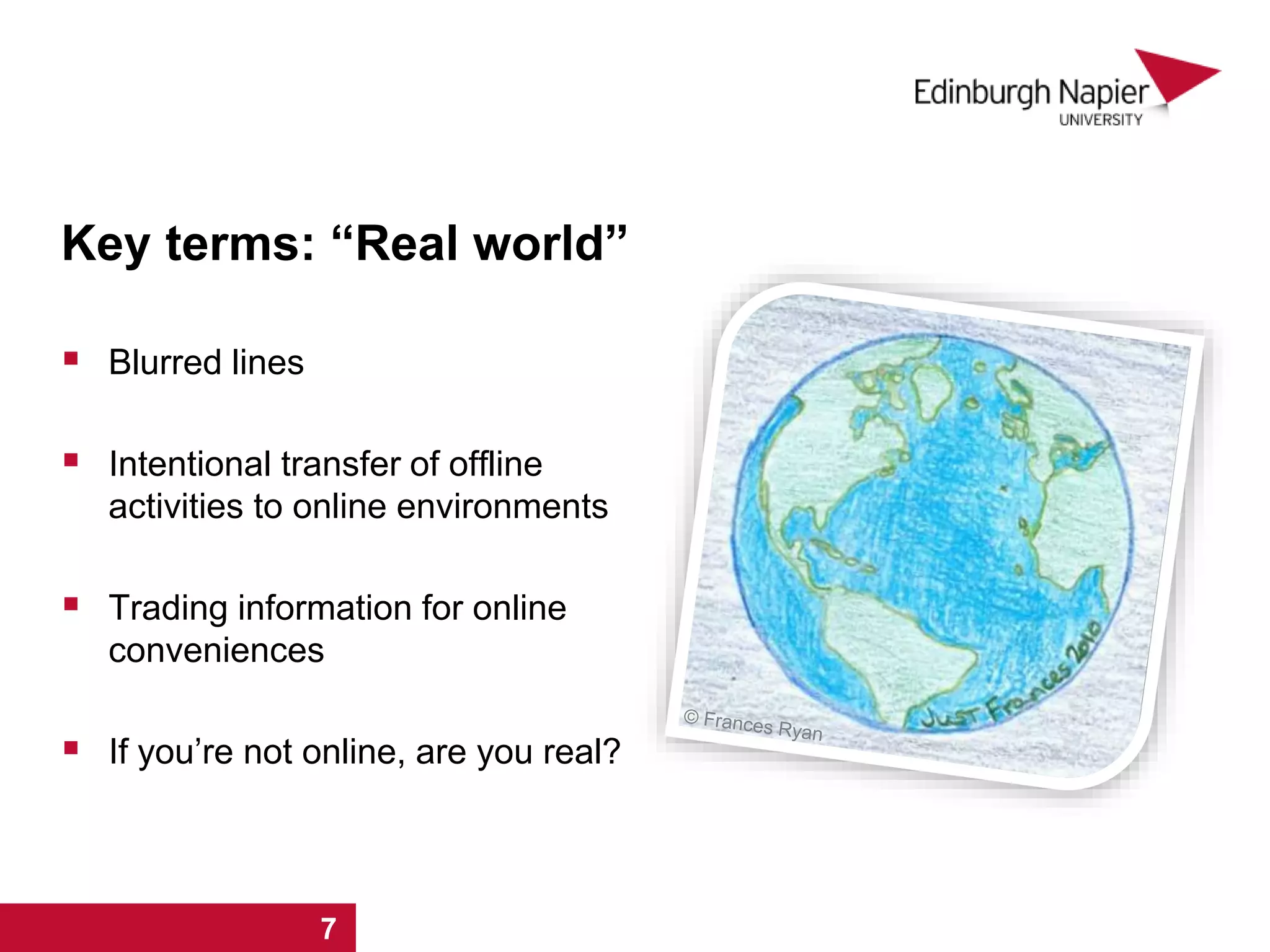
Key terms: “Real world”
 Blurred lines
 Intentional transfer of offline
activities to online environments
 Trading information for online
conveniences
 If you’re not online, are you real?
1 2 3 4 5 6 7
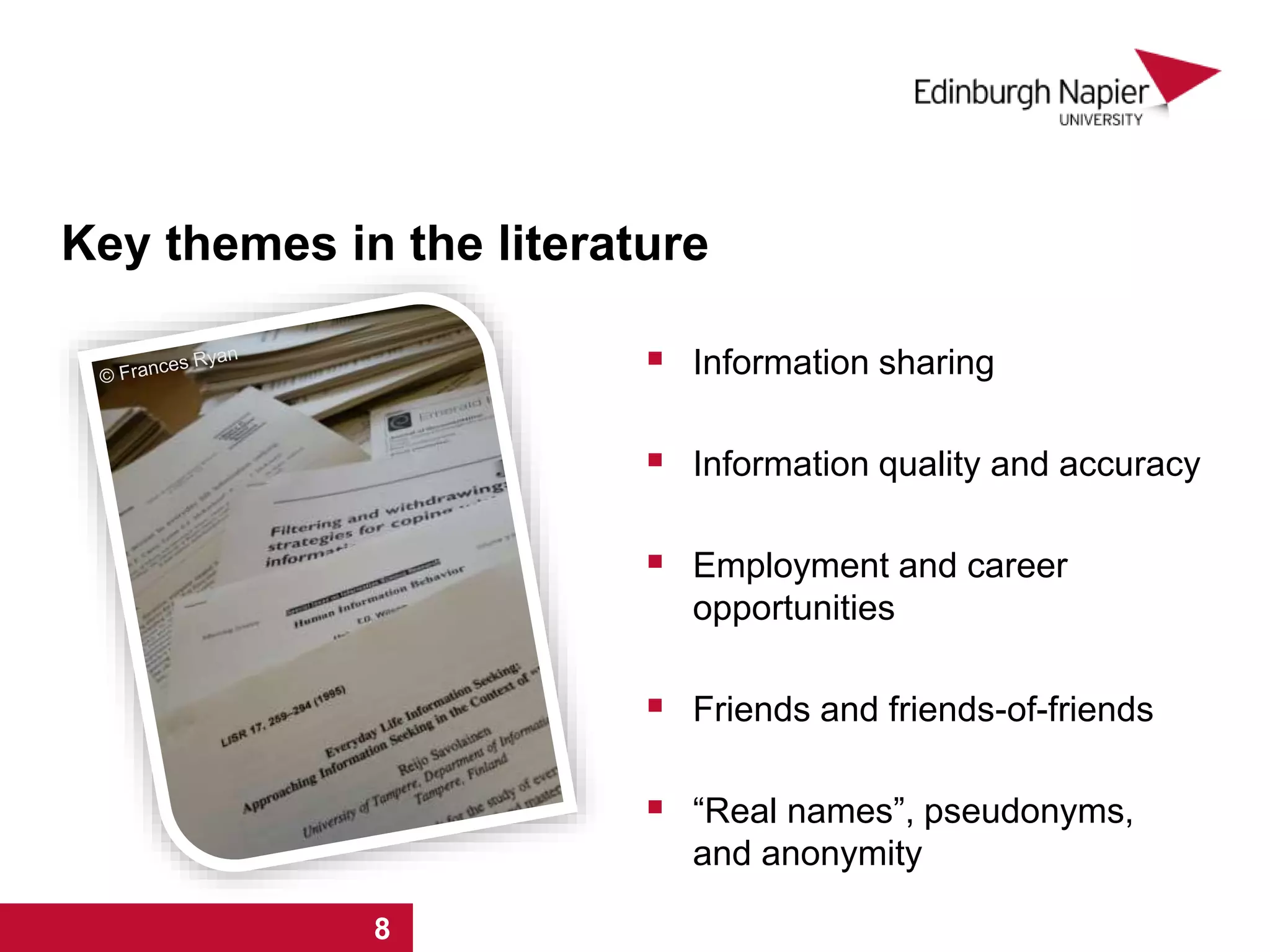
Key themes in the literature
 Information sharing
 Information quality and accuracy
 Employment and career
opportunities
 Friends and friends-of-friends
 “Real names”, pseudonyms,
and anonymity
1 2 3 4 5 6 7 8
What does the literature tell us?
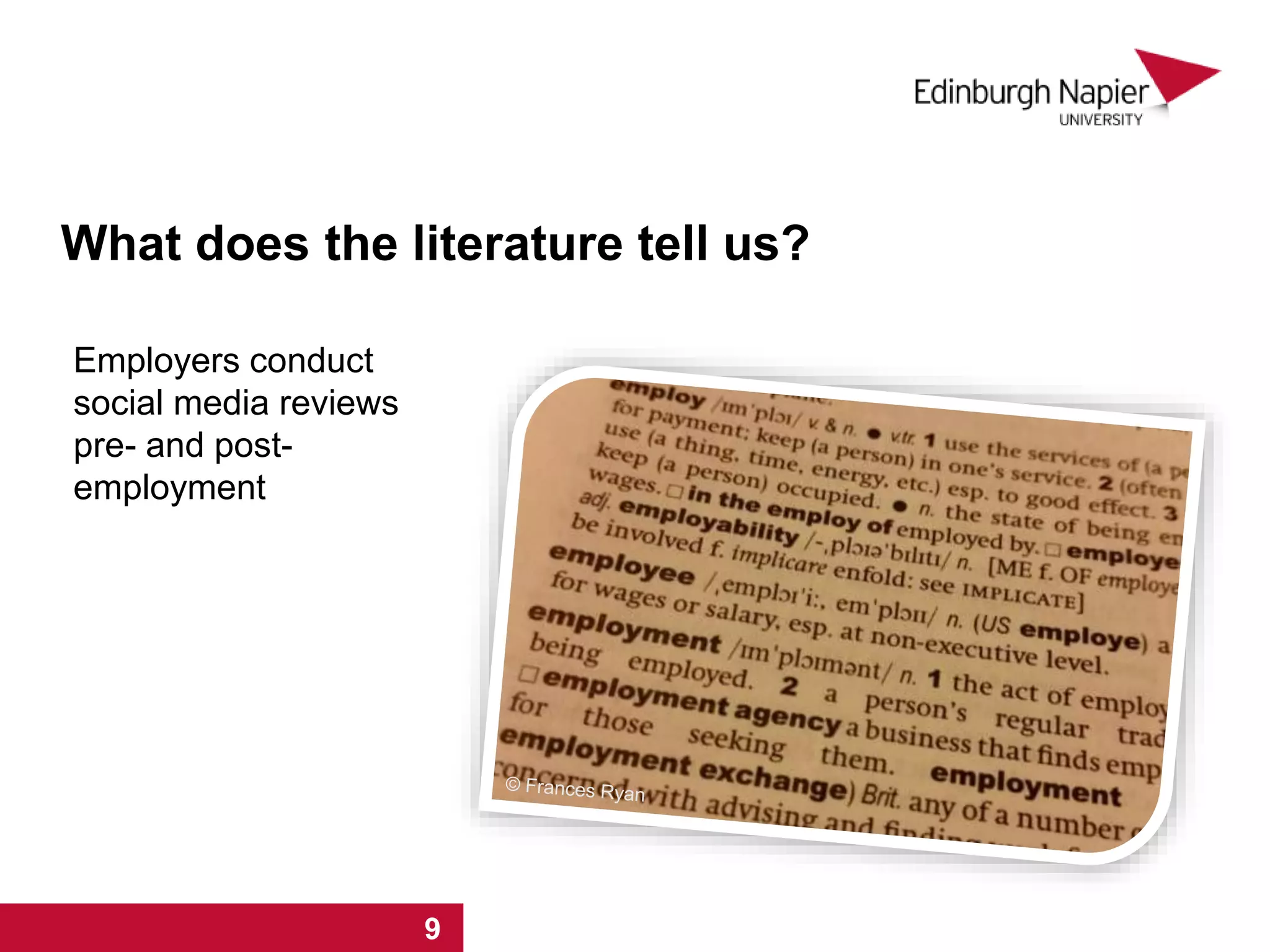
Employers conduct
social media reviews
pre- and post-
employment
1 2 3 4 5 6 7 8 9
What does the literature tell us?
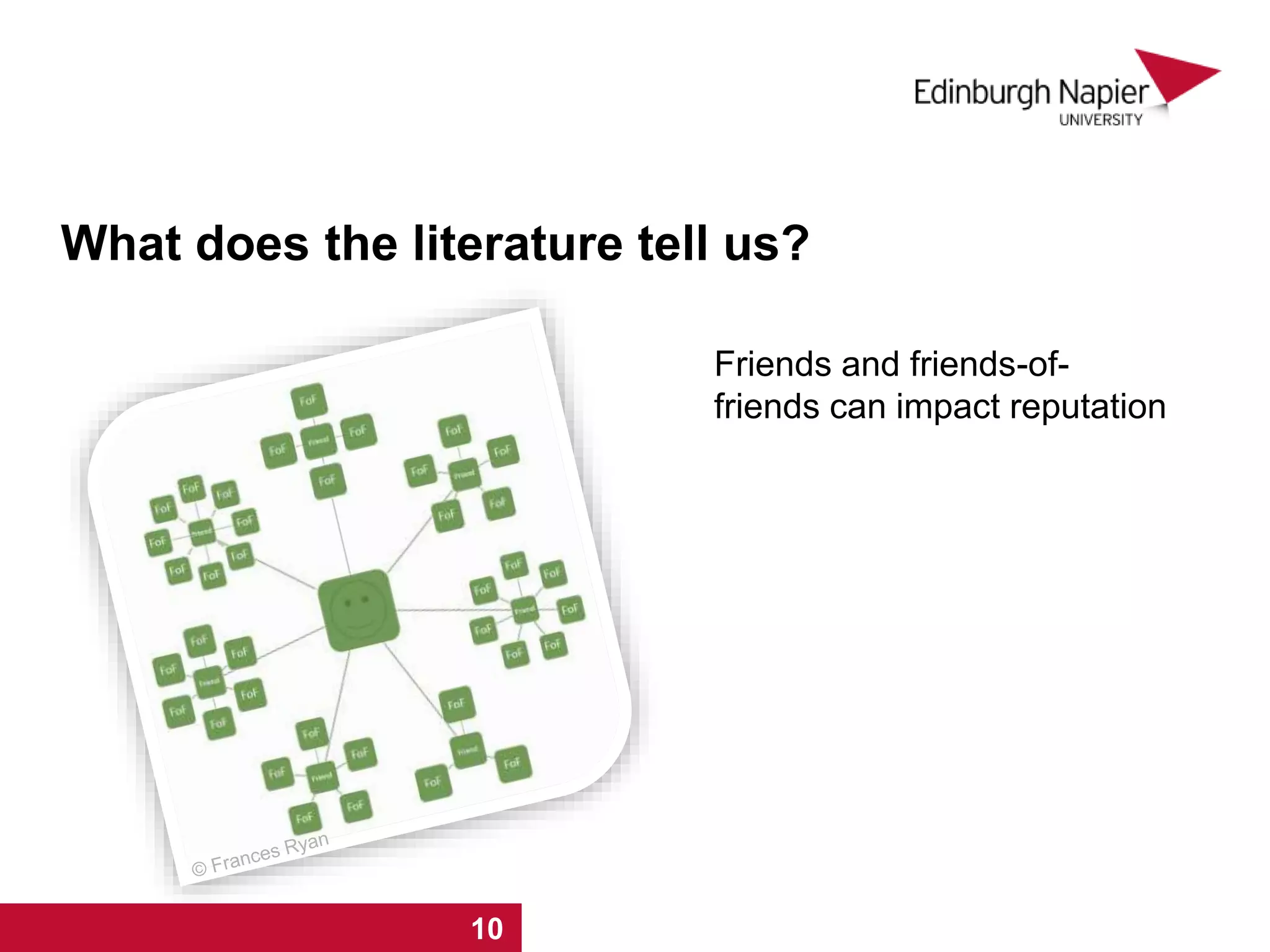
Friends and friends-of-
friends can impact reputation
1 2 3 4 5 6 7 8 9 10
What does the literature tell us?
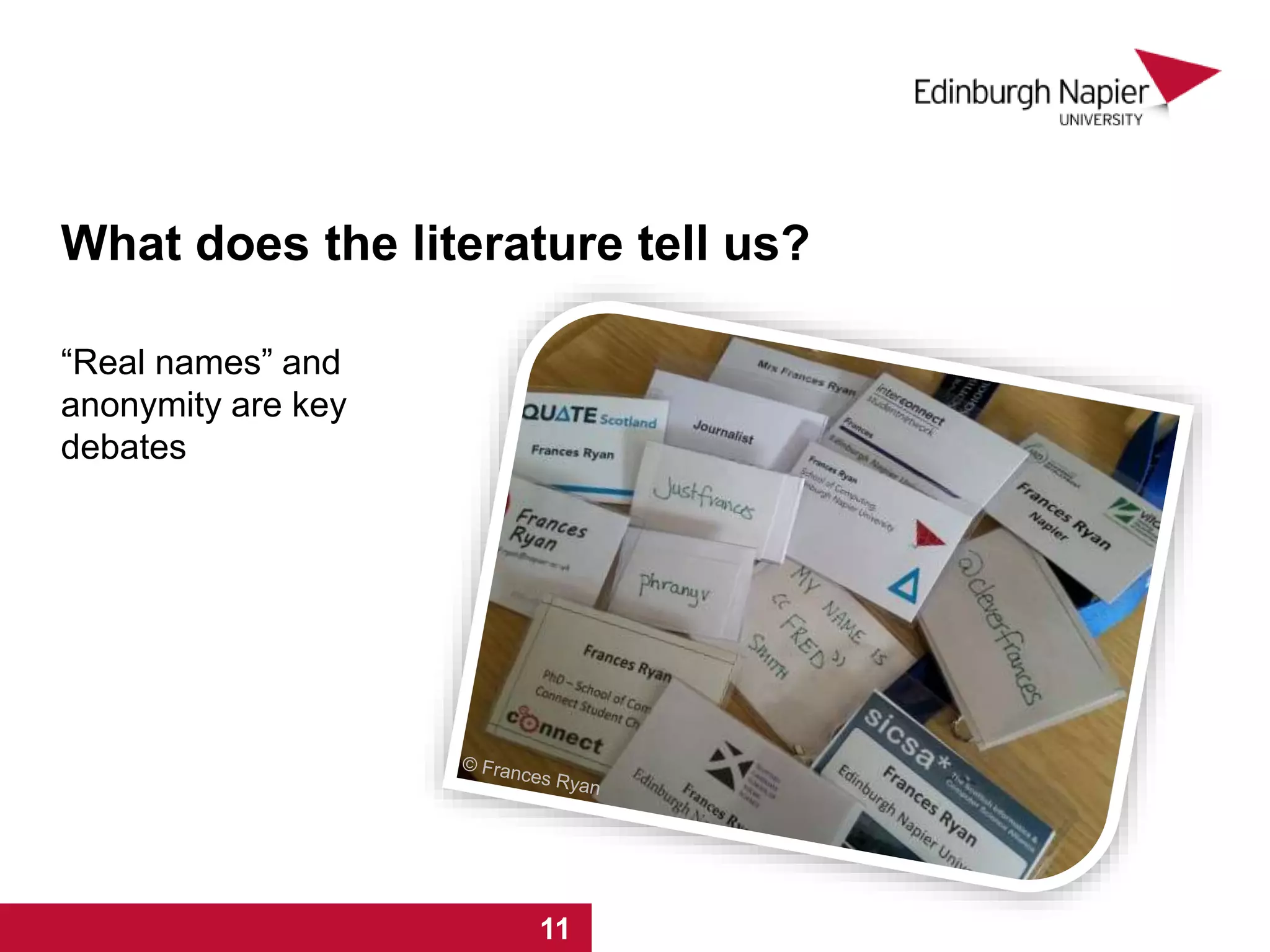
“Real names” and
anonymity are key
debates
1 2 3 4 5 6 7 8 9 10 11
1 2 3 4 5 6 7 8 9 10 11 12
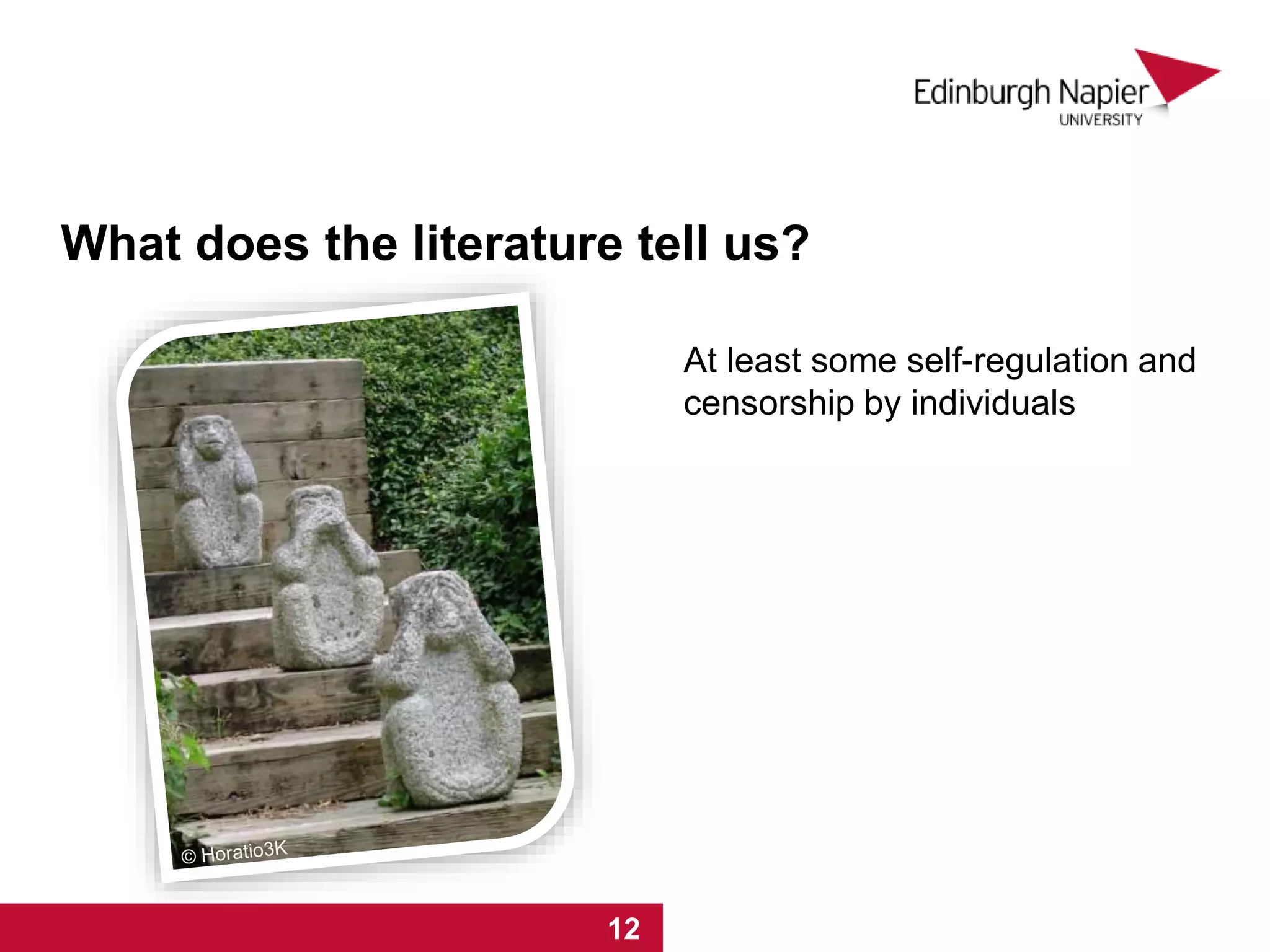
At least some self-regulation and
censorship by individuals
What does the literature tell us?
Mind the gap! (1)
 To what extent are individuals evaluating the reputations of others
based on the information found about them online?
 What processes do individuals follow to identify and collect online
information about others?
 How is online information about individuals rated, assessed, or
validated for the purposes of reputation evaluation?
 To what extent does the quality of information collected impact the
determination of individuals’ reputations?
1 2 3 4 5 6 7 8 9 10 11 12 13
Mind the gap! (2)
 How do individuals manage online information regarding their combined
professional and private reputations?
 How do individuals manage their online and offline reputations as one
“real world” reputation?
 To what extent do individuals feel more or less free or restricted
because of the blurred lines between their online and offline worlds?
 To what extent do individuals actively monitor their online footprints for
the purpose of reputation management? If so, how and to what extent?
1 2 3 4 5 6 7 8 9 10 11 12 13 14
1 2 3 4 5 6 7 8 9 10 11 12 13 14 15
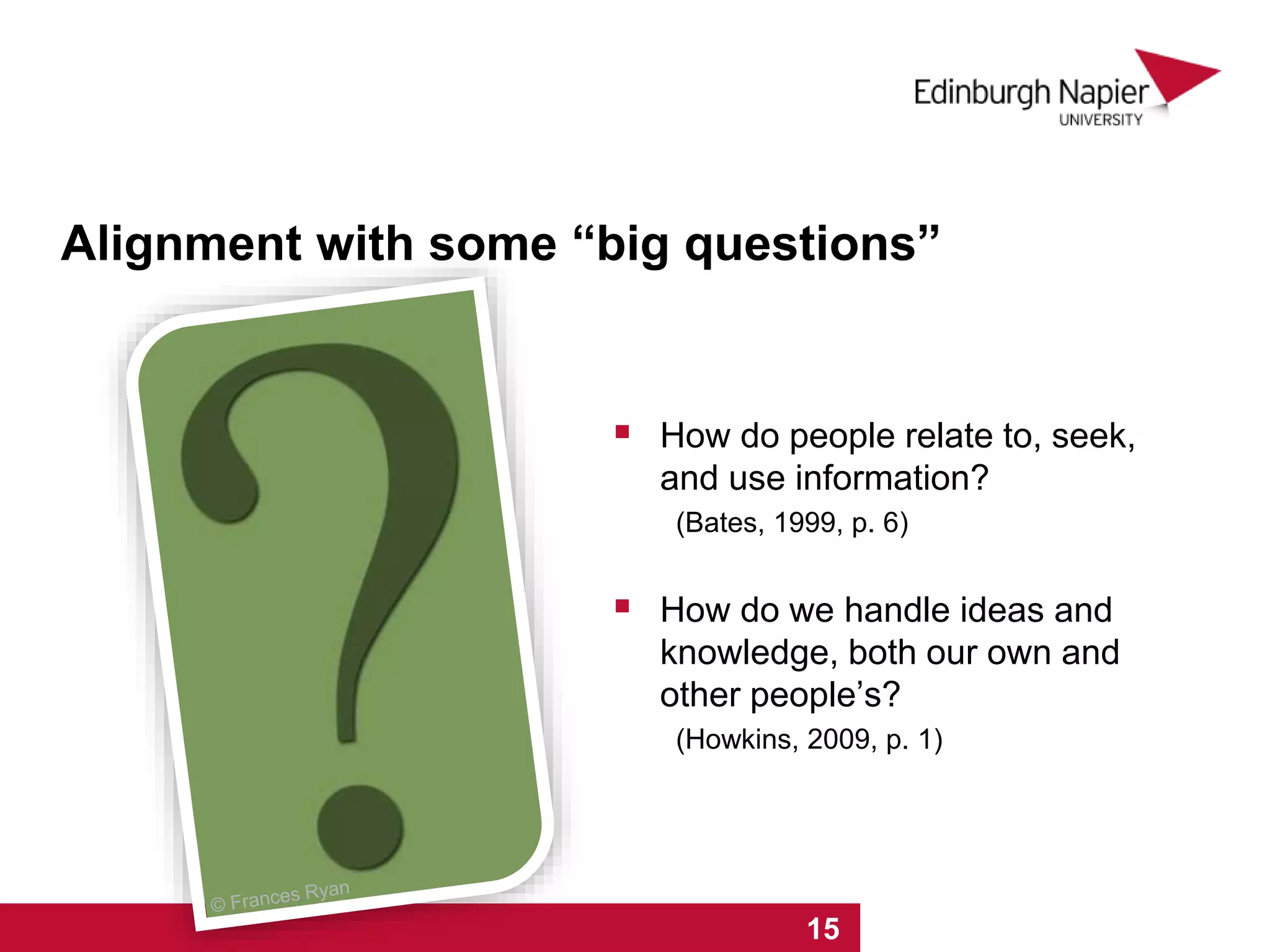
 How do people relate to, seek,
and use information?
(Bates, 1999, p. 6)
 How do we handle ideas and
knowledge, both our own and
other people’s?
(Howkins, 2009, p. 1)
Alignment with some “big questions”
The research questions
 How do individuals build identities for themselves online?
 How do individuals use online information to build and manage their
reputations?
 How do individuals asses the identities and reputations of others
based on the information available to them online?
 To what extent are individuals actively practicing identity and
reputation building and assessment online?
1 2 3 4 5 6 7 8 9 10 11 12 13 14 15 16
Next steps
 Pilot study being designed
 Scope and test possible
approaches for main study
 Largely qualitative work
 Preliminary results expected
by end of summer
1 2 3 4 5 6 7 8 9 10 11 12 13 14 15 16 17
Let’s chat about …
 Sample for main study
 Potential secondary methods
of investigation
 Other thoughts on the literature
or doctoral investigation
1 2 3 4 5 6 7 8 9 10 11 12 13 14 15 16 17 18
Indicative bibliography
1 2 3 4 5 6 7 8 9 10 11 12 13 14 15 16 17 18 19
Ausloos, J. (2012). The “Right to be forgotten”: Worth remembering? Computer Law & Security Review, 28(2), 143–152.
doi:10.1016/j.clsr.2012.01.006
Bates, M. J. (1999). The invisible substrate of information science. Journal of the American Society for Information
Science, 50(12), 1043–1050. doi:10.1002/(SICI)1097-4571(1999)50:12<1043::AID-ASI1>3.3.CO;2-O
Cronin, B. & Askins, H.B. (2000). The web of knowledge: a festschrift in honor of Eugene Garfield. Medford, NJ:
Information Today
Duguay, S. (2014). “He has a way gayer Facebook than I do”: Investigating sexual identity disclosure and context collapse
on a social networking site. New Media & Society, 1–17. doi:10.1177/1461444814549930
Fieseler, C., Meckel, M., & Ranzini, G. (2014). Professional personae: How organizational identification shapes online
identity in the workplace. Journal of Computer-Mediated Communication, 1–18. doi:10.1111/jcc4.12103
Finocchiaro, G. & Ricci, A. (2013). Quality of information, the right to oblivion, and digital reputation. In B. Custers, T.
Calders, B. Schermer, & T. Zarsky (Eds.), Discrimination and Privacy in the Information Society (Vol. 3, pp. 289–299).
Berlin, Heidelberg: Springer Berlin Heidelberg. doi:10.1007/978-3-642-30487-3
Greidanus, E. & Everall, R. D. (2010). Helper therapy in an online suicide prevention community. British Journal of
Guidance & Counselling, 38(2), 191–204. doi:10.1080/03069881003600991
Howkins, J. (2009). Creative ecologies: Where thinking is a proper job. St Lucia, Queensland: University of Queensland
Press.
Kluemper, D. H. & Rosen, P. A. (2009). Future employment selection methods: Evaluating social networking web sites.
Journal of Managerial Psychology, 24(6), 567–580. doi:10.1108/02683940910974134
Lingel, J. & boyd, d. (2013). “Keep it secret, keep it safe”: Information poverty, information norms, and stigma. Journal of
the American Society for Information Science and Technology, 64(5), 981–991. doi:10.1002/asi.22800
Madera, J. M. (2012). Using social networking websites as a selection tool: The role of selection process fairness and job
pursuit intentions. International Journal of Hospitality Management, 31(4), 1276–1282. doi:10.1016/j.ijhm.2012.03.008
Mesch, G. S. & Beker, G. (2010). Are norms of disclosure of online and offline personal information associated with the
disclosure of personal information online? Human Communication Research, 36(4), 570–592. doi:10.1111/j.1468-
2958.2010.01389.x
Ollier-Malaterre, A., Rothbard, N. P., & Berg, J. M. (2013). When worlds collide in cyberspace: How boundary work in
online social networks impacts professional relationships. Academy of Management Review, 38(4), 645–669.
doi:10.5465/amr.2011.0235
Savolainen, R. (2008). Everyday information practices: a social phenomenological perspective. Lanham, MD: Scarecrow
Press.
Uski, S. & Lampinen, A. (2014). Social norms and self-presentation on social network sites: Profile work in action. New
Media & Society, 1–18. doi:10.1177/1461444814543164
Vaast, E. (2007). Playing with masks: Fragmentation and continuity in the presentation of self in an occupational online
forum. Information Technology & People, 20(4), 334–351. doi:10.1108/09593840710839789
Van Dijck, J. (2013). “You have one identity”: Performing the self on Facebook and LinkedIn. Media, Culture & Society,
35(2), 199–215. doi:10.1177/0163443712468605
Copyright attributions
Slides 2 & 18: Creative commons copyright Andy Wright (www.flickr.com/rightee)
Slide 4: Creative commons copyright GotCredit (www.flickr.com/jakerust)
Slide 5: Creative commons copyright (1) José Luís Agapito (www.flickr.com/blvesboy); (2) Red Rose Exile
(www.flickr.com/redroseexile); (3) Stefano Mortellaro (www.flickr.com/fazen)
Slide 6: Creative commons copyright (1) Martin Tews (www.flickr.com/airpark); (2) Sarah Reid (www.flickr.com/sarahreido)
Slide 10: Creative commons copyright Horatio3K (www.flickr.com/horatio3k)
All other images copyright Frances VC Ryan
1 2 3 4 5 6 7 8 9 10 11 12 13 14 15 16 17 18 19 20
Indicative bibliography (cont.)
Thank you!
f.ryan@napier.ac.uk
@cleverfrances
www.JustAPhD.com
Slides available at: www.slideshare.net/justfrances