ONLINE PRIVACY LIS 768 – Fall 2009 How and why we should teach the risks and tools associated with online privacy and social networking By: Julia Bryan-Diehl Mike Hominick Dan Mauller Leslie Westerberg
Presentation In this presentation, we will discuss: The history of privacy and online social networking Perceptions of privacy Privacy risks and consequences Tools for teaching privacy
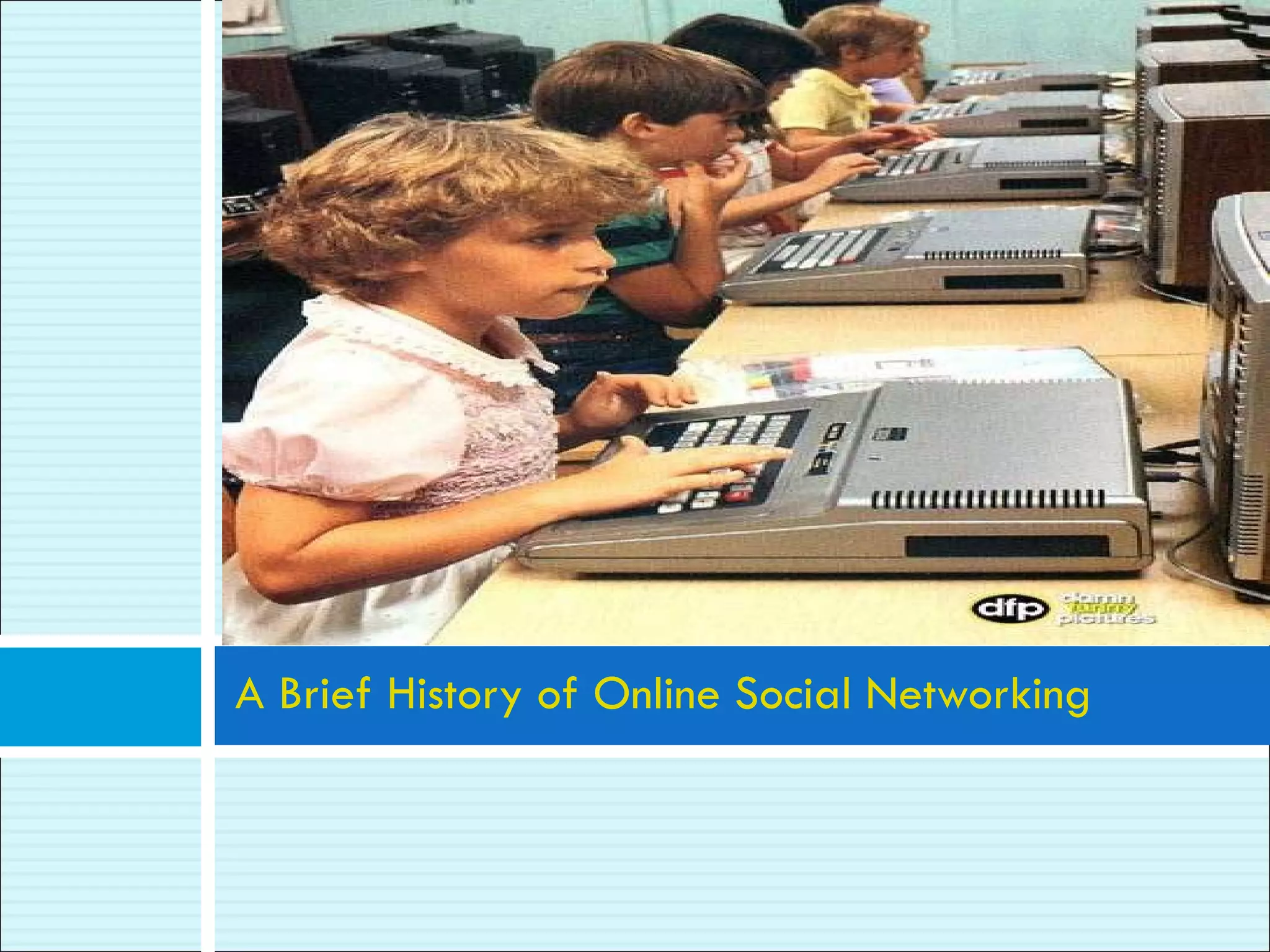
A Brief History of Online Social Networking
What is Online Social Networking? Construct a public or semi-public profile within a bounded system Articulate a list of other users with whom they share a connection View and traverse their list of connections and those made by others within the system. The nature and nomenclature of these connections may vary from site to site
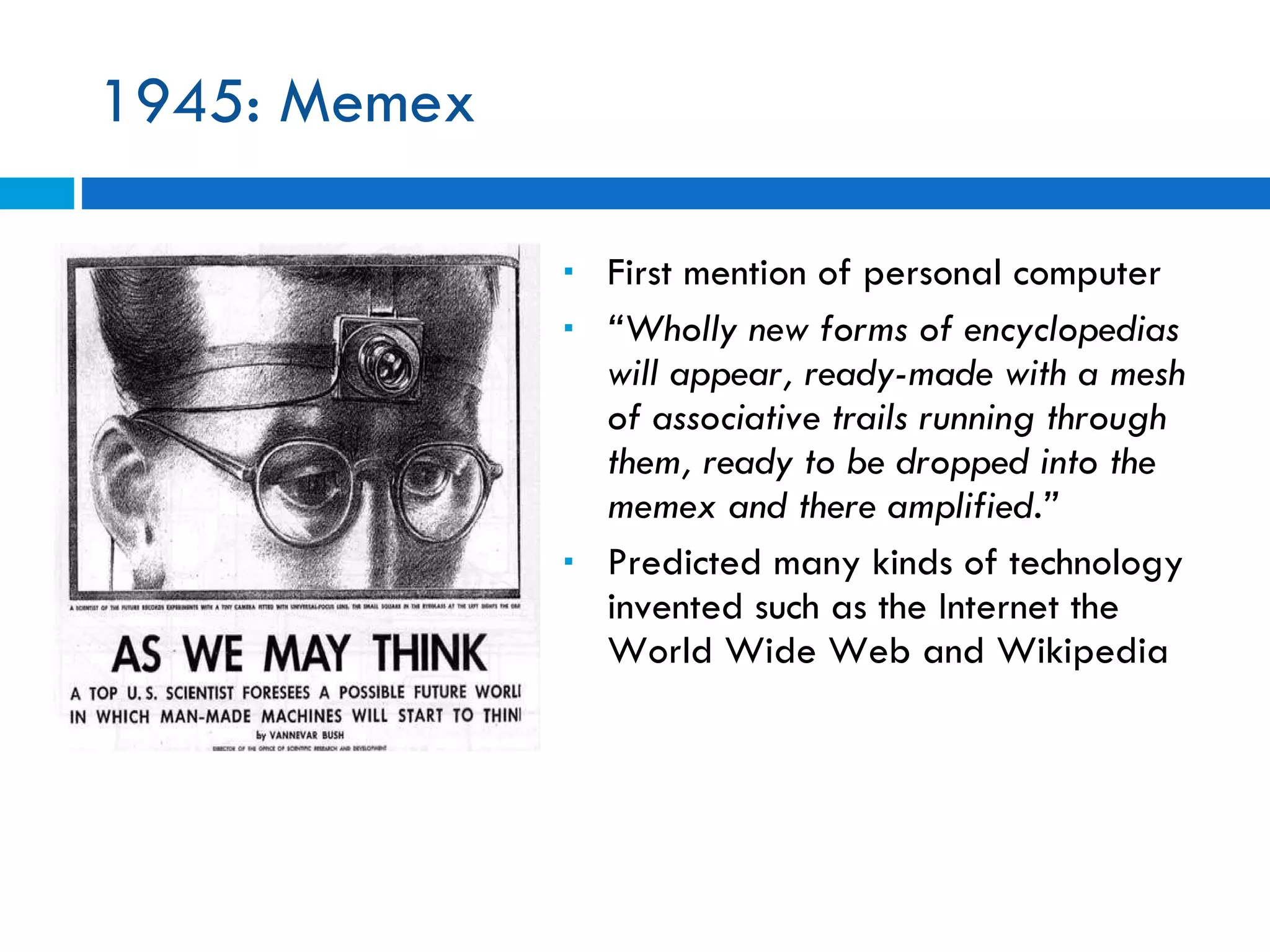
1945: Memex First mention of personal computer “ Wholly new forms of encyclopedias will appear, ready-made with a mesh of associative trails running through them, ready to be dropped into the memex and there amplified.”  Predicted many kinds of technology invented such as the Internet the World Wide Web and Wikipedia
1962: Advanced Research Project Agency Resulted in the creation of commercial time-sharing systems Ultimately led to the internet “ There has to be some way of facilitating communication among people without bringing them together in one place.” - Dr. J.C.R.  Licklider
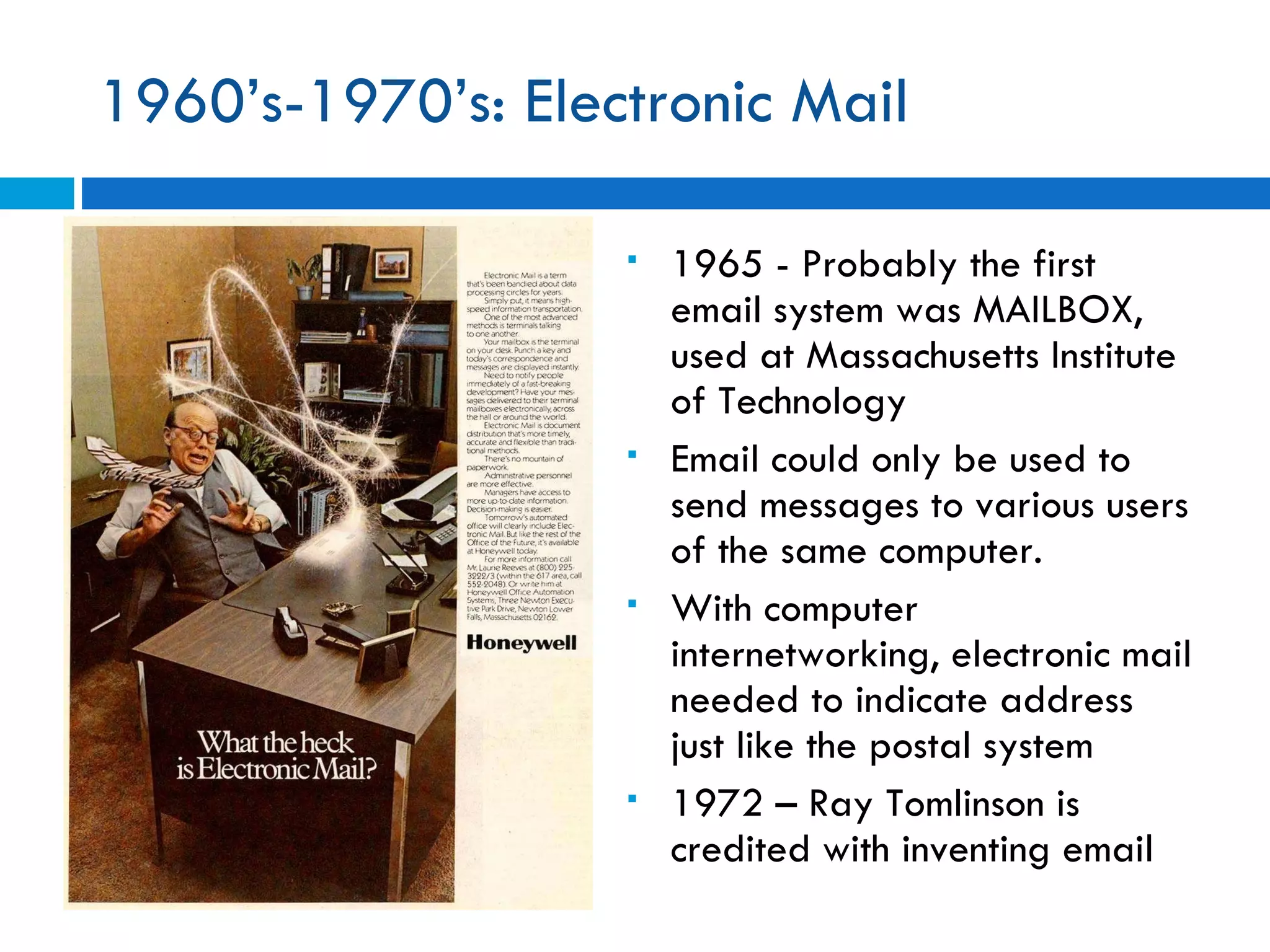
1960’s-1970’s: Electronic Mail  1965 -  Probably the first email system was MAILBOX, used at Massachusetts Institute of Technology Email could only be used to send messages to various users of the same computer.  With computer internetworking, electronic mail needed to indicate address just like the postal system 1972 – Ray Tomlinson is credited with inventing email
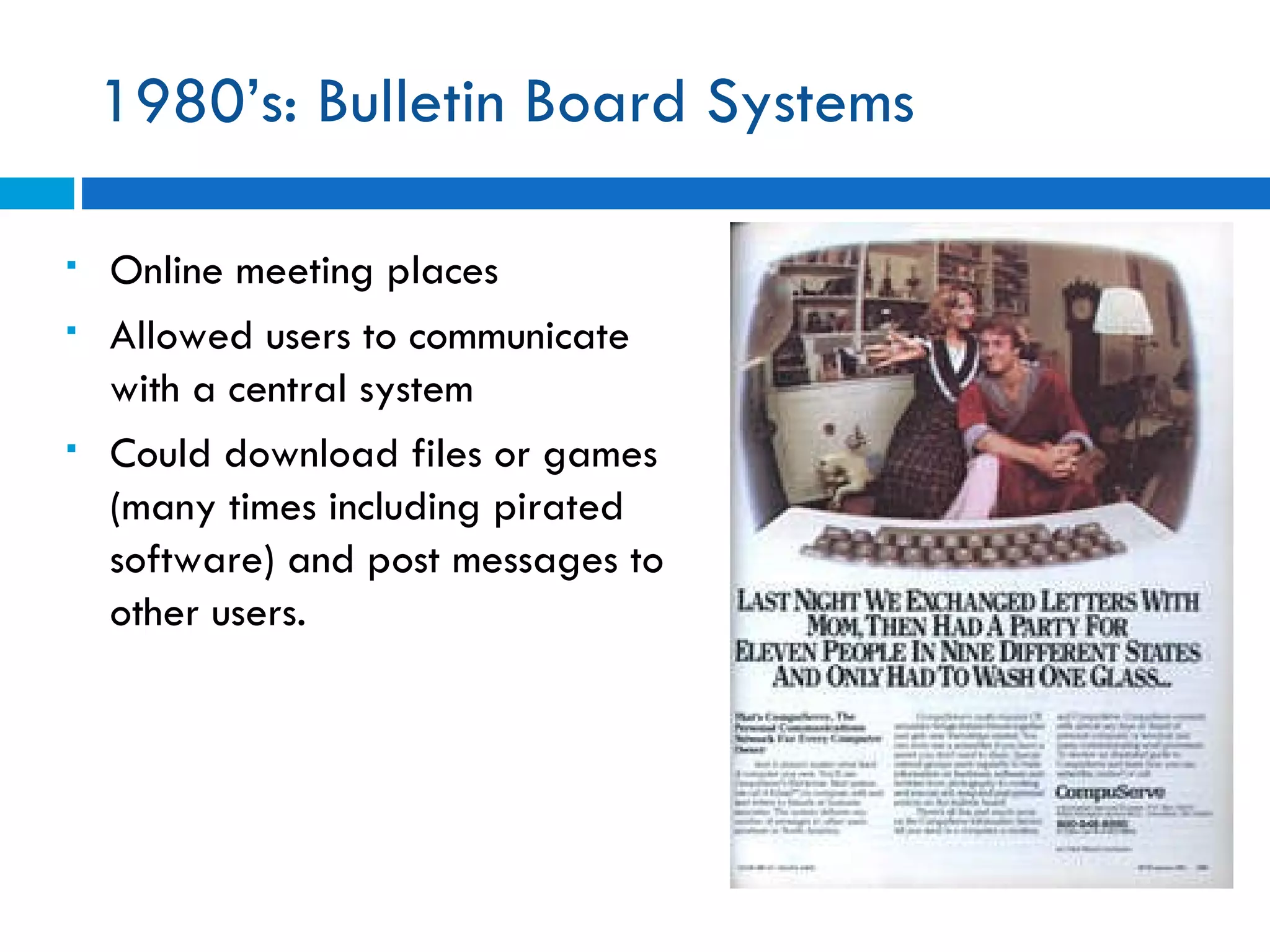
1980’s: Bulletin Board Systems Online meeting places  Allowed users to communicate with a central system Could download files or games (many times including pirated software) and post messages to other users.
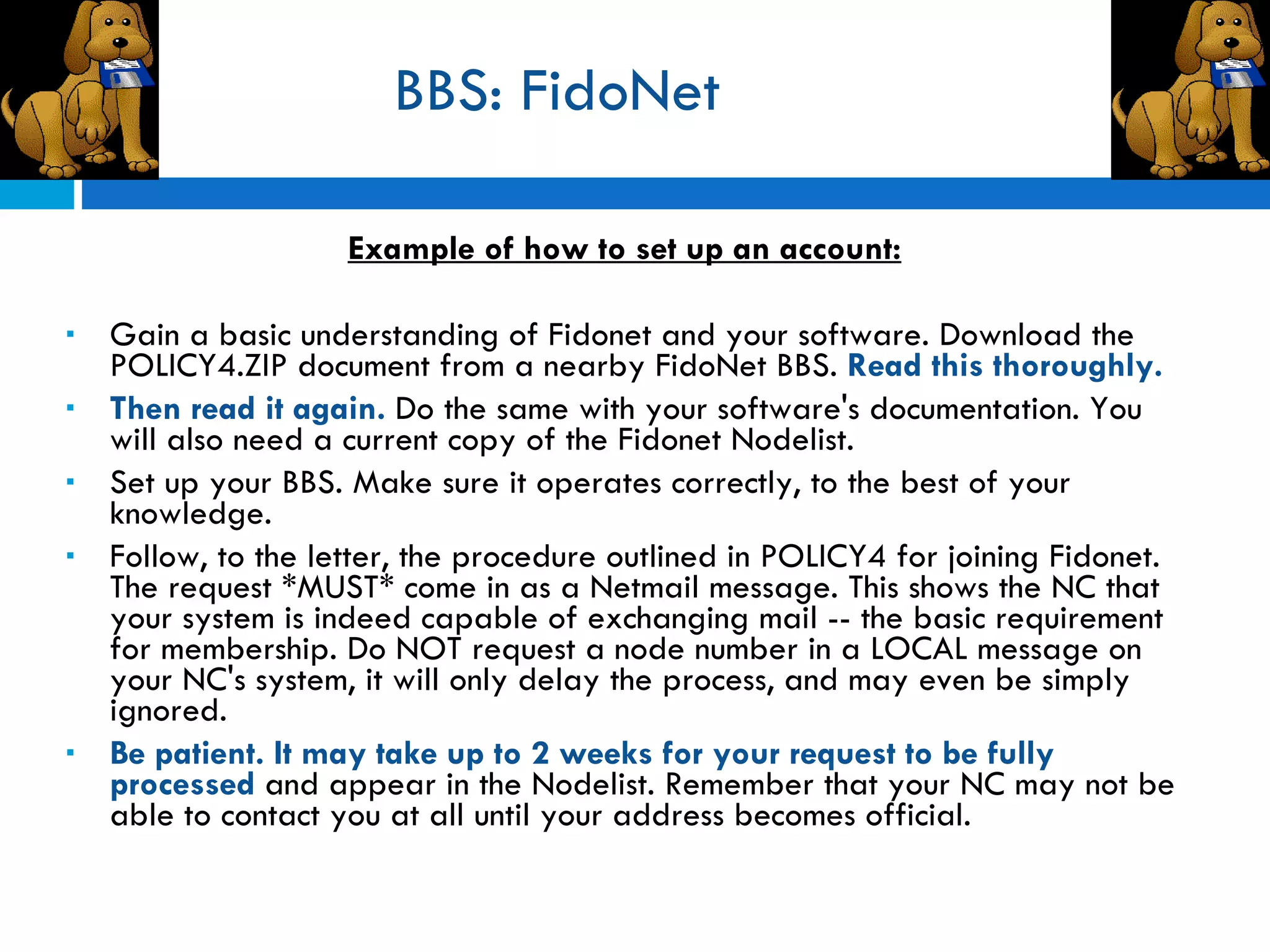
BBS: FidoNet Example of how to set up an account: Gain a basic understanding of Fidonet and your software. Download the POLICY4.ZIP document from a nearby FidoNet BBS.  Read this thoroughly.  Then read it again.  Do the same with your software's documentation. You will also need a current copy of the Fidonet Nodelist.  Set up your BBS. Make sure it operates correctly, to the best of your knowledge. Follow, to the letter, the procedure outlined in POLICY4 for joining Fidonet. The request *MUST* come in as a Netmail message. This shows the NC that your system is indeed capable of exchanging mail -- the basic requirement for membership. Do NOT request a node number in a LOCAL message on your NC's system, it will only delay the process, and may even be simply ignored.  Be patient. It may take up to 2 weeks for your request to be fully processed  and appear in the Nodelist. Remember that your NC may not be able to contact you at all until your address becomes official.
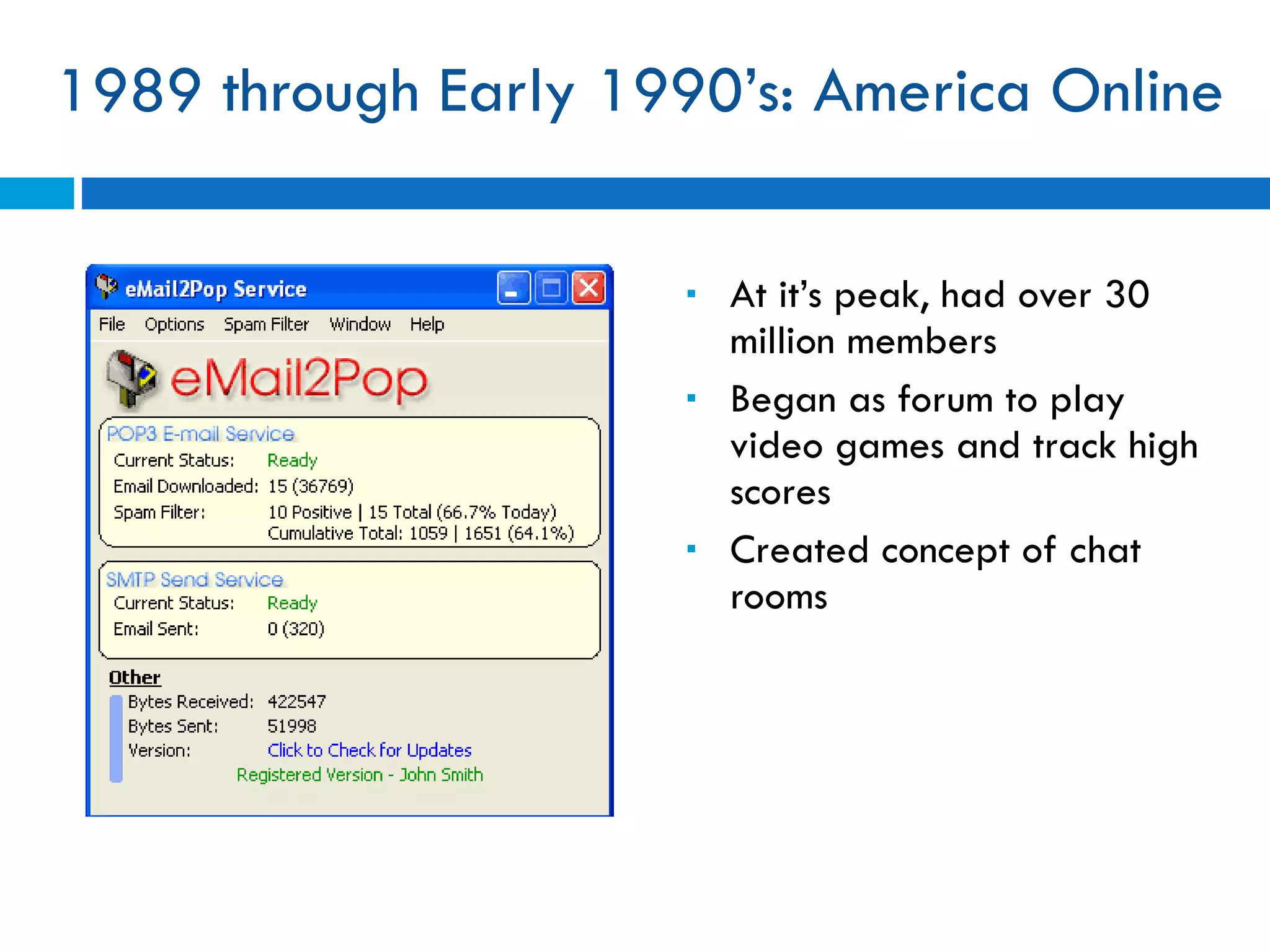
1989 through Early 1990’s: America Online At it’s peak, had over 30 million members Began as forum to play video games and track high scores  Created concept of chat rooms
1997:  Sixdegrees Many consider this the first social networking site Allowed users to create profiles List their Friends Surf the Friends lists
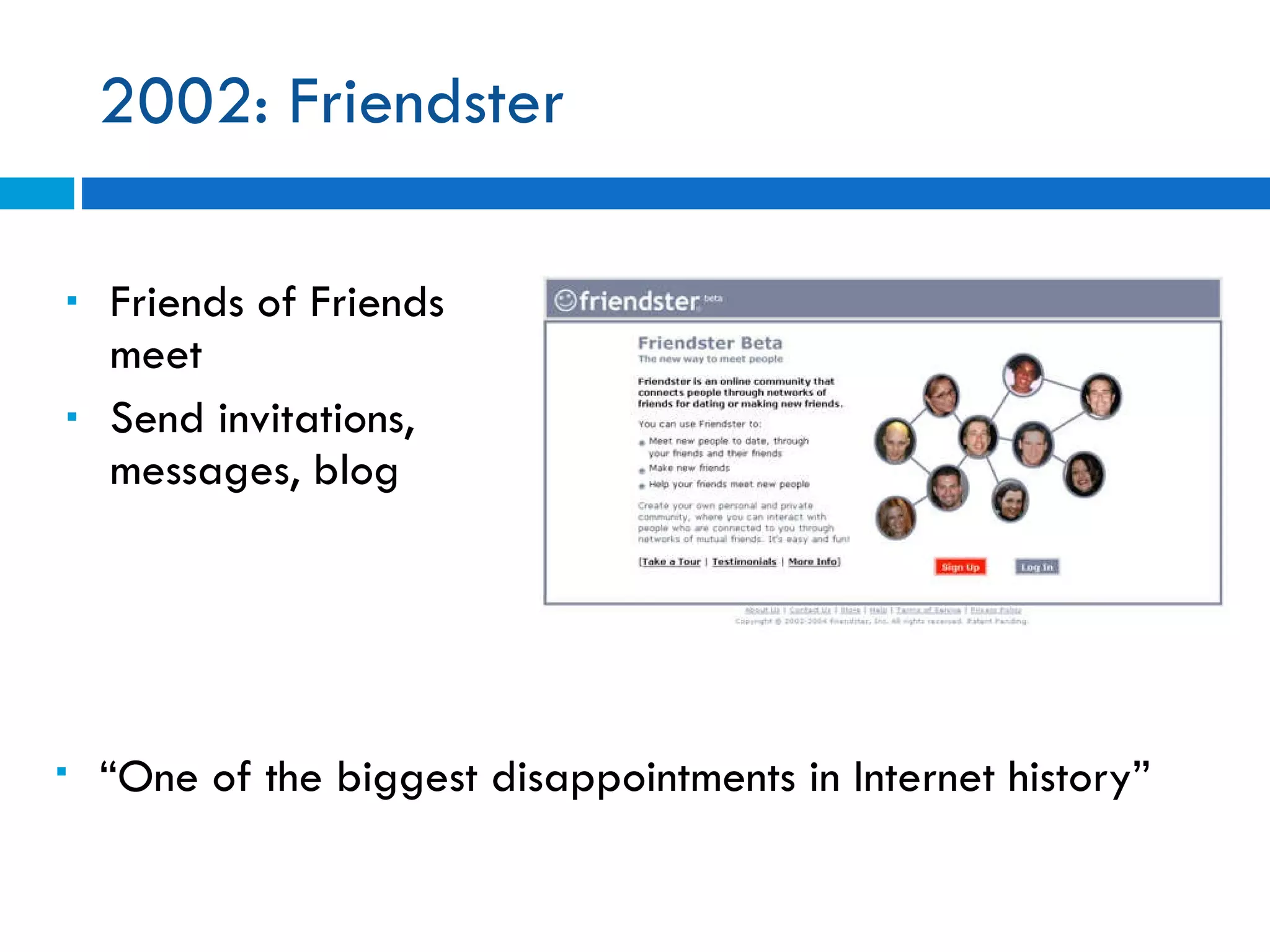
2002: Friendster Friends of Friends meet Send invitations, messages, blog “ One of the biggest disappointments in Internet history”
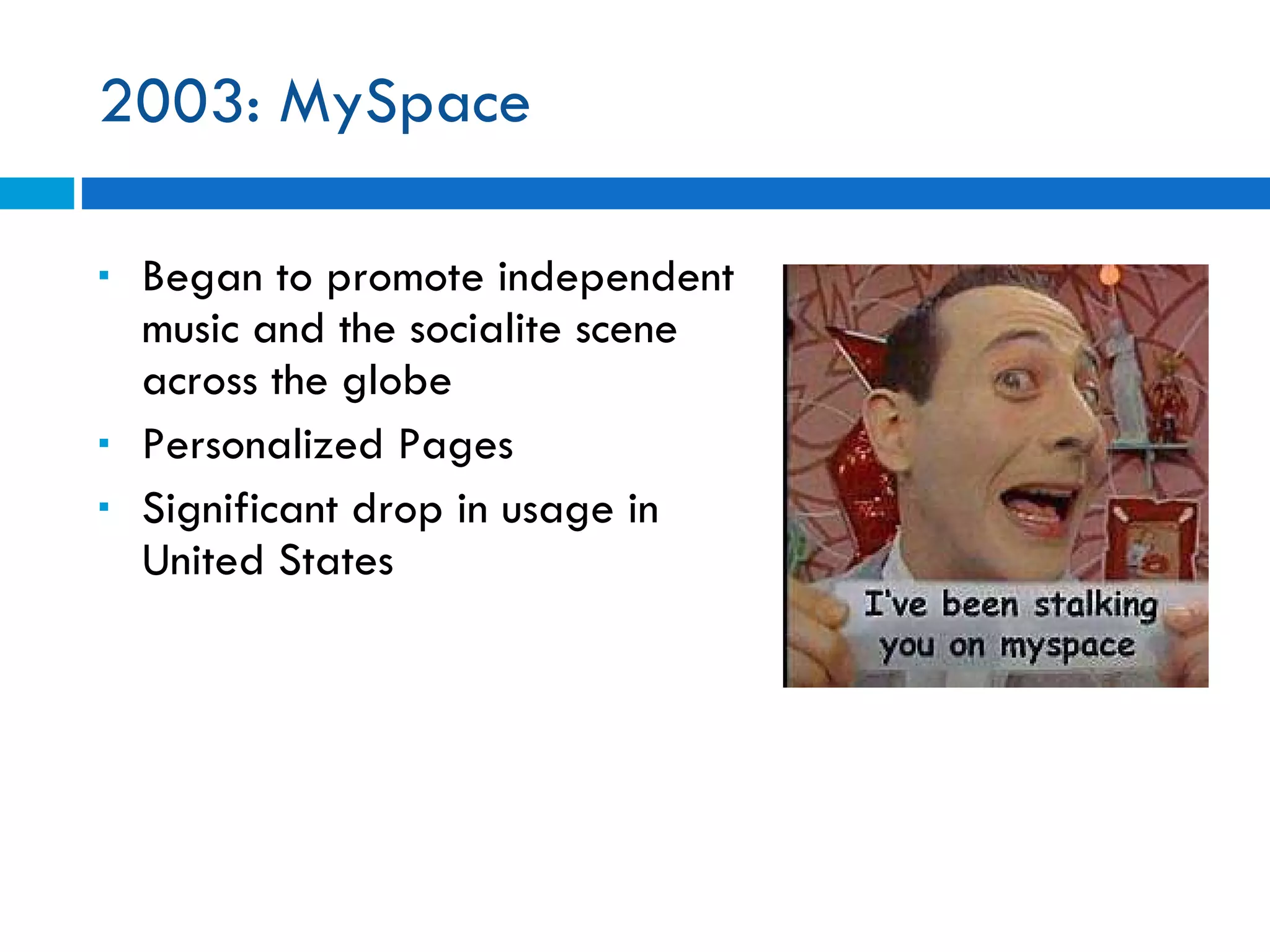
2003: MySpace Began to promote independent music and the socialite scene across the globe Personalized Pages  Significant drop in usage in United States
2003: Linkedin Networking Make “connections” Over 30 million business people are members
2005: YouTube Share videos Censored and criticized for content “ Embodies and promotes democracy”
2004: Facebook Needed school email to join Personalized profiles Corporations are advertising on site Controversies over personal data control
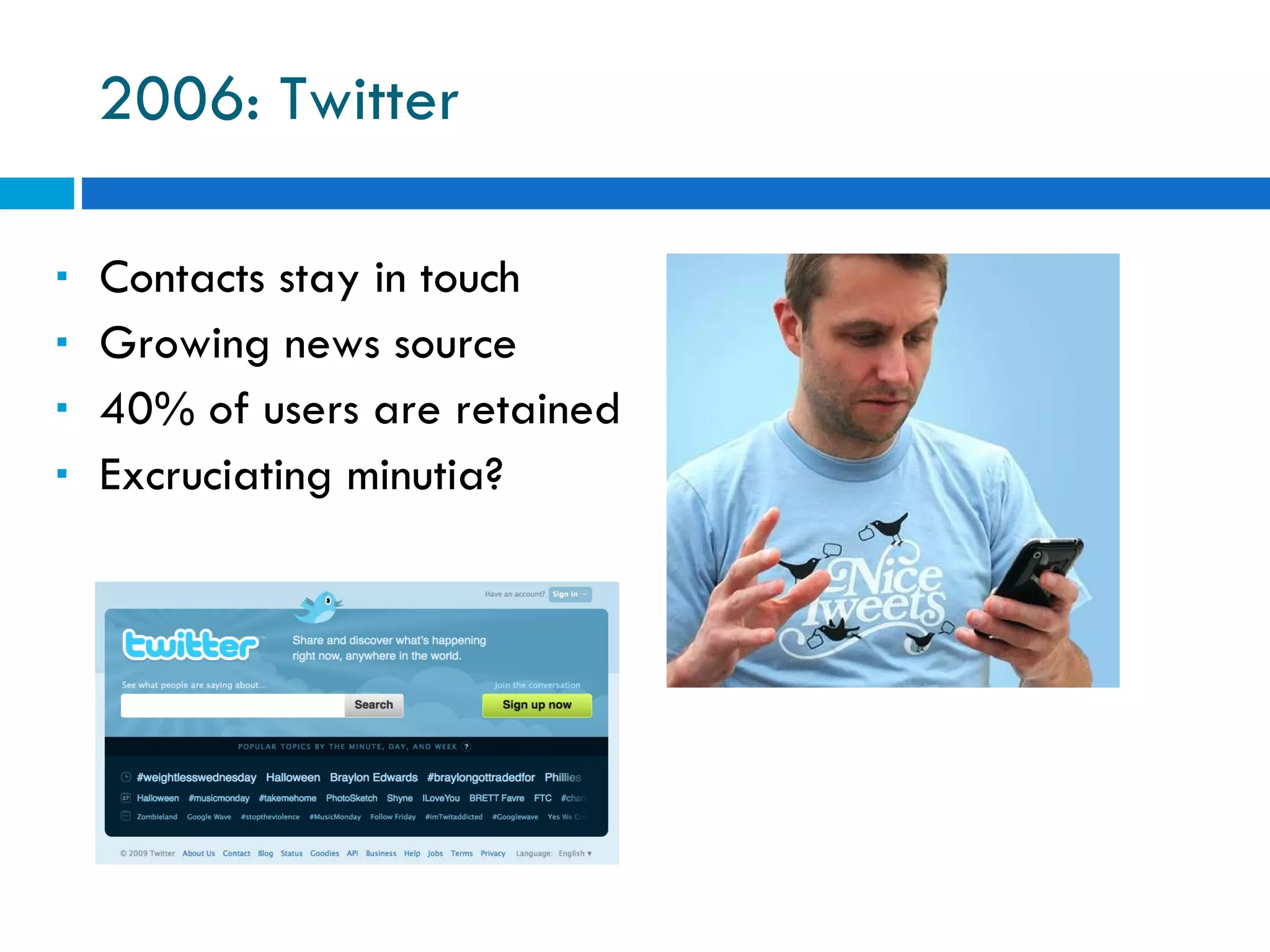
2006: Twitter Contacts stay in touch Growing news source 40% of users are retained Excruciating minutia?
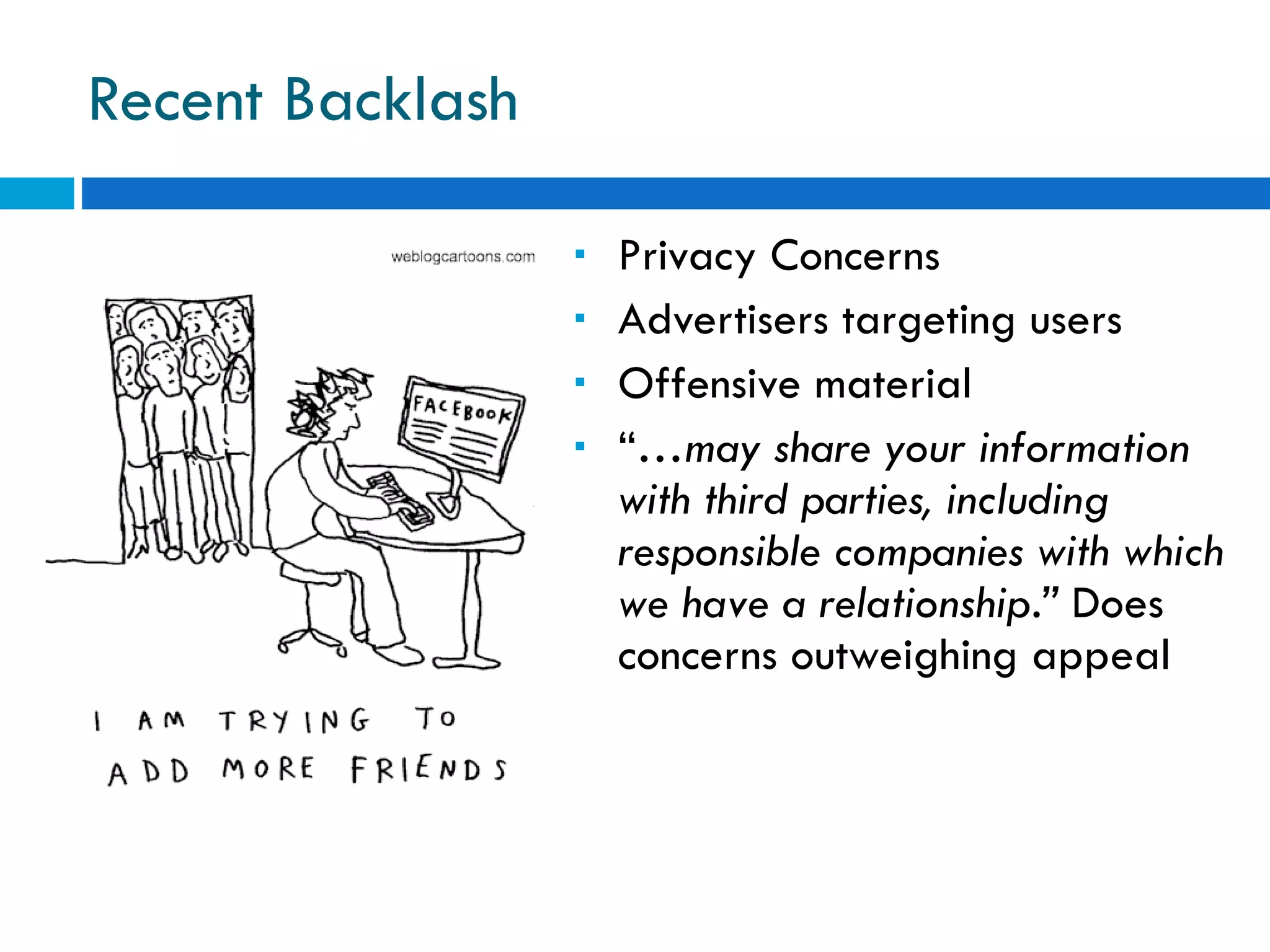
Recent Backlash Privacy Concerns Advertisers targeting users Offensive material “… may share your information with third parties, including responsible companies with which we have a relationship.”  Does concerns outweighing appeal
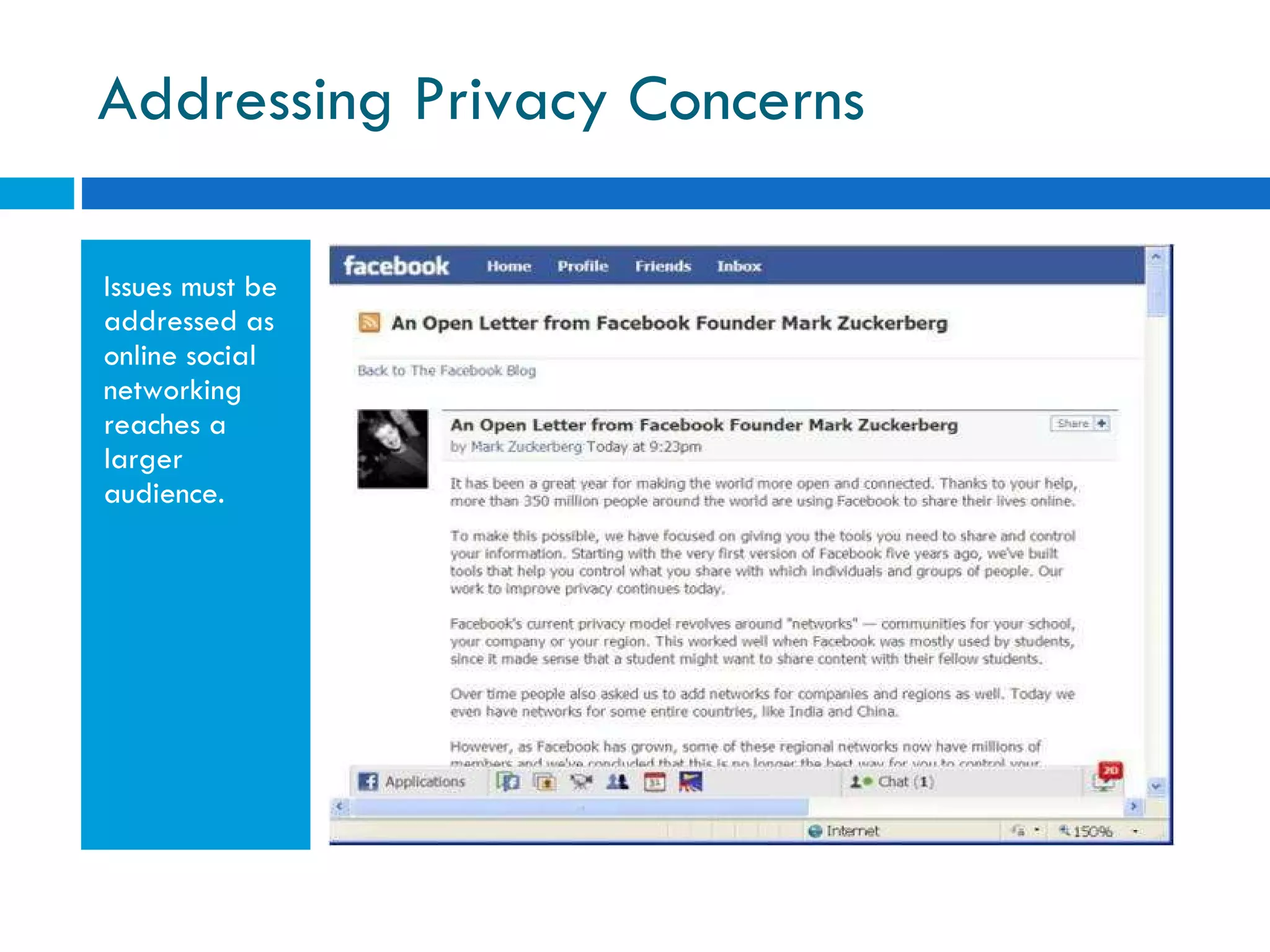
Addressing Privacy Concerns Issues must be addressed as online social networking reaches a larger audience.
Defining Online Privacy
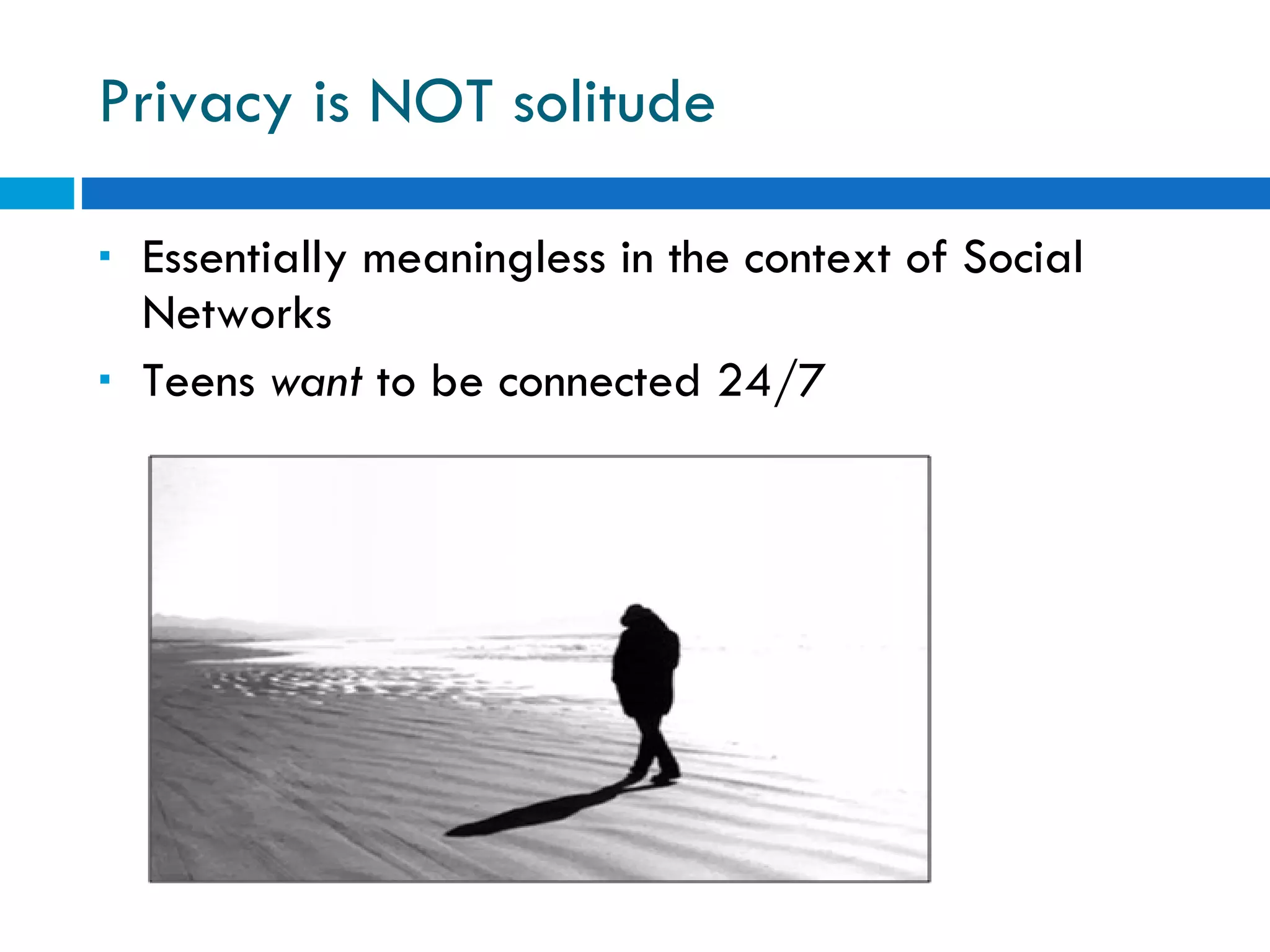
Privacy is NOT solitude Essentially meaningless in the context of Social Networks Teens  want  to be connected 24/7
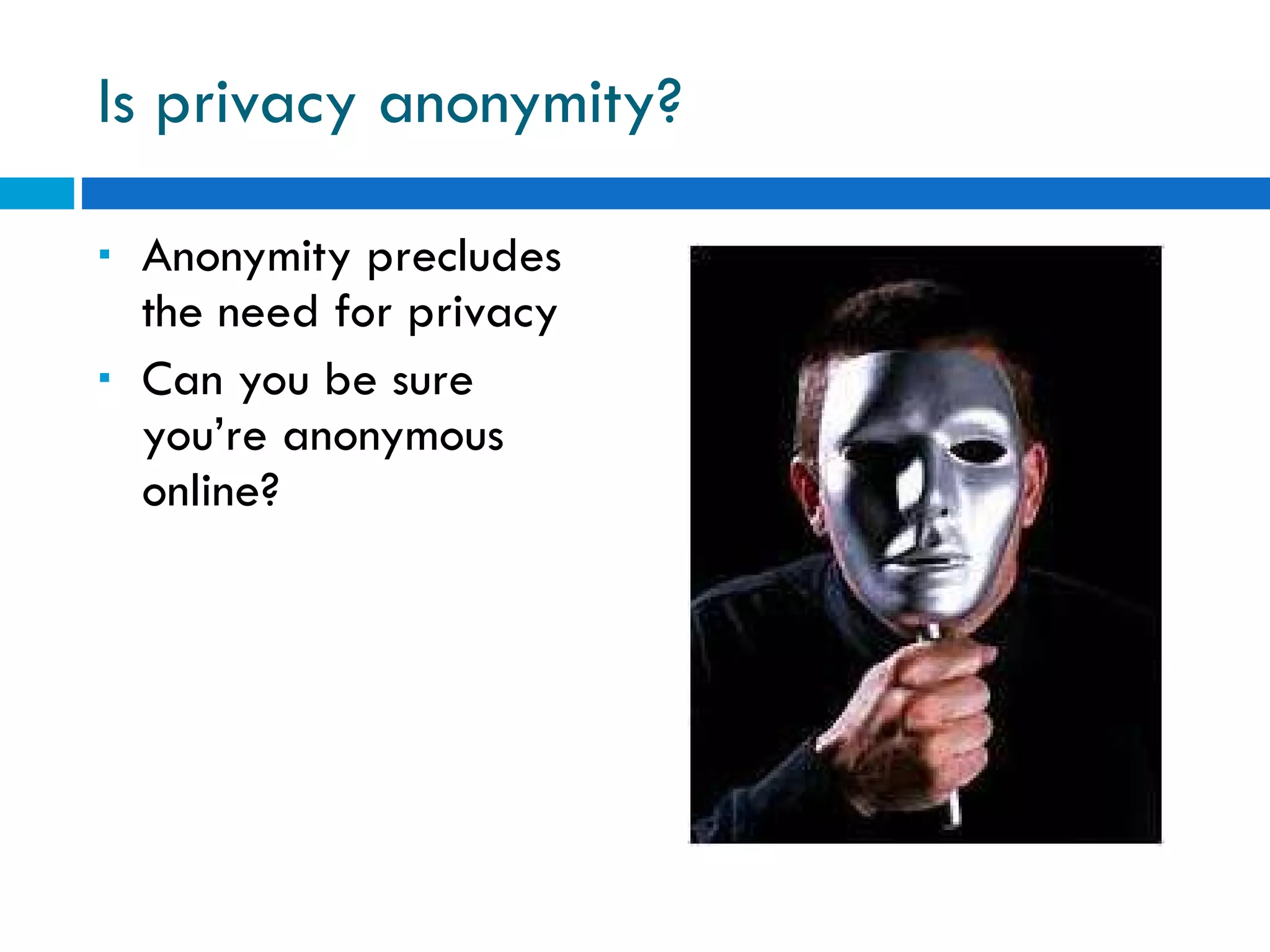
Is privacy anonymity? Anonymity precludes the need for privacy Can you be sure you’re anonymous online?
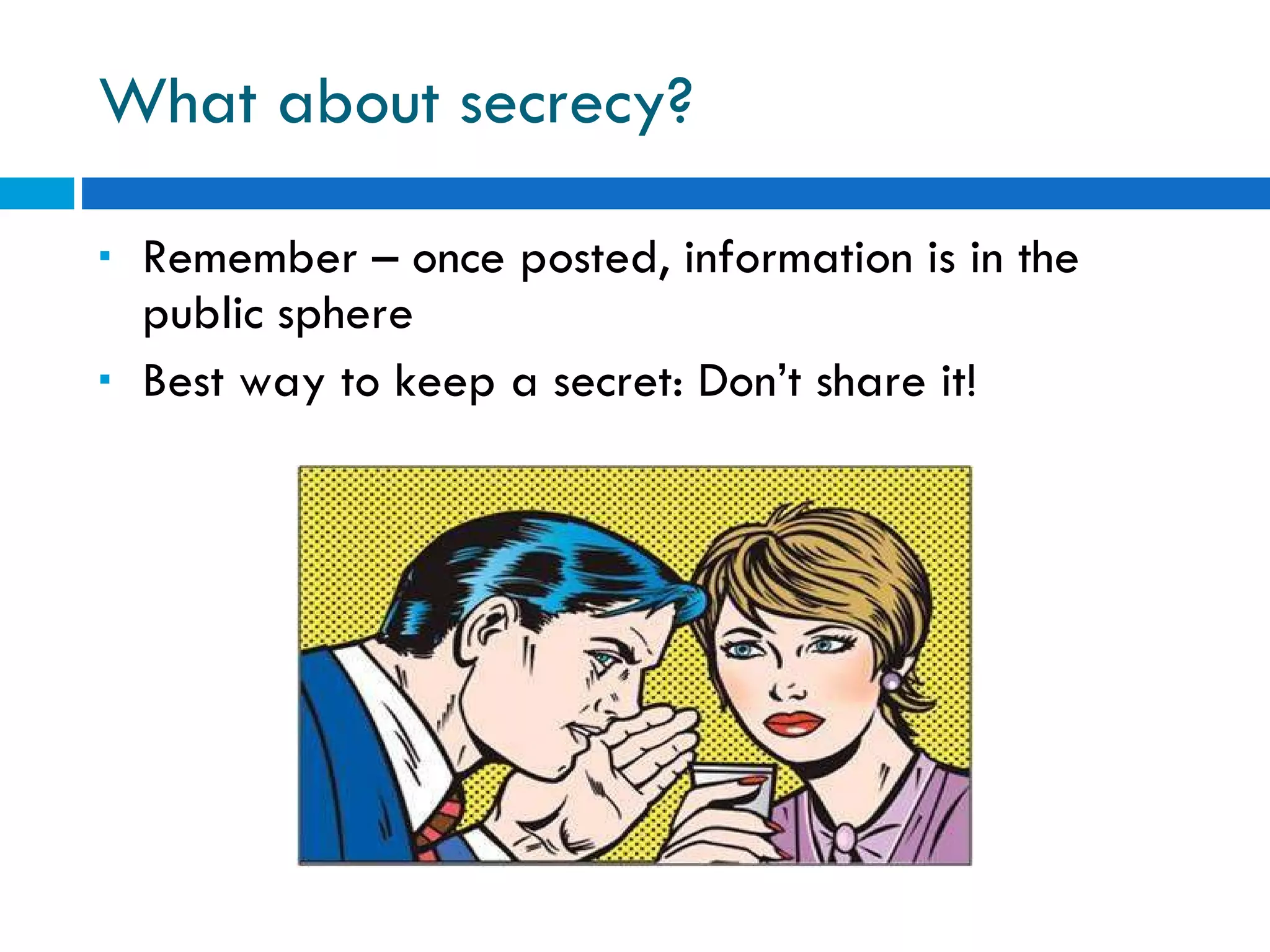
What about secrecy? Remember – once posted, information is in the public sphere Best way to keep a secret: Don’t share it!
Underlying Issue: Control You have NO control over the information others share…even if it’s about you! You CAN control the information YOU share (and access to it!)
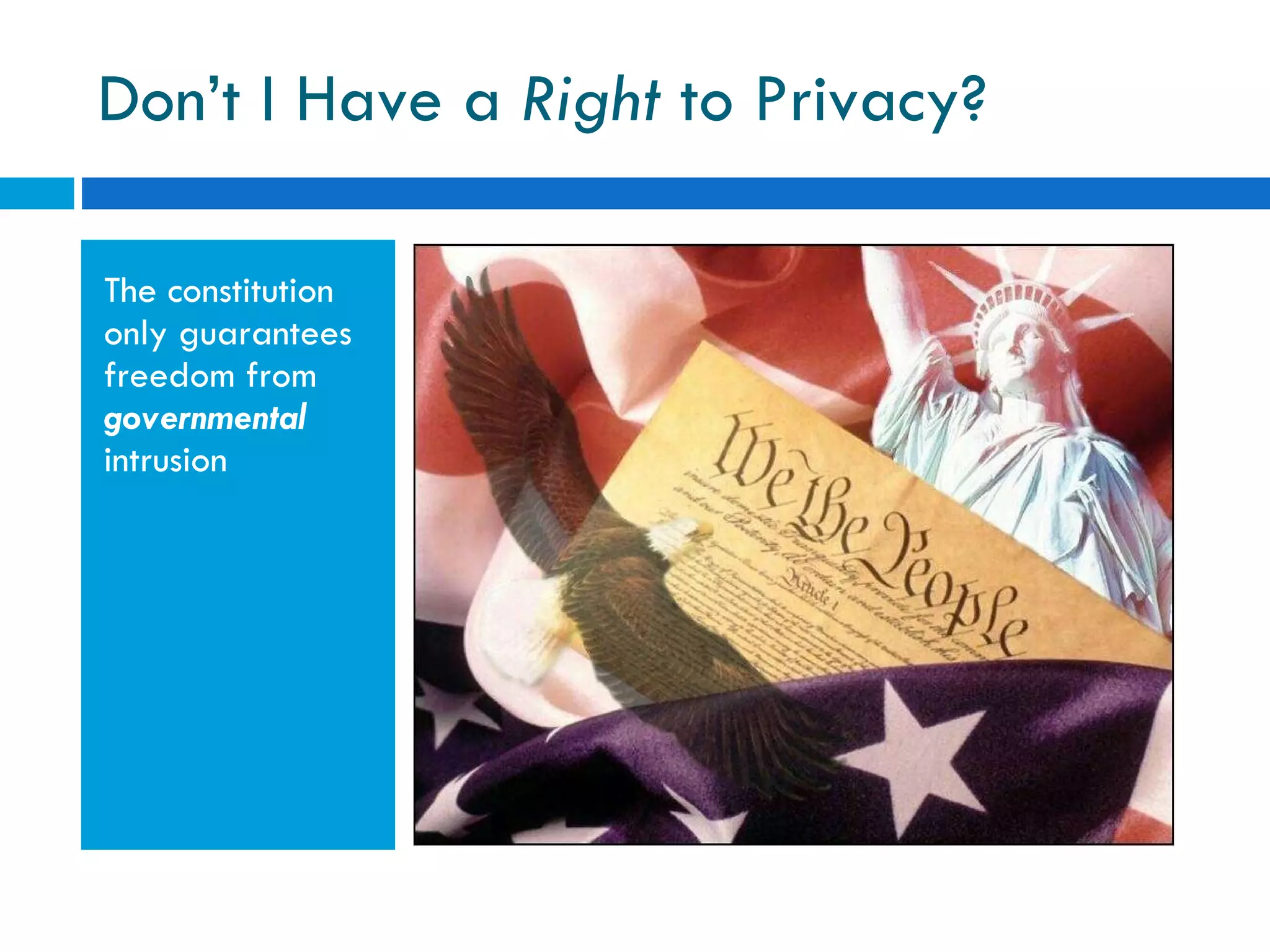
Don’t I Have a  Right  to Privacy? The constitution only guarantees freedom from  governmental  intrusion
Something to Know About… Deleting Online Predators Act of 2006 Intended to Protect Children Could require libraries to block access to Social Networking Sites PROBLEM : Too Broadly Defined Amazon.com Educational Sites “ We know that the best way to protect children is to teach them to guard their privacy and make wise choices. “  -Former ALA President Michael Gorman
Teens and Privacy
Good news! According to Pew (2007): 66% of teens use privacy controls to limit access to their personal information Only 6% make public their first and last names (first name + photo is the norm)
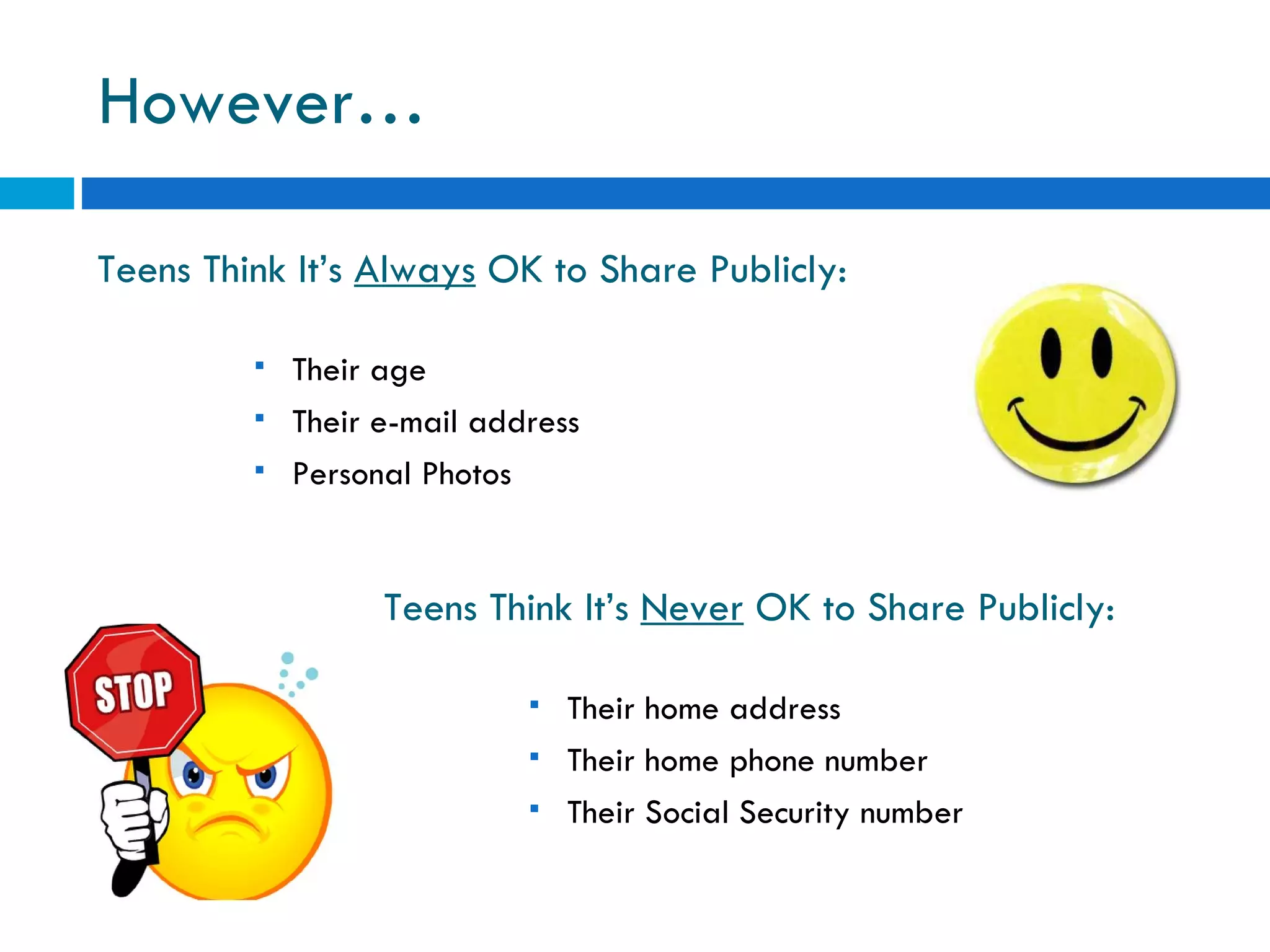
However… Teens Think It’s  Always  OK to Share Publicly: Teens Think It’s  Never  OK to Share Publicly: Their home address Their home phone number Their Social Security number Their age Their e-mail address Personal Photos
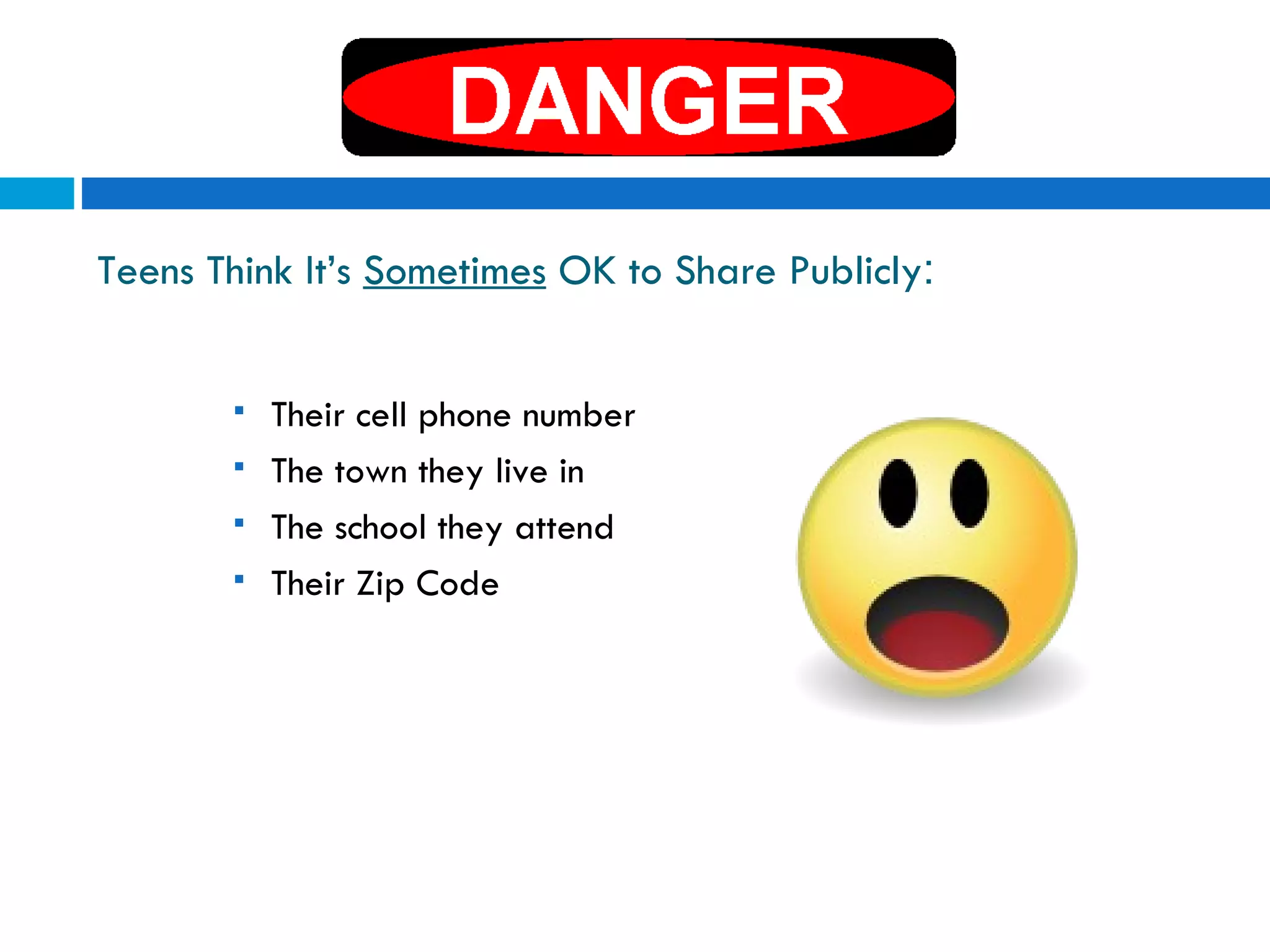
Teens Think It’s  Sometimes  OK to Share Publicly : Their cell phone number The town they live in The school they attend Their Zip Code
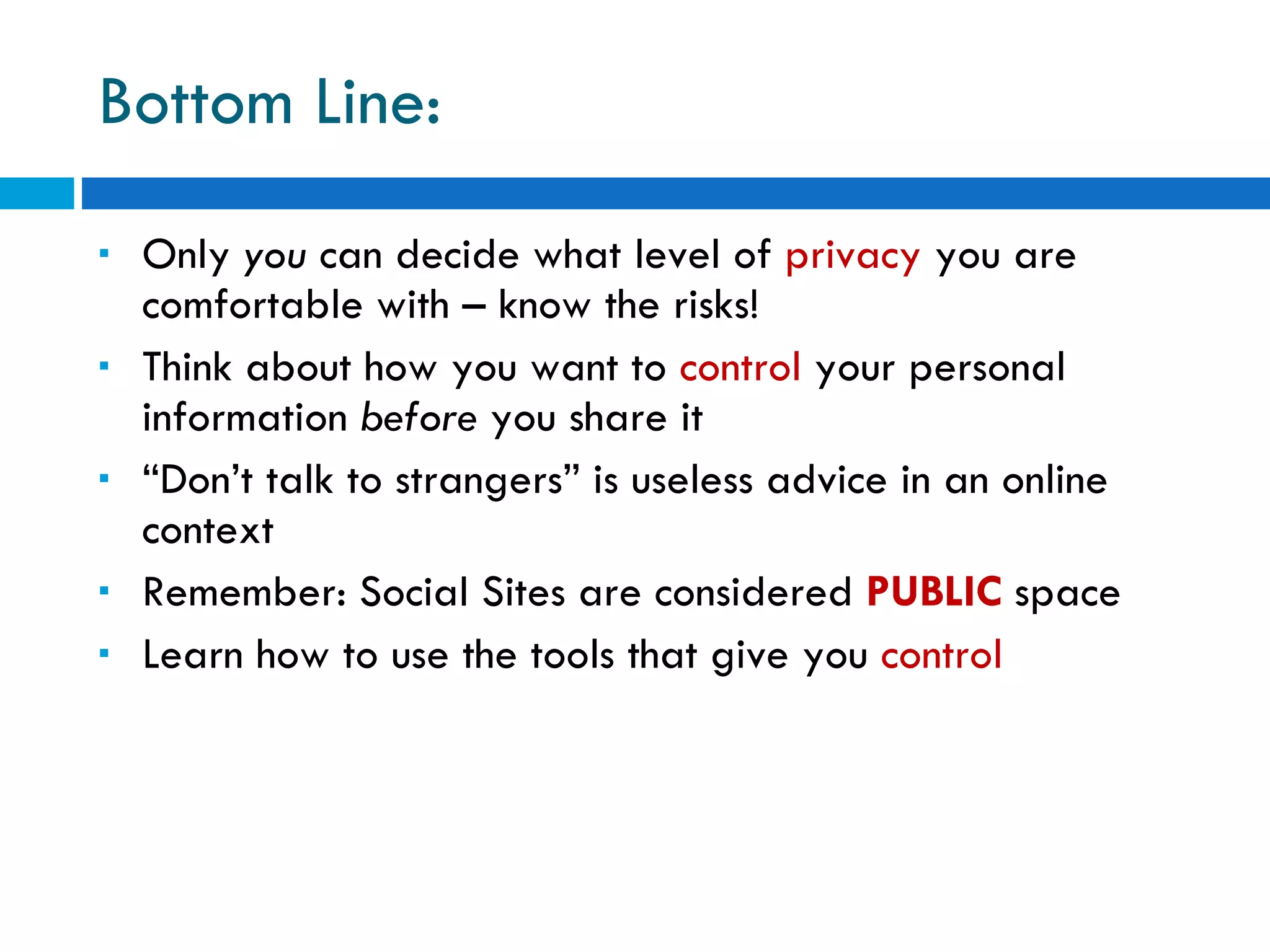
Bottom Line: Only  you  can decide what level of  privacy  you are comfortable with – know the risks! Think about how you want to  control  your personal information  before  you share it “ Don’t talk to strangers” is useless advice in an online context Remember: Social Sites are considered  PUBLIC  space Learn how to use the tools that give you  control
Social Networking and Privacy Risks
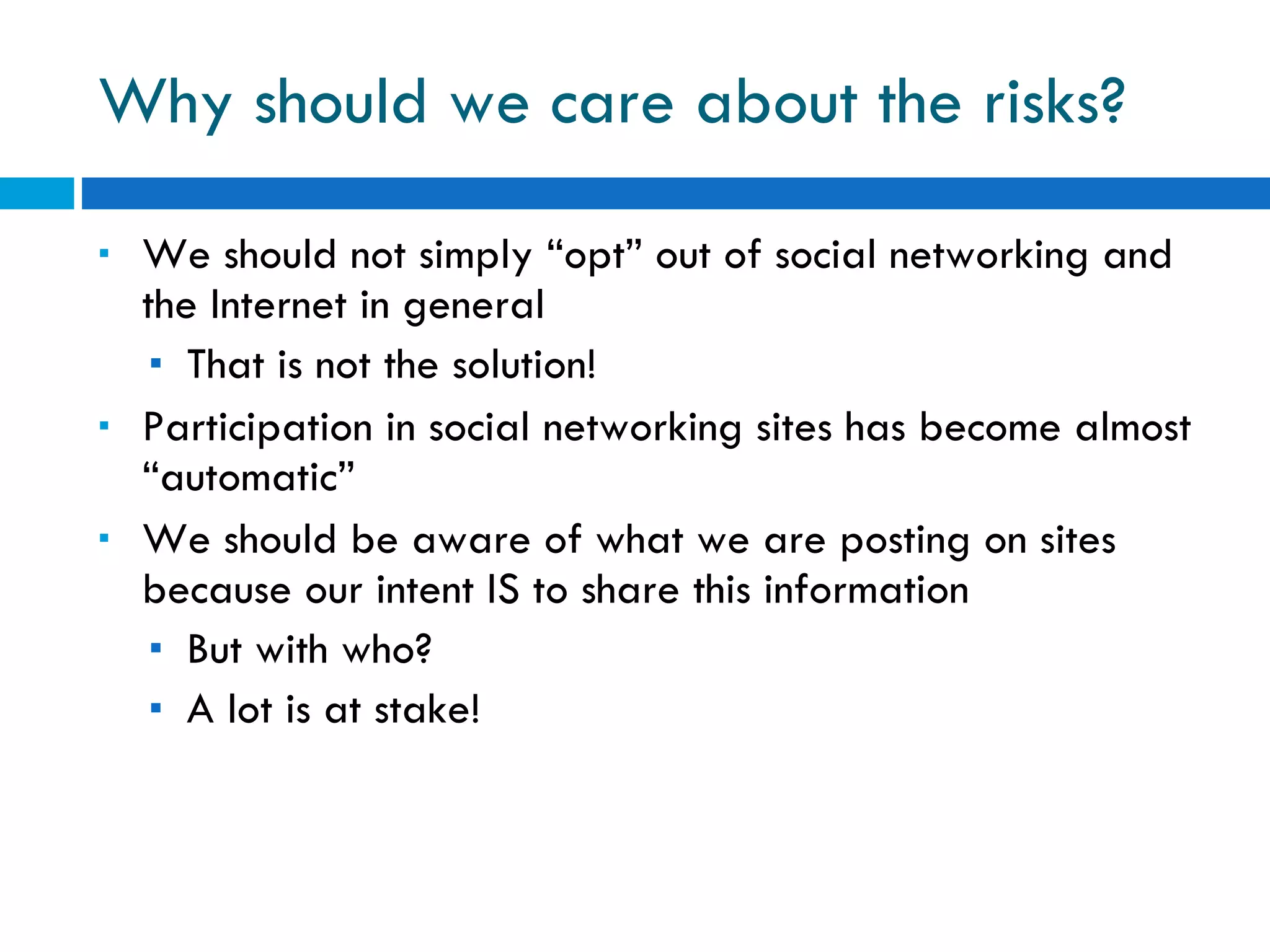
Why should we care about the risks? We should not simply “opt” out of social networking and the Internet in general That is not the solution! Participation in social networking sites has become almost “automatic” We should be aware of what we are posting on sites because our intent IS to share this information But with who? A lot is at stake!
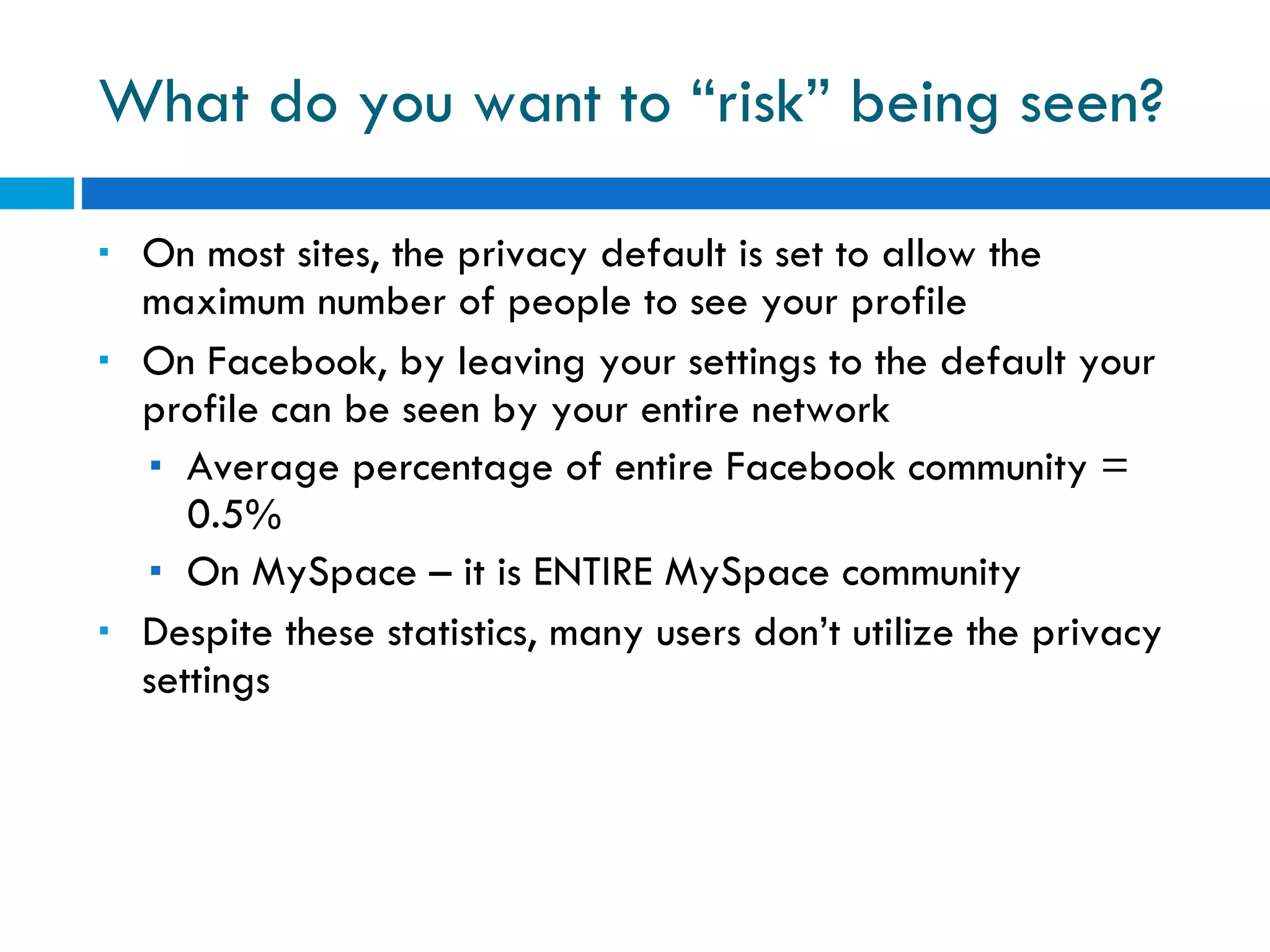
What do you want to “risk” being seen? On most sites, the privacy default is set to allow the maximum number of people to see your profile On Facebook, by leaving your settings to the default your profile can be seen by your entire network Average percentage of entire Facebook community = 0.5% On MySpace – it is ENTIRE MySpace community Despite these statistics, many users don’t utilize the privacy settings
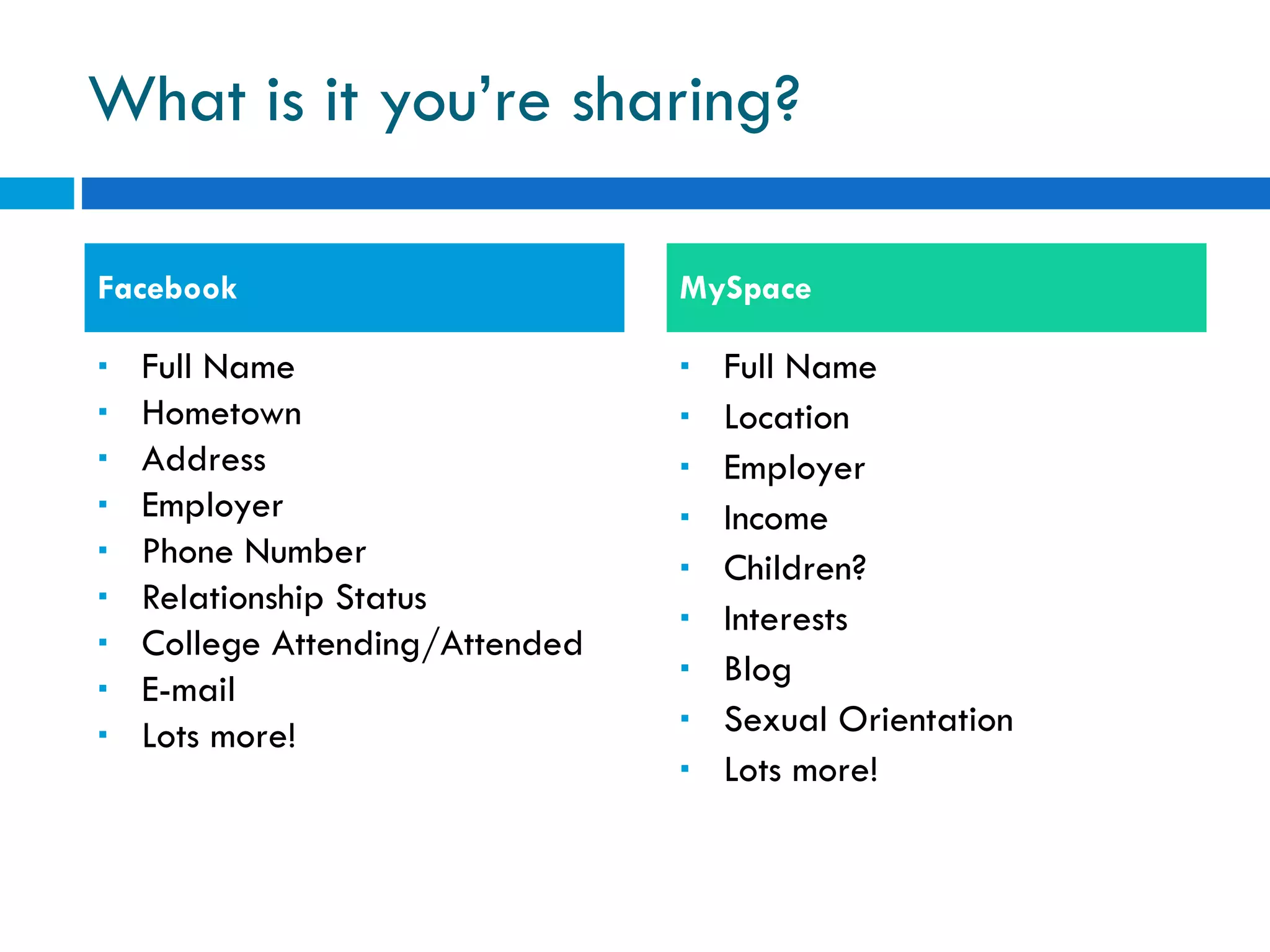
What is it you’re sharing? Full Name Hometown Address Employer Phone Number Relationship Status College Attending/Attended E-mail Lots more! Full Name Location Employer Income Children? Interests Blog Sexual Orientation Lots more! Facebook MySpace
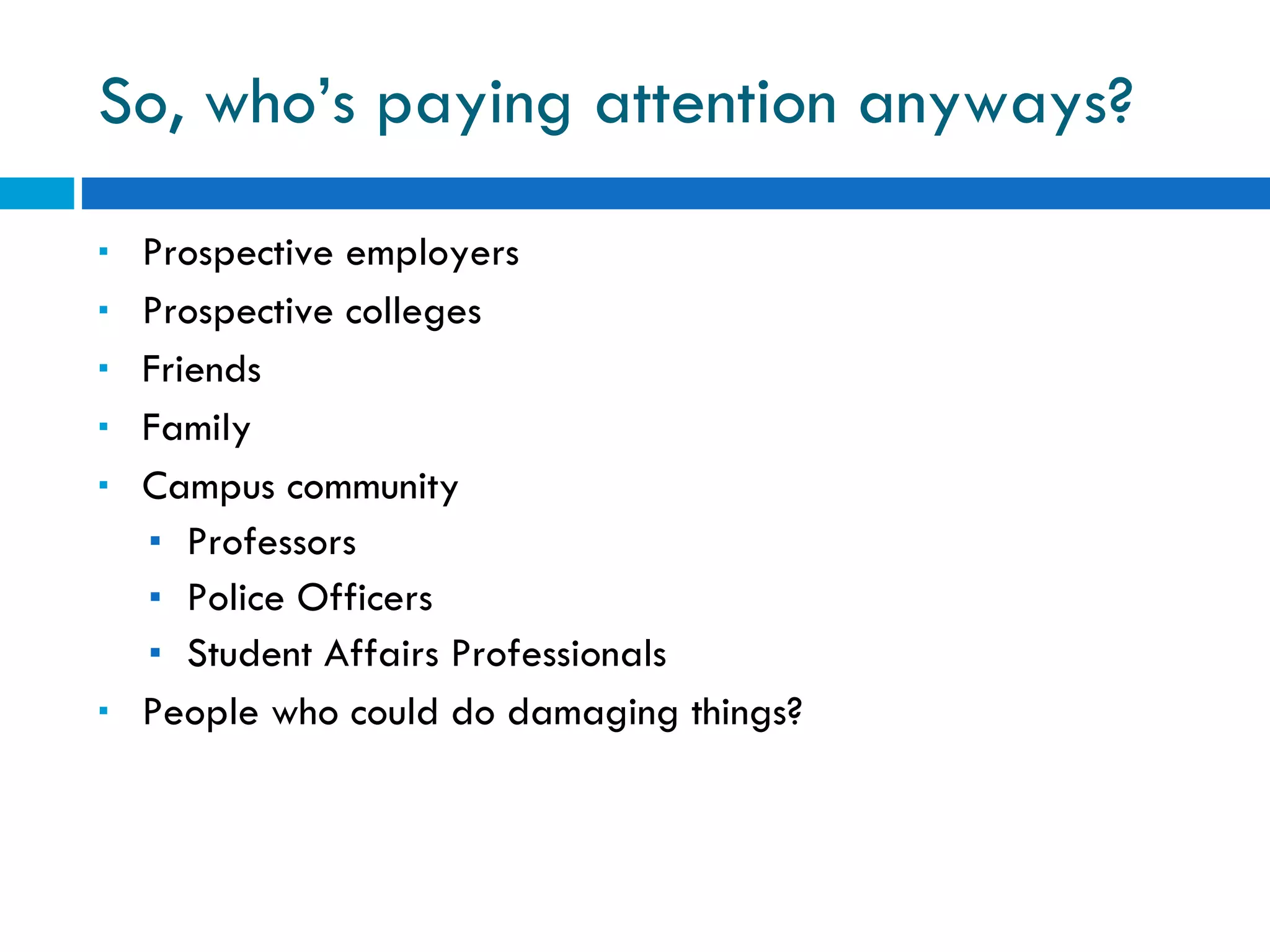
So, who’s paying attention anyways? Prospective employers Prospective colleges Friends Family Campus community Professors Police Officers Student Affairs Professionals People who could do damaging things?
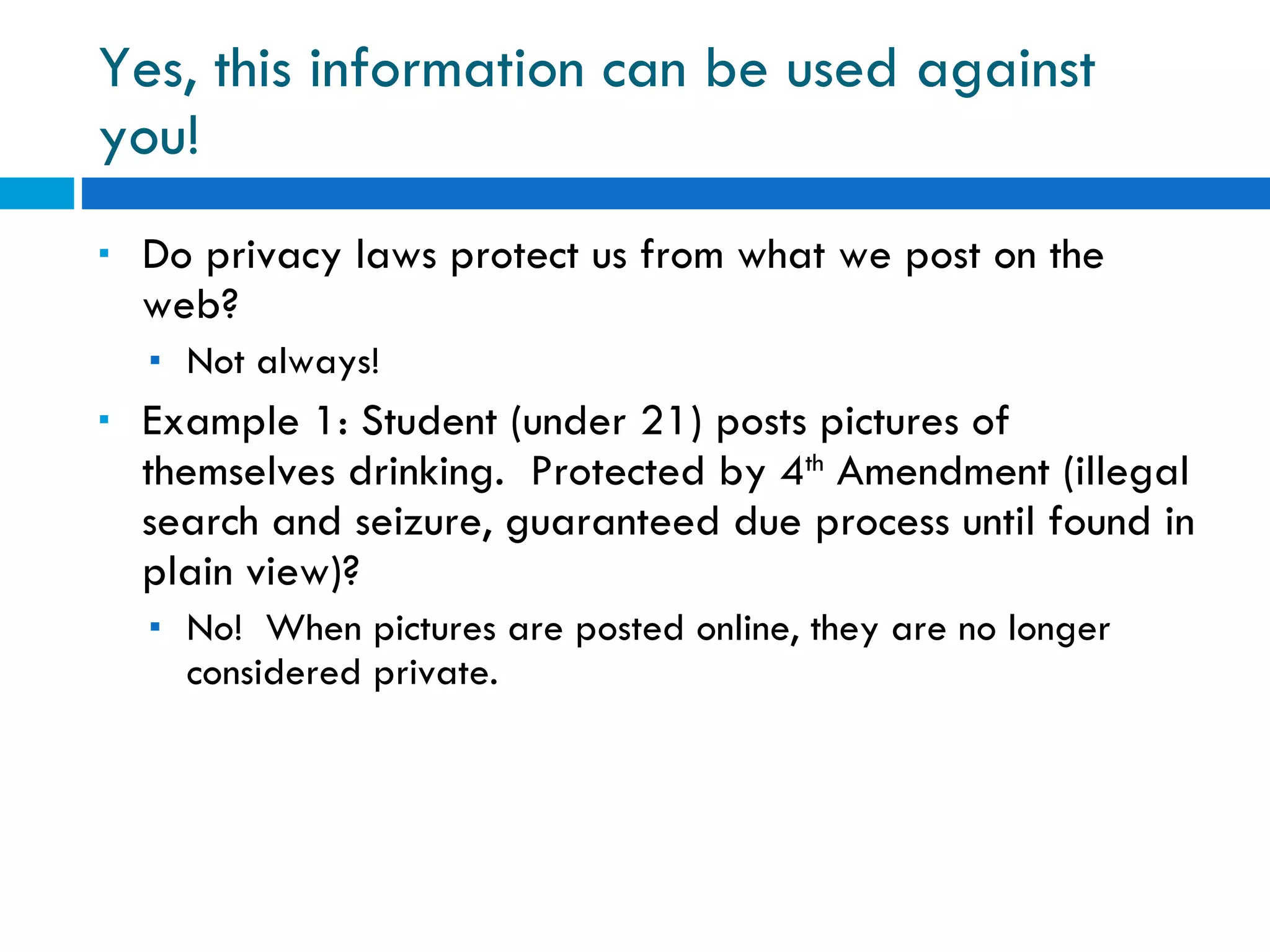
Yes, this information can be used against you! Do privacy laws protect us from what we post on the web? Not always! Example 1: Student (under 21) posts pictures of themselves drinking.  Protected by 4 th  Amendment (illegal search and seizure, guaranteed due process until found in plain view)?  No!  When pictures are posted online, they are no longer considered private.
Yes, this information can be used against you! Example 2: Student posts negative comments about a professor, including a threat (I’d like to beat that guy up!) – Is the student protected by 1 st  Amendment? No!  Because he made a threat and because he did so in a public forum, he is not protected by 1 st  Amendment OR privacy laws.
Are you being watched? Maybe? Students at George Washington U thought campus police were monitoring their Facebook activity Decided to advertise that they were having a “keg party” using Facebook  Police DID show up to the “keg party” The keg party consisted of a group of students eating cupcakes with the word “beer” written on them Confirmed their belief that university and police officials WERE monitoring their activity!
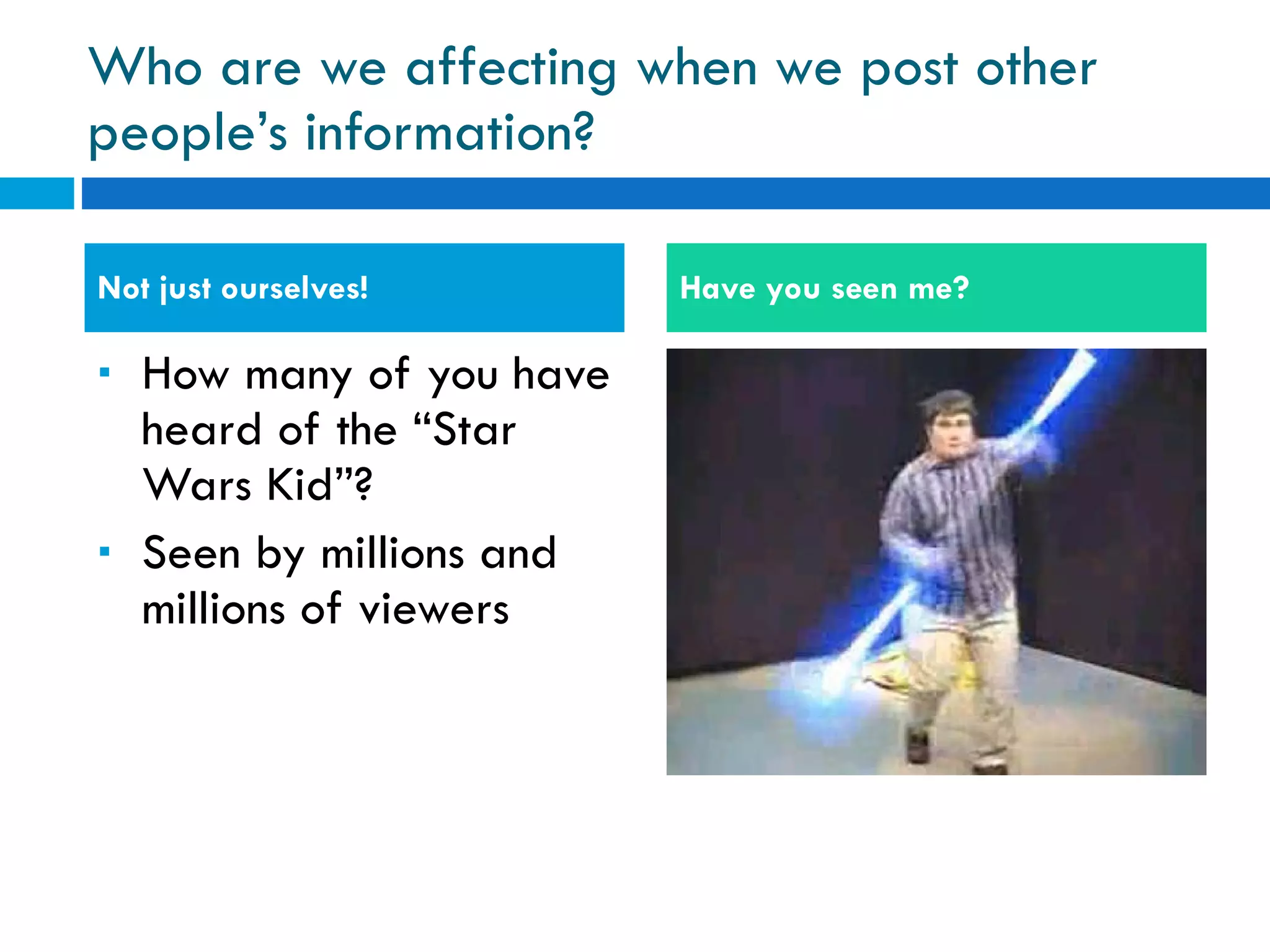
Who are we affecting when we post other people’s information? How many of you have heard of the “Star Wars Kid”? Seen by millions and millions of viewers Not just ourselves! Have you seen me?
What happened to him? People remixed the video of him with special effects and Star Wars music, “mashed” it with other movies Appeared in a video game and on several TV shows Since, the (then) 15-year-old kid has: Dropped out of school Gone to counseling More or less disappeared
Whose reputation are you ruining? What employees post during the work day and what they post about their company are things they SHOULD be aware they will be held accountable for What are companies doing? Social media policies Companies like IBM developing extensive policies – must be signed and read each year Outlines that you must be upfront about your identity and position at IBM when blogging and what constitutes “suitable behavior” on social media sites (such as Twitter and Facebook)
How about our own reputation being at stake? We usually take pride in our reputation We rely on it for a number of things Whether someone wants to befriend us How we are received by others Whether someone wants to date us Whether to hire someone Whether to undertake a business deal
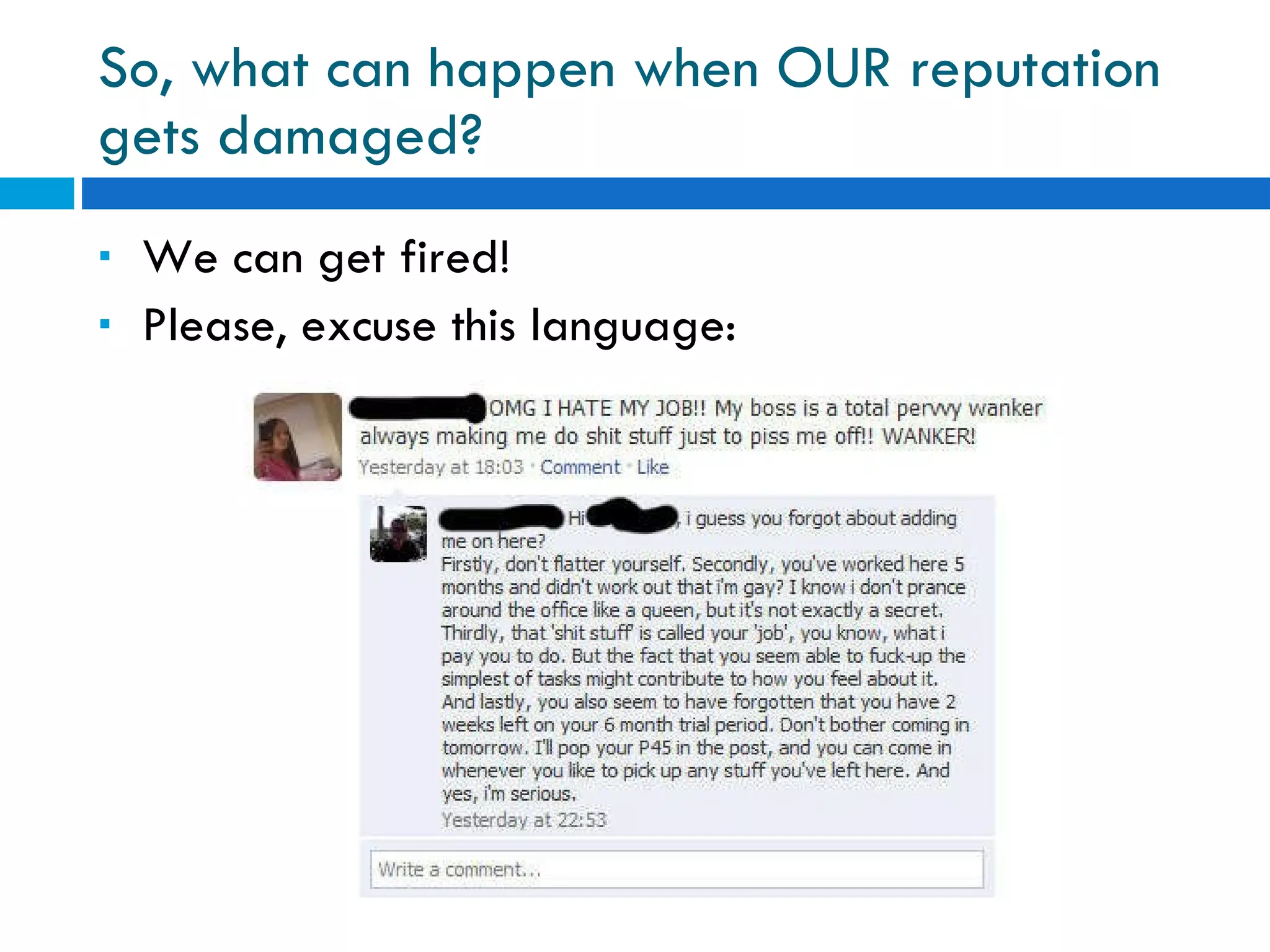
So, what can happen when OUR reputation gets damaged? We can get fired! Please, excuse this language:
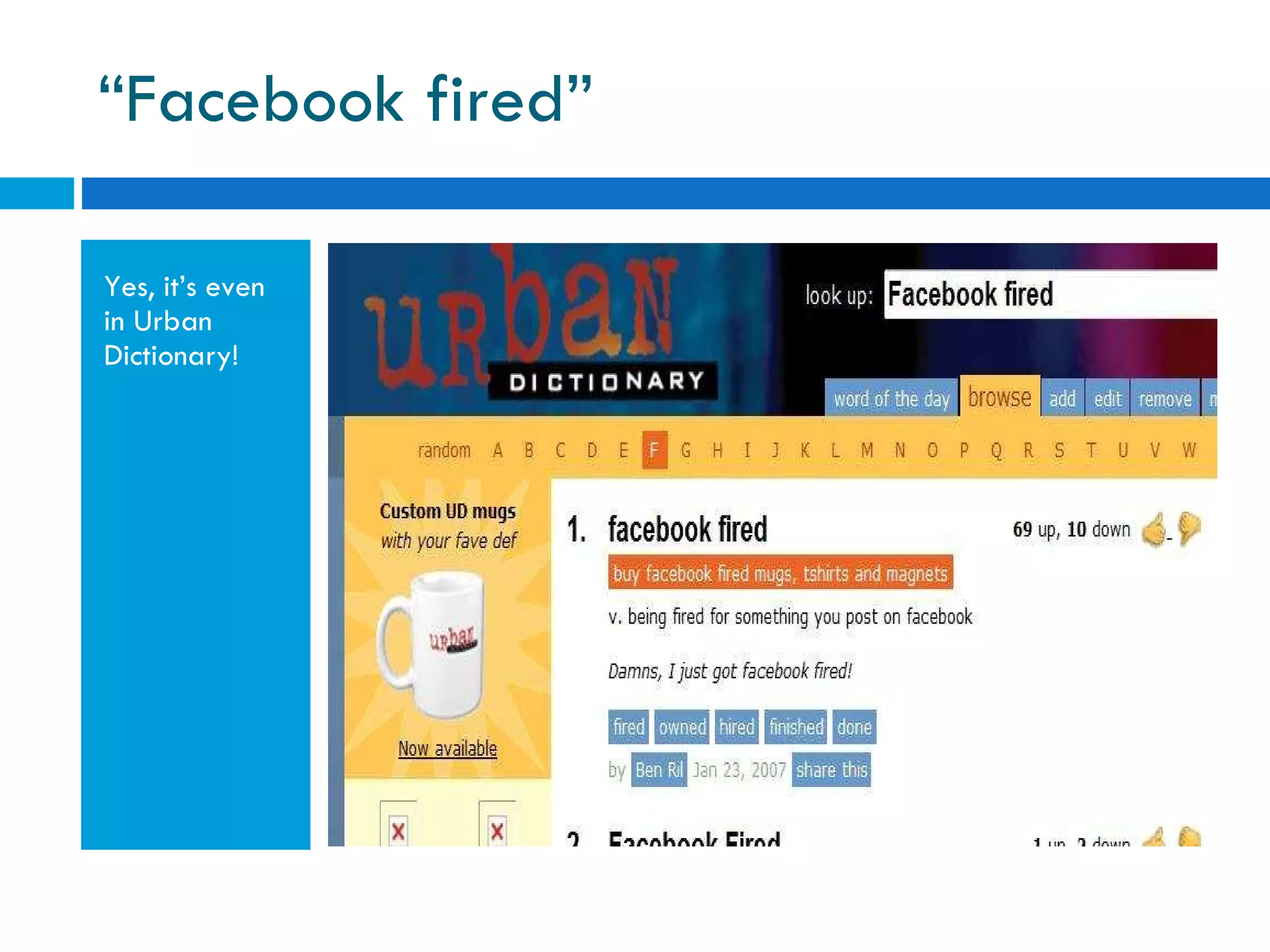
“ Facebook fired” Yes, it’s even in Urban Dictionary!
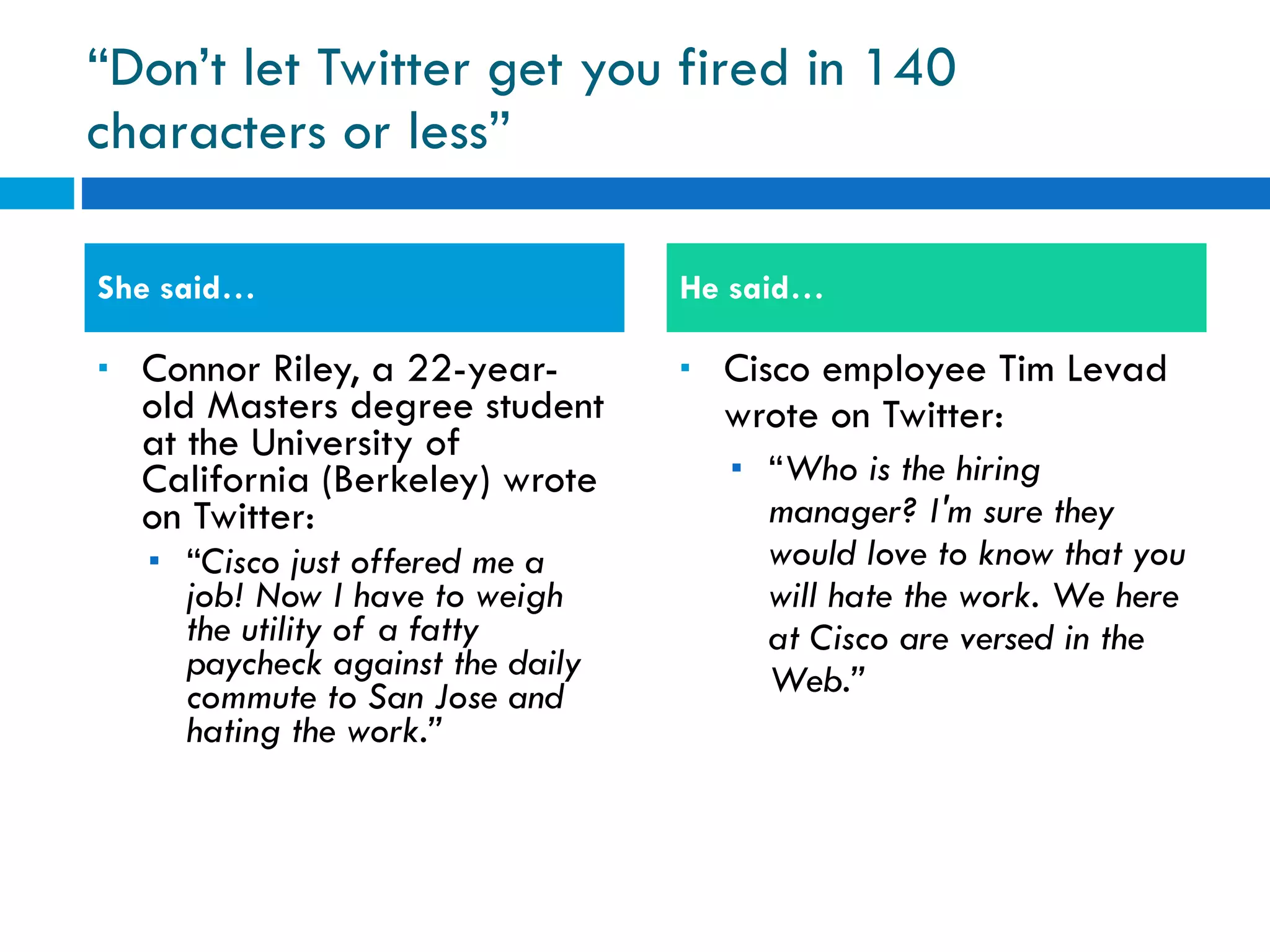
“ Don’t let Twitter get you fired in 140 characters or less” Connor Riley, a 22-year-old Masters degree student at the University of California (Berkeley) wrote on Twitter: “ Cisco just offered me a job! Now I have to weigh the utility of a fatty paycheck against the daily commute to San Jose and hating the work.” Cisco employee Tim Levad wrote on Twitter: “ Who is the hiring manager? I'm sure they would love to know that you will hate the work. We here at Cisco are versed in the Web.” She said… He said…
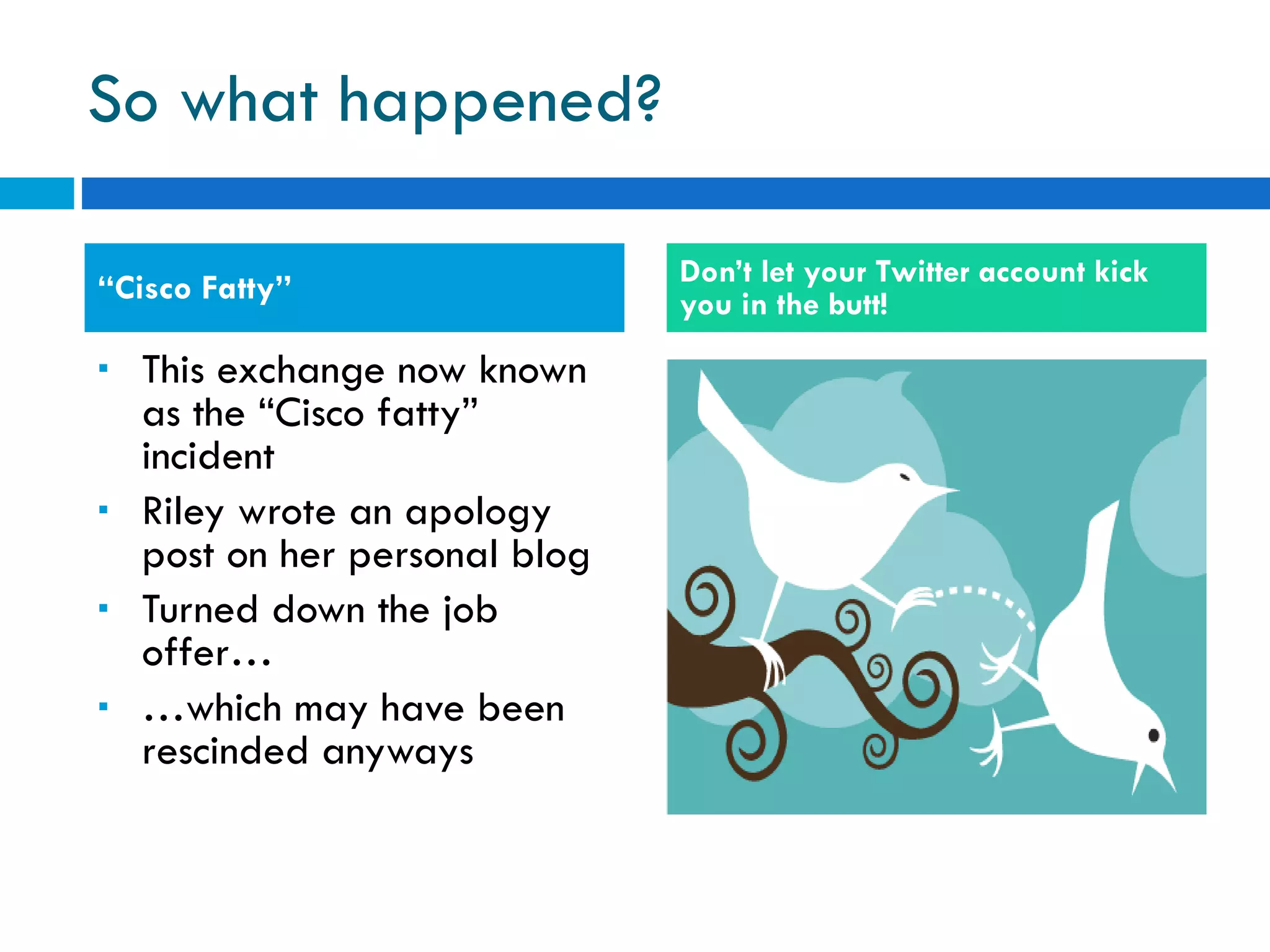
So what happened? This exchange now known as the “Cisco fatty” incident Riley wrote an apology post on her personal blog Turned down the job offer… … which may have been rescinded anyways “ Cisco Fatty” Don’t let your Twitter account kick you in the butt!
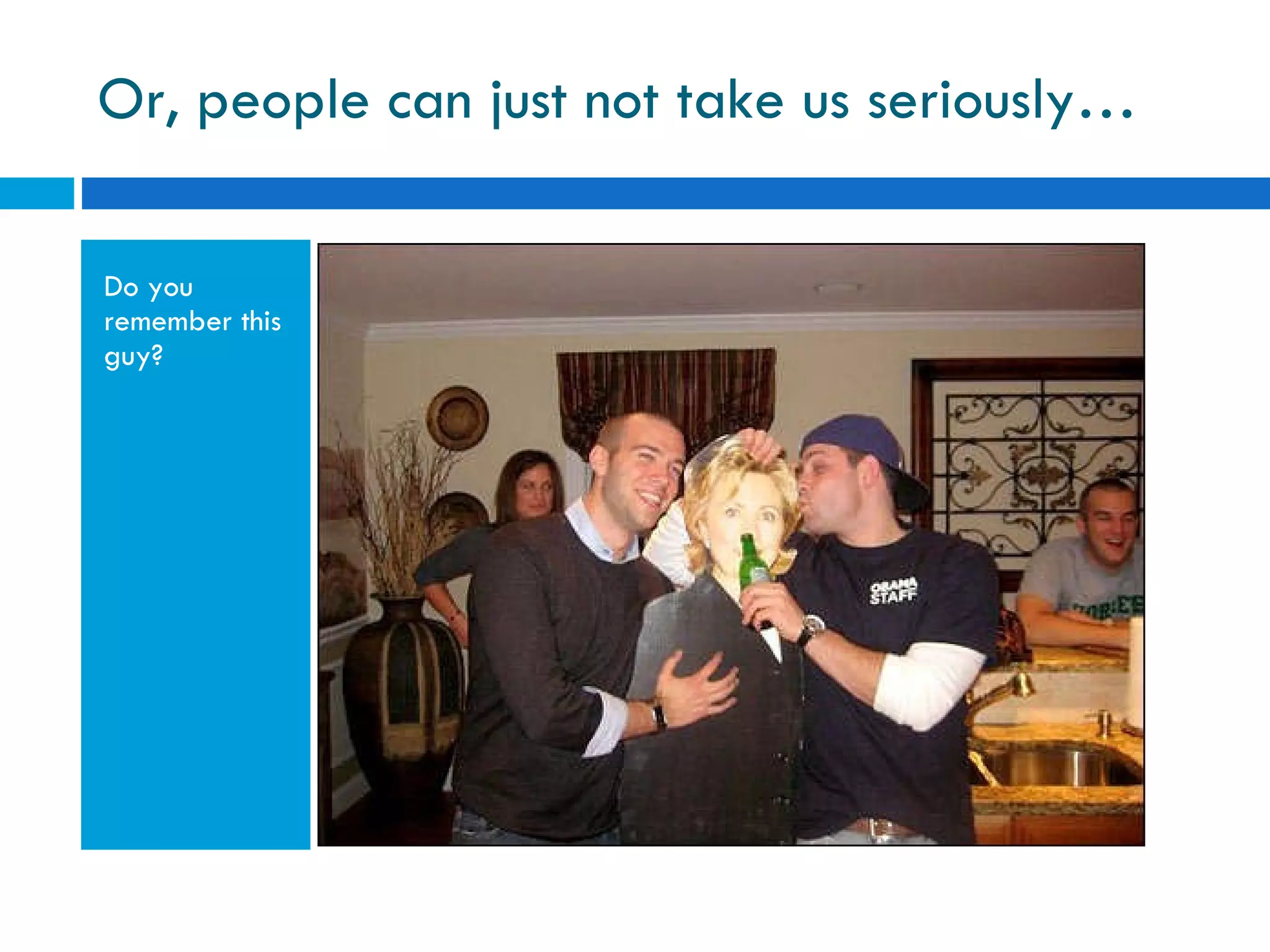
Or, people can just not take us seriously… Do you remember this guy?
Jon Favreau President Obama’s speechwriter throughout his campaign for president Tagged in a photo on Facebook One of his friends posted photo on a website for a total of TWO hours Which was TWO hours too many to be leaked across the world… Still Obama’s chief speechwriter He took down all photos but one on his Facebook profile Apologized profusely to Clinton and her team
Employers Not Taking Us Seriously… A substantial proportion of employers are screening social networking sites before they hire a prospective employee 35% of employers have not hired someone because of something they found online
So…who else is paying attention? We don’t even know! Nearly 4 in 10 Facebook and Twitter users have posted specifics on holiday plans or statuses on holiday getaways Increases risk of break-in Posting even your birthday on Facebook can allow others to “predict” your SSN In new study, researchers were able to predict SSN of recently born with 60% accuracy (of 1000 tries) Can be used to steal identity and/or open credit cards in someone’s name
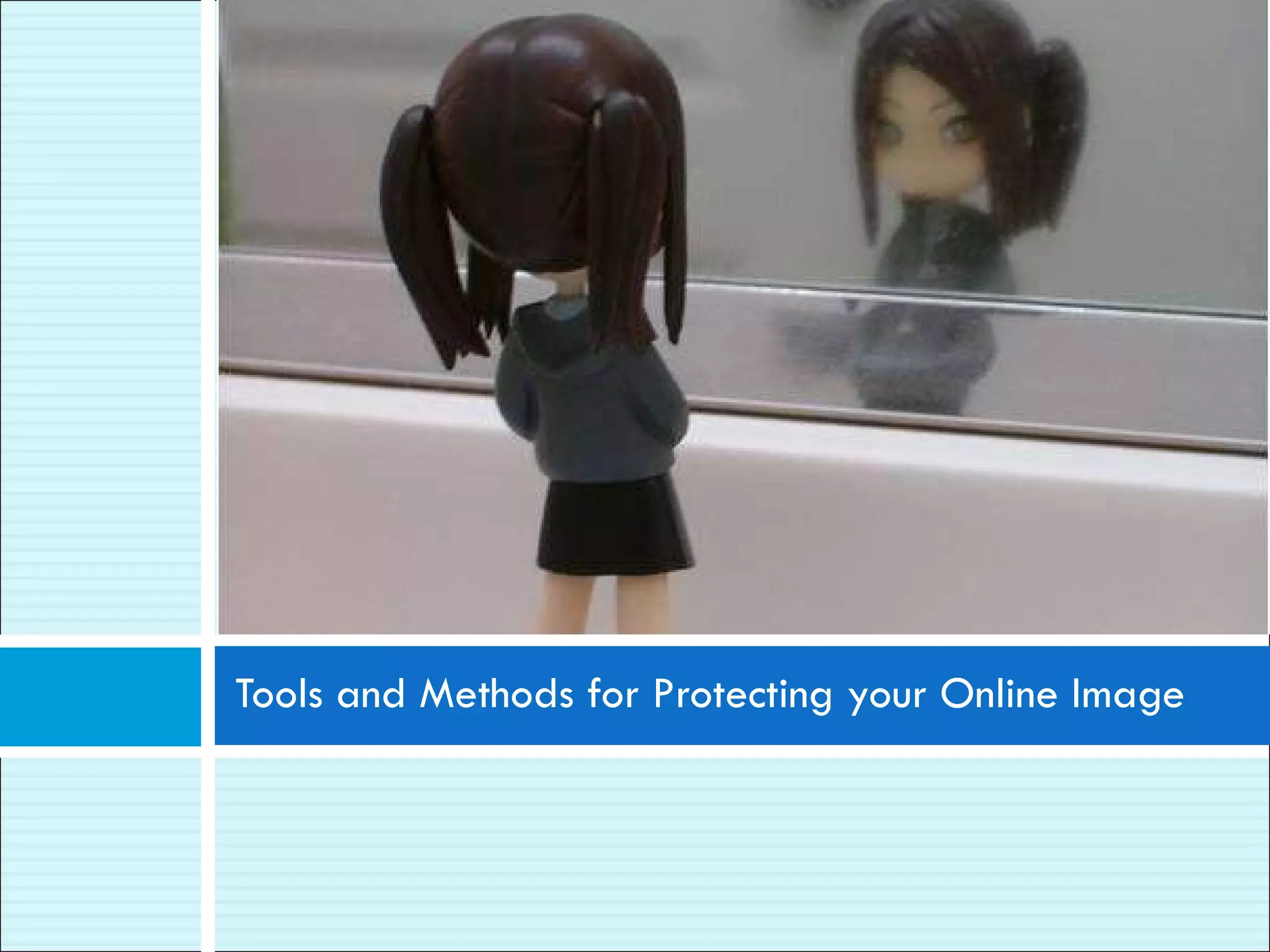
Tools and Methods for Protecting your Online Image
First, the bad news…
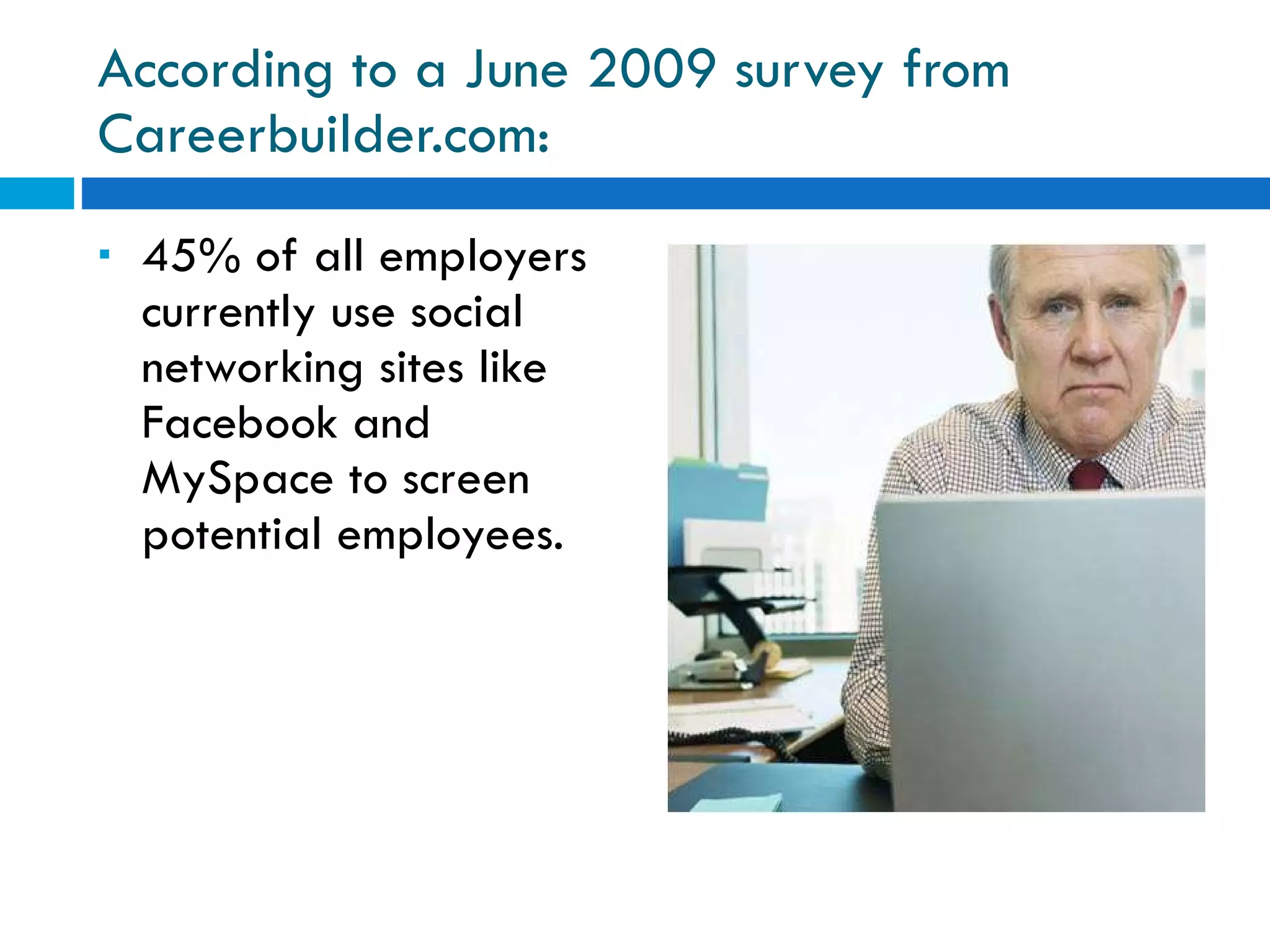
According to a June 2009 survey from Careerbuilder.com: 45% of all employers currently use social networking sites like Facebook and MySpace to screen potential employees.
Furthermore… 35% of employers say they have found material during an online search which caused them not to hire an job candidate, including: Provocative or inappropriate photographs or information Content about drinking or using drugs Bad-mouthing of previous employers, coworkers, or clients Poor communication skills Discriminatory comments
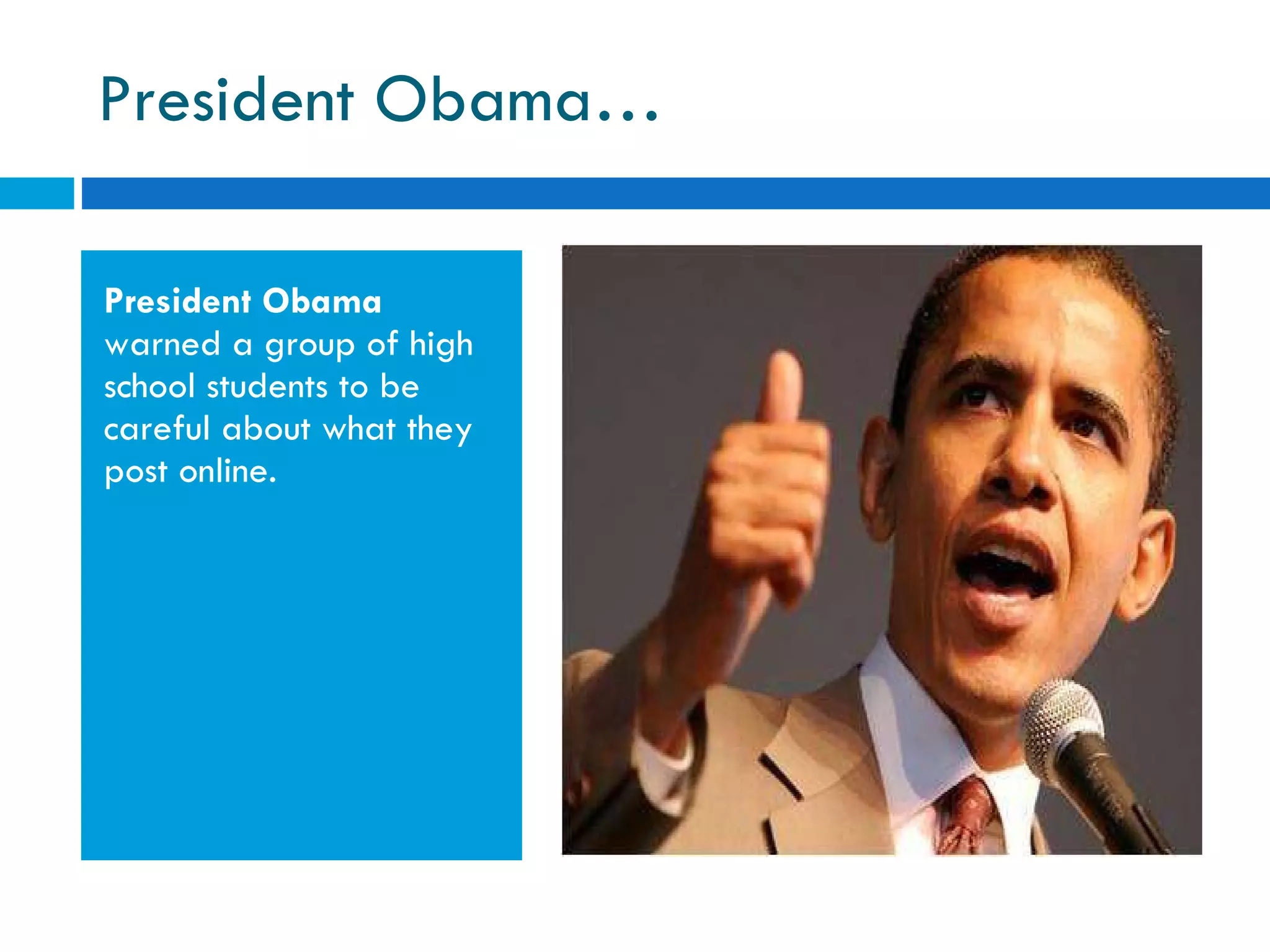
President Obama… President Obama  warned a group of high school students to be careful about what they post online.
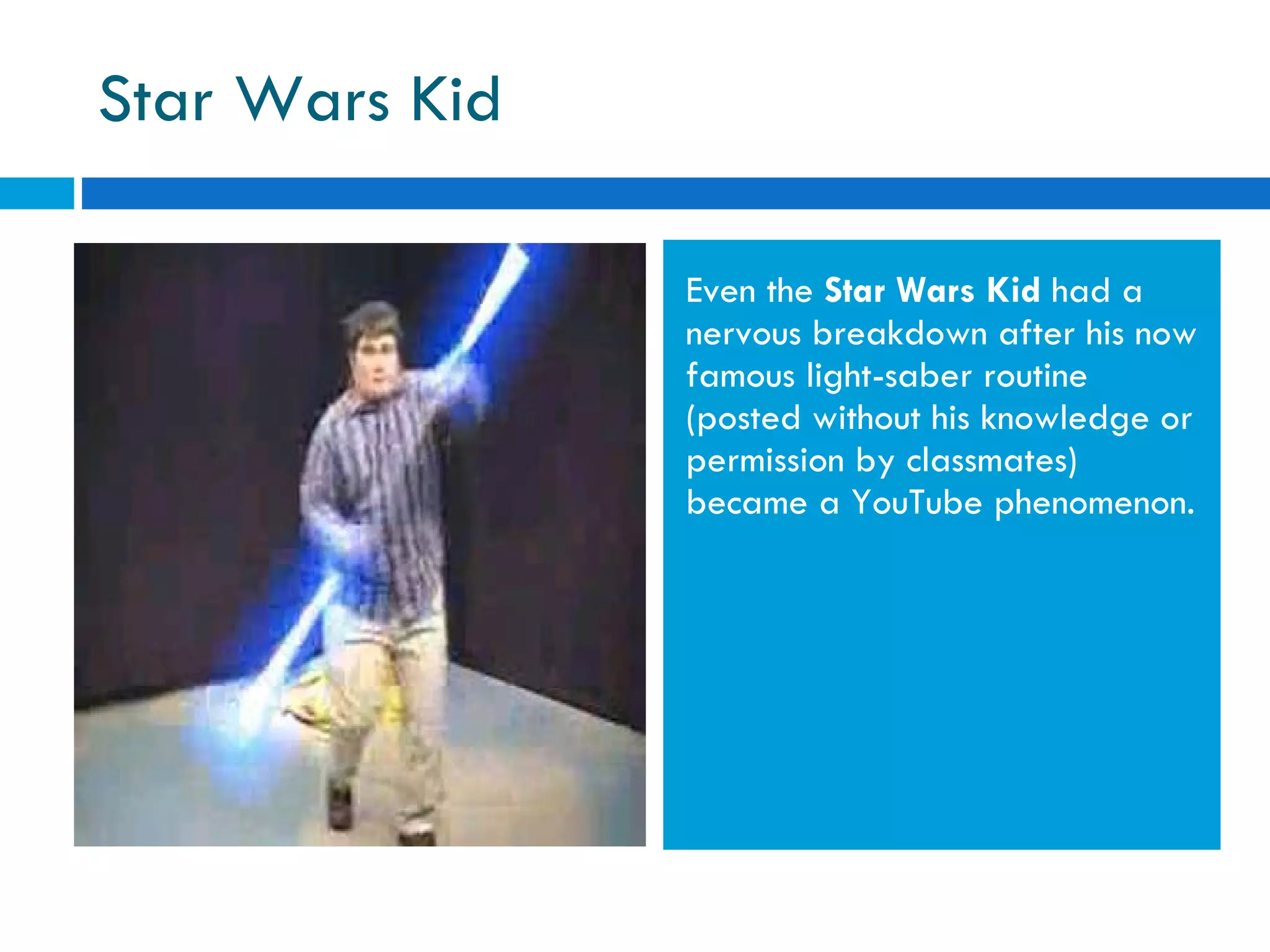
Star Wars Kid Even the  Star Wars Kid  had a nervous breakdown after his now famous light-saber routine (posted without his knowledge or permission by classmates) became a YouTube phenomenon.
Now for the good news…
You CAN protect your online privacy and reputation with just a few simple steps
Facebook Adjust your  Privacy Settings Read the  fine print  on all those applications and quizzes Consider using separate Facebook profiles for your professional and social life Be mindful about what you post
flick r Adjust your  Privacy and Permissions settings , your  Profile privacy , and your  account search options Consider licensing your photos under a  Creative Commons  license* Again, be careful about what you share
G o o g l e Google yourself and  see   what   pops   up   Contact the site's webmaster to see if you can have unwanted information removed Consider signing up for an online monitoring service such as  ReputationDefender.com
Twitter Twitter is generally considered a fairly public platform, but there are still steps that you can take to make your content more private if you prefer: Protect  your Tweets Hide  your location information One more time: be mindful about what you post
And in general… Always be sure to  read   the   fine   print  before signing up for a new online tool Check regularly for new or altered online content- BE VIGILANT! Finally (all together now): Be mindful about what you post or share!
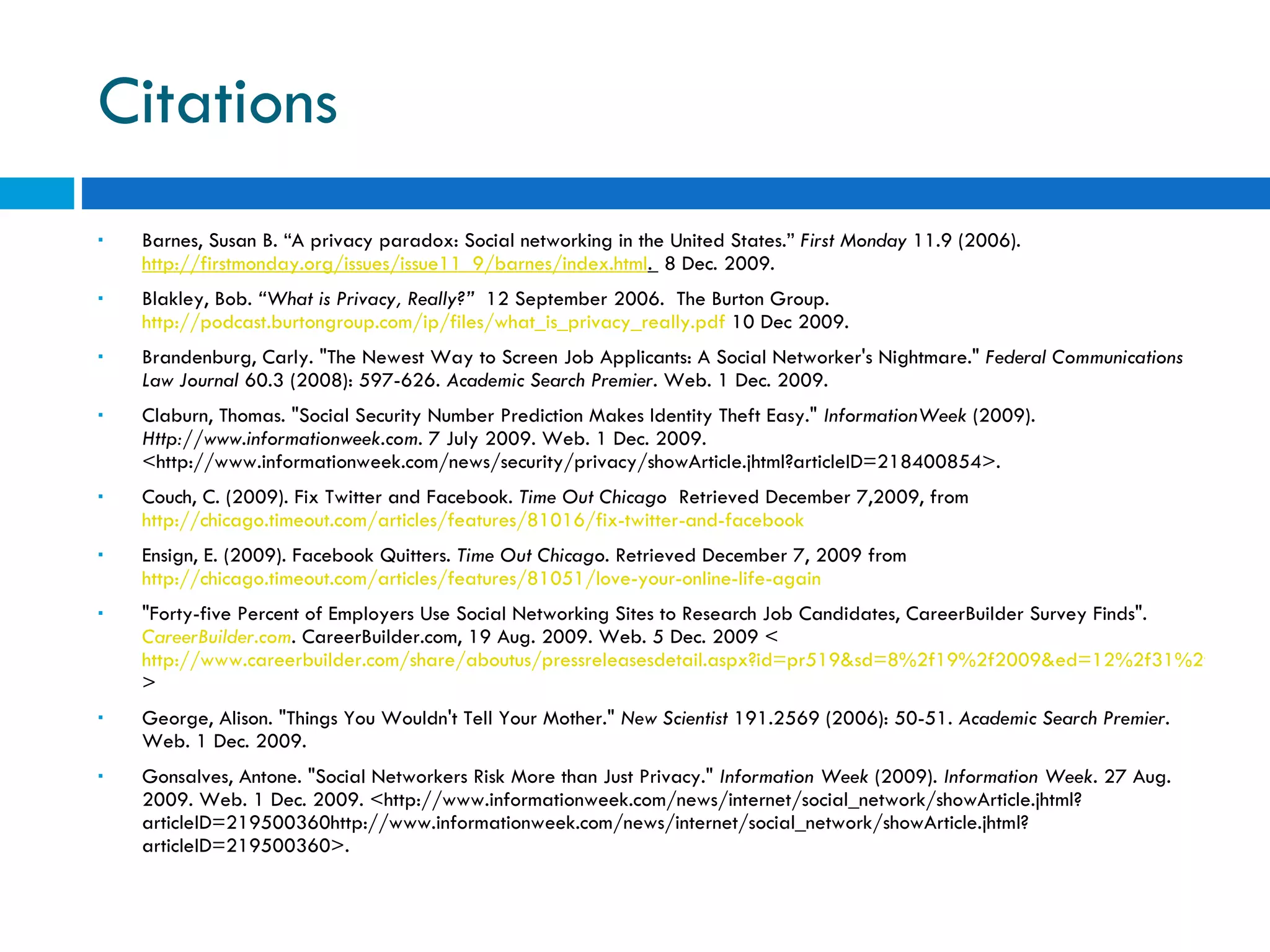
Citations Barnes, Susan B. “A privacy paradox: Social networking in the United States.”  First Monday  11.9 (2006).  http://firstmonday.org/issues/issue11_9/barnes/index.html .   8 Dec. 2009. Blakley, Bob.  “What is Privacy, Really?”   12 September 2006.  The Burton Group.  http://podcast.burtongroup.com/ip/files/what_is_privacy_really.pdf  10 Dec 2009.  Brandenburg, Carly. &quot;The Newest Way to Screen Job Applicants: A Social Networker's Nightmare.&quot;  Federal Communications Law Journal  60.3 (2008): 597-626.  Academic Search Premier . Web. 1 Dec. 2009.  Claburn, Thomas. &quot;Social Security Number Prediction Makes Identity Theft Easy.&quot;  InformationWeek  (2009).  Http://www.informationweek.com . 7 July 2009. Web. 1 Dec. 2009. <http://www.informationweek.com/news/security/privacy/showArticle.jhtml?articleID=218400854>.  Couch, C. (2009). Fix Twitter and Facebook.  Time Out Chicago   Retrieved December 7,2009, from  http://chicago.timeout.com/articles/features/81016/fix-twitter-and-facebook   Ensign, E. (2009). Facebook Quitters.  Time Out Chicago . Retrieved December 7, 2009 from  http://chicago.timeout.com/articles/features/81051/love-your-online-life-again   &quot;Forty-five Percent of Employers Use Social Networking Sites to Research Job Candidates, CareerBuilder Survey Finds&quot;.  CareerBuilder.com . CareerBuilder.com, 19 Aug. 2009. Web. 5 Dec. 2009 < http://www.careerbuilder.com/share/aboutus/pressreleasesdetail.aspx?id=pr519&sd=8%2f19%2f2009&ed=12%2f31%2f2009&siteid=cbpr&sc_cmp1=cb_pr519_ > George, Alison. &quot;Things You Wouldn't Tell Your Mother.&quot;  New Scientist  191.2569 (2006): 50-51.  Academic Search Premier . Web. 1 Dec. 2009.  Gonsalves, Antone. &quot;Social Networkers Risk More than Just Privacy.&quot;  Information Week  (2009).  Information Week . 27 Aug. 2009. Web. 1 Dec. 2009. <http://www.informationweek.com/news/internet/social_network/showArticle.jhtml?articleID=219500360http://www.informationweek.com/news/internet/social_network/showArticle.jhtml?articleID=219500360>.
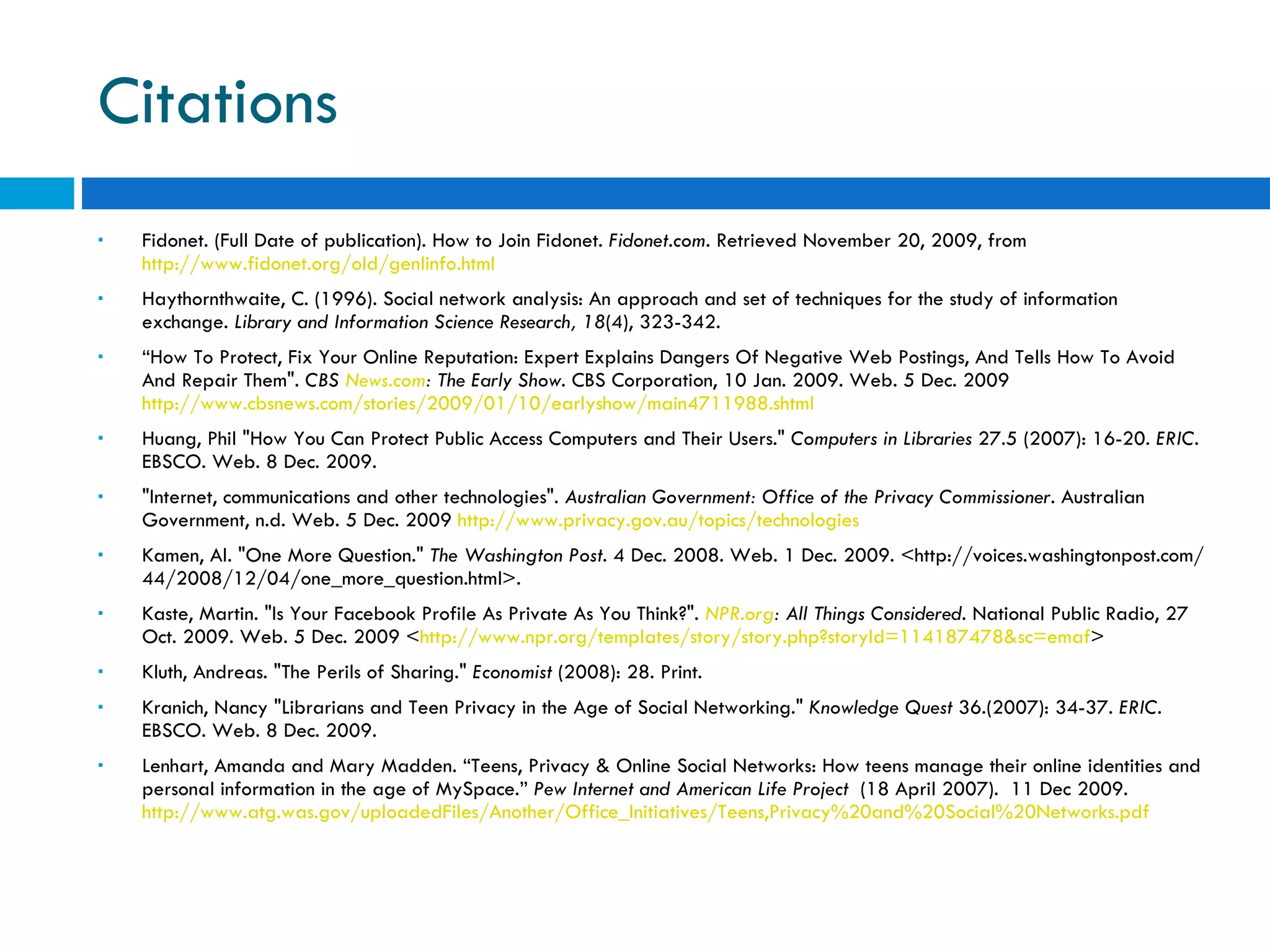
Citations Fidonet. (Full Date of publication). How to Join Fidonet.  Fidonet.com . Retrieved November 20, 2009, from  http://www.fidonet.org/old/genlinfo.html   Haythornthwaite, C. (1996). Social network analysis: An approach and set of techniques for the study of information exchange.  Library and Information Science Research, 18 (4), 323-342. “ How To Protect, Fix Your Online Reputation: Expert Explains Dangers Of Negative Web Postings, And Tells How To Avoid And Repair Them&quot;.  CBS  News.com : The Early Show . CBS Corporation, 10 Jan. 2009. Web. 5 Dec. 2009  http://www.cbsnews.com/stories/2009/01/10/earlyshow/main4711988.shtml Huang, Phil &quot;How You Can Protect Public Access Computers and Their Users.&quot;  Computers in Libraries  27.5 (2007): 16-20.  ERIC . EBSCO. Web. 8 Dec. 2009. &quot;Internet, communications and other technologies&quot;.  Australian Government: Office of the Privacy Commissioner . Australian Government, n.d. Web. 5 Dec. 2009  http://www.privacy.gov.au/topics/technologies Kamen, Al. &quot;One More Question.&quot;  The Washington Post . 4 Dec. 2008. Web. 1 Dec. 2009. <http://voices.washingtonpost.com/44/2008/12/04/one_more_question.html>.  Kaste, Martin. &quot;Is Your Facebook Profile As Private As You Think?&quot;.  NPR.org : All Things Considered . National Public Radio, 27 Oct. 2009. Web. 5 Dec. 2009 < http://www.npr.org/templates/story/story.php?storyId=114187478&sc=emaf > Kluth, Andreas. &quot;The Perils of Sharing.&quot;  Economist  (2008): 28. Print.  Kranich, Nancy &quot;Librarians and Teen Privacy in the Age of Social Networking.&quot;  Knowledge Quest  36.(2007): 34-37.  ERIC . EBSCO. Web. 8 Dec. 2009. Lenhart, Amanda and Mary Madden. “Teens, Privacy & Online Social Networks: How teens manage their online identities and personal information in the age of MySpace.”  Pew Internet and American Life Project  (18 April 2007).  11 Dec 2009.  http://www.atg.was.gov/uploadedFiles/Another/Office_Initiatives/Teens,Privacy%20and%20Social%20Networks.pdf
Citations Lorenz, Kate. &quot;Employers are digging up your digital dirt&quot;.  The Work Buzz . CareerBuilder.com, 19 Aug. 2009. Web. 5 Dec. 2009 < http://www.theworkbuzz.com/job-surveys/social-network/ > MacMillan, Douglas. &quot;A Twitter Code of Conduct.&quot;  BusinessWeek  (2009): 26.  Academic Search Premier . Web. 1 Dec. 2009.  Mangla, Ismat Sarah. &quot;Fired for Facebook: Don't Let it Happen to You.&quot;  CNN . 21 Apr. 2009. Web. 3 Dec. 2009. <http://www.cnn.com>.  McConnell, B. (2008). Social Networks from the 80’s to the 00’s.  Gigaom  Retrieved November 16, 2009, from  http://gigaom.com/2008/01/20/social-networks-from-the-80s-to-the-00s/   Mitrano, Tracy &quot;A Wider World: Youth, Privacy, and Social Networking Technologies.&quot;  EDUCAUSE Review  41.(2006): 16-18,.  ERIC . EBSCO. Web. 8 Dec. 2009. Nyce and Kahn (n.d.) Vannevar Bush and Memex   The World Wide Web: the Beginning and Now  Retrieved November 16, 2009, from   http://www-personal.umich.edu/~mattkaz/history/memex3.html O'Neill, Nick. &quot;10 Privacy Settings Every Facebook User Should Know&quot;.  All Facebook . n.p, 2 Feb. 09. Web. 5 Dec. 2009  http://www.allfacebook.com/2009/02/facebook-privacy/ Perez, Sarah. &quot;5 Easy Steps to Stay Safe (and Private!) on Facebook&quot;.  ReadWriteWeb . n.p., 16 Sep. 2009. Web. 5 Dec. 2009 < http://www.readwriteweb.com/archives/5_easy_steps_to_stay_safe_and_private_on_facebook.php > Peter, I. (2004). History of Email.  Net History . Retrieved November 16, 2009, from  http://www.nethistory.info/History%20of%20the%20Internet/email.html   Popkin, Helen A.S. &quot;Twitter Gets You Fired in 140 Characters or Less.&quot;  MSNBC . 23 Mar. 2009. Web. 1 Dec. 2009. <http://www.msnbc.com>.
Citations &quot;Rules and Tools for Protecting Personal Privacy Online&quot;.  Online Privacy Alliance . Online Privacy Alliance, n.d. Web. 5 Dec. 2009  http://www.privacyalliance.org/resources/rulesntools.shtml Schmidt, Cynthia Martin &quot;The Library Media Specialist's Role in Teaching Online Safety.&quot;  Library Media Connection  28.1 (2009): 10-13.  ERIC . EBSCO. Web. 8 Dec. 2009. Sheehan, Kim Bartel “How public opinion polls define and circumscribe online privacy.”  First Monday  9.7 (2004). 8 Dec. 2009.  http://firstmonday.org/htbin/cgiwrap/bin/ojs/index.php/fm/article/view/1162/1082 .  Solove, Daniel J. &quot;The End of Privacy?&quot;  Scientific American  299.3 (2008): 100-06.  Academic Search Premier . Web. 1 Dec. 2009.  Sydell, Laura. &quot;Teens Take Advantage of Online Privacy Tools&quot;.  NPR.org: All Things Considered . National Public Radio, 3 April 2008. Web. 5 Dec. 2009. < http://www.npr.org/templates/story/story.php?storyId=89355786 > Timm, Dianne M., and Carolyn J. Duven &quot;Privacy and Social Networking Sites.&quot;  New Directions for Student Services  124 (2008): 89-102.  ERIC . EBSCO. Web. 8 Dec. 2009. U.S. Department of Education “Family Educational Rights and Privacy Act (FERPA).” 8 Dec. 2009.  http://www.ed.gov/policy/gen/guid/fpco/ferpa/index.html .  West, Heather. “Is Online Privacy a Generational Issue?”  Pew Internet & American Life Project , October 1, 2009.  8 Dec. 2009 .  http://www.pewinternet.org/Media-Mentions/2009/Is-Online-Privacy-a-Generational-Issue.aspx.  Wikipedia (2009). YouTube.  Wikipedia . Retrieved November 16, 2009, from  http://en.wikipedia.org/wiki/YouTube Yadav, Sid (2006). Facebook – The Complete Biography.  Mashable: The Social Media Guide  Retrieved November 20, 2009, from  http://mashable.com/2006/08/25/facebook-profile/   Young Adult Library Serivices Association. “DOPA Information Packet: A Resource for Librarians and Library Workers.: 8 August 2006. 12 Dec. 2009 <http://www.ala.org/ala/mgrps/divs/yalsa/profdev/DOPAInfoPacket.pdf>
Citations – Images  “ Defining Online Privacy” - http://www.anniefox.com/parents/images/keep_out_sign.jpg  “ Privacy is Not Solitude”  -http://media.photobucket.com/image/loneliness/spectrojin/loneliness.gif  “ Is Privacy Anonymity?”  -  http://www.mathewingram.com/work/wp-content/uploads/anonymity.jpg  “ What About Secrecy?” -  http://www.psychologicalscience.org/observer/2006/0706/images/secrets.jpg “ Don’t I Have a Right to Privacy?” - http://www.wku.edu/Library/dlps/gdoc_pix/We_The_People.jpe  “ Important Privacy Legislation” –  http://upload.wikimedia.org/wikipedia/commons/archive/5/5a/20090613231808!US_Capitol_dome_Jan_2006.jpg   “ Teens and Privacy” -  http://www.reputationdefenderblog.com/wp-content/uploads/2008/12/teens-online-53.jpg   “ Good News!” -  http://www.vikingimporting.com/images/Wraps/ev_confetti.jpg “ However…” -  http://i153.photobucket.com/albums/s214/emeraldaslgirl08/happy_face.jpg http://2.bp.blogspot.com/_nWpwm6lhWUs/R7yQGWEGTKI/AAAAAAAABm4/FEDdNFFKGXc/s320/Unhappy%2Bface%2BStop.PNG   “ Danger” -  http://www.nmsu.edu/safety/images/signs/sign_danger_lg.GIF     http://conference.heavy-horse.co.uk/face-surprise.png

Lis 768 Privacy Presentation

  • 1.
    ONLINE PRIVACY LIS768 – Fall 2009 How and why we should teach the risks and tools associated with online privacy and social networking By: Julia Bryan-Diehl Mike Hominick Dan Mauller Leslie Westerberg
  • 2.
    Presentation In thispresentation, we will discuss: The history of privacy and online social networking Perceptions of privacy Privacy risks and consequences Tools for teaching privacy
  • 3.
    A Brief Historyof Online Social Networking
  • 4.
    What is OnlineSocial Networking? Construct a public or semi-public profile within a bounded system Articulate a list of other users with whom they share a connection View and traverse their list of connections and those made by others within the system. The nature and nomenclature of these connections may vary from site to site
  • 5.
    1945: Memex Firstmention of personal computer “ Wholly new forms of encyclopedias will appear, ready-made with a mesh of associative trails running through them, ready to be dropped into the memex and there amplified.” Predicted many kinds of technology invented such as the Internet the World Wide Web and Wikipedia
  • 6.
    1962: Advanced ResearchProject Agency Resulted in the creation of commercial time-sharing systems Ultimately led to the internet “ There has to be some way of facilitating communication among people without bringing them together in one place.” - Dr. J.C.R. Licklider
  • 7.
    1960’s-1970’s: Electronic Mail 1965 - Probably the first email system was MAILBOX, used at Massachusetts Institute of Technology Email could only be used to send messages to various users of the same computer. With computer internetworking, electronic mail needed to indicate address just like the postal system 1972 – Ray Tomlinson is credited with inventing email
  • 8.
    1980’s: Bulletin BoardSystems Online meeting places Allowed users to communicate with a central system Could download files or games (many times including pirated software) and post messages to other users.
  • 9.
    BBS: FidoNet Exampleof how to set up an account: Gain a basic understanding of Fidonet and your software. Download the POLICY4.ZIP document from a nearby FidoNet BBS. Read this thoroughly. Then read it again. Do the same with your software's documentation. You will also need a current copy of the Fidonet Nodelist. Set up your BBS. Make sure it operates correctly, to the best of your knowledge. Follow, to the letter, the procedure outlined in POLICY4 for joining Fidonet. The request *MUST* come in as a Netmail message. This shows the NC that your system is indeed capable of exchanging mail -- the basic requirement for membership. Do NOT request a node number in a LOCAL message on your NC's system, it will only delay the process, and may even be simply ignored. Be patient. It may take up to 2 weeks for your request to be fully processed and appear in the Nodelist. Remember that your NC may not be able to contact you at all until your address becomes official.
  • 10.
    1989 through Early1990’s: America Online At it’s peak, had over 30 million members Began as forum to play video games and track high scores Created concept of chat rooms
  • 11.
    1997: SixdegreesMany consider this the first social networking site Allowed users to create profiles List their Friends Surf the Friends lists
  • 12.
    2002: Friendster Friendsof Friends meet Send invitations, messages, blog “ One of the biggest disappointments in Internet history”
  • 13.
    2003: MySpace Beganto promote independent music and the socialite scene across the globe Personalized Pages Significant drop in usage in United States
  • 14.
    2003: Linkedin NetworkingMake “connections” Over 30 million business people are members
  • 15.
    2005: YouTube Sharevideos Censored and criticized for content “ Embodies and promotes democracy”
  • 16.
    2004: Facebook Neededschool email to join Personalized profiles Corporations are advertising on site Controversies over personal data control
  • 17.
    2006: Twitter Contactsstay in touch Growing news source 40% of users are retained Excruciating minutia?
  • 18.
    Recent Backlash PrivacyConcerns Advertisers targeting users Offensive material “… may share your information with third parties, including responsible companies with which we have a relationship.” Does concerns outweighing appeal
  • 19.
    Addressing Privacy ConcernsIssues must be addressed as online social networking reaches a larger audience.
  • 20.
  • 21.
    Privacy is NOTsolitude Essentially meaningless in the context of Social Networks Teens want to be connected 24/7
  • 22.
    Is privacy anonymity?Anonymity precludes the need for privacy Can you be sure you’re anonymous online?
  • 23.
    What about secrecy?Remember – once posted, information is in the public sphere Best way to keep a secret: Don’t share it!
  • 24.
    Underlying Issue: ControlYou have NO control over the information others share…even if it’s about you! You CAN control the information YOU share (and access to it!)
  • 25.
    Don’t I Havea Right to Privacy? The constitution only guarantees freedom from governmental intrusion
  • 26.
    Something to KnowAbout… Deleting Online Predators Act of 2006 Intended to Protect Children Could require libraries to block access to Social Networking Sites PROBLEM : Too Broadly Defined Amazon.com Educational Sites “ We know that the best way to protect children is to teach them to guard their privacy and make wise choices. “ -Former ALA President Michael Gorman
  • 27.
  • 28.
    Good news! Accordingto Pew (2007): 66% of teens use privacy controls to limit access to their personal information Only 6% make public their first and last names (first name + photo is the norm)
  • 29.
    However… Teens ThinkIt’s Always OK to Share Publicly: Teens Think It’s Never OK to Share Publicly: Their home address Their home phone number Their Social Security number Their age Their e-mail address Personal Photos
  • 30.
    Teens Think It’s Sometimes OK to Share Publicly : Their cell phone number The town they live in The school they attend Their Zip Code
  • 31.
    Bottom Line: Only you can decide what level of privacy you are comfortable with – know the risks! Think about how you want to control your personal information before you share it “ Don’t talk to strangers” is useless advice in an online context Remember: Social Sites are considered PUBLIC space Learn how to use the tools that give you control
  • 32.
    Social Networking andPrivacy Risks
  • 33.
    Why should wecare about the risks? We should not simply “opt” out of social networking and the Internet in general That is not the solution! Participation in social networking sites has become almost “automatic” We should be aware of what we are posting on sites because our intent IS to share this information But with who? A lot is at stake!
  • 34.
    What do youwant to “risk” being seen? On most sites, the privacy default is set to allow the maximum number of people to see your profile On Facebook, by leaving your settings to the default your profile can be seen by your entire network Average percentage of entire Facebook community = 0.5% On MySpace – it is ENTIRE MySpace community Despite these statistics, many users don’t utilize the privacy settings
  • 35.
    What is ityou’re sharing? Full Name Hometown Address Employer Phone Number Relationship Status College Attending/Attended E-mail Lots more! Full Name Location Employer Income Children? Interests Blog Sexual Orientation Lots more! Facebook MySpace
  • 36.
    So, who’s payingattention anyways? Prospective employers Prospective colleges Friends Family Campus community Professors Police Officers Student Affairs Professionals People who could do damaging things?
  • 37.
    Yes, this informationcan be used against you! Do privacy laws protect us from what we post on the web? Not always! Example 1: Student (under 21) posts pictures of themselves drinking. Protected by 4 th Amendment (illegal search and seizure, guaranteed due process until found in plain view)? No! When pictures are posted online, they are no longer considered private.
  • 38.
    Yes, this informationcan be used against you! Example 2: Student posts negative comments about a professor, including a threat (I’d like to beat that guy up!) – Is the student protected by 1 st Amendment? No! Because he made a threat and because he did so in a public forum, he is not protected by 1 st Amendment OR privacy laws.
  • 39.
    Are you beingwatched? Maybe? Students at George Washington U thought campus police were monitoring their Facebook activity Decided to advertise that they were having a “keg party” using Facebook Police DID show up to the “keg party” The keg party consisted of a group of students eating cupcakes with the word “beer” written on them Confirmed their belief that university and police officials WERE monitoring their activity!
  • 40.
    Who are weaffecting when we post other people’s information? How many of you have heard of the “Star Wars Kid”? Seen by millions and millions of viewers Not just ourselves! Have you seen me?
  • 41.
    What happened tohim? People remixed the video of him with special effects and Star Wars music, “mashed” it with other movies Appeared in a video game and on several TV shows Since, the (then) 15-year-old kid has: Dropped out of school Gone to counseling More or less disappeared
  • 42.
    Whose reputation areyou ruining? What employees post during the work day and what they post about their company are things they SHOULD be aware they will be held accountable for What are companies doing? Social media policies Companies like IBM developing extensive policies – must be signed and read each year Outlines that you must be upfront about your identity and position at IBM when blogging and what constitutes “suitable behavior” on social media sites (such as Twitter and Facebook)
  • 43.
    How about ourown reputation being at stake? We usually take pride in our reputation We rely on it for a number of things Whether someone wants to befriend us How we are received by others Whether someone wants to date us Whether to hire someone Whether to undertake a business deal
  • 44.
    So, what canhappen when OUR reputation gets damaged? We can get fired! Please, excuse this language:
  • 45.
    “ Facebook fired”Yes, it’s even in Urban Dictionary!
  • 46.
    “ Don’t letTwitter get you fired in 140 characters or less” Connor Riley, a 22-year-old Masters degree student at the University of California (Berkeley) wrote on Twitter: “ Cisco just offered me a job! Now I have to weigh the utility of a fatty paycheck against the daily commute to San Jose and hating the work.” Cisco employee Tim Levad wrote on Twitter: “ Who is the hiring manager? I'm sure they would love to know that you will hate the work. We here at Cisco are versed in the Web.” She said… He said…
  • 47.
    So what happened?This exchange now known as the “Cisco fatty” incident Riley wrote an apology post on her personal blog Turned down the job offer… … which may have been rescinded anyways “ Cisco Fatty” Don’t let your Twitter account kick you in the butt!
  • 48.
    Or, people canjust not take us seriously… Do you remember this guy?
  • 49.
    Jon Favreau PresidentObama’s speechwriter throughout his campaign for president Tagged in a photo on Facebook One of his friends posted photo on a website for a total of TWO hours Which was TWO hours too many to be leaked across the world… Still Obama’s chief speechwriter He took down all photos but one on his Facebook profile Apologized profusely to Clinton and her team
  • 50.
    Employers Not TakingUs Seriously… A substantial proportion of employers are screening social networking sites before they hire a prospective employee 35% of employers have not hired someone because of something they found online
  • 51.
    So…who else ispaying attention? We don’t even know! Nearly 4 in 10 Facebook and Twitter users have posted specifics on holiday plans or statuses on holiday getaways Increases risk of break-in Posting even your birthday on Facebook can allow others to “predict” your SSN In new study, researchers were able to predict SSN of recently born with 60% accuracy (of 1000 tries) Can be used to steal identity and/or open credit cards in someone’s name
  • 52.
    Tools and Methodsfor Protecting your Online Image
  • 53.
  • 54.
    According to aJune 2009 survey from Careerbuilder.com: 45% of all employers currently use social networking sites like Facebook and MySpace to screen potential employees.
  • 55.
    Furthermore… 35% ofemployers say they have found material during an online search which caused them not to hire an job candidate, including: Provocative or inappropriate photographs or information Content about drinking or using drugs Bad-mouthing of previous employers, coworkers, or clients Poor communication skills Discriminatory comments
  • 56.
    President Obama… PresidentObama warned a group of high school students to be careful about what they post online.
  • 57.
    Star Wars KidEven the Star Wars Kid had a nervous breakdown after his now famous light-saber routine (posted without his knowledge or permission by classmates) became a YouTube phenomenon.
  • 58.
    Now for thegood news…
  • 59.
    You CAN protectyour online privacy and reputation with just a few simple steps
  • 60.
    Facebook Adjust your Privacy Settings Read the fine print on all those applications and quizzes Consider using separate Facebook profiles for your professional and social life Be mindful about what you post
  • 61.
    flick r Adjustyour Privacy and Permissions settings , your Profile privacy , and your account search options Consider licensing your photos under a Creative Commons license* Again, be careful about what you share
  • 62.
    G o og l e Google yourself and see what pops up Contact the site's webmaster to see if you can have unwanted information removed Consider signing up for an online monitoring service such as ReputationDefender.com
  • 63.
    Twitter Twitter isgenerally considered a fairly public platform, but there are still steps that you can take to make your content more private if you prefer: Protect your Tweets Hide your location information One more time: be mindful about what you post
  • 64.
    And in general…Always be sure to read the fine print before signing up for a new online tool Check regularly for new or altered online content- BE VIGILANT! Finally (all together now): Be mindful about what you post or share!
  • 65.
    Citations Barnes, SusanB. “A privacy paradox: Social networking in the United States.” First Monday 11.9 (2006). http://firstmonday.org/issues/issue11_9/barnes/index.html . 8 Dec. 2009. Blakley, Bob. “What is Privacy, Really?” 12 September 2006. The Burton Group. http://podcast.burtongroup.com/ip/files/what_is_privacy_really.pdf 10 Dec 2009. Brandenburg, Carly. &quot;The Newest Way to Screen Job Applicants: A Social Networker's Nightmare.&quot; Federal Communications Law Journal 60.3 (2008): 597-626. Academic Search Premier . Web. 1 Dec. 2009. Claburn, Thomas. &quot;Social Security Number Prediction Makes Identity Theft Easy.&quot; InformationWeek (2009). Http://www.informationweek.com . 7 July 2009. Web. 1 Dec. 2009. <http://www.informationweek.com/news/security/privacy/showArticle.jhtml?articleID=218400854>. Couch, C. (2009). Fix Twitter and Facebook. Time Out Chicago Retrieved December 7,2009, from http://chicago.timeout.com/articles/features/81016/fix-twitter-and-facebook Ensign, E. (2009). Facebook Quitters. Time Out Chicago . Retrieved December 7, 2009 from http://chicago.timeout.com/articles/features/81051/love-your-online-life-again &quot;Forty-five Percent of Employers Use Social Networking Sites to Research Job Candidates, CareerBuilder Survey Finds&quot;. CareerBuilder.com . CareerBuilder.com, 19 Aug. 2009. Web. 5 Dec. 2009 < http://www.careerbuilder.com/share/aboutus/pressreleasesdetail.aspx?id=pr519&sd=8%2f19%2f2009&ed=12%2f31%2f2009&siteid=cbpr&sc_cmp1=cb_pr519_ > George, Alison. &quot;Things You Wouldn't Tell Your Mother.&quot; New Scientist 191.2569 (2006): 50-51. Academic Search Premier . Web. 1 Dec. 2009. Gonsalves, Antone. &quot;Social Networkers Risk More than Just Privacy.&quot; Information Week (2009). Information Week . 27 Aug. 2009. Web. 1 Dec. 2009. <http://www.informationweek.com/news/internet/social_network/showArticle.jhtml?articleID=219500360http://www.informationweek.com/news/internet/social_network/showArticle.jhtml?articleID=219500360>.
  • 66.
    Citations Fidonet. (FullDate of publication). How to Join Fidonet. Fidonet.com . Retrieved November 20, 2009, from http://www.fidonet.org/old/genlinfo.html Haythornthwaite, C. (1996). Social network analysis: An approach and set of techniques for the study of information exchange. Library and Information Science Research, 18 (4), 323-342. “ How To Protect, Fix Your Online Reputation: Expert Explains Dangers Of Negative Web Postings, And Tells How To Avoid And Repair Them&quot;. CBS News.com : The Early Show . CBS Corporation, 10 Jan. 2009. Web. 5 Dec. 2009 http://www.cbsnews.com/stories/2009/01/10/earlyshow/main4711988.shtml Huang, Phil &quot;How You Can Protect Public Access Computers and Their Users.&quot; Computers in Libraries 27.5 (2007): 16-20. ERIC . EBSCO. Web. 8 Dec. 2009. &quot;Internet, communications and other technologies&quot;. Australian Government: Office of the Privacy Commissioner . Australian Government, n.d. Web. 5 Dec. 2009 http://www.privacy.gov.au/topics/technologies Kamen, Al. &quot;One More Question.&quot; The Washington Post . 4 Dec. 2008. Web. 1 Dec. 2009. <http://voices.washingtonpost.com/44/2008/12/04/one_more_question.html>. Kaste, Martin. &quot;Is Your Facebook Profile As Private As You Think?&quot;. NPR.org : All Things Considered . National Public Radio, 27 Oct. 2009. Web. 5 Dec. 2009 < http://www.npr.org/templates/story/story.php?storyId=114187478&sc=emaf > Kluth, Andreas. &quot;The Perils of Sharing.&quot; Economist (2008): 28. Print. Kranich, Nancy &quot;Librarians and Teen Privacy in the Age of Social Networking.&quot; Knowledge Quest 36.(2007): 34-37. ERIC . EBSCO. Web. 8 Dec. 2009. Lenhart, Amanda and Mary Madden. “Teens, Privacy & Online Social Networks: How teens manage their online identities and personal information in the age of MySpace.” Pew Internet and American Life Project (18 April 2007). 11 Dec 2009. http://www.atg.was.gov/uploadedFiles/Another/Office_Initiatives/Teens,Privacy%20and%20Social%20Networks.pdf
  • 67.
    Citations Lorenz, Kate.&quot;Employers are digging up your digital dirt&quot;. The Work Buzz . CareerBuilder.com, 19 Aug. 2009. Web. 5 Dec. 2009 < http://www.theworkbuzz.com/job-surveys/social-network/ > MacMillan, Douglas. &quot;A Twitter Code of Conduct.&quot; BusinessWeek (2009): 26. Academic Search Premier . Web. 1 Dec. 2009. Mangla, Ismat Sarah. &quot;Fired for Facebook: Don't Let it Happen to You.&quot; CNN . 21 Apr. 2009. Web. 3 Dec. 2009. <http://www.cnn.com>. McConnell, B. (2008). Social Networks from the 80’s to the 00’s. Gigaom Retrieved November 16, 2009, from http://gigaom.com/2008/01/20/social-networks-from-the-80s-to-the-00s/ Mitrano, Tracy &quot;A Wider World: Youth, Privacy, and Social Networking Technologies.&quot; EDUCAUSE Review 41.(2006): 16-18,. ERIC . EBSCO. Web. 8 Dec. 2009. Nyce and Kahn (n.d.) Vannevar Bush and Memex The World Wide Web: the Beginning and Now Retrieved November 16, 2009, from http://www-personal.umich.edu/~mattkaz/history/memex3.html O'Neill, Nick. &quot;10 Privacy Settings Every Facebook User Should Know&quot;. All Facebook . n.p, 2 Feb. 09. Web. 5 Dec. 2009 http://www.allfacebook.com/2009/02/facebook-privacy/ Perez, Sarah. &quot;5 Easy Steps to Stay Safe (and Private!) on Facebook&quot;. ReadWriteWeb . n.p., 16 Sep. 2009. Web. 5 Dec. 2009 < http://www.readwriteweb.com/archives/5_easy_steps_to_stay_safe_and_private_on_facebook.php > Peter, I. (2004). History of Email. Net History . Retrieved November 16, 2009, from http://www.nethistory.info/History%20of%20the%20Internet/email.html Popkin, Helen A.S. &quot;Twitter Gets You Fired in 140 Characters or Less.&quot; MSNBC . 23 Mar. 2009. Web. 1 Dec. 2009. <http://www.msnbc.com>.
  • 68.
    Citations &quot;Rules andTools for Protecting Personal Privacy Online&quot;. Online Privacy Alliance . Online Privacy Alliance, n.d. Web. 5 Dec. 2009 http://www.privacyalliance.org/resources/rulesntools.shtml Schmidt, Cynthia Martin &quot;The Library Media Specialist's Role in Teaching Online Safety.&quot; Library Media Connection 28.1 (2009): 10-13. ERIC . EBSCO. Web. 8 Dec. 2009. Sheehan, Kim Bartel “How public opinion polls define and circumscribe online privacy.” First Monday 9.7 (2004). 8 Dec. 2009. http://firstmonday.org/htbin/cgiwrap/bin/ojs/index.php/fm/article/view/1162/1082 . Solove, Daniel J. &quot;The End of Privacy?&quot; Scientific American 299.3 (2008): 100-06. Academic Search Premier . Web. 1 Dec. 2009. Sydell, Laura. &quot;Teens Take Advantage of Online Privacy Tools&quot;. NPR.org: All Things Considered . National Public Radio, 3 April 2008. Web. 5 Dec. 2009. < http://www.npr.org/templates/story/story.php?storyId=89355786 > Timm, Dianne M., and Carolyn J. Duven &quot;Privacy and Social Networking Sites.&quot; New Directions for Student Services 124 (2008): 89-102. ERIC . EBSCO. Web. 8 Dec. 2009. U.S. Department of Education “Family Educational Rights and Privacy Act (FERPA).” 8 Dec. 2009. http://www.ed.gov/policy/gen/guid/fpco/ferpa/index.html . West, Heather. “Is Online Privacy a Generational Issue?” Pew Internet & American Life Project , October 1, 2009. 8 Dec. 2009 . http://www.pewinternet.org/Media-Mentions/2009/Is-Online-Privacy-a-Generational-Issue.aspx. Wikipedia (2009). YouTube. Wikipedia . Retrieved November 16, 2009, from http://en.wikipedia.org/wiki/YouTube Yadav, Sid (2006). Facebook – The Complete Biography. Mashable: The Social Media Guide Retrieved November 20, 2009, from http://mashable.com/2006/08/25/facebook-profile/ Young Adult Library Serivices Association. “DOPA Information Packet: A Resource for Librarians and Library Workers.: 8 August 2006. 12 Dec. 2009 <http://www.ala.org/ala/mgrps/divs/yalsa/profdev/DOPAInfoPacket.pdf>
  • 69.
    Citations – Images “ Defining Online Privacy” - http://www.anniefox.com/parents/images/keep_out_sign.jpg “ Privacy is Not Solitude” -http://media.photobucket.com/image/loneliness/spectrojin/loneliness.gif “ Is Privacy Anonymity?” - http://www.mathewingram.com/work/wp-content/uploads/anonymity.jpg “ What About Secrecy?” - http://www.psychologicalscience.org/observer/2006/0706/images/secrets.jpg “ Don’t I Have a Right to Privacy?” - http://www.wku.edu/Library/dlps/gdoc_pix/We_The_People.jpe “ Important Privacy Legislation” – http://upload.wikimedia.org/wikipedia/commons/archive/5/5a/20090613231808!US_Capitol_dome_Jan_2006.jpg “ Teens and Privacy” - http://www.reputationdefenderblog.com/wp-content/uploads/2008/12/teens-online-53.jpg “ Good News!” - http://www.vikingimporting.com/images/Wraps/ev_confetti.jpg “ However…” - http://i153.photobucket.com/albums/s214/emeraldaslgirl08/happy_face.jpg http://2.bp.blogspot.com/_nWpwm6lhWUs/R7yQGWEGTKI/AAAAAAAABm4/FEDdNFFKGXc/s320/Unhappy%2Bface%2BStop.PNG “ Danger” - http://www.nmsu.edu/safety/images/signs/sign_danger_lg.GIF http://conference.heavy-horse.co.uk/face-surprise.png