Medication
Adherence
www.ChangeThatMatters.UMN.edu
Special thanks to Anjoli Punjabi,
PharmD, MPH for her contribution to
this slide set
Brief Overview
Patient Case
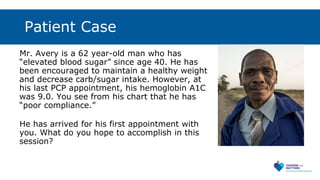
Mr. Avery is a 62 year-old man who has
“elevated blood sugar” since age 40. He has
been encouraged to maintain a healthy weight
and decrease carb/sugar intake. However, at
his last PCP appointment, his hemoglobin A1C
was 9.0. You see from his chart that he has
“poor compliance.”
He has arrived for his first appointment with
you. What do you hope to accomplish in this
session?
Discussion Questions
What behaviors do you want to address?
What are the “modifiable factors” that might be
impacting patient behavior?
What health behavior strategies could you apply?
Where Do We Start??
HTN
Psychosocial
Stressors
Depression
Elevated
BMI
DM
Lack of
Activity
Smoking
Heart Disease
Defining Adherence
“The extent to which a person’s behavior (taking
medication, following a diet, or making healthy lifestyle
changes) corresponds with agreed-upon
recommendations from a health-care provider”
World Health Organization, 2003
Defining Medication Adherence
“The patient’s conformance with the provider’s
recommendation with respect to timing, dosage, and
frequency of medication-taking during the prescribed
length of time”
Agency for Healthcare Research and Quality
Remember this…
“Drugs don’t work in patients who don’t take them.”
- C. Everett Koop
Medication Adherence Statistics
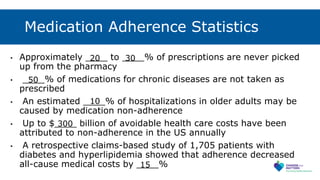
• Approximately ____ to ____% of prescriptions are never picked
up from the pharmacy
• ____% of medications for chronic diseases are not taken as
prescribed
• An estimated ____% of hospitalizations in older adults may be
caused by medication non-adherence
• Up to $____ billion of avoidable health care costs have been
attributed to non-adherence in the US annually
• A retrospective claims-based study of 1,705 patients with
diabetes and hyperlipidemia showed that adherence decreased
all-cause medical costs by ____%
20 30
50
10
300
15
The Problem With Non-Adherence
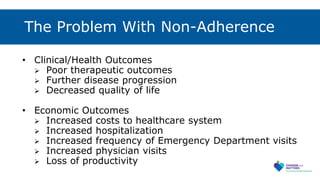
• Clinical/Health Outcomes
 Poor therapeutic outcomes
 Further disease progression
 Decreased quality of life
• Economic Outcomes
 Increased costs to healthcare system
 Increased hospitalization
 Increased frequency of Emergency Department visits
 Increased physician visits
 Loss of productivity
Most Common Reasons for Non-
Adherence
• Forgetfulness
• Concern about side effects
• High drug costs
• Perceived lack of efficacy
or low need
How Can We Predict Adherence?
Insurance
Coverage
Treatment
Modality/
Disease
Characteristics
Social Support
Social Barriers
Personality
Health
Beliefs
Attitudes
Patient &
Provider
Interactions
Assessment Strategies
Assessing Adherence
∙ Self report
∙ Homework/written materials
∙ Technology
∙ Lab values
Asking About Adherence
• Most people forget sometimes. How often do you
forget to take your medicine?
• When you feel better, do you sometimes stop taking
medicine?
• When you feel worse, do you sometimes stop taking
your medicine?
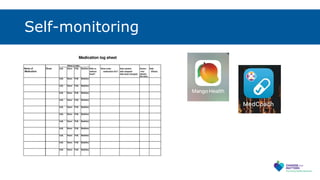
Self-monitoring
Types of “Objective” Data
Objective Recordings Laboratory Values
What About Conflicting Data?
Mr. Avery says he has been watching
his diet and monitoring his glucose.
“More vegetables, fewer desserts –
I’ve been making a lot of changes.”
“I’ve also been checking my blood
sugar and it’s been below 150 most
of the time.”
BUT….his hemoglobin A1c today was
8.0 (indicative of poor control).
AND…he left his glucometer at home.
Questions for Discussion
∙ How do you review data?
∙ What do you “believe?”
∙ Do you confront him with conflicting data?
What do you do?
“Okay… so maybe I haven’t been as
taking my medications as I should…and
maybe I’ve been eating too much ice
cream in the evenings…”
Evidence-Based Approaches
5 Approaches
• Education
• Motivational Interviewing
• Address Specific Barriers
• Self-Management Training
• Making Taking Medication a Habit
Education
Indication, Effectiveness, Safety & Adherence
• Indication Reason for taking medication
• Effectiveness What patient should expect
• Safety Potential side effects and/or interactions
• Adherence Cost, memory aids, swallowing problems
Motivational Interviewing
Facilitate patient sharing his/her story
Active and reflective listening, positive affirmations
Explore importance and build confidence (e.g. engage in
“change talk”)
Importance and confidence rulers
Make a change plan WITH the patient
Understand the Patient’s Story
How do they understand their disease?
How do they understand their treatment?
Decisional balance:
Good Bad
“Doing” treatment
Not “doing” treatment
Address Specific Barriers
• What might be specific barriers to adherence?
• A few patients will need true exposure treatment
(refer to behavioral health) for phobias (needles,
taking pills)
• Help patients set reminders if they are forgetful
Smart Phone Applications for
Adherence
Application
Name
Shape/Size
Notifications
Status
Notes
Snooze
Feature
Bedtime
Adjustment
Time
Zone
Adjustment
Interactions
Refill
Alerts
Family
Profiles
Exportable
Gamified
Medisafe
       
Dosecast
     
Medhelper
    
My Pillbox
     
Mango Health
      
Self-Management Training
Choosing Good Self-Reinforcements
Making Taking Medication a Habit
• Help with organizing medications (i.e. pillbox)
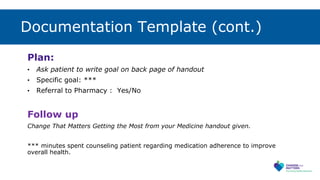
• Encourage patient to store all medications together
and out of reach of children (i.e. bathroom or kitchen
cabinet)
• Attach the timing of taking the medication to an
existing habit
• With breakfast
• When brushing teeth (AM and PM)
• Before bedtime
Making Taking Medication a Habit
• Have a contingency plan if away from home
• Single-compartment pill carriers
• Carry medicine in purse or bag
• Keep in car temporarily (most medications are temperature
sensitive)
• Engage social supports (i.e. family, friends) to help organize
medicines and remind patient
Change That Matters’ Focus
on Values/Meaning in Life
Connect Adherence to Values and Meaning
Invite patient to reflect upon:
● Why do you want to improve how you take
your medicines?
● How will improving your use of your
medicines impact your life?
● How will this change allow you to engage in
other, meaningful areas of your life?
Patient Brochure
Noteworthy Features
Handout encourages reader to:
• Identify challenges in adherence with a
specific medication
• Reflect on why this medicine is important
• Consider linking taking medication with a
daily behavior (e.g., brushing teeth)
• Ask someone to help with medication
organization and reminders
• Use alarms, apps, and pill organizers
EHR Template
Documentation Template
Assess:
• Pt IS/IS NOT using a pill box.
• Pt takes medications *** times/day.
• Frequency of missing a dose of any prescribed medication: {Never,
Almost never, 1-2 times/week, More than 2x/week}
• Barriers to adherence: {Memory, confusion, side effects, cost,
dislike taking pills, insurance coverage/restrictions, access, sheer
quantity of pills, Other}
• Reasons to improve adherence: {Health, mood, family, other)
Documentation Template (cont.)
Plan:
• Ask patient to write goal on back page of handout
• Specific goal: ***
• Referral to Pharmacy : Yes/No
Follow up
Change That Matters Getting the Most from your Medicine handout given.
*** minutes spent counseling patient regarding medication adherence to improve
overall health.
After Visit Summary (AVS) Template
Today we talked about improving how you take your medicine.
You stated you want to ***. To do this, you plan to ***.
Here are some other ideas to help with your medicines:
• Set up automatic refills with your pharmacy
• Put your medications in a pill box at the start of every week
• Link taking your medicines with a specific behavior every day.
• Ask a family member or friend to remind you
• Set a reminder alarm on your phone
• Download a free mobile app to give you reminders and track your medications
Structured Practice
Practice Activity
• Partner with someone near you!
• One person will be the patient
• One person with be the provider
● Think of a patient on your panel that you would like to improve
their adherence (e.g., using CPAP, taking pills, insulin
regimen). Imagine him/her for the role play.
● Using the pamphlet and EHR template, role play the discussion.
● Take about 5 minutes and then switch roles
Responding to Common Challenges
But Doc…
I hate taking pills.
It seems like every time I come
to the doctor I get MORE pills!
• Acknowledge taking pills can be difficult.
• Re-focus on why the medicine is important.
• Brainstorm options: taking with food, consulting with
pharmacy regarding possible decreases in quantity of pills.
But Doc…
I cannot tell that it really does anything…
Actually, I feel worse than before I started!
• Acknowledge and explore ways to manage side effects.
• Explain how some medicines may prevent the development of more serious
problems.
• Use shared decision making regarding dose and/or trying other options
Resources for Further Learning
Apgar, T., & Nunlist, M. M. (2016). Practical Ways to Improve Medication Adherence. Family
Practice Management, 23(5), 52-52.
Brown, M. T., & Sinsky, C. A. (2013). Medication adherence: We didn't ask and they didn't tell.
Family Practice Management, 20(2), 25-30.
Costa E, Giardini A, Savin M, et al. (2015). Interventional tools to improve medication adherence:
review of literature. Patient Prefer Adherence, 9, 1303–1314.
Hooker S, Punjabi A, Boyle L, et al. (2018). Encouraging health behavior change: Eight evidence-
based strategies. Family Practice Management, 25(2), 31-36
Viswanathan M, Golin CE, Jones CD, et al. (2012). Interventions to improve adherence to self-
administered medications for chronic diseases in the United States: A systematic review. Ann Intern
Med, 157(11), 785-795.
Change That Matters Team
Stephanie A. Hooker, PhD, MPH (co-PI)
Michelle D. Sherman, PhD, ABPP (co-PI)
Katie Loth, PhD, MPH Jean Moon, PharmD, BCACP
Kacey Justesen, MD Andrew Slattengren, DO
Sam Ngaw, MD Anne Doering, MD
Marc Uy, BA, MPH
Special Thanks
University of Minnesota Academic Health Center
and
National Institute for Integrated Behavioral Health
for financial support for their development and evaluation
of Change that Matters

Medication Adherence.pptx

  • 1.
    Medication Adherence www.ChangeThatMatters.UMN.edu Special thanks toAnjoli Punjabi, PharmD, MPH for her contribution to this slide set
  • 2.
  • 3.
    Patient Case Mr. Averyis a 62 year-old man who has “elevated blood sugar” since age 40. He has been encouraged to maintain a healthy weight and decrease carb/sugar intake. However, at his last PCP appointment, his hemoglobin A1C was 9.0. You see from his chart that he has “poor compliance.” He has arrived for his first appointment with you. What do you hope to accomplish in this session?
  • 4.
    Discussion Questions What behaviorsdo you want to address? What are the “modifiable factors” that might be impacting patient behavior? What health behavior strategies could you apply?
  • 5.
    Where Do WeStart?? HTN Psychosocial Stressors Depression Elevated BMI DM Lack of Activity Smoking Heart Disease
  • 6.
    Defining Adherence “The extentto which a person’s behavior (taking medication, following a diet, or making healthy lifestyle changes) corresponds with agreed-upon recommendations from a health-care provider” World Health Organization, 2003
  • 7.
    Defining Medication Adherence “Thepatient’s conformance with the provider’s recommendation with respect to timing, dosage, and frequency of medication-taking during the prescribed length of time” Agency for Healthcare Research and Quality
  • 8.
    Remember this… “Drugs don’twork in patients who don’t take them.” - C. Everett Koop
  • 9.
    Medication Adherence Statistics •Approximately ____ to ____% of prescriptions are never picked up from the pharmacy • ____% of medications for chronic diseases are not taken as prescribed • An estimated ____% of hospitalizations in older adults may be caused by medication non-adherence • Up to $____ billion of avoidable health care costs have been attributed to non-adherence in the US annually • A retrospective claims-based study of 1,705 patients with diabetes and hyperlipidemia showed that adherence decreased all-cause medical costs by ____% 20 30 50 10 300 15
  • 10.
    The Problem WithNon-Adherence • Clinical/Health Outcomes  Poor therapeutic outcomes  Further disease progression  Decreased quality of life • Economic Outcomes  Increased costs to healthcare system  Increased hospitalization  Increased frequency of Emergency Department visits  Increased physician visits  Loss of productivity
  • 11.
    Most Common Reasonsfor Non- Adherence • Forgetfulness • Concern about side effects • High drug costs • Perceived lack of efficacy or low need
  • 12.
    How Can WePredict Adherence? Insurance Coverage Treatment Modality/ Disease Characteristics Social Support Social Barriers Personality Health Beliefs Attitudes Patient & Provider Interactions
  • 13.
  • 14.
    Assessing Adherence ∙ Selfreport ∙ Homework/written materials ∙ Technology ∙ Lab values
  • 15.
    Asking About Adherence •Most people forget sometimes. How often do you forget to take your medicine? • When you feel better, do you sometimes stop taking medicine? • When you feel worse, do you sometimes stop taking your medicine?
  • 16.
  • 17.
    Types of “Objective”Data Objective Recordings Laboratory Values
  • 18.
    What About ConflictingData? Mr. Avery says he has been watching his diet and monitoring his glucose. “More vegetables, fewer desserts – I’ve been making a lot of changes.” “I’ve also been checking my blood sugar and it’s been below 150 most of the time.” BUT….his hemoglobin A1c today was 8.0 (indicative of poor control). AND…he left his glucometer at home.
  • 19.
    Questions for Discussion ∙How do you review data? ∙ What do you “believe?” ∙ Do you confront him with conflicting data?
  • 20.
    What do youdo? “Okay… so maybe I haven’t been as taking my medications as I should…and maybe I’ve been eating too much ice cream in the evenings…”
  • 21.
  • 22.
    5 Approaches • Education •Motivational Interviewing • Address Specific Barriers • Self-Management Training • Making Taking Medication a Habit
  • 23.
    Education Indication, Effectiveness, Safety& Adherence • Indication Reason for taking medication • Effectiveness What patient should expect • Safety Potential side effects and/or interactions • Adherence Cost, memory aids, swallowing problems
  • 24.
    Motivational Interviewing Facilitate patientsharing his/her story Active and reflective listening, positive affirmations Explore importance and build confidence (e.g. engage in “change talk”) Importance and confidence rulers Make a change plan WITH the patient
  • 25.
    Understand the Patient’sStory How do they understand their disease? How do they understand their treatment? Decisional balance: Good Bad “Doing” treatment Not “doing” treatment
  • 26.
    Address Specific Barriers •What might be specific barriers to adherence? • A few patients will need true exposure treatment (refer to behavioral health) for phobias (needles, taking pills) • Help patients set reminders if they are forgetful
  • 27.
    Smart Phone Applicationsfor Adherence Application Name Shape/Size Notifications Status Notes Snooze Feature Bedtime Adjustment Time Zone Adjustment Interactions Refill Alerts Family Profiles Exportable Gamified Medisafe         Dosecast       Medhelper      My Pillbox       Mango Health       
  • 28.
  • 29.
  • 30.
    Making Taking Medicationa Habit • Help with organizing medications (i.e. pillbox) • Encourage patient to store all medications together and out of reach of children (i.e. bathroom or kitchen cabinet) • Attach the timing of taking the medication to an existing habit • With breakfast • When brushing teeth (AM and PM) • Before bedtime
  • 31.
    Making Taking Medicationa Habit • Have a contingency plan if away from home • Single-compartment pill carriers • Carry medicine in purse or bag • Keep in car temporarily (most medications are temperature sensitive) • Engage social supports (i.e. family, friends) to help organize medicines and remind patient
  • 32.
    Change That Matters’Focus on Values/Meaning in Life
  • 33.
    Connect Adherence toValues and Meaning Invite patient to reflect upon: ● Why do you want to improve how you take your medicines? ● How will improving your use of your medicines impact your life? ● How will this change allow you to engage in other, meaningful areas of your life?
  • 34.
  • 35.
    Noteworthy Features Handout encouragesreader to: • Identify challenges in adherence with a specific medication • Reflect on why this medicine is important • Consider linking taking medication with a daily behavior (e.g., brushing teeth) • Ask someone to help with medication organization and reminders • Use alarms, apps, and pill organizers
  • 36.
  • 37.
    Documentation Template Assess: • PtIS/IS NOT using a pill box. • Pt takes medications *** times/day. • Frequency of missing a dose of any prescribed medication: {Never, Almost never, 1-2 times/week, More than 2x/week} • Barriers to adherence: {Memory, confusion, side effects, cost, dislike taking pills, insurance coverage/restrictions, access, sheer quantity of pills, Other} • Reasons to improve adherence: {Health, mood, family, other)
  • 38.
    Documentation Template (cont.) Plan: •Ask patient to write goal on back page of handout • Specific goal: *** • Referral to Pharmacy : Yes/No Follow up Change That Matters Getting the Most from your Medicine handout given. *** minutes spent counseling patient regarding medication adherence to improve overall health.
  • 39.
    After Visit Summary(AVS) Template Today we talked about improving how you take your medicine. You stated you want to ***. To do this, you plan to ***. Here are some other ideas to help with your medicines: • Set up automatic refills with your pharmacy • Put your medications in a pill box at the start of every week • Link taking your medicines with a specific behavior every day. • Ask a family member or friend to remind you • Set a reminder alarm on your phone • Download a free mobile app to give you reminders and track your medications
  • 40.
  • 41.
    Practice Activity • Partnerwith someone near you! • One person will be the patient • One person with be the provider ● Think of a patient on your panel that you would like to improve their adherence (e.g., using CPAP, taking pills, insulin regimen). Imagine him/her for the role play. ● Using the pamphlet and EHR template, role play the discussion. ● Take about 5 minutes and then switch roles
  • 42.
  • 43.
    But Doc… I hatetaking pills. It seems like every time I come to the doctor I get MORE pills! • Acknowledge taking pills can be difficult. • Re-focus on why the medicine is important. • Brainstorm options: taking with food, consulting with pharmacy regarding possible decreases in quantity of pills.
  • 44.
    But Doc… I cannottell that it really does anything… Actually, I feel worse than before I started! • Acknowledge and explore ways to manage side effects. • Explain how some medicines may prevent the development of more serious problems. • Use shared decision making regarding dose and/or trying other options
  • 45.
  • 46.
    Apgar, T., &Nunlist, M. M. (2016). Practical Ways to Improve Medication Adherence. Family Practice Management, 23(5), 52-52. Brown, M. T., & Sinsky, C. A. (2013). Medication adherence: We didn't ask and they didn't tell. Family Practice Management, 20(2), 25-30. Costa E, Giardini A, Savin M, et al. (2015). Interventional tools to improve medication adherence: review of literature. Patient Prefer Adherence, 9, 1303–1314. Hooker S, Punjabi A, Boyle L, et al. (2018). Encouraging health behavior change: Eight evidence- based strategies. Family Practice Management, 25(2), 31-36 Viswanathan M, Golin CE, Jones CD, et al. (2012). Interventions to improve adherence to self- administered medications for chronic diseases in the United States: A systematic review. Ann Intern Med, 157(11), 785-795.
  • 47.
    Change That MattersTeam Stephanie A. Hooker, PhD, MPH (co-PI) Michelle D. Sherman, PhD, ABPP (co-PI) Katie Loth, PhD, MPH Jean Moon, PharmD, BCACP Kacey Justesen, MD Andrew Slattengren, DO Sam Ngaw, MD Anne Doering, MD Marc Uy, BA, MPH
  • 48.
    Special Thanks University ofMinnesota Academic Health Center and National Institute for Integrated Behavioral Health for financial support for their development and evaluation of Change that Matters