RUSSIA
By Serina Joseph
RUSSIAS PAST FACTS
 Olegs great grandson Vladimir I was ruler as far as the black sea.
 Keivan Rus struggled in the 13th century. But was decisively
destroyed by the arrival of a new invador, the Monglos
 When Ivan the Terrible died in 1584, he was succeeded by his
son Fyodor, who left most of the management of the kingdom to
his brother-in-law, Boris Godunov, marked by the
magnificent Church of St. Demetrius
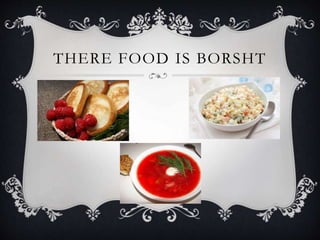
THERE FOOD IS BORSHT
LONGTITUDE AND
LATITUDE
 Moscow: (capital city) 55° 44' N, 37° 36' E
RUSSIAS BORDERS
 Azerbaijan 284 km
 Belarus 959 km
 China (southeast) 3,605 km
 China (south) 40 km
 Estonia 290 km
 Finland 1,313 km
 Georgia 723 km
 Kazakhstan 6,846 km
 North Korea 17.5 km
 Latvia 292 km
 Lithuania (Kaliningrad Oblast) 227 km
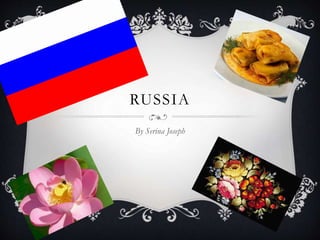
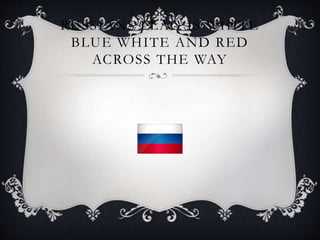
RUSSIANS FLAG IS WHITE
BLUE WHITE AND RED
ACROSS THE WAY
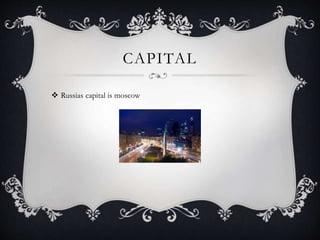
CAPITAL
 Russias capital is moscow
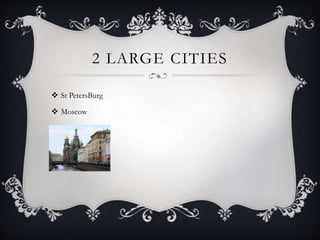
2 LARGE CITIES
 St PetersBurg
 Moscow
3 PHISICAL FEATURES OF
RUSSIE
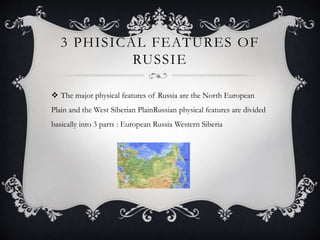
 The major physical features of Russia are the North European
Plain and the West Siberian PlainRussian physical features are divided
basically into 3 parts : European Russia Western Siberia
RUSSIA DAILY
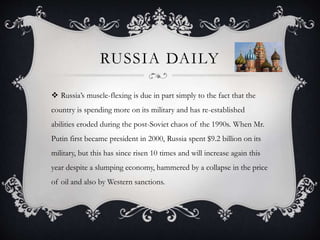
 Russia’s muscle-flexing is due in part simply to the fact that the
country is spending more on its military and has re-established
abilities eroded during the post-Soviet chaos of the 1990s. When Mr.
Putin first became president in 2000, Russia spent $9.2 billion on its
military, but this has since risen 10 times and will increase again this
year despite a slumping economy, hammered by a collapse in the price
of oil and also by Western sanctions.
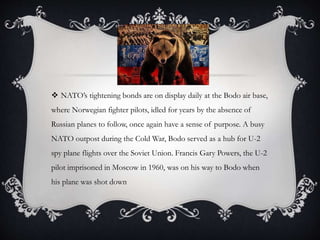
 NATO’s tightening bonds are on display daily at the Bodo air base,
where Norwegian fighter pilots, idled for years by the absence of
Russian planes to follow, once again have a sense of purpose. A busy
NATO outpost during the Cold War, Bodo served as a hub for U-2
spy plane flights over the Soviet Union. Francis Gary Powers, the U-2
pilot imprisoned in Moscow in 1960, was on his way to Bodo when
his plane was shot down
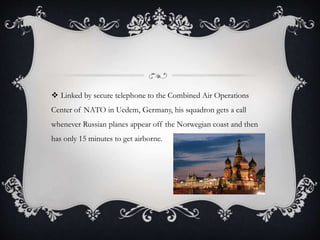
 Linked by secure telephone to the Combined Air Operations
Center of NATO in Uedem, Germany, his squadron gets a call
whenever Russian planes appear off the Norwegian coast and then
has only 15 minutes to get airborne.
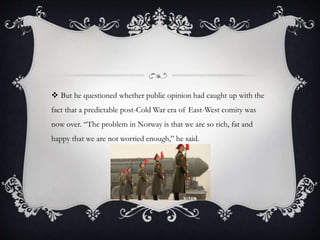
 But he questioned whether public opinion had caught up with the
fact that a predictable post-Cold War era of East-West comity was
now over. “The problem in Norway is that we are so rich, fat and
happy that we are not worried enough,” he said.
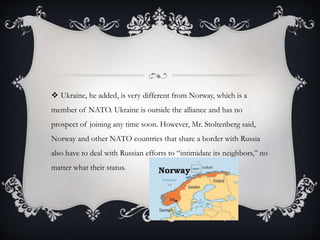
 Ukraine, he added, is very different from Norway, which is a
member of NATO. Ukraine is outside the alliance and has no
prospect of joining any time soon. However, Mr. Stoltenberg said,
Norway and other NATO countries that share a border with Russia
also have to deal with Russian efforts to “intimidate its neighbors,” no
matter what their status.
 Russian air activity along the borders of NATO, the northern parts
of which are patrolled by fighters based in Bodo, increased 50 percent
from 2013 to last year, according to the alliance. At the same time,
Russia sharply increased so-called snap military exercises, training
maneuvers that, in violation of established procedure, were either
announced at the last minute or kept secret.
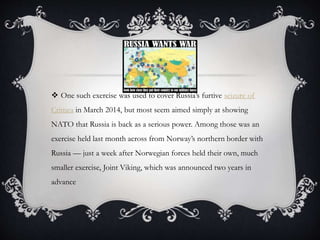
 One such exercise was used to cover Russia’s furtive seizure of
Crimea in March 2014, but most seem aimed simply at showing
NATO that Russia is back as a serious power. Among those was an
exercise held last month across from Norway’s northern border with
Russia — just a week after Norwegian forces held their own, much
smaller exercise, Joint Viking, which was announced two years in
advance
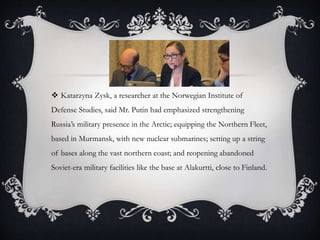
 Katarzyna Zysk, a researcher at the Norwegian Institute of
Defense Studies, said Mr. Putin had emphasized strengthening
Russia’s military presence in the Arctic; equipping the Northern Fleet,
based in Murmansk, with new nuclear submarines; setting up a string
of bases along the vast northern coast; and reopening abandoned
Soviet-era military facilities like the base at Alakurtti, close to Finland.
 Norway, along with all but three other European members of
NATO, still spends less than 2 percent of its gross domestic product
on its military, the target that all 28 members of the alliance are
supposed to meet
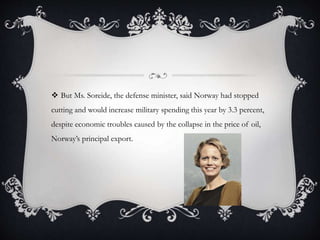
 But Ms. Soreide, the defense minister, said Norway had stopped
cutting and would increase military spending this year by 3.3 percent,
despite economic troubles caused by the collapse in the price of oil,
Norway’s principal export.
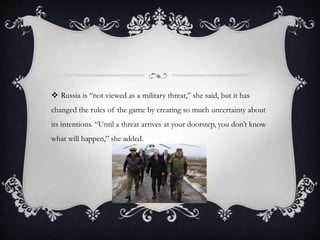
 Russia is “not viewed as a military threat,” she said, but it has
changed the rules of the game by creating so much uncertainty about
its intentions. “Until a threat arrives at your doorstep, you don’t know
what will happen,” she added.

Russia

  • 1.
  • 2.
    RUSSIAS PAST FACTS Olegs great grandson Vladimir I was ruler as far as the black sea.  Keivan Rus struggled in the 13th century. But was decisively destroyed by the arrival of a new invador, the Monglos  When Ivan the Terrible died in 1584, he was succeeded by his son Fyodor, who left most of the management of the kingdom to his brother-in-law, Boris Godunov, marked by the magnificent Church of St. Demetrius
  • 3.
  • 4.
    LONGTITUDE AND LATITUDE  Moscow:(capital city) 55° 44' N, 37° 36' E
  • 5.
    RUSSIAS BORDERS  Azerbaijan284 km  Belarus 959 km  China (southeast) 3,605 km  China (south) 40 km  Estonia 290 km  Finland 1,313 km  Georgia 723 km  Kazakhstan 6,846 km  North Korea 17.5 km  Latvia 292 km  Lithuania (Kaliningrad Oblast) 227 km
  • 6.
    RUSSIANS FLAG ISWHITE BLUE WHITE AND RED ACROSS THE WAY
  • 7.
  • 8.
    2 LARGE CITIES St PetersBurg  Moscow
  • 9.
    3 PHISICAL FEATURESOF RUSSIE  The major physical features of Russia are the North European Plain and the West Siberian PlainRussian physical features are divided basically into 3 parts : European Russia Western Siberia
  • 10.
    RUSSIA DAILY  Russia’smuscle-flexing is due in part simply to the fact that the country is spending more on its military and has re-established abilities eroded during the post-Soviet chaos of the 1990s. When Mr. Putin first became president in 2000, Russia spent $9.2 billion on its military, but this has since risen 10 times and will increase again this year despite a slumping economy, hammered by a collapse in the price of oil and also by Western sanctions.
  • 11.
     NATO’s tighteningbonds are on display daily at the Bodo air base, where Norwegian fighter pilots, idled for years by the absence of Russian planes to follow, once again have a sense of purpose. A busy NATO outpost during the Cold War, Bodo served as a hub for U-2 spy plane flights over the Soviet Union. Francis Gary Powers, the U-2 pilot imprisoned in Moscow in 1960, was on his way to Bodo when his plane was shot down
  • 12.
     Linked bysecure telephone to the Combined Air Operations Center of NATO in Uedem, Germany, his squadron gets a call whenever Russian planes appear off the Norwegian coast and then has only 15 minutes to get airborne.
  • 13.
     But hequestioned whether public opinion had caught up with the fact that a predictable post-Cold War era of East-West comity was now over. “The problem in Norway is that we are so rich, fat and happy that we are not worried enough,” he said.
  • 14.
     Ukraine, headded, is very different from Norway, which is a member of NATO. Ukraine is outside the alliance and has no prospect of joining any time soon. However, Mr. Stoltenberg said, Norway and other NATO countries that share a border with Russia also have to deal with Russian efforts to “intimidate its neighbors,” no matter what their status.
  • 15.
     Russian airactivity along the borders of NATO, the northern parts of which are patrolled by fighters based in Bodo, increased 50 percent from 2013 to last year, according to the alliance. At the same time, Russia sharply increased so-called snap military exercises, training maneuvers that, in violation of established procedure, were either announced at the last minute or kept secret.
  • 16.
     One suchexercise was used to cover Russia’s furtive seizure of Crimea in March 2014, but most seem aimed simply at showing NATO that Russia is back as a serious power. Among those was an exercise held last month across from Norway’s northern border with Russia — just a week after Norwegian forces held their own, much smaller exercise, Joint Viking, which was announced two years in advance
  • 17.
     Katarzyna Zysk,a researcher at the Norwegian Institute of Defense Studies, said Mr. Putin had emphasized strengthening Russia’s military presence in the Arctic; equipping the Northern Fleet, based in Murmansk, with new nuclear submarines; setting up a string of bases along the vast northern coast; and reopening abandoned Soviet-era military facilities like the base at Alakurtti, close to Finland.
  • 18.
     Norway, alongwith all but three other European members of NATO, still spends less than 2 percent of its gross domestic product on its military, the target that all 28 members of the alliance are supposed to meet
  • 19.
     But Ms.Soreide, the defense minister, said Norway had stopped cutting and would increase military spending this year by 3.3 percent, despite economic troubles caused by the collapse in the price of oil, Norway’s principal export.
  • 20.
     Russia is“not viewed as a military threat,” she said, but it has changed the rules of the game by creating so much uncertainty about its intentions. “Until a threat arrives at your doorstep, you don’t know what will happen,” she added.