Tensions between Russia and Ukraine:
What is behind the crisis?
We Make It HappenFebruary 24, 2022
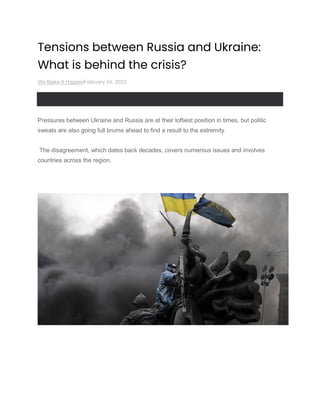
Pressures between Ukraine and Russia are at their loftiest position in times, but politic
sweats are also going full brume ahead to find a result to the extremity.
The disagreement, which dates back decades, covers numerous issues and involves
countries across the region.
Then we review what we know about the extremity.
Not to be missed on BBC Africa
"How I fell in love with a deepfake"
The extermination of Neanderthals wasn't due to the brutal elimination
The woman who's the face of the hijab disagreement in India
How did it start?
The origins of the last outbreak of violence between the two countries date back to October
2021. It was on this date that a massive military deployment by Russia began along the
Ukrainian border.
Satellite and intelligence reports have revealed that further than colors are now posted near
the area.
The Russian Defense Ministry also participated in images of military exercises.
The outfit used includes tone-propelled ordnance, combat tanks, and army fighting
vehicles.
Three keys to understanding why Ukraine is so important to Russia
How are Turkey's drones shaping conflicts in Ukraine and beyond?
Ukraine has expressed concern over the buildup, but its government has also stressed that
it doesn't believe Russia is in a position to take military action at this time.
Russia's position is that its military deployment doesn't pose trouble to Ukraine and that it
has the right to do whatever it wants with its own army in its own home.
Some say it could be the biggest Russian military figure-up around Ukraine since the Cold
War.
"Ukraine wants to strengthen its security because it feels strong pressure from the Russian
military presence, both at the borders and inside Ukrainian home, in the engaged corridor of
Ukraine", explains Orysia Lutsevych, head of the forum on Ukraine at the Chatham House
suppose tank in London.
And one of the ways it's considering to achieve this is"a collaborative alliance with NATO",
says Lutsevych.
But Russia believes the capability to emplace colors along its own border is an
autonomous right.
"They're on Russian home, nothing tells the United States where they should post their
forces on American home," said Elena Ananieva of the Moscow- grounded Europe Institute
(RAS).
"For other nations, it should be the same."
"As the West says, every country has the right to choose how to cover its security."
"But, from Russia's point of view, the main problem is the trouble of Ukraine joining NATO
and bringing NATO's military structure closer to Russia,"Ananieva said.
This brings us to our coming question.
Will NATO expand further and include Ukraine as a new member?
Along with the military buildup, a growing political rift has surfaced between Russia and the
Western military alliance, NATO.
"NATO's farther eastward expansion and the deployment of munitions, which may hang the
Russian Federation, are inferior,"Russian Foreign Minister Sergei Lavrov said.
Russia explosively opposes any possible expansion of NATO and wants to be guaranteed
that Ukraine will noway join NATO. This is a position participated by its close supporter,
China.
But these requests were rejected by NATO and its member countries.
NATO presently has 30 member countries, but more countries could join.
Ukraine isn't part of the alliance but is a" mate country".
"Ukrainian society and political parties believe that there's no better way to cover Ukraine
from Russian aggression than to be part of the collaborative security alliance,"Lutsevich
said, adding still that Ukraine's NATO class may not take place in the near future.
In the 1990s, after the end of the Cold War and the collapse of the Soviet Union, NATO
sought to establish close relations with the recently independent nations of Central and
Eastern Europe.
This is when the coalition expanded eastward, meaning its military capabilities and
armaments moved closer to the Russian border.
For decades, the Kremlin has constantly claimed that the West has broken its pledge not to
expand NATO. This claim refers to conversations held in 1990 between former US
Secretary of State JamesA. Baker and former Soviet leader Mikhail Gorbachev.
But Western leaders differ and say there has noway been a formal agreement on
NATO'snon-expansion to Eastern Europe and that the alliance maintains a" open door
policy.
How big is Russia's military figure-up around Ukraine?
Seven keys to understanding the raising pressure on the Russia-Ukraine border. Still,"it will
pose an fresh trouble to Russia", according to President Vladimir Putin, If Ukraine becomes
a member of NATO (it has not yet applied for class).
In November 2021, he'd formerly stated that Ukraine's presence in the alliance, as well as
the possible deployment of long- range dumdums able of hitting Russian metropolises or
bullet defense systems, analogous to those of the Poland and Romania, would constitute a"
red line"for Moscow.
But NATO Secretary General Jens Stoltenberg has made it clear that"Russia has no right
of proscription or right of scrutiny"over the possible blowup of the alliance.
Speaking to the BBC, Russian expert Ananieva outlined enterprises over possible NATO
blowup. “ NATO structure is getting near to the Russian border. NATO should have kept in
mind the principle of indivisibility of security,” she explains.
"Ukraine is doubtful to come a member of the alliance. NATO should suppose doubly about
its own security in case Ukraine becomes a member of the alliance."
As politic sweats to resolve the extremity continue, a hunt for possible druthers to Ukraine's
NATO shot has surfaced.
What's"Finlandization"and how does it relate to Ukraine?
Among the numerous political leaders trying to find a result to the conflict is French
President Emmanuel Macron. According to news reports, he mentioned the Cold War-
period term"Finlandization"in front of journalists during a trip to Moscow.
He reportedly suggested the"Finlandization of Ukraine"as a possible policy to reduce
pressure in the region.
But latterly, on February 8, Mr Macron denied making the controversial comment.
The term refers to Finland's status as a neutral buffer state during the Cold War. The
country participated a long border with the Soviet Union but remained neutral.
This position meant that Helsinki would not be a member of NATO and that the Soviet
Union would not see Finland as a implicit trouble. In 1948 Finland inked a convention with
Moscow agreeing to stay out of NATO.
How Putin managed to restore Russia's status as a world power
Still, the convention lapsed at the end of the Cold War and the Finnish government now
asserts that the decision whether or not to join transnational bodies similar as NATO should
be taken by it alone and not by others. other countries.
Ukraine has said it also doesn't want to be bound by a"Finlandization" policy that would
circumscribe its politic programs.
"I suppose this is completely inferior for Ukraine,"Lutsevych says.
"Ukraine was attacked when it was a neutral state, and also Putin doesn't admire Ukraine's
sovereignty, whether it's neutral or not.
"Ukraine rejects this idea because it's a bit of a smokescreen for Russia's capability to
control Ukraine."
Can Russia Really Foray Ukraine?
First, Russia has constantly stated that it has no intention of doing so, but for some these
statements haven't been cheering.
"They have formerly raided,"Lutsevych says, pertaining to 2014, when Russia adjoined the
Crimean promontory in southern Ukraine and backedpro-Russian secessionists who
captured large corridor of Ukraine. east of Ukraine.
"There are further than people dead, further than people heavily injured. Ukrainian society is
formerly paying a high price for Russian aggression."
NATO didn't intermediate directly in either incident, but the alliance's response was to
emplace fresh colors to Eastern European countries for the first time, specially in Estonia,
Latvia, Lithuania, Poland and Romania.
NATO has also strengthened its air defense and law enforcement capability in the Baltic
States and Eastern Europe.
Moscow wants these fresh forces to be withdrawn from these countries.
But for now, NATO says it has no intention of doing so.
What will be now?
Politic sweats to resolve the extremity continue in order to reach a peace agreement and
ease pressures.
On February 9, in an interview with the BBC, Russian Ambassador to the EU Vladimir
Chizhoz presented Russia's proffers to reduce pressures in Ukraine.
He indicated that Moscow could reply appreciatively if Ukraine becomes a neutral country.
Still, Ukraine and NATO have formerly declared that they aren't prepared to accept this
offer.
In another recent development, Spanish review El Pais published a blurted US document
outlining its negotiating position.
"The United States was ready todiscuss.commitments to refrain from planting obnoxious
land- launched bullet systems and standing forces with a combat charge on the home of
Ukraine,"it says. read in this document.
Still, this offer doesn't meet Russia's prospects.
European diplomats and leaders also explored ways to revive the 2015 ceasefire
agreement for rebel- held areas of Ukraine.
The so- called Minsk agreement between Kyiv and Moscow has noway been completely
enforced.
According to Ukrainian expert Lutsevych,"Kiev would not be willing to apply the agreement
if there's node-escalation and ceasefire."
"Russia wants to use these agreements to produce an fortified club inside Ukraine that has
Russian citizens,"she adds.
"The result to the extremity is Western and Ukrainian concinnity. What's at stake is
Ukrainian independence."
What response is NATO hanging?
On February 7, German Chancellor Olaf Scholz said in a meeting with US President Joe
Biden that Germany was" united"with the United States to put warrants on Russia if it raided
Ukraine.
Possible warrants planned by Washington would involve targeting major Russian banks
and banning Russia from the transnational payment system SWIFT, which is vital for
transnational deals. The UK has said it'll permission people and companies close to the
Kremlin.
"Russia has ever come flexible to Western warrants,"says Russian expert Ananieva when
asked about its possible counteraccusations for Russia.
"She turned to import negotiations. In some sectors of the Russian frugality, the warrants
have boosted product, and husbandry. Growers would like the Russiancounter-sanctions to
be extended,"she says..
NATO has not suggested that it would use military force in response to a Russian irruption.

Tensions between Russia and Ukraine.pdf

  • 1.
    Tensions between Russiaand Ukraine: What is behind the crisis? We Make It HappenFebruary 24, 2022 Pressures between Ukraine and Russia are at their loftiest position in times, but politic sweats are also going full brume ahead to find a result to the extremity. The disagreement, which dates back decades, covers numerous issues and involves countries across the region.
  • 2.
    Then we reviewwhat we know about the extremity. Not to be missed on BBC Africa "How I fell in love with a deepfake" The extermination of Neanderthals wasn't due to the brutal elimination The woman who's the face of the hijab disagreement in India How did it start? The origins of the last outbreak of violence between the two countries date back to October 2021. It was on this date that a massive military deployment by Russia began along the Ukrainian border. Satellite and intelligence reports have revealed that further than colors are now posted near the area. The Russian Defense Ministry also participated in images of military exercises. The outfit used includes tone-propelled ordnance, combat tanks, and army fighting vehicles. Three keys to understanding why Ukraine is so important to Russia How are Turkey's drones shaping conflicts in Ukraine and beyond? Ukraine has expressed concern over the buildup, but its government has also stressed that it doesn't believe Russia is in a position to take military action at this time. Russia's position is that its military deployment doesn't pose trouble to Ukraine and that it has the right to do whatever it wants with its own army in its own home.
  • 3.
    Some say itcould be the biggest Russian military figure-up around Ukraine since the Cold War. "Ukraine wants to strengthen its security because it feels strong pressure from the Russian military presence, both at the borders and inside Ukrainian home, in the engaged corridor of Ukraine", explains Orysia Lutsevych, head of the forum on Ukraine at the Chatham House suppose tank in London.
  • 4.
    And one ofthe ways it's considering to achieve this is"a collaborative alliance with NATO", says Lutsevych. But Russia believes the capability to emplace colors along its own border is an autonomous right. "They're on Russian home, nothing tells the United States where they should post their forces on American home," said Elena Ananieva of the Moscow- grounded Europe Institute (RAS). "For other nations, it should be the same." "As the West says, every country has the right to choose how to cover its security." "But, from Russia's point of view, the main problem is the trouble of Ukraine joining NATO and bringing NATO's military structure closer to Russia,"Ananieva said. This brings us to our coming question. Will NATO expand further and include Ukraine as a new member? Along with the military buildup, a growing political rift has surfaced between Russia and the Western military alliance, NATO.
  • 5.
    "NATO's farther eastwardexpansion and the deployment of munitions, which may hang the Russian Federation, are inferior,"Russian Foreign Minister Sergei Lavrov said. Russia explosively opposes any possible expansion of NATO and wants to be guaranteed that Ukraine will noway join NATO. This is a position participated by its close supporter, China. But these requests were rejected by NATO and its member countries. NATO presently has 30 member countries, but more countries could join. Ukraine isn't part of the alliance but is a" mate country".
  • 6.
    "Ukrainian society andpolitical parties believe that there's no better way to cover Ukraine from Russian aggression than to be part of the collaborative security alliance,"Lutsevich said, adding still that Ukraine's NATO class may not take place in the near future. In the 1990s, after the end of the Cold War and the collapse of the Soviet Union, NATO sought to establish close relations with the recently independent nations of Central and Eastern Europe. This is when the coalition expanded eastward, meaning its military capabilities and armaments moved closer to the Russian border. For decades, the Kremlin has constantly claimed that the West has broken its pledge not to expand NATO. This claim refers to conversations held in 1990 between former US Secretary of State JamesA. Baker and former Soviet leader Mikhail Gorbachev. But Western leaders differ and say there has noway been a formal agreement on NATO'snon-expansion to Eastern Europe and that the alliance maintains a" open door policy. How big is Russia's military figure-up around Ukraine? Seven keys to understanding the raising pressure on the Russia-Ukraine border. Still,"it will pose an fresh trouble to Russia", according to President Vladimir Putin, If Ukraine becomes a member of NATO (it has not yet applied for class). In November 2021, he'd formerly stated that Ukraine's presence in the alliance, as well as the possible deployment of long- range dumdums able of hitting Russian metropolises or bullet defense systems, analogous to those of the Poland and Romania, would constitute a" red line"for Moscow. But NATO Secretary General Jens Stoltenberg has made it clear that"Russia has no right of proscription or right of scrutiny"over the possible blowup of the alliance.
  • 7.
    Speaking to theBBC, Russian expert Ananieva outlined enterprises over possible NATO blowup. “ NATO structure is getting near to the Russian border. NATO should have kept in mind the principle of indivisibility of security,” she explains. "Ukraine is doubtful to come a member of the alliance. NATO should suppose doubly about its own security in case Ukraine becomes a member of the alliance." As politic sweats to resolve the extremity continue, a hunt for possible druthers to Ukraine's NATO shot has surfaced. What's"Finlandization"and how does it relate to Ukraine? Among the numerous political leaders trying to find a result to the conflict is French President Emmanuel Macron. According to news reports, he mentioned the Cold War- period term"Finlandization"in front of journalists during a trip to Moscow. He reportedly suggested the"Finlandization of Ukraine"as a possible policy to reduce pressure in the region. But latterly, on February 8, Mr Macron denied making the controversial comment. The term refers to Finland's status as a neutral buffer state during the Cold War. The country participated a long border with the Soviet Union but remained neutral. This position meant that Helsinki would not be a member of NATO and that the Soviet Union would not see Finland as a implicit trouble. In 1948 Finland inked a convention with Moscow agreeing to stay out of NATO. How Putin managed to restore Russia's status as a world power Still, the convention lapsed at the end of the Cold War and the Finnish government now asserts that the decision whether or not to join transnational bodies similar as NATO should be taken by it alone and not by others. other countries.
  • 8.
    Ukraine has saidit also doesn't want to be bound by a"Finlandization" policy that would circumscribe its politic programs. "I suppose this is completely inferior for Ukraine,"Lutsevych says. "Ukraine was attacked when it was a neutral state, and also Putin doesn't admire Ukraine's sovereignty, whether it's neutral or not. "Ukraine rejects this idea because it's a bit of a smokescreen for Russia's capability to control Ukraine." Can Russia Really Foray Ukraine? First, Russia has constantly stated that it has no intention of doing so, but for some these statements haven't been cheering. "They have formerly raided,"Lutsevych says, pertaining to 2014, when Russia adjoined the Crimean promontory in southern Ukraine and backedpro-Russian secessionists who captured large corridor of Ukraine. east of Ukraine. "There are further than people dead, further than people heavily injured. Ukrainian society is formerly paying a high price for Russian aggression." NATO didn't intermediate directly in either incident, but the alliance's response was to emplace fresh colors to Eastern European countries for the first time, specially in Estonia, Latvia, Lithuania, Poland and Romania. NATO has also strengthened its air defense and law enforcement capability in the Baltic States and Eastern Europe. Moscow wants these fresh forces to be withdrawn from these countries. But for now, NATO says it has no intention of doing so.
  • 9.
    What will benow? Politic sweats to resolve the extremity continue in order to reach a peace agreement and ease pressures. On February 9, in an interview with the BBC, Russian Ambassador to the EU Vladimir Chizhoz presented Russia's proffers to reduce pressures in Ukraine. He indicated that Moscow could reply appreciatively if Ukraine becomes a neutral country. Still, Ukraine and NATO have formerly declared that they aren't prepared to accept this offer. In another recent development, Spanish review El Pais published a blurted US document outlining its negotiating position. "The United States was ready todiscuss.commitments to refrain from planting obnoxious land- launched bullet systems and standing forces with a combat charge on the home of Ukraine,"it says. read in this document. Still, this offer doesn't meet Russia's prospects. European diplomats and leaders also explored ways to revive the 2015 ceasefire agreement for rebel- held areas of Ukraine. The so- called Minsk agreement between Kyiv and Moscow has noway been completely enforced. According to Ukrainian expert Lutsevych,"Kiev would not be willing to apply the agreement if there's node-escalation and ceasefire." "Russia wants to use these agreements to produce an fortified club inside Ukraine that has Russian citizens,"she adds.
  • 10.
    "The result tothe extremity is Western and Ukrainian concinnity. What's at stake is Ukrainian independence." What response is NATO hanging? On February 7, German Chancellor Olaf Scholz said in a meeting with US President Joe Biden that Germany was" united"with the United States to put warrants on Russia if it raided Ukraine. Possible warrants planned by Washington would involve targeting major Russian banks and banning Russia from the transnational payment system SWIFT, which is vital for transnational deals. The UK has said it'll permission people and companies close to the Kremlin. "Russia has ever come flexible to Western warrants,"says Russian expert Ananieva when asked about its possible counteraccusations for Russia. "She turned to import negotiations. In some sectors of the Russian frugality, the warrants have boosted product, and husbandry. Growers would like the Russiancounter-sanctions to be extended,"she says.. NATO has not suggested that it would use military force in response to a Russian irruption.