Demand Side Management Programs
National Energy and Utility Affordability Conference
Denver, Colorado
David Carroll
June 18, 2008
Presentation Outline
• Why should you care?
• If you decide to play, learn the rules of the
game.
• Winning strategies; the best offense is a good
offense.
2
Why should you care?
3
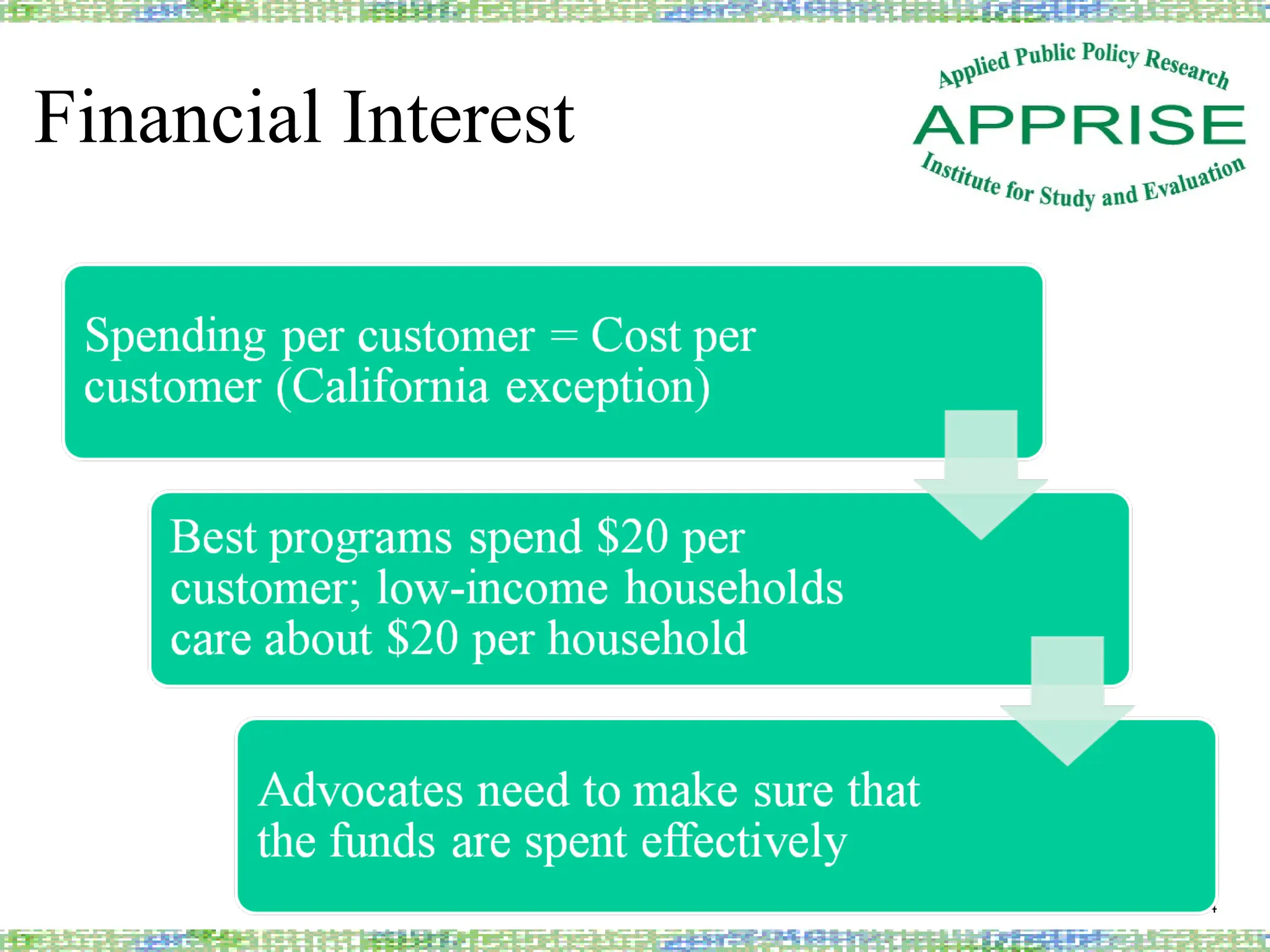
Financial Interest
4
Participation Opportunities
• Participation by households – Equipment
replacement and residential DSM programs
(Colorado REACH)
• Participation by programs – Affordable
housing and new multifamily construction
programs
• Participation by organizations – Small
commercial buildings programs
5
The rules of the game…
6
What counts? Usually…
• Electricity not gas
• KW not kWh
• Peak load not average load
• Opportunities not equity
7
How is it counted?
• Cost effectiveness tests
– Vary by jurisdiction
– Not just energy savings / program costs
• Cost effectiveness “adders”
– Environmental
– Jobs
– Other
8
Winning strategies!
9
Advantages
• Existing infrastructure
– Lower costs
– Quicker deployment
• Proven performance
– Program statistics
– Evaluation data
10
Advantages
• More opportunities
– Low existing efficiency level
– Peak load usage (elderly)
• Better net impacts
– No free riders
– Local program expenditures
– Offset other SBC expenditures
11
Strategies
• Target add-ons, not new programs
– Add electric measures to WX
– Increase rates for qualifying measures
• Make use of client lists and data
– Reduce marketing costs
– Increase program performance
12
Strategies
• Insist on “fair share”
– Low-income households pay SBC
– Low-income programs have proven
performance
• Cost-effectiveness
– Don’t accept “equity only” label
– Demand to see verified savings estimates from
other programs
13
Examples
14
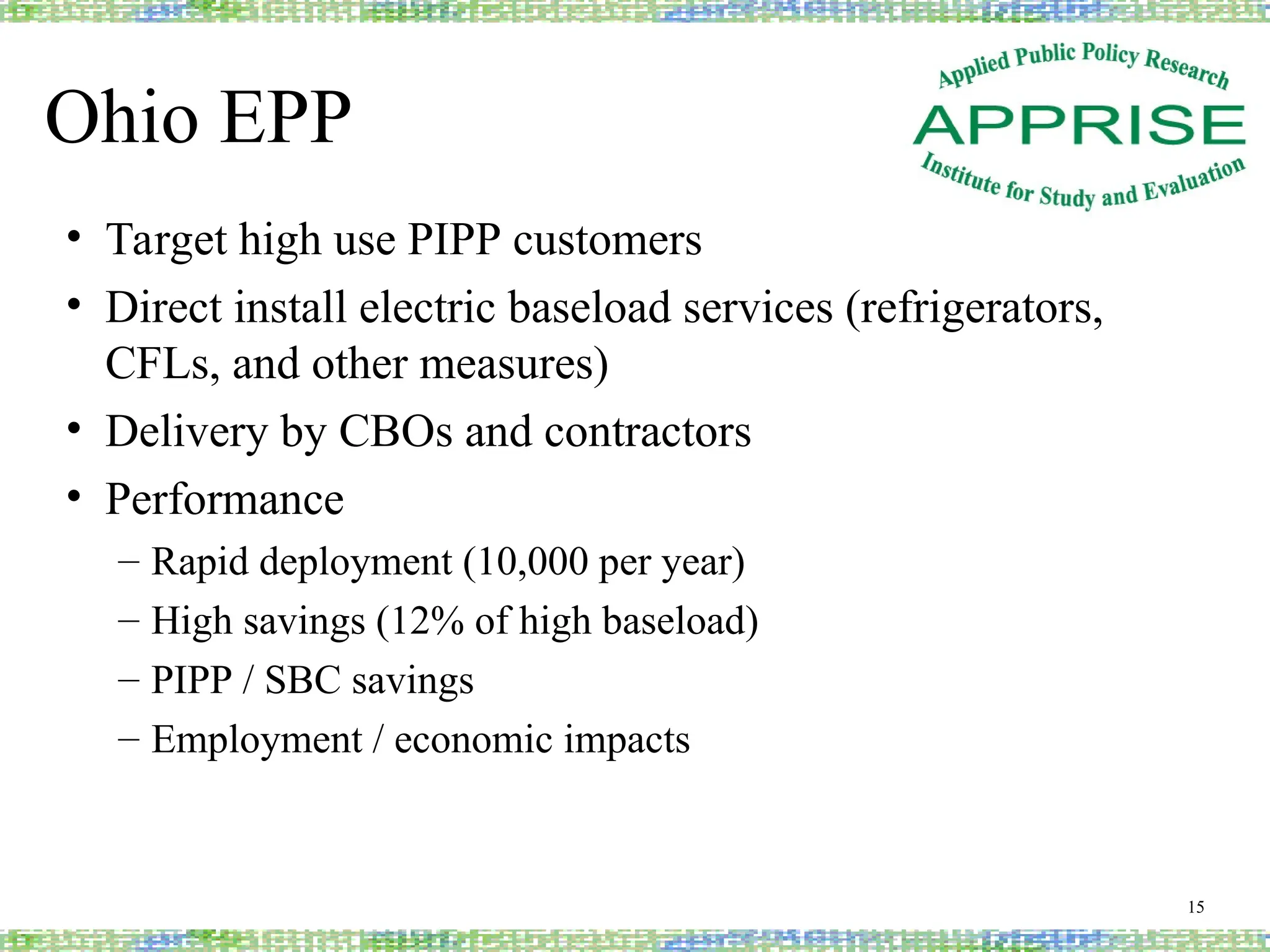
Ohio EPP
• Target high use PIPP customers
• Direct install electric baseload services (refrigerators,
CFLs, and other measures)
• Delivery by CBOs and contractors
• Performance
– Rapid deployment (10,000 per year)
– High savings (12% of high baseload)
– PIPP / SBC savings
– Employment / economic impacts
15
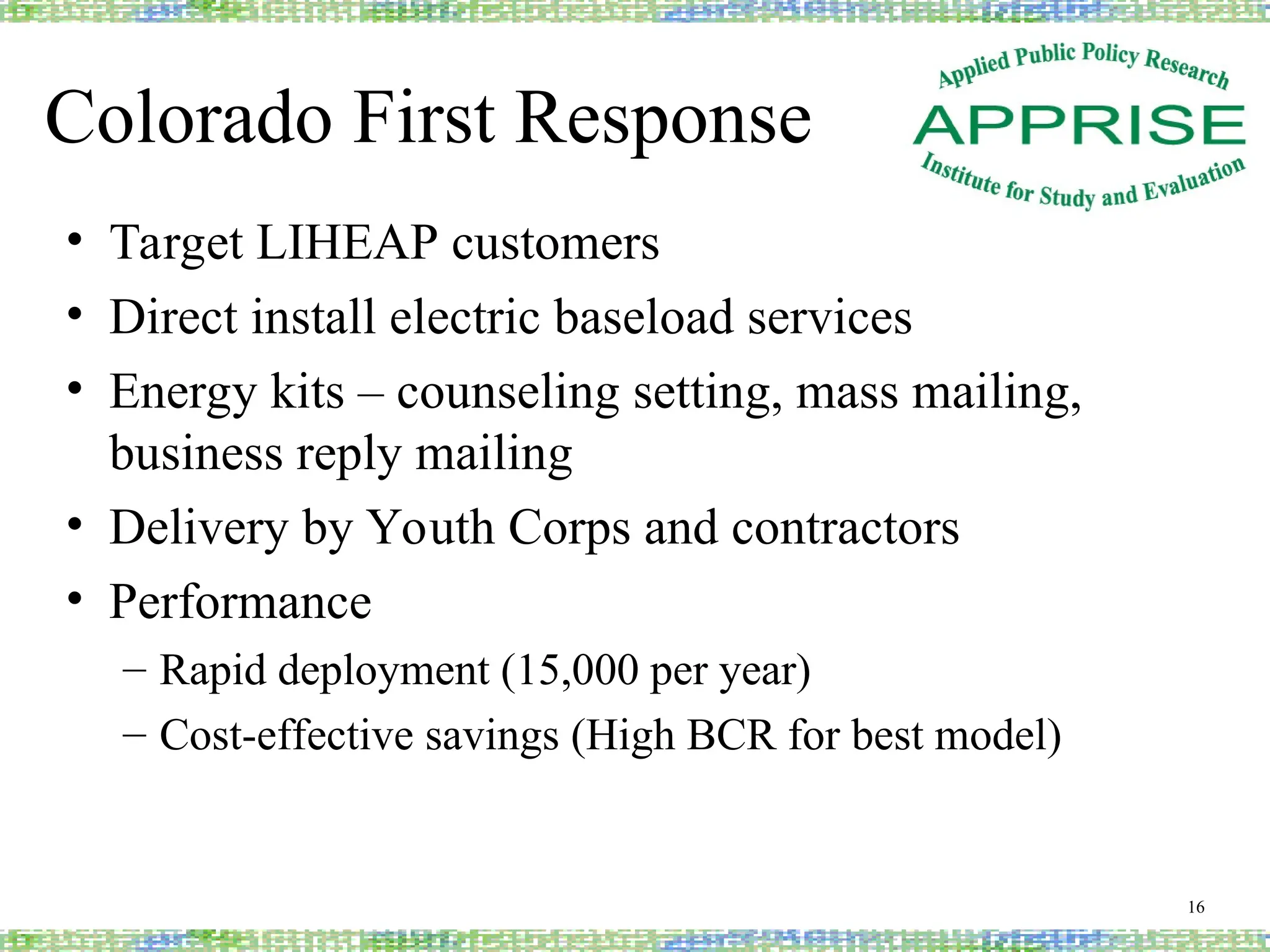
Colorado First Response
• Target LIHEAP customers
• Direct install electric baseload services
• Energy kits – counseling setting, mass mailing,
business reply mailing
• Delivery by Youth Corps and contractors
• Performance
– Rapid deployment (15,000 per year)
– Cost-effective savings (High BCR for best model)
16
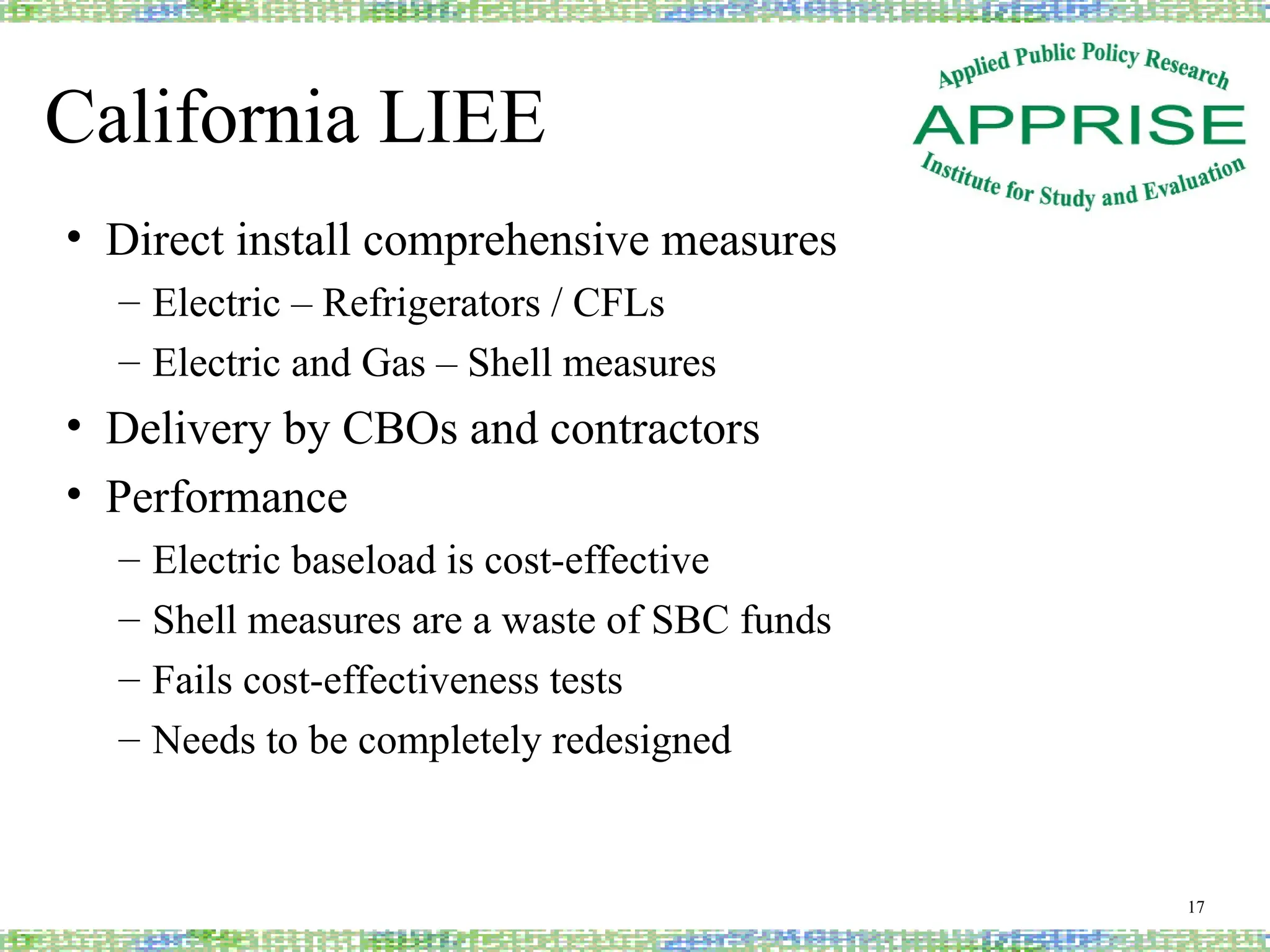
California LIEE
• Direct install comprehensive measures
– Electric – Refrigerators / CFLs
– Electric and Gas – Shell measures
• Delivery by CBOs and contractors
• Performance
– Electric baseload is cost-effective
– Shell measures are a waste of SBC funds
– Fails cost-effectiveness tests
– Needs to be completely redesigned
17
Summary
18
DSM Opportunities
• Make programs work for your clients
– Learn the rules / be at the table
– Identify opportunities / aggressively pursue
– Set the stage for performance measurement
– Demand allocation based on performance
19
David Carroll
APPRISE
609-252-8010
david-carroll@appriseinc.org
20

Fundamentals of Demand Side Management Programs.ppt

  • 1.
    Demand Side ManagementPrograms National Energy and Utility Affordability Conference Denver, Colorado David Carroll June 18, 2008
  • 2.
    Presentation Outline • Whyshould you care? • If you decide to play, learn the rules of the game. • Winning strategies; the best offense is a good offense. 2
  • 3.
  • 4.
  • 5.
    Participation Opportunities • Participationby households – Equipment replacement and residential DSM programs (Colorado REACH) • Participation by programs – Affordable housing and new multifamily construction programs • Participation by organizations – Small commercial buildings programs 5
  • 6.
    The rules ofthe game… 6
  • 7.
    What counts? Usually… •Electricity not gas • KW not kWh • Peak load not average load • Opportunities not equity 7
  • 8.
    How is itcounted? • Cost effectiveness tests – Vary by jurisdiction – Not just energy savings / program costs • Cost effectiveness “adders” – Environmental – Jobs – Other 8
  • 9.
  • 10.
    Advantages • Existing infrastructure –Lower costs – Quicker deployment • Proven performance – Program statistics – Evaluation data 10
  • 11.
    Advantages • More opportunities –Low existing efficiency level – Peak load usage (elderly) • Better net impacts – No free riders – Local program expenditures – Offset other SBC expenditures 11
  • 12.
    Strategies • Target add-ons,not new programs – Add electric measures to WX – Increase rates for qualifying measures • Make use of client lists and data – Reduce marketing costs – Increase program performance 12
  • 13.
    Strategies • Insist on“fair share” – Low-income households pay SBC – Low-income programs have proven performance • Cost-effectiveness – Don’t accept “equity only” label – Demand to see verified savings estimates from other programs 13
  • 14.
  • 15.
    Ohio EPP • Targethigh use PIPP customers • Direct install electric baseload services (refrigerators, CFLs, and other measures) • Delivery by CBOs and contractors • Performance – Rapid deployment (10,000 per year) – High savings (12% of high baseload) – PIPP / SBC savings – Employment / economic impacts 15
  • 16.
    Colorado First Response •Target LIHEAP customers • Direct install electric baseload services • Energy kits – counseling setting, mass mailing, business reply mailing • Delivery by Youth Corps and contractors • Performance – Rapid deployment (15,000 per year) – Cost-effective savings (High BCR for best model) 16
  • 17.
    California LIEE • Directinstall comprehensive measures – Electric – Refrigerators / CFLs – Electric and Gas – Shell measures • Delivery by CBOs and contractors • Performance – Electric baseload is cost-effective – Shell measures are a waste of SBC funds – Fails cost-effectiveness tests – Needs to be completely redesigned 17
  • 18.
  • 19.
    DSM Opportunities • Makeprograms work for your clients – Learn the rules / be at the table – Identify opportunities / aggressively pursue – Set the stage for performance measurement – Demand allocation based on performance 19
  • 20.