Rahul Sayal
MBA I (D)
5804
MARKETING
The Chartered Institute of Marketing defines marketing as “The
management process responsible for identifying, anticipating and
satisfying customer requirements profitably”.
Marketing is defined by the American Marketing Association “as the
activity, set of institutions, and processes for creating,
communicating, delivering, and exchanging offerings that have
value for customers, clients, partners, and society at large.”
Professor E. Jerome McCarthy, at the Michigan
State University in the early 1960s, suggested
that the Marketing contained 4 elements:
The Four P`s
Product
Price
Placement
Promotion
THE MARKETING ENVIORNMENT
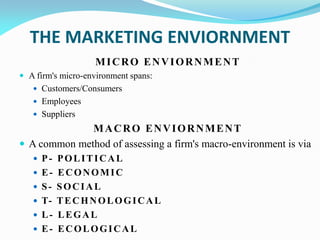
MICRO ENVIORNMENT
 A firm's micro-environment spans:
 Customers/Consumers
 Employees
 Suppliers
MACRO ENVIORNMENT
 A common method of assessing a firm's macro-environment is via
 P- POLITICAL
 E- ECONOMIC
 S- SOCIAL
 T- TECHNOLOGICAL
 L- LEGAL
 E- ECOLOGICAL
RURAL
Sparsely populated area outside of the limits of a
city or town or a designated commercial, industrial
and residential centre.
Rural areas are characterized by farms, vegetation,
and open areas.
RURAL MARKETING
Rural Markets are defined as those segments of overall
market of any economy, which are distinct from the
other types of markets like Stock market, Commodity
markets or Labour economics.
Selling in Rural India
Opportunity
The Indian rural market with its vast size and demand
base offers a huge opportunity that MNCs cannot afford
to ignore. With 128 million households, the rural
population is nearly three times the urban.
The 4A Approach
 Availability
 Because of the poor state of roads, it is greater challenge to regularly
reach products to the far-flung villages.
 Affordability
 Godrej introduced three brands of Cinthol, Fair Glow and Godrej in
50-gm packs, priced at Rs. 4-5.
 Acceptability
 LG Electronics developed a customised TV for the rural market and
named it Sampoorna.
 Awareness
 Coca-Cola uses a combination of TV, cinema and radio to reach 53.6
per cent of rural households.
STRATEGIES OF FMCG COMPANIES
IN RURAL AREAS
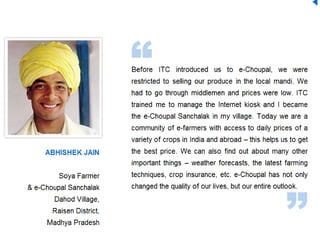
The e-Choupal model has been specifically designed to
tackle the challenges posed by the unique features of
Indian agriculture, characterised by fragmented farms,
weak infrastructure and the involvement of numerous
intermediaries, among others.
E-Choupal (Launched in June 2000)
ITC Limited has established computers and Internet access
in rural areas across several agricultural regions of the
country, where the farmers can directly negotiate the sale
of their produce with ITC Limited.
Main Challenges Involved in Rural
Marketing
 Convincing the rural customer.
 Promotion of products in their regional
language.
 Lack of Infrastructure Facilities
 Low Levels of Literacy and awareness.
 Lack of knowledge in usage of advanced
products.
CORPORATES INTEREST IN RURAL
MARKETING
When rural customers discover the new and
exiting choice of brands available in urban
markets, a demand for these brands is created
in rural areas. When Titan found rural
consumers purchasing their Sonata brand of
quartz watches, they formulated a marketing
strategy tailored to the requirement of the
large rural market.
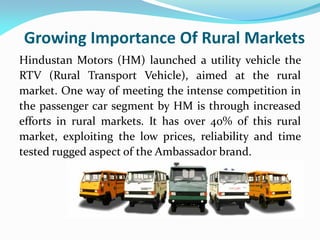
Growing Importance Of Rural Markets
Hindustan Motors (HM) launched a utility vehicle the
RTV (Rural Transport Vehicle), aimed at the rural
market. One way of meeting the intense competition in
the passenger car segment by HM is through increased
efforts in rural markets. It has over 40% of this rural
market, exploiting the low prices, reliability and time
tested rugged aspect of the Ambassador brand.
COMPETITION IN RURAL MARKET
• Competition in rural markets is varied in nature and a
marketer faces competition not only from other
brands but also from substitutes, especially in places
where the product is new to the consumer.
• Such situations are quite common in rural markets.
Competition for existing brands can be from other
brands, from new player’s small unorganized sectors,
duplicates and imitation.
• The task for a new player entering in the market is
difficult given the advantage that entrenched brands
have in rural markets.
Perspective Role and Contribution of
Information Technology in Rural Markets in India
With the changing patterns of Rural Market, the
role of I.T. has increased from providing only the
Networks to set-up the basis of updated
technological programs in the rural area.
In Rural India, Government has already provided
Info-kiosks (a rural version of cyber café) which
provide basic communication facilities like
internet connection and telecommunication
services.
Some of the programs run by the government in
different areas of rural sector are:
 E-Mitra
 Wi-Fi Projects
 Drishtee
 Gyandoot
 TARAhaat
 O TARABazar (for product information)
 O TARAdhaba (for providing connectivity)
 O TARAdak (connect to relatives at distance)
 O TARAgyan (educate rural youth on various issues)
 O TARAguru (helps in mentoring and consultancy)
 O TARAvan (delivery of orders at remote areas)
Continue……..
 Rural e-seva
 Bhoomi
 e-choupal
 Aksh
 n-Logue
INCLINATION OF SECTORS TOWARDS
RURAL INDIA
FMCG
Insurance
Retail
Automobiles
Pharmaceuticals
Consumer Durables
STRATEGIES FOR IMPROVING
MARKETING WITHIN RURAL AREAS
• Product Strategies
• Small unit and low priced packing
• New product designs
• Sturdy products
• Brand name
• Pricing Strategies
• Distribution Strategies
• Promotion Strategies
CONCLUSION
The face of Indian rural market can be
transformed only with the deployment
of I.T. I.T. enabled services are growing
at a fast rate and are providing several
services to rural people with the
common motive of having increase in
the connectivity and thus creation of
bigger market in the rural areas.
A LAST WORD
This is just the tip of the iceberg.
Rural marketing is at its infancy and is
advancing by leaps and bounds.
So stay tuned… and stay ahead of your
competitor.
YOU
QUERY???

Rural Marketing

  • 2.
  • 3.
    MARKETING The Chartered Instituteof Marketing defines marketing as “The management process responsible for identifying, anticipating and satisfying customer requirements profitably”. Marketing is defined by the American Marketing Association “as the activity, set of institutions, and processes for creating, communicating, delivering, and exchanging offerings that have value for customers, clients, partners, and society at large.”
  • 4.
    Professor E. JeromeMcCarthy, at the Michigan State University in the early 1960s, suggested that the Marketing contained 4 elements: The Four P`s Product Price Placement Promotion
  • 5.
    THE MARKETING ENVIORNMENT MICROENVIORNMENT  A firm's micro-environment spans:  Customers/Consumers  Employees  Suppliers MACRO ENVIORNMENT  A common method of assessing a firm's macro-environment is via  P- POLITICAL  E- ECONOMIC  S- SOCIAL  T- TECHNOLOGICAL  L- LEGAL  E- ECOLOGICAL
  • 6.
    RURAL Sparsely populated areaoutside of the limits of a city or town or a designated commercial, industrial and residential centre. Rural areas are characterized by farms, vegetation, and open areas.
  • 7.
    RURAL MARKETING Rural Marketsare defined as those segments of overall market of any economy, which are distinct from the other types of markets like Stock market, Commodity markets or Labour economics.
  • 8.
    Selling in RuralIndia Opportunity The Indian rural market with its vast size and demand base offers a huge opportunity that MNCs cannot afford to ignore. With 128 million households, the rural population is nearly three times the urban.
  • 9.
    The 4A Approach Availability  Because of the poor state of roads, it is greater challenge to regularly reach products to the far-flung villages.  Affordability  Godrej introduced three brands of Cinthol, Fair Glow and Godrej in 50-gm packs, priced at Rs. 4-5.  Acceptability  LG Electronics developed a customised TV for the rural market and named it Sampoorna.  Awareness  Coca-Cola uses a combination of TV, cinema and radio to reach 53.6 per cent of rural households.
  • 10.
    STRATEGIES OF FMCGCOMPANIES IN RURAL AREAS The e-Choupal model has been specifically designed to tackle the challenges posed by the unique features of Indian agriculture, characterised by fragmented farms, weak infrastructure and the involvement of numerous intermediaries, among others. E-Choupal (Launched in June 2000) ITC Limited has established computers and Internet access in rural areas across several agricultural regions of the country, where the farmers can directly negotiate the sale of their produce with ITC Limited.
  • 12.
    Main Challenges Involvedin Rural Marketing  Convincing the rural customer.  Promotion of products in their regional language.  Lack of Infrastructure Facilities  Low Levels of Literacy and awareness.  Lack of knowledge in usage of advanced products.
  • 13.
    CORPORATES INTEREST INRURAL MARKETING When rural customers discover the new and exiting choice of brands available in urban markets, a demand for these brands is created in rural areas. When Titan found rural consumers purchasing their Sonata brand of quartz watches, they formulated a marketing strategy tailored to the requirement of the large rural market.
  • 14.
    Growing Importance OfRural Markets Hindustan Motors (HM) launched a utility vehicle the RTV (Rural Transport Vehicle), aimed at the rural market. One way of meeting the intense competition in the passenger car segment by HM is through increased efforts in rural markets. It has over 40% of this rural market, exploiting the low prices, reliability and time tested rugged aspect of the Ambassador brand.
  • 15.
    COMPETITION IN RURALMARKET • Competition in rural markets is varied in nature and a marketer faces competition not only from other brands but also from substitutes, especially in places where the product is new to the consumer. • Such situations are quite common in rural markets. Competition for existing brands can be from other brands, from new player’s small unorganized sectors, duplicates and imitation. • The task for a new player entering in the market is difficult given the advantage that entrenched brands have in rural markets.
  • 16.
    Perspective Role andContribution of Information Technology in Rural Markets in India With the changing patterns of Rural Market, the role of I.T. has increased from providing only the Networks to set-up the basis of updated technological programs in the rural area. In Rural India, Government has already provided Info-kiosks (a rural version of cyber café) which provide basic communication facilities like internet connection and telecommunication services.
  • 17.
    Some of theprograms run by the government in different areas of rural sector are:  E-Mitra  Wi-Fi Projects  Drishtee  Gyandoot  TARAhaat  O TARABazar (for product information)  O TARAdhaba (for providing connectivity)  O TARAdak (connect to relatives at distance)  O TARAgyan (educate rural youth on various issues)  O TARAguru (helps in mentoring and consultancy)  O TARAvan (delivery of orders at remote areas)
  • 18.
    Continue……..  Rural e-seva Bhoomi  e-choupal  Aksh  n-Logue
  • 19.
    INCLINATION OF SECTORSTOWARDS RURAL INDIA FMCG Insurance Retail Automobiles Pharmaceuticals Consumer Durables
  • 20.
    STRATEGIES FOR IMPROVING MARKETINGWITHIN RURAL AREAS • Product Strategies • Small unit and low priced packing • New product designs • Sturdy products • Brand name • Pricing Strategies • Distribution Strategies • Promotion Strategies
  • 21.
    CONCLUSION The face ofIndian rural market can be transformed only with the deployment of I.T. I.T. enabled services are growing at a fast rate and are providing several services to rural people with the common motive of having increase in the connectivity and thus creation of bigger market in the rural areas.
  • 22.
    A LAST WORD Thisis just the tip of the iceberg. Rural marketing is at its infancy and is advancing by leaps and bounds. So stay tuned… and stay ahead of your competitor.
  • 23.
  • 24.