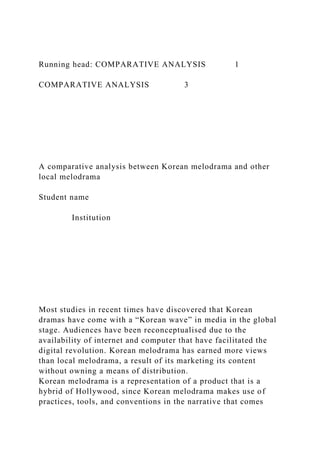
Running head: COMPARATIVE ANALYSIS 1
COMPARATIVE ANALYSIS 3
A comparative analysis between Korean melodrama and other
local melodrama
Student name
Institution
Most studies in recent times have discovered that Korean
dramas have come with a “Korean wave” in media in the global
stage. Audiences have been reconceptualised due to the
availability of internet and computer that have facilitated the
digital revolution. Korean melodrama has earned more views
than local melodrama, a result of its marketing its content
without owning a means of distribution.
Korean melodrama is a representation of a product that is a
hybrid of Hollywood, since Korean melodrama makes use of
practices, tools, and conventions in the narrative that comes
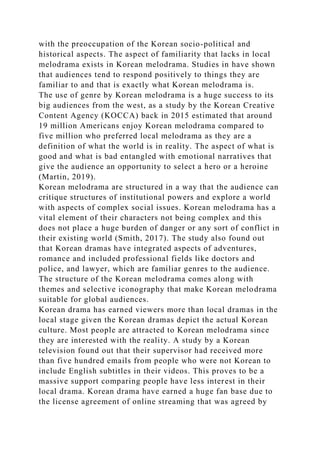
with the preoccupation of the Korean socio-political and
historical aspects. The aspect of familiarity that lacks in local
melodrama exists in Korean melodrama. Studies in have shown
that audiences tend to respond positively to things they are
familiar to and that is exactly what Korean melodrama is.
The use of genre by Korean melodrama is a huge success to its
big audiences from the west, as a study by the Korean Creative
Content Agency (KOCCA) back in 2015 estimated that around
19 million Americans enjoy Korean melodrama compared to
five million who preferred local melodrama as they are a
definition of what the world is in reality. The aspect of what is
good and what is bad entangled with emotional narratives that
give the audience an opportunity to select a hero or a heroine
(Martin, 2019).
Korean melodrama are structured in a way that the audience can
critique structures of institutional powers and explore a world
with aspects of complex social issues. Korean melodrama has a
vital element of their characters not being complex and this
does not place a huge burden of danger or any sort of conflict in
their existing world (Smith, 2017). The study also found out
that Korean dramas have integrated aspects of adventures,
romance and included professional fields like doctors and
police, and lawyer, which are familiar genres to the audience.
The structure of the Korean melodrama comes along with
themes and selective iconography that make Korean melodrama
suitable for global audiences.
Korean drama has earned viewers more than local dramas in the
local stage given the Korean dramas depict the actual Korean
culture. Most people are attracted to Korean melodrama since
they are interested with the reality. A study by a Korean
television found out that their supervisor had received more
than five hundred emails from people who were not Korean to
include English subtitles in their videos. This proves to be a
massive support comparing people have less interest in their
local drama. Korean drama have earned a huge fan base due to
the license agreement of online streaming that was agreed by
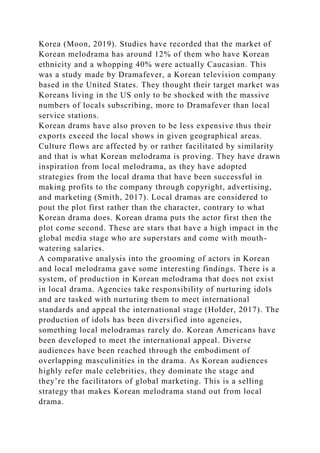
Korea (Moon, 2019). Studies have recorded that the market of
Korean melodrama has around 12% of them who have Korean
ethnicity and a whopping 40% were actually Caucasian. This
was a study made by Dramafever, a Korean television company
based in the United States. They thought their target market was
Koreans living in the US only to be shocked with the massive
numbers of locals subscribing, more to Dramafever than local
service stations.
Korean drams have also proven to be less expensive thus their
exports exceed the local shows in given geographical areas.
Culture flows are affected by or rather facilitated by similarity
and that is what Korean melodrama is proving. They have drawn
inspiration from local melodrama, as they have adopted
strategies from the local drama that have been successful in
making profits to the company through copyright, advertising,
and marketing (Smith, 2017). Local dramas are considered to
pout the plot first rather than the character, contrary to what
Korean drama does. Korean drama puts the actor first then the
plot come second. These are stars that have a high impact in the
global media stage who are superstars and come with mouth-
watering salaries.
A comparative analysis into the grooming of actors in Korean
and local melodrama gave some interesting findings. There is a
system, of production in Korean melodrama that does not exist
in local drama. Agencies take responsibility of nurturing idols
and are tasked with nurturing them to meet international
standards and appeal the international stage (Holder, 2017). The
production of idols has been diversified into agencies,
something local melodramas rarely do. Korean Americans have
been developed to meet the international appeal. Diverse
audiences have been reached through the embodiment of
overlapping masculinities in the drama. As Korean audiences
highly refer male celebrities, they dominate the stage and
they’re the facilitators of global marketing. This is a selling
strategy that makes Korean melodrama stand out from local
drama.
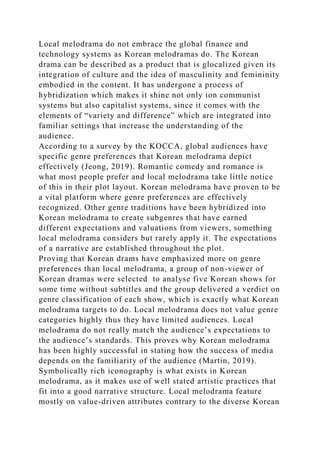
Local melodrama do not embrace the global finance and
technology systems as Korean melodramas do. The Korean
drama can be described as a product that is glocalized given its
integration of culture and the idea of masculinity and femininity
embodied in the content. It has undergone a process of
hybridization which makes it shine not only ion communist
systems but also capitalist systems, since it comes with the
elements of “variety and difference” which are integrated into
familiar settings that increase the understanding of the
audience.
According to a survey by the KOCCA, global audiences have
specific genre preferences that Korean melodrama depict
effectively (Jeong, 2019). Romantic comedy and romance is
what most people prefer and local melodrama take little notice
of this in their plot layout. Korean melodrama have proven to be
a vital platform where genre preferences are effectively
recognized. Other genre traditions have been hybridized into
Korean melodrama to create subgenres that have earned
different expectations and valuations from viewers, something
local melodrama considers but rarely apply it. The expectations
of a narrative are established throughout the plot.
Proving that Korean drams have emphasized more on genre
preferences than local melodrama, a group of non-viewer of
Korean dramas were selected to analyse five Korean shows for
some time without subtitles and the group delivered a verdict on
genre classification of each show, which is exactly what Korean
melodrama targets to do. Local melodrama does not value genre
categories highly thus they have limited audiences. Local
melodrama do not really match the audience’s expectations to
the audience’s standards. This proves why Korean melodrama
has been highly successful in stating how the success of media
depends on the familiarity of the audience (Martin, 2019).
Symbolically rich iconography is what exists in Korean
melodrama, as it makes use of well stated artistic practices that
fit into a good narrative structure. Local melodrama feature
mostly on value-driven attributes contrary to the diverse Korean
melodrama. Korean melodrama emphasis on the family as a unit
rather than an individual as the local ones do. Korean
melodrama have different endings from local melodrama. The
actors in Korean melodrama who experience breakdowns in the
narrative never find a form of satisfaction contrary to the
Hollywood type where there is a happy ending (Holder, 2017).
Characters in Korean melodrama do not recover and in the event
that they realise they are losing these actors in Korean
melodrama are taken back to an enticing memory they had back
then and the scene ends unceremoniously.
Local melodrama have prioritized production over consumption.
Korean melodrama have focuses on consumption, as they define
the culture of Korea that has attracted a wide global interests.
They are more emotional and sentimental, as any viewer would
understand he visual scenes since they are familiar to them.
Local melodrama should be defined to meet the needs of the
nation and not for production only. Local melodrama employ
the traditional formulas of narratives. They have no high sense
of drama and ordinary scenes do not exhibit huge tension to the
viewer.
Local melodrama lack the quality of a strong build up and
conclusion that keeps the audience emotionally invested
compared to Korean melodrama. Characters are developed in
such a way that they go through tribulations and trials that
makes the audience relate to their emotions and makes them feel
the same way. Tension build up with each episode, and it leaves
the audience in a cliff hanger that makes them anxious for the
next episode. To conclude the discussion, Korean melodrama
has more viewers in the global audience compared to local
melodrama because of the genre specification the creators have
based on. Local melodrama has viewers in their localities but
mot audiences in the recent past consider melodramas that
depict their genres.
Reference
Holder, H. J. (2017). Melodrama, realism and empire on the
British stage. In Acts of supremacy. Manchester University
Press.
Jeong, K. Y. (2019). The Spectacle of Affect: Postwar South
Korean Melodrama Films. In East Asian Transwar Popular
Culture (pp. 235-260). Palgrave Macmillan, Singapore.
Martin, D. (2019). Sadness and Suffering in South Korean
Horror. Rediscovering Korean Cinema, 395.
Moon, G. J. (2019). A Study on the Modern Architecture Space
Represented in Melodrama Films of the Late 1950s. Journal of
the Korea Convergence Society, 10(4), 115-121.
Smith, J. L. (2017). Melodrama (Vol. 27). Taylor & Francis.

Running head COMPARATIVE ANALYSIS 1COMPARATIVE ANALYSIS .docx

  • 1.
    Running head: COMPARATIVEANALYSIS 1 COMPARATIVE ANALYSIS 3 A comparative analysis between Korean melodrama and other local melodrama Student name Institution Most studies in recent times have discovered that Korean dramas have come with a “Korean wave” in media in the global stage. Audiences have been reconceptualised due to the availability of internet and computer that have facilitated the digital revolution. Korean melodrama has earned more views than local melodrama, a result of its marketing its content without owning a means of distribution. Korean melodrama is a representation of a product that is a hybrid of Hollywood, since Korean melodrama makes use of practices, tools, and conventions in the narrative that comes
  • 2.
    with the preoccupationof the Korean socio-political and historical aspects. The aspect of familiarity that lacks in local melodrama exists in Korean melodrama. Studies in have shown that audiences tend to respond positively to things they are familiar to and that is exactly what Korean melodrama is. The use of genre by Korean melodrama is a huge success to its big audiences from the west, as a study by the Korean Creative Content Agency (KOCCA) back in 2015 estimated that around 19 million Americans enjoy Korean melodrama compared to five million who preferred local melodrama as they are a definition of what the world is in reality. The aspect of what is good and what is bad entangled with emotional narratives that give the audience an opportunity to select a hero or a heroine (Martin, 2019). Korean melodrama are structured in a way that the audience can critique structures of institutional powers and explore a world with aspects of complex social issues. Korean melodrama has a vital element of their characters not being complex and this does not place a huge burden of danger or any sort of conflict in their existing world (Smith, 2017). The study also found out that Korean dramas have integrated aspects of adventures, romance and included professional fields like doctors and police, and lawyer, which are familiar genres to the audience. The structure of the Korean melodrama comes along with themes and selective iconography that make Korean melodrama suitable for global audiences. Korean drama has earned viewers more than local dramas in the local stage given the Korean dramas depict the actual Korean culture. Most people are attracted to Korean melodrama since they are interested with the reality. A study by a Korean television found out that their supervisor had received more than five hundred emails from people who were not Korean to include English subtitles in their videos. This proves to be a massive support comparing people have less interest in their local drama. Korean drama have earned a huge fan base due to the license agreement of online streaming that was agreed by
  • 3.
    Korea (Moon, 2019).Studies have recorded that the market of Korean melodrama has around 12% of them who have Korean ethnicity and a whopping 40% were actually Caucasian. This was a study made by Dramafever, a Korean television company based in the United States. They thought their target market was Koreans living in the US only to be shocked with the massive numbers of locals subscribing, more to Dramafever than local service stations. Korean drams have also proven to be less expensive thus their exports exceed the local shows in given geographical areas. Culture flows are affected by or rather facilitated by similarity and that is what Korean melodrama is proving. They have drawn inspiration from local melodrama, as they have adopted strategies from the local drama that have been successful in making profits to the company through copyright, advertising, and marketing (Smith, 2017). Local dramas are considered to pout the plot first rather than the character, contrary to what Korean drama does. Korean drama puts the actor first then the plot come second. These are stars that have a high impact in the global media stage who are superstars and come with mouth- watering salaries. A comparative analysis into the grooming of actors in Korean and local melodrama gave some interesting findings. There is a system, of production in Korean melodrama that does not exist in local drama. Agencies take responsibility of nurturing idols and are tasked with nurturing them to meet international standards and appeal the international stage (Holder, 2017). The production of idols has been diversified into agencies, something local melodramas rarely do. Korean Americans have been developed to meet the international appeal. Diverse audiences have been reached through the embodiment of overlapping masculinities in the drama. As Korean audiences highly refer male celebrities, they dominate the stage and they’re the facilitators of global marketing. This is a selling strategy that makes Korean melodrama stand out from local drama.
  • 4.
    Local melodrama donot embrace the global finance and technology systems as Korean melodramas do. The Korean drama can be described as a product that is glocalized given its integration of culture and the idea of masculinity and femininity embodied in the content. It has undergone a process of hybridization which makes it shine not only ion communist systems but also capitalist systems, since it comes with the elements of “variety and difference” which are integrated into familiar settings that increase the understanding of the audience. According to a survey by the KOCCA, global audiences have specific genre preferences that Korean melodrama depict effectively (Jeong, 2019). Romantic comedy and romance is what most people prefer and local melodrama take little notice of this in their plot layout. Korean melodrama have proven to be a vital platform where genre preferences are effectively recognized. Other genre traditions have been hybridized into Korean melodrama to create subgenres that have earned different expectations and valuations from viewers, something local melodrama considers but rarely apply it. The expectations of a narrative are established throughout the plot. Proving that Korean drams have emphasized more on genre preferences than local melodrama, a group of non-viewer of Korean dramas were selected to analyse five Korean shows for some time without subtitles and the group delivered a verdict on genre classification of each show, which is exactly what Korean melodrama targets to do. Local melodrama does not value genre categories highly thus they have limited audiences. Local melodrama do not really match the audience’s expectations to the audience’s standards. This proves why Korean melodrama has been highly successful in stating how the success of media depends on the familiarity of the audience (Martin, 2019). Symbolically rich iconography is what exists in Korean melodrama, as it makes use of well stated artistic practices that fit into a good narrative structure. Local melodrama feature mostly on value-driven attributes contrary to the diverse Korean
  • 5.
    melodrama. Korean melodramaemphasis on the family as a unit rather than an individual as the local ones do. Korean melodrama have different endings from local melodrama. The actors in Korean melodrama who experience breakdowns in the narrative never find a form of satisfaction contrary to the Hollywood type where there is a happy ending (Holder, 2017). Characters in Korean melodrama do not recover and in the event that they realise they are losing these actors in Korean melodrama are taken back to an enticing memory they had back then and the scene ends unceremoniously. Local melodrama have prioritized production over consumption. Korean melodrama have focuses on consumption, as they define the culture of Korea that has attracted a wide global interests. They are more emotional and sentimental, as any viewer would understand he visual scenes since they are familiar to them. Local melodrama should be defined to meet the needs of the nation and not for production only. Local melodrama employ the traditional formulas of narratives. They have no high sense of drama and ordinary scenes do not exhibit huge tension to the viewer. Local melodrama lack the quality of a strong build up and conclusion that keeps the audience emotionally invested compared to Korean melodrama. Characters are developed in such a way that they go through tribulations and trials that makes the audience relate to their emotions and makes them feel the same way. Tension build up with each episode, and it leaves the audience in a cliff hanger that makes them anxious for the next episode. To conclude the discussion, Korean melodrama has more viewers in the global audience compared to local melodrama because of the genre specification the creators have based on. Local melodrama has viewers in their localities but mot audiences in the recent past consider melodramas that depict their genres.
  • 6.
    Reference Holder, H. J.(2017). Melodrama, realism and empire on the British stage. In Acts of supremacy. Manchester University Press. Jeong, K. Y. (2019). The Spectacle of Affect: Postwar South Korean Melodrama Films. In East Asian Transwar Popular Culture (pp. 235-260). Palgrave Macmillan, Singapore. Martin, D. (2019). Sadness and Suffering in South Korean Horror. Rediscovering Korean Cinema, 395. Moon, G. J. (2019). A Study on the Modern Architecture Space Represented in Melodrama Films of the Late 1950s. Journal of the Korea Convergence Society, 10(4), 115-121. Smith, J. L. (2017). Melodrama (Vol. 27). Taylor & Francis.