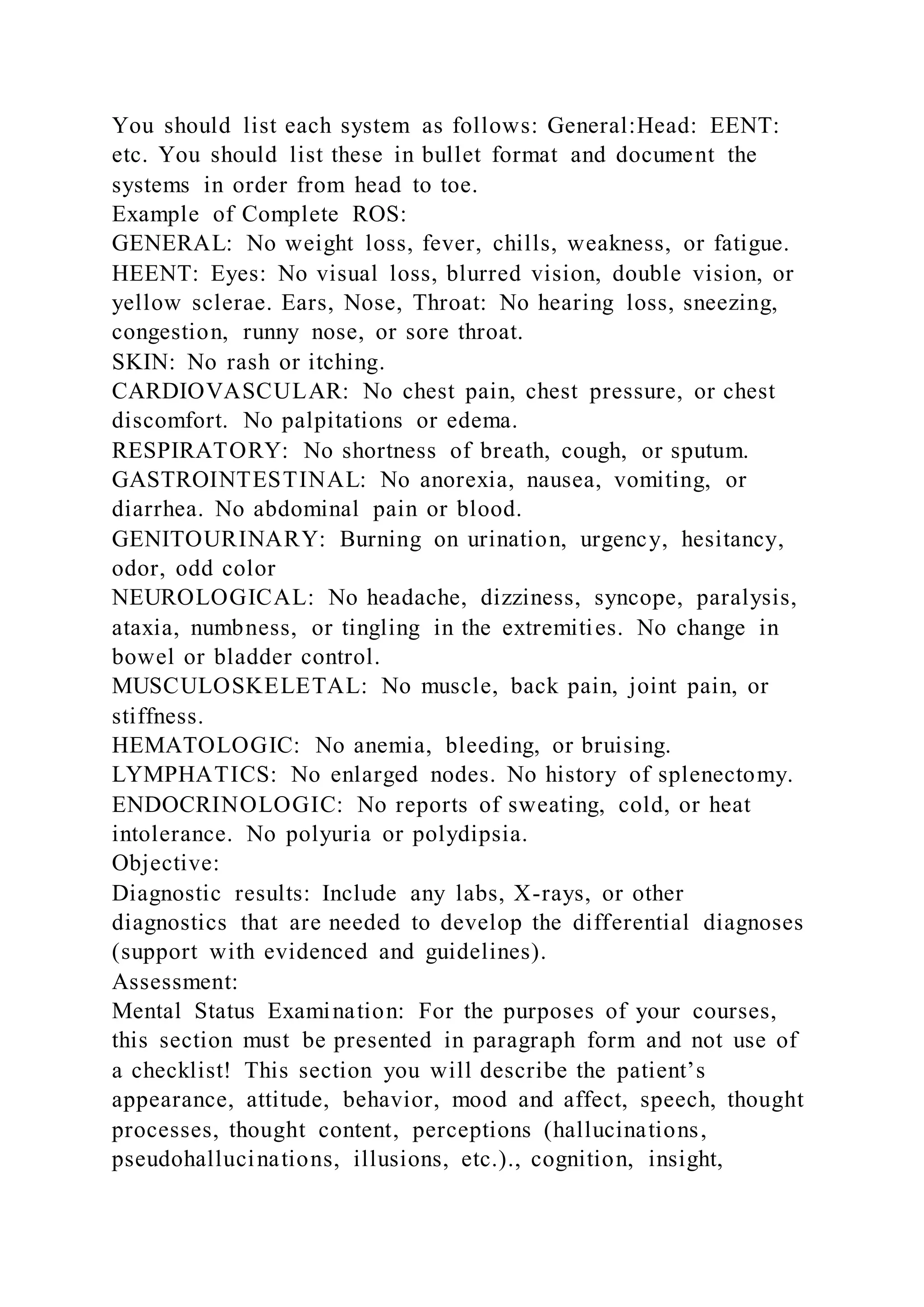
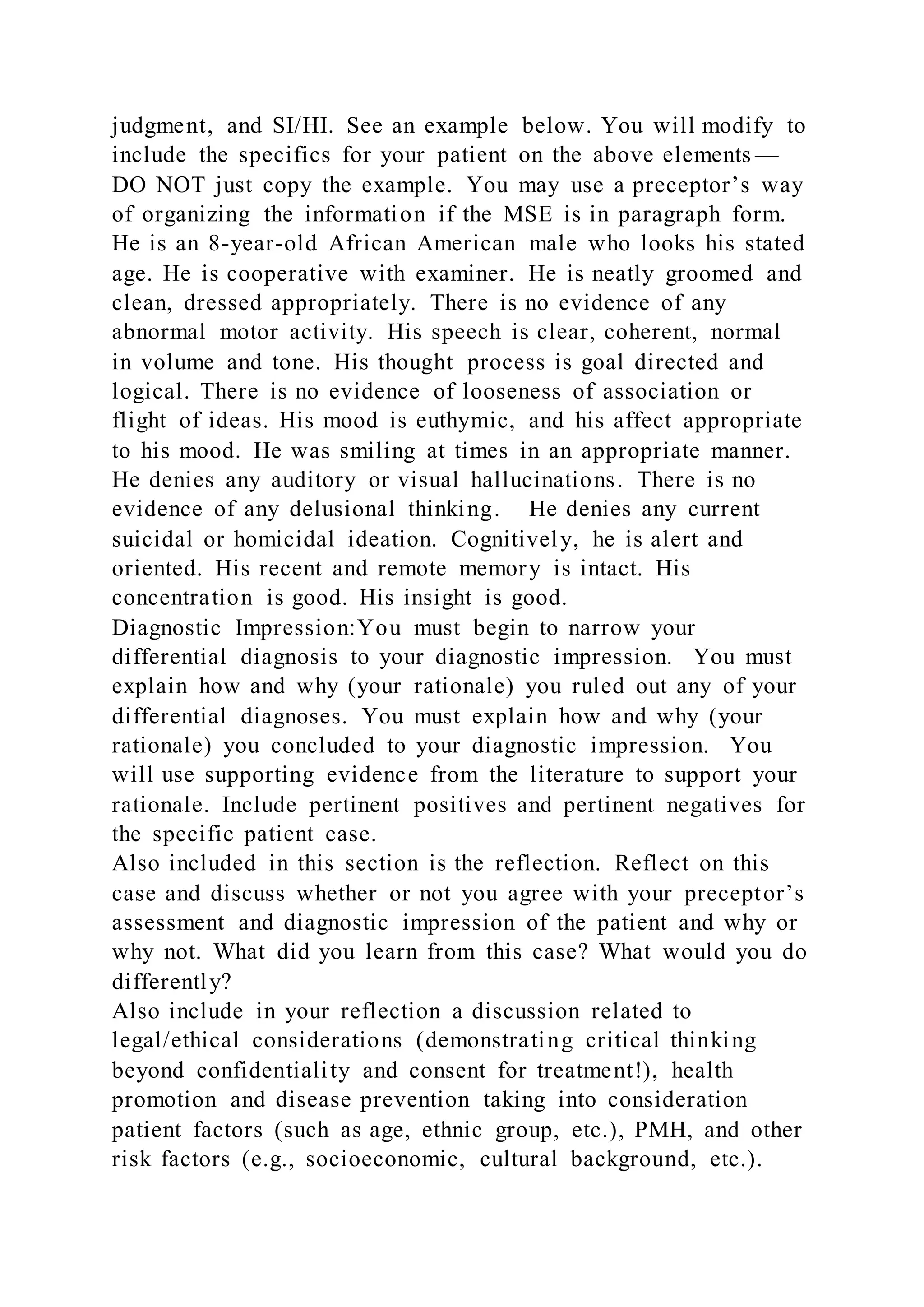
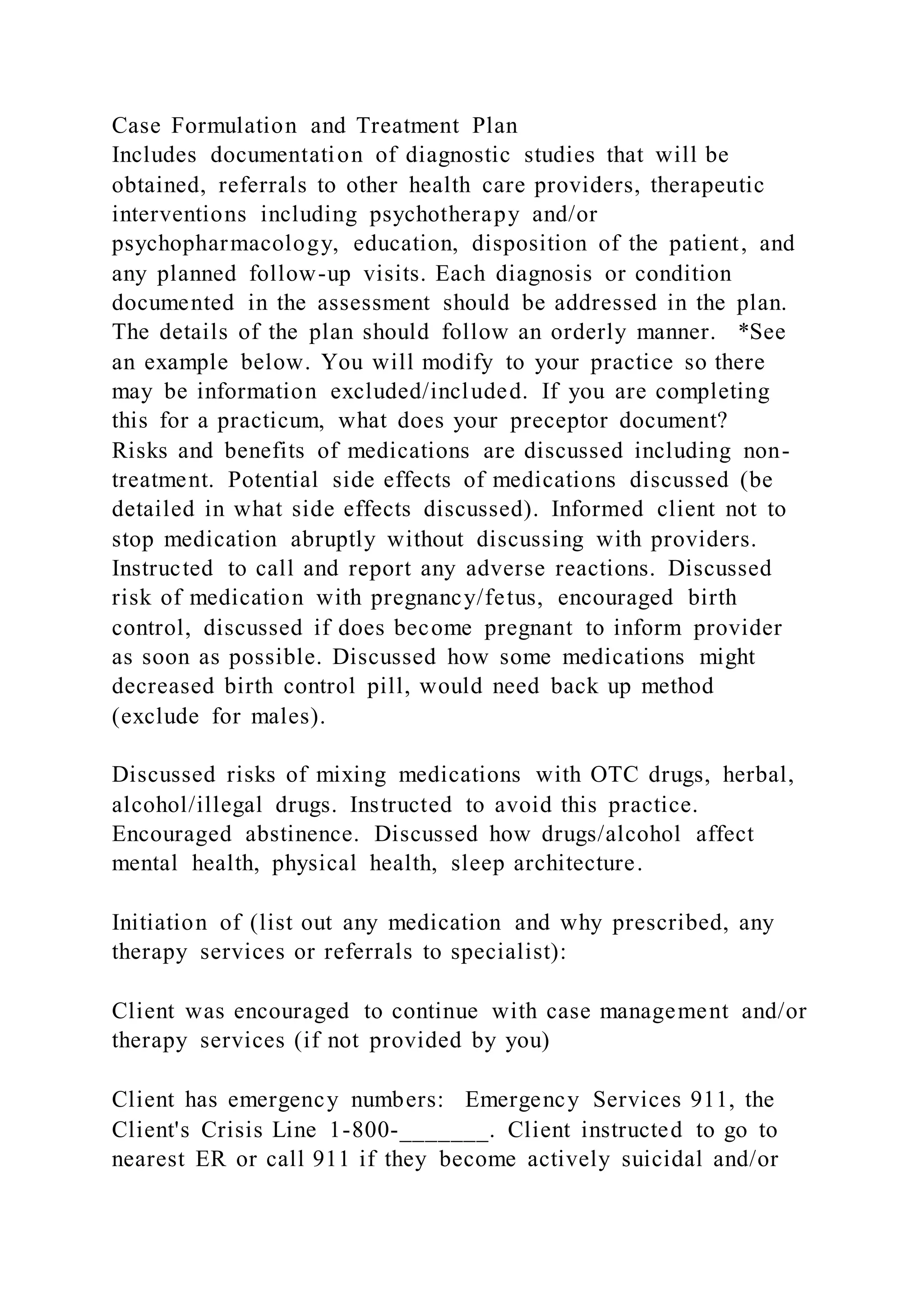
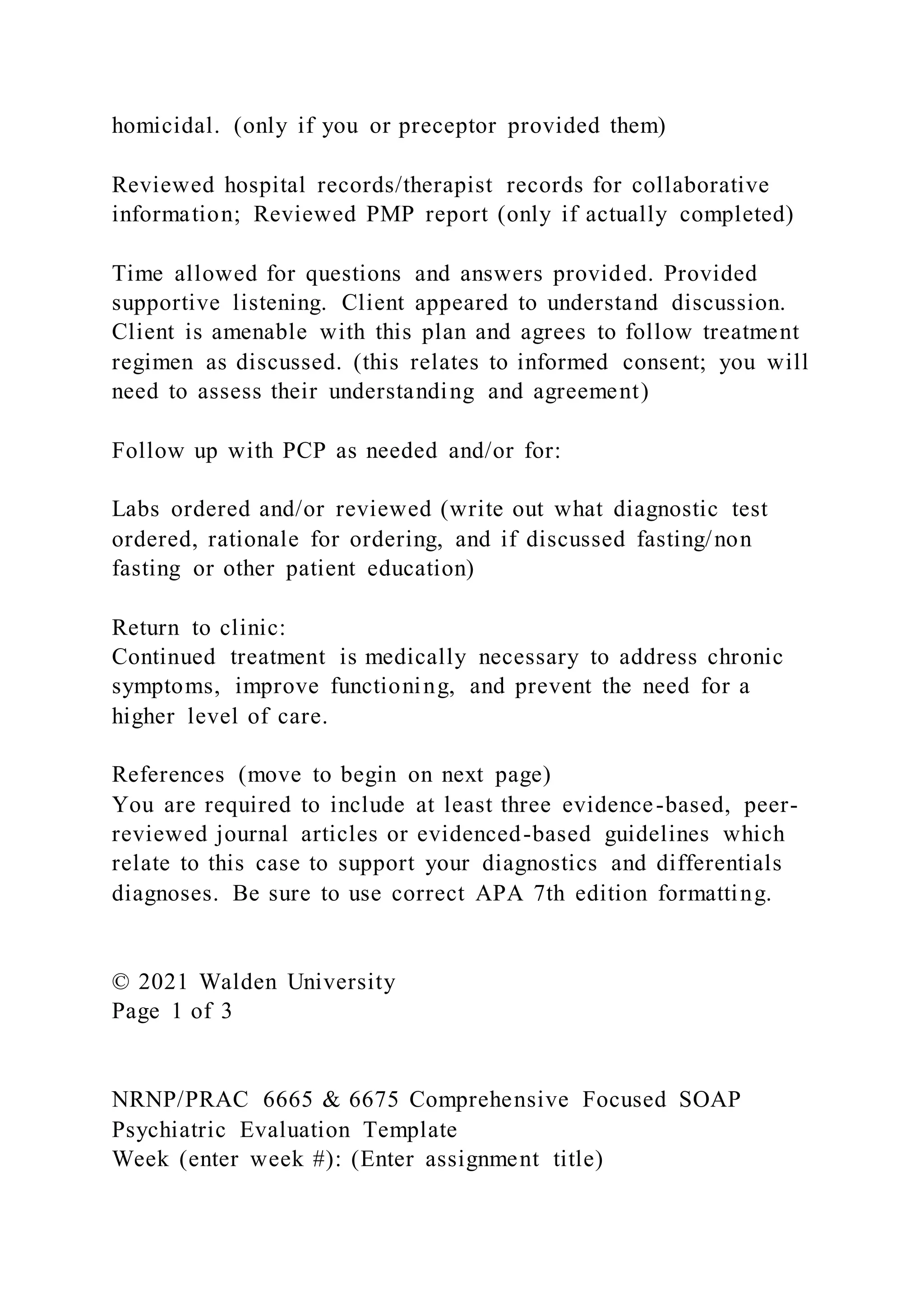
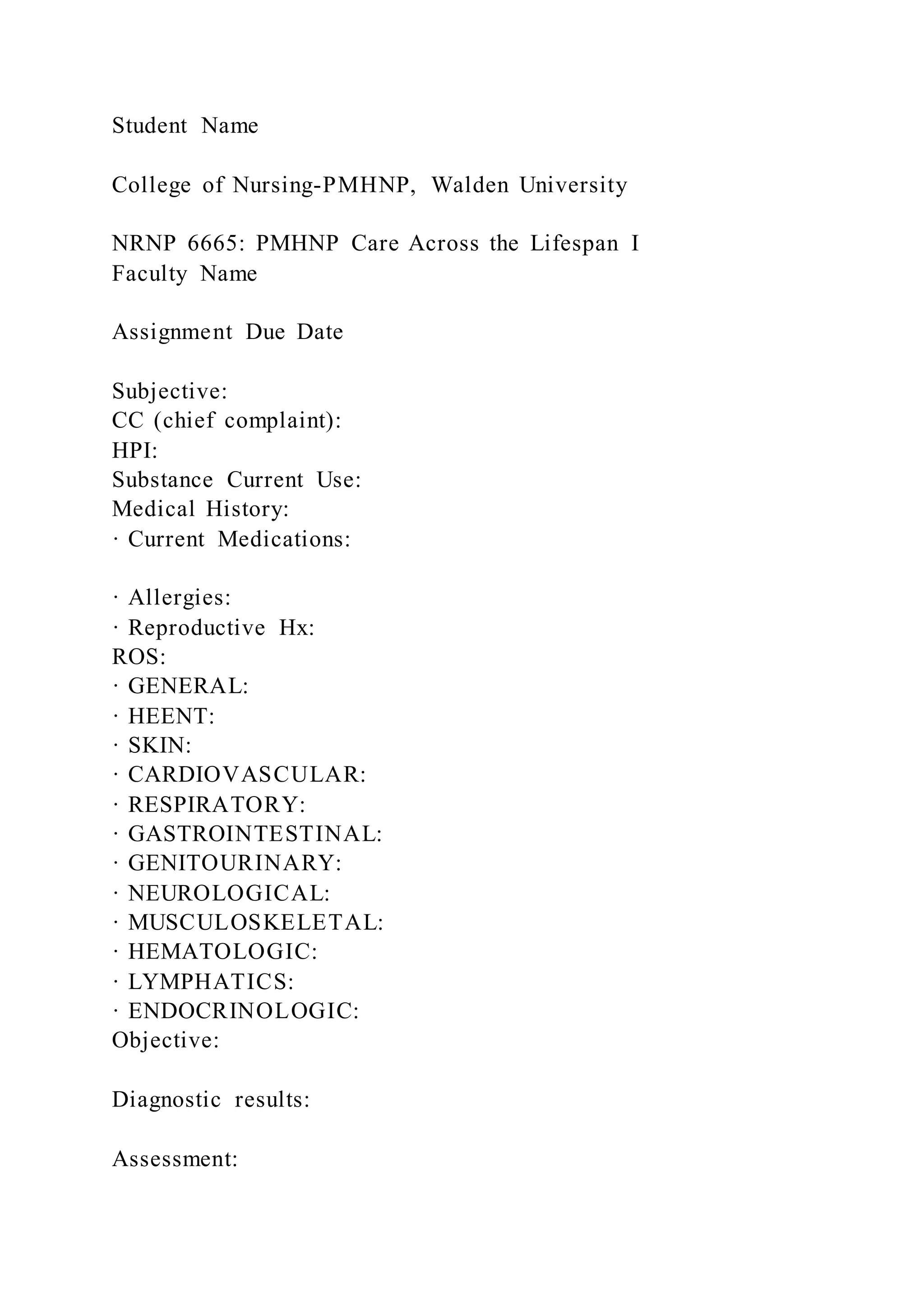
Rubric Detail
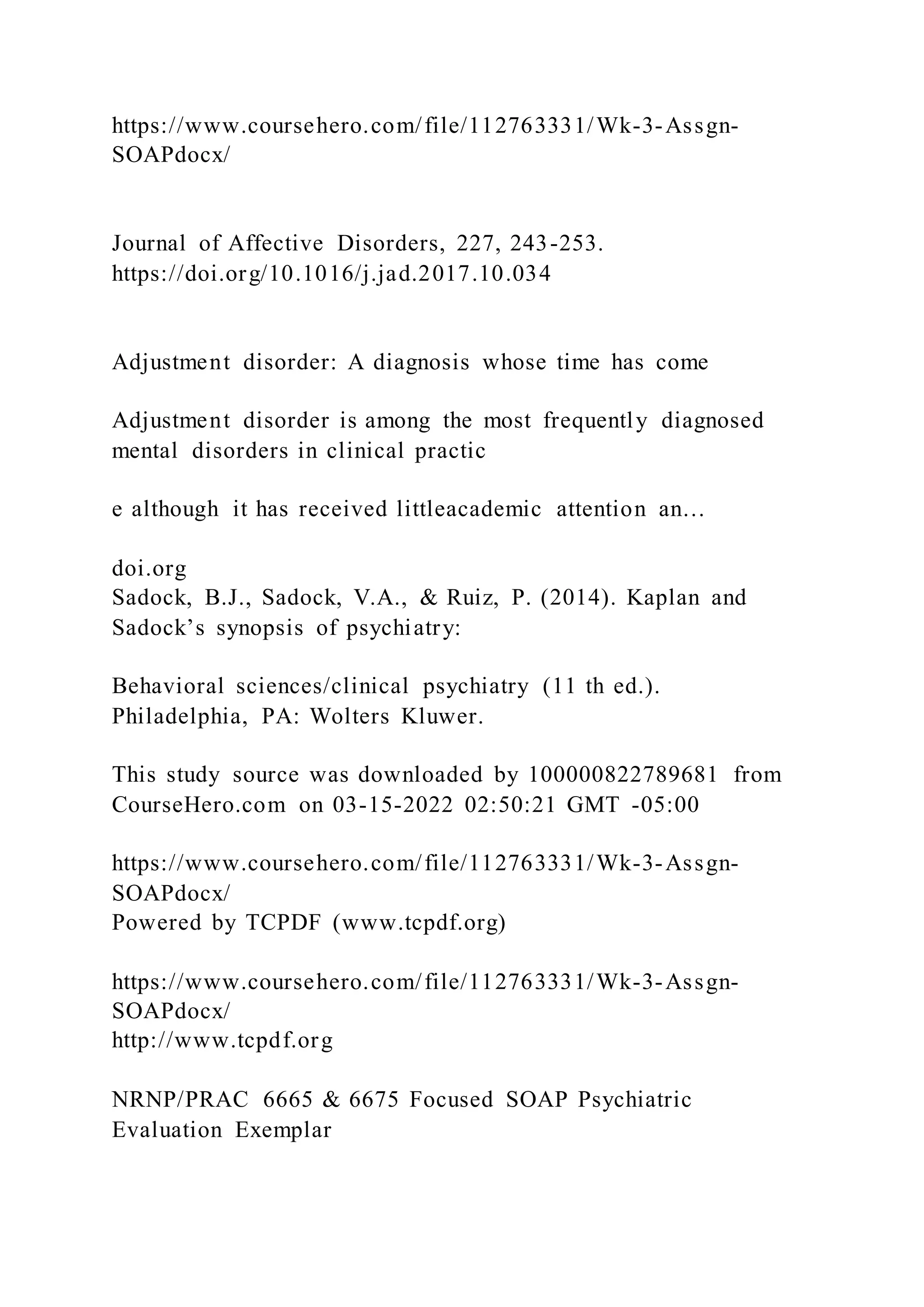
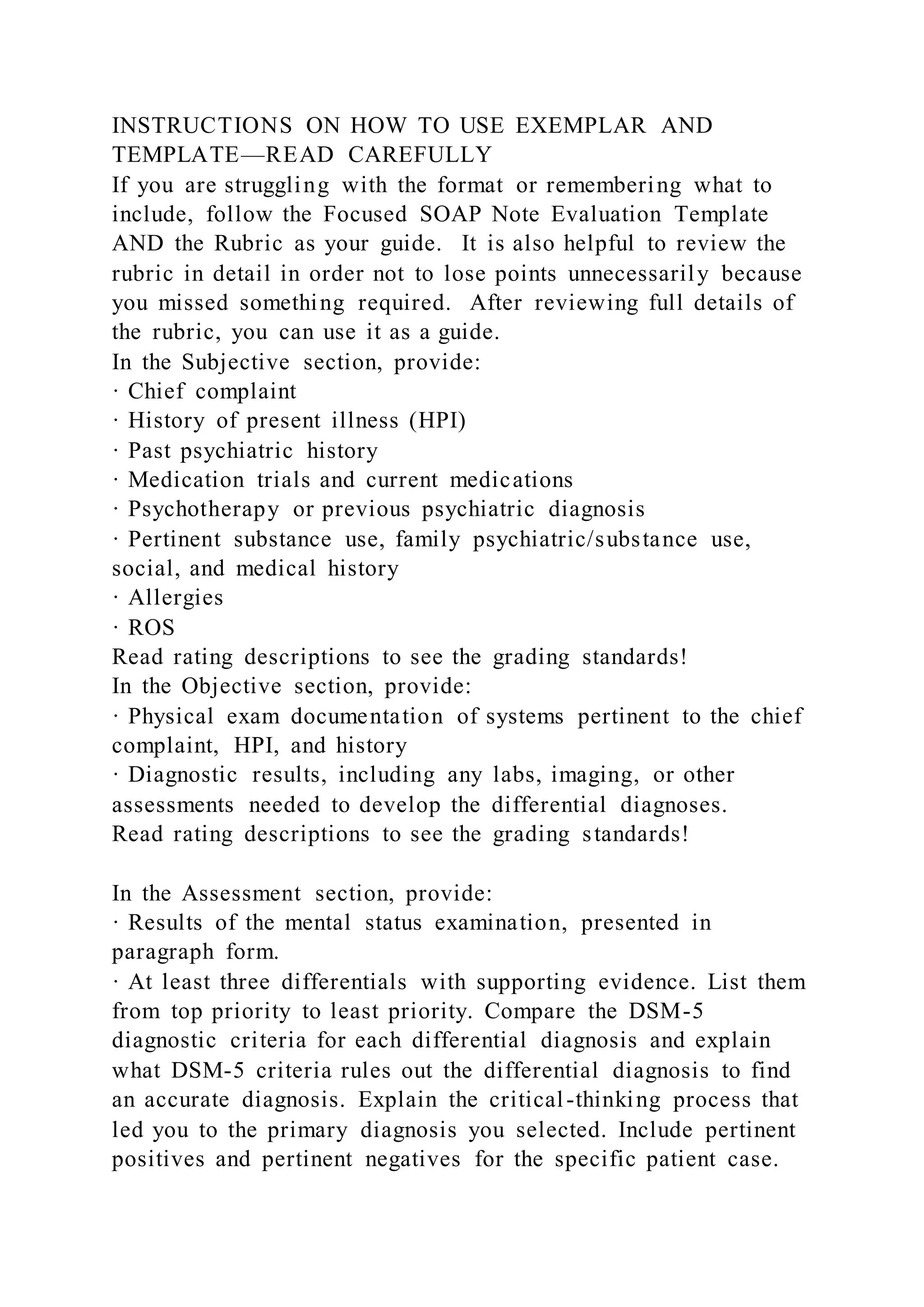
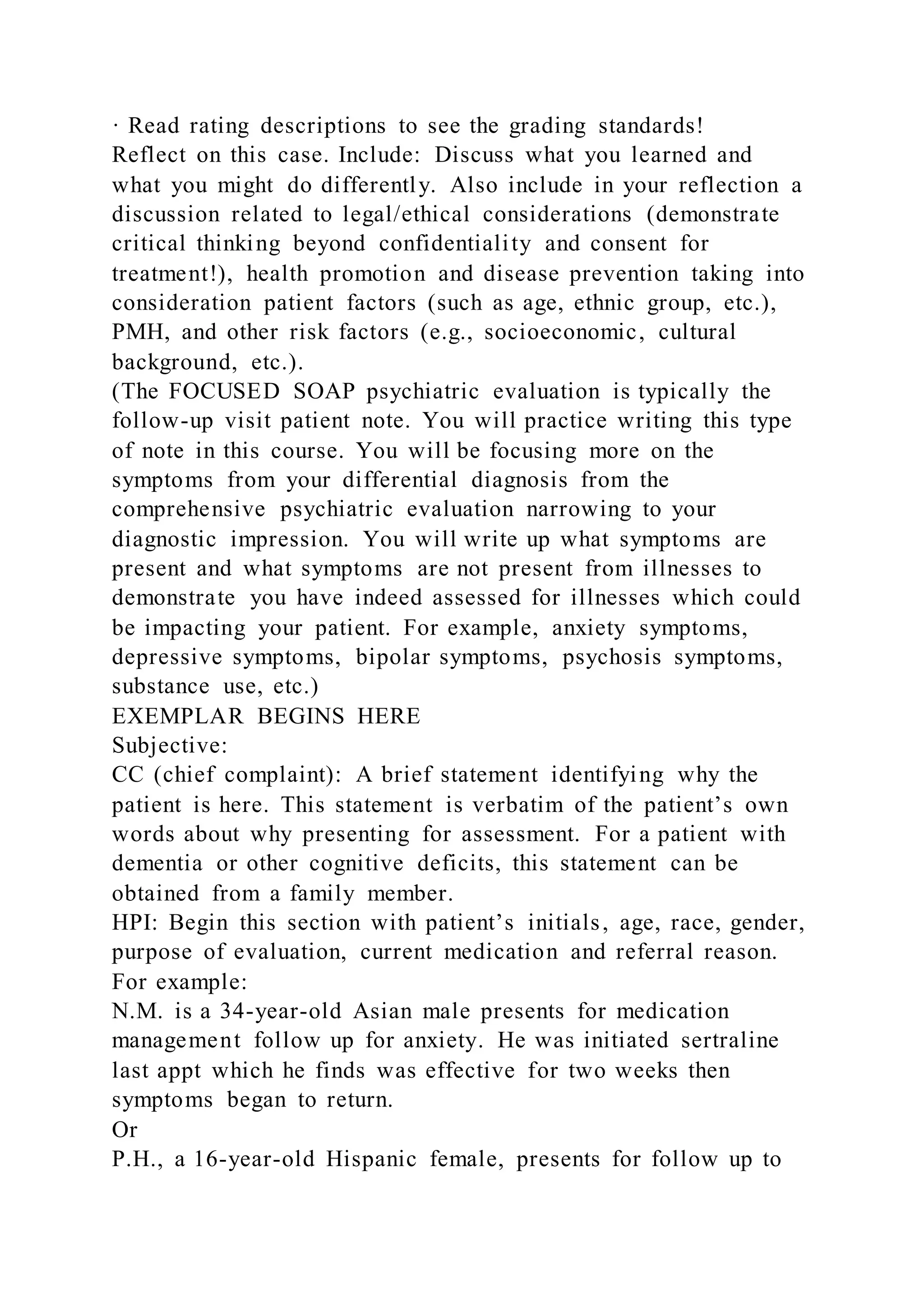
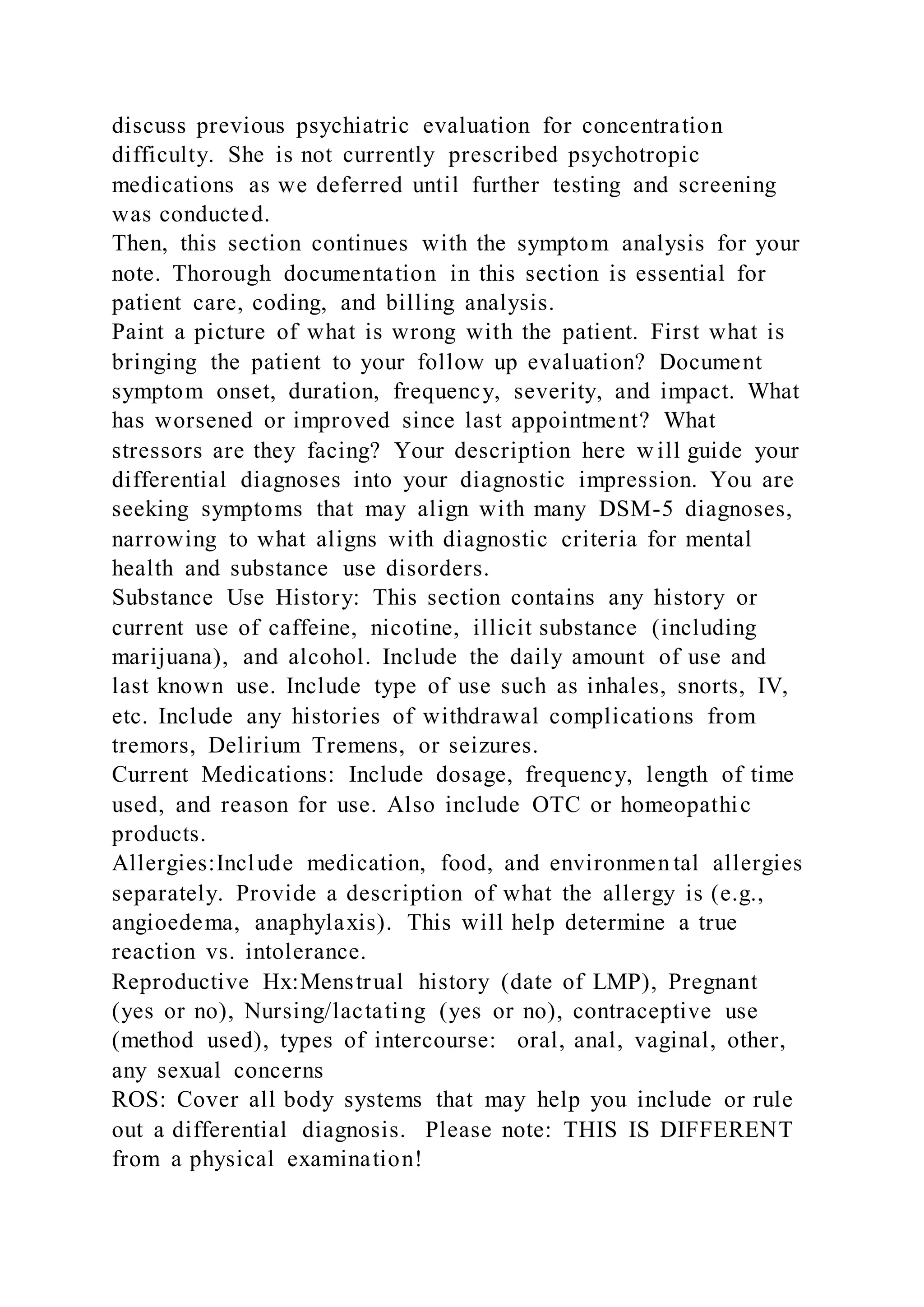
Select Grid View or List View to change the rubric's layout.
Content
Name: PRAC_6665_Week3_Assignment2_Rubric
Grid ViewList View
Excellent
Good
Fair
Poor
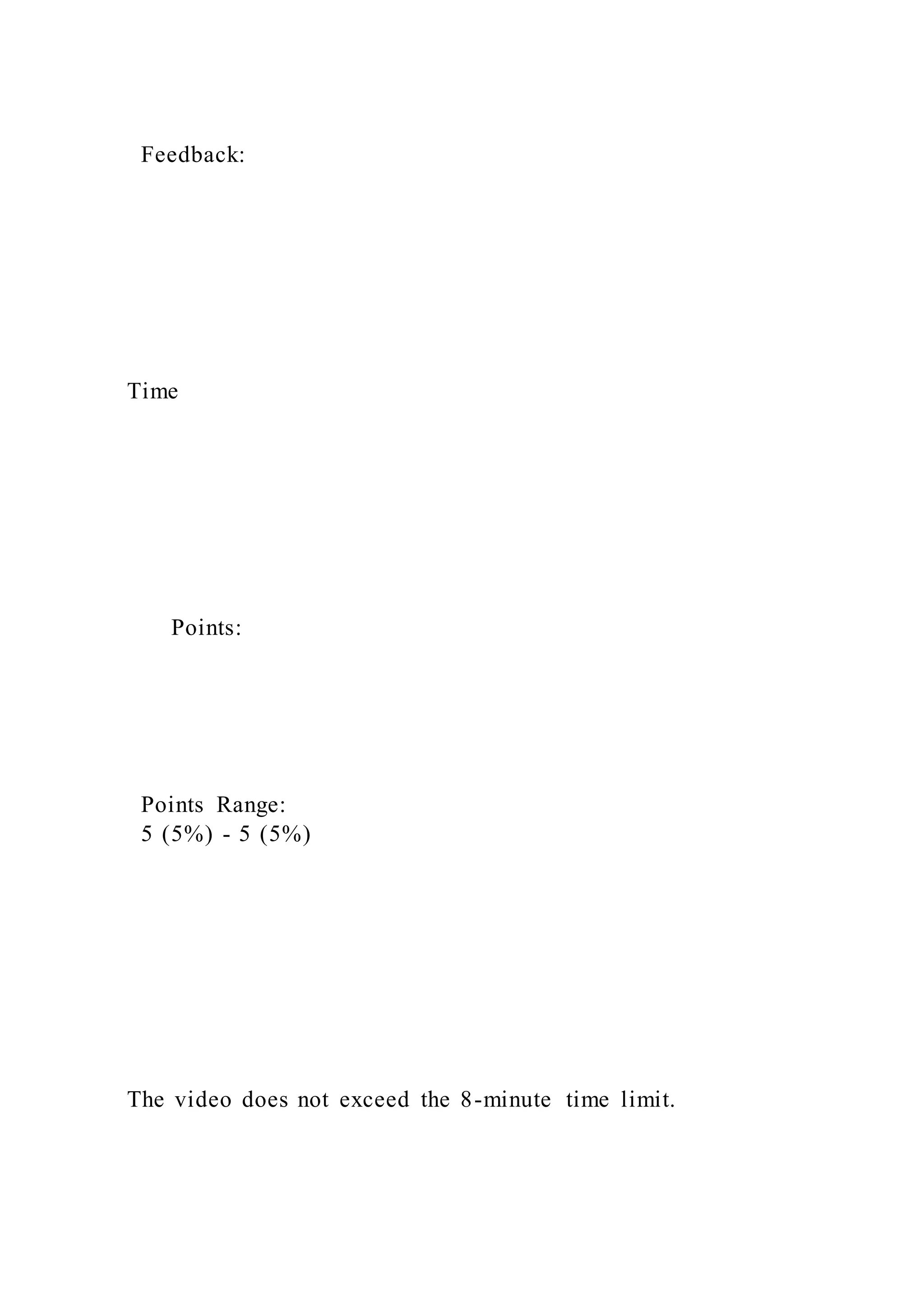
Photo ID display and professional attire
Points:
Points Range:
5 (5%) - 5 (5%)
Photo ID is displayed. The student is dressed professionally.
Feedback:
Points:
Points Range:
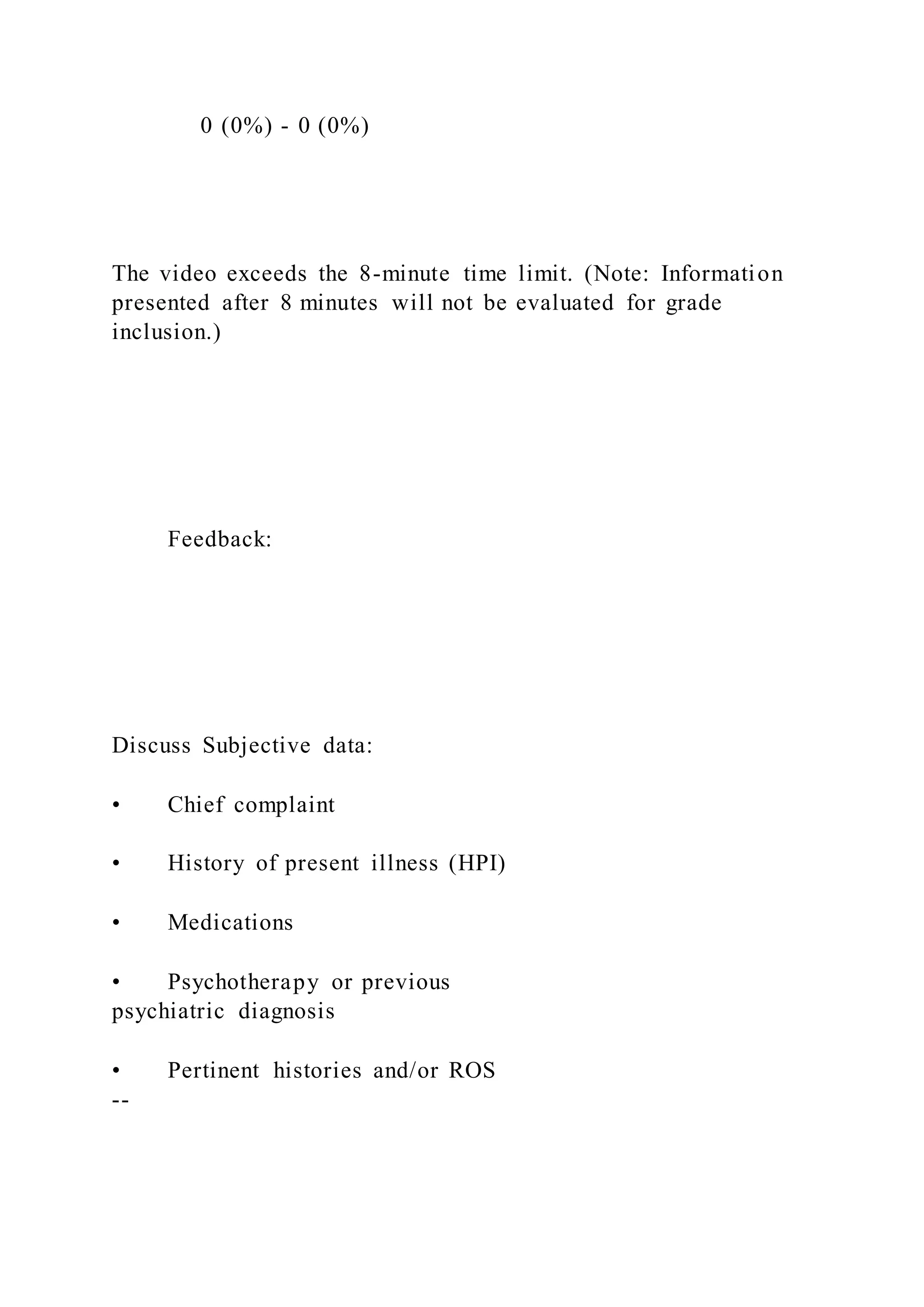
0 (0%) - 0 (0%)
Feedback:
Points:
Points Range:
0 (0%) - 0 (0%)
Feedback:
Points:
Points Range:
0 (0%) - 0 (0%)
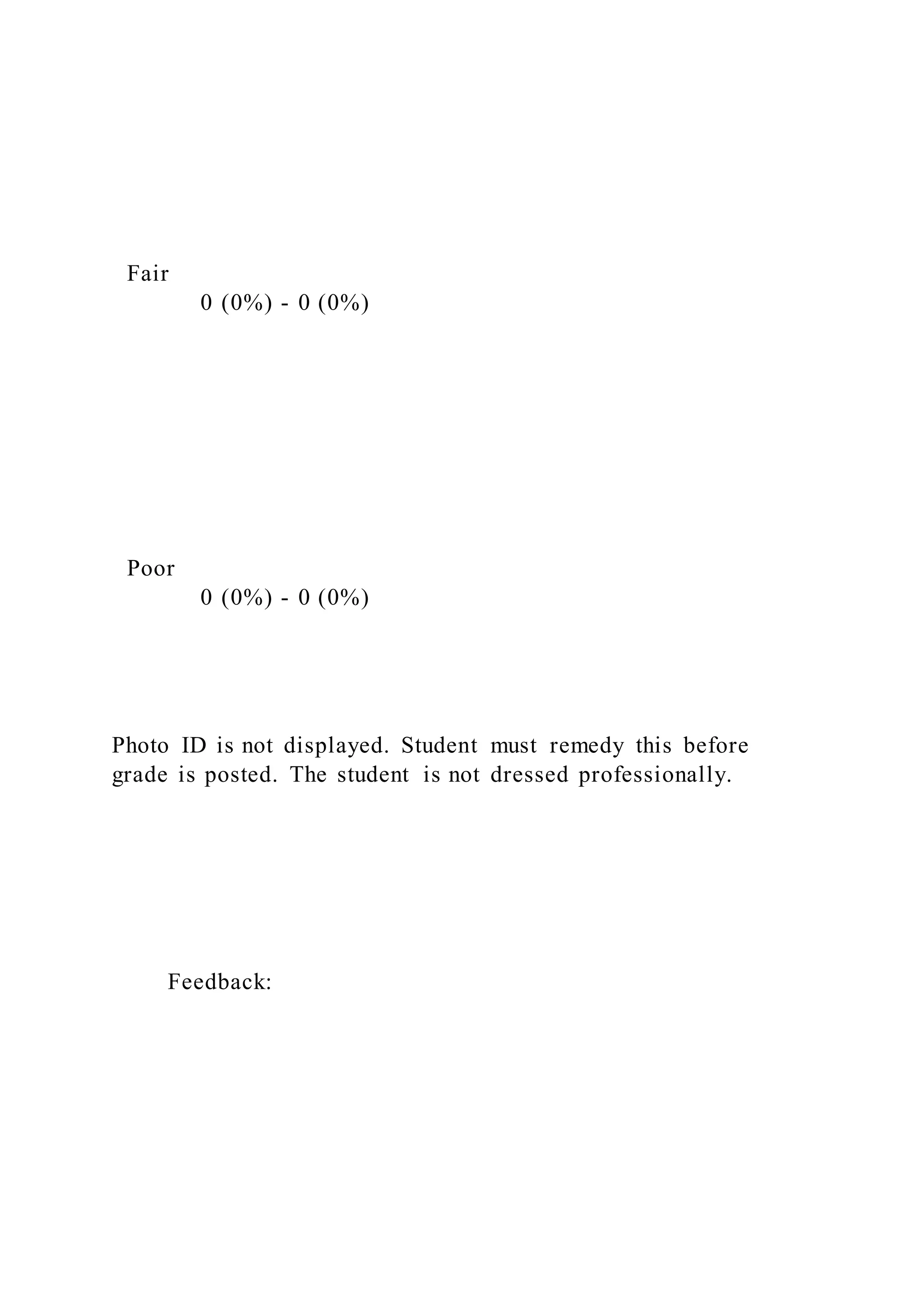
Photo ID is not displayed. Student must remedy this before
grade is posted. The student is not dressed professionally.
Feedback:
Time
Points:
Points Range:
5 (5%) - 5 (5%)
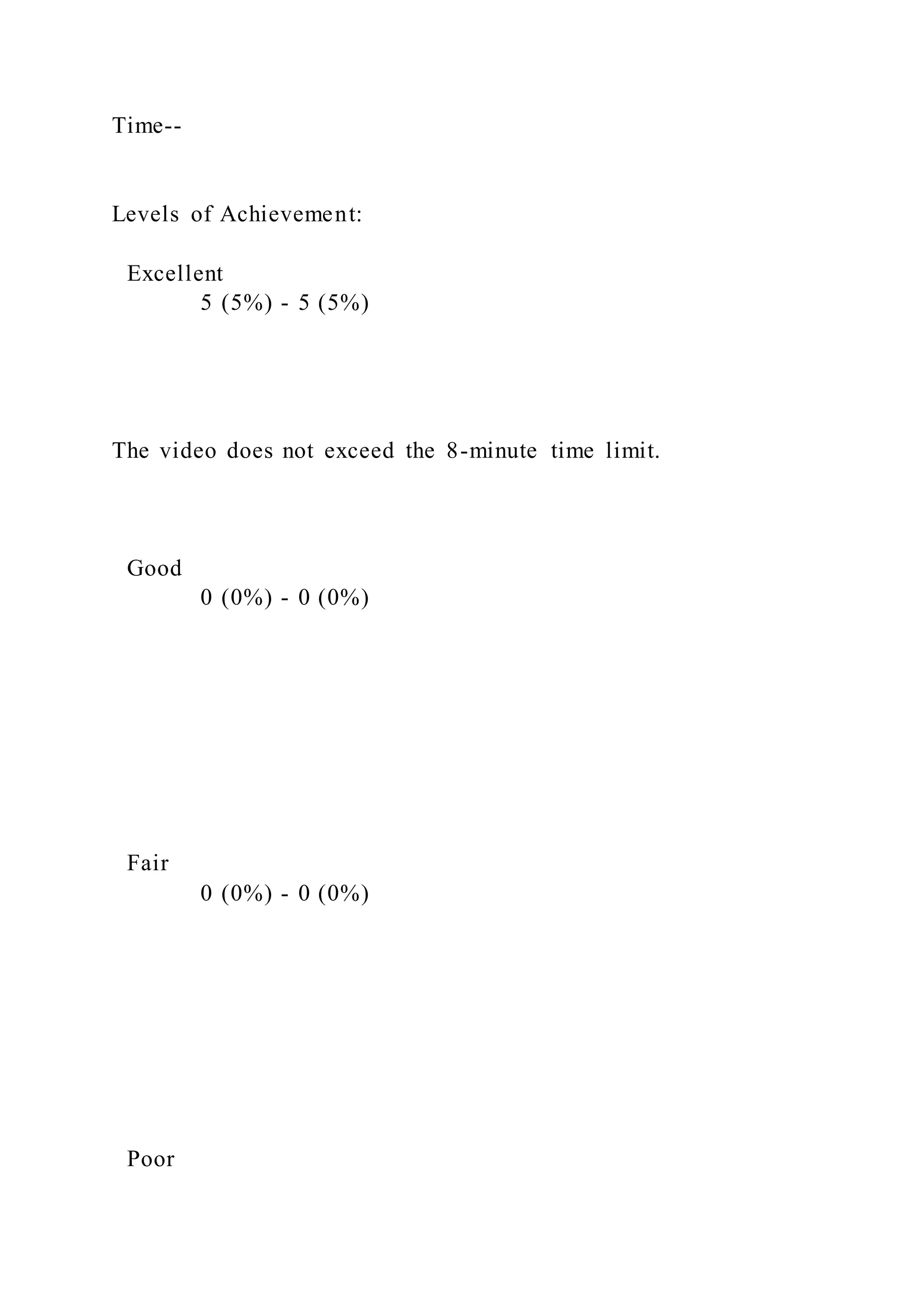
The video does not exceed the 8-minute time limit.
Feedback:
Points:
Points Range:
0 (0%) - 0 (0%)
Feedback:
Points:
Points Range:
0 (0%) - 0 (0%)
Feedback:
Points:
Points Range:
0 (0%) - 0 (0%)
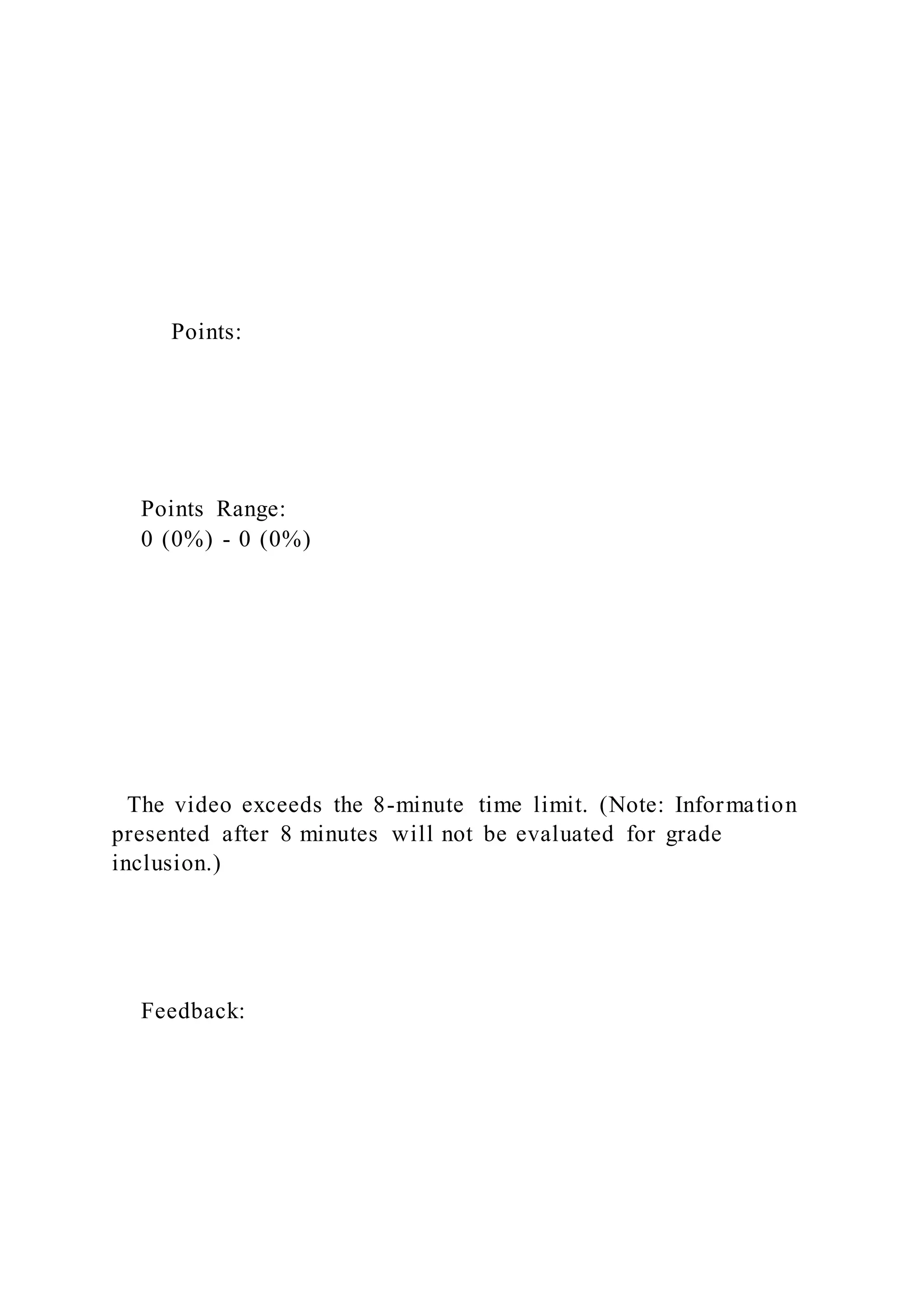
The video exceeds the 8-minute time limit. (Note: Information
presented after 8 minutes will not be evaluated for grade
inclusion.)
Feedback:
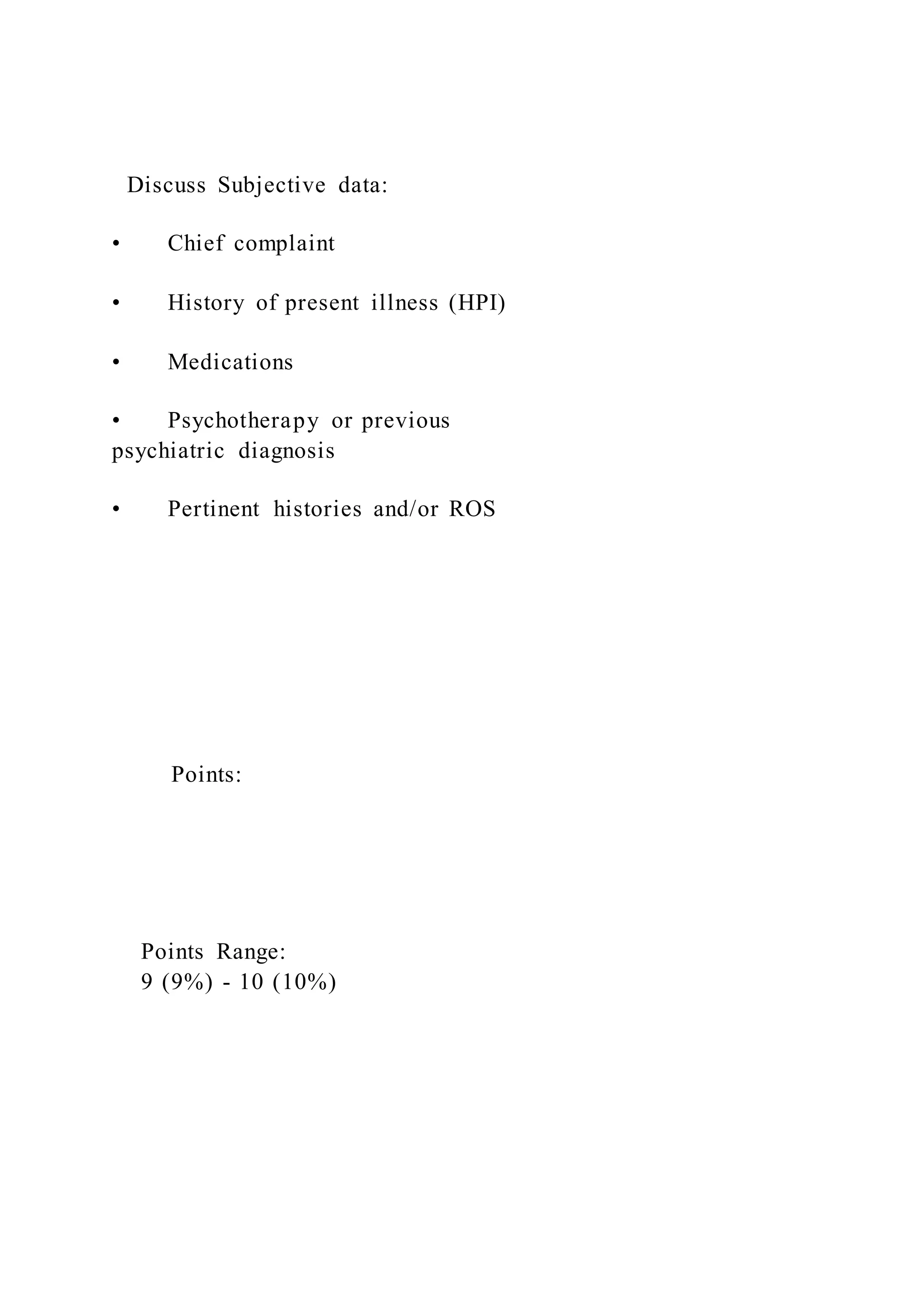
Discuss Subjective data:
• Chief complaint
• History of present illness (HPI)
• Medications
• Psychotherapy or previous
psychiatric diagnosis
• Pertinent histories and/or ROS
Points:
Points Range:
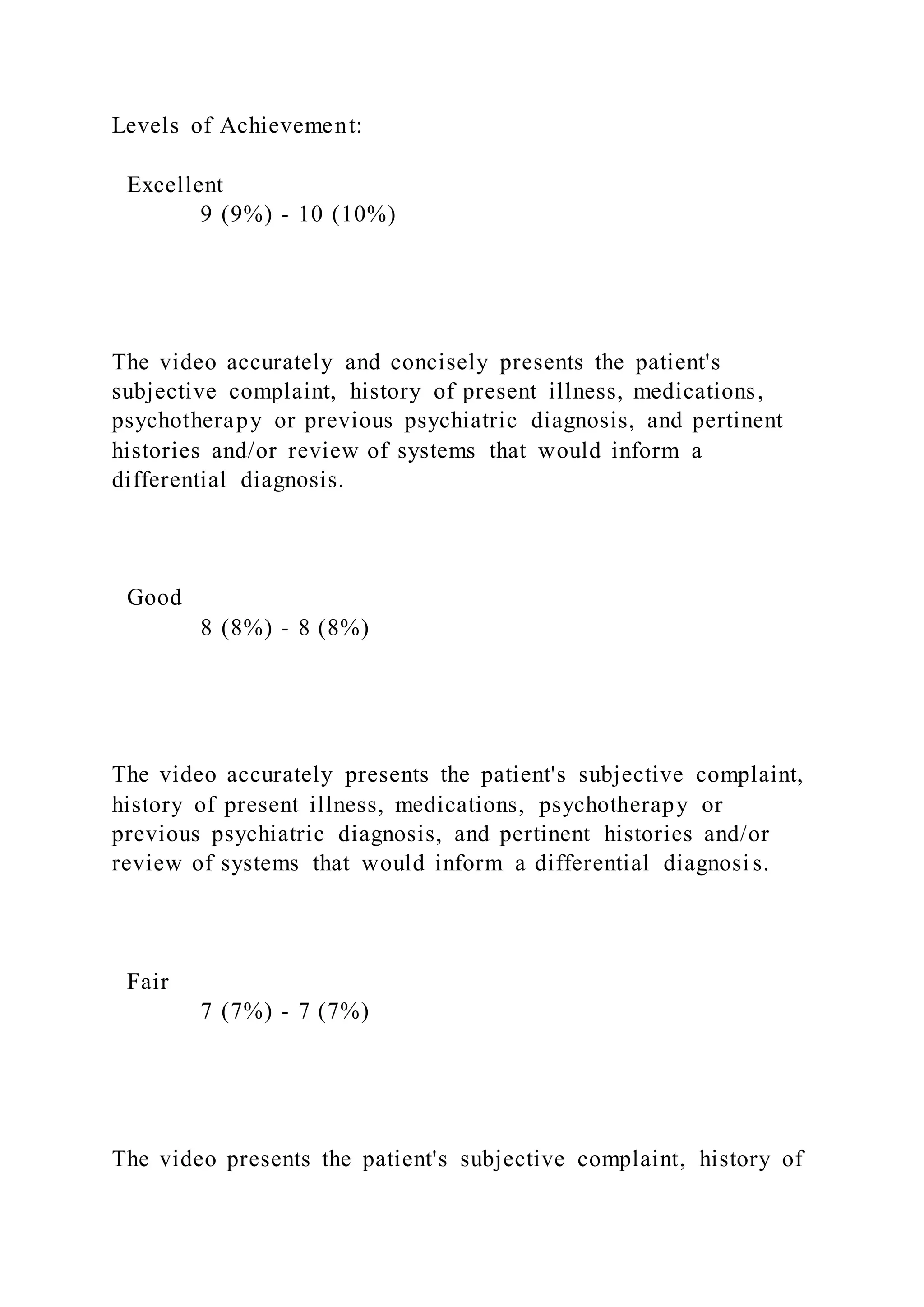
9 (9%) - 10 (10%)
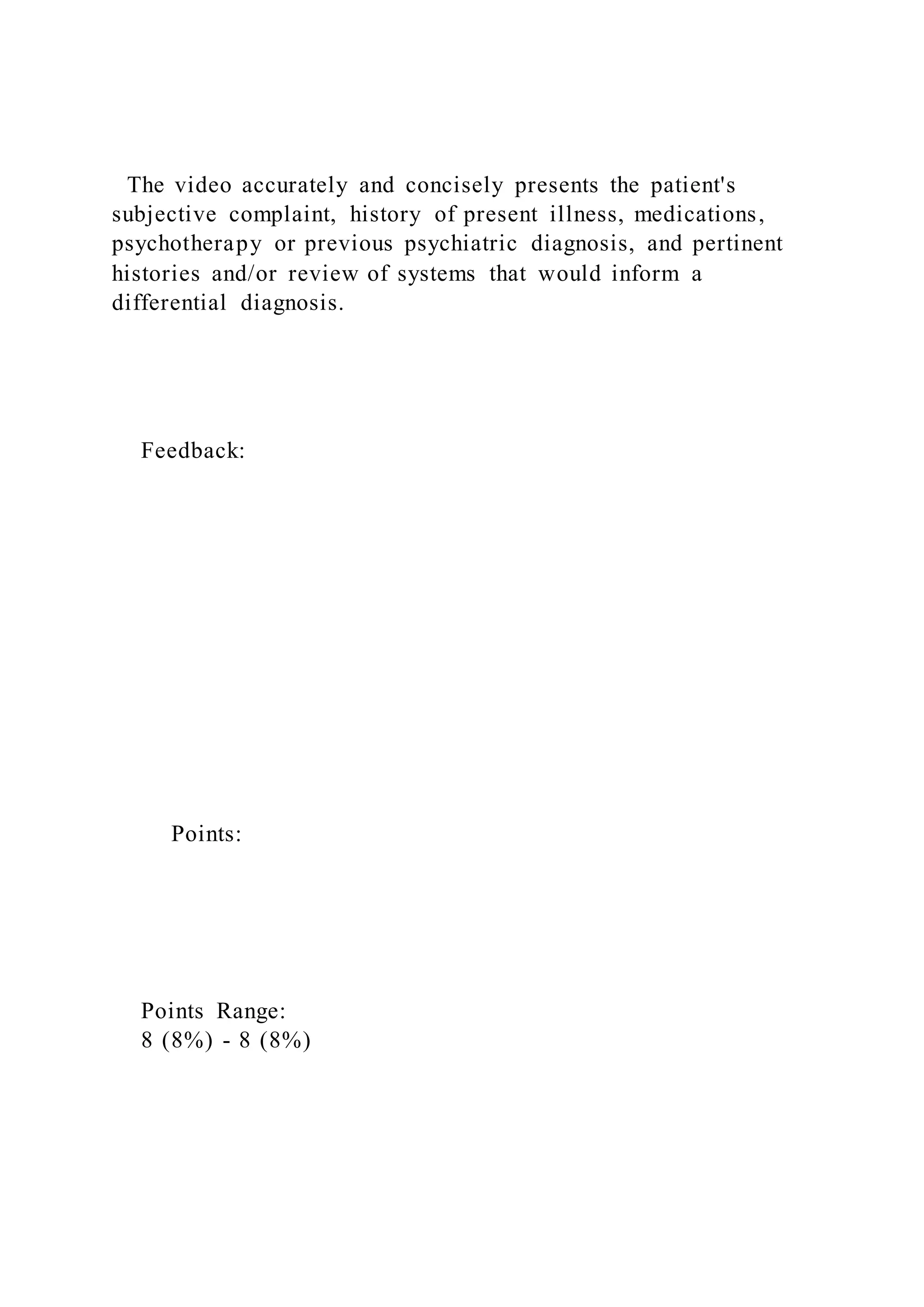
The video accurately and concisely presents the patient's
subjective complaint, history of present illness, medications,
psychotherapy or previous psychiatric diagnosis, and pertinent
histories and/or review of systems that would inform a
differential diagnosis.
Feedback:
Points:
Points Range:
8 (8%) - 8 (8%)
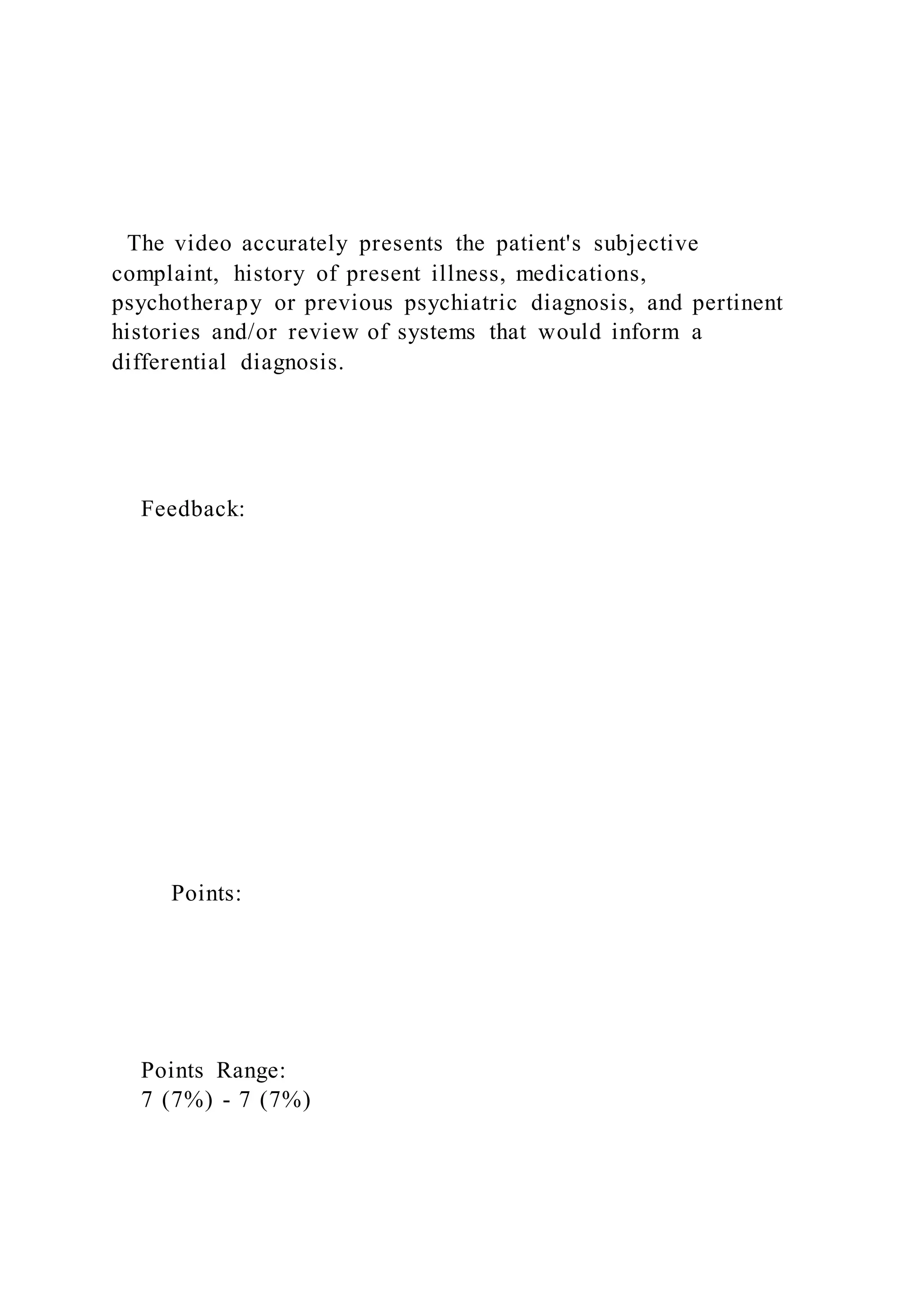
The video accurately presents the patient's subjective
complaint, history of present illness, medications,
psychotherapy or previous psychiatric diagnosis, and pertinent
histories and/or review of systems that would inform a
differential diagnosis.
Feedback:
Points:
Points Range:
7 (7%) - 7 (7%)
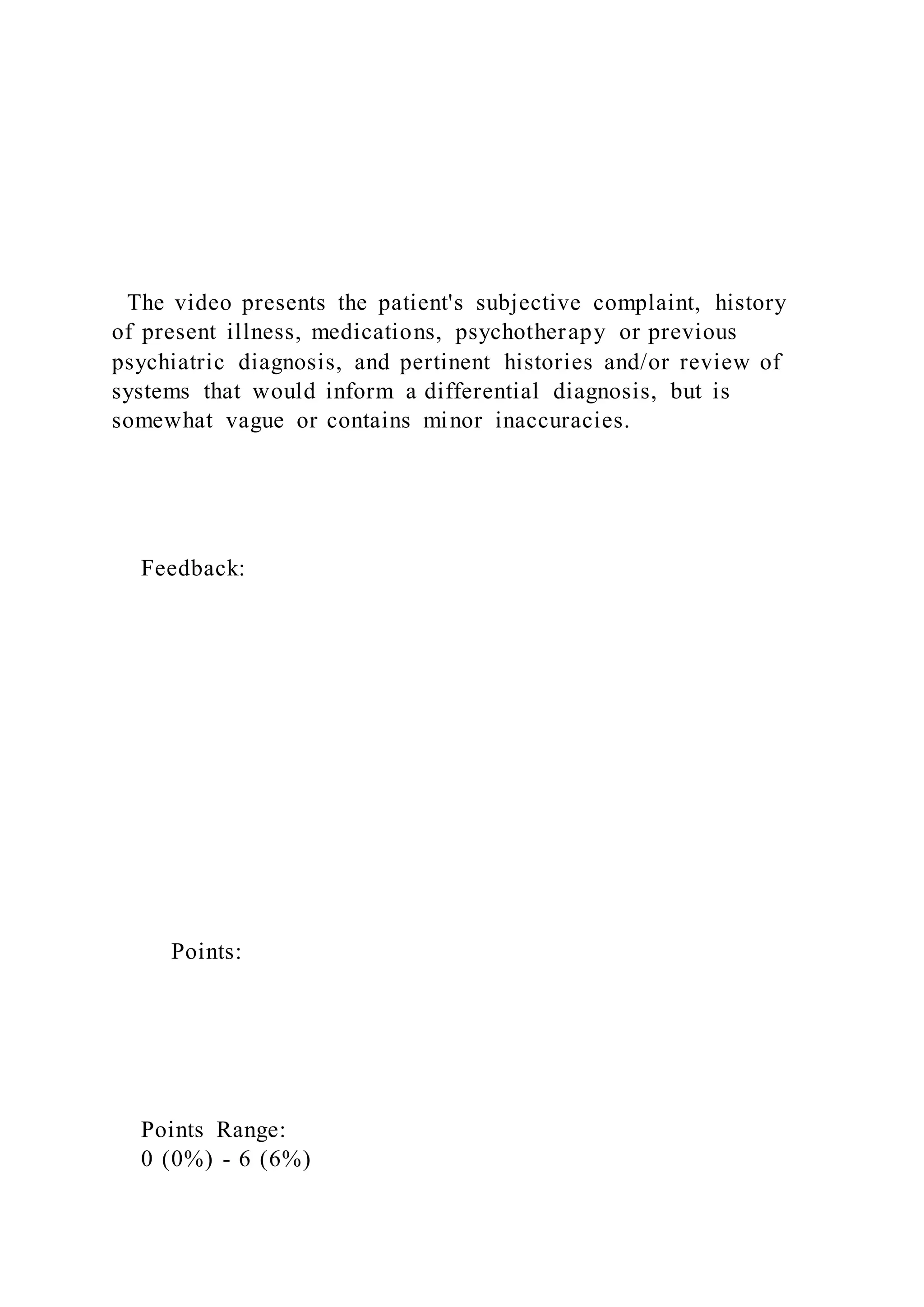
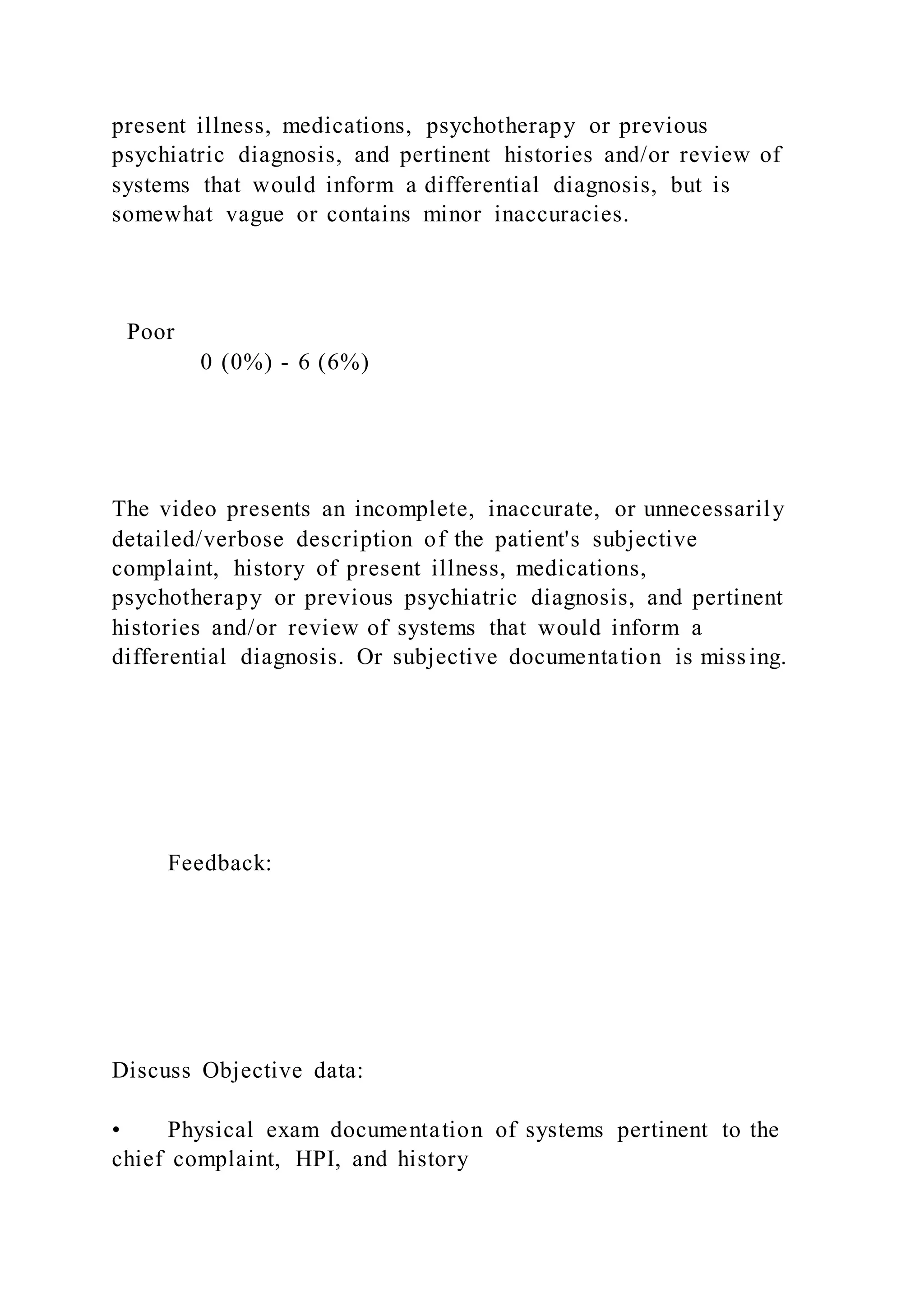
The video presents the patient's subjective complaint, history
of present illness, medications, psychotherapy or previous
psychiatric diagnosis, and pertinent histories and/or review of
systems that would inform a differential diagnosis, but is
somewhat vague or contains minor inaccuracies.
Feedback:
Points:
Points Range:
0 (0%) - 6 (6%)
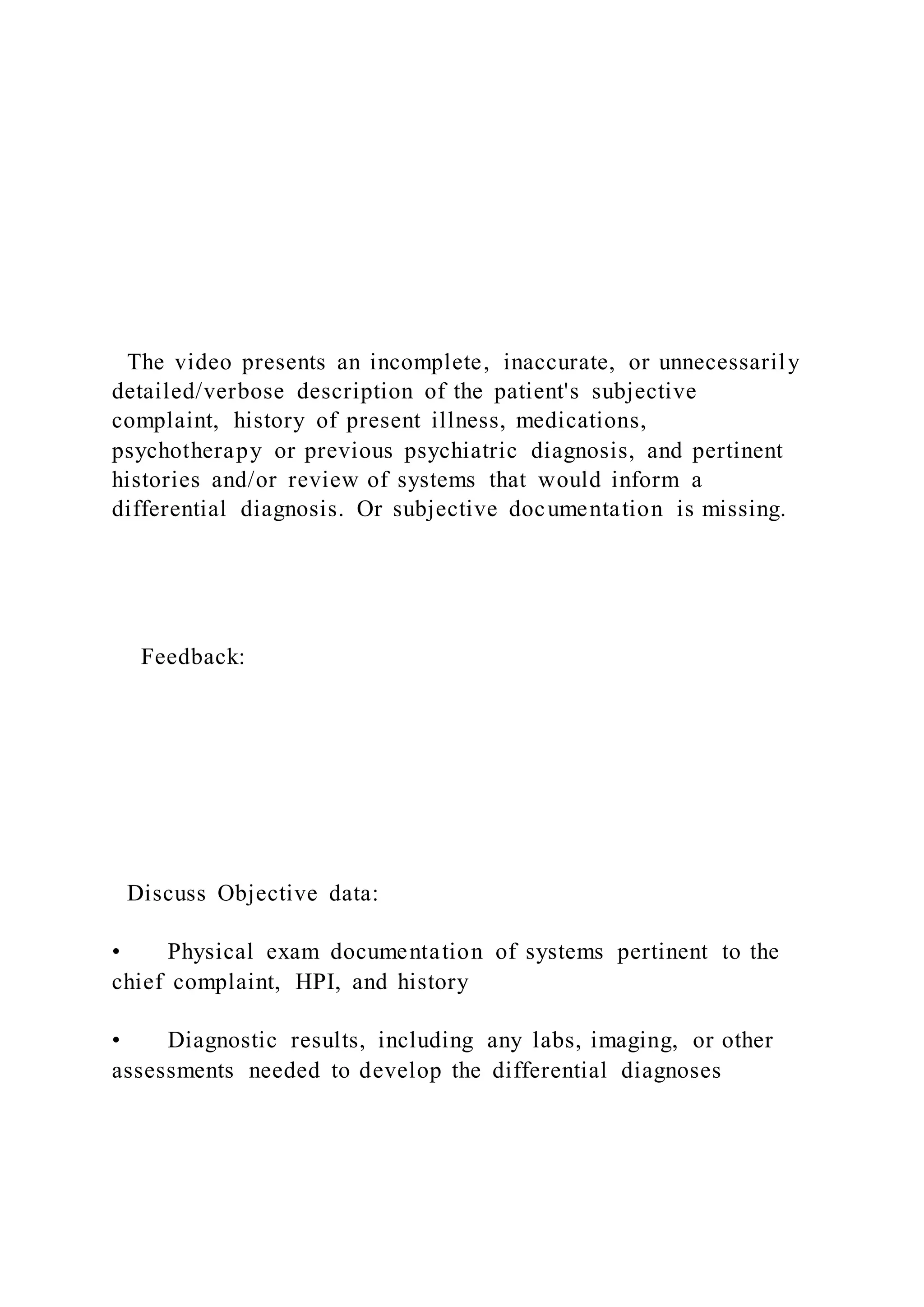
The video presents an incomplete, inaccurate, or unnecessarily
detailed/verbose description of the patient's subjective
complaint, history of present illness, medications,
psychotherapy or previous psychiatric diagnosis, and pertinent
histories and/or review of systems that would inform a
differential diagnosis. Or subjective documentation is missing.
Feedback:
Discuss Objective data:
• Physical exam documentation of systems pertinent to the
chief complaint, HPI, and history
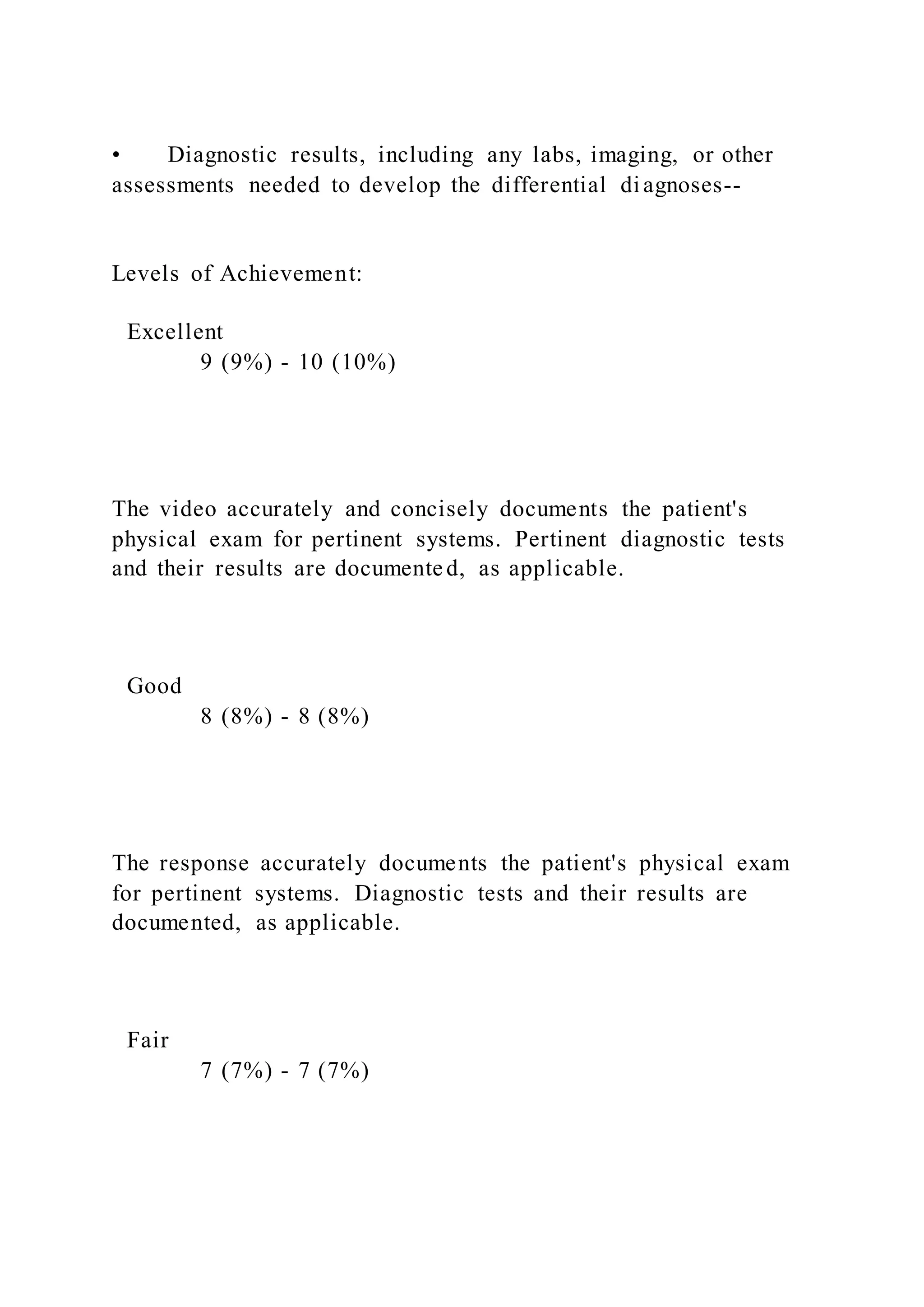
• Diagnostic results, including any labs, imaging, or other
assessments needed to develop the differential diagnoses
Points:
Points Range:
9 (9%) - 10 (10%)
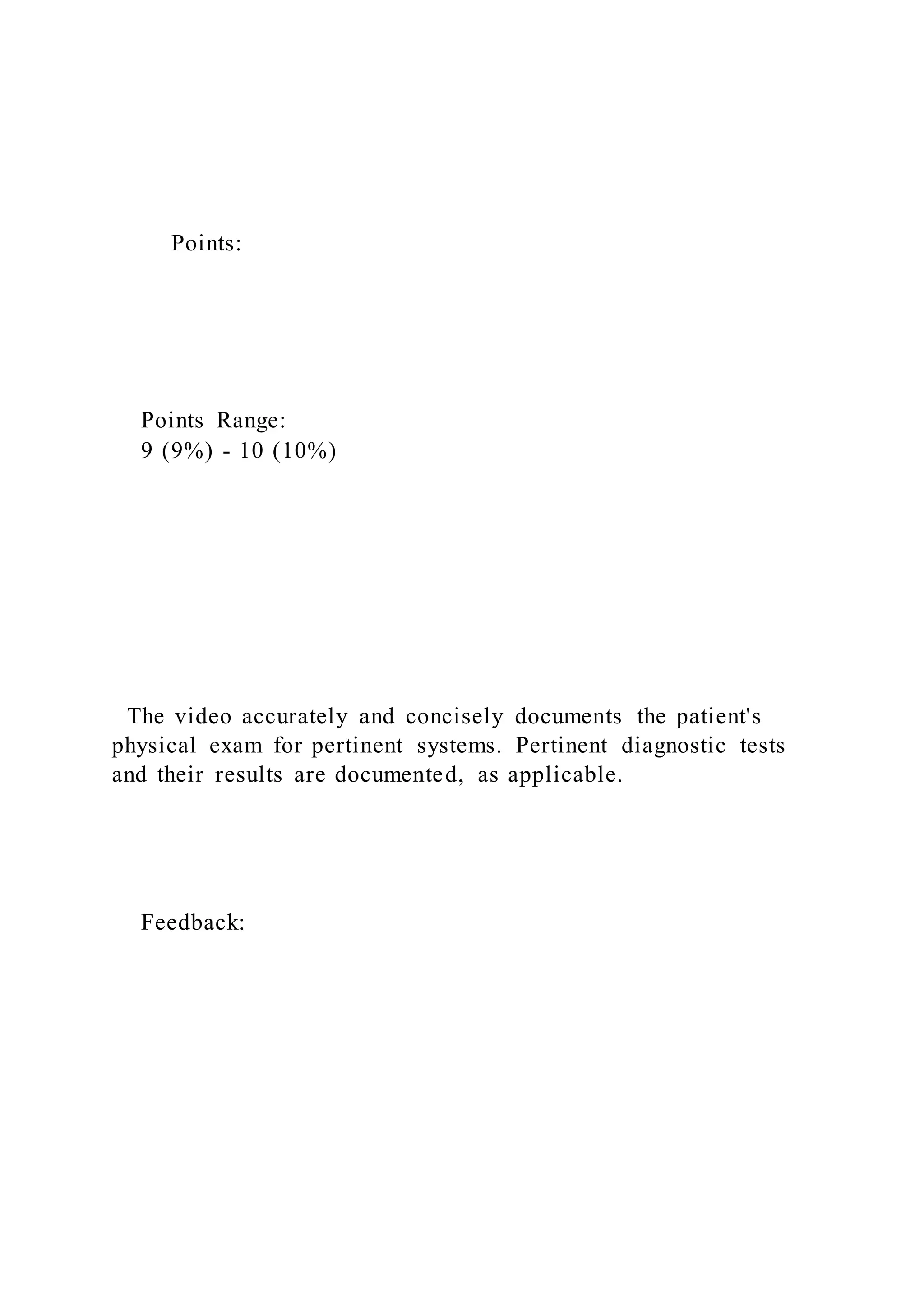
The video accurately and concisely documents the patient's
physical exam for pertinent systems. Pertinent diagnostic tests
and their results are documented, as applicable.
Feedback:
Points:
Points Range:
8 (8%) - 8 (8%)
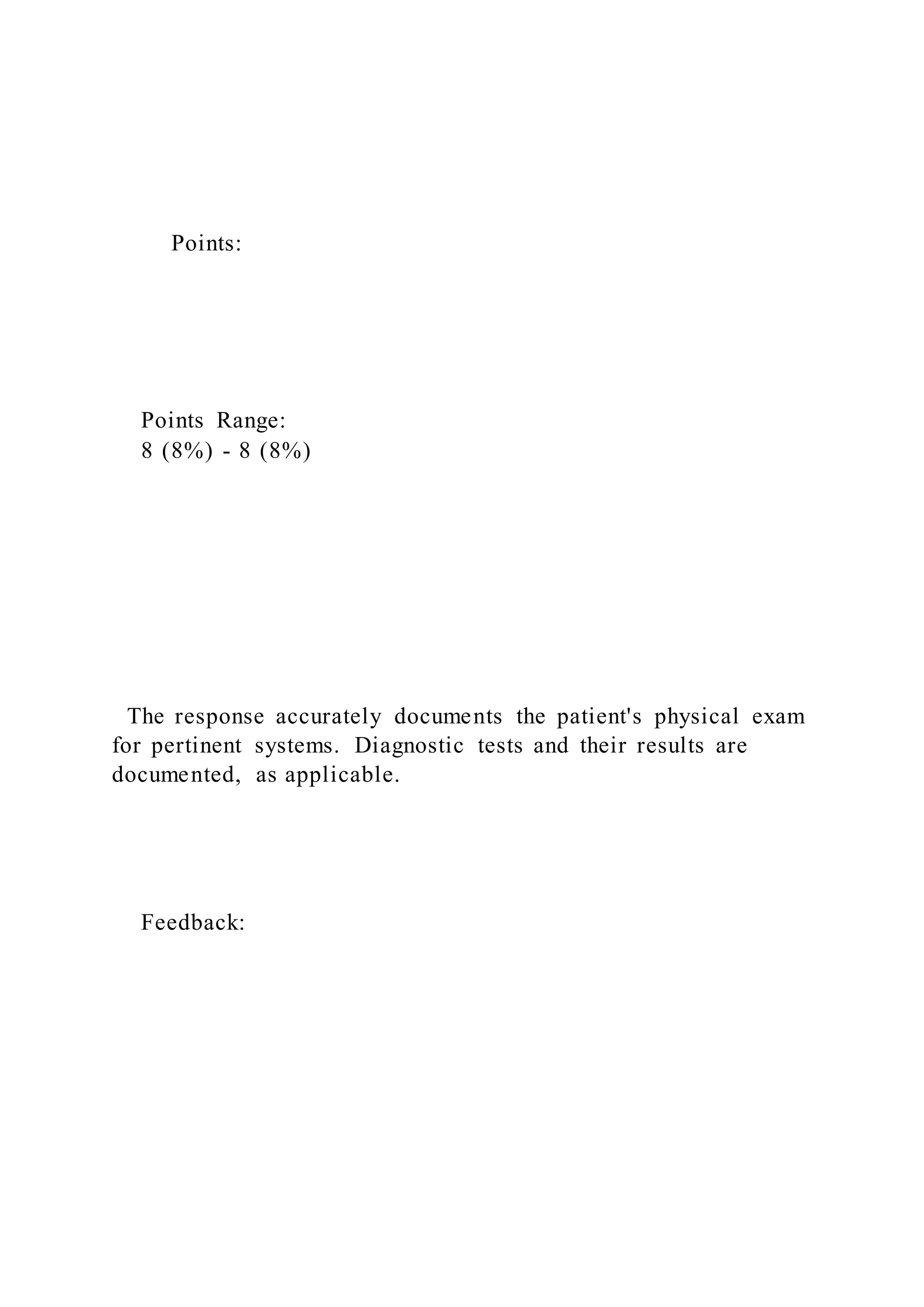
The response accurately documents the patient's physical exam
for pertinent systems. Diagnostic tests and their results are
documented, as applicable.
Feedback:
Points:
Points Range:
7 (7%) - 7 (7%)
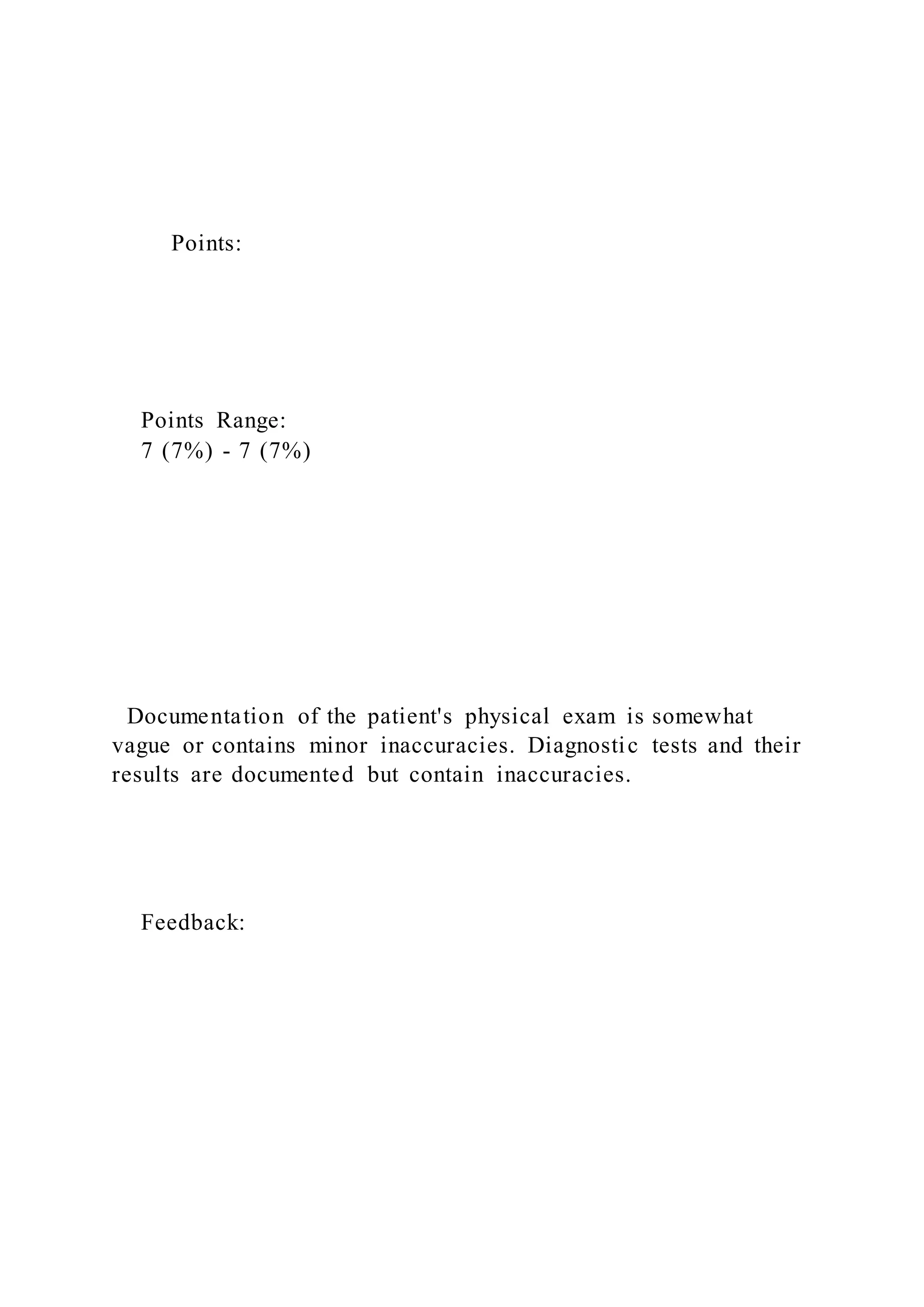
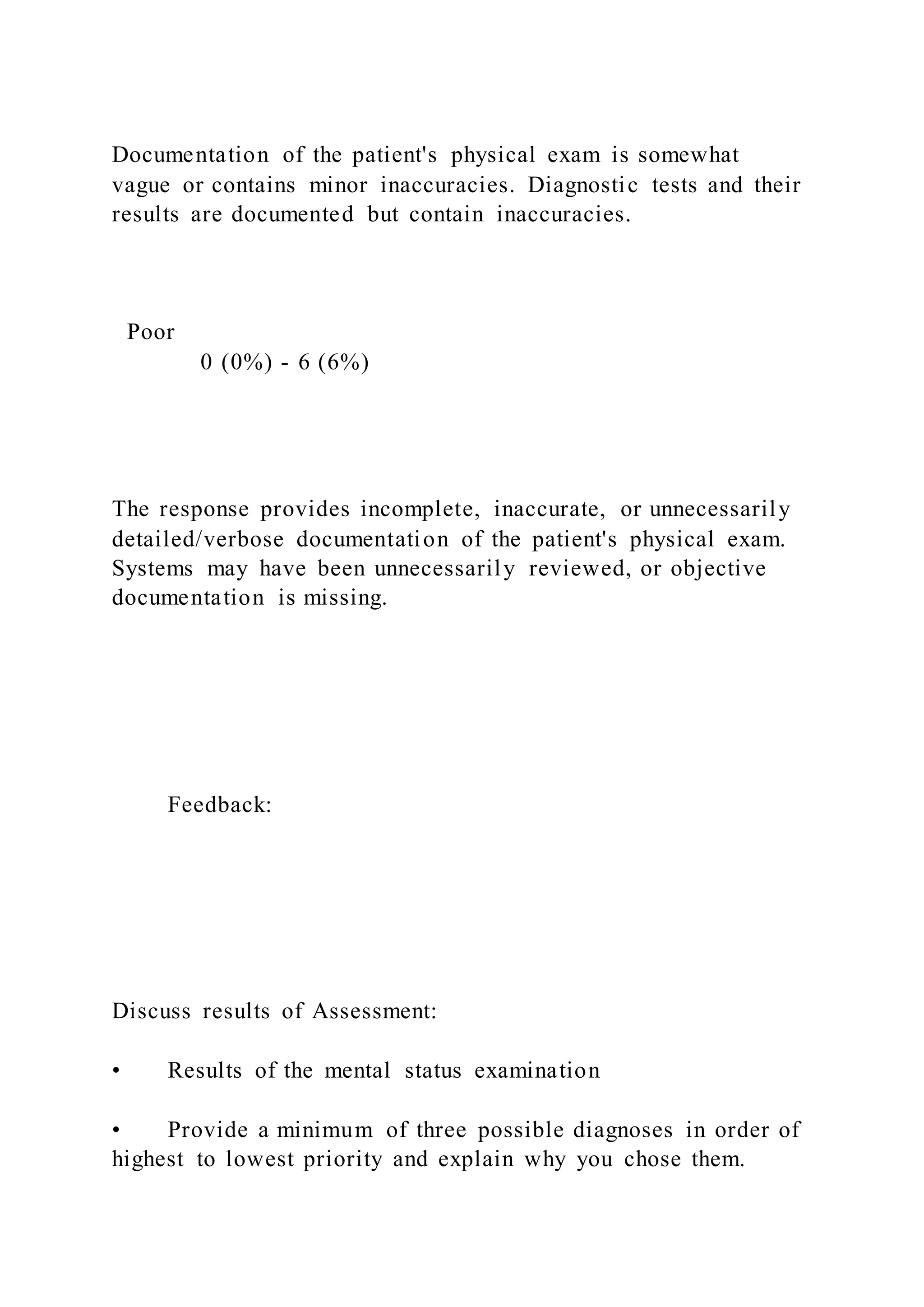
Documentation of the patient's physical exam is somewhat
vague or contains minor inaccuracies. Diagnostic tests and their
results are documented but contain inaccuracies.
Feedback:
Points:
Points Range:
0 (0%) - 6 (6%)
The response provides incomplete, inaccurate, or
unnecessarily detailed/verbose documentation of the patient's
physical exam. Systems may have been unnecessarily reviewed,
or objective documentation is missing.
Feedback:
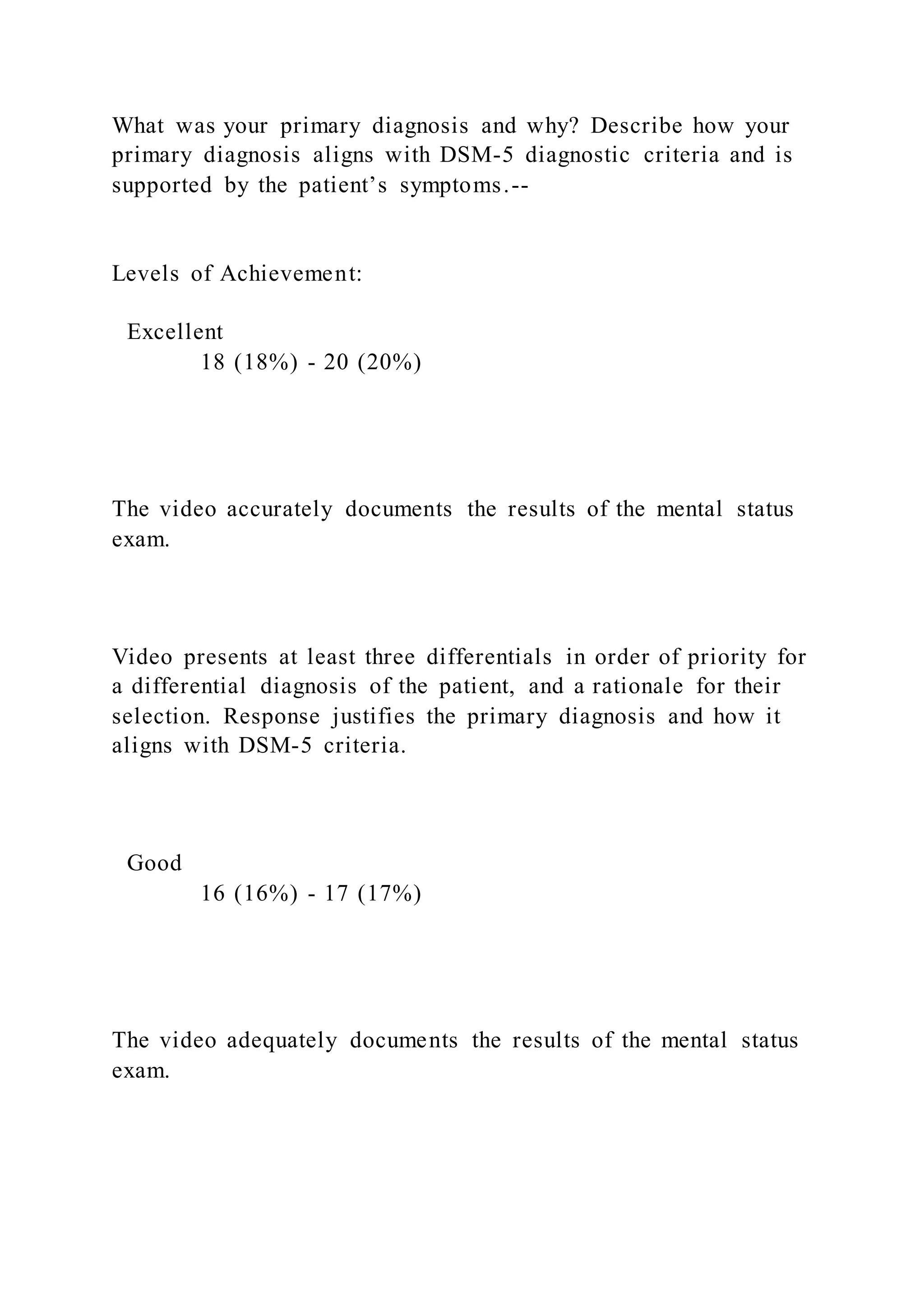
Discuss results of Assessment:
• Results of the mental status examination
• Provide a minimum of three possible diagnoses in order of
highest to lowest priority and explain why you chose them.
What was your primary diagnosis and why? Describe how your
primary diagnosis aligns with DSM-5 diagnostic criteria and is
supported by the patient’s symptoms.
Points:
Points Range:
18 (18%) - 20 (20%)
The video accurately documents the results of the mental
status exam.
Video presents at least three differentials in order of priority for
a differential diagnosis of the patient, and a rationale for their
selection. Response justifies the primary diagnosis and how it
aligns with DSM-5 criteria.
Feedback:
Points:
Points Range:
16 (16%) - 17 (17%)
The video adequately documents the results of the mental
status exam.
Video presents three differentials for the patient and a rationale
for their selection. Response adequately justifies the pr imary
diagnosis and how it aligns with DSM-5 criteria.
Feedback:
Points:
Points Range:
14 (14%) - 15 (15%)
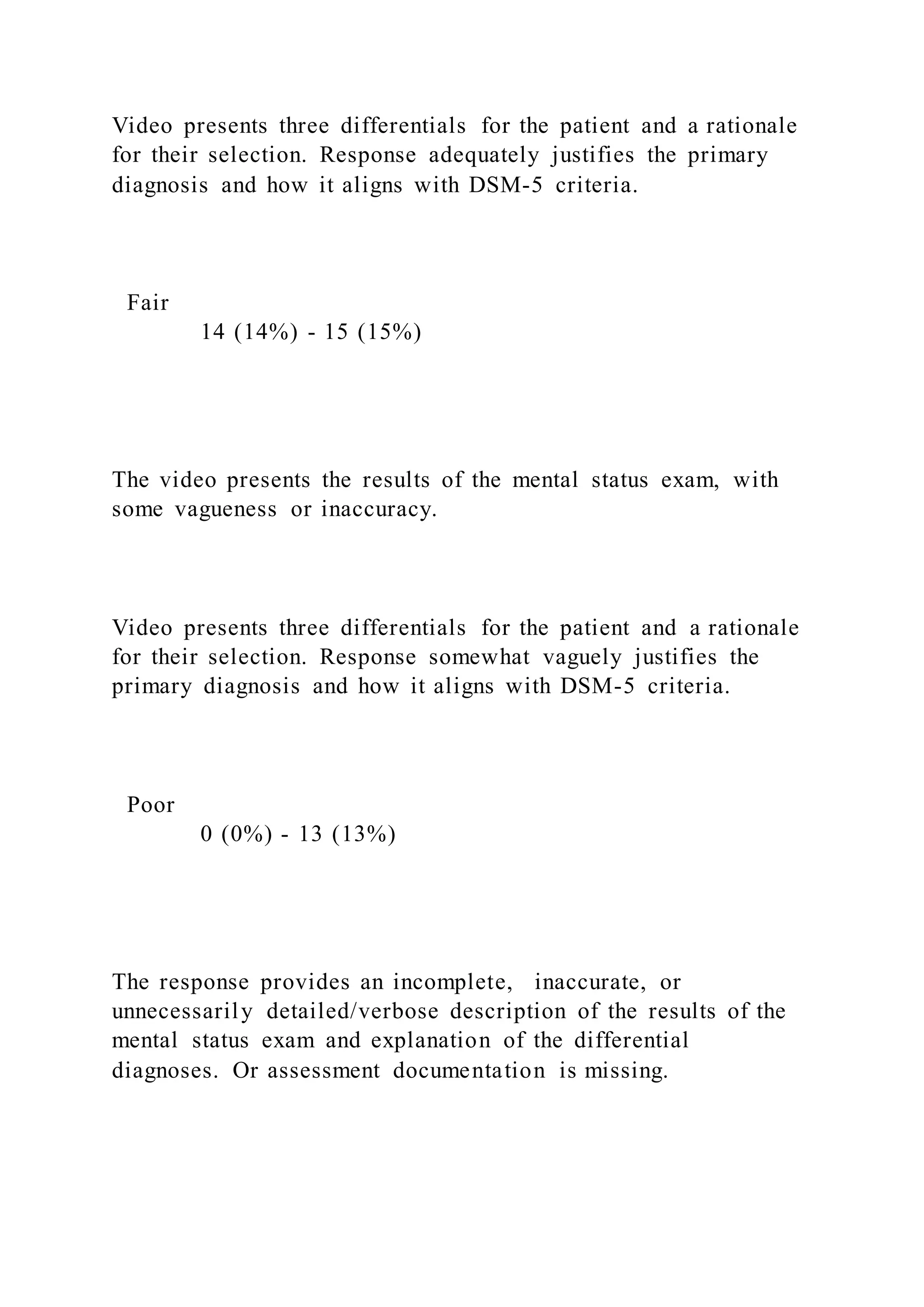
The video presents the results of the mental status exam, with
some vagueness or inaccuracy.
Video presents three differentials for the patient and a rationale
for their selection. Response somewhat vaguely justifies the
primary diagnosis and how it aligns with DSM-5 criteria.
Feedback:
Points:
Points Range:
0 (0%) - 13 (13%)
The response provides an incomplete, inaccurate, or
unnecessarily detailed/verbose description of the results of the
mental status exam and explanation of the differential
diagnoses. Or assessment documentation is missing.
Feedback:
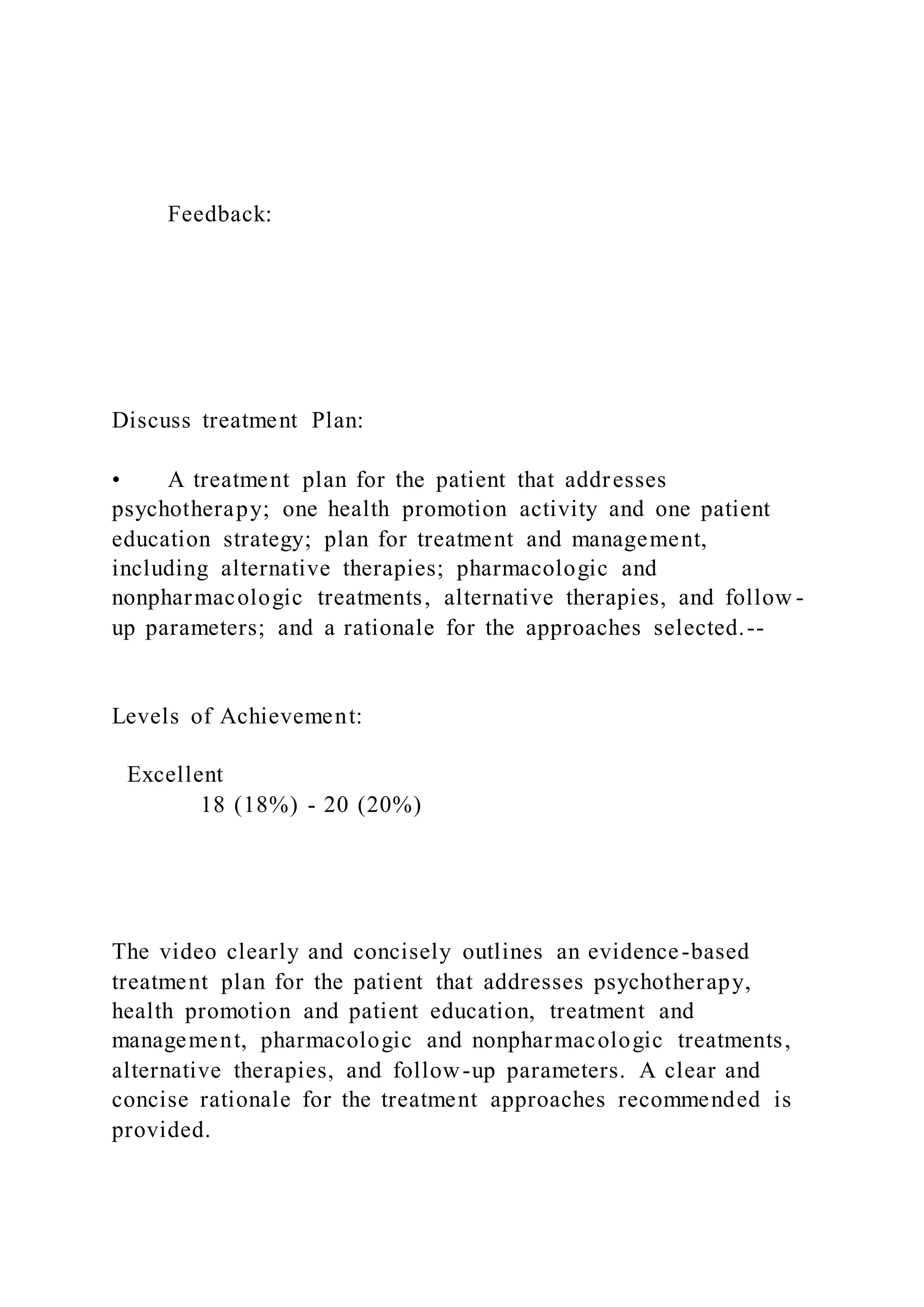
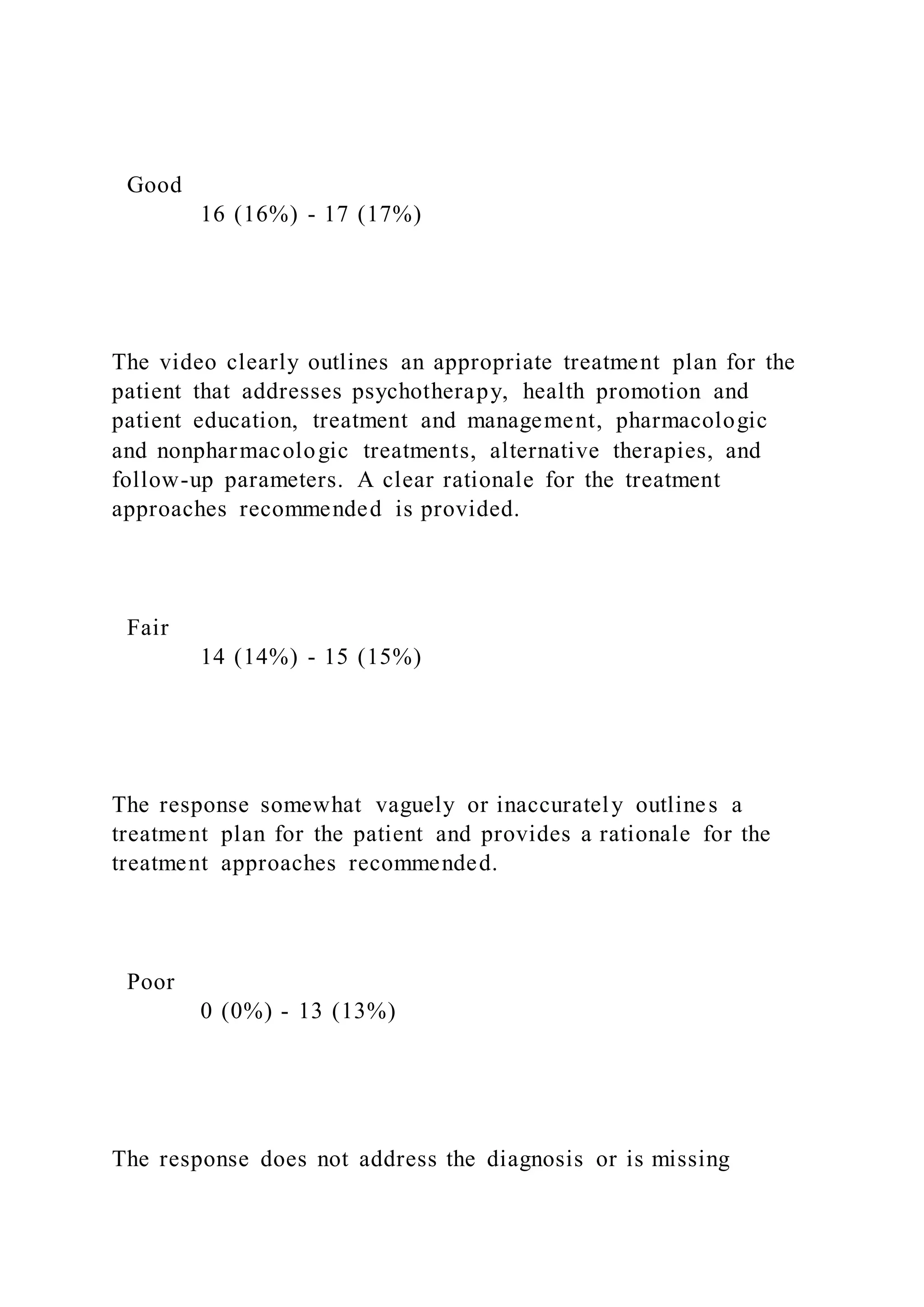
Discuss treatment Plan:
• A treatment plan for the patient that addresses
psychotherapy; one health promotion activity and one patient
education strategy; plan for treatment and management,
including alternative therapies; pharmacologic and
nonpharmacologic treatments, alternative therapies, and follow -
up parameters; and a rationale for the approaches selected.
Points:
Points Range:
18 (18%) - 20 (20%)
The video clearly and concisely outlines an evidence-based
treatment plan for the patient that addresses psychotherapy,
health promotion and patient education, treatment and
management, pharmacologic and nonpharmacologic treatments,
alternative therapies, and follow-up parameters. A clear and
concise rationale for the treatment approaches recommended is
provided.
Feedback:
Points:
Points Range:
16 (16%) - 17 (17%)
The video clearly outlines an appropriate treatment plan for
the patient that addresses psychotherapy, health promotion and
patient education, treatment and management, pharmacologic
and nonpharmacologic treatments, alternative therapies, and
follow-up parameters. A clear rationale for the treatment
approaches recommended is provided.
Feedback:
Points:
Points Range:
14 (14%) - 15 (15%)
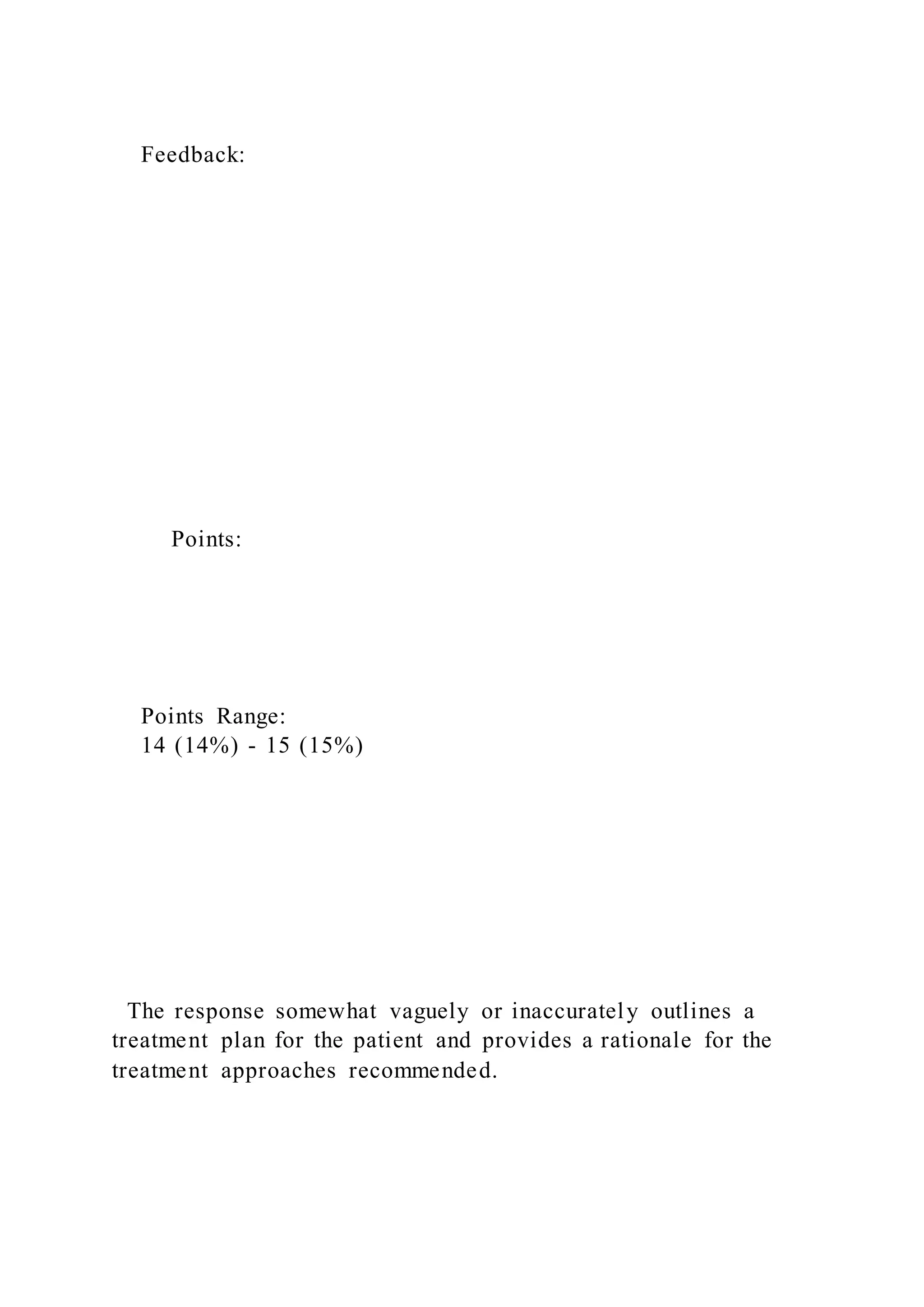
The response somewhat vaguely or inaccurately outlines a
treatment plan for the patient and provides a rationale for the
treatment approaches recommended.
Feedback:
Points:
Points Range:
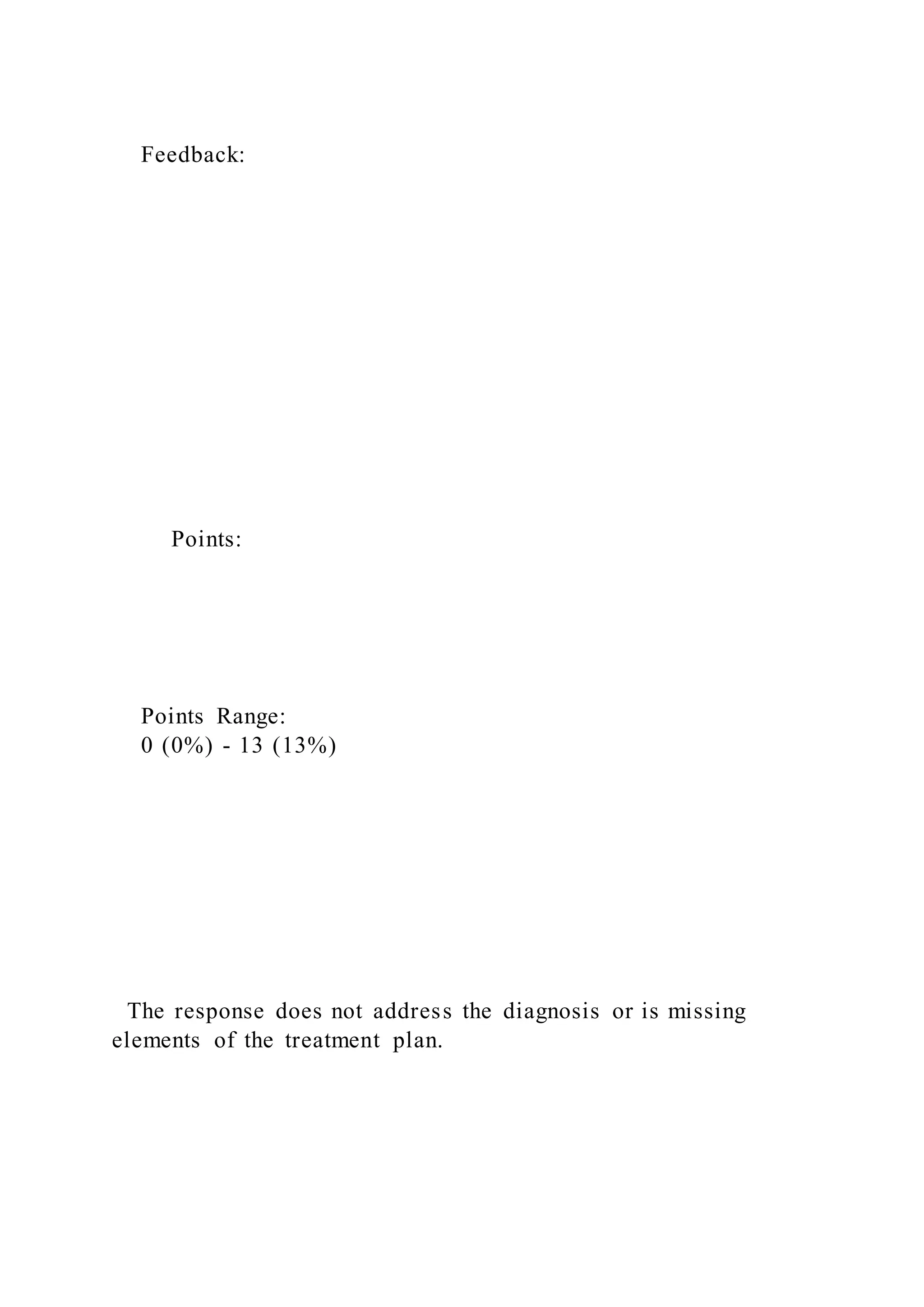
0 (0%) - 13 (13%)
The response does not address the diagnosis or is missing
elements of the treatment plan.
Feedback:
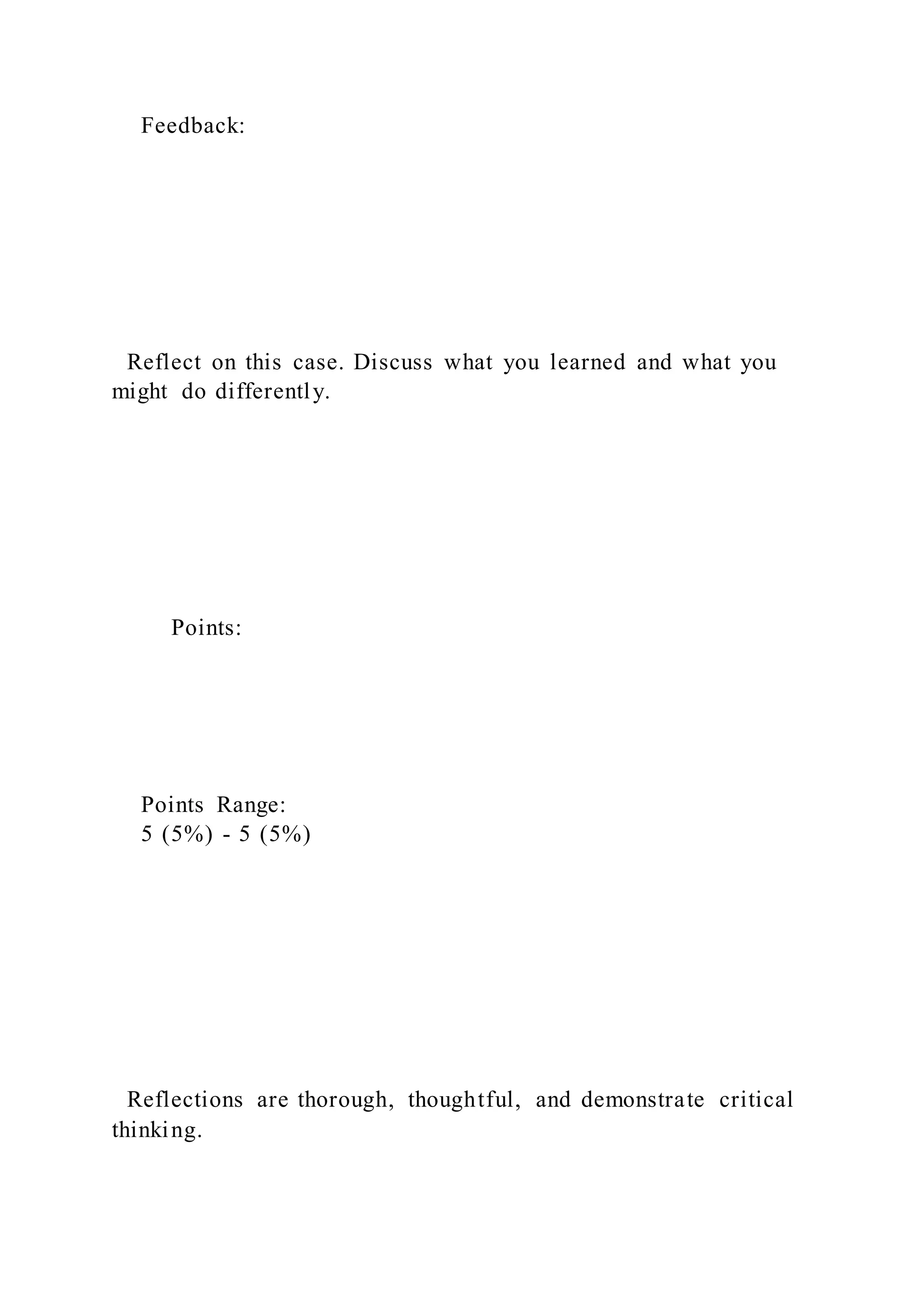
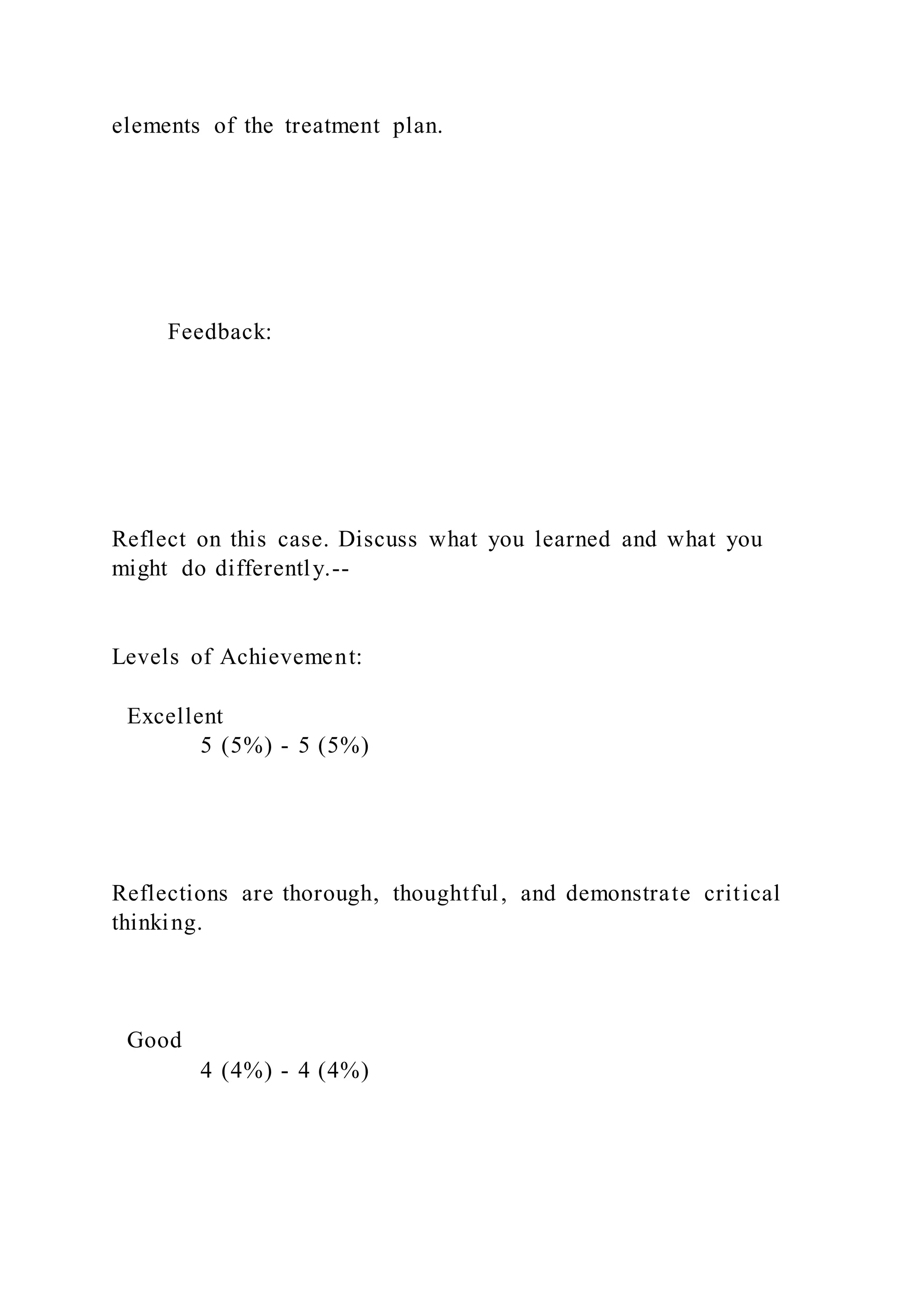
Reflect on this case. Discuss what you learned and what you
might do differently.
Points:
Points Range:
5 (5%) - 5 (5%)
Reflections are thorough, thoughtful, and demonstrate critical
thinking.
Feedback:
Points:
Points Range:
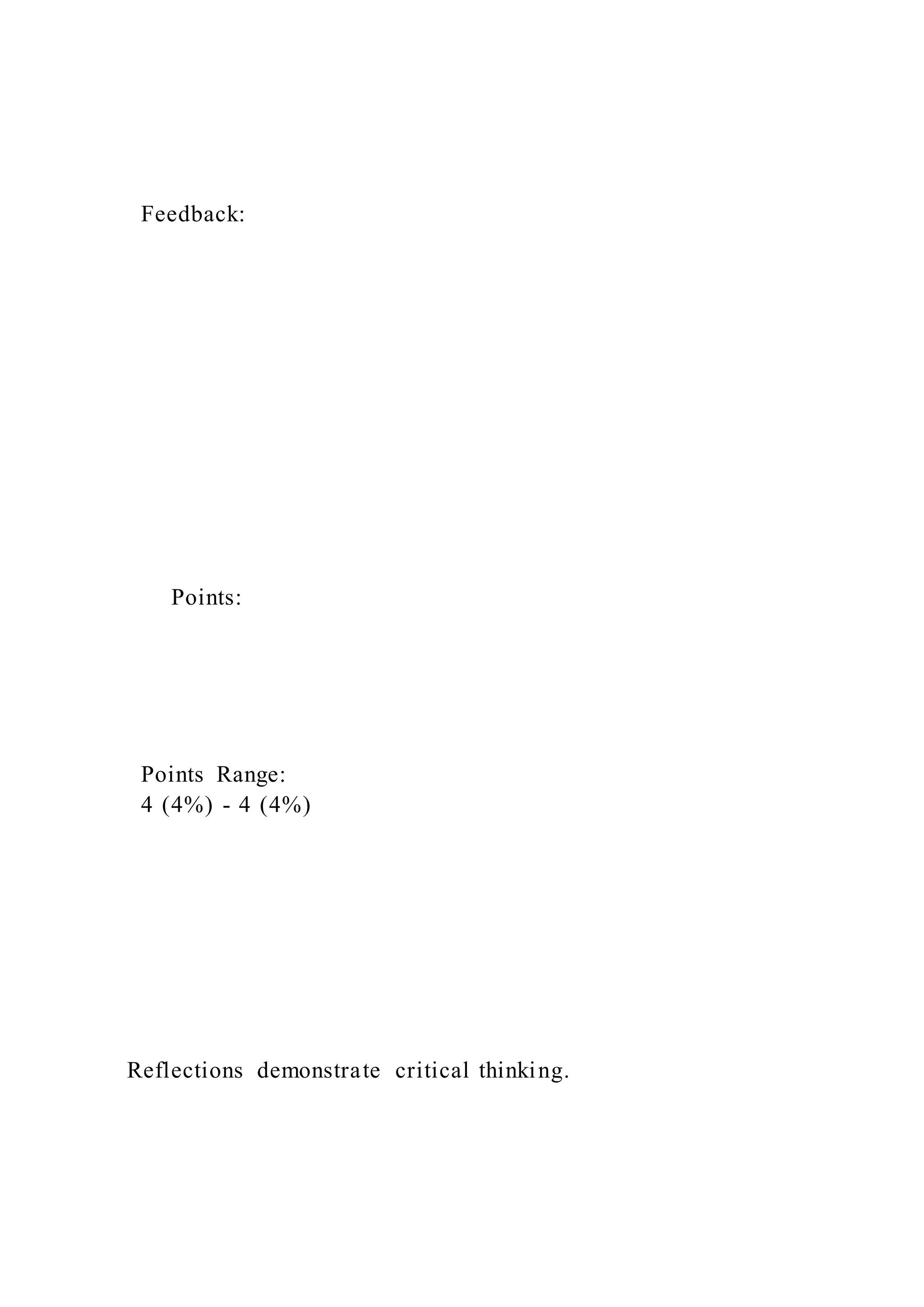
4 (4%) - 4 (4%)
Reflections demonstrate critical thinking.
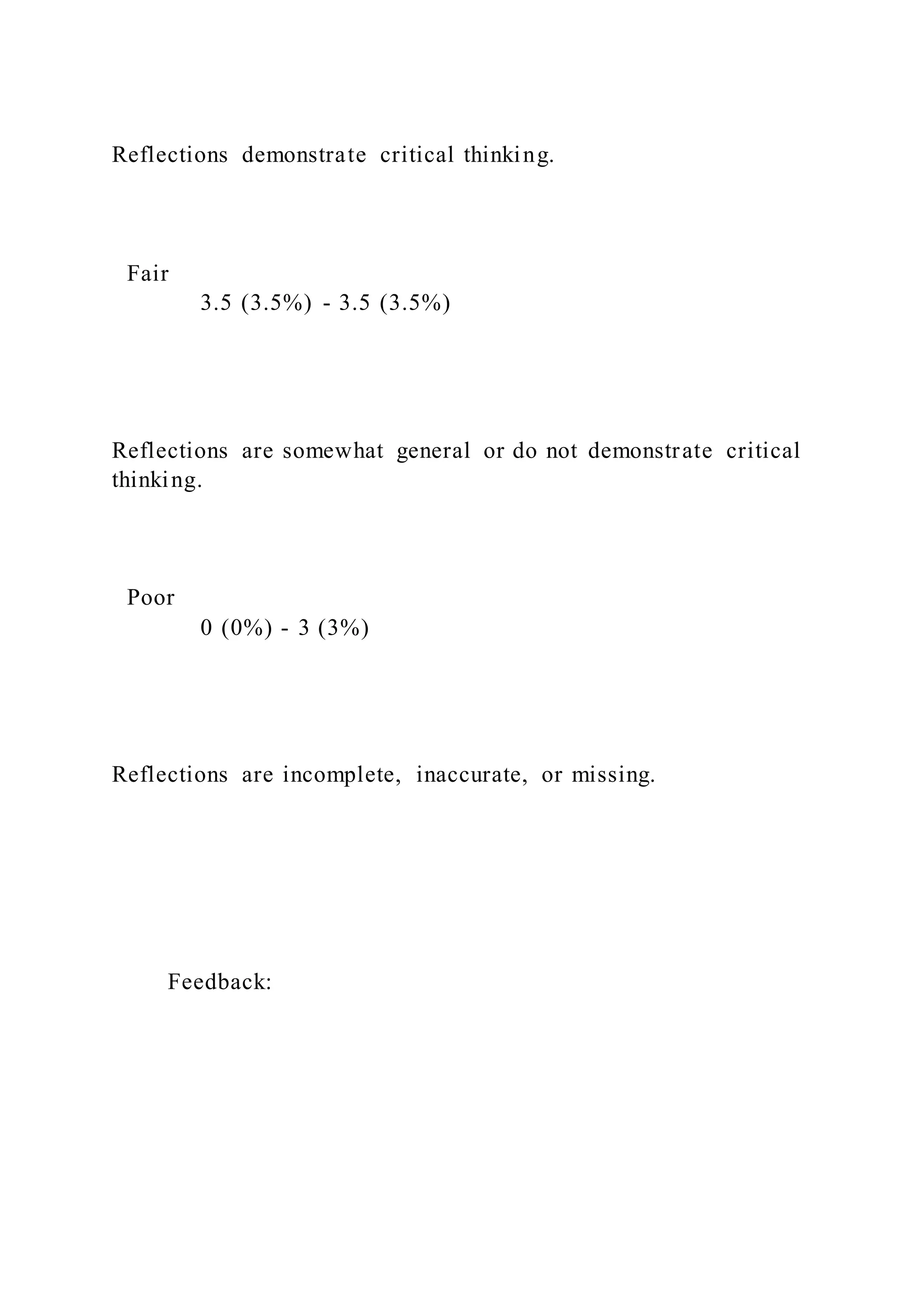
Feedback:
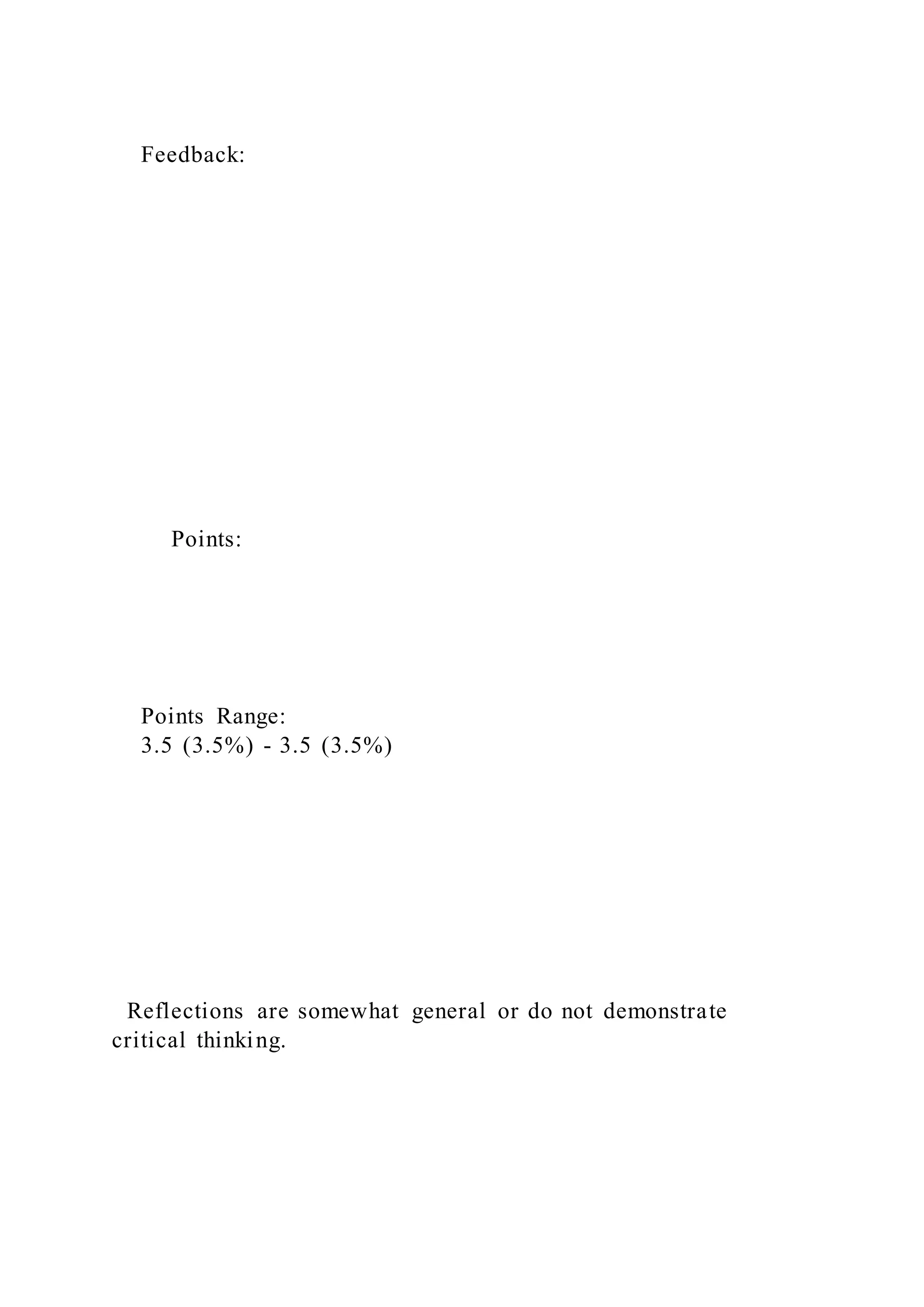
Points:
Points Range:
3.5 (3.5%) - 3.5 (3.5%)
Reflections are somewhat general or do not demonstrate
critical thinking.
Feedback:
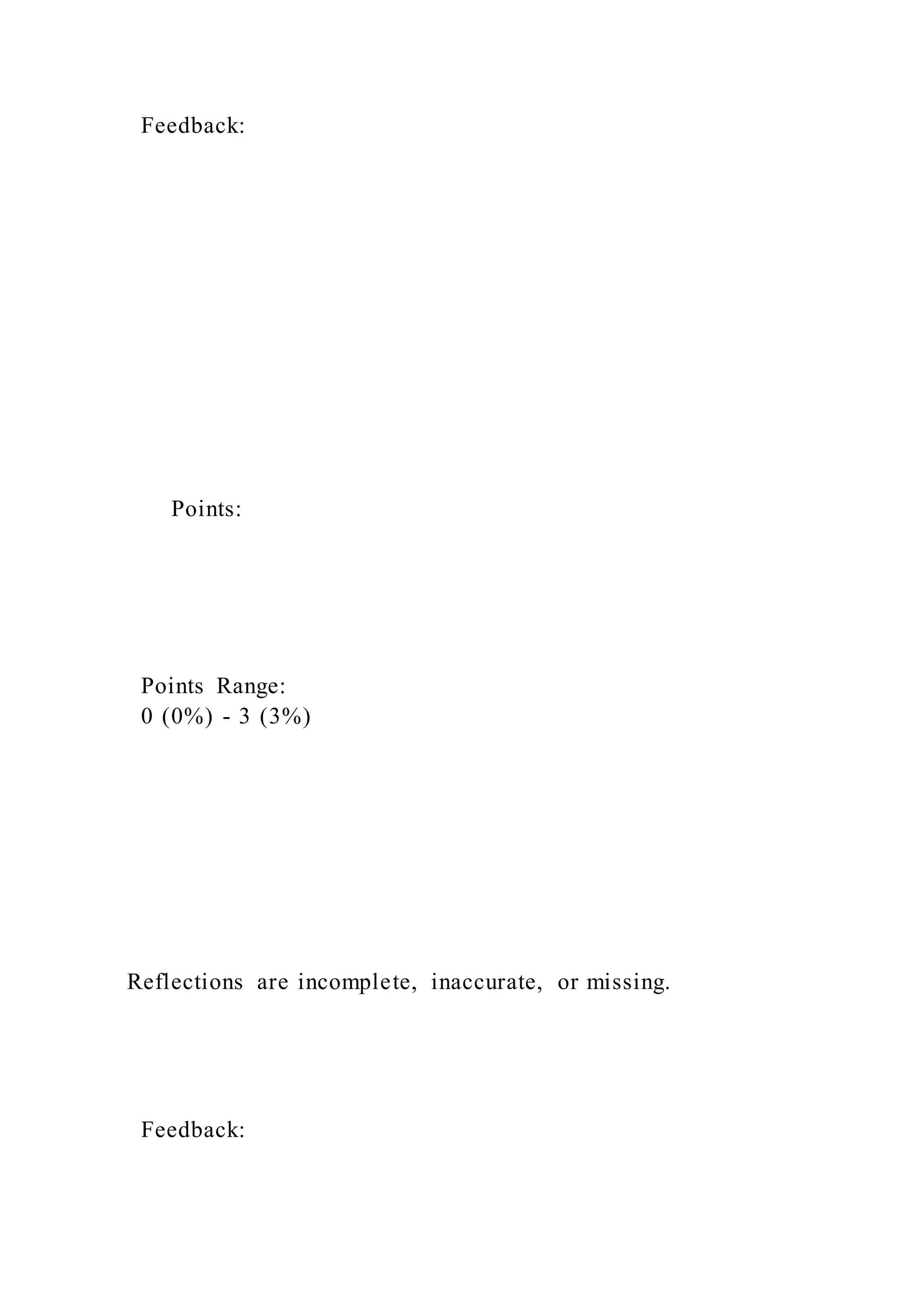
Points:
Points Range:
0 (0%) - 3 (3%)
Reflections are incomplete, inaccurate, or missing.
Feedback:
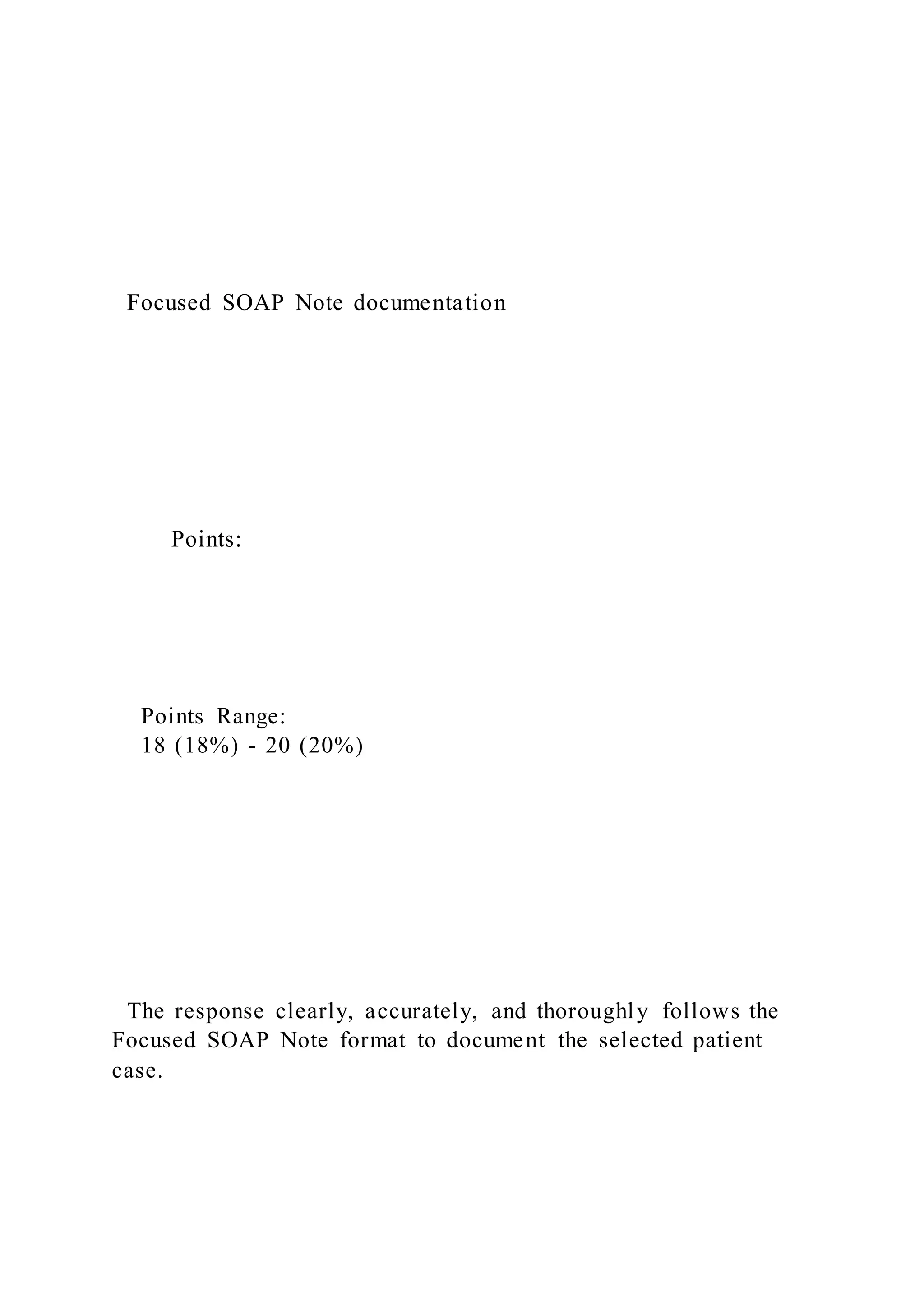
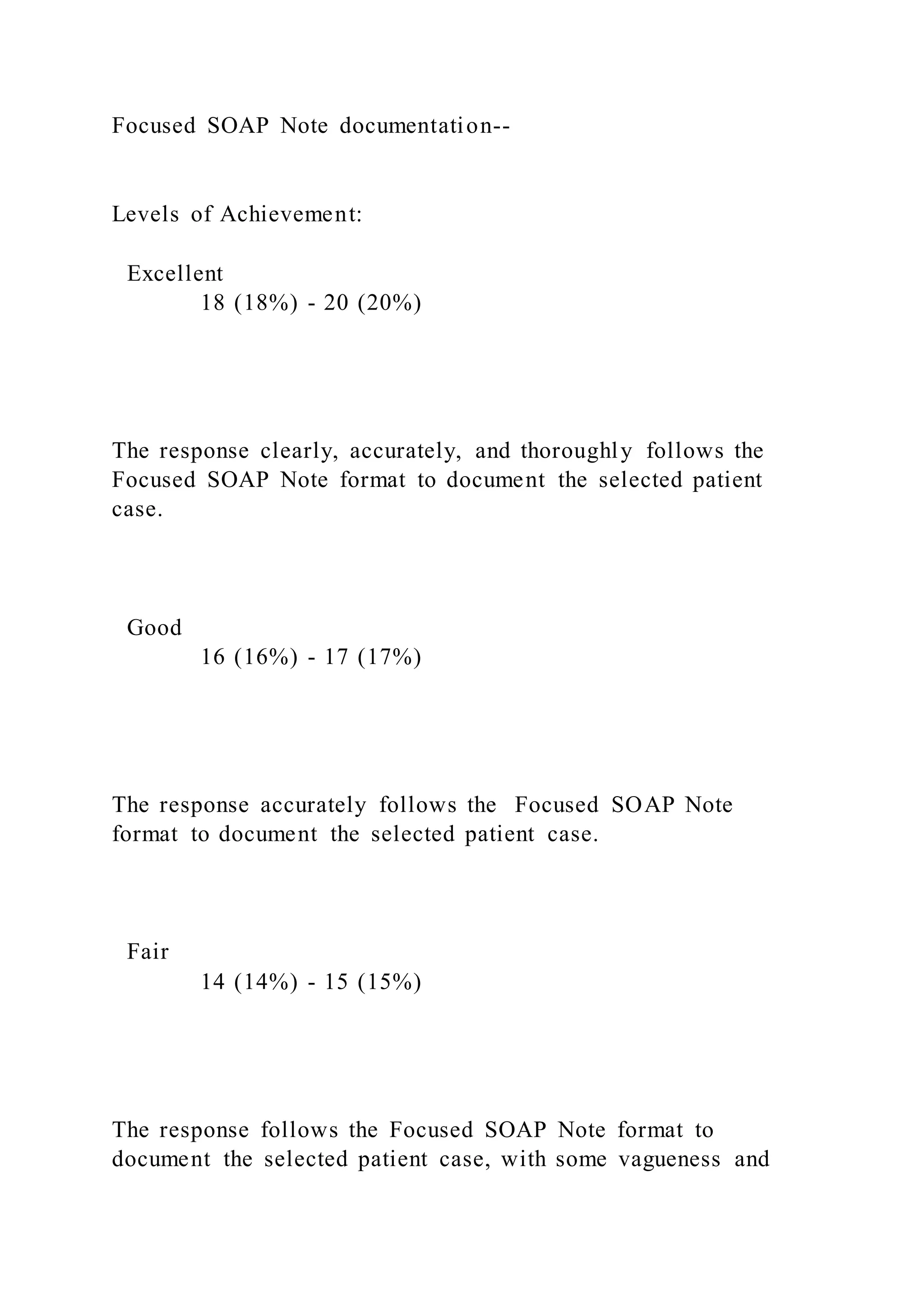
Focused SOAP Note documentation
Points:
Points Range:
18 (18%) - 20 (20%)
The response clearly, accurately, and thoroughly follows the
Focused SOAP Note format to document the selected patient
case.
Feedback:
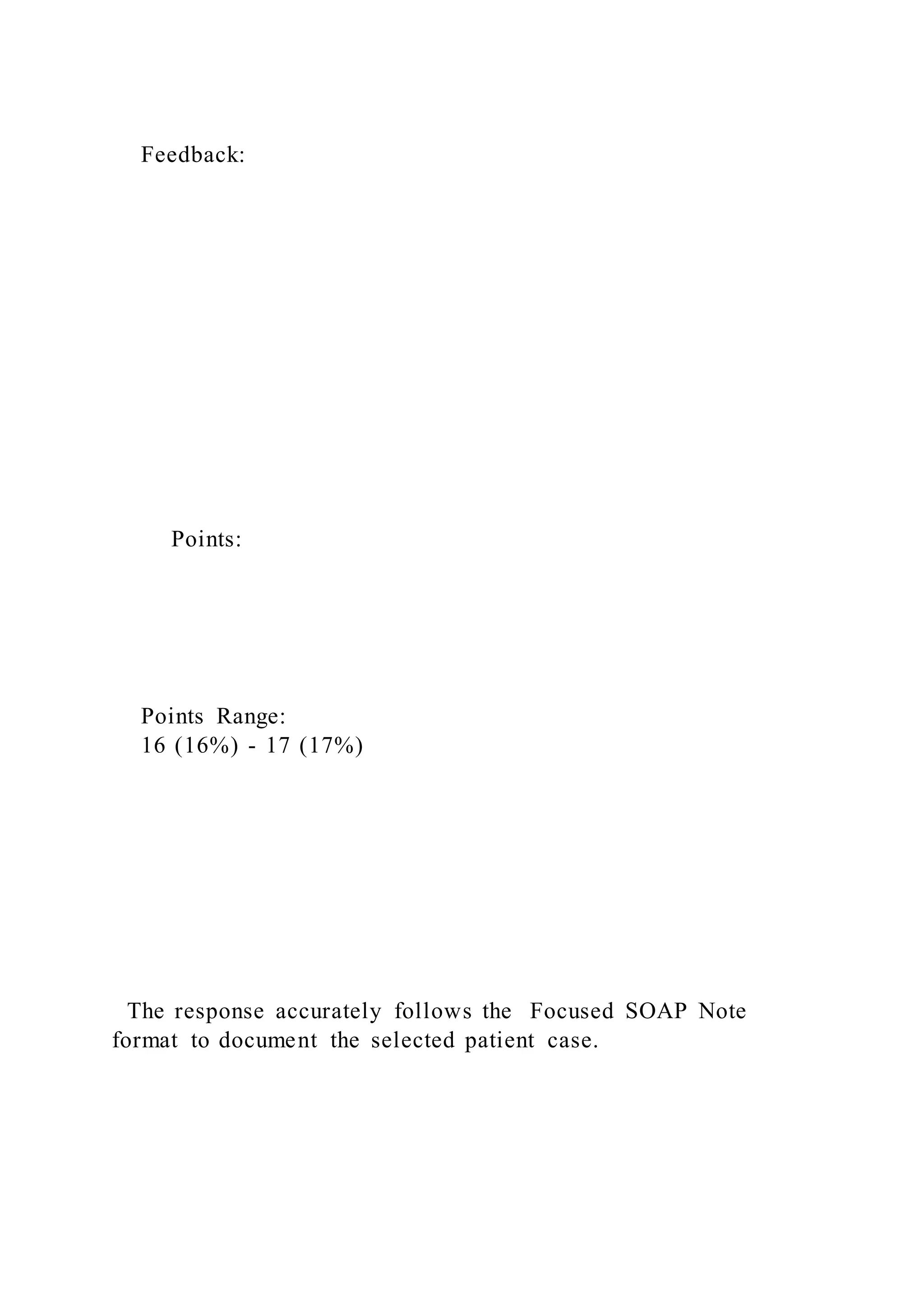
Points:
Points Range:
16 (16%) - 17 (17%)
The response accurately follows the Focused SOAP Note
format to document the selected patient case.
Feedback:
Points:
Points Range:
14 (14%) - 15 (15%)
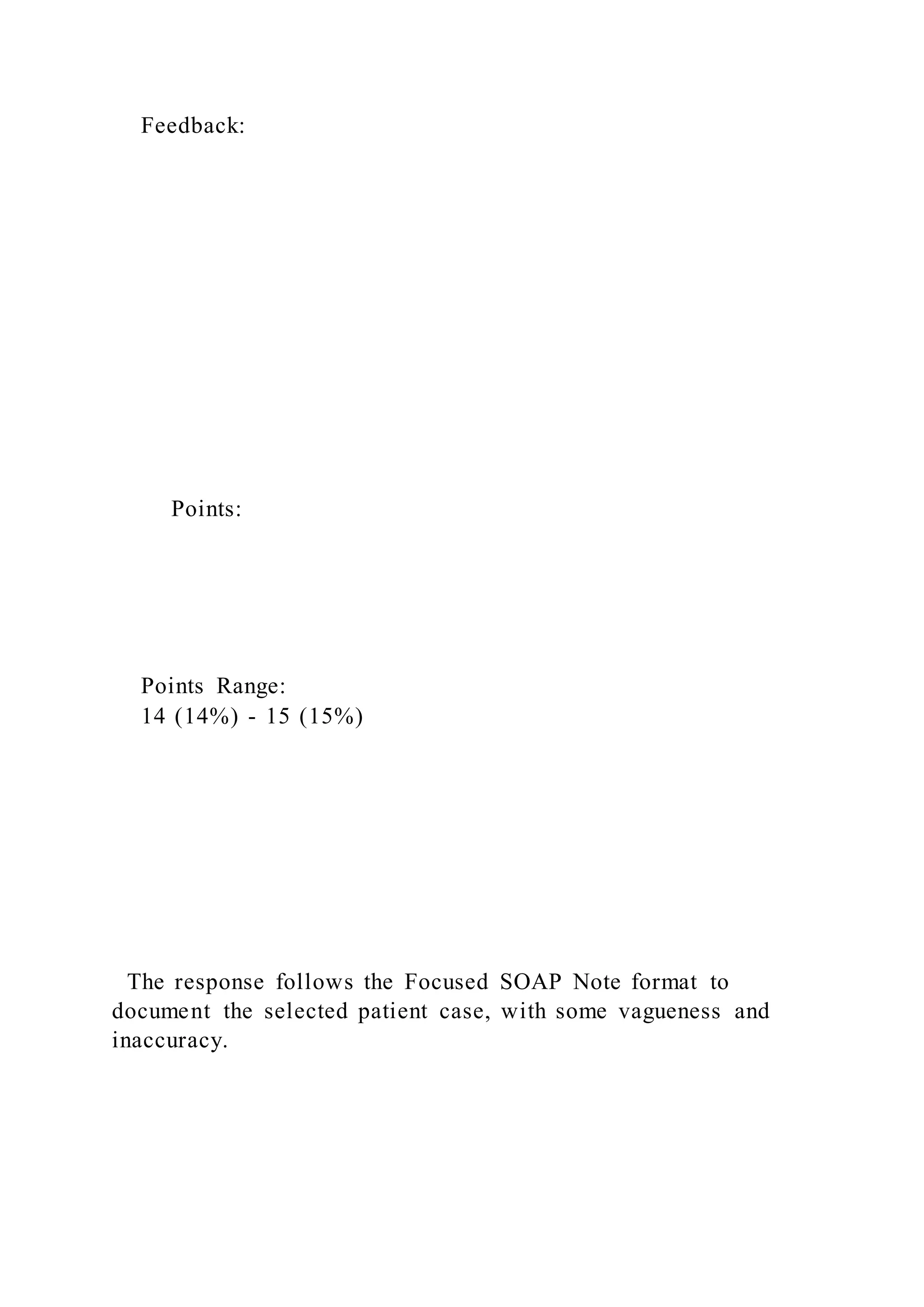
The response follows the Focused SOAP Note format to
document the selected patient case, with some vagueness and
inaccuracy.
Feedback:
Points:
Points Range:
0 (0%) - 13 (13%)
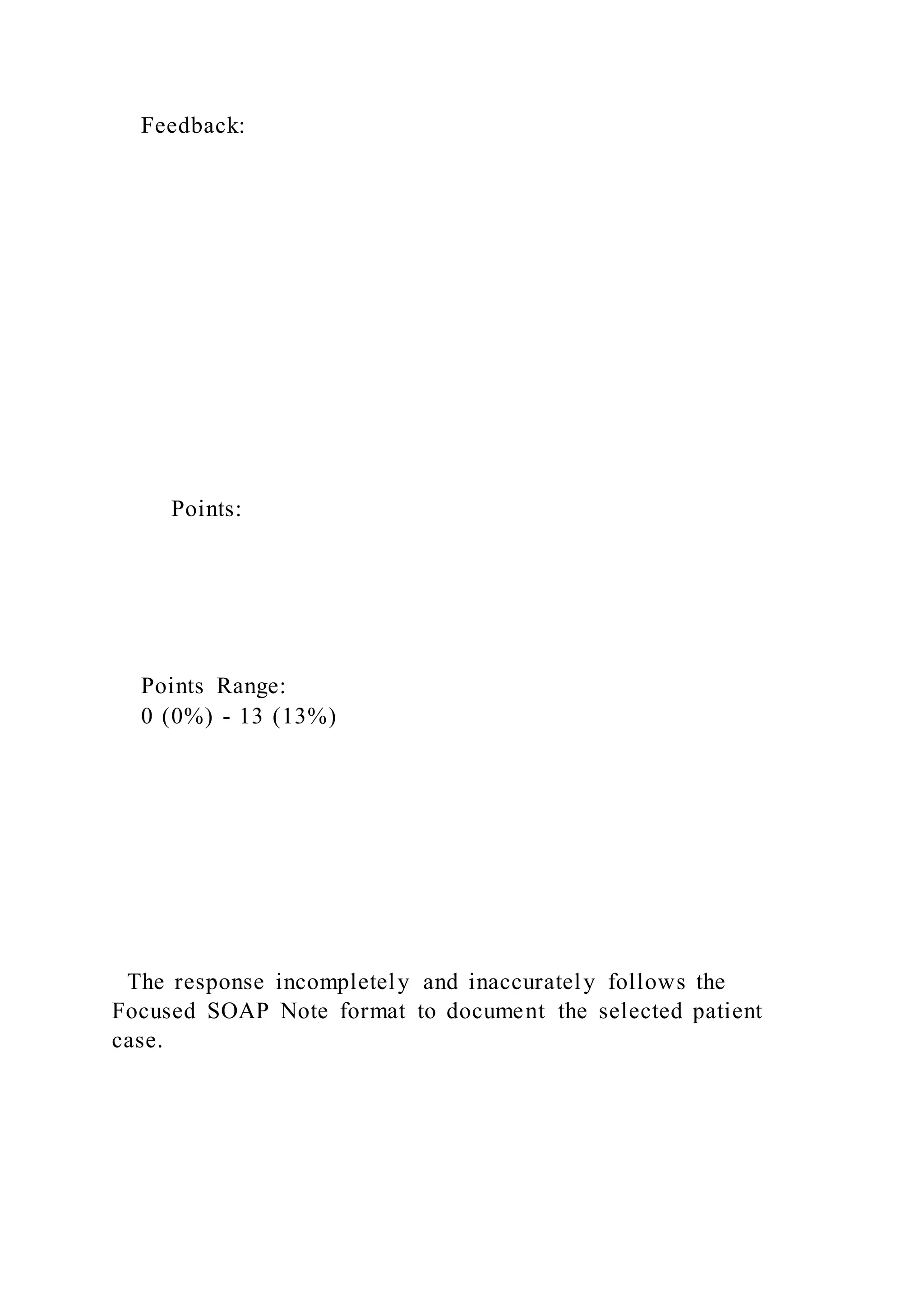
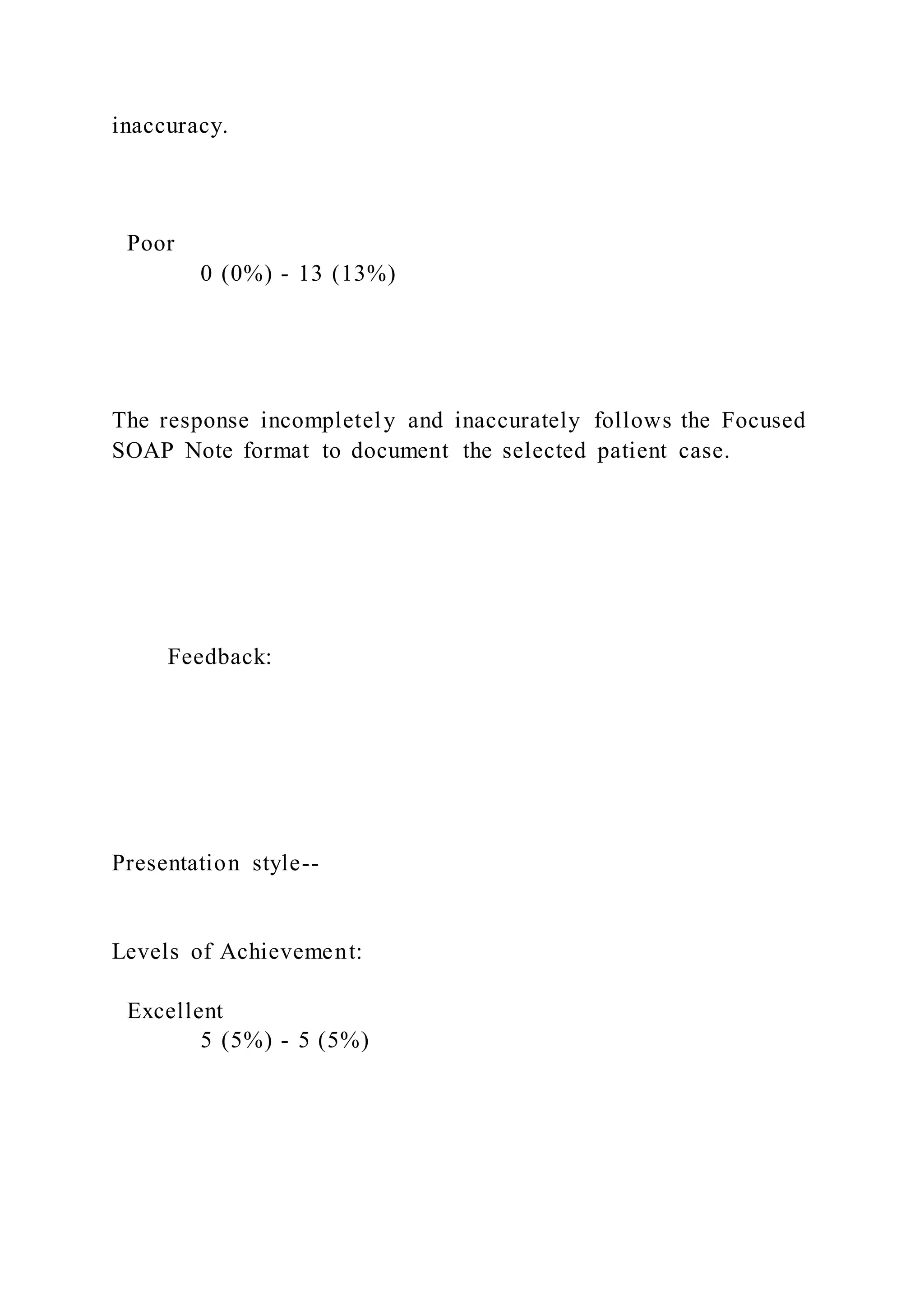
The response incompletely and inaccurately follows the
Focused SOAP Note format to document the selected patient
case.
Feedback:
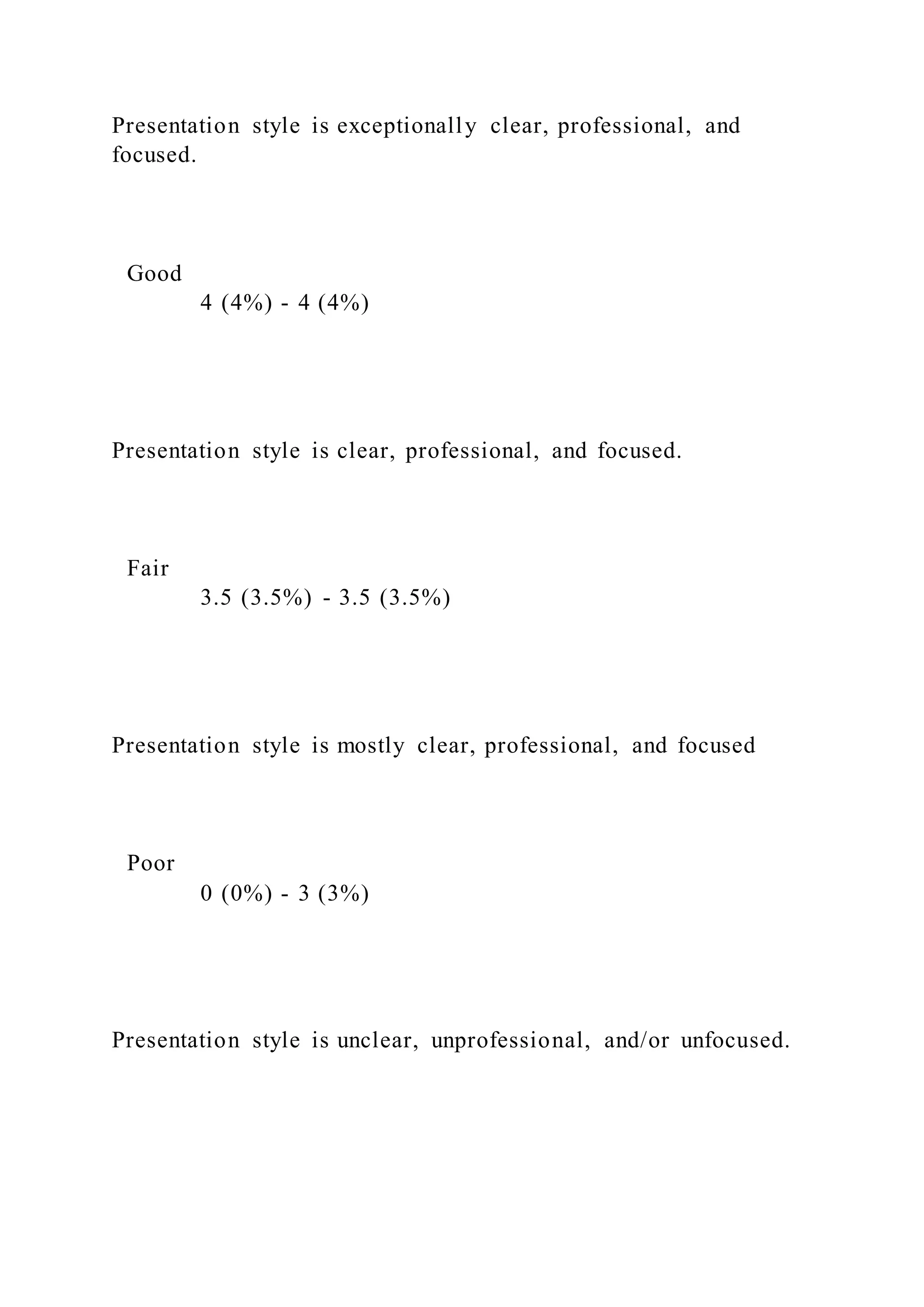
Presentation style
Points:
Points Range:
5 (5%) - 5 (5%)
Presentation style is exceptionally clear, professional, and
focused.
Feedback:
Points:
Points Range:
4 (4%) - 4 (4%)
Presentation style is clear, professional, and focused.
Feedback:
Points:
Points Range:
3.5 (3.5%) - 3.5 (3.5%)
Presentation style is mostly clear, professional, and focused
Feedback:
Points:
Points Range:
0 (0%) - 3 (3%)
Presentation style is unclear, unprofessional, and/or
unfocused.
Feedback:
Show Descriptions
Show Feedback
Photo ID display and professional attire--
Levels of Achievement:
Excellent
5 (5%) - 5 (5%)
Photo ID is displayed. The student is dressed professionally.
Good
0 (0%) - 0 (0%)
Fair
0 (0%) - 0 (0%)
Poor
0 (0%) - 0 (0%)
Photo ID is not displayed. Student must remedy this before
grade is posted. The student is not dressed professionally.
Feedback:
Time--
Levels of Achievement:
Excellent
5 (5%) - 5 (5%)
The video does not exceed the 8-minute time limit.
Good
0 (0%) - 0 (0%)
Fair
0 (0%) - 0 (0%)
Poor
0 (0%) - 0 (0%)
The video exceeds the 8-minute time limit. (Note: Information
presented after 8 minutes will not be evaluated for grade
inclusion.)
Feedback:
Discuss Subjective data:
• Chief complaint
• History of present illness (HPI)
• Medications
• Psychotherapy or previous
psychiatric diagnosis
• Pertinent histories and/or ROS
--
Levels of Achievement:
Excellent
9 (9%) - 10 (10%)
The video accurately and concisely presents the patient's
subjective complaint, history of present illness, medications,
psychotherapy or previous psychiatric diagnosis, and pertinent
histories and/or review of systems that would inform a
differential diagnosis.
Good
8 (8%) - 8 (8%)
The video accurately presents the patient's subjective complaint,
history of present illness, medications, psychotherapy or
previous psychiatric diagnosis, and pertinent histories and/or
review of systems that would inform a differential diagnosi s.
Fair
7 (7%) - 7 (7%)
The video presents the patient's subjective complaint, history of
present illness, medications, psychotherapy or previous
psychiatric diagnosis, and pertinent histories and/or review of
systems that would inform a differential diagnosis, but is
somewhat vague or contains minor inaccuracies.
Poor
0 (0%) - 6 (6%)
The video presents an incomplete, inaccurate, or unnecessarily
detailed/verbose description of the patient's subjective
complaint, history of present illness, medications,
psychotherapy or previous psychiatric diagnosis, and pertinent
histories and/or review of systems that would inform a
differential diagnosis. Or subjective documentation is missing.
Feedback:
Discuss Objective data:
• Physical exam documentation of systems pertinent to the
chief complaint, HPI, and history
• Diagnostic results, including any labs, imaging, or other
assessments needed to develop the differential diagnoses--
Levels of Achievement:
Excellent
9 (9%) - 10 (10%)
The video accurately and concisely documents the patient's
physical exam for pertinent systems. Pertinent diagnostic tests
and their results are documented, as applicable.
Good
8 (8%) - 8 (8%)
The response accurately documents the patient's physical exam
for pertinent systems. Diagnostic tests and their results are
documented, as applicable.
Fair
7 (7%) - 7 (7%)
Documentation of the patient's physical exam is somewhat
vague or contains minor inaccuracies. Diagnostic tests and their
results are documented but contain inaccuracies.
Poor
0 (0%) - 6 (6%)
The response provides incomplete, inaccurate, or unnecessarily
detailed/verbose documentation of the patient's physical exam.
Systems may have been unnecessarily reviewed, or objective
documentation is missing.
Feedback:
Discuss results of Assessment:
• Results of the mental status examination
• Provide a minimum of three possible diagnoses in order of
highest to lowest priority and explain why you chose them.
What was your primary diagnosis and why? Describe how your
primary diagnosis aligns with DSM-5 diagnostic criteria and is
supported by the patient’s symptoms.--
Levels of Achievement:
Excellent
18 (18%) - 20 (20%)
The video accurately documents the results of the mental status
exam.
Video presents at least three differentials in order of priority for
a differential diagnosis of the patient, and a rationale for their
selection. Response justifies the primary diagnosis and how it
aligns with DSM-5 criteria.
Good
16 (16%) - 17 (17%)
The video adequately documents the results of the mental status
exam.
Video presents three differentials for the patient and a rationale
for their selection. Response adequately justifies the primary
diagnosis and how it aligns with DSM-5 criteria.
Fair
14 (14%) - 15 (15%)
The video presents the results of the mental status exam, with
some vagueness or inaccuracy.
Video presents three differentials for the patient and a rationale
for their selection. Response somewhat vaguely justifies the
primary diagnosis and how it aligns with DSM-5 criteria.
Poor
0 (0%) - 13 (13%)
The response provides an incomplete, inaccurate, or
unnecessarily detailed/verbose description of the results of the
mental status exam and explanation of the differential
diagnoses. Or assessment documentation is missing.
Feedback:
Discuss treatment Plan:
• A treatment plan for the patient that addresses
psychotherapy; one health promotion activity and one patient
education strategy; plan for treatment and management,
including alternative therapies; pharmacologic and
nonpharmacologic treatments, alternative therapies, and follow -
up parameters; and a rationale for the approaches selected.--
Levels of Achievement:
Excellent
18 (18%) - 20 (20%)
The video clearly and concisely outlines an evidence-based
treatment plan for the patient that addresses psychotherapy,
health promotion and patient education, treatment and
management, pharmacologic and nonpharmacologic treatments,
alternative therapies, and follow-up parameters. A clear and
concise rationale for the treatment approaches recommended is
provided.
Good
16 (16%) - 17 (17%)
The video clearly outlines an appropriate treatment plan for the
patient that addresses psychotherapy, health promotion and
patient education, treatment and management, pharmacologic
and nonpharmacologic treatments, alternative therapies, and
follow-up parameters. A clear rationale for the treatment
approaches recommended is provided.
Fair
14 (14%) - 15 (15%)
The response somewhat vaguely or inaccurately outlines a
treatment plan for the patient and provides a rationale for the
treatment approaches recommended.
Poor
0 (0%) - 13 (13%)
The response does not address the diagnosis or is missing
elements of the treatment plan.
Feedback:
Reflect on this case. Discuss what you learned and what you
might do differently.--
Levels of Achievement:
Excellent
5 (5%) - 5 (5%)
Reflections are thorough, thoughtful, and demonstrate critical
thinking.
Good
4 (4%) - 4 (4%)
Reflections demonstrate critical thinking.
Fair
3.5 (3.5%) - 3.5 (3.5%)
Reflections are somewhat general or do not demonstrate critical
thinking.
Poor
0 (0%) - 3 (3%)
Reflections are incomplete, inaccurate, or missing.
Feedback:
Focused SOAP Note documentation--
Levels of Achievement:
Excellent
18 (18%) - 20 (20%)
The response clearly, accurately, and thoroughly follows the
Focused SOAP Note format to document the selected patient
case.
Good
16 (16%) - 17 (17%)
The response accurately follows the Focused SOAP Note
format to document the selected patient case.
Fair
14 (14%) - 15 (15%)
The response follows the Focused SOAP Note format to
document the selected patient case, with some vagueness and
inaccuracy.
Poor
0 (0%) - 13 (13%)
The response incompletely and inaccurately follows the Focused
SOAP Note format to document the selected patient case.
Feedback:
Presentation style--
Levels of Achievement:
Excellent
5 (5%) - 5 (5%)
Presentation style is exceptionally clear, professional, and
focused.
Good
4 (4%) - 4 (4%)
Presentation style is clear, professional, and focused.
Fair
3.5 (3.5%) - 3.5 (3.5%)
Presentation style is mostly clear, professional, and focused
Poor
0 (0%) - 3 (3%)
Presentation style is unclear, unprofessional, and/or unfocused.
Feedback:
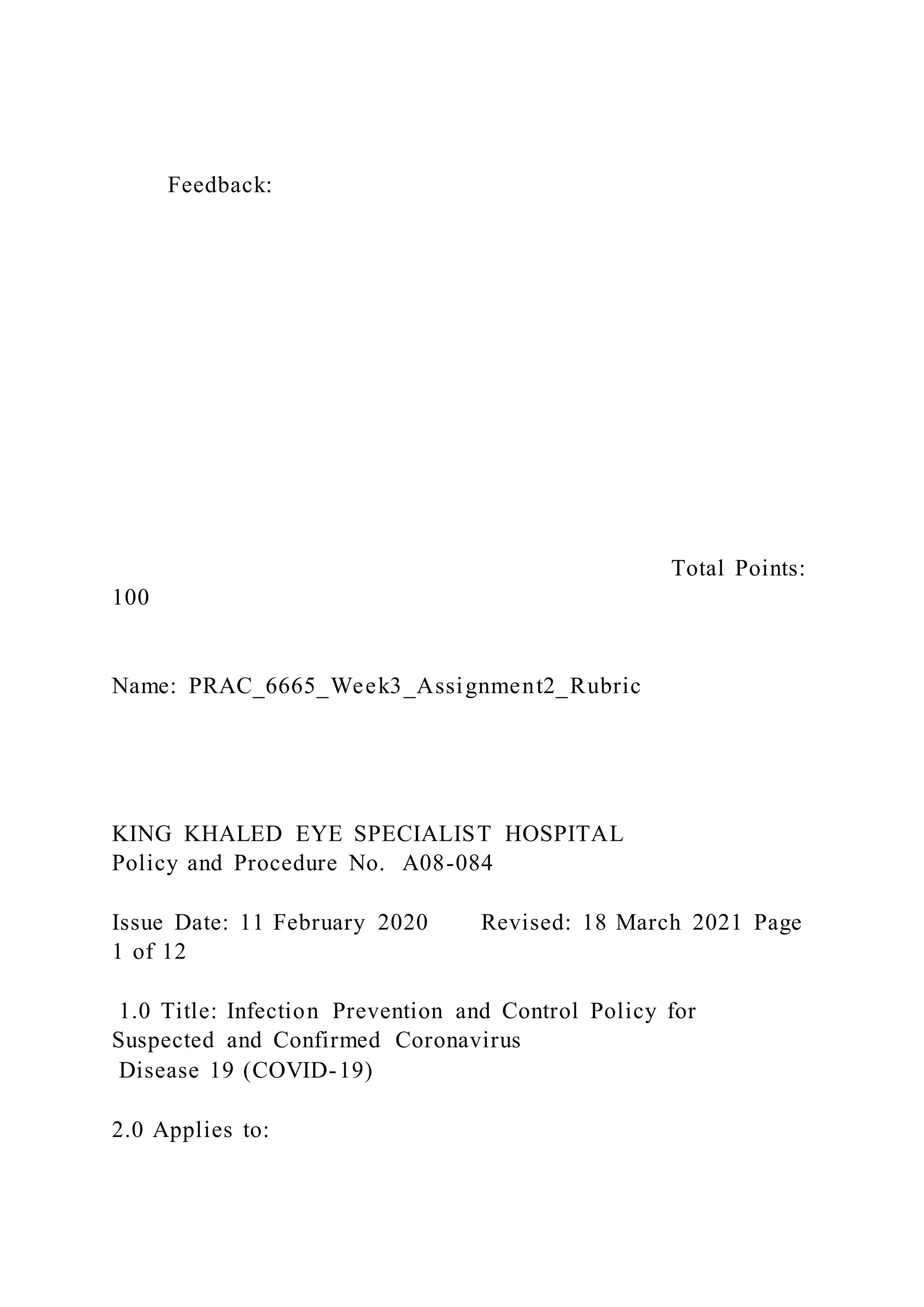
Total Points:
100
Name: PRAC_6665_Week3_Assignment2_Rubric
KING KHALED EYE SPECIALIST HOSPITAL
Policy and Procedure No. A08-084
Issue Date: 11 February 2020 Revised: 18 March 2021 Page
1 of 12
1.0 Title: Infection Prevention and Control Policy for
Suspected and Confirmed Coronavirus
Disease 19 (COVID-19)
2.0 Applies to:
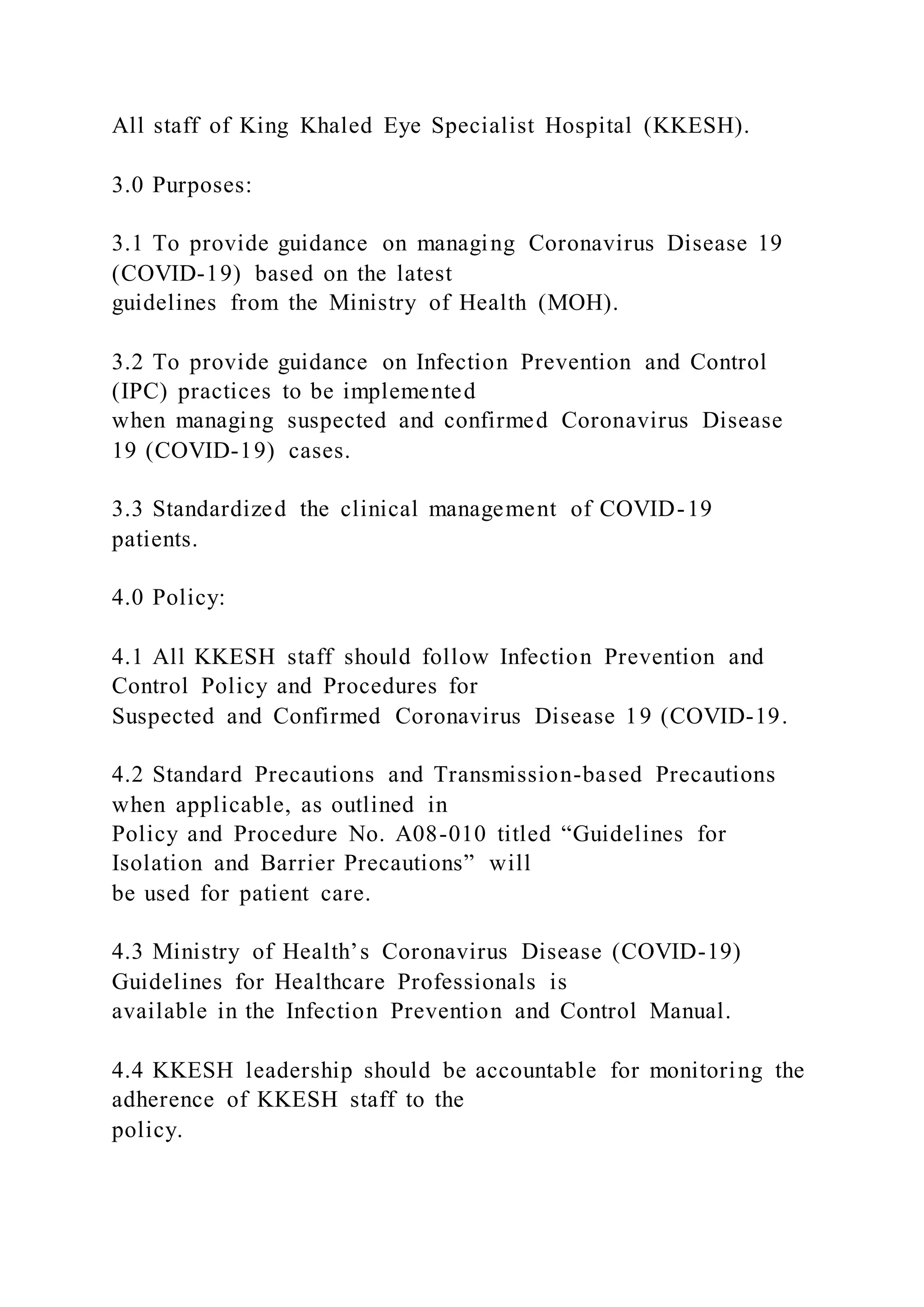
All staff of King Khaled Eye Specialist Hospital (KKESH).
3.0 Purposes:
3.1 To provide guidance on managing Coronavirus Disease 19
(COVID-19) based on the latest
guidelines from the Ministry of Health (MOH).
3.2 To provide guidance on Infection Prevention and Control
(IPC) practices to be implemented
when managing suspected and confirmed Coronavirus Disease
19 (COVID-19) cases.
3.3 Standardized the clinical management of COVID-19
patients.
4.0 Policy:
4.1 All KKESH staff should follow Infection Prevention and
Control Policy and Procedures for
Suspected and Confirmed Coronavirus Disease 19 (COVID-19.
4.2 Standard Precautions and Transmission-based Precautions
when applicable, as outlined in
Policy and Procedure No. A08-010 titled “Guidelines for
Isolation and Barrier Precautions” will
be used for patient care.
4.3 Ministry of Health’s Coronavirus Disease (COVID-19)
Guidelines for Healthcare Professionals is
available in the Infection Prevention and Control Manual.
4.4 KKESH leadership should be accountable for monitoring the
adherence of KKESH staff to the
policy.
5.0 Definition
5.1 Health Care Worker defined as all staff in the health care
facility involved in the provision of care
for a COVID-19 infected patient, including those who have been
present in the same area as the
patient, as well as those who may not have provided direct care
to the patient, but who have had
contact with the patient’s body fluids, potentially contaminated
items or environmental surfaces.
This includes health care professionals, allied health workers,
auxiliary health workers (e.g.
cleaning and laundry personnel, x-ray physicians and
technicians, clerks, phlebotomists,
respiratory therapist, nutritionists, social workers, physical
therapists, lab personnel, cleaners,
admission/reception clerks, patient transporters, catering staff
etc.).
5.2 Patient- a person receiving or registered to received medical
treatment.
5.3 Suspected Coronavirus Disease 19 (COVID-19) Case is
defined as:
5.3.1 Patient with acute respiratory illness (sudden onset of at
least one of the following: fever
(measured or by history), cough, or shortness of breath).
5.3.2 Patient with sudden onset of at least one of the following:
headache, sore throat,
rhinorrhea, nausea or diarrhea AND in the 14 days prior to
symptom onset, met at least
one of the following criteria:
5.3.2.1 Had contact with a confirmed COVID-19 case
KING KHALED EYE SPECIALIST HOSPITAL
Policy and Procedure No. A08-084
Issue Date: 11 February 2020 Revised: 18 March 2021 Page
2 of 12
5.3.2.2 Working in or attended a healthcare facility where
patients with confirmed
COVID-19 were admitted.
5.3.2.3 Any admitted adult patient with unexplained severe
acute respiratory infection
(SARI), either Community Acquired Pneumonia (CAP) or
Hospital Acquired
Pneumonia (HAP).
5.3.3 Contact is defined as anyone with any of the following
exposures:
5.3.4 Being within 2 meter of a confirmed COVID-19 case for
>15 minutes;
5.3.5 Direct physical contact with a confirmed COVID-19 case;
5.3.6 Providing direct care for a confirmed COVID-19 patient
without using proper personal
protective equipment (PPE);
5.3.7 Living in the household with a confirmed COVID-19 case;
5.3.8 Sharing a room, meal, or other space with a confirmed
COVID-19 case;
5.3.9 Sitting within 2 rows (in any direction) of a confirmed
COVID-19 case for >15 minutes
and any crew in direct contact with the case in a public or
shared transportation.
5.4 Confirmed Coronavirus Disease 19 (COVID-19) case is
defined as a person who meets the
suspected case definition with laboratory confirmation of
COVID-19 infection.
6.0 Procedure:
6.1 VISUAL TRIAGE:
6.1.1 Visual triage should be used for early identification of all
patients with Acute Respiratory
Illness (ARI) in the entrances of Emergency Room, Hospital
Main Entrance, Screening
Clinic, Employee Health, Saleh AlRajhi Center, OR for excimer
laser patients, Pre-
Hospitalization, West Building and in Basement A Ramp
(cafeteria).
6.1.2 Designated areas will be attended by trained staff to have
a high level of clinical
suspicion of COVID-19
6.1.3 HCWs should maintain social distance by staying at least
one meter away, whenever
possible, from anyone, including anyone that is with the patient
(e.g., companion or
caregiver). When physical distance is NOT feasible and yet NO
direct contact with
patients, use mask and eye protection (face shield or goggles)
6.1.4 All HCWs should adhere to Standard Precautions, which
includes hand hygiene,
selection of PPE based risk assessment, respiratory hygiene,
cleaning and disinfection.
6.1.5 Staff performing triage must be aware of the COVID-19
Case definitions described
above in section 5.3 and the precautionary measures to be
applied.
6.1.6 All patients with clinical symptoms will be assessed using
the predefined scoring of
Visual Triage Checklist (see Appendix A).
6.1.7 A score of ≥4 separate patients at high risk for COVID-19
from others or direct patient to
respiratory clinic if emergency eye cases and to be seen by the
Ophthalmologist. Offer
mask and ask to perform hand hygiene. Apply droplet and
contact precautions. Limit the
number of accompanying family members in the respiratory
clinic for (no one less than
18 years old unless a patient or a parent) then patient will be
given a referral letter.
KING KHALED EYE SPECIALIST HOSPITAL
Policy and Procedure No. A08-084
Issue Date: 11 February 2020 Revised: 18 March 2021 Page
3 of 12
6.1.8 If patient for admission or for emergency surgery apply
contact and droplet precautions.
6.1.9 Patient who are stable and not emergency eye cases will
be given a referral letter from
CMO / MD and will be sent to a general hospital/Coronavirus
Disease19 (COVID-19)
facility at Prince Mohammed bin Abdul-Aziz Hospital for
evaluation.
6.1.10 Patient in respiratory distress or unstable patient should
be placed in Airborne Infection
Isolation Room (AIIR) in ER at the back of VIP clinic for MD
assessment. MD will
coordinate with MOH (#937) for diagnosing the case and
transferring of patient to a
COVID-19 facility at Prince Mohammed bin Abdul-Aziz
Hospital.
6.1.11 Coronavirus Disease 19 algorithm see Appendix B.
6.1.12 Post visual alerts at the entrances and in all patient care
areas (English and Arabic)
about respiratory hygiene and cough etiquette and social
distancing. This includes how
to cover nose and mouth when coughing or sneezing and
disposal of contaminated
items in trash cans.
6.2 ADMISSION PROCESS AND PATIENT PLACEMENT:
6.2.1 RT-PCR guidelines for patient and sitter admitted in our
facility is based on the decision
of the COVID 19 committee.
6.2.2 Patient with suspected or confirmed COVID-19 should not
be admitted in KKESH unless
emergency cases.
6.2.2.1 Patient will be admitted to 5th floor A wing.
6.2.2.2 Patient will be discharged as soon as possible after
emergency eye
intervention and follow up will be given through ER
Respiratory clinic.
6.2.3 Patient and sitter waiting for RT-PCR result will be
admitted to 5th floor B wing.
6.2.4 Inpatient areas, patients with suspected Coronavirus
Disease 19 (COVID-19) infection
who are stable, mask will be offered, transfer patients in
adequately ventilated single
rooms and will be assessed by medical Doctor and will be
discharged from the hospital
by the medical doctor and ophthalmologist with medical report
and will be advised to go
to general hospital / Coronavirus Disease 19 (COVID-19)
facility for evaluation.
6.2.4.1 If patient requires emergency eye intervention, patient
will be tested for COVID
-19 infection (RT-PCR) without delaying the treatment.
6.2.5 Patients in respiratory distress admitted in inpatient
department with suspected or
confirmed Coronavirus Disease 19(COVID-19) infection should
be placed in Airborne
Infection Isolation Rooms 347and 502 for MD assessment. MD
will coordinate with
MOH (#937) for diagnosing the case and transferring of patient
to a COVID-19 facility to
Prince Mohammed bin Abdul-Aziz Hospital. RT-PCR for
COVID-19 infection will be
taken depends on medical doctor recomme ndations.
6.2.6 It is preferred and strongly recommended not to cohort
suspected COVID-19 patients
because it carries a risk of transmission of infection between
patients if one of them will
be confirmed.
6.2.7 In cases of severe shortage of single rooms, it is possible
to cohort suspected COVID-
19 patients together with strict adherence to the following
standards:
KING KHALED EYE SPECIALIST HOSPITAL
Policy and Procedure No. A08-084
Issue Date: 11 February 2020 Revised: 18 March 2021 Page
4 of 12
6.2.8 One patient only should be admitted in each multi bed
room, then another patient will be
put to bed far from the first patient’s bed, and so on until the
need to admit patients in all
the beds of the room.
6.2.9 There must be a physical separation between the patients’
beds (single use curtains –
mobile or fixed partitions) and in the event of unavailability the
distance between the bed
and the other, distance should not be less than two (2) meters.
6.2.10 It is strictly forbidden to implement aerosol-generating
procedures (AGPs) such as
respiratory suctioning and nasopharyngeal swabbing in these
cohort rooms, the patient
should be directed to a negative pressure room or single room
with portable HEPA filter
if negative pressure room is not available.
6.2.11 If the mobile HEPA filter devices are available, a device
can be placed between each of
two beds.
6.2.12 Cohort Healthcare Workers to exclusively care for cases
to reduce the risk of spreading
transmission due to inadvertent infection control breaches.
6.2.13 Never share the patient care equipment between patients,
use either single use
disposable equipment or dedicated equipment (e.g.
stethoscopes, blood pressure cuffs
and thermometers). If equipment needs to be shared among
patients, clean and
disinfect between each patient use (e.g. ethyl alcohol 70%).
6.2.14 Strict adherence by health care workers to infection
control practices, hand hygiene
between patients, new gloves between patients, wearing new set
of personal protective
equipment if the worn set become visibly soiled.
6.2.15 Patients should be asked to wear surgical mask
throughout their hospitalization period
(except during eating or sleeping), they are required not to
move in the rooms between
beds and corridors.
6.2.16 Limit the number of HCWs, family members and visitors
in contact with a patient with
suspected or confirmed COVID-19 infection.
6.2.17 Refrain from touching eyes, nose or mouth with
potentially contaminated hands.
6.2.18 All Healthcare workers, visitors and companion entering
the room of patient
suspected/confirmed COVID-19 should fill in the log in sheet
(see Appendix E for
healthcare workers, see Appendix C for Companion and
visitors).
6.3 PERSONAL PROTECTIVE EQUIPMENT (PPE):
6.3.1 Recommended PPE for Healthcare workers for
suspected/confirmed COVID-19 patient
according to the type of activity (see Appendix D).
6.3.2 PPE should be worn by HCWs upon entry into the
patient’s room or care areas in the
following order:
6.3.2.1 Gowns (clean, non-sterile, long-sleeved disposable
gown)
6.3.2.2 Surgical mask (or N95 when airborne precautions are
applied)
6.3.2.3 Eye protection (goggles or face shield)
6.3.2.4 Gloves
KING KHALED EYE SPECIALIST HOSPITAL
Policy and Procedure No. A08-084
Issue Date: 11 February 2020 Revised: 18 March 2021 Page
5 of 12
6.3.3 For patients on airborne precautions, any person entering
the patient's room should
wear a fit-tested N95 mask instead of a surgical mask. Those
who failed the fit-testing
(e.g. those with beards), they can use the Air Purifying
Respirator (PAPR).
6.3.4 Re-use of N95 mask during outbreak and N95 fit test and
seal check are outlined in
P&P A08-067 titled “Handling, Fit Testing and Fit Checking
Guidelines”.
6.3.5 Upon exit from the patient’s room or care area, PPEs
should be removed and
discarded in a yellow bag. Except for N95 masks, remove PPE
at the doorway or in
the anteroom. Remove N95 mask after leaving the patient’s
room and close the
door.
6.3.6 Remove PPE in the following sequence:
6.3.6.1 Gloves
6.3.6.2 Goggles or face shield
6.3.6.3 Gown
6.3.6.4 Mask or respirator
6.3.7 The following should also be noted:
6.3.7.1 The outside of the gloves, masks, goggles and face
shield are
contaminated.
6.3.7.2 Never wear a surgical mask under the N95 mask as this
prevents proper
fitting and sealing of the N95 mask thus decreasing its efficacy.
6.3.7.3 For female staff who wear veils, the N95 mask should
always be placed
directly on the face behind the veil and not over the veil. In this
instance,
face-shield should also be used along with the mask to protect
the veil
from droplet sprays.
6.3.7.4 Whenever possible, use either disposable equipment or
dedicated
equipment (e.g. stethoscopes, blood pressure cuffs and
thermometers).
6.3.7.5 If hands become contaminated during PPE removal, stop
and perform
hand hygiene, and then proceed with PPE removal.
6.4 TRANSMISSION PRECAUTIONS:
6.4.1 For patients with suspected/confirmed infection of
Coronavirus Disease 19 (COVID-
19), Contact and Droplet precautions are recommended in
addition with Standard
precautions.
6.4.2 Airborne precautions is recommended for
suspected/confirmed Coronavirus
Disease19 (COVID-19) requiring aerosol-generating procedures
(AGP).
6.5 AEROSOL-GENERATING PROCEDURES:
6.5.1 Aerosol generating procedures have been associated with
increased risk of
transmission of coronaviruses (SARS-CoV and MERS-CoV)
such as
nasopharyngeal swabbing, tracheal intubation, non-invasive
ventilation,
tracheotomy, cardiopulmonary resuscitation, manual ventilation
before intubation
and bronchoscopy.
KING KHALED EYE SPECIALIST HOSPITAL
Policy and Procedure No. A08-084
Issue Date: 11 February 2020 Revised: 18 March 2021 Page
6 of 12
6.5.1.1 Additional precautions should be observed when
performing aerosol-
generating procedures, which may be associated with an
increased risk of
infection transmission.
6.5.1.2 Perform procedures in negative pressure rooms with at
least 12 air
changes per hour (ACH) and controlled direction of air flow
when using
mechanical ventilation or other aerosol-generating procedures.
6.5.1.3 During the procedure, room doors should be kept closed
except when
entering or leaving the room, and entry and exit should be
minimized.
Maintain negative pressure by opening only one door at a time.
6.5.1.4 Limit the number of persons present in the room to the
absolute minimum
required for the patient’s care and support.
6.5.1.5 Wear a fit tested particulate respirator or PAPR
(Powered Air Purifying
Respirator): Always perform the seal-check when putting on a
disposable
particulate respirator. Wear eye protection. Wear a clean, non-
sterile, long-
sleeved gown and gloves. Wear an impermeable apron for some
procedures with expected high fluid volumes that might
penetrate the
gown.
6.5.1.6 For nasopharyngeal swabbing, in case of non-
availability of respirators
(n95 or PAPR) the HCW can use surgical mask and face shield
during the
process.
6.5.1.7 HCW that all available types of respirators are not fit or
with facial hair
(beard) should be excluded from aerosol-generating procedures
or use
PAPR (Powered Air-Purifying Respirator).
6.5.1.8 In case of unavailability of negative pressure room,
nasopharyngeal swab
could be taken in well ventilated single room with portable
HEPA filter.
6.5.1.9 Perform hand hygiene before and after contact with the
patient and his /
her surroundings and after PPE removal.
6.6 SURGICAL INTERVENTIONS
6.6.1 Risk of transmission of COVID-19 infection during
surgery and anesthesia from
suspected or confirmed COVID-19 is due to prolonged close
contact with the patient
and aerosol generating procedures practiced with the patient.
6.6.2 Only emergency or medically necessary surgical
intervention is allowed for
suspected or confirmed COVID-19 cases and this should be by
a discussion
between infection control department and treating department.
6.6.3 Minimize the amount of equipment, supplies and
personnel in the room to the most
needed.
6.6.4 When the patient become inside the room Minimize traffic
into and out of the room;
only open the door if necessary and the theatre door should be
closed with warning
sign hanged outside the door to alarm other OR staff with “no
entry without4
permission”.
6.6.5 Dedicate a trained HCW to be the “runner” station him/her
outside the OR in case
additional drugs or equipment are needed.
KING KHALED EYE SPECIALIST HOSPITAL
Policy and Procedure No. A08-084
Issue Date: 11 February 2020 Revised: 18 March 2021 Page
7 of 12
6.6.6 Positive pressure should be maintained during the
procedure > 20 ACH per hour,
never switch the pressure in the OR to neutral or negative as it
is not recommended
and disrupt pressure balance.
6.6.7 All the attending staff should wear fit tested respirator
masks or PAPR (for bearded
staff) throughout the procedure.
6.6.8 Place portable HEPA filters near the head of the patient
and the patient’s breathing
zone, Turn on during intubation and extubation. The HEPA
filter should be switched
off during the surgical procedure.
6.6.9 Extubate and allow the patient to recover in the Theatre
Room.
6.6.10 When the patient is ready for discharge from OR, the
route to the isolation room
should be cleared by security.
6.6.11 Attending OR staff should remove all PPE inside the
theatre except the respirator or
surgical mask removed outside then hand hygiene is a must.
6.6.12 Terminal cleaning and disinfection of the operating
theater outlined in Policy and
Procedure A08-016 “Terminal Cleaning”.
6.7 RADIOLOGY DEPARTMENT:
6.7.1 If portable machine is not available or cases requested for
static machines and/or
advance imaging/procedure, (e.g. CT scan, MRI etc.) the
attending Physician should
discuss the case with the radiology consultant and infection
control department
before sending the patient for imaging.
6.7.2 Use designated portable X-ray equipment and/or other
important diagnostic equipment.
6.7.3 The patient should be directly taken into the modality
room without delay and should
not be waiting in general waiting areas of the department.
6.7.4 The modality scan area should be clear of patients and/or
unnecessary staff.
6.7.5 Items/equipment that are not needed in the examination
should be cleared.
6.7.6 Radiology staff should don the necessary PPE when
dealing with the patient and
doff them after the process finished.
6.8 PATIENT TRANSPORT INSIDE HOSPITAL:
6.8.1 Security should clear the route.
6.8.2 Avoid the movement and transport of patients out of the
room or area unless
medically necessary.
6.8.3 Patients should wear a surgical mask during movement to
contain secretions. If
patient on nasal cannula facemask should be fixed over the
cannula.
6.8.4 Use pre-determined transport routes to minimize exposure
to staff, other patients
and visitors.
6.8.5 Notify the receiving area of necessary precautions as soon
as possible before
patient’s arrival.
KING KHALED EYE SPECIALIST HOSPITAL
Policy and Procedure No. A08-084
Issue Date: 11 February 2020 Revised: 18 March 2021 Page
8 of 12
6.8.6 Transporting team should wear surgical mask, clean
gloves, and goggles or face
shield isolation gowns and perform hand hygiene afterwards.
6.8.7 Limit the number of HCWs, family members and visitors
in contact with a patient
with suspected COVID-19 infection.
6.8.8 Refrain from touching eye, nose or mouth with potentially
contaminated hands.
6.8.9 Staff should disinfect the patient’s bed/ wheelchair using
MOH approved disinfectant
after used.
6.8.10 Dispose Personal Protective Equipment (PPE) in a yellow
bag properly after patient
contact.
6.9 COLLECTION AND HANDLING OF LABORATORY
SPECIMEN
6.9.1 All specimens collected for laboratory investigations
should be regarded as
potentially infectious.
6.9.2 HCWs who collect or transport clinical specimens should
rigorously to Standard
Precautions to minimize the possibility of exposure to
pathogens.
6.9.3 Ensure that HCWs who collect specimens use appropriate
PPE (see Appendix D).
6.9.4 The respiratory specimen should be collected under
Airborne Precautions and
aerosol generating procedure guidelines. Personnel should wear
a particulate
certified N95 respirator.
6.9.5 Samples to be collected in upper respiratory tract :
6.9.5.1 Sample collections in adults; whenever feasible,
nasopharyngeal swab
should be the first choice when collecting the samples. If
nasopharyngeal
swab not feasible oropharyngeal swab can be used.
6.9.5.2 Sample collection in children less than 12 years old;
Oropharyngeal swab
should be considered. If not feasible nasopharyngeal swab can
be used.
6.9.6 Ensure that all personnel who transport specimens are
trained in safe handling
practices and spill decontamination procedures.
6.9.7 Place specimens for transport in leak-proof specimen bags
(secondary container)
that have a separate sealable pocket for the specimen (i.e. a
plastic biohazard
specimen bag), with the patient’s name label on the specimen
container (primary
container), and a clearly written laboratory request form.
6.9.8 Ensure that health-care facility laboratories adhere to
appropriate biosafety practices
and transport requirements according to the type of organism
being handled.
6.9.8.1 Deliver all specimens by hand whenever possible.
6.9.8.2 DO NOT use pneumatic-tube systems to transport
specimens.
6.9.8.3 HESN Printed lab requisitions must be sent with
samples to Riyadh
Regional laboratory via courier, SMSA, at the following number
(8006149999), and result values must be updated on HESN on
their
corresponding time.
KING KHALED EYE SPECIALIST HOSPITAL
Policy and Procedure No. A08-084
Issue Date: 11 February 2020 Revised: 18 March 2021 Page
9 of 12
6.10 MANAGEMENT OF HEALTHCARE WORKERS
EXPOSED TO CORONA VIRUS DISEASE
19 (COVID-19):
6.10.1 Risk category will be identify according to the available
“Management of Healthcare
workers exposed to COVID-19’ MOH updated guidelines.
6.10.2 Return to work of Healthcare Workers Infected with
COVID-19:
6.10.2.1 Refer to Employee Health protocol.
6.10.2.2 Always wear mask.
6.10.2.3 Self-monitor for symptoms and seek re-evaluation from
Employee Health
if respiratory symptoms recur or worsen.
6.11 MANAGEMENT OF PATIENTS EXPOSED TO A COVID-
19 CASE:
6.11.1 Patients sharing the same room with a confirmed case of
COVID-19 for at least 15
minutes:
6.11.1.1 Patients should be followed up daily for symptoms for
14 days after
exposure if patient still admitted.
6.11.1.2 Testing (Nasopharyngeal swabs or deep respiratory
sample if intubated)
for COVID-19 is required (preferably 24 hours or more after
the
exposure).
6.11.1.3 If negative on initial testing, exposed patients should
be re tested with
RT-PCR if they develop symptoms suggestive of COVID-19
within the
follow up period.
6.11.1.4 Patients discharged during the follow up period will be
reported to the
Public Health Department to continue monitoring for
symptoms.
6.12 OUTBREAK MANAGEMENT
6.12.1 Protocol for Epidemiological Investigation of a
Suspected Epidemic is outlined in
Policy and Procedure A08-050.
6.13 PATIENT TRANSPORTATION / AMBULANCE
PRECAUTION
6.13.1 Transport of infectious/contagious patient outlined in
P&P A08-065 titled “Infection
Control Guidelines for Transport of Patients with
Infectious/Contagious Disease”.
6.13.2 Where possible, ambulance staff should carry out initial
assessment keeping a
distance of at least 2 meters from the patient.
6.13.3 Ambulances with isolated driver and patient sections
providing independent
ventilation to each area is preferred. To assure driver isolation
from the patient
section, keep connecting doors and windows closed before
bringing the patient into
the ambulance.
6.13.4 Ambulance staff providing care for or accompanying
suspected or confirmed
COVID-19 patients in the patient section of the ambulance
should adhere to
standard and transmission-based precautions including required
PPE (see Appendix
D).
KING KHALED EYE SPECIALIST HOSPITAL
Policy and Procedure No. A08-084
Issue Date: 11 February 2020 Revised: 18 March 2021 Page
10 of 12
6.13.5 Recommended PPE for ambulance drivers (see Appendix
D).
6.13.6 Minimize the number of people involved in the
transportation, when possible, use an
ambulance that has a separate driver and patient compartment
with closed door/
window between these compartments.
6.13.7 To use the ventilation in ambulances lacking a physically
isolated driver section,
open the outside air vents in the driver section should be opened
and the rear
exhaust ventilation fans turned on to the highest setting. This
generates a negative
pressure gradient in the patient area.
6.13.8 Place a surgical mask on the patient (if tolerated) and
have the patient cover the
mouth / nose with a tissue when coughing. Non-rebreather
facemask may be used
to provide oxygen support during transportation.
6.13.9 Coordinate with the receiving facility to receive the
patient at the ambulance door
and limit the need for EMS personnel entering the Emergency
Department.
6.13.10 PPE will be removed on return to KKESH and will be
disposed of in yellow bags.
6.13.11 Clean and disinfect the ambulance and reusable patient-
care equipment using an
MOH approved hospital disinfectant by the staff who assisted
the patient during
transport. Personnel performing the cleaning should wear proper
PPE (see
Appendix D).
6.13.12 Ambulance use outlined in Policy and Procedure M02-
049 titled “Transfer and
Transportation of Patient and Employees”
6.14 MANAGING BODIES OF DECEASED COVID-19
PATIENTS
6.14.1 Morgue’s staff should be informed about infectious
status of the deceased.
6.14.2 Isolation precautions should be continued to the deceased
COVID-19 patient, those
handling the body at this point should use PPE (surgical mask,
clean gloves,
isolation gown.
6.14.3 Prevents relatives from direct surface contact with the
body such as touching or
kissing it is acceptable to open the body bag for the family
viewing wearing PPE.
6.14.4 Limit the number of morgue’s personnel dealing with the
dead body to the minimum
number required.
6.14.5 Managing deceased body in KKESH is outlined in Policy
and Procedure N08-032
titled “Death at KKESH”.
6.15 LAUNDRY:
6.15.1 Linen management for Coronavirus Disease 19 (COVID-
19) patient’s, outlined in
Policy and Procedure A08-063 titled “Infection Prevention and
Control Guidelines for
Laundry Department (section 5.3 Linen Management).
6.16 ENVIRONMENTAL CLEANING AND DISINFECTION:
6.16.1 Only designated, well-trained Housekeeping Personnel
will be assigned for cleaning
and disinfecting of Coronavirus Disease 19 (COVID-19) patient
rooms / units.
KING KHALED EYE SPECIALIST HOSPITAL
Policy and Procedure No. A08-084
Issue Date: 11 February 2020 Revised: 18 March 2021 Page
11 of 12
6.16.2 Nurses are responsible for cleaning and disi nfecting
patient-care medical equipment
(e.g. IV pumps, ventilators, monitors, etc.).
6.16.3 A checklist will be provided to guide the Housekeeping
Staff in cleaning the room
(A08-016 Appendix A&B).
6.16.4 Housekeeping personnel should wear PPE. Housekeeping
Staff are trained by the
Infection Control about COVID-19 infection, the importance of
hand hygiene and the
proper use of PPE (see Appendix D).
6.16.5 Keep cleaning supplies outside the patient’s room (e.g. in
an anteroom or storage
area). Use MOH-approved disinfectant.
6.16.6 Clean and disinfect Coronavirus Disease 19 (COVID-19)
patients' rooms at least
daily and more often when visible soiling / contamination
occurs. Pay special
attention to frequently touched surfaces in addition to floors
and other horizontal
surfaces.
6.16.7 After an aerosol-generating procedure (e.g. suctioning,
intubation), clean and
disinfect horizontal surfaces around the patient. Clean and
disinfect as soon as
possible after the procedure.
6.16.8 Clean and disinfect spills of blood and body fluids by
trained staff using the kit.
6.16.9 Cleaning and disinfection after Coronavirus Disease 19
(COVID-19) patient
discharge or transfer must follow standard procedures for
terminal cleaning of an
isolation room. (Policy and Procedure A08-016 Terminal
Cleaning).
6.17 MEDICAL WASTE:
6.17.1 Housekeeping Staff must wear disposable gloves and
perform hand hygiene after
removal of gloves when handling waste.
6.17.2 Collection and disposal of Coronavirus Disease 19
(COVID-19) contaminated
medical waste is outlined in Policy and Procedure S03-007
titled “Environmental
Service Department Waste Disposal” (section 5.2 Hazardous
Healthcare Waste).
7.0 References:
7.1 Guidelines for Isolation Precautions: Preventing
Transmission of Infectious Agents in
Healthcare Settings, updated July 2019
7.2 Saudi Center for Disease Prevention and Control,
Coronavirus Disease 19 (COVID-19)
Infection Guidelines V2.0 October 2020
7.3 Saudi Center for Disease Prevention and Control Guidance
for Proper Selection and Use of
PPE in Healthcare Setting, March 2020
8.0 Organizing / Reviewing Departments:
8.1 Infection Prevention and Control Unit
8.2 Emergency Room Department
8.3 Nursing Services
8.4 Internal Medicine and Employee Health Department
8.5 Quality Management
8.6 Chief Medical Officer
KING KHALED EYE SPECIALIST HOSPITAL
Policy and Procedure No. A08-084
Issue Date: 11 February 2020 Revised: 18 March 2021 Page
12 of 12
Prepared by:
______________________________________ 18
March 2021
Rhona Mae Hipe, RN, Coordinator
Date
Infection Prevention and Control Unit
Recommended by:
______________________________________ 18
March 2021
Elvira V. Mabato, RN, Acting Supervisor
Date
Infection Prevention and Control Unit
Recommended by: ___________________________________
21 March 2021
Mohammed AlAmry, MD, Chairman
Date
Emergency Room Department
Recommended by:
__________________________________ 21 March
2021
Emily Bratcher, Acting Chief Nursing
Officer Date
Nursing Services
Recommended by: _____________________________________
22 March 2021
Rachid Zeitounie, MD, Chair, Internal Medicine
Date
Internal Medicine and Employee
Health Department
Recommended by:
______________________________________ 22 March
2021
Mohammed Fathy Shaban, MD, Director Date
Quality Management Department
Approved by: ____________________________________ 24
March 2021
Saleh AlMesfer, MD, Chief Medical Officer Date
Chair, Infection Prevention and Control Committee
1
RAD 517: Medical Image Processing
Second Semester 1443 H
Research Paper and Presentation Assignment (15 Points)
This is your term assignment. The assignment is divided into
three parts: Research Proposal, Main Research
Paper, and Presentation.
1. First, you are required to propose a topic. The research
proposal should be one to two pages
(approximately 500 to 1000 words). Your research proposal is
due on Monday 28th of February, and it
is worth two points (2 out of 15 points). After you get the
approval from the instructors, you can proceed
to the next step.
2. The second step, write a research paper on your approved
topic (at least 1500 words, not including the
title page and the references page). Please note that you cannot
limit yourself to the materials in the
lectures, you need to RESEARCH. This is worth eight points (8
out of 15 points). The research paper
is due on Monday 25th of April.
3. Finally, you need to present your work to the instructors of
the course. This is worth five points (5 out of
15 points). This is due by the end of the semester after the last
lecture.
Instructions:
1. You will work individually on your assignment.
2. Use a plain serif (e.g. Times New Roman) or sans serif (e.g.
Arial) font. This is because a serif font is
easier to read.
3. Required sizes are 12 for the text and 14 for headings.
4. The paper must be single-spaced.
5. Margins of the paper should be 1" on all sides (top, bottom,
left, and right).
6. Use at least 15 references (only scientific journal article s).
7. Use APA, MLA or JAMA citation style to reference your
sources.
8. Do not forget in-text citations.
9. You may use one of the citation tools, such as EndNote or
Zotero, to help you reference your sources.
10. Your paper should be 75% UNIQUE. If there are more than
25% similarities (plagiarized), 8 points will
be deducted from your total grade.
11. DO NOT copy and paste. Always paraphrase.
12. Your research paper will be evaluated based on the rubric
on page 2.
13. No late submissions are allowed.
14. Submit your work to Blackboard before the deadline of each
step.
15. The total grade of this assignment will be 15 points, divided
as follows:
a. Two points for the research proposal.
b. Eight points for the research paper.
c. Five points for the presentation.
2
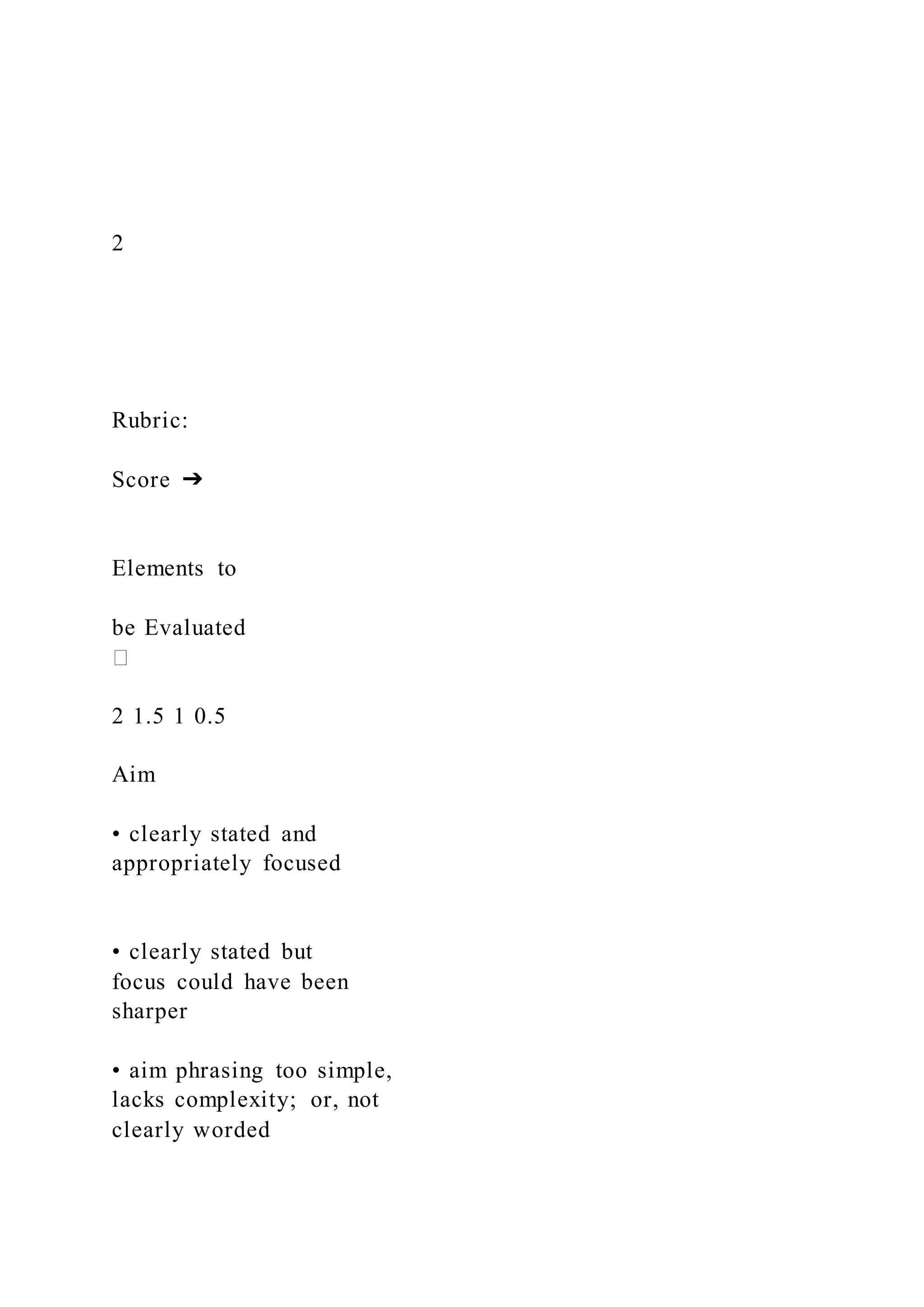
Rubric:
Score ➔
Elements to
be Evaluated
2 1.5 1 0.5
Aim
• clearly stated and
appropriately focused
• clearly stated but
focus could have been
sharper
• aim phrasing too simple,
lacks complexity; or, not
clearly worded
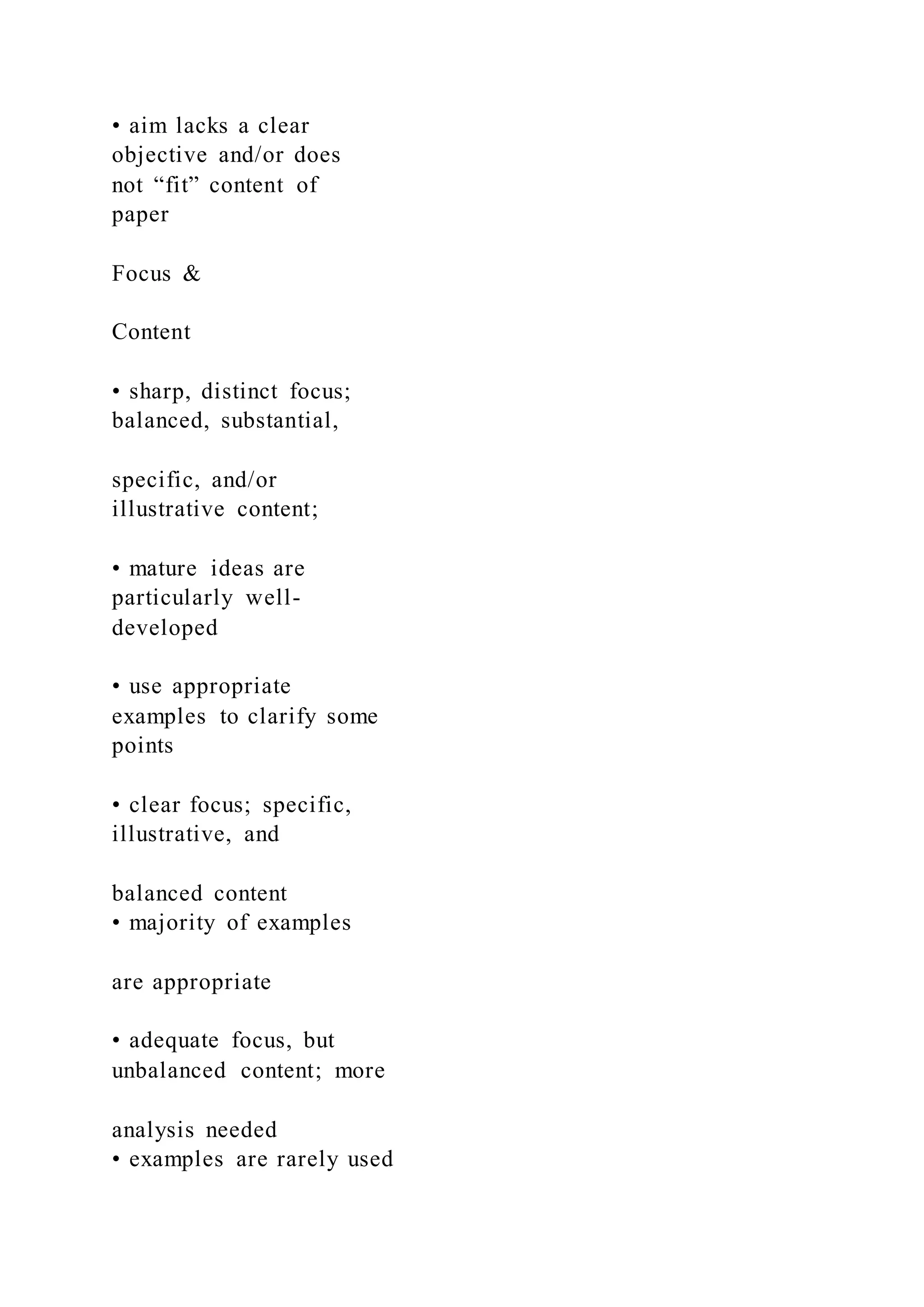
• aim lacks a clear
objective and/or does
not “fit” content of
paper
Focus &
Content
• sharp, distinct focus;
balanced, substantial,
specific, and/or
illustrative content;
• mature ideas are
particularly well-
developed
• use appropriate
examples to clarify some
points
• clear focus; specific,
illustrative, and
balanced content
• majority of examples
are appropriate
• adequate focus, but
unbalanced content; more
analysis needed
• examples are rarely used
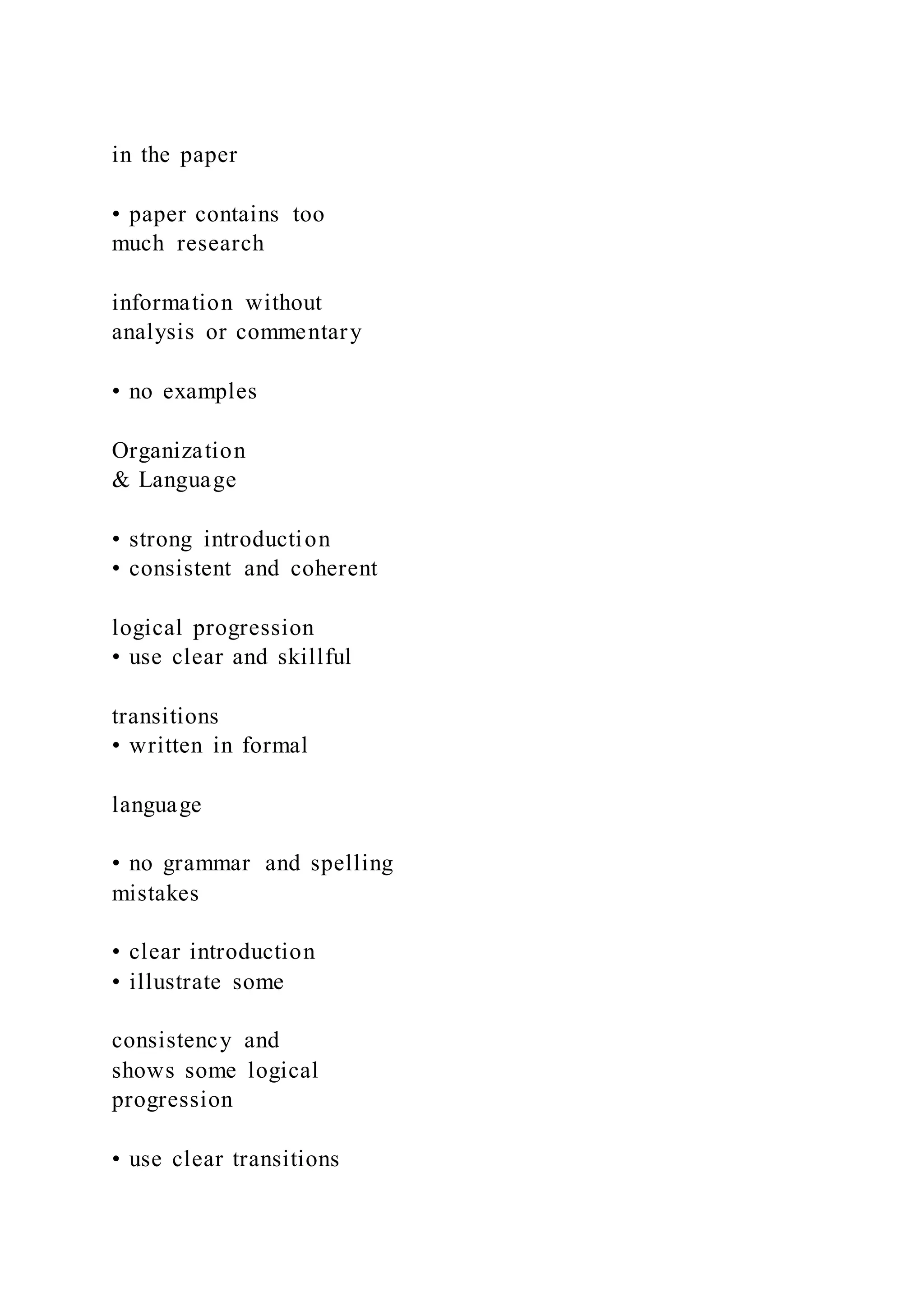
in the paper
• paper contains too
much research
information without
analysis or commentary
• no examples
Organization
& Language
• strong introduction
• consistent and coherent
logical progression
• use clear and skillful
transitions
• written in formal
language
• no grammar and spelling
mistakes
• clear introduction
• illustrate some
consistency and
shows some logical
progression
• use clear transitions
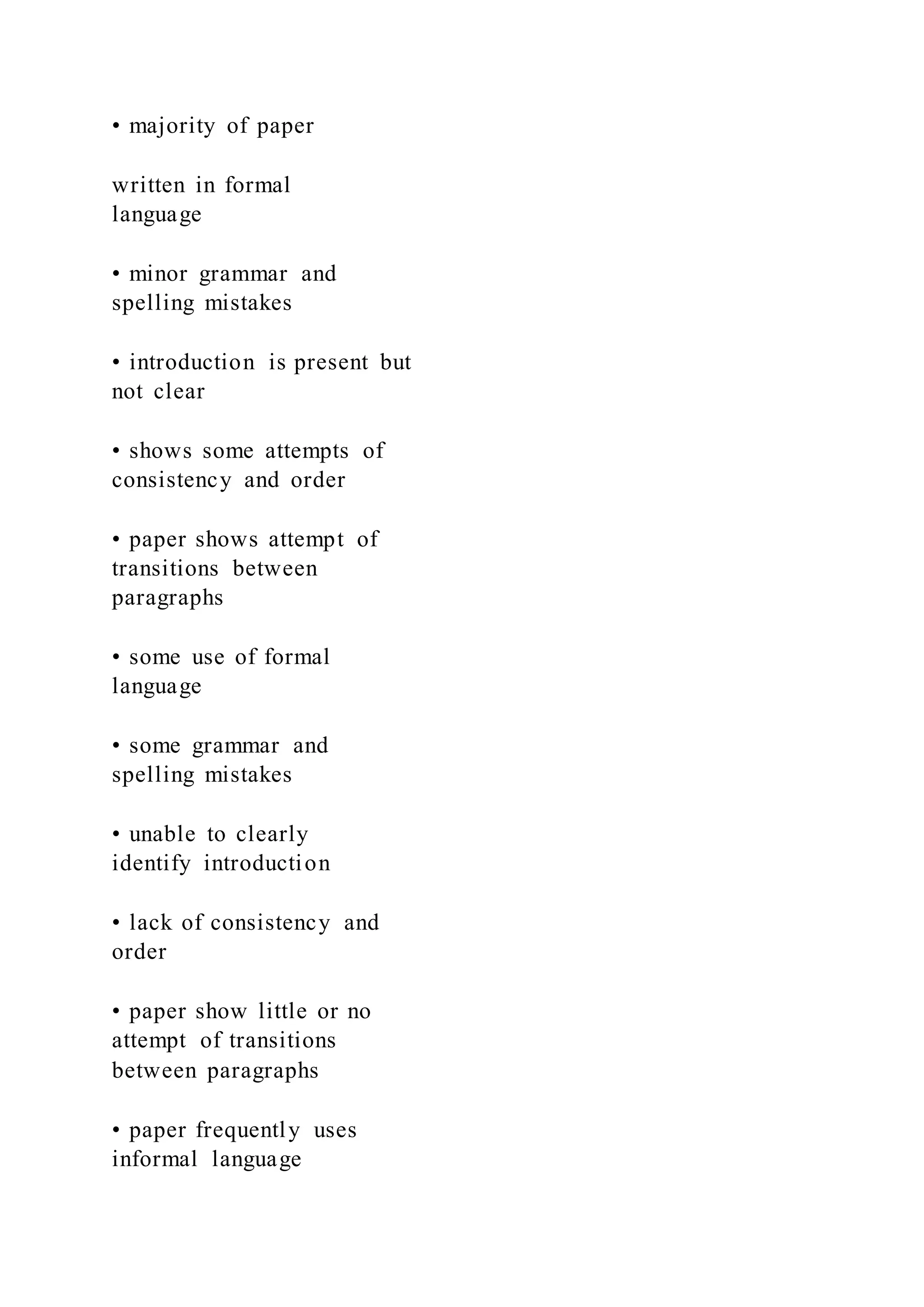
• majority of paper
written in formal
language
• minor grammar and
spelling mistakes
• introduction is present but
not clear
• shows some attempts of
consistency and order
• paper shows attempt of
transitions between
paragraphs
• some use of formal
language
• some grammar and
spelling mistakes
• unable to clearly
identify introduction
• lack of consistency and
order
• paper show little or no
attempt of transitions
between paragraphs
• paper frequently uses
informal language
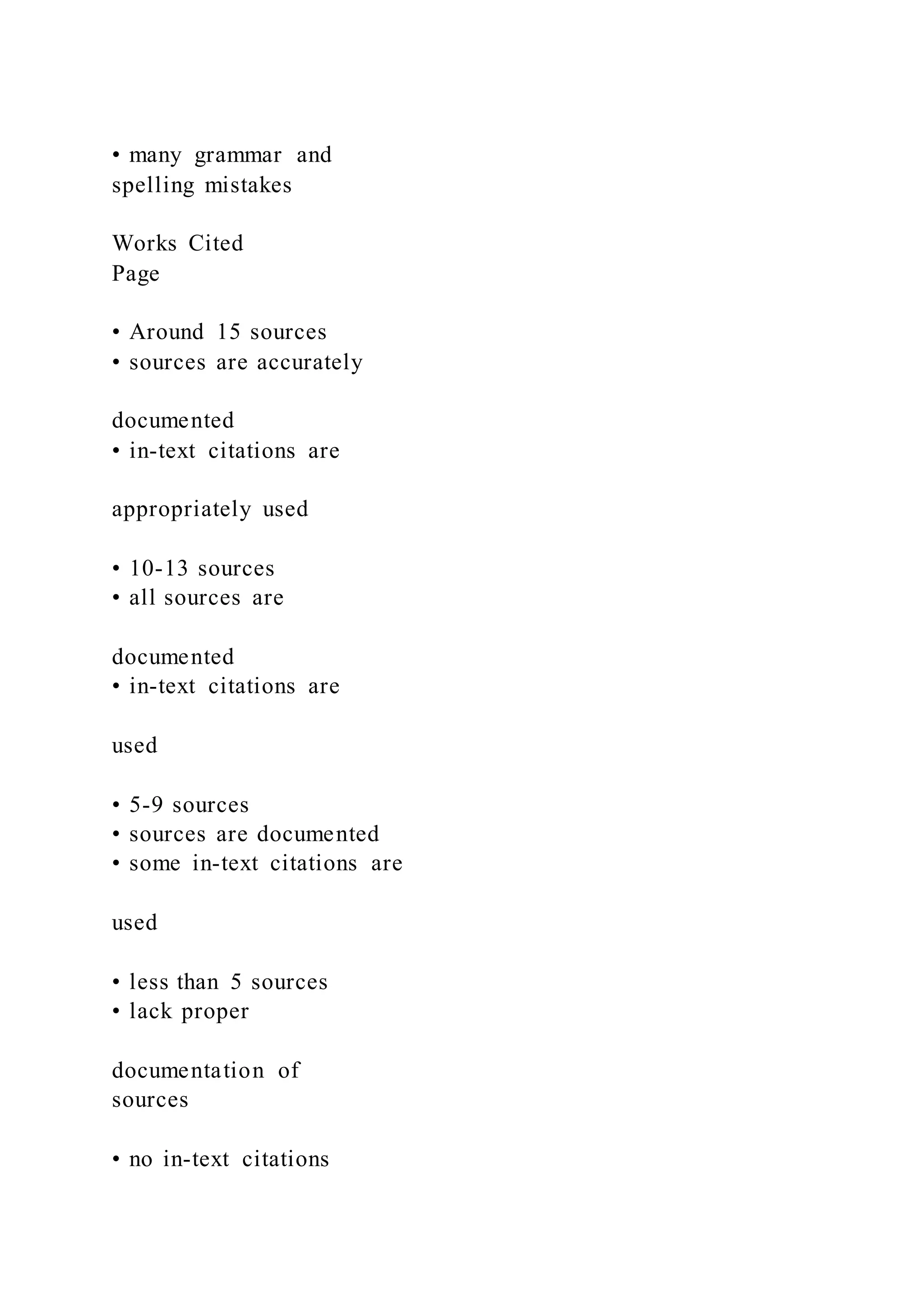
• many grammar and
spelling mistakes
Works Cited
Page
• Around 15 sources
• sources are accurately
documented
• in-text citations are
appropriately used
• 10-13 sources
• all sources are
documented
• in-text citations are
used
• 5-9 sources
• sources are documented
• some in-text citations are
used
• less than 5 sources
• lack proper
documentation of
sources
• no in-text citations
Summary of Grade Distribution
Research Proposal = 2 points
Research Paper = 8 points
Presentation = 5 points
-----------------------------------------
Total grade = 15 points
Samar Ismail
443204085
Supervisor Name
e-mail
Mobile Triage Applications: Speed up COVID-19 detection and
help in early response for positive cases
1-Introduction:
1.1 Background
Triage means “Trier” and it is a French word that first appeared
when Baron Dominique Jean Larrey, who was a Surgeon in
Chief to Napoleon’s Imperial Guard, created the organizational
structure that was mandatory to handle the huge and rising
number of wars victims. (Robertson-Steel, 2006)
At this moment in time, triage is utilized to classify patients'
level of urgency and make a quick response and decision based
on their triage level. (Farrohknia et al. Scandinavian, 2011)
In other words, Triage medical system is aimed to improve
health care by setting priorities regarding medical cases.
Emergency and critical cases always come first in the category
of tasks that must be accomplished first, this quick intervention
can save patient’s life as well as it can save time and effort
required for response to be done.
1.2 Motivation and importance
My interest in clinical triage system started with the onset of
Corona virus pandemic, which is an acute and sever respiratory
syndrome caused by a virus termed (COVID-19).
This virus has the ability to spread out rapidly between humans,
the onset of disease started in Wuhan, Hubei Province, China
then it is proliferating to cause worldwide outbreak. (Koichi
Yuki, 2020)
Due to this fast transmission of COVID-19, it becomes so hard
to be controlled. So many mobile applications came out to
instruct the people how to do social distancing, wearing mask,
hand hygiene and if needed Quarantine.
triage in the other hand plays an important role in speeding up
the detection process of disease to start an early response for
positive cases by making it available in a form of mobile
applications.
1.3 problem Statement
we have witnessed accelerating numbers of COVID-19 cases
and associated deaths worldwide; several different scenarios can
be considered when interpreting deaths from COVID-19.
(Vincent, 2020)
But the presence of such mobile Triage applications practiced in
our kingdom i.e., Sehhaty, Tawakkalna, Anat and Tabaud, that
contain the problem as quickly as possible by increase people's
awareness more and more and make them apply necessary
preventive measures to protect themselves and those around
from that infection or contribute to its faster transmission.
2-Methadology
King Khaled Eye Specialist Hospital use Mobile aided Triage
application to scored people according to the number of
symptoms they have.
This application provided with symptoms check list and a set of
certain questions that must be answered by the users in order to
get their score result.
They become suspected if his or her score reaches four or
above. In this case insulation and SWAP is mandatory to
confirm infection.
Take into a consideration the policy that must be followed in
King Khaled eye specialist hospital in case of confirmed
positive cases.
3-References
1- Robertson-Steel, I. (2006). Evolution of triage systems.
Emergency medicine journal, 23(2), 154-155.
2- Farrohknia, N., Castrén, M., Ehrenberg, A., Lind, L.,
Oredsson, S., Jonsson, H., ... & Göransson, K. E. (2011).
Emergency department triage scales and their components: a
systematic review of the scientific evidence. Scandinavian
journal of trauma, resuscitation and emergency medicine, 19(1),
1-13.
3- Yuki, K., Fujiogi, M., & Koutsogiannaki, S. (2020). COVID-
19 pathophysiology: A review. Clinical immunology, 215,
108427.
4- Vincent, J. L., & Taccone, F. S. (2020). Understanding
pathways to death in patients with COVID-19. The Lancet
Respiratory Medicine, 8(5), 430-432.
Week 3: Focused SOAP Note and Patient Case Presentation
College of Nursing-PMHNP, Walden University
NRNP 6665: PMHNP Care Across the Lifespan 1 Practicum
Introduction
Every patient's treatment begins with a full health assessment,
because the plan of care
and every mental intervention are all dependent on the
information gathered at the initial meeting
with the patient. In this situation, the assessment was
documented after the patient was evaluated,
and a diagnostic impression was formed based on the
information gained from the patient during
This study source was downloaded by 100000822789681 from
CourseHero.com on 03-15-2022 02:50:21 GMT -05:00
https://www.coursehero.com/file/112763331/Wk-3-Assgn-
SOAPdocx/
https://www.coursehero.com/file/112763331/Wk-3-Assgn-
SOAPdocx/
the evaluation. A 30 years old White female attending a follow
up on tele psych appointment.
Patient states that she is doing well with meds. Patient is taking
all prescribed
medications: Gabapentin 100mg PO 3 times per day, Wellbutrin
300mg PO daily, Effexor 112mg
PO daily and will continue with the above listed medications as
they are effective.
Subjective:
CC: "Sometimes I get really anxious, sometimes depressed. It's
hard to describe my feelings".
HPI: Amy a 30 years old White female attending a follow up on
tele psych appointment. Patient
states that she is doing well with meds. Patient is taking
Gabapentin 100mg PO 3 times per day,
Wellbutrin 300mg PO daily, Effexor 112mg PO daily. Patient
admits to the use of Weed and
Alcohol daily. Admits that she took alcohol last night and that
has been going on for the last 10
days. States that weed makes her more social, calm, get things
done. The patient was evaluated
by the Nurse Practitioner student. The patient describes her
mood as good. Her affect is restricted
but adequate. Patient denies SI/HI. Following the note on prior
meeting with patient and the
psychiatrist, patient is coping well with her mental condition.
Substance Current Use and History: Patient admit to use of
alcohol and weed. Admits that she
took alcohol last night and that has been going on for the last 10
days. States that weed makes
her more social, calm, get things done.
This study source was downloaded by 100000822789681 from
CourseHero.com on 03-15-2022 02:50:21 GMT -05:00
https://www.coursehero.com/file/112763331/Wk-3-Assgn-
SOAPdocx/
https://www.coursehero.com/file/112763331/Wk-3-Assgn-
SOAPdocx/
Medical History: Patient denies any medical history
Current Medication: Gabapentin 100mg PO 3 times per day,
Wellbutrin 300mg PO daily,
Effexor 112mg PO daily
Allergies: No known drug allergies, food or seasonal allergies
Reproductive History: Patient is presently sexually active,
practices safe sex. No history of
abortion or miscarriages
ROS:
GENERAL: Well attired, appeared nervous and shy during the
session.
HEENT: There is no swelling or redness in the eyes. Denies
having an ear condition.
No abnormalities or disfigurements were found in the nose.
There is no deviation or swelling in
the throat or neck.
SKIN: no discoloration noted or history of skin condition
CARDIOVASCULAR: Within typical limits for heart rate and
blood pressure
PULMONARY: There are no aberrant noises in any of the
lungs; sounds all clear
GASTROINTESTINAL: able to move bowels without no
problem or discomfort
GENITOURINARY: continent times two, and able to void
without problem
NEUROLOGICAL: alert, oriented, to person, place, time, and
circumstance
MUSCULOSKELETAL: moves all upper extremities with no
deformities
HEMOTOLOGICAL: no blood disorder reported or listed in
history
LYMPATHIC : no condition reported or enlarged nodes
ENDOCRINOLOGY: no condition reported or reported of cold
or heat intolerance
Objective:
Diagnostic Results: No diagnostic test was required during thi s
assessment session
This study source was downloaded by 100000822789681 from
CourseHero.com on 03-15-2022 02:50:21 GMT -05:00
https://www.coursehero.com/file/112763331/Wk-3-Assgn-
SOAPdocx/
https://www.coursehero.com/file/112763331/Wk-3-Assgn-
SOAPdocx/
Assessment:
Mental Status Examination
Amy a 30-years-old White female who looks like the above
stated age was scheduled for
a psych tele evaluation session. Patient is focused, alert, follows
all orders, and accurately
answers all questions The patient was nice and well-dressed, yet
appeared uneasy and fidgety.
Although there were no acute psychosis or mood symptoms, the
patient appeared concerned.
Denies any current or previous history of suicide. Denies any
current or previous or
present history of suicide. Denies having any homicidal ideas or
hearing voices or thoughts that
might cause harm to people. All of memories are intact,
however patient is extremely forgetful
and have poor focus due to ADHD.
Diagnostic Impression
Attention Deficit Hyperactivity Disorder (ADHD): Limited
attention, hyperactivity, inability
to focus for long periods of time, difficulties at school or at
work, worries, forgetfulness, anxiety,
excessive fidgeting, wanders off task, lacks tenacity, is
disorganized, and takes hasty acts are all
symptoms of ADHD in children and adults (Sadock, et al.,
2014). Patients with this disorder
must have the following symptoms, according to the DSM-5: a
history of impulsive behavior,
difficulties at school or at work, forgetfulness, nervousness,
excessive fidgeting, wandering off
track, lacks tenacity, has problems maintaining attention, is
disorganized, makes casual mistakes
in schooling or at work, dislikes tasks that require
concentration, misplaces things, patient stating
that weed makes her more social, calm, and get things done.
Anxiety Disorder: Anxiety Disorder is a mental health condition
that is more than just a worry
or fear, and it can have a significant impact on job,
relationships, and other aspects of one's life
(Bachem & Casey, 2018). According to the DSM-5, an
individual must meet certain criteria in
This study source was downloaded by 100000822789681 from
CourseHero.com on 03-15-2022 02:50:21 GMT -05:00
https://www.coursehero.com/file/112763331/Wk-3-Assgn-
SOAPdocx/
https://www.coursehero.com/file/112763331/Wk-3-Assgn-
SOAPdocx/
order to be diagnosed with anxiety disorder: edginess,
irritability, feeling as if the mind is going
blank, unsatisfying sleep, limited attention, troubled
relationships, difficulty at school or work,
forgetful, excessively fidgets, wanders off task, has difficulty
concentrating etc. (American
Psychiatric Association, 2013). In the case of our patient Ms.
Amy, this is demonstrated by the
patient admitting that she forgets to finish work, loses her
temper, fidgets while sitting for no
apparent reason, can't sit still for long periods of time,
misplaces things, or forgets to read, and
the patient claiming that weed makes her more social, calm, and
efficient.
Depressive Disorder 311 (F32.9): Changes in energy level,
anxiety, wanders off task, lacks
tenacity, has problems sustaining attention, self-esteem
difficulties, isolates self for no cause,
change in sleep pattern, loss of interest in activities, guilt,
impatience, misplacing items, and so
on are all symptoms of depression (Bachem & Casey, 2018).
Change in energy level, wanders off
task, lacks persistence, poor self-esteem, anxiety, isolation,
appetite change, forgetfulness, not
completing assigned chores at work or school, feeling guilty,
and loss of energy are all signs and
symptoms of Depressive Disorder, according to the DSM-5
(American Psychiatric Association,
2013). The following explanation correlates with the behaviors
reported by our patient, Ms.
Amy, with the symptoms listed above. This is demonstrated by
the patient's admission that she
forgets to finish her work and that she uses weed and alcohol on
a daily basis. She admits to
drinking last night and has been doing so for the past ten days,
patient claiming that weed makes
her more social, calm, and efficient.
Reflection
One thing I could have done differently as a PMHNP is to begin
the interview by greeting
the patient and asking questions unrelated to the scheduled
meeting, which would assist to create
a congenial atmosphere. Then, without appearing like I have a
predetermined notion about the
This study source was downloaded by 100000822789681 from
CourseHero.com on 03-15-2022 02:50:21 GMT -05:00
https://www.coursehero.com/file/112763331/Wk-3-Assgn-
SOAPdocx/
https://www.coursehero.com/file/112763331/Wk-3-Assgn-
SOAPdocx/
patient's personality, illness, or what the practitioner said about
the patient, ask open-ended
questions. Also, inquire if the patient would want to speak with
the provider privately if there is
something she would like to share with the provider rather than
the clinical rotation
student. Then learn about the patient's pressures, depression,
identity, and sexual orientation
issues. As a PHMNP, it is critical to create an accepting
environment for all patients during an
interview; this will assist my patients understand that this is a
place to help them heal and that
they are accepted despite of their mistakes or imperfections.
Trust, respect for diversity, equity,
fairness, and social justice are all elements of cultural
competence that must be considered
throughout any form of interview or encounter between a
healthcare practitioner and a patient
(Sadock et al., 2014).
Substance addiction resources should be made available to this
patient, since it is clear
that she uses substances on a daily basis in order to complete
her daily tasks. If it hasn't already,
this can lead to substance abuse. Substance abuse education
focuses on teaching people about
drug and alcohol abuse, as well as how to avoid, quit, or seek
help for substance use disorders.
Case Formation and Treatment Plan
The patient will undergo 15 minutes of group supportive
therapy every day from Monday
to Friday. The patient will receive an instructional brochure, as
well as assignments and a follow-
up visit, on the issues discussed.
This study source was downloaded by 100000822789681 from
CourseHero.com on 03-15-2022 02:50:21 GMT -05:00
https://www.coursehero.com/file/112763331/Wk-3-Assgn-
SOAPdocx/
https://www.coursehero.com/file/112763331/Wk-3-Assgn-
SOAPdocx/
There are two phone lines supplied to the patient: 911 for
immediate assistance and the Client's
Crisis Line. For mutual and collaborative understanding,
medical and therapist reports were
evaluated.
There was plenty of opportunity for questions and answers
throughout this 60-minute session.
The patient was given supportive listening, and he appeared to
understand what was said. She
believes in the treatment plan and continues to follow it.
Consult your PCP if necessary, or if you have any questions or
concerns concerning the start of
any undesirable or unexpected side effects.
As part of the treatment, group counseling was ordered and
implemented.
Substance abuse resources was provided; list of available places
was given to patient.
The patient will be psychiatrically stable and able to live in the
community for extended periods
of time while maintaining a better quality of life.
Any other supplier recommendations: There are none.
Return to psych tele appointments: every 90 days.
Conclusion
During an interview, a PMHNP student must attempt to produce
their own facts or
information from patients in order to give tailored or
personalized care, independent of the
information provided by the preceptor about the patient prior to
the interview. Prejudices about
the patient's personality, health, or what the practitioner says
about the patient should be
avoided. Also, inquire if the patient would like to speak
privately if there is anything she would
like to share privately. Then learn about the patient's pressures,
depression, identity, and sexual
orientation issues. More so, it's critical to know what
distinguishes one psychological condition
from another. Treatment methods are beneficial since they assist
people in managing their
This study source was downloaded by 100000822789681 from
CourseHero.com on 03-15-2022 02:50:21 GMT -05:00
https://www.coursehero.com/file/112763331/Wk-3-Assgn-
SOAPdocx/
https://www.coursehero.com/file/112763331/Wk-3-Assgn-
SOAPdocx/
illnesses. Determining an individual's illness type could have
led to more reliable and accurate
treatment alternatives; treatment approaches are beneficial since
they help people regulate their
conditions. An unbiased individual is not swayed by personal
feelings or beliefs since the facts
of the issue are weighed. When dealing with customers, as a
potential PMHNP, I must retain
objectivity. From an ethical sense, I must emphasize that people
should be assisted rather than
criticized or treated unfairly.
References
American Psychiatric Association. (2013). Diagnostic and
Statistical Manual of Mental
Disorders, fifth edition DSM-5 American Psychiatric
Association, 2013.
Bachem, R., & Casey, P. (2018). Adjustment disorder: A
diagnosis whose time has come.
This study source was downloaded by 100000822789681 from
CourseHero.com on 03-15-2022 02:50:21 GMT -05:00
https://www.coursehero.com/file/112763331/Wk-3-Assgn-
SOAPdocx/
https://www.coursehero.com/file/112763331/Wk-3-Assgn-
SOAPdocx/
Journal of Affective Disorders, 227, 243-253.
https://doi.org/10.1016/j.jad.2017.10.034
Adjustment disorder: A diagnosis whose time has come
Adjustment disorder is among the most frequently diagnosed
mental disorders in clinical practic
e although it has received littleacademic attention an…
doi.org
Sadock, B.J., Sadock, V.A., & Ruiz, P. (2014). Kaplan and
Sadock’s synopsis of psychiatry:
Behavioral sciences/clinical psychiatry (11 th ed.).
Philadelphia, PA: Wolters Kluwer.
This study source was downloaded by 100000822789681 from
CourseHero.com on 03-15-2022 02:50:21 GMT -05:00
https://www.coursehero.com/file/112763331/Wk-3-Assgn-
SOAPdocx/
Powered by TCPDF (www.tcpdf.org)
https://www.coursehero.com/file/112763331/Wk-3-Assgn-
SOAPdocx/
http://www.tcpdf.org
NRNP/PRAC 6665 & 6675 Focused SOAP Psychiatric
Evaluation Exemplar
INSTRUCTIONS ON HOW TO USE EXEMPLAR AND
TEMPLATE—READ CAREFULLY
If you are struggling with the format or remembering what to
include, follow the Focused SOAP Note Evaluation Template
AND the Rubric as your guide. It is also helpful to review the
rubric in detail in order not to lose points unnecessarily because
you missed something required. After reviewing full details of
the rubric, you can use it as a guide.
In the Subjective section, provide:
· Chief complaint
· History of present illness (HPI)
· Past psychiatric history
· Medication trials and current medications
· Psychotherapy or previous psychiatric diagnosis
· Pertinent substance use, family psychiatric/substance use,
social, and medical history
· Allergies
· ROS
Read rating descriptions to see the grading standards!
In the Objective section, provide:
· Physical exam documentation of systems pertinent to the chief
complaint, HPI, and history
· Diagnostic results, including any labs, imaging, or other
assessments needed to develop the differential diagnoses.
Read rating descriptions to see the grading standards!
In the Assessment section, provide:
· Results of the mental status examination, presented in
paragraph form.
· At least three differentials with supporting evidence. List them
from top priority to least priority. Compare the DSM-5
diagnostic criteria for each differential diagnosis and explain
what DSM-5 criteria rules out the differential diagnosis to find
an accurate diagnosis. Explain the critical-thinking process that
led you to the primary diagnosis you selected. Include pertinent
positives and pertinent negatives for the specific patient case.
· Read rating descriptions to see the grading standards!
Reflect on this case. Include: Discuss what you learned and
what you might do differently. Also include in your reflection a
discussion related to legal/ethical considerations (demonstrate
critical thinking beyond confidentiality and consent for
treatment!), health promotion and disease prevention taking into
consideration patient factors (such as age, ethnic group, etc.),
PMH, and other risk factors (e.g., socioeconomic, cultural
background, etc.).
(The FOCUSED SOAP psychiatric evaluation is typically the
follow-up visit patient note. You will practice writing this type
of note in this course. You will be focusing more on the
symptoms from your differential diagnosis from the
comprehensive psychiatric evaluation narrowing to your
diagnostic impression. You will write up what symptoms are
present and what symptoms are not present from illnesses to
demonstrate you have indeed assessed for illnesses which could
be impacting your patient. For example, anxiety symptoms,
depressive symptoms, bipolar symptoms, psychosis symptoms,
substance use, etc.)
EXEMPLAR BEGINS HERE
Subjective:
CC (chief complaint): A brief statement identifying why the
patient is here. This statement is verbatim of the patient’s own
words about why presenting for assessment. For a patient with
dementia or other cognitive deficits, this statement can be
obtained from a family member.
HPI: Begin this section with patient’s initials, age, race, gender,
purpose of evaluation, current medication and referral reason.
For example:
N.M. is a 34-year-old Asian male presents for medication
management follow up for anxiety. He was initiated sertraline
last appt which he finds was effective for two weeks then
symptoms began to return.
Or
P.H., a 16-year-old Hispanic female, presents for follow up to
discuss previous psychiatric evaluation for concentration
difficulty. She is not currently prescribed psychotropic
medications as we deferred until further testing and screening
was conducted.
Then, this section continues with the symptom analysis for your
note. Thorough documentation in this section is essential for
patient care, coding, and billing analysis.
Paint a picture of what is wrong with the patient. First what is
bringing the patient to your follow up evaluation? Document
symptom onset, duration, frequency, severity, and impact. What
has worsened or improved since last appointment? What
stressors are they facing? Your description here w ill guide your
differential diagnoses into your diagnostic impression. You are
seeking symptoms that may align with many DSM-5 diagnoses,
narrowing to what aligns with diagnostic criteria for mental
health and substance use disorders.
Substance Use History: This section contains any history or
current use of caffeine, nicotine, illicit substance (including
marijuana), and alcohol. Include the daily amount of use and
last known use. Include type of use such as inhales, snorts, IV,
etc. Include any histories of withdrawal complications from
tremors, Delirium Tremens, or seizures.
Current Medications: Include dosage, frequency, length of time
used, and reason for use. Also include OTC or homeopathic
products.
Allergies:Include medication, food, and environmen tal allergies
separately. Provide a description of what the allergy is (e.g.,
angioedema, anaphylaxis). This will help determine a true
reaction vs. intolerance.
Reproductive Hx:Menstrual history (date of LMP), Pregnant
(yes or no), Nursing/lactating (yes or no), contraceptive use
(method used), types of intercourse: oral, anal, vaginal, other,
any sexual concerns
ROS: Cover all body systems that may help you include or rule
out a differential diagnosis. Please note: THIS IS DIFFERENT
from a physical examination!
You should list each system as follows: General:Head: EENT:
etc. You should list these in bullet format and document the
systems in order from head to toe.
Example of Complete ROS:
GENERAL: No weight loss, fever, chills, weakness, or fatigue.
HEENT: Eyes: No visual loss, blurred vision, double vision, or
yellow sclerae. Ears, Nose, Throat: No hearing loss, sneezing,
congestion, runny nose, or sore throat.
SKIN: No rash or itching.
CARDIOVASCULAR: No chest pain, chest pressure, or chest
discomfort. No palpitations or edema.
RESPIRATORY: No shortness of breath, cough, or sputum.
GASTROINTESTINAL: No anorexia, nausea, vomiting, or
diarrhea. No abdominal pain or blood.
GENITOURINARY: Burning on urination, urgency, hesitancy,
odor, odd color
NEUROLOGICAL: No headache, dizziness, syncope, paralysis,
ataxia, numbness, or tingling in the extremities. No change in
bowel or bladder control.
MUSCULOSKELETAL: No muscle, back pain, joint pain, or
stiffness.
HEMATOLOGIC: No anemia, bleeding, or bruising.
LYMPHATICS: No enlarged nodes. No history of splenectomy.
ENDOCRINOLOGIC: No reports of sweating, cold, or heat
intolerance. No polyuria or polydipsia.
Objective:
Diagnostic results: Include any labs, X-rays, or other
diagnostics that are needed to develop the differential diagnoses
(support with evidenced and guidelines).
Assessment:
Mental Status Examination: For the purposes of your courses,
this section must be presented in paragraph form and not use of
a checklist! This section you will describe the patient’s
appearance, attitude, behavior, mood and affect, speech, thought
processes, thought content, perceptions (hallucinations,
pseudohallucinations, illusions, etc.)., cognition, insight,
judgment, and SI/HI. See an example below. You will modify to
include the specifics for your patient on the above elements —
DO NOT just copy the example. You may use a preceptor’s way
of organizing the information if the MSE is in paragraph form.
He is an 8-year-old African American male who looks his stated
age. He is cooperative with examiner. He is neatly groomed and
clean, dressed appropriately. There is no evidence of any
abnormal motor activity. His speech is clear, coherent, normal
in volume and tone. His thought process is goal directed and
logical. There is no evidence of looseness of association or
flight of ideas. His mood is euthymic, and his affect appropriate
to his mood. He was smiling at times in an appropriate manner.
He denies any auditory or visual hallucinations. There is no
evidence of any delusional thinking. He denies any current
suicidal or homicidal ideation. Cognitively, he is alert and
oriented. His recent and remote memory is intact. His
concentration is good. His insight is good.
Diagnostic Impression:You must begin to narrow your
differential diagnosis to your diagnostic impression. You must
explain how and why (your rationale) you ruled out any of your
differential diagnoses. You must explain how and why (your
rationale) you concluded to your diagnostic impression. You
will use supporting evidence from the literature to support your
rationale. Include pertinent positives and pertinent negatives for
the specific patient case.
Also included in this section is the reflection. Reflect on this
case and discuss whether or not you agree with your preceptor’s
assessment and diagnostic impression of the patient and why or
why not. What did you learn from this case? What would you do
differently?
Also include in your reflection a discussion related to
legal/ethical considerations (demonstrating critical thinking
beyond confidentiality and consent for treatment!), health
promotion and disease prevention taking into consideration
patient factors (such as age, ethnic group, etc.), PMH, and other
risk factors (e.g., socioeconomic, cultural background, etc.).
Case Formulation and Treatment Plan
Includes documentation of diagnostic studies that will be
obtained, referrals to other health care providers, therapeutic
interventions including psychotherapy and/or
psychopharmacology, education, disposition of the patient, and
any planned follow-up visits. Each diagnosis or condition
documented in the assessment should be addressed in the plan.
The details of the plan should follow an orderly manner. *See
an example below. You will modify to your practice so there
may be information excluded/included. If you are completing
this for a practicum, what does your preceptor document?
Risks and benefits of medications are discussed including non-
treatment. Potential side effects of medications discussed (be
detailed in what side effects discussed). Informed client not to
stop medication abruptly without discussing with providers.
Instructed to call and report any adverse reactions. Discussed
risk of medication with pregnancy/fetus, encouraged birth
control, discussed if does become pregnant to inform provider
as soon as possible. Discussed how some medications might
decreased birth control pill, would need back up method
(exclude for males).
Discussed risks of mixing medications with OTC drugs, herbal,
alcohol/illegal drugs. Instructed to avoid this practice.
Encouraged abstinence. Discussed how drugs/alcohol affect
mental health, physical health, sleep architecture.
Initiation of (list out any medication and why prescribed, any
therapy services or referrals to specialist):
Client was encouraged to continue with case management and/or
therapy services (if not provided by you)
Client has emergency numbers: Emergency Services 911, the
Client's Crisis Line 1-800-_______. Client instructed to go to
nearest ER or call 911 if they become actively suicidal and/or
homicidal. (only if you or preceptor provided them)
Reviewed hospital records/therapist records for collaborative
information; Reviewed PMP report (only if actually completed)
Time allowed for questions and answers provided. Provided
supportive listening. Client appeared to understand discussion.
Client is amenable with this plan and agrees to follow treatment
regimen as discussed. (this relates to informed consent; you will
need to assess their understanding and agreement)
Follow up with PCP as needed and/or for:
Labs ordered and/or reviewed (write out what diagnostic test
ordered, rationale for ordering, and if discussed fasting/non
fasting or other patient education)
Return to clinic:
Continued treatment is medically necessary to address chronic
symptoms, improve functioning, and prevent the need for a
higher level of care.
References (move to begin on next page)
You are required to include at least three evidence-based, peer-
reviewed journal articles or evidenced-based guidelines which
relate to this case to support your diagnostics and differentials
diagnoses. Be sure to use correct APA 7th edition formatting.
© 2021 Walden University
Page 1 of 3
NRNP/PRAC 6665 & 6675 Comprehensive Focused SOAP
Psychiatric Evaluation Template
Week (enter week #): (Enter assignment title)
Student Name
College of Nursing-PMHNP, Walden University
NRNP 6665: PMHNP Care Across the Lifespan I
Faculty Name
Assignment Due Date
Subjective:
CC (chief complaint):
HPI:
Substance Current Use:
Medical History:
· Current Medications:
· Allergies:
· Reproductive Hx:
ROS:
· GENERAL:
· HEENT:
· SKIN:
· CARDIOVASCULAR:
· RESPIRATORY:
· GASTROINTESTINAL:
· GENITOURINARY:
· NEUROLOGICAL:
· MUSCULOSKELETAL:
· HEMATOLOGIC:
· LYMPHATICS:
· ENDOCRINOLOGIC:
Objective:
Diagnostic results:
Assessment:
Mental Status Examination:
Diagnostic Impression:
Reflections:
Case Formulation and Treatment Plan:
References
© 2021 Walden University
Page 1 of 3
PRAC 6665 WK3 SOAP
Assignment 2: Focused SOAP Note and Patient Case
Presentation
Photo Credit: Pexels
Psychiatric notes are a way to reflect on your practicum
experiences and connect them to the didactic learning you gain
from your NRNP courses. Focused SOAP notes, such as the
ones required in this practicum course, are often used in clinical
settings to document patient care.
For this Assignment, you will document information about a
patient that you examined during the last three weeks, using the
Focused SOAP Note Template provided. You will then use this
note to develop and record a case presentation for this patient.
To Prepare
· Review this week's Learning Resources and consider the
insights they provide. Also review the Kaltura Media Uploader
resource in the left-hand navigation of the classroom for help
creating your self-recorded Kaltura video.
· Select a patient of any age (either a child or an adult) that you
examined during the last 3 weeks.
· Create a Focused SOAP Note on this patient using the
template provided in the Learning Resources. There is also a
completed Focused SOAP Note Exemplar provided to serve as a
guide to assignment expectations.
PleaseNote:
· All SOAP notes must be signed, and each page must be
initialed by your Preceptor. Note: Electronic signatures are not
accepted.
· When you submit your note, you should include the complete
focused SOAP note as a Word document and PDF/images of
each page that is initialed and signed by your Preceptor.
· You must submit your SOAP note using SafeAssign. Note: If
both files are not received by the due date, faculty will deduct
points per the Walden Grading Policy.
· Then, based on your SOAP note of this patient, develop a
video case study presentation. Take time to practice your
presentation before you record.
· Include at least five scholarly resources to support your
assessment, diagnosis, and treatment planning.
· Ensure that you have the appropriate lighting and equipment
to record the presentation.
The Assignment
Record yourself presenting the complex case study for your
clinical patient. In your presentation:
· Dress professionally and present yourself in a professional
manner.
· Display your photo ID at the start of the video when you
introduce yourself.
· Ensure that you do not include any informa tion that violates
the principles of HIPAA (i.e., don’t use the patient’s name or
any other identifying information).
· Present the full complex case study. Include chief complaint;
history of present illness; any pertinent past psychiatric,
substance use, medical, social, family history; most recent
mental status exam; current psychiatric diagnosis including
differentials that were ruled out; and plan for treatment and
management.
· Report normal diagnostic results as the name of the test and
“normal” (rather than specific value). Abnormal results should
be reported as a specific value.
· Be succinct in your presentation, and do not exceed 8 minutes.
Specifically address the following for the patient, using your
SOAP note as a guide:
· Subjective: What details did the patient provide regarding
their chief complaint and symptomology to derive your
differential diagnosis? What is the duration and severity of their
symptoms? How are their symptoms impacting their functioning
in life?
· Objective: What observations did you make during the
psychiatric assessment?
· Assessment: Discuss their mental status examination results.
What were your differential diagnoses? Provide a minimum of
three possible diagnoses and why you chose them. List them
from highest priority to lowest priority. What was your primary
diagnosis and why? Describe how your primary diagnosis aligns
with DSM-5 diagnostic criteria and supported by the patient’s
symptoms.
· Plan: What was your plan for psychotherapy? What was your
plan for treatment and management, including alternative
therapies? Include pharmacologic and nonpharmacologic
treatments, alternative therapies, and follow-up parameters, as
well as a rationale for this treatment and management plan. Also
be sure to include at least one health promotion activity and one
patient education strategy.
· Reflection notes: What would you do differently with this
patient if you could conduct the session again? If you are able
to follow up with your patient, explain whether these
interventions were successful and why or why not. If you were
not able to conduct a follow up, discuss what your next
intervention would be.
Learning Resources
Required Readings (click to expand/reduce)
Carlat, D. J. (2017). The psychiatric interview (4th ed.).
Wolters Kluwer.
· Section II. The Psychiatric History (Chapters 14–18)
· Section III. Interviewing for Diagnosis: The Psychiatric
Review of Symptoms (Chapters 23–24)
Lorberg, B., Davico, C., Martsenkovskyi, D., & Vitiello, B.
(2019). Principles in using psychotropic medication in children
and adolescents. In J. M. Rey & A. Martin (Eds.), IACAPAP e-
textbook of child and adolescent mental health (2019 ed., pp. 1–
25). International Association for Child and Adolescent
Psychiatry and Allied Professions.
https://iacapap.org/content/uploads/A.7-Psychopharmacology-
2019.1.pdf
Meditrek
https://edu.meditrek.com/Default.html
Note: Use this link to log into Meditrek to report your clinical
hours and patient encounters.
Document: Focused SOAP Note Template (Word document)
Document: Focused SOAP Note Exemplar (Word document)
CASE STUDY
A.Q 13 YEARS OLD FEMALE TO MALE, PRONOUNS ARE
HE AND THEY
ADMITTED FOR SI, SIB, MAJOR DEPRESSIVE DISORDER,
ADHD
MEDICATIONS ARE ADDERALL 20MG PO QAM FOR ADHD
AND PROZAC 20MG PO QAM
COMPLIANT WITH MEDICATION
ALLERGIES- NONE
PATIENT FEEL MORE SECURE AND SAFE WITH FRIENDS,
DON’T HAVE GOOD RAPPORT WITH MOM.
PATIENT IS EASILY TRIGGER BY MOM TELLING HER TO
DO CHORES
FAMILY BACKGROUND UNKNOWN, REFUSED TO
DISCUSS
POSITIVE COPING SKILLS ARE- DRAWING, HOLDING
ICES, PLAYING WITH PUPPET, MUSIC, AND STRESS.
GOOD APPERTITE AND SLEEP REPORT. BOWEL
MOVEMENT- DAILY
HAS SIBLINGS TWO OLDER SISTER BUT DOES NOT GET
ALONG WITH THEM.

Rubric Detail Select Grid View or List View to change the r

  • 1.
    Rubric Detail Select GridView or List View to change the rubric's layout. Content Name: PRAC_6665_Week3_Assignment2_Rubric Grid ViewList View Excellent Good Fair Poor Photo ID display and professional attire Points: Points Range: 5 (5%) - 5 (5%)
  • 2.
    Photo ID isdisplayed. The student is dressed professionally. Feedback: Points: Points Range: 0 (0%) - 0 (0%)
  • 3.
  • 4.
    Feedback: Points: Points Range: 0 (0%)- 0 (0%) Photo ID is not displayed. Student must remedy this before grade is posted. The student is not dressed professionally.
  • 5.
    Feedback: Time Points: Points Range: 5 (5%)- 5 (5%) The video does not exceed the 8-minute time limit.
  • 6.
  • 7.
    Points: Points Range: 0 (0%)- 0 (0%) Feedback:
  • 8.
    Points: Points Range: 0 (0%)- 0 (0%) The video exceeds the 8-minute time limit. (Note: Information presented after 8 minutes will not be evaluated for grade inclusion.) Feedback:
  • 9.
    Discuss Subjective data: •Chief complaint • History of present illness (HPI) • Medications • Psychotherapy or previous psychiatric diagnosis • Pertinent histories and/or ROS Points: Points Range: 9 (9%) - 10 (10%)
  • 10.
    The video accuratelyand concisely presents the patient's subjective complaint, history of present illness, medications, psychotherapy or previous psychiatric diagnosis, and pertinent histories and/or review of systems that would inform a differential diagnosis. Feedback: Points: Points Range: 8 (8%) - 8 (8%)
  • 11.
    The video accuratelypresents the patient's subjective complaint, history of present illness, medications, psychotherapy or previous psychiatric diagnosis, and pertinent histories and/or review of systems that would inform a differential diagnosis. Feedback: Points: Points Range: 7 (7%) - 7 (7%)
  • 12.
    The video presentsthe patient's subjective complaint, history of present illness, medications, psychotherapy or previous psychiatric diagnosis, and pertinent histories and/or review of systems that would inform a differential diagnosis, but is somewhat vague or contains minor inaccuracies. Feedback: Points: Points Range: 0 (0%) - 6 (6%)
  • 13.
    The video presentsan incomplete, inaccurate, or unnecessarily detailed/verbose description of the patient's subjective complaint, history of present illness, medications, psychotherapy or previous psychiatric diagnosis, and pertinent histories and/or review of systems that would inform a differential diagnosis. Or subjective documentation is missing. Feedback: Discuss Objective data: • Physical exam documentation of systems pertinent to the chief complaint, HPI, and history • Diagnostic results, including any labs, imaging, or other assessments needed to develop the differential diagnoses
  • 14.
    Points: Points Range: 9 (9%)- 10 (10%) The video accurately and concisely documents the patient's physical exam for pertinent systems. Pertinent diagnostic tests and their results are documented, as applicable. Feedback:
  • 15.
    Points: Points Range: 8 (8%)- 8 (8%) The response accurately documents the patient's physical exam for pertinent systems. Diagnostic tests and their results are documented, as applicable. Feedback:
  • 16.
    Points: Points Range: 7 (7%)- 7 (7%) Documentation of the patient's physical exam is somewhat vague or contains minor inaccuracies. Diagnostic tests and their results are documented but contain inaccuracies. Feedback:
  • 17.
    Points: Points Range: 0 (0%)- 6 (6%) The response provides incomplete, inaccurate, or unnecessarily detailed/verbose documentation of the patient's physical exam. Systems may have been unnecessarily reviewed, or objective documentation is missing. Feedback:
  • 18.
    Discuss results ofAssessment: • Results of the mental status examination • Provide a minimum of three possible diagnoses in order of highest to lowest priority and explain why you chose them. What was your primary diagnosis and why? Describe how your primary diagnosis aligns with DSM-5 diagnostic criteria and is supported by the patient’s symptoms. Points: Points Range: 18 (18%) - 20 (20%) The video accurately documents the results of the mental status exam.
  • 19.
    Video presents atleast three differentials in order of priority for a differential diagnosis of the patient, and a rationale for their selection. Response justifies the primary diagnosis and how it aligns with DSM-5 criteria. Feedback: Points: Points Range: 16 (16%) - 17 (17%)
  • 20.
    The video adequatelydocuments the results of the mental status exam. Video presents three differentials for the patient and a rationale for their selection. Response adequately justifies the pr imary diagnosis and how it aligns with DSM-5 criteria. Feedback: Points: Points Range: 14 (14%) - 15 (15%)
  • 21.
    The video presentsthe results of the mental status exam, with some vagueness or inaccuracy. Video presents three differentials for the patient and a rationale for their selection. Response somewhat vaguely justifies the primary diagnosis and how it aligns with DSM-5 criteria. Feedback: Points:
  • 22.
    Points Range: 0 (0%)- 13 (13%) The response provides an incomplete, inaccurate, or unnecessarily detailed/verbose description of the results of the mental status exam and explanation of the differential diagnoses. Or assessment documentation is missing. Feedback: Discuss treatment Plan: • A treatment plan for the patient that addresses psychotherapy; one health promotion activity and one patient education strategy; plan for treatment and management, including alternative therapies; pharmacologic and nonpharmacologic treatments, alternative therapies, and follow - up parameters; and a rationale for the approaches selected.
  • 23.
    Points: Points Range: 18 (18%)- 20 (20%) The video clearly and concisely outlines an evidence-based treatment plan for the patient that addresses psychotherapy, health promotion and patient education, treatment and management, pharmacologic and nonpharmacologic treatments, alternative therapies, and follow-up parameters. A clear and concise rationale for the treatment approaches recommended is provided. Feedback:
  • 24.
    Points: Points Range: 16 (16%)- 17 (17%) The video clearly outlines an appropriate treatment plan for the patient that addresses psychotherapy, health promotion and patient education, treatment and management, pharmacologic and nonpharmacologic treatments, alternative therapies, and follow-up parameters. A clear rationale for the treatment approaches recommended is provided.
  • 25.
    Feedback: Points: Points Range: 14 (14%)- 15 (15%) The response somewhat vaguely or inaccurately outlines a treatment plan for the patient and provides a rationale for the treatment approaches recommended.
  • 26.
    Feedback: Points: Points Range: 0 (0%)- 13 (13%) The response does not address the diagnosis or is missing elements of the treatment plan.
  • 27.
    Feedback: Reflect on thiscase. Discuss what you learned and what you might do differently. Points: Points Range: 5 (5%) - 5 (5%) Reflections are thorough, thoughtful, and demonstrate critical thinking.
  • 28.
    Feedback: Points: Points Range: 4 (4%)- 4 (4%) Reflections demonstrate critical thinking.
  • 29.
    Feedback: Points: Points Range: 3.5 (3.5%)- 3.5 (3.5%) Reflections are somewhat general or do not demonstrate critical thinking.
  • 30.
    Feedback: Points: Points Range: 0 (0%)- 3 (3%) Reflections are incomplete, inaccurate, or missing. Feedback:
  • 31.
    Focused SOAP Notedocumentation Points: Points Range: 18 (18%) - 20 (20%) The response clearly, accurately, and thoroughly follows the Focused SOAP Note format to document the selected patient case.
  • 32.
    Feedback: Points: Points Range: 16 (16%)- 17 (17%) The response accurately follows the Focused SOAP Note format to document the selected patient case.
  • 33.
    Feedback: Points: Points Range: 14 (14%)- 15 (15%) The response follows the Focused SOAP Note format to document the selected patient case, with some vagueness and inaccuracy.
  • 34.
    Feedback: Points: Points Range: 0 (0%)- 13 (13%) The response incompletely and inaccurately follows the Focused SOAP Note format to document the selected patient case.
  • 35.
    Feedback: Presentation style Points: Points Range: 5(5%) - 5 (5%) Presentation style is exceptionally clear, professional, and focused.
  • 36.
    Feedback: Points: Points Range: 4 (4%)- 4 (4%) Presentation style is clear, professional, and focused.
  • 37.
    Feedback: Points: Points Range: 3.5 (3.5%)- 3.5 (3.5%) Presentation style is mostly clear, professional, and focused Feedback:
  • 38.
    Points: Points Range: 0 (0%)- 3 (3%) Presentation style is unclear, unprofessional, and/or unfocused. Feedback:
  • 39.
    Show Descriptions Show Feedback PhotoID display and professional attire-- Levels of Achievement: Excellent 5 (5%) - 5 (5%) Photo ID is displayed. The student is dressed professionally. Good 0 (0%) - 0 (0%)
  • 40.
    Fair 0 (0%) -0 (0%) Poor 0 (0%) - 0 (0%) Photo ID is not displayed. Student must remedy this before grade is posted. The student is not dressed professionally. Feedback:
  • 41.
    Time-- Levels of Achievement: Excellent 5(5%) - 5 (5%) The video does not exceed the 8-minute time limit. Good 0 (0%) - 0 (0%) Fair 0 (0%) - 0 (0%) Poor
  • 42.
    0 (0%) -0 (0%) The video exceeds the 8-minute time limit. (Note: Information presented after 8 minutes will not be evaluated for grade inclusion.) Feedback: Discuss Subjective data: • Chief complaint • History of present illness (HPI) • Medications • Psychotherapy or previous psychiatric diagnosis • Pertinent histories and/or ROS --
  • 43.
    Levels of Achievement: Excellent 9(9%) - 10 (10%) The video accurately and concisely presents the patient's subjective complaint, history of present illness, medications, psychotherapy or previous psychiatric diagnosis, and pertinent histories and/or review of systems that would inform a differential diagnosis. Good 8 (8%) - 8 (8%) The video accurately presents the patient's subjective complaint, history of present illness, medications, psychotherapy or previous psychiatric diagnosis, and pertinent histories and/or review of systems that would inform a differential diagnosi s. Fair 7 (7%) - 7 (7%) The video presents the patient's subjective complaint, history of
  • 44.
    present illness, medications,psychotherapy or previous psychiatric diagnosis, and pertinent histories and/or review of systems that would inform a differential diagnosis, but is somewhat vague or contains minor inaccuracies. Poor 0 (0%) - 6 (6%) The video presents an incomplete, inaccurate, or unnecessarily detailed/verbose description of the patient's subjective complaint, history of present illness, medications, psychotherapy or previous psychiatric diagnosis, and pertinent histories and/or review of systems that would inform a differential diagnosis. Or subjective documentation is missing. Feedback: Discuss Objective data: • Physical exam documentation of systems pertinent to the chief complaint, HPI, and history
  • 45.
    • Diagnostic results,including any labs, imaging, or other assessments needed to develop the differential diagnoses-- Levels of Achievement: Excellent 9 (9%) - 10 (10%) The video accurately and concisely documents the patient's physical exam for pertinent systems. Pertinent diagnostic tests and their results are documented, as applicable. Good 8 (8%) - 8 (8%) The response accurately documents the patient's physical exam for pertinent systems. Diagnostic tests and their results are documented, as applicable. Fair 7 (7%) - 7 (7%)
  • 46.
    Documentation of thepatient's physical exam is somewhat vague or contains minor inaccuracies. Diagnostic tests and their results are documented but contain inaccuracies. Poor 0 (0%) - 6 (6%) The response provides incomplete, inaccurate, or unnecessarily detailed/verbose documentation of the patient's physical exam. Systems may have been unnecessarily reviewed, or objective documentation is missing. Feedback: Discuss results of Assessment: • Results of the mental status examination • Provide a minimum of three possible diagnoses in order of highest to lowest priority and explain why you chose them.
  • 47.
    What was yourprimary diagnosis and why? Describe how your primary diagnosis aligns with DSM-5 diagnostic criteria and is supported by the patient’s symptoms.-- Levels of Achievement: Excellent 18 (18%) - 20 (20%) The video accurately documents the results of the mental status exam. Video presents at least three differentials in order of priority for a differential diagnosis of the patient, and a rationale for their selection. Response justifies the primary diagnosis and how it aligns with DSM-5 criteria. Good 16 (16%) - 17 (17%) The video adequately documents the results of the mental status exam.
  • 48.
    Video presents threedifferentials for the patient and a rationale for their selection. Response adequately justifies the primary diagnosis and how it aligns with DSM-5 criteria. Fair 14 (14%) - 15 (15%) The video presents the results of the mental status exam, with some vagueness or inaccuracy. Video presents three differentials for the patient and a rationale for their selection. Response somewhat vaguely justifies the primary diagnosis and how it aligns with DSM-5 criteria. Poor 0 (0%) - 13 (13%) The response provides an incomplete, inaccurate, or unnecessarily detailed/verbose description of the results of the mental status exam and explanation of the differential diagnoses. Or assessment documentation is missing.
  • 49.
    Feedback: Discuss treatment Plan: •A treatment plan for the patient that addresses psychotherapy; one health promotion activity and one patient education strategy; plan for treatment and management, including alternative therapies; pharmacologic and nonpharmacologic treatments, alternative therapies, and follow - up parameters; and a rationale for the approaches selected.-- Levels of Achievement: Excellent 18 (18%) - 20 (20%) The video clearly and concisely outlines an evidence-based treatment plan for the patient that addresses psychotherapy, health promotion and patient education, treatment and management, pharmacologic and nonpharmacologic treatments, alternative therapies, and follow-up parameters. A clear and concise rationale for the treatment approaches recommended is provided.
  • 50.
    Good 16 (16%) -17 (17%) The video clearly outlines an appropriate treatment plan for the patient that addresses psychotherapy, health promotion and patient education, treatment and management, pharmacologic and nonpharmacologic treatments, alternative therapies, and follow-up parameters. A clear rationale for the treatment approaches recommended is provided. Fair 14 (14%) - 15 (15%) The response somewhat vaguely or inaccurately outlines a treatment plan for the patient and provides a rationale for the treatment approaches recommended. Poor 0 (0%) - 13 (13%) The response does not address the diagnosis or is missing
  • 51.
    elements of thetreatment plan. Feedback: Reflect on this case. Discuss what you learned and what you might do differently.-- Levels of Achievement: Excellent 5 (5%) - 5 (5%) Reflections are thorough, thoughtful, and demonstrate critical thinking. Good 4 (4%) - 4 (4%)
  • 52.
    Reflections demonstrate criticalthinking. Fair 3.5 (3.5%) - 3.5 (3.5%) Reflections are somewhat general or do not demonstrate critical thinking. Poor 0 (0%) - 3 (3%) Reflections are incomplete, inaccurate, or missing. Feedback:
  • 53.
    Focused SOAP Notedocumentation-- Levels of Achievement: Excellent 18 (18%) - 20 (20%) The response clearly, accurately, and thoroughly follows the Focused SOAP Note format to document the selected patient case. Good 16 (16%) - 17 (17%) The response accurately follows the Focused SOAP Note format to document the selected patient case. Fair 14 (14%) - 15 (15%) The response follows the Focused SOAP Note format to document the selected patient case, with some vagueness and
  • 54.
    inaccuracy. Poor 0 (0%) -13 (13%) The response incompletely and inaccurately follows the Focused SOAP Note format to document the selected patient case. Feedback: Presentation style-- Levels of Achievement: Excellent 5 (5%) - 5 (5%)
  • 55.
    Presentation style isexceptionally clear, professional, and focused. Good 4 (4%) - 4 (4%) Presentation style is clear, professional, and focused. Fair 3.5 (3.5%) - 3.5 (3.5%) Presentation style is mostly clear, professional, and focused Poor 0 (0%) - 3 (3%) Presentation style is unclear, unprofessional, and/or unfocused.
  • 56.
    Feedback: Total Points: 100 Name: PRAC_6665_Week3_Assignment2_Rubric KINGKHALED EYE SPECIALIST HOSPITAL Policy and Procedure No. A08-084 Issue Date: 11 February 2020 Revised: 18 March 2021 Page 1 of 12 1.0 Title: Infection Prevention and Control Policy for Suspected and Confirmed Coronavirus Disease 19 (COVID-19) 2.0 Applies to:
  • 57.
    All staff ofKing Khaled Eye Specialist Hospital (KKESH). 3.0 Purposes: 3.1 To provide guidance on managing Coronavirus Disease 19 (COVID-19) based on the latest guidelines from the Ministry of Health (MOH). 3.2 To provide guidance on Infection Prevention and Control (IPC) practices to be implemented when managing suspected and confirmed Coronavirus Disease 19 (COVID-19) cases. 3.3 Standardized the clinical management of COVID-19 patients. 4.0 Policy: 4.1 All KKESH staff should follow Infection Prevention and Control Policy and Procedures for Suspected and Confirmed Coronavirus Disease 19 (COVID-19. 4.2 Standard Precautions and Transmission-based Precautions when applicable, as outlined in Policy and Procedure No. A08-010 titled “Guidelines for Isolation and Barrier Precautions” will be used for patient care. 4.3 Ministry of Health’s Coronavirus Disease (COVID-19) Guidelines for Healthcare Professionals is available in the Infection Prevention and Control Manual. 4.4 KKESH leadership should be accountable for monitoring the adherence of KKESH staff to the policy.
  • 58.
    5.0 Definition 5.1 HealthCare Worker defined as all staff in the health care facility involved in the provision of care for a COVID-19 infected patient, including those who have been present in the same area as the patient, as well as those who may not have provided direct care to the patient, but who have had contact with the patient’s body fluids, potentially contaminated items or environmental surfaces. This includes health care professionals, allied health workers, auxiliary health workers (e.g. cleaning and laundry personnel, x-ray physicians and technicians, clerks, phlebotomists, respiratory therapist, nutritionists, social workers, physical therapists, lab personnel, cleaners, admission/reception clerks, patient transporters, catering staff etc.). 5.2 Patient- a person receiving or registered to received medical treatment. 5.3 Suspected Coronavirus Disease 19 (COVID-19) Case is defined as: 5.3.1 Patient with acute respiratory illness (sudden onset of at least one of the following: fever (measured or by history), cough, or shortness of breath). 5.3.2 Patient with sudden onset of at least one of the following: headache, sore throat, rhinorrhea, nausea or diarrhea AND in the 14 days prior to symptom onset, met at least one of the following criteria: 5.3.2.1 Had contact with a confirmed COVID-19 case
  • 59.
    KING KHALED EYESPECIALIST HOSPITAL Policy and Procedure No. A08-084 Issue Date: 11 February 2020 Revised: 18 March 2021 Page 2 of 12 5.3.2.2 Working in or attended a healthcare facility where patients with confirmed COVID-19 were admitted. 5.3.2.3 Any admitted adult patient with unexplained severe acute respiratory infection (SARI), either Community Acquired Pneumonia (CAP) or Hospital Acquired Pneumonia (HAP). 5.3.3 Contact is defined as anyone with any of the following exposures: 5.3.4 Being within 2 meter of a confirmed COVID-19 case for >15 minutes; 5.3.5 Direct physical contact with a confirmed COVID-19 case; 5.3.6 Providing direct care for a confirmed COVID-19 patient without using proper personal protective equipment (PPE); 5.3.7 Living in the household with a confirmed COVID-19 case; 5.3.8 Sharing a room, meal, or other space with a confirmed COVID-19 case;
  • 60.
    5.3.9 Sitting within2 rows (in any direction) of a confirmed COVID-19 case for >15 minutes and any crew in direct contact with the case in a public or shared transportation. 5.4 Confirmed Coronavirus Disease 19 (COVID-19) case is defined as a person who meets the suspected case definition with laboratory confirmation of COVID-19 infection. 6.0 Procedure: 6.1 VISUAL TRIAGE: 6.1.1 Visual triage should be used for early identification of all patients with Acute Respiratory Illness (ARI) in the entrances of Emergency Room, Hospital Main Entrance, Screening Clinic, Employee Health, Saleh AlRajhi Center, OR for excimer laser patients, Pre- Hospitalization, West Building and in Basement A Ramp (cafeteria). 6.1.2 Designated areas will be attended by trained staff to have a high level of clinical suspicion of COVID-19 6.1.3 HCWs should maintain social distance by staying at least one meter away, whenever possible, from anyone, including anyone that is with the patient (e.g., companion or caregiver). When physical distance is NOT feasible and yet NO direct contact with patients, use mask and eye protection (face shield or goggles) 6.1.4 All HCWs should adhere to Standard Precautions, which
  • 61.
    includes hand hygiene, selectionof PPE based risk assessment, respiratory hygiene, cleaning and disinfection. 6.1.5 Staff performing triage must be aware of the COVID-19 Case definitions described above in section 5.3 and the precautionary measures to be applied. 6.1.6 All patients with clinical symptoms will be assessed using the predefined scoring of Visual Triage Checklist (see Appendix A). 6.1.7 A score of ≥4 separate patients at high risk for COVID-19 from others or direct patient to respiratory clinic if emergency eye cases and to be seen by the Ophthalmologist. Offer mask and ask to perform hand hygiene. Apply droplet and contact precautions. Limit the number of accompanying family members in the respiratory clinic for (no one less than 18 years old unless a patient or a parent) then patient will be given a referral letter. KING KHALED EYE SPECIALIST HOSPITAL Policy and Procedure No. A08-084 Issue Date: 11 February 2020 Revised: 18 March 2021 Page 3 of 12 6.1.8 If patient for admission or for emergency surgery apply contact and droplet precautions. 6.1.9 Patient who are stable and not emergency eye cases will
  • 62.
    be given areferral letter from CMO / MD and will be sent to a general hospital/Coronavirus Disease19 (COVID-19) facility at Prince Mohammed bin Abdul-Aziz Hospital for evaluation. 6.1.10 Patient in respiratory distress or unstable patient should be placed in Airborne Infection Isolation Room (AIIR) in ER at the back of VIP clinic for MD assessment. MD will coordinate with MOH (#937) for diagnosing the case and transferring of patient to a COVID-19 facility at Prince Mohammed bin Abdul-Aziz Hospital. 6.1.11 Coronavirus Disease 19 algorithm see Appendix B. 6.1.12 Post visual alerts at the entrances and in all patient care areas (English and Arabic) about respiratory hygiene and cough etiquette and social distancing. This includes how to cover nose and mouth when coughing or sneezing and disposal of contaminated items in trash cans. 6.2 ADMISSION PROCESS AND PATIENT PLACEMENT: 6.2.1 RT-PCR guidelines for patient and sitter admitted in our facility is based on the decision of the COVID 19 committee. 6.2.2 Patient with suspected or confirmed COVID-19 should not be admitted in KKESH unless emergency cases. 6.2.2.1 Patient will be admitted to 5th floor A wing.
  • 63.
    6.2.2.2 Patient willbe discharged as soon as possible after emergency eye intervention and follow up will be given through ER Respiratory clinic. 6.2.3 Patient and sitter waiting for RT-PCR result will be admitted to 5th floor B wing. 6.2.4 Inpatient areas, patients with suspected Coronavirus Disease 19 (COVID-19) infection who are stable, mask will be offered, transfer patients in adequately ventilated single rooms and will be assessed by medical Doctor and will be discharged from the hospital by the medical doctor and ophthalmologist with medical report and will be advised to go to general hospital / Coronavirus Disease 19 (COVID-19) facility for evaluation. 6.2.4.1 If patient requires emergency eye intervention, patient will be tested for COVID -19 infection (RT-PCR) without delaying the treatment. 6.2.5 Patients in respiratory distress admitted in inpatient department with suspected or confirmed Coronavirus Disease 19(COVID-19) infection should be placed in Airborne Infection Isolation Rooms 347and 502 for MD assessment. MD will coordinate with MOH (#937) for diagnosing the case and transferring of patient to a COVID-19 facility to Prince Mohammed bin Abdul-Aziz Hospital. RT-PCR for COVID-19 infection will be taken depends on medical doctor recomme ndations.
  • 64.
    6.2.6 It ispreferred and strongly recommended not to cohort suspected COVID-19 patients because it carries a risk of transmission of infection between patients if one of them will be confirmed. 6.2.7 In cases of severe shortage of single rooms, it is possible to cohort suspected COVID- 19 patients together with strict adherence to the following standards: KING KHALED EYE SPECIALIST HOSPITAL Policy and Procedure No. A08-084 Issue Date: 11 February 2020 Revised: 18 March 2021 Page 4 of 12 6.2.8 One patient only should be admitted in each multi bed room, then another patient will be put to bed far from the first patient’s bed, and so on until the need to admit patients in all the beds of the room. 6.2.9 There must be a physical separation between the patients’ beds (single use curtains – mobile or fixed partitions) and in the event of unavailability the distance between the bed and the other, distance should not be less than two (2) meters. 6.2.10 It is strictly forbidden to implement aerosol-generating procedures (AGPs) such as respiratory suctioning and nasopharyngeal swabbing in these cohort rooms, the patient should be directed to a negative pressure room or single room
  • 65.
    with portable HEPAfilter if negative pressure room is not available. 6.2.11 If the mobile HEPA filter devices are available, a device can be placed between each of two beds. 6.2.12 Cohort Healthcare Workers to exclusively care for cases to reduce the risk of spreading transmission due to inadvertent infection control breaches. 6.2.13 Never share the patient care equipment between patients, use either single use disposable equipment or dedicated equipment (e.g. stethoscopes, blood pressure cuffs and thermometers). If equipment needs to be shared among patients, clean and disinfect between each patient use (e.g. ethyl alcohol 70%). 6.2.14 Strict adherence by health care workers to infection control practices, hand hygiene between patients, new gloves between patients, wearing new set of personal protective equipment if the worn set become visibly soiled. 6.2.15 Patients should be asked to wear surgical mask throughout their hospitalization period (except during eating or sleeping), they are required not to move in the rooms between beds and corridors. 6.2.16 Limit the number of HCWs, family members and visitors in contact with a patient with suspected or confirmed COVID-19 infection. 6.2.17 Refrain from touching eyes, nose or mouth with
  • 66.
    potentially contaminated hands. 6.2.18All Healthcare workers, visitors and companion entering the room of patient suspected/confirmed COVID-19 should fill in the log in sheet (see Appendix E for healthcare workers, see Appendix C for Companion and visitors). 6.3 PERSONAL PROTECTIVE EQUIPMENT (PPE): 6.3.1 Recommended PPE for Healthcare workers for suspected/confirmed COVID-19 patient according to the type of activity (see Appendix D). 6.3.2 PPE should be worn by HCWs upon entry into the patient’s room or care areas in the following order: 6.3.2.1 Gowns (clean, non-sterile, long-sleeved disposable gown) 6.3.2.2 Surgical mask (or N95 when airborne precautions are applied) 6.3.2.3 Eye protection (goggles or face shield) 6.3.2.4 Gloves KING KHALED EYE SPECIALIST HOSPITAL Policy and Procedure No. A08-084 Issue Date: 11 February 2020 Revised: 18 March 2021 Page 5 of 12
  • 67.
    6.3.3 For patientson airborne precautions, any person entering the patient's room should wear a fit-tested N95 mask instead of a surgical mask. Those who failed the fit-testing (e.g. those with beards), they can use the Air Purifying Respirator (PAPR). 6.3.4 Re-use of N95 mask during outbreak and N95 fit test and seal check are outlined in P&P A08-067 titled “Handling, Fit Testing and Fit Checking Guidelines”. 6.3.5 Upon exit from the patient’s room or care area, PPEs should be removed and discarded in a yellow bag. Except for N95 masks, remove PPE at the doorway or in the anteroom. Remove N95 mask after leaving the patient’s room and close the door. 6.3.6 Remove PPE in the following sequence: 6.3.6.1 Gloves 6.3.6.2 Goggles or face shield 6.3.6.3 Gown 6.3.6.4 Mask or respirator 6.3.7 The following should also be noted: 6.3.7.1 The outside of the gloves, masks, goggles and face shield are contaminated.
  • 68.
    6.3.7.2 Never weara surgical mask under the N95 mask as this prevents proper fitting and sealing of the N95 mask thus decreasing its efficacy. 6.3.7.3 For female staff who wear veils, the N95 mask should always be placed directly on the face behind the veil and not over the veil. In this instance, face-shield should also be used along with the mask to protect the veil from droplet sprays. 6.3.7.4 Whenever possible, use either disposable equipment or dedicated equipment (e.g. stethoscopes, blood pressure cuffs and thermometers). 6.3.7.5 If hands become contaminated during PPE removal, stop and perform hand hygiene, and then proceed with PPE removal. 6.4 TRANSMISSION PRECAUTIONS: 6.4.1 For patients with suspected/confirmed infection of Coronavirus Disease 19 (COVID- 19), Contact and Droplet precautions are recommended in addition with Standard precautions. 6.4.2 Airborne precautions is recommended for suspected/confirmed Coronavirus Disease19 (COVID-19) requiring aerosol-generating procedures (AGP). 6.5 AEROSOL-GENERATING PROCEDURES:
  • 69.
    6.5.1 Aerosol generatingprocedures have been associated with increased risk of transmission of coronaviruses (SARS-CoV and MERS-CoV) such as nasopharyngeal swabbing, tracheal intubation, non-invasive ventilation, tracheotomy, cardiopulmonary resuscitation, manual ventilation before intubation and bronchoscopy. KING KHALED EYE SPECIALIST HOSPITAL Policy and Procedure No. A08-084 Issue Date: 11 February 2020 Revised: 18 March 2021 Page 6 of 12 6.5.1.1 Additional precautions should be observed when performing aerosol- generating procedures, which may be associated with an increased risk of infection transmission. 6.5.1.2 Perform procedures in negative pressure rooms with at least 12 air changes per hour (ACH) and controlled direction of air flow when using mechanical ventilation or other aerosol-generating procedures. 6.5.1.3 During the procedure, room doors should be kept closed except when entering or leaving the room, and entry and exit should be minimized. Maintain negative pressure by opening only one door at a time.
  • 70.
    6.5.1.4 Limit thenumber of persons present in the room to the absolute minimum required for the patient’s care and support. 6.5.1.5 Wear a fit tested particulate respirator or PAPR (Powered Air Purifying Respirator): Always perform the seal-check when putting on a disposable particulate respirator. Wear eye protection. Wear a clean, non- sterile, long- sleeved gown and gloves. Wear an impermeable apron for some procedures with expected high fluid volumes that might penetrate the gown. 6.5.1.6 For nasopharyngeal swabbing, in case of non- availability of respirators (n95 or PAPR) the HCW can use surgical mask and face shield during the process. 6.5.1.7 HCW that all available types of respirators are not fit or with facial hair (beard) should be excluded from aerosol-generating procedures or use PAPR (Powered Air-Purifying Respirator). 6.5.1.8 In case of unavailability of negative pressure room, nasopharyngeal swab could be taken in well ventilated single room with portable HEPA filter. 6.5.1.9 Perform hand hygiene before and after contact with the patient and his / her surroundings and after PPE removal.
  • 71.
    6.6 SURGICAL INTERVENTIONS 6.6.1Risk of transmission of COVID-19 infection during surgery and anesthesia from suspected or confirmed COVID-19 is due to prolonged close contact with the patient and aerosol generating procedures practiced with the patient. 6.6.2 Only emergency or medically necessary surgical intervention is allowed for suspected or confirmed COVID-19 cases and this should be by a discussion between infection control department and treating department. 6.6.3 Minimize the amount of equipment, supplies and personnel in the room to the most needed. 6.6.4 When the patient become inside the room Minimize traffic into and out of the room; only open the door if necessary and the theatre door should be closed with warning sign hanged outside the door to alarm other OR staff with “no entry without4 permission”. 6.6.5 Dedicate a trained HCW to be the “runner” station him/her outside the OR in case additional drugs or equipment are needed. KING KHALED EYE SPECIALIST HOSPITAL Policy and Procedure No. A08-084
  • 72.
    Issue Date: 11February 2020 Revised: 18 March 2021 Page 7 of 12 6.6.6 Positive pressure should be maintained during the procedure > 20 ACH per hour, never switch the pressure in the OR to neutral or negative as it is not recommended and disrupt pressure balance. 6.6.7 All the attending staff should wear fit tested respirator masks or PAPR (for bearded staff) throughout the procedure. 6.6.8 Place portable HEPA filters near the head of the patient and the patient’s breathing zone, Turn on during intubation and extubation. The HEPA filter should be switched off during the surgical procedure. 6.6.9 Extubate and allow the patient to recover in the Theatre Room. 6.6.10 When the patient is ready for discharge from OR, the route to the isolation room should be cleared by security. 6.6.11 Attending OR staff should remove all PPE inside the theatre except the respirator or surgical mask removed outside then hand hygiene is a must. 6.6.12 Terminal cleaning and disinfection of the operating theater outlined in Policy and Procedure A08-016 “Terminal Cleaning”. 6.7 RADIOLOGY DEPARTMENT:
  • 73.
    6.7.1 If portablemachine is not available or cases requested for static machines and/or advance imaging/procedure, (e.g. CT scan, MRI etc.) the attending Physician should discuss the case with the radiology consultant and infection control department before sending the patient for imaging. 6.7.2 Use designated portable X-ray equipment and/or other important diagnostic equipment. 6.7.3 The patient should be directly taken into the modality room without delay and should not be waiting in general waiting areas of the department. 6.7.4 The modality scan area should be clear of patients and/or unnecessary staff. 6.7.5 Items/equipment that are not needed in the examination should be cleared. 6.7.6 Radiology staff should don the necessary PPE when dealing with the patient and doff them after the process finished. 6.8 PATIENT TRANSPORT INSIDE HOSPITAL: 6.8.1 Security should clear the route. 6.8.2 Avoid the movement and transport of patients out of the room or area unless medically necessary. 6.8.3 Patients should wear a surgical mask during movement to contain secretions. If patient on nasal cannula facemask should be fixed over the
  • 74.
    cannula. 6.8.4 Use pre-determinedtransport routes to minimize exposure to staff, other patients and visitors. 6.8.5 Notify the receiving area of necessary precautions as soon as possible before patient’s arrival. KING KHALED EYE SPECIALIST HOSPITAL Policy and Procedure No. A08-084 Issue Date: 11 February 2020 Revised: 18 March 2021 Page 8 of 12 6.8.6 Transporting team should wear surgical mask, clean gloves, and goggles or face shield isolation gowns and perform hand hygiene afterwards. 6.8.7 Limit the number of HCWs, family members and visitors in contact with a patient with suspected COVID-19 infection. 6.8.8 Refrain from touching eye, nose or mouth with potentially contaminated hands. 6.8.9 Staff should disinfect the patient’s bed/ wheelchair using MOH approved disinfectant after used. 6.8.10 Dispose Personal Protective Equipment (PPE) in a yellow bag properly after patient contact.
  • 75.
    6.9 COLLECTION ANDHANDLING OF LABORATORY SPECIMEN 6.9.1 All specimens collected for laboratory investigations should be regarded as potentially infectious. 6.9.2 HCWs who collect or transport clinical specimens should rigorously to Standard Precautions to minimize the possibility of exposure to pathogens. 6.9.3 Ensure that HCWs who collect specimens use appropriate PPE (see Appendix D). 6.9.4 The respiratory specimen should be collected under Airborne Precautions and aerosol generating procedure guidelines. Personnel should wear a particulate certified N95 respirator. 6.9.5 Samples to be collected in upper respiratory tract : 6.9.5.1 Sample collections in adults; whenever feasible, nasopharyngeal swab should be the first choice when collecting the samples. If nasopharyngeal swab not feasible oropharyngeal swab can be used. 6.9.5.2 Sample collection in children less than 12 years old; Oropharyngeal swab should be considered. If not feasible nasopharyngeal swab can be used. 6.9.6 Ensure that all personnel who transport specimens are
  • 76.
    trained in safehandling practices and spill decontamination procedures. 6.9.7 Place specimens for transport in leak-proof specimen bags (secondary container) that have a separate sealable pocket for the specimen (i.e. a plastic biohazard specimen bag), with the patient’s name label on the specimen container (primary container), and a clearly written laboratory request form. 6.9.8 Ensure that health-care facility laboratories adhere to appropriate biosafety practices and transport requirements according to the type of organism being handled. 6.9.8.1 Deliver all specimens by hand whenever possible. 6.9.8.2 DO NOT use pneumatic-tube systems to transport specimens. 6.9.8.3 HESN Printed lab requisitions must be sent with samples to Riyadh Regional laboratory via courier, SMSA, at the following number (8006149999), and result values must be updated on HESN on their corresponding time. KING KHALED EYE SPECIALIST HOSPITAL Policy and Procedure No. A08-084 Issue Date: 11 February 2020 Revised: 18 March 2021 Page 9 of 12
  • 77.
    6.10 MANAGEMENT OFHEALTHCARE WORKERS EXPOSED TO CORONA VIRUS DISEASE 19 (COVID-19): 6.10.1 Risk category will be identify according to the available “Management of Healthcare workers exposed to COVID-19’ MOH updated guidelines. 6.10.2 Return to work of Healthcare Workers Infected with COVID-19: 6.10.2.1 Refer to Employee Health protocol. 6.10.2.2 Always wear mask. 6.10.2.3 Self-monitor for symptoms and seek re-evaluation from Employee Health if respiratory symptoms recur or worsen. 6.11 MANAGEMENT OF PATIENTS EXPOSED TO A COVID- 19 CASE: 6.11.1 Patients sharing the same room with a confirmed case of COVID-19 for at least 15 minutes: 6.11.1.1 Patients should be followed up daily for symptoms for 14 days after exposure if patient still admitted. 6.11.1.2 Testing (Nasopharyngeal swabs or deep respiratory sample if intubated) for COVID-19 is required (preferably 24 hours or more after the exposure).
  • 78.
    6.11.1.3 If negativeon initial testing, exposed patients should be re tested with RT-PCR if they develop symptoms suggestive of COVID-19 within the follow up period. 6.11.1.4 Patients discharged during the follow up period will be reported to the Public Health Department to continue monitoring for symptoms. 6.12 OUTBREAK MANAGEMENT 6.12.1 Protocol for Epidemiological Investigation of a Suspected Epidemic is outlined in Policy and Procedure A08-050. 6.13 PATIENT TRANSPORTATION / AMBULANCE PRECAUTION 6.13.1 Transport of infectious/contagious patient outlined in P&P A08-065 titled “Infection Control Guidelines for Transport of Patients with Infectious/Contagious Disease”. 6.13.2 Where possible, ambulance staff should carry out initial assessment keeping a distance of at least 2 meters from the patient. 6.13.3 Ambulances with isolated driver and patient sections providing independent ventilation to each area is preferred. To assure driver isolation from the patient section, keep connecting doors and windows closed before bringing the patient into the ambulance.
  • 79.
    6.13.4 Ambulance staffproviding care for or accompanying suspected or confirmed COVID-19 patients in the patient section of the ambulance should adhere to standard and transmission-based precautions including required PPE (see Appendix D). KING KHALED EYE SPECIALIST HOSPITAL Policy and Procedure No. A08-084 Issue Date: 11 February 2020 Revised: 18 March 2021 Page 10 of 12 6.13.5 Recommended PPE for ambulance drivers (see Appendix D). 6.13.6 Minimize the number of people involved in the transportation, when possible, use an ambulance that has a separate driver and patient compartment with closed door/ window between these compartments. 6.13.7 To use the ventilation in ambulances lacking a physically isolated driver section, open the outside air vents in the driver section should be opened and the rear exhaust ventilation fans turned on to the highest setting. This generates a negative pressure gradient in the patient area. 6.13.8 Place a surgical mask on the patient (if tolerated) and have the patient cover the
  • 80.
    mouth / nosewith a tissue when coughing. Non-rebreather facemask may be used to provide oxygen support during transportation. 6.13.9 Coordinate with the receiving facility to receive the patient at the ambulance door and limit the need for EMS personnel entering the Emergency Department. 6.13.10 PPE will be removed on return to KKESH and will be disposed of in yellow bags. 6.13.11 Clean and disinfect the ambulance and reusable patient- care equipment using an MOH approved hospital disinfectant by the staff who assisted the patient during transport. Personnel performing the cleaning should wear proper PPE (see Appendix D). 6.13.12 Ambulance use outlined in Policy and Procedure M02- 049 titled “Transfer and Transportation of Patient and Employees” 6.14 MANAGING BODIES OF DECEASED COVID-19 PATIENTS 6.14.1 Morgue’s staff should be informed about infectious status of the deceased. 6.14.2 Isolation precautions should be continued to the deceased COVID-19 patient, those handling the body at this point should use PPE (surgical mask, clean gloves, isolation gown.
  • 81.
    6.14.3 Prevents relativesfrom direct surface contact with the body such as touching or kissing it is acceptable to open the body bag for the family viewing wearing PPE. 6.14.4 Limit the number of morgue’s personnel dealing with the dead body to the minimum number required. 6.14.5 Managing deceased body in KKESH is outlined in Policy and Procedure N08-032 titled “Death at KKESH”. 6.15 LAUNDRY: 6.15.1 Linen management for Coronavirus Disease 19 (COVID- 19) patient’s, outlined in Policy and Procedure A08-063 titled “Infection Prevention and Control Guidelines for Laundry Department (section 5.3 Linen Management). 6.16 ENVIRONMENTAL CLEANING AND DISINFECTION: 6.16.1 Only designated, well-trained Housekeeping Personnel will be assigned for cleaning and disinfecting of Coronavirus Disease 19 (COVID-19) patient rooms / units. KING KHALED EYE SPECIALIST HOSPITAL Policy and Procedure No. A08-084 Issue Date: 11 February 2020 Revised: 18 March 2021 Page 11 of 12
  • 82.
    6.16.2 Nurses areresponsible for cleaning and disi nfecting patient-care medical equipment (e.g. IV pumps, ventilators, monitors, etc.). 6.16.3 A checklist will be provided to guide the Housekeeping Staff in cleaning the room (A08-016 Appendix A&B). 6.16.4 Housekeeping personnel should wear PPE. Housekeeping Staff are trained by the Infection Control about COVID-19 infection, the importance of hand hygiene and the proper use of PPE (see Appendix D). 6.16.5 Keep cleaning supplies outside the patient’s room (e.g. in an anteroom or storage area). Use MOH-approved disinfectant. 6.16.6 Clean and disinfect Coronavirus Disease 19 (COVID-19) patients' rooms at least daily and more often when visible soiling / contamination occurs. Pay special attention to frequently touched surfaces in addition to floors and other horizontal surfaces. 6.16.7 After an aerosol-generating procedure (e.g. suctioning, intubation), clean and disinfect horizontal surfaces around the patient. Clean and disinfect as soon as possible after the procedure. 6.16.8 Clean and disinfect spills of blood and body fluids by trained staff using the kit. 6.16.9 Cleaning and disinfection after Coronavirus Disease 19
  • 83.
    (COVID-19) patient discharge ortransfer must follow standard procedures for terminal cleaning of an isolation room. (Policy and Procedure A08-016 Terminal Cleaning). 6.17 MEDICAL WASTE: 6.17.1 Housekeeping Staff must wear disposable gloves and perform hand hygiene after removal of gloves when handling waste. 6.17.2 Collection and disposal of Coronavirus Disease 19 (COVID-19) contaminated medical waste is outlined in Policy and Procedure S03-007 titled “Environmental Service Department Waste Disposal” (section 5.2 Hazardous Healthcare Waste). 7.0 References: 7.1 Guidelines for Isolation Precautions: Preventing Transmission of Infectious Agents in Healthcare Settings, updated July 2019 7.2 Saudi Center for Disease Prevention and Control, Coronavirus Disease 19 (COVID-19) Infection Guidelines V2.0 October 2020 7.3 Saudi Center for Disease Prevention and Control Guidance for Proper Selection and Use of PPE in Healthcare Setting, March 2020 8.0 Organizing / Reviewing Departments: 8.1 Infection Prevention and Control Unit
  • 84.
    8.2 Emergency RoomDepartment 8.3 Nursing Services 8.4 Internal Medicine and Employee Health Department 8.5 Quality Management 8.6 Chief Medical Officer KING KHALED EYE SPECIALIST HOSPITAL Policy and Procedure No. A08-084 Issue Date: 11 February 2020 Revised: 18 March 2021 Page 12 of 12 Prepared by: ______________________________________ 18 March 2021 Rhona Mae Hipe, RN, Coordinator Date Infection Prevention and Control Unit Recommended by: ______________________________________ 18 March 2021 Elvira V. Mabato, RN, Acting Supervisor Date Infection Prevention and Control Unit Recommended by: ___________________________________
  • 85.
    21 March 2021 MohammedAlAmry, MD, Chairman Date Emergency Room Department Recommended by: __________________________________ 21 March 2021 Emily Bratcher, Acting Chief Nursing Officer Date Nursing Services Recommended by: _____________________________________ 22 March 2021 Rachid Zeitounie, MD, Chair, Internal Medicine Date Internal Medicine and Employee Health Department Recommended by: ______________________________________ 22 March 2021 Mohammed Fathy Shaban, MD, Director Date Quality Management Department
  • 86.
    Approved by: ____________________________________24 March 2021 Saleh AlMesfer, MD, Chief Medical Officer Date Chair, Infection Prevention and Control Committee 1 RAD 517: Medical Image Processing Second Semester 1443 H Research Paper and Presentation Assignment (15 Points) This is your term assignment. The assignment is divided into three parts: Research Proposal, Main Research Paper, and Presentation. 1. First, you are required to propose a topic. The research proposal should be one to two pages (approximately 500 to 1000 words). Your research proposal is due on Monday 28th of February, and it is worth two points (2 out of 15 points). After you get the approval from the instructors, you can proceed
  • 87.
    to the nextstep. 2. The second step, write a research paper on your approved topic (at least 1500 words, not including the title page and the references page). Please note that you cannot limit yourself to the materials in the lectures, you need to RESEARCH. This is worth eight points (8 out of 15 points). The research paper is due on Monday 25th of April. 3. Finally, you need to present your work to the instructors of the course. This is worth five points (5 out of 15 points). This is due by the end of the semester after the last lecture. Instructions: 1. You will work individually on your assignment. 2. Use a plain serif (e.g. Times New Roman) or sans serif (e.g. Arial) font. This is because a serif font is easier to read. 3. Required sizes are 12 for the text and 14 for headings. 4. The paper must be single-spaced. 5. Margins of the paper should be 1" on all sides (top, bottom, left, and right).
  • 88.
    6. Use atleast 15 references (only scientific journal article s). 7. Use APA, MLA or JAMA citation style to reference your sources. 8. Do not forget in-text citations. 9. You may use one of the citation tools, such as EndNote or Zotero, to help you reference your sources. 10. Your paper should be 75% UNIQUE. If there are more than 25% similarities (plagiarized), 8 points will be deducted from your total grade. 11. DO NOT copy and paste. Always paraphrase. 12. Your research paper will be evaluated based on the rubric on page 2. 13. No late submissions are allowed. 14. Submit your work to Blackboard before the deadline of each step. 15. The total grade of this assignment will be 15 points, divided as follows: a. Two points for the research proposal. b. Eight points for the research paper. c. Five points for the presentation.
  • 89.
    2 Rubric: Score ➔ Elements to beEvaluated 2 1.5 1 0.5 Aim • clearly stated and appropriately focused • clearly stated but focus could have been sharper • aim phrasing too simple, lacks complexity; or, not clearly worded
  • 90.
    • aim lacksa clear objective and/or does not “fit” content of paper Focus & Content • sharp, distinct focus; balanced, substantial, specific, and/or illustrative content; • mature ideas are particularly well- developed • use appropriate examples to clarify some points • clear focus; specific, illustrative, and balanced content • majority of examples are appropriate • adequate focus, but unbalanced content; more analysis needed • examples are rarely used
  • 91.
    in the paper •paper contains too much research information without analysis or commentary • no examples Organization & Language • strong introduction • consistent and coherent logical progression • use clear and skillful transitions • written in formal language • no grammar and spelling mistakes • clear introduction • illustrate some consistency and shows some logical progression • use clear transitions
  • 92.
    • majority ofpaper written in formal language • minor grammar and spelling mistakes • introduction is present but not clear • shows some attempts of consistency and order • paper shows attempt of transitions between paragraphs • some use of formal language • some grammar and spelling mistakes • unable to clearly identify introduction • lack of consistency and order • paper show little or no attempt of transitions between paragraphs • paper frequently uses informal language
  • 93.
    • many grammarand spelling mistakes Works Cited Page • Around 15 sources • sources are accurately documented • in-text citations are appropriately used • 10-13 sources • all sources are documented • in-text citations are used • 5-9 sources • sources are documented • some in-text citations are used • less than 5 sources • lack proper documentation of sources • no in-text citations
  • 94.
    Summary of GradeDistribution Research Proposal = 2 points Research Paper = 8 points Presentation = 5 points ----------------------------------------- Total grade = 15 points Samar Ismail 443204085 Supervisor Name e-mail Mobile Triage Applications: Speed up COVID-19 detection and help in early response for positive cases 1-Introduction: 1.1 Background Triage means “Trier” and it is a French word that first appeared when Baron Dominique Jean Larrey, who was a Surgeon in Chief to Napoleon’s Imperial Guard, created the organizational
  • 95.
    structure that wasmandatory to handle the huge and rising number of wars victims. (Robertson-Steel, 2006) At this moment in time, triage is utilized to classify patients' level of urgency and make a quick response and decision based on their triage level. (Farrohknia et al. Scandinavian, 2011) In other words, Triage medical system is aimed to improve health care by setting priorities regarding medical cases. Emergency and critical cases always come first in the category of tasks that must be accomplished first, this quick intervention can save patient’s life as well as it can save time and effort required for response to be done. 1.2 Motivation and importance My interest in clinical triage system started with the onset of Corona virus pandemic, which is an acute and sever respiratory syndrome caused by a virus termed (COVID-19). This virus has the ability to spread out rapidly between humans, the onset of disease started in Wuhan, Hubei Province, China then it is proliferating to cause worldwide outbreak. (Koichi Yuki, 2020) Due to this fast transmission of COVID-19, it becomes so hard to be controlled. So many mobile applications came out to instruct the people how to do social distancing, wearing mask, hand hygiene and if needed Quarantine. triage in the other hand plays an important role in speeding up the detection process of disease to start an early response for positive cases by making it available in a form of mobile
  • 96.
    applications. 1.3 problem Statement wehave witnessed accelerating numbers of COVID-19 cases and associated deaths worldwide; several different scenarios can be considered when interpreting deaths from COVID-19. (Vincent, 2020) But the presence of such mobile Triage applications practiced in our kingdom i.e., Sehhaty, Tawakkalna, Anat and Tabaud, that contain the problem as quickly as possible by increase people's awareness more and more and make them apply necessary preventive measures to protect themselves and those around from that infection or contribute to its faster transmission. 2-Methadology King Khaled Eye Specialist Hospital use Mobile aided Triage application to scored people according to the number of symptoms they have. This application provided with symptoms check list and a set of certain questions that must be answered by the users in order to get their score result. They become suspected if his or her score reaches four or above. In this case insulation and SWAP is mandatory to confirm infection. Take into a consideration the policy that must be followed in King Khaled eye specialist hospital in case of confirmed positive cases.
  • 97.
    3-References 1- Robertson-Steel, I.(2006). Evolution of triage systems. Emergency medicine journal, 23(2), 154-155. 2- Farrohknia, N., Castrén, M., Ehrenberg, A., Lind, L., Oredsson, S., Jonsson, H., ... & Göransson, K. E. (2011). Emergency department triage scales and their components: a systematic review of the scientific evidence. Scandinavian journal of trauma, resuscitation and emergency medicine, 19(1), 1-13. 3- Yuki, K., Fujiogi, M., & Koutsogiannaki, S. (2020). COVID- 19 pathophysiology: A review. Clinical immunology, 215, 108427. 4- Vincent, J. L., & Taccone, F. S. (2020). Understanding pathways to death in patients with COVID-19. The Lancet Respiratory Medicine, 8(5), 430-432. Week 3: Focused SOAP Note and Patient Case Presentation College of Nursing-PMHNP, Walden University NRNP 6665: PMHNP Care Across the Lifespan 1 Practicum Introduction Every patient's treatment begins with a full health assessment, because the plan of care and every mental intervention are all dependent on the
  • 98.
    information gathered atthe initial meeting with the patient. In this situation, the assessment was documented after the patient was evaluated, and a diagnostic impression was formed based on the information gained from the patient during This study source was downloaded by 100000822789681 from CourseHero.com on 03-15-2022 02:50:21 GMT -05:00 https://www.coursehero.com/file/112763331/Wk-3-Assgn- SOAPdocx/ https://www.coursehero.com/file/112763331/Wk-3-Assgn- SOAPdocx/ the evaluation. A 30 years old White female attending a follow up on tele psych appointment. Patient states that she is doing well with meds. Patient is taking all prescribed medications: Gabapentin 100mg PO 3 times per day, Wellbutrin 300mg PO daily, Effexor 112mg PO daily and will continue with the above listed medications as they are effective. Subjective: CC: "Sometimes I get really anxious, sometimes depressed. It's hard to describe my feelings". HPI: Amy a 30 years old White female attending a follow up on
  • 99.
    tele psych appointment.Patient states that she is doing well with meds. Patient is taking Gabapentin 100mg PO 3 times per day, Wellbutrin 300mg PO daily, Effexor 112mg PO daily. Patient admits to the use of Weed and Alcohol daily. Admits that she took alcohol last night and that has been going on for the last 10 days. States that weed makes her more social, calm, get things done. The patient was evaluated by the Nurse Practitioner student. The patient describes her mood as good. Her affect is restricted but adequate. Patient denies SI/HI. Following the note on prior meeting with patient and the psychiatrist, patient is coping well with her mental condition. Substance Current Use and History: Patient admit to use of alcohol and weed. Admits that she took alcohol last night and that has been going on for the last 10 days. States that weed makes her more social, calm, get things done. This study source was downloaded by 100000822789681 from CourseHero.com on 03-15-2022 02:50:21 GMT -05:00
  • 100.
    https://www.coursehero.com/file/112763331/Wk-3-Assgn- SOAPdocx/ https://www.coursehero.com/file/112763331/Wk-3-Assgn- SOAPdocx/ Medical History: Patientdenies any medical history Current Medication: Gabapentin 100mg PO 3 times per day, Wellbutrin 300mg PO daily, Effexor 112mg PO daily Allergies: No known drug allergies, food or seasonal allergies Reproductive History: Patient is presently sexually active, practices safe sex. No history of abortion or miscarriages ROS: GENERAL: Well attired, appeared nervous and shy during the session. HEENT: There is no swelling or redness in the eyes. Denies having an ear condition. No abnormalities or disfigurements were found in the nose. There is no deviation or swelling in the throat or neck. SKIN: no discoloration noted or history of skin condition
  • 101.
    CARDIOVASCULAR: Within typicallimits for heart rate and blood pressure PULMONARY: There are no aberrant noises in any of the lungs; sounds all clear GASTROINTESTINAL: able to move bowels without no problem or discomfort GENITOURINARY: continent times two, and able to void without problem NEUROLOGICAL: alert, oriented, to person, place, time, and circumstance MUSCULOSKELETAL: moves all upper extremities with no deformities HEMOTOLOGICAL: no blood disorder reported or listed in history LYMPATHIC : no condition reported or enlarged nodes ENDOCRINOLOGY: no condition reported or reported of cold or heat intolerance Objective: Diagnostic Results: No diagnostic test was required during thi s assessment session This study source was downloaded by 100000822789681 from CourseHero.com on 03-15-2022 02:50:21 GMT -05:00 https://www.coursehero.com/file/112763331/Wk-3-Assgn- SOAPdocx/
  • 102.
    https://www.coursehero.com/file/112763331/Wk-3-Assgn- SOAPdocx/ Assessment: Mental Status Examination Amya 30-years-old White female who looks like the above stated age was scheduled for a psych tele evaluation session. Patient is focused, alert, follows all orders, and accurately answers all questions The patient was nice and well-dressed, yet appeared uneasy and fidgety. Although there were no acute psychosis or mood symptoms, the patient appeared concerned. Denies any current or previous history of suicide. Denies any current or previous or present history of suicide. Denies having any homicidal ideas or hearing voices or thoughts that might cause harm to people. All of memories are intact, however patient is extremely forgetful and have poor focus due to ADHD. Diagnostic Impression Attention Deficit Hyperactivity Disorder (ADHD): Limited attention, hyperactivity, inability
  • 103.
    to focus forlong periods of time, difficulties at school or at work, worries, forgetfulness, anxiety, excessive fidgeting, wanders off task, lacks tenacity, is disorganized, and takes hasty acts are all symptoms of ADHD in children and adults (Sadock, et al., 2014). Patients with this disorder must have the following symptoms, according to the DSM-5: a history of impulsive behavior, difficulties at school or at work, forgetfulness, nervousness, excessive fidgeting, wandering off track, lacks tenacity, has problems maintaining attention, is disorganized, makes casual mistakes in schooling or at work, dislikes tasks that require concentration, misplaces things, patient stating that weed makes her more social, calm, and get things done. Anxiety Disorder: Anxiety Disorder is a mental health condition that is more than just a worry or fear, and it can have a significant impact on job, relationships, and other aspects of one's life (Bachem & Casey, 2018). According to the DSM-5, an individual must meet certain criteria in This study source was downloaded by 100000822789681 from CourseHero.com on 03-15-2022 02:50:21 GMT -05:00
  • 104.
    https://www.coursehero.com/file/112763331/Wk-3-Assgn- SOAPdocx/ https://www.coursehero.com/file/112763331/Wk-3-Assgn- SOAPdocx/ order to bediagnosed with anxiety disorder: edginess, irritability, feeling as if the mind is going blank, unsatisfying sleep, limited attention, troubled relationships, difficulty at school or work, forgetful, excessively fidgets, wanders off task, has difficulty concentrating etc. (American Psychiatric Association, 2013). In the case of our patient Ms. Amy, this is demonstrated by the patient admitting that she forgets to finish work, loses her temper, fidgets while sitting for no apparent reason, can't sit still for long periods of time, misplaces things, or forgets to read, and the patient claiming that weed makes her more social, calm, and efficient. Depressive Disorder 311 (F32.9): Changes in energy level, anxiety, wanders off task, lacks tenacity, has problems sustaining attention, self-esteem difficulties, isolates self for no cause, change in sleep pattern, loss of interest in activities, guilt, impatience, misplacing items, and so
  • 105.
    on are allsymptoms of depression (Bachem & Casey, 2018). Change in energy level, wanders off task, lacks persistence, poor self-esteem, anxiety, isolation, appetite change, forgetfulness, not completing assigned chores at work or school, feeling guilty, and loss of energy are all signs and symptoms of Depressive Disorder, according to the DSM-5 (American Psychiatric Association, 2013). The following explanation correlates with the behaviors reported by our patient, Ms. Amy, with the symptoms listed above. This is demonstrated by the patient's admission that she forgets to finish her work and that she uses weed and alcohol on a daily basis. She admits to drinking last night and has been doing so for the past ten days, patient claiming that weed makes her more social, calm, and efficient. Reflection One thing I could have done differently as a PMHNP is to begin the interview by greeting the patient and asking questions unrelated to the scheduled meeting, which would assist to create a congenial atmosphere. Then, without appearing like I have a
  • 106.
    predetermined notion aboutthe This study source was downloaded by 100000822789681 from CourseHero.com on 03-15-2022 02:50:21 GMT -05:00 https://www.coursehero.com/file/112763331/Wk-3-Assgn- SOAPdocx/ https://www.coursehero.com/file/112763331/Wk-3-Assgn- SOAPdocx/ patient's personality, illness, or what the practitioner said about the patient, ask open-ended questions. Also, inquire if the patient would want to speak with the provider privately if there is something she would like to share with the provider rather than the clinical rotation student. Then learn about the patient's pressures, depression, identity, and sexual orientation issues. As a PHMNP, it is critical to create an accepting environment for all patients during an interview; this will assist my patients understand that this is a place to help them heal and that they are accepted despite of their mistakes or imperfections. Trust, respect for diversity, equity, fairness, and social justice are all elements of cultural competence that must be considered
  • 107.
    throughout any formof interview or encounter between a healthcare practitioner and a patient (Sadock et al., 2014). Substance addiction resources should be made available to this patient, since it is clear that she uses substances on a daily basis in order to complete her daily tasks. If it hasn't already, this can lead to substance abuse. Substance abuse education focuses on teaching people about drug and alcohol abuse, as well as how to avoid, quit, or seek help for substance use disorders. Case Formation and Treatment Plan The patient will undergo 15 minutes of group supportive therapy every day from Monday to Friday. The patient will receive an instructional brochure, as well as assignments and a follow- up visit, on the issues discussed. This study source was downloaded by 100000822789681 from CourseHero.com on 03-15-2022 02:50:21 GMT -05:00 https://www.coursehero.com/file/112763331/Wk-3-Assgn- SOAPdocx/ https://www.coursehero.com/file/112763331/Wk-3-Assgn- SOAPdocx/
  • 108.
    There are twophone lines supplied to the patient: 911 for immediate assistance and the Client's Crisis Line. For mutual and collaborative understanding, medical and therapist reports were evaluated. There was plenty of opportunity for questions and answers throughout this 60-minute session. The patient was given supportive listening, and he appeared to understand what was said. She believes in the treatment plan and continues to follow it. Consult your PCP if necessary, or if you have any questions or concerns concerning the start of any undesirable or unexpected side effects. As part of the treatment, group counseling was ordered and implemented. Substance abuse resources was provided; list of available places was given to patient. The patient will be psychiatrically stable and able to live in the community for extended periods of time while maintaining a better quality of life. Any other supplier recommendations: There are none. Return to psych tele appointments: every 90 days.
  • 109.
    Conclusion During an interview,a PMHNP student must attempt to produce their own facts or information from patients in order to give tailored or personalized care, independent of the information provided by the preceptor about the patient prior to the interview. Prejudices about the patient's personality, health, or what the practitioner says about the patient should be avoided. Also, inquire if the patient would like to speak privately if there is anything she would like to share privately. Then learn about the patient's pressures, depression, identity, and sexual orientation issues. More so, it's critical to know what distinguishes one psychological condition from another. Treatment methods are beneficial since they assist people in managing their This study source was downloaded by 100000822789681 from CourseHero.com on 03-15-2022 02:50:21 GMT -05:00 https://www.coursehero.com/file/112763331/Wk-3-Assgn- SOAPdocx/ https://www.coursehero.com/file/112763331/Wk-3-Assgn- SOAPdocx/
  • 110.
    illnesses. Determining anindividual's illness type could have led to more reliable and accurate treatment alternatives; treatment approaches are beneficial since they help people regulate their conditions. An unbiased individual is not swayed by personal feelings or beliefs since the facts of the issue are weighed. When dealing with customers, as a potential PMHNP, I must retain objectivity. From an ethical sense, I must emphasize that people should be assisted rather than criticized or treated unfairly. References American Psychiatric Association. (2013). Diagnostic and Statistical Manual of Mental Disorders, fifth edition DSM-5 American Psychiatric Association, 2013. Bachem, R., & Casey, P. (2018). Adjustment disorder: A diagnosis whose time has come. This study source was downloaded by 100000822789681 from CourseHero.com on 03-15-2022 02:50:21 GMT -05:00 https://www.coursehero.com/file/112763331/Wk-3-Assgn- SOAPdocx/
  • 111.
    https://www.coursehero.com/file/112763331/Wk-3-Assgn- SOAPdocx/ Journal of AffectiveDisorders, 227, 243-253. https://doi.org/10.1016/j.jad.2017.10.034 Adjustment disorder: A diagnosis whose time has come Adjustment disorder is among the most frequently diagnosed mental disorders in clinical practic e although it has received littleacademic attention an… doi.org Sadock, B.J., Sadock, V.A., & Ruiz, P. (2014). Kaplan and Sadock’s synopsis of psychiatry: Behavioral sciences/clinical psychiatry (11 th ed.). Philadelphia, PA: Wolters Kluwer. This study source was downloaded by 100000822789681 from CourseHero.com on 03-15-2022 02:50:21 GMT -05:00 https://www.coursehero.com/file/112763331/Wk-3-Assgn- SOAPdocx/ Powered by TCPDF (www.tcpdf.org) https://www.coursehero.com/file/112763331/Wk-3-Assgn- SOAPdocx/ http://www.tcpdf.org NRNP/PRAC 6665 & 6675 Focused SOAP Psychiatric Evaluation Exemplar
  • 112.
    INSTRUCTIONS ON HOWTO USE EXEMPLAR AND TEMPLATE—READ CAREFULLY If you are struggling with the format or remembering what to include, follow the Focused SOAP Note Evaluation Template AND the Rubric as your guide. It is also helpful to review the rubric in detail in order not to lose points unnecessarily because you missed something required. After reviewing full details of the rubric, you can use it as a guide. In the Subjective section, provide: · Chief complaint · History of present illness (HPI) · Past psychiatric history · Medication trials and current medications · Psychotherapy or previous psychiatric diagnosis · Pertinent substance use, family psychiatric/substance use, social, and medical history · Allergies · ROS Read rating descriptions to see the grading standards! In the Objective section, provide: · Physical exam documentation of systems pertinent to the chief complaint, HPI, and history · Diagnostic results, including any labs, imaging, or other assessments needed to develop the differential diagnoses. Read rating descriptions to see the grading standards! In the Assessment section, provide: · Results of the mental status examination, presented in paragraph form. · At least three differentials with supporting evidence. List them from top priority to least priority. Compare the DSM-5 diagnostic criteria for each differential diagnosis and explain what DSM-5 criteria rules out the differential diagnosis to find an accurate diagnosis. Explain the critical-thinking process that led you to the primary diagnosis you selected. Include pertinent positives and pertinent negatives for the specific patient case.
  • 113.
    · Read ratingdescriptions to see the grading standards! Reflect on this case. Include: Discuss what you learned and what you might do differently. Also include in your reflection a discussion related to legal/ethical considerations (demonstrate critical thinking beyond confidentiality and consent for treatment!), health promotion and disease prevention taking into consideration patient factors (such as age, ethnic group, etc.), PMH, and other risk factors (e.g., socioeconomic, cultural background, etc.). (The FOCUSED SOAP psychiatric evaluation is typically the follow-up visit patient note. You will practice writing this type of note in this course. You will be focusing more on the symptoms from your differential diagnosis from the comprehensive psychiatric evaluation narrowing to your diagnostic impression. You will write up what symptoms are present and what symptoms are not present from illnesses to demonstrate you have indeed assessed for illnesses which could be impacting your patient. For example, anxiety symptoms, depressive symptoms, bipolar symptoms, psychosis symptoms, substance use, etc.) EXEMPLAR BEGINS HERE Subjective: CC (chief complaint): A brief statement identifying why the patient is here. This statement is verbatim of the patient’s own words about why presenting for assessment. For a patient with dementia or other cognitive deficits, this statement can be obtained from a family member. HPI: Begin this section with patient’s initials, age, race, gender, purpose of evaluation, current medication and referral reason. For example: N.M. is a 34-year-old Asian male presents for medication management follow up for anxiety. He was initiated sertraline last appt which he finds was effective for two weeks then symptoms began to return. Or P.H., a 16-year-old Hispanic female, presents for follow up to
  • 114.
    discuss previous psychiatricevaluation for concentration difficulty. She is not currently prescribed psychotropic medications as we deferred until further testing and screening was conducted. Then, this section continues with the symptom analysis for your note. Thorough documentation in this section is essential for patient care, coding, and billing analysis. Paint a picture of what is wrong with the patient. First what is bringing the patient to your follow up evaluation? Document symptom onset, duration, frequency, severity, and impact. What has worsened or improved since last appointment? What stressors are they facing? Your description here w ill guide your differential diagnoses into your diagnostic impression. You are seeking symptoms that may align with many DSM-5 diagnoses, narrowing to what aligns with diagnostic criteria for mental health and substance use disorders. Substance Use History: This section contains any history or current use of caffeine, nicotine, illicit substance (including marijuana), and alcohol. Include the daily amount of use and last known use. Include type of use such as inhales, snorts, IV, etc. Include any histories of withdrawal complications from tremors, Delirium Tremens, or seizures. Current Medications: Include dosage, frequency, length of time used, and reason for use. Also include OTC or homeopathic products. Allergies:Include medication, food, and environmen tal allergies separately. Provide a description of what the allergy is (e.g., angioedema, anaphylaxis). This will help determine a true reaction vs. intolerance. Reproductive Hx:Menstrual history (date of LMP), Pregnant (yes or no), Nursing/lactating (yes or no), contraceptive use (method used), types of intercourse: oral, anal, vaginal, other, any sexual concerns ROS: Cover all body systems that may help you include or rule out a differential diagnosis. Please note: THIS IS DIFFERENT from a physical examination!
  • 115.
    You should listeach system as follows: General:Head: EENT: etc. You should list these in bullet format and document the systems in order from head to toe. Example of Complete ROS: GENERAL: No weight loss, fever, chills, weakness, or fatigue. HEENT: Eyes: No visual loss, blurred vision, double vision, or yellow sclerae. Ears, Nose, Throat: No hearing loss, sneezing, congestion, runny nose, or sore throat. SKIN: No rash or itching. CARDIOVASCULAR: No chest pain, chest pressure, or chest discomfort. No palpitations or edema. RESPIRATORY: No shortness of breath, cough, or sputum. GASTROINTESTINAL: No anorexia, nausea, vomiting, or diarrhea. No abdominal pain or blood. GENITOURINARY: Burning on urination, urgency, hesitancy, odor, odd color NEUROLOGICAL: No headache, dizziness, syncope, paralysis, ataxia, numbness, or tingling in the extremities. No change in bowel or bladder control. MUSCULOSKELETAL: No muscle, back pain, joint pain, or stiffness. HEMATOLOGIC: No anemia, bleeding, or bruising. LYMPHATICS: No enlarged nodes. No history of splenectomy. ENDOCRINOLOGIC: No reports of sweating, cold, or heat intolerance. No polyuria or polydipsia. Objective: Diagnostic results: Include any labs, X-rays, or other diagnostics that are needed to develop the differential diagnoses (support with evidenced and guidelines). Assessment: Mental Status Examination: For the purposes of your courses, this section must be presented in paragraph form and not use of a checklist! This section you will describe the patient’s appearance, attitude, behavior, mood and affect, speech, thought processes, thought content, perceptions (hallucinations, pseudohallucinations, illusions, etc.)., cognition, insight,
  • 116.
    judgment, and SI/HI.See an example below. You will modify to include the specifics for your patient on the above elements — DO NOT just copy the example. You may use a preceptor’s way of organizing the information if the MSE is in paragraph form. He is an 8-year-old African American male who looks his stated age. He is cooperative with examiner. He is neatly groomed and clean, dressed appropriately. There is no evidence of any abnormal motor activity. His speech is clear, coherent, normal in volume and tone. His thought process is goal directed and logical. There is no evidence of looseness of association or flight of ideas. His mood is euthymic, and his affect appropriate to his mood. He was smiling at times in an appropriate manner. He denies any auditory or visual hallucinations. There is no evidence of any delusional thinking. He denies any current suicidal or homicidal ideation. Cognitively, he is alert and oriented. His recent and remote memory is intact. His concentration is good. His insight is good. Diagnostic Impression:You must begin to narrow your differential diagnosis to your diagnostic impression. You must explain how and why (your rationale) you ruled out any of your differential diagnoses. You must explain how and why (your rationale) you concluded to your diagnostic impression. You will use supporting evidence from the literature to support your rationale. Include pertinent positives and pertinent negatives for the specific patient case. Also included in this section is the reflection. Reflect on this case and discuss whether or not you agree with your preceptor’s assessment and diagnostic impression of the patient and why or why not. What did you learn from this case? What would you do differently? Also include in your reflection a discussion related to legal/ethical considerations (demonstrating critical thinking beyond confidentiality and consent for treatment!), health promotion and disease prevention taking into consideration patient factors (such as age, ethnic group, etc.), PMH, and other risk factors (e.g., socioeconomic, cultural background, etc.).
  • 117.
    Case Formulation andTreatment Plan Includes documentation of diagnostic studies that will be obtained, referrals to other health care providers, therapeutic interventions including psychotherapy and/or psychopharmacology, education, disposition of the patient, and any planned follow-up visits. Each diagnosis or condition documented in the assessment should be addressed in the plan. The details of the plan should follow an orderly manner. *See an example below. You will modify to your practice so there may be information excluded/included. If you are completing this for a practicum, what does your preceptor document? Risks and benefits of medications are discussed including non- treatment. Potential side effects of medications discussed (be detailed in what side effects discussed). Informed client not to stop medication abruptly without discussing with providers. Instructed to call and report any adverse reactions. Discussed risk of medication with pregnancy/fetus, encouraged birth control, discussed if does become pregnant to inform provider as soon as possible. Discussed how some medications might decreased birth control pill, would need back up method (exclude for males). Discussed risks of mixing medications with OTC drugs, herbal, alcohol/illegal drugs. Instructed to avoid this practice. Encouraged abstinence. Discussed how drugs/alcohol affect mental health, physical health, sleep architecture. Initiation of (list out any medication and why prescribed, any therapy services or referrals to specialist): Client was encouraged to continue with case management and/or therapy services (if not provided by you) Client has emergency numbers: Emergency Services 911, the Client's Crisis Line 1-800-_______. Client instructed to go to nearest ER or call 911 if they become actively suicidal and/or
  • 118.
    homicidal. (only ifyou or preceptor provided them) Reviewed hospital records/therapist records for collaborative information; Reviewed PMP report (only if actually completed) Time allowed for questions and answers provided. Provided supportive listening. Client appeared to understand discussion. Client is amenable with this plan and agrees to follow treatment regimen as discussed. (this relates to informed consent; you will need to assess their understanding and agreement) Follow up with PCP as needed and/or for: Labs ordered and/or reviewed (write out what diagnostic test ordered, rationale for ordering, and if discussed fasting/non fasting or other patient education) Return to clinic: Continued treatment is medically necessary to address chronic symptoms, improve functioning, and prevent the need for a higher level of care. References (move to begin on next page) You are required to include at least three evidence-based, peer- reviewed journal articles or evidenced-based guidelines which relate to this case to support your diagnostics and differentials diagnoses. Be sure to use correct APA 7th edition formatting. © 2021 Walden University Page 1 of 3 NRNP/PRAC 6665 & 6675 Comprehensive Focused SOAP Psychiatric Evaluation Template Week (enter week #): (Enter assignment title)
  • 119.
    Student Name College ofNursing-PMHNP, Walden University NRNP 6665: PMHNP Care Across the Lifespan I Faculty Name Assignment Due Date Subjective: CC (chief complaint): HPI: Substance Current Use: Medical History: · Current Medications: · Allergies: · Reproductive Hx: ROS: · GENERAL: · HEENT: · SKIN: · CARDIOVASCULAR: · RESPIRATORY: · GASTROINTESTINAL: · GENITOURINARY: · NEUROLOGICAL: · MUSCULOSKELETAL: · HEMATOLOGIC: · LYMPHATICS: · ENDOCRINOLOGIC: Objective: Diagnostic results: Assessment:
  • 120.
    Mental Status Examination: DiagnosticImpression: Reflections: Case Formulation and Treatment Plan: References © 2021 Walden University Page 1 of 3 PRAC 6665 WK3 SOAP Assignment 2: Focused SOAP Note and Patient Case Presentation Photo Credit: Pexels Psychiatric notes are a way to reflect on your practicum experiences and connect them to the didactic learning you gain from your NRNP courses. Focused SOAP notes, such as the ones required in this practicum course, are often used in clinical settings to document patient care. For this Assignment, you will document information about a patient that you examined during the last three weeks, using the Focused SOAP Note Template provided. You will then use this note to develop and record a case presentation for this patient. To Prepare · Review this week's Learning Resources and consider the insights they provide. Also review the Kaltura Media Uploader resource in the left-hand navigation of the classroom for help creating your self-recorded Kaltura video. · Select a patient of any age (either a child or an adult) that you examined during the last 3 weeks.
  • 121.
    · Create aFocused SOAP Note on this patient using the template provided in the Learning Resources. There is also a completed Focused SOAP Note Exemplar provided to serve as a guide to assignment expectations. PleaseNote: · All SOAP notes must be signed, and each page must be initialed by your Preceptor. Note: Electronic signatures are not accepted. · When you submit your note, you should include the complete focused SOAP note as a Word document and PDF/images of each page that is initialed and signed by your Preceptor. · You must submit your SOAP note using SafeAssign. Note: If both files are not received by the due date, faculty will deduct points per the Walden Grading Policy. · Then, based on your SOAP note of this patient, develop a video case study presentation. Take time to practice your presentation before you record. · Include at least five scholarly resources to support your assessment, diagnosis, and treatment planning. · Ensure that you have the appropriate lighting and equipment to record the presentation. The Assignment Record yourself presenting the complex case study for your clinical patient. In your presentation: · Dress professionally and present yourself in a professional manner. · Display your photo ID at the start of the video when you introduce yourself. · Ensure that you do not include any informa tion that violates the principles of HIPAA (i.e., don’t use the patient’s name or any other identifying information). · Present the full complex case study. Include chief complaint; history of present illness; any pertinent past psychiatric, substance use, medical, social, family history; most recent mental status exam; current psychiatric diagnosis including differentials that were ruled out; and plan for treatment and
  • 122.
    management. · Report normaldiagnostic results as the name of the test and “normal” (rather than specific value). Abnormal results should be reported as a specific value. · Be succinct in your presentation, and do not exceed 8 minutes. Specifically address the following for the patient, using your SOAP note as a guide: · Subjective: What details did the patient provide regarding their chief complaint and symptomology to derive your differential diagnosis? What is the duration and severity of their symptoms? How are their symptoms impacting their functioning in life? · Objective: What observations did you make during the psychiatric assessment? · Assessment: Discuss their mental status examination results. What were your differential diagnoses? Provide a minimum of three possible diagnoses and why you chose them. List them from highest priority to lowest priority. What was your primary diagnosis and why? Describe how your primary diagnosis aligns with DSM-5 diagnostic criteria and supported by the patient’s symptoms. · Plan: What was your plan for psychotherapy? What was your plan for treatment and management, including alternative therapies? Include pharmacologic and nonpharmacologic treatments, alternative therapies, and follow-up parameters, as well as a rationale for this treatment and management plan. Also be sure to include at least one health promotion activity and one patient education strategy. · Reflection notes: What would you do differently with this patient if you could conduct the session again? If you are able to follow up with your patient, explain whether these interventions were successful and why or why not. If you were not able to conduct a follow up, discuss what your next intervention would be. Learning Resources
  • 123.
    Required Readings (clickto expand/reduce) Carlat, D. J. (2017). The psychiatric interview (4th ed.). Wolters Kluwer. · Section II. The Psychiatric History (Chapters 14–18) · Section III. Interviewing for Diagnosis: The Psychiatric Review of Symptoms (Chapters 23–24) Lorberg, B., Davico, C., Martsenkovskyi, D., & Vitiello, B. (2019). Principles in using psychotropic medication in children and adolescents. In J. M. Rey & A. Martin (Eds.), IACAPAP e- textbook of child and adolescent mental health (2019 ed., pp. 1– 25). International Association for Child and Adolescent Psychiatry and Allied Professions. https://iacapap.org/content/uploads/A.7-Psychopharmacology- 2019.1.pdf Meditrek https://edu.meditrek.com/Default.html Note: Use this link to log into Meditrek to report your clinical hours and patient encounters. Document: Focused SOAP Note Template (Word document) Document: Focused SOAP Note Exemplar (Word document) CASE STUDY A.Q 13 YEARS OLD FEMALE TO MALE, PRONOUNS ARE HE AND THEY ADMITTED FOR SI, SIB, MAJOR DEPRESSIVE DISORDER, ADHD MEDICATIONS ARE ADDERALL 20MG PO QAM FOR ADHD
  • 124.
    AND PROZAC 20MGPO QAM COMPLIANT WITH MEDICATION ALLERGIES- NONE PATIENT FEEL MORE SECURE AND SAFE WITH FRIENDS, DON’T HAVE GOOD RAPPORT WITH MOM. PATIENT IS EASILY TRIGGER BY MOM TELLING HER TO DO CHORES FAMILY BACKGROUND UNKNOWN, REFUSED TO DISCUSS POSITIVE COPING SKILLS ARE- DRAWING, HOLDING ICES, PLAYING WITH PUPPET, MUSIC, AND STRESS. GOOD APPERTITE AND SLEEP REPORT. BOWEL MOVEMENT- DAILY HAS SIBLINGS TWO OLDER SISTER BUT DOES NOT GET ALONG WITH THEM.