Process Recording Template – Required for each Process
Recording assignment.
The first section is for introducing the client. Please include
the following information:
Agency Information.
Client information (confidentiality of course).
Session Number.
Date of Session.
Presenting Issue (reason for referral).
Other Relevant Information.
Goal of Session (use the SMART Goals Format).
1. Client/Session Goal.
2. Your Goal.
Dialogue
Please group dialogue together.
Use 15 minutes at most from your session with client.
Identify (for each section)
1. Theory
2. Tools
3. Skills
Analysis/assessment of dialogue
What was going on? What were the patient's reactions to your
feedback? How did the client respond verbally (quality of
voice, tone, did the respond better to closed or open-ended
questions?) How did the client respond non-verbally (how did
you know they were listening? were they distracted? Did they
welcome your feedback?)
Personal reactions and self-reflection to the interaction
What were you thinking? How do you feel the session went?
What could you have done better? What will you do
differently/the same next time?
References
Process Recording- Cavanagh ( Foundation Year) 2019
NRNP/PRAC 6645 Comprehensive Psychiatric Evaluation
Template
Week (enter week #): (Enter assignment title)
Student Name
College of Nursing-PMHNP, Walden University
NRNP 6635: Psychopathology and Diagnostic Reasoning
Faculty Name
Assignment Due Date
Subjective:
CC (chief complaint):
HPI:
(include psychiatric ROS rule out)
Past Psychiatric History:
· General Statement:
· Caregivers (if applicable):
· Hospitalizations:
· Medication trials:
· Psychotherapy or Previous Psychiatric Diagnosis:
Substance Current Use and History:
Family Psychiatric/Substance Use History:
Psychosocial History:
Medical History:
· Current Medications:
· Allergies:
· Reproductive Hx:
Objective:
Diagnostic results:
Assessment:
Mental Status Examination:
Differential Diagnoses:
Reflections:
Case Formulation and Treatment Plan:
References
© 2021 Walden University
Page 1 of 3
NRNP/PRAC 6645 Comprehensive Psychiatric
Evaluation Note Template
INSTRUCTIONS ON HOW TO USE EXEMPLAR AND
TEMPLATE—READ CAREFULLY
If you are struggling with the format or remembering what to
include, follow the Comprehensive Psychiatric Evaluation
Template AND the Rubric as your guide. It is also helpful to
review the rubric in detail in order not to lose points
unnecessarily because you missed something required. Below
highlights by category are taken directly from the grading rubric
for the assignments. After reviewing full details of the rubric,
you can use it as a guide.
In the Subjective section, provide:
· Chief complaint
· History of present illness (HPI)
· Past psychiatric history
· Medication trials and current medications
· Psychotherapy or previous psychiatric diagnosis
· Pertinent substance use, family psychiatric/substance use,
social, and medical history
· Allergies
· ROS
· Read rating descriptions to see the grading standards!
In the Objective section, provide:
· Physical exam documentation of systems pertinent to the chief
complaint, HPI, and history
· Diagnostic results, including any labs, imaging, or other
assessments needed to develop the differential diagnoses.
· Read rating descriptions to see the grading standards!
In the Assessment section, provide:
· Results of the mental status examination, presented in
paragraph form.
· At least three differentials with supporting evidence. List them
from top priority to least priority. Compare the DSM-5
diagnostic criteria for each differential diagnosis and explain
what DSM-5 criteria rules out the differential diagnosis to find
an accurate diagnosis. Explain the critical-thinking process that
led you to the primary diagnosis you selected. Include pertinent
positives and pertinent negatives for the specific patient case.
· Read rating descriptions to see the grading standards!
Reflect on this case. Include what you learned and what you
might do differently. Also include in your reflection a
discussion related to legal/ethical considerations (demonstrate
critical thinking beyond confidentiality and consent for
treatment!), health promotion and disease prevention taking into
consideration patient factors (such as age, ethnic group, etc.),
PMH, and other risk factors (e.g., socioeconomic, cultural
background, etc.).
(The comprehensive evaluation is typically the initial new
patient evaluation. You will practice writing this type of note in
this course. You will be ruling out other mental illnesses so
often you will write up what symptoms are present and what
symptoms are not present from illnesses to demonstrate you
have indeed assessed for all illnesses which could be impacting
your patient. For example, anxiety symptoms, depressive
symptoms, bipolar symptoms, psychosis symptoms, substance
use, etc.)
EXEMPLAR BEGINS HERE
CC (chief complaint): A brief statement identifying why the
patient is here. This statement is verbatim of the patient’s own
words about why they are presenting for assessment. For a
patient with dementia or other cognitive deficits, this statement
can be obtained from a family member.
HPI: Begin this section with patient’s initials, age, race, gender,
purpose of evaluation, current medication, and referral reason.
For example:
N.M. is a 34-year-old Asian male who presents for
psychotherapeutic evaluation for anxiety. He is currently
prescribed sertraline by (?) which he finds ineffective. His PCP
referred him for evaluation and treatment.
Or
P.H. is a 16-year-old Hispanic female who presents for
psychotherapeutic evaluation for concentration difficulty. She is
not currently prescribed psychotropic medications. She is
referred by her mental health provider for evaluation and
treatment.
Then, this section continues with the symptom analysis for your
note. Thorough documentation in this section is essential for
patient care, coding, and billing analysis.
Paint a picture of what is wrong with the patient. This section
contains the symptoms that is bringing the patient into your
office. The symptoms onset, the duration, the frequency, the
severity, and the impact. Your description here will guide your
differential diagnoses. You are seeking symptoms that may
align with many DSM-5 diagnoses, narrowing to what aligns
with diagnostic criteria for mental health and substance use
disorders. You will complete a psychiatric ROS to rule out other
psychiatric illnesses.
Past Psychiatric History: This section documents the patient’s
past treatments. Use the mnemonic Go Cha MP.
General Statement: Typically, this is a statement of the patients
first treatment experience. For example: The patient entered
treatment at the age of 10 with counseling for depression during
her parents’ divorce. OR The patient entered treatment for detox
at age 26 after abusing alcohol since age 13.
Caregivers are listed if applicable.
Hospitalizations: How many hospitalizations? When and where
was last hospitalization? How many detox? How many
residential treatments? When and where was last
detox/residential treatment? Any history of suicidal or
homicidal behaviors? Any history of self-harm behaviors?
Medication trials: What are the previous psychotropic
medications the patient has tried and what was their reaction?
Effective, Not Effective, Adverse Reaction? Some examples:
Haloperidol (dystonic reaction), risperidone
(hyperprolactinemia), olanzapine (effective, insurance wouldn’t
pay for it)
Psychotherapy or Previous Psychiatric Diagnosis: This section
can be completed one of two ways depending on what you want
to capture to support the evaluation. First, does the patient
know what type? Did they find psychotherapy helpful or not?
Why? Second, what are the previous diagnosis for the client
noted from previous treatments and other providers. (Or, you
could document both.)
Substance Use History: This section contains any history or
current use of caffeine, nicotine, illicit substance (including
marijuana), and alcohol. Include the daily amount of use and
last known use. Include type of use such as inhales, snorts, IV,
etc. Include any histories of withdrawal complications from
tremors, Delirium Tremens, or seizures.
Family Psychiatric/Substance Use History: This section contains
any family history of psychiatric illness, substance use
illnesses, and family suicides. You may choose to use a
genogram to depict this information (be sure to include a
reader’s key to your genogram) or write up in narrative form.
Psychosocial History: This section may be lengthy if completing
an evaluation for psychotherapy or shorter if completing an
evaluation for psychopharmacology. However, at a minimum,
please include:
· Where patient was born, who raised the patient
· Number of brothers/sisters (what order is the patient within
siblings)
· Who the patient currently lives with in a home? Are they
single, married, divorced, widowed? How many children?
· Educational Level
· Hobbies
· Work History: currently working/profession, disabled,
unemployed, retired?
· Legal history: past hx, any current issues?
· Trauma history: Any childhood or adult history of trauma?
· Violence Hx:Concern or issues about safety (personal, home,
community, sexual (current & historical)
Medical History: This section contains any illnesses, surgeries,
include any hx of seizures, head injuries.
Current Medications: Include dosage, frequency, length of time
used, and reason for use. Also include OTC or homeopathic
products.
Allergies:Include medication, food, and environmental allergies
separately. Provide a description of what the allergy is (e.g.,
angioedema, anaphylaxis). This will help determine a true
reaction vs. intolerance.
Reproductive Hx:Menstrual history (date of LMP), Pregnant
(yes or no), Nursing/lactating (yes or no), contraceptive use
(method used), types of intercourse: oral, anal, vaginal, other,
any sexual concerns
Diagnostic results: Include any labs, X-rays, or other
diagnostics that are needed to develop the differential diagnoses
(support with evidenced and guidelines).
Assessment
Mental Status Examination: For the purposes of your courses,
this section must be presented in paragraph form and not use of
a checklist! This section you will describe the patient’s
appearance, attitude, behavior, mood and affect, speech, thought
processes, thought content, perceptions (hallucinations, pseudo
hallucinations, illusions, etc.), cognition, insight, judgment, and
SI/HI. See an example below. You will modify to include the
specifics for your patient on the above elements—DO NOT just
copy the example. You may use a preceptor’s way of organizing
the information if the MSE is in paragraph form.
He is an 8 yo African American male who looks his stated age.
He is cooperative with examiner. He is neatly groomed and
clean, dressed appropriately. There is no evidence of any
abnormal motor activity. His speech is clear, coherent, normal
in volume and tone. His thought process is goal directed and
logical. There is no evidence of looseness of association or
flight of ideas. His mood is euthymic, and his affect appropriate
to his mood. He was smiling at times in an appropriate manner.
He denies any auditory or visual hallucinations. There is no
evidence of any delusional thinking. He denies any current
suicidal or homicidal ideation. Cognitively, he is alert and
oriented. His recent and remote memory is intact. His
concentration is good. His insight is good.
Differential Diagnoses:You must have at least three
differentials with supporting evidence. Explain what rules each
differential in or out and justify your primary diagnosis
selection. Include pertinent positives and pertinent negatives for
the specific patient case.
Also included in this section is the reflection. Reflect on this
case and discuss whether or not you agree with your preceptor’s
treatment of the patient and why or why not. What did you learn
from this case? What would you do differently?
Also include in your reflection a discussion related to
legal/ethical considerations (demonstrate critical thinking
beyond confidentiality and consent for treatment!), health
promotion and disease prevention taking into consideration
patient factors (such as age, ethnic group, etc.), PMH, and other
risk factors (e.g., socioeconomic, cultural background, etc.).
Case Formulation and Treatment Plan.
Includes documentation of diagnostic studies that will be
obtained, referrals to other health care providers, therapeutic
interventions with psychotherapy, education, disposition of the
patient, and any planned follow-up visits. Each diagnosis or
condition documented in the assessment should be addressed in
the plan. The details of the plan should follow an orderly
manner. *see an example below—you will modify to your
practice so there may be information excluded/included—what
does your preceptor document?
Example:
Initiation of (what form/type) of individual, group, or family
psychotherapy and frequency.
Documentation of any resources you provide for patient
education or coping/relaxation skills, homework for next
appointment.
Client has emergency numbers: Emergency Services 911, the
Client's Crisis Line 1-800-_______. Client instructed to go to
nearest ER or call 911 if they become actively suicidal and/or
homicidal. (only if you or preceptor provided them)
Reviewed hospital records/therapist records for collaborative
information; Reviewed PCP report (only if actually available)
Time allowed for questions and answers provided. Provided
supportive listening. Client appeared to understand discussion.
Client is amenable with this plan and agrees to follow treatment
regimen as discussed. (This relates to informed consent; you
will need to assess their understanding and agreement.)
Follow up with PCP as needed and/or for:
Write out what psychotherapy testing or screening
ordered/conducted, rationale for ordering
Any other community or provider referrals
Return to clinic:
Continued treatment is medically necessary to address chronic
symptoms, improve functioning, and prevent the need for a
higher level of care OR if one-time evaluation, say so and any
other follow up plans.
References (move to begin on next page)
You are required to include at least three evidence-based, peer-
reviewed journal articles or evidenced-based guidelines which
relate to this case to support your diagnostics and differentials
diagnoses. Be sure to use correct APA 7th edition formatting.
© 2021 Walden University
Page 1 of 3
Psychiatric notes are a way to reflect on your practicum
experiences and connect them to the didactic learning you gain
from your NRNP courses. Comprehensive psychiatric evaluation
notes, such as the ones required in this practicum course, are
often used in clinical settings to document patient care.
For this Assignment, you will document information about a
patient that you examined in a group setting during the last 4
weeks, using the Comprehensive Psychiatric Evaluation Note
Template provided. You will then use this note to develop and
record a case presentation for this patient.
To Prepare
· Review this week's Learning Resources and consider the
insights they provide about clinical practice guidelines.
· Select a group patient for whom you conducted psychotherapy
for a mood disorder during the last 4 weeks. Create a
Comprehensive Psychiatric Evaluation Note on this patient
using the template provided in the Learning Resources. There is
also a completed template provided as an exemplar and guide.
All psychiatric evaluation notes must be signed, and each page
must be initialed by your Preceptor. When you submit your
note, you should include the complete comprehensive
psychiatric evaluation note as a Word document and pdf/images
of each page that is initialed and signed by your Preceptor. You
must submit your note using SafeAssign.
Please Note: Electronic signatures are not accepted. If both files
are not received by the due date, Faculty will deduct points per
the Walden Grading Policy.
· Then, based on your evaluation of this patient, develop a video
presentation of the case. Plan your presentation using the
Assignment rubric and rehearse what you plan to say. Be sure to
review the Kaltura Media Uploader resource in the left-hand
navigation of the classroom for help creating your self-recorded
Kaltura video.
· Include at least five scholarly resources to support your
assessment and diagnostic reasoning.
· Ensure that you have the appropriate lighting and equipment
to record the presentation.
The Assignment
Record yourself presenting the complex case study for your
clinical patient. In your presentation:
· Dress professionally with a lab coat and present yourself in a
professional manner.
· Display your photo ID at the start of the video when you
introduce yourself.
· Ensure that you do not include any information that violates
the principles of HIPAA (i.e., don’t use the patient’s name or
any other identifying information).
· Present the full complex case study. Be succinct in your
presentation, and do not exceed 8 minutes. Include subjective
and objective data; assessment from most recent mental status
exam; current psychiatric diagnosis including differentials that
were ruled out; current psychotherapeutic plan (include one
health promotion activity and one patient education strategy you
provided); and patient progress toward treatment goals.
·
· Subjective: What details did the patient provide regarding
their chief complaint and symptomology to derive your
differential diagnosis? What was the duration and severity of
their symptoms? How are their symptoms impacting their
functioning in life?
· Objective: What observations did you make during the
psychiatric assessment?
· Assessment: Discuss the patient’s mental status examination
results. What were your differential diagnoses? Provide a
minimum of three possible diagnoses in order of highest to
lowest priority and explain why you chose them. What was your
primary diagnosis and why? Describe how your primary
diagnosis aligns with DSM-5 diagnostic criteria and is
supported by the patient’s symptoms.
·
· Plan: What was your plan for psychotherapy (including one
health promotion activity and one patient education strategy)?
What was your plan for treatment and management, including
alternative therapies? Include nonpharmacologic treatments,
alternative therapies, and follow-up parameters, as well as a
rationale for this treatment and management plan.
·
· Reflection notes: What would you do differently with this
patient if you could conduct the session again?
By Day 7
PLEASE FOLLOW THE INSTRUCTIONS AS INDICATED
BELOW:
1). ZERO (0) PLAGIARISM.
2). AT LEAST 5 REFERENCES, NO MORE THAN 5 YEARS
(WITHIN 5YRS, OR LESS THAN 5YRS)
3). PLEASE SEE THE ATTACHED: Rubric details, Patient’s
Assessment Documentation, Comprehensive evaluation
exemplar and Comprehensive evaluation Template, The
Assignment Directions.
4). Please review and follow the grading rubric details, and
include each component in the assignment as required. Also,
follow the APA 7 writing rules and style/Format.
Thank you.
Psychotherapy, 60 minutes with patient
Patient’s Age: 34 yrs.
Chief complaint: The patient stated, “I am stressed on my job
and in my personal life”.
Vitals
Height: 5’6”
Weight: 158 lbs.
B/P: 136/74
Temperature: 97.3
Pulse: 88
Respiratory rate: 18
O2 Saturation: 97%
Pain: Denied any pain presently
Diagnoses
•Major depressive disorder.
Allergies
Drug allergies
Patient has no known drug allergies
Food allergies
No food allergies
Environmental allergies
No environmental allergies
Medications:
Escitalopram Oxalate (Lexapro) 5 MG Oral Tablet. Take 1
tablet (5 mg) by mouth daily
Escitalopram Oxalate (Lexapro) 10 MG Oral Tablet. Take 1
tablet (10 mg) by mouth daily
Smoking status
Non-smoker 01/25/2021
Gender identity
Female
Sexual orientation
Straight or heterosexual
Social history:
Patient completed high school and is trying to get her degree in
BA Business. She has two children and is not sexually active at
the moment She works as an oncology financial navigator for
ANOVA Hospital
Past medical history
Family health history:
No one clinically diagnosed with mental illness in the family
Social history:
Patient completed high school and is trying to get her degree in
BA Business. She has two children and is not sexually active at
the moment She works as an oncology financial navigator for
ANOVA Hospital
Developmental history:
Patient grew up with both parents at the beginning. She reports
that her parents separated when she was 8 years. She reports
that her father was great, but her mother was physically and
emotionally abusive when she was a child. She is trying to have
a positive relationship with her mother but feels that her
mother's feelings are superficial. Her father is a great source for
support
Subjective
The patient stated that she was stressed out on the job and in
her personal life.
Objective
The patient is alert and oriented x 4, to person, place, time and
situation. She was engaging and her mood was appropriate. She
expressed and shared her emotions. She stated that she is
stressed at and in her personal life.
Objective Continues
General appearance: Appropriate
Attitude: Good
Behavior: normal
Speech: Soft
Mood: Normal
Affect: Normal
Thought Process: Good
Thought Content: Good
perceptions: Fair
insight: Good
judgment: Fair
cognition: Good
Memory: Intact
Assessment
The patient shared that she was stressed. She had some medical
challenges that she is currently under a doctor's care for. The
patient stated that she has an inflammation around her ribs that
she was told was the result of stress.
The patient shared that she was happy that her son was accepted
into his aftercare program and was doing well that the wanted
him to join their full martial arts program. However, the patient
stated that she cannot afford the full program. She asked her
son's father for financial assistance and he reported he could
only contribute $100. The cost of the program per the patient is
$600.00 a month which she states that she cannot afford.
Besides the cost, the patient stated that her son is doing well
and blossoming in the program.
At school, the patient stated that she learned that someone was
hitting on her son. The patient stated that her son did not tell
her anything that was happening at school, she learned from the
teacher.
Self-care / stress reducing interventions was discussed with the
patient. The patient stated that she would try to incorporate it.
However, small deep breathing, meditation, timeout
interventions were discussed that can be incorporated daily to
help reduce stress.
Plan
The patient will incorporate small selfcare stress reducing
interventions in her daily activities.
The patient will follow up with her medical doctor for medical
interventions.
The patient will continue to discuss her feelings, emotions and
what self-care interventions she utilized.
The patient will continue to do well mentally. She will
continue to take her medication as prescribed and note any
adverse side effects.
To follow up in 2-4 weeks.
To call 911 if feeling suicidal and/or homicidal ideation.
Rubric Detail
Select Grid View or List View to change the rubric's layout.
Content
Name: PRAC_6645_Week4_Assignment2_Rubric
Grid ViewList View
Excellent
Good
Fair
Poor
Photo ID display and professional attire
Points:
Points Range:
5 (5%) - 5 (5%)
Photo ID is displayed. The student is dressed professionally.
Feedback:
Points:
Points Range:
0 (0%) - 0 (0%)
Feedback:
Points:
Points Range:
0 (0%) - 0 (0%)
Feedback:
Points:
Points Range:
0 (0%) - 0 (0%)
Photo ID is not displayed. Student must remedy this before
grade is posted. The student is not dressed professionally.
Feedback:
Time
Points:
Points Range:
5 (5%) - 5 (5%)
The video does not exceed the 8-minute time limit.
Feedback:
Points:
Points Range:
0 (0%) - 0 (0%)
Feedback:
Points:
Points Range:
0 (0%) - 0 (0%)
Feedback:
Points:
Points Range:
0 (0%) - 3 (3%)
The video exceeds the 8-minute time limit. (Note: Information
presented after 8 minutes will not be evaluated for grade
inclusion.)
Feedback:
Discuss Subjective data:
• Chief complaint
• History of present illness (HPI)
• Medications
• Psychotherapy or previous psychiatric diagnosis
• Pertinent histories and/or ROS
Points:
Points Range:
9 (9%) - 10 (10%)
The video accurately and concisely presents the patient's
subjective complaint, history of present illness, medications,
psychotherapy or previous psychiatric diagnosis, and pertinent
histories and/or review of systems that would inform a
differential diagnosis.
Feedback:
Points:
Points Range:
8 (8%) - 8 (8%)
The video accurately presents the patient's subjective
complaint, history of present illness, medications,
psychotherapy or previous psychiatric diagnosis, and pertinent
histories and/or review of systems that would inform a
differential diagnosis.
Feedback:
Points:
Points Range:
7 (7%) - 7 (7%)
The video presents the patient's subjective complaint, history
of present illness, medications, psychotherapy or previous
psychiatric diagnosis, and pertinent histories and/or review of
systems that would inform a differential diagnosis, but i s
somewhat vague or contains minor inaccuracies.
Feedback:
Points:
Points Range:
0 (0%) - 6 (6%)
The video presents an incomplete, inaccurate, or unnecessarily
detailed/verbose description of the patient's subjective
complaint, history of present illness, medications,
psychotherapy or previous psychiatric diagnosis, and pertinent
histories and/or review of systems that would inform a
differential diagnosis. Or subjective documentation is missing.
Feedback:
Discuss Objective data:
• Physical exam documentation of systems pertinent to the
chief complaint, HPI, and history
• Diagnostic results, including any labs, imaging, or other
assessments needed to develop the differential diagnoses
Points:
Points Range:
9 (9%) - 10 (10%)
The video accurately and concisely documents the patient's
physical exam for pertinent systems. Pertinent diagnostic tests
and their results are documented, as applicable.
Feedback:
Points:
Points Range:
8 (8%) - 8 (8%)
The response accurately documents the patient's physical exam
for pertinent systems. Diagnostic tests and their results are
documented, as applicable.
Feedback:
Points:
Points Range:
7 (7%) - 7 (7%)
Documentation of the patient's physical exam is somewhat
vague or contains minor inaccuracies. Diagnostic tests and their
results are documented but contain inaccuracies.
Feedback:
Points:
Points Range:
0 (0%) - 6 (6%)
The response provides incomplete, inaccurate, or
unnecessarily detailed/verbose documentation of the patient's
physical exam. Systems may have been unnecessarily reviewed,
or objective documentation is missing.
Feedback:
Discuss results of Assessment:
• Results of the mental status examination
• Provide a minimum of three possible diagnoses in order of
highest to lowest priority and explain why you chose them.
What was your primary diagnosis and why? Describe how your
primary diagnosis aligns with DSM-5 diagnostic criteria and is
supported by the patient’s symptoms.
Points:
Points Range:
18 (18%) - 20 (20%)
The video accurately documents the results of the mental
status exam.
Video presents at least three differentials in order of priority for
a differential diagnosis of the patient, and a rationale for their
selection. Response justifies the primary diagnosis and how it
aligns with DSM-5 criteria.
Feedback:
Points:
Points Range:
16 (16%) - 17 (17%)
The video adequately documents the results of the mental
status exam.
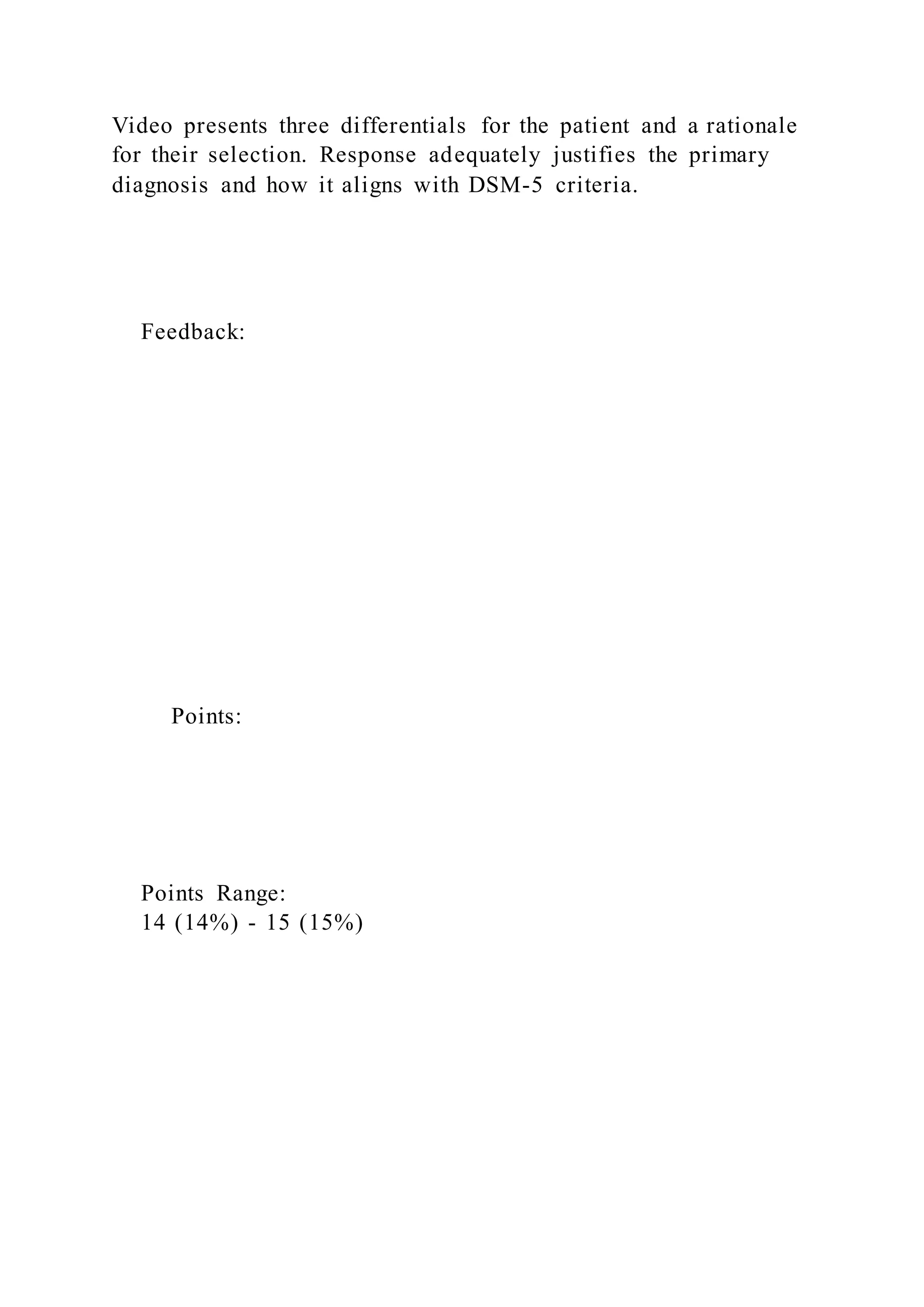
Video presents three differentials for the patient and a rationale
for their selection. Response adequately justifies the primary
diagnosis and how it aligns with DSM-5 criteria.
Feedback:
Points:
Points Range:
14 (14%) - 15 (15%)
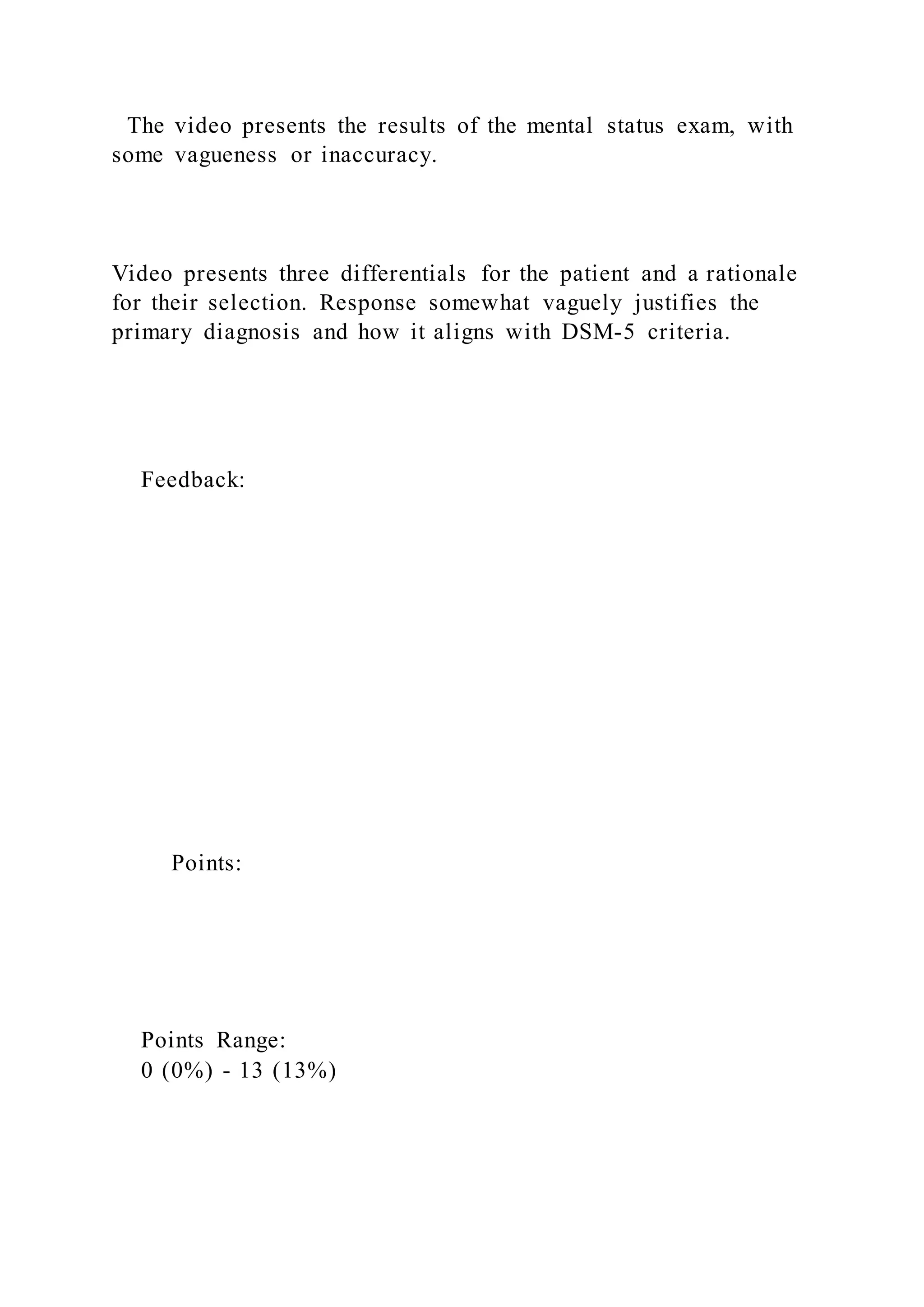
The video presents the results of the mental status exam, with
some vagueness or inaccuracy.
Video presents three differentials for the patient and a rationale
for their selection. Response somewhat vaguely justifies the
primary diagnosis and how it aligns with DSM-5 criteria.
Feedback:
Points:
Points Range:
0 (0%) - 13 (13%)
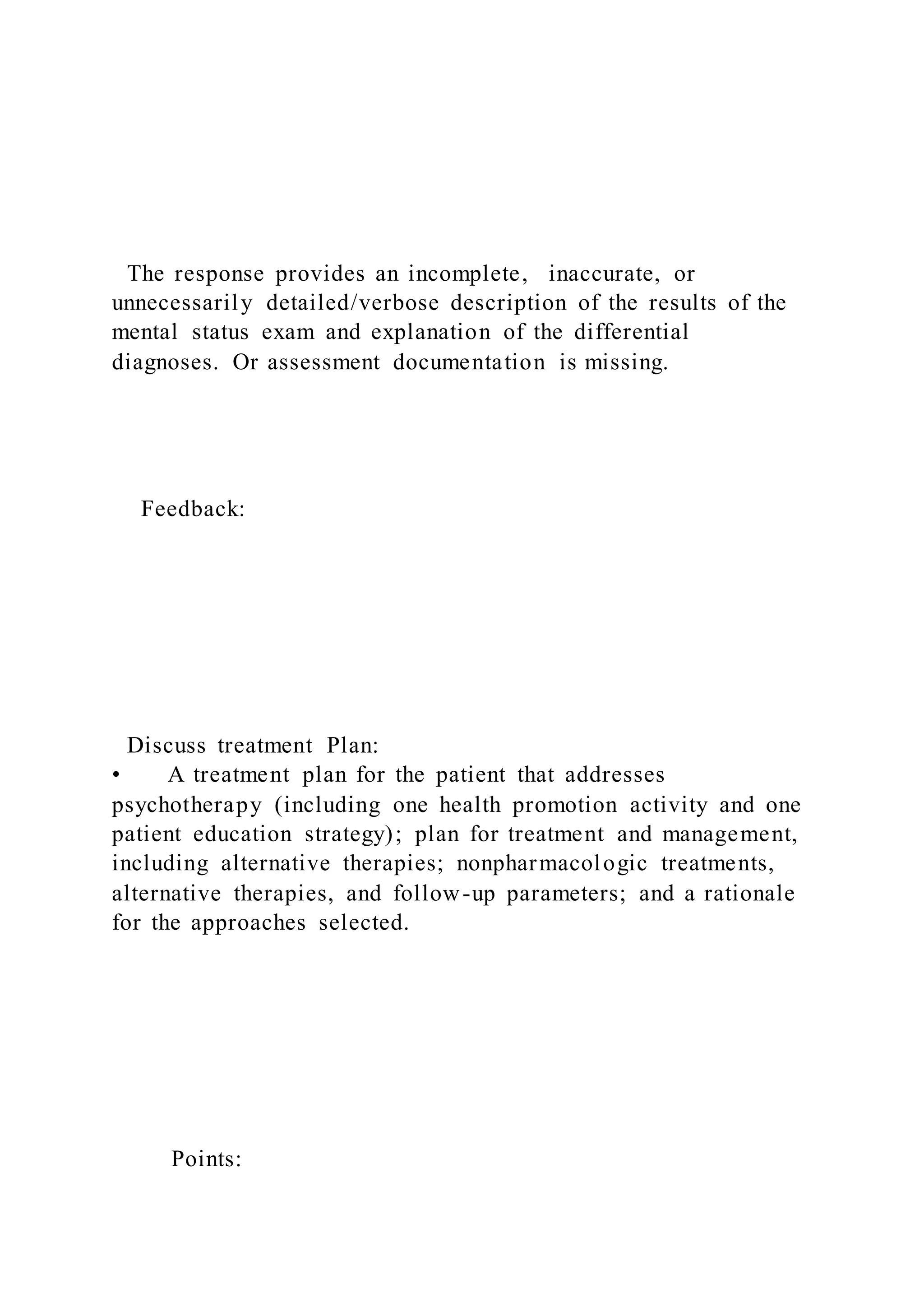
The response provides an incomplete, inaccurate, or
unnecessarily detailed/verbose description of the results of the
mental status exam and explanation of the differential
diagnoses. Or assessment documentation is missing.
Feedback:
Discuss treatment Plan:
• A treatment plan for the patient that addresses
psychotherapy (including one health promotion activity and one
patient education strategy); plan for treatment and management,
including alternative therapies; nonpharmacologic treatments,
alternative therapies, and follow-up parameters; and a rationale
for the approaches selected.
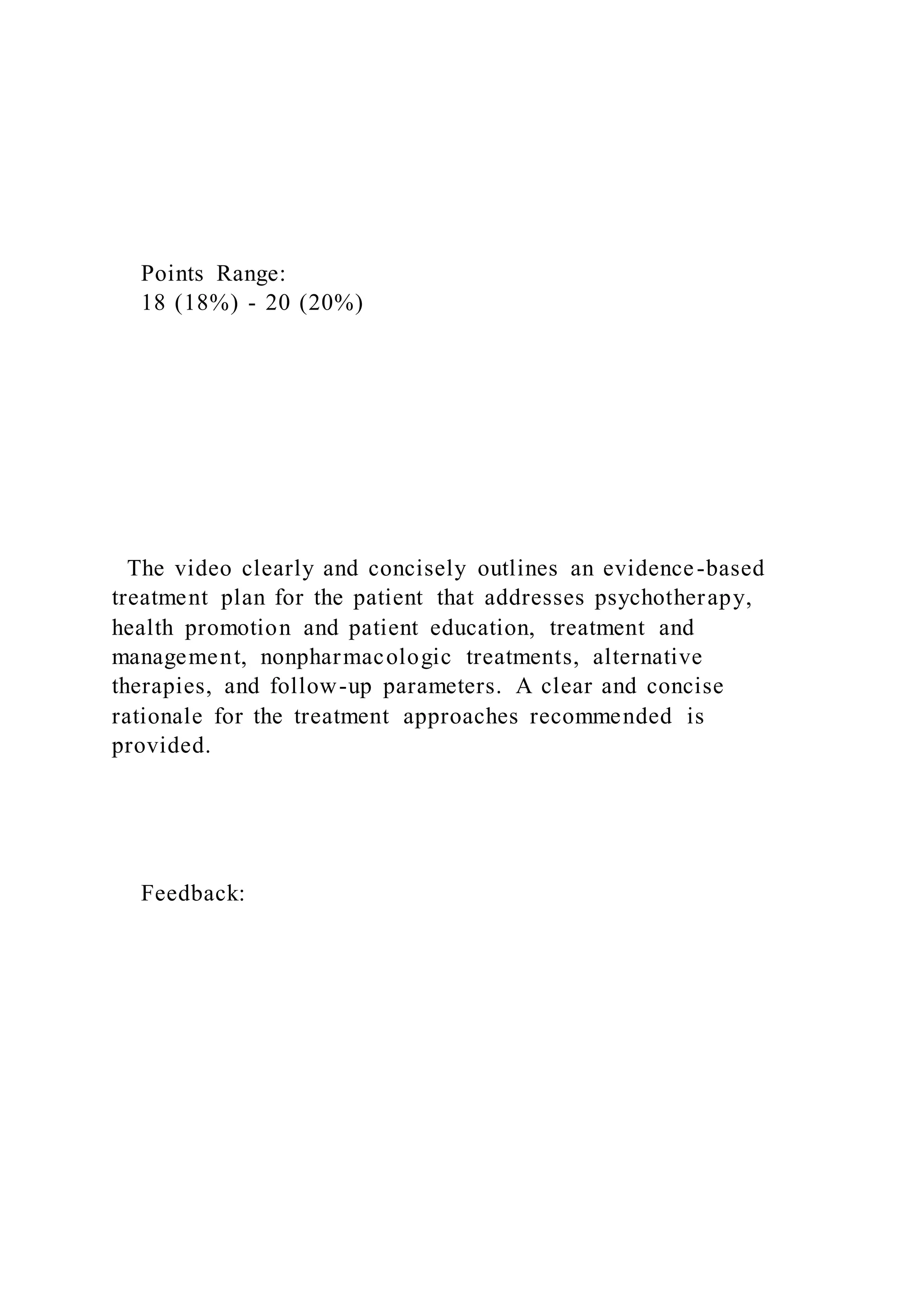
Points:
Points Range:
18 (18%) - 20 (20%)
The video clearly and concisely outlines an evidence-based
treatment plan for the patient that addresses psychotherapy,
health promotion and patient education, treatment and
management, nonpharmacologic treatments, alternative
therapies, and follow-up parameters. A clear and concise
rationale for the treatment approaches recommended is
provided.
Feedback:
Points:
Points Range:
16 (16%) - 17 (17%)
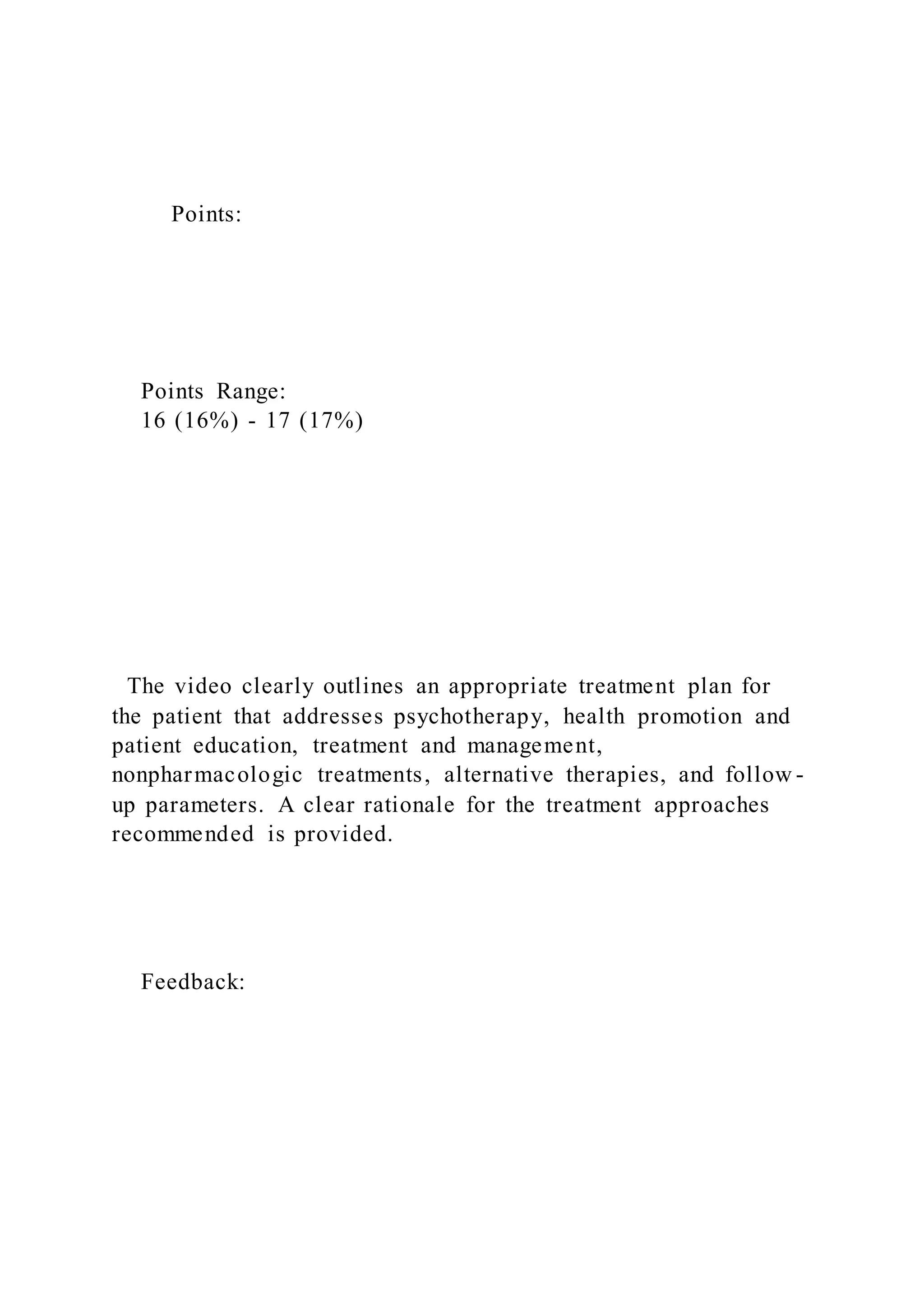
The video clearly outlines an appropriate treatment plan for
the patient that addresses psychotherapy, health promotion and
patient education, treatment and management,
nonpharmacologic treatments, alternative therapies, and follow -
up parameters. A clear rationale for the treatment approaches
recommended is provided.
Feedback:
Points:
Points Range:
14 (14%) - 15 (15%)
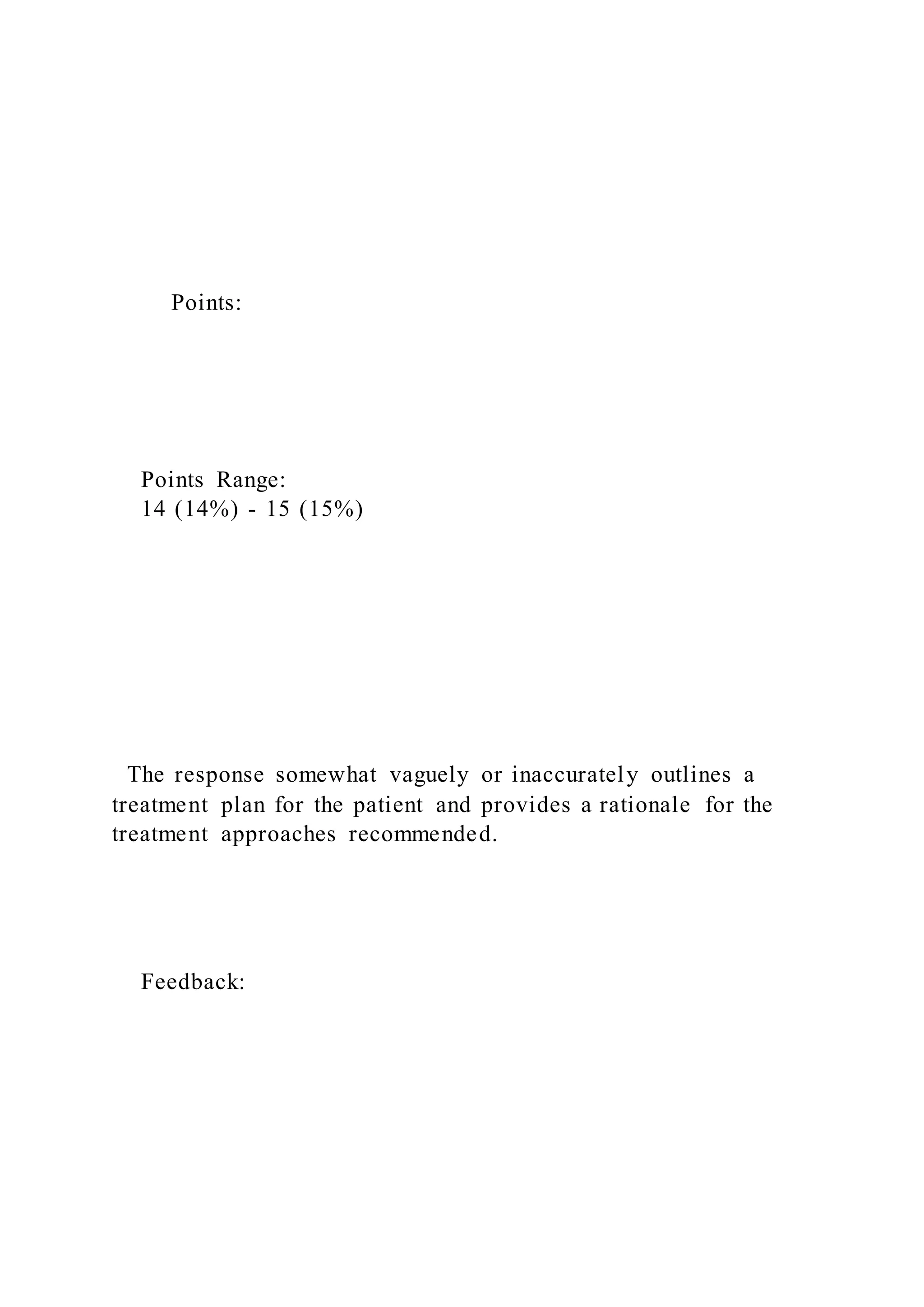
The response somewhat vaguely or inaccurately outlines a
treatment plan for the patient and provides a rationale for the
treatment approaches recommended.
Feedback:
Points:
Points Range:
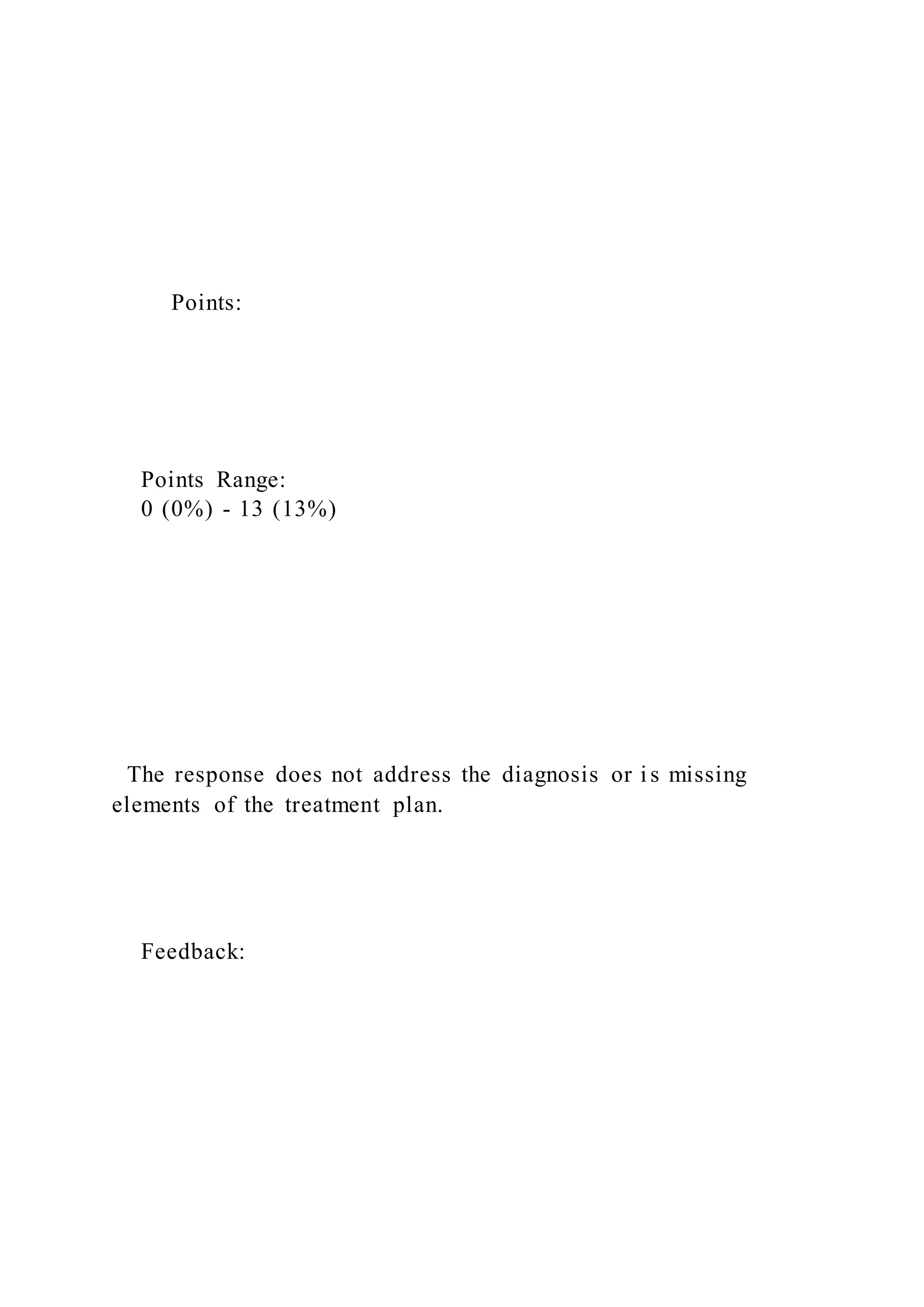
0 (0%) - 13 (13%)
The response does not address the diagnosis or is missing
elements of the treatment plan.
Feedback:
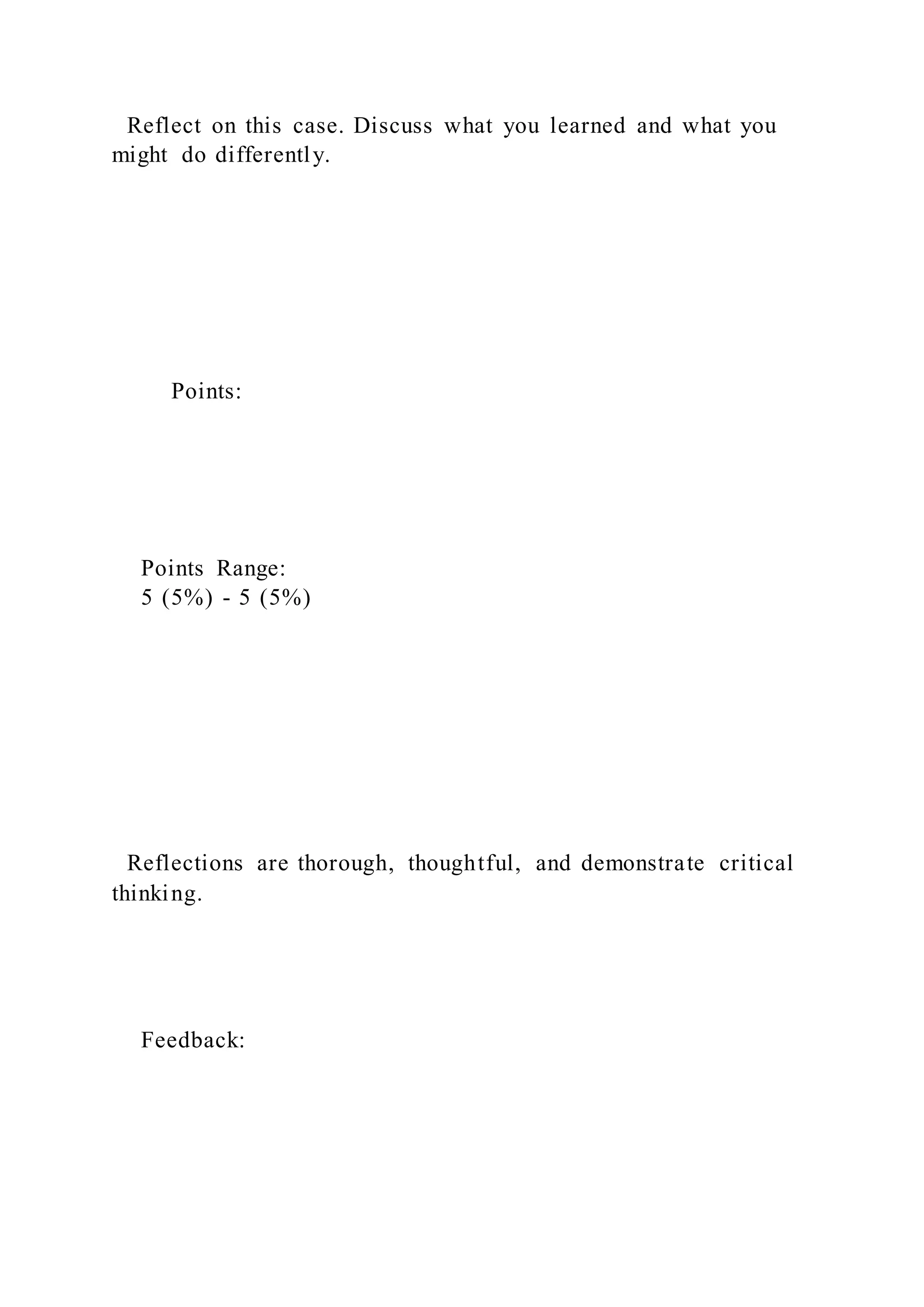
Reflect on this case. Discuss what you learned and what you
might do differently.
Points:
Points Range:
5 (5%) - 5 (5%)
Reflections are thorough, thoughtful, and demonstrate critical
thinking.
Feedback:
Points:
Points Range:
4 (4%) - 4 (4%)
Reflections demonstrate critical thinking.
Feedback:
Points:
Points Range:
3.5 (3.5%) - 3.5 (3.5%)
Reflections are somewhat general or do not demonstrate
critical thinking.
Feedback:
Points:
Points Range:
0 (0%) - 3 (3%)
Reflections are incomplete, inaccurate, or missing.
Feedback:
Comprehensive Psychiatric Evaluation documentation
Points:
Points Range:
18 (18%) - 20 (20%)
The response clearly, accurately, and thoroughly follows the
Comprehensive Psychiatric Evaluation format to document the
selected patient case.
Feedback:
Points:
Points Range:
16 (16%) - 17 (17%)
The response accurately follows the Comprehensive
Psychiatric Evaluation format to document the selected patient
case.
Feedback:
Points:
Points Range:
14 (14%) - 15 (15%)
The response follows the Comprehensive Psychiatric
Evaluation format to document the selected patient case, with
some vagueness and inaccuracy.
Feedback:
Points:
Points Range:
0 (0%) - 13 (13%)
The response incompletely and inaccurately follows the
Comprehensive Psychiatric Evaluation format to document the
selected patient case.
Feedback:
Presentation style
Points:
Points Range:
5 (5%) - 5 (5%)
Presentation style is exceptionally clear, professional, and
focused.
Feedback:
Points:
Points Range:
4 (4%) - 4 (4%)
Presentation style is clear, professional, and focused.
Feedback:
Points:
Points Range:
3.5 (3.5%) - 3.5 (3.5%)
Presentation style is mostly clear, professional, and focused.
Feedback:
Points:
Points Range:
0 (0%) - 2 (2%)
Presentation style is unclear, unprofessional, and/or
unfocused.
Feedback:
Show Descriptions
Show Feedback
Photo ID display and professional attire--
Levels of Achievement:
Excellent
5 (5%) - 5 (5%)
Photo ID is displayed. The student is dressed professionally.
Good
0 (0%) - 0 (0%)
Fair
0 (0%) - 0 (0%)
Poor
0 (0%) - 0 (0%)
Photo ID is not displayed. Student must remedy this before
grade is posted. The student is not dressed professionally.
Feedback:
Time--
Levels of Achievement:
Excellent
5 (5%) - 5 (5%)
The video does not exceed the 8-minute time limit.
Good
0 (0%) - 0 (0%)
Fair
0 (0%) - 0 (0%)
Poor
0 (0%) - 3 (3%)
The video exceeds the 8-minute time limit. (Note: Information
presented after 8 minutes will not be evaluated for grade
inclusion.)
Feedback:
Discuss Subjective data:
• Chief complaint
• History of present illness (HPI)
• Medications
• Psychotherapy or previous psychiatric diagnosis
• Pertinent histories and/or ROS--
Levels of Achievement:
Excellent
9 (9%) - 10 (10%)
The video accurately and concisely presents the patient's
subjective complaint, history of present illness, medications,
psychotherapy or previous psychiatric diagnosis, and pertinent
histories and/or review of systems that would inform a
differential diagnosis.
Good
8 (8%) - 8 (8%)
The video accurately presents the patient's subjective complaint,
history of present illness, medications, psychotherapy or
previous psychiatric diagnosis, and pertinent histories and/or
review of systems that would inform a differential diagnosis.
Fair
7 (7%) - 7 (7%)
The video presents the patient's subjective complaint, history of
present illness, medications, psychotherapy or previous
psychiatric diagnosis, and pertinent histories and/or review of
systems that would inform a differential diagnosis, but is
somewhat vague or contains minor inaccuracies.
Poor
0 (0%) - 6 (6%)
The video presents an incomplete, inaccurate, or unnecessarily
detailed/verbose description of the patient's subjective
complaint, history of present illness, medications,
psychotherapy or previous psychiatric diagnosis, and pertinent
histories and/or review of systems that would inform a
differential diagnosis. Or subjective documentation is missing.
Feedback:
Discuss Objective data:
• Physical exam documentation of systems pertinent to the
chief complaint, HPI, and history
• Diagnostic results, including any labs, imaging, or other
assessments needed to develop the differential diagnoses--
Levels of Achievement:
Excellent
9 (9%) - 10 (10%)
The video accurately and concisely documents the patient's
physical exam for pertinent systems. Pertinent diagnostic tests
and their results are documented, as applicable.
Good
8 (8%) - 8 (8%)
The response accurately documents the patient's physical exam
for pertinent systems. Diagnostic tests and their results are
documented, as applicable.
Fair
7 (7%) - 7 (7%)
Documentation of the patient's physical exam is somewhat
vague or contains minor inaccuracies. Diagnostic tests and their
results are documented but contain inaccuracies.
Poor
0 (0%) - 6 (6%)
The response provides incomplete, inaccurate, or unnecessarily
detailed/verbose documentation of the patient's physical exam.
Systems may have been unnecessarily reviewed, or objective
documentation is missing.
Feedback:
Discuss results of Assessment:
• Results of the mental status examination
• Provide a minimum of three possible diagnoses in order of
highest to lowest priority and explain why you chose them.
What was your primary diagnosis and why? Describe how your
primary diagnosis aligns with DSM-5 diagnostic criteria and is
supported by the patient’s symptoms.--
Levels of Achievement:
Excellent
18 (18%) - 20 (20%)
The video accurately documents the results of the mental status
exam.
Video presents at least three differentials in order of priority for
a differential diagnosis of the patient, and a rationale for their
selection. Response justifies the primary diagnosis and how it
aligns with DSM-5 criteria.
Good
16 (16%) - 17 (17%)
The video adequately documents the results of the mental status
exam.
Video presents three differentials for the patient and a rationale
for their selection. Response adequately justifies the primary
diagnosis and how it aligns with DSM-5 criteria.
Fair
14 (14%) - 15 (15%)
The video presents the results of the mental status exam, with
some vagueness or inaccuracy.
Video presents three differentials for the patient and a rationale
for their selection. Response somewhat vaguely justifies the
primary diagnosis and how it aligns with DSM-5 criteria.
Poor
0 (0%) - 13 (13%)
The response provides an incomplete, inaccurate, or
unnecessarily detailed/verbose description of the results of the
mental status exam and explanation of the differential
diagnoses. Or assessment documentation is missing.
Feedback:
Discuss treatment Plan:
• A treatment plan for the patient that addresses
psychotherapy (including one health promotion activity and one
patient education strategy); plan for treatment and management,
including alternative therapies; nonpharmacologic treatments,
alternative therapies, and follow-up parameters; and a rationale
for the approaches selected.--
Levels of Achievement:
Excellent
18 (18%) - 20 (20%)
The video clearly and concisely outlines an evidence-based
treatment plan for the patient that addresses psychotherapy,
health promotion and patient education, treatment and
management, nonpharmacologic treatments, alternative
therapies, and follow-up parameters. A clear and concise
rationale for the treatment approaches recommended is
provided.
Good
16 (16%) - 17 (17%)
The video clearly outlines an appropriate treatment plan for the
patient that addresses psychotherapy, health promotion and
patient education, treatment and management,
nonpharmacologic treatments, alternative therapies, and follow -
up parameters. A clear rationale for the treatment approaches
recommended is provided.
Fair
14 (14%) - 15 (15%)
The response somewhat vaguely or inaccurately outlines a
treatment plan for the patient and provides a rationale for the
treatment approaches recommended.
Poor
0 (0%) - 13 (13%)
The response does not address the diagnosis or is missing
elements of the treatment plan.
Feedback:
Reflect on this case. Discuss what you learned and what you
might do differently.--
Levels of Achievement:
Excellent
5 (5%) - 5 (5%)
Reflections are thorough, thoughtful, and demonstrate critical
thinking.
Good
4 (4%) - 4 (4%)
Reflections demonstrate critical thinking.
Fair
3.5 (3.5%) - 3.5 (3.5%)
Reflections are somewhat general or do not demonstrate critical
thinking.
Poor
0 (0%) - 3 (3%)
Reflections are incomplete, inaccurate, or missing.
Feedback:
Comprehensive Psychiatric Evaluation documentation--
Levels of Achievement:
Excellent
18 (18%) - 20 (20%)
The response clearly, accurately, and thoroughly follows the
Comprehensive Psychiatric Evaluation format to document the
selected patient case.
Good
16 (16%) - 17 (17%)
The response accurately follows the Comprehensive Psychiatric
Evaluation format to document the selected patient case.
Fair
14 (14%) - 15 (15%)
The response follows the Comprehensive Psychiatric Evaluation
format to document the selected patient case, with some
vagueness and inaccuracy.
Poor
0 (0%) - 13 (13%)
The response incompletely and inaccurately follows the
Comprehensive Psychiatric Evaluation format to document the
selected patient case.
Feedback:
Presentation style--
Levels of Achievement:
Excellent
5 (5%) - 5 (5%)
Presentation style is exceptionally clear, professional, and
focused.
Good
4 (4%) - 4 (4%)
Presentation style is clear, professional, and focused.
Fair
3.5 (3.5%) - 3.5 (3.5%)
Presentation style is mostly clear, professional, and focused.
Poor
0 (0%) - 2 (2%)
Presentation style is unclear, unprofessional, and/or unfocused.
Feedback:
Total Points:
100
Name: PRAC_6645_Week4_Assignment2_Rubric

Process Recording Template – Required for each Process Recording a

  • 1.
    Process Recording Template– Required for each Process Recording assignment. The first section is for introducing the client. Please include the following information: Agency Information. Client information (confidentiality of course). Session Number. Date of Session. Presenting Issue (reason for referral). Other Relevant Information. Goal of Session (use the SMART Goals Format). 1. Client/Session Goal. 2. Your Goal. Dialogue Please group dialogue together. Use 15 minutes at most from your session with client. Identify (for each section) 1. Theory
  • 2.
    2. Tools 3. Skills Analysis/assessmentof dialogue What was going on? What were the patient's reactions to your feedback? How did the client respond verbally (quality of voice, tone, did the respond better to closed or open-ended questions?) How did the client respond non-verbally (how did you know they were listening? were they distracted? Did they welcome your feedback?) Personal reactions and self-reflection to the interaction What were you thinking? How do you feel the session went? What could you have done better? What will you do differently/the same next time?
  • 3.
    References Process Recording- Cavanagh( Foundation Year) 2019 NRNP/PRAC 6645 Comprehensive Psychiatric Evaluation Template Week (enter week #): (Enter assignment title) Student Name College of Nursing-PMHNP, Walden University
  • 4.
    NRNP 6635: Psychopathologyand Diagnostic Reasoning Faculty Name Assignment Due Date Subjective: CC (chief complaint): HPI: (include psychiatric ROS rule out) Past Psychiatric History: · General Statement: · Caregivers (if applicable): · Hospitalizations: · Medication trials: · Psychotherapy or Previous Psychiatric Diagnosis: Substance Current Use and History: Family Psychiatric/Substance Use History: Psychosocial History: Medical History: · Current Medications: · Allergies: · Reproductive Hx: Objective: Diagnostic results: Assessment: Mental Status Examination: Differential Diagnoses: Reflections:
  • 5.
    Case Formulation andTreatment Plan: References © 2021 Walden University Page 1 of 3 NRNP/PRAC 6645 Comprehensive Psychiatric Evaluation Note Template INSTRUCTIONS ON HOW TO USE EXEMPLAR AND TEMPLATE—READ CAREFULLY If you are struggling with the format or remembering what to include, follow the Comprehensive Psychiatric Evaluation Template AND the Rubric as your guide. It is also helpful to review the rubric in detail in order not to lose points unnecessarily because you missed something required. Below highlights by category are taken directly from the grading rubric for the assignments. After reviewing full details of the rubric, you can use it as a guide. In the Subjective section, provide: · Chief complaint · History of present illness (HPI) · Past psychiatric history · Medication trials and current medications
  • 6.
    · Psychotherapy orprevious psychiatric diagnosis · Pertinent substance use, family psychiatric/substance use, social, and medical history · Allergies · ROS · Read rating descriptions to see the grading standards! In the Objective section, provide: · Physical exam documentation of systems pertinent to the chief complaint, HPI, and history · Diagnostic results, including any labs, imaging, or other assessments needed to develop the differential diagnoses. · Read rating descriptions to see the grading standards! In the Assessment section, provide: · Results of the mental status examination, presented in paragraph form. · At least three differentials with supporting evidence. List them from top priority to least priority. Compare the DSM-5 diagnostic criteria for each differential diagnosis and explain what DSM-5 criteria rules out the differential diagnosis to find an accurate diagnosis. Explain the critical-thinking process that led you to the primary diagnosis you selected. Include pertinent positives and pertinent negatives for the specific patient case. · Read rating descriptions to see the grading standards! Reflect on this case. Include what you learned and what you might do differently. Also include in your reflection a
  • 7.
    discussion related tolegal/ethical considerations (demonstrate critical thinking beyond confidentiality and consent for treatment!), health promotion and disease prevention taking into consideration patient factors (such as age, ethnic group, etc.), PMH, and other risk factors (e.g., socioeconomic, cultural background, etc.). (The comprehensive evaluation is typically the initial new patient evaluation. You will practice writing this type of note in this course. You will be ruling out other mental illnesses so often you will write up what symptoms are present and what symptoms are not present from illnesses to demonstrate you have indeed assessed for all illnesses which could be impacting your patient. For example, anxiety symptoms, depressive symptoms, bipolar symptoms, psychosis symptoms, substance use, etc.) EXEMPLAR BEGINS HERE CC (chief complaint): A brief statement identifying why the patient is here. This statement is verbatim of the patient’s own words about why they are presenting for assessment. For a patient with dementia or other cognitive deficits, this statement can be obtained from a family member. HPI: Begin this section with patient’s initials, age, race, gender, purpose of evaluation, current medication, and referral reason. For example: N.M. is a 34-year-old Asian male who presents for psychotherapeutic evaluation for anxiety. He is currently prescribed sertraline by (?) which he finds ineffective. His PCP referred him for evaluation and treatment. Or P.H. is a 16-year-old Hispanic female who presents for psychotherapeutic evaluation for concentration difficulty. She is
  • 8.
    not currently prescribedpsychotropic medications. She is referred by her mental health provider for evaluation and treatment. Then, this section continues with the symptom analysis for your note. Thorough documentation in this section is essential for patient care, coding, and billing analysis. Paint a picture of what is wrong with the patient. This section contains the symptoms that is bringing the patient into your office. The symptoms onset, the duration, the frequency, the severity, and the impact. Your description here will guide your differential diagnoses. You are seeking symptoms that may align with many DSM-5 diagnoses, narrowing to what aligns with diagnostic criteria for mental health and substance use disorders. You will complete a psychiatric ROS to rule out other psychiatric illnesses. Past Psychiatric History: This section documents the patient’s past treatments. Use the mnemonic Go Cha MP. General Statement: Typically, this is a statement of the patients first treatment experience. For example: The patient entered treatment at the age of 10 with counseling for depression during her parents’ divorce. OR The patient entered treatment for detox at age 26 after abusing alcohol since age 13. Caregivers are listed if applicable. Hospitalizations: How many hospitalizations? When and where was last hospitalization? How many detox? How many residential treatments? When and where was last detox/residential treatment? Any history of suicidal or homicidal behaviors? Any history of self-harm behaviors? Medication trials: What are the previous psychotropic medications the patient has tried and what was their reaction? Effective, Not Effective, Adverse Reaction? Some examples: Haloperidol (dystonic reaction), risperidone (hyperprolactinemia), olanzapine (effective, insurance wouldn’t
  • 9.
    pay for it) Psychotherapyor Previous Psychiatric Diagnosis: This section can be completed one of two ways depending on what you want to capture to support the evaluation. First, does the patient know what type? Did they find psychotherapy helpful or not? Why? Second, what are the previous diagnosis for the client noted from previous treatments and other providers. (Or, you could document both.) Substance Use History: This section contains any history or current use of caffeine, nicotine, illicit substance (including marijuana), and alcohol. Include the daily amount of use and last known use. Include type of use such as inhales, snorts, IV, etc. Include any histories of withdrawal complications from tremors, Delirium Tremens, or seizures. Family Psychiatric/Substance Use History: This section contains any family history of psychiatric illness, substance use illnesses, and family suicides. You may choose to use a genogram to depict this information (be sure to include a reader’s key to your genogram) or write up in narrative form. Psychosocial History: This section may be lengthy if completing an evaluation for psychotherapy or shorter if completing an evaluation for psychopharmacology. However, at a minimum, please include: · Where patient was born, who raised the patient · Number of brothers/sisters (what order is the patient within siblings) · Who the patient currently lives with in a home? Are they single, married, divorced, widowed? How many children? · Educational Level
  • 10.
    · Hobbies · WorkHistory: currently working/profession, disabled, unemployed, retired? · Legal history: past hx, any current issues? · Trauma history: Any childhood or adult history of trauma? · Violence Hx:Concern or issues about safety (personal, home, community, sexual (current & historical) Medical History: This section contains any illnesses, surgeries, include any hx of seizures, head injuries. Current Medications: Include dosage, frequency, length of time used, and reason for use. Also include OTC or homeopathic products. Allergies:Include medication, food, and environmental allergies separately. Provide a description of what the allergy is (e.g., angioedema, anaphylaxis). This will help determine a true reaction vs. intolerance. Reproductive Hx:Menstrual history (date of LMP), Pregnant (yes or no), Nursing/lactating (yes or no), contraceptive use (method used), types of intercourse: oral, anal, vaginal, other, any sexual concerns Diagnostic results: Include any labs, X-rays, or other diagnostics that are needed to develop the differential diagnoses (support with evidenced and guidelines). Assessment Mental Status Examination: For the purposes of your courses, this section must be presented in paragraph form and not use of a checklist! This section you will describe the patient’s appearance, attitude, behavior, mood and affect, speech, thought processes, thought content, perceptions (hallucinations, pseudo hallucinations, illusions, etc.), cognition, insight, judgment, and
  • 11.
    SI/HI. See anexample below. You will modify to include the specifics for your patient on the above elements—DO NOT just copy the example. You may use a preceptor’s way of organizing the information if the MSE is in paragraph form. He is an 8 yo African American male who looks his stated age. He is cooperative with examiner. He is neatly groomed and clean, dressed appropriately. There is no evidence of any abnormal motor activity. His speech is clear, coherent, normal in volume and tone. His thought process is goal directed and logical. There is no evidence of looseness of association or flight of ideas. His mood is euthymic, and his affect appropriate to his mood. He was smiling at times in an appropriate manner. He denies any auditory or visual hallucinations. There is no evidence of any delusional thinking. He denies any current suicidal or homicidal ideation. Cognitively, he is alert and oriented. His recent and remote memory is intact. His concentration is good. His insight is good. Differential Diagnoses:You must have at least three differentials with supporting evidence. Explain what rules each differential in or out and justify your primary diagnosis selection. Include pertinent positives and pertinent negatives for the specific patient case. Also included in this section is the reflection. Reflect on this case and discuss whether or not you agree with your preceptor’s treatment of the patient and why or why not. What did you learn from this case? What would you do differently? Also include in your reflection a discussion related to legal/ethical considerations (demonstrate critical thinking beyond confidentiality and consent for treatment!), health promotion and disease prevention taking into consideration patient factors (such as age, ethnic group, etc.), PMH, and other risk factors (e.g., socioeconomic, cultural background, etc.). Case Formulation and Treatment Plan. Includes documentation of diagnostic studies that will be obtained, referrals to other health care providers, therapeutic
  • 12.
    interventions with psychotherapy,education, disposition of the patient, and any planned follow-up visits. Each diagnosis or condition documented in the assessment should be addressed in the plan. The details of the plan should follow an orderly manner. *see an example below—you will modify to your practice so there may be information excluded/included—what does your preceptor document? Example: Initiation of (what form/type) of individual, group, or family psychotherapy and frequency. Documentation of any resources you provide for patient education or coping/relaxation skills, homework for next appointment. Client has emergency numbers: Emergency Services 911, the Client's Crisis Line 1-800-_______. Client instructed to go to nearest ER or call 911 if they become actively suicidal and/or homicidal. (only if you or preceptor provided them) Reviewed hospital records/therapist records for collaborative information; Reviewed PCP report (only if actually available) Time allowed for questions and answers provided. Provided supportive listening. Client appeared to understand discussion. Client is amenable with this plan and agrees to follow treatment regimen as discussed. (This relates to informed consent; you will need to assess their understanding and agreement.) Follow up with PCP as needed and/or for: Write out what psychotherapy testing or screening ordered/conducted, rationale for ordering Any other community or provider referrals
  • 13.
    Return to clinic: Continuedtreatment is medically necessary to address chronic symptoms, improve functioning, and prevent the need for a higher level of care OR if one-time evaluation, say so and any other follow up plans. References (move to begin on next page) You are required to include at least three evidence-based, peer- reviewed journal articles or evidenced-based guidelines which relate to this case to support your diagnostics and differentials diagnoses. Be sure to use correct APA 7th edition formatting. © 2021 Walden University Page 1 of 3 Psychiatric notes are a way to reflect on your practicum experiences and connect them to the didactic learning you gain from your NRNP courses. Comprehensive psychiatric evaluation notes, such as the ones required in this practicum course, are often used in clinical settings to document patient care. For this Assignment, you will document information about a patient that you examined in a group setting during the last 4 weeks, using the Comprehensive Psychiatric Evaluation Note Template provided. You will then use this note to develop and record a case presentation for this patient. To Prepare · Review this week's Learning Resources and consider the
  • 14.
    insights they provideabout clinical practice guidelines. · Select a group patient for whom you conducted psychotherapy for a mood disorder during the last 4 weeks. Create a Comprehensive Psychiatric Evaluation Note on this patient using the template provided in the Learning Resources. There is also a completed template provided as an exemplar and guide. All psychiatric evaluation notes must be signed, and each page must be initialed by your Preceptor. When you submit your note, you should include the complete comprehensive psychiatric evaluation note as a Word document and pdf/images of each page that is initialed and signed by your Preceptor. You must submit your note using SafeAssign. Please Note: Electronic signatures are not accepted. If both files are not received by the due date, Faculty will deduct points per the Walden Grading Policy. · Then, based on your evaluation of this patient, develop a video presentation of the case. Plan your presentation using the Assignment rubric and rehearse what you plan to say. Be sure to review the Kaltura Media Uploader resource in the left-hand navigation of the classroom for help creating your self-recorded Kaltura video. · Include at least five scholarly resources to support your assessment and diagnostic reasoning. · Ensure that you have the appropriate lighting and equipment to record the presentation. The Assignment Record yourself presenting the complex case study for your clinical patient. In your presentation: · Dress professionally with a lab coat and present yourself in a professional manner. · Display your photo ID at the start of the video when you introduce yourself.
  • 15.
    · Ensure thatyou do not include any information that violates the principles of HIPAA (i.e., don’t use the patient’s name or any other identifying information). · Present the full complex case study. Be succinct in your presentation, and do not exceed 8 minutes. Include subjective and objective data; assessment from most recent mental status exam; current psychiatric diagnosis including differentials that were ruled out; current psychotherapeutic plan (include one health promotion activity and one patient education strategy you provided); and patient progress toward treatment goals. · · Subjective: What details did the patient provide regarding their chief complaint and symptomology to derive your differential diagnosis? What was the duration and severity of their symptoms? How are their symptoms impacting their functioning in life? · Objective: What observations did you make during the psychiatric assessment? · Assessment: Discuss the patient’s mental status examination results. What were your differential diagnoses? Provide a minimum of three possible diagnoses in order of highest to lowest priority and explain why you chose them. What was your primary diagnosis and why? Describe how your primary diagnosis aligns with DSM-5 diagnostic criteria and is supported by the patient’s symptoms. · · Plan: What was your plan for psychotherapy (including one health promotion activity and one patient education strategy)? What was your plan for treatment and management, including alternative therapies? Include nonpharmacologic treatments, alternative therapies, and follow-up parameters, as well as a rationale for this treatment and management plan. ·
  • 16.
    · Reflection notes:What would you do differently with this patient if you could conduct the session again? By Day 7 PLEASE FOLLOW THE INSTRUCTIONS AS INDICATED BELOW: 1). ZERO (0) PLAGIARISM. 2). AT LEAST 5 REFERENCES, NO MORE THAN 5 YEARS (WITHIN 5YRS, OR LESS THAN 5YRS) 3). PLEASE SEE THE ATTACHED: Rubric details, Patient’s Assessment Documentation, Comprehensive evaluation exemplar and Comprehensive evaluation Template, The Assignment Directions. 4). Please review and follow the grading rubric details, and include each component in the assignment as required. Also, follow the APA 7 writing rules and style/Format. Thank you. Psychotherapy, 60 minutes with patient Patient’s Age: 34 yrs. Chief complaint: The patient stated, “I am stressed on my job and in my personal life”. Vitals Height: 5’6” Weight: 158 lbs. B/P: 136/74 Temperature: 97.3
  • 17.
    Pulse: 88 Respiratory rate:18 O2 Saturation: 97% Pain: Denied any pain presently Diagnoses •Major depressive disorder. Allergies Drug allergies Patient has no known drug allergies Food allergies No food allergies Environmental allergies No environmental allergies Medications: Escitalopram Oxalate (Lexapro) 5 MG Oral Tablet. Take 1 tablet (5 mg) by mouth daily Escitalopram Oxalate (Lexapro) 10 MG Oral Tablet. Take 1 tablet (10 mg) by mouth daily Smoking status Non-smoker 01/25/2021 Gender identity Female Sexual orientation Straight or heterosexual
  • 18.
    Social history: Patient completedhigh school and is trying to get her degree in BA Business. She has two children and is not sexually active at the moment She works as an oncology financial navigator for ANOVA Hospital Past medical history Family health history: No one clinically diagnosed with mental illness in the family Social history: Patient completed high school and is trying to get her degree in BA Business. She has two children and is not sexually active at the moment She works as an oncology financial navigator for ANOVA Hospital Developmental history: Patient grew up with both parents at the beginning. She reports that her parents separated when she was 8 years. She reports that her father was great, but her mother was physically and emotionally abusive when she was a child. She is trying to have a positive relationship with her mother but feels that her mother's feelings are superficial. Her father is a great source for support Subjective The patient stated that she was stressed out on the job and in her personal life. Objective The patient is alert and oriented x 4, to person, place, time and situation. She was engaging and her mood was appropriate. She expressed and shared her emotions. She stated that she is stressed at and in her personal life.
  • 19.
    Objective Continues General appearance:Appropriate Attitude: Good Behavior: normal Speech: Soft Mood: Normal Affect: Normal Thought Process: Good Thought Content: Good perceptions: Fair insight: Good judgment: Fair cognition: Good Memory: Intact Assessment The patient shared that she was stressed. She had some medical challenges that she is currently under a doctor's care for. The patient stated that she has an inflammation around her ribs that she was told was the result of stress. The patient shared that she was happy that her son was accepted
  • 20.
    into his aftercareprogram and was doing well that the wanted him to join their full martial arts program. However, the patient stated that she cannot afford the full program. She asked her son's father for financial assistance and he reported he could only contribute $100. The cost of the program per the patient is $600.00 a month which she states that she cannot afford. Besides the cost, the patient stated that her son is doing well and blossoming in the program. At school, the patient stated that she learned that someone was hitting on her son. The patient stated that her son did not tell her anything that was happening at school, she learned from the teacher. Self-care / stress reducing interventions was discussed with the patient. The patient stated that she would try to incorporate it. However, small deep breathing, meditation, timeout interventions were discussed that can be incorporated daily to help reduce stress. Plan The patient will incorporate small selfcare stress reducing interventions in her daily activities. The patient will follow up with her medical doctor for medical interventions. The patient will continue to discuss her feelings, emotions and what self-care interventions she utilized. The patient will continue to do well mentally. She will continue to take her medication as prescribed and note any adverse side effects.
  • 21.
    To follow upin 2-4 weeks. To call 911 if feeling suicidal and/or homicidal ideation. Rubric Detail Select Grid View or List View to change the rubric's layout. Content Name: PRAC_6645_Week4_Assignment2_Rubric Grid ViewList View Excellent Good Fair Poor Photo ID display and professional attire Points: Points Range:
  • 22.
    5 (5%) -5 (5%) Photo ID is displayed. The student is dressed professionally. Feedback: Points: Points Range: 0 (0%) - 0 (0%)
  • 23.
  • 24.
    Feedback: Points: Points Range: 0 (0%)- 0 (0%) Photo ID is not displayed. Student must remedy this before
  • 25.
    grade is posted.The student is not dressed professionally. Feedback: Time Points: Points Range: 5 (5%) - 5 (5%)
  • 26.
    The video doesnot exceed the 8-minute time limit. Feedback: Points: Points Range: 0 (0%) - 0 (0%)
  • 27.
  • 28.
    Points: Points Range: 0 (0%)- 3 (3%) The video exceeds the 8-minute time limit. (Note: Information presented after 8 minutes will not be evaluated for grade inclusion.) Feedback:
  • 29.
    Discuss Subjective data: •Chief complaint • History of present illness (HPI) • Medications • Psychotherapy or previous psychiatric diagnosis • Pertinent histories and/or ROS Points: Points Range: 9 (9%) - 10 (10%) The video accurately and concisely presents the patient's
  • 30.
    subjective complaint, historyof present illness, medications, psychotherapy or previous psychiatric diagnosis, and pertinent histories and/or review of systems that would inform a differential diagnosis. Feedback: Points: Points Range: 8 (8%) - 8 (8%)
  • 31.
    The video accuratelypresents the patient's subjective complaint, history of present illness, medications, psychotherapy or previous psychiatric diagnosis, and pertinent histories and/or review of systems that would inform a differential diagnosis. Feedback: Points: Points Range: 7 (7%) - 7 (7%)
  • 32.
    The video presentsthe patient's subjective complaint, history of present illness, medications, psychotherapy or previous psychiatric diagnosis, and pertinent histories and/or review of systems that would inform a differential diagnosis, but i s somewhat vague or contains minor inaccuracies. Feedback: Points: Points Range: 0 (0%) - 6 (6%)
  • 33.
    The video presentsan incomplete, inaccurate, or unnecessarily detailed/verbose description of the patient's subjective complaint, history of present illness, medications, psychotherapy or previous psychiatric diagnosis, and pertinent histories and/or review of systems that would inform a differential diagnosis. Or subjective documentation is missing. Feedback: Discuss Objective data: • Physical exam documentation of systems pertinent to the chief complaint, HPI, and history • Diagnostic results, including any labs, imaging, or other assessments needed to develop the differential diagnoses Points:
  • 34.
    Points Range: 9 (9%)- 10 (10%) The video accurately and concisely documents the patient's physical exam for pertinent systems. Pertinent diagnostic tests and their results are documented, as applicable. Feedback: Points:
  • 35.
    Points Range: 8 (8%)- 8 (8%) The response accurately documents the patient's physical exam for pertinent systems. Diagnostic tests and their results are documented, as applicable. Feedback: Points:
  • 36.
    Points Range: 7 (7%)- 7 (7%) Documentation of the patient's physical exam is somewhat vague or contains minor inaccuracies. Diagnostic tests and their results are documented but contain inaccuracies. Feedback: Points:
  • 37.
    Points Range: 0 (0%)- 6 (6%) The response provides incomplete, inaccurate, or unnecessarily detailed/verbose documentation of the patient's physical exam. Systems may have been unnecessarily reviewed, or objective documentation is missing. Feedback: Discuss results of Assessment: • Results of the mental status examination • Provide a minimum of three possible diagnoses in order of highest to lowest priority and explain why you chose them. What was your primary diagnosis and why? Describe how your
  • 38.
    primary diagnosis alignswith DSM-5 diagnostic criteria and is supported by the patient’s symptoms. Points: Points Range: 18 (18%) - 20 (20%) The video accurately documents the results of the mental status exam. Video presents at least three differentials in order of priority for a differential diagnosis of the patient, and a rationale for their selection. Response justifies the primary diagnosis and how it aligns with DSM-5 criteria.
  • 39.
    Feedback: Points: Points Range: 16 (16%)- 17 (17%) The video adequately documents the results of the mental status exam.
  • 40.
    Video presents threedifferentials for the patient and a rationale for their selection. Response adequately justifies the primary diagnosis and how it aligns with DSM-5 criteria. Feedback: Points: Points Range: 14 (14%) - 15 (15%)
  • 41.
    The video presentsthe results of the mental status exam, with some vagueness or inaccuracy. Video presents three differentials for the patient and a rationale for their selection. Response somewhat vaguely justifies the primary diagnosis and how it aligns with DSM-5 criteria. Feedback: Points: Points Range: 0 (0%) - 13 (13%)
  • 42.
    The response providesan incomplete, inaccurate, or unnecessarily detailed/verbose description of the results of the mental status exam and explanation of the differential diagnoses. Or assessment documentation is missing. Feedback: Discuss treatment Plan: • A treatment plan for the patient that addresses psychotherapy (including one health promotion activity and one patient education strategy); plan for treatment and management, including alternative therapies; nonpharmacologic treatments, alternative therapies, and follow-up parameters; and a rationale for the approaches selected. Points:
  • 43.
    Points Range: 18 (18%)- 20 (20%) The video clearly and concisely outlines an evidence-based treatment plan for the patient that addresses psychotherapy, health promotion and patient education, treatment and management, nonpharmacologic treatments, alternative therapies, and follow-up parameters. A clear and concise rationale for the treatment approaches recommended is provided. Feedback:
  • 44.
    Points: Points Range: 16 (16%)- 17 (17%) The video clearly outlines an appropriate treatment plan for the patient that addresses psychotherapy, health promotion and patient education, treatment and management, nonpharmacologic treatments, alternative therapies, and follow - up parameters. A clear rationale for the treatment approaches recommended is provided. Feedback:
  • 45.
    Points: Points Range: 14 (14%)- 15 (15%) The response somewhat vaguely or inaccurately outlines a treatment plan for the patient and provides a rationale for the treatment approaches recommended. Feedback:
  • 46.
    Points: Points Range: 0 (0%)- 13 (13%) The response does not address the diagnosis or is missing elements of the treatment plan. Feedback:
  • 47.
    Reflect on thiscase. Discuss what you learned and what you might do differently. Points: Points Range: 5 (5%) - 5 (5%) Reflections are thorough, thoughtful, and demonstrate critical thinking. Feedback:
  • 48.
    Points: Points Range: 4 (4%)- 4 (4%) Reflections demonstrate critical thinking. Feedback:
  • 49.
    Points: Points Range: 3.5 (3.5%)- 3.5 (3.5%) Reflections are somewhat general or do not demonstrate critical thinking. Feedback:
  • 50.
    Points: Points Range: 0 (0%)- 3 (3%) Reflections are incomplete, inaccurate, or missing. Feedback: Comprehensive Psychiatric Evaluation documentation
  • 51.
    Points: Points Range: 18 (18%)- 20 (20%) The response clearly, accurately, and thoroughly follows the Comprehensive Psychiatric Evaluation format to document the selected patient case. Feedback:
  • 52.
    Points: Points Range: 16 (16%)- 17 (17%) The response accurately follows the Comprehensive Psychiatric Evaluation format to document the selected patient case. Feedback:
  • 53.
    Points: Points Range: 14 (14%)- 15 (15%) The response follows the Comprehensive Psychiatric Evaluation format to document the selected patient case, with some vagueness and inaccuracy. Feedback:
  • 54.
    Points: Points Range: 0 (0%)- 13 (13%) The response incompletely and inaccurately follows the Comprehensive Psychiatric Evaluation format to document the selected patient case. Feedback:
  • 55.
    Presentation style Points: Points Range: 5(5%) - 5 (5%) Presentation style is exceptionally clear, professional, and focused. Feedback:
  • 56.
    Points: Points Range: 4 (4%)- 4 (4%) Presentation style is clear, professional, and focused. Feedback:
  • 57.
    Points: Points Range: 3.5 (3.5%)- 3.5 (3.5%) Presentation style is mostly clear, professional, and focused. Feedback:
  • 58.
    Points: Points Range: 0 (0%)- 2 (2%) Presentation style is unclear, unprofessional, and/or unfocused. Feedback:
  • 59.
    Show Descriptions Show Feedback PhotoID display and professional attire-- Levels of Achievement: Excellent 5 (5%) - 5 (5%) Photo ID is displayed. The student is dressed professionally. Good 0 (0%) - 0 (0%) Fair 0 (0%) - 0 (0%)
  • 60.
    Poor 0 (0%) -0 (0%) Photo ID is not displayed. Student must remedy this before grade is posted. The student is not dressed professionally. Feedback: Time-- Levels of Achievement: Excellent 5 (5%) - 5 (5%)
  • 61.
    The video doesnot exceed the 8-minute time limit. Good 0 (0%) - 0 (0%) Fair 0 (0%) - 0 (0%) Poor 0 (0%) - 3 (3%) The video exceeds the 8-minute time limit. (Note: Information presented after 8 minutes will not be evaluated for grade
  • 62.
    inclusion.) Feedback: Discuss Subjective data: •Chief complaint • History of present illness (HPI) • Medications • Psychotherapy or previous psychiatric diagnosis • Pertinent histories and/or ROS-- Levels of Achievement: Excellent 9 (9%) - 10 (10%) The video accurately and concisely presents the patient's subjective complaint, history of present illness, medications, psychotherapy or previous psychiatric diagnosis, and pertinent histories and/or review of systems that would inform a differential diagnosis.
  • 63.
    Good 8 (8%) -8 (8%) The video accurately presents the patient's subjective complaint, history of present illness, medications, psychotherapy or previous psychiatric diagnosis, and pertinent histories and/or review of systems that would inform a differential diagnosis. Fair 7 (7%) - 7 (7%) The video presents the patient's subjective complaint, history of present illness, medications, psychotherapy or previous psychiatric diagnosis, and pertinent histories and/or review of systems that would inform a differential diagnosis, but is somewhat vague or contains minor inaccuracies. Poor 0 (0%) - 6 (6%) The video presents an incomplete, inaccurate, or unnecessarily
  • 64.
    detailed/verbose description ofthe patient's subjective complaint, history of present illness, medications, psychotherapy or previous psychiatric diagnosis, and pertinent histories and/or review of systems that would inform a differential diagnosis. Or subjective documentation is missing. Feedback: Discuss Objective data: • Physical exam documentation of systems pertinent to the chief complaint, HPI, and history • Diagnostic results, including any labs, imaging, or other assessments needed to develop the differential diagnoses-- Levels of Achievement: Excellent 9 (9%) - 10 (10%) The video accurately and concisely documents the patient's physical exam for pertinent systems. Pertinent diagnostic tests and their results are documented, as applicable.
  • 65.
    Good 8 (8%) -8 (8%) The response accurately documents the patient's physical exam for pertinent systems. Diagnostic tests and their results are documented, as applicable. Fair 7 (7%) - 7 (7%) Documentation of the patient's physical exam is somewhat vague or contains minor inaccuracies. Diagnostic tests and their results are documented but contain inaccuracies. Poor 0 (0%) - 6 (6%) The response provides incomplete, inaccurate, or unnecessarily detailed/verbose documentation of the patient's physical exam. Systems may have been unnecessarily reviewed, or objective
  • 66.
    documentation is missing. Feedback: Discussresults of Assessment: • Results of the mental status examination • Provide a minimum of three possible diagnoses in order of highest to lowest priority and explain why you chose them. What was your primary diagnosis and why? Describe how your primary diagnosis aligns with DSM-5 diagnostic criteria and is supported by the patient’s symptoms.-- Levels of Achievement: Excellent 18 (18%) - 20 (20%) The video accurately documents the results of the mental status exam.
  • 67.
    Video presents atleast three differentials in order of priority for a differential diagnosis of the patient, and a rationale for their selection. Response justifies the primary diagnosis and how it aligns with DSM-5 criteria. Good 16 (16%) - 17 (17%) The video adequately documents the results of the mental status exam. Video presents three differentials for the patient and a rationale for their selection. Response adequately justifies the primary diagnosis and how it aligns with DSM-5 criteria. Fair 14 (14%) - 15 (15%) The video presents the results of the mental status exam, with some vagueness or inaccuracy. Video presents three differentials for the patient and a rationale
  • 68.
    for their selection.Response somewhat vaguely justifies the primary diagnosis and how it aligns with DSM-5 criteria. Poor 0 (0%) - 13 (13%) The response provides an incomplete, inaccurate, or unnecessarily detailed/verbose description of the results of the mental status exam and explanation of the differential diagnoses. Or assessment documentation is missing. Feedback: Discuss treatment Plan: • A treatment plan for the patient that addresses psychotherapy (including one health promotion activity and one patient education strategy); plan for treatment and management, including alternative therapies; nonpharmacologic treatments, alternative therapies, and follow-up parameters; and a rationale for the approaches selected.--
  • 69.
    Levels of Achievement: Excellent 18(18%) - 20 (20%) The video clearly and concisely outlines an evidence-based treatment plan for the patient that addresses psychotherapy, health promotion and patient education, treatment and management, nonpharmacologic treatments, alternative therapies, and follow-up parameters. A clear and concise rationale for the treatment approaches recommended is provided. Good 16 (16%) - 17 (17%) The video clearly outlines an appropriate treatment plan for the patient that addresses psychotherapy, health promotion and patient education, treatment and management, nonpharmacologic treatments, alternative therapies, and follow - up parameters. A clear rationale for the treatment approaches recommended is provided. Fair 14 (14%) - 15 (15%)
  • 70.
    The response somewhatvaguely or inaccurately outlines a treatment plan for the patient and provides a rationale for the treatment approaches recommended. Poor 0 (0%) - 13 (13%) The response does not address the diagnosis or is missing elements of the treatment plan. Feedback: Reflect on this case. Discuss what you learned and what you might do differently.-- Levels of Achievement:
  • 71.
    Excellent 5 (5%) -5 (5%) Reflections are thorough, thoughtful, and demonstrate critical thinking. Good 4 (4%) - 4 (4%) Reflections demonstrate critical thinking. Fair 3.5 (3.5%) - 3.5 (3.5%) Reflections are somewhat general or do not demonstrate critical thinking. Poor 0 (0%) - 3 (3%)
  • 72.
    Reflections are incomplete,inaccurate, or missing. Feedback: Comprehensive Psychiatric Evaluation documentation-- Levels of Achievement: Excellent 18 (18%) - 20 (20%) The response clearly, accurately, and thoroughly follows the Comprehensive Psychiatric Evaluation format to document the selected patient case. Good 16 (16%) - 17 (17%)
  • 73.
    The response accuratelyfollows the Comprehensive Psychiatric Evaluation format to document the selected patient case. Fair 14 (14%) - 15 (15%) The response follows the Comprehensive Psychiatric Evaluation format to document the selected patient case, with some vagueness and inaccuracy. Poor 0 (0%) - 13 (13%) The response incompletely and inaccurately follows the Comprehensive Psychiatric Evaluation format to document the selected patient case.
  • 74.
    Feedback: Presentation style-- Levels ofAchievement: Excellent 5 (5%) - 5 (5%) Presentation style is exceptionally clear, professional, and focused. Good 4 (4%) - 4 (4%) Presentation style is clear, professional, and focused. Fair 3.5 (3.5%) - 3.5 (3.5%)
  • 75.
    Presentation style ismostly clear, professional, and focused. Poor 0 (0%) - 2 (2%) Presentation style is unclear, unprofessional, and/or unfocused. Feedback: Total Points: 100
  • 76.