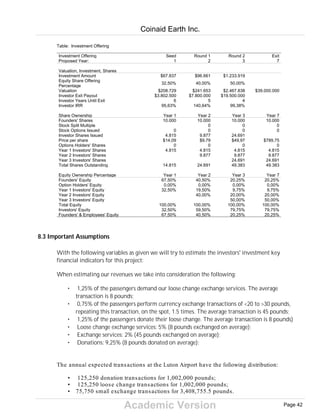
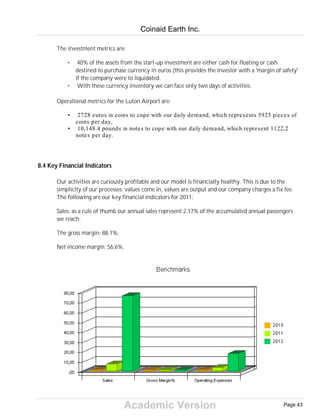
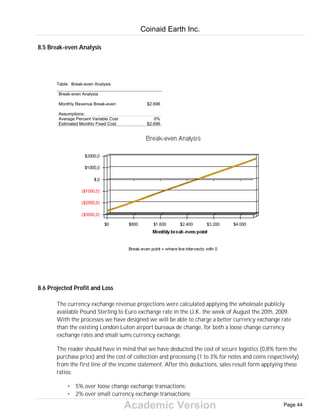
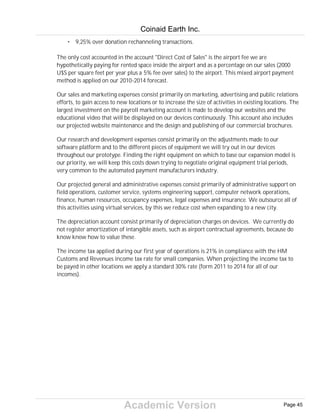
Academic Version
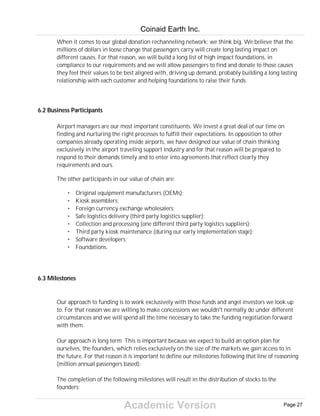
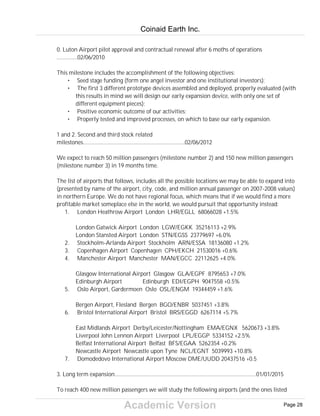
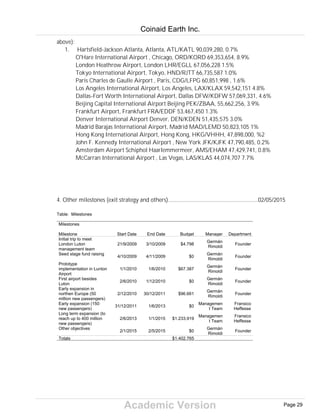
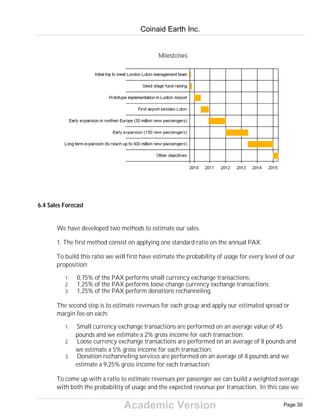
Coinaid Earth Project
Germán Rimoldi
Academic Version
Academic Version
1.0 Executive Summary . . . . . . . . . . . . . . . . . . . . . . . . . . . . . . . . . . . . . . . . . . . . . . . . . . . . . . . . . . . . 1
1.1 Business Mission . . . . . . . . . . . . . . . . . . . . . . . . . . . . . . . . . . . . . . . . . . . . . . . . . . . . . . . . . . . . . . . . . . . . . . 2
1.2 Objectives . . . . . . . . . . . . . . . . . . . . . . . . . . . . . . . . . . . . . . . . . . . . . . . . . . . . . . . . . . . . . . . . . . . . . . . . . . . 2
1.3 Keys to Success . . . . . . . . . . . . . . . . . . . . . . . . . . . . . . . . . . . . . . . . . . . . . . . . . . . . . . . . . . . . . . . . . . . . . . . 3
1.4 Purpose of Being . . . . . . . . . . . . . . . . . . . . . . . . . . . . . . . . . . . . . . . . . . . . . . . . . . . . . . . . . . . . . . . . . . . . . . 3
1.5 Facts that may affect our business . . . . . . . . . . . . . . . . . . . . . . . . . . . . . . . . . . . . . . . . . . . . . . . . . . . . . . . . 4
1.6 Options plan . . . . . . . . . . . . . . . . . . . . . . . . . . . . . . . . . . . . . . . . . . . . . . . . . . . . . . . . . . . . . . . . . . . . . . . . . 6
2.0 Company Summary . . . . . . . . . . . . . . . . . . . . . . . . . . . . . . . . . . . . . . . . . . . . . . . . . . . . . . . . . . . . 6
2.1 Company Locations and Facilities . . . . . . . . . . . . . . . . . . . . . . . . . . . . . . . . . . . . . . . . . . . . . . . . . . . . . . . . 7
2.2 Company Ownership . . . . . . . . . . . . . . . . . . . . . . . . . . . . . . . . . . . . . . . . . . . . . . . . . . . . . . . . . . . . . . . . . . 8
3.0 Service Description . . . . . . . . . . . . . . . . . . . . . . . . . . . . . . . . . . . . . . . . . . . . . . . . . . . . . . . . . . . . . 8
3.1 Competitive Comparison . . . . . . . . . . . . . . . . . . . . . . . . . . . . . . . . . . . . . . . . . . . . . . . . . . . . . . . . . . . . . . . 9
3.2 Technology . . . . . . . . . . . . . . . . . . . . . . . . . . . . . . . . . . . . . . . . . . . . . . . . . . . . . . . . . . . . . . . . . . . . . . . . . . 10
3.3 Doing well by doing good . . . . . . . . . . . . . . . . . . . . . . . . . . . . . . . . . . . . . . . . . . . . . . . . . . . . . . . . . . . . . . 11
3.4 Fulfillment . . . . . . . . . . . . . . . . . . . . . . . . . . . . . . . . . . . . . . . . . . . . . . . . . . . . . . . . . . . . . . . . . . . . . . . . . . . 12
3.5 Future Services . . . . . . . . . . . . . . . . . . . . . . . . . . . . . . . . . . . . . . . . . . . . . . . . . . . . . . . . . . . . . . . . . . . . . . . 12
3.6 Coinaid Station Design . . . . . . . . . . . . . . . . . . . . . . . . . . . . . . . . . . . . . . . . . . . . . . . . . . . . . . . . . . . . . . . . . 13
3.7 Business Model Innovation . . . . . . . . . . . . . . . . . . . . . . . . . . . . . . . . . . . . . . . . . . . . . . . . . . . . . . . . . . . . . 16
3.8 The Travelex experience . . . . . . . . . . . . . . . . . . . . . . . . . . . . . . . . . . . . . . . . . . . . . . . . . . . . . . . . . . . . . . . 17
4.0 Market Analysis Summary . . . . . . . . . . . . . . . . . . . . . . . . . . . . . . . . . . . . . . . . . . . . . . . . . . . . . . . 18
4.1 Market Segmentation . . . . . . . . . . . . . . . . . . . . . . . . . . . . . . . . . . . . . . . . . . . . . . . . . . . . . . . . . . . . . . . . . . 19
4.2 Target Market Segment Strategy . . . . . . . . . . . . . . . . . . . . . . . . . . . . . . . . . . . . . . . . . . . . . . . . . . . . . . . . . 20
4.2.1 Market Needs . . . . . . . . . . . . . . . . . . . . . . . . . . . . . . . . . . . . . . . . . . . . . . . . . . . . . . . . . . . . . . . . . 21
4.2.2 Market Trends . . . . . . . . . . . . . . . . . . . . . . . . . . . . . . . . . . . . . . . . . . . . . . . . . . . . . . . . . . . . . . . . 22
4.2.3 Market Growth . . . . . . . . . . . . . . . . . . . . . . . . . . . . . . . . . . . . . . . . . . . . . . . . . . . . . . . . . . . . . . . 22
5.0 Service Business Analysis . . . . . . . . . . . . . . . . . . . . . . . . . . . . . . . . . . . . . . . . . . . . . . . . . . . . . . . . 24
5.1 Distribution Patterns . . . . . . . . . . . . . . . . . . . . . . . . . . . . . . . . . . . . . . . . . . . . . . . . . . . . . . . . . . . . . . . . . . 24
5.2 Business Model Return on Investment . . . . . . . . . . . . . . . . . . . . . . . . . . . . . . . . . . . . . . . . . . . . . . . . . . . . 25
6.0 Strategy and Implementation Summary . . . . . . . . . . . . . . . . . . . . . . . . . . . . . . . . . . . . . . . . . . . . 26
6.1 Strategy Pyramid . . . . . . . . . . . . . . . . . . . . . . . . . . . . . . . . . . . . . . . . . . . . . . . . . . . . . . . . . . . . . . . . . . . . . . 26
6.2 Business Participants . . . . . . . . . . . . . . . . . . . . . . . . . . . . . . . . . . . . . . . . . . . . . . . . . . . . . . . . . . . . . . . . . . . 27
6.3 Milestones . . . . . . . . . . . . . . . . . . . . . . . . . . . . . . . . . . . . . . . . . . . . . . . . . . . . . . . . . . . . . . . . . . . . . . . . . . . 27
6.4 Sales Forecast . . . . . . . . . . . . . . . . . . . . . . . . . . . . . . . . . . . . . . . . . . . . . . . . . . . . . . . . . . . . . . . . . . . . . . . . . 30
6.5 Competitive Edge . . . . . . . . . . . . . . . . . . . . . . . . . . . . . . . . . . . . . . . . . . . . . . . . . . . . . . . . . . . . . . . . . . . . . 34
6.6 Value Proposition . . . . . . . . . . . . . . . . . . . . . . . . . . . . . . . . . . . . . . . . . . . . . . . . . . . . . . . . . . . . . . . . . . . . . 34
6.7 Strategic Alliances . . . . . . . . . . . . . . . . . . . . . . . . . . . . . . . . . . . . . . . . . . . . . . . . . . . . . . . . . . . . . . . . . . . . . 35
7.0 Management Summary . . . . . . . . . . . . . . . . . . . . . . . . . . . . . . . . . . . . . . . . . . . . . . . . . . . . . . . . . . 35
7.1 Organizational Structure . . . . . . . . . . . . . . . . . . . . . . . . . . . . . . . . . . . . . . . . . . . . . . . . . . . . . . . . . . . . . . . 35
7.2 Management Team . . . . . . . . . . . . . . . . . . . . . . . . . . . . . . . . . . . . . . . . . . . . . . . . . . . . . . . . . . . . . . . . . . . . 36
7.3 Management Team Gaps . . . . . . . . . . . . . . . . . . . . . . . . . . . . . . . . . . . . . . . . . . . . . . . . . . . . . . . . . . . . . . . 37
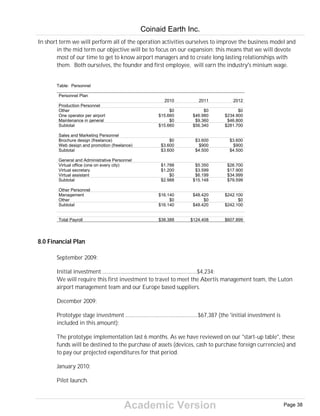
7.4 Personnel Plan . . . . . . . . . . . . . . . . . . . . . . . . . . . . . . . . . . . . . . . . . . . . . . . . . . . . . . . . . . . . . . . . . . . . . . . 37
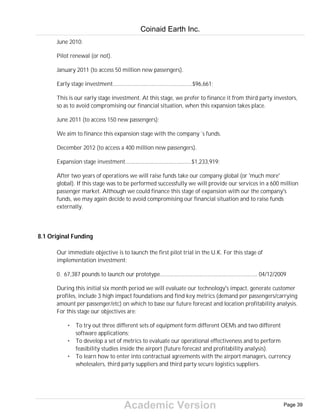
8.0 Financial Plan . . . . . . . . . . . . . . . . . . . . . . . . . . . . . . . . . . . . . . . . . . . . . . . . . . . . . . . . . . . . . . . . . 38
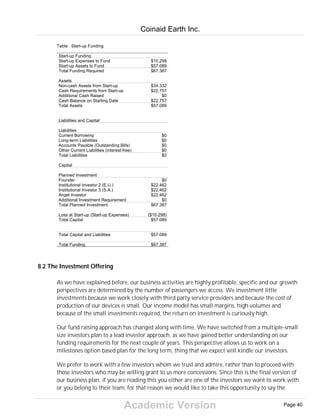
8.1 Original Funding . . . . . . . . . . . . . . . . . . . . . . . . . . . . . . . . . . . . . . . . . . . . . . . . . . . . . . . . . . . . . . . . . . . . . . 39
Table of Contents
Academic Version
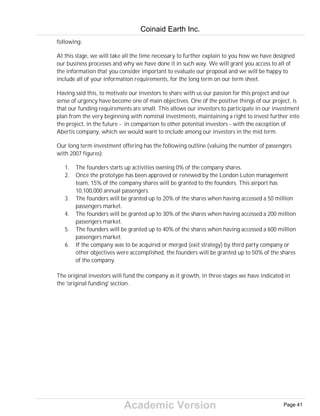
8.2 The Investment Offering . . . . . . . . . . . . . . . . . . . . . . . . . . . . . . . . . . . . . . . . . . . . . . . . . . . . . . . . . . . . . . . 40
8.3 Important Assumptions . . . . . . . . . . . . . . . . . . . . . . . . . . . . . . . . . . . . . . . . . . . . . . . . . . . . . . . . . . . . . . . . 42
8.4 Key Financial Indicators . . . . . . . . . . . . . . . . . . . . . . . . . . . . . . . . . . . . . . . . . . . . . . . . . . . . . . . . . . . . . . . . 43
8.5 Break-even Analysis . . . . . . . . . . . . . . . . . . . . . . . . . . . . . . . . . . . . . . . . . . . . . . . . . . . . . . . . . . . . . . . . . . . 44
8.6 Projected Profit and Loss . . . . . . . . . . . . . . . . . . . . . . . . . . . . . . . . . . . . . . . . . . . . . . . . . . . . . . . . . . . . . . . 44
8.7 Projected Cash Flow . . . . . . . . . . . . . . . . . . . . . . . . . . . . . . . . . . . . . . . . . . . . . . . . . . . . . . . . . . . . . . . . . . . 49
8.8 Projected Balance Sheet . . . . . . . . . . . . . . . . . . . . . . . . . . . . . . . . . . . . . . . . . . . . . . . . . . . . . . . . . . . . . . . . 52
8.9 Business Ratios . . . . . . . . . . . . . . . . . . . . . . . . . . . . . . . . . . . . . . . . . . . . . . . . . . . . . . . . . . . . . . . . . . . . . . . 54
8.10 Payback . . . . . . . . . . . . . . . . . . . . . . . . . . . . . . . . . . . . . . . . . . . . . . . . . . . . . . . . . . . . . . . . . . . . . . . . . . . . . 55
8.11 Valuation . . . . . . . . . . . . . . . . . . . . . . . . . . . . . . . . . . . . . . . . . . . . . . . . . . . . . . . . . . . . . . . . . . . . . . . . . . . . 55
Appendix . . . . . . . . . . . . . . . . . . . . . . . . . . . . . . . . . . . . . . . . . . . . . . . . . . . . . . . . . . . . . . . . . . . . . . . . . . . . . . . . . . . . . . . . . . 57
Table of Contents
Academic Version
1.0 Executive Summary
¿How many foreign coins and notes do you have stored in your drawers as a result of your
business or tourist international trips? Million of international passengers carry millions of euros
in loose change every year, and little is the value and use that they end up giving to this money,
once they have returned from these trips.
Here at CoinAID we have designed a touchscreen kiosk device to deal with this loose change and
perform currency exchange transactions or process donations at airports. We have a simple idea:
we can access the 0 to 30 euro market, currently unattended by airport bureaux de change, by
placing our small and highly effective devices in convenient locations inside the airport, and get
users to find our proposition valuable and aligned with their own values.
When we started to design our business model, we begun to outline a set of processes that would
allow us to reach the coins-only exchange market at a profit, by avoiding to immobilize capital in
every possible level. Throughout this stage we found and nurtured a set of process which have
now become the cornerstone of our model, because it allows us to offers great exchange rates and
a convenient experience (placing our devices in boarding rooms, steps away from the customer) to
the customer, for our different notes and coin transactions propositions.
We will implement our prototype at the London Luton Airport (10.100.000 annual passengers)
and work hard to improve our processes and transform all the virtues of our business model and
technology into great prices and convenience to end user form day one. Our proposition is more
convenient and it has better prices than those offered by the standard airport bureaux de change
and for that reason our model has an edge. Because of this we believe that in the mid-term we
will be able to compete against the "big guys" of the airport currency exchange market, sustaining
income expectation for our airport partners and investors.
Our financial model relies on high volumes, low margins and small investment which results on
high returns on the investment from the very beginning of activities. This is a very profitable
business: we charge a fix fee for coin and notes counting and processing, for both donations
rechanneling and exchange services, and we rely on highly experienced suppliers to manufacture
our hardware (OEMs), develop our kiosk software, supply currencies at wholesaler prices,
assemble the device and to delivery, collect and deposit currencies and donations, using secure
logistics third party suppliers.
This model can be replicated in every major airport in the world. We aim to access 771.000.000
passengers in three years time, by providing our services in 15 international airports: we believe
this is one honest and straight forward objective that can be accomplished.
Coinaid Earth Inc.
Page 1
Academic Version
1.1 Business Mission
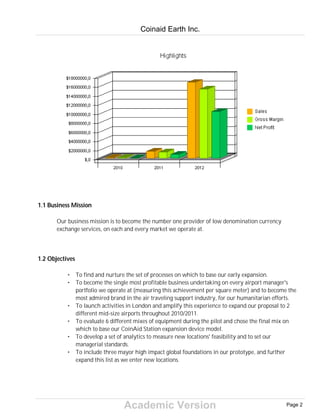
Our business mission is to become the number one provider of low denomination currency
exchange services, on each and every market we operate at.
1.2 Objectives
• To find and nurture the set of processes on which to base our early expansion.
• To become the single most profitable business undertaking on every airport manager's
portfolio we operate at (measuring this achievement per square meter) and to become the
most admired brand in the air traveling support industry, for our humanitarian efforts.
• To launch activities in London and amplify this experience to expand our proposal to 2
different mid-size airports throughout 2010/2011.
• To evaluate 6 different mixes of equipment during the pilot and chose the final mix on
which to base our CoinAid Station expansion device model.
• To develop a set of analytics to measure new locations' feasibility and to set our
managerial standards.
• To include three mayor high impact global foundations in our prototype, and further
expand this list as we enter new locations.
Coinaid Earth Inc.
Page 2
Academic Version
1.3 Keys to Success
• To charge better prices: our set of processes translate into great value for our customer.
We are able to perform currency exchange services at great prices and to access the 0 to 30
euro currency exchange market, at a profit.
• Convenience: to place our devices in boarding rooms and hallways, which is more
convenient than the existing locations where airport bureaux de change are currently at.
• To design a high end experience which redefines our customers' expectations and sets the
standards for the low denomination currency exchange industry for the present and the
times to come.
• To enter into long term contracts with airport managers.
• To design an attractive i-pod like looking device to trigger curious customer to try out our
services for the first time.
• To avoid capital immobilization on every level possible, by leveraging our suppliers
capabilities on hardware manufacturing, software development and secure logistics.
1.4 Purpose of Being
The purpose of being of our company is to create a unified global network of Coinaid Stations,
which aggregately contribute the gross of all of our customers' donations to the most influential
non profit organizations in the world.
Passengers will decide to which foundation to rechannel their loose change, choosing form a wide
variety of options. Besides those foundations and causes we aim to support, we are committed to
develop a structured selection process to evaluate one or more regional foundations in each
airport we operate at and to include in our menu, those foundations to which the airports may be
already contributing to.
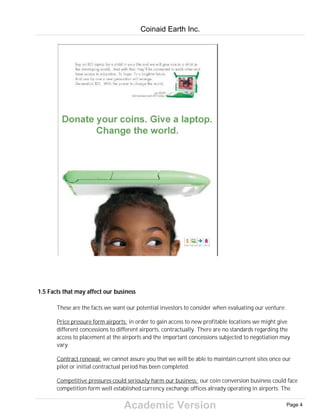
OLPC Foundation (advertising example).
Coinaid Earth Inc.
Page 3
Academic Version
1.5 Facts that may affect our business
These are the facts we want our potential investors to consider when evaluating our venture:
Price pressure form airports: in order to gain access to new profitable locations we might give
different concessions to different airports, contractually. There are no standards regarding the
access to placement at the airports and the important concessions subjected to negotiation may
vary.
Contract renewal: we cannot assure you that we will be able to maintain current sites once our
pilot or initial contractual period has been completed.
Competitive pressures could seriously harm our business: our coin conversion business could face
competition form well established currency exchange offices already operating in airports. The
Coinaid Earth Inc.
Page 4
Academic Version
lack of global currency exchange franchises is a positive aspect at this stage.
We may be unable to adequately generate, protect and enforce patents and other proprietary
rights for our Coinaid Stations: a core technology pending patent may not be held valid if
challenged, patent applications may not be issued and other parties may claim rights in or
ownership of our patents and other proprietary rights.
Trademarks, copyrights, trade secrets and other proprietary intellectual property may be
protected by confidentiality agreements: our employees, consultants, vendors or corporate
partners might breach this agreements. We may not be able to remedy this breach or, at the same
time, these trade secrets may be discovered by our competitors independently.
Certain parties may assert claims of patent infringement or misappropriation against us based on
current or pending United States and/or foreign patents, copyrights or trade secrets or contracts. If
such claims were successful our business could be harmed.
We depend upon third party manufacturers, suppliers and service providers: we currently depend
on third party manufacturing operations to sustain our international expansion.
New markets and locations may require the leverage of new OEMs networks, new to our demands
and working standards. Our mid term expansion beyond the European Union will require the
development of a new logistics architecture.
Our business is subject to foreign laws and government regulation: our currency exchange,
charitable fund raising, transfer of money, consumer protection and the access to machines in
public places is normally subject are sensible matters that may be approach differently by the
different law systems we make business at. Accessing the right legal assistance to interpret these
matters correctly may be important to sustain our international expansion.
We may be subject to product liability claims if people or property are harmed by our products
and services: operating a vending machine on third party property may expose us to product
liability claims arising form injury or property damage. Even if we successfully defend ourselves
form this type of claim, we could be forced to spend a considerable amount of money in litigation
expenses and our management could spend a considerable amount of time in defending against
this claims.
Our global expansion may not be accurately predicable: our international expansion plans depend
on negotiation with every single airport, one at the time. Each management team may have
different approach to value and approve our operations at their airport.
Coinaid Earth Inc.
Page 5
Academic Version
1.6 Options plan
Our growth is driven by the number of passengers we serve. We estimate to reach up to
771.000.000 passenger in a three to four year time frame (distributed in 15 airports). Since we
expect to work with our investors in the long term, we believe that to work on a purely option
based shares plan for the founders could be possible.
We will not display the milestones based stock distribution plan in this document. We believe
that the processes we have design will redefine the way passengers perform spot exchange
transactions and donations, and for that reason we believe that the best possible scenario is to plan
for the long term. Our long term option plan has the following outline:
• The founders start up activities with only 15% equity share.
• The founders gain a larger proportion of the shares (up to 40%) gradually, as they access a
+600 million passenger market.
• An additional share of the shares are distributed among the founders if an exit strategy is
implemented successfully (to the EasyGroup or Travelex for example) or if other similar
milestones are accomplished.
2.0 Company Summary
Here at CoinAid Earth we're all about making a sustainable, scalable and commercially viable
product that people would love to use. We love solving problems, and want to be known as value
driven business people who create great technology and treat our partners and users with respect.
We believe that it's worth working extra hard to make complicated things simple and delightful
to use.
We have developed a technological solution to solve one valuable and simple problem. We use
our company as a platform to express our founders, investors and partners values and to try to
make the world a better place. Beyond our business scope, high growth prospects and remarkable
high profitability we have developed this company to ultimately bring to our customer's fingertips
the possibility of channeling their resources (in this case, loose change) to those humanitarian
causes that align best with their own core values.
We are a young group of entrepreneurs, working to make CoinAid Earth one globally known
brand recognized for its commitment to create real value for our customers and to improve high
impact non for profit organizations real access to resources.
Coinaid Earth Inc.
Page 6
Academic Version
2.1 Company Locations and Facilities
The London City pilot will allow to asses the impact of our technology, test and improve our core
processes and to understand how to conduct a feasibility study inside the airport, to locate the
equipment in the most profitable possible locations (boarding rooms or hallways) increasing the
return for our investors.
The reason why we have decided to focus exclusively on airports is because in these locations
passengers carry millions of dollars in loose change which they will find of little or no use once
they have departed. Since the existing bureaux de change do not perform currency exchange
transactions below one given value, this allows us to position our proposal in a non conflicting
way with the existent currency exchange offices and by this present our proposal to the airport
managers, portraying a win-win situation.
Airports are secure and monitored constantly. It is safe to place currency exchange device over
there. International airports receive millions of passengers every year, and most of this airport
passenger are our potential customers. To focus on airports, to place our equipment conveniently
and to perform currency exchange transactions at great prices allow us to target this new market
at a profit.
Our early expansion will be based in the United Kingdom, Scandinavia and Eastern Europe. Most
of the international passengers that depart form these airport do so heading to the european
continent which has only one of currency: the euro. By this we are able to develop one single
currency exchange device, thing that simplifies our process structure and lowers our costs of
development. Our short term expansion perspectives are the following:
+ London City (130.000.000 million passengers);
+ Northern Britain (37.000.000 million passengers);
+ Scandinavia (43.000.000 million passengers);
In the mid term we expect to launch our activities in the American continent and Asia. We
further explain our expansion outline in section 9. The one great thing of working with airports is
that if we were to access to 15 mayor international airports, we would be operating on a
+771.000.000 passengers market.
Coinaid Earth Inc.
Page 7
Academic Version
2.2 Company Ownership
The company's equity ownership is divided into the founders, one angel investor and one South
American venture capital fund. We expect to include one northern hemisphere based institutional
investor, in the mid term.
3.0 Service Description
We have categorized our value proposition into three different levels:
• Loose change exchange transactions: we apply a net 5% fee on transactions below 15
pounds. We expect 1,25% form the total annual passengers to perform this sort of
transactions, with an average input value of 8 pounds per transaction.
• Donation rechanneling and processing: we charge a net 9,25% fee for this transactions.
We expect 1,25% from the annual passengers to perform this sort of transactions, with an
average input value of 8 pounds per transaction.
• Small exchange transactions: we apply a net 2% fee over transaction form 15 to 30 pounds,
and we expect the average passenger to utilize this proposal 1,5 times. We expect 0,75%
of the total annual passengers to perform this sort of transactions, with an average value of
45 pounds per transaction.
Millions of international passengers have been keeping millions of dollars in foreign loose change
for years. We have one simple proposition: if we develop the appropriate technology, develop a
beautiful interface and place the devices steps away form our customers, our simple and profitable
business model will be embraced by both the passengers and airport managers. We will invest
time and resources to educate our customers about their own needs and about the value of our
services. We are certain, that as times goes by, a straight forward proposition as ours will create
great value for our customers and constituents and our brand will become admired for our values.
As we explained above, we charge a fix fee for coin counting and processing over donations and
when it comes to currency exchange, both for "loose change" and "small" transactions, we charge
different rates, which are implicit on the final exchange rate offered to the customer.
For that reason, the coin counting and processing fee is only exposed in the donation
rechanneling services, both on the software application and the invoices printed. This fee is 12.5%
and we estimate a 3.25% cost distributed into collection, safe logistics and processing, arriving to
the 9.25% net fee. When it comes to currency exchange the final net fee (after deducting
wholesale purchase of currencies delivery and collection) is 2% form "small" transactions and 5%
for loose change currency exchange transactions. We utilize this net fee to account our sales
projected on this plan, and in the account "Direct costs of sales" we include the airport fee which
Coinaid Earth Inc.
Page 8
Academic Version
rages form 5% to 25% from our sales.
We have designed our business model relying on the experience and knowledge of our suppliers,
and all of the costs that we save by leveraging third parties capabilities, are translated into the
final currency exchange rate we charge to our customers. We believe that great prices and
unprecedented convenience in location are the two fundamental levels of our proposition, and
that a great future awaits if we improve processes continuously and if we start to create brand
awareness and one improved device customer experience.
3.1 Competitive Comparison
We have designed a very specific set of processes to access the 0 to 30 pounds currency exchange
market, currently unattended by the traditional airport bureaux de change. This level of the value
proposition does not compete with any other company.
Because we have originally designed this set of processes aiming to create the "loose change"
exchange market and to monetize it at a profit, we have found that when performing larger
transactions we can create exceptional value for passengers, transforming all our cost savings into
one better final end currency exchange rate. We explain our processes further in point 3.3:
Fulfillment, but we do not include the names or location of our third party suppliers of third party
secure logistics suppliers.
When it comes to currency exchange services we have the following competitive edge:
• Convenient location in boarding rooms and hallways to perform our services steps away
form the departing passenger.
• Great currency exchange rates (for example, on our prototype, we have better prices
compared to other currency exchange companies operating at the Luton Airport, but this
does not apply when comparing to other bureaux de change located in London city).
We expect 1/3 of our revenues to come from our donation rechanneling services. On this field, we
do not compete with others, because our objective is to raise funds in the name of a wide list of
high impact foundations, as an option for those passenger how would prefer to give their loose
change another use. The passenger may have the possibility of
Coinaid Earth Inc.
Page 9
Academic Version
3.2 Technology
We do not manufacture our own hardware, develop software nor process coins and notes
ourselves. It is a key success factor to reach arrangements with each constituent to avoid capital
immobilization and leverage their capabilities.
Our device is similar to existent coins and notes deposit systems, already well know for companies
like Coinstar and other. The most common hardware solutions available in the marker aims the
gambling, vending, ATM and kiosk markets and only a limited number of OEMs manufacture
original equipment to build these coin and notes deposit systems, as we require (the difference is
that this equipment, although more costly, it processes larger sums notes and coins accurately and
avoiding jams, at high speed).
During our prototype implementation we will use 6 different original equipment mixes, form
different equipment manufacturers. By this we will experiencing technology first hand so as to
understand which mix will actually outperform the rest, so as to use this equipment when
designing and development of our final expansion device model.
Developing the software required to manage our equipment is no challenge. We have to
register small transactions without the requirement of working online with ATM networks or
payment platforms. For that reason our system does not have to comply with the money
laundering regulations applied to electronic money transactions and we can focus exclusively
on developing a user friendly interface and great software touch-screen based experience.
Having clarified this, the software development is fairly simple and it will have two purposes:
• To perform and register loose change, small exchange and donation transactions
guiding the end user through the whole process.
• To register transactions, generate business analytics and upload information in real
time for our constituents (foundations and airport managers) and ourselves.
The software development has the following characteristics:
• C+ o Java running on different protocols to support the different equipment mix we
will tryout during the prototype;
• Daily online currency exchange rate update;
• Donations and currency exchange menu and screen flows;
• Wireless internet connection;
End user interaction summary:
• Presentation inviting the user to touch the screen in order to begin using our service;
• First screen displaying two possibilities: donations or loose change/small exchange;
• If the passenger has selected the donation option, the menu will have two
possibilities: the global development foundations menu and the global health
foundations menu;
• If the passenger has selected the currency exchange option, she will have to options
among which she will have to chose: loose change exchange or small exchange
Coinaid Earth Inc.
Page 10
Academic Version
services (the first option allows her to perform transactions from 0 to 15 pounds, and
the last form 15 to 30 pounds);
• When performing loose change or small exchange transactions the screen will
display the currency exchange rate applied to each particular type of transaction;
• In both cases the user will introduce notes and coins. Coins can be escrowed at any
time, but when introducing notes, this will be done one note at the time to allow the
user to escrow or cancel the transaction when she decides (since most of the note
acceptors can escrow one note at the time only).
• Values input and the expected exchange sum to be received are displayed on the
screen, as the transaction is being completed;
• Once the user is ready to perform the transaction she presses the enter button (on
the screen) and the transaction is preformed;
• Two receipts are printed, one internally (control process) and one externally (invoice).
The second purpose of our software is to register transactions and to generate business
analytics to create business insights. By registering transactions online we raise the bar on
our internal control procedures by allowing our airport partners or foundations to monitor our
transactions in real time. This works the in following way:
• Every transaction is uploaded, accounted and stored. Both the operator and
ourselves know how many transactions have been performed, which is the total
amount of coins and notes stored in the device and its final value. Every time the
equipment is to be loaded up, the operator has to compare this to the internal receipts
printed.
• End users decide to which foundation they'd want to contribute their loose change.
Foundations' managers can register online (we provide each manager with one user
name and password) and monitor the donation received, in real time on a device level.
• Airport managers may have access to all of those transactions registered and stored
by using their user name and password. Because they will receive a share of our end
results, this will prove valuable both for them and ourselves.
• This system improves our operational effectiveness because each time one piece of
equipment registers problems the operator will be emailed in real time to fix it. If one
user were to have any trouble when using our device, she may require assistance in
real time and the operator will assist her in minutes.
3.3 Doing well by doing good
Once we have generated a global network of Coinaid Stations, the aggregated sum of money
donated to humanitarian causes will be significant. We expect to channel and focus million Euros
loose change market into causes that reflect our customers' values.
On our early expansion plan we will include the following high impact NGOs, on the following
fields:
• Malaria: Program for Appropriate Technology in Health (PATH)
World Health Organization
Institute for One World Health
• Tuberculosis: Global Alliance for TB Drug Development
Coinaid Earth Inc.
Page 11
Academic Version
• Maternal, Newborn, & Child Health: Save the Children Federation
• Nutrition: International: Bank for Reconstruction and Development
World Health Organization
• Diarrhea: Institute for One World Health
• Vaccines: International Bank for Reconstruction and Development
• Neglected diseases: The Carter Center
• Agricultural development International: Food Policy Research Institute
• Animal Life Preservation: Wild Life Foundation
3.4 Fulfillment
Our business model has a unique structure. As we have mentioned before, the fact that we had
been focused on developing a set of processes that would allow us to access the 0 to 30 pound
market at a profit has now become the reason why we may be able to perform currency exchange
services at great prices.
The business model has the following core processes:
• Device design, assembly and deployment;
• Software development including multi protocol configuration to manage in a standard
way the different equipment mixes we will try out during the prototype;
• Purchasing currencies from two different wholesalers;
• Collecting coins and notes hiring a secure logistics company;
• Processing donations, airport managers' fees and our currency inventories after collection.
3.5 Future Services
In the future we will add one variable to our currency exchange proposition, which is to allow
passengers to input their loose change into the device and to deposit it in their credit card account
online, through an ATM network. This is a novel service which may have potential on its own,
but we will not focus on it at this stage.
As our airport network increases in size and we learn more about the air traveling support
industry, we may be able to offer to the airport managers different kiosk device solutions, besides
our currency exchange and donations rechanneling services. For now, we are not studying new
device solutions to target new possible customer problems, probably already existing in the
industry. Still, we believe that our Skycycle kiosk design company will gain considerable
recognition as an innovative technological brand, as we continue to grow: we may be able to use
this asset to pursuit further opportunities in the future.
For the time being we will focus on these two objectives:
Coinaid Earth Inc.
Page 12
Academic Version
1. To improve the operational effectiveness of our kiosk device (user friendliness, speed and
reliability) and to include a second currency as a currency exchange possibility (Dollars in
most cases) when expanding to new locations;
2. To extend the list of global foundation we aim to include in our giving menu. This is
aligned with our humanitarian mission: "To create unified global network of Coinaid
Stations to contribute the gross of all of our clients' donations to the most influential non
profit organizations in the world "
As we gradually increase the number of foundations included on our menu, we will try to include
those that comply with the following standards:
• +100 million dollars of annual budget and one truly global mission;
• Processes to guarantee the accountability of the pounds passengers have decided to donate;
• If existing airports were to be already contributing with local foundations, we will include
this on our donation menu.
3.6 Coinaid Station Design
We are looking to deliver a functional and intuitive software experience and one fast and reliable
coin and note processing system. We believe our value mix will redefine travelers' spot currency
exchange transactions expectations, but still the single most important factor to drive our growth
will be to transform this end customers value into value for our airport partners. We can create
value for the airport in two ways:
• Economically (revenue on sales and land lease - we cover this topic in the financial plan
section);
• Creating brand awareness and triggering need recognition.
In the short term, the best way to trigger need recognition is by placing our attractive devices
close to passengers, in boarding rooms or hallways. By this we increase profitability, by driving
more customers to tryout or use our device. To this end we will develop business set of analytics
to perform feasibility studies in each location we operate at.
In the long term, we will invest our resources and time to educate the passenger about the value
of our services in two ways:
• Displaying the humanitarian causes we support on our device (graphical advertising);
• Displaying cartoon video to educate the passengers about the value of our services and
about how to use the device;
As we improve our processes with time, we will become an increasingly profitable business
partner to the airport managers and at the same time, passengers will start to be aware of the
value of our services. As our customers and constituents begun to consider our services as
important for the overall airport experience, our expansion process will gain momentum.
Coinaid Earth Inc.
Page 13
Academic Version
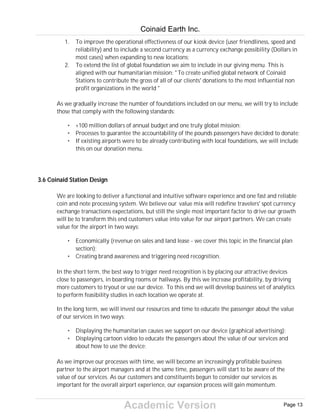
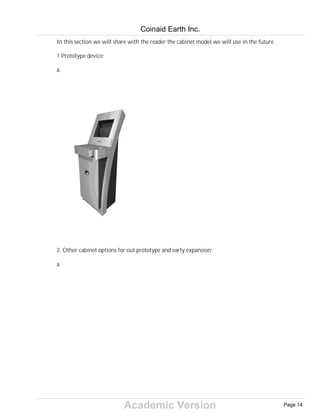
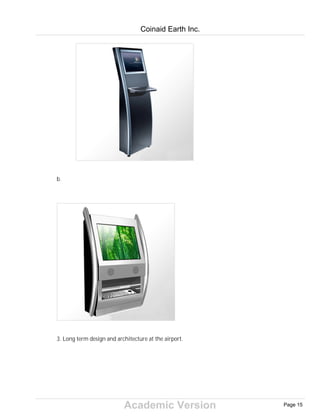
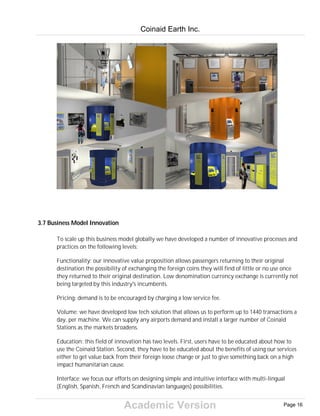
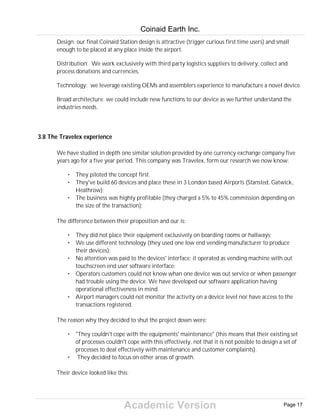
In this section we will share with the reader the cabinet model we will use in the future.
1 Prototype device:
a.
2. Other cabinet options for out prototype and early expansion:
a.
Coinaid Earth Inc.
Page 14
Academic Version
b.
3. Long term design and architecture at the airport.
Coinaid Earth Inc.
Page 15
Academic Version
3.7 Business Model Innovation
To scale up this business model globally we have developed a number of innovative processes and
practices on the following levels:
Functionality: our innovative value proposition allows passengers returning to their original
destination the possibility of exchanging the foreign coins they will find of little or no use once
they returned to their original destination. Low denomination currency exchange is currently not
being targeted by this industry's incumbents.
Pricing: demand is to be encouraged by charging a low service fee.
Volume: we have developed low tech solution that allows us to perform up to 1440 transactions a
day, per machine. We can supply any airports demand and install a larger number of Coinaid
Stations as the markets broadens.
Education: this field of innovation has two levels. First, users have to be educated about how to
use the Coinaid Station. Second, they have to be educated about the benefits of using our services
either to get value back from their foreign loose change or just to give something back on a high
impact humanitarian cause.
Interface: we focus our efforts on designing simple and intuitive interface with multi-lingual
(English, Spanish, French and Scandinavian languages) possibilities.
Coinaid Earth Inc.
Page 16
Academic Version
Design: our final Coinaid Station design is attractive (trigger curious first time users) and small
enough to be placed at any place inside the airport.
Distribution: We work exclusively with third party logistics suppliers to delivery, collect and
process donations and currencies.
Technology: we leverage existing OEMs and assemblers experience to manufacture a novel device.
Broad architecture: we could include new functions to our device as we further understand the
industries needs.
3.8 The Travelex experience
We have studied in depth one similar solution provided by one currency exchange company five
years ago for a five year period. This company was Travelex, form our research we now know:
• They piloted the concept first.
• They've build 60 devices and place these in 3 London based Airports (Stansted, Gatwick,
Heathrow);
• The business was highly profitable (they charged a 5% to 45% commission depending on
the size of the transaction);
The difference between their proposition and our is:
• They did not place their equipment exclusively on boarding rooms or hallways;
• We use different technology (they used one low end vending manufacturer to produce
their devices);
• No attention was paid to the devices' interface: it operated as vending machine with out
touchscreen end user software interface;
• Operators customers could not know whan one device was out service or when passenger
had trouble using the device. We have developed our software application having
operational effectiveness in mind.
• Airport managers could not monitor the activity on a device level nor have access to the
transactions registered.
The reason why they decided to shut the project down were:
• "They couldn't cope with the equipments' maintenance" (this means that their existing set
of processes couldn't cope with this effectively, not that it is not possible to design a set of
processes to deal effectively with maintenance and customer complaints).
• They decided to focus on other areas of growth.
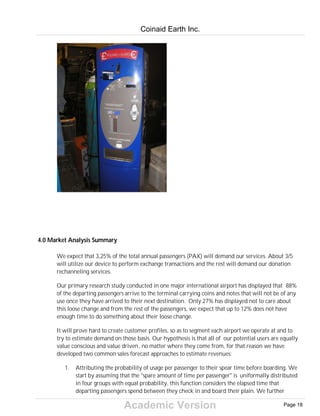
Their device looked like this:
Coinaid Earth Inc.
Page 17
Academic Version
4.0 Market Analysis Summary
We expect that 3,25% of the total annual passengers (PAX) will demand our services. About 3/5
will utilize our device to perform exchange transactions and the rest will demand our donation
rechanneling services.
Our primary research study conducted in one major international airport has displayed that 88%
of the departing passengers arrive to the terminal carrying coins and notes that will not be of any
use once they have arrived to their next destination. Only 27% has displayed not to care about
this loose change and from the rest of the passengers, we expect that up to 12% does not have
enough time to do something about their loose change.
It will prove hard to create customer profiles, so as to segment each airport we operate at and to
try to estimate demand on those basis. Our hypothesis is that all of our potential users are equally
value conscious and value driven, no matter where they come from, for that reason we have
developed two common sales forecast approaches to estimate revenues:
1. Attributing the probability of usage per passenger to their spear time before boarding. We
start by assuming that the "spare amount of time per passenger" is uniformally distributed
in four groups with equal probability, this function considers the elapsed time that
departing passengers spend between they check in and board their plain. We further
Coinaid Earth Inc.
Page 18
Academic Version
explain this reasoning in point 9.3.
2. We apply the standard 3,25% to the annual PAX, which represents 6,5%, of the departing
passengers (slightly higher than the percentage of usage estimated on average ATM
machines, which is 5%).
We will build our financial projections taking the second approach. First, this 3,25% is the lower
estimated usage ratio from the two of these and it seems to be a practical approach we could apply
as a rule of thumb because it is simple and straight forward.
The other variables that we will consider when estimating revenues:
• Average value of the loose change carried by passengers (8 pounds in loose change and 45
pounds when performing exchange transactions);
• Percentage of departing passengers (50% of PAX);
• Percentage of departing international passengers (we consider all of the departing
passengers international, because at this stage we are focusing on international airports);
The important thing is that when we combine these variables with the weighted usage ratio (1/5
perform small currency exchange transactions, 2/5 perform loose change exchange transactions
and 2/5 perform donation rechanneling transactions) we can estimate revenues, rapidly.
4.1 Market Segmentation
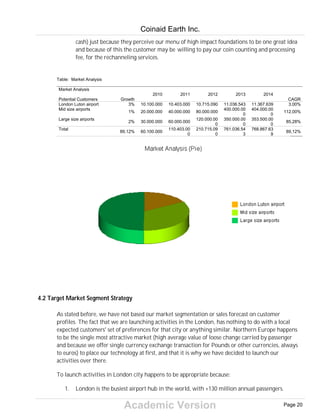
The market analysis table explains how we picture and prioritize our expansion possibilities. We
are launching activities in a 10.100.000 annual PAX airport (which we've placed in the "small"
category). Since we are aware that each and every airport account requires plenty of time
invested, we have decided to focus exclusively on large accounts during our first four years of
operations. These are more profitable and more time-effective to manage (that is the reason why
mid size and large airport are the largest category in the market analysis table).
We have segmented our market on purely managerial bases, having in mind that this particular
version of our business plan may be read by investors and airport managers exclusively. The
"expansion focus" to our market analysis is straight forward and most appropriate at this stage, the
annual PAX represents the size of the market, but our actual market is the departing passengers
market, which would be that number, divided by two.
Still, when managing the day to day operations of our business, a behavioral segmentation will be
best, to design new processes and get the most out of the market. We know travelers recognize
one need: that the existence of foreign loose change, in notes and coins, has little or no value,
before departure. Although the need recognition may be the triggered by the same reason, usage
could be categorized into two groups:
• Value conscious (or rational) customers: who values our services and appreciate getting
value back from their coin and notes, hence they willing to exchange them.
• Cause driven customers: who prefer to donate their loose change (or larger quantities of
Coinaid Earth Inc.
Page 19
Academic Version
cash) just because they perceive our menu of high impact foundations to be one great idea
and because of this the customer may be willing to pay our coin counting and processing
fee, for the rechanneling services.
Table: Market Analysis
Market Analysis
2010 2011 2012 2013 2014
Potential Customers Growth CAGR
London Luton airport 3% 10.100.000 10.403.000 10.715.090 11.036.543 11.367.639 3,00%
Mid size airports
1% 20.000.000 40.000.000 80.000.000
400.000.00
0
404.000.00
0
112,00%
Large size airports
2% 30.000.000 60.000.000
120.000.00
0
350.000.00
0
353.500.00
0
85,28%
Total
89,12% 60.100.000
110.403.00
0
210.715.09
0
761.036.54
3
768.867.63
9
89,12%
4.2 Target Market Segment Strategy
As stated before, we have not based our market segmentation or sales forecast on customer
profiles. The fact that we are launching activities in the London, has nothing to do with a local
expected customers' set of preferences for that city or anything similar. Northern Europe happens
to be the single most attractive market (high average value of loose change carried by passenger
and because we offer single currency exchange transaction for Pounds or other currencies, always
to euros) to place our technology at first, and that it is why we have decided to launch our
activities over there.
To launch activities in London city happens to be appropriate because:
1. London is the busiest airport hub in the world, with +130 million annual passengers.
Coinaid Earth Inc.
Page 20
Academic Version
2. It sets the standards of our technology for the short term: both in Scandinavia or Britain,
the great majority of passengers will carry Crowns or Pounds and will probably want to
exchange these for Euros. By this we can design one single currency exchange kiosk
device during our prototype, improve it and work on a similar version to expand two our
second airport.
4.2.1 Market Needs
How many time have you found yourself putting away in jars or drawers those foreign coins and
notes which have little value for you at that point?
Passengers traveling internationally have always carried this foreign "loose change" with them.
The reasons why passenger can't do anything about it are the following:
• Currency exchange bureaux do not target the 0 to 30 euro market.
• Although passengers may have the possibility of exchanging larger sums and with them,
their loose change, traditional bureaux de change are located next to customs and check-in
spots, where people has less spear time and tend to feel more stressed, hence the
probability of currency exchange engagement, diminishes.
We have designed a business proposition that is conveniently located (in boarding rooms and
hallways) while still offering great currency exchange rates. This, combined with the fact that
foreign coins won´t be of any use once the passenger has returned back to her original
destination, may trigger need recognition and increase the probability of usage per passenger.
Since passengers have this need but they may not be aware of it so far, to educate them about it is
our responsibility. For that reason, each device will display educational video as long as passengers
are not interacting with the touchscreen. We have designed the device to make it look attractive
to attract curious users and we will communicate our donation rechanneling services to
communicate our values and attract first time users.
Once passengers have recognized that they actually have the need to do something about their
loose change, our technology will be right to offer a solution conveniently and at a great price.
We will work hard to redefine the passengers' expectations and to become the number one
provider of low denomination currency exchange services on every market we operate at.
Coinaid Earth Inc.
Page 21
Academic Version
4.2.2 Market Trends
Our customers are value oriented and socially responsible. At the same time, they are
technologically savvy and will probably find our services enhancing and entertaining. We have
designed an attractive device, with a simple interface to guide the user through the giving or
exchange experience. Passengers have been carrying foreign loose change for a long time now,
and we do not see how that could change in next couple of years.
4.2.3 Market Growth
We can asses how fast the air traveling industry is growing by estimating the increase in the
number international passengers. This access to this information is transparent and available for
research. When it comes to try to understand how one particular airport will behave it becomes
difficult because some variable are not predictable in the long term, in particular how the
different airlines will organize their air plains fleets, which ultimately determines how one
particular city air flux is defined.
Our company's growth is not driven by market growth per se but by our ultimately in accessing
new locations as fast and efficiently as we can. As a general rule of thumb, we expect that the
volume of annual passengers, in those airport we already begin to operate, will grow at a annual
compound 1% rate.
The list of northern european airports we may aim to do business at follows. When outlining our
early expansion sequence we will order our preferences in following this order:
1. Number of international annual passengers (right after our pilot implementation in
London we may prefer to expand our activities to Stockholm before Birmingham);
2. Proximity to other projects (right after our London Pilot, we may prefer to expand our
activities to Manchester before Moscow);
3. Airport managers' support, trial period and long term contractual attractiveness (we may
prefer to pursuit the most profitable contractual agreements first).
The list of potential airports on which to base our early expansion plans is organized presenting
the name of the city were these are located, the airport's code, the annual number of passengers
who flew form there in 2008 and their 2008-2007 growth rate:
Pilot:
0. London Luton London London LTN/EGGW 10180734 +2.6%
Early expansion:
1. London Heathrow Airport - London LHR/EGLL 68066028 +1.5%
London Gatwick Airport - London LGW/EGKK 35216113 +2.9%
Coinaid Earth Inc.
Page 22
Academic Version
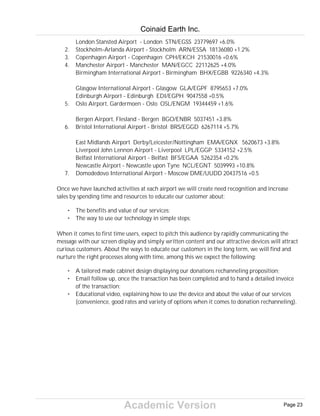
London Stansted Airport - London STN/EGSS 23779697 +6.0%
2. Stockholm-Arlanda Airport - Stockholm ARN/ESSA 18136080 +1.2%
3. Copenhagen Airport - Copenhagen CPH/EKCH 21530016 +0.6%
4. Manchester Airport - Manchester MAN/EGCC 22112625 +4.0%
Birmingham International Airport - Birmingham BHX/EGBB 9226340 +4.3%
Glasgow International Airport - Glasgow GLA/EGPF 8795653 +7.0%
Edinburgh Airport - Edinburgh EDI/EGPH 9047558 +0.5%
5. Oslo Airport, Gardermoen - Oslo OSL/ENGM 19344459 +1.6%
Bergen Airport, Flesland - Bergen BGO/ENBR 5037451 +3.8%
6. Bristol International Airport - Bristol BRS/EGGD 6267114 +5.7%
East Midlands Airport Derby/Leicester/Nottingham EMA/EGNX 5620673 +3.8%
Liverpool John Lennon Airport - Liverpool LPL/EGGP 5334152 +2.5%
Belfast International Airport - Belfast BFS/EGAA 5262354 +0.2%
Newcastle Airport - Newcastle upon Tyne NCL/EGNT 5039993 +10.8%
7. Domodedovo International Airport - Moscow DME/UUDD 20437516 +0.5
Once we have launched activities at each airport we will create need recognition and increase
sales by spending time and resources to educate our customer about:
• The benefits and value of our services;
• The way to use our technology in simple steps;
When it comes to first time users, expect to pitch this audience by rapidly communicating the
message with our screen display and simply written content and our attractive devices will attract
curious customers. About the ways to educate our customers in the long term, we will find and
nurture the right processes along with time, among this we expect the following:
• A tailored made cabinet design displaying our donations rechanneling proposition;
• Email follow up, once the transaction has been completed and to hand a detailed invoice
of the transaction;
• Educational video, explaining how to use the device and about the value of our services
(convenience, good rates and variety of options when it comes to donation rechanneling).
Coinaid Earth Inc.
Page 23
Academic Version
5.0 Service Business Analysis
We perform automated currency exchange spot transactions and donation rechanneling services
in the air traveling support industry. Airports are fantastic places to perform our services because
of their safety and the large number of passengers carrying loose change. At the same time
airports allow us to amplify the unique benefits of our business model (convenience and and value
for money):
• Because our devices are small in size we can place them in boarding rooms and hallways
(presence which would otherwise be constrained for building regulation matters). At this
stage passenger perceive no value for the already foreign loose change that they carry,
they have plenty of time to do this, bureaux de change are far away form that spot and the
probability of usage is at its peak.
• Because of the business processes we have designed we are able to charge great currency
exchange rates and to include a long list of high impact global foundations.
We perceive airport bureaux de change to be our competitors, although we do not target the exact
same market. The novel thing about our business model, is that we can target the 0 to 30 pounds
market, most of the time unattended by airport bureaux de change, profitably. Once we have
achieved this, we will start to think about including higher currency exchange transactions in our
proposition and to extend the list of foundations, even further so as to democratize the on the spot
giving proposition. As our value proposition is redefined or extended, after the prototype
implementation in London Luton, we will be able to identify clearly the new competitive
landscape for each new location we intend to access.
5.1 Distribution Patterns
Our business model has an edge. We are able to charge great prices because we have simplified
the distribution processes to have the currencies purchased from the wholesalers delivered to the
airport on demand, eliminating stock requirements (that other currency exchange offices may
have) by operating exclusively with the currency inventory we have inside the devices. We have
developed our software to monitor each device, calculate our foreign currency requirement and to
deliver and purchase it, on the spot using.
Coinaid Earth Inc.
Page 24
Academic Version
5.2 Business Model Return on Investment
As we have stated before, we are working to create a new market: the 0 to 30 pound currency
exchange market at airports. While not every airport bureaux de change has "minimum
transaction limits" (this would mean that these companies wouldn't perform exchange
transactions below one given value, say 30 pounds), we believe passengers en up carrying this
loose change for the following reasons:
• They find the airport processes to be time consuming and stressful and they would not
spend extra time to engage in such transaction for the value this loose change represents;
• They forget about their loose change;
• They would have exchanged their loose change along with their currencies, but the
airport's bureaux the change were out of the way, or at least, far away form the boarding
rooms where they would have had more time to perform this transaction;
• They are local passengers departing for a business trip or tourism and they do not perceive
the need to do something about this loose change, because they will be back in the short
term;
Our device innovation and business model result on:
• Exceptional convenience (in boarding rooms and hallways, where the probability of usage
is higher);
• Great prices (we have nurtured a set of simple processes which simplifies currency
distribution in one step, to deliver our currency inventory directly to airport).
If we evaluate both levels of our proposition, our competitors may be the following:
• Airport bureaux de change (if passengers decide to use our device repeatedly to perform
higher transactions);
• Already existing piggy-boxes for donations (if the airport managers would not decide for
us to include this foundations on our giving software menu, consolidating every giving
activity in the airport on our devices);
• Other commercial and retail operators placed inside the airport (where passengers could
donate their loose change).
It every case it is arguable if we compete with each them because our model relies on the fact that
our devices are placed right before the boarding process takes place, when these companies have
been left behind.
Coinaid Earth Inc.
Page 25
Academic Version
6.0 Strategy and Implementation Summary
We will launch activities in London. This city is the busiest airport hub in the world with more
than 130.000.000 annual passengers. At the same time, this city alone represents the single most
profitable market in Europe both because the number of passenger and the sterling pounds loose
change currency values we estimate passengers carry.
Our prototype will be implemented in the Luton Airport, a small size international airport which
handles mostly UK to continental Europe flights. We consider this to be a great opportunity to
test first hand the different pieces of equipment we have purchased form different OEMs. At the
same time, we will evaluate the processes we have designed and apply all the experience we have
accumulated when negotiating with third party suppliers, third party secure logistics suppliers
and airports, on our early expansion implementation stage. By experiencing our technology and
business model first hand, we will also understand how to build up work force to cope with our
early expansion plans operational requirements.
In the mid term and because our single most important growth driver is the number of airport we
enter, we expect our management team to focus their time and efforts exclusively in earning new
accounts or renewing the existing.
6.1 Strategy Pyramid
Our strategic sequences are:
1. Launch operations at the Luton Airport in London, in a three month time frame;
2. Early expansion in Northern Europe;
3. International expansion in the Americas and Asia.
Our prototype implementation is important because we will evaluate and redesign our processes
as we operate. During this period, we will place three different sets of equipment in 6 devices and
by this we will be able to evaluate each piece of equipment first hand, and to use the best
performing mix to develop of our expansion device model.
Our expansion plans are outlined on city bases (which usually means one single airport per city,
but not always). For each new location we have to access the appropriate coins and notes
currency suppliers locally and the same may apply for all our core processes performed by third
party business participants (as we have outlined previously) because we will have to find
solutions, locally. It is this part of our business model the one that represent the bigger challenge.
The expansion device model will have two currencies dispensing capabilities. The number of
currencies dispensed drive the final cost of the device (because for each, a new set of hoppers and
note dispensers have to be included). For this device we intend to use the equipment mix that we
have described before, but to assemble it locally so as to try to minimize shipment costs and gain
post-sale services, form the assemblers, if that was possible in each case.
Coinaid Earth Inc.
Page 26
Academic Version
When it comes to our global donation rechanneling network: we think big. We believe that the
millions of dollars in loose change that passengers carry will create long lasting impact on
different causes. For that reason, we will build a long list of high impact foundations, in
compliance to our requirements and we will allow passengers to find and donate to those causes
they feel their values to be best aligned with, driving up demand, probably building a long lasting
relationship with each customer and helping foundations to raise their funds.
6.2 Business Participants
Airport managers are our most important constituents. We invest a great deal of our time on
finding and nurturing the right processes to fulfill their expectations. In opposition to other
companies already operating inside airports, we have designed our value of chain thinking
exclusively in the airport traveling support industry and for that reason will be prepared to
respond to their demands timely and to enter into agreements that reflect clearly they
requirements and ours.
The other participants in our value of chain are:
• Original equipment manufacturers (OEMs);
• Kiosk assemblers;
• Foreign currency exchange wholesalers;
• Safe logistics delivery (third party logistics supplier);
• Collection and processing (one different third party logistics suppliers);
• Third party kiosk maintenance (during our early implementation stage);
• Software developers;
• Foundations.
6.3 Milestones
Our approach to funding is to work exclusively with those funds and angel investors we look up
to. For that reason we are willing to make concessions we wouldn't normally do under different
circumstances and we will spend all the time necessary to take the funding negotiation forward
with them.
Our approach is long term. This is important because we expect to build an option plan for
ourselves, the founders, which relies exclusively on the size of the markets we gain access to in
the future. For that reason it is important to define our milestones following that line of reasoning
(million annual passengers based):
The completion of the following milestones will result in the distribution of stocks to the
founders:
Coinaid Earth Inc.
Page 27
Academic Version
0. Luton Airport pilot approval and contractual renewal after 6 moths of operations
..............02/06/2010
This milestone includes the accomplishment of the following objectives:
• Seed stage funding (form one angel investor and one institutional investors);
• The first 3 different prototype devices assembled and deployed, properly evaluated (with
this results in mind we will design our early expansion device, with only one set of
different equipment pieces);
• Positive economic outcome of our activities;
• Properly tested and improved processes, on which to base our early expansion.
1 and 2. Second and third stock related
milestones.....................................................................02/06/2012
We expect to reach 50 million passengers (milestone number 2) and 150 new million passengers
(milestone number 3) in 19 months time.
The list of airports that follows, includes all the possible locations we may be able to expand into
(presented by name of the airport, city, code, and million annual passenger on 2007-2008 values)
in northern Europe. We do not have regional focus, which means that if we would find a more
profitable market someplace else in the world, we would pursuit that opportunity instead:
1. London Heathrow Airport London LHR/EGLL 68066028 +1.5%
London Gatwick Airport London LGW/EGKK 35216113 +2.9%
London Stansted Airport London STN/EGSS 23779697 +6.0%
2. Stockholm-Arlanda Airport Stockholm ARN/ESSA 18136080 +1.2%
3. Copenhagen Airport Copenhagen CPH/EKCH 21530016 +0.6%
4. Manchester Airport Manchester MAN/EGCC 22112625 +4.0%
Glasgow International Airport Glasgow GLA/EGPF 8795653 +7.0%
Edinburgh Airport Edinburgh EDI/EGPH 9047558 +0.5%
5. Oslo Airport, Gardermoen Oslo OSL/ENGM 19344459 +1.6%
Bergen Airport, Flesland Bergen BGO/ENBR 5037451 +3.8%
6. Bristol International Airport Bristol BRS/EGGD 6267114 +5.7%
East Midlands Airport Derby/Leicester/Nottingham EMA/EGNX 5620673 +3.8%
Liverpool John Lennon Airport Liverpool LPL/EGGP 5334152 +2.5%
Belfast International Airport Belfast BFS/EGAA 5262354 +0.2%
Newcastle Airport Newcastle upon Tyne NCL/EGNT 5039993 +10.8%
7. Domodedovo International Airport Moscow DME/UUDD 20437516 +0.5
3. Long term expansion................................................................................................01/01/2015
To reach 400 new million passengers we will study the following airports (and the ones listed
Coinaid Earth Inc.
Page 28
Academic Version
above):
1. Hartsfield-Jackson Atlanta, Atlanta, ATL/KATL 90,039,280, 0.7%
O'Hare International Airport , Chicago, ORD/KORD 69,353,654, 8.9%
London Heathrow Airport, London LHR/EGLL 67,056,228 1.5%
Tokyo International Airport, Tokyo, HND/RJTT 66,735,587 1.0%
Paris Charles de Gaulle Airport , Paris, CDG/LFPG 60,851,998 , 1.6%
Los Angeles International Airport, Los Angeles, LAX/KLAX 59,542,151 4.8%
Dallas-Fort Worth International Airport, Dallas DFW/KDFW 57,069,331, 4.6%
Beijing Capital International Airport Beijing PEK/ZBAA, 55,662,256, 3.9%
Frankfurt Airport, Frankfurt FRA/EDDF 53,467,450 1.3%
Denver International Airport Denver, DEN/KDEN 51,435,575 3.0%
Madrid Barajas International Airport, Madrid MAD/LEMD 50,823,105 1%
Hong Kong International Airport, Hong Kong, HKG/VHHH, 47,898,000, %2
John F. Kennedy International Airport , New York JFK/KJFK 47,790,485, 0.2%
Amsterdam Airport Schiphol Haarlemmermeer, AMS/EHAM 47,429,741, 0.8%
McCarran International Airport , Las Vegas, LAS/KLAS 44,074,707 7.7%
4. Other milestones (exit strategy and others).............................................................02/05/2015
Table: Milestones
Milestones
Milestone Start Date End Date Budget Manager Department
Initial trip to meet
London Luton
management team
21/9/2009 3/10/2009 $4.798
Germán
Rimoldi
Founder
Seed stage fund raising
4/10/2009 4/11/2009 $0
Germán
Rimoldi
Founder
Prototype
implementation in Lunton
Airport
1/1/2010 1/6/2010 $67.387
Germán
Rimoldi
Founder
First airport besides
Luton
2/6/2010 1/12/2010 $0
Germán
Rimoldi
Founder
Early expansion in
northen Europe (50
million new passengers)
2/12/2010 30/12/2011 $96.661
Germán
Rimoldi
Founder
Early expansion (150
new passengers)
31/12/2011 1/6/2013 $0
Managemen
t Team
Fransico
Heffesse
Long term expansion (to
reach up to 400 million
new passengers)
2/6/2013 1/1/2015 $1.233.919
Managemen
t Team
Fransico
Heffesse
Other objectives
2/1/2015 2/5/2015 $0
Germán
Rimoldi
Founder
Totals $1.402.765
Coinaid Earth Inc.
Page 29
Academic Version
6.4 Sales Forecast
We have developed two methods to estimate our sales.
1. The first method consist on applying one standard ratio on the annual PAX.
To build this ratio we will first have estimate the probability of usage for every level of our
proposition:
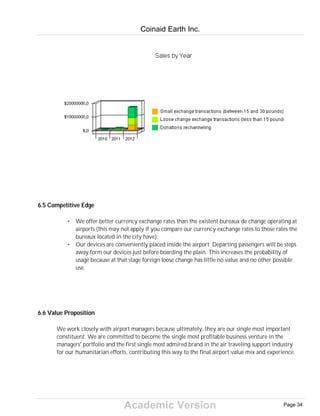
1. 0,75% of the PAX performs small currency exchange transactions;
2. 1,25% of the PAX performs loose change currency exchange transactions;
3. 1,25% of the PAX perform donations rechanneling.
The second step is to estimate revenues for each group and apply our estimated spread or
margin fee on each:
1. Small currency exchange transactions are performed on an average value of 45
pounds and we estimate a 2% gross income for each transaction;
2. Loose currency exchange transactions are performed on an average of 8 pounds and
we estimate a 5% gross income for each transaction;
3. Donation rechanneling services are performed on an average of 8 pounds and we
estimate a 9,25% gross income for each transaction;
To come up with a ratio to estimate revenues per passenger we can build a weighted average
with both the probability of usage and the expected revenue per transaction. In this case we
Coinaid Earth Inc.
Page 30
Academic Version
have decided to build our forecast presenting information divided into each level of our proposition .
The wholesale currencies purchase prices that we have used and the estimated percentages
we have discounted (for currencies delivery and collection) form the sales price, correspond
to the third week of August, 2009 in London city. If those prices were applied, we would
purchase euros directly form a wholesaler at a final price of 1,149 euros per pound (1,159
euros less 0,8% for delivery to the airport) and offer the end customer 1,0989 euros on >15
pounds transactions, and 1,0462 on loose change exchange (that is 3% and 8% charge)
calculating our gross income percentage to be 2% and 5% on each case.
Besides having a convenient service located a few steps away form the departing passenger,
we offer better prices than the currency exchange offices already operating at London Luton
Airport. During that same week, passengers could purchase 1,041 euros with 1 pound in the
traditional currency exchange offices operating over there. None of these currency
exchange offices are to be found next boarding rooms, where loose change already has little
value for the international passenger, and usage probability is at its peak: for that reason we
charge better prices and our devices are conveniently located, in comparison to the
traditional currency exchange prices.
In sales forecast we do not "Direct costs of sales" because the Abertis company has agreed
not charge a fee on sales nor the land lease, while we implement our prototype.
2. We have also worked on a different approach to estimate sales but we have NOT taken
this reasoning to build the sales forecast that follows:
First, we try to estimate the size of the market:
The number of potential estimated customers on an average U.K. airport is around 40% of the
total number of passengers and 44% for other airports. Around 94% of the departing passengers
(UK or other) depart to a Euro currency destination, and for that reason they could demand our
services.
Total Potential Customers = total number of annual passengers (UK PAX + Others PAX);
'Other' potential customers= total yearly passengers * 0.44 * 0.94 = = TYP * 0.44;
U.K. potential customers= total yearly passengers * 0.4 * 0.94 = UKTYP * 0.40;
Total Potential Customers = ('Others' PAX * 0,44 + U.K. PAX * 0,44)*0,94;
We expect passengers to carry an average of 3 Euros Pounds or other currencies.
Size of the maket= 'Total Potential Customers' * 'Average value of loose change' carried by
passenger = ('Others' PAX* 0,44 + UK PAX * 0,44)*0,94 * 3;
Second, we try to estimate the probability of usage per passenger.
We apply the following mathematical reasoning: the probability of usage depends on the spare
Coinaid Earth Inc.
Page 31
Academic Version
time a passenger has between she has checked-in and the flight departs. We call this variable
"elapsed time".
Elapsed time = Boarding time - Check-in time (result in minutes);
We will say that the variable "elapsed time" has a Uniform distribution divided in four groups
with .25 probability of success on each case.
U [0,25;4] ~ x1,x2,x3,x4 (x being the group of passengers ordered by their 'elapsed time');
• The first group represents passenger that have arrived with 02:00-01:30 hours before
departure,
• the second group represent those passenger who have arrived with 01:30-01:00,
• the third group with 01:00-00:30 and,
• the last goup has just half an hour of time left to board the plain after checked in.
Our hypothesis is that the usage probability depends on the spare time passengers have once at
the airport, and that the this distribution is uniform (therefore, we are assuming that prior to use
our currency exchange services or to use our donation rechanneling services, users will - only -
take into consideration the correct timing of their own flight schedule).
The probability of success or probability of usage, for each group (x1....x4) can be expressed by
this the function f(xi) = 1/3^xi
"Elapsed time" f(xi)
02:00-01:30................................... 1/3
01:30-01:00................................... 1/9
01:00-00:30................................... 1/27
00:30-00:00................................... = 1/81
f(xi) represents the probability of usage per group, and since each 'elapsed time' group of
passengers is uniformally distributed into 4 groups, the probability for each group is 0,25. Hence,
when we are trying to estimate our total transactions in relation to the size market, we multiply
the probability of each group times its probability of usage and this times the 'total potential
passengers' and the 'average value of loose change' that they carry ('size of the market').
Therefore, on an airport with 18 million passenger a year, about half, 9 million, depart form that
destination to another. Hence the probability of usage could be expressed using the following
mathematical equation:
Probability of usage = .25*1/3+.25*1/9+.25*1/27+.25*1/81
Since the average loose change carried by passenger is 3 pounds, the total transactions we expect
to perform are calculated the following way:
Coinaid Earth Inc.
Page 32
Academic Version
= ( .25*1/3+.25*1/9+.25*1/27+.25*0 ) * 3 * (Total Potential Customers);
To estimate our income, we would have to apply our service fee to the total number of transaction
performed. If we would charge 12,5% fee for coins and notes counting and processing, the
equation would look like this:
= [ ( .25*1/3+.25*1/9+.25*1/27+.25*0 ) * 3 * Total Potential Customers ] * 0.125;
When estimating our income on a particular region, northern Europe for example, the equation
would be the following:
= [ 3 * ( (0.0528902 * U.K.) + (0.05649635 * Scandinavian) ) ] * 0.125.
Table: Sales Forecast
Sales Forecast
2010 2011 2012
Sales
Small exchange transactions
(between 15 and 30 pounds)
$50.496 $350.473 $3.849.695
Loose change exchange
transactions (less than 15 pounds)
$68.172 $473.155 $5.197.272
Donations rechanneling $101.004 $701.928 $7.700.306
Total Sales $219.672 $1.525.556 $16.747.273
Direct Cost of Sales 2010 2011 2012
Airport Fee (5% sales + rent) $0 $123.736 $1.187.837
Delivery, collection and processing
costs of coins (subtracted from the
sales spread)
$0 $0 $0
Delivery, collection and processing
costs of notes (subtracted form the
sales spread)
$0 $0 $0
Subtotal Direct Cost of Sales $0 $123.736 $1.187.837
Coinaid Earth Inc.
Page 33
Academic Version
6.5 Competitive Edge
• We offer better currency exchange rates than the existent bureaux de change operating at
airports (this may not apply if you compare our currency exchange rates to those rates the
bureaux located in the city have);
• Our devices are conveniently placed inside the airport. Departing passengers will be steps
away form our devices just before boarding the plain. This increases the probability of
usage because at that stage foreign loose change has little no value and no other possible
use.
6.6 Value Proposition
We work closely with airport managers because ultimately, they are our single most important
constituent. We are committed to become the single most profitable business venture in the
managers' portfolio and the first single most admired brand in the air traveling support industry
for our humanitarian efforts, contributing this way to the final airport value mix and experience.
Coinaid Earth Inc.
Page 34
Academic Version
6.7 Strategic Alliances
Our most important constituents are the airport managers. We work hard to establish long lasting
business relationships with them and we are willing to make important concessions regarding
location, trial period time extension and fees over revenues arrangements (when this implies
longer term space rentals), because by doing this we improve our long term relationships with
them.
When it comes to airport managers we have an open information policy:
• They can access our database online and review or monitor the transactions registered on
a device level, in real time.
• We will hand to them critical business insights resulting from a set analytics, so as to work
together in locating our devices in places where we could improve our profitability.
• If the airport is already supporting one or more foundations by placing piggy-boxes or
donation envelopes, we will include these in our giving software menu, if they require so.
There are others strategic alliances which we will enforce as our business model expands. This
alliances respond to the core processes we have designed and previously mentioned (currency
exchange wholesale, delivery and secure logistics collection, kiosk assembly and deployment). We
do not display the names of these suppliers in this business plan but will share this information
with our investors, on demand.
7.0 Management Summary
Founder:
Germán Rimoldi - CPA and Business Administration graduate.
Management team:
Francisc Heffesse - CFA and Business Administration graduate.
7.1 Organizational Structure
At this stage, our organizational structure is fairly simple because the founding management
team performs every task. We do not think that operating our devices or that collecting
notes and coins is beneath us, and for that reason we will manage the field operation hands
on, for as long as our prototype lasts.
After the first six months of operations, we would have performed each and every task
required on our business model, ourselves. This is important because during our expansion,
Coinaid Earth Inc.
Page 35
Academic Version
we will have to explain to our employees why processes are performed in such way and how
does each process work, for that reason it is important for us, the founders, to perform "field
operations" throughout out prototype implementation period.
These are the processes that we perform ourselves (the company) in the long term:
• Finding and gaining new airport contracts to perform our services;
• Kiosk design;
• Software design;
• Business model design (process planning);
• Managing relationships with our business' constituents or "participants";
• Field operations (loading up the devices with currencies, performing maintenance
tasks, responding to customer complaints and coins and notes packaging and sorting
before collection or delivery).
These are the processes performed by third party suppliers and third party logistics suppliers:
• Virtual offices placed on each location and virtual assistance;
• Kiosk assembly and post-sale services;
• Software development;
• Currencies wholesale supply and delivery;
• Collection and processing (to deposit coins in different bank accounts: airport,
foundations and ours);
• Hardware and cabinets manufacturing;
Organizational Chart
Founder
and founding management team
7.2 Management Team
Germán Rimoldi - entrepreneur, CPA and Business Administration graduate.
Francisc Heffesse - CFA and Business Administration graduate.
Coinaid Earth Inc.
Page 36
Academic Version
7.3 Management Team Gaps
We have designed and nurtured a number of processes to fully leverage our suppliers technologies
and capabilities. Hardware manufacturers, kiosk assemblers and software developers can fully
cover the task we have to perform. The same applies to third party secure logistics providers for
currencies and donations delivery and pick-up. We have reviewed this when designing our
business model and we believe that we are much better off working with these suppliers, than
performing those activities ourselves. By following this approach, we may accomplish the
following:
• To avoid capital immobilization and reduce our investments requirements because we do
not have to hire personal, rent offices or manufacturing space nor go through a costly
learning cycle in hardware assembly or software development.
• To allow the managers to focus on negotiating new airport contracts.
Airport contracts drive our business' growth. To have designed a business model which allows our
management team to focus on gaining new airport space is important in long term.
When performing field activities during our prototype implementation in London, we will learn
more about the technical and maintenance requirements of each different piece of equipment, by
this we will begin to understand how the hardware technology works to fill our technical gap.
Having experience the different pieces of equipment first hand, we will design our expansion
device model.
7.4 Personnel Plan
Operators: represent the single most numerous HR category on our payroll. We have structured
this section to include technical personnel operating the supply, maintenance and the
improvements to our devices.
We require one operator per airport to cope with the daily loading and maintenance requirement
of the equipment and this is how we estimate our operators requirements.
Engineer: our device assembly is completely outsourced (and also its deployment), by this we fully
our leverage the capabilities these manufacturers. As our management team increasingly focuses
on the commercial side of the business we will evaluate to hire one chief engineer to manage our
software and hardware improvements that we are now managing ourselves.
Assistance: once we have launched activities we will open one office in Europe. For our expansion
we will hire virtual offices services, virtual assistants and rented PO boxes, in every city we
operate at. By doing this our savings will be enormous, if we were to compare this to hiring and
training one assistant and secretary (and renting office space) in each and every city we operate at.
Management: the management team is composed by the founding entrepreneur and one manager.
Coinaid Earth Inc.
Page 37
Academic Version
In short term we will perform all of the operation activities ourselves to improve the business model and
in the mid term our objective will be to focus on our expansion: this means that we will devote
most of our time to get to know airport managers and to create long lasting relationships with
them. Both ourselves, the founder and first employee, will earn the industry's minium wage.
Table: Personnel
Personnel Plan
2010 2011 2012
Production Personnel
Other $0 $0 $0
One operator per airport $15.660 $46.980 $234.900
Maintenance in general $0 $9.360 $46.800
Subtotal $15.660 $56.340 $281.700
Sales and Marketing Personnel
Brochure design (freelance) $0 $3.600 $3.600
Web design and promotion (freelance) $3.600 $900 $900
Subtotal $3.600 $4.500 $4.500
General and Administrative Personnel
Virtual office (one on every city) $1.788 $5.350 $26.700
Virtual secretary $1.200 $3.599 $17.900
Virtual assistant $0 $6.199 $34.999
Subtotal $2.988 $15.148 $79.599
Other Personnel
Management $16.140 $48.420 $242.100
Other $0 $0 $0
Subtotal $16.140 $48.420 $242.100
Total Payroll $38.388 $124.408 $607.899
8.0 Financial Plan
September 2009:
Initial investment ................................................................$4,234;
We will require this first investment to travel to meet the Abertis management team, the Luton
airport management team and our Europe based suppliers.
December 2009:
Prototype stage investment .................................................$67,387 (the 'initial investment is
included in this amount);
The prototype implementation last 6 months. As we have reviewed on our "start-up table", these
funds will be destined to the purchase of assets (devices, cash to purchase foreign currencies) and
to pay our projected expenditures for that period.
January 2010:
Pilot launch.
Coinaid Earth Inc.
Page 38
Academic Version
June 2010:
Pilot renewal (or not).
January 2011 (to access 50 million new passengers).
Early stage investment......................................................$96,661;
This is our early stage investment. At this stage, we prefer to finance it from third party investors,
so as to avoid compromising our financial situation, when this expansion takes place.
June 2011 (to access 150 new passengers);
We aim to finance this expansion stage with the company´s funds.
December 2012 (to access a 400 million new passengers).
Expansion stage investment.............................................$1,233,919;
After two years of operations we will raise funds take our company global (or 'much more'
global). If this stage was to be performed successfully we will provide our services in a 600 million
passenger market. Although we could finance this stage of expansion with our the company's
funds, we may again decide to avoid compromising our financial situation and to raise funds
externally.
8.1 Original Funding
Our immediate objective is to launch the first pilot trial in the U.K. For this stage of
implementation investment:
0. 67,387 pounds to launch our prototype.................................................................. 04/12/2009
During this initial six month period we will evaluate our technology's impact, generate customer
profiles, include 3 high impact foundations and find key metrics (demand per passengers/carrying
amount per passenger/etc) on which to base our future forecast and location profitability analysis.
For this stage our objectives are:
• To try out three different sets of equipment form different OEMs and two different
software applications;
• To develop a set of metrics to evaluate our operational effectiveness and to perform
feasibility studies inside the airport (future forecast and profitability analysis).
• To learn how to enter into contractual agreements with the airport managers, currency
wholesalers, third party suppliers and third party secure logistics suppliers.
Coinaid Earth Inc.
Page 39
Academic Version
Table: Start-up Funding
Start-up Funding
Start-up Expenses to Fund $10.298
Start-up Assets to Fund $57.089
Total Funding Required $67.387
Assets
Non-cash Assets from Start-up $34.332
Cash Requirements from Start-up $22.757
Additional Cash Raised $0
Cash Balance on Starting Date $22.757
Total Assets $57.089
Liabilities and Capital
Liabilities
Current Borrowing $0
Long-term Liabilities $0
Accounts Payable (Outstanding Bills) $0
Other Current Liabilities (interest-free) $0
Total Liabilities $0
Capital
Planned Investment
Founder $0
Institutional Investor 2 (E.U.) $22.462
Institutional Investor 3 (S.A.) $22.462
Angel Investor $22.462
Additional Investment Requirement $0
Total Planned Investment $67.387
Loss at Start-up (Start-up Expenses) ($10.298)
Total Capital $57.089
Total Capital and Liabilities $57.089
Total Funding $67.387
8.2 The Investment Offering
As we have explained before, our business activities are highly profitable, specific and our growth
perspectives are determined by the number of passengers we access. We investment little
investments because we work closely with third party service providers and because the cost of
production of our devices is small. Our income model has small margins, high volumes and
because of the small investments required, the return on investment is curiously high.
Our fund raising approach has changed along with time. We have switched from a multiple-small
size investors plan to a lead investor approach, as we have gained better understanding on our
funding requirements for the next couple of years. This perspective allows us to work on a
milestones option based plan for the long term, thing that we expect will kindle our investors.
We prefer to work with a few investors whom we trust and admire, rather than to proceed with
those investors who may be willing grant to us more concessions. Since this is the final version of
our business plan, if you are reading this you either are one of the investors we want to work with
or you belong to their team; for that reason we would like to take this opportunity to say the
Coinaid Earth Inc.
Page 40
Academic Version
following:
At this stage, we will take all the time necessary to further explain to you how we have designed
our business processes and why we have done it in such way. We will grant you access to all of
the information that you consider important to evaluate our proposal and we will be happy to
include all of your information requirements, for the long term on our term sheet.
Having said this, to motivate our investors to share with us our passion for this project and our
sense of urgency have become one of main objectives. One of the positive things of our project, is
that our funding requirements are small. This allows our investors to participate in our investment
plan from the very beginning with nominal investments, maintaining a right to invest further into
the project, in the future - in comparison to other potential investors - with the exception of
Abertis company, which we would want to include among our investors in the mid term.
Our long term investment offering has the following outline (valuing the number of passengers
with 2007 figures):
1. The founders starts up activities owning 0% of the company shares.
2. Once the prototype has been approved or renewed by the London Luton management
team, 15% of the company shares will be granted to the founders. This airport has
10,100,000 annual passengers.
3. The founders will be granted up to 20% of the shares when having accessed a 50 million
passengers market.
4. The founders will be granted up to 30% of the shares when having accessed a 200 million
passengers market.
5. The founders will be granted up to 40% of the shares when having accessed a 600 million
passengers market.
6. If the company was to be acquired or merged (exit strategy) by third party company or
other objectives were accomplished, the founders will be granted up to 50% of the shares
of the company.
The original investors will fund the company as it growth, in three stages we have indicated in
the 'original funding' section.
Coinaid Earth Inc.
Page 41
Academic Version
Table: Investment Offering
Investment Offering Seed Round 1 Round 2 Exit
Proposed Year: 1 2 3 7
Valuation, Investment, Shares
Investment Amount $67.837 $96.661 $1.233.919
Equity Share Offering
Percentage
32,50% 40,00% 50,00%
Valuation $208.729 $241.653 $2.467.838 $39.000.000
Investor Exit Payout $3.802.500 $7.800.000 $19.500.000
Investor Years Until Exit 6 5 4
Investor IRR 95,63% 140,64% 99,38%
Share Ownership Year 1 Year 2 Year 3 Year 7
Founders' Shares 10.000 10.000 10.000 10.000
Stock Split Multiple 0 0 0
Stock Options Issued 0 0 0 0
Investor Shares Issued 4.815 9.877 24.691
Price per share $14,09 $9,79 $49,97 $789,75
Options Holders' Shares 0 0 0 0
Year 1 Investors' Shares 4.815 4.815 4.815 4.815
Year 2 Investors' Shares 9.877 9.877 9.877
Year 3 Investors' Shares 24.691 24.691
Total Shares Outstanding 14.815 24.691 49.383 49.383
Equity Ownership Percentage Year 1 Year 2 Year 3 Year 7
Founders' Equity 67,50% 40,50% 20,25% 20,25%
Option Holders' Equity 0,00% 0,00% 0,00% 0,00%
Year 1 Investors' Equity 32,50% 19,50% 9,75% 9,75%
Year 2 Investors' Equity 40,00% 20,00% 20,00%
Year 3 Investors' Equity 50,00% 50,00%
Total Equity 100,00% 100,00% 100,00% 100,00%
Investors' Equity 32,50% 59,50% 79,75% 79,75%
Founders' & Employees' Equity 67,50% 40,50% 20,25% 20,25%
8.3 Important Assumptions
With the following variables as given we will try to estimate the investors' investment key
financial indicators for this project:
When estimating our revenues we take into consideration the following:
• 1,25% of the passengers demand our loose change exchange services. The average
transaction is 8 pounds;
• 0,75% of the passengers perform currency exchange transactions of <20 to >30 pounds,
repeating this transaction, on the spot, 1.5 times. The average transaction is 45 pounds;
• 1,25% of the passengers donate their loose change. The average transaction is 8 pounds)
• Loose change exchange services: 5% (8 pounds exchanged on average);
• Exchange services: 2% (45 pounds exchanged on average);
• Donations: 9,25% (8 pounds donated on average);
The annual expected transactions at the Luton Airport have the following distribution:
• 125,250 donation transactions for 1,002,000 pounds;
• 125,250 loose change transactions for 1,002,000 pounds;
• 75,750 small exchange transactions for 3,408,755.5 pounds.
Coinaid Earth Inc.
Page 42
Academic Version
The investment metrics are:
• 40% of the assets from the start-up investment are either cash for floating or cash
destined to purchase currency in euros (this provides the investor with a 'margin of safety'
if the company were to liquidated.
• With these currency inventory we can face only two days of activities.
Operational metrics for the Luton Airport are:
• 2728 euros in coins to cope with our daily demand, which represents 5925 pieces of
coins per day,
• 10,148.4 pounds in notes to cope with our daily demand, which represent 1122,2
notes per day.
8.4 Key Financial Indicators
Our activities are curiously profitable and our model is financially healthy. This is due to the
simplicity of our processes: values come in, values are output and our company charges a fix fee.
The following are our key financial indicators for 2011:
Sales: as a rule of thumb our annual sales represent 2,17% of the accumulated annual passengers
we reach;
The gross margin: 88,1%;
Net income margin: 56,6%.
Coinaid Earth Inc.
Page 43
Academic Version
8.5 Break-even Analysis
Table: Break-even Analysis
Break-even Analysis
Monthly Revenue Break-even $2.696
Assumptions:
Average Percent Variable Cost 0%
Estimated Monthly Fixed Cost $2.696
8.6 Projected Profit and Loss
The currency exchange revenue projections were calculated applying the wholesale publicly
available Pound Sterling to Euro exchange rate in the U.K. the week of August the 20th, 2009.
With the processes we have designed we will be able to charge a better currency exchange rate
than the existing London Luton airport bureaux de change, for both a loose change currency
exchange rates and small sums currency exchange.
The reader should have in mind that we have deducted the cost of secure logistics (0,8% form the
purchase price) and the cost of collection and processing (1 to 3% for notes and coins respectively)
from the first line of the income statement. After this deductions, sales result form applying these
ratios:
• 5% over loose change exchange transactions;
• 2% over small currency exchange transactions;
Coinaid Earth Inc.
Page 44
Academic Version
• 9,25% over donation rechanneling transactions.
The only cost accounted in the account "Direct Cost of Sales" is the airport fee we are
hypothetically paying for rented space inside the airport and as a percentage on our sales (2000
U$S per square feet per year plus a 5% fee over sales) to the airport. This mixed airport payment
method is applied on our 2010-2014 forecast.
Our sales and marketing expenses consist primarily on marketing, advertising and public relations
efforts, to gain access to new locations or to increase the size of activities in existing locations. The
largest investment on the payroll marketing account is made to develop our websites and the
educational video that will be displayed on our devices continuously. This account also includes
our projected website maintenance and the design and publishing of our commercial brochures.
Our research and development expenses consist primarily on the adjustments made to our
software platform and to the different pieces of equipment we will try out in our devices
throughout our prototype. Finding the right equipment on which to base our expansion model is
our priority, we will keep this costs down trying to negotiate original equipment trial periods,
very common to the automated payment manufacturers industry.
Our projected general and administrative expenses consist primarily of administrative support on
field operations, customer service, systems engineering support, computer network operations,
finance, human resources, occupancy expenses, legal expenses and insurance. We outsource all of
this activities using virtual services, by this we reduce cost when expanding to a new city.
The depreciation account consist primarily of depreciation charges on devices. We currently do
not register amortization of intangible assets, such as airport contractual agreements, because do
know know how to value these.
The income tax applied during our first year of operations is 21% in compliance with the HM
Customs and Revenues income tax rate for small companies. When projecting the income tax to
be payed in other locations we apply a standard 30% rate (form 2011 to 2014 for all of our
incomes).
Coinaid Earth Inc.
Page 45
Academic Version
Table: Profit and Loss
Pro Forma Profit and Loss
2010 2011 2012
Sales $219.6
72
$1.525.556
$16.747.2
73
Direct Cost of Sales
$0 $123.736
$1.187.83
7
Production Payroll $15.66
0
$56.340 $281.700
Other Costs of Sales $0 $0 $0
----------
--
------------ ------------
Total Cost of Sales $15.66
0
$180.076
$1.469.53
7
Gross Margin $204.0
12
$1.345.480
$15.277.7
36
Gross Margin % 92,87% 88,20% 91,23%
Operating Expenses
Sales and Marketing Expenses
Sales and Marketing Payroll $3.600 $4.500 $4.500
Advertising and promotion $0 $0 $0
Other Marketing Expenses
(Website)
$0 $0 $0
----------
--
------------ ------------
Total Sales and Marketing
Expenses
$3.600 $4.500 $4.500
Sales and Marketing % 1,64% 0,29% 0,03%
General and Administrative
Expenses
General and Administrative
Payroll
$2.988 $15.148 $79.599
Marketing/Promotion $0 $0 $0
Depreciation $3.864 $23.799 $147.191
Rent $0 $0 $0
Legal $0 $0 $0
Insurance $0 $0 $0
Payroll Taxes $5.758 $18.661 $91.185
Research and Development $0 $0 $0
General Expenses $0 $0 $0
Administrative Expenses $0 $0 $0
----------
--
------------ ------------
Total General and
Administrative Expenses
$12.61
0
$57.608 $317.975
General and Administrative % 5,74% 3,78% 1,90%
Other Expenses:
Other Payroll $16.14
0
$48.420 $242.100
Consultants $0 $0 $0
Other Expenses $0 $0 $0
----------
--
------------ ------------
Total Other Expenses $16.14
0
$48.420 $242.100
Other % 7,35% 3,17% 1,45%
----------
--
------------ ------------
Total Operating Expenses $32.35
0
$110.528 $564.575
Profit Before Interest and Taxes $171.6
62
$1.234.952
$14.713.1
61
EBITDA $175.5
26
$1.258.751
$14.860.3
52
Coinaid Earth Inc.
Page 46
Academic Version
Interest Expense $0 $0 $0
Taxes Incurred $36.04
9
$370.486
$4.413.94
8
Other Income
Other Income Account Name $0 $0 $0
Total Other Income $0 $0 $0
Other Expense
Other Expense Account Name $0 $0 $0
Total Other Expense $0 $0 $0
Net Other Income $0 $0 $0
Net Profit $135.6
13
$864.466
$10.299.2
13
Net Profit/Sales 61,73% 56,67% 61,50%
Coinaid Earth Inc.
Page 47
Academic Version
Coinaid Earth Inc.
Page 48
Academic Version
8.7 Projected Cash Flow
Our projected cash flows provides the reader with more information about the future
rounds of funding we have planned for 2011 and 2012. At this stage we are only certain of
the amount of devices that we will have to manufactured to reach a 50 and 400 million new
passenger markets in the future. Since we expect to build 0,33 devices per million
passengers, we can quickly estimate the number of devices that we will companies and their
costs. It is this exact long-term asset purchase sum, the one we identify as our additional
funding requirements.
These investments are registered in the account "New investment received". Its counterpart
is "Purchase long-term assets", presented on the "Additional cash spent" section.
The VAT (value added tax) applied is 15% (as we have stated on the "Letter to the investors"
in compliance with the United Kingdom tax standards). The actual VAT tax payed to the
government is 67,34% form the total value added tax charged to the end customer, after
calculating the appropriate weighted average over the estimated gross income described on
section 6.4. This actually paid to the HM Revenues and Customs department. From year
two onwards we apply this same hypothetical sales tax rate to our projected sales for each
tax system we contribute with.
We have decided to fund our company solely by investments, for that reason the reader will
not find any sort of loan repayment or a similar liability account. Our company does sells on
Coinaid Earth Inc.
Page 49
Academic Version
credit, because all of our exchange and donation rechanneling transactions are performed on
the spot ("spot transactions"), and for that reason there also aren't any "bill payments"
greater than 0.
We have not planned any sort of dividend payment plan for our investors in this projections
nor have incurred on the purchase of "other current assets". The currencies purchased to
perform currency exchange transactions are registered in the "Cash" account in the balance
sheet, in line with the UK GAAP (the IFRS).
Coinaid Earth Inc.
Page 50
Academic Version
Table: Cash Flow
Pro Forma Cash Flow
2010 2011 2012
Cash Received
Cash from Operations
Cash Sales $219.672 $1.525.556 $16.747.273
Subtotal Cash from Operations $219.672 $1.525.556 $16.747.273
Additional Cash Received
Non Operating (Other) Income $0 $0 $0
Sales Tax, VAT, HST/GST
Received
$32.951 $228.833 $2.512.091
New Current Borrowing $0 $0 $0
New Other Liabilities (interest-free) $0 $0 $0
New Long-term Liabilities $0 $0 $0
Sales of Other Current Assets $0 $0 $0
Sales of Long-term Assets $0 $0 $0
New Investment Received $0 $96.661 $1.233.919
Subtotal Cash Received $252.623 $1.851.050 $20.493.283
Expenditures 2010 2011 2012
Expenditures from Operations
Cash Spending $80.195 $637.291 $6.300.869
Bill Payments $0 $0 $0
Subtotal Spent on Operations $80.195 $637.291 $6.300.869
Additional Cash Spent
Non Operating (Other) Expense $0 $0 $0
Sales Tax, VAT, HST/GST Paid Out $22.188 $133.134 $1.597.613
Principal Repayment of Current
Borrowing
$0 $0 $0
Other Liabilities Principal
Repayment
$0 $0 $0
Long-term Liabilities Principal
Repayment
$0 $0 $0
Purchase Other Current Assets $0 $0 $0
Purchase Long-term Assets $0 $96.661 $234.900
Dividends $0 $0 $0
Subtotal Cash Spent $102.383 $867.086 $8.133.382
Net Cash Flow $150.240 $983.965 $12.359.901
Cash Balance $172.997 $1.156.962 $13.516.862
Coinaid Earth Inc.
Page 51
Academic Version
Table: Sources and Uses
Sources and Uses of Cash
(Indirect Cash Flow Method) 2010 2011 2012
Sources of Cash
Net Income $135.613 $864.466 $10.299.213
Depreciation $3.864 $23.799 $147.191
Increase in Accounts Payable $0 $0 $0
New Loans $0 $0 $0
New Investment $0 $96.661 $1.233.919
Sales Taxes (VAT/GST)
Collected
$32.951 $228.833 $2.512.091
Sale of Assets $0 $0 $0
Subtotal Sources of Cash $172.428 $1.213.760 $14.192.414
Use of Cash 2010 2011 2012
Decrease in Accounts Payable $0 $0 $0
Repay Loans $0 $0 $0
Purchase Other Assets $0 $96.661 $234.900
Distributions $0 $0 $0
Sales Tax Payment $22.188 $133.134 $1.597.613
Subtotal Uses of Cash $22.188 $229.795 $1.832.513
Net Cash Flow $150.240 $983.965 $12.359.901
Cash Balance $172.997 $1.156.962 $13.516.862
8.8 Projected Balance Sheet
This business model very healthy financially. "Cash" is our single largest assets account and the
liabilities we would have to incur into to operate, are minimal or non existent. The explanation
for this is simple: our adding value process is limited to process and count notes and coins, we
charge our fees directly over these values and rely on third party suppliers and third party
logistics, to perform the rest processing activities.
We have completed this section following the accounting principles generally accepted in the
United Kingdom (UK GAAP are also the IFRS, issued by the IASB), place were our company has
been incorporated. We would like the reader to understand further the following accounts:
Revenue recognition: revenues are recognized at the time our customers' coins and notes are
counted and exchanged by our machine.
Cash, cash equivalents and cash being processed: represents coins residing in our coin and note
processing devices or being processed by third parties carriers, which we are specifically obligated
to use to settle our accrued liabilities payable to the airport managers. We have the contractual
right and obligation to pick up and process those coins in our machines, although in certain
circumstances, we may not be able to immediately access the coins until they have been deposited
into one of our regional bank account.
Inventory: coins and notes inside our machines are not considered inventory, this are recognized
in the cash account.
Property and equipment: Property and equipment are stated at cost, net of accumulated
depreciation. Expenditures that extend the life, increase the capacity, or improve the efficiency of
the property and equipment are capitalize, while expenditures for repairs and maintenance are
Coinaid Earth Inc.
Page 52
Academic Version
expensed as incurred. Depreciation is recognized using the straight-line method over the following
approximate useful lives:
• Coinaid device..................................... 5 years.
• Computers............................................ 3 years.
• Leasehold improvements...................... 5 to 7 years.
Longed lived assets: Longed lived assets, such as property and equipment are reviewed for
impairment whenever events or changes in circumstances indicate that the carrying amount of an
asset may not be recoverable. Recoverability of assets to be held and used is measured by a
comparison of the carrying amount of an asset group to the estimated undiscounted future cash
flows expected to be generated by the asset group. If the carrying amount of an asset group
exceeds its estimated future cash flows, an impairment charge is recognized in the amount by
which the carrying amount of the asset group exceeds the fair value of the asset group.
Fees paid to the airport: Fees paid to the airport relate to the amount we pay to airport managers
for the benefit of placing our machines in their storages and their agreement to provide certain
services on our behalf to our customers. The fee is calculated as a percentage of each coins and
notes counted and processed in donations or on spread bases when performing exchange
transactions.
Table: Balance Sheet
Pro Forma Balance Sheet
2010 2011 2012
Assets
Current Assets
Cash $172.997 $1.156.962 $13.516.862
Other Current Assets $15.000 $15.000 $15.000
Total Current Assets $187.997 $1.171.962 $13.531.862
Long-term Assets
Long-term Assets $19.332 $115.993 $350.893
Accumulated Depreciation $3.864 $27.663 $174.854
Total Long-term Assets $15.468 $88.330 $176.039
Total Assets $203.465 $1.260.292 $13.707.901
Liabilities and Capital 2010 2011 2012
Current Liabilities
Accounts Payable $0 $0 $0
Current Borrowing $0 $0 $0
Other Current Liabilities $10.763 $106.462 $1.020.940
Subtotal Current Liabilities $10.763 $106.462 $1.020.940
Long-term Liabilities $0 $0 $0
Total Liabilities $10.763 $106.462 $1.020.940
Paid-in Capital $67.387 $164.048 $1.397.967
Retained Earnings ($10.298) $125.315 $989.781
Earnings $135.613 $864.466 $10.299.213
Total Capital $192.702 $1.153.829 $12.686.961
Total Liabilities and Capital $203.465 $1.260.292 $13.707.901
Net Worth $192.702 $1.153.829 $12.686.961
Coinaid Earth Inc.
Page 53
Academic Version
8.9 Business Ratios
We compare our rations with those of "vending operations" industry. We could compare ours to
the financial services "miscellaneous transactions" sector, but we have decided not to follow this
criteria, because as it happens in the vending industry, our business model relies mostly on
assembling, deploying and maintaining long term assets (in this case the our currency exchange
and donation rechanneling devices).
Table: Ratios
Ratio Analysis
2010 2011 2012 Industry Profile
Sales Growth 0,00% 594,47% 997,78% 2,43%
Percent of Total Assets
Other Current Assets 7,37% 1,19% 0,11% 32,33%
Total Current Assets 92,40% 92,99% 98,72% 80,90%
Long-term Assets 7,60% 7,01% 1,28% 19,10%
Total Assets 100,00% 100,00% 100,00% 100,00%
Current Liabilities 5,29% 8,45% 7,45% 41,30%
Long-term Liabilities 0,00% 0,00% 0,00% 15,19%
Total Liabilities 5,29% 8,45% 7,45% 56,49%
Net Worth 94,71% 91,55% 92,55% 43,51%
Percent of Sales
Sales 100,00% 100,00% 100,00% 100,00%
Gross Margin 92,87% 88,20% 91,23% 26,54%
Selling, General & Administrative
Expenses
31,14% 31,53% 29,73% 12,47%
Advertising Expenses 0,00% 0,00% 0,00% 3,65%
Profit Before Interest and Taxes 78,14% 80,95% 87,85% 1,33%
Main Ratios
Current 17,47 11,01 13,25 1,66
Quick 17,47 11,01 13,25 0,79
Total Debt to Total Assets 5,29% 8,45% 7,45% 62,88%
Pre-tax Return on Net Worth 89,08% 107,03% 115,97% 3,46%
Pre-tax Return on Assets 84,37% 97,99% 107,33% 9,32%
Additional Ratios 2010 2011 2012
Net Profit Margin 61,73% 56,67% 61,50% n.a
Return on Equity 70,37% 74,92% 81,18% n.a
Activity Ratios
Accounts Payable Turnover 0,00 0,00 0,00 n.a
Payment Days 0 0 0 n.a
Total Asset Turnover 1,08 1,21 1,22 n.a
Debt Ratios
Debt to Net Worth 0,06 0,09 0,08 n.a
Current Liab. to Liab. 1,00 1,00 1,00 n.a
Liquidity Ratios
Net Working Capital $177.234 $1.065.499 $12.510.922 n.a
Interest Coverage 0,00 0,00 0,00 n.a
Additional Ratios
Assets to Sales 0,93 0,83 0,82 n.a
Current Debt/Total Assets 5% 8% 7% n.a
Acid Test 17,47 11,01 13,25 n.a
Sales/Net Worth 1,14 1,32 1,32 n.a
Dividend Payout 0,00 0,00 0,00 n.a
Coinaid Earth Inc.
Page 54
Academic Version
8.10 Payback
The payback period is less than an year.
Table: Payback
Payback
Projected Payback Calculation
Investment 2010 2011 2012 2013 2014
Investment $44.620
Cash Returns by Year $35.272 $319.543 $3.748.535 $3.748.535 $3.748.535
Combination as Income Stream ($44.620) $35.272 $319.543 $3.748.535 $3.748.535 $3.748.535
Cumulative Net Cash Flow to
Investors
($44.620) ($9.348) $310.195 $4.058.730 $7.807.265 $11.555.800
Payback Period 1 years
8.11 Valuation
The percentage offered to the investors in the long term (shareholders other than the founders) is
60% if the company was not be sold ('exit strategy') or if 'other milestones' were not completed. If
these additional milestones are accomplished, the founders will be granted a 10% more of the
company's shares (being the shares distributed equally among investors and founders).
This has changed since last time, when we made an initial offering of 32,5% of the equity
covering only seed stage of funding. What we expect to accomplish with this proposal is to grant
our investors a controlling proportion of our shares, until the company is sold. By doing this we
guarantee that the investments we performing in the long term will actually take place, and by
that we will have more time to focus on growing the business.
Coinaid Earth Inc.
Page 55
Academic Version
Table: Investment Analysis
Investment Analysis
Start 2010 2011 2012
Initial Investment
Investment $67.387 $0 $96.661 $1.233.919
Dividends $0 $0 $0 $0
Ending Valuation $0 $0 $0 $61.794.000
Combination as Income Stream ($67.387) $0 ($96.661) $60.560.081
Percent Equity Acquired 60%
Net Present Value (NPV) $41.229.466
Internal Rate of Return (IRR) 860%
Assumptions
Discount Rate 10,00%
Valuation Earnings Multiple 10 10 10
Valuation Sales Multiple 2 2 2
Investment (calculated) $67.387 $0 $96.661 $1.233.919
Dividends $0 $0 $0
Calculated Earnings-based Valuation $1.360.000 $8.640.000 $102.990.000
Calculated Sales-based Valuation $440.000 $3.050.000 $33.490.000
Calculated Average Valuation $900.000 $5.845.000 $68.240.000
Table: General Assumptions
General Assumptions
2010 2011 2012
Plan Month 1 2 3
Current Interest Rate 10,00% 10,00% 10,00%
Long-term Interest Rate 10,00% 10,00% 10,00%
Tax Rate 21,00% 30,00% 30,00%
Other 0 0 0
Coinaid Earth Inc.
Page 56
Academic Version
Table: Sales Forecast
Sales Forecast
Ene-10 Feb-10 Mar-10 Abr-10 May-10 Jun-10 Jul-10 Ago-10 Sep-10 Oct-10 Nov-10 Dic-10
Sales
Small exchange transactions
(between 15 and 30 pounds)
0%
$4.208 $4.208 $4.208 $4.208 $4.208 $4.208 $4.208 $4.208 $4.208 $4.208 $4.208 $4.208
Loose change exchange transactions
(less than 15 pounds)
0%
$5.681 $5.681 $5.681 $5.681 $5.681 $5.681 $5.681 $5.681 $5.681 $5.681 $5.681 $5.681
Donations rechanneling 0% $8.417 $8.417 $8.417 $8.417 $8.417 $8.417 $8.417 $8.417 $8.417 $8.417 $8.417 $8.417
Total Sales $18.306 $18.306 $18.306 $18.306 $18.306 $18.306 $18.306 $18.306 $18.306 $18.306 $18.306 $18.306
Direct Cost of Sales Ene-10 Feb-10 Mar-10 Abr-10 May-10 Jun-10 Jul-10 Ago-10 Sep-10 Oct-10 Nov-10 Dic-10
Airport Fee (5% sales + rent) $0 $0 $0 $0 $0 $0 $0 $0 $0 $0 $0 $0
Delivery, collection and processing
costs of coins (subtracted from the
sales spread)
$0 $0 $0 $0 $0 $0 $0 $0 $0 $0 $0 $0
Delivery, collection and processing
costs of notes (subtracted form the
sales spread)
$0 $0 $0 $0 $0 $0 $0 $0 $0 $0 $0 $0
Subtotal Direct Cost of Sales $0 $0 $0 $0 $0 $0 $0 $0 $0 $0 $0 $0
Appendix
Page 57
Academic Version
Table: Personnel
Personnel Plan
Ene-10 Feb-10 Mar-10 Abr-10 May-10 Jun-10 Jul-10 Ago-10 Sep-10 Oct-10 Nov-10 Dic-10
Production Personnel
Other $0 $0 $0 $0 $0 $0 $0 $0 $0 $0 $0 $0
One operator per airport $1.305 $1.305 $1.305 $1.305 $1.305 $1.305 $1.305 $1.305 $1.305 $1.305 $1.305 $1.305
Maintenance in general $0 $0 $0 $0 $0 $0 $0 $0 $0 $0 $0 $0
Subtotal $1.305 $1.305 $1.305 $1.305 $1.305 $1.305 $1.305 $1.305 $1.305 $1.305 $1.305 $1.305
Sales and Marketing Personnel
Brochure design (freelance) $0 $0 $0 $0 $0 $0 $0 $0 $0 $0 $0 $0
Web design and promotion
(freelance)
$300 $300 $300 $300 $300 $300 $300 $300 $300 $300 $300 $300
Subtotal $300 $300 $300 $300 $300 $300 $300 $300 $300 $300 $300 $300
General and Administrative
Personnel
Virtual office (one on every city) $149 $149 $149 $149 $149 $149 $149 $149 $149 $149 $149 $149
Virtual secretary $100 $100 $100 $100 $100 $100 $100 $100 $100 $100 $100 $100
Virtual assistant $0 $0 $0 $0 $0 $0 $0 $0 $0 $0 $0 $0
Subtotal $249 $249 $249 $249 $249 $249 $249 $249 $249 $249 $249 $249
Other Personnel
Management $1.345 $1.345 $1.345 $1.345 $1.345 $1.345 $1.345 $1.345 $1.345 $1.345 $1.345 $1.345
Other $0 $0 $0 $0 $0 $0 $0 $0 $0 $0 $0 $0
Subtotal $1.345 $1.345 $1.345 $1.345 $1.345 $1.345 $1.345 $1.345 $1.345 $1.345 $1.345 $1.345
Total Payroll $3.199 $3.199 $3.199 $3.199 $3.199 $3.199 $3.199 $3.199 $3.199 $3.199 $3.199 $3.199
Appendix
Page 58
Academic Version
Table: Profit and Loss
Pro Forma Profit and Loss
Ene-10 Feb-10 Mar-10 Abr-10 May-10 Jun-10 Jul-10 Ago-10 Sep-10 Oct-10 Nov-10 Dic-10
Sales $18.306 $18.306 $18.306 $18.306 $18.306 $18.306 $18.306 $18.306 $18.306 $18.306 $18.306 $18.306
Direct Cost of Sales $0 $0 $0 $0 $0 $0 $0 $0 $0 $0 $0 $0
Production Payroll $1.305 $1.305 $1.305 $1.305 $1.305 $1.305 $1.305 $1.305 $1.305 $1.305 $1.305 $1.305
Other Costs of Sales $0 $0 $0 $0 $0 $0 $0 $0 $0 $0 $0 $0
------------ ------------ ------------ ------------ ------------ ------------ ------------ ------------ ------------ ------------ ------------ ------------
Total Cost of Sales $1.305 $1.305 $1.305 $1.305 $1.305 $1.305 $1.305 $1.305 $1.305 $1.305 $1.305 $1.305
Gross Margin $17.001 $17.001 $17.001 $17.001 $17.001 $17.001 $17.001 $17.001 $17.001 $17.001 $17.001 $17.001
Gross Margin % 92,87% 92,87% 92,87% 92,87% 92,87% 92,87% 92,87% 92,87% 92,87% 92,87% 92,87% 92,87%
Operating Expenses
Sales and Marketing Expenses
Sales and Marketing Payroll $300 $300 $300 $300 $300 $300 $300 $300 $300 $300 $300 $300
Advertising and promotion $0 $0 $0 $0 $0 $0 $0 $0 $0 $0 $0 $0
Other Marketing Expenses
(Website)
$0 $0 $0 $0 $0 $0 $0 $0 $0 $0 $0 $0
------------ ------------ ------------ ------------ ------------ ------------ ------------ ------------ ------------ ------------ ------------ ------------
Total Sales and Marketing
Expenses
$300 $300 $300 $300 $300 $300 $300 $300 $300 $300 $300 $300
Sales and Marketing % 1,64% 1,64% 1,64% 1,64% 1,64% 1,64% 1,64% 1,64% 1,64% 1,64% 1,64% 1,64%
General and Administrative
Expenses
General and Administrative
Payroll
$249 $249 $249 $249 $249 $249 $249 $249 $249 $249 $249 $249
Marketing/Promotion $0 $0 $0 $0 $0 $0 $0 $0 $0 $0 $0 $0
Depreciation $322 $322 $322 $322 $322 $322 $322 $322 $322 $322 $322 $322
Rent $0 $0 $0 $0 $0 $0 $0 $0 $0 $0 $0 $0
Legal $0 $0 $0 $0 $0 $0 $0 $0 $0 $0 $0 $0
Insurance $0 $0 $0 $0 $0 $0 $0 $0 $0 $0 $0 $0
Payroll Taxes 15% $480 $480 $480 $480 $480 $480 $480 $480 $480 $480 $480 $480
Research and Development $0 $0 $0 $0 $0 $0 $0 $0 $0 $0 $0 $0
General Expenses $0 $0 $0 $0 $0 $0 $0 $0 $0 $0 $0 $0
Administrative Expenses $0 $0 $0 $0 $0 $0 $0 $0 $0 $0 $0 $0
------------ ------------ ------------ ------------ ------------ ------------ ------------ ------------ ------------ ------------ ------------ ------------
Total General and Administrative
Expenses
$1.051 $1.051 $1.051 $1.051 $1.051 $1.051 $1.051 $1.051 $1.051 $1.051 $1.051 $1.051
General and Administrative % 5,74% 5,74% 5,74% 5,74% 5,74% 5,74% 5,74% 5,74% 5,74% 5,74% 5,74% 5,74%
Other Expenses:
Other Payroll $1.345 $1.345 $1.345 $1.345 $1.345 $1.345 $1.345 $1.345 $1.345 $1.345 $1.345 $1.345
Consultants $0 $0 $0 $0 $0 $0 $0 $0 $0 $0 $0 $0
Other Expenses $0 $0 $0 $0 $0 $0 $0 $0 $0 $0 $0 $0
------------ ------------ ------------ ------------ ------------ ------------ ------------ ------------ ------------ ------------ ------------ ------------
Total Other Expenses $1.345 $1.345 $1.345 $1.345 $1.345 $1.345 $1.345 $1.345 $1.345 $1.345 $1.345 $1.345
Other % 7,35% 7,35% 7,35% 7,35% 7,35% 7,35% 7,35% 7,35% 7,35% 7,35% 7,35% 7,35%
------------ ------------ ------------ ------------ ------------ ------------ ------------ ------------ ------------ ------------ ------------ ------------
Total Operating Expenses $2.696 $2.696 $2.696 $2.696 $2.696 $2.696 $2.696 $2.696 $2.696 $2.696 $2.696 $2.696
Profit Before Interest and Taxes $14.305 $14.305 $14.305 $14.305 $14.305 $14.305 $14.305 $14.305 $14.305 $14.305 $14.305 $14.305
EBITDA $14.627 $14.627 $14.627 $14.627 $14.627 $14.627 $14.627 $14.627 $14.627 $14.627 $14.627 $14.627
Interest Expense $0 $0 $0 $0 $0 $0 $0 $0 $0 $0 $0 $0
Taxes Incurred $3.004 $3.004 $3.004 $3.004 $3.004 $3.004 $3.004 $3.004 $3.004 $3.004 $3.004 $3.004
Other Income
Other Income Account Name $0 $0 $0 $0 $0 $0 $0 $0 $0 $0 $0 $0
Appendix
Page 59
Academic Version
Other Income Account Name $0 $0 $0 $0 $0 $0 $0 $0 $0 $0 $0 $0
Total Other Income $0 $0 $0 $0 $0 $0 $0 $0 $0 $0 $0 $0
Other Expense
Other Expense Account Name $0 $0 $0 $0 $0 $0 $0 $0 $0 $0 $0 $0
Total Other Expense $0 $0 $0 $0 $0 $0 $0 $0 $0 $0 $0 $0
Net Other Income $0 $0 $0 $0 $0 $0 $0 $0 $0 $0 $0 $0
Net Profit $11.301 $11.301 $11.301 $11.301 $11.301 $11.301 $11.301 $11.301 $11.301 $11.301 $11.301 $11.301
Net Profit/Sales 61,73% 61,73% 61,73% 61,73% 61,73% 61,73% 61,73% 61,73% 61,73% 61,73% 61,73% 61,73%
Appendix
Page 60
Academic Version
Table: Cash Flow
Pro Forma Cash Flow
Ene-10 Feb-10 Mar-10 Abr-10 May-10 Jun-10 Jul-10 Ago-10 Sep-10 Oct-10 Nov-10 Dic-10
Cash Received
Cash from Operations
Cash Sales $18.306 $18.306 $18.306 $18.306 $18.306 $18.306 $18.306 $18.306 $18.306 $18.306 $18.306 $18.306
Subtotal Cash from Operations $18.306 $18.306 $18.306 $18.306 $18.306 $18.306 $18.306 $18.306 $18.306 $18.306 $18.306 $18.306
Additional Cash Received
Non Operating (Other) Income $0 $0 $0 $0 $0 $0 $0 $0 $0 $0 $0 $0
Sales Tax, VAT, HST/GST Received 15,00% $2.746 $2.746 $2.746 $2.746 $2.746 $2.746 $2.746 $2.746 $2.746 $2.746 $2.746 $2.746
New Current Borrowing $0 $0 $0 $0 $0 $0 $0 $0 $0 $0 $0 $0
New Other Liabilities (interest-free) $0 $0 $0 $0 $0 $0 $0 $0 $0 $0 $0 $0
New Long-term Liabilities $0 $0 $0 $0 $0 $0 $0 $0 $0 $0 $0 $0
Sales of Other Current Assets $0 $0 $0 $0 $0 $0 $0 $0 $0 $0 $0 $0
Sales of Long-term Assets $0 $0 $0 $0 $0 $0 $0 $0 $0 $0 $0 $0
New Investment Received $0 $0 $0 $0 $0 $0 $0 $0 $0 $0 $0 $0
Subtotal Cash Received $21.052 $21.052 $21.052 $21.052 $21.052 $21.052 $21.052 $21.052 $21.052 $21.052 $21.052 $21.052
Expenditures Ene-10 Feb-10 Mar-10 Abr-10 May-10 Jun-10 Jul-10 Ago-10 Sep-10 Oct-10 Nov-10 Dic-10
Expenditures from Operations
Cash Spending $6.683 $6.683 $6.683 $6.683 $6.683 $6.683 $6.683 $6.683 $6.683 $6.683 $6.683 $6.683
Bill Payments $0 $0 $0 $0 $0 $0 $0 $0 $0 $0 $0 $0
Subtotal Spent on Operations $6.683 $6.683 $6.683 $6.683 $6.683 $6.683 $6.683 $6.683 $6.683 $6.683 $6.683 $6.683
Additional Cash Spent
Non Operating (Other) Expense $0 $0 $0 $0 $0 $0 $0 $0 $0 $0 $0 $0
Sales Tax, VAT, HST/GST Paid Out $1.849 $1.849 $1.849 $1.849 $1.849 $1.849 $1.849 $1.849 $1.849 $1.849 $1.849 $1.849
Principal Repayment of Current
Borrowing
$0 $0 $0 $0 $0 $0 $0 $0 $0 $0 $0 $0
Other Liabilities Principal Repayment $0 $0 $0 $0 $0 $0 $0 $0 $0 $0 $0 $0
Long-term Liabilities Principal
Repayment
$0 $0 $0 $0 $0 $0 $0 $0 $0 $0 $0 $0
Purchase Other Current Assets $0 $0 $0 $0 $0 $0 $0 $0 $0 $0 $0 $0
Purchase Long-term Assets $0 $0 $0 $0 $0 $0 $0 $0 $0 $0 $0 $0
Dividends $0 $0 $0 $0 $0 $0 $0 $0 $0 $0 $0 $0
Subtotal Cash Spent $8.532 $8.532 $8.532 $8.532 $8.532 $8.532 $8.532 $8.532 $8.532 $8.532 $8.532 $8.532
Net Cash Flow $12.520 $12.520 $12.520 $12.520 $12.520 $12.520 $12.520 $12.520 $12.520 $12.520 $12.520 $12.520
Cash Balance $35.277 $47.797 $60.317 $72.837 $85.357 $97.877 $110.397 $122.917 $135.437 $147.957 $160.477 $172.997
Appendix
Page 61
Academic Version
Table: Balance Sheet
Pro Forma Balance Sheet
Ene-10 Feb-10 Mar-10 Abr-10 May-10 Jun-10 Jul-10 Ago-10 Sep-10 Oct-10 Nov-10 Dic-10
Assets Starting Balances
Current Assets
Cash $22.757 $35.277 $47.797 $60.317 $72.837 $85.357 $97.877 $110.397 $122.917 $135.437 $147.957 $160.477 $172.997
Other Current Assets $15.000 $15.000 $15.000 $15.000 $15.000 $15.000 $15.000 $15.000 $15.000 $15.000 $15.000 $15.000 $15.000
Total Current Assets $37.757 $50.277 $62.797 $75.317 $87.837 $100.357 $112.877 $125.397 $137.917 $150.437 $162.957 $175.477 $187.997
Long-term Assets
Long-term Assets $19.332 $19.332 $19.332 $19.332 $19.332 $19.332 $19.332 $19.332 $19.332 $19.332 $19.332 $19.332 $19.332
Accumulated Depreciation $0 $322 $644 $966 $1.288 $1.610 $1.932 $2.254 $2.576 $2.898 $3.220 $3.542 $3.864
Total Long-term Assets $19.332 $19.010 $18.688 $18.366 $18.044 $17.722 $17.400 $17.078 $16.756 $16.434 $16.112 $15.790 $15.468
Total Assets $57.089 $69.287 $81.485 $93.683 $105.881 $118.079 $130.277 $142.475 $154.673 $166.871 $179.069 $191.267 $203.465
Liabilities and Capital Ene-10 Feb-10 Mar-10 Abr-10 May-10 Jun-10 Jul-10 Ago-10 Sep-10 Oct-10 Nov-10 Dic-10
Current Liabilities
Accounts Payable $0 $0 $0 $0 $0 $0 $0 $0 $0 $0 $0 $0 $0
Current Borrowing $0 $0 $0 $0 $0 $0 $0 $0 $0 $0 $0 $0 $0
Other Current Liabilities $0 $897 $1.794 $2.691 $3.588 $4.485 $5.381 $6.278 $7.175 $8.072 $8.969 $9.866 $10.763
Subtotal Current Liabilities $0 $897 $1.794 $2.691 $3.588 $4.485 $5.381 $6.278 $7.175 $8.072 $8.969 $9.866 $10.763
Long-term Liabilities $0 $0 $0 $0 $0 $0 $0 $0 $0 $0 $0 $0 $0
Total Liabilities $0 $897 $1.794 $2.691 $3.588 $4.485 $5.381 $6.278 $7.175 $8.072 $8.969 $9.866 $10.763
Paid-in Capital $67.387 $67.387 $67.387 $67.387 $67.387 $67.387 $67.387 $67.387 $67.387 $67.387 $67.387 $67.387 $67.387
Retained Earnings ($10.298) ($10.298) ($10.298) ($10.298) ($10.298) ($10.298) ($10.298) ($10.298) ($10.298) ($10.298) ($10.298) ($10.298) ($10.298)
Earnings $0 $11.301 $22.602 $33.903 $45.204 $56.505 $67.806 $79.107 $90.409 $101.710 $113.011 $124.312 $135.613
Total Capital $57.089 $68.390 $79.691 $90.992 $102.293 $113.595 $124.896 $136.197 $147.498 $158.799 $170.100 $181.401 $192.702
Total Liabilities and Capital $57.089 $69.287 $81.485 $93.683 $105.881 $118.079 $130.277 $142.475 $154.673 $166.871 $179.069 $191.267 $203.465
Net Worth $57.089 $68.390 $79.691 $90.992 $102.293 $113.595 $124.896 $136.197 $147.498 $158.799 $170.100 $181.401 $192.702
Appendix
Page 62
Academic Version
Table: General Assumptions
General Assumptions
Ene-10 Feb-10 Mar-10 Abr-10 May-10 Jun-10 Jul-10 Ago-10 Sep-10 Oct-10 Nov-10 Dic-10
Plan Month 1 2 3 4 5 6 7 8 9 10 11 12
Current Interest Rate 10,00% 10,00% 10,00% 10,00% 10,00% 10,00% 10,00% 10,00% 10,00% 10,00% 10,00% 10,00%
Long-term Interest Rate 10,00% 10,00% 10,00% 10,00% 10,00% 10,00% 10,00% 10,00% 10,00% 10,00% 10,00% 10,00%
Tax Rate 21,00% 21,00% 21,00% 21,00% 21,00% 21,00% 21,00% 21,00% 21,00% 21,00% 21,00% 21,00%
Other 0 0 0 0 0 0 0 0 0 0 0 0
Appendix
Page 63
Academic Version
Table: Sources and Uses
Sources and Uses of Cash
(Indirect Cash Flow Method) Ene-10 Feb-10 Mar-10 Abr-10 May-10 Jun-10 Jul-10 Ago-10 Sep-10 Oct-10 Nov-10 Dic-10
Sources of Cash
Net Income $11.301 $11.301 $11.301 $11.301 $11.301 $11.301 $11.301 $11.301 $11.301 $11.301 $11.301 $11.301
Depreciation $322 $322 $322 $322 $322 $322 $322 $322 $322 $322 $322 $322
Increase in Accounts Payable $0 $0 $0 $0 $0 $0 $0 $0 $0 $0 $0 $0
New Loans $0 $0 $0 $0 $0 $0 $0 $0 $0 $0 $0 $0
New Investment $0 $0 $0 $0 $0 $0 $0 $0 $0 $0 $0 $0
Sales Taxes (VAT/GST)
Collected
$2.746 $2.746 $2.746 $2.746 $2.746 $2.746 $2.746 $2.746 $2.746 $2.746 $2.746 $2.746
Sale of Assets $0 $0 $0 $0 $0 $0 $0 $0 $0 $0 $0 $0
Subtotal Sources of Cash $14.369 $14.369 $14.369 $14.369 $14.369 $14.369 $14.369 $14.369 $14.369 $14.369 $14.369 $14.369
Use of Cash Ene-10 Feb-10 Mar-10 Abr-10 May-10 Jun-10 Jul-10 Ago-10 Sep-10 Oct-10 Nov-10 Dic-10
Decrease in Accounts Payable $0 $0 $0 $0 $0 $0 $0 $0 $0 $0 $0 $0
Repay Loans $0 $0 $0 $0 $0 $0 $0 $0 $0 $0 $0 $0
Purchase Other Assets $0 $0 $0 $0 $0 $0 $0 $0 $0 $0 $0 $0
Distributions $0 $0 $0 $0 $0 $0 $0 $0 $0 $0 $0 $0
Sales Tax Payment $1.849 $1.849 $1.849 $1.849 $1.849 $1.849 $1.849 $1.849 $1.849 $1.849 $1.849 $1.849
Subtotal Uses of Cash $1.849 $1.849 $1.849 $1.849 $1.849 $1.849 $1.849 $1.849 $1.849 $1.849 $1.849 $1.849
Net Cash Flow $12.520 $12.520 $12.520 $12.520 $12.520 $12.520 $12.520 $12.520 $12.520 $12.520 $12.520 $12.520
Cash Balance $35.277 $47.797 $60.317 $72.837 $85.357 $97.877 $110.397 $122.917 $135.437 $147.957 $160.477 $172.997
Appendix
Page 64

Coinaid earth pilot

  • 1.
    Academic Version Coinaid EarthProject Germán Rimoldi
  • 2.
  • 3.
    Academic Version 1.0 ExecutiveSummary . . . . . . . . . . . . . . . . . . . . . . . . . . . . . . . . . . . . . . . . . . . . . . . . . . . . . . . . . . . . 1 1.1 Business Mission . . . . . . . . . . . . . . . . . . . . . . . . . . . . . . . . . . . . . . . . . . . . . . . . . . . . . . . . . . . . . . . . . . . . . . 2 1.2 Objectives . . . . . . . . . . . . . . . . . . . . . . . . . . . . . . . . . . . . . . . . . . . . . . . . . . . . . . . . . . . . . . . . . . . . . . . . . . . 2 1.3 Keys to Success . . . . . . . . . . . . . . . . . . . . . . . . . . . . . . . . . . . . . . . . . . . . . . . . . . . . . . . . . . . . . . . . . . . . . . . 3 1.4 Purpose of Being . . . . . . . . . . . . . . . . . . . . . . . . . . . . . . . . . . . . . . . . . . . . . . . . . . . . . . . . . . . . . . . . . . . . . . 3 1.5 Facts that may affect our business . . . . . . . . . . . . . . . . . . . . . . . . . . . . . . . . . . . . . . . . . . . . . . . . . . . . . . . . 4 1.6 Options plan . . . . . . . . . . . . . . . . . . . . . . . . . . . . . . . . . . . . . . . . . . . . . . . . . . . . . . . . . . . . . . . . . . . . . . . . . 6 2.0 Company Summary . . . . . . . . . . . . . . . . . . . . . . . . . . . . . . . . . . . . . . . . . . . . . . . . . . . . . . . . . . . . 6 2.1 Company Locations and Facilities . . . . . . . . . . . . . . . . . . . . . . . . . . . . . . . . . . . . . . . . . . . . . . . . . . . . . . . . 7 2.2 Company Ownership . . . . . . . . . . . . . . . . . . . . . . . . . . . . . . . . . . . . . . . . . . . . . . . . . . . . . . . . . . . . . . . . . . 8 3.0 Service Description . . . . . . . . . . . . . . . . . . . . . . . . . . . . . . . . . . . . . . . . . . . . . . . . . . . . . . . . . . . . . 8 3.1 Competitive Comparison . . . . . . . . . . . . . . . . . . . . . . . . . . . . . . . . . . . . . . . . . . . . . . . . . . . . . . . . . . . . . . . 9 3.2 Technology . . . . . . . . . . . . . . . . . . . . . . . . . . . . . . . . . . . . . . . . . . . . . . . . . . . . . . . . . . . . . . . . . . . . . . . . . . 10 3.3 Doing well by doing good . . . . . . . . . . . . . . . . . . . . . . . . . . . . . . . . . . . . . . . . . . . . . . . . . . . . . . . . . . . . . . 11 3.4 Fulfillment . . . . . . . . . . . . . . . . . . . . . . . . . . . . . . . . . . . . . . . . . . . . . . . . . . . . . . . . . . . . . . . . . . . . . . . . . . . 12 3.5 Future Services . . . . . . . . . . . . . . . . . . . . . . . . . . . . . . . . . . . . . . . . . . . . . . . . . . . . . . . . . . . . . . . . . . . . . . . 12 3.6 Coinaid Station Design . . . . . . . . . . . . . . . . . . . . . . . . . . . . . . . . . . . . . . . . . . . . . . . . . . . . . . . . . . . . . . . . . 13 3.7 Business Model Innovation . . . . . . . . . . . . . . . . . . . . . . . . . . . . . . . . . . . . . . . . . . . . . . . . . . . . . . . . . . . . . 16 3.8 The Travelex experience . . . . . . . . . . . . . . . . . . . . . . . . . . . . . . . . . . . . . . . . . . . . . . . . . . . . . . . . . . . . . . . 17 4.0 Market Analysis Summary . . . . . . . . . . . . . . . . . . . . . . . . . . . . . . . . . . . . . . . . . . . . . . . . . . . . . . . 18 4.1 Market Segmentation . . . . . . . . . . . . . . . . . . . . . . . . . . . . . . . . . . . . . . . . . . . . . . . . . . . . . . . . . . . . . . . . . . 19 4.2 Target Market Segment Strategy . . . . . . . . . . . . . . . . . . . . . . . . . . . . . . . . . . . . . . . . . . . . . . . . . . . . . . . . . 20 4.2.1 Market Needs . . . . . . . . . . . . . . . . . . . . . . . . . . . . . . . . . . . . . . . . . . . . . . . . . . . . . . . . . . . . . . . . . 21 4.2.2 Market Trends . . . . . . . . . . . . . . . . . . . . . . . . . . . . . . . . . . . . . . . . . . . . . . . . . . . . . . . . . . . . . . . . 22 4.2.3 Market Growth . . . . . . . . . . . . . . . . . . . . . . . . . . . . . . . . . . . . . . . . . . . . . . . . . . . . . . . . . . . . . . . 22 5.0 Service Business Analysis . . . . . . . . . . . . . . . . . . . . . . . . . . . . . . . . . . . . . . . . . . . . . . . . . . . . . . . . 24 5.1 Distribution Patterns . . . . . . . . . . . . . . . . . . . . . . . . . . . . . . . . . . . . . . . . . . . . . . . . . . . . . . . . . . . . . . . . . . 24 5.2 Business Model Return on Investment . . . . . . . . . . . . . . . . . . . . . . . . . . . . . . . . . . . . . . . . . . . . . . . . . . . . 25 6.0 Strategy and Implementation Summary . . . . . . . . . . . . . . . . . . . . . . . . . . . . . . . . . . . . . . . . . . . . 26 6.1 Strategy Pyramid . . . . . . . . . . . . . . . . . . . . . . . . . . . . . . . . . . . . . . . . . . . . . . . . . . . . . . . . . . . . . . . . . . . . . . 26 6.2 Business Participants . . . . . . . . . . . . . . . . . . . . . . . . . . . . . . . . . . . . . . . . . . . . . . . . . . . . . . . . . . . . . . . . . . . 27 6.3 Milestones . . . . . . . . . . . . . . . . . . . . . . . . . . . . . . . . . . . . . . . . . . . . . . . . . . . . . . . . . . . . . . . . . . . . . . . . . . . 27 6.4 Sales Forecast . . . . . . . . . . . . . . . . . . . . . . . . . . . . . . . . . . . . . . . . . . . . . . . . . . . . . . . . . . . . . . . . . . . . . . . . . 30 6.5 Competitive Edge . . . . . . . . . . . . . . . . . . . . . . . . . . . . . . . . . . . . . . . . . . . . . . . . . . . . . . . . . . . . . . . . . . . . . 34 6.6 Value Proposition . . . . . . . . . . . . . . . . . . . . . . . . . . . . . . . . . . . . . . . . . . . . . . . . . . . . . . . . . . . . . . . . . . . . . 34 6.7 Strategic Alliances . . . . . . . . . . . . . . . . . . . . . . . . . . . . . . . . . . . . . . . . . . . . . . . . . . . . . . . . . . . . . . . . . . . . . 35 7.0 Management Summary . . . . . . . . . . . . . . . . . . . . . . . . . . . . . . . . . . . . . . . . . . . . . . . . . . . . . . . . . . 35 7.1 Organizational Structure . . . . . . . . . . . . . . . . . . . . . . . . . . . . . . . . . . . . . . . . . . . . . . . . . . . . . . . . . . . . . . . 35 7.2 Management Team . . . . . . . . . . . . . . . . . . . . . . . . . . . . . . . . . . . . . . . . . . . . . . . . . . . . . . . . . . . . . . . . . . . . 36 7.3 Management Team Gaps . . . . . . . . . . . . . . . . . . . . . . . . . . . . . . . . . . . . . . . . . . . . . . . . . . . . . . . . . . . . . . . 37 7.4 Personnel Plan . . . . . . . . . . . . . . . . . . . . . . . . . . . . . . . . . . . . . . . . . . . . . . . . . . . . . . . . . . . . . . . . . . . . . . . 37 8.0 Financial Plan . . . . . . . . . . . . . . . . . . . . . . . . . . . . . . . . . . . . . . . . . . . . . . . . . . . . . . . . . . . . . . . . . 38 8.1 Original Funding . . . . . . . . . . . . . . . . . . . . . . . . . . . . . . . . . . . . . . . . . . . . . . . . . . . . . . . . . . . . . . . . . . . . . . 39 Table of Contents
  • 4.
    Academic Version 8.2 TheInvestment Offering . . . . . . . . . . . . . . . . . . . . . . . . . . . . . . . . . . . . . . . . . . . . . . . . . . . . . . . . . . . . . . . 40 8.3 Important Assumptions . . . . . . . . . . . . . . . . . . . . . . . . . . . . . . . . . . . . . . . . . . . . . . . . . . . . . . . . . . . . . . . . 42 8.4 Key Financial Indicators . . . . . . . . . . . . . . . . . . . . . . . . . . . . . . . . . . . . . . . . . . . . . . . . . . . . . . . . . . . . . . . . 43 8.5 Break-even Analysis . . . . . . . . . . . . . . . . . . . . . . . . . . . . . . . . . . . . . . . . . . . . . . . . . . . . . . . . . . . . . . . . . . . 44 8.6 Projected Profit and Loss . . . . . . . . . . . . . . . . . . . . . . . . . . . . . . . . . . . . . . . . . . . . . . . . . . . . . . . . . . . . . . . 44 8.7 Projected Cash Flow . . . . . . . . . . . . . . . . . . . . . . . . . . . . . . . . . . . . . . . . . . . . . . . . . . . . . . . . . . . . . . . . . . . 49 8.8 Projected Balance Sheet . . . . . . . . . . . . . . . . . . . . . . . . . . . . . . . . . . . . . . . . . . . . . . . . . . . . . . . . . . . . . . . . 52 8.9 Business Ratios . . . . . . . . . . . . . . . . . . . . . . . . . . . . . . . . . . . . . . . . . . . . . . . . . . . . . . . . . . . . . . . . . . . . . . . 54 8.10 Payback . . . . . . . . . . . . . . . . . . . . . . . . . . . . . . . . . . . . . . . . . . . . . . . . . . . . . . . . . . . . . . . . . . . . . . . . . . . . . 55 8.11 Valuation . . . . . . . . . . . . . . . . . . . . . . . . . . . . . . . . . . . . . . . . . . . . . . . . . . . . . . . . . . . . . . . . . . . . . . . . . . . . 55 Appendix . . . . . . . . . . . . . . . . . . . . . . . . . . . . . . . . . . . . . . . . . . . . . . . . . . . . . . . . . . . . . . . . . . . . . . . . . . . . . . . . . . . . . . . . . . 57 Table of Contents
  • 5.
    Academic Version 1.0 ExecutiveSummary ¿How many foreign coins and notes do you have stored in your drawers as a result of your business or tourist international trips? Million of international passengers carry millions of euros in loose change every year, and little is the value and use that they end up giving to this money, once they have returned from these trips. Here at CoinAID we have designed a touchscreen kiosk device to deal with this loose change and perform currency exchange transactions or process donations at airports. We have a simple idea: we can access the 0 to 30 euro market, currently unattended by airport bureaux de change, by placing our small and highly effective devices in convenient locations inside the airport, and get users to find our proposition valuable and aligned with their own values. When we started to design our business model, we begun to outline a set of processes that would allow us to reach the coins-only exchange market at a profit, by avoiding to immobilize capital in every possible level. Throughout this stage we found and nurtured a set of process which have now become the cornerstone of our model, because it allows us to offers great exchange rates and a convenient experience (placing our devices in boarding rooms, steps away from the customer) to the customer, for our different notes and coin transactions propositions. We will implement our prototype at the London Luton Airport (10.100.000 annual passengers) and work hard to improve our processes and transform all the virtues of our business model and technology into great prices and convenience to end user form day one. Our proposition is more convenient and it has better prices than those offered by the standard airport bureaux de change and for that reason our model has an edge. Because of this we believe that in the mid-term we will be able to compete against the "big guys" of the airport currency exchange market, sustaining income expectation for our airport partners and investors. Our financial model relies on high volumes, low margins and small investment which results on high returns on the investment from the very beginning of activities. This is a very profitable business: we charge a fix fee for coin and notes counting and processing, for both donations rechanneling and exchange services, and we rely on highly experienced suppliers to manufacture our hardware (OEMs), develop our kiosk software, supply currencies at wholesaler prices, assemble the device and to delivery, collect and deposit currencies and donations, using secure logistics third party suppliers. This model can be replicated in every major airport in the world. We aim to access 771.000.000 passengers in three years time, by providing our services in 15 international airports: we believe this is one honest and straight forward objective that can be accomplished. Coinaid Earth Inc. Page 1
  • 6.
    Academic Version 1.1 BusinessMission Our business mission is to become the number one provider of low denomination currency exchange services, on each and every market we operate at. 1.2 Objectives • To find and nurture the set of processes on which to base our early expansion. • To become the single most profitable business undertaking on every airport manager's portfolio we operate at (measuring this achievement per square meter) and to become the most admired brand in the air traveling support industry, for our humanitarian efforts. • To launch activities in London and amplify this experience to expand our proposal to 2 different mid-size airports throughout 2010/2011. • To evaluate 6 different mixes of equipment during the pilot and chose the final mix on which to base our CoinAid Station expansion device model. • To develop a set of analytics to measure new locations' feasibility and to set our managerial standards. • To include three mayor high impact global foundations in our prototype, and further expand this list as we enter new locations. Coinaid Earth Inc. Page 2
  • 7.
    Academic Version 1.3 Keysto Success • To charge better prices: our set of processes translate into great value for our customer. We are able to perform currency exchange services at great prices and to access the 0 to 30 euro currency exchange market, at a profit. • Convenience: to place our devices in boarding rooms and hallways, which is more convenient than the existing locations where airport bureaux de change are currently at. • To design a high end experience which redefines our customers' expectations and sets the standards for the low denomination currency exchange industry for the present and the times to come. • To enter into long term contracts with airport managers. • To design an attractive i-pod like looking device to trigger curious customer to try out our services for the first time. • To avoid capital immobilization on every level possible, by leveraging our suppliers capabilities on hardware manufacturing, software development and secure logistics. 1.4 Purpose of Being The purpose of being of our company is to create a unified global network of Coinaid Stations, which aggregately contribute the gross of all of our customers' donations to the most influential non profit organizations in the world. Passengers will decide to which foundation to rechannel their loose change, choosing form a wide variety of options. Besides those foundations and causes we aim to support, we are committed to develop a structured selection process to evaluate one or more regional foundations in each airport we operate at and to include in our menu, those foundations to which the airports may be already contributing to. OLPC Foundation (advertising example). Coinaid Earth Inc. Page 3
  • 8.
    Academic Version 1.5 Factsthat may affect our business These are the facts we want our potential investors to consider when evaluating our venture: Price pressure form airports: in order to gain access to new profitable locations we might give different concessions to different airports, contractually. There are no standards regarding the access to placement at the airports and the important concessions subjected to negotiation may vary. Contract renewal: we cannot assure you that we will be able to maintain current sites once our pilot or initial contractual period has been completed. Competitive pressures could seriously harm our business: our coin conversion business could face competition form well established currency exchange offices already operating in airports. The Coinaid Earth Inc. Page 4
  • 9.
    Academic Version lack ofglobal currency exchange franchises is a positive aspect at this stage. We may be unable to adequately generate, protect and enforce patents and other proprietary rights for our Coinaid Stations: a core technology pending patent may not be held valid if challenged, patent applications may not be issued and other parties may claim rights in or ownership of our patents and other proprietary rights. Trademarks, copyrights, trade secrets and other proprietary intellectual property may be protected by confidentiality agreements: our employees, consultants, vendors or corporate partners might breach this agreements. We may not be able to remedy this breach or, at the same time, these trade secrets may be discovered by our competitors independently. Certain parties may assert claims of patent infringement or misappropriation against us based on current or pending United States and/or foreign patents, copyrights or trade secrets or contracts. If such claims were successful our business could be harmed. We depend upon third party manufacturers, suppliers and service providers: we currently depend on third party manufacturing operations to sustain our international expansion. New markets and locations may require the leverage of new OEMs networks, new to our demands and working standards. Our mid term expansion beyond the European Union will require the development of a new logistics architecture. Our business is subject to foreign laws and government regulation: our currency exchange, charitable fund raising, transfer of money, consumer protection and the access to machines in public places is normally subject are sensible matters that may be approach differently by the different law systems we make business at. Accessing the right legal assistance to interpret these matters correctly may be important to sustain our international expansion. We may be subject to product liability claims if people or property are harmed by our products and services: operating a vending machine on third party property may expose us to product liability claims arising form injury or property damage. Even if we successfully defend ourselves form this type of claim, we could be forced to spend a considerable amount of money in litigation expenses and our management could spend a considerable amount of time in defending against this claims. Our global expansion may not be accurately predicable: our international expansion plans depend on negotiation with every single airport, one at the time. Each management team may have different approach to value and approve our operations at their airport. Coinaid Earth Inc. Page 5
  • 10.
    Academic Version 1.6 Optionsplan Our growth is driven by the number of passengers we serve. We estimate to reach up to 771.000.000 passenger in a three to four year time frame (distributed in 15 airports). Since we expect to work with our investors in the long term, we believe that to work on a purely option based shares plan for the founders could be possible. We will not display the milestones based stock distribution plan in this document. We believe that the processes we have design will redefine the way passengers perform spot exchange transactions and donations, and for that reason we believe that the best possible scenario is to plan for the long term. Our long term option plan has the following outline: • The founders start up activities with only 15% equity share. • The founders gain a larger proportion of the shares (up to 40%) gradually, as they access a +600 million passenger market. • An additional share of the shares are distributed among the founders if an exit strategy is implemented successfully (to the EasyGroup or Travelex for example) or if other similar milestones are accomplished. 2.0 Company Summary Here at CoinAid Earth we're all about making a sustainable, scalable and commercially viable product that people would love to use. We love solving problems, and want to be known as value driven business people who create great technology and treat our partners and users with respect. We believe that it's worth working extra hard to make complicated things simple and delightful to use. We have developed a technological solution to solve one valuable and simple problem. We use our company as a platform to express our founders, investors and partners values and to try to make the world a better place. Beyond our business scope, high growth prospects and remarkable high profitability we have developed this company to ultimately bring to our customer's fingertips the possibility of channeling their resources (in this case, loose change) to those humanitarian causes that align best with their own core values. We are a young group of entrepreneurs, working to make CoinAid Earth one globally known brand recognized for its commitment to create real value for our customers and to improve high impact non for profit organizations real access to resources. Coinaid Earth Inc. Page 6
  • 11.
    Academic Version 2.1 CompanyLocations and Facilities The London City pilot will allow to asses the impact of our technology, test and improve our core processes and to understand how to conduct a feasibility study inside the airport, to locate the equipment in the most profitable possible locations (boarding rooms or hallways) increasing the return for our investors. The reason why we have decided to focus exclusively on airports is because in these locations passengers carry millions of dollars in loose change which they will find of little or no use once they have departed. Since the existing bureaux de change do not perform currency exchange transactions below one given value, this allows us to position our proposal in a non conflicting way with the existent currency exchange offices and by this present our proposal to the airport managers, portraying a win-win situation. Airports are secure and monitored constantly. It is safe to place currency exchange device over there. International airports receive millions of passengers every year, and most of this airport passenger are our potential customers. To focus on airports, to place our equipment conveniently and to perform currency exchange transactions at great prices allow us to target this new market at a profit. Our early expansion will be based in the United Kingdom, Scandinavia and Eastern Europe. Most of the international passengers that depart form these airport do so heading to the european continent which has only one of currency: the euro. By this we are able to develop one single currency exchange device, thing that simplifies our process structure and lowers our costs of development. Our short term expansion perspectives are the following: + London City (130.000.000 million passengers); + Northern Britain (37.000.000 million passengers); + Scandinavia (43.000.000 million passengers); In the mid term we expect to launch our activities in the American continent and Asia. We further explain our expansion outline in section 9. The one great thing of working with airports is that if we were to access to 15 mayor international airports, we would be operating on a +771.000.000 passengers market. Coinaid Earth Inc. Page 7
  • 12.
    Academic Version 2.2 CompanyOwnership The company's equity ownership is divided into the founders, one angel investor and one South American venture capital fund. We expect to include one northern hemisphere based institutional investor, in the mid term. 3.0 Service Description We have categorized our value proposition into three different levels: • Loose change exchange transactions: we apply a net 5% fee on transactions below 15 pounds. We expect 1,25% form the total annual passengers to perform this sort of transactions, with an average input value of 8 pounds per transaction. • Donation rechanneling and processing: we charge a net 9,25% fee for this transactions. We expect 1,25% from the annual passengers to perform this sort of transactions, with an average input value of 8 pounds per transaction. • Small exchange transactions: we apply a net 2% fee over transaction form 15 to 30 pounds, and we expect the average passenger to utilize this proposal 1,5 times. We expect 0,75% of the total annual passengers to perform this sort of transactions, with an average value of 45 pounds per transaction. Millions of international passengers have been keeping millions of dollars in foreign loose change for years. We have one simple proposition: if we develop the appropriate technology, develop a beautiful interface and place the devices steps away form our customers, our simple and profitable business model will be embraced by both the passengers and airport managers. We will invest time and resources to educate our customers about their own needs and about the value of our services. We are certain, that as times goes by, a straight forward proposition as ours will create great value for our customers and constituents and our brand will become admired for our values. As we explained above, we charge a fix fee for coin counting and processing over donations and when it comes to currency exchange, both for "loose change" and "small" transactions, we charge different rates, which are implicit on the final exchange rate offered to the customer. For that reason, the coin counting and processing fee is only exposed in the donation rechanneling services, both on the software application and the invoices printed. This fee is 12.5% and we estimate a 3.25% cost distributed into collection, safe logistics and processing, arriving to the 9.25% net fee. When it comes to currency exchange the final net fee (after deducting wholesale purchase of currencies delivery and collection) is 2% form "small" transactions and 5% for loose change currency exchange transactions. We utilize this net fee to account our sales projected on this plan, and in the account "Direct costs of sales" we include the airport fee which Coinaid Earth Inc. Page 8
  • 13.
    Academic Version rages form5% to 25% from our sales. We have designed our business model relying on the experience and knowledge of our suppliers, and all of the costs that we save by leveraging third parties capabilities, are translated into the final currency exchange rate we charge to our customers. We believe that great prices and unprecedented convenience in location are the two fundamental levels of our proposition, and that a great future awaits if we improve processes continuously and if we start to create brand awareness and one improved device customer experience. 3.1 Competitive Comparison We have designed a very specific set of processes to access the 0 to 30 pounds currency exchange market, currently unattended by the traditional airport bureaux de change. This level of the value proposition does not compete with any other company. Because we have originally designed this set of processes aiming to create the "loose change" exchange market and to monetize it at a profit, we have found that when performing larger transactions we can create exceptional value for passengers, transforming all our cost savings into one better final end currency exchange rate. We explain our processes further in point 3.3: Fulfillment, but we do not include the names or location of our third party suppliers of third party secure logistics suppliers. When it comes to currency exchange services we have the following competitive edge: • Convenient location in boarding rooms and hallways to perform our services steps away form the departing passenger. • Great currency exchange rates (for example, on our prototype, we have better prices compared to other currency exchange companies operating at the Luton Airport, but this does not apply when comparing to other bureaux de change located in London city). We expect 1/3 of our revenues to come from our donation rechanneling services. On this field, we do not compete with others, because our objective is to raise funds in the name of a wide list of high impact foundations, as an option for those passenger how would prefer to give their loose change another use. The passenger may have the possibility of Coinaid Earth Inc. Page 9
  • 14.
    Academic Version 3.2 Technology Wedo not manufacture our own hardware, develop software nor process coins and notes ourselves. It is a key success factor to reach arrangements with each constituent to avoid capital immobilization and leverage their capabilities. Our device is similar to existent coins and notes deposit systems, already well know for companies like Coinstar and other. The most common hardware solutions available in the marker aims the gambling, vending, ATM and kiosk markets and only a limited number of OEMs manufacture original equipment to build these coin and notes deposit systems, as we require (the difference is that this equipment, although more costly, it processes larger sums notes and coins accurately and avoiding jams, at high speed). During our prototype implementation we will use 6 different original equipment mixes, form different equipment manufacturers. By this we will experiencing technology first hand so as to understand which mix will actually outperform the rest, so as to use this equipment when designing and development of our final expansion device model. Developing the software required to manage our equipment is no challenge. We have to register small transactions without the requirement of working online with ATM networks or payment platforms. For that reason our system does not have to comply with the money laundering regulations applied to electronic money transactions and we can focus exclusively on developing a user friendly interface and great software touch-screen based experience. Having clarified this, the software development is fairly simple and it will have two purposes: • To perform and register loose change, small exchange and donation transactions guiding the end user through the whole process. • To register transactions, generate business analytics and upload information in real time for our constituents (foundations and airport managers) and ourselves. The software development has the following characteristics: • C+ o Java running on different protocols to support the different equipment mix we will tryout during the prototype; • Daily online currency exchange rate update; • Donations and currency exchange menu and screen flows; • Wireless internet connection; End user interaction summary: • Presentation inviting the user to touch the screen in order to begin using our service; • First screen displaying two possibilities: donations or loose change/small exchange; • If the passenger has selected the donation option, the menu will have two possibilities: the global development foundations menu and the global health foundations menu; • If the passenger has selected the currency exchange option, she will have to options among which she will have to chose: loose change exchange or small exchange Coinaid Earth Inc. Page 10
  • 15.
    Academic Version services (thefirst option allows her to perform transactions from 0 to 15 pounds, and the last form 15 to 30 pounds); • When performing loose change or small exchange transactions the screen will display the currency exchange rate applied to each particular type of transaction; • In both cases the user will introduce notes and coins. Coins can be escrowed at any time, but when introducing notes, this will be done one note at the time to allow the user to escrow or cancel the transaction when she decides (since most of the note acceptors can escrow one note at the time only). • Values input and the expected exchange sum to be received are displayed on the screen, as the transaction is being completed; • Once the user is ready to perform the transaction she presses the enter button (on the screen) and the transaction is preformed; • Two receipts are printed, one internally (control process) and one externally (invoice). The second purpose of our software is to register transactions and to generate business analytics to create business insights. By registering transactions online we raise the bar on our internal control procedures by allowing our airport partners or foundations to monitor our transactions in real time. This works the in following way: • Every transaction is uploaded, accounted and stored. Both the operator and ourselves know how many transactions have been performed, which is the total amount of coins and notes stored in the device and its final value. Every time the equipment is to be loaded up, the operator has to compare this to the internal receipts printed. • End users decide to which foundation they'd want to contribute their loose change. Foundations' managers can register online (we provide each manager with one user name and password) and monitor the donation received, in real time on a device level. • Airport managers may have access to all of those transactions registered and stored by using their user name and password. Because they will receive a share of our end results, this will prove valuable both for them and ourselves. • This system improves our operational effectiveness because each time one piece of equipment registers problems the operator will be emailed in real time to fix it. If one user were to have any trouble when using our device, she may require assistance in real time and the operator will assist her in minutes. 3.3 Doing well by doing good Once we have generated a global network of Coinaid Stations, the aggregated sum of money donated to humanitarian causes will be significant. We expect to channel and focus million Euros loose change market into causes that reflect our customers' values. On our early expansion plan we will include the following high impact NGOs, on the following fields: • Malaria: Program for Appropriate Technology in Health (PATH) World Health Organization Institute for One World Health • Tuberculosis: Global Alliance for TB Drug Development Coinaid Earth Inc. Page 11
  • 16.
    Academic Version • Maternal,Newborn, & Child Health: Save the Children Federation • Nutrition: International: Bank for Reconstruction and Development World Health Organization • Diarrhea: Institute for One World Health • Vaccines: International Bank for Reconstruction and Development • Neglected diseases: The Carter Center • Agricultural development International: Food Policy Research Institute • Animal Life Preservation: Wild Life Foundation 3.4 Fulfillment Our business model has a unique structure. As we have mentioned before, the fact that we had been focused on developing a set of processes that would allow us to access the 0 to 30 pound market at a profit has now become the reason why we may be able to perform currency exchange services at great prices. The business model has the following core processes: • Device design, assembly and deployment; • Software development including multi protocol configuration to manage in a standard way the different equipment mixes we will try out during the prototype; • Purchasing currencies from two different wholesalers; • Collecting coins and notes hiring a secure logistics company; • Processing donations, airport managers' fees and our currency inventories after collection. 3.5 Future Services In the future we will add one variable to our currency exchange proposition, which is to allow passengers to input their loose change into the device and to deposit it in their credit card account online, through an ATM network. This is a novel service which may have potential on its own, but we will not focus on it at this stage. As our airport network increases in size and we learn more about the air traveling support industry, we may be able to offer to the airport managers different kiosk device solutions, besides our currency exchange and donations rechanneling services. For now, we are not studying new device solutions to target new possible customer problems, probably already existing in the industry. Still, we believe that our Skycycle kiosk design company will gain considerable recognition as an innovative technological brand, as we continue to grow: we may be able to use this asset to pursuit further opportunities in the future. For the time being we will focus on these two objectives: Coinaid Earth Inc. Page 12
  • 17.
    Academic Version 1. Toimprove the operational effectiveness of our kiosk device (user friendliness, speed and reliability) and to include a second currency as a currency exchange possibility (Dollars in most cases) when expanding to new locations; 2. To extend the list of global foundation we aim to include in our giving menu. This is aligned with our humanitarian mission: "To create unified global network of Coinaid Stations to contribute the gross of all of our clients' donations to the most influential non profit organizations in the world " As we gradually increase the number of foundations included on our menu, we will try to include those that comply with the following standards: • +100 million dollars of annual budget and one truly global mission; • Processes to guarantee the accountability of the pounds passengers have decided to donate; • If existing airports were to be already contributing with local foundations, we will include this on our donation menu. 3.6 Coinaid Station Design We are looking to deliver a functional and intuitive software experience and one fast and reliable coin and note processing system. We believe our value mix will redefine travelers' spot currency exchange transactions expectations, but still the single most important factor to drive our growth will be to transform this end customers value into value for our airport partners. We can create value for the airport in two ways: • Economically (revenue on sales and land lease - we cover this topic in the financial plan section); • Creating brand awareness and triggering need recognition. In the short term, the best way to trigger need recognition is by placing our attractive devices close to passengers, in boarding rooms or hallways. By this we increase profitability, by driving more customers to tryout or use our device. To this end we will develop business set of analytics to perform feasibility studies in each location we operate at. In the long term, we will invest our resources and time to educate the passenger about the value of our services in two ways: • Displaying the humanitarian causes we support on our device (graphical advertising); • Displaying cartoon video to educate the passengers about the value of our services and about how to use the device; As we improve our processes with time, we will become an increasingly profitable business partner to the airport managers and at the same time, passengers will start to be aware of the value of our services. As our customers and constituents begun to consider our services as important for the overall airport experience, our expansion process will gain momentum. Coinaid Earth Inc. Page 13
  • 18.
    Academic Version In thissection we will share with the reader the cabinet model we will use in the future. 1 Prototype device: a. 2. Other cabinet options for out prototype and early expansion: a. Coinaid Earth Inc. Page 14
  • 19.
    Academic Version b. 3. Longterm design and architecture at the airport. Coinaid Earth Inc. Page 15
  • 20.
    Academic Version 3.7 BusinessModel Innovation To scale up this business model globally we have developed a number of innovative processes and practices on the following levels: Functionality: our innovative value proposition allows passengers returning to their original destination the possibility of exchanging the foreign coins they will find of little or no use once they returned to their original destination. Low denomination currency exchange is currently not being targeted by this industry's incumbents. Pricing: demand is to be encouraged by charging a low service fee. Volume: we have developed low tech solution that allows us to perform up to 1440 transactions a day, per machine. We can supply any airports demand and install a larger number of Coinaid Stations as the markets broadens. Education: this field of innovation has two levels. First, users have to be educated about how to use the Coinaid Station. Second, they have to be educated about the benefits of using our services either to get value back from their foreign loose change or just to give something back on a high impact humanitarian cause. Interface: we focus our efforts on designing simple and intuitive interface with multi-lingual (English, Spanish, French and Scandinavian languages) possibilities. Coinaid Earth Inc. Page 16
  • 21.
    Academic Version Design: ourfinal Coinaid Station design is attractive (trigger curious first time users) and small enough to be placed at any place inside the airport. Distribution: We work exclusively with third party logistics suppliers to delivery, collect and process donations and currencies. Technology: we leverage existing OEMs and assemblers experience to manufacture a novel device. Broad architecture: we could include new functions to our device as we further understand the industries needs. 3.8 The Travelex experience We have studied in depth one similar solution provided by one currency exchange company five years ago for a five year period. This company was Travelex, form our research we now know: • They piloted the concept first. • They've build 60 devices and place these in 3 London based Airports (Stansted, Gatwick, Heathrow); • The business was highly profitable (they charged a 5% to 45% commission depending on the size of the transaction); The difference between their proposition and our is: • They did not place their equipment exclusively on boarding rooms or hallways; • We use different technology (they used one low end vending manufacturer to produce their devices); • No attention was paid to the devices' interface: it operated as vending machine with out touchscreen end user software interface; • Operators customers could not know whan one device was out service or when passenger had trouble using the device. We have developed our software application having operational effectiveness in mind. • Airport managers could not monitor the activity on a device level nor have access to the transactions registered. The reason why they decided to shut the project down were: • "They couldn't cope with the equipments' maintenance" (this means that their existing set of processes couldn't cope with this effectively, not that it is not possible to design a set of processes to deal effectively with maintenance and customer complaints). • They decided to focus on other areas of growth. Their device looked like this: Coinaid Earth Inc. Page 17
  • 22.
    Academic Version 4.0 MarketAnalysis Summary We expect that 3,25% of the total annual passengers (PAX) will demand our services. About 3/5 will utilize our device to perform exchange transactions and the rest will demand our donation rechanneling services. Our primary research study conducted in one major international airport has displayed that 88% of the departing passengers arrive to the terminal carrying coins and notes that will not be of any use once they have arrived to their next destination. Only 27% has displayed not to care about this loose change and from the rest of the passengers, we expect that up to 12% does not have enough time to do something about their loose change. It will prove hard to create customer profiles, so as to segment each airport we operate at and to try to estimate demand on those basis. Our hypothesis is that all of our potential users are equally value conscious and value driven, no matter where they come from, for that reason we have developed two common sales forecast approaches to estimate revenues: 1. Attributing the probability of usage per passenger to their spear time before boarding. We start by assuming that the "spare amount of time per passenger" is uniformally distributed in four groups with equal probability, this function considers the elapsed time that departing passengers spend between they check in and board their plain. We further Coinaid Earth Inc. Page 18
  • 23.
    Academic Version explain thisreasoning in point 9.3. 2. We apply the standard 3,25% to the annual PAX, which represents 6,5%, of the departing passengers (slightly higher than the percentage of usage estimated on average ATM machines, which is 5%). We will build our financial projections taking the second approach. First, this 3,25% is the lower estimated usage ratio from the two of these and it seems to be a practical approach we could apply as a rule of thumb because it is simple and straight forward. The other variables that we will consider when estimating revenues: • Average value of the loose change carried by passengers (8 pounds in loose change and 45 pounds when performing exchange transactions); • Percentage of departing passengers (50% of PAX); • Percentage of departing international passengers (we consider all of the departing passengers international, because at this stage we are focusing on international airports); The important thing is that when we combine these variables with the weighted usage ratio (1/5 perform small currency exchange transactions, 2/5 perform loose change exchange transactions and 2/5 perform donation rechanneling transactions) we can estimate revenues, rapidly. 4.1 Market Segmentation The market analysis table explains how we picture and prioritize our expansion possibilities. We are launching activities in a 10.100.000 annual PAX airport (which we've placed in the "small" category). Since we are aware that each and every airport account requires plenty of time invested, we have decided to focus exclusively on large accounts during our first four years of operations. These are more profitable and more time-effective to manage (that is the reason why mid size and large airport are the largest category in the market analysis table). We have segmented our market on purely managerial bases, having in mind that this particular version of our business plan may be read by investors and airport managers exclusively. The "expansion focus" to our market analysis is straight forward and most appropriate at this stage, the annual PAX represents the size of the market, but our actual market is the departing passengers market, which would be that number, divided by two. Still, when managing the day to day operations of our business, a behavioral segmentation will be best, to design new processes and get the most out of the market. We know travelers recognize one need: that the existence of foreign loose change, in notes and coins, has little or no value, before departure. Although the need recognition may be the triggered by the same reason, usage could be categorized into two groups: • Value conscious (or rational) customers: who values our services and appreciate getting value back from their coin and notes, hence they willing to exchange them. • Cause driven customers: who prefer to donate their loose change (or larger quantities of Coinaid Earth Inc. Page 19
  • 24.
    Academic Version cash) justbecause they perceive our menu of high impact foundations to be one great idea and because of this the customer may be willing to pay our coin counting and processing fee, for the rechanneling services. Table: Market Analysis Market Analysis 2010 2011 2012 2013 2014 Potential Customers Growth CAGR London Luton airport 3% 10.100.000 10.403.000 10.715.090 11.036.543 11.367.639 3,00% Mid size airports 1% 20.000.000 40.000.000 80.000.000 400.000.00 0 404.000.00 0 112,00% Large size airports 2% 30.000.000 60.000.000 120.000.00 0 350.000.00 0 353.500.00 0 85,28% Total 89,12% 60.100.000 110.403.00 0 210.715.09 0 761.036.54 3 768.867.63 9 89,12% 4.2 Target Market Segment Strategy As stated before, we have not based our market segmentation or sales forecast on customer profiles. The fact that we are launching activities in the London, has nothing to do with a local expected customers' set of preferences for that city or anything similar. Northern Europe happens to be the single most attractive market (high average value of loose change carried by passenger and because we offer single currency exchange transaction for Pounds or other currencies, always to euros) to place our technology at first, and that it is why we have decided to launch our activities over there. To launch activities in London city happens to be appropriate because: 1. London is the busiest airport hub in the world, with +130 million annual passengers. Coinaid Earth Inc. Page 20
  • 25.
    Academic Version 2. Itsets the standards of our technology for the short term: both in Scandinavia or Britain, the great majority of passengers will carry Crowns or Pounds and will probably want to exchange these for Euros. By this we can design one single currency exchange kiosk device during our prototype, improve it and work on a similar version to expand two our second airport. 4.2.1 Market Needs How many time have you found yourself putting away in jars or drawers those foreign coins and notes which have little value for you at that point? Passengers traveling internationally have always carried this foreign "loose change" with them. The reasons why passenger can't do anything about it are the following: • Currency exchange bureaux do not target the 0 to 30 euro market. • Although passengers may have the possibility of exchanging larger sums and with them, their loose change, traditional bureaux de change are located next to customs and check-in spots, where people has less spear time and tend to feel more stressed, hence the probability of currency exchange engagement, diminishes. We have designed a business proposition that is conveniently located (in boarding rooms and hallways) while still offering great currency exchange rates. This, combined with the fact that foreign coins won´t be of any use once the passenger has returned back to her original destination, may trigger need recognition and increase the probability of usage per passenger. Since passengers have this need but they may not be aware of it so far, to educate them about it is our responsibility. For that reason, each device will display educational video as long as passengers are not interacting with the touchscreen. We have designed the device to make it look attractive to attract curious users and we will communicate our donation rechanneling services to communicate our values and attract first time users. Once passengers have recognized that they actually have the need to do something about their loose change, our technology will be right to offer a solution conveniently and at a great price. We will work hard to redefine the passengers' expectations and to become the number one provider of low denomination currency exchange services on every market we operate at. Coinaid Earth Inc. Page 21
  • 26.
    Academic Version 4.2.2 MarketTrends Our customers are value oriented and socially responsible. At the same time, they are technologically savvy and will probably find our services enhancing and entertaining. We have designed an attractive device, with a simple interface to guide the user through the giving or exchange experience. Passengers have been carrying foreign loose change for a long time now, and we do not see how that could change in next couple of years. 4.2.3 Market Growth We can asses how fast the air traveling industry is growing by estimating the increase in the number international passengers. This access to this information is transparent and available for research. When it comes to try to understand how one particular airport will behave it becomes difficult because some variable are not predictable in the long term, in particular how the different airlines will organize their air plains fleets, which ultimately determines how one particular city air flux is defined. Our company's growth is not driven by market growth per se but by our ultimately in accessing new locations as fast and efficiently as we can. As a general rule of thumb, we expect that the volume of annual passengers, in those airport we already begin to operate, will grow at a annual compound 1% rate. The list of northern european airports we may aim to do business at follows. When outlining our early expansion sequence we will order our preferences in following this order: 1. Number of international annual passengers (right after our pilot implementation in London we may prefer to expand our activities to Stockholm before Birmingham); 2. Proximity to other projects (right after our London Pilot, we may prefer to expand our activities to Manchester before Moscow); 3. Airport managers' support, trial period and long term contractual attractiveness (we may prefer to pursuit the most profitable contractual agreements first). The list of potential airports on which to base our early expansion plans is organized presenting the name of the city were these are located, the airport's code, the annual number of passengers who flew form there in 2008 and their 2008-2007 growth rate: Pilot: 0. London Luton London London LTN/EGGW 10180734 +2.6% Early expansion: 1. London Heathrow Airport - London LHR/EGLL 68066028 +1.5% London Gatwick Airport - London LGW/EGKK 35216113 +2.9% Coinaid Earth Inc. Page 22
  • 27.
    Academic Version London StanstedAirport - London STN/EGSS 23779697 +6.0% 2. Stockholm-Arlanda Airport - Stockholm ARN/ESSA 18136080 +1.2% 3. Copenhagen Airport - Copenhagen CPH/EKCH 21530016 +0.6% 4. Manchester Airport - Manchester MAN/EGCC 22112625 +4.0% Birmingham International Airport - Birmingham BHX/EGBB 9226340 +4.3% Glasgow International Airport - Glasgow GLA/EGPF 8795653 +7.0% Edinburgh Airport - Edinburgh EDI/EGPH 9047558 +0.5% 5. Oslo Airport, Gardermoen - Oslo OSL/ENGM 19344459 +1.6% Bergen Airport, Flesland - Bergen BGO/ENBR 5037451 +3.8% 6. Bristol International Airport - Bristol BRS/EGGD 6267114 +5.7% East Midlands Airport Derby/Leicester/Nottingham EMA/EGNX 5620673 +3.8% Liverpool John Lennon Airport - Liverpool LPL/EGGP 5334152 +2.5% Belfast International Airport - Belfast BFS/EGAA 5262354 +0.2% Newcastle Airport - Newcastle upon Tyne NCL/EGNT 5039993 +10.8% 7. Domodedovo International Airport - Moscow DME/UUDD 20437516 +0.5 Once we have launched activities at each airport we will create need recognition and increase sales by spending time and resources to educate our customer about: • The benefits and value of our services; • The way to use our technology in simple steps; When it comes to first time users, expect to pitch this audience by rapidly communicating the message with our screen display and simply written content and our attractive devices will attract curious customers. About the ways to educate our customers in the long term, we will find and nurture the right processes along with time, among this we expect the following: • A tailored made cabinet design displaying our donations rechanneling proposition; • Email follow up, once the transaction has been completed and to hand a detailed invoice of the transaction; • Educational video, explaining how to use the device and about the value of our services (convenience, good rates and variety of options when it comes to donation rechanneling). Coinaid Earth Inc. Page 23
  • 28.
    Academic Version 5.0 ServiceBusiness Analysis We perform automated currency exchange spot transactions and donation rechanneling services in the air traveling support industry. Airports are fantastic places to perform our services because of their safety and the large number of passengers carrying loose change. At the same time airports allow us to amplify the unique benefits of our business model (convenience and and value for money): • Because our devices are small in size we can place them in boarding rooms and hallways (presence which would otherwise be constrained for building regulation matters). At this stage passenger perceive no value for the already foreign loose change that they carry, they have plenty of time to do this, bureaux de change are far away form that spot and the probability of usage is at its peak. • Because of the business processes we have designed we are able to charge great currency exchange rates and to include a long list of high impact global foundations. We perceive airport bureaux de change to be our competitors, although we do not target the exact same market. The novel thing about our business model, is that we can target the 0 to 30 pounds market, most of the time unattended by airport bureaux de change, profitably. Once we have achieved this, we will start to think about including higher currency exchange transactions in our proposition and to extend the list of foundations, even further so as to democratize the on the spot giving proposition. As our value proposition is redefined or extended, after the prototype implementation in London Luton, we will be able to identify clearly the new competitive landscape for each new location we intend to access. 5.1 Distribution Patterns Our business model has an edge. We are able to charge great prices because we have simplified the distribution processes to have the currencies purchased from the wholesalers delivered to the airport on demand, eliminating stock requirements (that other currency exchange offices may have) by operating exclusively with the currency inventory we have inside the devices. We have developed our software to monitor each device, calculate our foreign currency requirement and to deliver and purchase it, on the spot using. Coinaid Earth Inc. Page 24
  • 29.
    Academic Version 5.2 BusinessModel Return on Investment As we have stated before, we are working to create a new market: the 0 to 30 pound currency exchange market at airports. While not every airport bureaux de change has "minimum transaction limits" (this would mean that these companies wouldn't perform exchange transactions below one given value, say 30 pounds), we believe passengers en up carrying this loose change for the following reasons: • They find the airport processes to be time consuming and stressful and they would not spend extra time to engage in such transaction for the value this loose change represents; • They forget about their loose change; • They would have exchanged their loose change along with their currencies, but the airport's bureaux the change were out of the way, or at least, far away form the boarding rooms where they would have had more time to perform this transaction; • They are local passengers departing for a business trip or tourism and they do not perceive the need to do something about this loose change, because they will be back in the short term; Our device innovation and business model result on: • Exceptional convenience (in boarding rooms and hallways, where the probability of usage is higher); • Great prices (we have nurtured a set of simple processes which simplifies currency distribution in one step, to deliver our currency inventory directly to airport). If we evaluate both levels of our proposition, our competitors may be the following: • Airport bureaux de change (if passengers decide to use our device repeatedly to perform higher transactions); • Already existing piggy-boxes for donations (if the airport managers would not decide for us to include this foundations on our giving software menu, consolidating every giving activity in the airport on our devices); • Other commercial and retail operators placed inside the airport (where passengers could donate their loose change). It every case it is arguable if we compete with each them because our model relies on the fact that our devices are placed right before the boarding process takes place, when these companies have been left behind. Coinaid Earth Inc. Page 25
  • 30.
    Academic Version 6.0 Strategyand Implementation Summary We will launch activities in London. This city is the busiest airport hub in the world with more than 130.000.000 annual passengers. At the same time, this city alone represents the single most profitable market in Europe both because the number of passenger and the sterling pounds loose change currency values we estimate passengers carry. Our prototype will be implemented in the Luton Airport, a small size international airport which handles mostly UK to continental Europe flights. We consider this to be a great opportunity to test first hand the different pieces of equipment we have purchased form different OEMs. At the same time, we will evaluate the processes we have designed and apply all the experience we have accumulated when negotiating with third party suppliers, third party secure logistics suppliers and airports, on our early expansion implementation stage. By experiencing our technology and business model first hand, we will also understand how to build up work force to cope with our early expansion plans operational requirements. In the mid term and because our single most important growth driver is the number of airport we enter, we expect our management team to focus their time and efforts exclusively in earning new accounts or renewing the existing. 6.1 Strategy Pyramid Our strategic sequences are: 1. Launch operations at the Luton Airport in London, in a three month time frame; 2. Early expansion in Northern Europe; 3. International expansion in the Americas and Asia. Our prototype implementation is important because we will evaluate and redesign our processes as we operate. During this period, we will place three different sets of equipment in 6 devices and by this we will be able to evaluate each piece of equipment first hand, and to use the best performing mix to develop of our expansion device model. Our expansion plans are outlined on city bases (which usually means one single airport per city, but not always). For each new location we have to access the appropriate coins and notes currency suppliers locally and the same may apply for all our core processes performed by third party business participants (as we have outlined previously) because we will have to find solutions, locally. It is this part of our business model the one that represent the bigger challenge. The expansion device model will have two currencies dispensing capabilities. The number of currencies dispensed drive the final cost of the device (because for each, a new set of hoppers and note dispensers have to be included). For this device we intend to use the equipment mix that we have described before, but to assemble it locally so as to try to minimize shipment costs and gain post-sale services, form the assemblers, if that was possible in each case. Coinaid Earth Inc. Page 26
  • 31.
    Academic Version When itcomes to our global donation rechanneling network: we think big. We believe that the millions of dollars in loose change that passengers carry will create long lasting impact on different causes. For that reason, we will build a long list of high impact foundations, in compliance to our requirements and we will allow passengers to find and donate to those causes they feel their values to be best aligned with, driving up demand, probably building a long lasting relationship with each customer and helping foundations to raise their funds. 6.2 Business Participants Airport managers are our most important constituents. We invest a great deal of our time on finding and nurturing the right processes to fulfill their expectations. In opposition to other companies already operating inside airports, we have designed our value of chain thinking exclusively in the airport traveling support industry and for that reason will be prepared to respond to their demands timely and to enter into agreements that reflect clearly they requirements and ours. The other participants in our value of chain are: • Original equipment manufacturers (OEMs); • Kiosk assemblers; • Foreign currency exchange wholesalers; • Safe logistics delivery (third party logistics supplier); • Collection and processing (one different third party logistics suppliers); • Third party kiosk maintenance (during our early implementation stage); • Software developers; • Foundations. 6.3 Milestones Our approach to funding is to work exclusively with those funds and angel investors we look up to. For that reason we are willing to make concessions we wouldn't normally do under different circumstances and we will spend all the time necessary to take the funding negotiation forward with them. Our approach is long term. This is important because we expect to build an option plan for ourselves, the founders, which relies exclusively on the size of the markets we gain access to in the future. For that reason it is important to define our milestones following that line of reasoning (million annual passengers based): The completion of the following milestones will result in the distribution of stocks to the founders: Coinaid Earth Inc. Page 27
  • 32.
    Academic Version 0. LutonAirport pilot approval and contractual renewal after 6 moths of operations ..............02/06/2010 This milestone includes the accomplishment of the following objectives: • Seed stage funding (form one angel investor and one institutional investors); • The first 3 different prototype devices assembled and deployed, properly evaluated (with this results in mind we will design our early expansion device, with only one set of different equipment pieces); • Positive economic outcome of our activities; • Properly tested and improved processes, on which to base our early expansion. 1 and 2. Second and third stock related milestones.....................................................................02/06/2012 We expect to reach 50 million passengers (milestone number 2) and 150 new million passengers (milestone number 3) in 19 months time. The list of airports that follows, includes all the possible locations we may be able to expand into (presented by name of the airport, city, code, and million annual passenger on 2007-2008 values) in northern Europe. We do not have regional focus, which means that if we would find a more profitable market someplace else in the world, we would pursuit that opportunity instead: 1. London Heathrow Airport London LHR/EGLL 68066028 +1.5% London Gatwick Airport London LGW/EGKK 35216113 +2.9% London Stansted Airport London STN/EGSS 23779697 +6.0% 2. Stockholm-Arlanda Airport Stockholm ARN/ESSA 18136080 +1.2% 3. Copenhagen Airport Copenhagen CPH/EKCH 21530016 +0.6% 4. Manchester Airport Manchester MAN/EGCC 22112625 +4.0% Glasgow International Airport Glasgow GLA/EGPF 8795653 +7.0% Edinburgh Airport Edinburgh EDI/EGPH 9047558 +0.5% 5. Oslo Airport, Gardermoen Oslo OSL/ENGM 19344459 +1.6% Bergen Airport, Flesland Bergen BGO/ENBR 5037451 +3.8% 6. Bristol International Airport Bristol BRS/EGGD 6267114 +5.7% East Midlands Airport Derby/Leicester/Nottingham EMA/EGNX 5620673 +3.8% Liverpool John Lennon Airport Liverpool LPL/EGGP 5334152 +2.5% Belfast International Airport Belfast BFS/EGAA 5262354 +0.2% Newcastle Airport Newcastle upon Tyne NCL/EGNT 5039993 +10.8% 7. Domodedovo International Airport Moscow DME/UUDD 20437516 +0.5 3. Long term expansion................................................................................................01/01/2015 To reach 400 new million passengers we will study the following airports (and the ones listed Coinaid Earth Inc. Page 28
  • 33.
    Academic Version above): 1. Hartsfield-JacksonAtlanta, Atlanta, ATL/KATL 90,039,280, 0.7% O'Hare International Airport , Chicago, ORD/KORD 69,353,654, 8.9% London Heathrow Airport, London LHR/EGLL 67,056,228 1.5% Tokyo International Airport, Tokyo, HND/RJTT 66,735,587 1.0% Paris Charles de Gaulle Airport , Paris, CDG/LFPG 60,851,998 , 1.6% Los Angeles International Airport, Los Angeles, LAX/KLAX 59,542,151 4.8% Dallas-Fort Worth International Airport, Dallas DFW/KDFW 57,069,331, 4.6% Beijing Capital International Airport Beijing PEK/ZBAA, 55,662,256, 3.9% Frankfurt Airport, Frankfurt FRA/EDDF 53,467,450 1.3% Denver International Airport Denver, DEN/KDEN 51,435,575 3.0% Madrid Barajas International Airport, Madrid MAD/LEMD 50,823,105 1% Hong Kong International Airport, Hong Kong, HKG/VHHH, 47,898,000, %2 John F. Kennedy International Airport , New York JFK/KJFK 47,790,485, 0.2% Amsterdam Airport Schiphol Haarlemmermeer, AMS/EHAM 47,429,741, 0.8% McCarran International Airport , Las Vegas, LAS/KLAS 44,074,707 7.7% 4. Other milestones (exit strategy and others).............................................................02/05/2015 Table: Milestones Milestones Milestone Start Date End Date Budget Manager Department Initial trip to meet London Luton management team 21/9/2009 3/10/2009 $4.798 Germán Rimoldi Founder Seed stage fund raising 4/10/2009 4/11/2009 $0 Germán Rimoldi Founder Prototype implementation in Lunton Airport 1/1/2010 1/6/2010 $67.387 Germán Rimoldi Founder First airport besides Luton 2/6/2010 1/12/2010 $0 Germán Rimoldi Founder Early expansion in northen Europe (50 million new passengers) 2/12/2010 30/12/2011 $96.661 Germán Rimoldi Founder Early expansion (150 new passengers) 31/12/2011 1/6/2013 $0 Managemen t Team Fransico Heffesse Long term expansion (to reach up to 400 million new passengers) 2/6/2013 1/1/2015 $1.233.919 Managemen t Team Fransico Heffesse Other objectives 2/1/2015 2/5/2015 $0 Germán Rimoldi Founder Totals $1.402.765 Coinaid Earth Inc. Page 29
  • 34.
    Academic Version 6.4 SalesForecast We have developed two methods to estimate our sales. 1. The first method consist on applying one standard ratio on the annual PAX. To build this ratio we will first have estimate the probability of usage for every level of our proposition: 1. 0,75% of the PAX performs small currency exchange transactions; 2. 1,25% of the PAX performs loose change currency exchange transactions; 3. 1,25% of the PAX perform donations rechanneling. The second step is to estimate revenues for each group and apply our estimated spread or margin fee on each: 1. Small currency exchange transactions are performed on an average value of 45 pounds and we estimate a 2% gross income for each transaction; 2. Loose currency exchange transactions are performed on an average of 8 pounds and we estimate a 5% gross income for each transaction; 3. Donation rechanneling services are performed on an average of 8 pounds and we estimate a 9,25% gross income for each transaction; To come up with a ratio to estimate revenues per passenger we can build a weighted average with both the probability of usage and the expected revenue per transaction. In this case we Coinaid Earth Inc. Page 30
  • 35.
    Academic Version have decidedto build our forecast presenting information divided into each level of our proposition . The wholesale currencies purchase prices that we have used and the estimated percentages we have discounted (for currencies delivery and collection) form the sales price, correspond to the third week of August, 2009 in London city. If those prices were applied, we would purchase euros directly form a wholesaler at a final price of 1,149 euros per pound (1,159 euros less 0,8% for delivery to the airport) and offer the end customer 1,0989 euros on >15 pounds transactions, and 1,0462 on loose change exchange (that is 3% and 8% charge) calculating our gross income percentage to be 2% and 5% on each case. Besides having a convenient service located a few steps away form the departing passenger, we offer better prices than the currency exchange offices already operating at London Luton Airport. During that same week, passengers could purchase 1,041 euros with 1 pound in the traditional currency exchange offices operating over there. None of these currency exchange offices are to be found next boarding rooms, where loose change already has little value for the international passenger, and usage probability is at its peak: for that reason we charge better prices and our devices are conveniently located, in comparison to the traditional currency exchange prices. In sales forecast we do not "Direct costs of sales" because the Abertis company has agreed not charge a fee on sales nor the land lease, while we implement our prototype. 2. We have also worked on a different approach to estimate sales but we have NOT taken this reasoning to build the sales forecast that follows: First, we try to estimate the size of the market: The number of potential estimated customers on an average U.K. airport is around 40% of the total number of passengers and 44% for other airports. Around 94% of the departing passengers (UK or other) depart to a Euro currency destination, and for that reason they could demand our services. Total Potential Customers = total number of annual passengers (UK PAX + Others PAX); 'Other' potential customers= total yearly passengers * 0.44 * 0.94 = = TYP * 0.44; U.K. potential customers= total yearly passengers * 0.4 * 0.94 = UKTYP * 0.40; Total Potential Customers = ('Others' PAX * 0,44 + U.K. PAX * 0,44)*0,94; We expect passengers to carry an average of 3 Euros Pounds or other currencies. Size of the maket= 'Total Potential Customers' * 'Average value of loose change' carried by passenger = ('Others' PAX* 0,44 + UK PAX * 0,44)*0,94 * 3; Second, we try to estimate the probability of usage per passenger. We apply the following mathematical reasoning: the probability of usage depends on the spare Coinaid Earth Inc. Page 31
  • 36.
    Academic Version time apassenger has between she has checked-in and the flight departs. We call this variable "elapsed time". Elapsed time = Boarding time - Check-in time (result in minutes); We will say that the variable "elapsed time" has a Uniform distribution divided in four groups with .25 probability of success on each case. U [0,25;4] ~ x1,x2,x3,x4 (x being the group of passengers ordered by their 'elapsed time'); • The first group represents passenger that have arrived with 02:00-01:30 hours before departure, • the second group represent those passenger who have arrived with 01:30-01:00, • the third group with 01:00-00:30 and, • the last goup has just half an hour of time left to board the plain after checked in. Our hypothesis is that the usage probability depends on the spare time passengers have once at the airport, and that the this distribution is uniform (therefore, we are assuming that prior to use our currency exchange services or to use our donation rechanneling services, users will - only - take into consideration the correct timing of their own flight schedule). The probability of success or probability of usage, for each group (x1....x4) can be expressed by this the function f(xi) = 1/3^xi "Elapsed time" f(xi) 02:00-01:30................................... 1/3 01:30-01:00................................... 1/9 01:00-00:30................................... 1/27 00:30-00:00................................... = 1/81 f(xi) represents the probability of usage per group, and since each 'elapsed time' group of passengers is uniformally distributed into 4 groups, the probability for each group is 0,25. Hence, when we are trying to estimate our total transactions in relation to the size market, we multiply the probability of each group times its probability of usage and this times the 'total potential passengers' and the 'average value of loose change' that they carry ('size of the market'). Therefore, on an airport with 18 million passenger a year, about half, 9 million, depart form that destination to another. Hence the probability of usage could be expressed using the following mathematical equation: Probability of usage = .25*1/3+.25*1/9+.25*1/27+.25*1/81 Since the average loose change carried by passenger is 3 pounds, the total transactions we expect to perform are calculated the following way: Coinaid Earth Inc. Page 32
  • 37.
    Academic Version = (.25*1/3+.25*1/9+.25*1/27+.25*0 ) * 3 * (Total Potential Customers); To estimate our income, we would have to apply our service fee to the total number of transaction performed. If we would charge 12,5% fee for coins and notes counting and processing, the equation would look like this: = [ ( .25*1/3+.25*1/9+.25*1/27+.25*0 ) * 3 * Total Potential Customers ] * 0.125; When estimating our income on a particular region, northern Europe for example, the equation would be the following: = [ 3 * ( (0.0528902 * U.K.) + (0.05649635 * Scandinavian) ) ] * 0.125. Table: Sales Forecast Sales Forecast 2010 2011 2012 Sales Small exchange transactions (between 15 and 30 pounds) $50.496 $350.473 $3.849.695 Loose change exchange transactions (less than 15 pounds) $68.172 $473.155 $5.197.272 Donations rechanneling $101.004 $701.928 $7.700.306 Total Sales $219.672 $1.525.556 $16.747.273 Direct Cost of Sales 2010 2011 2012 Airport Fee (5% sales + rent) $0 $123.736 $1.187.837 Delivery, collection and processing costs of coins (subtracted from the sales spread) $0 $0 $0 Delivery, collection and processing costs of notes (subtracted form the sales spread) $0 $0 $0 Subtotal Direct Cost of Sales $0 $123.736 $1.187.837 Coinaid Earth Inc. Page 33
  • 38.
    Academic Version 6.5 CompetitiveEdge • We offer better currency exchange rates than the existent bureaux de change operating at airports (this may not apply if you compare our currency exchange rates to those rates the bureaux located in the city have); • Our devices are conveniently placed inside the airport. Departing passengers will be steps away form our devices just before boarding the plain. This increases the probability of usage because at that stage foreign loose change has little no value and no other possible use. 6.6 Value Proposition We work closely with airport managers because ultimately, they are our single most important constituent. We are committed to become the single most profitable business venture in the managers' portfolio and the first single most admired brand in the air traveling support industry for our humanitarian efforts, contributing this way to the final airport value mix and experience. Coinaid Earth Inc. Page 34
  • 39.
    Academic Version 6.7 StrategicAlliances Our most important constituents are the airport managers. We work hard to establish long lasting business relationships with them and we are willing to make important concessions regarding location, trial period time extension and fees over revenues arrangements (when this implies longer term space rentals), because by doing this we improve our long term relationships with them. When it comes to airport managers we have an open information policy: • They can access our database online and review or monitor the transactions registered on a device level, in real time. • We will hand to them critical business insights resulting from a set analytics, so as to work together in locating our devices in places where we could improve our profitability. • If the airport is already supporting one or more foundations by placing piggy-boxes or donation envelopes, we will include these in our giving software menu, if they require so. There are others strategic alliances which we will enforce as our business model expands. This alliances respond to the core processes we have designed and previously mentioned (currency exchange wholesale, delivery and secure logistics collection, kiosk assembly and deployment). We do not display the names of these suppliers in this business plan but will share this information with our investors, on demand. 7.0 Management Summary Founder: Germán Rimoldi - CPA and Business Administration graduate. Management team: Francisc Heffesse - CFA and Business Administration graduate. 7.1 Organizational Structure At this stage, our organizational structure is fairly simple because the founding management team performs every task. We do not think that operating our devices or that collecting notes and coins is beneath us, and for that reason we will manage the field operation hands on, for as long as our prototype lasts. After the first six months of operations, we would have performed each and every task required on our business model, ourselves. This is important because during our expansion, Coinaid Earth Inc. Page 35
  • 40.
    Academic Version we willhave to explain to our employees why processes are performed in such way and how does each process work, for that reason it is important for us, the founders, to perform "field operations" throughout out prototype implementation period. These are the processes that we perform ourselves (the company) in the long term: • Finding and gaining new airport contracts to perform our services; • Kiosk design; • Software design; • Business model design (process planning); • Managing relationships with our business' constituents or "participants"; • Field operations (loading up the devices with currencies, performing maintenance tasks, responding to customer complaints and coins and notes packaging and sorting before collection or delivery). These are the processes performed by third party suppliers and third party logistics suppliers: • Virtual offices placed on each location and virtual assistance; • Kiosk assembly and post-sale services; • Software development; • Currencies wholesale supply and delivery; • Collection and processing (to deposit coins in different bank accounts: airport, foundations and ours); • Hardware and cabinets manufacturing; Organizational Chart Founder and founding management team 7.2 Management Team Germán Rimoldi - entrepreneur, CPA and Business Administration graduate. Francisc Heffesse - CFA and Business Administration graduate. Coinaid Earth Inc. Page 36
  • 41.
    Academic Version 7.3 ManagementTeam Gaps We have designed and nurtured a number of processes to fully leverage our suppliers technologies and capabilities. Hardware manufacturers, kiosk assemblers and software developers can fully cover the task we have to perform. The same applies to third party secure logistics providers for currencies and donations delivery and pick-up. We have reviewed this when designing our business model and we believe that we are much better off working with these suppliers, than performing those activities ourselves. By following this approach, we may accomplish the following: • To avoid capital immobilization and reduce our investments requirements because we do not have to hire personal, rent offices or manufacturing space nor go through a costly learning cycle in hardware assembly or software development. • To allow the managers to focus on negotiating new airport contracts. Airport contracts drive our business' growth. To have designed a business model which allows our management team to focus on gaining new airport space is important in long term. When performing field activities during our prototype implementation in London, we will learn more about the technical and maintenance requirements of each different piece of equipment, by this we will begin to understand how the hardware technology works to fill our technical gap. Having experience the different pieces of equipment first hand, we will design our expansion device model. 7.4 Personnel Plan Operators: represent the single most numerous HR category on our payroll. We have structured this section to include technical personnel operating the supply, maintenance and the improvements to our devices. We require one operator per airport to cope with the daily loading and maintenance requirement of the equipment and this is how we estimate our operators requirements. Engineer: our device assembly is completely outsourced (and also its deployment), by this we fully our leverage the capabilities these manufacturers. As our management team increasingly focuses on the commercial side of the business we will evaluate to hire one chief engineer to manage our software and hardware improvements that we are now managing ourselves. Assistance: once we have launched activities we will open one office in Europe. For our expansion we will hire virtual offices services, virtual assistants and rented PO boxes, in every city we operate at. By doing this our savings will be enormous, if we were to compare this to hiring and training one assistant and secretary (and renting office space) in each and every city we operate at. Management: the management team is composed by the founding entrepreneur and one manager. Coinaid Earth Inc. Page 37
  • 42.
    Academic Version In shortterm we will perform all of the operation activities ourselves to improve the business model and in the mid term our objective will be to focus on our expansion: this means that we will devote most of our time to get to know airport managers and to create long lasting relationships with them. Both ourselves, the founder and first employee, will earn the industry's minium wage. Table: Personnel Personnel Plan 2010 2011 2012 Production Personnel Other $0 $0 $0 One operator per airport $15.660 $46.980 $234.900 Maintenance in general $0 $9.360 $46.800 Subtotal $15.660 $56.340 $281.700 Sales and Marketing Personnel Brochure design (freelance) $0 $3.600 $3.600 Web design and promotion (freelance) $3.600 $900 $900 Subtotal $3.600 $4.500 $4.500 General and Administrative Personnel Virtual office (one on every city) $1.788 $5.350 $26.700 Virtual secretary $1.200 $3.599 $17.900 Virtual assistant $0 $6.199 $34.999 Subtotal $2.988 $15.148 $79.599 Other Personnel Management $16.140 $48.420 $242.100 Other $0 $0 $0 Subtotal $16.140 $48.420 $242.100 Total Payroll $38.388 $124.408 $607.899 8.0 Financial Plan September 2009: Initial investment ................................................................$4,234; We will require this first investment to travel to meet the Abertis management team, the Luton airport management team and our Europe based suppliers. December 2009: Prototype stage investment .................................................$67,387 (the 'initial investment is included in this amount); The prototype implementation last 6 months. As we have reviewed on our "start-up table", these funds will be destined to the purchase of assets (devices, cash to purchase foreign currencies) and to pay our projected expenditures for that period. January 2010: Pilot launch. Coinaid Earth Inc. Page 38
  • 43.
    Academic Version June 2010: Pilotrenewal (or not). January 2011 (to access 50 million new passengers). Early stage investment......................................................$96,661; This is our early stage investment. At this stage, we prefer to finance it from third party investors, so as to avoid compromising our financial situation, when this expansion takes place. June 2011 (to access 150 new passengers); We aim to finance this expansion stage with the company´s funds. December 2012 (to access a 400 million new passengers). Expansion stage investment.............................................$1,233,919; After two years of operations we will raise funds take our company global (or 'much more' global). If this stage was to be performed successfully we will provide our services in a 600 million passenger market. Although we could finance this stage of expansion with our the company's funds, we may again decide to avoid compromising our financial situation and to raise funds externally. 8.1 Original Funding Our immediate objective is to launch the first pilot trial in the U.K. For this stage of implementation investment: 0. 67,387 pounds to launch our prototype.................................................................. 04/12/2009 During this initial six month period we will evaluate our technology's impact, generate customer profiles, include 3 high impact foundations and find key metrics (demand per passengers/carrying amount per passenger/etc) on which to base our future forecast and location profitability analysis. For this stage our objectives are: • To try out three different sets of equipment form different OEMs and two different software applications; • To develop a set of metrics to evaluate our operational effectiveness and to perform feasibility studies inside the airport (future forecast and profitability analysis). • To learn how to enter into contractual agreements with the airport managers, currency wholesalers, third party suppliers and third party secure logistics suppliers. Coinaid Earth Inc. Page 39
  • 44.
    Academic Version Table: Start-upFunding Start-up Funding Start-up Expenses to Fund $10.298 Start-up Assets to Fund $57.089 Total Funding Required $67.387 Assets Non-cash Assets from Start-up $34.332 Cash Requirements from Start-up $22.757 Additional Cash Raised $0 Cash Balance on Starting Date $22.757 Total Assets $57.089 Liabilities and Capital Liabilities Current Borrowing $0 Long-term Liabilities $0 Accounts Payable (Outstanding Bills) $0 Other Current Liabilities (interest-free) $0 Total Liabilities $0 Capital Planned Investment Founder $0 Institutional Investor 2 (E.U.) $22.462 Institutional Investor 3 (S.A.) $22.462 Angel Investor $22.462 Additional Investment Requirement $0 Total Planned Investment $67.387 Loss at Start-up (Start-up Expenses) ($10.298) Total Capital $57.089 Total Capital and Liabilities $57.089 Total Funding $67.387 8.2 The Investment Offering As we have explained before, our business activities are highly profitable, specific and our growth perspectives are determined by the number of passengers we access. We investment little investments because we work closely with third party service providers and because the cost of production of our devices is small. Our income model has small margins, high volumes and because of the small investments required, the return on investment is curiously high. Our fund raising approach has changed along with time. We have switched from a multiple-small size investors plan to a lead investor approach, as we have gained better understanding on our funding requirements for the next couple of years. This perspective allows us to work on a milestones option based plan for the long term, thing that we expect will kindle our investors. We prefer to work with a few investors whom we trust and admire, rather than to proceed with those investors who may be willing grant to us more concessions. Since this is the final version of our business plan, if you are reading this you either are one of the investors we want to work with or you belong to their team; for that reason we would like to take this opportunity to say the Coinaid Earth Inc. Page 40
  • 45.
    Academic Version following: At thisstage, we will take all the time necessary to further explain to you how we have designed our business processes and why we have done it in such way. We will grant you access to all of the information that you consider important to evaluate our proposal and we will be happy to include all of your information requirements, for the long term on our term sheet. Having said this, to motivate our investors to share with us our passion for this project and our sense of urgency have become one of main objectives. One of the positive things of our project, is that our funding requirements are small. This allows our investors to participate in our investment plan from the very beginning with nominal investments, maintaining a right to invest further into the project, in the future - in comparison to other potential investors - with the exception of Abertis company, which we would want to include among our investors in the mid term. Our long term investment offering has the following outline (valuing the number of passengers with 2007 figures): 1. The founders starts up activities owning 0% of the company shares. 2. Once the prototype has been approved or renewed by the London Luton management team, 15% of the company shares will be granted to the founders. This airport has 10,100,000 annual passengers. 3. The founders will be granted up to 20% of the shares when having accessed a 50 million passengers market. 4. The founders will be granted up to 30% of the shares when having accessed a 200 million passengers market. 5. The founders will be granted up to 40% of the shares when having accessed a 600 million passengers market. 6. If the company was to be acquired or merged (exit strategy) by third party company or other objectives were accomplished, the founders will be granted up to 50% of the shares of the company. The original investors will fund the company as it growth, in three stages we have indicated in the 'original funding' section. Coinaid Earth Inc. Page 41
  • 46.
    Academic Version Table: InvestmentOffering Investment Offering Seed Round 1 Round 2 Exit Proposed Year: 1 2 3 7 Valuation, Investment, Shares Investment Amount $67.837 $96.661 $1.233.919 Equity Share Offering Percentage 32,50% 40,00% 50,00% Valuation $208.729 $241.653 $2.467.838 $39.000.000 Investor Exit Payout $3.802.500 $7.800.000 $19.500.000 Investor Years Until Exit 6 5 4 Investor IRR 95,63% 140,64% 99,38% Share Ownership Year 1 Year 2 Year 3 Year 7 Founders' Shares 10.000 10.000 10.000 10.000 Stock Split Multiple 0 0 0 Stock Options Issued 0 0 0 0 Investor Shares Issued 4.815 9.877 24.691 Price per share $14,09 $9,79 $49,97 $789,75 Options Holders' Shares 0 0 0 0 Year 1 Investors' Shares 4.815 4.815 4.815 4.815 Year 2 Investors' Shares 9.877 9.877 9.877 Year 3 Investors' Shares 24.691 24.691 Total Shares Outstanding 14.815 24.691 49.383 49.383 Equity Ownership Percentage Year 1 Year 2 Year 3 Year 7 Founders' Equity 67,50% 40,50% 20,25% 20,25% Option Holders' Equity 0,00% 0,00% 0,00% 0,00% Year 1 Investors' Equity 32,50% 19,50% 9,75% 9,75% Year 2 Investors' Equity 40,00% 20,00% 20,00% Year 3 Investors' Equity 50,00% 50,00% Total Equity 100,00% 100,00% 100,00% 100,00% Investors' Equity 32,50% 59,50% 79,75% 79,75% Founders' & Employees' Equity 67,50% 40,50% 20,25% 20,25% 8.3 Important Assumptions With the following variables as given we will try to estimate the investors' investment key financial indicators for this project: When estimating our revenues we take into consideration the following: • 1,25% of the passengers demand our loose change exchange services. The average transaction is 8 pounds; • 0,75% of the passengers perform currency exchange transactions of <20 to >30 pounds, repeating this transaction, on the spot, 1.5 times. The average transaction is 45 pounds; • 1,25% of the passengers donate their loose change. The average transaction is 8 pounds) • Loose change exchange services: 5% (8 pounds exchanged on average); • Exchange services: 2% (45 pounds exchanged on average); • Donations: 9,25% (8 pounds donated on average); The annual expected transactions at the Luton Airport have the following distribution: • 125,250 donation transactions for 1,002,000 pounds; • 125,250 loose change transactions for 1,002,000 pounds; • 75,750 small exchange transactions for 3,408,755.5 pounds. Coinaid Earth Inc. Page 42
  • 47.
    Academic Version The investmentmetrics are: • 40% of the assets from the start-up investment are either cash for floating or cash destined to purchase currency in euros (this provides the investor with a 'margin of safety' if the company were to liquidated. • With these currency inventory we can face only two days of activities. Operational metrics for the Luton Airport are: • 2728 euros in coins to cope with our daily demand, which represents 5925 pieces of coins per day, • 10,148.4 pounds in notes to cope with our daily demand, which represent 1122,2 notes per day. 8.4 Key Financial Indicators Our activities are curiously profitable and our model is financially healthy. This is due to the simplicity of our processes: values come in, values are output and our company charges a fix fee. The following are our key financial indicators for 2011: Sales: as a rule of thumb our annual sales represent 2,17% of the accumulated annual passengers we reach; The gross margin: 88,1%; Net income margin: 56,6%. Coinaid Earth Inc. Page 43
  • 48.
    Academic Version 8.5 Break-evenAnalysis Table: Break-even Analysis Break-even Analysis Monthly Revenue Break-even $2.696 Assumptions: Average Percent Variable Cost 0% Estimated Monthly Fixed Cost $2.696 8.6 Projected Profit and Loss The currency exchange revenue projections were calculated applying the wholesale publicly available Pound Sterling to Euro exchange rate in the U.K. the week of August the 20th, 2009. With the processes we have designed we will be able to charge a better currency exchange rate than the existing London Luton airport bureaux de change, for both a loose change currency exchange rates and small sums currency exchange. The reader should have in mind that we have deducted the cost of secure logistics (0,8% form the purchase price) and the cost of collection and processing (1 to 3% for notes and coins respectively) from the first line of the income statement. After this deductions, sales result form applying these ratios: • 5% over loose change exchange transactions; • 2% over small currency exchange transactions; Coinaid Earth Inc. Page 44
  • 49.
    Academic Version • 9,25%over donation rechanneling transactions. The only cost accounted in the account "Direct Cost of Sales" is the airport fee we are hypothetically paying for rented space inside the airport and as a percentage on our sales (2000 U$S per square feet per year plus a 5% fee over sales) to the airport. This mixed airport payment method is applied on our 2010-2014 forecast. Our sales and marketing expenses consist primarily on marketing, advertising and public relations efforts, to gain access to new locations or to increase the size of activities in existing locations. The largest investment on the payroll marketing account is made to develop our websites and the educational video that will be displayed on our devices continuously. This account also includes our projected website maintenance and the design and publishing of our commercial brochures. Our research and development expenses consist primarily on the adjustments made to our software platform and to the different pieces of equipment we will try out in our devices throughout our prototype. Finding the right equipment on which to base our expansion model is our priority, we will keep this costs down trying to negotiate original equipment trial periods, very common to the automated payment manufacturers industry. Our projected general and administrative expenses consist primarily of administrative support on field operations, customer service, systems engineering support, computer network operations, finance, human resources, occupancy expenses, legal expenses and insurance. We outsource all of this activities using virtual services, by this we reduce cost when expanding to a new city. The depreciation account consist primarily of depreciation charges on devices. We currently do not register amortization of intangible assets, such as airport contractual agreements, because do know know how to value these. The income tax applied during our first year of operations is 21% in compliance with the HM Customs and Revenues income tax rate for small companies. When projecting the income tax to be payed in other locations we apply a standard 30% rate (form 2011 to 2014 for all of our incomes). Coinaid Earth Inc. Page 45
  • 50.
    Academic Version Table: Profitand Loss Pro Forma Profit and Loss 2010 2011 2012 Sales $219.6 72 $1.525.556 $16.747.2 73 Direct Cost of Sales $0 $123.736 $1.187.83 7 Production Payroll $15.66 0 $56.340 $281.700 Other Costs of Sales $0 $0 $0 ---------- -- ------------ ------------ Total Cost of Sales $15.66 0 $180.076 $1.469.53 7 Gross Margin $204.0 12 $1.345.480 $15.277.7 36 Gross Margin % 92,87% 88,20% 91,23% Operating Expenses Sales and Marketing Expenses Sales and Marketing Payroll $3.600 $4.500 $4.500 Advertising and promotion $0 $0 $0 Other Marketing Expenses (Website) $0 $0 $0 ---------- -- ------------ ------------ Total Sales and Marketing Expenses $3.600 $4.500 $4.500 Sales and Marketing % 1,64% 0,29% 0,03% General and Administrative Expenses General and Administrative Payroll $2.988 $15.148 $79.599 Marketing/Promotion $0 $0 $0 Depreciation $3.864 $23.799 $147.191 Rent $0 $0 $0 Legal $0 $0 $0 Insurance $0 $0 $0 Payroll Taxes $5.758 $18.661 $91.185 Research and Development $0 $0 $0 General Expenses $0 $0 $0 Administrative Expenses $0 $0 $0 ---------- -- ------------ ------------ Total General and Administrative Expenses $12.61 0 $57.608 $317.975 General and Administrative % 5,74% 3,78% 1,90% Other Expenses: Other Payroll $16.14 0 $48.420 $242.100 Consultants $0 $0 $0 Other Expenses $0 $0 $0 ---------- -- ------------ ------------ Total Other Expenses $16.14 0 $48.420 $242.100 Other % 7,35% 3,17% 1,45% ---------- -- ------------ ------------ Total Operating Expenses $32.35 0 $110.528 $564.575 Profit Before Interest and Taxes $171.6 62 $1.234.952 $14.713.1 61 EBITDA $175.5 26 $1.258.751 $14.860.3 52 Coinaid Earth Inc. Page 46
  • 51.
    Academic Version Interest Expense$0 $0 $0 Taxes Incurred $36.04 9 $370.486 $4.413.94 8 Other Income Other Income Account Name $0 $0 $0 Other Income Account Name $0 $0 $0 Total Other Income $0 $0 $0 Other Expense Other Expense Account Name $0 $0 $0 Other Expense Account Name $0 $0 $0 Total Other Expense $0 $0 $0 Net Other Income $0 $0 $0 Net Profit $135.6 13 $864.466 $10.299.2 13 Net Profit/Sales 61,73% 56,67% 61,50% Coinaid Earth Inc. Page 47
  • 52.
  • 53.
    Academic Version 8.7 ProjectedCash Flow Our projected cash flows provides the reader with more information about the future rounds of funding we have planned for 2011 and 2012. At this stage we are only certain of the amount of devices that we will have to manufactured to reach a 50 and 400 million new passenger markets in the future. Since we expect to build 0,33 devices per million passengers, we can quickly estimate the number of devices that we will companies and their costs. It is this exact long-term asset purchase sum, the one we identify as our additional funding requirements. These investments are registered in the account "New investment received". Its counterpart is "Purchase long-term assets", presented on the "Additional cash spent" section. The VAT (value added tax) applied is 15% (as we have stated on the "Letter to the investors" in compliance with the United Kingdom tax standards). The actual VAT tax payed to the government is 67,34% form the total value added tax charged to the end customer, after calculating the appropriate weighted average over the estimated gross income described on section 6.4. This actually paid to the HM Revenues and Customs department. From year two onwards we apply this same hypothetical sales tax rate to our projected sales for each tax system we contribute with. We have decided to fund our company solely by investments, for that reason the reader will not find any sort of loan repayment or a similar liability account. Our company does sells on Coinaid Earth Inc. Page 49
  • 54.
    Academic Version credit, becauseall of our exchange and donation rechanneling transactions are performed on the spot ("spot transactions"), and for that reason there also aren't any "bill payments" greater than 0. We have not planned any sort of dividend payment plan for our investors in this projections nor have incurred on the purchase of "other current assets". The currencies purchased to perform currency exchange transactions are registered in the "Cash" account in the balance sheet, in line with the UK GAAP (the IFRS). Coinaid Earth Inc. Page 50
  • 55.
    Academic Version Table: CashFlow Pro Forma Cash Flow 2010 2011 2012 Cash Received Cash from Operations Cash Sales $219.672 $1.525.556 $16.747.273 Subtotal Cash from Operations $219.672 $1.525.556 $16.747.273 Additional Cash Received Non Operating (Other) Income $0 $0 $0 Sales Tax, VAT, HST/GST Received $32.951 $228.833 $2.512.091 New Current Borrowing $0 $0 $0 New Other Liabilities (interest-free) $0 $0 $0 New Long-term Liabilities $0 $0 $0 Sales of Other Current Assets $0 $0 $0 Sales of Long-term Assets $0 $0 $0 New Investment Received $0 $96.661 $1.233.919 Subtotal Cash Received $252.623 $1.851.050 $20.493.283 Expenditures 2010 2011 2012 Expenditures from Operations Cash Spending $80.195 $637.291 $6.300.869 Bill Payments $0 $0 $0 Subtotal Spent on Operations $80.195 $637.291 $6.300.869 Additional Cash Spent Non Operating (Other) Expense $0 $0 $0 Sales Tax, VAT, HST/GST Paid Out $22.188 $133.134 $1.597.613 Principal Repayment of Current Borrowing $0 $0 $0 Other Liabilities Principal Repayment $0 $0 $0 Long-term Liabilities Principal Repayment $0 $0 $0 Purchase Other Current Assets $0 $0 $0 Purchase Long-term Assets $0 $96.661 $234.900 Dividends $0 $0 $0 Subtotal Cash Spent $102.383 $867.086 $8.133.382 Net Cash Flow $150.240 $983.965 $12.359.901 Cash Balance $172.997 $1.156.962 $13.516.862 Coinaid Earth Inc. Page 51
  • 56.
    Academic Version Table: Sourcesand Uses Sources and Uses of Cash (Indirect Cash Flow Method) 2010 2011 2012 Sources of Cash Net Income $135.613 $864.466 $10.299.213 Depreciation $3.864 $23.799 $147.191 Increase in Accounts Payable $0 $0 $0 New Loans $0 $0 $0 New Investment $0 $96.661 $1.233.919 Sales Taxes (VAT/GST) Collected $32.951 $228.833 $2.512.091 Sale of Assets $0 $0 $0 Subtotal Sources of Cash $172.428 $1.213.760 $14.192.414 Use of Cash 2010 2011 2012 Decrease in Accounts Payable $0 $0 $0 Repay Loans $0 $0 $0 Purchase Other Assets $0 $96.661 $234.900 Distributions $0 $0 $0 Sales Tax Payment $22.188 $133.134 $1.597.613 Subtotal Uses of Cash $22.188 $229.795 $1.832.513 Net Cash Flow $150.240 $983.965 $12.359.901 Cash Balance $172.997 $1.156.962 $13.516.862 8.8 Projected Balance Sheet This business model very healthy financially. "Cash" is our single largest assets account and the liabilities we would have to incur into to operate, are minimal or non existent. The explanation for this is simple: our adding value process is limited to process and count notes and coins, we charge our fees directly over these values and rely on third party suppliers and third party logistics, to perform the rest processing activities. We have completed this section following the accounting principles generally accepted in the United Kingdom (UK GAAP are also the IFRS, issued by the IASB), place were our company has been incorporated. We would like the reader to understand further the following accounts: Revenue recognition: revenues are recognized at the time our customers' coins and notes are counted and exchanged by our machine. Cash, cash equivalents and cash being processed: represents coins residing in our coin and note processing devices or being processed by third parties carriers, which we are specifically obligated to use to settle our accrued liabilities payable to the airport managers. We have the contractual right and obligation to pick up and process those coins in our machines, although in certain circumstances, we may not be able to immediately access the coins until they have been deposited into one of our regional bank account. Inventory: coins and notes inside our machines are not considered inventory, this are recognized in the cash account. Property and equipment: Property and equipment are stated at cost, net of accumulated depreciation. Expenditures that extend the life, increase the capacity, or improve the efficiency of the property and equipment are capitalize, while expenditures for repairs and maintenance are Coinaid Earth Inc. Page 52
  • 57.
    Academic Version expensed asincurred. Depreciation is recognized using the straight-line method over the following approximate useful lives: • Coinaid device..................................... 5 years. • Computers............................................ 3 years. • Leasehold improvements...................... 5 to 7 years. Longed lived assets: Longed lived assets, such as property and equipment are reviewed for impairment whenever events or changes in circumstances indicate that the carrying amount of an asset may not be recoverable. Recoverability of assets to be held and used is measured by a comparison of the carrying amount of an asset group to the estimated undiscounted future cash flows expected to be generated by the asset group. If the carrying amount of an asset group exceeds its estimated future cash flows, an impairment charge is recognized in the amount by which the carrying amount of the asset group exceeds the fair value of the asset group. Fees paid to the airport: Fees paid to the airport relate to the amount we pay to airport managers for the benefit of placing our machines in their storages and their agreement to provide certain services on our behalf to our customers. The fee is calculated as a percentage of each coins and notes counted and processed in donations or on spread bases when performing exchange transactions. Table: Balance Sheet Pro Forma Balance Sheet 2010 2011 2012 Assets Current Assets Cash $172.997 $1.156.962 $13.516.862 Other Current Assets $15.000 $15.000 $15.000 Total Current Assets $187.997 $1.171.962 $13.531.862 Long-term Assets Long-term Assets $19.332 $115.993 $350.893 Accumulated Depreciation $3.864 $27.663 $174.854 Total Long-term Assets $15.468 $88.330 $176.039 Total Assets $203.465 $1.260.292 $13.707.901 Liabilities and Capital 2010 2011 2012 Current Liabilities Accounts Payable $0 $0 $0 Current Borrowing $0 $0 $0 Other Current Liabilities $10.763 $106.462 $1.020.940 Subtotal Current Liabilities $10.763 $106.462 $1.020.940 Long-term Liabilities $0 $0 $0 Total Liabilities $10.763 $106.462 $1.020.940 Paid-in Capital $67.387 $164.048 $1.397.967 Retained Earnings ($10.298) $125.315 $989.781 Earnings $135.613 $864.466 $10.299.213 Total Capital $192.702 $1.153.829 $12.686.961 Total Liabilities and Capital $203.465 $1.260.292 $13.707.901 Net Worth $192.702 $1.153.829 $12.686.961 Coinaid Earth Inc. Page 53
  • 58.
    Academic Version 8.9 BusinessRatios We compare our rations with those of "vending operations" industry. We could compare ours to the financial services "miscellaneous transactions" sector, but we have decided not to follow this criteria, because as it happens in the vending industry, our business model relies mostly on assembling, deploying and maintaining long term assets (in this case the our currency exchange and donation rechanneling devices). Table: Ratios Ratio Analysis 2010 2011 2012 Industry Profile Sales Growth 0,00% 594,47% 997,78% 2,43% Percent of Total Assets Other Current Assets 7,37% 1,19% 0,11% 32,33% Total Current Assets 92,40% 92,99% 98,72% 80,90% Long-term Assets 7,60% 7,01% 1,28% 19,10% Total Assets 100,00% 100,00% 100,00% 100,00% Current Liabilities 5,29% 8,45% 7,45% 41,30% Long-term Liabilities 0,00% 0,00% 0,00% 15,19% Total Liabilities 5,29% 8,45% 7,45% 56,49% Net Worth 94,71% 91,55% 92,55% 43,51% Percent of Sales Sales 100,00% 100,00% 100,00% 100,00% Gross Margin 92,87% 88,20% 91,23% 26,54% Selling, General & Administrative Expenses 31,14% 31,53% 29,73% 12,47% Advertising Expenses 0,00% 0,00% 0,00% 3,65% Profit Before Interest and Taxes 78,14% 80,95% 87,85% 1,33% Main Ratios Current 17,47 11,01 13,25 1,66 Quick 17,47 11,01 13,25 0,79 Total Debt to Total Assets 5,29% 8,45% 7,45% 62,88% Pre-tax Return on Net Worth 89,08% 107,03% 115,97% 3,46% Pre-tax Return on Assets 84,37% 97,99% 107,33% 9,32% Additional Ratios 2010 2011 2012 Net Profit Margin 61,73% 56,67% 61,50% n.a Return on Equity 70,37% 74,92% 81,18% n.a Activity Ratios Accounts Payable Turnover 0,00 0,00 0,00 n.a Payment Days 0 0 0 n.a Total Asset Turnover 1,08 1,21 1,22 n.a Debt Ratios Debt to Net Worth 0,06 0,09 0,08 n.a Current Liab. to Liab. 1,00 1,00 1,00 n.a Liquidity Ratios Net Working Capital $177.234 $1.065.499 $12.510.922 n.a Interest Coverage 0,00 0,00 0,00 n.a Additional Ratios Assets to Sales 0,93 0,83 0,82 n.a Current Debt/Total Assets 5% 8% 7% n.a Acid Test 17,47 11,01 13,25 n.a Sales/Net Worth 1,14 1,32 1,32 n.a Dividend Payout 0,00 0,00 0,00 n.a Coinaid Earth Inc. Page 54
  • 59.
    Academic Version 8.10 Payback Thepayback period is less than an year. Table: Payback Payback Projected Payback Calculation Investment 2010 2011 2012 2013 2014 Investment $44.620 Cash Returns by Year $35.272 $319.543 $3.748.535 $3.748.535 $3.748.535 Combination as Income Stream ($44.620) $35.272 $319.543 $3.748.535 $3.748.535 $3.748.535 Cumulative Net Cash Flow to Investors ($44.620) ($9.348) $310.195 $4.058.730 $7.807.265 $11.555.800 Payback Period 1 years 8.11 Valuation The percentage offered to the investors in the long term (shareholders other than the founders) is 60% if the company was not be sold ('exit strategy') or if 'other milestones' were not completed. If these additional milestones are accomplished, the founders will be granted a 10% more of the company's shares (being the shares distributed equally among investors and founders). This has changed since last time, when we made an initial offering of 32,5% of the equity covering only seed stage of funding. What we expect to accomplish with this proposal is to grant our investors a controlling proportion of our shares, until the company is sold. By doing this we guarantee that the investments we performing in the long term will actually take place, and by that we will have more time to focus on growing the business. Coinaid Earth Inc. Page 55
  • 60.
    Academic Version Table: InvestmentAnalysis Investment Analysis Start 2010 2011 2012 Initial Investment Investment $67.387 $0 $96.661 $1.233.919 Dividends $0 $0 $0 $0 Ending Valuation $0 $0 $0 $61.794.000 Combination as Income Stream ($67.387) $0 ($96.661) $60.560.081 Percent Equity Acquired 60% Net Present Value (NPV) $41.229.466 Internal Rate of Return (IRR) 860% Assumptions Discount Rate 10,00% Valuation Earnings Multiple 10 10 10 Valuation Sales Multiple 2 2 2 Investment (calculated) $67.387 $0 $96.661 $1.233.919 Dividends $0 $0 $0 Calculated Earnings-based Valuation $1.360.000 $8.640.000 $102.990.000 Calculated Sales-based Valuation $440.000 $3.050.000 $33.490.000 Calculated Average Valuation $900.000 $5.845.000 $68.240.000 Table: General Assumptions General Assumptions 2010 2011 2012 Plan Month 1 2 3 Current Interest Rate 10,00% 10,00% 10,00% Long-term Interest Rate 10,00% 10,00% 10,00% Tax Rate 21,00% 30,00% 30,00% Other 0 0 0 Coinaid Earth Inc. Page 56
  • 61.
    Academic Version Table: SalesForecast Sales Forecast Ene-10 Feb-10 Mar-10 Abr-10 May-10 Jun-10 Jul-10 Ago-10 Sep-10 Oct-10 Nov-10 Dic-10 Sales Small exchange transactions (between 15 and 30 pounds) 0% $4.208 $4.208 $4.208 $4.208 $4.208 $4.208 $4.208 $4.208 $4.208 $4.208 $4.208 $4.208 Loose change exchange transactions (less than 15 pounds) 0% $5.681 $5.681 $5.681 $5.681 $5.681 $5.681 $5.681 $5.681 $5.681 $5.681 $5.681 $5.681 Donations rechanneling 0% $8.417 $8.417 $8.417 $8.417 $8.417 $8.417 $8.417 $8.417 $8.417 $8.417 $8.417 $8.417 Total Sales $18.306 $18.306 $18.306 $18.306 $18.306 $18.306 $18.306 $18.306 $18.306 $18.306 $18.306 $18.306 Direct Cost of Sales Ene-10 Feb-10 Mar-10 Abr-10 May-10 Jun-10 Jul-10 Ago-10 Sep-10 Oct-10 Nov-10 Dic-10 Airport Fee (5% sales + rent) $0 $0 $0 $0 $0 $0 $0 $0 $0 $0 $0 $0 Delivery, collection and processing costs of coins (subtracted from the sales spread) $0 $0 $0 $0 $0 $0 $0 $0 $0 $0 $0 $0 Delivery, collection and processing costs of notes (subtracted form the sales spread) $0 $0 $0 $0 $0 $0 $0 $0 $0 $0 $0 $0 Subtotal Direct Cost of Sales $0 $0 $0 $0 $0 $0 $0 $0 $0 $0 $0 $0 Appendix Page 57
  • 62.
    Academic Version Table: Personnel PersonnelPlan Ene-10 Feb-10 Mar-10 Abr-10 May-10 Jun-10 Jul-10 Ago-10 Sep-10 Oct-10 Nov-10 Dic-10 Production Personnel Other $0 $0 $0 $0 $0 $0 $0 $0 $0 $0 $0 $0 One operator per airport $1.305 $1.305 $1.305 $1.305 $1.305 $1.305 $1.305 $1.305 $1.305 $1.305 $1.305 $1.305 Maintenance in general $0 $0 $0 $0 $0 $0 $0 $0 $0 $0 $0 $0 Subtotal $1.305 $1.305 $1.305 $1.305 $1.305 $1.305 $1.305 $1.305 $1.305 $1.305 $1.305 $1.305 Sales and Marketing Personnel Brochure design (freelance) $0 $0 $0 $0 $0 $0 $0 $0 $0 $0 $0 $0 Web design and promotion (freelance) $300 $300 $300 $300 $300 $300 $300 $300 $300 $300 $300 $300 Subtotal $300 $300 $300 $300 $300 $300 $300 $300 $300 $300 $300 $300 General and Administrative Personnel Virtual office (one on every city) $149 $149 $149 $149 $149 $149 $149 $149 $149 $149 $149 $149 Virtual secretary $100 $100 $100 $100 $100 $100 $100 $100 $100 $100 $100 $100 Virtual assistant $0 $0 $0 $0 $0 $0 $0 $0 $0 $0 $0 $0 Subtotal $249 $249 $249 $249 $249 $249 $249 $249 $249 $249 $249 $249 Other Personnel Management $1.345 $1.345 $1.345 $1.345 $1.345 $1.345 $1.345 $1.345 $1.345 $1.345 $1.345 $1.345 Other $0 $0 $0 $0 $0 $0 $0 $0 $0 $0 $0 $0 Subtotal $1.345 $1.345 $1.345 $1.345 $1.345 $1.345 $1.345 $1.345 $1.345 $1.345 $1.345 $1.345 Total Payroll $3.199 $3.199 $3.199 $3.199 $3.199 $3.199 $3.199 $3.199 $3.199 $3.199 $3.199 $3.199 Appendix Page 58
  • 63.
    Academic Version Table: Profitand Loss Pro Forma Profit and Loss Ene-10 Feb-10 Mar-10 Abr-10 May-10 Jun-10 Jul-10 Ago-10 Sep-10 Oct-10 Nov-10 Dic-10 Sales $18.306 $18.306 $18.306 $18.306 $18.306 $18.306 $18.306 $18.306 $18.306 $18.306 $18.306 $18.306 Direct Cost of Sales $0 $0 $0 $0 $0 $0 $0 $0 $0 $0 $0 $0 Production Payroll $1.305 $1.305 $1.305 $1.305 $1.305 $1.305 $1.305 $1.305 $1.305 $1.305 $1.305 $1.305 Other Costs of Sales $0 $0 $0 $0 $0 $0 $0 $0 $0 $0 $0 $0 ------------ ------------ ------------ ------------ ------------ ------------ ------------ ------------ ------------ ------------ ------------ ------------ Total Cost of Sales $1.305 $1.305 $1.305 $1.305 $1.305 $1.305 $1.305 $1.305 $1.305 $1.305 $1.305 $1.305 Gross Margin $17.001 $17.001 $17.001 $17.001 $17.001 $17.001 $17.001 $17.001 $17.001 $17.001 $17.001 $17.001 Gross Margin % 92,87% 92,87% 92,87% 92,87% 92,87% 92,87% 92,87% 92,87% 92,87% 92,87% 92,87% 92,87% Operating Expenses Sales and Marketing Expenses Sales and Marketing Payroll $300 $300 $300 $300 $300 $300 $300 $300 $300 $300 $300 $300 Advertising and promotion $0 $0 $0 $0 $0 $0 $0 $0 $0 $0 $0 $0 Other Marketing Expenses (Website) $0 $0 $0 $0 $0 $0 $0 $0 $0 $0 $0 $0 ------------ ------------ ------------ ------------ ------------ ------------ ------------ ------------ ------------ ------------ ------------ ------------ Total Sales and Marketing Expenses $300 $300 $300 $300 $300 $300 $300 $300 $300 $300 $300 $300 Sales and Marketing % 1,64% 1,64% 1,64% 1,64% 1,64% 1,64% 1,64% 1,64% 1,64% 1,64% 1,64% 1,64% General and Administrative Expenses General and Administrative Payroll $249 $249 $249 $249 $249 $249 $249 $249 $249 $249 $249 $249 Marketing/Promotion $0 $0 $0 $0 $0 $0 $0 $0 $0 $0 $0 $0 Depreciation $322 $322 $322 $322 $322 $322 $322 $322 $322 $322 $322 $322 Rent $0 $0 $0 $0 $0 $0 $0 $0 $0 $0 $0 $0 Legal $0 $0 $0 $0 $0 $0 $0 $0 $0 $0 $0 $0 Insurance $0 $0 $0 $0 $0 $0 $0 $0 $0 $0 $0 $0 Payroll Taxes 15% $480 $480 $480 $480 $480 $480 $480 $480 $480 $480 $480 $480 Research and Development $0 $0 $0 $0 $0 $0 $0 $0 $0 $0 $0 $0 General Expenses $0 $0 $0 $0 $0 $0 $0 $0 $0 $0 $0 $0 Administrative Expenses $0 $0 $0 $0 $0 $0 $0 $0 $0 $0 $0 $0 ------------ ------------ ------------ ------------ ------------ ------------ ------------ ------------ ------------ ------------ ------------ ------------ Total General and Administrative Expenses $1.051 $1.051 $1.051 $1.051 $1.051 $1.051 $1.051 $1.051 $1.051 $1.051 $1.051 $1.051 General and Administrative % 5,74% 5,74% 5,74% 5,74% 5,74% 5,74% 5,74% 5,74% 5,74% 5,74% 5,74% 5,74% Other Expenses: Other Payroll $1.345 $1.345 $1.345 $1.345 $1.345 $1.345 $1.345 $1.345 $1.345 $1.345 $1.345 $1.345 Consultants $0 $0 $0 $0 $0 $0 $0 $0 $0 $0 $0 $0 Other Expenses $0 $0 $0 $0 $0 $0 $0 $0 $0 $0 $0 $0 ------------ ------------ ------------ ------------ ------------ ------------ ------------ ------------ ------------ ------------ ------------ ------------ Total Other Expenses $1.345 $1.345 $1.345 $1.345 $1.345 $1.345 $1.345 $1.345 $1.345 $1.345 $1.345 $1.345 Other % 7,35% 7,35% 7,35% 7,35% 7,35% 7,35% 7,35% 7,35% 7,35% 7,35% 7,35% 7,35% ------------ ------------ ------------ ------------ ------------ ------------ ------------ ------------ ------------ ------------ ------------ ------------ Total Operating Expenses $2.696 $2.696 $2.696 $2.696 $2.696 $2.696 $2.696 $2.696 $2.696 $2.696 $2.696 $2.696 Profit Before Interest and Taxes $14.305 $14.305 $14.305 $14.305 $14.305 $14.305 $14.305 $14.305 $14.305 $14.305 $14.305 $14.305 EBITDA $14.627 $14.627 $14.627 $14.627 $14.627 $14.627 $14.627 $14.627 $14.627 $14.627 $14.627 $14.627 Interest Expense $0 $0 $0 $0 $0 $0 $0 $0 $0 $0 $0 $0 Taxes Incurred $3.004 $3.004 $3.004 $3.004 $3.004 $3.004 $3.004 $3.004 $3.004 $3.004 $3.004 $3.004 Other Income Other Income Account Name $0 $0 $0 $0 $0 $0 $0 $0 $0 $0 $0 $0 Appendix Page 59
  • 64.
    Academic Version Other IncomeAccount Name $0 $0 $0 $0 $0 $0 $0 $0 $0 $0 $0 $0 Total Other Income $0 $0 $0 $0 $0 $0 $0 $0 $0 $0 $0 $0 Other Expense Other Expense Account Name $0 $0 $0 $0 $0 $0 $0 $0 $0 $0 $0 $0 Other Expense Account Name $0 $0 $0 $0 $0 $0 $0 $0 $0 $0 $0 $0 Total Other Expense $0 $0 $0 $0 $0 $0 $0 $0 $0 $0 $0 $0 Net Other Income $0 $0 $0 $0 $0 $0 $0 $0 $0 $0 $0 $0 Net Profit $11.301 $11.301 $11.301 $11.301 $11.301 $11.301 $11.301 $11.301 $11.301 $11.301 $11.301 $11.301 Net Profit/Sales 61,73% 61,73% 61,73% 61,73% 61,73% 61,73% 61,73% 61,73% 61,73% 61,73% 61,73% 61,73% Appendix Page 60
  • 65.
    Academic Version Table: CashFlow Pro Forma Cash Flow Ene-10 Feb-10 Mar-10 Abr-10 May-10 Jun-10 Jul-10 Ago-10 Sep-10 Oct-10 Nov-10 Dic-10 Cash Received Cash from Operations Cash Sales $18.306 $18.306 $18.306 $18.306 $18.306 $18.306 $18.306 $18.306 $18.306 $18.306 $18.306 $18.306 Subtotal Cash from Operations $18.306 $18.306 $18.306 $18.306 $18.306 $18.306 $18.306 $18.306 $18.306 $18.306 $18.306 $18.306 Additional Cash Received Non Operating (Other) Income $0 $0 $0 $0 $0 $0 $0 $0 $0 $0 $0 $0 Sales Tax, VAT, HST/GST Received 15,00% $2.746 $2.746 $2.746 $2.746 $2.746 $2.746 $2.746 $2.746 $2.746 $2.746 $2.746 $2.746 New Current Borrowing $0 $0 $0 $0 $0 $0 $0 $0 $0 $0 $0 $0 New Other Liabilities (interest-free) $0 $0 $0 $0 $0 $0 $0 $0 $0 $0 $0 $0 New Long-term Liabilities $0 $0 $0 $0 $0 $0 $0 $0 $0 $0 $0 $0 Sales of Other Current Assets $0 $0 $0 $0 $0 $0 $0 $0 $0 $0 $0 $0 Sales of Long-term Assets $0 $0 $0 $0 $0 $0 $0 $0 $0 $0 $0 $0 New Investment Received $0 $0 $0 $0 $0 $0 $0 $0 $0 $0 $0 $0 Subtotal Cash Received $21.052 $21.052 $21.052 $21.052 $21.052 $21.052 $21.052 $21.052 $21.052 $21.052 $21.052 $21.052 Expenditures Ene-10 Feb-10 Mar-10 Abr-10 May-10 Jun-10 Jul-10 Ago-10 Sep-10 Oct-10 Nov-10 Dic-10 Expenditures from Operations Cash Spending $6.683 $6.683 $6.683 $6.683 $6.683 $6.683 $6.683 $6.683 $6.683 $6.683 $6.683 $6.683 Bill Payments $0 $0 $0 $0 $0 $0 $0 $0 $0 $0 $0 $0 Subtotal Spent on Operations $6.683 $6.683 $6.683 $6.683 $6.683 $6.683 $6.683 $6.683 $6.683 $6.683 $6.683 $6.683 Additional Cash Spent Non Operating (Other) Expense $0 $0 $0 $0 $0 $0 $0 $0 $0 $0 $0 $0 Sales Tax, VAT, HST/GST Paid Out $1.849 $1.849 $1.849 $1.849 $1.849 $1.849 $1.849 $1.849 $1.849 $1.849 $1.849 $1.849 Principal Repayment of Current Borrowing $0 $0 $0 $0 $0 $0 $0 $0 $0 $0 $0 $0 Other Liabilities Principal Repayment $0 $0 $0 $0 $0 $0 $0 $0 $0 $0 $0 $0 Long-term Liabilities Principal Repayment $0 $0 $0 $0 $0 $0 $0 $0 $0 $0 $0 $0 Purchase Other Current Assets $0 $0 $0 $0 $0 $0 $0 $0 $0 $0 $0 $0 Purchase Long-term Assets $0 $0 $0 $0 $0 $0 $0 $0 $0 $0 $0 $0 Dividends $0 $0 $0 $0 $0 $0 $0 $0 $0 $0 $0 $0 Subtotal Cash Spent $8.532 $8.532 $8.532 $8.532 $8.532 $8.532 $8.532 $8.532 $8.532 $8.532 $8.532 $8.532 Net Cash Flow $12.520 $12.520 $12.520 $12.520 $12.520 $12.520 $12.520 $12.520 $12.520 $12.520 $12.520 $12.520 Cash Balance $35.277 $47.797 $60.317 $72.837 $85.357 $97.877 $110.397 $122.917 $135.437 $147.957 $160.477 $172.997 Appendix Page 61
  • 66.
    Academic Version Table: BalanceSheet Pro Forma Balance Sheet Ene-10 Feb-10 Mar-10 Abr-10 May-10 Jun-10 Jul-10 Ago-10 Sep-10 Oct-10 Nov-10 Dic-10 Assets Starting Balances Current Assets Cash $22.757 $35.277 $47.797 $60.317 $72.837 $85.357 $97.877 $110.397 $122.917 $135.437 $147.957 $160.477 $172.997 Other Current Assets $15.000 $15.000 $15.000 $15.000 $15.000 $15.000 $15.000 $15.000 $15.000 $15.000 $15.000 $15.000 $15.000 Total Current Assets $37.757 $50.277 $62.797 $75.317 $87.837 $100.357 $112.877 $125.397 $137.917 $150.437 $162.957 $175.477 $187.997 Long-term Assets Long-term Assets $19.332 $19.332 $19.332 $19.332 $19.332 $19.332 $19.332 $19.332 $19.332 $19.332 $19.332 $19.332 $19.332 Accumulated Depreciation $0 $322 $644 $966 $1.288 $1.610 $1.932 $2.254 $2.576 $2.898 $3.220 $3.542 $3.864 Total Long-term Assets $19.332 $19.010 $18.688 $18.366 $18.044 $17.722 $17.400 $17.078 $16.756 $16.434 $16.112 $15.790 $15.468 Total Assets $57.089 $69.287 $81.485 $93.683 $105.881 $118.079 $130.277 $142.475 $154.673 $166.871 $179.069 $191.267 $203.465 Liabilities and Capital Ene-10 Feb-10 Mar-10 Abr-10 May-10 Jun-10 Jul-10 Ago-10 Sep-10 Oct-10 Nov-10 Dic-10 Current Liabilities Accounts Payable $0 $0 $0 $0 $0 $0 $0 $0 $0 $0 $0 $0 $0 Current Borrowing $0 $0 $0 $0 $0 $0 $0 $0 $0 $0 $0 $0 $0 Other Current Liabilities $0 $897 $1.794 $2.691 $3.588 $4.485 $5.381 $6.278 $7.175 $8.072 $8.969 $9.866 $10.763 Subtotal Current Liabilities $0 $897 $1.794 $2.691 $3.588 $4.485 $5.381 $6.278 $7.175 $8.072 $8.969 $9.866 $10.763 Long-term Liabilities $0 $0 $0 $0 $0 $0 $0 $0 $0 $0 $0 $0 $0 Total Liabilities $0 $897 $1.794 $2.691 $3.588 $4.485 $5.381 $6.278 $7.175 $8.072 $8.969 $9.866 $10.763 Paid-in Capital $67.387 $67.387 $67.387 $67.387 $67.387 $67.387 $67.387 $67.387 $67.387 $67.387 $67.387 $67.387 $67.387 Retained Earnings ($10.298) ($10.298) ($10.298) ($10.298) ($10.298) ($10.298) ($10.298) ($10.298) ($10.298) ($10.298) ($10.298) ($10.298) ($10.298) Earnings $0 $11.301 $22.602 $33.903 $45.204 $56.505 $67.806 $79.107 $90.409 $101.710 $113.011 $124.312 $135.613 Total Capital $57.089 $68.390 $79.691 $90.992 $102.293 $113.595 $124.896 $136.197 $147.498 $158.799 $170.100 $181.401 $192.702 Total Liabilities and Capital $57.089 $69.287 $81.485 $93.683 $105.881 $118.079 $130.277 $142.475 $154.673 $166.871 $179.069 $191.267 $203.465 Net Worth $57.089 $68.390 $79.691 $90.992 $102.293 $113.595 $124.896 $136.197 $147.498 $158.799 $170.100 $181.401 $192.702 Appendix Page 62
  • 67.
    Academic Version Table: GeneralAssumptions General Assumptions Ene-10 Feb-10 Mar-10 Abr-10 May-10 Jun-10 Jul-10 Ago-10 Sep-10 Oct-10 Nov-10 Dic-10 Plan Month 1 2 3 4 5 6 7 8 9 10 11 12 Current Interest Rate 10,00% 10,00% 10,00% 10,00% 10,00% 10,00% 10,00% 10,00% 10,00% 10,00% 10,00% 10,00% Long-term Interest Rate 10,00% 10,00% 10,00% 10,00% 10,00% 10,00% 10,00% 10,00% 10,00% 10,00% 10,00% 10,00% Tax Rate 21,00% 21,00% 21,00% 21,00% 21,00% 21,00% 21,00% 21,00% 21,00% 21,00% 21,00% 21,00% Other 0 0 0 0 0 0 0 0 0 0 0 0 Appendix Page 63
  • 68.
    Academic Version Table: Sourcesand Uses Sources and Uses of Cash (Indirect Cash Flow Method) Ene-10 Feb-10 Mar-10 Abr-10 May-10 Jun-10 Jul-10 Ago-10 Sep-10 Oct-10 Nov-10 Dic-10 Sources of Cash Net Income $11.301 $11.301 $11.301 $11.301 $11.301 $11.301 $11.301 $11.301 $11.301 $11.301 $11.301 $11.301 Depreciation $322 $322 $322 $322 $322 $322 $322 $322 $322 $322 $322 $322 Increase in Accounts Payable $0 $0 $0 $0 $0 $0 $0 $0 $0 $0 $0 $0 New Loans $0 $0 $0 $0 $0 $0 $0 $0 $0 $0 $0 $0 New Investment $0 $0 $0 $0 $0 $0 $0 $0 $0 $0 $0 $0 Sales Taxes (VAT/GST) Collected $2.746 $2.746 $2.746 $2.746 $2.746 $2.746 $2.746 $2.746 $2.746 $2.746 $2.746 $2.746 Sale of Assets $0 $0 $0 $0 $0 $0 $0 $0 $0 $0 $0 $0 Subtotal Sources of Cash $14.369 $14.369 $14.369 $14.369 $14.369 $14.369 $14.369 $14.369 $14.369 $14.369 $14.369 $14.369 Use of Cash Ene-10 Feb-10 Mar-10 Abr-10 May-10 Jun-10 Jul-10 Ago-10 Sep-10 Oct-10 Nov-10 Dic-10 Decrease in Accounts Payable $0 $0 $0 $0 $0 $0 $0 $0 $0 $0 $0 $0 Repay Loans $0 $0 $0 $0 $0 $0 $0 $0 $0 $0 $0 $0 Purchase Other Assets $0 $0 $0 $0 $0 $0 $0 $0 $0 $0 $0 $0 Distributions $0 $0 $0 $0 $0 $0 $0 $0 $0 $0 $0 $0 Sales Tax Payment $1.849 $1.849 $1.849 $1.849 $1.849 $1.849 $1.849 $1.849 $1.849 $1.849 $1.849 $1.849 Subtotal Uses of Cash $1.849 $1.849 $1.849 $1.849 $1.849 $1.849 $1.849 $1.849 $1.849 $1.849 $1.849 $1.849 Net Cash Flow $12.520 $12.520 $12.520 $12.520 $12.520 $12.520 $12.520 $12.520 $12.520 $12.520 $12.520 $12.520 Cash Balance $35.277 $47.797 $60.317 $72.837 $85.357 $97.877 $110.397 $122.917 $135.437 $147.957 $160.477 $172.997 Appendix Page 64