The SD-WAN
marketplace and
Verizon’s position in it.
White paper
White paper: The SDN-WAN marketplace and Verizon’s position in it.
2
We’re proud that the IDC
MarketScape has named us as
a leader for SD-WAN managed
services. In this post, we examine
the needs of the SD-WAN market
in more detail, compare Verizon’s
offering to the competition, and
take a look at why the IDC
MarketScape came to the
conclusions it did.
Proud to be a leader in SD-WAN.
In September, IDC published its IDC MarketScape 2018
vendor assessment for global communication services
providers with a focus on software-defined WAN
(SD-WAN) managed services.
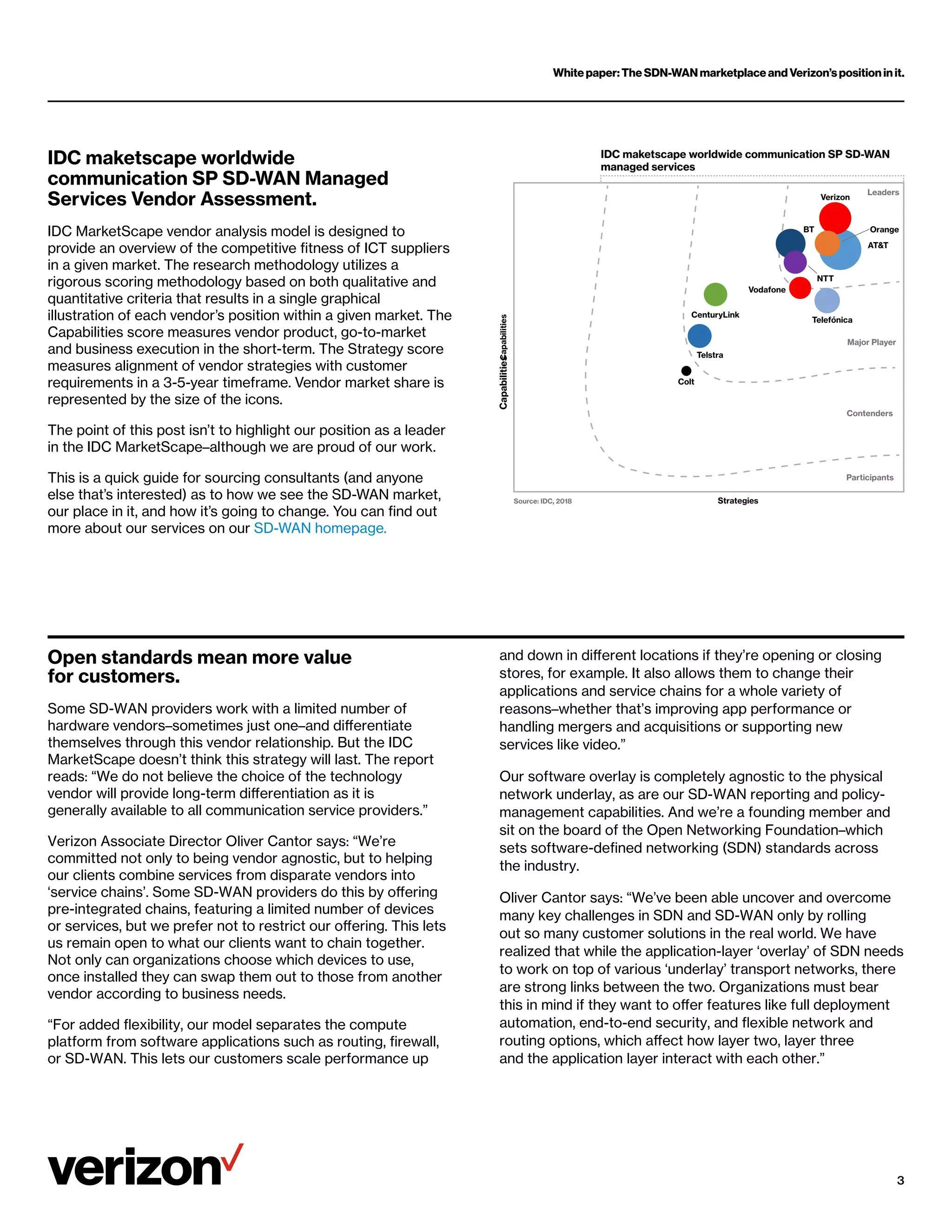
The report evaluates ten SD-WAN managed service
providers (including Verizon), positioning them on their
current capabilities and future strategy for delivering
these services.
White paper: The SDN-WAN marketplace and Verizon’s position in it.
3
Open standards mean more value
for customers.
Some SD-WAN providers work with a limited number of
hardware vendors–sometimes just one–and differentiate
themselves through this vendor relationship. But the IDC
MarketScape doesn’t think this strategy will last. The report
reads: “We do not believe the choice of the technology
vendor will provide long-term differentiation as it is
generally available to all communication service providers.”
Verizon Associate Director Oliver Cantor says: “We’re
committed not only to being vendor agnostic, but to helping
our clients combine services from disparate vendors into
‘service chains’. Some SD-WAN providers do this by offering
pre-integrated chains, featuring a limited number of devices
or services, but we prefer not to restrict our offering. This lets
us remain open to what our clients want to chain together.
Not only can organizations choose which devices to use,
once installed they can swap them out to those from another
vendor according to business needs.
“For added flexibility, our model separates the compute
platform from software applications such as routing, firewall,
or SD-WAN. This lets our customers scale performance up
IDC maketscape worldwide
communication SP SD-WAN Managed
Services Vendor Assessment.
IDC MarketScape vendor analysis model is designed to
provide an overview of the competitive fitness of ICT suppliers
in a given market. The research methodology utilizes a
rigorous scoring methodology based on both qualitative and
quantitative criteria that results in a single graphical
illustration of each vendor’s position within a given market. The
Capabilities score measures vendor product, go-to-market
and business execution in the short-term. The Strategy score
measures alignment of vendor strategies with customer
requirements in a 3-5-year timeframe. Vendor market share is
represented by the size of the icons.
The point of this post isn’t to highlight our position as a leader
in the IDC MarketScape–although we are proud of our work.
This is a quick guide for sourcing consultants (and anyone
else that’s interested) as to how we see the SD-WAN market,
our place in it, and how it’s going to change. You can find out
more about our services on our SD-WAN homepage.
and down in different locations if they’re opening or closing
stores, for example. It also allows them to change their
applications and service chains for a whole variety of
reasons–whether that’s improving app performance or
handling mergers and acquisitions or supporting new
services like video.”
Our software overlay is completely agnostic to the physical
network underlay, as are our SD-WAN reporting and policy-
management capabilities. And we’re a founding member and
sit on the board of the Open Networking Foundation–which
sets software-defined networking (SDN) standards across
the industry.
Oliver Cantor says: “We’ve been able uncover and overcome
many key challenges in SDN and SD-WAN only by rolling
out so many customer solutions in the real world. We have
realized that while the application-layer ‘overlay’ of SDN needs
to work on top of various ‘underlay’ transport networks, there
are strong links between the two. Organizations must bear
this in mind if they want to offer features like full deployment
automation, end-to-end security, and flexible network and
routing options, which affect how layer two, layer three
and the application layer interact with each other.”
Capabilities
IDC maketscape worldwide communication SP SD-WAN
managed services
Leaders
Major Player
Contenders
Participants
Verizon
Orange
BT
NTT
AT&T
Telefónica
Strategies
Source: IDC, 2018
Capabilities
Vodafone
CenturyLink
Telstra
Colt
White paper: The SDN-WAN marketplace and Verizon’s position in it.
4
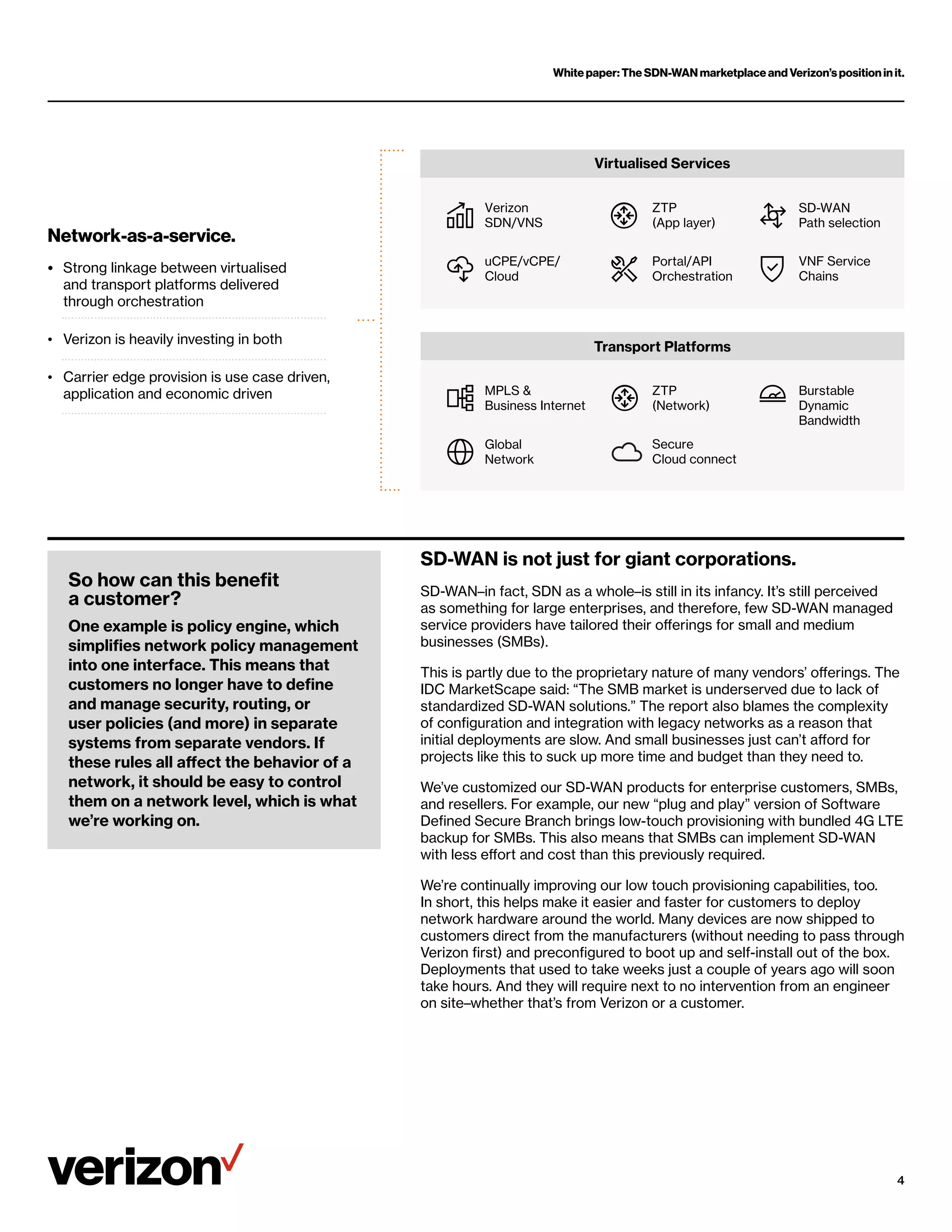
Network-as-a-service.
• 	
Strong linkage between virtualised
and transport platforms delivered
through orchestration
• Verizon is heavily investing in both
• 	
Carrier edge provision is use case driven,
application and economic driven
Virtualised Services
Transport Platforms
MPLS 
Business Internet
Verizon
SDN/VNS
Global
Network
uCPE/vCPE/
Cloud
ZTP
(Network)
ZTP
(App layer)
Secure
Cloud connect
Portal/API
Orchestration
Burstable
Dynamic
Bandwidth
SD-WAN
Path selection
VNF Service
Chains
SD-WAN is not just for giant corporations.
SD-WAN–in fact, SDN as a whole–is still in its infancy. It’s still perceived
as something for large enterprises, and therefore, few SD-WAN managed
service providers have tailored their offerings for small and medium
businesses (SMBs).
This is partly due to the proprietary nature of many vendors’ offerings. The
IDC MarketScape said: “The SMB market is underserved due to lack of
standardized SD-WAN solutions.” The report also blames the complexity
of configuration and integration with legacy networks as a reason that
initial deployments are slow. And small businesses just can’t afford for
projects like this to suck up more time and budget than they need to.
We’ve customized our SD-WAN products for enterprise customers, SMBs,
and resellers. For example, our new “plug and play” version of Software
Defined Secure Branch brings low-touch provisioning with bundled 4G LTE
backup for SMBs. This also means that SMBs can implement SD-WAN
with less effort and cost than this previously required.
We’re continually improving our low touch provisioning capabilities, too.
In short, this helps make it easier and faster for customers to deploy
network hardware around the world. Many devices are now shipped to
customers direct from the manufacturers (without needing to pass through
Verizon first) and preconfigured to boot up and self-install out of the box.
Deployments that used to take weeks just a couple of years ago will soon
take hours. And they will require next to no intervention from an engineer
on site–whether that’s from Verizon or a customer.
So how can this benefit
a customer?
One example is policy engine, which
simplifies network policy management
into one interface. This means that
customers no longer have to define
and manage security, routing, or
user policies (and more) in separate
systems from separate vendors. If
these rules all affect the behavior of a
network, it should be easy to control
them on a network level, which is what
we’re working on.
White paper: The SDN-WAN marketplace and Verizon’s position in it.
5
More resources on SD-WAN.
As a companion to this post, we’ve created a one-page/
two-page summary of our strengths relative to the SD-WAN
market’s needs, which you can download here.
If you’d like to speak to a Verizon expert about any of the
points raised here–or to find out more about our upcoming
projects–please contact us. We’re always delighted to talk to
consultants. We recognize the vital work you do in sourcing
the right networking services for your clients and are always
happy to discuss any questions you or they may have.
Towards on-demand networking services.
The IDC MarketScape recognizes the appetite in the SD-WAN
market for simpler ways of procuring and consuming network
services. The IDC MarketScape report says:
Many organizations are used to buying IT in fixed, three-to-
five-year cycles. They’re simply not used to flexibility. The
cloud is changing that–more quickly in some organizations
than others–and we want networking to go in the same
direction. Indeed, the IDC MarketScape report mentions our
“flexible, as-a-service pricing model with bundled deployment
platform options” as a key strength.
Again, it’s still early days for these new networking
consumption models, and many organizations are happy
working the way they’ve always worked. But the days of fixed
cycles are numbered, and more agile organizations are already
gaining an edge with pay-as-you-go models. Signing up to
a five-year deal today will tie an organization up until 2023,
when long-term deals might look completely outdated.
“Leaders provide a commercial framework
to provide a global SLA and simplify
contractual agreements.”
Learn more
Find out more about SD-WAN marketplace request a meeting with one of our specialists.

rsmiraldi_WHITEPAPER_SAMPLE.pdf

  • 1.
    The SD-WAN marketplace and Verizon’sposition in it. White paper
  • 2.
    White paper: TheSDN-WAN marketplace and Verizon’s position in it. 2 We’re proud that the IDC MarketScape has named us as a leader for SD-WAN managed services. In this post, we examine the needs of the SD-WAN market in more detail, compare Verizon’s offering to the competition, and take a look at why the IDC MarketScape came to the conclusions it did. Proud to be a leader in SD-WAN. In September, IDC published its IDC MarketScape 2018 vendor assessment for global communication services providers with a focus on software-defined WAN (SD-WAN) managed services. The report evaluates ten SD-WAN managed service providers (including Verizon), positioning them on their current capabilities and future strategy for delivering these services.
  • 3.
    White paper: TheSDN-WAN marketplace and Verizon’s position in it. 3 Open standards mean more value for customers. Some SD-WAN providers work with a limited number of hardware vendors–sometimes just one–and differentiate themselves through this vendor relationship. But the IDC MarketScape doesn’t think this strategy will last. The report reads: “We do not believe the choice of the technology vendor will provide long-term differentiation as it is generally available to all communication service providers.” Verizon Associate Director Oliver Cantor says: “We’re committed not only to being vendor agnostic, but to helping our clients combine services from disparate vendors into ‘service chains’. Some SD-WAN providers do this by offering pre-integrated chains, featuring a limited number of devices or services, but we prefer not to restrict our offering. This lets us remain open to what our clients want to chain together. Not only can organizations choose which devices to use, once installed they can swap them out to those from another vendor according to business needs. “For added flexibility, our model separates the compute platform from software applications such as routing, firewall, or SD-WAN. This lets our customers scale performance up IDC maketscape worldwide communication SP SD-WAN Managed Services Vendor Assessment. IDC MarketScape vendor analysis model is designed to provide an overview of the competitive fitness of ICT suppliers in a given market. The research methodology utilizes a rigorous scoring methodology based on both qualitative and quantitative criteria that results in a single graphical illustration of each vendor’s position within a given market. The Capabilities score measures vendor product, go-to-market and business execution in the short-term. The Strategy score measures alignment of vendor strategies with customer requirements in a 3-5-year timeframe. Vendor market share is represented by the size of the icons. The point of this post isn’t to highlight our position as a leader in the IDC MarketScape–although we are proud of our work. This is a quick guide for sourcing consultants (and anyone else that’s interested) as to how we see the SD-WAN market, our place in it, and how it’s going to change. You can find out more about our services on our SD-WAN homepage. and down in different locations if they’re opening or closing stores, for example. It also allows them to change their applications and service chains for a whole variety of reasons–whether that’s improving app performance or handling mergers and acquisitions or supporting new services like video.” Our software overlay is completely agnostic to the physical network underlay, as are our SD-WAN reporting and policy- management capabilities. And we’re a founding member and sit on the board of the Open Networking Foundation–which sets software-defined networking (SDN) standards across the industry. Oliver Cantor says: “We’ve been able uncover and overcome many key challenges in SDN and SD-WAN only by rolling out so many customer solutions in the real world. We have realized that while the application-layer ‘overlay’ of SDN needs to work on top of various ‘underlay’ transport networks, there are strong links between the two. Organizations must bear this in mind if they want to offer features like full deployment automation, end-to-end security, and flexible network and routing options, which affect how layer two, layer three and the application layer interact with each other.” Capabilities IDC maketscape worldwide communication SP SD-WAN managed services Leaders Major Player Contenders Participants Verizon Orange BT NTT AT&T Telefónica Strategies Source: IDC, 2018 Capabilities Vodafone CenturyLink Telstra Colt
  • 4.
    White paper: TheSDN-WAN marketplace and Verizon’s position in it. 4 Network-as-a-service. • Strong linkage between virtualised and transport platforms delivered through orchestration • Verizon is heavily investing in both • Carrier edge provision is use case driven, application and economic driven Virtualised Services Transport Platforms MPLS Business Internet Verizon SDN/VNS Global Network uCPE/vCPE/ Cloud ZTP (Network) ZTP (App layer) Secure Cloud connect Portal/API Orchestration Burstable Dynamic Bandwidth SD-WAN Path selection VNF Service Chains SD-WAN is not just for giant corporations. SD-WAN–in fact, SDN as a whole–is still in its infancy. It’s still perceived as something for large enterprises, and therefore, few SD-WAN managed service providers have tailored their offerings for small and medium businesses (SMBs). This is partly due to the proprietary nature of many vendors’ offerings. The IDC MarketScape said: “The SMB market is underserved due to lack of standardized SD-WAN solutions.” The report also blames the complexity of configuration and integration with legacy networks as a reason that initial deployments are slow. And small businesses just can’t afford for projects like this to suck up more time and budget than they need to. We’ve customized our SD-WAN products for enterprise customers, SMBs, and resellers. For example, our new “plug and play” version of Software Defined Secure Branch brings low-touch provisioning with bundled 4G LTE backup for SMBs. This also means that SMBs can implement SD-WAN with less effort and cost than this previously required. We’re continually improving our low touch provisioning capabilities, too. In short, this helps make it easier and faster for customers to deploy network hardware around the world. Many devices are now shipped to customers direct from the manufacturers (without needing to pass through Verizon first) and preconfigured to boot up and self-install out of the box. Deployments that used to take weeks just a couple of years ago will soon take hours. And they will require next to no intervention from an engineer on site–whether that’s from Verizon or a customer. So how can this benefit a customer? One example is policy engine, which simplifies network policy management into one interface. This means that customers no longer have to define and manage security, routing, or user policies (and more) in separate systems from separate vendors. If these rules all affect the behavior of a network, it should be easy to control them on a network level, which is what we’re working on.
  • 5.
    White paper: TheSDN-WAN marketplace and Verizon’s position in it. 5 More resources on SD-WAN. As a companion to this post, we’ve created a one-page/ two-page summary of our strengths relative to the SD-WAN market’s needs, which you can download here. If you’d like to speak to a Verizon expert about any of the points raised here–or to find out more about our upcoming projects–please contact us. We’re always delighted to talk to consultants. We recognize the vital work you do in sourcing the right networking services for your clients and are always happy to discuss any questions you or they may have. Towards on-demand networking services. The IDC MarketScape recognizes the appetite in the SD-WAN market for simpler ways of procuring and consuming network services. The IDC MarketScape report says: Many organizations are used to buying IT in fixed, three-to- five-year cycles. They’re simply not used to flexibility. The cloud is changing that–more quickly in some organizations than others–and we want networking to go in the same direction. Indeed, the IDC MarketScape report mentions our “flexible, as-a-service pricing model with bundled deployment platform options” as a key strength. Again, it’s still early days for these new networking consumption models, and many organizations are happy working the way they’ve always worked. But the days of fixed cycles are numbered, and more agile organizations are already gaining an edge with pay-as-you-go models. Signing up to a five-year deal today will tie an organization up until 2023, when long-term deals might look completely outdated. “Leaders provide a commercial framework to provide a global SLA and simplify contractual agreements.” Learn more Find out more about SD-WAN marketplace request a meeting with one of our specialists.