TRANSFORMING
ENTERPRISE NETWORK
INFRASTRUCTURE
WITH SD-WAN
WHITEPAPER
WHITEPAPER
Transforming enterprise network infrastructure with SD-WAN
2
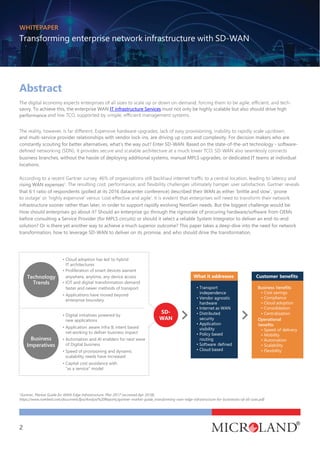
• Cloud adoption has led to hybrid
IT architectures
• Proliferation of smart devices warrant
Technology anywhere, anytime, any device access
Trends • IOT and digital transformation demand
faster and newer methods of transport
• Applications have moved beyond
enterprise boundary
Business
Imperatives
• Digital initiatives powered by
new applications
• Application aware infra & intent based
net working to deliver business impact
• Automation and AI enablers for next wave
of Digital business
• Speed of provisioning and dynamic
scalability needs have increased
• Capital cost avoidance with
“as a service” model
SD-
WAN
• Transport
independence
• Vendor agnostic
hardware
• Internet as WAN
• Distributed
security
• Application
visibility
• Policy based
routing
• d
• Cloud based
What it addresses b
b
• Cost savings
• Compliance
• Cloud adoption
• Consolidation
• Centralization
Operational
b
• Speed of delivery
• Mobility
• Automation
• Scalability
• Flexibility
Abstract
savvy. To achieve this, the enterprise WAN IT infrastructure Services must not only be highly scalable but also should drive high
performance
and multi-service provider relationships with vendor lock-ins, are driving up costs and complexity. For decision makers who are
constantly scouting for better alternatives, what’s the way out? Enter SD-WAN. Based on the state-of-the-art technology - software-
business branches, without the hassle of deploying additional systems, manual MPLS upgrades, or dedicated IT teams at individual
locations.
rising WAN expenses1
that 6:1 ratio of respondents (polled at its 2016 datacenter conference) described their WAN as either ‘brittle and slow’, ‘prone
infrastructure sooner rather than later, in-order to support rapidly evolving NextGen needs. But the biggest challenge would be:
How should enterprises go about it? Should an enterprise go through the rigmorale of procuring hardware/software from OEMs
before consulting a Service Provider (for MPLS circuits) or should it select a reliable System Integrator to deliver an end-to-end
solution? Or is there yet another way to achieve a much superior outcome? This paper takes a deep-dive into the need for network
transformation, how to leverage SD-WAN to deliver on its promise, and who should drive the transformation.
1
Gartner, Market Guide for WAN Edge Infrastructure, Mar 2017 (accessed Apr 2018),
https://www.riverbed.com/document/fpo/Analyst%20Reports/gartner-market-guide_transforming-wan-edge-infrastructure-for-businesses-of-all-sizes.pdf
WHITEPAPER
Transforming enterprise network infrastructure with SD-WAN
3
WAN marketplace
At its core, digital transformation is all about accelerating the pace of business to improve performance and reach, whenever and
wherever possible. For an enterprise to successfully embark on its digital transformation journey, it is imperative that its IT infrastructure
capability is geared to leverage NextGen technologies such as cloud, SaaS applications, et al. However, traditional WAN architectures
are typically complex with little visibility into application performance and control, and can take weeks or months to provision besides
requiring frequent MPLS upgrades and CPE equipment refresh.
As digital transformation becomes imperative, the need for higher bandwidth and availability, real-time application-level visibility, low
latency and superior security, is becoming more pressing than ever before. The situation is further compounded by the challenges and
the past decade or two. While these solutions worked well in the absence of other options, the emergence of newer technologies such
as IoT, Big Data, AI, ML, etc., is forcing the traditional WAN marketplace to undergo a complete makeover.
SD-WAN is that change-agent that the traditional WAN marketplace had been waiting for.
SD-WAN enables IT to not just respond rapidly to evolving business needs but it does so
networking, it enables dynamic path selection leveraging the underlying transport technology
resource consumption up/down, end-to-end visibility enabling IT to control network performance
to integrate emerging technologies such as 5G networks, cloud-based Wi-Fi, and IoT/ IIoT, AI and
ML, paving the way for a truly NextGen network experience. As enterprises aggressively pursue
their digital transformation strategies, a recent survey from 451 Research found that 10% of U.S.
year, and yet another 30% are considering it in the next three years.3
SD-WAN signals the end of edge routers
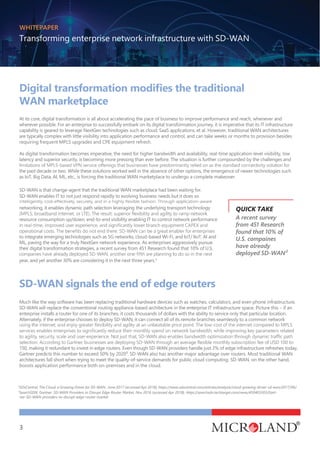
A recent survey
from 451 Research
found that 10% of
U.S. compaines
have already
deployed SD-WAN²
Much like the way software has been replacing traditional hardware devices such as watches, calculators, and even phone infrastructure,
SD-WAN will replace the conventional routing appliance-based architecture in the enterprise IT infrastructure space. Picture this – if an
enterprise installs a router for one of its branches, it costs thousands of dollars with the ability to service only that particular location.
Alternately, if the enterprise chooses to deploy SD-WAN, it can connect all of its remote branches seamlessly to a common network
150, making it redundant to invest in edge routers. Even though SD-WAN providers handle just 2% of edge infrastructure refreshes today,
Gartner predicts this number to exceed 50% by 2020³. SD-WAN also has another major advantage over routers. Most traditional WAN
architectures fall short when trying to meet the quality-of-service demands for public cloud computing. SD-WAN, on the other hand,
boosts application performance both on-premises and in the cloud.
2
SDxCentral, The Cloud: a Growing Driver for SD-WAN , June 2017 (accessed Apr 2018), https://www.sdxcentral.com/articles/analysis/cloud-growing-driver-sd-wan/2017/06/
3
SearchSDN, Gartner: SD-WAN Providers to Disrupt Edge Router Market, Nov 2016 (accessed Apr 2018), https://searchsdn.techtarget.com/news/450403303/Gart-
ner-SD-WAN-providers-to-disrupt-edge-router-market
QUICK TAKE
WHITEPAPER
Transforming enterprise network infrastructure with SD-WAN
4
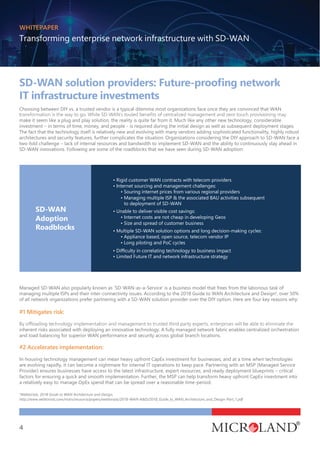
• Rigid customer WAN contracts with telecom providers
• Internet sourcing and management challenges:
• Souring internet prices from various regional providers
• Managing multiple ISP & the associated BAU activities subsequent
to deployment of SD-WAN
• Unable to deliver visible cost savings:
• Internet costs are not cheap in developing Geos
• Size and spread of customer business
• Multiple SD-WAN solution options and long decision-making cycles:
• Appliance based, open source, telecom vendor IP
• Long piloting and PoC cycles
• Limited Future IT and network infrastructure strategy
SD-WAN
Adoption
Roadblocks
IT infrastructure investments
Choosing between DIY vs. a trusted vendor is a typical dilemma most organizations face once they are convinced that WAN
make it seem like a plug and play solution, the reality is quite far from it. Much like any other new technology, considerable
investment – in terms of time, money, and people - is required during the initial design as well as subsequent deployment stages.
The fact that the technology itself is relatively new and evolving with many vendors adding sophisticated functionality, highly robust
architectures and security features, further complicates the situation. Organizations considering the DIY approach to SD-WAN face a
two-fold challenge – lack of internal resources and bandwidth to implement SD-WAN and the ability to continuously stay ahead in
SD-WAN innovations. Following are some of the roadblocks that we have seen during SD-WAN adoption:
Managed SD-WAN also popularly known as ‘SD-WAN-as-a-Service’ is a business model that frees from the laborious task of
managing multiple ISPs and their inter-connectivity issues. According to the 2018 Guide to WAN Architecture and Design4
, over 50%
of all network organizations prefer partnering with a SD-WAN solution provider over the DIY option. Here are four key reasons why:
#1 Mitigates risk:
inherent risks associated with deploying an innovative technology. A fully managed network fabric enables centralized orchestration
and load balancing for superior WAN performance and security across global branch locations.
#2 Accelerates implementation:
In-housing technology management can mean heavy upfront CapEx investment for businesses, and at a time when technologies
are evolving rapidly, it can become a nightmare for internal IT operations to keep pace. Partnering with an MSP (Managed Service
Provider) ensures businesses have access to the latest infrastructure, expert resources, and ready deployment blueprints – critical
factors for ensuring a quick and smooth implementation. Further, the MSP can help transform heavy upfront CapEx investment into
a relatively easy to manage OpEx spend that can be spread over a reasonable time-period.
4
Webtorials, 2018 Guide to WAN Architecture and Design,
http://www.webtorials.com/main/resource/papers/webtorials/2018-WAN-A&D/2018_Guide_to_WAN_Architecture_and_Design-Part_1.pdf
WHITEPAPER
Transforming enterprise network infrastructure with SD-WAN
5
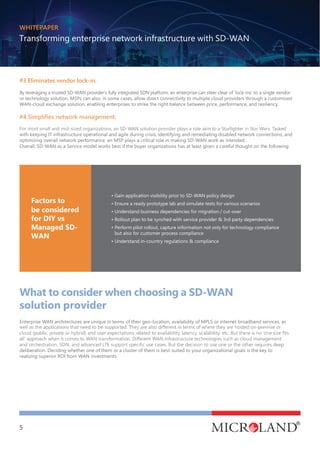
• Gain application visibility prior to SD-WAN policy design
• Ensure a ready prototype lab and simulate tests for various scenarios
• Understand business dependencies for migration / cut-over
• Rollout plan to be synched with service provider & 3rd party dependencies
• Perform pilot rollout, capture information not only for technology compliance
but also for customer process compliance
• Understand in-country regulations & compliance
Factors to
be considered
for DIY vs
Managed SD-
WAN
#3 Eliminates vendor lock-in:
By leveraging a trusted SD-WAN provider’s fully integrated SDN platform, an enterprise can steer clear of ‘lock-ins’ to a single vendor
or technology solution. MSPs can also, in some cases, allow direct connectivity to multiple cloud providers through a customized
WAN-cloud exchange solution, enabling enterprises to strike the right balance between price, performance, and resiliency.
with keeping IT infrastructure operational and agile during crisis, identifying and remediating disabled network connections, and
optimizing overall network performance, an MSP plays a critical role in making SD-WAN work as intended.
Overall, SD-WAN as a Service model works best if the buyer organizations has at least given a careful thought on the following:
What to consider when choosing a SD-WAN
solution provider
Enterprise WAN architectures are unique in terms of their geo-location, availability of MPLS or internet broadband services, as
deliberation. Deciding whether one of them or a cluster of them is best-suited to your organizational goals is the key to
realizing superior ROI from WAN investments.
WHITEPAPER
Transforming enterprise network infrastructure with SD-WAN
6
What's more, the SD-WAN provider market is congested with cloud networking,
WAN and LAN vendors moving in to get a piece of this pie. So how should
enterprises go about choosing the right SD-WAN solution provider? Enterprises
must evaluate their own strategies and future plans as much as those of the MSPs
to reap the right benefits in the promised timeframe. Here are three important
capabilities to consider when selecting an SD-WAN provider:
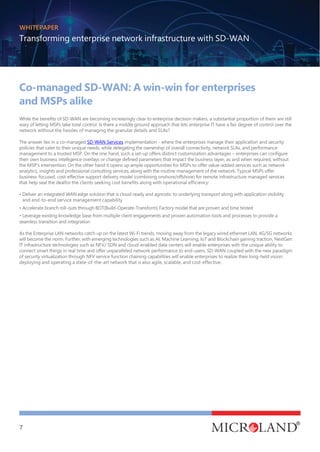
#1 Provides SLA-driven hybrid WAN services:
The main catalyst behind organizations shifting to SD-WAN is to acquire the
ability to efficiently leverage any available combination of public and private cloud
services. Instead of using internet links or wireless networks in a passive mode
as a back-up link to the primary MPLS circuits, enterprises prefer to use all these
simultaneously to slash WAN transport spend.
The trick to finding your
best-fit SD-WAN solution
provider is to first sort out
your top requirements,
and only then scout for
appropriate vendors who
promise to offer solutions/
benefits that match your
needs - not the other
way around.
An effective SD-WAN solution provider should therefore support wide-ranging WAN transport from MPLS, ethernet, internet,
wireless, and broadband. A key concern here is the flexibility offered by the SD-WAN provider when it comes to defining and
meeting SLAs. For instance, do they support the SLAs embodied in application policies that are the essence of many SD-WAN
systems? Telco-agnostic and vendor-independent systems integrators (SI) are often best positioned to address a plethora of
enterprise needs.
#2 Strong deployment expertise:
The right SD-WAN solution provider should be able to assess, design, transform, and manage the end-to-end WAN infrastructure
through customization. Not all enterprises deploy SD-WAN for the same reasons. Requirements can vary across business sizes
and the industry verticals, and even across applications deployed at the enterprise and their branch locations. For instance,
day-to-day branch operations may require a simple connectivity overlay to exchange data to and from branch locations to a
central cloud repository or a data center, but surveillance monitoring systems will need additional security features to safeguard
operations. Similarly, in industries such as banking, financial services, and healthcare that require compliance with stringent security
requirements. In such situations an MSP can implement robust security measures. These could include IDS/IPS, anti-virus modules,
vulnerability scan, and advanced unified threat management (UTM) systems as part of the WAN infrastructure. The MSP should have
the right people, processes, and technology expertise to offer tiered support to cater to low, high, and mission-critical requirements.
If the MSP can offer analytics capabilities on top of tiered services, it provides an extra layer of visibility and WAN optimization that
enterprises typically desire.
#3 Leverages strategic partnerships:
In most cases, buying an SD-WAN solution from a single vendor is likely to curtail independence and constrain the choices available
for enterprises. Opting for a fully managed and integrated network solution from a reputed SD-WAN solution provider is a better
option. Such providers typically establish strategic working partnerships with key players in the WAN value chain to ensure a
smoother deployment and cost-effective management. These include alliances with telco service providers for MPLS circuits, OEMs
for hardware/software, and local vendors to provide rack and stack or hands and feet and break-fix support.
This type of service chain also helps enterprises customize SD-WAN solutions through additional functionalities such as security
and WAN optimization. The key questions to consider include: when does the case for a proven, trusted SD-WAN provider make
sense and when is it best to collaborate with partners? How robust are those partnerships? Are there verifiable success stories of the
vendor’s capabilities and expertise?
QUICK TAKE
WHITEPAPER
Transforming enterprise network infrastructure with SD-WAN
7
Co-managed SD-WAN: A win-win for enterprises
and MSPs alike
While the benefits of SD-WAN are becoming increasingly clear to enterprise decision makers, a substantial proportion of them are still
wary of letting MSPs take total control. Is there a middle ground approach that lets enterprise IT have a fair degree of control over the
network without the hassles of managing the granular details and SLAs?
The answer lies in a co-managed SD-WAN Services implementation - where the enterprises manage their application and security
policies that cater to their unique needs, while delegating the ownership of overall connectivity, network SLAs, and performance
management to a trusted MSP. On the one hand, such a set-up offers distinct customization advantages – enterprises can configure
their own business intelligence overlays or change defined parameters that impact the business layer, as and when required, without
the MSP's intervention. On the other hand it opens up ample opportunities for MSPs to offer value-added services such as network
analytics, insights and professional consulting services, along with the routine management of the network. Typical MSPs offer
business-focused, cost-effective support delivery model (combining onshore/offshore) for remote infrastructure managed services
that help seal the dealfor the clients seeking cost benefits along with operational efficiency:
• Deliver an integrated WAN edge solution that is cloud-ready and agnostic to underlying transport along with application visibility
and end-to-end service management capability
• Accelerate branch roll-outs through BOT(Build-Operate-Transform) Factory model that are proven and time tested
• Leverage existing knowledge base from multiple client engagements and proven automation tools and processes to provide a
seamless transition and integration
As the Enterprise LAN networks catch up on the latest Wi-Fi trends, moving away from the legacy wired ethernet LAN, 4G/5G networks
will become the norm. Further, with emerging technologies such as AI, Machine Learning, IoT and Blockchain gaining traction, NextGen
IT infrastructure technologies such as NFV/ SDN and cloud-enabled data centers will enable enterprises with the unique ability to
connect smart things in real time and offer unparalleled network performance to end-users. SD-WAN coupled with the new paradigm
of security virtualization through NFV service function chaining capabilities will enable enterprises to realize their long-held vision:
deploying and operating a state-of-the-art network that is also agile, scalable, and cost-effective.
WHITEPAPER
Transforming enterprise network infrastructure with SD-WAN
8
About the author
Nithin Babu
Sr. Manager, Digital Network Services, Microland
Nithin Babu leads the Sales Enablement function for the Network Practice at Microland.
His wide-ranging expertise spans inter-disciplinary domains such as SDN/NFV networking
technologies, security infrastructure, cloud and enterprise applications.
His prior experience includes presales, marketing, business development and product management.
Nithin is a graduate in Computer Science from R.V. College of Engineering and a Post Graduate
Diploma in Software Enterprise Management from IIM Bangalore.
For further information
Contact us at: + 1 646-254-3598 or Email us at: info@microland.com
About Microland
Microland accelerates the digital transformation journey for global enterprises enabling them to deliver high-value
business outcomes and superior customer experience. Headquartered in Bangalore, India, Microland has more
than 3,800 professionals across its offices in Australia, Europe, India, Middle East and North America. Microland
partners with global enterprises to help them become more agile and innovative by integrating emerging technol-
ogies and applying automation, analytics and predictive intelligence to business processes. For more information
visit www.microland.com or email us at info@microland.com
© 2018 Microland Limited
Learn more about us at:
www.microland.com

Transforming enterprise network infrastructure with sd wan services

  • 1.
  • 2.
    WHITEPAPER Transforming enterprise networkinfrastructure with SD-WAN 2 • Cloud adoption has led to hybrid IT architectures • Proliferation of smart devices warrant Technology anywhere, anytime, any device access Trends • IOT and digital transformation demand faster and newer methods of transport • Applications have moved beyond enterprise boundary Business Imperatives • Digital initiatives powered by new applications • Application aware infra & intent based net working to deliver business impact • Automation and AI enablers for next wave of Digital business • Speed of provisioning and dynamic scalability needs have increased • Capital cost avoidance with “as a service” model SD- WAN • Transport independence • Vendor agnostic hardware • Internet as WAN • Distributed security • Application visibility • Policy based routing • d • Cloud based What it addresses b b • Cost savings • Compliance • Cloud adoption • Consolidation • Centralization Operational b • Speed of delivery • Mobility • Automation • Scalability • Flexibility Abstract savvy. To achieve this, the enterprise WAN IT infrastructure Services must not only be highly scalable but also should drive high performance and multi-service provider relationships with vendor lock-ins, are driving up costs and complexity. For decision makers who are constantly scouting for better alternatives, what’s the way out? Enter SD-WAN. Based on the state-of-the-art technology - software- business branches, without the hassle of deploying additional systems, manual MPLS upgrades, or dedicated IT teams at individual locations. rising WAN expenses1 that 6:1 ratio of respondents (polled at its 2016 datacenter conference) described their WAN as either ‘brittle and slow’, ‘prone infrastructure sooner rather than later, in-order to support rapidly evolving NextGen needs. But the biggest challenge would be: How should enterprises go about it? Should an enterprise go through the rigmorale of procuring hardware/software from OEMs before consulting a Service Provider (for MPLS circuits) or should it select a reliable System Integrator to deliver an end-to-end solution? Or is there yet another way to achieve a much superior outcome? This paper takes a deep-dive into the need for network transformation, how to leverage SD-WAN to deliver on its promise, and who should drive the transformation. 1 Gartner, Market Guide for WAN Edge Infrastructure, Mar 2017 (accessed Apr 2018), https://www.riverbed.com/document/fpo/Analyst%20Reports/gartner-market-guide_transforming-wan-edge-infrastructure-for-businesses-of-all-sizes.pdf
  • 3.
    WHITEPAPER Transforming enterprise networkinfrastructure with SD-WAN 3 WAN marketplace At its core, digital transformation is all about accelerating the pace of business to improve performance and reach, whenever and wherever possible. For an enterprise to successfully embark on its digital transformation journey, it is imperative that its IT infrastructure capability is geared to leverage NextGen technologies such as cloud, SaaS applications, et al. However, traditional WAN architectures are typically complex with little visibility into application performance and control, and can take weeks or months to provision besides requiring frequent MPLS upgrades and CPE equipment refresh. As digital transformation becomes imperative, the need for higher bandwidth and availability, real-time application-level visibility, low latency and superior security, is becoming more pressing than ever before. The situation is further compounded by the challenges and the past decade or two. While these solutions worked well in the absence of other options, the emergence of newer technologies such as IoT, Big Data, AI, ML, etc., is forcing the traditional WAN marketplace to undergo a complete makeover. SD-WAN is that change-agent that the traditional WAN marketplace had been waiting for. SD-WAN enables IT to not just respond rapidly to evolving business needs but it does so networking, it enables dynamic path selection leveraging the underlying transport technology resource consumption up/down, end-to-end visibility enabling IT to control network performance to integrate emerging technologies such as 5G networks, cloud-based Wi-Fi, and IoT/ IIoT, AI and ML, paving the way for a truly NextGen network experience. As enterprises aggressively pursue their digital transformation strategies, a recent survey from 451 Research found that 10% of U.S. year, and yet another 30% are considering it in the next three years.3 SD-WAN signals the end of edge routers A recent survey from 451 Research found that 10% of U.S. compaines have already deployed SD-WAN² Much like the way software has been replacing traditional hardware devices such as watches, calculators, and even phone infrastructure, SD-WAN will replace the conventional routing appliance-based architecture in the enterprise IT infrastructure space. Picture this – if an enterprise installs a router for one of its branches, it costs thousands of dollars with the ability to service only that particular location. Alternately, if the enterprise chooses to deploy SD-WAN, it can connect all of its remote branches seamlessly to a common network 150, making it redundant to invest in edge routers. Even though SD-WAN providers handle just 2% of edge infrastructure refreshes today, Gartner predicts this number to exceed 50% by 2020³. SD-WAN also has another major advantage over routers. Most traditional WAN architectures fall short when trying to meet the quality-of-service demands for public cloud computing. SD-WAN, on the other hand, boosts application performance both on-premises and in the cloud. 2 SDxCentral, The Cloud: a Growing Driver for SD-WAN , June 2017 (accessed Apr 2018), https://www.sdxcentral.com/articles/analysis/cloud-growing-driver-sd-wan/2017/06/ 3 SearchSDN, Gartner: SD-WAN Providers to Disrupt Edge Router Market, Nov 2016 (accessed Apr 2018), https://searchsdn.techtarget.com/news/450403303/Gart- ner-SD-WAN-providers-to-disrupt-edge-router-market QUICK TAKE
  • 4.
    WHITEPAPER Transforming enterprise networkinfrastructure with SD-WAN 4 • Rigid customer WAN contracts with telecom providers • Internet sourcing and management challenges: • Souring internet prices from various regional providers • Managing multiple ISP & the associated BAU activities subsequent to deployment of SD-WAN • Unable to deliver visible cost savings: • Internet costs are not cheap in developing Geos • Size and spread of customer business • Multiple SD-WAN solution options and long decision-making cycles: • Appliance based, open source, telecom vendor IP • Long piloting and PoC cycles • Limited Future IT and network infrastructure strategy SD-WAN Adoption Roadblocks IT infrastructure investments Choosing between DIY vs. a trusted vendor is a typical dilemma most organizations face once they are convinced that WAN make it seem like a plug and play solution, the reality is quite far from it. Much like any other new technology, considerable investment – in terms of time, money, and people - is required during the initial design as well as subsequent deployment stages. The fact that the technology itself is relatively new and evolving with many vendors adding sophisticated functionality, highly robust architectures and security features, further complicates the situation. Organizations considering the DIY approach to SD-WAN face a two-fold challenge – lack of internal resources and bandwidth to implement SD-WAN and the ability to continuously stay ahead in SD-WAN innovations. Following are some of the roadblocks that we have seen during SD-WAN adoption: Managed SD-WAN also popularly known as ‘SD-WAN-as-a-Service’ is a business model that frees from the laborious task of managing multiple ISPs and their inter-connectivity issues. According to the 2018 Guide to WAN Architecture and Design4 , over 50% of all network organizations prefer partnering with a SD-WAN solution provider over the DIY option. Here are four key reasons why: #1 Mitigates risk: inherent risks associated with deploying an innovative technology. A fully managed network fabric enables centralized orchestration and load balancing for superior WAN performance and security across global branch locations. #2 Accelerates implementation: In-housing technology management can mean heavy upfront CapEx investment for businesses, and at a time when technologies are evolving rapidly, it can become a nightmare for internal IT operations to keep pace. Partnering with an MSP (Managed Service Provider) ensures businesses have access to the latest infrastructure, expert resources, and ready deployment blueprints – critical factors for ensuring a quick and smooth implementation. Further, the MSP can help transform heavy upfront CapEx investment into a relatively easy to manage OpEx spend that can be spread over a reasonable time-period. 4 Webtorials, 2018 Guide to WAN Architecture and Design, http://www.webtorials.com/main/resource/papers/webtorials/2018-WAN-A&D/2018_Guide_to_WAN_Architecture_and_Design-Part_1.pdf
  • 5.
    WHITEPAPER Transforming enterprise networkinfrastructure with SD-WAN 5 • Gain application visibility prior to SD-WAN policy design • Ensure a ready prototype lab and simulate tests for various scenarios • Understand business dependencies for migration / cut-over • Rollout plan to be synched with service provider & 3rd party dependencies • Perform pilot rollout, capture information not only for technology compliance but also for customer process compliance • Understand in-country regulations & compliance Factors to be considered for DIY vs Managed SD- WAN #3 Eliminates vendor lock-in: By leveraging a trusted SD-WAN provider’s fully integrated SDN platform, an enterprise can steer clear of ‘lock-ins’ to a single vendor or technology solution. MSPs can also, in some cases, allow direct connectivity to multiple cloud providers through a customized WAN-cloud exchange solution, enabling enterprises to strike the right balance between price, performance, and resiliency. with keeping IT infrastructure operational and agile during crisis, identifying and remediating disabled network connections, and optimizing overall network performance, an MSP plays a critical role in making SD-WAN work as intended. Overall, SD-WAN as a Service model works best if the buyer organizations has at least given a careful thought on the following: What to consider when choosing a SD-WAN solution provider Enterprise WAN architectures are unique in terms of their geo-location, availability of MPLS or internet broadband services, as deliberation. Deciding whether one of them or a cluster of them is best-suited to your organizational goals is the key to realizing superior ROI from WAN investments.
  • 6.
    WHITEPAPER Transforming enterprise networkinfrastructure with SD-WAN 6 What's more, the SD-WAN provider market is congested with cloud networking, WAN and LAN vendors moving in to get a piece of this pie. So how should enterprises go about choosing the right SD-WAN solution provider? Enterprises must evaluate their own strategies and future plans as much as those of the MSPs to reap the right benefits in the promised timeframe. Here are three important capabilities to consider when selecting an SD-WAN provider: #1 Provides SLA-driven hybrid WAN services: The main catalyst behind organizations shifting to SD-WAN is to acquire the ability to efficiently leverage any available combination of public and private cloud services. Instead of using internet links or wireless networks in a passive mode as a back-up link to the primary MPLS circuits, enterprises prefer to use all these simultaneously to slash WAN transport spend. The trick to finding your best-fit SD-WAN solution provider is to first sort out your top requirements, and only then scout for appropriate vendors who promise to offer solutions/ benefits that match your needs - not the other way around. An effective SD-WAN solution provider should therefore support wide-ranging WAN transport from MPLS, ethernet, internet, wireless, and broadband. A key concern here is the flexibility offered by the SD-WAN provider when it comes to defining and meeting SLAs. For instance, do they support the SLAs embodied in application policies that are the essence of many SD-WAN systems? Telco-agnostic and vendor-independent systems integrators (SI) are often best positioned to address a plethora of enterprise needs. #2 Strong deployment expertise: The right SD-WAN solution provider should be able to assess, design, transform, and manage the end-to-end WAN infrastructure through customization. Not all enterprises deploy SD-WAN for the same reasons. Requirements can vary across business sizes and the industry verticals, and even across applications deployed at the enterprise and their branch locations. For instance, day-to-day branch operations may require a simple connectivity overlay to exchange data to and from branch locations to a central cloud repository or a data center, but surveillance monitoring systems will need additional security features to safeguard operations. Similarly, in industries such as banking, financial services, and healthcare that require compliance with stringent security requirements. In such situations an MSP can implement robust security measures. These could include IDS/IPS, anti-virus modules, vulnerability scan, and advanced unified threat management (UTM) systems as part of the WAN infrastructure. The MSP should have the right people, processes, and technology expertise to offer tiered support to cater to low, high, and mission-critical requirements. If the MSP can offer analytics capabilities on top of tiered services, it provides an extra layer of visibility and WAN optimization that enterprises typically desire. #3 Leverages strategic partnerships: In most cases, buying an SD-WAN solution from a single vendor is likely to curtail independence and constrain the choices available for enterprises. Opting for a fully managed and integrated network solution from a reputed SD-WAN solution provider is a better option. Such providers typically establish strategic working partnerships with key players in the WAN value chain to ensure a smoother deployment and cost-effective management. These include alliances with telco service providers for MPLS circuits, OEMs for hardware/software, and local vendors to provide rack and stack or hands and feet and break-fix support. This type of service chain also helps enterprises customize SD-WAN solutions through additional functionalities such as security and WAN optimization. The key questions to consider include: when does the case for a proven, trusted SD-WAN provider make sense and when is it best to collaborate with partners? How robust are those partnerships? Are there verifiable success stories of the vendor’s capabilities and expertise? QUICK TAKE
  • 7.
    WHITEPAPER Transforming enterprise networkinfrastructure with SD-WAN 7 Co-managed SD-WAN: A win-win for enterprises and MSPs alike While the benefits of SD-WAN are becoming increasingly clear to enterprise decision makers, a substantial proportion of them are still wary of letting MSPs take total control. Is there a middle ground approach that lets enterprise IT have a fair degree of control over the network without the hassles of managing the granular details and SLAs? The answer lies in a co-managed SD-WAN Services implementation - where the enterprises manage their application and security policies that cater to their unique needs, while delegating the ownership of overall connectivity, network SLAs, and performance management to a trusted MSP. On the one hand, such a set-up offers distinct customization advantages – enterprises can configure their own business intelligence overlays or change defined parameters that impact the business layer, as and when required, without the MSP's intervention. On the other hand it opens up ample opportunities for MSPs to offer value-added services such as network analytics, insights and professional consulting services, along with the routine management of the network. Typical MSPs offer business-focused, cost-effective support delivery model (combining onshore/offshore) for remote infrastructure managed services that help seal the dealfor the clients seeking cost benefits along with operational efficiency: • Deliver an integrated WAN edge solution that is cloud-ready and agnostic to underlying transport along with application visibility and end-to-end service management capability • Accelerate branch roll-outs through BOT(Build-Operate-Transform) Factory model that are proven and time tested • Leverage existing knowledge base from multiple client engagements and proven automation tools and processes to provide a seamless transition and integration As the Enterprise LAN networks catch up on the latest Wi-Fi trends, moving away from the legacy wired ethernet LAN, 4G/5G networks will become the norm. Further, with emerging technologies such as AI, Machine Learning, IoT and Blockchain gaining traction, NextGen IT infrastructure technologies such as NFV/ SDN and cloud-enabled data centers will enable enterprises with the unique ability to connect smart things in real time and offer unparalleled network performance to end-users. SD-WAN coupled with the new paradigm of security virtualization through NFV service function chaining capabilities will enable enterprises to realize their long-held vision: deploying and operating a state-of-the-art network that is also agile, scalable, and cost-effective.
  • 8.
    WHITEPAPER Transforming enterprise networkinfrastructure with SD-WAN 8 About the author Nithin Babu Sr. Manager, Digital Network Services, Microland Nithin Babu leads the Sales Enablement function for the Network Practice at Microland. His wide-ranging expertise spans inter-disciplinary domains such as SDN/NFV networking technologies, security infrastructure, cloud and enterprise applications. His prior experience includes presales, marketing, business development and product management. Nithin is a graduate in Computer Science from R.V. College of Engineering and a Post Graduate Diploma in Software Enterprise Management from IIM Bangalore. For further information Contact us at: + 1 646-254-3598 or Email us at: info@microland.com About Microland Microland accelerates the digital transformation journey for global enterprises enabling them to deliver high-value business outcomes and superior customer experience. Headquartered in Bangalore, India, Microland has more than 3,800 professionals across its offices in Australia, Europe, India, Middle East and North America. Microland partners with global enterprises to help them become more agile and innovative by integrating emerging technol- ogies and applying automation, analytics and predictive intelligence to business processes. For more information visit www.microland.com or email us at info@microland.com © 2018 Microland Limited Learn more about us at: www.microland.com