RSA Algorithm:
Pseudocode and
Implementation in C++
Name: Anees ur Rehman
Reg#: BCB242011
Design And Analysis Of Algorithm
Introduction
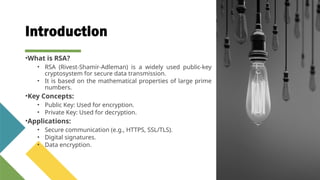
•What is RSA?
• RSA (Rivest-Shamir-Adleman) is a widely used public-key
cryptosystem for secure data transmission.
• It is based on the mathematical properties of large prime
numbers.
•Key Concepts:
• Public Key: Used for encryption.
• Private Key: Used for decryption.
•Applications:
• Secure communication (e.g., HTTPS, SSL/TLS).
• Digital signatures.
• Data encryption.
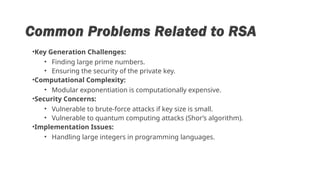
Common Problems Related to RSA
•Key Generation Challenges:
• Finding large prime numbers.
• Ensuring the security of the private key.
•Computational Complexity:
• Modular exponentiation is computationally expensive.
•Security Concerns:
• Vulnerable to brute-force attacks if key size is small.
• Vulnerable to quantum computing attacks (Shor’s algorithm).
•Implementation Issues:
• Handling large integers in programming languages.
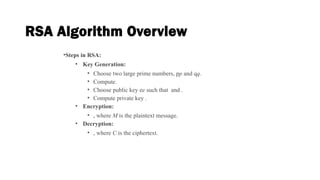
RSA Algorithm Overview
•Steps in RSA:
• Key Generation:
• Choose two large prime numbers, pp and qq.
• Compute.
• Choose public key ee such that and .
• Compute private key .
• Encryption:
• , where M is the plaintext message.
• Decryption:
• , where C is the ciphertext.
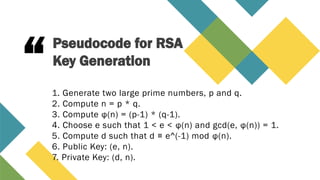
“1. Generate two large prime numbers, p and q.
2. Compute n = p * q.
3. Compute φ(n) = (p-1) * (q-1).
4. Choose e such that 1 < e < φ(n) and gcd(e, φ(n)) = 1.
5. Compute d such that d ≡ e^(-1) mod φ(n).
6. Public Key: (e, n).
7. Private Key: (d, n).
Pseudocode for RSA
Key Generation
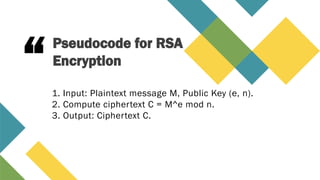
“1. Input: Plaintext message M, Public Key (e, n).
2. Compute ciphertext C = M^e mod n.
3. Output: Ciphertext C.
Pseudocode for RSA
Encryption
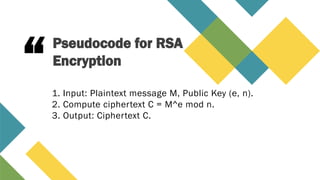
“1. Input: Plaintext message M, Public Key (e, n).
2. Compute ciphertext C = M^e mod n.
3. Output: Ciphertext C.
Pseudocode for RSA
Encryption
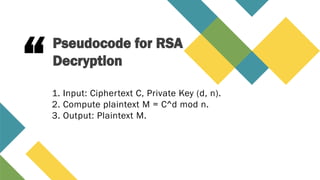
“1. Input: Ciphertext C, Private Key (d, n).
2. Compute plaintext M = C^d mod n.
3. Output: Plaintext M.
Pseudocode for RSA
Decryption
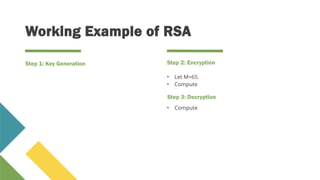
Working Example of RSA
Step 1: Key Generation Step 2: Encryption
• Let M=65.
• Compute
Step 3: Decryption
• Compute
Time and Space Complexity
•Key Generation:
• Time Complexity: , where k is the number of bits in n.
•Encryption/Decryption:
• Time Complexity: for modular exponentiation.
•Space Complexity:
• O(k)O(k) for storing keys and intermediate results.
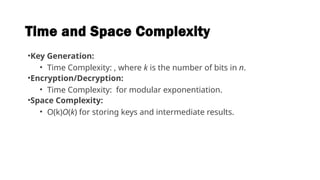
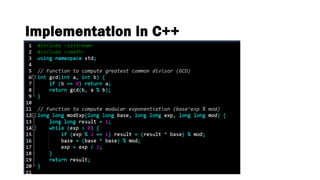
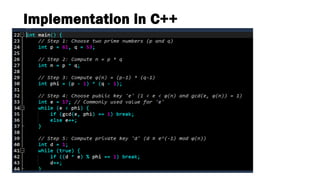
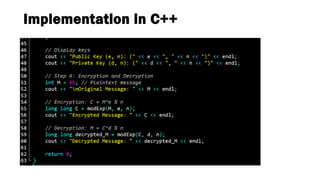
Implementation in C++
Summary
• RSA is a robust public-key cryptosystem based on the difficulty of
factoring large prime numbers.
• It involves key generation, encryption, and decryption using modular
arithmetic.
• Proper implementation requires handling large integers and ensuring
security through appropriate key sizes.
• Applications include secure communication and digital signatures.
References
•Books:
• "Introduction to Algorithms" by Cormen, Leiserson, Rivest,
and Stein.
• "Applied Cryptography" by Bruce Schneier.
•Online Resources:
• Wikipedia: RSA Algorithm
• GeeksforGeeks: RSA Algorithm
Thank you
Anees ur Rehman
Reg#: BCB242011

RSA Algorithm and its implementation in C++.pptx

  • 1.
    RSA Algorithm: Pseudocode and Implementationin C++ Name: Anees ur Rehman Reg#: BCB242011 Design And Analysis Of Algorithm
  • 2.
    Introduction •What is RSA? •RSA (Rivest-Shamir-Adleman) is a widely used public-key cryptosystem for secure data transmission. • It is based on the mathematical properties of large prime numbers. •Key Concepts: • Public Key: Used for encryption. • Private Key: Used for decryption. •Applications: • Secure communication (e.g., HTTPS, SSL/TLS). • Digital signatures. • Data encryption.
  • 3.
    Common Problems Relatedto RSA •Key Generation Challenges: • Finding large prime numbers. • Ensuring the security of the private key. •Computational Complexity: • Modular exponentiation is computationally expensive. •Security Concerns: • Vulnerable to brute-force attacks if key size is small. • Vulnerable to quantum computing attacks (Shor’s algorithm). •Implementation Issues: • Handling large integers in programming languages.
  • 4.
    RSA Algorithm Overview •Stepsin RSA: • Key Generation: • Choose two large prime numbers, pp and qq. • Compute. • Choose public key ee such that and . • Compute private key . • Encryption: • , where M is the plaintext message. • Decryption: • , where C is the ciphertext.
  • 5.
    “1. Generate twolarge prime numbers, p and q. 2. Compute n = p * q. 3. Compute φ(n) = (p-1) * (q-1). 4. Choose e such that 1 < e < φ(n) and gcd(e, φ(n)) = 1. 5. Compute d such that d ≡ e^(-1) mod φ(n). 6. Public Key: (e, n). 7. Private Key: (d, n). Pseudocode for RSA Key Generation
  • 6.
    “1. Input: Plaintextmessage M, Public Key (e, n). 2. Compute ciphertext C = M^e mod n. 3. Output: Ciphertext C. Pseudocode for RSA Encryption
  • 7.
    “1. Input: Plaintextmessage M, Public Key (e, n). 2. Compute ciphertext C = M^e mod n. 3. Output: Ciphertext C. Pseudocode for RSA Encryption
  • 8.
    “1. Input: CiphertextC, Private Key (d, n). 2. Compute plaintext M = C^d mod n. 3. Output: Plaintext M. Pseudocode for RSA Decryption
  • 9.
    Working Example ofRSA Step 1: Key Generation Step 2: Encryption • Let M=65. • Compute Step 3: Decryption • Compute
  • 10.
    Time and SpaceComplexity •Key Generation: • Time Complexity: , where k is the number of bits in n. •Encryption/Decryption: • Time Complexity: for modular exponentiation. •Space Complexity: • O(k)O(k) for storing keys and intermediate results.
  • 11.
  • 12.
  • 13.
  • 14.
    Summary • RSA isa robust public-key cryptosystem based on the difficulty of factoring large prime numbers. • It involves key generation, encryption, and decryption using modular arithmetic. • Proper implementation requires handling large integers and ensuring security through appropriate key sizes. • Applications include secure communication and digital signatures.
  • 15.
    References •Books: • "Introduction toAlgorithms" by Cormen, Leiserson, Rivest, and Stein. • "Applied Cryptography" by Bruce Schneier. •Online Resources: • Wikipedia: RSA Algorithm • GeeksforGeeks: RSA Algorithm
  • 16.
    Thank you Anees urRehman Reg#: BCB242011