© 2008 Cisco Systems, Inc. All rights reserved. Cisco Confidential
Presentation_ID 1
Chapter 7: Routing
Dynamically
Routing Protocols
Presentation_ID 2
© 2008 Cisco Systems, Inc. All rights reserved. Cisco Confidential
Chapter 7
7.1 Dynamic Routing Protocols
7.2 Distance Vector Dynamic Routing
7.3 RIP and RIPng Routing
7.4 Link-State Dynamic Routing
7.5 The Routing Table
7.6 Summary
Presentation_ID 3
© 2008 Cisco Systems, Inc. All rights reserved. Cisco Confidential
Chapter 7: Objectives
 Explain the basic operation of dynamic routing protocols.
 Compare and contrast dynamic and static routing.
 Determine which networks are available during an initial network
discovery phase.
 Define the different categories of routing protocols.
 Describe the process by which distance vector routing protocols
learn about other networks.
 Identify the types of distance-vector routing protocols.
 Configure the RIP routing protocol.
 Configure the RIPng routing protocol.
 Explain the process by which link-state routing protocols learn about
other networks.
Presentation_ID 4
© 2008 Cisco Systems, Inc. All rights reserved. Cisco Confidential
Chapter 7: Objectives (continued)
 Describe the information sent in a link-state update.
 Describe advantages and disadvantages of using link-state routing
protocols.
 Identify protocols that use the link-state routing process. (OSPF, IS-
IS)
 Determine the route source, administrative distance, and metric for a
given route.
 Explain the concept of a parent/child relationship in a dynamically
built routing table.
 Compare the IPv4 classless route lookup process and the IPv6
lookup process.
 Analyze a routing table to determine which route will be used to
forward a packet.
Presentation_ID 5
© 2008 Cisco Systems, Inc. All rights reserved. Cisco Confidential
Dynamic Routing Protocols
Presentation_ID 6
© 2008 Cisco Systems, Inc. All rights reserved. Cisco Confidential
Dynamic Routing Protocol Operation
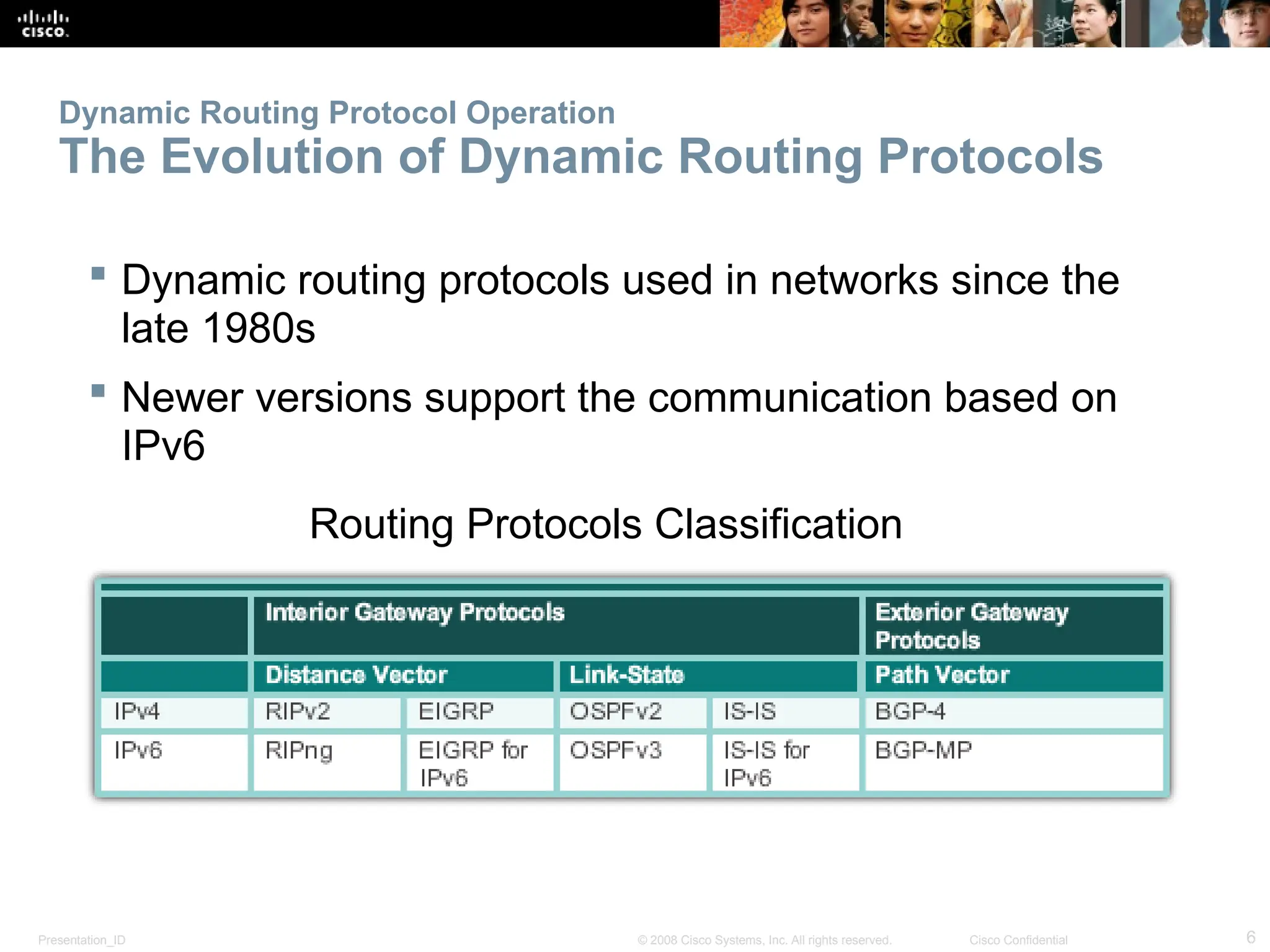
The Evolution of Dynamic Routing Protocols
 Dynamic routing protocols used in networks since the
late 1980s
 Newer versions support the communication based on
IPv6
Routing Protocols Classification
Presentation_ID 7
© 2008 Cisco Systems, Inc. All rights reserved. Cisco Confidential
Dynamic Routing Protocol Operation
Purpose of Dynamic Routing Protocols
 Routing Protocols
• Used to facilitate the exchange of routing information between
routers
 Purpose of dynamic routing protocols includes:
• Discovery of remote networks
• Maintaining up-to-date routing information
• Choosing the best path to destination networks
• Ability to find a new best path if the current path is no longer
available
Presentation_ID 8
© 2008 Cisco Systems, Inc. All rights reserved. Cisco Confidential
Dynamic Routing Protocol Operation
Purpose of Dynamic Routing Protocols
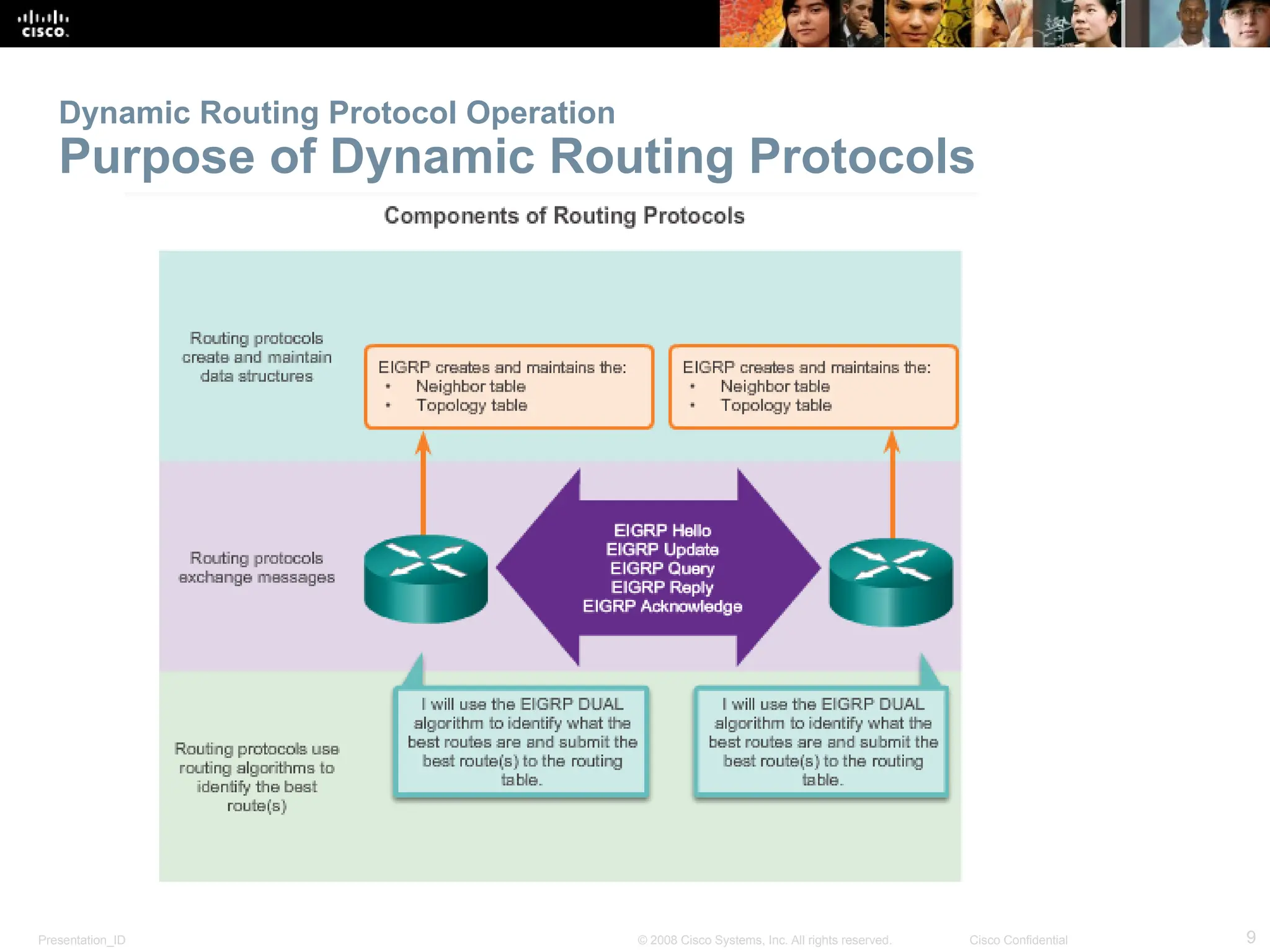
Main components of dynamic routing protocols include:
 Data structures - Routing protocols typically use tables
or databases for its operations. This information is kept
in RAM.
 Routing protocol messages - Routing protocols use
various types of messages to discover neighboring
routers, exchange routing information, and other tasks
to learn and maintain accurate information about the
network.
 Algorithm - Routing protocols use algorithms for
facilitating routing information for best path
determination.
Presentation_ID 9
© 2008 Cisco Systems, Inc. All rights reserved. Cisco Confidential
Dynamic Routing Protocol Operation
Purpose of Dynamic Routing Protocols
Presentation_ID 10
© 2008 Cisco Systems, Inc. All rights reserved. Cisco Confidential
Dynamic Routing Protocol Operation
The Role of Dynamic Routing Protocols
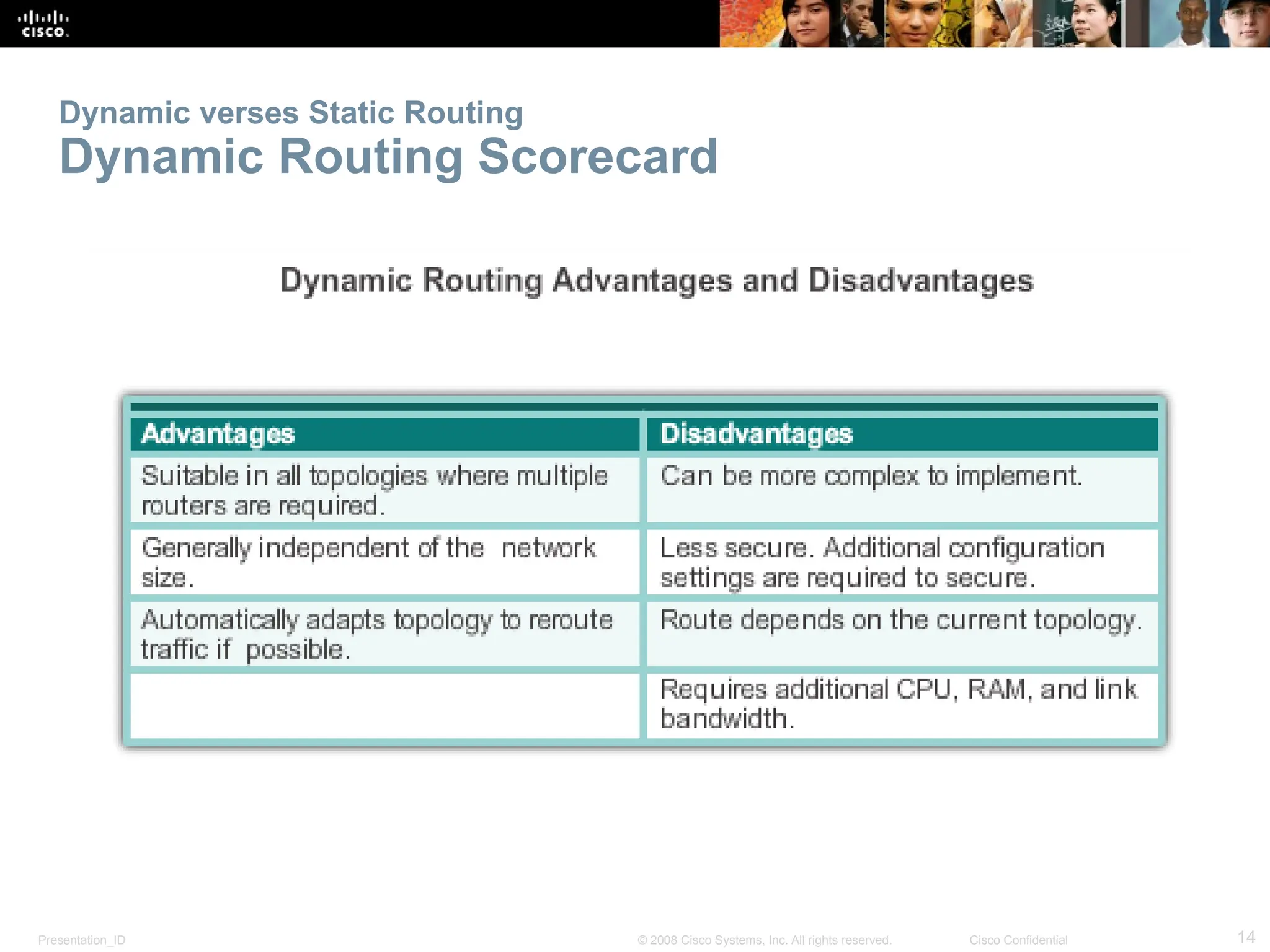
 Advantages of dynamic routing
• Automatically share information about remote
networks
• Determine the best path to each network and add
this information to their routing tables
• Compared to static routing, dynamic routing
protocols require less administrative overhead
• Help the network administrator manage the time-
consuming process of configuring and maintaining
static routes
 Disadvantages of dynamic routing
• Dedicate part of a routers resources for protocol
operation, including CPU time and network link
bandwidth
 Times when static routing is more appropriate
Presentation_ID 11
© 2008 Cisco Systems, Inc. All rights reserved. Cisco Confidential
Dynamic verses Static Routing
Using Static Routing
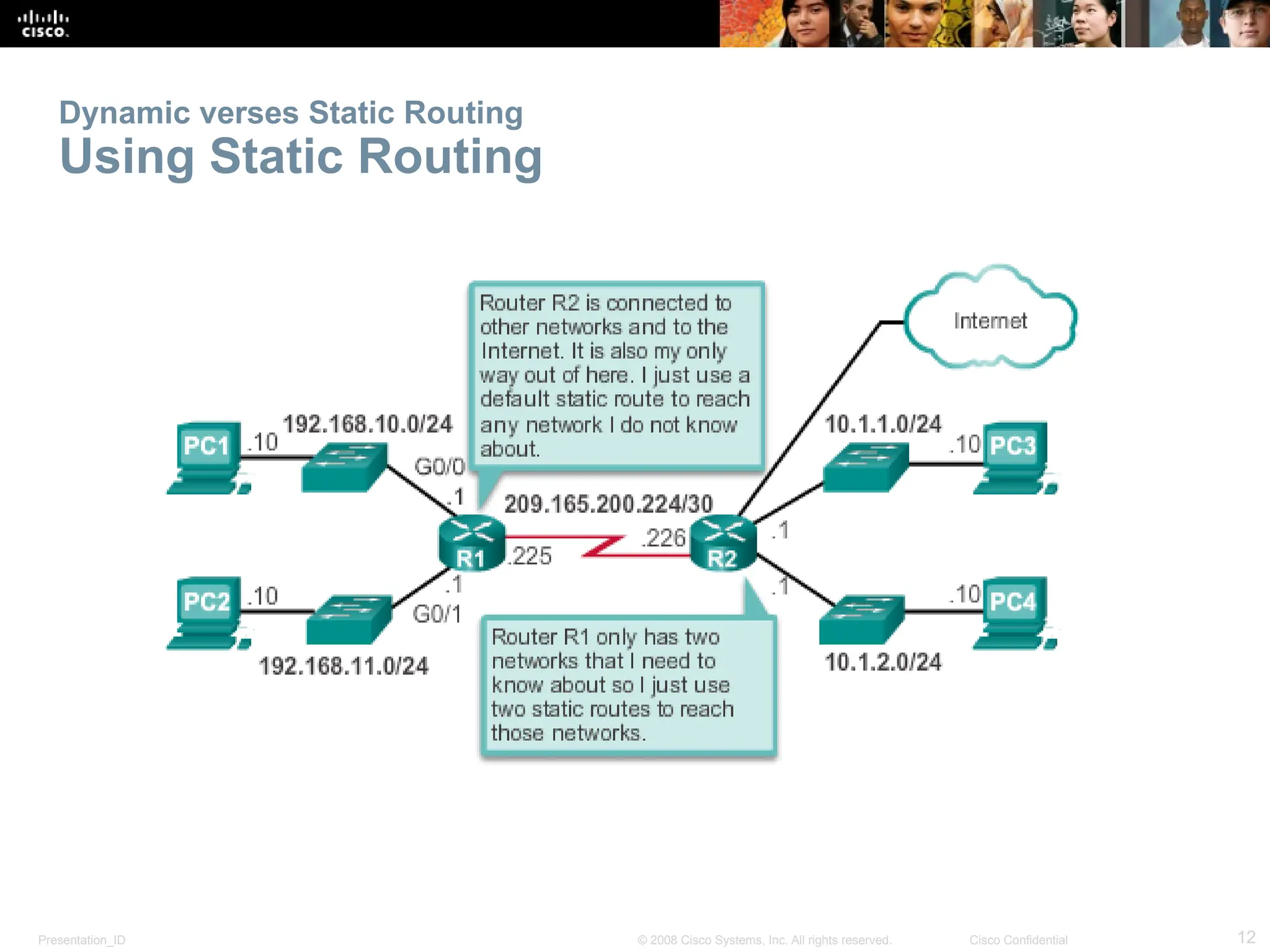
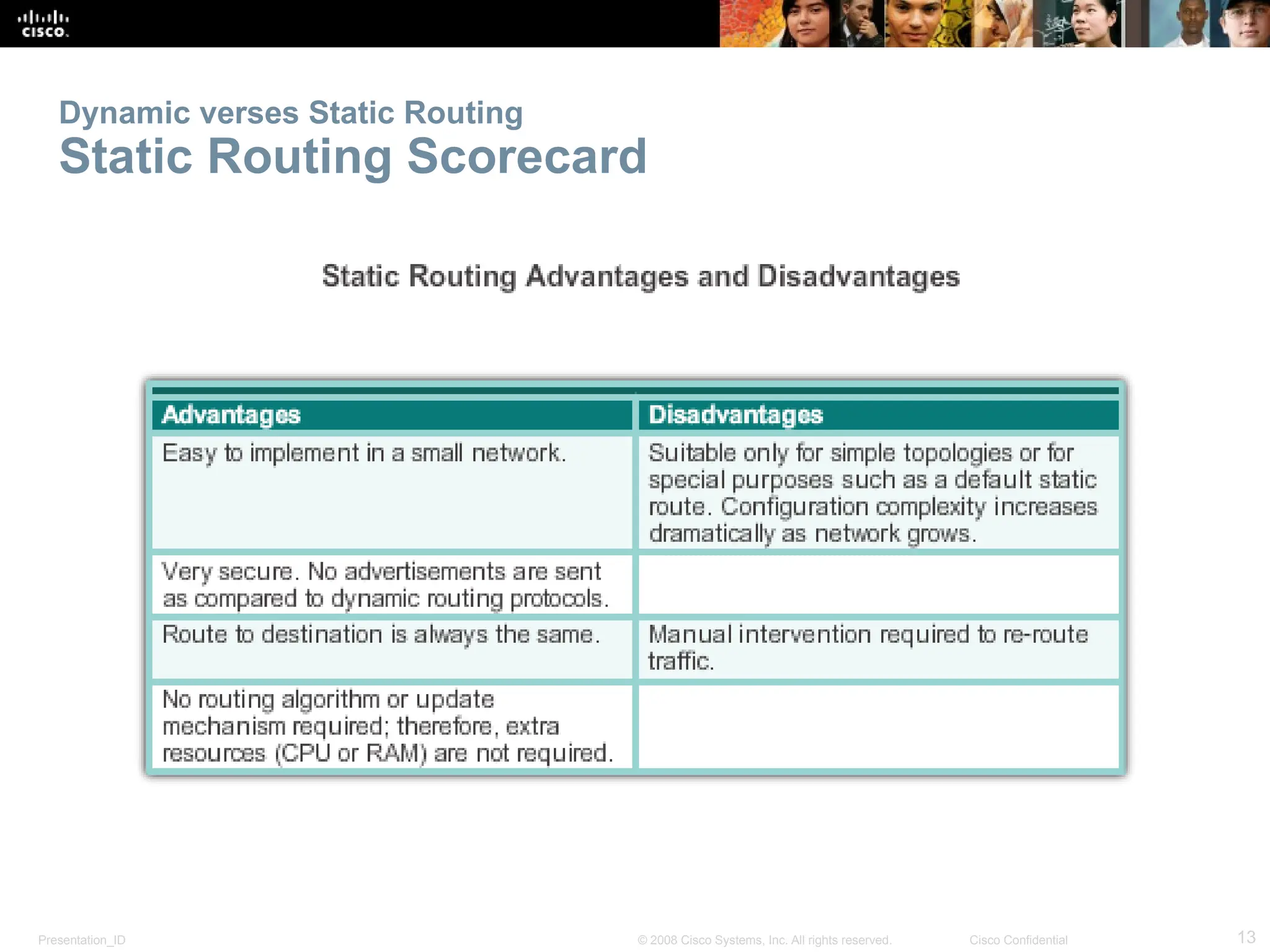
 Networks typically use a combination of both static and
dynamic routing
 Static routing has several primary uses
• Providing ease of routing table maintenance in smaller
networks that are not expected to grow significantly
• Routing to and from a stub network
o a network with only one default route out and no
knowledge of any remote networks
• Accessing a single default router
o used to represent a path to any network that does not
have a match in the routing table
Presentation_ID 12
© 2008 Cisco Systems, Inc. All rights reserved. Cisco Confidential
Dynamic verses Static Routing
Using Static Routing
Presentation_ID 13
© 2008 Cisco Systems, Inc. All rights reserved. Cisco Confidential
Dynamic verses Static Routing
Static Routing Scorecard
Presentation_ID 14
© 2008 Cisco Systems, Inc. All rights reserved. Cisco Confidential
Dynamic verses Static Routing
Dynamic Routing Scorecard
Presentation_ID 15
© 2008 Cisco Systems, Inc. All rights reserved. Cisco Confidential
Routing Protocol Operating Fundamentals
Dynamic Routing Protocol Operation
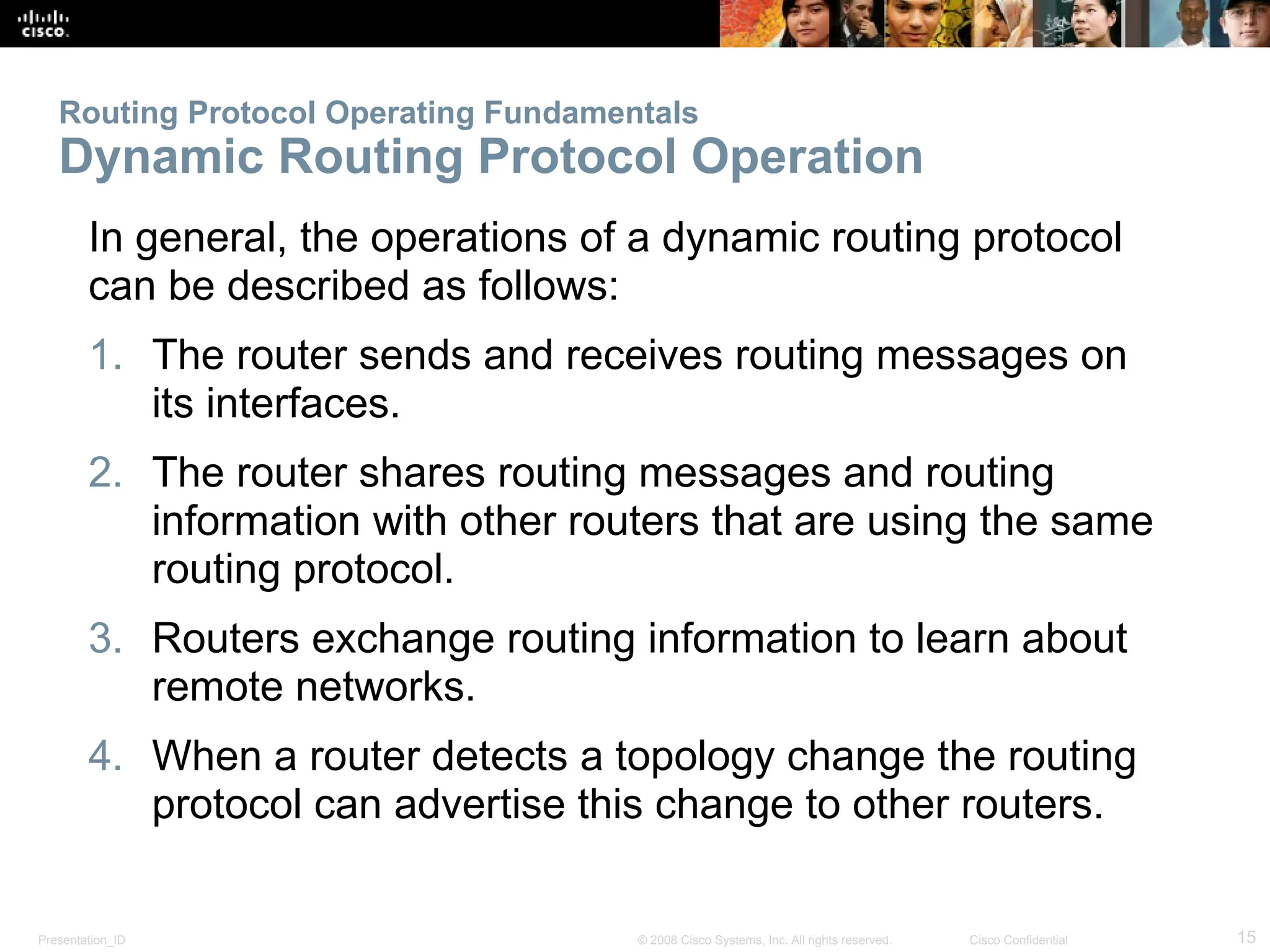
In general, the operations of a dynamic routing protocol
can be described as follows:
1. The router sends and receives routing messages on
its interfaces.
2. The router shares routing messages and routing
information with other routers that are using the same
routing protocol.
3. Routers exchange routing information to learn about
remote networks.
4. When a router detects a topology change the routing
protocol can advertise this change to other routers.
Presentation_ID 16
© 2008 Cisco Systems, Inc. All rights reserved. Cisco Confidential
Routing Protocol Operating Fundamentals
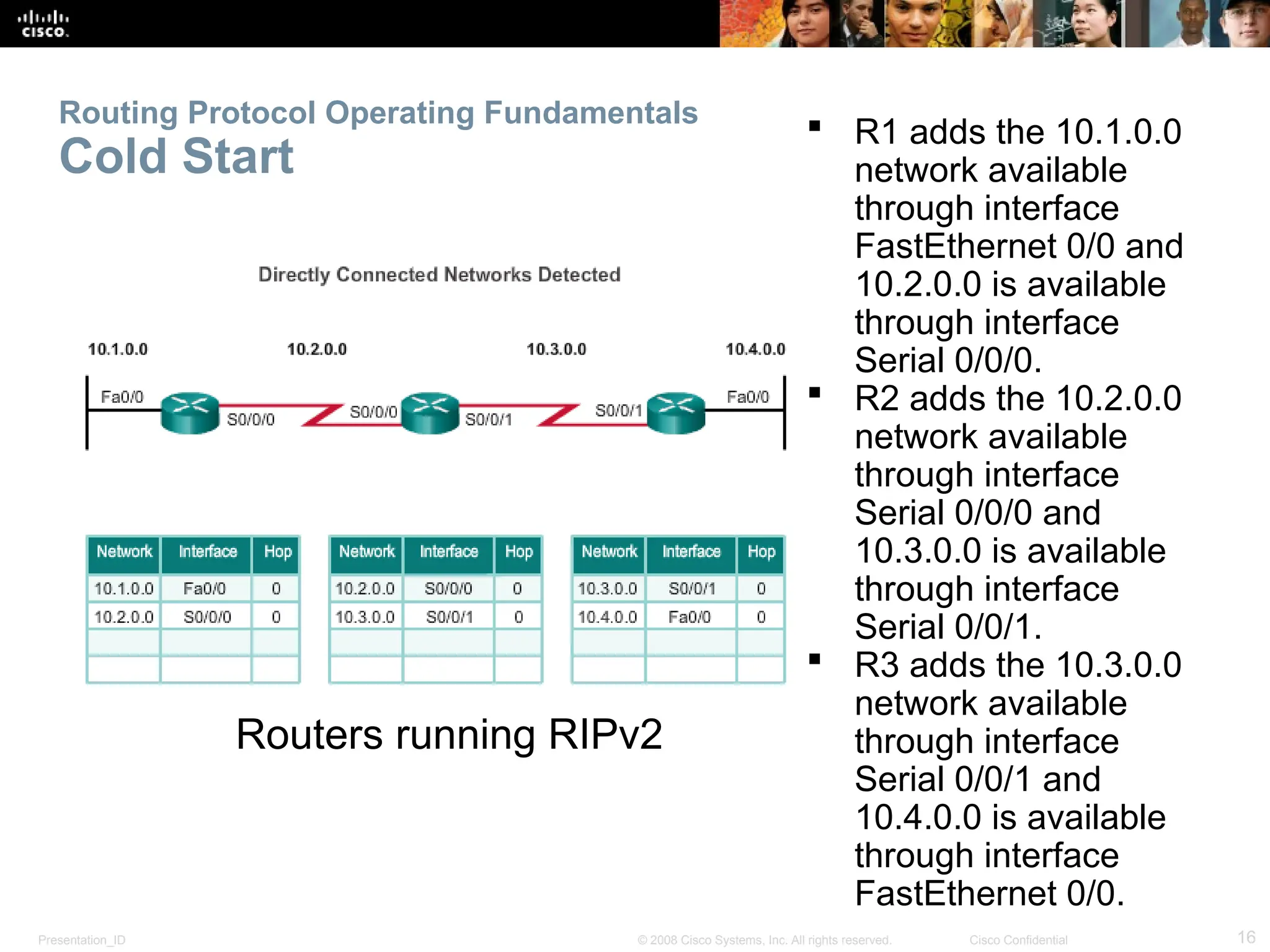
Cold Start
 R1 adds the 10.1.0.0
network available
through interface
FastEthernet 0/0 and
10.2.0.0 is available
through interface
Serial 0/0/0.
 R2 adds the 10.2.0.0
network available
through interface
Serial 0/0/0 and
10.3.0.0 is available
through interface
Serial 0/0/1.
 R3 adds the 10.3.0.0
network available
through interface
Serial 0/0/1 and
10.4.0.0 is available
through interface
FastEthernet 0/0.
Routers running RIPv2
Presentation_ID 17
© 2008 Cisco Systems, Inc. All rights reserved. Cisco Confidential
Routing Protocol Operating Fundamentals
Network Discovery
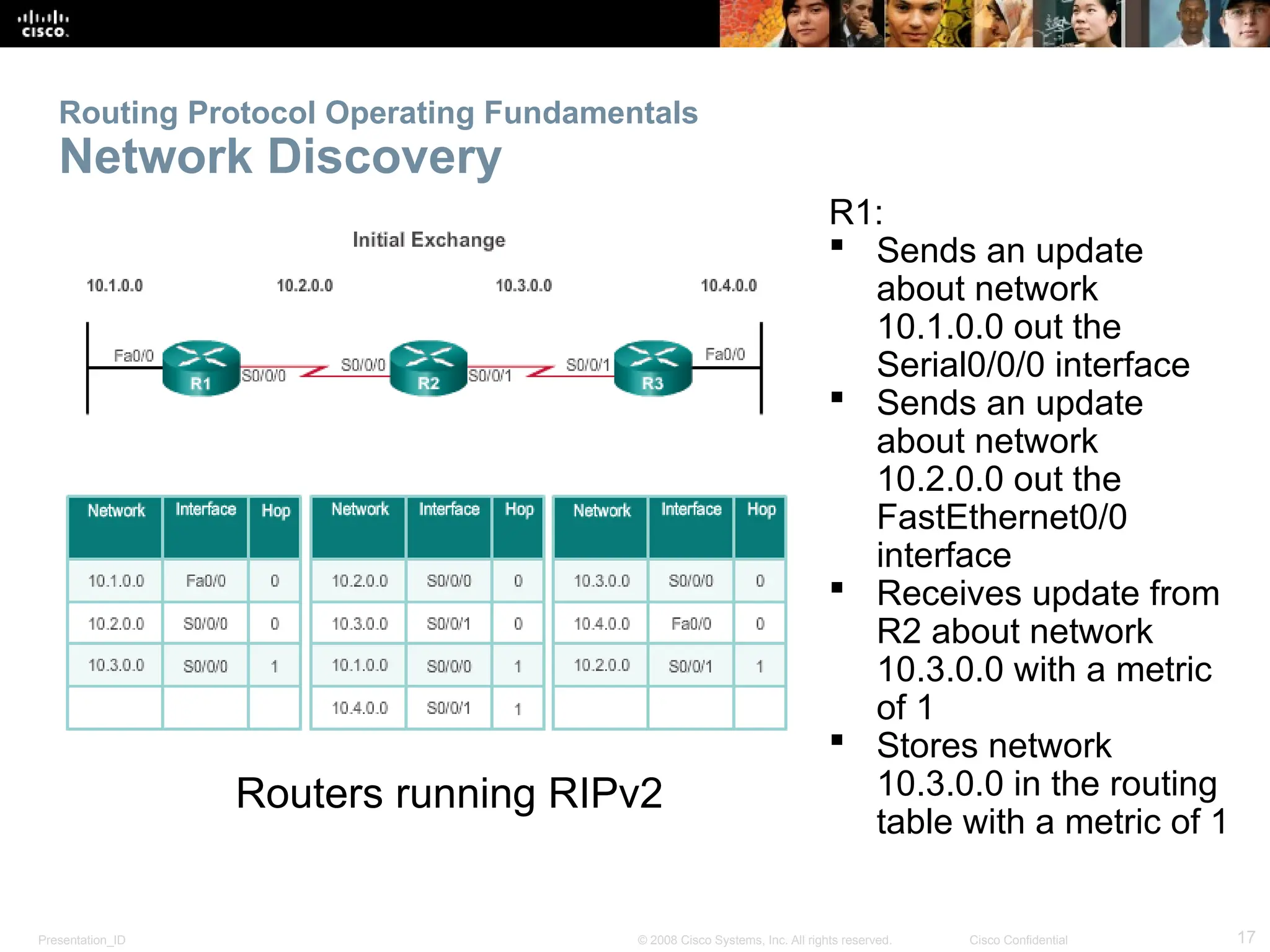
R1:
 Sends an update
about network
10.1.0.0 out the
Serial0/0/0 interface
 Sends an update
about network
10.2.0.0 out the
FastEthernet0/0
interface
 Receives update from
R2 about network
10.3.0.0 with a metric
of 1
 Stores network
10.3.0.0 in the routing
table with a metric of 1
Routers running RIPv2
Presentation_ID 18
© 2008 Cisco Systems, Inc. All rights reserved. Cisco Confidential
Routing Protocol Operating Fundamentals
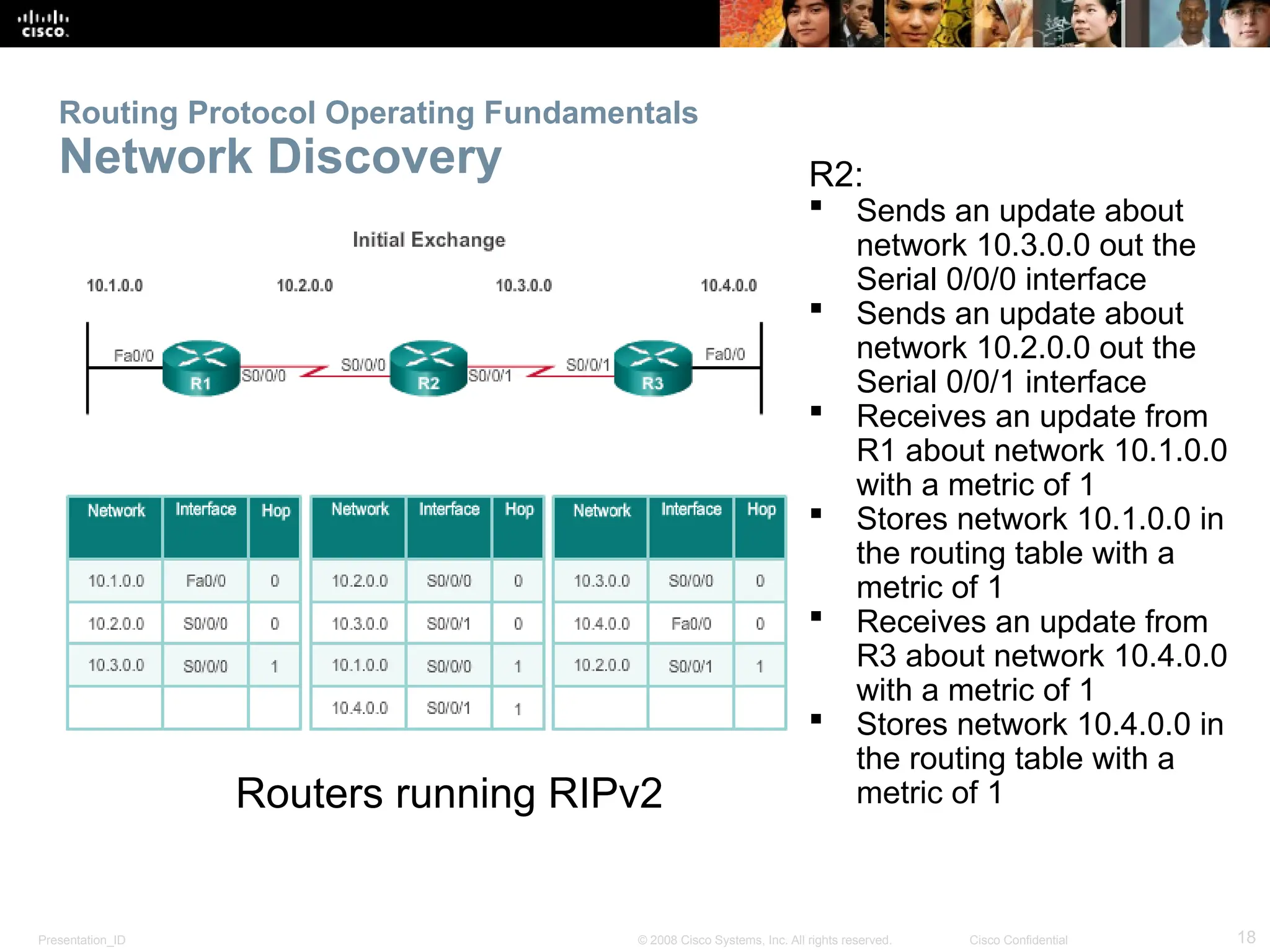
Network Discovery R2:
 Sends an update about
network 10.3.0.0 out the
Serial 0/0/0 interface
 Sends an update about
network 10.2.0.0 out the
Serial 0/0/1 interface
 Receives an update from
R1 about network 10.1.0.0
with a metric of 1
 Stores network 10.1.0.0 in
the routing table with a
metric of 1
 Receives an update from
R3 about network 10.4.0.0
with a metric of 1
 Stores network 10.4.0.0 in
the routing table with a
metric of 1
Routers running RIPv2
Presentation_ID 19
© 2008 Cisco Systems, Inc. All rights reserved. Cisco Confidential
Routing Protocol Operating Fundamentals
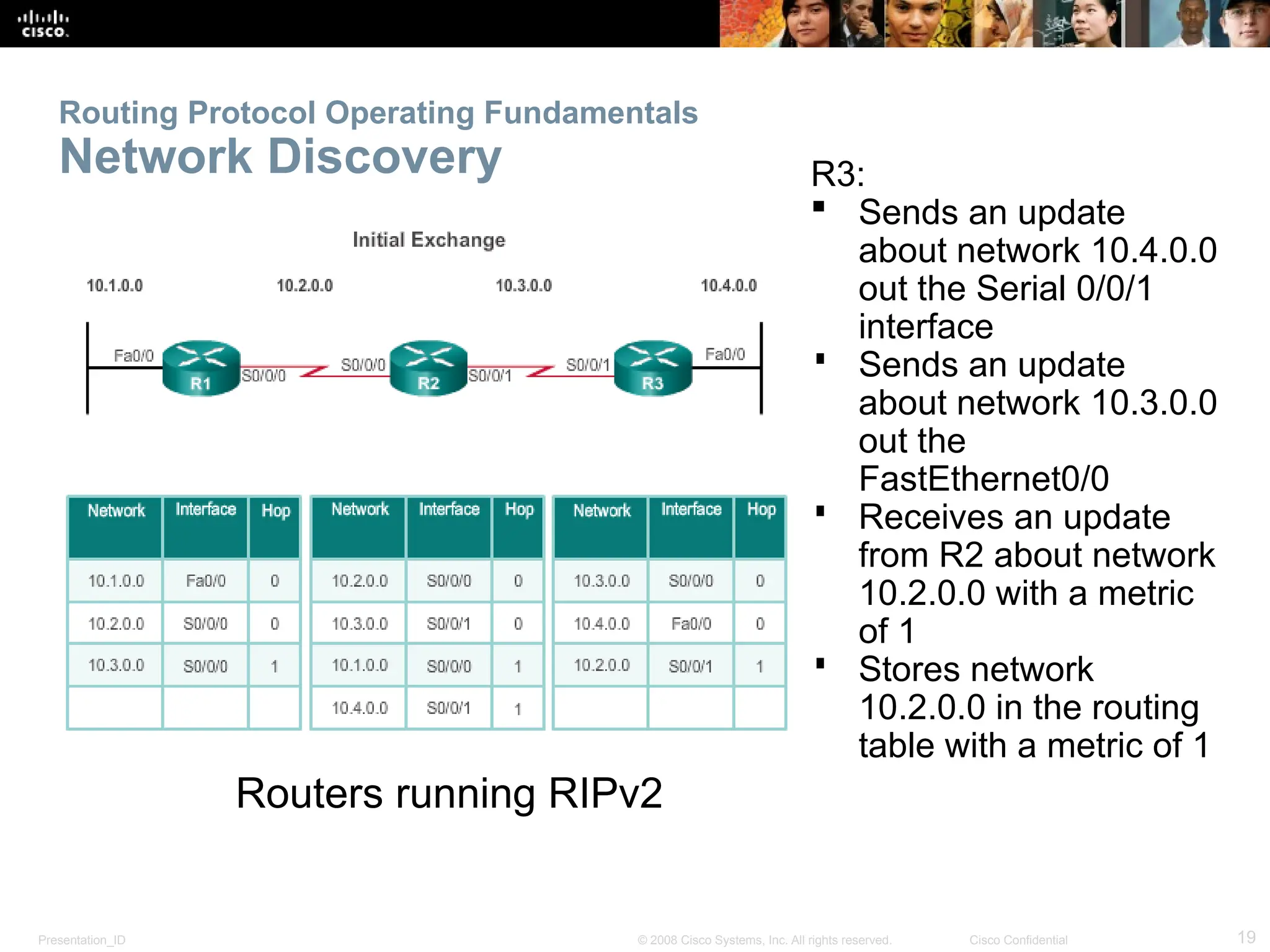
Network Discovery R3:
 Sends an update
about network 10.4.0.0
out the Serial 0/0/1
interface
 Sends an update
about network 10.3.0.0
out the
FastEthernet0/0
 Receives an update
from R2 about network
10.2.0.0 with a metric
of 1
 Stores network
10.2.0.0 in the routing
table with a metric of 1
Routers running RIPv2
Presentation_ID 20
© 2008 Cisco Systems, Inc. All rights reserved. Cisco Confidential
Routing Protocol Operating Fundamentals
Exchanging the Routing Information
R1:
 Sends an update about
network 10. 1. 0. 0 out the
Serial 0/0/0 interface
 Sends an update about
networks 10. 2. 0. 0 and 10.
3. 0. 0 out the
FastEthernet0/0 interface
 Receives an update from
R2 about network 10. 4. 0. 0
with a metric of 2
 Stores network 10. 4. 0. 0 in
the routing table with a
metric of 2
 Same update from R2
contains information about
network 10. 3. 0. 0 with a
metric of 1. There is no
change; therefore, the
routing information remains
the same
Routers running RIPv2
Presentation_ID 21
© 2008 Cisco Systems, Inc. All rights reserved. Cisco Confidential
Routing Protocol Operating Fundamentals
Exchanging the Routing Information
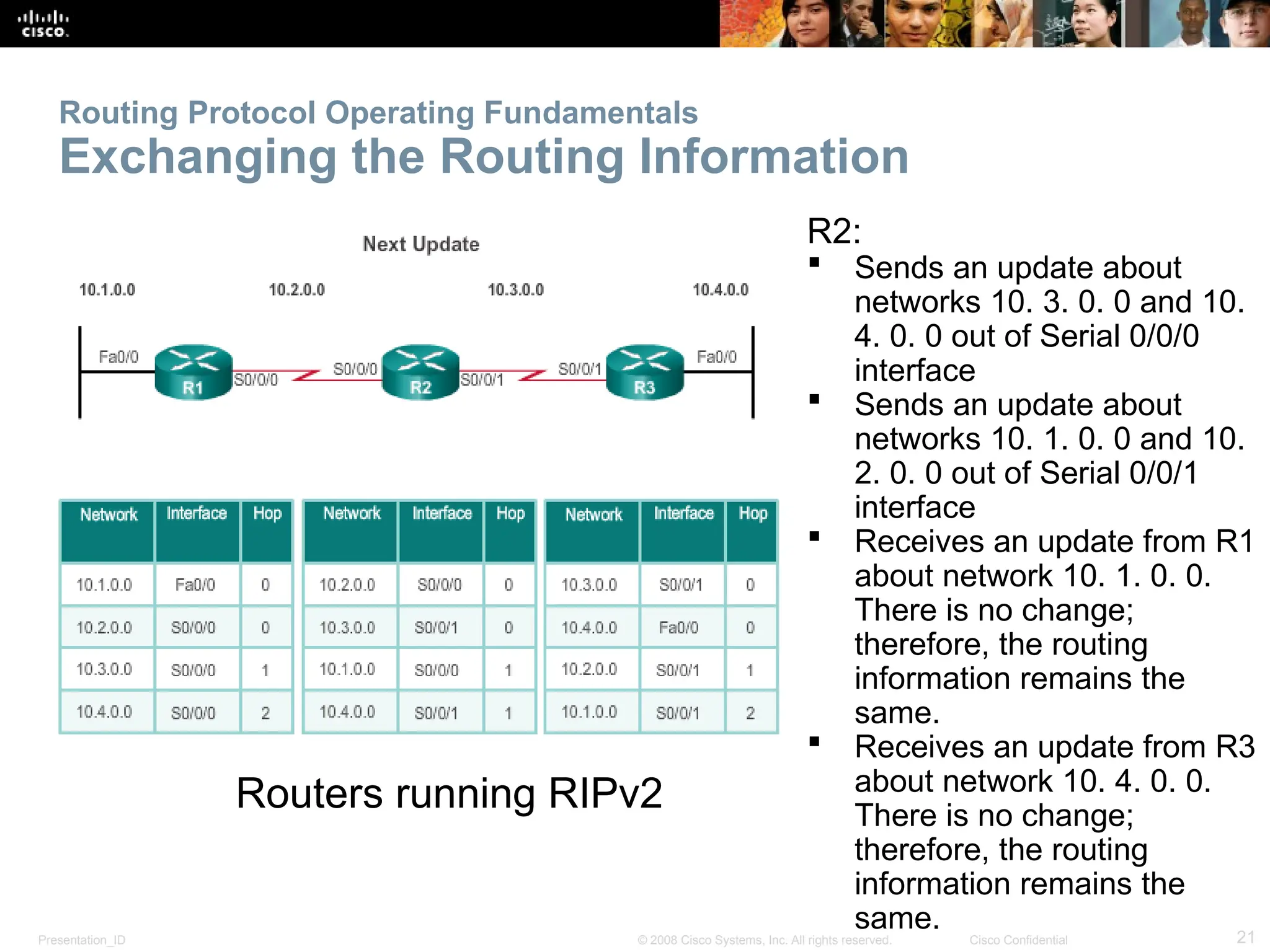
R2:
 Sends an update about
networks 10. 3. 0. 0 and 10.
4. 0. 0 out of Serial 0/0/0
interface
 Sends an update about
networks 10. 1. 0. 0 and 10.
2. 0. 0 out of Serial 0/0/1
interface
 Receives an update from R1
about network 10. 1. 0. 0.
There is no change;
therefore, the routing
information remains the
same.
 Receives an update from R3
about network 10. 4. 0. 0.
There is no change;
therefore, the routing
information remains the
same.
Routers running RIPv2
Presentation_ID 22
© 2008 Cisco Systems, Inc. All rights reserved. Cisco Confidential
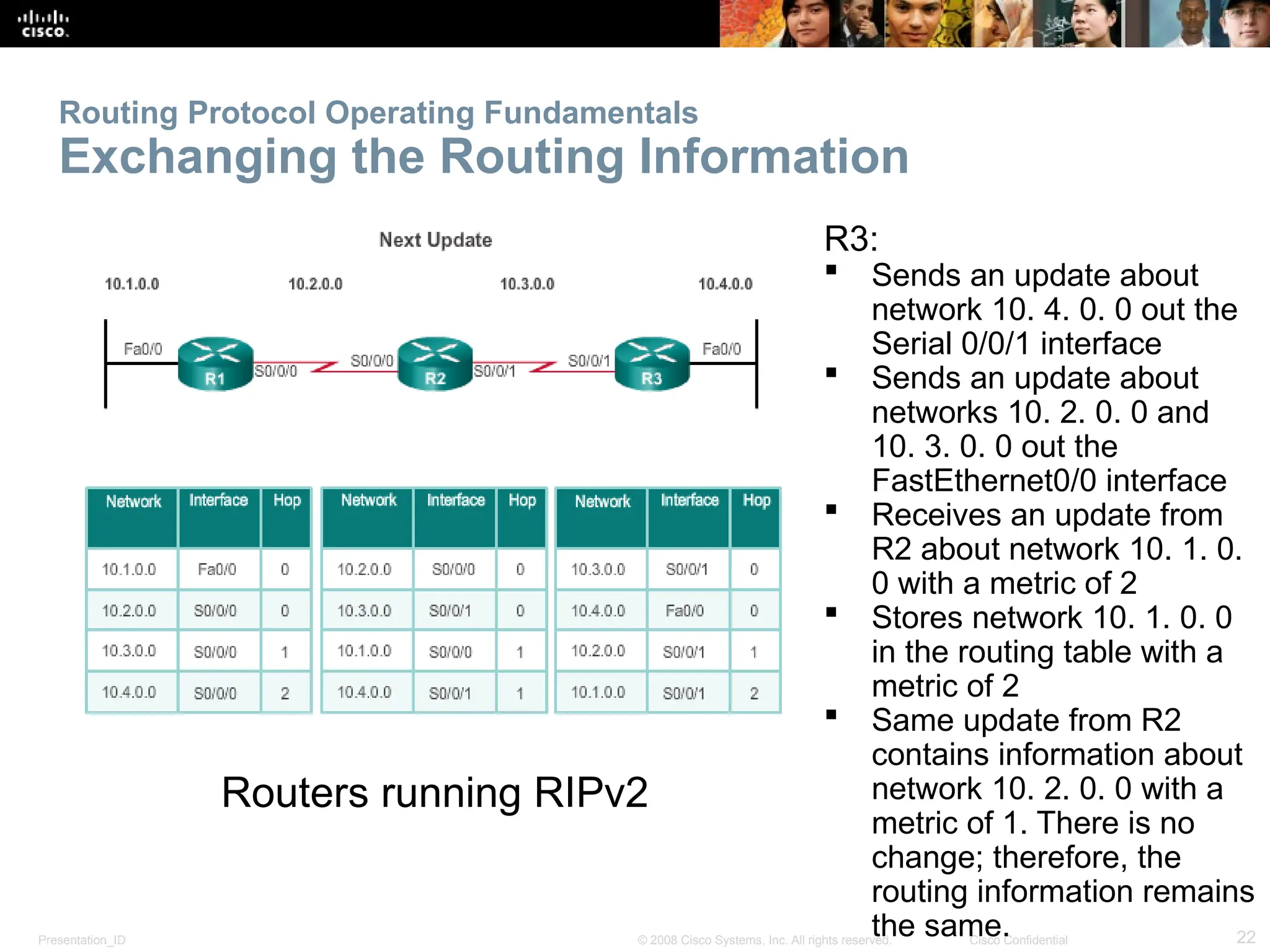
Routing Protocol Operating Fundamentals
Exchanging the Routing Information
R3:
 Sends an update about
network 10. 4. 0. 0 out the
Serial 0/0/1 interface
 Sends an update about
networks 10. 2. 0. 0 and
10. 3. 0. 0 out the
FastEthernet0/0 interface
 Receives an update from
R2 about network 10. 1. 0.
0 with a metric of 2
 Stores network 10. 1. 0. 0
in the routing table with a
metric of 2
 Same update from R2
contains information about
network 10. 2. 0. 0 with a
metric of 1. There is no
change; therefore, the
routing information remains
the same.
Routers running RIPv2
Presentation_ID 23
© 2008 Cisco Systems, Inc. All rights reserved. Cisco Confidential
Routing Protocol Operating Fundamentals
Achieving Convergence
 Network converged when all routers have complete and accurate
information about the entire network.
 Convergence time is the time it takes routers to share information,
calculate best paths, and update their routing tables.
 A network is not completely operable until the network has
converged.
 Convergence properties include the speed of propagation of routing
information and the calculation of optimal paths. The speed of
propagation refers to the amount of time it takes for routers within the
network to forward routing information.
 Generally, older protocols, such as RIP, are slow to converge,
whereas modern protocols, such as EIGRP and OSPF, converge
more quickly.
Presentation_ID 24
© 2008 Cisco Systems, Inc. All rights reserved. Cisco Confidential
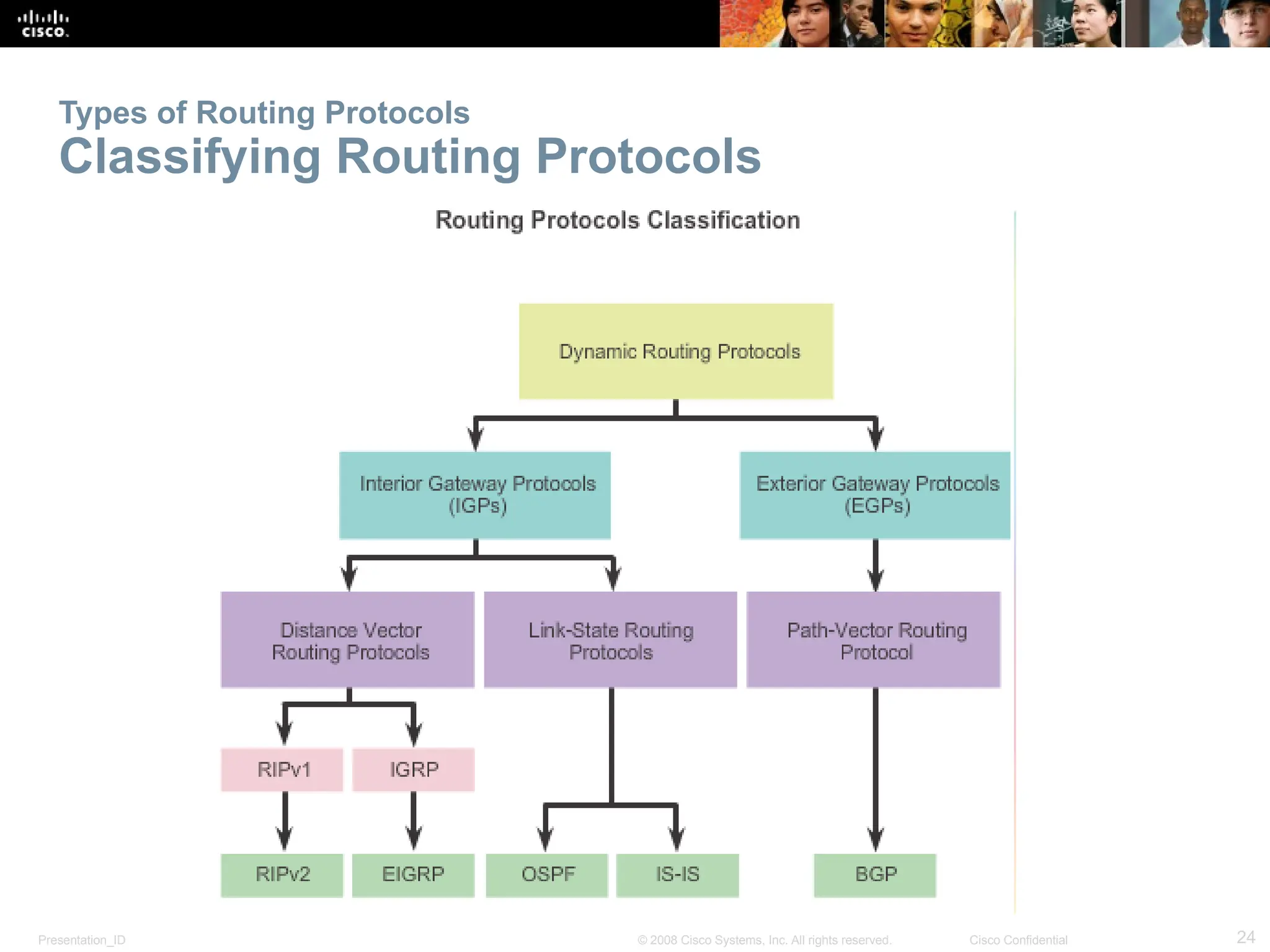
Types of Routing Protocols
Classifying Routing Protocols
Presentation_ID 25
© 2008 Cisco Systems, Inc. All rights reserved. Cisco Confidential
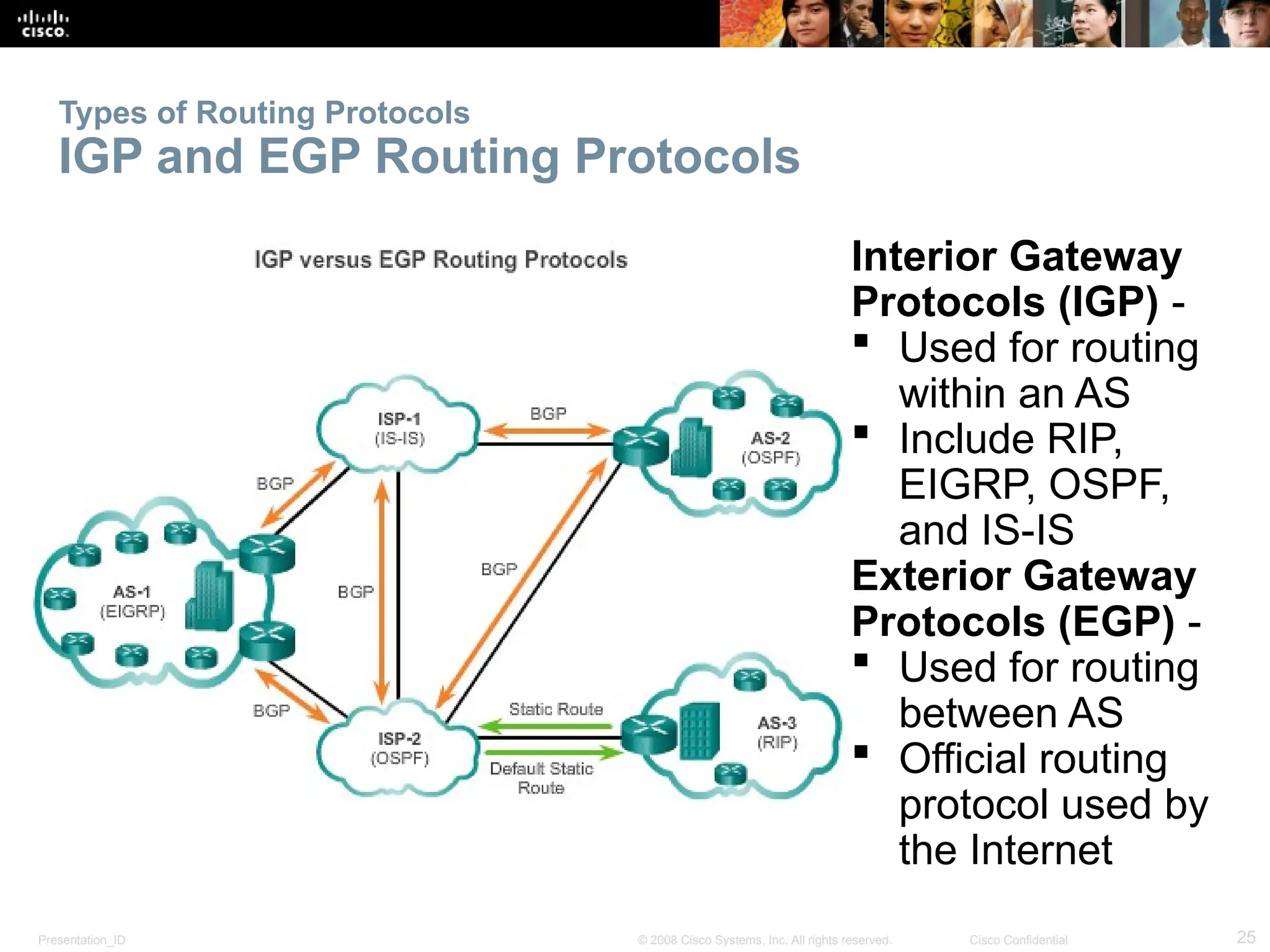
Types of Routing Protocols
IGP and EGP Routing Protocols
Interior Gateway
Protocols (IGP) -
 Used for routing
within an AS
 Include RIP,
EIGRP, OSPF,
and IS-IS
Exterior Gateway
Protocols (EGP) -
 Used for routing
between AS
 Official routing
protocol used by
the Internet
Presentation_ID 26
© 2008 Cisco Systems, Inc. All rights reserved. Cisco Confidential
Types of Routing Protocols
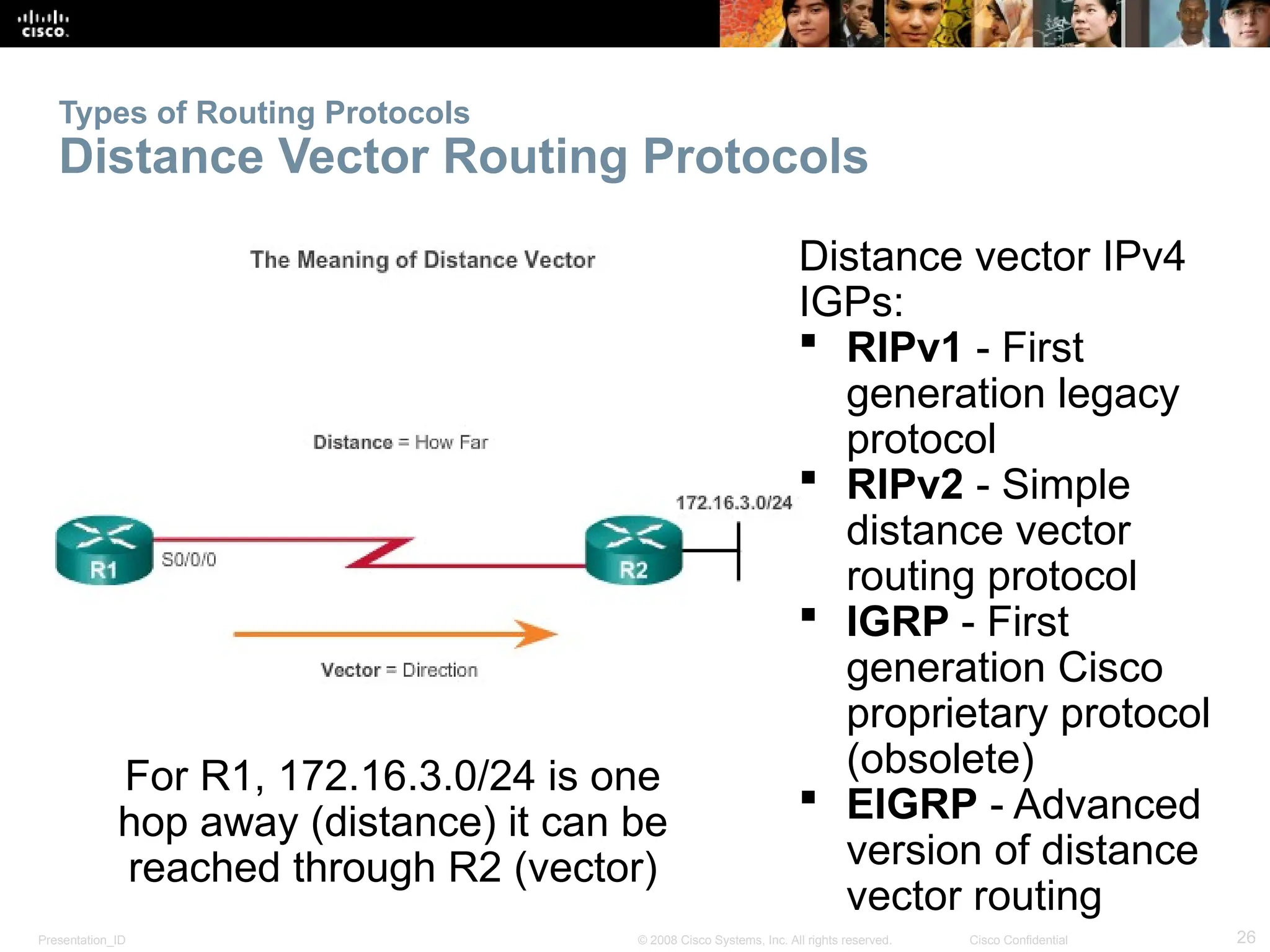
Distance Vector Routing Protocols
Distance vector IPv4
IGPs:
 RIPv1 - First
generation legacy
protocol
 RIPv2 - Simple
distance vector
routing protocol
 IGRP - First
generation Cisco
proprietary protocol
(obsolete)
 EIGRP - Advanced
version of distance
vector routing
For R1, 172.16.3.0/24 is one
hop away (distance) it can be
reached through R2 (vector)
Presentation_ID 27
© 2008 Cisco Systems, Inc. All rights reserved. Cisco Confidential
Types of Routing Protocols
Distance Vector or Link-State Routing Protocols
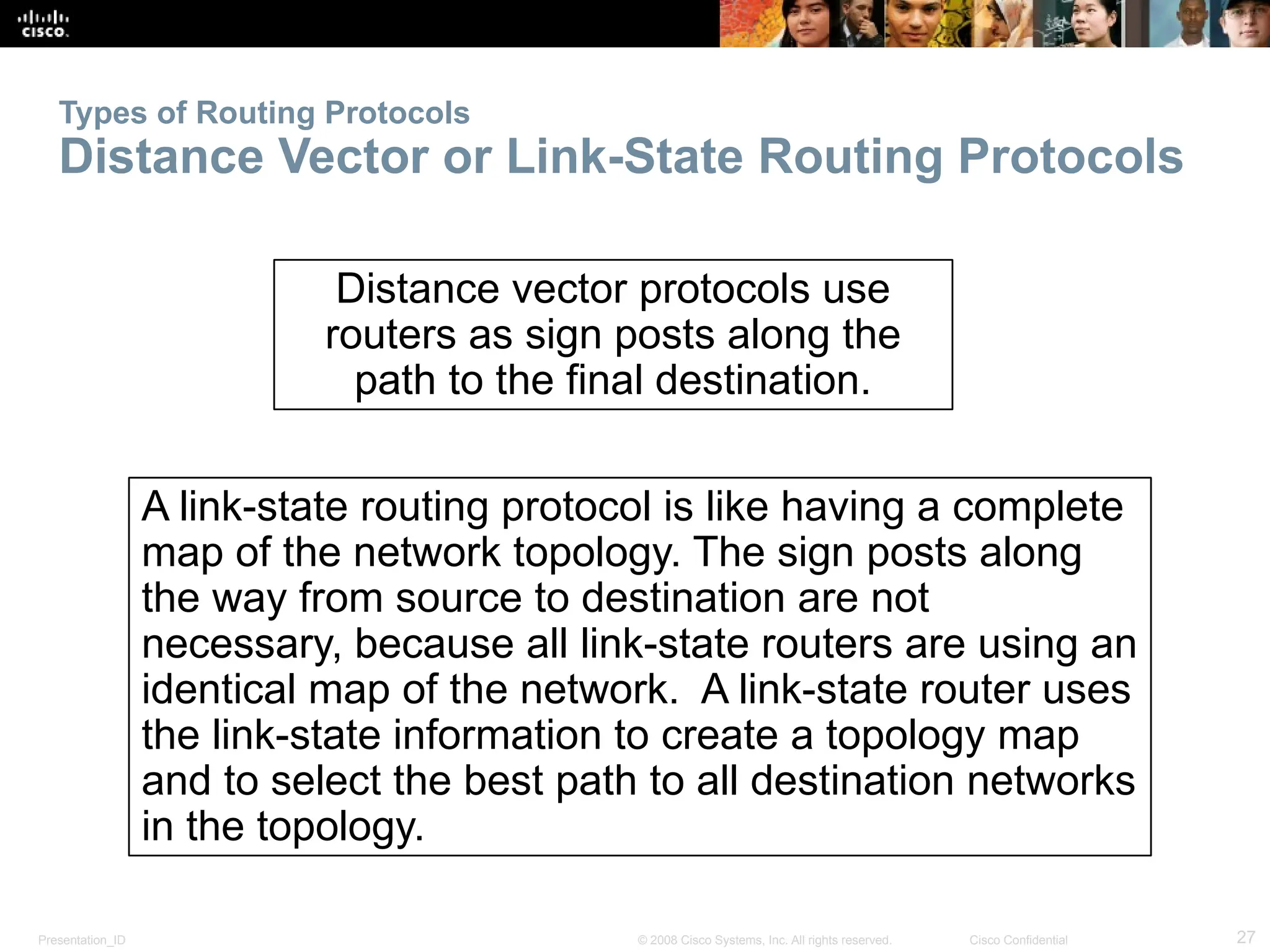
Distance vector protocols use
routers as sign posts along the
path to the final destination.
A link-state routing protocol is like having a complete
map of the network topology. The sign posts along
the way from source to destination are not
necessary, because all link-state routers are using an
identical map of the network. A link-state router uses
the link-state information to create a topology map
and to select the best path to all destination networks
in the topology.
Presentation_ID 28
© 2008 Cisco Systems, Inc. All rights reserved. Cisco Confidential
Types of Routing Protocols
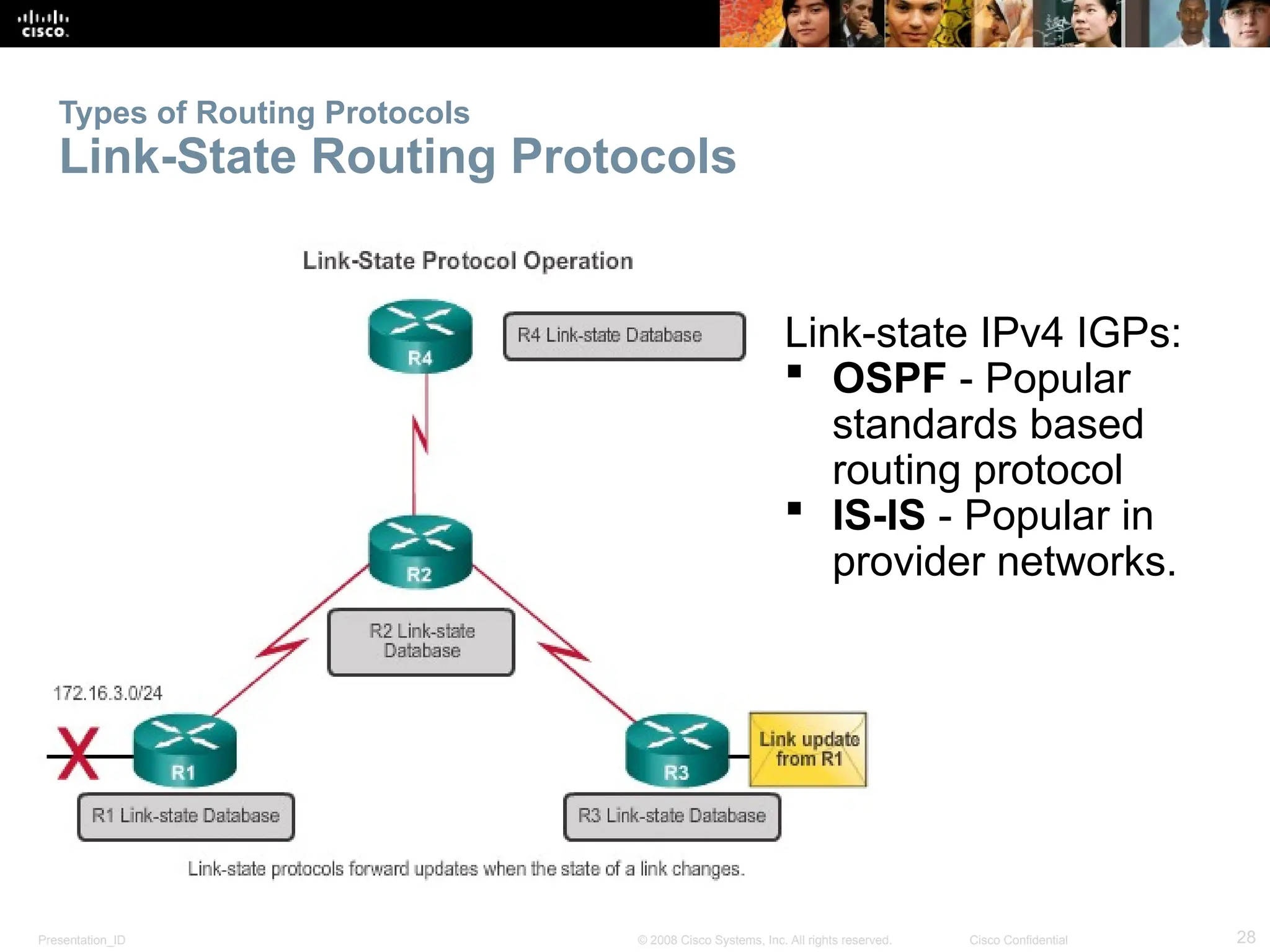
Link-State Routing Protocols
Link-state IPv4 IGPs:
 OSPF - Popular
standards based
routing protocol
 IS-IS - Popular in
provider networks.
Presentation_ID 29
© 2008 Cisco Systems, Inc. All rights reserved. Cisco Confidential
Types of Routing Protocols
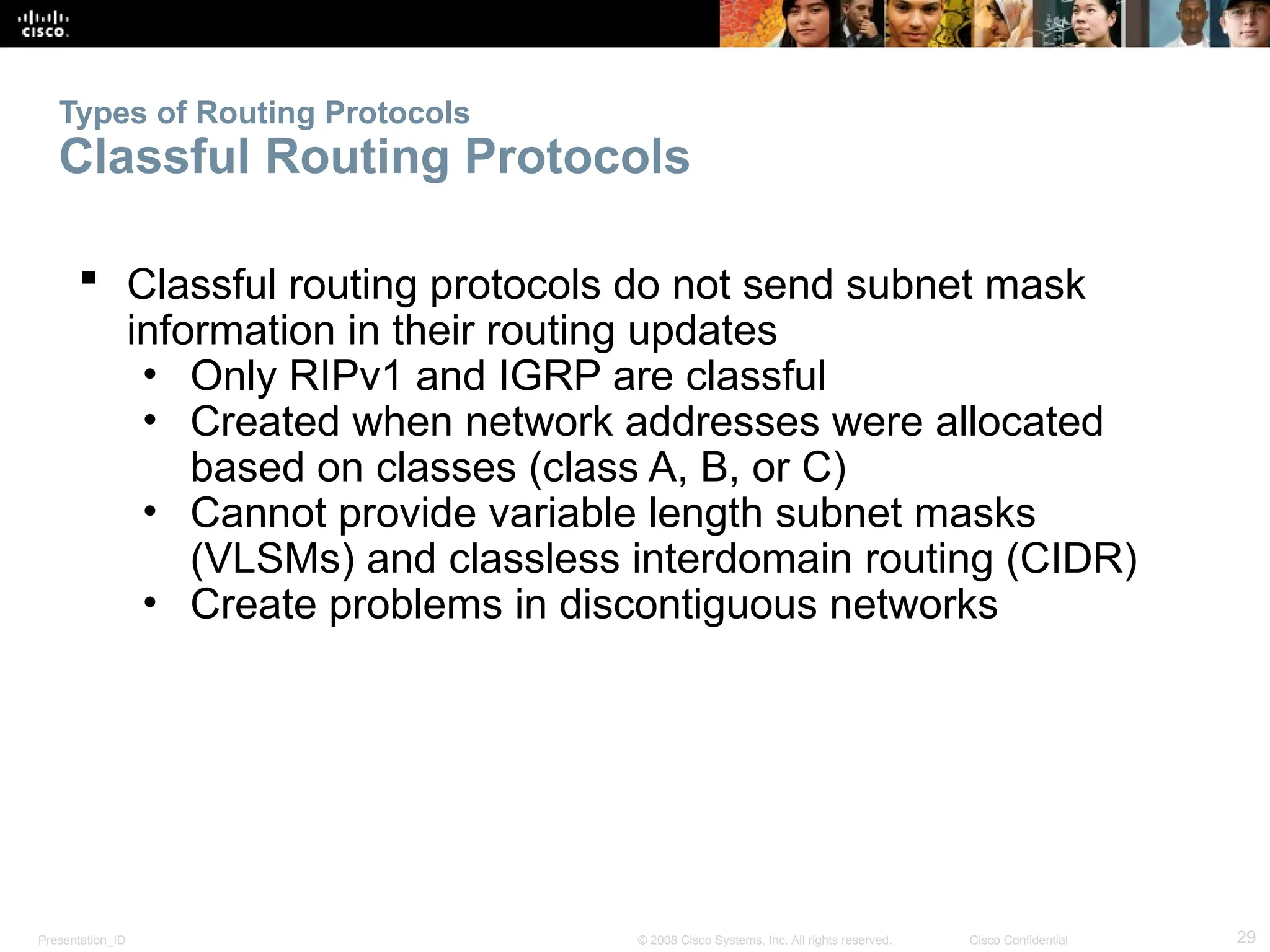
Classful Routing Protocols
 Classful routing protocols do not send subnet mask
information in their routing updates
• Only RIPv1 and IGRP are classful
• Created when network addresses were allocated
based on classes (class A, B, or C)
• Cannot provide variable length subnet masks
(VLSMs) and classless interdomain routing (CIDR)
• Create problems in discontiguous networks
Presentation_ID 30
© 2008 Cisco Systems, Inc. All rights reserved. Cisco Confidential
Types of Routing Protocols
Classless Routing Protocols
 Classless routing protocols include subnet mask
information in the routing updates
• RIPv2, EIGRP, OSPF, and IS_IS
• Support VLSM and CIDR
• IPv6 routing protocols
Presentation_ID 31
© 2008 Cisco Systems, Inc. All rights reserved. Cisco Confidential
Types of Routing Protocols
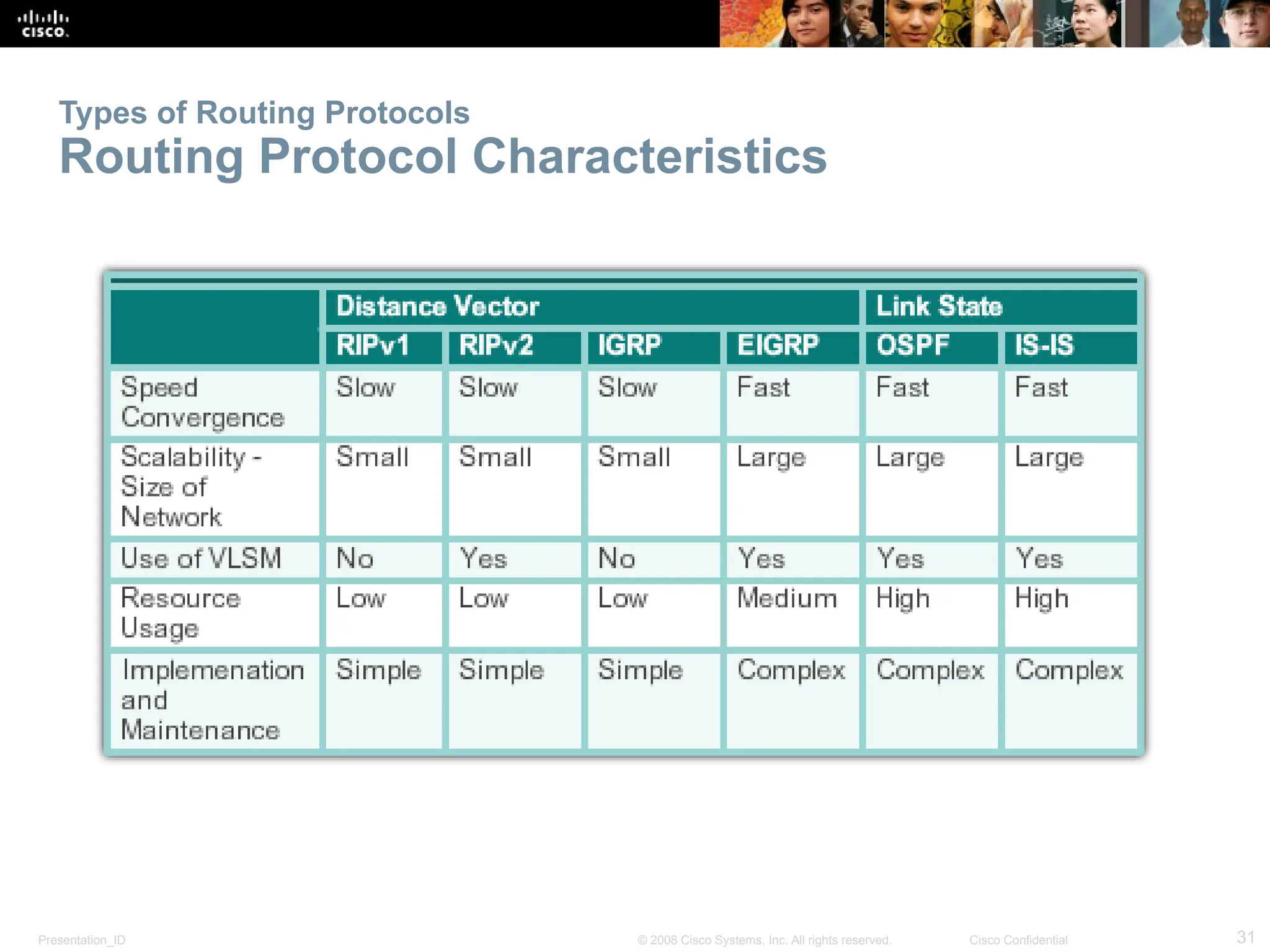
Routing Protocol Characteristics
Presentation_ID 32
© 2008 Cisco Systems, Inc. All rights reserved. Cisco Confidential
Types of Routing Protocols
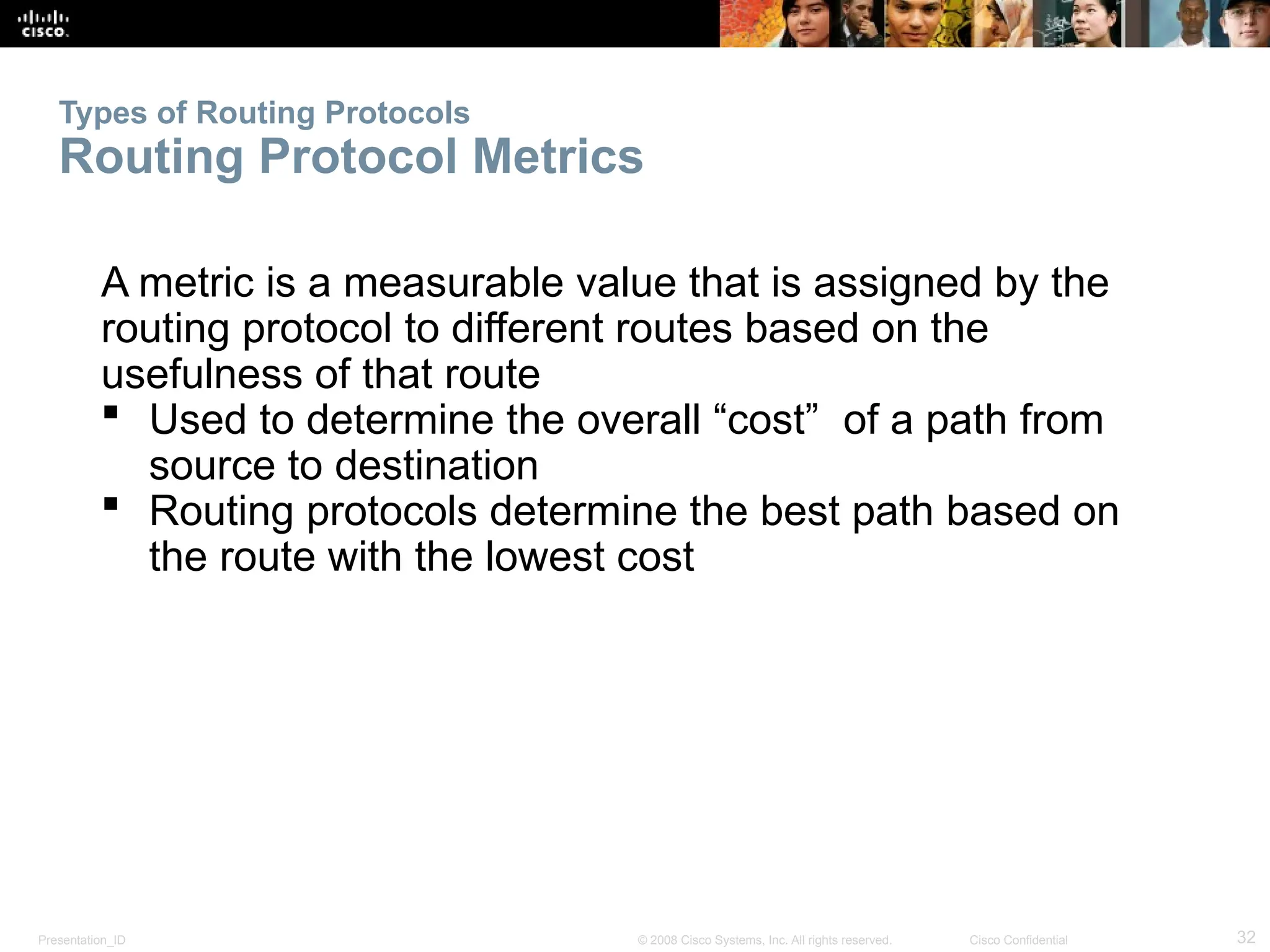
Routing Protocol Metrics
A metric is a measurable value that is assigned by the
routing protocol to different routes based on the
usefulness of that route
 Used to determine the overall “cost” of a path from
source to destination
 Routing protocols determine the best path based on
the route with the lowest cost
Presentation_ID 33
© 2008 Cisco Systems, Inc. All rights reserved. Cisco Confidential
Distance Vector Dynamic Routing
Presentation_ID 34
© 2008 Cisco Systems, Inc. All rights reserved. Cisco Confidential
Distance Vector Routing Protocol Operation
Distance Vector Technologies
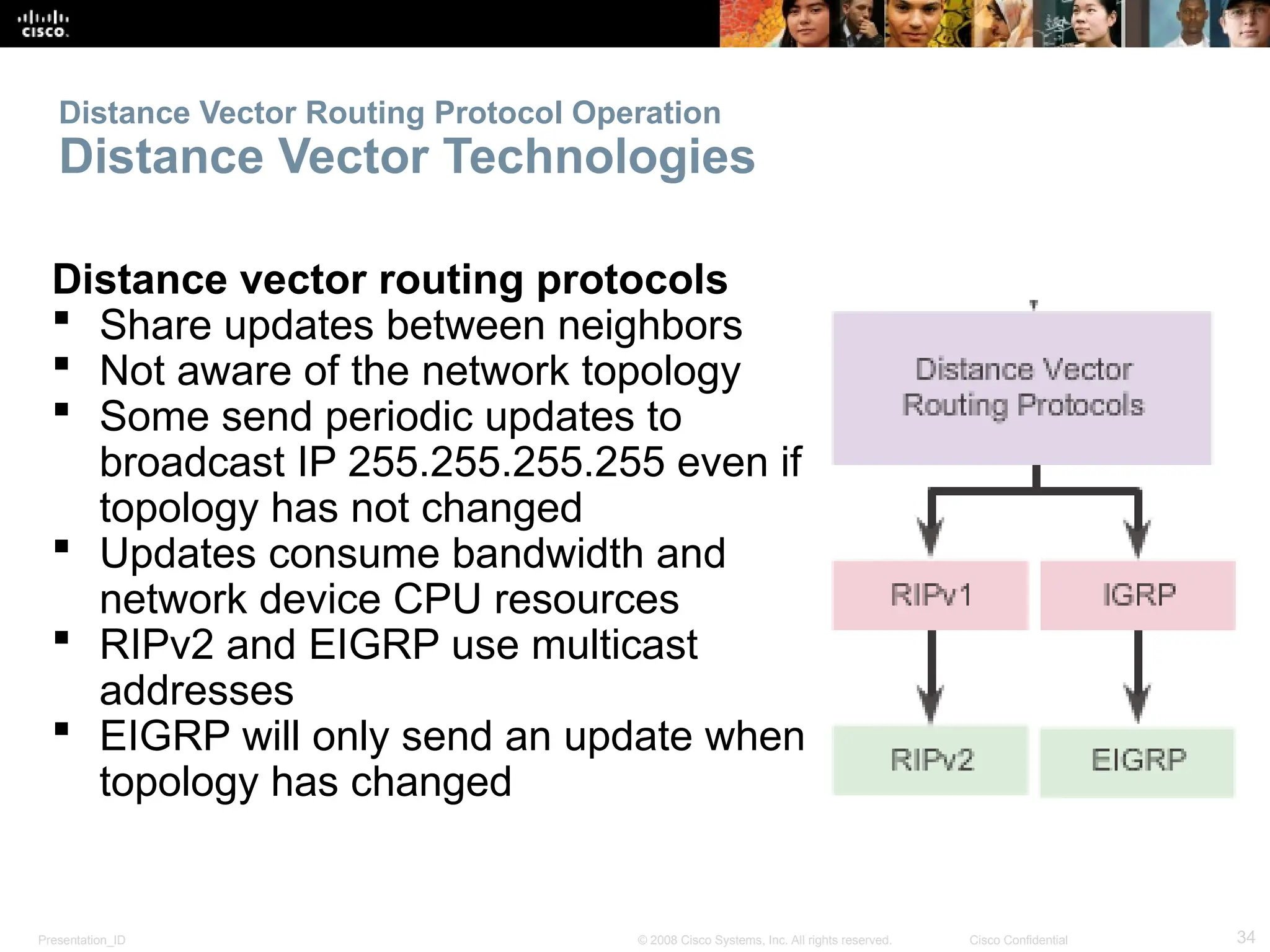
Distance vector routing protocols
 Share updates between neighbors
 Not aware of the network topology
 Some send periodic updates to
broadcast IP 255.255.255.255 even if
topology has not changed
 Updates consume bandwidth and
network device CPU resources
 RIPv2 and EIGRP use multicast
addresses
 EIGRP will only send an update when
topology has changed
Presentation_ID 35
© 2008 Cisco Systems, Inc. All rights reserved. Cisco Confidential
Distance Vector Routing Protocol Operation
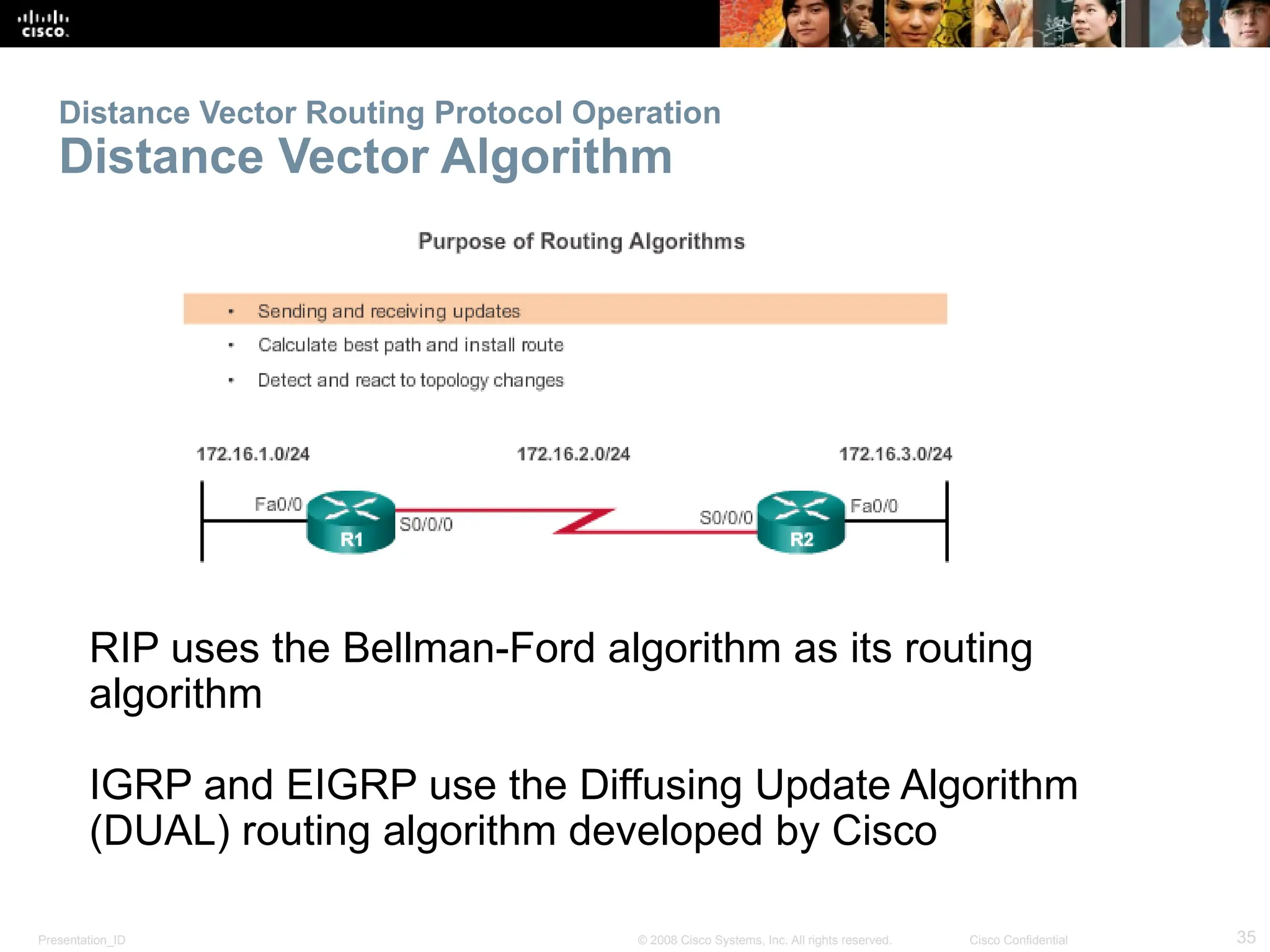
Distance Vector Algorithm
RIP uses the Bellman-Ford algorithm as its routing
algorithm
IGRP and EIGRP use the Diffusing Update Algorithm
(DUAL) routing algorithm developed by Cisco
Presentation_ID 36
© 2008 Cisco Systems, Inc. All rights reserved. Cisco Confidential
Types of Distance Vector Routing Protocols
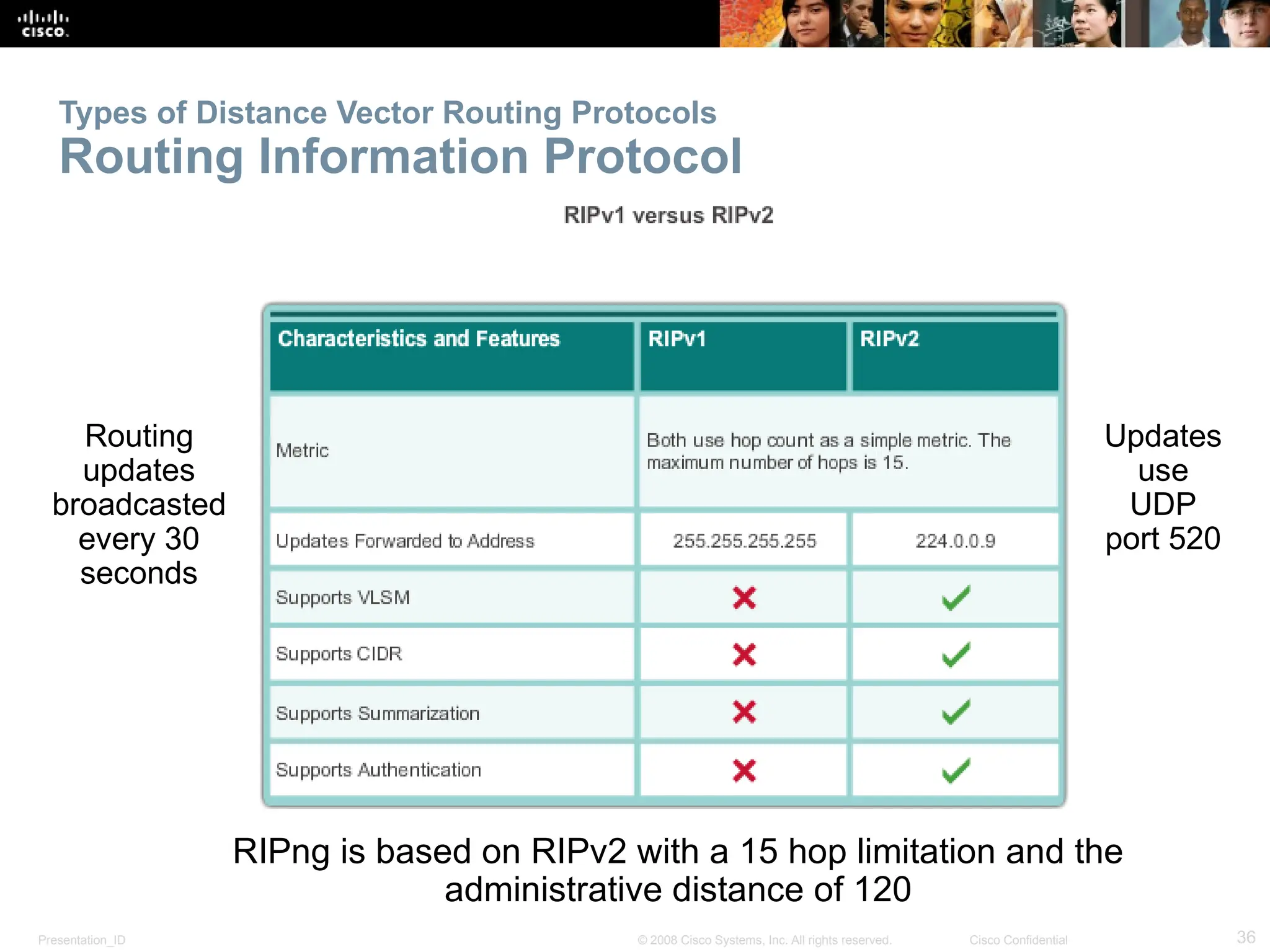
Routing Information Protocol
RIPng is based on RIPv2 with a 15 hop limitation and the
administrative distance of 120
Updates
use
UDP
port 520
Routing
updates
broadcasted
every 30
seconds
Presentation_ID 37
© 2008 Cisco Systems, Inc. All rights reserved. Cisco Confidential
Types of Distance Vector Routing Protocols
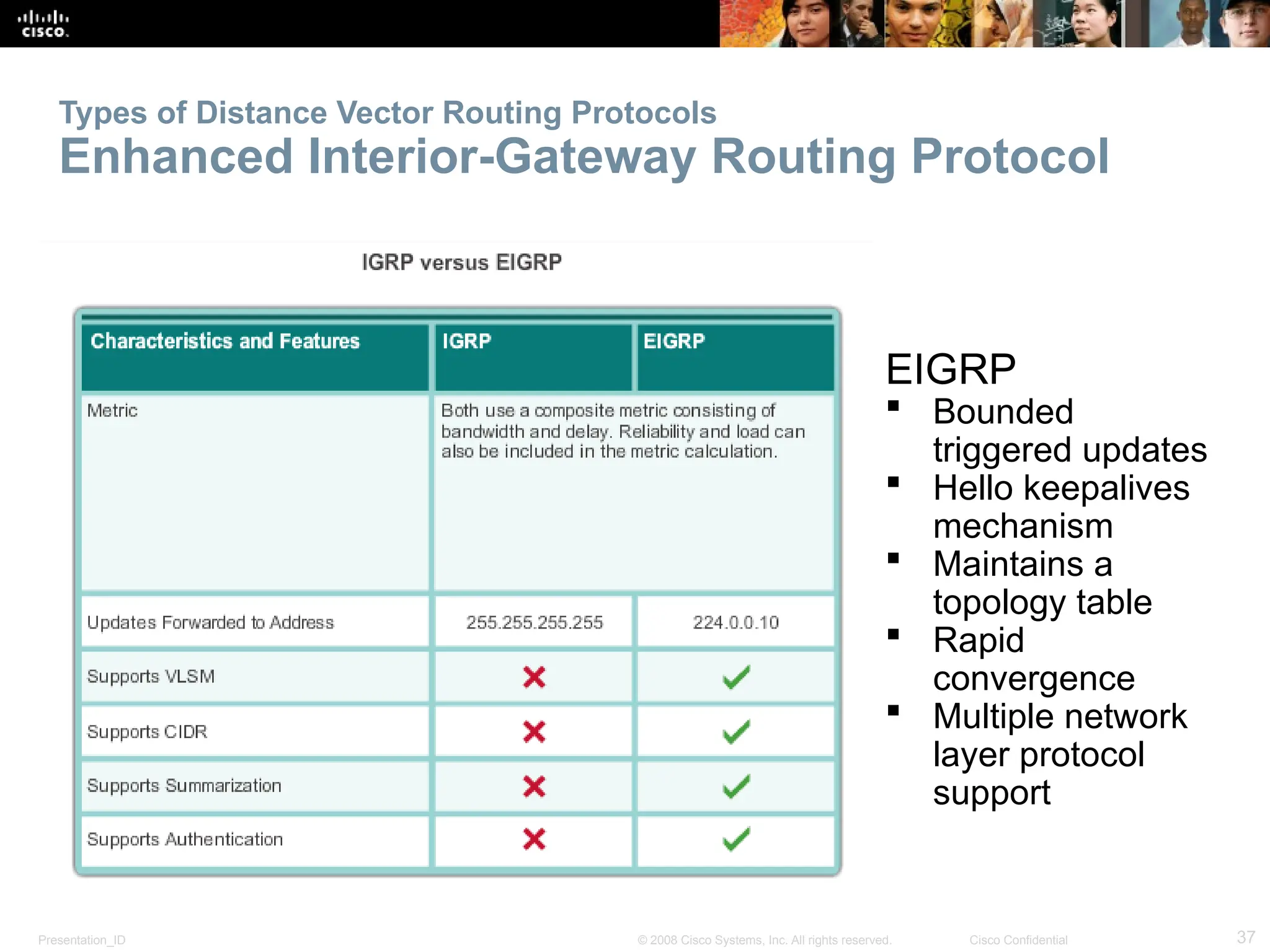
Enhanced Interior-Gateway Routing Protocol
EIGRP
 Bounded
triggered updates
 Hello keepalives
mechanism
 Maintains a
topology table
 Rapid
convergence
 Multiple network
layer protocol
support
Presentation_ID 38
© 2008 Cisco Systems, Inc. All rights reserved. Cisco Confidential
RIP and RIPng Routing
Presentation_ID 39
© 2008 Cisco Systems, Inc. All rights reserved. Cisco Confidential
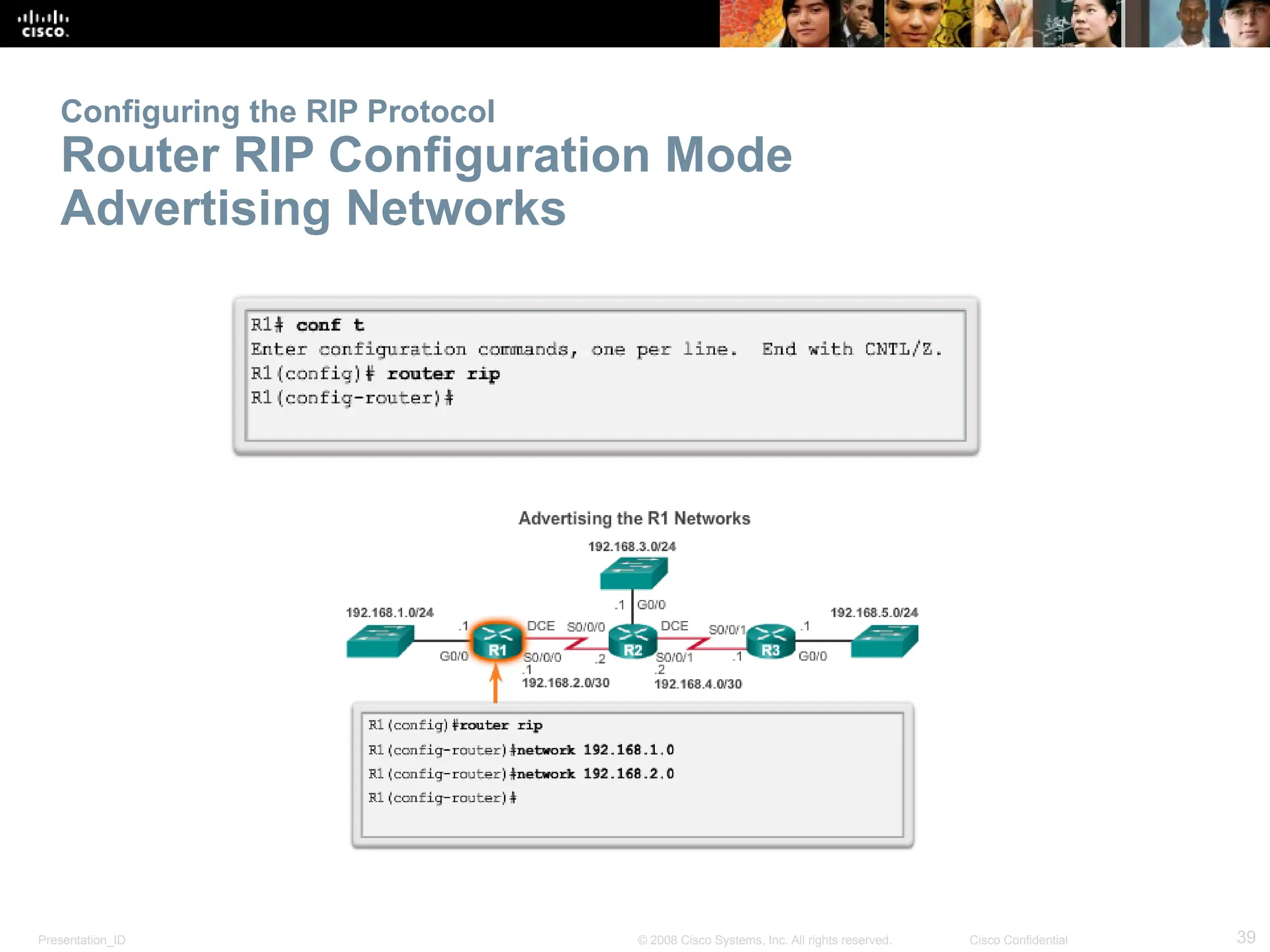
Configuring the RIP Protocol
Router RIP Configuration Mode
Advertising Networks
Presentation_ID 40
© 2008 Cisco Systems, Inc. All rights reserved. Cisco Confidential
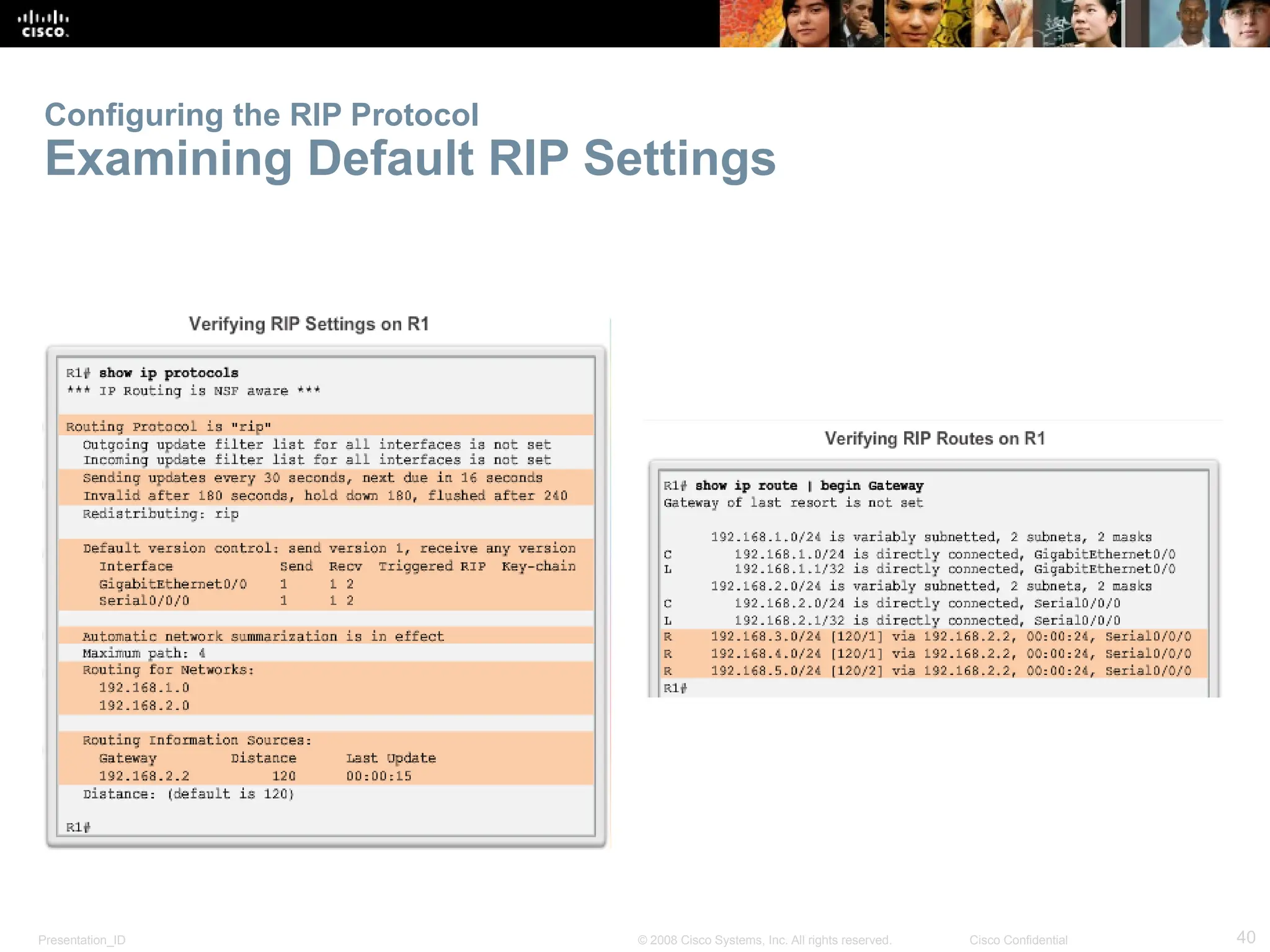
Configuring the RIP Protocol
Examining Default RIP Settings
Presentation_ID 41
© 2008 Cisco Systems, Inc. All rights reserved. Cisco Confidential
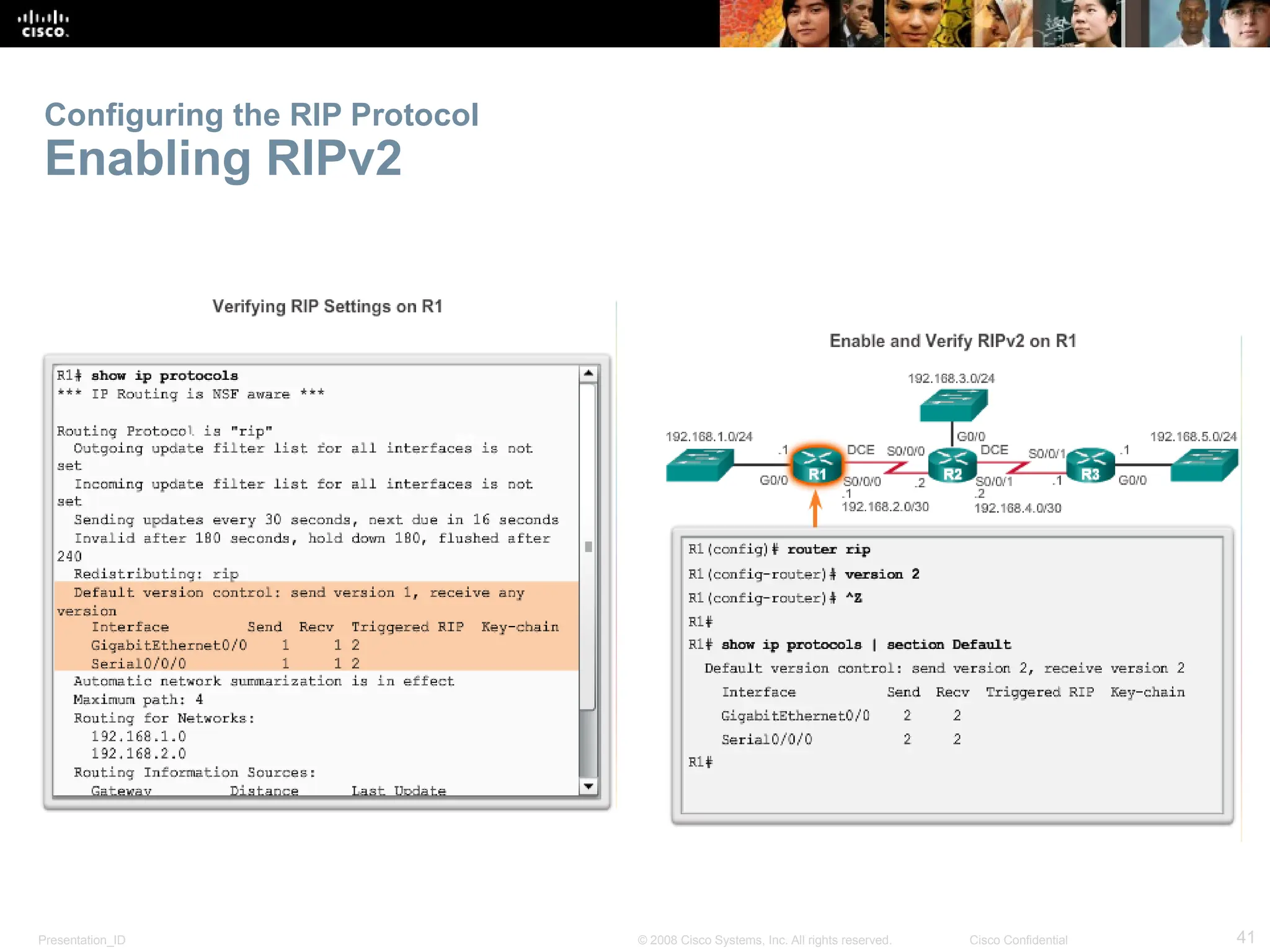
Configuring the RIP Protocol
Enabling RIPv2
Presentation_ID 42
© 2008 Cisco Systems, Inc. All rights reserved. Cisco Confidential
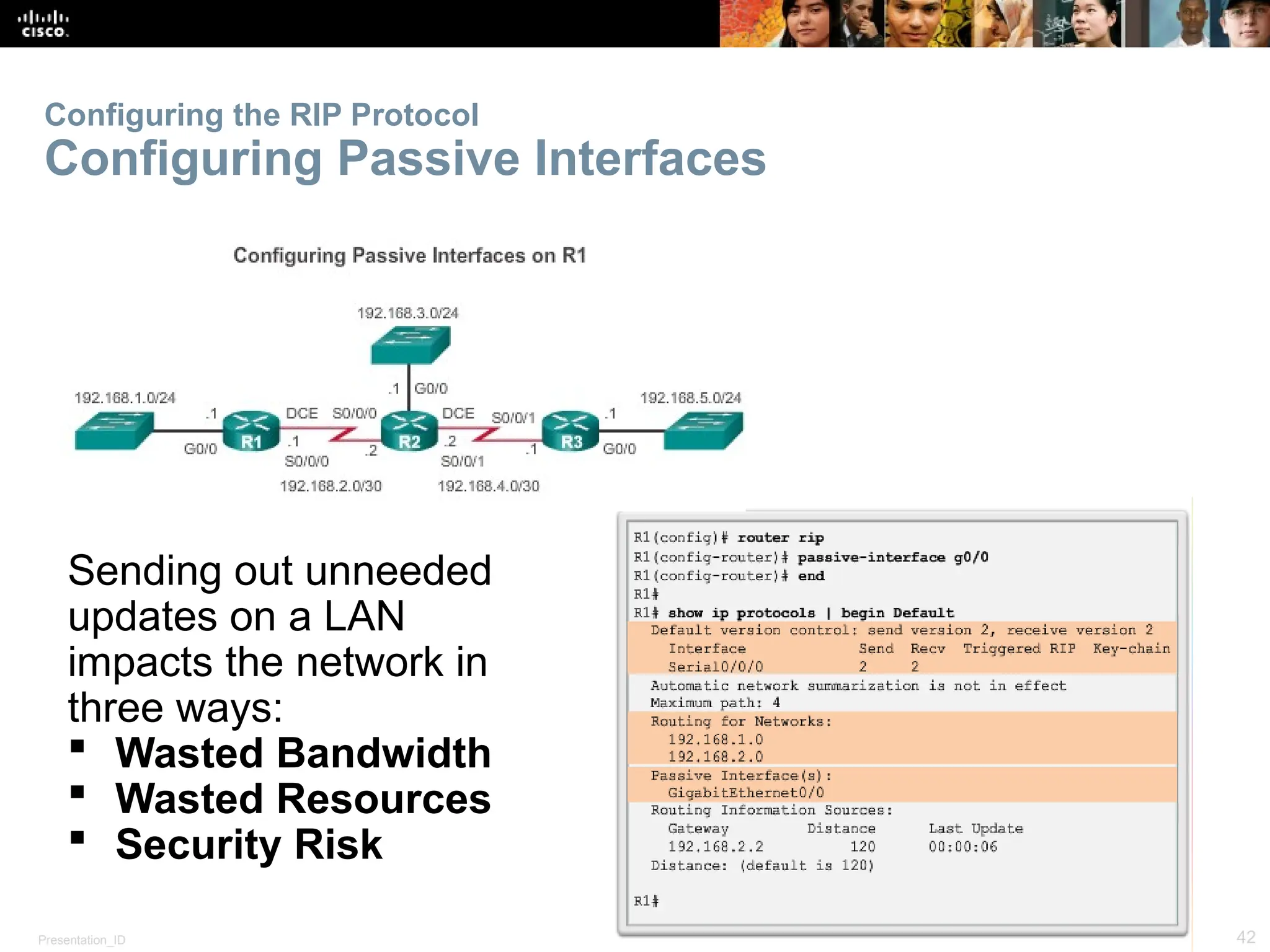
Configuring the RIP Protocol
Configuring Passive Interfaces
Sending out unneeded
updates on a LAN
impacts the network in
three ways:
 Wasted Bandwidth
 Wasted Resources
 Security Risk
Presentation_ID 43
© 2008 Cisco Systems, Inc. All rights reserved. Cisco Confidential
Configuring the RIP Protocol
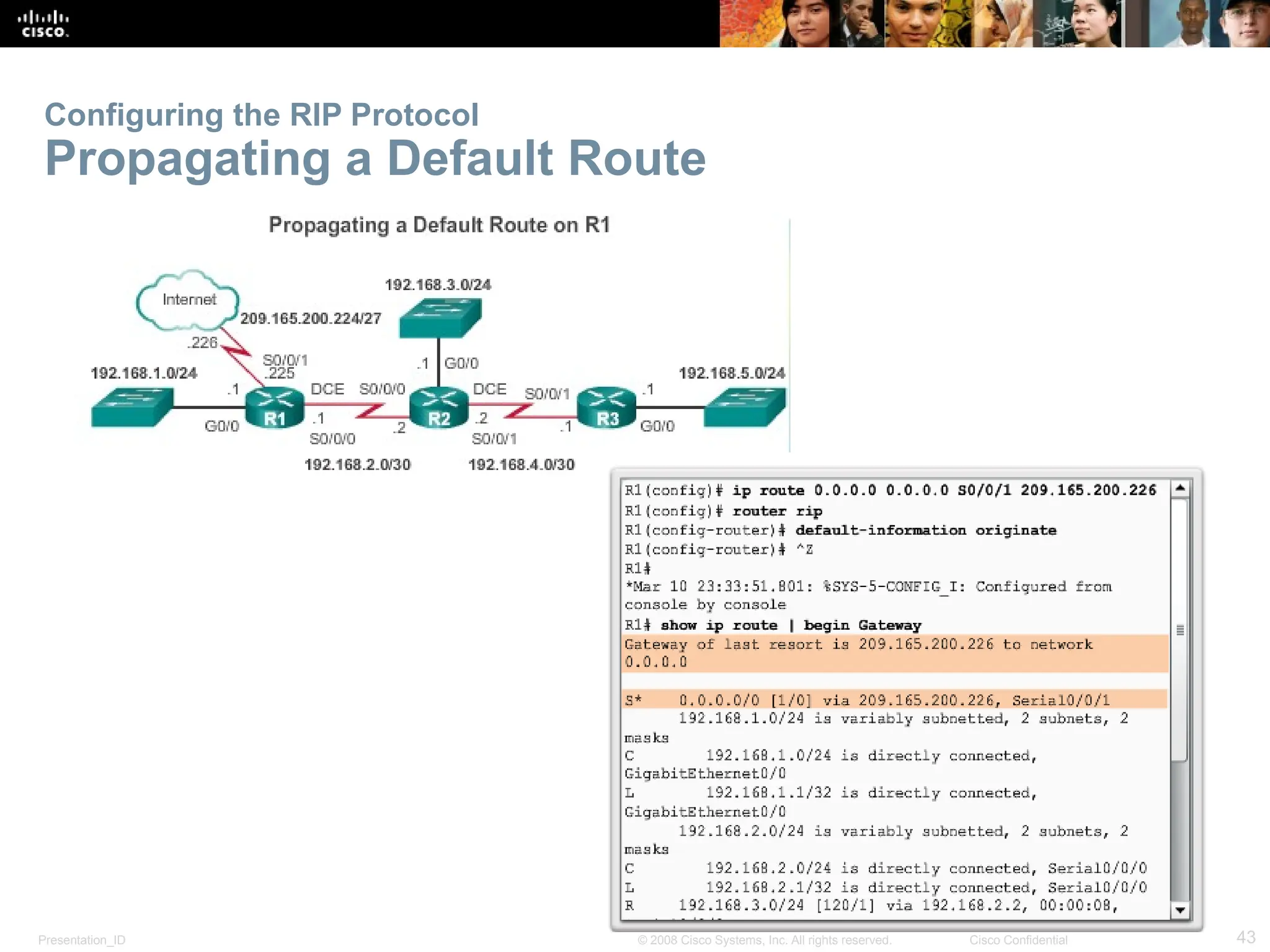
Propagating a Default Route
Presentation_ID 44
© 2008 Cisco Systems, Inc. All rights reserved. Cisco Confidential
Configuring the RIPng Protocol
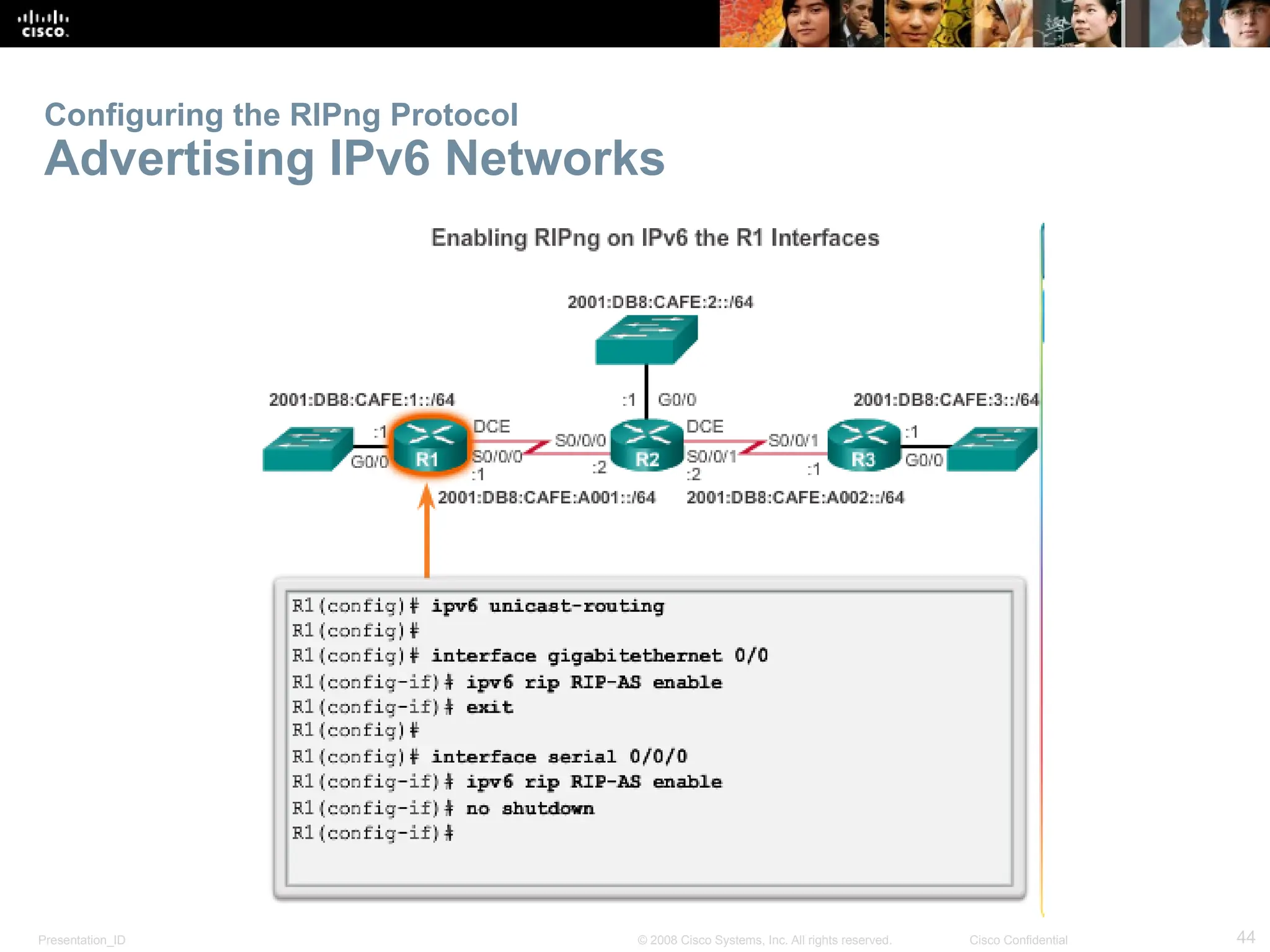
Advertising IPv6 Networks
Presentation_ID 45
© 2008 Cisco Systems, Inc. All rights reserved. Cisco Confidential
Configuring the RIPng Protocol
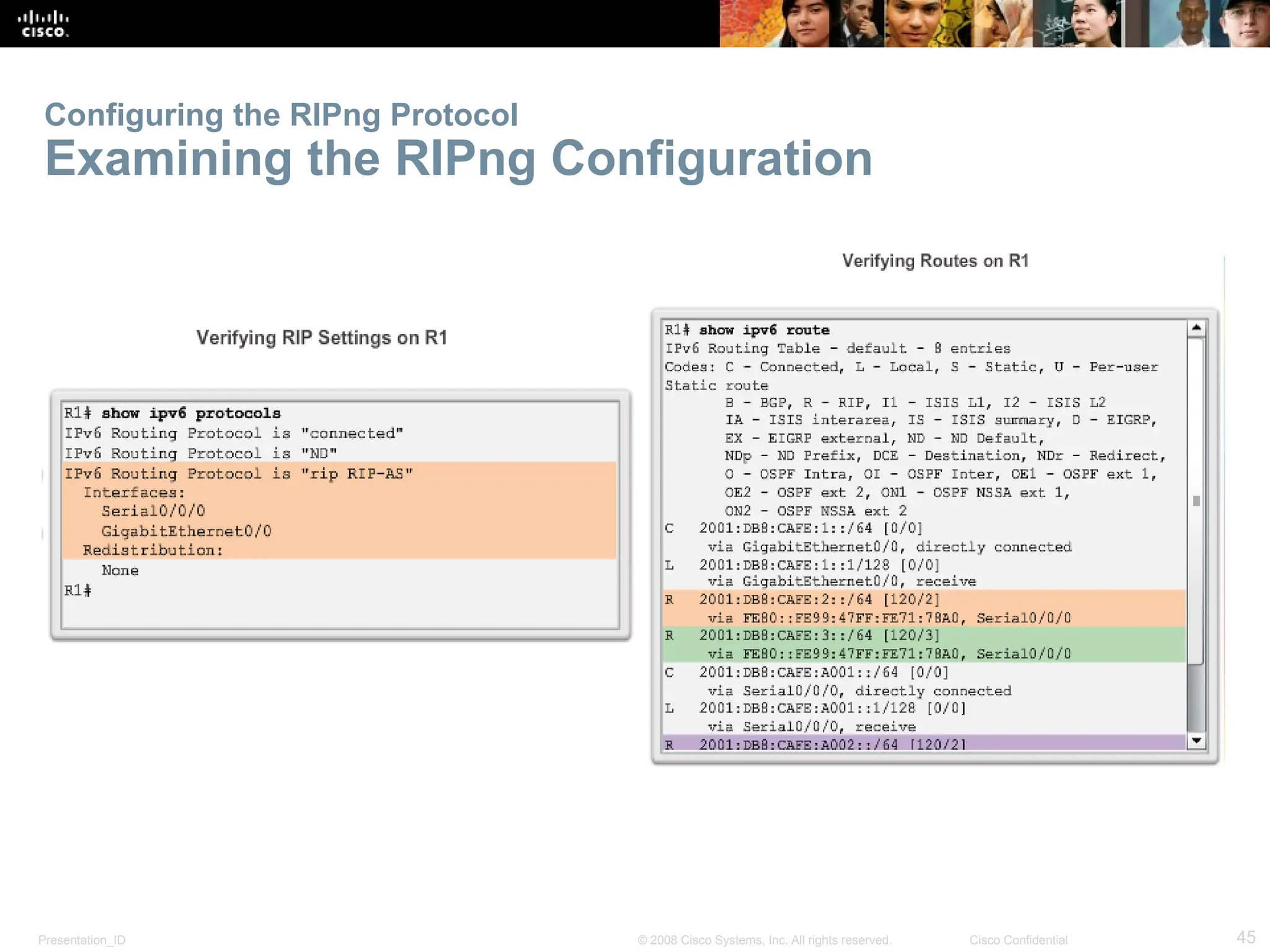
Examining the RIPng Configuration
Presentation_ID 46
© 2008 Cisco Systems, Inc. All rights reserved. Cisco Confidential
Configuring the RIPng Protocol
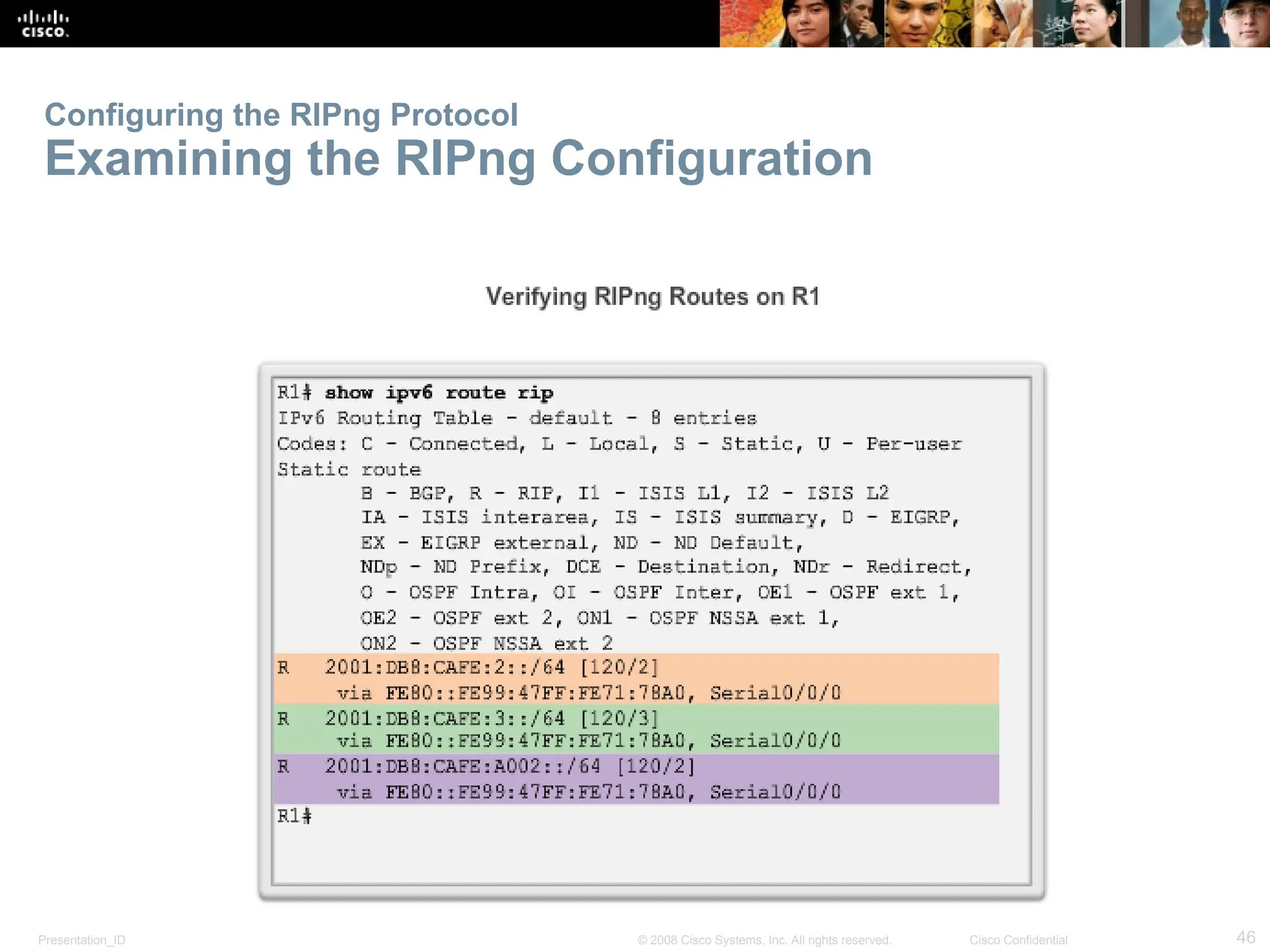
Examining the RIPng Configuration
Presentation_ID 47
© 2008 Cisco Systems, Inc. All rights reserved. Cisco Confidential
Link-State Dynamic Routing
Presentation_ID 48
© 2008 Cisco Systems, Inc. All rights reserved. Cisco Confidential
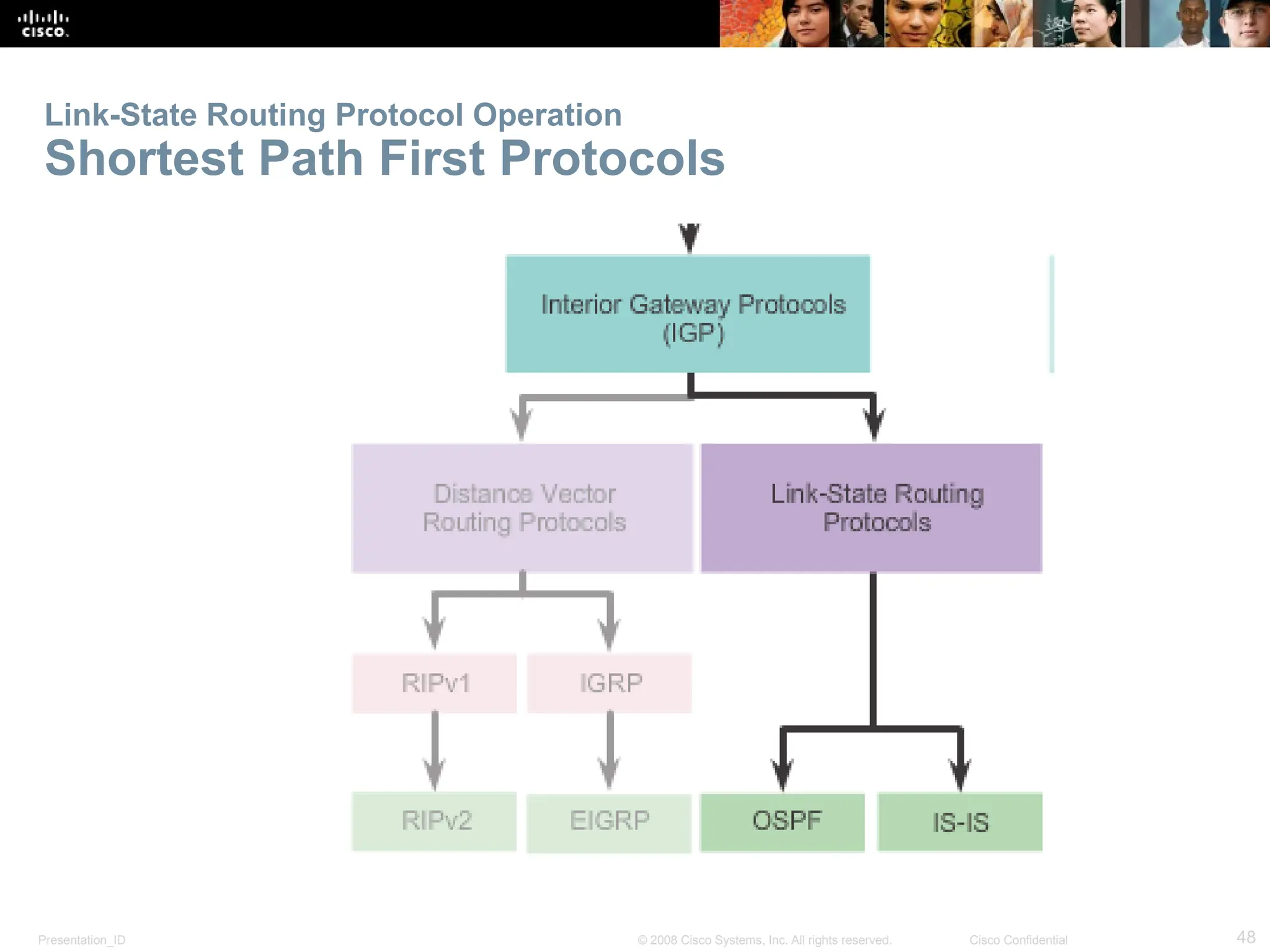
Link-State Routing Protocol Operation
Shortest Path First Protocols
Presentation_ID 49
© 2008 Cisco Systems, Inc. All rights reserved. Cisco Confidential
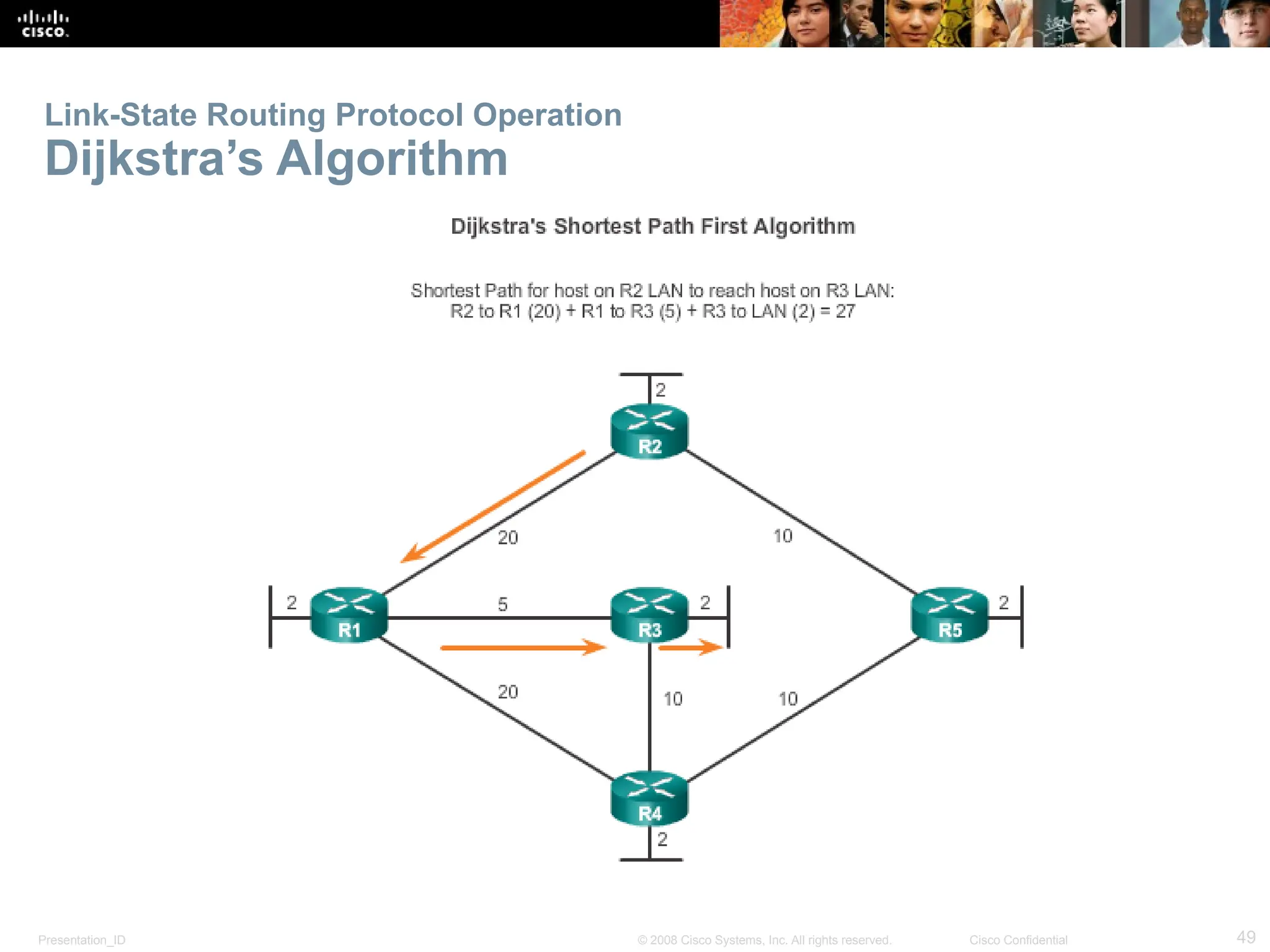
Link-State Routing Protocol Operation
Dijkstra’s Algorithm
Presentation_ID 50
© 2008 Cisco Systems, Inc. All rights reserved. Cisco Confidential
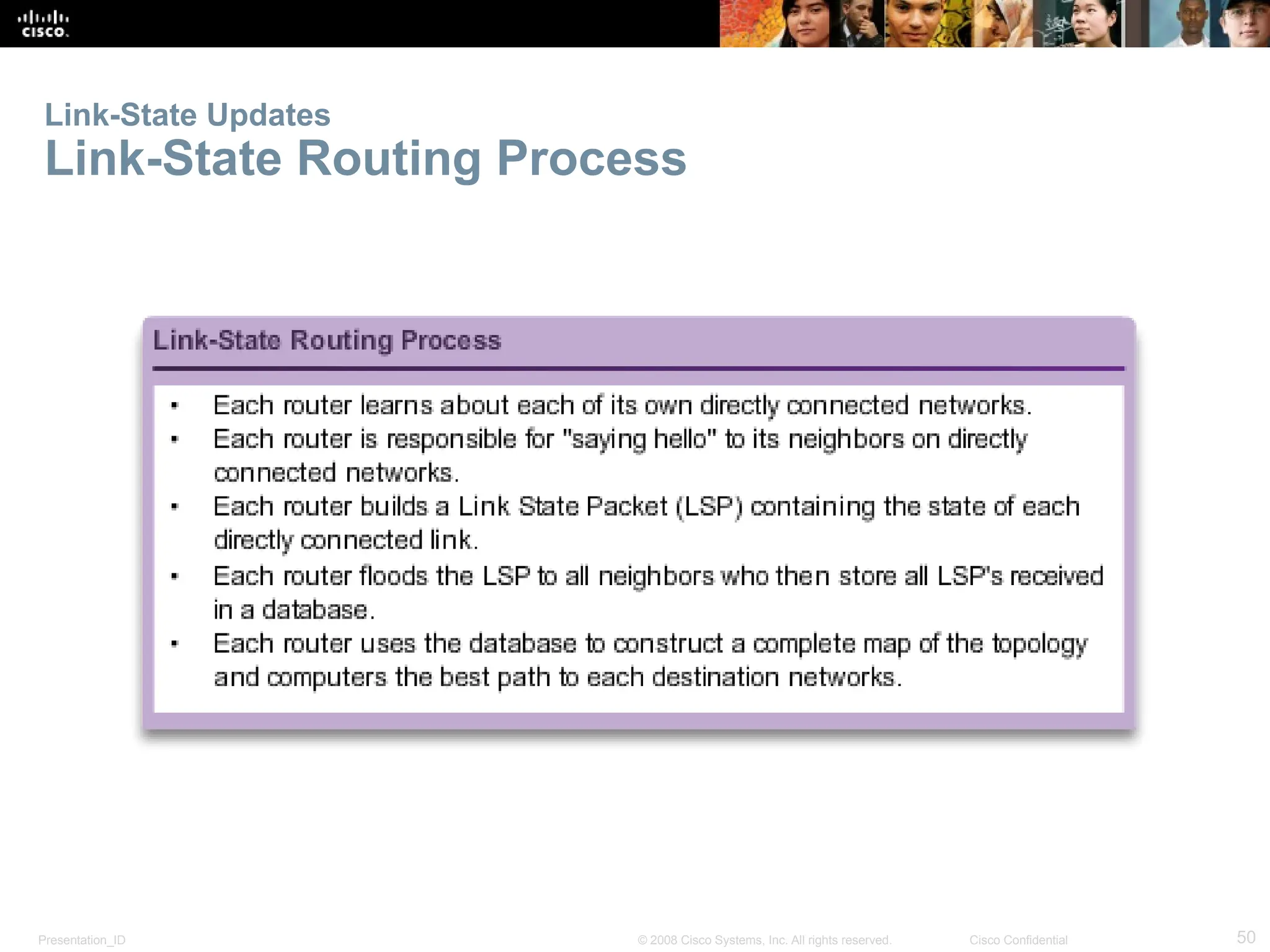
Link-State Updates
Link-State Routing Process
Presentation_ID 51
© 2008 Cisco Systems, Inc. All rights reserved. Cisco Confidential
Link-State Updates
Link and Link-State
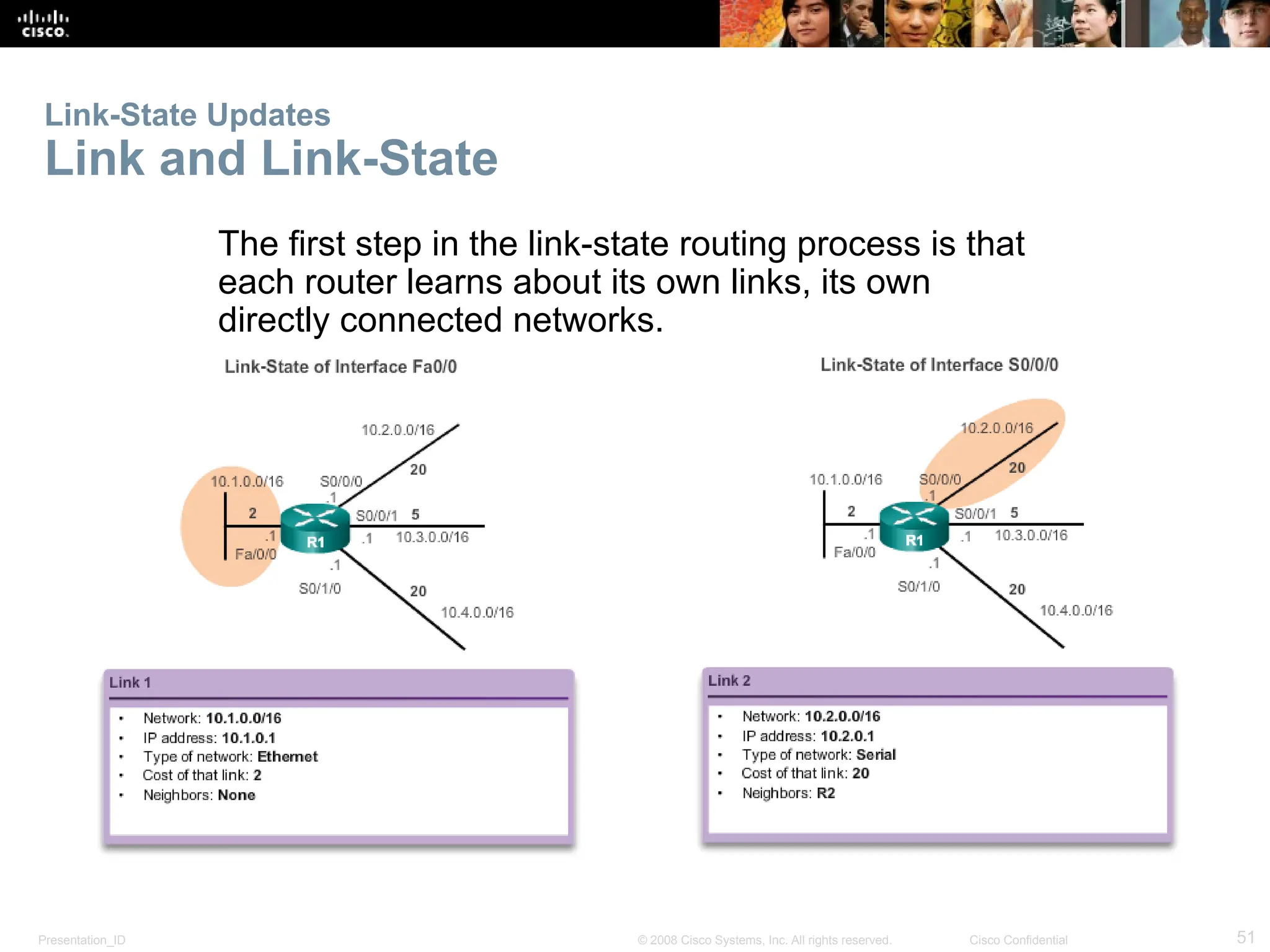
The first step in the link-state routing process is that
each router learns about its own links, its own
directly connected networks.
Presentation_ID 52
© 2008 Cisco Systems, Inc. All rights reserved. Cisco Confidential
Link-State Updates
Say Hello
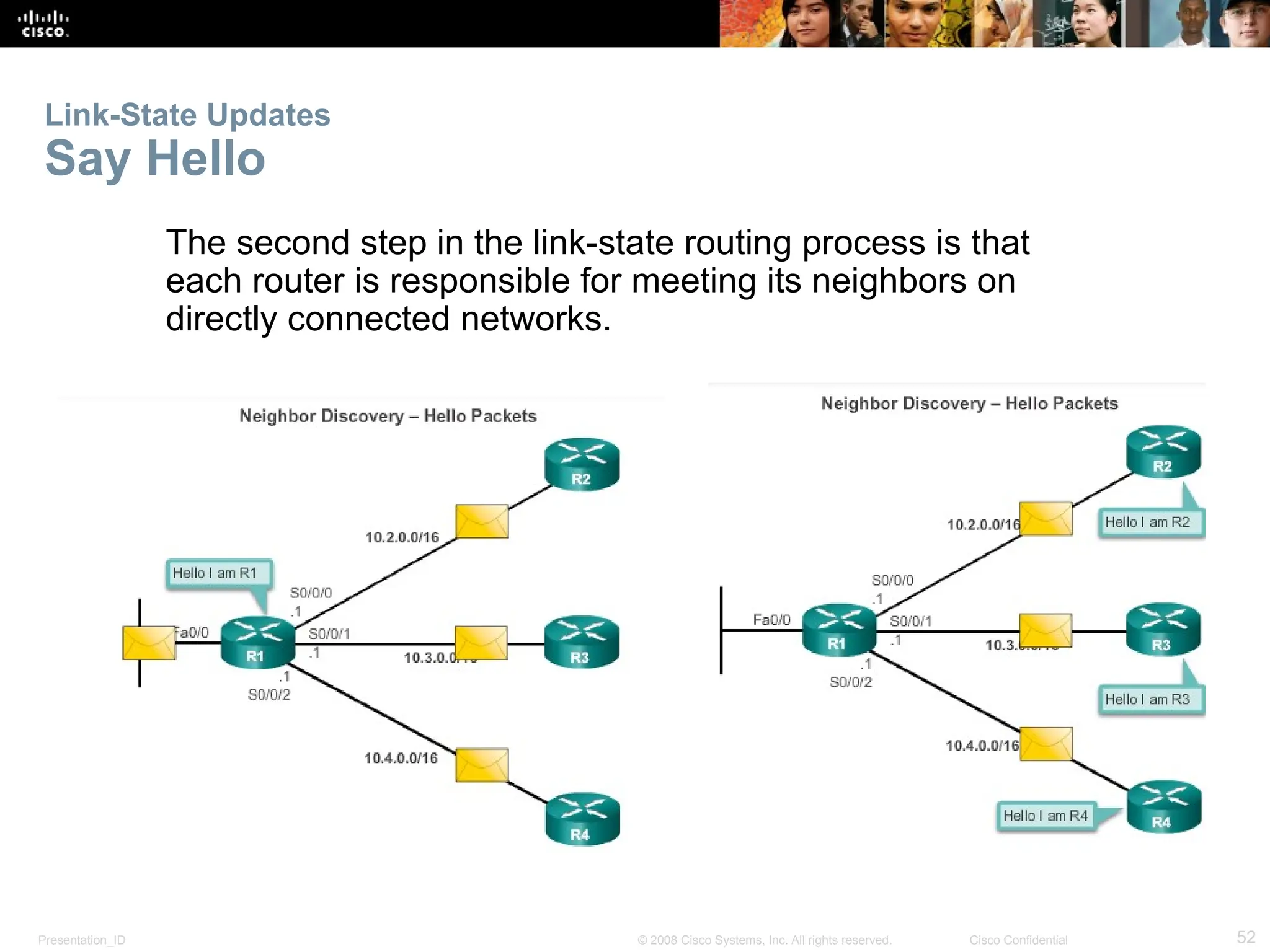
The second step in the link-state routing process is that
each router is responsible for meeting its neighbors on
directly connected networks.
Presentation_ID 53
© 2008 Cisco Systems, Inc. All rights reserved. Cisco Confidential
Link-State Updates
Say Hello
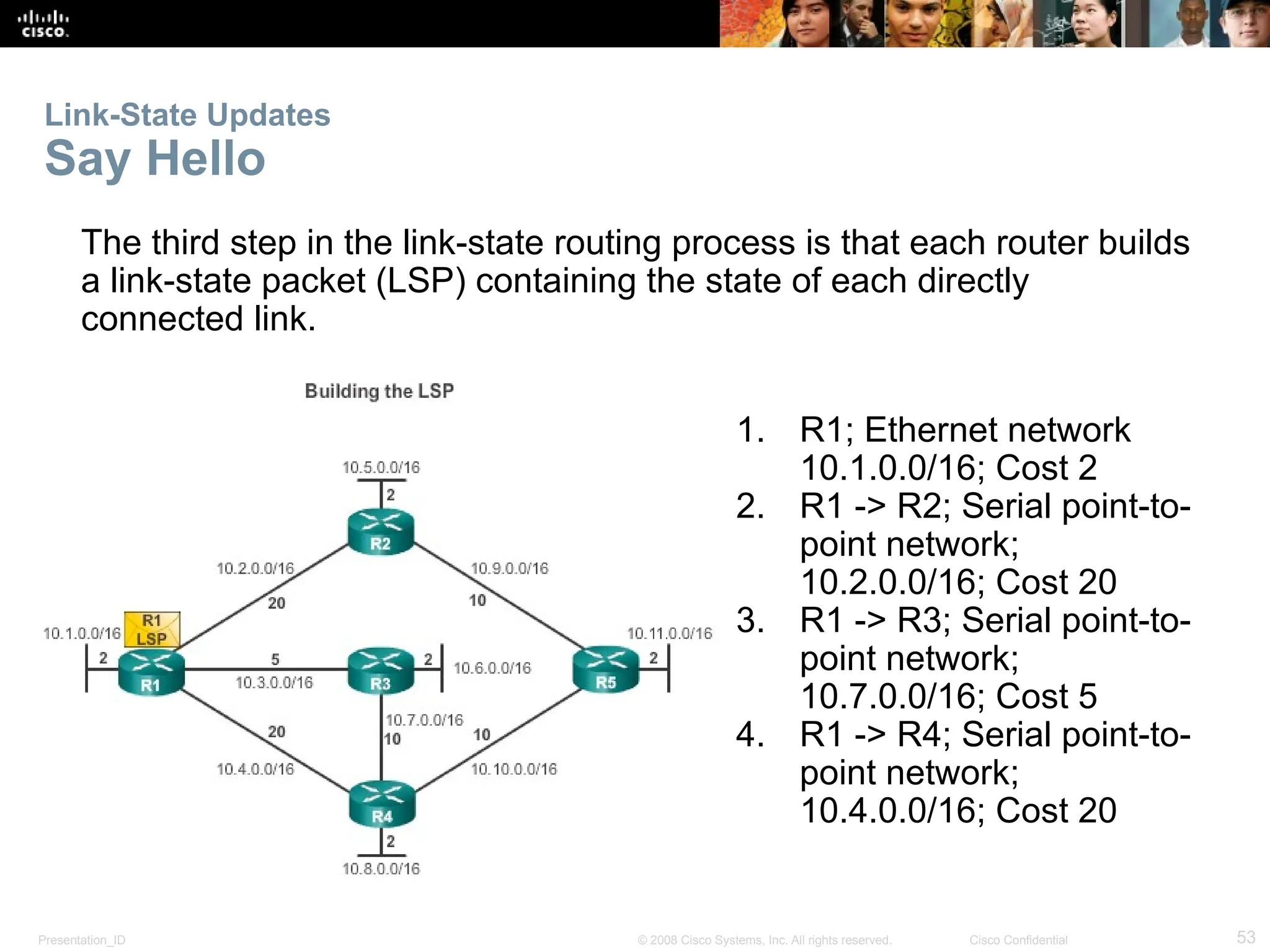
The third step in the link-state routing process is that each router builds
a link-state packet (LSP) containing the state of each directly
connected link.
1. R1; Ethernet network
10.1.0.0/16; Cost 2
2. R1 -> R2; Serial point-to-
point network;
10.2.0.0/16; Cost 20
3. R1 -> R3; Serial point-to-
point network;
10.7.0.0/16; Cost 5
4. R1 -> R4; Serial point-to-
point network;
10.4.0.0/16; Cost 20
Presentation_ID 54
© 2008 Cisco Systems, Inc. All rights reserved. Cisco Confidential
Link-State Updates
Flooding the LSP
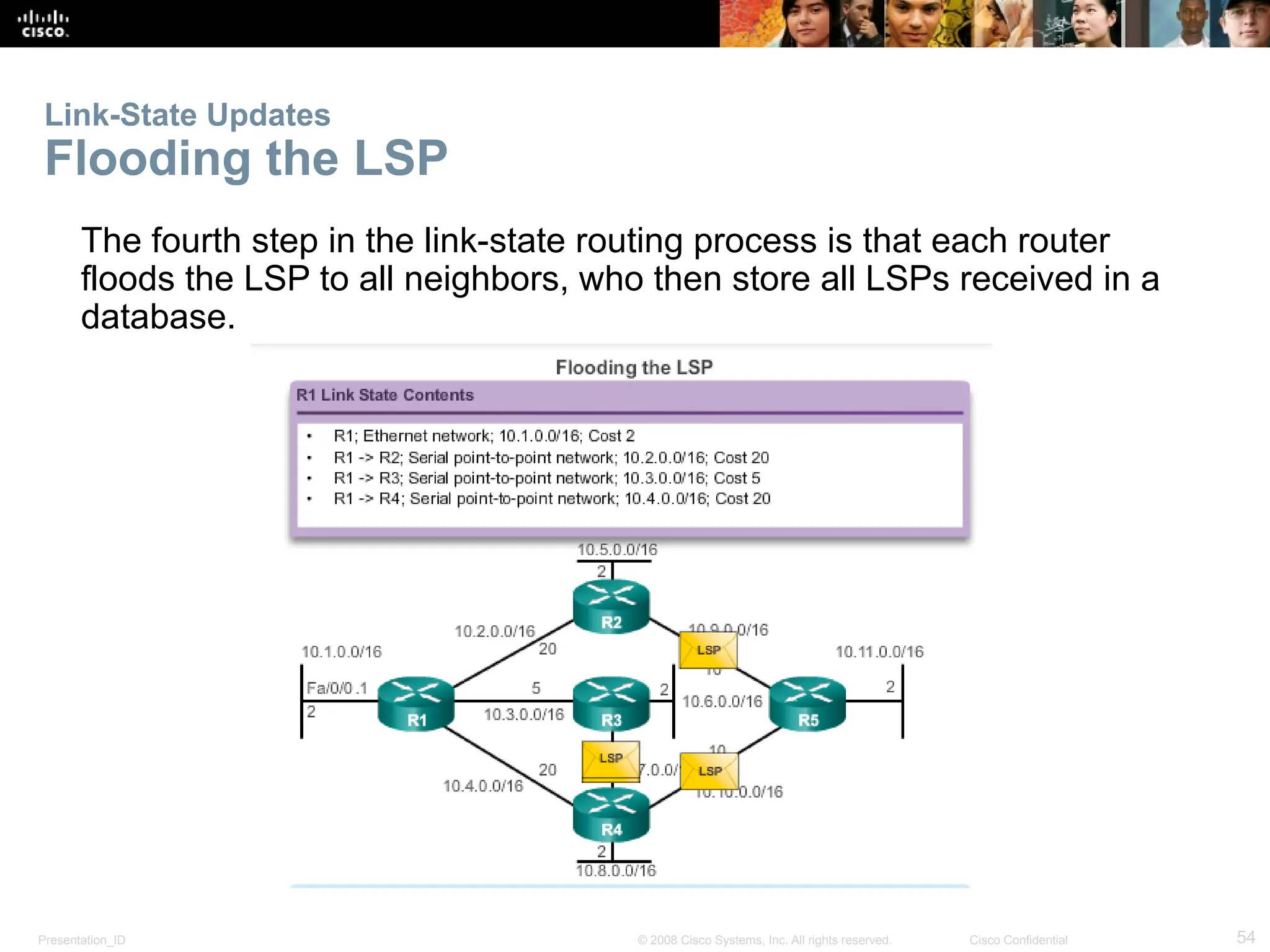
The fourth step in the link-state routing process is that each router
floods the LSP to all neighbors, who then store all LSPs received in a
database.
Presentation_ID 55
© 2008 Cisco Systems, Inc. All rights reserved. Cisco Confidential
Link-State Updates
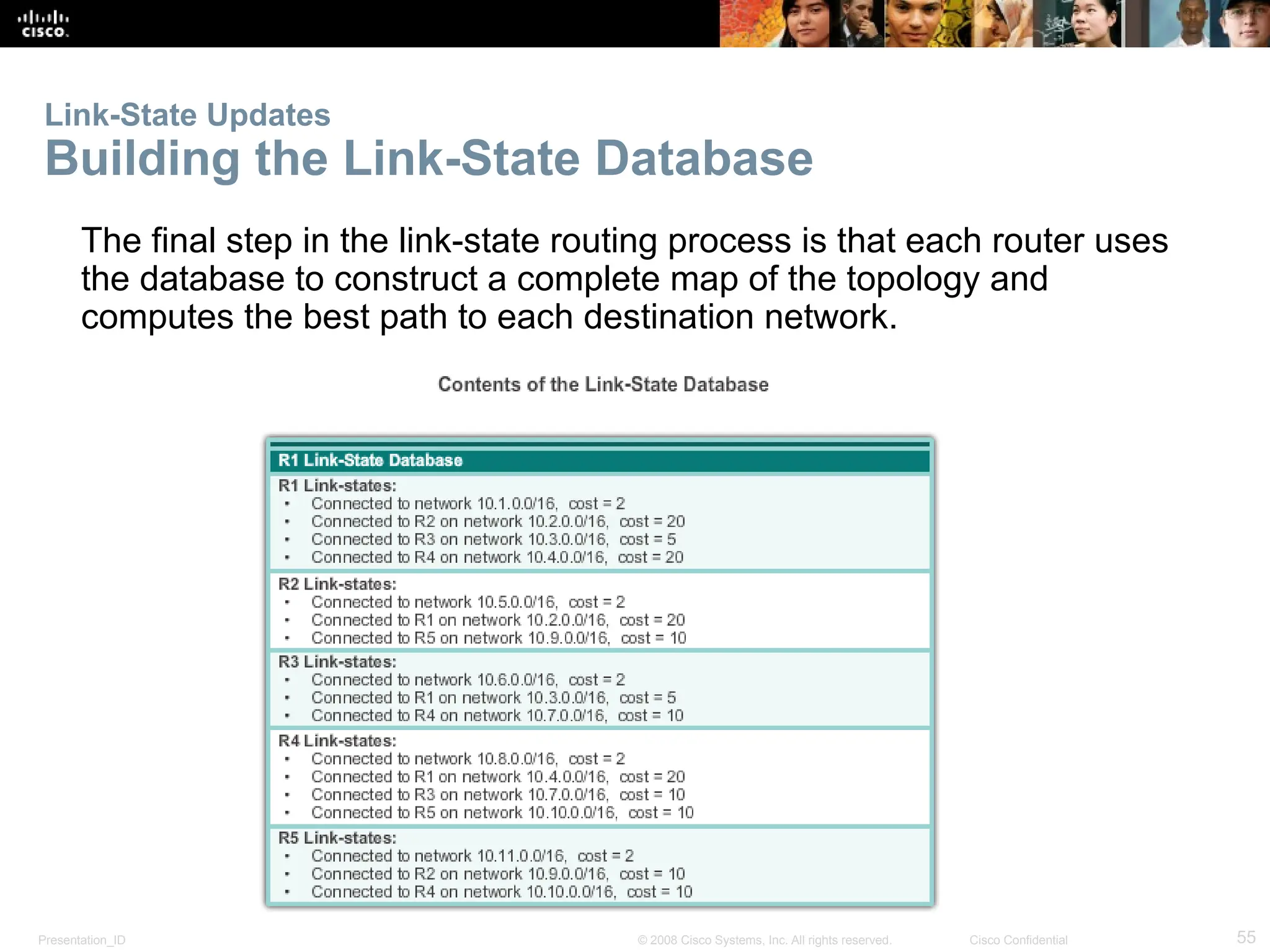
Building the Link-State Database
The final step in the link-state routing process is that each router uses
the database to construct a complete map of the topology and
computes the best path to each destination network.
Presentation_ID 56
© 2008 Cisco Systems, Inc. All rights reserved. Cisco Confidential
Link-State Updates
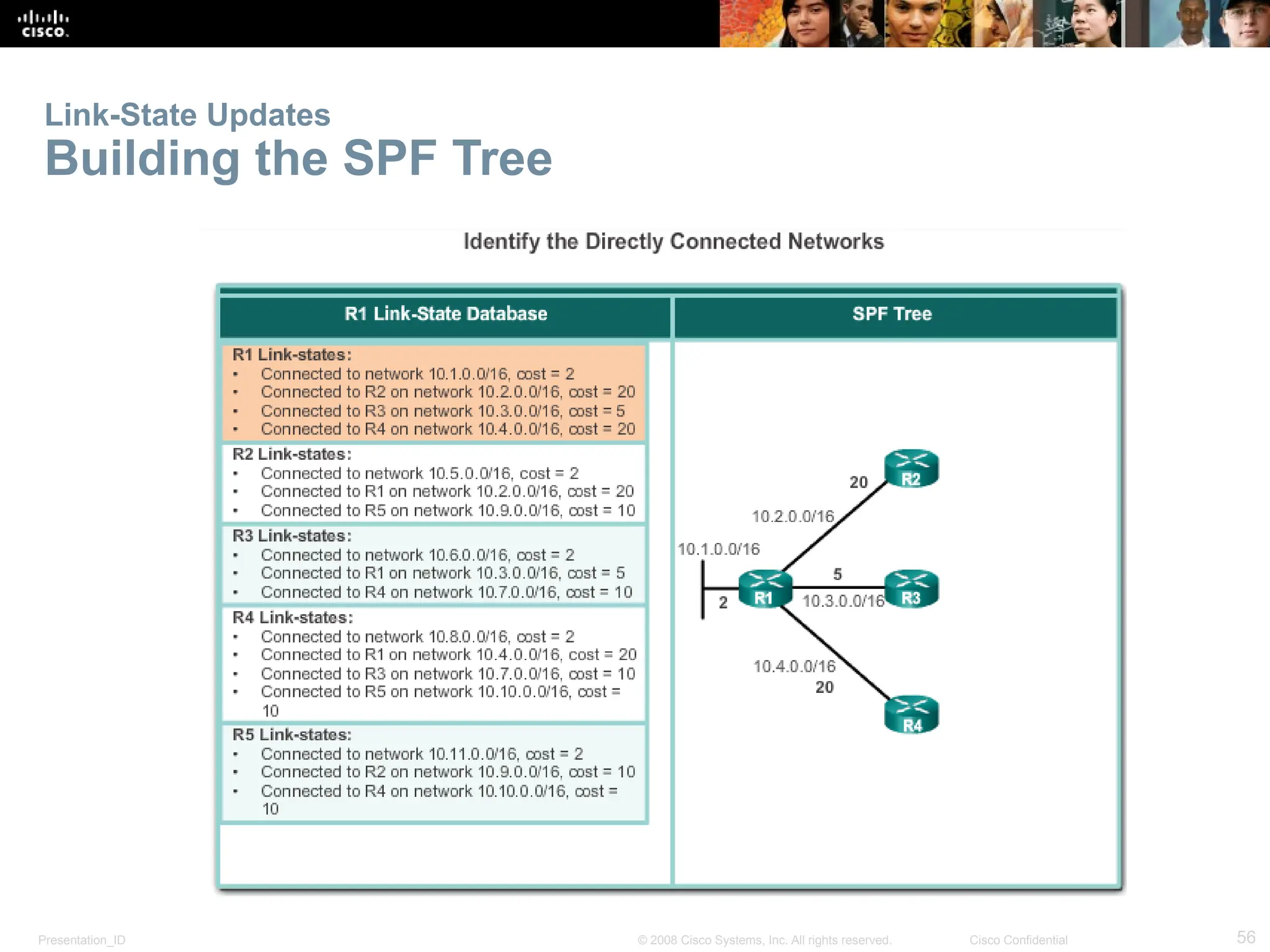
Building the SPF Tree
Presentation_ID 57
© 2008 Cisco Systems, Inc. All rights reserved. Cisco Confidential
Link-State Updates
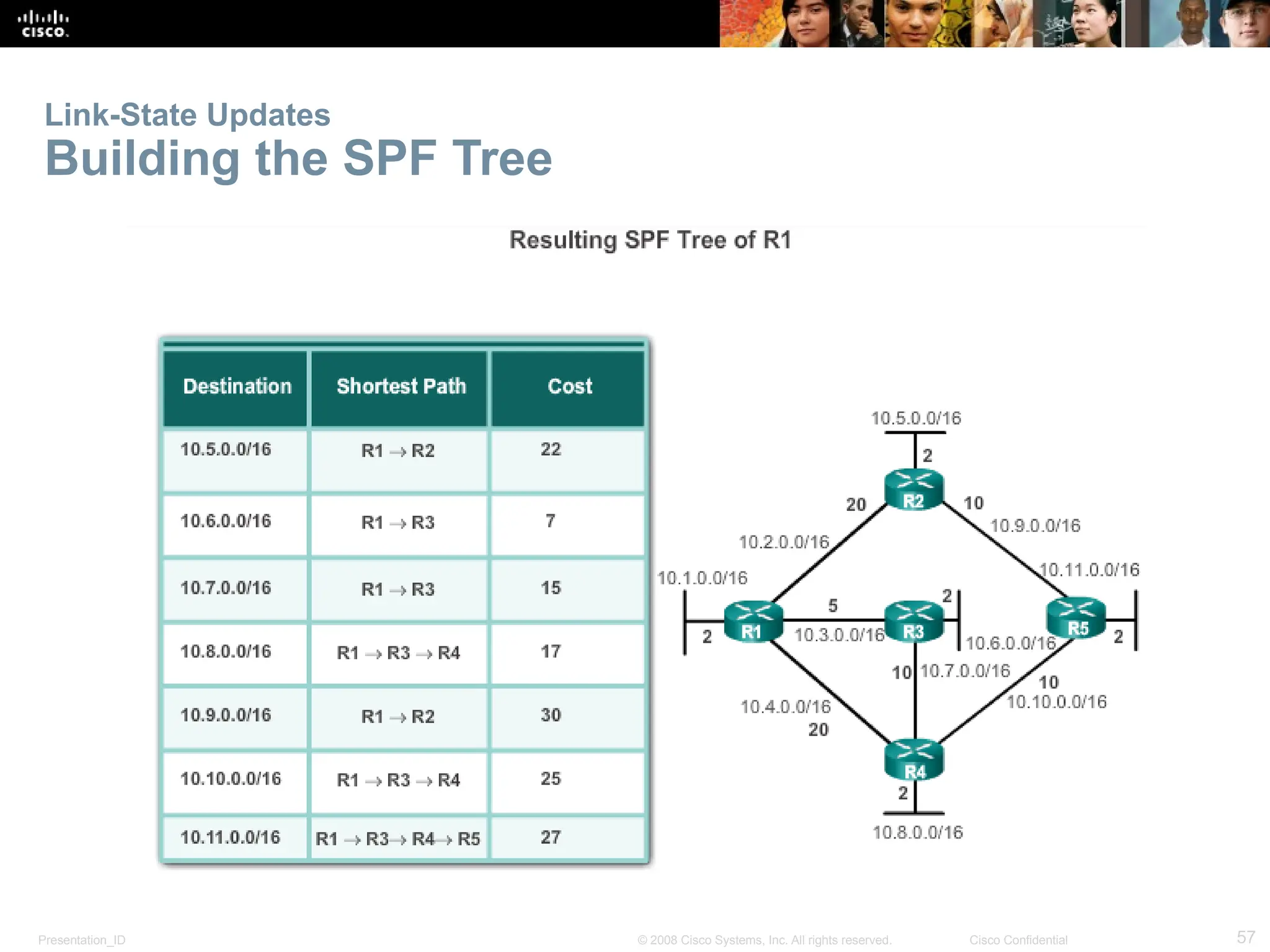
Building the SPF Tree
Presentation_ID 58
© 2008 Cisco Systems, Inc. All rights reserved. Cisco Confidential
Link-State Updates
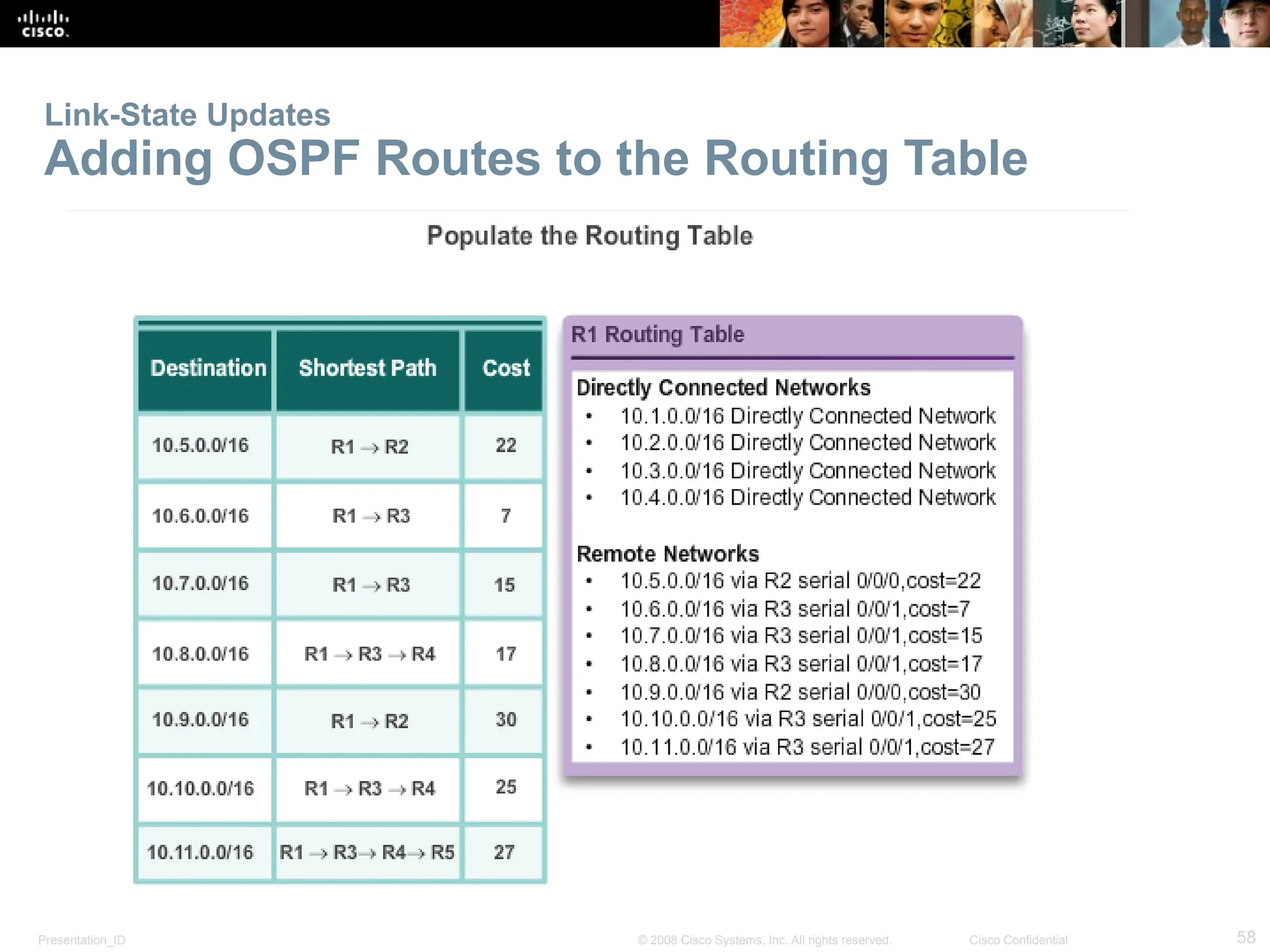
Adding OSPF Routes to the Routing Table
Presentation_ID 59
© 2008 Cisco Systems, Inc. All rights reserved. Cisco Confidential
Why Use Link-State Routing Protocols
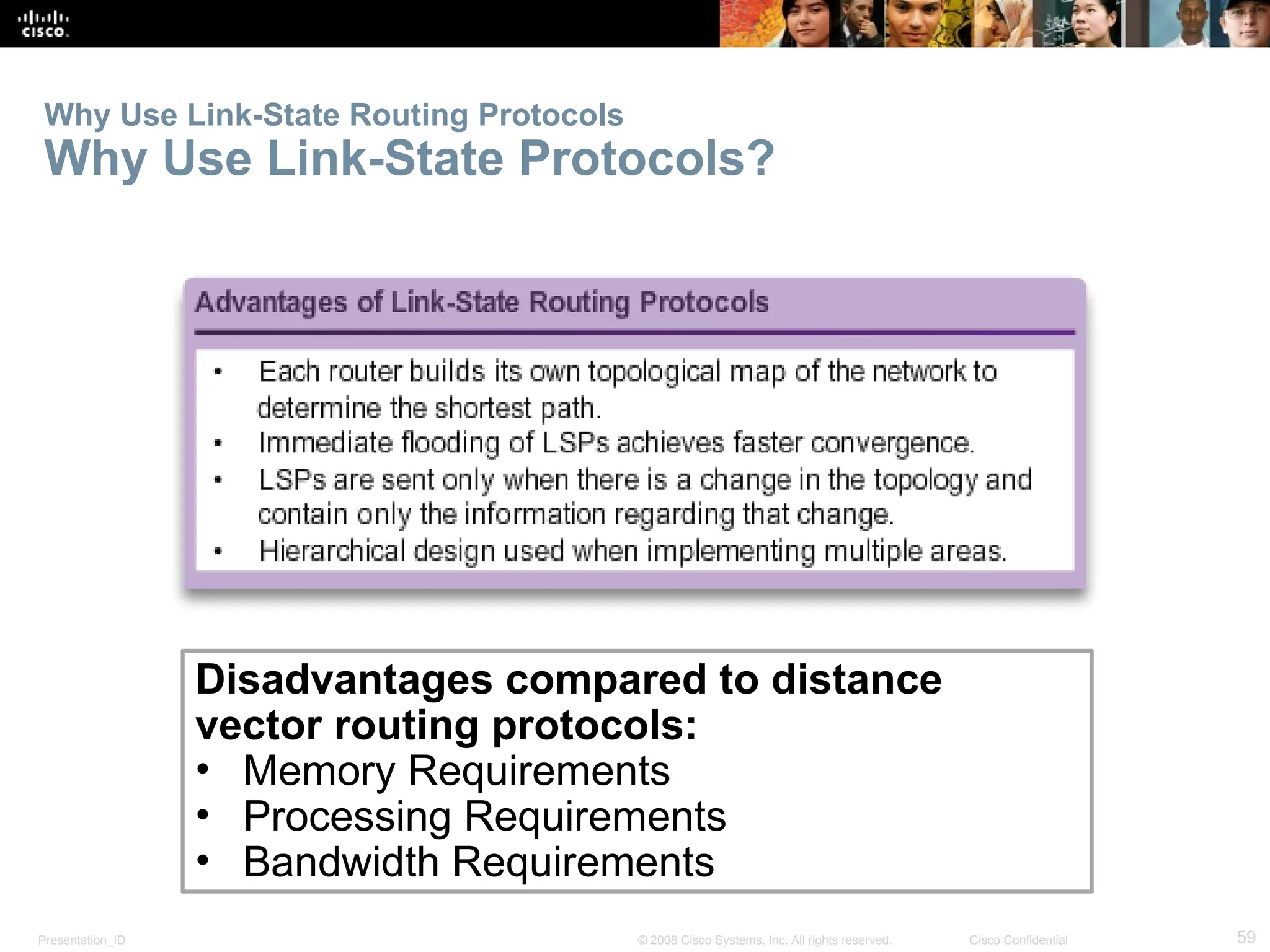
Why Use Link-State Protocols?
Disadvantages compared to distance
vector routing protocols:
• Memory Requirements
• Processing Requirements
• Bandwidth Requirements
Presentation_ID 60
© 2008 Cisco Systems, Inc. All rights reserved. Cisco Confidential
Why Use Link-State Routing Protocols
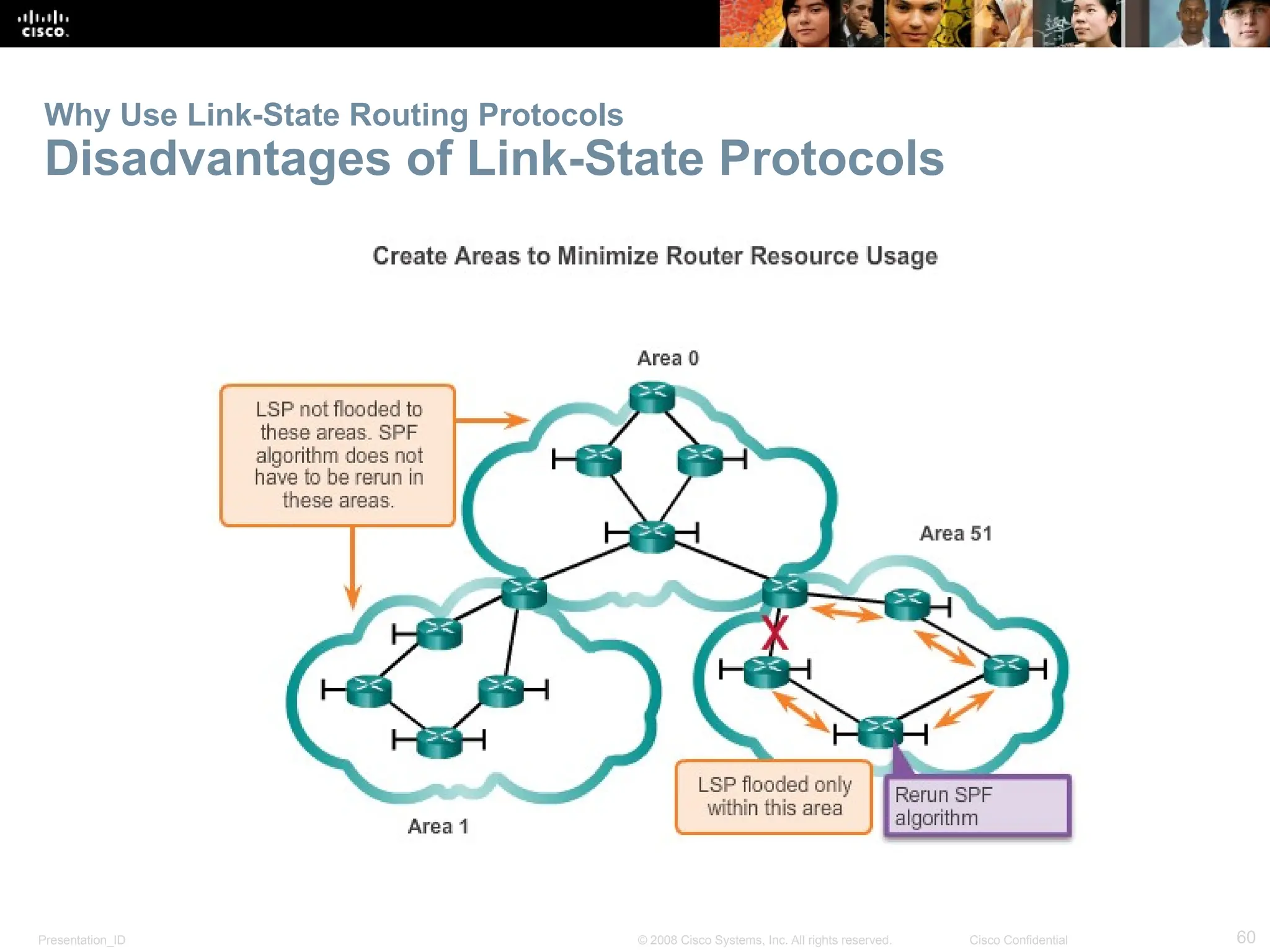
Disadvantages of Link-State Protocols
Presentation_ID 61
© 2008 Cisco Systems, Inc. All rights reserved. Cisco Confidential
Why Use Link-State Routing Protocols
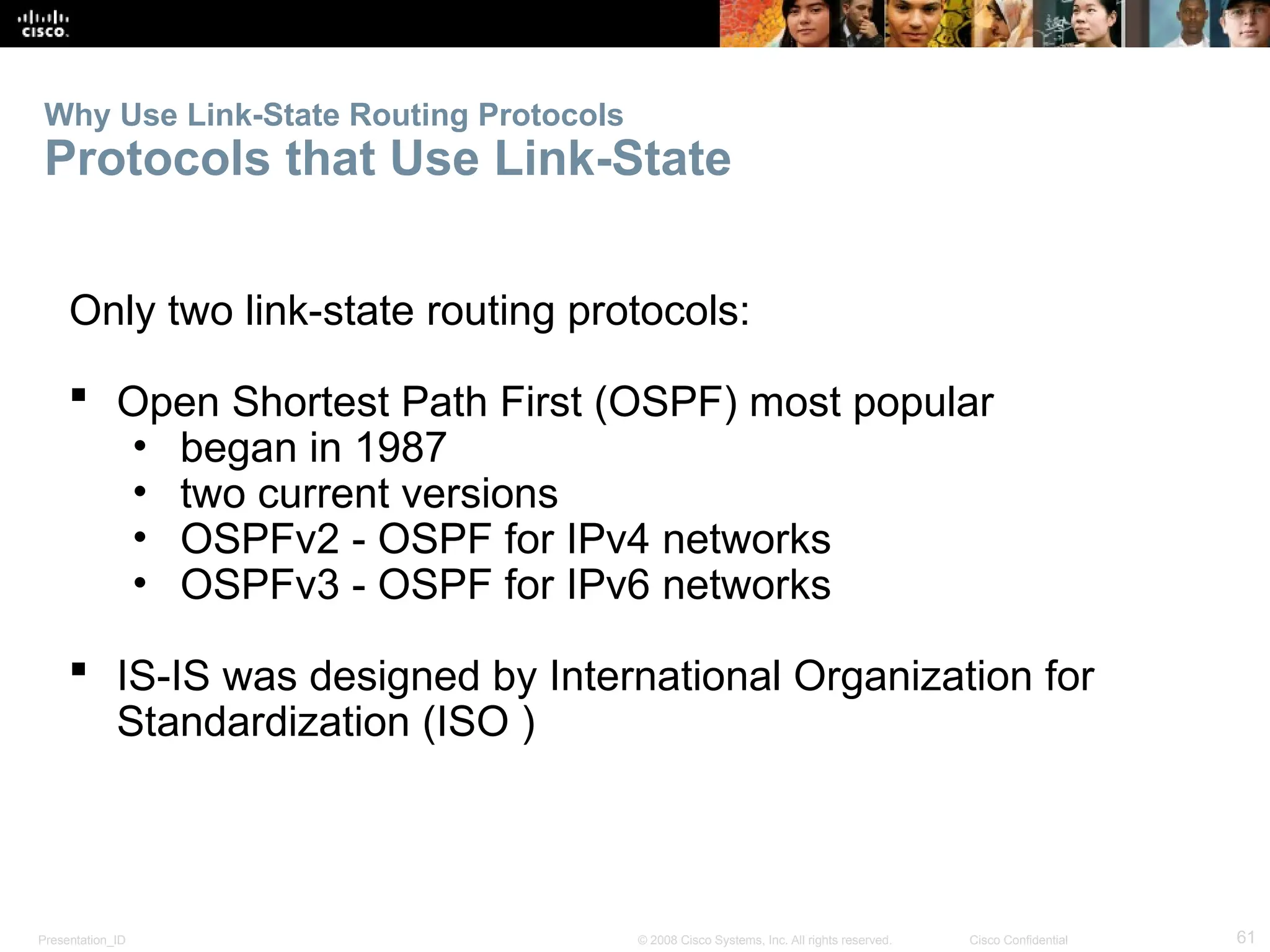
Protocols that Use Link-State
Only two link-state routing protocols:
 Open Shortest Path First (OSPF) most popular
• began in 1987
• two current versions
• OSPFv2 - OSPF for IPv4 networks
• OSPFv3 - OSPF for IPv6 networks
 IS-IS was designed by International Organization for
Standardization (ISO )
Presentation_ID 62
© 2008 Cisco Systems, Inc. All rights reserved. Cisco Confidential
The Routing Table
Presentation_ID 63
© 2008 Cisco Systems, Inc. All rights reserved. Cisco Confidential
Parts of an IPv4 Route Entry
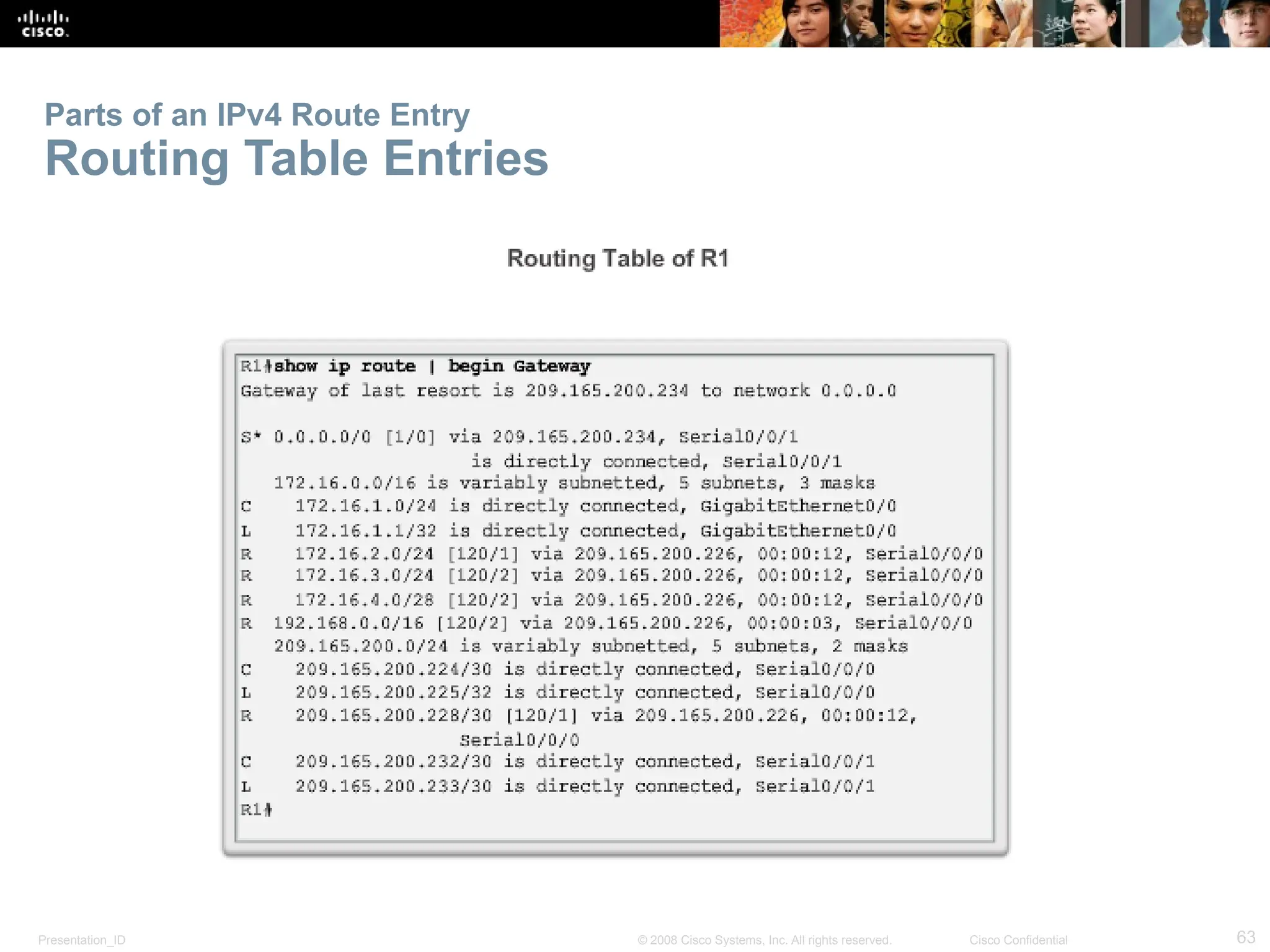
Routing Table Entries
Presentation_ID 64
© 2008 Cisco Systems, Inc. All rights reserved. Cisco Confidential
Parts of an IPv4 Route Entry
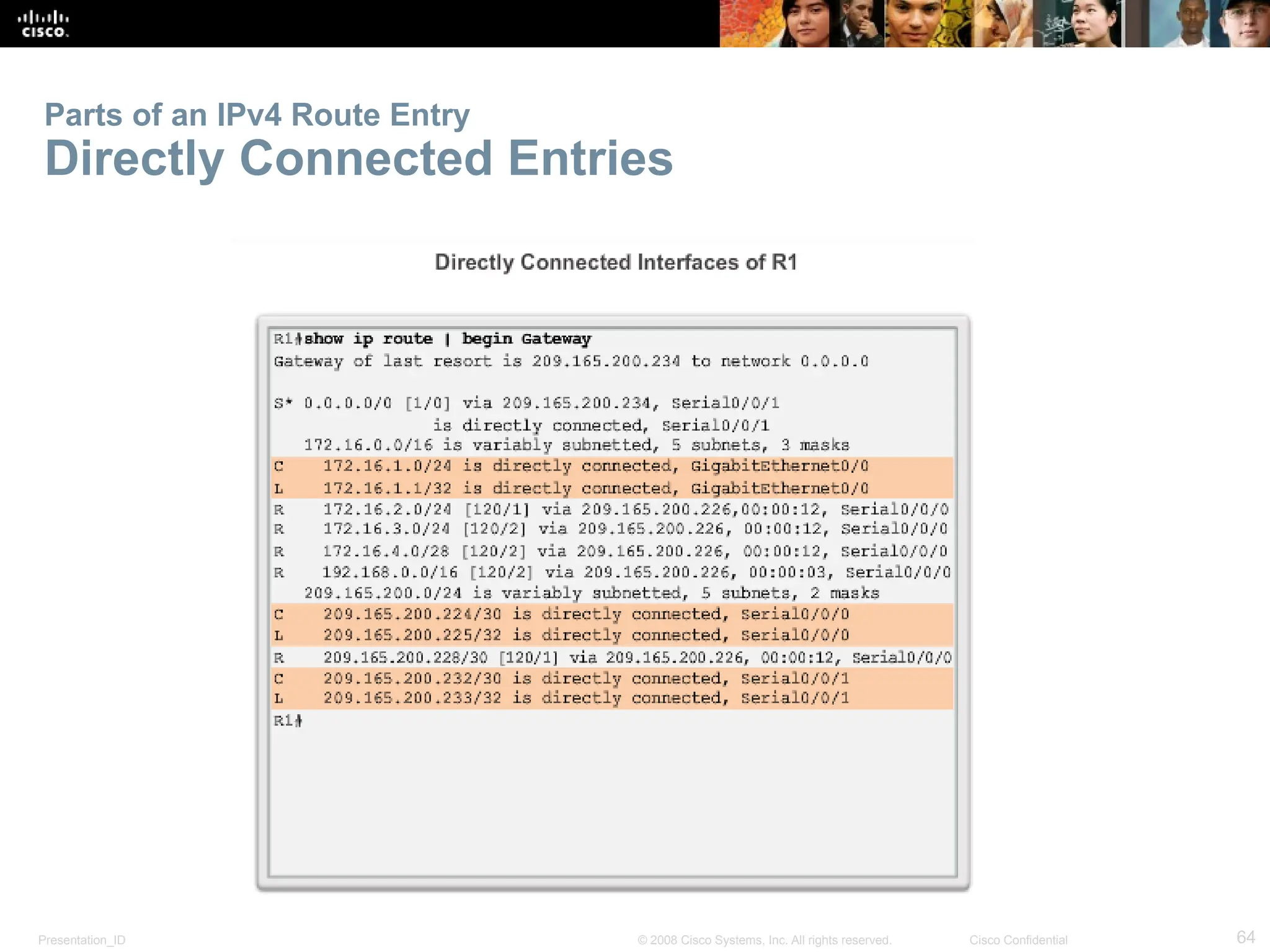
Directly Connected Entries
Presentation_ID 65
© 2008 Cisco Systems, Inc. All rights reserved. Cisco Confidential
Parts of an IPv4 Route Entry
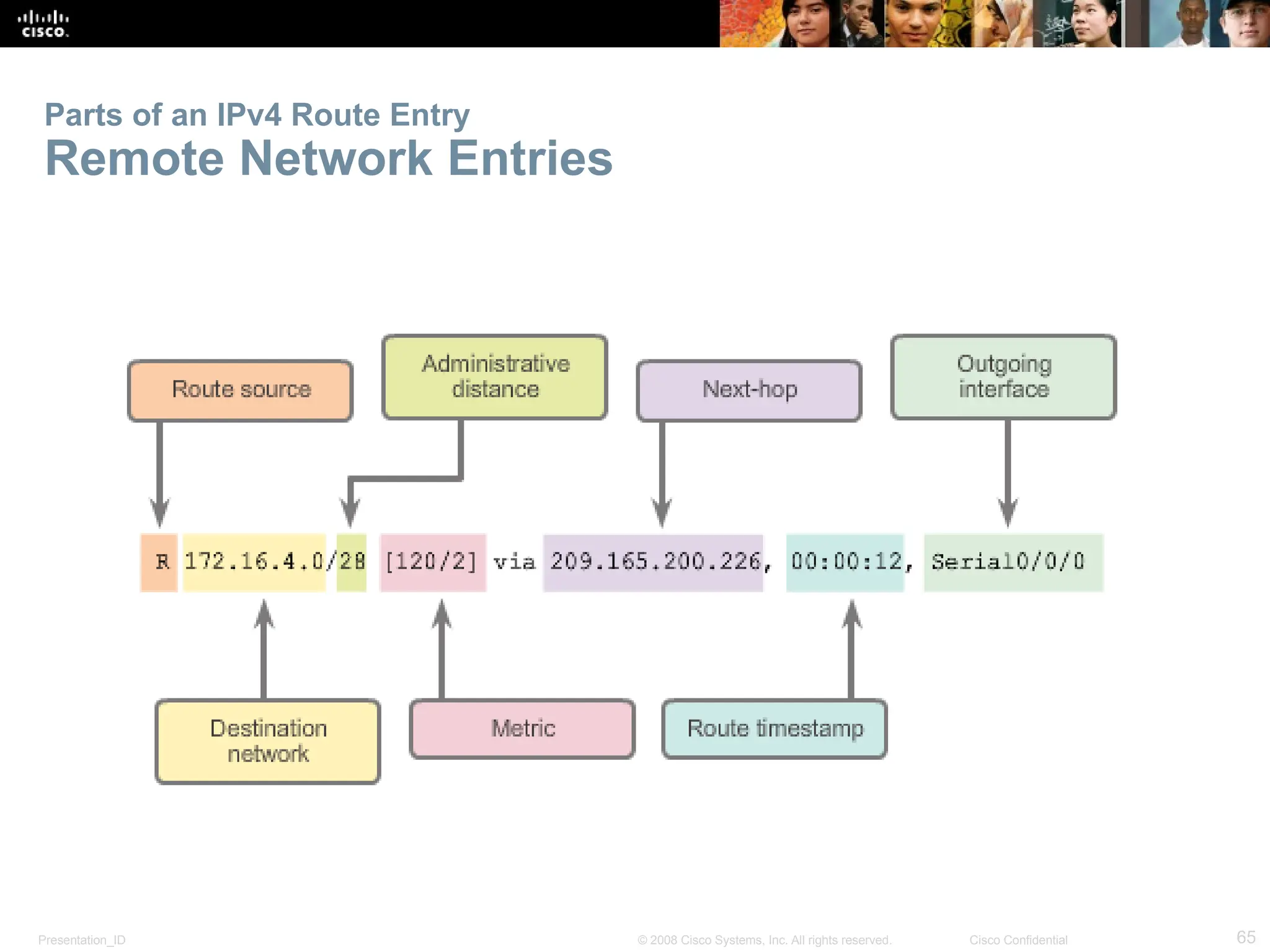
Remote Network Entries
Presentation_ID 66
© 2008 Cisco Systems, Inc. All rights reserved. Cisco Confidential
Dynamically Learned IPv4 Routes
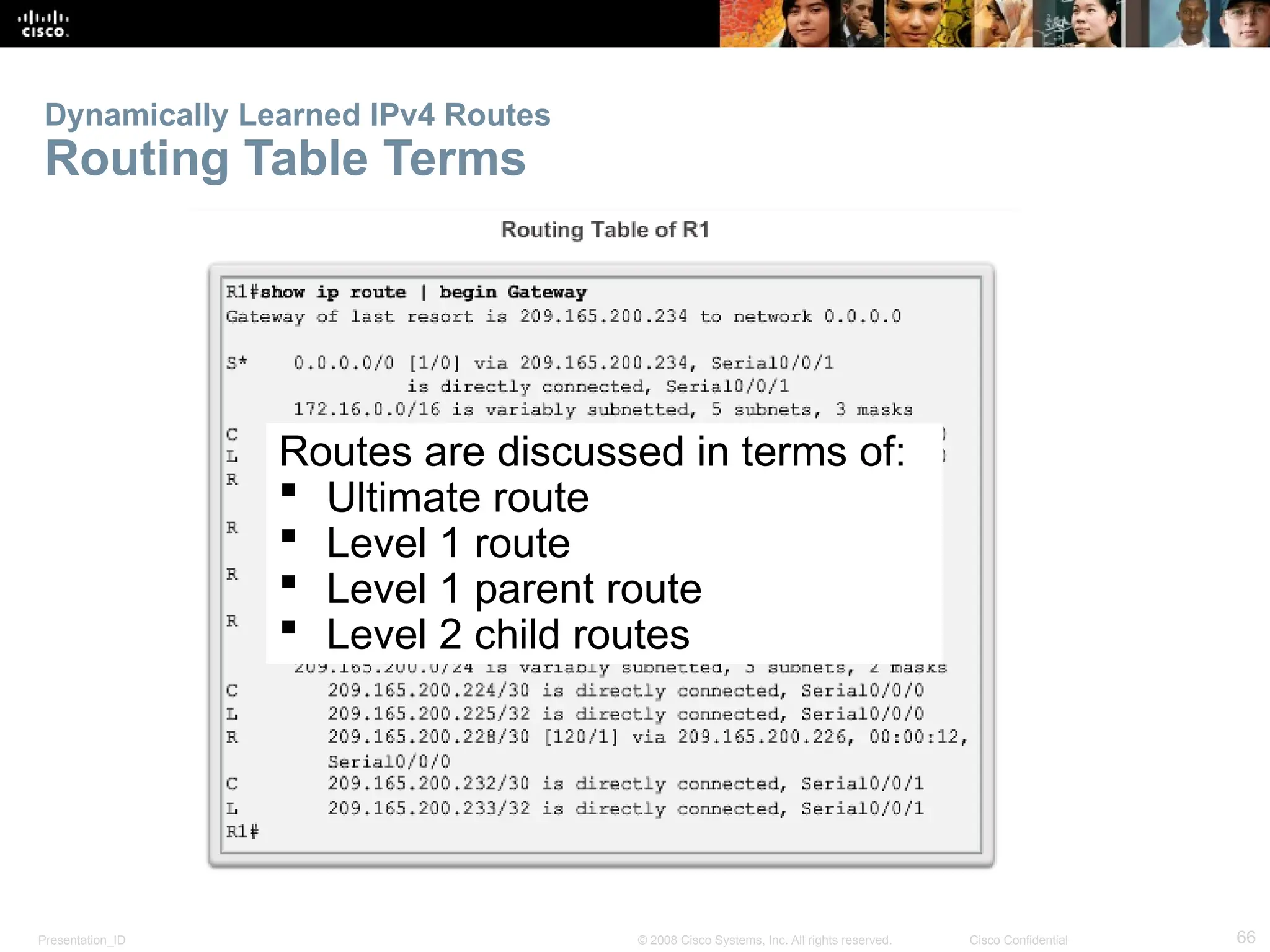
Routing Table Terms
Routes are discussed in terms of:
 Ultimate route
 Level 1 route
 Level 1 parent route
 Level 2 child routes
Presentation_ID 67
© 2008 Cisco Systems, Inc. All rights reserved. Cisco Confidential
Dynamically Learned IPv4 Routes
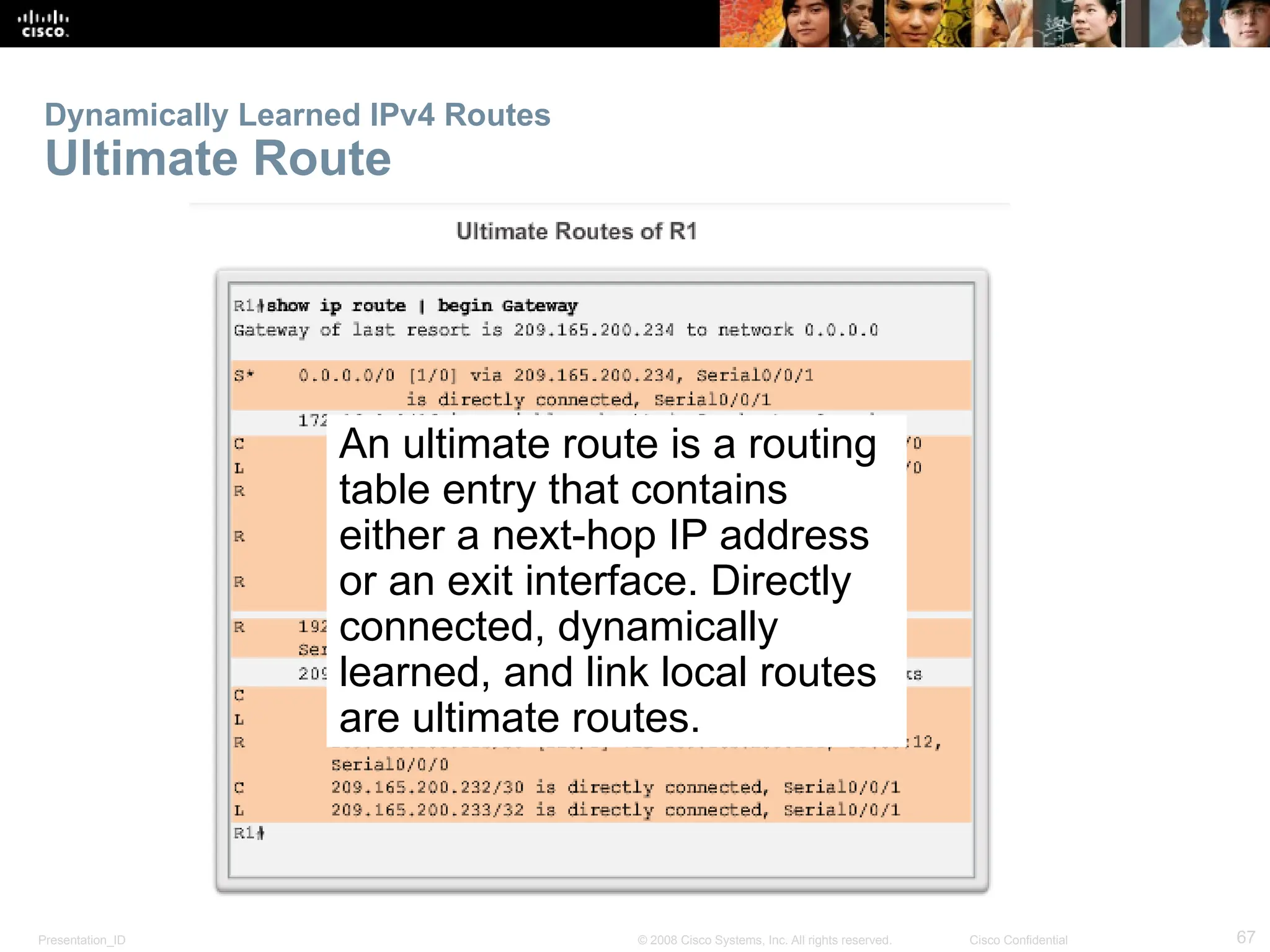
Ultimate Route
An ultimate route is a routing
table entry that contains
either a next-hop IP address
or an exit interface. Directly
connected, dynamically
learned, and link local routes
are ultimate routes.
Presentation_ID 68
© 2008 Cisco Systems, Inc. All rights reserved. Cisco Confidential
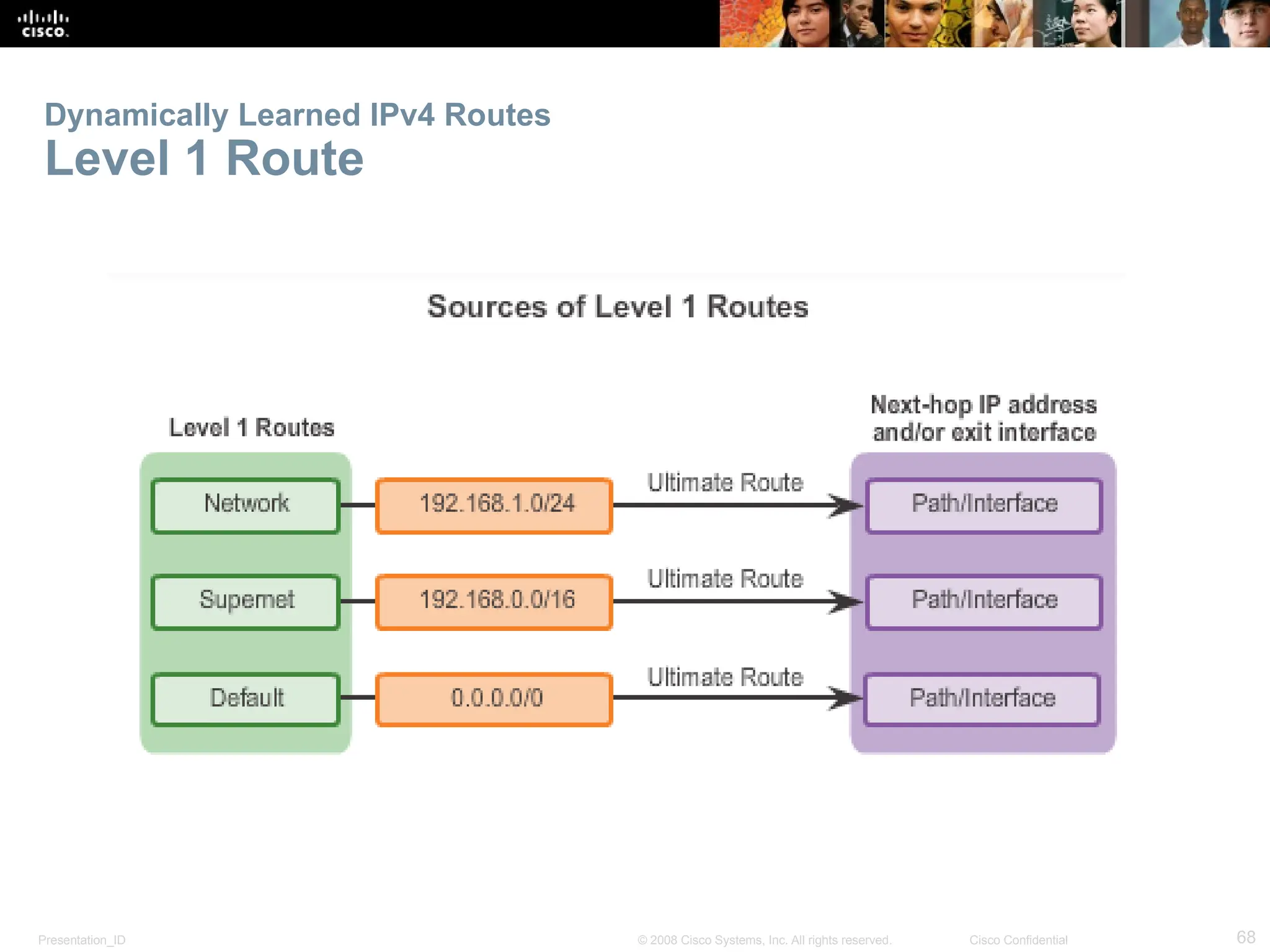
Dynamically Learned IPv4 Routes
Level 1 Route
Presentation_ID 69
© 2008 Cisco Systems, Inc. All rights reserved. Cisco Confidential
Dynamically Learned IPv4 Routes
Level 1 Parent Route
Presentation_ID 70
© 2008 Cisco Systems, Inc. All rights reserved. Cisco Confidential
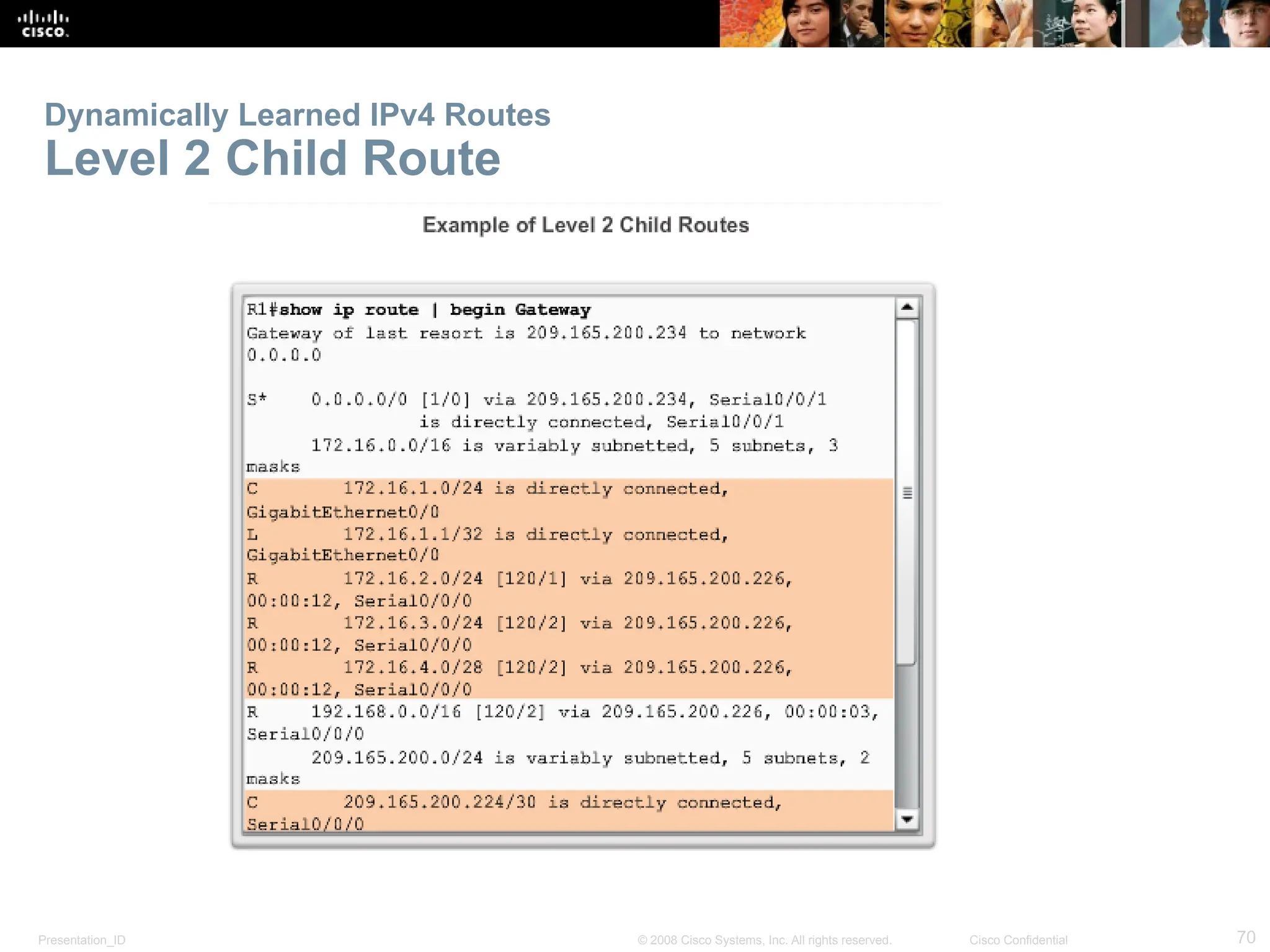
Dynamically Learned IPv4 Routes
Level 2 Child Route
Presentation_ID 71
© 2008 Cisco Systems, Inc. All rights reserved. Cisco Confidential
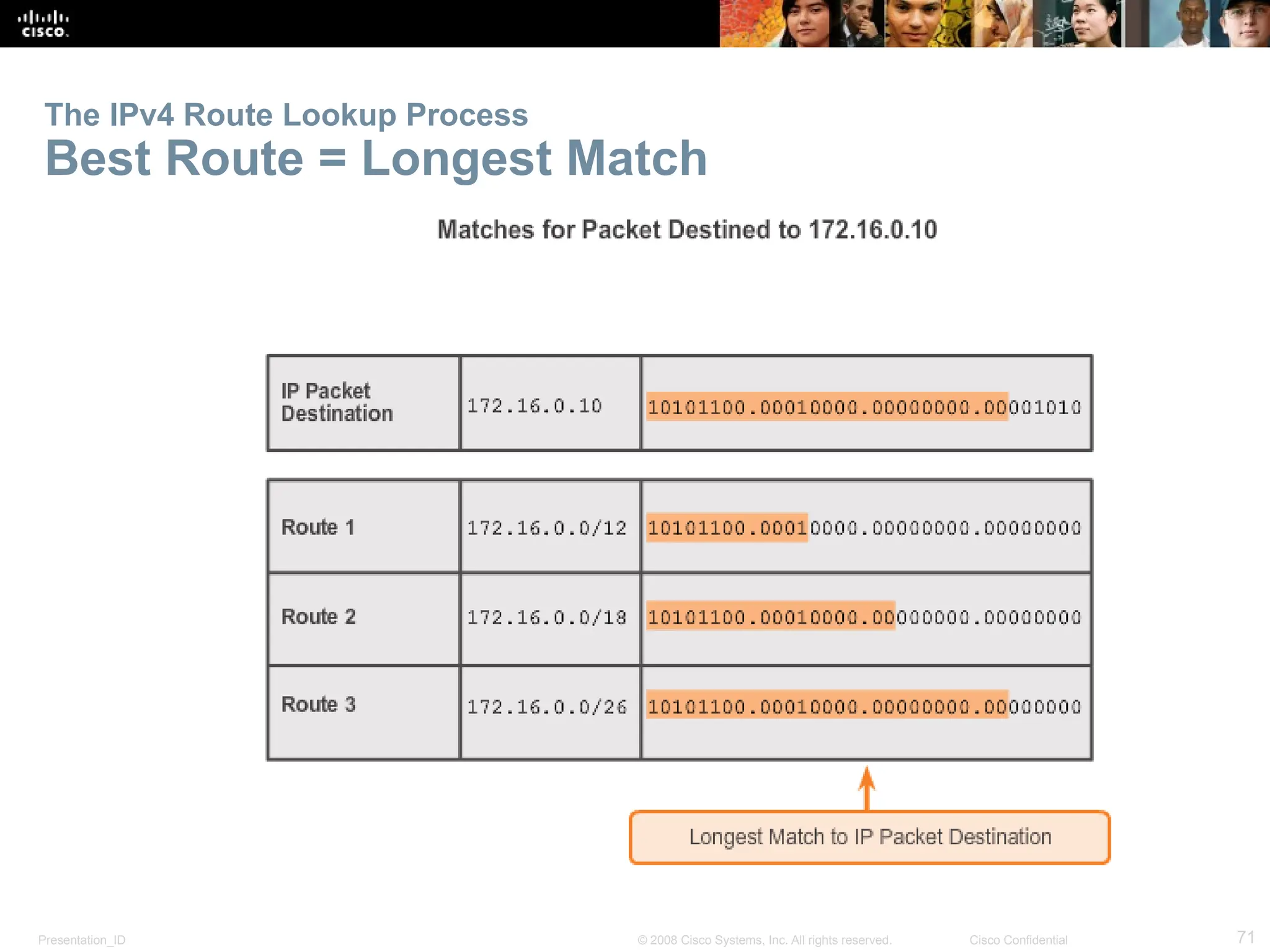
The IPv4 Route Lookup Process
Best Route = Longest Match
Presentation_ID 72
© 2008 Cisco Systems, Inc. All rights reserved. Cisco Confidential
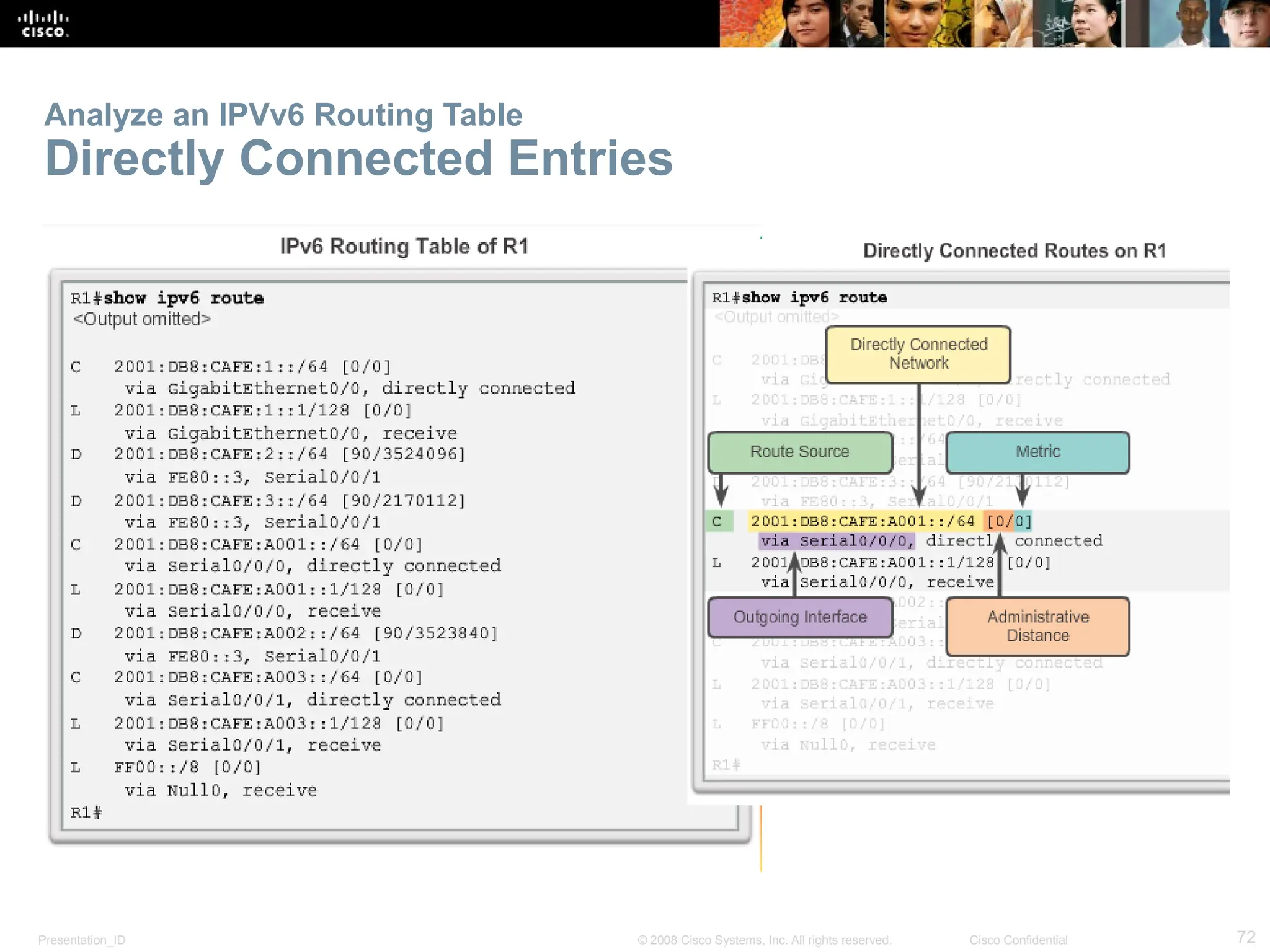
Analyze an IPVv6 Routing Table
Directly Connected Entries
Presentation_ID 73
© 2008 Cisco Systems, Inc. All rights reserved. Cisco Confidential
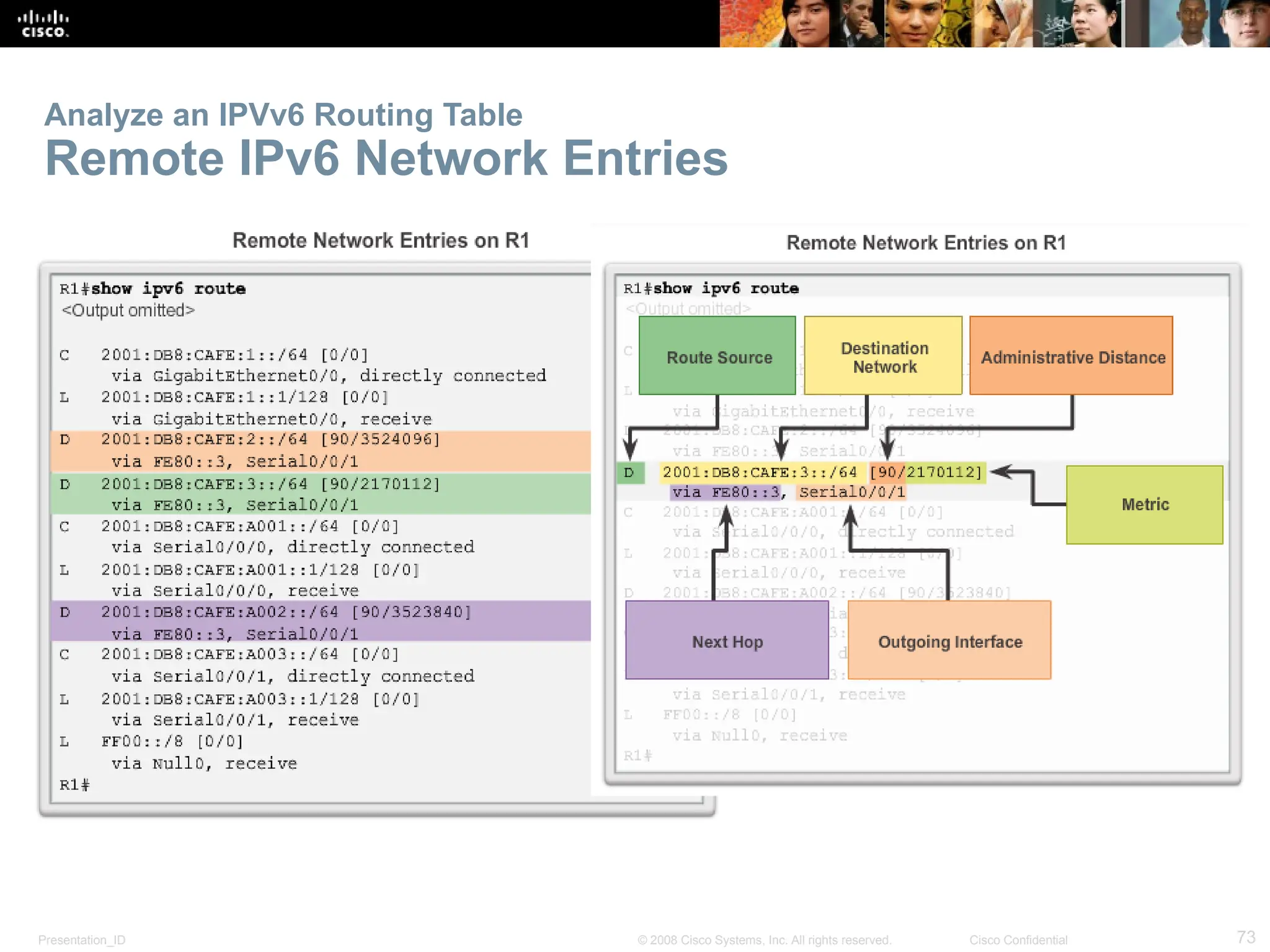
Analyze an IPVv6 Routing Table
Remote IPv6 Network Entries
Presentation_ID 74
© 2008 Cisco Systems, Inc. All rights reserved. Cisco Confidential
Chapter 7: Summary
Dynamic routing protocols:
 Used by routers to automatically learn about remote networks from
other routers
 Purpose includes: discovery of remote networks, maintaining up-to-
date routing information, choosing the best path to destination
networks, and ability to find a new best path if the current path is no
longer available
 Best choice for large networks but static routing is better for stub
networks.
 Function to inform other routers about changes
 Can be classified as either classful or classless, distance-vector or
link-state, and an interior or an exterior gateway protocol
Presentation_ID 75
© 2008 Cisco Systems, Inc. All rights reserved. Cisco Confidential
Chapter 7: Summary
Dynamic routing protocols (continued):
 A link-state routing protocol can create a complete view or topology
of the network by gathering information from all of the other routers
 Metrics are used to determine the best path or shortest path to reach
a destination network
 Different routing protocols may use different (hops, bandwidth,
delay, reliability, and load)
 Show ip protocols command displays the IPv4 routing protocol
settings currently configured on the router, for IPv6, use show ipv6
protocols
Presentation_ID 76
© 2008 Cisco Systems, Inc. All rights reserved. Cisco Confidential
Chapter 7: Summary
Dynamic routing protocols (continued):
 Cisco routers use the administrative distance value to determine
which routing source to use
 Each dynamic routing protocol has a unique administrative value,
along with static routes and directly connected networks, lower is
preferred the route
 Directly connected networks are preferred source, followed by static
routes and then various dynamic routing protocols
 An OSPF link is an interface on a router, information about the state
of the links is known as link-states
 Link-state routing protocols apply Dijkstra’s algorithm to calculate the
best path route which uses accumulated costs along each path, from
source to destination, to determine the total cost of a route
Presentation_ID 77
© 2008 Cisco Systems, Inc. All rights reserved. Cisco Confidential

RS_InstructorPPT_Chapter7RS_InstructorPPT_Chapter7.pptx

  • 1.
    © 2008 CiscoSystems, Inc. All rights reserved. Cisco Confidential Presentation_ID 1 Chapter 7: Routing Dynamically Routing Protocols
  • 2.
    Presentation_ID 2 © 2008Cisco Systems, Inc. All rights reserved. Cisco Confidential Chapter 7 7.1 Dynamic Routing Protocols 7.2 Distance Vector Dynamic Routing 7.3 RIP and RIPng Routing 7.4 Link-State Dynamic Routing 7.5 The Routing Table 7.6 Summary
  • 3.
    Presentation_ID 3 © 2008Cisco Systems, Inc. All rights reserved. Cisco Confidential Chapter 7: Objectives  Explain the basic operation of dynamic routing protocols.  Compare and contrast dynamic and static routing.  Determine which networks are available during an initial network discovery phase.  Define the different categories of routing protocols.  Describe the process by which distance vector routing protocols learn about other networks.  Identify the types of distance-vector routing protocols.  Configure the RIP routing protocol.  Configure the RIPng routing protocol.  Explain the process by which link-state routing protocols learn about other networks.
  • 4.
    Presentation_ID 4 © 2008Cisco Systems, Inc. All rights reserved. Cisco Confidential Chapter 7: Objectives (continued)  Describe the information sent in a link-state update.  Describe advantages and disadvantages of using link-state routing protocols.  Identify protocols that use the link-state routing process. (OSPF, IS- IS)  Determine the route source, administrative distance, and metric for a given route.  Explain the concept of a parent/child relationship in a dynamically built routing table.  Compare the IPv4 classless route lookup process and the IPv6 lookup process.  Analyze a routing table to determine which route will be used to forward a packet.
  • 5.
    Presentation_ID 5 © 2008Cisco Systems, Inc. All rights reserved. Cisco Confidential Dynamic Routing Protocols
  • 6.
    Presentation_ID 6 © 2008Cisco Systems, Inc. All rights reserved. Cisco Confidential Dynamic Routing Protocol Operation The Evolution of Dynamic Routing Protocols  Dynamic routing protocols used in networks since the late 1980s  Newer versions support the communication based on IPv6 Routing Protocols Classification
  • 7.
    Presentation_ID 7 © 2008Cisco Systems, Inc. All rights reserved. Cisco Confidential Dynamic Routing Protocol Operation Purpose of Dynamic Routing Protocols  Routing Protocols • Used to facilitate the exchange of routing information between routers  Purpose of dynamic routing protocols includes: • Discovery of remote networks • Maintaining up-to-date routing information • Choosing the best path to destination networks • Ability to find a new best path if the current path is no longer available
  • 8.
    Presentation_ID 8 © 2008Cisco Systems, Inc. All rights reserved. Cisco Confidential Dynamic Routing Protocol Operation Purpose of Dynamic Routing Protocols Main components of dynamic routing protocols include:  Data structures - Routing protocols typically use tables or databases for its operations. This information is kept in RAM.  Routing protocol messages - Routing protocols use various types of messages to discover neighboring routers, exchange routing information, and other tasks to learn and maintain accurate information about the network.  Algorithm - Routing protocols use algorithms for facilitating routing information for best path determination.
  • 9.
    Presentation_ID 9 © 2008Cisco Systems, Inc. All rights reserved. Cisco Confidential Dynamic Routing Protocol Operation Purpose of Dynamic Routing Protocols
  • 10.
    Presentation_ID 10 © 2008Cisco Systems, Inc. All rights reserved. Cisco Confidential Dynamic Routing Protocol Operation The Role of Dynamic Routing Protocols  Advantages of dynamic routing • Automatically share information about remote networks • Determine the best path to each network and add this information to their routing tables • Compared to static routing, dynamic routing protocols require less administrative overhead • Help the network administrator manage the time- consuming process of configuring and maintaining static routes  Disadvantages of dynamic routing • Dedicate part of a routers resources for protocol operation, including CPU time and network link bandwidth  Times when static routing is more appropriate
  • 11.
    Presentation_ID 11 © 2008Cisco Systems, Inc. All rights reserved. Cisco Confidential Dynamic verses Static Routing Using Static Routing  Networks typically use a combination of both static and dynamic routing  Static routing has several primary uses • Providing ease of routing table maintenance in smaller networks that are not expected to grow significantly • Routing to and from a stub network o a network with only one default route out and no knowledge of any remote networks • Accessing a single default router o used to represent a path to any network that does not have a match in the routing table
  • 12.
    Presentation_ID 12 © 2008Cisco Systems, Inc. All rights reserved. Cisco Confidential Dynamic verses Static Routing Using Static Routing
  • 13.
    Presentation_ID 13 © 2008Cisco Systems, Inc. All rights reserved. Cisco Confidential Dynamic verses Static Routing Static Routing Scorecard
  • 14.
    Presentation_ID 14 © 2008Cisco Systems, Inc. All rights reserved. Cisco Confidential Dynamic verses Static Routing Dynamic Routing Scorecard
  • 15.
    Presentation_ID 15 © 2008Cisco Systems, Inc. All rights reserved. Cisco Confidential Routing Protocol Operating Fundamentals Dynamic Routing Protocol Operation In general, the operations of a dynamic routing protocol can be described as follows: 1. The router sends and receives routing messages on its interfaces. 2. The router shares routing messages and routing information with other routers that are using the same routing protocol. 3. Routers exchange routing information to learn about remote networks. 4. When a router detects a topology change the routing protocol can advertise this change to other routers.
  • 16.
    Presentation_ID 16 © 2008Cisco Systems, Inc. All rights reserved. Cisco Confidential Routing Protocol Operating Fundamentals Cold Start  R1 adds the 10.1.0.0 network available through interface FastEthernet 0/0 and 10.2.0.0 is available through interface Serial 0/0/0.  R2 adds the 10.2.0.0 network available through interface Serial 0/0/0 and 10.3.0.0 is available through interface Serial 0/0/1.  R3 adds the 10.3.0.0 network available through interface Serial 0/0/1 and 10.4.0.0 is available through interface FastEthernet 0/0. Routers running RIPv2
  • 17.
    Presentation_ID 17 © 2008Cisco Systems, Inc. All rights reserved. Cisco Confidential Routing Protocol Operating Fundamentals Network Discovery R1:  Sends an update about network 10.1.0.0 out the Serial0/0/0 interface  Sends an update about network 10.2.0.0 out the FastEthernet0/0 interface  Receives update from R2 about network 10.3.0.0 with a metric of 1  Stores network 10.3.0.0 in the routing table with a metric of 1 Routers running RIPv2
  • 18.
    Presentation_ID 18 © 2008Cisco Systems, Inc. All rights reserved. Cisco Confidential Routing Protocol Operating Fundamentals Network Discovery R2:  Sends an update about network 10.3.0.0 out the Serial 0/0/0 interface  Sends an update about network 10.2.0.0 out the Serial 0/0/1 interface  Receives an update from R1 about network 10.1.0.0 with a metric of 1  Stores network 10.1.0.0 in the routing table with a metric of 1  Receives an update from R3 about network 10.4.0.0 with a metric of 1  Stores network 10.4.0.0 in the routing table with a metric of 1 Routers running RIPv2
  • 19.
    Presentation_ID 19 © 2008Cisco Systems, Inc. All rights reserved. Cisco Confidential Routing Protocol Operating Fundamentals Network Discovery R3:  Sends an update about network 10.4.0.0 out the Serial 0/0/1 interface  Sends an update about network 10.3.0.0 out the FastEthernet0/0  Receives an update from R2 about network 10.2.0.0 with a metric of 1  Stores network 10.2.0.0 in the routing table with a metric of 1 Routers running RIPv2
  • 20.
    Presentation_ID 20 © 2008Cisco Systems, Inc. All rights reserved. Cisco Confidential Routing Protocol Operating Fundamentals Exchanging the Routing Information R1:  Sends an update about network 10. 1. 0. 0 out the Serial 0/0/0 interface  Sends an update about networks 10. 2. 0. 0 and 10. 3. 0. 0 out the FastEthernet0/0 interface  Receives an update from R2 about network 10. 4. 0. 0 with a metric of 2  Stores network 10. 4. 0. 0 in the routing table with a metric of 2  Same update from R2 contains information about network 10. 3. 0. 0 with a metric of 1. There is no change; therefore, the routing information remains the same Routers running RIPv2
  • 21.
    Presentation_ID 21 © 2008Cisco Systems, Inc. All rights reserved. Cisco Confidential Routing Protocol Operating Fundamentals Exchanging the Routing Information R2:  Sends an update about networks 10. 3. 0. 0 and 10. 4. 0. 0 out of Serial 0/0/0 interface  Sends an update about networks 10. 1. 0. 0 and 10. 2. 0. 0 out of Serial 0/0/1 interface  Receives an update from R1 about network 10. 1. 0. 0. There is no change; therefore, the routing information remains the same.  Receives an update from R3 about network 10. 4. 0. 0. There is no change; therefore, the routing information remains the same. Routers running RIPv2
  • 22.
    Presentation_ID 22 © 2008Cisco Systems, Inc. All rights reserved. Cisco Confidential Routing Protocol Operating Fundamentals Exchanging the Routing Information R3:  Sends an update about network 10. 4. 0. 0 out the Serial 0/0/1 interface  Sends an update about networks 10. 2. 0. 0 and 10. 3. 0. 0 out the FastEthernet0/0 interface  Receives an update from R2 about network 10. 1. 0. 0 with a metric of 2  Stores network 10. 1. 0. 0 in the routing table with a metric of 2  Same update from R2 contains information about network 10. 2. 0. 0 with a metric of 1. There is no change; therefore, the routing information remains the same. Routers running RIPv2
  • 23.
    Presentation_ID 23 © 2008Cisco Systems, Inc. All rights reserved. Cisco Confidential Routing Protocol Operating Fundamentals Achieving Convergence  Network converged when all routers have complete and accurate information about the entire network.  Convergence time is the time it takes routers to share information, calculate best paths, and update their routing tables.  A network is not completely operable until the network has converged.  Convergence properties include the speed of propagation of routing information and the calculation of optimal paths. The speed of propagation refers to the amount of time it takes for routers within the network to forward routing information.  Generally, older protocols, such as RIP, are slow to converge, whereas modern protocols, such as EIGRP and OSPF, converge more quickly.
  • 24.
    Presentation_ID 24 © 2008Cisco Systems, Inc. All rights reserved. Cisco Confidential Types of Routing Protocols Classifying Routing Protocols
  • 25.
    Presentation_ID 25 © 2008Cisco Systems, Inc. All rights reserved. Cisco Confidential Types of Routing Protocols IGP and EGP Routing Protocols Interior Gateway Protocols (IGP) -  Used for routing within an AS  Include RIP, EIGRP, OSPF, and IS-IS Exterior Gateway Protocols (EGP) -  Used for routing between AS  Official routing protocol used by the Internet
  • 26.
    Presentation_ID 26 © 2008Cisco Systems, Inc. All rights reserved. Cisco Confidential Types of Routing Protocols Distance Vector Routing Protocols Distance vector IPv4 IGPs:  RIPv1 - First generation legacy protocol  RIPv2 - Simple distance vector routing protocol  IGRP - First generation Cisco proprietary protocol (obsolete)  EIGRP - Advanced version of distance vector routing For R1, 172.16.3.0/24 is one hop away (distance) it can be reached through R2 (vector)
  • 27.
    Presentation_ID 27 © 2008Cisco Systems, Inc. All rights reserved. Cisco Confidential Types of Routing Protocols Distance Vector or Link-State Routing Protocols Distance vector protocols use routers as sign posts along the path to the final destination. A link-state routing protocol is like having a complete map of the network topology. The sign posts along the way from source to destination are not necessary, because all link-state routers are using an identical map of the network. A link-state router uses the link-state information to create a topology map and to select the best path to all destination networks in the topology.
  • 28.
    Presentation_ID 28 © 2008Cisco Systems, Inc. All rights reserved. Cisco Confidential Types of Routing Protocols Link-State Routing Protocols Link-state IPv4 IGPs:  OSPF - Popular standards based routing protocol  IS-IS - Popular in provider networks.
  • 29.
    Presentation_ID 29 © 2008Cisco Systems, Inc. All rights reserved. Cisco Confidential Types of Routing Protocols Classful Routing Protocols  Classful routing protocols do not send subnet mask information in their routing updates • Only RIPv1 and IGRP are classful • Created when network addresses were allocated based on classes (class A, B, or C) • Cannot provide variable length subnet masks (VLSMs) and classless interdomain routing (CIDR) • Create problems in discontiguous networks
  • 30.
    Presentation_ID 30 © 2008Cisco Systems, Inc. All rights reserved. Cisco Confidential Types of Routing Protocols Classless Routing Protocols  Classless routing protocols include subnet mask information in the routing updates • RIPv2, EIGRP, OSPF, and IS_IS • Support VLSM and CIDR • IPv6 routing protocols
  • 31.
    Presentation_ID 31 © 2008Cisco Systems, Inc. All rights reserved. Cisco Confidential Types of Routing Protocols Routing Protocol Characteristics
  • 32.
    Presentation_ID 32 © 2008Cisco Systems, Inc. All rights reserved. Cisco Confidential Types of Routing Protocols Routing Protocol Metrics A metric is a measurable value that is assigned by the routing protocol to different routes based on the usefulness of that route  Used to determine the overall “cost” of a path from source to destination  Routing protocols determine the best path based on the route with the lowest cost
  • 33.
    Presentation_ID 33 © 2008Cisco Systems, Inc. All rights reserved. Cisco Confidential Distance Vector Dynamic Routing
  • 34.
    Presentation_ID 34 © 2008Cisco Systems, Inc. All rights reserved. Cisco Confidential Distance Vector Routing Protocol Operation Distance Vector Technologies Distance vector routing protocols  Share updates between neighbors  Not aware of the network topology  Some send periodic updates to broadcast IP 255.255.255.255 even if topology has not changed  Updates consume bandwidth and network device CPU resources  RIPv2 and EIGRP use multicast addresses  EIGRP will only send an update when topology has changed
  • 35.
    Presentation_ID 35 © 2008Cisco Systems, Inc. All rights reserved. Cisco Confidential Distance Vector Routing Protocol Operation Distance Vector Algorithm RIP uses the Bellman-Ford algorithm as its routing algorithm IGRP and EIGRP use the Diffusing Update Algorithm (DUAL) routing algorithm developed by Cisco
  • 36.
    Presentation_ID 36 © 2008Cisco Systems, Inc. All rights reserved. Cisco Confidential Types of Distance Vector Routing Protocols Routing Information Protocol RIPng is based on RIPv2 with a 15 hop limitation and the administrative distance of 120 Updates use UDP port 520 Routing updates broadcasted every 30 seconds
  • 37.
    Presentation_ID 37 © 2008Cisco Systems, Inc. All rights reserved. Cisco Confidential Types of Distance Vector Routing Protocols Enhanced Interior-Gateway Routing Protocol EIGRP  Bounded triggered updates  Hello keepalives mechanism  Maintains a topology table  Rapid convergence  Multiple network layer protocol support
  • 38.
    Presentation_ID 38 © 2008Cisco Systems, Inc. All rights reserved. Cisco Confidential RIP and RIPng Routing
  • 39.
    Presentation_ID 39 © 2008Cisco Systems, Inc. All rights reserved. Cisco Confidential Configuring the RIP Protocol Router RIP Configuration Mode Advertising Networks
  • 40.
    Presentation_ID 40 © 2008Cisco Systems, Inc. All rights reserved. Cisco Confidential Configuring the RIP Protocol Examining Default RIP Settings
  • 41.
    Presentation_ID 41 © 2008Cisco Systems, Inc. All rights reserved. Cisco Confidential Configuring the RIP Protocol Enabling RIPv2
  • 42.
    Presentation_ID 42 © 2008Cisco Systems, Inc. All rights reserved. Cisco Confidential Configuring the RIP Protocol Configuring Passive Interfaces Sending out unneeded updates on a LAN impacts the network in three ways:  Wasted Bandwidth  Wasted Resources  Security Risk
  • 43.
    Presentation_ID 43 © 2008Cisco Systems, Inc. All rights reserved. Cisco Confidential Configuring the RIP Protocol Propagating a Default Route
  • 44.
    Presentation_ID 44 © 2008Cisco Systems, Inc. All rights reserved. Cisco Confidential Configuring the RIPng Protocol Advertising IPv6 Networks
  • 45.
    Presentation_ID 45 © 2008Cisco Systems, Inc. All rights reserved. Cisco Confidential Configuring the RIPng Protocol Examining the RIPng Configuration
  • 46.
    Presentation_ID 46 © 2008Cisco Systems, Inc. All rights reserved. Cisco Confidential Configuring the RIPng Protocol Examining the RIPng Configuration
  • 47.
    Presentation_ID 47 © 2008Cisco Systems, Inc. All rights reserved. Cisco Confidential Link-State Dynamic Routing
  • 48.
    Presentation_ID 48 © 2008Cisco Systems, Inc. All rights reserved. Cisco Confidential Link-State Routing Protocol Operation Shortest Path First Protocols
  • 49.
    Presentation_ID 49 © 2008Cisco Systems, Inc. All rights reserved. Cisco Confidential Link-State Routing Protocol Operation Dijkstra’s Algorithm
  • 50.
    Presentation_ID 50 © 2008Cisco Systems, Inc. All rights reserved. Cisco Confidential Link-State Updates Link-State Routing Process
  • 51.
    Presentation_ID 51 © 2008Cisco Systems, Inc. All rights reserved. Cisco Confidential Link-State Updates Link and Link-State The first step in the link-state routing process is that each router learns about its own links, its own directly connected networks.
  • 52.
    Presentation_ID 52 © 2008Cisco Systems, Inc. All rights reserved. Cisco Confidential Link-State Updates Say Hello The second step in the link-state routing process is that each router is responsible for meeting its neighbors on directly connected networks.
  • 53.
    Presentation_ID 53 © 2008Cisco Systems, Inc. All rights reserved. Cisco Confidential Link-State Updates Say Hello The third step in the link-state routing process is that each router builds a link-state packet (LSP) containing the state of each directly connected link. 1. R1; Ethernet network 10.1.0.0/16; Cost 2 2. R1 -> R2; Serial point-to- point network; 10.2.0.0/16; Cost 20 3. R1 -> R3; Serial point-to- point network; 10.7.0.0/16; Cost 5 4. R1 -> R4; Serial point-to- point network; 10.4.0.0/16; Cost 20
  • 54.
    Presentation_ID 54 © 2008Cisco Systems, Inc. All rights reserved. Cisco Confidential Link-State Updates Flooding the LSP The fourth step in the link-state routing process is that each router floods the LSP to all neighbors, who then store all LSPs received in a database.
  • 55.
    Presentation_ID 55 © 2008Cisco Systems, Inc. All rights reserved. Cisco Confidential Link-State Updates Building the Link-State Database The final step in the link-state routing process is that each router uses the database to construct a complete map of the topology and computes the best path to each destination network.
  • 56.
    Presentation_ID 56 © 2008Cisco Systems, Inc. All rights reserved. Cisco Confidential Link-State Updates Building the SPF Tree
  • 57.
    Presentation_ID 57 © 2008Cisco Systems, Inc. All rights reserved. Cisco Confidential Link-State Updates Building the SPF Tree
  • 58.
    Presentation_ID 58 © 2008Cisco Systems, Inc. All rights reserved. Cisco Confidential Link-State Updates Adding OSPF Routes to the Routing Table
  • 59.
    Presentation_ID 59 © 2008Cisco Systems, Inc. All rights reserved. Cisco Confidential Why Use Link-State Routing Protocols Why Use Link-State Protocols? Disadvantages compared to distance vector routing protocols: • Memory Requirements • Processing Requirements • Bandwidth Requirements
  • 60.
    Presentation_ID 60 © 2008Cisco Systems, Inc. All rights reserved. Cisco Confidential Why Use Link-State Routing Protocols Disadvantages of Link-State Protocols
  • 61.
    Presentation_ID 61 © 2008Cisco Systems, Inc. All rights reserved. Cisco Confidential Why Use Link-State Routing Protocols Protocols that Use Link-State Only two link-state routing protocols:  Open Shortest Path First (OSPF) most popular • began in 1987 • two current versions • OSPFv2 - OSPF for IPv4 networks • OSPFv3 - OSPF for IPv6 networks  IS-IS was designed by International Organization for Standardization (ISO )
  • 62.
    Presentation_ID 62 © 2008Cisco Systems, Inc. All rights reserved. Cisco Confidential The Routing Table
  • 63.
    Presentation_ID 63 © 2008Cisco Systems, Inc. All rights reserved. Cisco Confidential Parts of an IPv4 Route Entry Routing Table Entries
  • 64.
    Presentation_ID 64 © 2008Cisco Systems, Inc. All rights reserved. Cisco Confidential Parts of an IPv4 Route Entry Directly Connected Entries
  • 65.
    Presentation_ID 65 © 2008Cisco Systems, Inc. All rights reserved. Cisco Confidential Parts of an IPv4 Route Entry Remote Network Entries
  • 66.
    Presentation_ID 66 © 2008Cisco Systems, Inc. All rights reserved. Cisco Confidential Dynamically Learned IPv4 Routes Routing Table Terms Routes are discussed in terms of:  Ultimate route  Level 1 route  Level 1 parent route  Level 2 child routes
  • 67.
    Presentation_ID 67 © 2008Cisco Systems, Inc. All rights reserved. Cisco Confidential Dynamically Learned IPv4 Routes Ultimate Route An ultimate route is a routing table entry that contains either a next-hop IP address or an exit interface. Directly connected, dynamically learned, and link local routes are ultimate routes.
  • 68.
    Presentation_ID 68 © 2008Cisco Systems, Inc. All rights reserved. Cisco Confidential Dynamically Learned IPv4 Routes Level 1 Route
  • 69.
    Presentation_ID 69 © 2008Cisco Systems, Inc. All rights reserved. Cisco Confidential Dynamically Learned IPv4 Routes Level 1 Parent Route
  • 70.
    Presentation_ID 70 © 2008Cisco Systems, Inc. All rights reserved. Cisco Confidential Dynamically Learned IPv4 Routes Level 2 Child Route
  • 71.
    Presentation_ID 71 © 2008Cisco Systems, Inc. All rights reserved. Cisco Confidential The IPv4 Route Lookup Process Best Route = Longest Match
  • 72.
    Presentation_ID 72 © 2008Cisco Systems, Inc. All rights reserved. Cisco Confidential Analyze an IPVv6 Routing Table Directly Connected Entries
  • 73.
    Presentation_ID 73 © 2008Cisco Systems, Inc. All rights reserved. Cisco Confidential Analyze an IPVv6 Routing Table Remote IPv6 Network Entries
  • 74.
    Presentation_ID 74 © 2008Cisco Systems, Inc. All rights reserved. Cisco Confidential Chapter 7: Summary Dynamic routing protocols:  Used by routers to automatically learn about remote networks from other routers  Purpose includes: discovery of remote networks, maintaining up-to- date routing information, choosing the best path to destination networks, and ability to find a new best path if the current path is no longer available  Best choice for large networks but static routing is better for stub networks.  Function to inform other routers about changes  Can be classified as either classful or classless, distance-vector or link-state, and an interior or an exterior gateway protocol
  • 75.
    Presentation_ID 75 © 2008Cisco Systems, Inc. All rights reserved. Cisco Confidential Chapter 7: Summary Dynamic routing protocols (continued):  A link-state routing protocol can create a complete view or topology of the network by gathering information from all of the other routers  Metrics are used to determine the best path or shortest path to reach a destination network  Different routing protocols may use different (hops, bandwidth, delay, reliability, and load)  Show ip protocols command displays the IPv4 routing protocol settings currently configured on the router, for IPv6, use show ipv6 protocols
  • 76.
    Presentation_ID 76 © 2008Cisco Systems, Inc. All rights reserved. Cisco Confidential Chapter 7: Summary Dynamic routing protocols (continued):  Cisco routers use the administrative distance value to determine which routing source to use  Each dynamic routing protocol has a unique administrative value, along with static routes and directly connected networks, lower is preferred the route  Directly connected networks are preferred source, followed by static routes and then various dynamic routing protocols  An OSPF link is an interface on a router, information about the state of the links is known as link-states  Link-state routing protocols apply Dijkstra’s algorithm to calculate the best path route which uses accumulated costs along each path, from source to destination, to determine the total cost of a route
  • 77.
    Presentation_ID 77 © 2008Cisco Systems, Inc. All rights reserved. Cisco Confidential

Editor's Notes