Chapter 1
Rotational
Dynamics
Prepared by
Shital Aher
Msc.BE.d
Aarambh mahavidyalaya Nashik Road.
Basic Concepts
Circular motion
 The motion of a particle along a complete circle or a
part of it is called circular motion.
Centre of mass:-
The center of mass is a position defined relative to an
object or system of objects. It is the average position
of all the parts of the system, weighted according to
their masses. For simple rigid objects with uniform
density, the center of mass is located at the centroid.
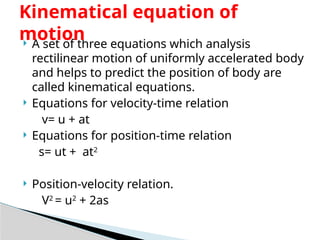
 A set of three equations which analysis
rectilinear motion of uniformly accelerated body
and helps to predict the position of body are
called kinematical equations.
 Equations for velocity-time relation
v= u + at
 Equations for position-time relation
s= ut + at2
 Position-velocity relation.
V2
= u2
+ 2as
Kinematical equation of
motion
Real Force:-
 A force which is produced due to interaction between the
objects is called real force.
 Real forces obey Newton’s laws of motion.
 Real forces are one of the four fundamental forces.
 Example., The earth revolves around the sun in circular path
due to gravitational force of attraction between the sun and
the earth.
Pseudo Force:-
 A pseudo force is one which arises due to the acceleration of
the observer’s frame of reference.
 Pseudo forces do not obey Newton’s laws of motion.
 Pseudo forces are not among any of the four fundamental
forces.
 Example., Bus in moving with an acceleration (a) on a straight
road in forward direction, a person of mass ’m’ experiences a
backward pseudo force of magnitude ‘ma’
Real Force and Pseudo force
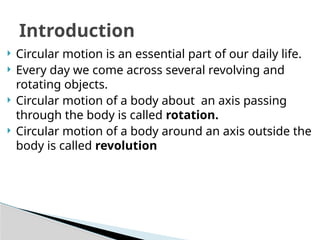
 Circular motion is an essential part of our daily life.
 Every day we come across several revolving and
rotating objects.
 Circular motion of a body about an axis passing
through the body is called rotation.
 Circular motion of a body around an axis outside the
body is called revolution
Introduction
 It is an accelerated motion:
As the direction of velocity changes at
every instant, it is an accelerated motion.
 It is a periodic motion :
During the motion the particle repeats its
path along the same trajectory. Thus, the motion
is periodic
Characteristics of circular motion
We use the quantities
Angular displacement ,
Angular velocity ,
Angular acceleration
Which are analogous to displacement s
velocity v =
Acceleration a =
Used in translational motion
Kinematics of circular motion
 The time rate of angular displacement of a
particle performing circular motion is called the
angular velocity.
1) If the particle has an angular displacement in a
short time interval its angular velocity
= =
2) is a vector along the axis of rotation, in the
direction of d , given by the right hand thumb rule
Angular velocity
 If the fingers of the right hand are curled in the
sense of revolution of the particle then the
outstretched thumb gives the direction of the
angular displacement.
Right hand thumb rule
 A particle is said to perform uniform circular
motion if it moves in a circle or a circular arc at
constant linear speed or constant angular
velocity.
 In this case, only the direction of its velocity
changes at every instant in such a way that the
velocity is always tangential to the path.
 The acceleration responsible for this is the
centripetal or radial acceleration
 ar = - 2
r= = v
 It is always directed towards the centre of the
circular motion hence called centripetal
Uniform Circular motion

12th std science rotational dynamics.pptx

  • 1.
    Chapter 1 Rotational Dynamics Prepared by ShitalAher Msc.BE.d Aarambh mahavidyalaya Nashik Road.
  • 2.
    Basic Concepts Circular motion The motion of a particle along a complete circle or a part of it is called circular motion. Centre of mass:- The center of mass is a position defined relative to an object or system of objects. It is the average position of all the parts of the system, weighted according to their masses. For simple rigid objects with uniform density, the center of mass is located at the centroid.
  • 3.
     A setof three equations which analysis rectilinear motion of uniformly accelerated body and helps to predict the position of body are called kinematical equations.  Equations for velocity-time relation v= u + at  Equations for position-time relation s= ut + at2  Position-velocity relation. V2 = u2 + 2as Kinematical equation of motion
  • 4.
    Real Force:-  Aforce which is produced due to interaction between the objects is called real force.  Real forces obey Newton’s laws of motion.  Real forces are one of the four fundamental forces.  Example., The earth revolves around the sun in circular path due to gravitational force of attraction between the sun and the earth. Pseudo Force:-  A pseudo force is one which arises due to the acceleration of the observer’s frame of reference.  Pseudo forces do not obey Newton’s laws of motion.  Pseudo forces are not among any of the four fundamental forces.  Example., Bus in moving with an acceleration (a) on a straight road in forward direction, a person of mass ’m’ experiences a backward pseudo force of magnitude ‘ma’ Real Force and Pseudo force
  • 5.
     Circular motionis an essential part of our daily life.  Every day we come across several revolving and rotating objects.  Circular motion of a body about an axis passing through the body is called rotation.  Circular motion of a body around an axis outside the body is called revolution Introduction
  • 6.
     It isan accelerated motion: As the direction of velocity changes at every instant, it is an accelerated motion.  It is a periodic motion : During the motion the particle repeats its path along the same trajectory. Thus, the motion is periodic Characteristics of circular motion
  • 7.
    We use thequantities Angular displacement , Angular velocity , Angular acceleration Which are analogous to displacement s velocity v = Acceleration a = Used in translational motion Kinematics of circular motion
  • 8.
     The timerate of angular displacement of a particle performing circular motion is called the angular velocity. 1) If the particle has an angular displacement in a short time interval its angular velocity = = 2) is a vector along the axis of rotation, in the direction of d , given by the right hand thumb rule Angular velocity
  • 9.
     If thefingers of the right hand are curled in the sense of revolution of the particle then the outstretched thumb gives the direction of the angular displacement. Right hand thumb rule
  • 10.
     A particleis said to perform uniform circular motion if it moves in a circle or a circular arc at constant linear speed or constant angular velocity.  In this case, only the direction of its velocity changes at every instant in such a way that the velocity is always tangential to the path.  The acceleration responsible for this is the centripetal or radial acceleration  ar = - 2 r= = v  It is always directed towards the centre of the circular motion hence called centripetal Uniform Circular motion