Understanding the Principles
of Rotational Motion: A
Comprehensive Overview
BY MA Hasan
Definition of Rotational Motion
Rotational motion occurs when an object spins
around an axis. It is characterized by parameters
such as angular displacement, angular velocity,
and angular acceleration. These parameters help
describe how an object rotates over time.
Introduction to Rotational Motion
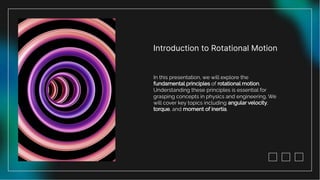
In this presentation, we will explore the
fundamental principles of rotational motion.
Understanding these principles is essential for
grasping concepts in physics and engineering. We
will cover key topics including angular velocity,
torque, and moment of inertia.
Angular Displacement
Angular displacement is the angle through which
an object has rotated about a specific axis. It is
measured in radians and is crucial for
understanding the extent of rotation in physical
systems.
Angular Velocity
Angular velocity is the rate of change of angular
displacement over time. It is expressed in radians per
second and indicates how fast an object is rotating.
Understanding this concept is vital for analyzing
rotating systems.
Angular Acceleration
Angular acceleration refers to the rate of change of
angular velocity. It indicates how quickly an object's
rotation is increasing or decreasing. This concept is
essential for understanding the dynamics of rotating
bodies.
Torque Explained
Torque is a measure of the force that causes an object
to rotate around an axis. It depends on the force
applied and the distance from the axis of rotation.
Understanding torque is crucial for analyzing rotational
systems.
Moment of Inertia
Moment of inertia is a property that quantifies an
object's resistance to changes in its rotational
motion. It depends on the mass distribution
relative to the axis of rotation. This principle is key
in dynamics and engineering applications.
Rotational Kinetic Energy
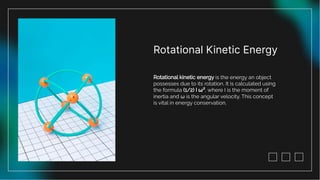
Rotational kinetic energy is the energy an object
possesses due to its rotation. It is calculated using
the formula (1/2) I ω², where I is the moment of
inertia and ω is the angular velocity. This concept
is vital in energy conservation.
Conservation of Angular Momentum
Angular momentum is conserved in a closed
system, meaning the total angular momentum
remains constant if no external torque acts on it.
This principle is fundamental in understanding
various physical phenomena, including planetary
motion.
Applications in Engineering
The principles of rotational motion have significant
applications in engineering and technology. They are used in
designing machines, vehicles, and aerospace systems.
Understanding these principles allows engineers to create
efficient and effective designs.
Challenges in Rotational Motion
Despite its importance, understanding rotational motion
poses challenges such as complex calculations and non-
linear dynamics. Addressing these challenges is essential for
advancements in fields like robotics and aerospace
engineering.
In conclusion, understanding the principles of rotational motion
is crucial for various scientific and engineering applications. By
mastering concepts such as torque, moment of inertia, and
angular momentum, we can better analyze and design systems
that involve rotation.
Do you have any questions?
youremail@freepik.com
+34 654 321 432
yourwebsite.com

Rotational Motion complete chapter 11th.

  • 1.
    Understanding the Principles ofRotational Motion: A Comprehensive Overview BY MA Hasan
  • 2.
    Definition of RotationalMotion Rotational motion occurs when an object spins around an axis. It is characterized by parameters such as angular displacement, angular velocity, and angular acceleration. These parameters help describe how an object rotates over time.
  • 3.
    Introduction to RotationalMotion In this presentation, we will explore the fundamental principles of rotational motion. Understanding these principles is essential for grasping concepts in physics and engineering. We will cover key topics including angular velocity, torque, and moment of inertia.
  • 4.
    Angular Displacement Angular displacementis the angle through which an object has rotated about a specific axis. It is measured in radians and is crucial for understanding the extent of rotation in physical systems.
  • 5.
    Angular Velocity Angular velocityis the rate of change of angular displacement over time. It is expressed in radians per second and indicates how fast an object is rotating. Understanding this concept is vital for analyzing rotating systems.
  • 6.
    Angular Acceleration Angular accelerationrefers to the rate of change of angular velocity. It indicates how quickly an object's rotation is increasing or decreasing. This concept is essential for understanding the dynamics of rotating bodies.
  • 7.
    Torque Explained Torque isa measure of the force that causes an object to rotate around an axis. It depends on the force applied and the distance from the axis of rotation. Understanding torque is crucial for analyzing rotational systems.
  • 8.
    Moment of Inertia Momentof inertia is a property that quantifies an object's resistance to changes in its rotational motion. It depends on the mass distribution relative to the axis of rotation. This principle is key in dynamics and engineering applications.
  • 9.
    Rotational Kinetic Energy Rotationalkinetic energy is the energy an object possesses due to its rotation. It is calculated using the formula (1/2) I ω², where I is the moment of inertia and ω is the angular velocity. This concept is vital in energy conservation.
  • 10.
    Conservation of AngularMomentum Angular momentum is conserved in a closed system, meaning the total angular momentum remains constant if no external torque acts on it. This principle is fundamental in understanding various physical phenomena, including planetary motion.
  • 11.
    Applications in Engineering Theprinciples of rotational motion have significant applications in engineering and technology. They are used in designing machines, vehicles, and aerospace systems. Understanding these principles allows engineers to create efficient and effective designs.
  • 12.
    Challenges in RotationalMotion Despite its importance, understanding rotational motion poses challenges such as complex calculations and non- linear dynamics. Addressing these challenges is essential for advancements in fields like robotics and aerospace engineering.
  • 13.
    In conclusion, understandingthe principles of rotational motion is crucial for various scientific and engineering applications. By mastering concepts such as torque, moment of inertia, and angular momentum, we can better analyze and design systems that involve rotation.
  • 14.
    Do you haveany questions? youremail@freepik.com +34 654 321 432 yourwebsite.com