Elder Abuse in Institutions
By Sailesh Mishra
Founder President - Silver Innings
Founder – A1 Snehanjali
Member INPEA
Caregiving and Institutional Practice
International conference on Services for the Elderly- Challenges & Trends
Hyderabad
Feb 2017
Silver Inning Foundation 1
Silver Inning Foundation 2
"Trees grow stronger over the years, rivers
wider. Likewise, with age, human beings
gain immeasurable depth and breadth of
experience and wisdom. That is why older
persons should be not only respected and
revered; they should be utilized as the
rich resource to society that they are”:
United Nations Ex. Secretary-General Kofi
Annan
Love ,Care and Respect will give them
Dignity and better Life
Silver Inning Foundation
3
Elders in India
• Due to better medical facility, good lifestyle longevity
increase
• In 2008 India population of Elderly was around 8% of total
population 86 Million
• In 2014 Elder Population approx 104 million , 174 million
projected in by 2026 , 356 Million in 2050
• Average age in 1951 – 42 yrs, Average age in 2008 - 68.6 yrs
• It will be75 years in 2045-2050.
• According to UN India will be soon Ageing nation, India has
2nd largest number of Senior Citizens
• Around 70% Elderly are in Rural area
• Many Elderly are illiterate and rely mostly on Family members
• 90% of Indians Retires without Pension
• Feminization of Ageing
• Increase of 80 + very old population
• Increase in Incidence of Dementia & Alzheimer’s 3%Silver Inning Foundation 4
Longevity
 According to UNICEF Life expectancy in India :
 In 1951 42 yrs
 In 1970 49 yrs
 In 1990 58 yrs
 In 2005 64 yrs
 In 2008 68.6 yrs ( Female : 70yrs)
 There is 60% increase in 60 yrs of lifespan
 3 TYPES OF SENIOR CITIZENS: Drastic change in 3
segment :Young Old (60- 69 yrs ), Old Old ( 70 –
79yrs ) Very Old ( 80+ yrs)
Silver Inning Foundation 5
India Pyramid 2000
Silver Inning Foundation6
India Pyramid 2050
Silver Inning Foundation7
Old Age in India
• In India, old age was never a problem.
Elder abuse was considered as a western
problem and old age home was an alien
concept.
• Earlier, the elderly persons of a family
were respected a lot and they continued
to live with respect till their death. But
now the times have changed. The elderly
are treated as burden , often neglected /
ignored Silver Inning Foundation 8
Elder Abuse
• Elder abuse as a social problem remains hidden.
• Least researched topic with very little intervention.
• According to pan-Indian surveys, 40% of
elderly subject to some form of abuse
• Elderly are equally responsible
• Few Intervention by Government and Society ,
hardly any Law
• More abuse done by Family and Relative
• Old Age Homes and Institutions
Silver Inning Foundation 9
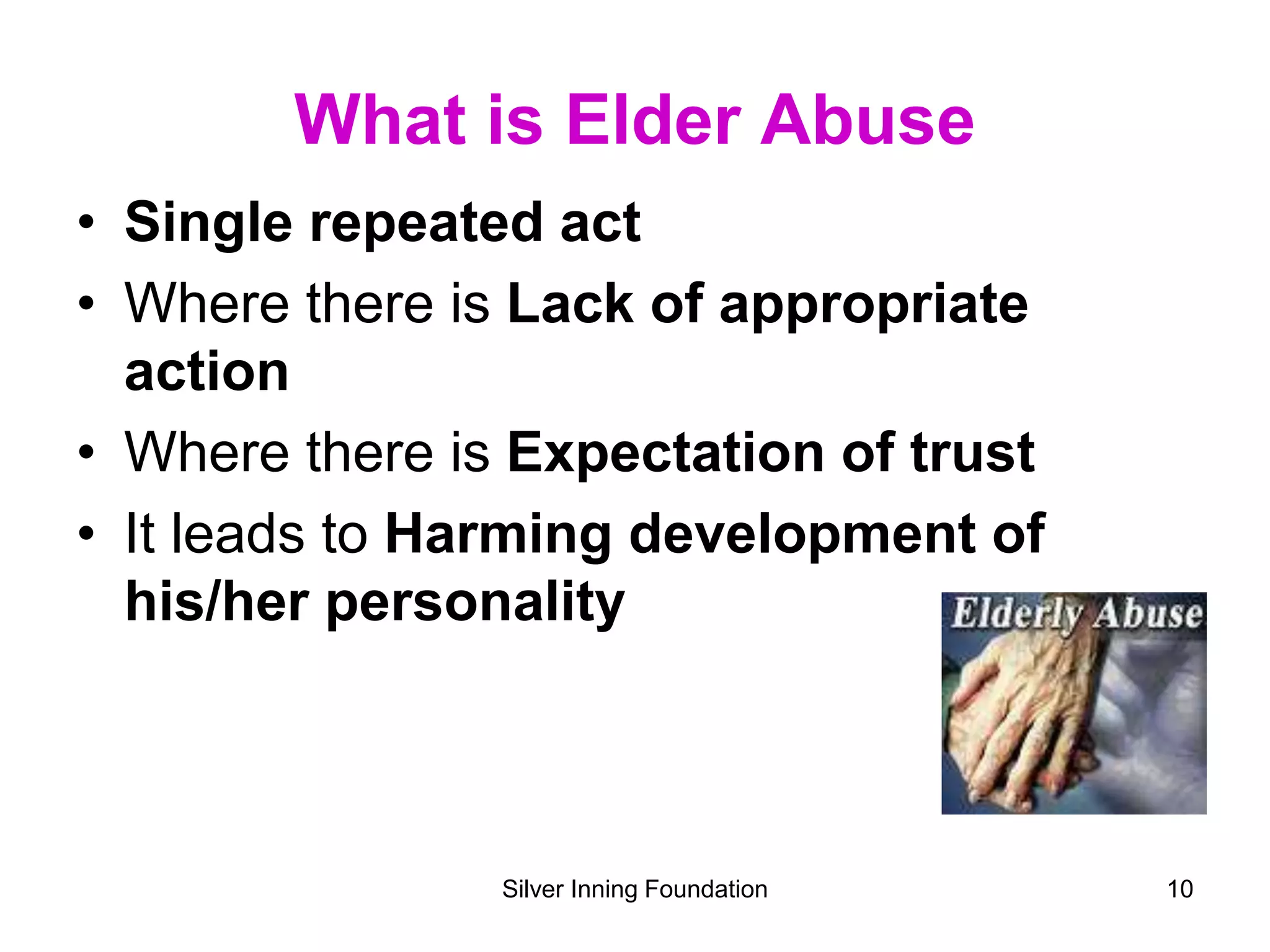
What is Elder Abuse
• Single repeated act
• Where there is Lack of appropriate
action
• Where there is Expectation of trust
• It leads to Harming development of
his/her personality
Silver Inning Foundation 10
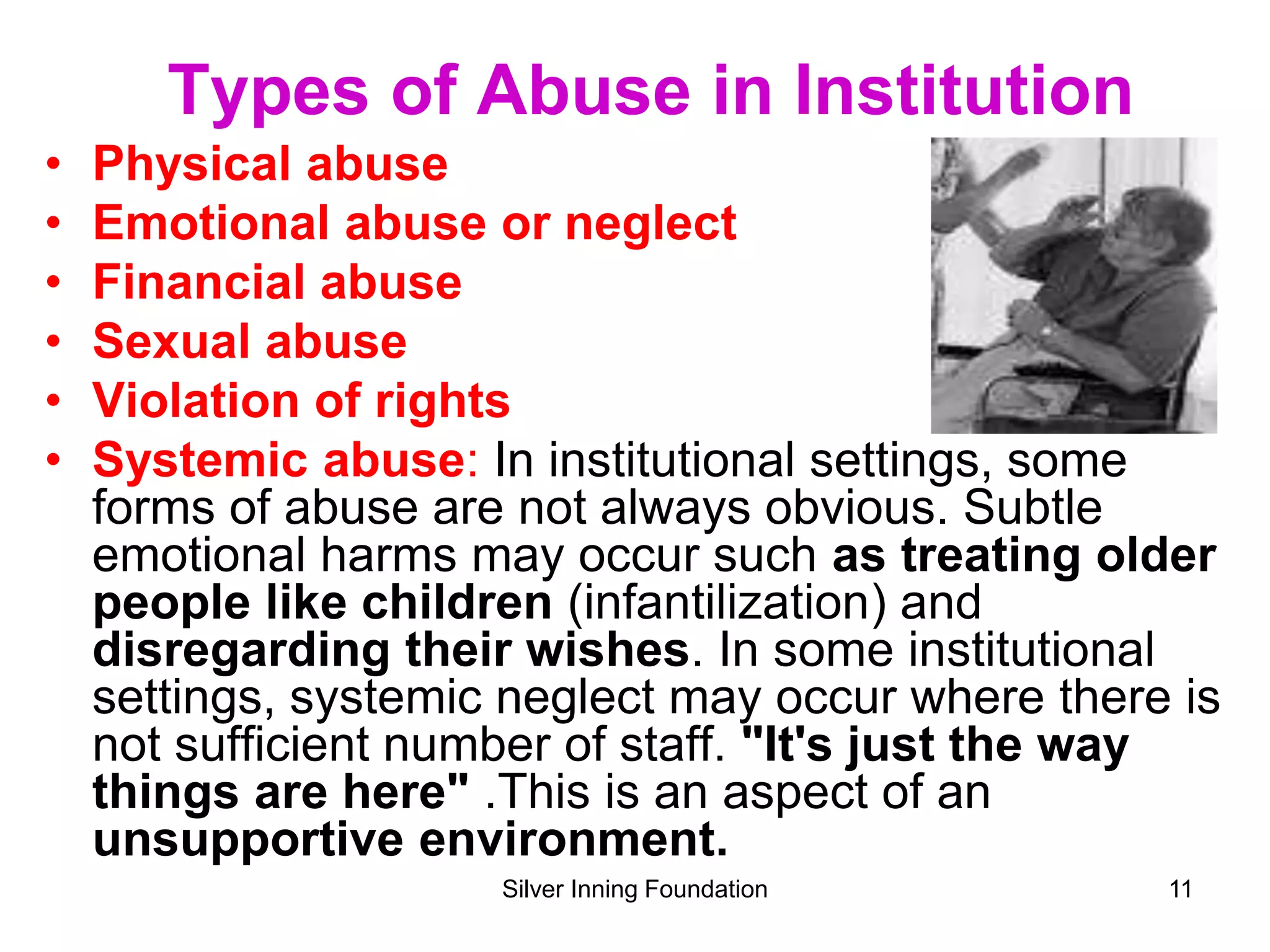
Types of Abuse in Institution
• Physical abuse
• Emotional abuse or neglect
• Financial abuse
• Sexual abuse
• Violation of rights
• Systemic abuse: In institutional settings, some
forms of abuse are not always obvious. Subtle
emotional harms may occur such as treating older
people like children (infantilization) and
disregarding their wishes. In some institutional
settings, systemic neglect may occur where there is
not sufficient number of staff. "It's just the way
things are here" .This is an aspect of an
unsupportive environment.
Silver Inning Foundation 11
Other types of abuse/neglect
• Abuse by over-medication or under medication
• Abuse by inappropriate use of physical or chemical
(medication) restraints – diapers , Tied down ,
Sedative
• Thefts of residents' personal property because of
lack of security
• Some forms of institutional abuse violate people's
rights to accept or decline treatment
• Food – Quality/Quantity/Time
• End of Life
• Lack of Basic Facility - Cleanliness, Bathing,
Recreation, Grievances cell , Communication
Silver Inning Foundation 12
Common Abuse in Institutions
• More of physical abuse: Slapping or hitting
• Excessive use of restraints – more like
hostel – not like home
• Pushing, grabbing, shoving or pinching of
residents.
• Psychological abuse : included yelling at the
resident in anger, insulting or swearing at the
resident, and isolating the resident
inappropriately.
• Neglect situations
Silver Inning Foundation 13
Case Study1
• Son working in MNC could not handle his
restless AD father , admitted his Dad in
Nursing/Care Home .
• Could not visit frequently ,visited after 15 days &
was Surprised to find father Passive & dull .
Took him home & found Bruise mark on hand &
legs – liked Tied down , found him drugged , got
huge bill with 15 unnecessary medicines , no
Activity
Silver Inning Foundation 14
Case Study 2
• Daughter in law could not manage the Stress of
handling Cheerful & overactive Dementia Pa in Law,
admitted him in Well known Dementia Care facility
away from city with lots of hope
• Visited after couple of months , found him Weak & Tired
with bundle of Unwashed Clothes , Soiled Bed sheets
& unchanged Diapers , Smelly Room …………….
Silver Inning Foundation 15
Case Study 3
• A NRI son admits his AD mother to Elder Home
• After few months Visited mother, founds Staff
untrained, inefficient medical support , No Spiritual
facility, No Counselor, No Psychologist , Average Food
quality– his complaint was ignored
• Unfortunately Mother passed away after 2 years and
Son still running Pillar to post to Get the Refund
Deposit and Justice for Excess Billing
Silver Inning Foundation 16
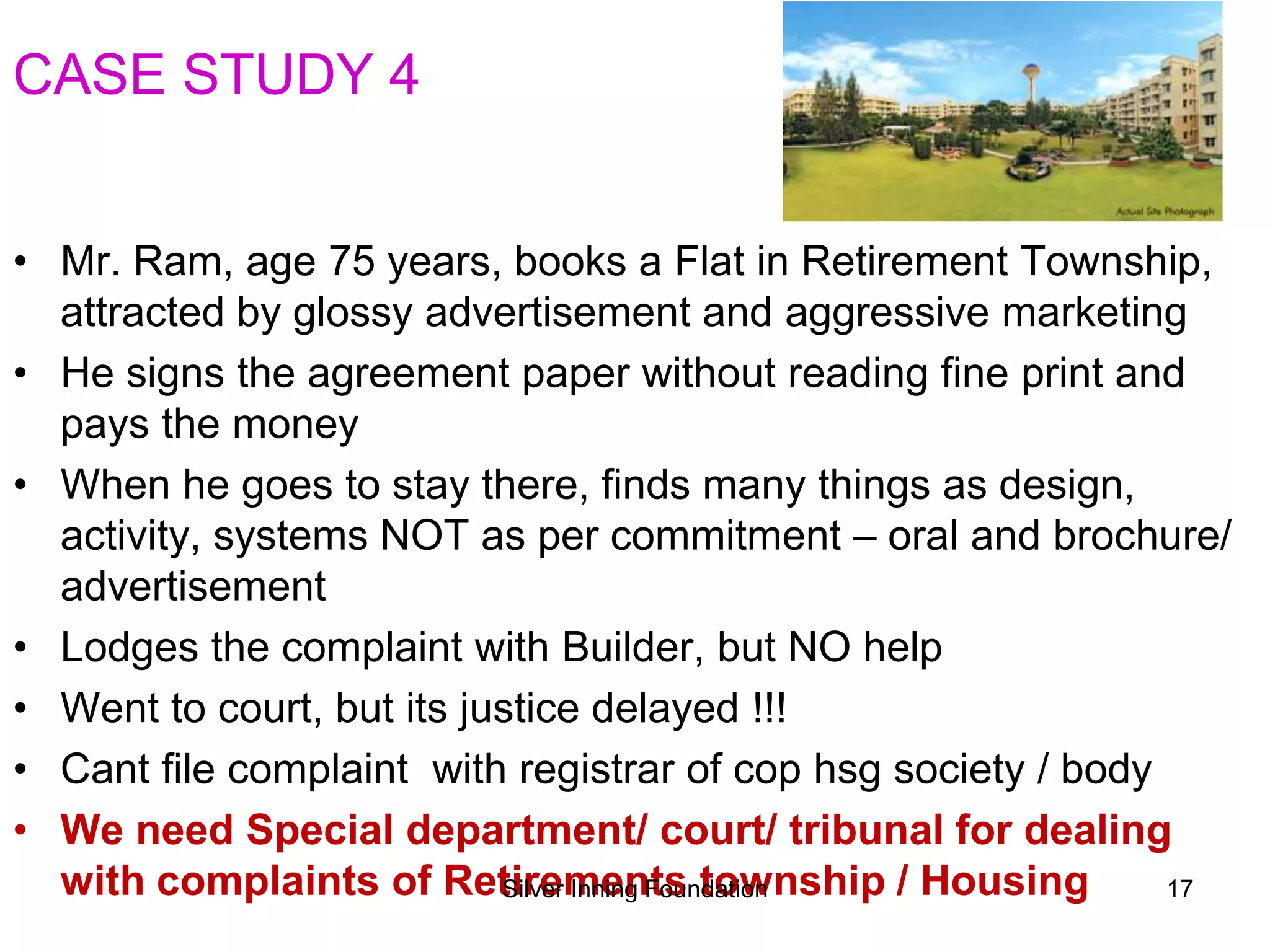
CASE STUDY 4
• Mr. Ram, age 75 years, books a Flat in Retirement Township,
attracted by glossy advertisement and aggressive marketing
• He signs the agreement paper without reading fine print and
pays the money
• When he goes to stay there, finds many things as design,
activity, systems NOT as per commitment – oral and brochure/
advertisement
• Lodges the complaint with Builder, but NO help
• Went to court, but its justice delayed !!!
• Cant file complaint with registrar of cop hsg society / body
• We need Special department/ court/ tribunal for dealing
with complaints of Retirements township / HousingSilver Inning Foundation 17
Slippery Tiles , Unfriendly Staff , Scared Elderly , Lonely Elderly
Non Elderly Friendly Infrastructure, Untrained & Inadequate Staff
Management : Top to Bottom Approach
Silver Inning Foundation 18
Why Abuse or Neglect Happens
• Isolation/ Hidden: Many care facilities are separate from the
community. Other than family members who may visits, few outsiders
may have contact with seniors who are living in care facilities. That may
make it easier for abuse or neglect to remain hidden or go undetected.
• Mismatch of Skills: Seniors in care today are much more physically
frail and much more likely to be cognitively impaired. Staff members
giving care today need considerable skills in assisting seniors who are
physically or cognitively impaired. Without these staff skills, the risk of
abuse or neglect of the residents in care can increase.
• Ageism and Ablebodied-ism: Sometimes a society places considerable
value on being young and active. When people grow older or develop
conditions that impair their abilities, they may become devalued.
Their preferences and wishes are given less weight than other (usually
younger) people's needs or interests.
• Systemic Problems: "It's just the way things are here" , This is an
aspect of an unsupportive environment.
Silver Inning Foundation 19
Why
• Personality traits of staff, volunteers,
administration or other persons in the environment
may lead to abuse or neglect. Like any other
setting, some people working or volunteering in a
nursing home, personal care home, assisted living
or other institutional setting may not have the
personality best suited for helping frail older
adults.
• The facility's culture and organization. An
abuse-free environment starts from the top. The
development and maintenance of a respectful
environment that recognizes the inherent dignity
and worthy of each individual requires
organizational work and attention.
• Inadequate staffingSilver Inning Foundation 20
Why
• Staff minimization and rationalization of abuse:
Some people may have a tolerance for certain kinds of
disrespect, or verbal aggression towards residents or
the staff because of the institutional culture, or lack of
training.
• Financial constraints within the facility which may
contribute to poor quality care.
• Poor enforcement of nursing home standards or
inadequate standards.
• Difficulty recruiting and retaining qualified and
well trained staff. This may be related to wages or
working conditions.
• Work related stress and professional burnout.
Silver Inning Foundation 21
Rights of the Residents
• Independence : Elders should have access to adequate food,
water, shelter, clothing and health care
• Care : Elders should be able to enjoy human rights and
fundamental freedoms when residing in any shelter, care or
treatment facility, including full respect for their dignity, beliefs,
needs and privacy and for the right to make decisions about
their care and the quality of their lives.
• Dignity: Elders should be able to live in dignity and security
and be free of exploitation and physical or mental abuse.
• Meet with Advocate as often as necessary
• Meet privately with friends and family
• Choose recreational activities and have access to an
organized spiritual and religious care program.
• Rights to make their own health care and personal care
decisions,
• Freedom from discriminationSilver Inning Foundation 22
How to avoid/STOP Abuse
• Training and Education
• Good Selection of Facility
• Read the agreement properly and see under the line – fine print
• Refund policy
• Facility they provide – Food, Recreation, Water , Shelter
• Ask for receipt
• See the organisation/Trustee
• Do they follow minimum standard
• Do they have Medical, social, Psychological , proper security
• facility - mostly its only FOUR walls
• Emphasizing that health care professionals are not to respond to aggression
with aggression.
• Educating the staff on how to deal with conflict with the patients.
• Promoting support groups and counseling for staff members.
• Listening to employees about concerns they have in regards to work
overload, or other problems which are occurring which head staff may be
unaware of.
Silver Inning Foundation 23
Laws for Elderly in India
• Section 125 of the Cr PC:A magistrate can order the child to
maintain his old parents.
• Hindu Adoptions and Maintenance Act (HAMA) :an aged a
parents can demand maintenance from same way a wife can
demand from her husband
• Domestic Violence Act (DVA): Lodge complaint with local
Police
• Maintenance of Welfare of Parents and Senior Citizens
Act 2007 (MWPSCA) : Not yet implemented . Tribunal , No
Advocate needed,90 days ,3rd Party can do it, Max Rs
10,000/- p.m..Penality Rs.5000/- - 3 months jail
Silver Inning Foundation 24
What can be done
• Set Minimum Standard
• License
• Monitoring and Evaluation
• Awareness campaign
• Legislation / ACT’s
• Grievances cell like Tribunals/Consumer Court
• Report abuse
• Visit them, don't leave them alone
• Intergeneration programmes
• Participation and responsibility of Civil Society
Silver Inning Foundation 25
Silver Inning Foundation 26
Rights of Residents at
A1 Snehanjali
• Right to voluntary participation : Each resident’s
participation shall be voluntary and they shall be
provided information to make an informed choice of
participating and accepting services.
• Right to practice own religion : Every resident is free
to practice his/her own religion, without disturbing
other residents
• Right to medical care : Every resident has the right to
have private communications and consultations with
physicians of their choice and of A1 Snehanjali /
Silver Innings, as per terms and condition of A1
Snehanjali
• Right to present grievances by residents and family :
Every resident, plus family will have the right to
express grievances if any to the centre manager for
redress Silver Inning Foundation 27
Rights of Residents at
A1 Snehanjali
• Right to confidentiality in treatment : Every resident has
the right to confidentiality, privacy and treatment.
• Right to receive needs based services : If required, every
resident has the right to need based assessment when
required. Additional costs would be provided by the family
/ guardian / self.
• Right to dignity : Every resident has the right to live
respectively and enjoy a dignified life.
• Right to have family visit : Every resident shall have the
right to receive visits from family members and other
adults as per the terms and conditions of A1 Snehanjali.
• Responsibility to respect personal rights and privacy :
Every resident shall follow all the rules of the home and
will respect the rights and property of other residents.
Silver Inning Foundation 28
Silver Inning Foundation 29
Putting old parents in old age homes should be considered
as a secondary / last option by the children and not as the
only option for taking better care of their parents. The
People who do not have enough economic resources to
fulfill all the necessities of their old parents and if they find
that they can be given better care in old age homes then
they can go for such options.
Silver Inning Foundation 30
Someday this could happen to
you one can be victim
• By learning to recognize signs of abuse and
reporting suspected cases, you can make a
difference in the lives of elderly and
dependent.
• Parents are a treasure that children should
guard zealously. Putting them into old age
homes must never be the first but always the
last option. Treat your parents as assets not
liability. Let them feel wanted and not a
burden..
Silver Inning Foundation 31
Let us all Protect Senior Citizens rights
which will help them to lead dignified,
secure lives, as equal members of
society. Exercising these rights will
enable Elders to be treated with respect
on an equal basis with younger people.
Love ,Care and Respect will give them
Dignity and better Life
Silver Inning Foundation 32
We are Human Being too….
Silver Inning Foundation 33
“My World… Your World… Our World –
Free of Elder Abuse”
Its Silver Inning Foundation
Presentation
www.silverinnings.com
Email: silverinnings@gmail.com
Tel: 9029000091
Silver Inning Foundation 34
• Reference: Charter of Rights for People with Dementia and their
Carers in Scotland : http://social.un.org/ageing-working-
group/documents/Alzheimer%20Scotland%202.pdf
• WHO : Dementia Fact Sheet :
http://www.who.int/mediacentre/factsheets/fs362/en/
• A1 Snehanjali, Silver Innings Assisted Living Elder Care Home
• SPAIN : “The Act for the Promotion of Personal Autonomy and Care
for Dependent Persons” configures a new citizenship right. A right for
the elderly or disabled people that need help in carrying out the basic
activities of daily living
• RIGHTS OF RESIDENTS IN ASSISTED LIVING RESIDENCES , NYC ,
Susan Somers
References
Silver Inning Foundation 35
Thanks
Silver Inning Foundation 36

Elder Abuse in Institutions 2017

  • 1.
    Elder Abuse inInstitutions By Sailesh Mishra Founder President - Silver Innings Founder – A1 Snehanjali Member INPEA Caregiving and Institutional Practice International conference on Services for the Elderly- Challenges & Trends Hyderabad Feb 2017 Silver Inning Foundation 1
  • 2.
  • 3.
    "Trees grow strongerover the years, rivers wider. Likewise, with age, human beings gain immeasurable depth and breadth of experience and wisdom. That is why older persons should be not only respected and revered; they should be utilized as the rich resource to society that they are”: United Nations Ex. Secretary-General Kofi Annan Love ,Care and Respect will give them Dignity and better Life Silver Inning Foundation 3
  • 4.
    Elders in India •Due to better medical facility, good lifestyle longevity increase • In 2008 India population of Elderly was around 8% of total population 86 Million • In 2014 Elder Population approx 104 million , 174 million projected in by 2026 , 356 Million in 2050 • Average age in 1951 – 42 yrs, Average age in 2008 - 68.6 yrs • It will be75 years in 2045-2050. • According to UN India will be soon Ageing nation, India has 2nd largest number of Senior Citizens • Around 70% Elderly are in Rural area • Many Elderly are illiterate and rely mostly on Family members • 90% of Indians Retires without Pension • Feminization of Ageing • Increase of 80 + very old population • Increase in Incidence of Dementia & Alzheimer’s 3%Silver Inning Foundation 4
  • 5.
    Longevity  According toUNICEF Life expectancy in India :  In 1951 42 yrs  In 1970 49 yrs  In 1990 58 yrs  In 2005 64 yrs  In 2008 68.6 yrs ( Female : 70yrs)  There is 60% increase in 60 yrs of lifespan  3 TYPES OF SENIOR CITIZENS: Drastic change in 3 segment :Young Old (60- 69 yrs ), Old Old ( 70 – 79yrs ) Very Old ( 80+ yrs) Silver Inning Foundation 5
  • 6.
    India Pyramid 2000 SilverInning Foundation6
  • 7.
    India Pyramid 2050 SilverInning Foundation7
  • 8.
    Old Age inIndia • In India, old age was never a problem. Elder abuse was considered as a western problem and old age home was an alien concept. • Earlier, the elderly persons of a family were respected a lot and they continued to live with respect till their death. But now the times have changed. The elderly are treated as burden , often neglected / ignored Silver Inning Foundation 8
  • 9.
    Elder Abuse • Elderabuse as a social problem remains hidden. • Least researched topic with very little intervention. • According to pan-Indian surveys, 40% of elderly subject to some form of abuse • Elderly are equally responsible • Few Intervention by Government and Society , hardly any Law • More abuse done by Family and Relative • Old Age Homes and Institutions Silver Inning Foundation 9
  • 10.
    What is ElderAbuse • Single repeated act • Where there is Lack of appropriate action • Where there is Expectation of trust • It leads to Harming development of his/her personality Silver Inning Foundation 10
  • 11.
    Types of Abusein Institution • Physical abuse • Emotional abuse or neglect • Financial abuse • Sexual abuse • Violation of rights • Systemic abuse: In institutional settings, some forms of abuse are not always obvious. Subtle emotional harms may occur such as treating older people like children (infantilization) and disregarding their wishes. In some institutional settings, systemic neglect may occur where there is not sufficient number of staff. "It's just the way things are here" .This is an aspect of an unsupportive environment. Silver Inning Foundation 11
  • 12.
    Other types ofabuse/neglect • Abuse by over-medication or under medication • Abuse by inappropriate use of physical or chemical (medication) restraints – diapers , Tied down , Sedative • Thefts of residents' personal property because of lack of security • Some forms of institutional abuse violate people's rights to accept or decline treatment • Food – Quality/Quantity/Time • End of Life • Lack of Basic Facility - Cleanliness, Bathing, Recreation, Grievances cell , Communication Silver Inning Foundation 12
  • 13.
    Common Abuse inInstitutions • More of physical abuse: Slapping or hitting • Excessive use of restraints – more like hostel – not like home • Pushing, grabbing, shoving or pinching of residents. • Psychological abuse : included yelling at the resident in anger, insulting or swearing at the resident, and isolating the resident inappropriately. • Neglect situations Silver Inning Foundation 13
  • 14.
    Case Study1 • Sonworking in MNC could not handle his restless AD father , admitted his Dad in Nursing/Care Home . • Could not visit frequently ,visited after 15 days & was Surprised to find father Passive & dull . Took him home & found Bruise mark on hand & legs – liked Tied down , found him drugged , got huge bill with 15 unnecessary medicines , no Activity Silver Inning Foundation 14
  • 15.
    Case Study 2 •Daughter in law could not manage the Stress of handling Cheerful & overactive Dementia Pa in Law, admitted him in Well known Dementia Care facility away from city with lots of hope • Visited after couple of months , found him Weak & Tired with bundle of Unwashed Clothes , Soiled Bed sheets & unchanged Diapers , Smelly Room ……………. Silver Inning Foundation 15
  • 16.
    Case Study 3 •A NRI son admits his AD mother to Elder Home • After few months Visited mother, founds Staff untrained, inefficient medical support , No Spiritual facility, No Counselor, No Psychologist , Average Food quality– his complaint was ignored • Unfortunately Mother passed away after 2 years and Son still running Pillar to post to Get the Refund Deposit and Justice for Excess Billing Silver Inning Foundation 16
  • 17.
    CASE STUDY 4 •Mr. Ram, age 75 years, books a Flat in Retirement Township, attracted by glossy advertisement and aggressive marketing • He signs the agreement paper without reading fine print and pays the money • When he goes to stay there, finds many things as design, activity, systems NOT as per commitment – oral and brochure/ advertisement • Lodges the complaint with Builder, but NO help • Went to court, but its justice delayed !!! • Cant file complaint with registrar of cop hsg society / body • We need Special department/ court/ tribunal for dealing with complaints of Retirements township / HousingSilver Inning Foundation 17
  • 18.
    Slippery Tiles ,Unfriendly Staff , Scared Elderly , Lonely Elderly Non Elderly Friendly Infrastructure, Untrained & Inadequate Staff Management : Top to Bottom Approach Silver Inning Foundation 18
  • 19.
    Why Abuse orNeglect Happens • Isolation/ Hidden: Many care facilities are separate from the community. Other than family members who may visits, few outsiders may have contact with seniors who are living in care facilities. That may make it easier for abuse or neglect to remain hidden or go undetected. • Mismatch of Skills: Seniors in care today are much more physically frail and much more likely to be cognitively impaired. Staff members giving care today need considerable skills in assisting seniors who are physically or cognitively impaired. Without these staff skills, the risk of abuse or neglect of the residents in care can increase. • Ageism and Ablebodied-ism: Sometimes a society places considerable value on being young and active. When people grow older or develop conditions that impair their abilities, they may become devalued. Their preferences and wishes are given less weight than other (usually younger) people's needs or interests. • Systemic Problems: "It's just the way things are here" , This is an aspect of an unsupportive environment. Silver Inning Foundation 19
  • 20.
    Why • Personality traitsof staff, volunteers, administration or other persons in the environment may lead to abuse or neglect. Like any other setting, some people working or volunteering in a nursing home, personal care home, assisted living or other institutional setting may not have the personality best suited for helping frail older adults. • The facility's culture and organization. An abuse-free environment starts from the top. The development and maintenance of a respectful environment that recognizes the inherent dignity and worthy of each individual requires organizational work and attention. • Inadequate staffingSilver Inning Foundation 20
  • 21.
    Why • Staff minimizationand rationalization of abuse: Some people may have a tolerance for certain kinds of disrespect, or verbal aggression towards residents or the staff because of the institutional culture, or lack of training. • Financial constraints within the facility which may contribute to poor quality care. • Poor enforcement of nursing home standards or inadequate standards. • Difficulty recruiting and retaining qualified and well trained staff. This may be related to wages or working conditions. • Work related stress and professional burnout. Silver Inning Foundation 21
  • 22.
    Rights of theResidents • Independence : Elders should have access to adequate food, water, shelter, clothing and health care • Care : Elders should be able to enjoy human rights and fundamental freedoms when residing in any shelter, care or treatment facility, including full respect for their dignity, beliefs, needs and privacy and for the right to make decisions about their care and the quality of their lives. • Dignity: Elders should be able to live in dignity and security and be free of exploitation and physical or mental abuse. • Meet with Advocate as often as necessary • Meet privately with friends and family • Choose recreational activities and have access to an organized spiritual and religious care program. • Rights to make their own health care and personal care decisions, • Freedom from discriminationSilver Inning Foundation 22
  • 23.
    How to avoid/STOPAbuse • Training and Education • Good Selection of Facility • Read the agreement properly and see under the line – fine print • Refund policy • Facility they provide – Food, Recreation, Water , Shelter • Ask for receipt • See the organisation/Trustee • Do they follow minimum standard • Do they have Medical, social, Psychological , proper security • facility - mostly its only FOUR walls • Emphasizing that health care professionals are not to respond to aggression with aggression. • Educating the staff on how to deal with conflict with the patients. • Promoting support groups and counseling for staff members. • Listening to employees about concerns they have in regards to work overload, or other problems which are occurring which head staff may be unaware of. Silver Inning Foundation 23
  • 24.
    Laws for Elderlyin India • Section 125 of the Cr PC:A magistrate can order the child to maintain his old parents. • Hindu Adoptions and Maintenance Act (HAMA) :an aged a parents can demand maintenance from same way a wife can demand from her husband • Domestic Violence Act (DVA): Lodge complaint with local Police • Maintenance of Welfare of Parents and Senior Citizens Act 2007 (MWPSCA) : Not yet implemented . Tribunal , No Advocate needed,90 days ,3rd Party can do it, Max Rs 10,000/- p.m..Penality Rs.5000/- - 3 months jail Silver Inning Foundation 24
  • 25.
    What can bedone • Set Minimum Standard • License • Monitoring and Evaluation • Awareness campaign • Legislation / ACT’s • Grievances cell like Tribunals/Consumer Court • Report abuse • Visit them, don't leave them alone • Intergeneration programmes • Participation and responsibility of Civil Society Silver Inning Foundation 25
  • 26.
  • 27.
    Rights of Residentsat A1 Snehanjali • Right to voluntary participation : Each resident’s participation shall be voluntary and they shall be provided information to make an informed choice of participating and accepting services. • Right to practice own religion : Every resident is free to practice his/her own religion, without disturbing other residents • Right to medical care : Every resident has the right to have private communications and consultations with physicians of their choice and of A1 Snehanjali / Silver Innings, as per terms and condition of A1 Snehanjali • Right to present grievances by residents and family : Every resident, plus family will have the right to express grievances if any to the centre manager for redress Silver Inning Foundation 27
  • 28.
    Rights of Residentsat A1 Snehanjali • Right to confidentiality in treatment : Every resident has the right to confidentiality, privacy and treatment. • Right to receive needs based services : If required, every resident has the right to need based assessment when required. Additional costs would be provided by the family / guardian / self. • Right to dignity : Every resident has the right to live respectively and enjoy a dignified life. • Right to have family visit : Every resident shall have the right to receive visits from family members and other adults as per the terms and conditions of A1 Snehanjali. • Responsibility to respect personal rights and privacy : Every resident shall follow all the rules of the home and will respect the rights and property of other residents. Silver Inning Foundation 28
  • 29.
  • 30.
    Putting old parentsin old age homes should be considered as a secondary / last option by the children and not as the only option for taking better care of their parents. The People who do not have enough economic resources to fulfill all the necessities of their old parents and if they find that they can be given better care in old age homes then they can go for such options. Silver Inning Foundation 30
  • 31.
    Someday this couldhappen to you one can be victim • By learning to recognize signs of abuse and reporting suspected cases, you can make a difference in the lives of elderly and dependent. • Parents are a treasure that children should guard zealously. Putting them into old age homes must never be the first but always the last option. Treat your parents as assets not liability. Let them feel wanted and not a burden.. Silver Inning Foundation 31
  • 32.
    Let us allProtect Senior Citizens rights which will help them to lead dignified, secure lives, as equal members of society. Exercising these rights will enable Elders to be treated with respect on an equal basis with younger people. Love ,Care and Respect will give them Dignity and better Life Silver Inning Foundation 32
  • 33.
    We are HumanBeing too…. Silver Inning Foundation 33
  • 34.
    “My World… YourWorld… Our World – Free of Elder Abuse” Its Silver Inning Foundation Presentation www.silverinnings.com Email: silverinnings@gmail.com Tel: 9029000091 Silver Inning Foundation 34
  • 35.
    • Reference: Charterof Rights for People with Dementia and their Carers in Scotland : http://social.un.org/ageing-working- group/documents/Alzheimer%20Scotland%202.pdf • WHO : Dementia Fact Sheet : http://www.who.int/mediacentre/factsheets/fs362/en/ • A1 Snehanjali, Silver Innings Assisted Living Elder Care Home • SPAIN : “The Act for the Promotion of Personal Autonomy and Care for Dependent Persons” configures a new citizenship right. A right for the elderly or disabled people that need help in carrying out the basic activities of daily living • RIGHTS OF RESIDENTS IN ASSISTED LIVING RESIDENCES , NYC , Susan Somers References Silver Inning Foundation 35
  • 36.