Elder Abuse
Saeed Khayyat Kakhki
MSc of Geriatric Nursing at TUMS
Contents of This Topic
● Introduction
● Risk factors
● Sign & symptoms
● Types of Abuse
● Nursing consideration
● Prevention
● Elder Abuse & COVID-19
● Elder Abuse & LGBT Older Adult
● Appendices
● References
Introduction
● Elder mistreatment is an umbrella term that covers abuse, neglect, exploitation
● Mistreatment of older frail and vulnerable adults is found in all socioeconomic,
racial, and ethnic groups across the globe.
● Elder mistreatment may be intentional, accidental, episodic, or recurrent
● Elder abuse can occur in patients’ homes or in health care facilities by loved
ones, caregivers, or strangers. Particularly in long-term caregiving relationships, in
which family members or staff “burn out,” Most abusers are spouses or adult
children.
Abuse can assume many forms, including inflicting pain or injury; stealing;
mismanaging funds; misusing medications; causing psychological distress;
withholding food or care; or confining a person.
✓ Even threatening to commit any of these acts is considered abuse.
Abuse may be undetected due to an older person’s lack of contact with others
(e.g., being homebound and not having communication with anyone but the relative
who is the abuser) or due to the reluctance to report the problem due to fear or
shame. (up to 80% of actual mistreatment may be unreported).
Introduction (Count…)
Risk Factors
• Elder abuse requires:
• Abuser
• Elder
• Context of caregiving or trust
So risk factors includes:
1.Persons who are abusing alcohol or other substances, have emotional or mental
illnesses, or have a history of abusing or being abused are more likely to be
abusers, as are caregivers who are exhausted and frustrated.
2.younger women with higher levels of education and higher levels of burden are
more frequent abuser.
Risk Factors (Count…)
3.Sex; Women are at particular abuse risk.
4.The risk for abuse is intensified if the person has been abused in the past or if his
or her behavior is considered aggressive, combative, or provocative.
5.level of dependency (the more dependent the elder, the more vulnerable he or she is to being abused).
6.Men or women who had abused the caregiver earlier in life may be at risk for
retaliation .
7.Depression
8.Dementia
9. When a number of providers are giving care, monitoring becomes especially difficult.
Risk Factors (Count…)
Sign & symptoms
● Slapping, bruising, striking (with or without an object), burning, shaking;
inappropriate use of physical restraints; force feeding, Unwanted touching; all
sexual assault or battery Verbal assaults; insults or threats; intimidations or
humiliation; treating like an infant; isolating from family, friends, or regular
activities; giving “the silent treatment” Being dropped off at a hospital, nursing
facility or institution.
several recognized types of elder abuse which include:
1.Physical abuse
2.Psychological/Emotional Abuse
3.Sexual abuse
4.Financial or Material Exploitation Abuse
5.Neglect
Types of Elder Abuse
Physical abuse
Physical abuse is the use of physical force that may result in bodily injury, physical
pain, or impairment.
✓ It includes, striking (with or without an object), hitting, beating, pushing,
shoving, shaking, slapping, kicking, pinching, and burning.
✓ The inappropriate use of chemical and physical restraints, force-feeding, and
physical punishment of any kind also are examples of physical abuse.
Bruises that are the result of physical abuse are most likely found on the face, the
lateral aspect of the arm, and the posterior torso, and are larger >5 cm .
• Frequently, the person will not be able to explain or offer a reasonable
explanation for the injury.
Psychological/Emotional Abuse
Emotional or Psychological abuse includes verbal assaults, insults, threats,
intimidation, humiliation, and harassment.
Psychological abuse is the infliction of anguish, pain, or distress through verbal or
nonverbal acts, treating an older person like a child; isolating the person from his
or her family, friends, or regular activities; and enforced social isolation are examples
of psychological abuse.
✓ This type of abuse may be a deliberate effort to dehumanize the person,
sometimes to mitigate the guilt of providing poor care or abusing the
person emotionally.
Sexual Abuse
Sexual abuse is nonconsensual sexual contact of any kind with another person,
regardless of age.
➢ Sexual contact with a person incapable of giving consent is also
considered sexual abuse.
➢ Sexual abuse is not limited to unwanted touching and all types of sexual assault
or battery, such as rape, sodomy, coerced nudity, and sexually explicit
photographing
Nurses and other health care providers may observe injuries from rough or
forceful sexual activity. However, sometimes injury may not be present but certain
behaviors may be revealing.
➢ Fear of certain persons, resistance to necessary touch in the genital area, or reports of
sexual contact cannot be ignored.
Financial or Material Exploitation Abuse
Financial or material exploitation is the illegal or improper use of another’s funds, property,
or assets.
➢ Exploitation may be accomplished by force, such as demanding that the person
sign checks or other documents with the threat of withholding care. It can also
be done with stealth through deceit, misrepresentation, or fraud, such as
cashing a person’s checks without authorization or permission, forging a
signature, or misusing or stealing an older person’s money or possessions.
➢ Whereas other forms of abuse have external signs, it is often difficult to detect financial
exploitation. Care is costly, and much of the person’s assets may be gone before it is noted
that far more has been used than seems to be needed. Changes in banking practices,
failure to pay medical or other care bills, unexpected changes in a will, and finding
personal valuable items missing are all evidence of possible financial.
Abuse Summery
Neglect
Neglect is the most common form of elder mistreatment and may be at the hands of a
caregiver or oneself.
Neglect of self and neglect by caretakers are often difficult to define because they are
intertwined with energy, lifestyle, and resources. Nurses must be cautious in setting specific
boundaries around neglect.
➢ However, when basic needs go unmet, intervention may be required.
Physical neglect is the most common and obvious occurrence and may be
indicated by a person’s failure to thrive, untreated medical conditions (medical
neglect), badly neglected grooming, malnutrition, and dehydration.
Caregiver Neglect
Neglect is passive abuse not characterized by physical violence. Caregiver neglect is
seen as: an act of omission or withholding needed goods and services such as food,
medication, medical treatment, and personal care necessary for the well-being of
the frail elder. It also includes behavior that ignores the person’s obvious needs
even though the caretaker is present.
➢ Neglect by a caregiver may occur for many reasons:
caregiver stress, incompetence, unawareness of importance of the neglected
care, no legal requirement to give such care, unavailability of resources, or
exhaustion.
➢ The caregivers’ own frailty and advanced age are often mitigating factors.

Self-Neglect
Elder self-neglect is a behavior of the individual person. It is usually a function of a person’s
diminished physical or mental capacity that threatens his or her own health or safety.
➢ Self-neglect generally manifests itself in an older person as a refusal or failure to provide
himself or herself with adequate safety, food, water, clothing, shelter, personal hygiene,
or health care.
Self-neglect may be associated with increasing severity of physical or mental impairments but
may also reflect a lifestyle of alcoholism and drug abuse.
It is an ethical and legal question as to how much health care professionals should intervene
in these situations unless it can definitely be determined that the person lacks decision-
making capacity or competence.
Nursing considerations
Assessment
When working with frail and vulnerable elders, nurses must always be vigilant in their
sensitivity to the potential for abuse, observing for signs and symptoms in all their interactions
with vulnerable elders.
Ask self-questions such as:
❖ Is there an unusual delay between the beginning of a health problem and when help is
sought?
❖ Are appointments often missed without reasonable explanations?
❖ Are the histories given by the elder and the caregiver inconsistent?
❖ Does the caregiver do all of the talking in a situation, even though the elder is capable?
❖ Does the caregiver appear angry, frustrated, or indifferent while the elder appears
hesitant or frightened?
❖ Is the caregiver or the care recipient aggressive toward one another or the nurse?
Nursing considerations (Count…)
Assessment
Gerontological nurses must also be alert to indications of possible abuse or neglect
during routine interactions with older adults; such as:
➢ delay in seeking necessary medical care
➢ malnutrition
➢ dehydration
➢ unexplained bruises
➢ poor hygiene and grooming
➢ urine odor, urine-stained clothing/linens
➢ excoriation or abrasions of genitalia
➢ inappropriate administration of medications
➢ repeated infections, injuries, or preventable complications from existing diseases
➢ evasiveness in describing condition, symptoms, problems, home life
➢ unsafe living environment
➢ social isolation
➢ anxiety, suspiciousness, and depression
Nursing considerations (Count…)
Assessment tools
✓ Elder Abuse Suspicion Index (EASI)
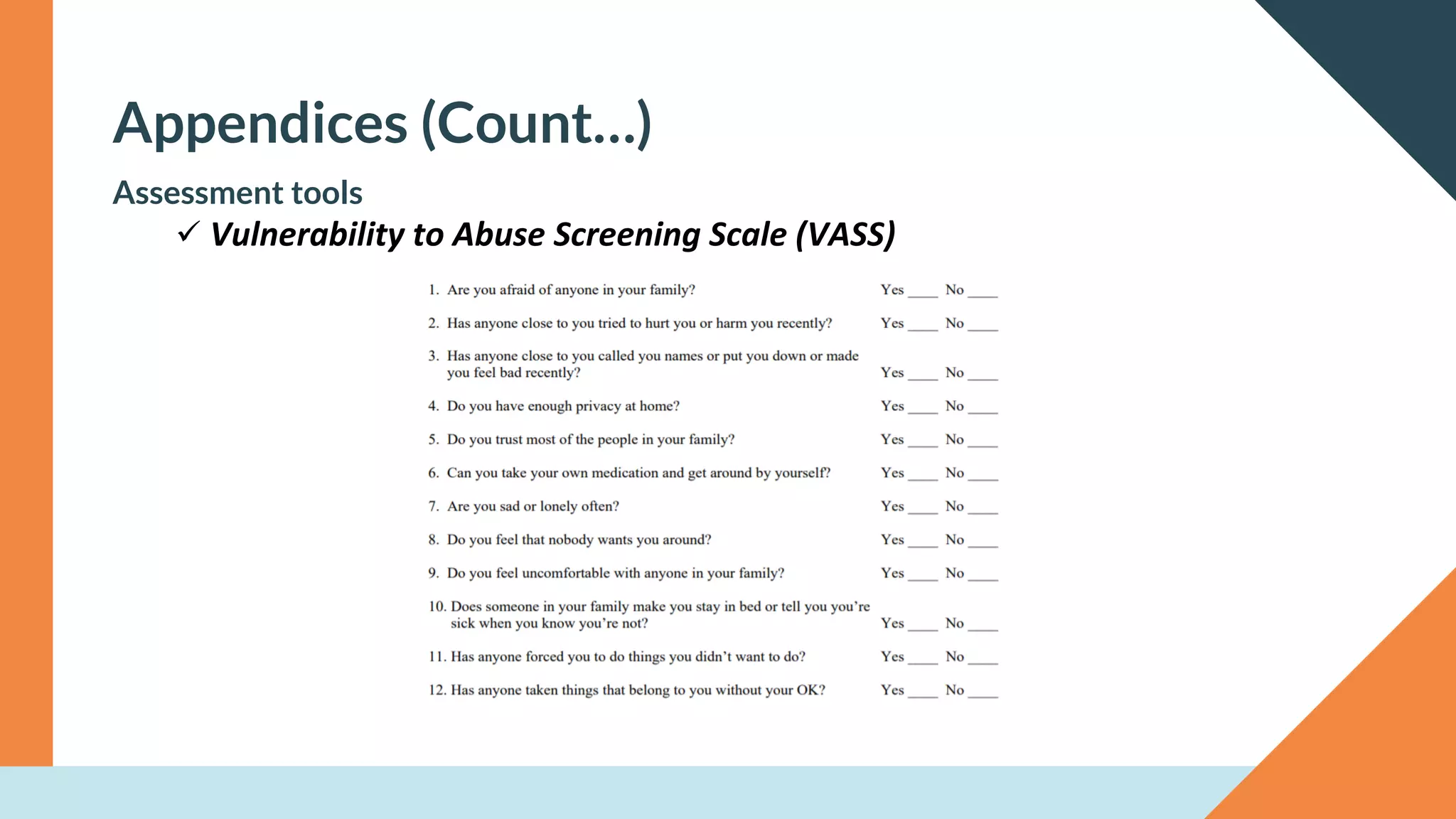
✓ Vulnerability to Abuse Screening Scale (VASS)
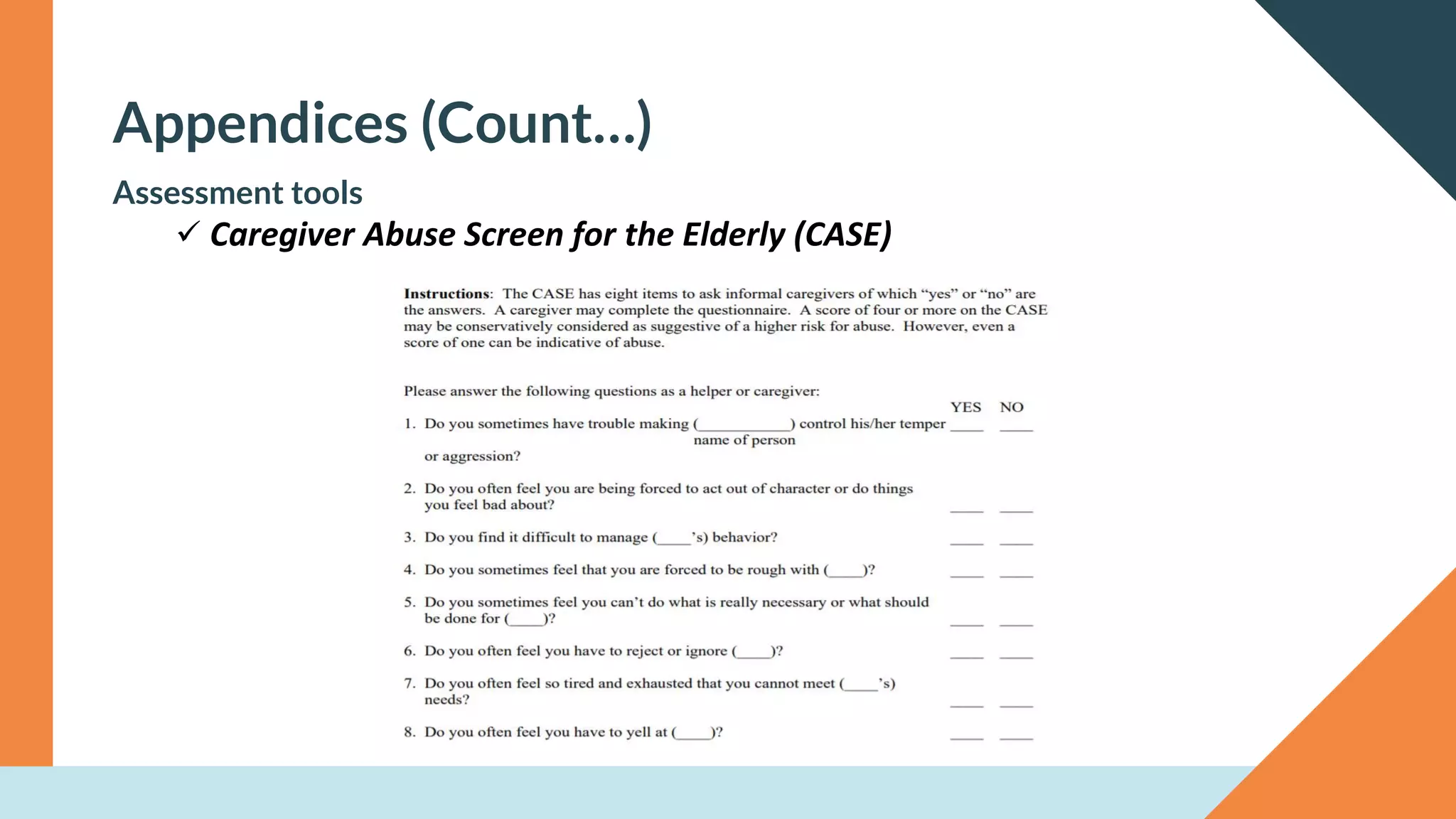
✓ Caregiver Abuse Screen for the Elderly (CASE)
✓ Brief Abuse Screen for the Elderly (BASE)
Note: To see this tools go to Appendices slide
Nursing considerations (Count…)
Interventions
➢Documentation (including photographic documentation taken before the victim is washed or treated)
➢Collection and preservation of any and all physical evidence (e.g., dirty or bloody
clothing, bandages, sheets)
➢Social services consultation
➢If the elder is in immediate danger, consider implementing a safety plan (e.g.,
hospital admission)
➢Mandatory report to the appropriate state agency and/or law enforcement on
the suspicion of abuse or neglect.
Nursing considerations (Count…)
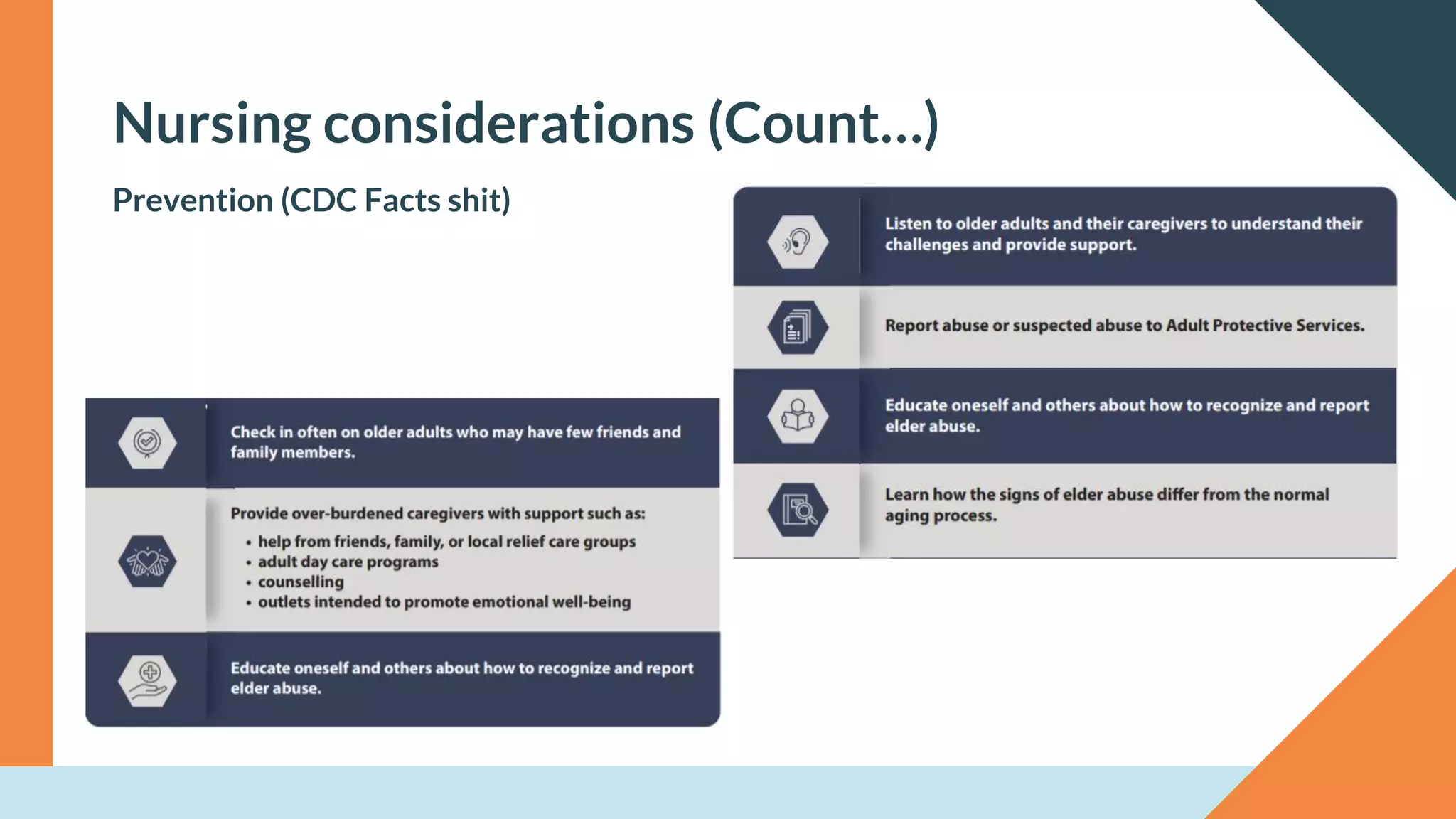
Prevention
➢Make professionals aware of potentially abusive situations.
➢Educate the public about normal aging processes.
➢Help families develop and nurture informal support systems.
➢Link families with support groups.
➢Teach families stress management techniques.
➢Arrange comprehensive care resources.
➢Provide counseling for troubled families.
➢Encourage the use of respite care and day care.
➢Obtain necessary home health care services.
➢Inform families of resources for meals and transportation.
➢Encourage caregivers to pursue their individual interests.
Nursing considerations (Count…)
Prevention (CDC Facts shit)
Elder Abuse & COVID-19
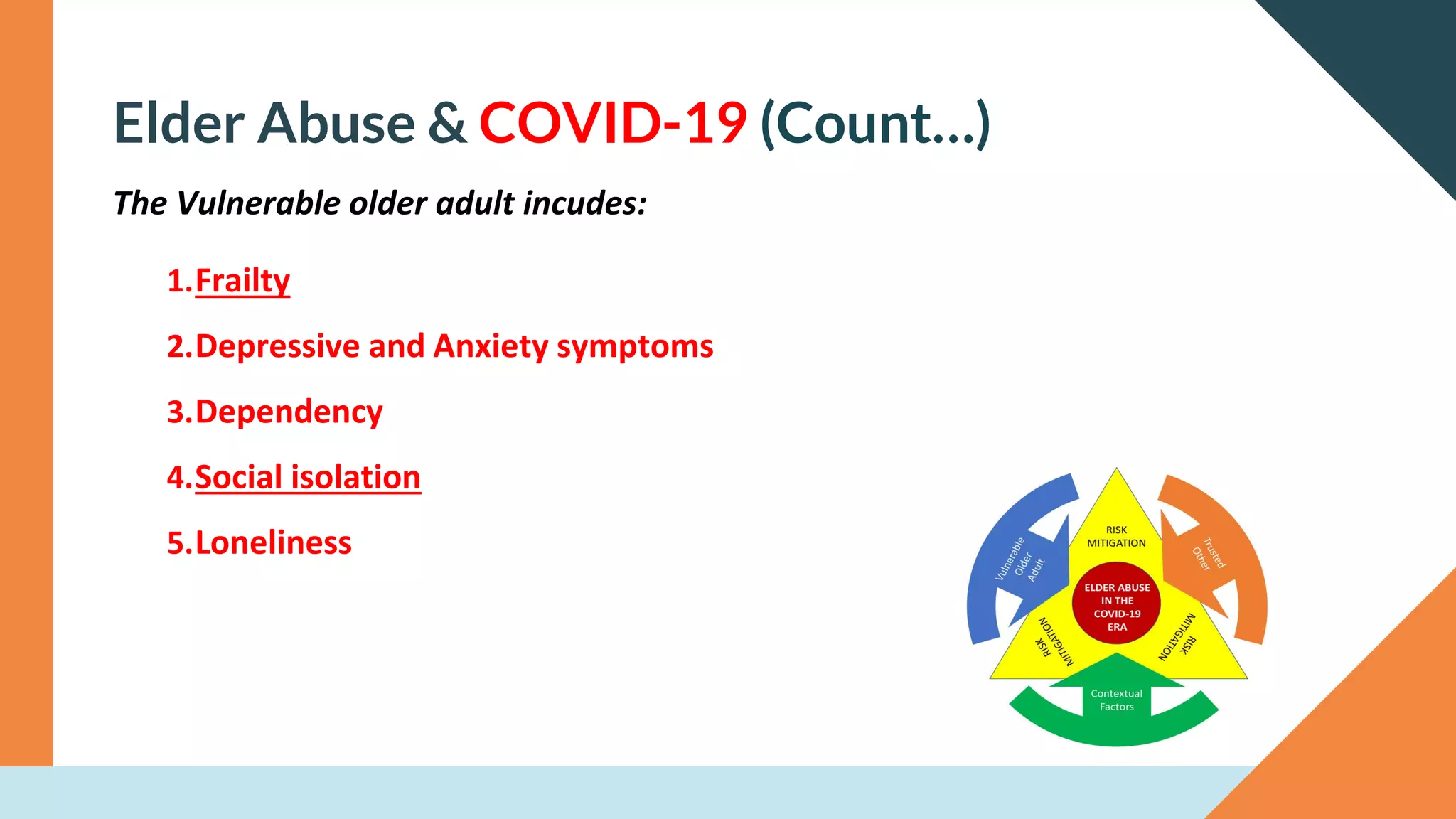
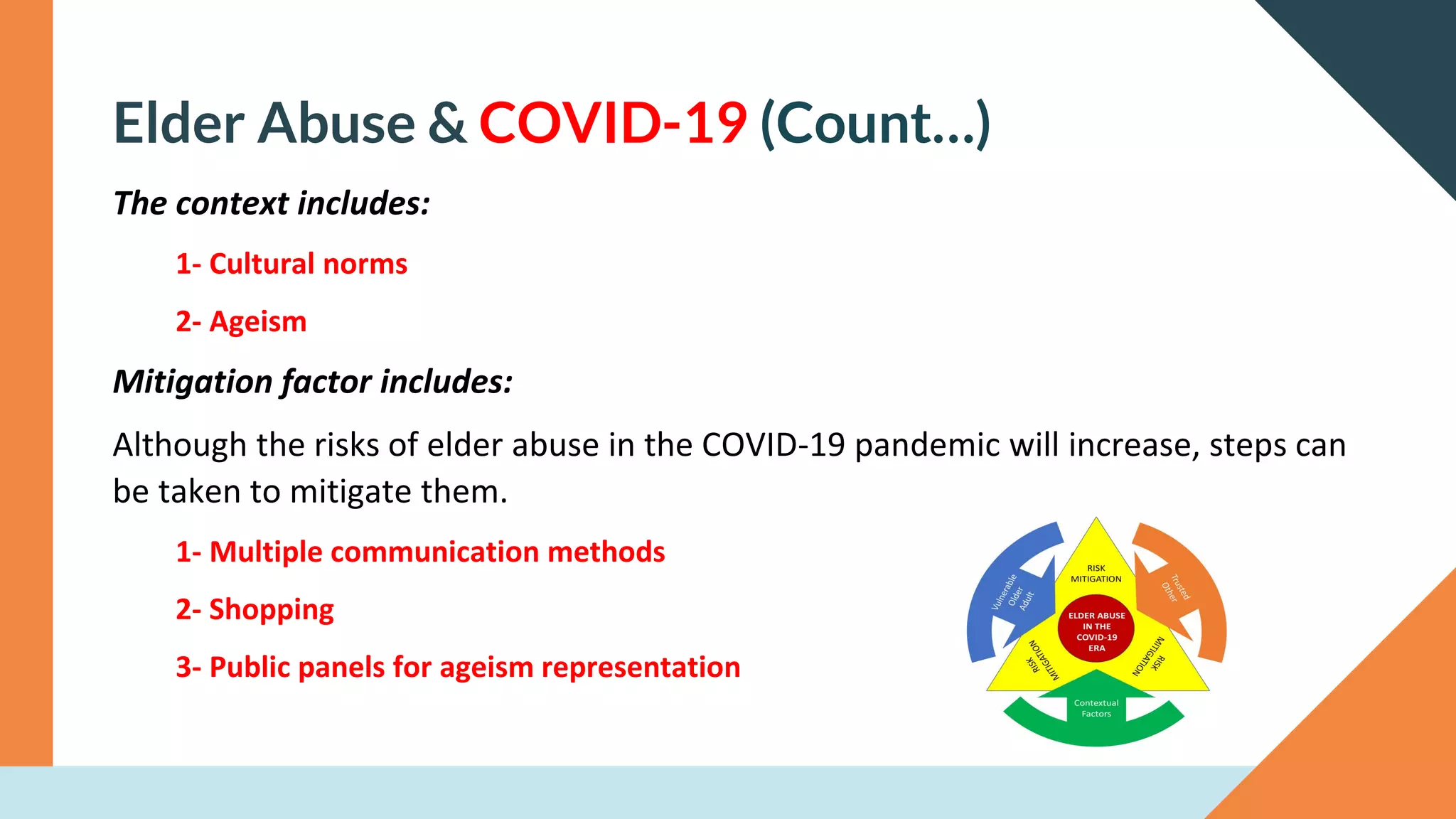
Abuse Intervention/Prevention Model (AIM)
This model focuses on 3 core and intersecting considerations:
1.the vulnerable older adult
2.the trusted other
3.the context in which the abuse occurs
✓ they consider each of these in relation to the COVID‐19 pandemic and end with
suggested ways to mitigate the risks.
Elder Abuse & COVID-19 (Count…)
The Vulnerable older adult incudes:
1.Frailty
2.Depressive and Anxiety symptoms
3.Dependency
4.Social isolation
5.Loneliness
Elder Abuse & COVID-19 (Count…)
The Trusted other includes:
refers to others surrounding the vulnerable older adult, and can refer to family
members, caregivers, neighbors, friends, and financial advisors.
▪ The trusted other becomes a consideration for elder abuse when trust is broken, similar
to situations of domestic violence or child abuse.
during the COVID-19 and social distancing dependency of older adults on others
were increased.
Elder Abuse & COVID-19 (Count…)
The context includes:
1- Cultural norms
2- Ageism
Mitigation factor includes:
Although the risks of elder abuse in the COVID-19 pandemic will increase, steps can
be taken to mitigate them.
1- Multiple communication methods
2- Shopping
3- Public panels for ageism representation
Elder Abuse & COVID-19 (Count…)
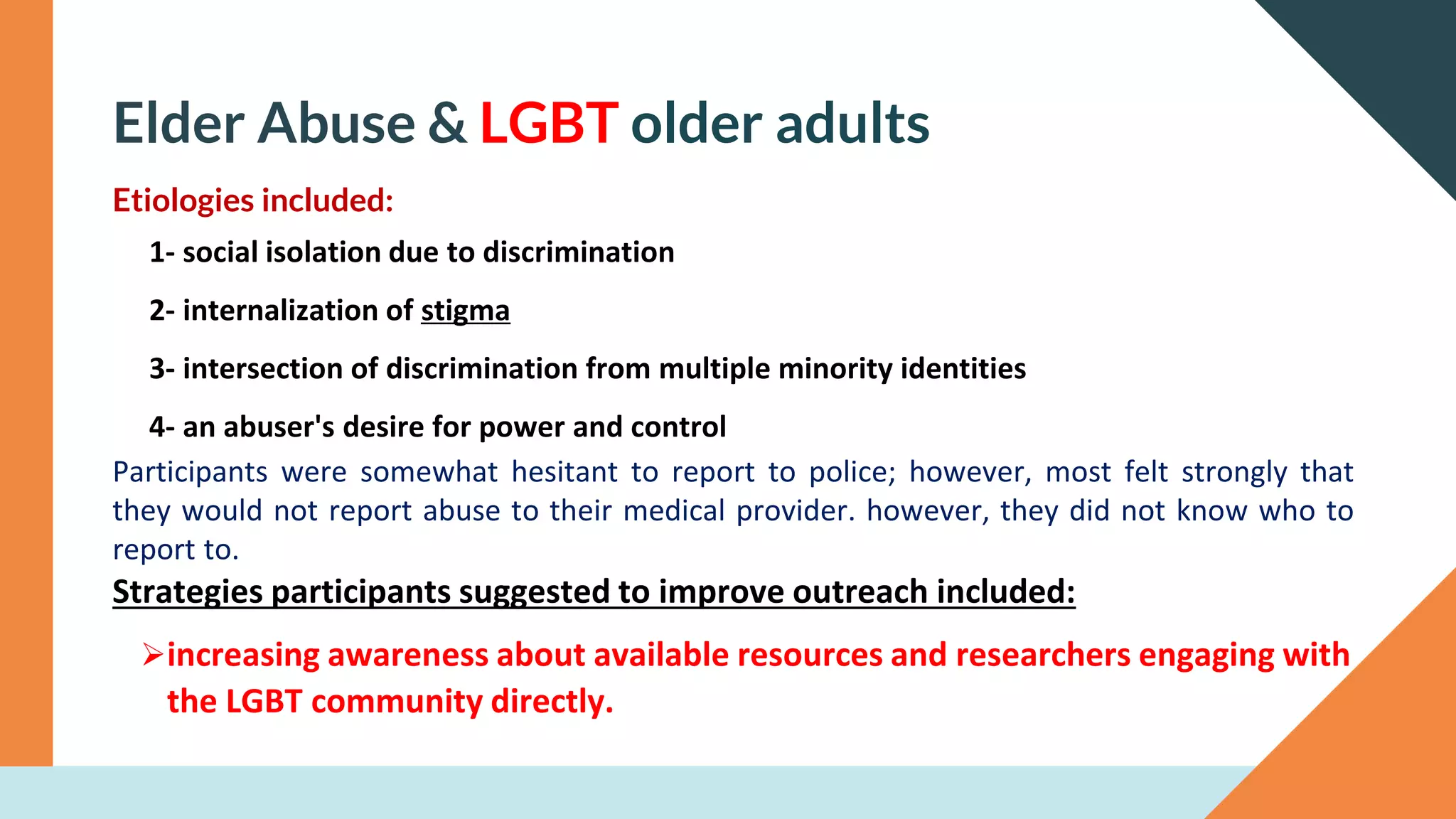
Elder Abuse & LGBT older adults
Etiologies included:
1- social isolation due to discrimination
2- internalization of stigma
3- intersection of discrimination from multiple minority identities
4- an abuser's desire for power and control
Participants were somewhat hesitant to report to police; however, most felt strongly that
they would not report abuse to their medical provider. however, they did not know who to
report to.
Strategies participants suggested to improve outreach included:
➢increasing awareness about available resources and researchers engaging with
the LGBT community directly.
Appendices
Assessment tools
✓ Elder Abuse Suspicion Index (EASI)
Appendices (Count…)
Assessment tools
✓ Vulnerability to Abuse Screening Scale (VASS)
Appendices (Count…)
Assessment tools
✓ Caregiver Abuse Screen for the Elderly (CASE)
Appendices (Count…)
Assessment tools
✓ Brief Abuse Screen for the Elderly (BASE)
References
▪ Eliopoulos C. Gerontological nursing. Lippincott Williams & Wilkins; 2013 Feb 1.
▪ Hazzard WR, Halter JB. Hazzard's geriatric medicine and gerontology. Univerza v
Ljubljani, Medicinska fakulteta; 2016.
▪ Touhy TA, Jett KF. Ebersole & Hess' Toward Healthy Aging-E-Book: Human Needs and
Nursing Response. Elsevier Health Sciences; 2018.
▪ Han SD, Mosqueda L. Elder Abuse in the COVID‐19 Era. Journal of the American
Geriatrics Society. 2020 Apr 20.
▪ Marshall K, Herbst J, Girod C, Annor F. Do interventions to prevent or stop abuse and
neglect among older adults work? A systematic review of reviews. Journal of Elder
Abuse & Neglect. 2020 Sep 23:1-25.
▪ Van Royen K, Van Royen P, De Donder L, Gobbens RJ. Elder Abuse Assessment Tools and
Interventions for use in the Home Environment: a Scoping Review. Clinical
Interventions in Aging. 2020 Sep 28;15:1793-807.
▪ Bloemen EM, Rosen T, LoFaso VM, Lasky A, Church S, Hall P, Weber T, Clark S. Lesbian,
Gay, Bisexual, and Transgender Older Adults' Experiences With Elder Abuse and
Neglect. Journal of the American Geriatrics Society. 2019 Nov;67(11):2338-45.
References (Count…)
▪ Fearing G, Sheppard CL, McDonald L, Beaulieu M, Hitzig SL. A systematic review on
community-based interventions for elder abuse and neglect. J Elder Abuse Negl. 2017;
29(2-3): 102-133. doi: 10.1080/08946566.2017.1308286.
▪ Logan JE, Haileyesus T, Ertl A, Rostad WL, Herbst JH. Nonfatal Assaults and Homicides
Among Adults Aged ≥60 Years– United States, 2002-2016. MMWR Morb Mortal Wkly Rep.
2019 Apr 5;68(13):297-302. doi:10.15585/mmwr.mm6813a.
CREDITS: This presentation template was
created by Slidesgo, including icons by
Flaticon, infographics & images by Freepik and
illustrations by Stories
Thanks
Do you have any questions?
Zistfrom@gmail.com
+98937-534-4941

Elder Abuse

  • 1.
    Elder Abuse Saeed KhayyatKakhki MSc of Geriatric Nursing at TUMS
  • 3.
    Contents of ThisTopic ● Introduction ● Risk factors ● Sign & symptoms ● Types of Abuse ● Nursing consideration ● Prevention ● Elder Abuse & COVID-19 ● Elder Abuse & LGBT Older Adult ● Appendices ● References
  • 4.
    Introduction ● Elder mistreatmentis an umbrella term that covers abuse, neglect, exploitation ● Mistreatment of older frail and vulnerable adults is found in all socioeconomic, racial, and ethnic groups across the globe. ● Elder mistreatment may be intentional, accidental, episodic, or recurrent ● Elder abuse can occur in patients’ homes or in health care facilities by loved ones, caregivers, or strangers. Particularly in long-term caregiving relationships, in which family members or staff “burn out,” Most abusers are spouses or adult children.
  • 5.
    Abuse can assumemany forms, including inflicting pain or injury; stealing; mismanaging funds; misusing medications; causing psychological distress; withholding food or care; or confining a person. ✓ Even threatening to commit any of these acts is considered abuse. Abuse may be undetected due to an older person’s lack of contact with others (e.g., being homebound and not having communication with anyone but the relative who is the abuser) or due to the reluctance to report the problem due to fear or shame. (up to 80% of actual mistreatment may be unreported). Introduction (Count…)
  • 6.
    Risk Factors • Elderabuse requires: • Abuser • Elder • Context of caregiving or trust So risk factors includes: 1.Persons who are abusing alcohol or other substances, have emotional or mental illnesses, or have a history of abusing or being abused are more likely to be abusers, as are caregivers who are exhausted and frustrated. 2.younger women with higher levels of education and higher levels of burden are more frequent abuser.
  • 7.
    Risk Factors (Count…) 3.Sex;Women are at particular abuse risk. 4.The risk for abuse is intensified if the person has been abused in the past or if his or her behavior is considered aggressive, combative, or provocative. 5.level of dependency (the more dependent the elder, the more vulnerable he or she is to being abused). 6.Men or women who had abused the caregiver earlier in life may be at risk for retaliation . 7.Depression 8.Dementia 9. When a number of providers are giving care, monitoring becomes especially difficult.
  • 8.
  • 9.
    Sign & symptoms ●Slapping, bruising, striking (with or without an object), burning, shaking; inappropriate use of physical restraints; force feeding, Unwanted touching; all sexual assault or battery Verbal assaults; insults or threats; intimidations or humiliation; treating like an infant; isolating from family, friends, or regular activities; giving “the silent treatment” Being dropped off at a hospital, nursing facility or institution.
  • 10.
    several recognized typesof elder abuse which include: 1.Physical abuse 2.Psychological/Emotional Abuse 3.Sexual abuse 4.Financial or Material Exploitation Abuse 5.Neglect Types of Elder Abuse
  • 11.
    Physical abuse Physical abuseis the use of physical force that may result in bodily injury, physical pain, or impairment. ✓ It includes, striking (with or without an object), hitting, beating, pushing, shoving, shaking, slapping, kicking, pinching, and burning. ✓ The inappropriate use of chemical and physical restraints, force-feeding, and physical punishment of any kind also are examples of physical abuse. Bruises that are the result of physical abuse are most likely found on the face, the lateral aspect of the arm, and the posterior torso, and are larger >5 cm . • Frequently, the person will not be able to explain or offer a reasonable explanation for the injury.
  • 12.
    Psychological/Emotional Abuse Emotional orPsychological abuse includes verbal assaults, insults, threats, intimidation, humiliation, and harassment. Psychological abuse is the infliction of anguish, pain, or distress through verbal or nonverbal acts, treating an older person like a child; isolating the person from his or her family, friends, or regular activities; and enforced social isolation are examples of psychological abuse. ✓ This type of abuse may be a deliberate effort to dehumanize the person, sometimes to mitigate the guilt of providing poor care or abusing the person emotionally.
  • 13.
    Sexual Abuse Sexual abuseis nonconsensual sexual contact of any kind with another person, regardless of age. ➢ Sexual contact with a person incapable of giving consent is also considered sexual abuse. ➢ Sexual abuse is not limited to unwanted touching and all types of sexual assault or battery, such as rape, sodomy, coerced nudity, and sexually explicit photographing Nurses and other health care providers may observe injuries from rough or forceful sexual activity. However, sometimes injury may not be present but certain behaviors may be revealing. ➢ Fear of certain persons, resistance to necessary touch in the genital area, or reports of sexual contact cannot be ignored.
  • 14.
    Financial or MaterialExploitation Abuse Financial or material exploitation is the illegal or improper use of another’s funds, property, or assets. ➢ Exploitation may be accomplished by force, such as demanding that the person sign checks or other documents with the threat of withholding care. It can also be done with stealth through deceit, misrepresentation, or fraud, such as cashing a person’s checks without authorization or permission, forging a signature, or misusing or stealing an older person’s money or possessions. ➢ Whereas other forms of abuse have external signs, it is often difficult to detect financial exploitation. Care is costly, and much of the person’s assets may be gone before it is noted that far more has been used than seems to be needed. Changes in banking practices, failure to pay medical or other care bills, unexpected changes in a will, and finding personal valuable items missing are all evidence of possible financial.
  • 15.
  • 16.
    Neglect Neglect is themost common form of elder mistreatment and may be at the hands of a caregiver or oneself. Neglect of self and neglect by caretakers are often difficult to define because they are intertwined with energy, lifestyle, and resources. Nurses must be cautious in setting specific boundaries around neglect. ➢ However, when basic needs go unmet, intervention may be required. Physical neglect is the most common and obvious occurrence and may be indicated by a person’s failure to thrive, untreated medical conditions (medical neglect), badly neglected grooming, malnutrition, and dehydration.
  • 17.
    Caregiver Neglect Neglect ispassive abuse not characterized by physical violence. Caregiver neglect is seen as: an act of omission or withholding needed goods and services such as food, medication, medical treatment, and personal care necessary for the well-being of the frail elder. It also includes behavior that ignores the person’s obvious needs even though the caretaker is present. ➢ Neglect by a caregiver may occur for many reasons: caregiver stress, incompetence, unawareness of importance of the neglected care, no legal requirement to give such care, unavailability of resources, or exhaustion. ➢ The caregivers’ own frailty and advanced age are often mitigating factors.
  • 18.
    Self-Neglect Elder self-neglect isa behavior of the individual person. It is usually a function of a person’s diminished physical or mental capacity that threatens his or her own health or safety. ➢ Self-neglect generally manifests itself in an older person as a refusal or failure to provide himself or herself with adequate safety, food, water, clothing, shelter, personal hygiene, or health care. Self-neglect may be associated with increasing severity of physical or mental impairments but may also reflect a lifestyle of alcoholism and drug abuse. It is an ethical and legal question as to how much health care professionals should intervene in these situations unless it can definitely be determined that the person lacks decision- making capacity or competence.
  • 19.
    Nursing considerations Assessment When workingwith frail and vulnerable elders, nurses must always be vigilant in their sensitivity to the potential for abuse, observing for signs and symptoms in all their interactions with vulnerable elders. Ask self-questions such as: ❖ Is there an unusual delay between the beginning of a health problem and when help is sought? ❖ Are appointments often missed without reasonable explanations? ❖ Are the histories given by the elder and the caregiver inconsistent? ❖ Does the caregiver do all of the talking in a situation, even though the elder is capable? ❖ Does the caregiver appear angry, frustrated, or indifferent while the elder appears hesitant or frightened? ❖ Is the caregiver or the care recipient aggressive toward one another or the nurse?
  • 20.
    Nursing considerations (Count…) Assessment Gerontologicalnurses must also be alert to indications of possible abuse or neglect during routine interactions with older adults; such as: ➢ delay in seeking necessary medical care ➢ malnutrition ➢ dehydration ➢ unexplained bruises ➢ poor hygiene and grooming ➢ urine odor, urine-stained clothing/linens ➢ excoriation or abrasions of genitalia ➢ inappropriate administration of medications ➢ repeated infections, injuries, or preventable complications from existing diseases ➢ evasiveness in describing condition, symptoms, problems, home life ➢ unsafe living environment ➢ social isolation ➢ anxiety, suspiciousness, and depression
  • 21.
    Nursing considerations (Count…) Assessmenttools ✓ Elder Abuse Suspicion Index (EASI) ✓ Vulnerability to Abuse Screening Scale (VASS) ✓ Caregiver Abuse Screen for the Elderly (CASE) ✓ Brief Abuse Screen for the Elderly (BASE) Note: To see this tools go to Appendices slide
  • 22.
    Nursing considerations (Count…) Interventions ➢Documentation(including photographic documentation taken before the victim is washed or treated) ➢Collection and preservation of any and all physical evidence (e.g., dirty or bloody clothing, bandages, sheets) ➢Social services consultation ➢If the elder is in immediate danger, consider implementing a safety plan (e.g., hospital admission) ➢Mandatory report to the appropriate state agency and/or law enforcement on the suspicion of abuse or neglect.
  • 23.
    Nursing considerations (Count…) Prevention ➢Makeprofessionals aware of potentially abusive situations. ➢Educate the public about normal aging processes. ➢Help families develop and nurture informal support systems. ➢Link families with support groups. ➢Teach families stress management techniques. ➢Arrange comprehensive care resources. ➢Provide counseling for troubled families. ➢Encourage the use of respite care and day care. ➢Obtain necessary home health care services. ➢Inform families of resources for meals and transportation. ➢Encourage caregivers to pursue their individual interests.
  • 24.
  • 25.
    Elder Abuse &COVID-19 Abuse Intervention/Prevention Model (AIM) This model focuses on 3 core and intersecting considerations: 1.the vulnerable older adult 2.the trusted other 3.the context in which the abuse occurs ✓ they consider each of these in relation to the COVID‐19 pandemic and end with suggested ways to mitigate the risks.
  • 26.
    Elder Abuse &COVID-19 (Count…) The Vulnerable older adult incudes: 1.Frailty 2.Depressive and Anxiety symptoms 3.Dependency 4.Social isolation 5.Loneliness
  • 27.
    Elder Abuse &COVID-19 (Count…) The Trusted other includes: refers to others surrounding the vulnerable older adult, and can refer to family members, caregivers, neighbors, friends, and financial advisors. ▪ The trusted other becomes a consideration for elder abuse when trust is broken, similar to situations of domestic violence or child abuse. during the COVID-19 and social distancing dependency of older adults on others were increased.
  • 28.
    Elder Abuse &COVID-19 (Count…) The context includes: 1- Cultural norms 2- Ageism Mitigation factor includes: Although the risks of elder abuse in the COVID-19 pandemic will increase, steps can be taken to mitigate them. 1- Multiple communication methods 2- Shopping 3- Public panels for ageism representation
  • 29.
    Elder Abuse &COVID-19 (Count…)
  • 30.
    Elder Abuse &LGBT older adults Etiologies included: 1- social isolation due to discrimination 2- internalization of stigma 3- intersection of discrimination from multiple minority identities 4- an abuser's desire for power and control Participants were somewhat hesitant to report to police; however, most felt strongly that they would not report abuse to their medical provider. however, they did not know who to report to. Strategies participants suggested to improve outreach included: ➢increasing awareness about available resources and researchers engaging with the LGBT community directly.
  • 31.
    Appendices Assessment tools ✓ ElderAbuse Suspicion Index (EASI)
  • 32.
    Appendices (Count…) Assessment tools ✓Vulnerability to Abuse Screening Scale (VASS)
  • 33.
    Appendices (Count…) Assessment tools ✓Caregiver Abuse Screen for the Elderly (CASE)
  • 34.
    Appendices (Count…) Assessment tools ✓Brief Abuse Screen for the Elderly (BASE)
  • 35.
    References ▪ Eliopoulos C.Gerontological nursing. Lippincott Williams & Wilkins; 2013 Feb 1. ▪ Hazzard WR, Halter JB. Hazzard's geriatric medicine and gerontology. Univerza v Ljubljani, Medicinska fakulteta; 2016. ▪ Touhy TA, Jett KF. Ebersole & Hess' Toward Healthy Aging-E-Book: Human Needs and Nursing Response. Elsevier Health Sciences; 2018. ▪ Han SD, Mosqueda L. Elder Abuse in the COVID‐19 Era. Journal of the American Geriatrics Society. 2020 Apr 20. ▪ Marshall K, Herbst J, Girod C, Annor F. Do interventions to prevent or stop abuse and neglect among older adults work? A systematic review of reviews. Journal of Elder Abuse & Neglect. 2020 Sep 23:1-25. ▪ Van Royen K, Van Royen P, De Donder L, Gobbens RJ. Elder Abuse Assessment Tools and Interventions for use in the Home Environment: a Scoping Review. Clinical Interventions in Aging. 2020 Sep 28;15:1793-807. ▪ Bloemen EM, Rosen T, LoFaso VM, Lasky A, Church S, Hall P, Weber T, Clark S. Lesbian, Gay, Bisexual, and Transgender Older Adults' Experiences With Elder Abuse and Neglect. Journal of the American Geriatrics Society. 2019 Nov;67(11):2338-45.
  • 36.
    References (Count…) ▪ FearingG, Sheppard CL, McDonald L, Beaulieu M, Hitzig SL. A systematic review on community-based interventions for elder abuse and neglect. J Elder Abuse Negl. 2017; 29(2-3): 102-133. doi: 10.1080/08946566.2017.1308286. ▪ Logan JE, Haileyesus T, Ertl A, Rostad WL, Herbst JH. Nonfatal Assaults and Homicides Among Adults Aged ≥60 Years– United States, 2002-2016. MMWR Morb Mortal Wkly Rep. 2019 Apr 5;68(13):297-302. doi:10.15585/mmwr.mm6813a.
  • 37.
    CREDITS: This presentationtemplate was created by Slidesgo, including icons by Flaticon, infographics & images by Freepik and illustrations by Stories Thanks Do you have any questions? Zistfrom@gmail.com +98937-534-4941