RC4 1
RC4
RC4 2
RC4
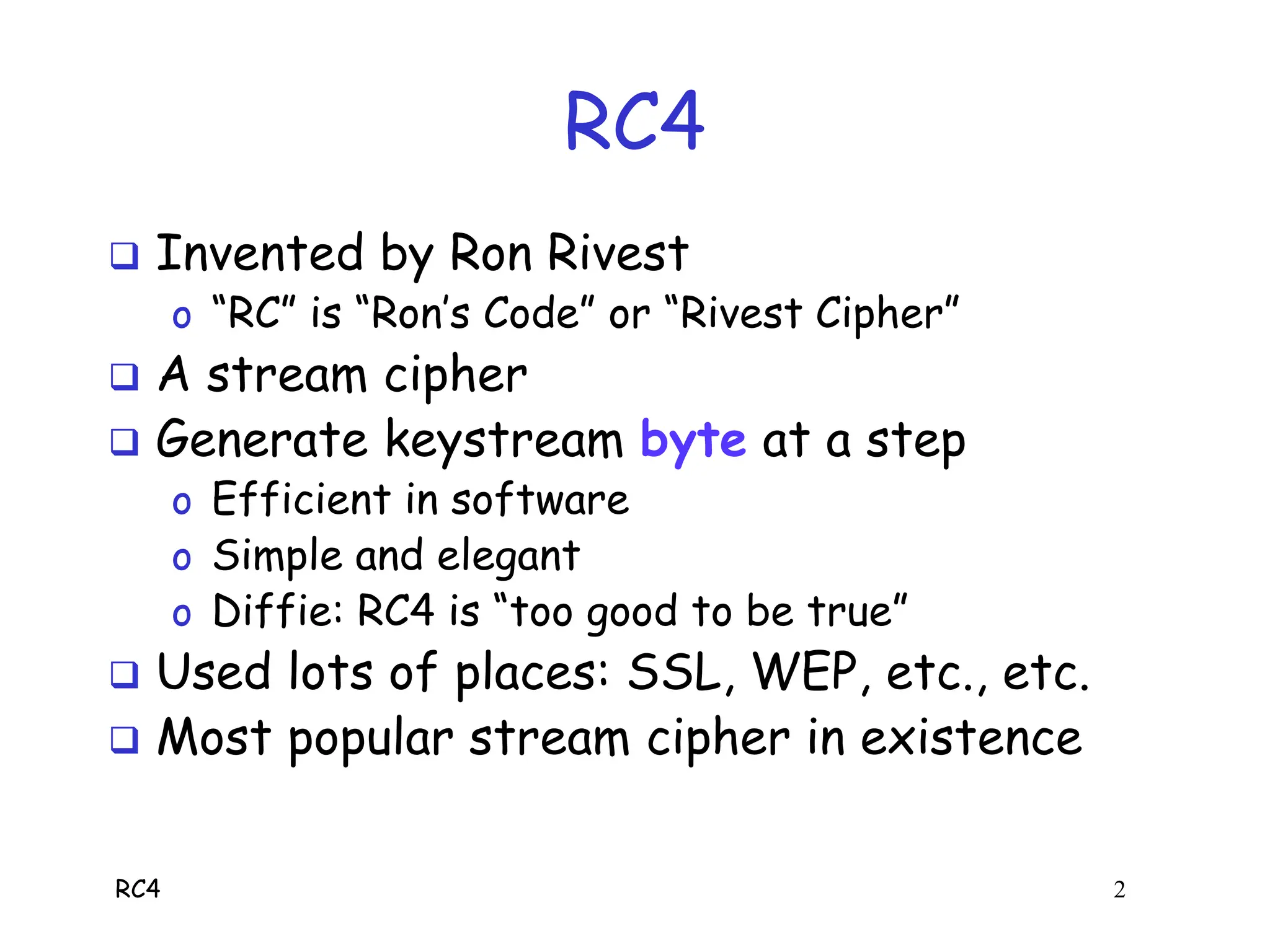
 Invented by Ron Rivest
o “RC” is “Ron’s Code” or “Rivest Cipher”
 A stream cipher
 Generate keystream byte at a step
o Efficient in software
o Simple and elegant
o Diffie: RC4 is “too good to be true”
 Used lots of places: SSL, WEP, etc., etc.
 Most popular stream cipher in existence
RC4 3
RC4 Initialization
 Array key contains N bytes of key
 Array S always has a permutation of 0,1,…,255
for i = 0 to 255
S[i] = i
K[i] = key[i (mod N)]
next i
j = 0
for i = 0 to 255
j = (j + S[i] + K[i]) (mod 256)
swap(S[i],S[j])
next i
i = j = 0
RC4 4
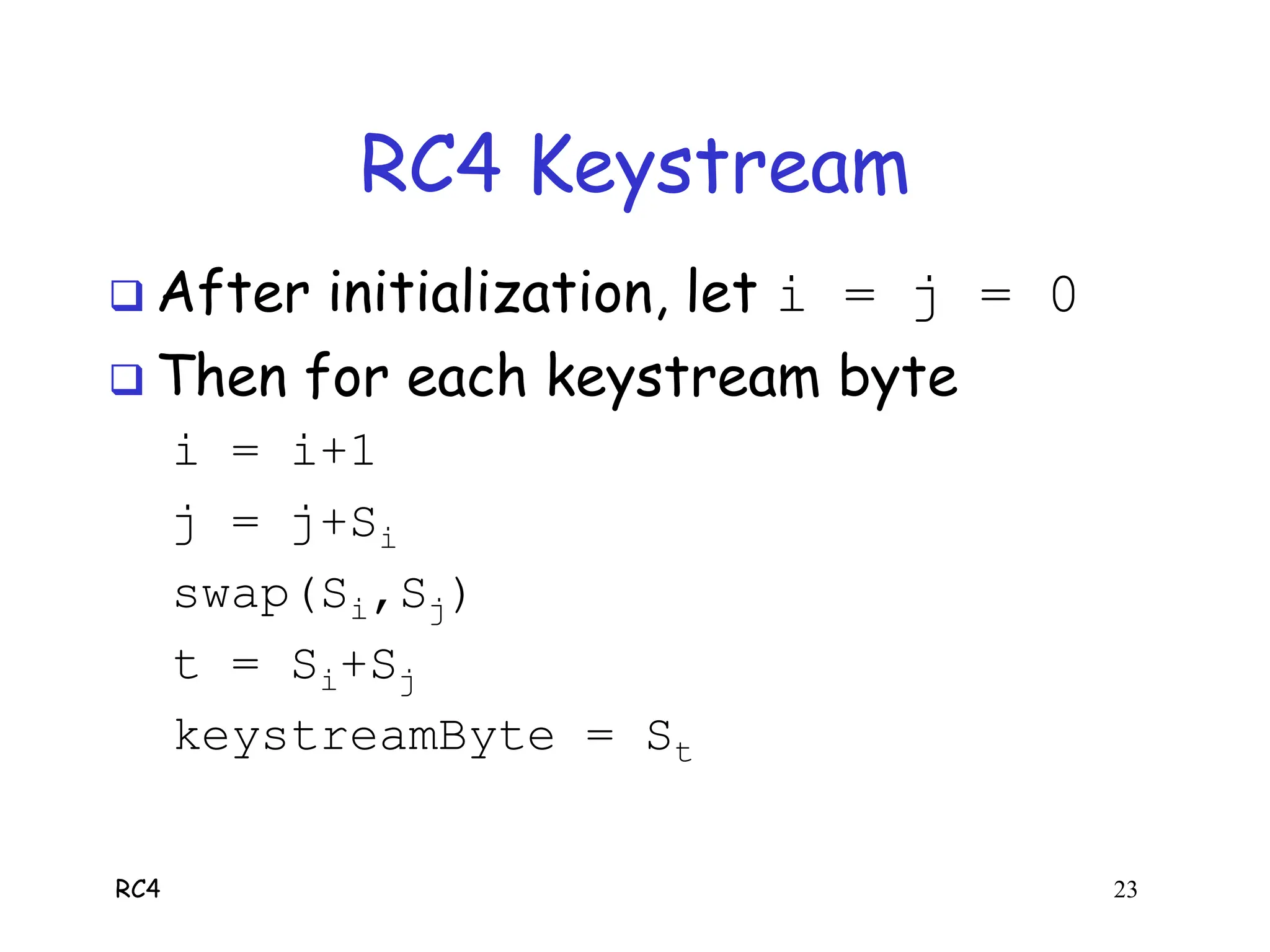
RC4 Keystream
 For each keystream byte, swap elements of
array S and select a byte from the array:
i = (i + 1) (mod 256)
j = (j + S[i]) (mod 256)
swap(S[i], S[j])
t = (S[i] + S[j]) (mod 256)
keystreamByte = S[t]
 Use keystream bytes like a one-time pad
o XOR to encrypt or decrypt
RC4 5
WEP
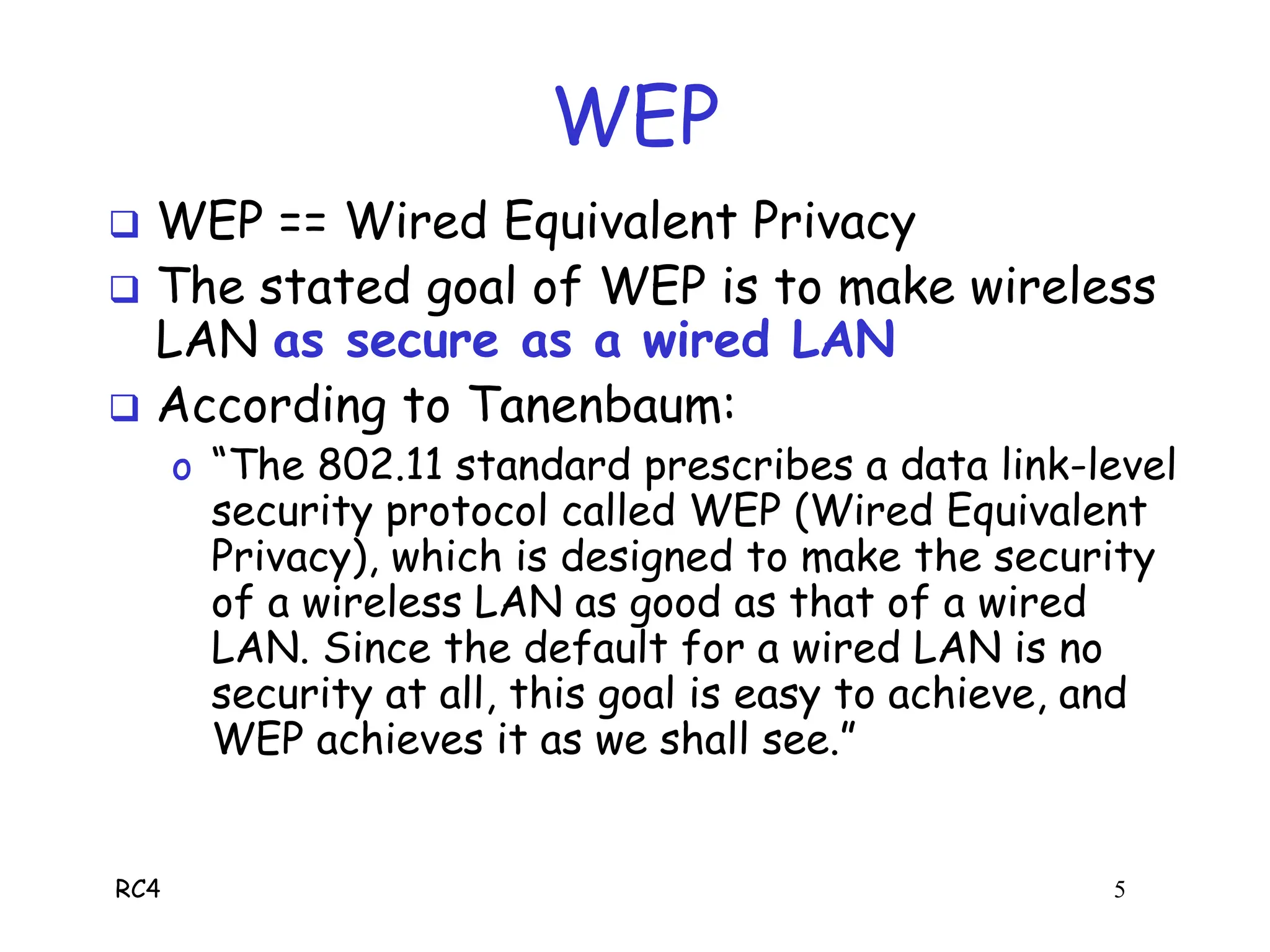
 WEP == Wired Equivalent Privacy
 The stated goal of WEP is to make wireless
LAN as secure as a wired LAN
 According to Tanenbaum:
o “The 802.11 standard prescribes a data link-level
security protocol called WEP (Wired Equivalent
Privacy), which is designed to make the security
of a wireless LAN as good as that of a wired
LAN. Since the default for a wired LAN is no
security at all, this goal is easy to achieve, and
WEP achieves it as we shall see.”
RC4 6
WEP
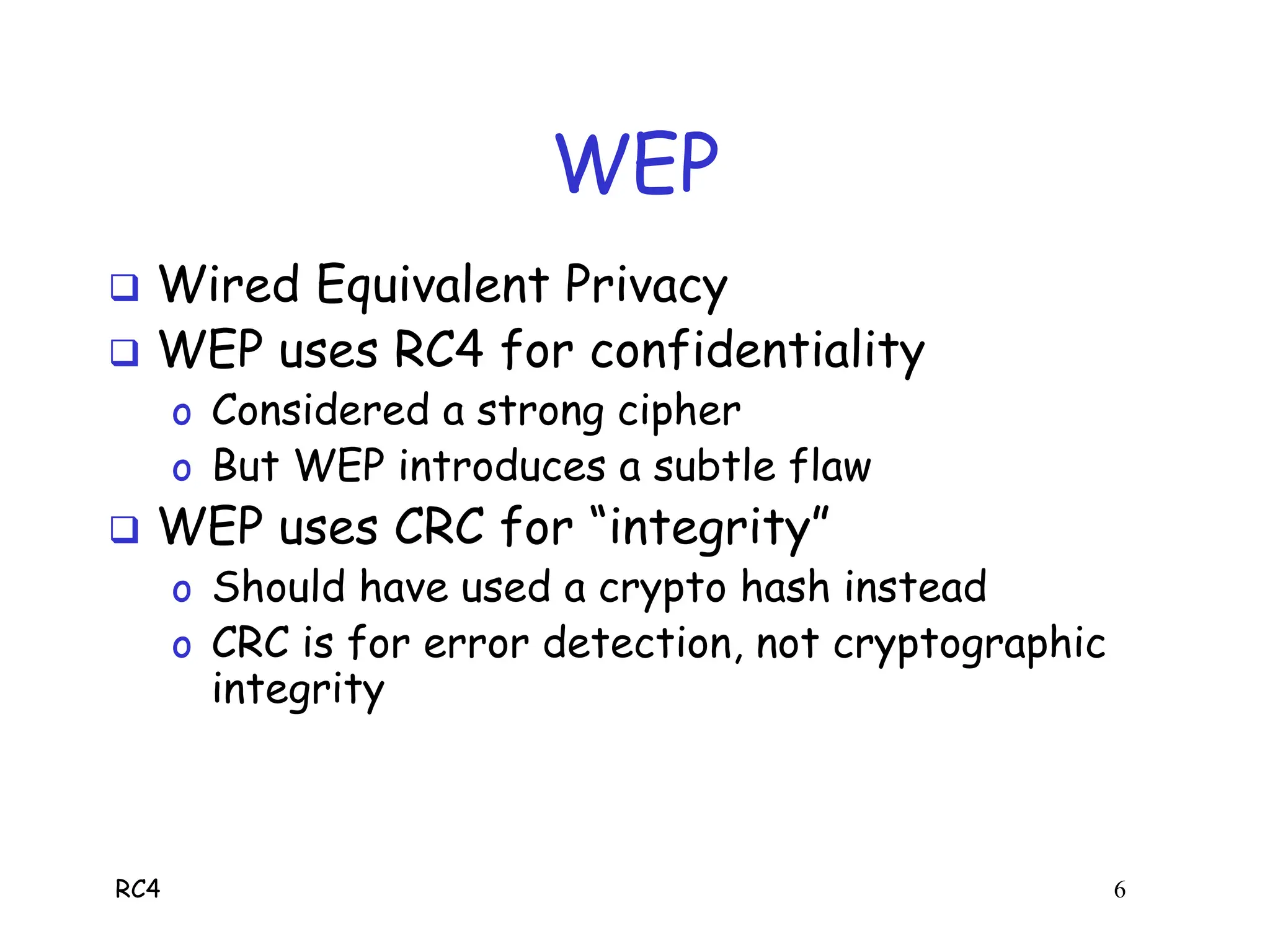
 Wired Equivalent Privacy
 WEP uses RC4 for confidentiality
o Considered a strong cipher
o But WEP introduces a subtle flaw
 WEP uses CRC for “integrity”
o Should have used a crypto hash instead
o CRC is for error detection, not cryptographic
integrity
RC4 7
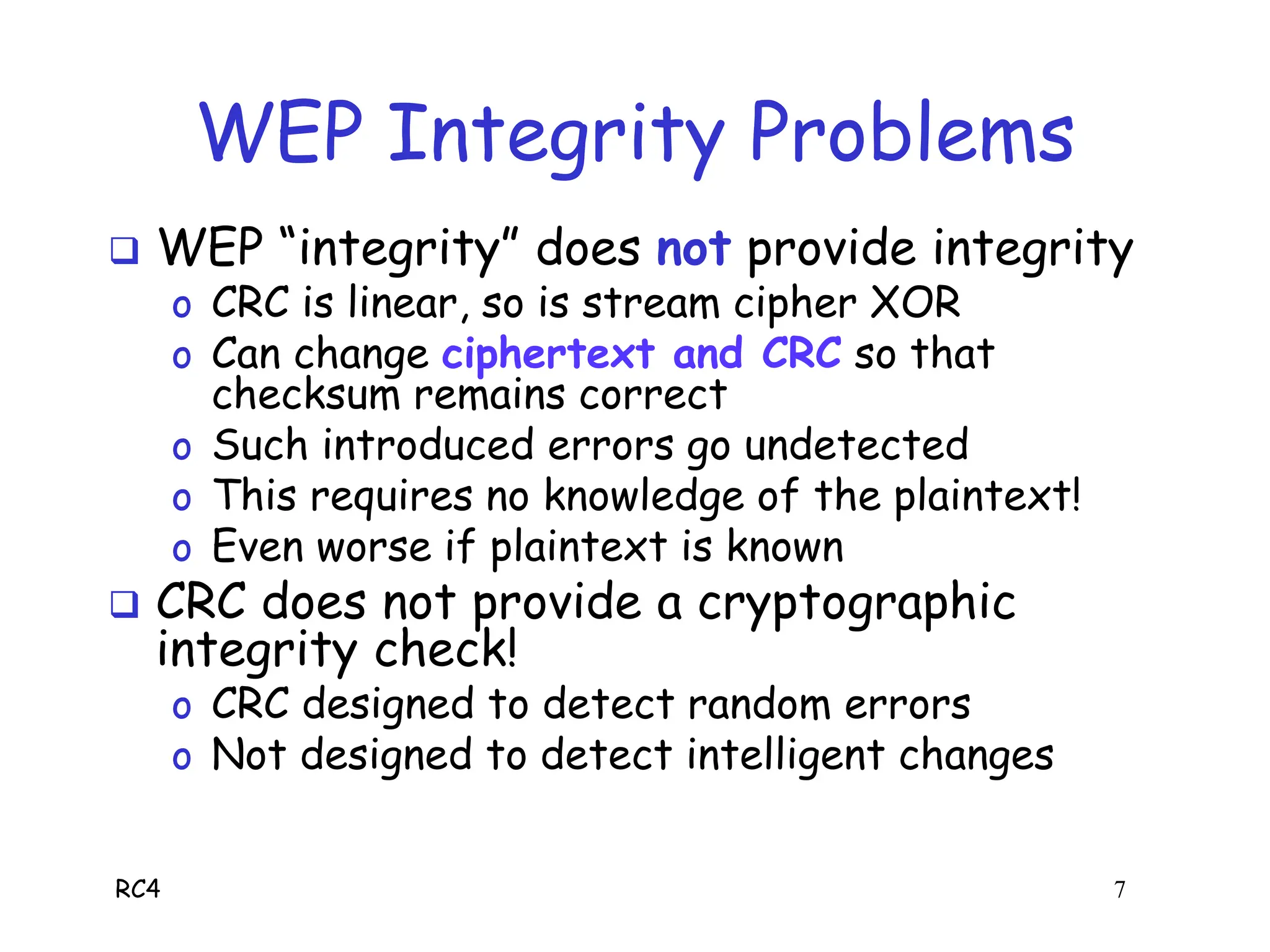
WEP Integrity Problems
 WEP “integrity” does not provide integrity
o CRC is linear, so is stream cipher XOR
o Can change ciphertext and CRC so that
checksum remains correct
o Such introduced errors go undetected
o This requires no knowledge of the plaintext!
o Even worse if plaintext is known
 CRC does not provide a cryptographic
integrity check!
o CRC designed to detect random errors
o Not designed to detect intelligent changes
RC4 8
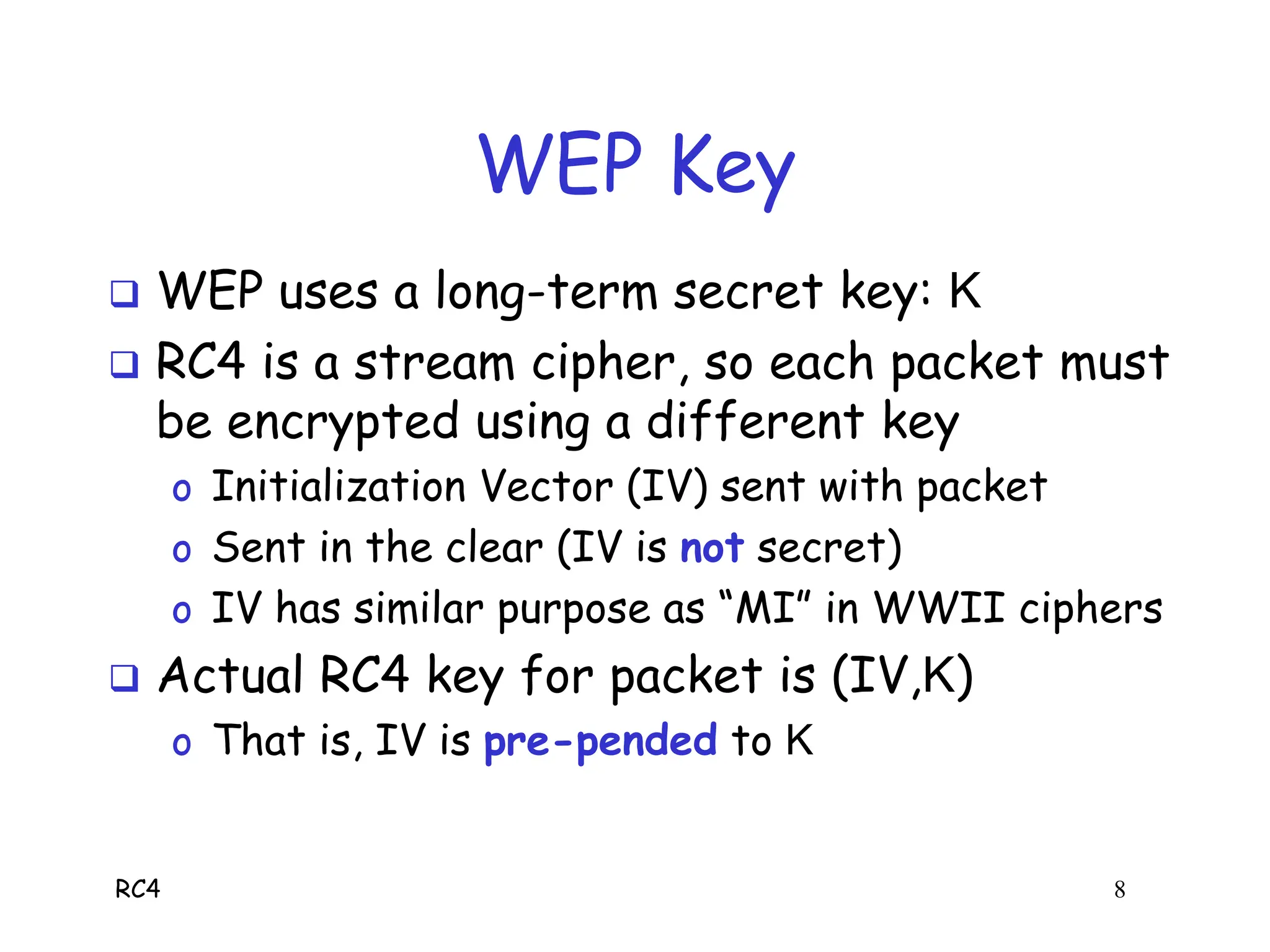
WEP Key
 WEP uses a long-term secret key: K
 RC4 is a stream cipher, so each packet must
be encrypted using a different key
o Initialization Vector (IV) sent with packet
o Sent in the clear (IV is not secret)
o IV has similar purpose as “MI” in WWII ciphers
 Actual RC4 key for packet is (IV,K)
o That is, IV is pre-pended to K
RC4 9
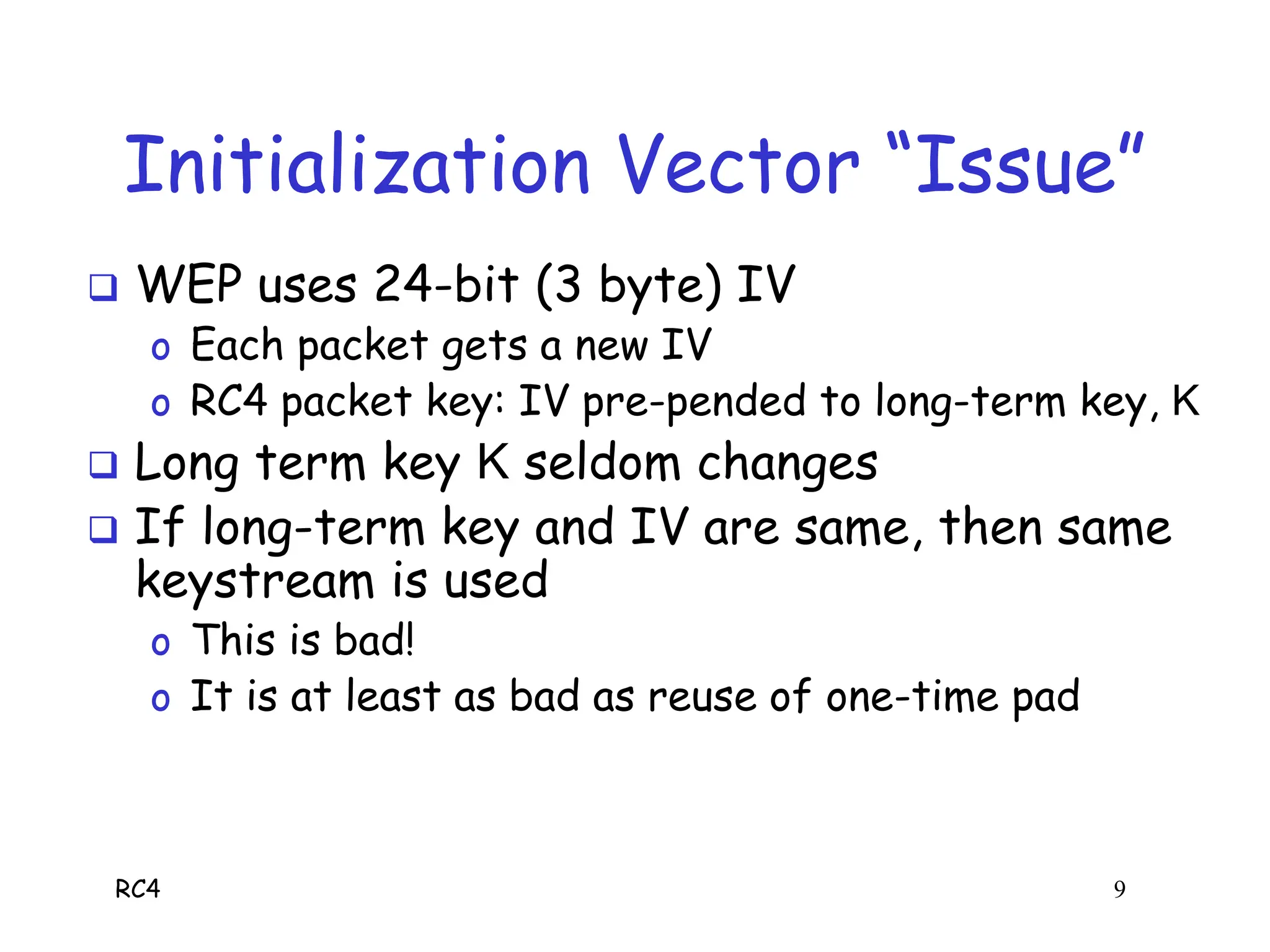
Initialization Vector “Issue”
 WEP uses 24-bit (3 byte) IV
o Each packet gets a new IV
o RC4 packet key: IV pre-pended to long-term key, K
 Long term key K seldom changes
 If long-term key and IV are same, then same
keystream is used
o This is bad!
o It is at least as bad as reuse of one-time pad
RC4 10
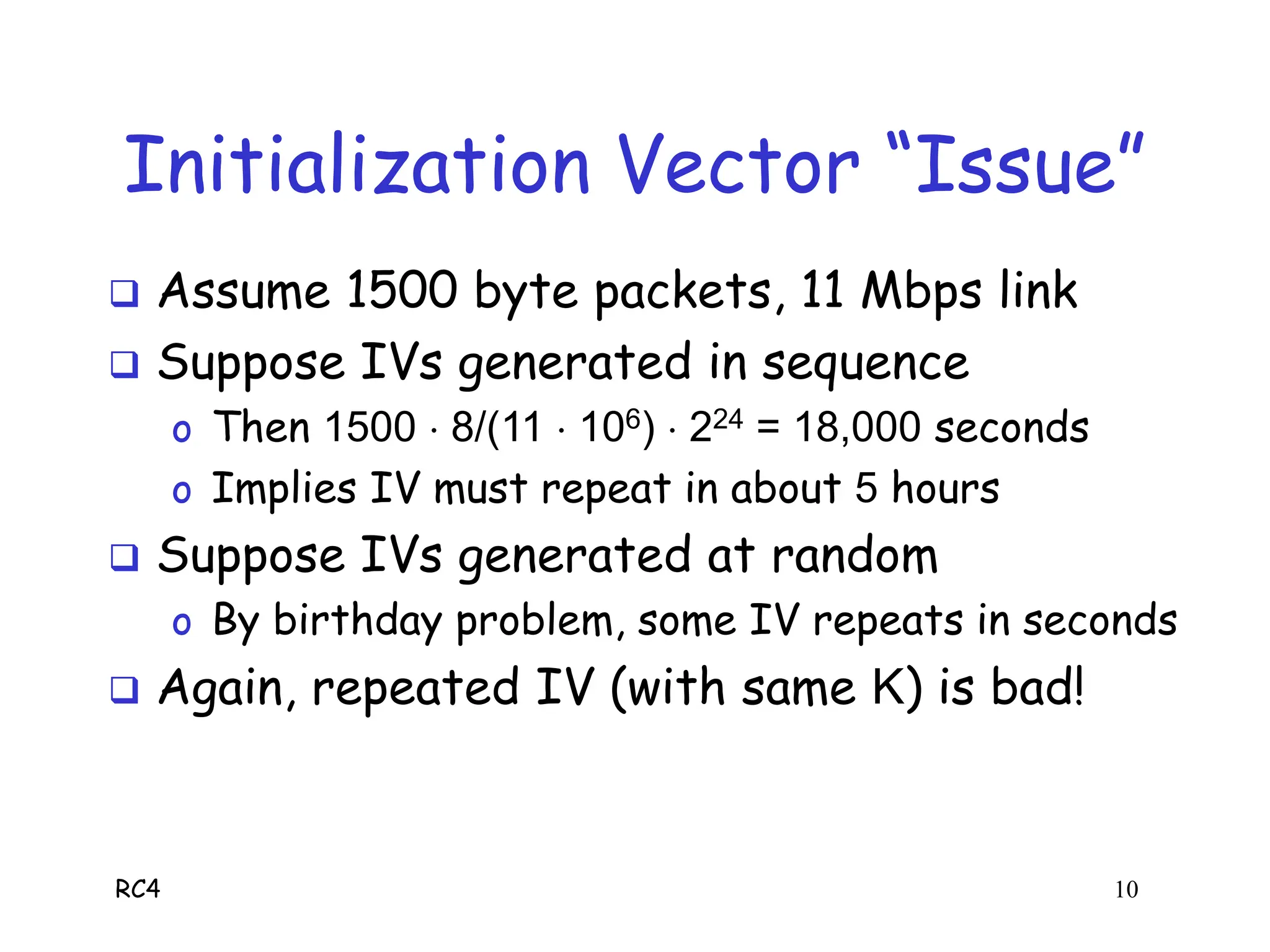
Initialization Vector “Issue”
 Assume 1500 byte packets, 11 Mbps link
 Suppose IVs generated in sequence
o Then 1500  8/(11  106)  224 = 18,000 seconds
o Implies IV must repeat in about 5 hours
 Suppose IVs generated at random
o By birthday problem, some IV repeats in seconds
 Again, repeated IV (with same K) is bad!
RC4 11
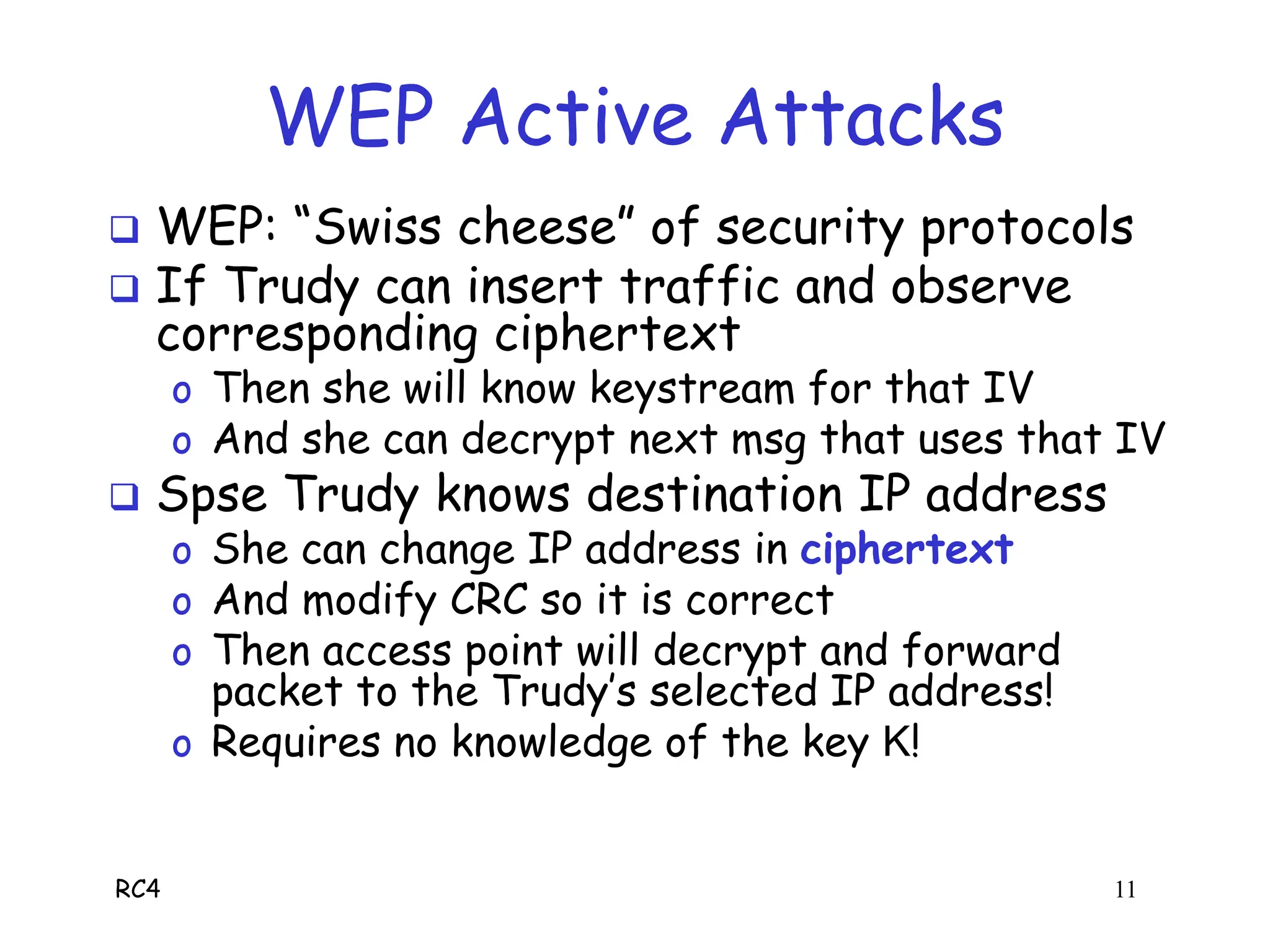
WEP Active Attacks
 WEP: “Swiss cheese” of security protocols
 If Trudy can insert traffic and observe
corresponding ciphertext
o Then she will know keystream for that IV
o And she can decrypt next msg that uses that IV
 Spse Trudy knows destination IP address
o She can change IP address in ciphertext
o And modify CRC so it is correct
o Then access point will decrypt and forward
packet to the Trudy’s selected IP address!
o Requires no knowledge of the key K!
RC4 12
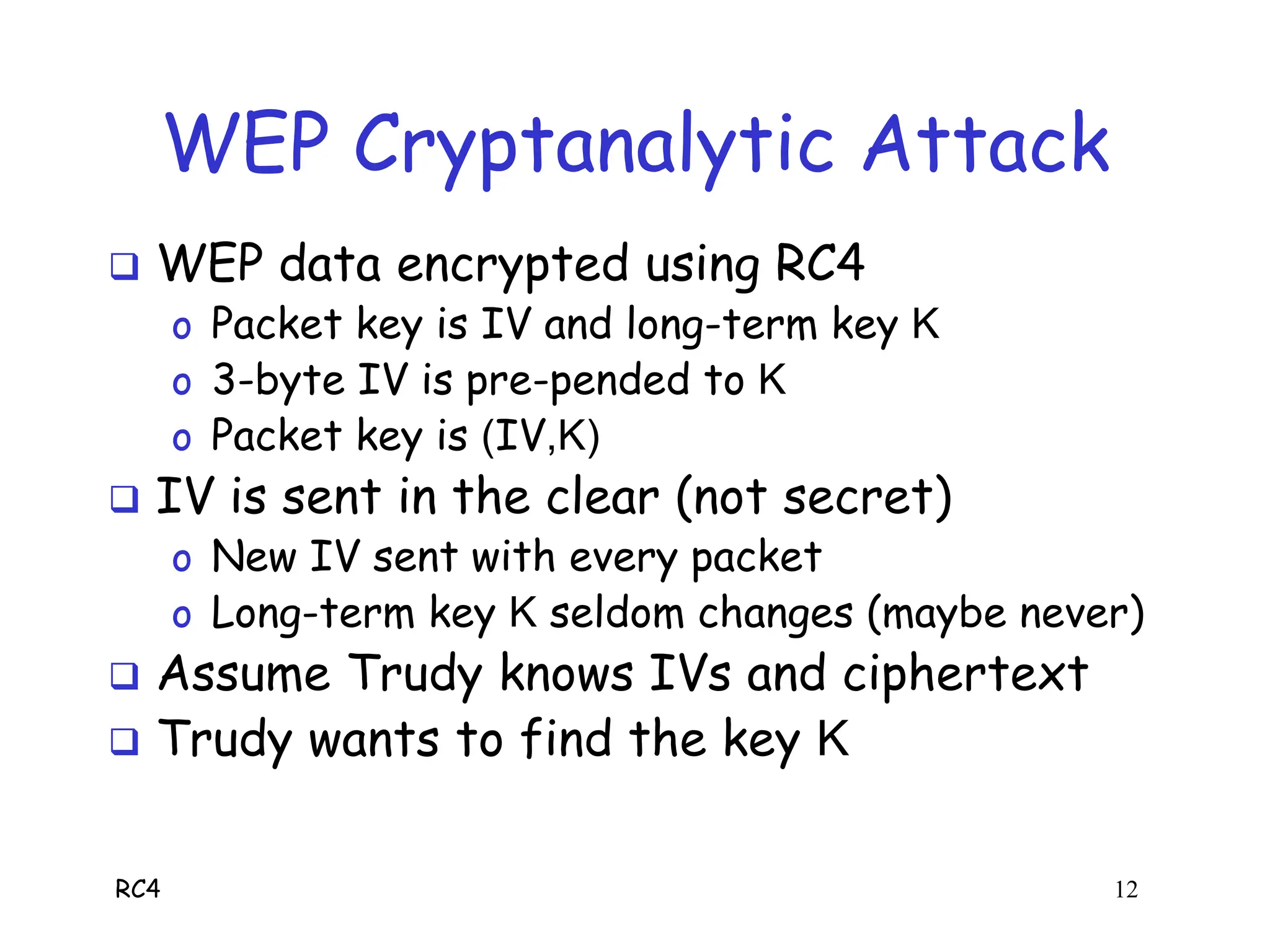
WEP Cryptanalytic Attack
 WEP data encrypted using RC4
o Packet key is IV and long-term key K
o 3-byte IV is pre-pended to K
o Packet key is (IV,K)
 IV is sent in the clear (not secret)
o New IV sent with every packet
o Long-term key K seldom changes (maybe never)
 Assume Trudy knows IVs and ciphertext
 Trudy wants to find the key K
RC4 13
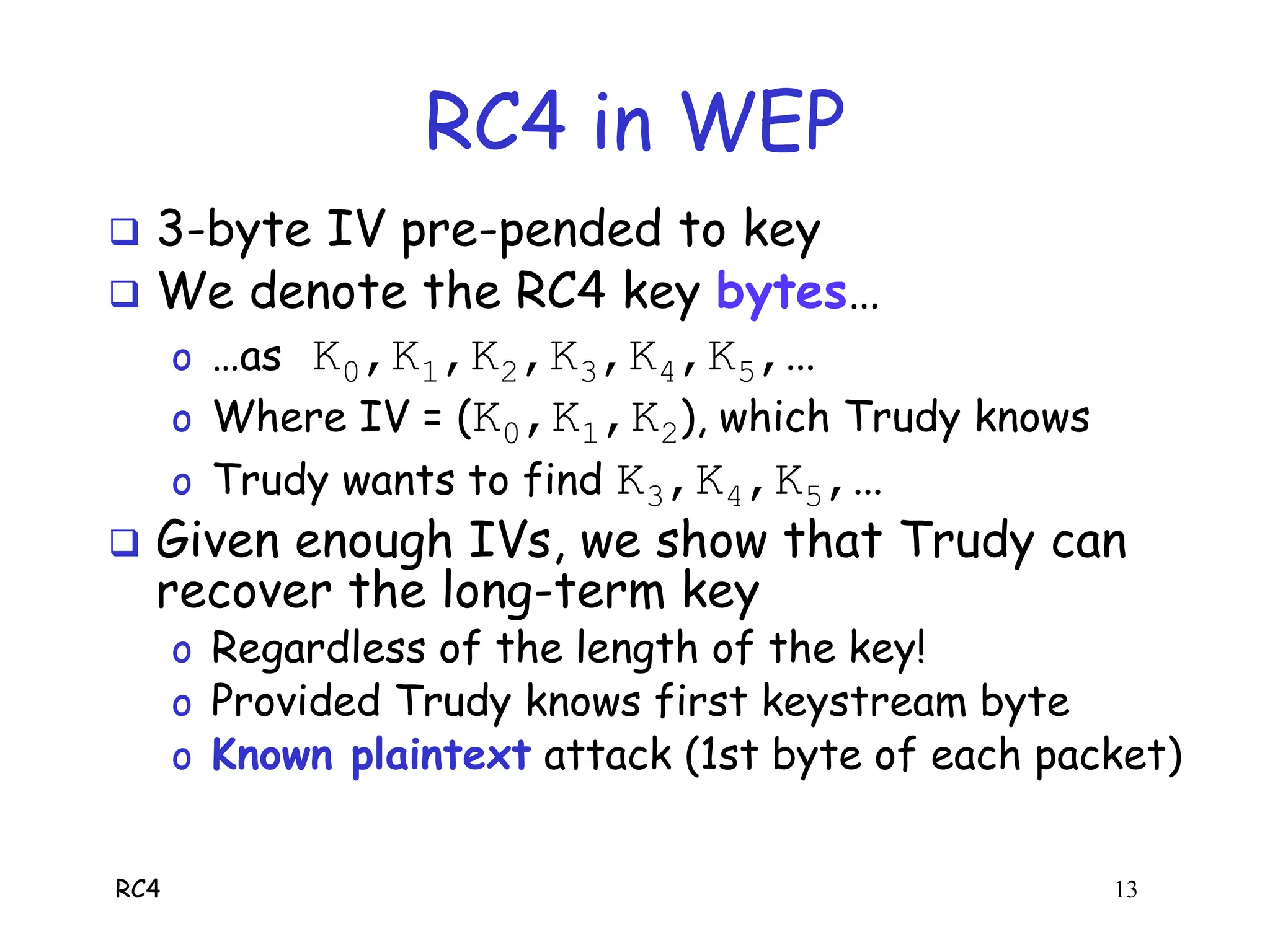
RC4 in WEP
 3-byte IV pre-pended to key
 We denote the RC4 key bytes…
o …as K0,K1,K2,K3,K4,K5,…
o Where IV = (K0,K1,K2), which Trudy knows
o Trudy wants to find K3,K4,K5,…
 Given enough IVs, we show that Trudy can
recover the long-term key
o Regardless of the length of the key!
o Provided Trudy knows first keystream byte
o Known plaintext attack (1st byte of each packet)
RC4 14
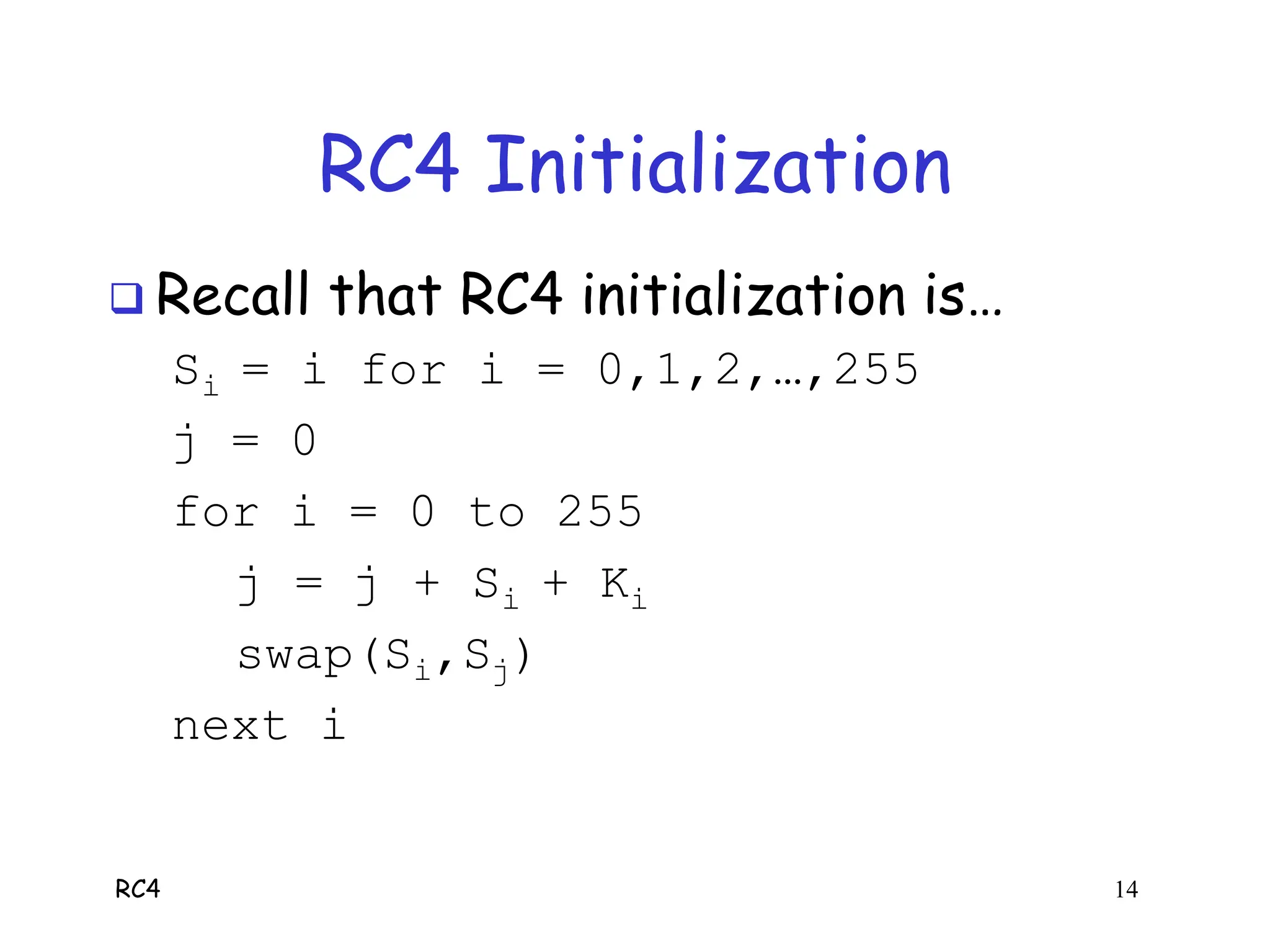
RC4 Initialization
 Recall that RC4 initialization is…
Si = i for i = 0,1,2,…,255
j = 0
for i = 0 to 255
j = j + Si + Ki
swap(Si,Sj)
next i
RC4 15
RC4/WEP Attack
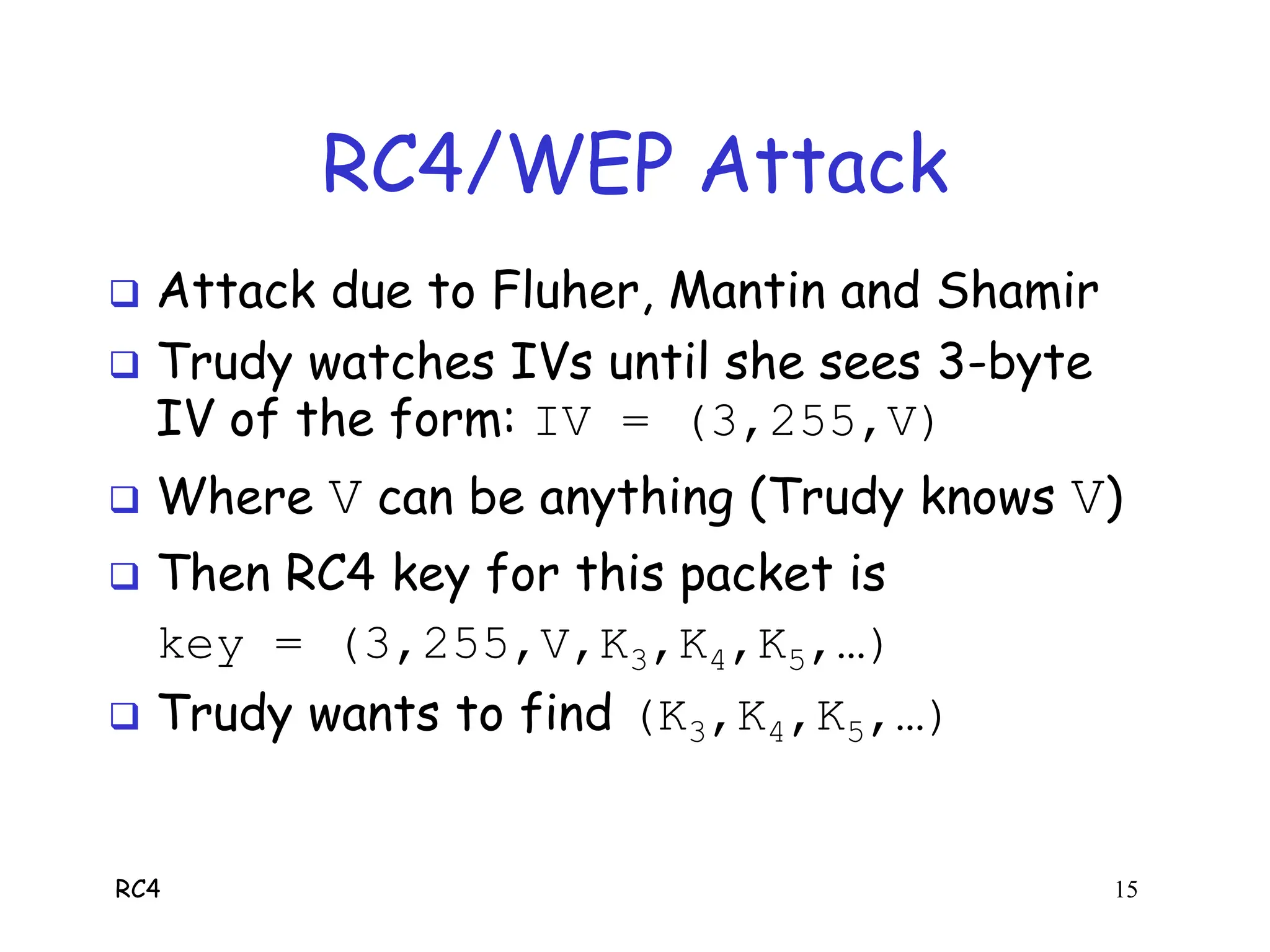
 Attack due to Fluher, Mantin and Shamir
 Trudy watches IVs until she sees 3-byte
IV of the form: IV = (3,255,V)
 Where V can be anything (Trudy knows V)
 Then RC4 key for this packet is
key = (3,255,V,K3,K4,K5,…)
 Trudy wants to find (K3,K4,K5,…)
RC4 16
RC4/WEP Attack
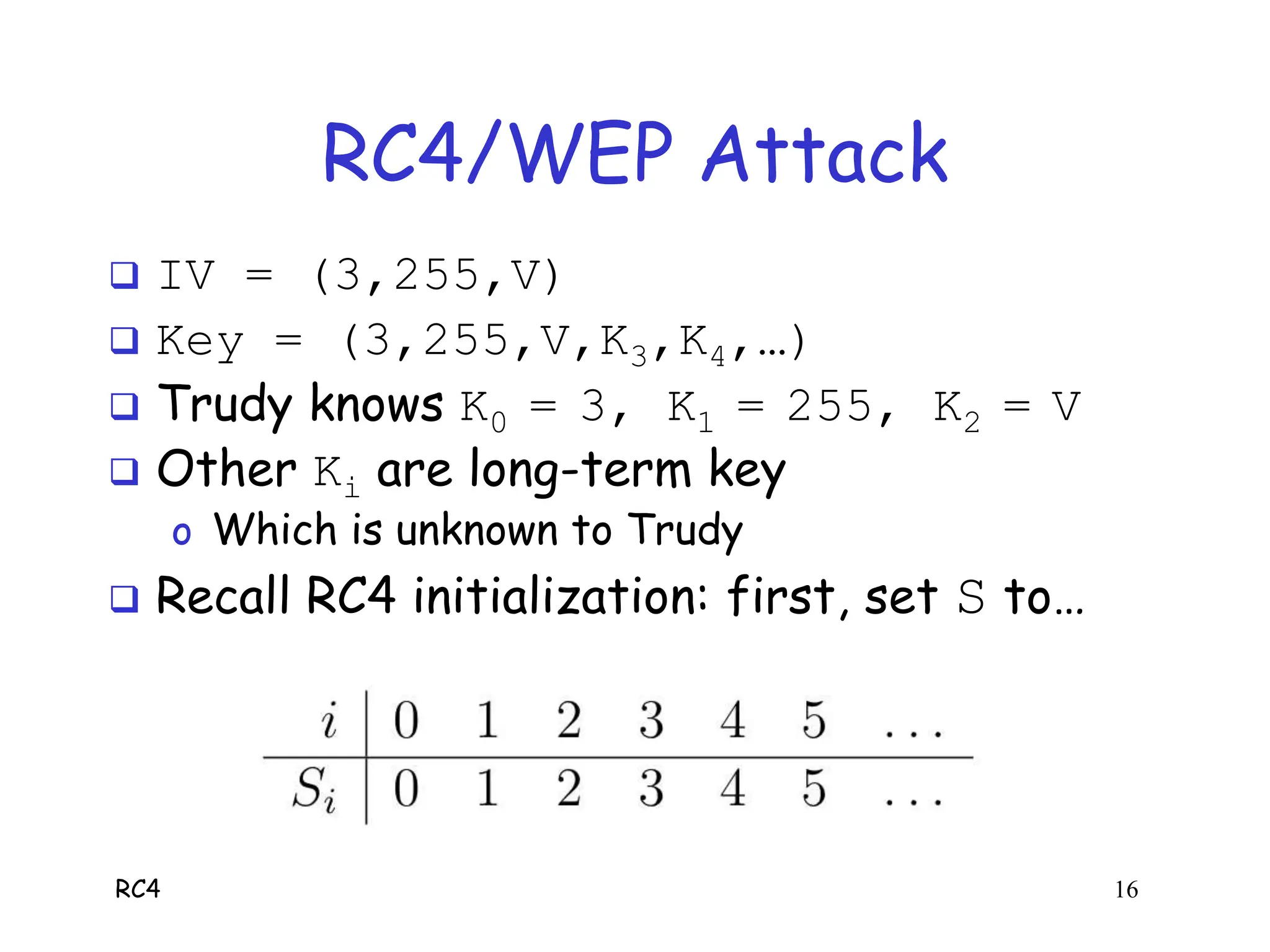
 IV = (3,255,V)
 Key = (3,255,V,K3,K4,…)
 Trudy knows K0 = 3, K1 = 255, K2 = V
 Other Ki are long-term key
o Which is unknown to Trudy
 Recall RC4 initialization: first, set S to…
RC4 17
RC4/WEP Attack
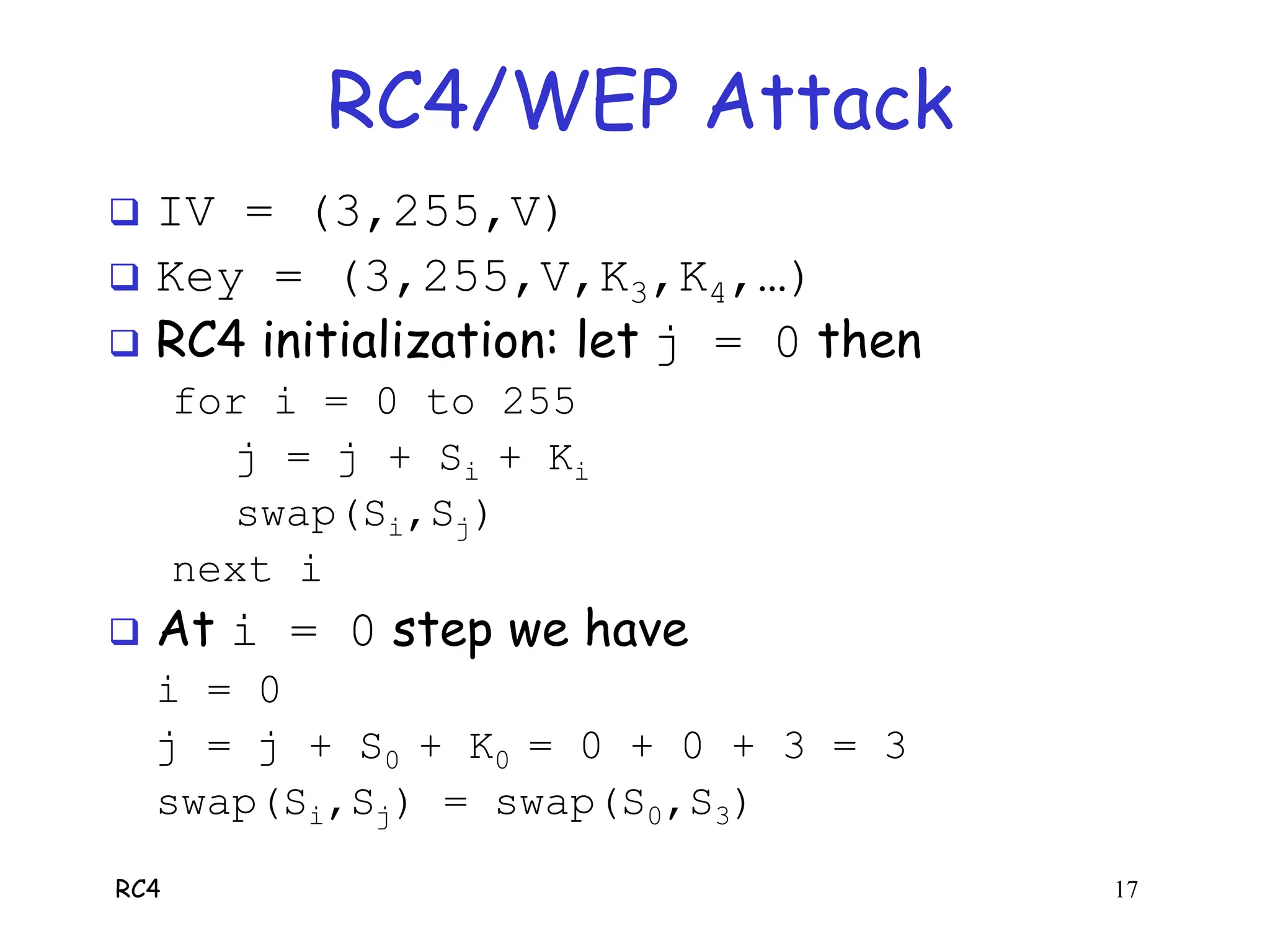
 IV = (3,255,V)
 Key = (3,255,V,K3,K4,…)
 RC4 initialization: let j = 0 then
for i = 0 to 255
j = j + Si + Ki
swap(Si,Sj)
next i
 At i = 0 step we have
i = 0
j = j + S0 + K0 = 0 + 0 + 3 = 3
swap(Si,Sj) = swap(S0,S3)
RC4 18
RC4/WEP Attack
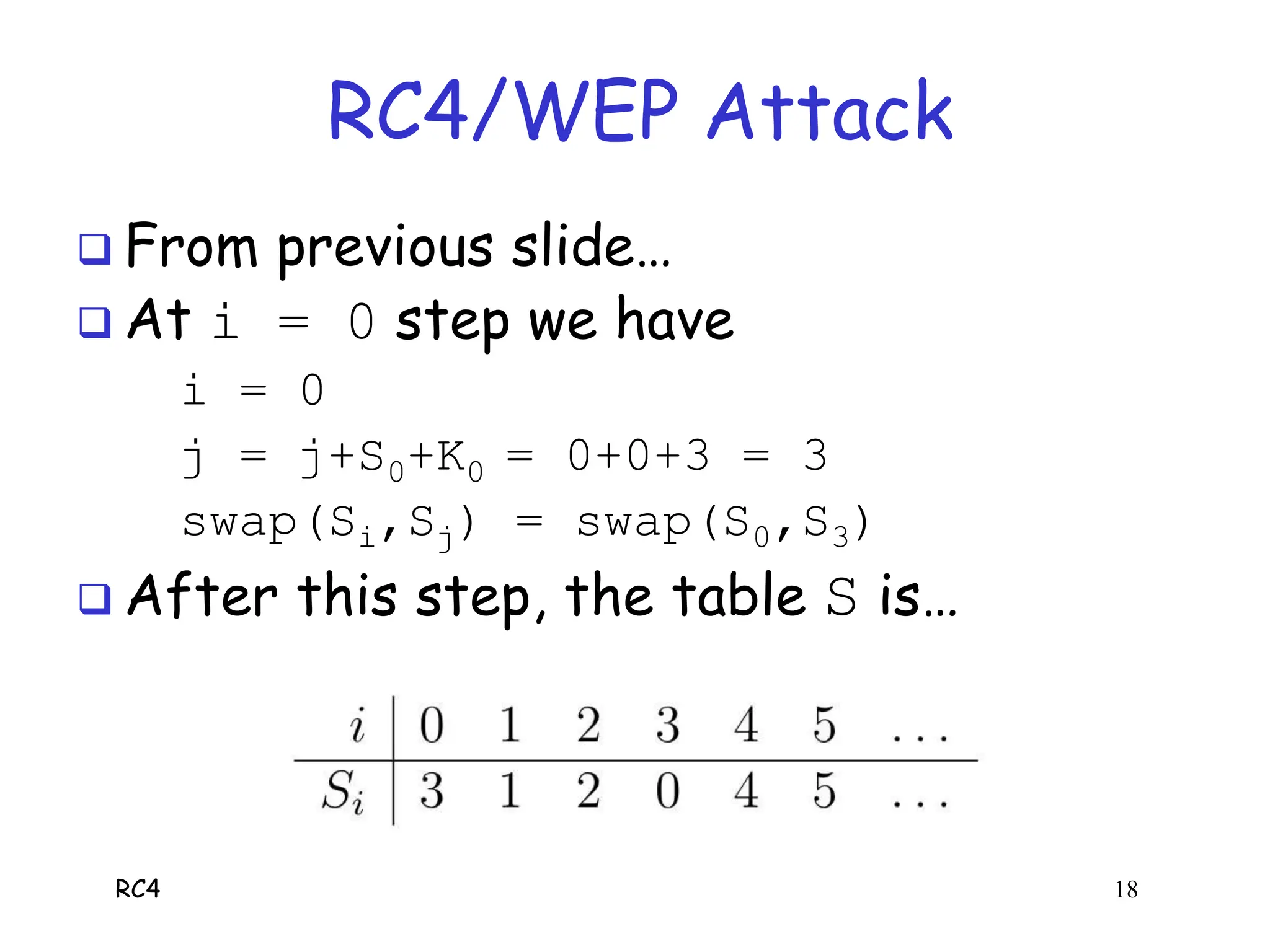
 From previous slide…
 At i = 0 step we have
i = 0
j = j+S0+K0 = 0+0+3 = 3
swap(Si,Sj) = swap(S0,S3)
 After this step, the table S is…
RC4 19
RC4/WEP Attack
 IV = (3,255,V)
 Key = (3,255,V,K3,K4,…)
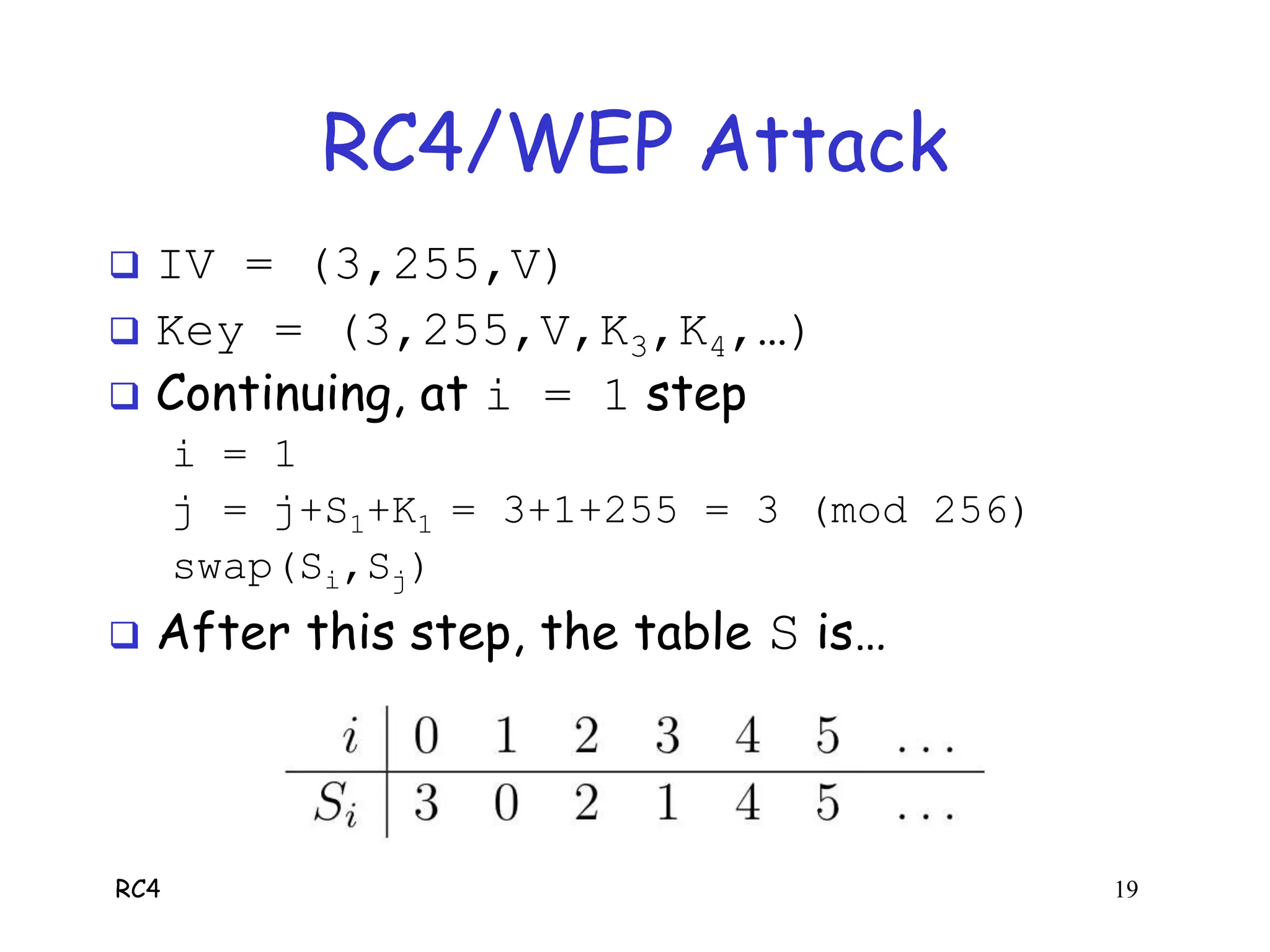
 Continuing, at i = 1 step
i = 1
j = j+S1+K1 = 3+1+255 = 3 (mod 256)
swap(Si,Sj)
 After this step, the table S is…
RC4 20
RC4/WEP Attack
 IV = (3,255,V)
 Key = (3,255,V,K3,K4,…)
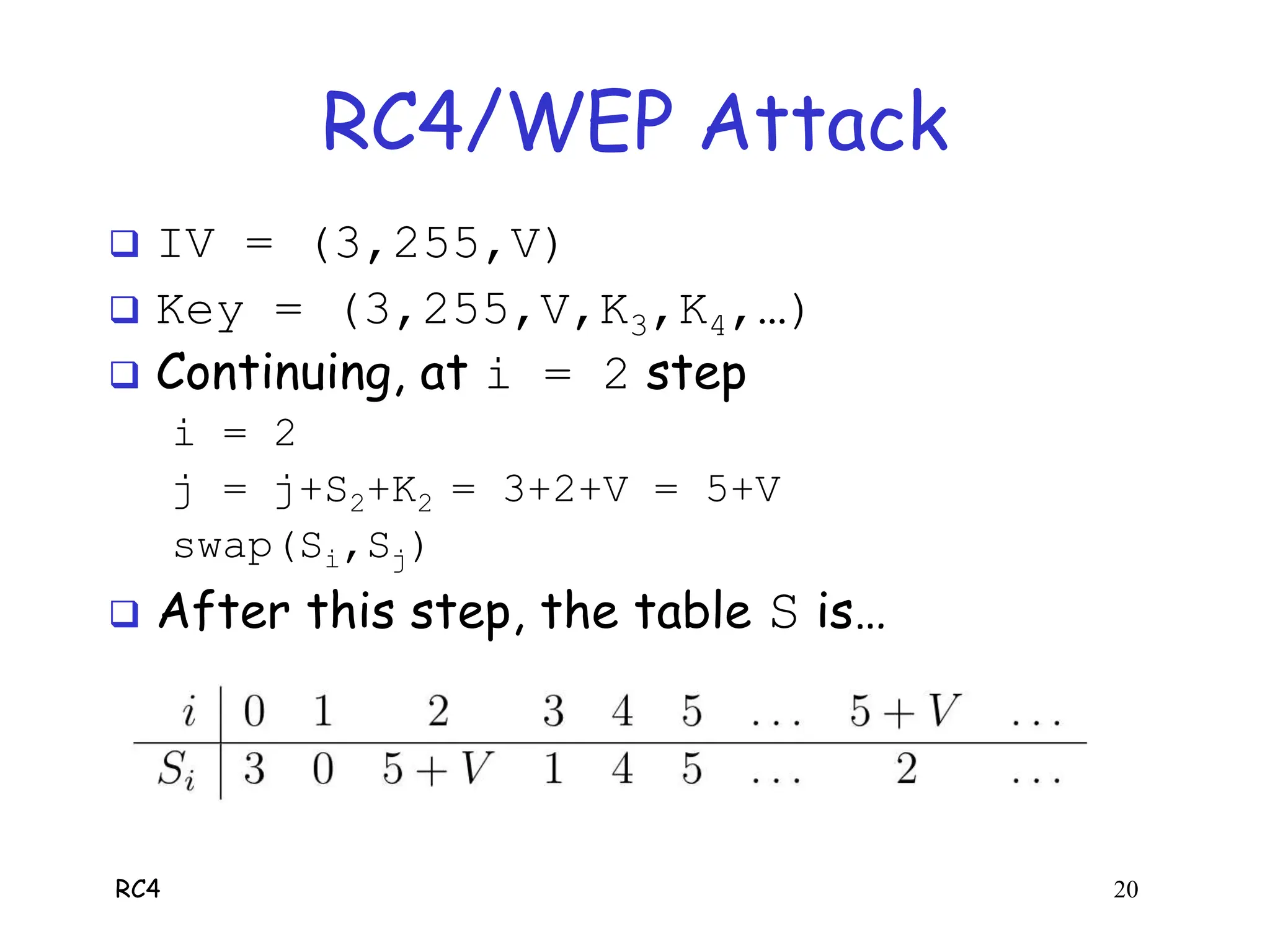
 Continuing, at i = 2 step
i = 2
j = j+S2+K2 = 3+2+V = 5+V
swap(Si,Sj)
 After this step, the table S is…
RC4 21
RC4/WEP Attack
 IV = (3,255,V)
 Key = (3,255,V,K3,K4,…)
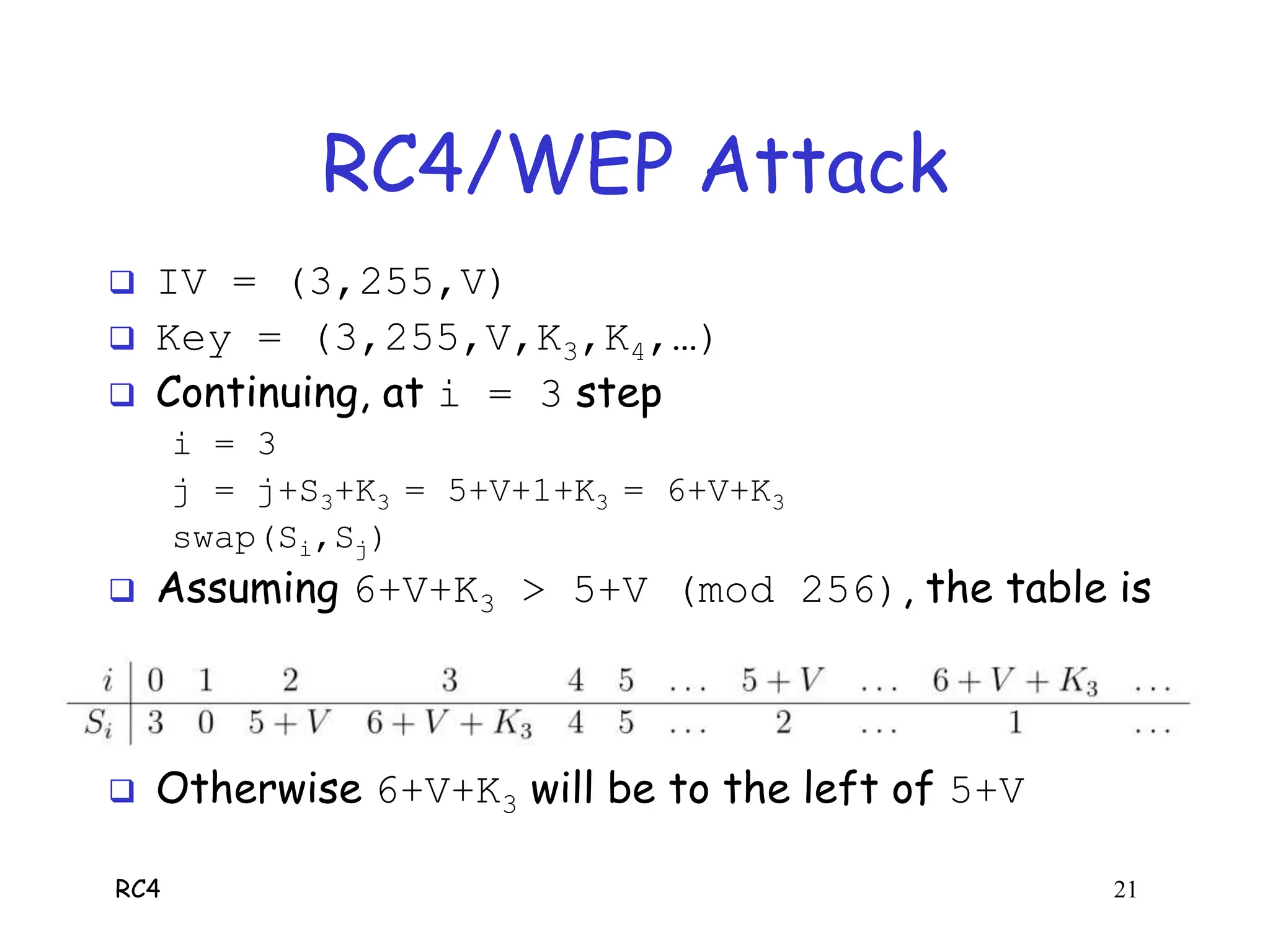
 Continuing, at i = 3 step
i = 3
j = j+S3+K3 = 5+V+1+K3 = 6+V+K3
swap(Si,Sj)
 Assuming 6+V+K3 > 5+V (mod 256), the table is
 Otherwise 6+V+K3 will be to the left of 5+V
RC4 22
RC4 Initialization
 Note that we have only considered the first
4 steps of initialization, i = 0,1,2,3
o In reality, there are 256 steps
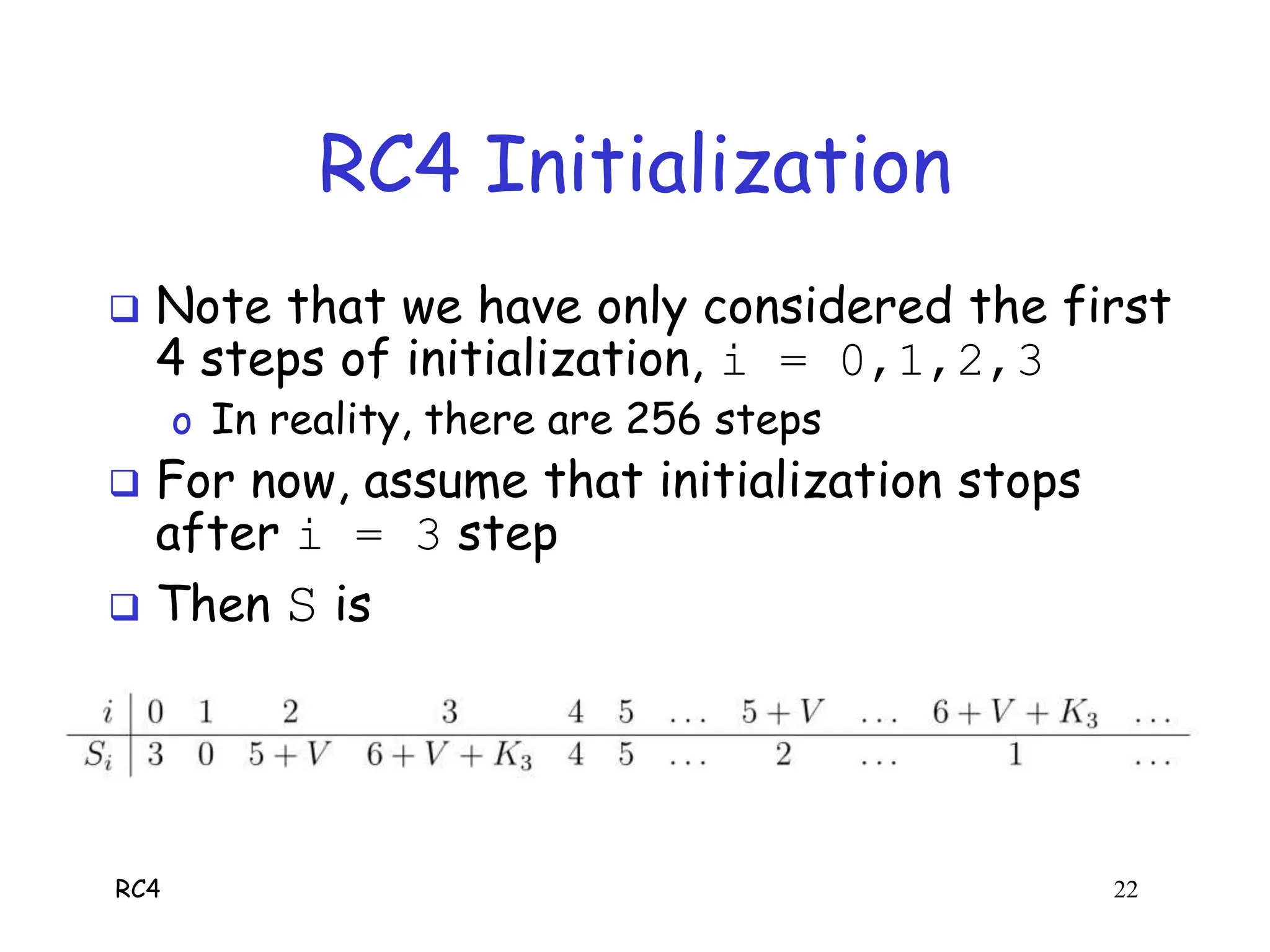
 For now, assume that initialization stops
after i = 3 step
 Then S is
 Next, we consider RC4 keystream algorithm
RC4 23
RC4 Keystream
 After initialization, let i = j = 0
 Then for each keystream byte
i = i+1
j = j+Si
swap(Si,Sj)
t = Si+Sj
keystreamByte = St
RC4 24
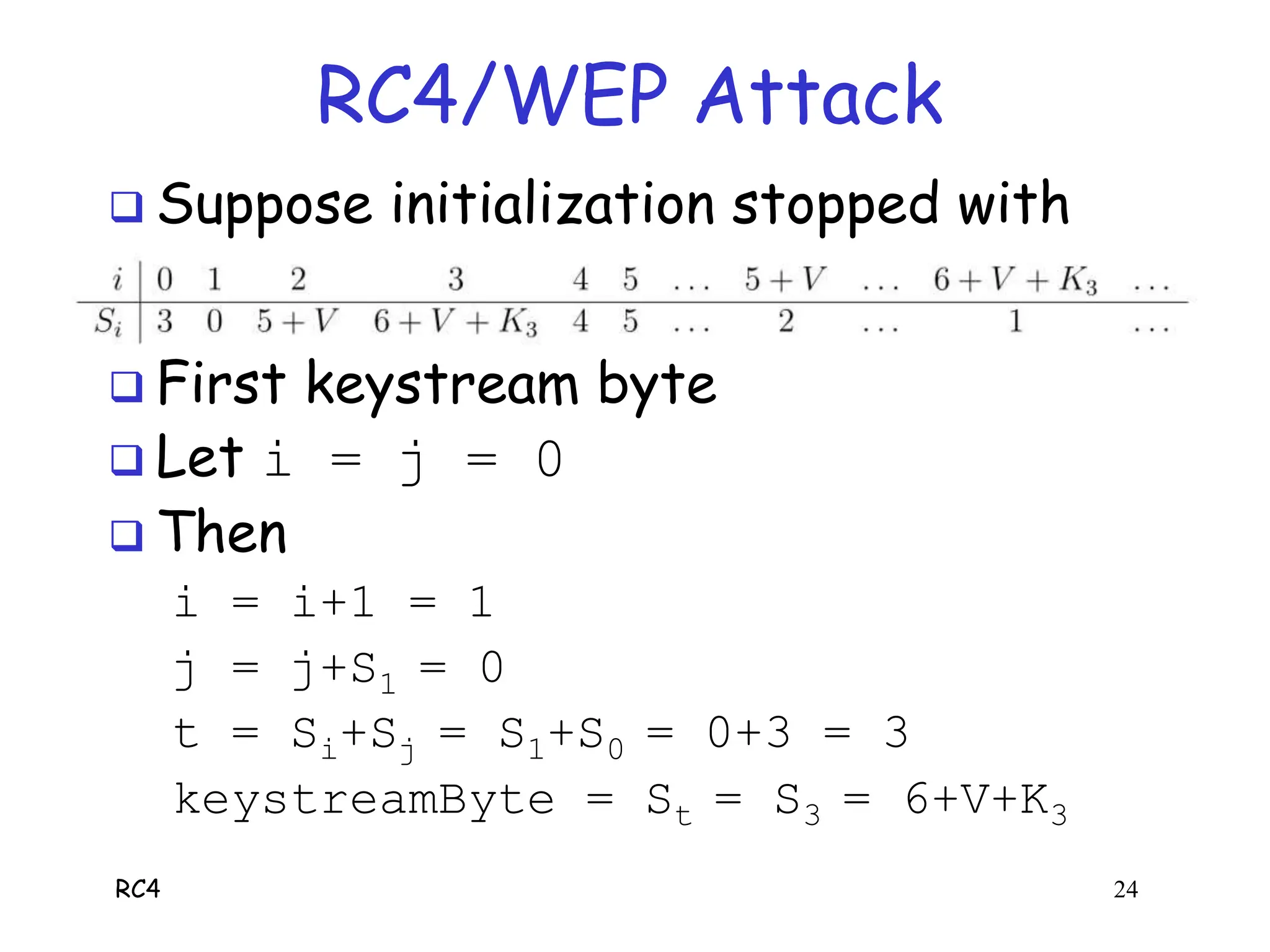
RC4/WEP Attack
 Suppose initialization stopped with
 First keystream byte
 Let i = j = 0
 Then
i = i+1 = 1
j = j+S1 = 0
t = Si+Sj = S1+S0 = 0+3 = 3
keystreamByte = St = S3 = 6+V+K3
RC4 25
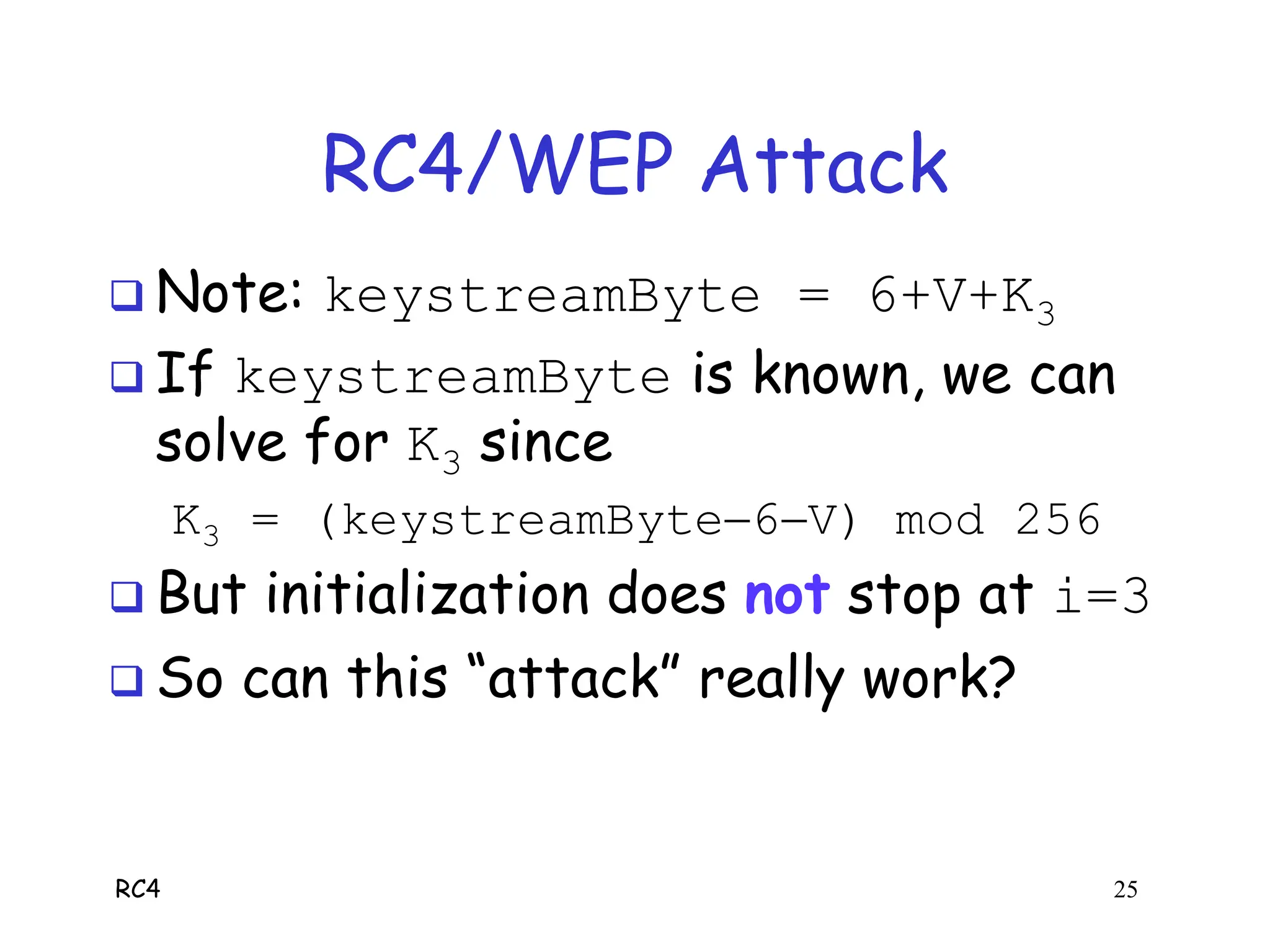
RC4/WEP Attack
 Note: keystreamByte = 6+V+K3
 If keystreamByte is known, we can
solve for K3 since
K3 = (keystreamByte6V) mod 256
 But initialization does not stop at i=3
 So can this “attack” really work?
RC4 26
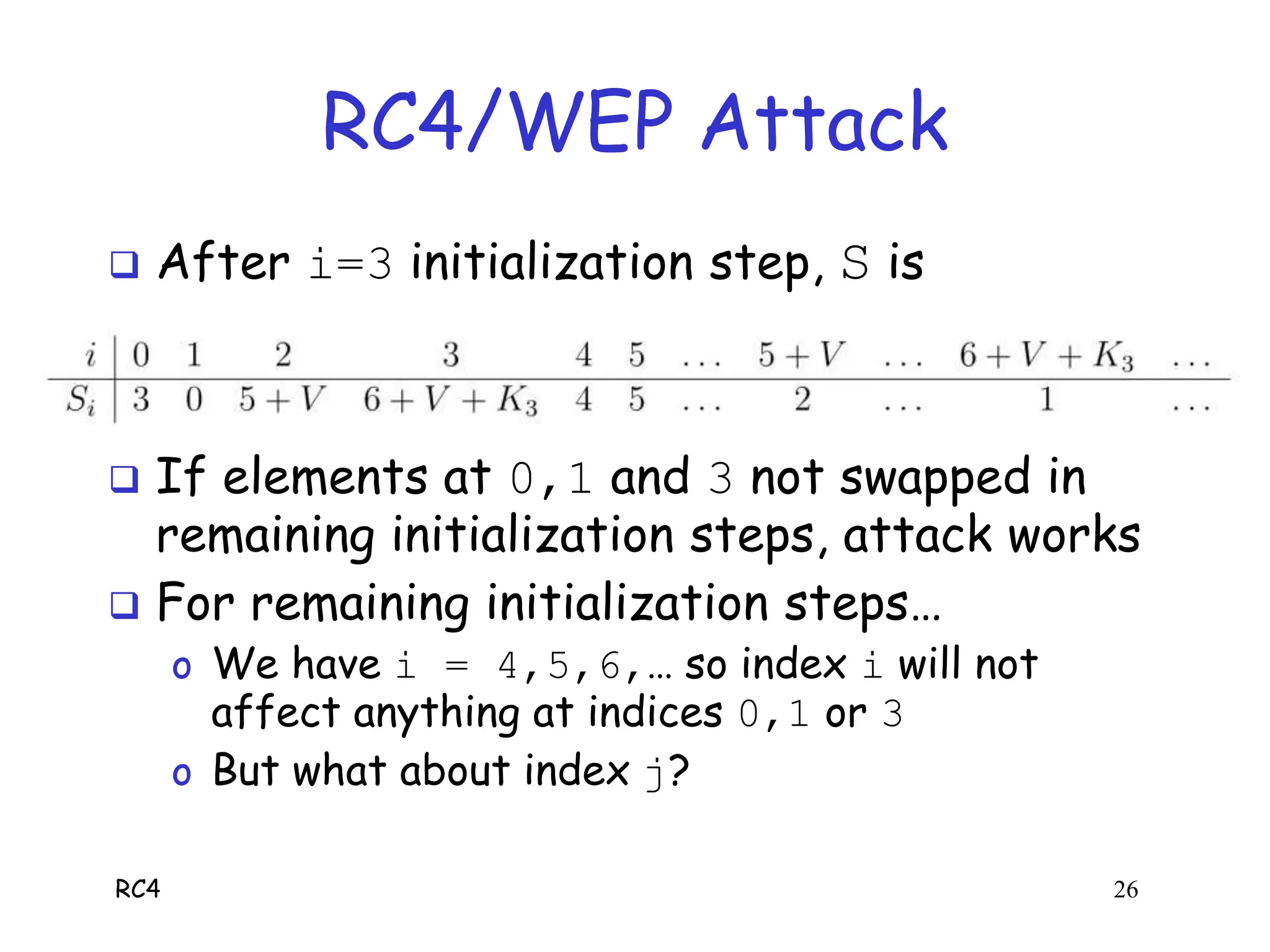
RC4/WEP Attack
 After i=3 initialization step, S is
 If elements at 0,1 and 3 not swapped in
remaining initialization steps, attack works
 For remaining initialization steps…
o We have i = 4,5,6,… so index i will not
affect anything at indices 0,1 or 3
o But what about index j?
RC4 27
RC4/WEP Attack
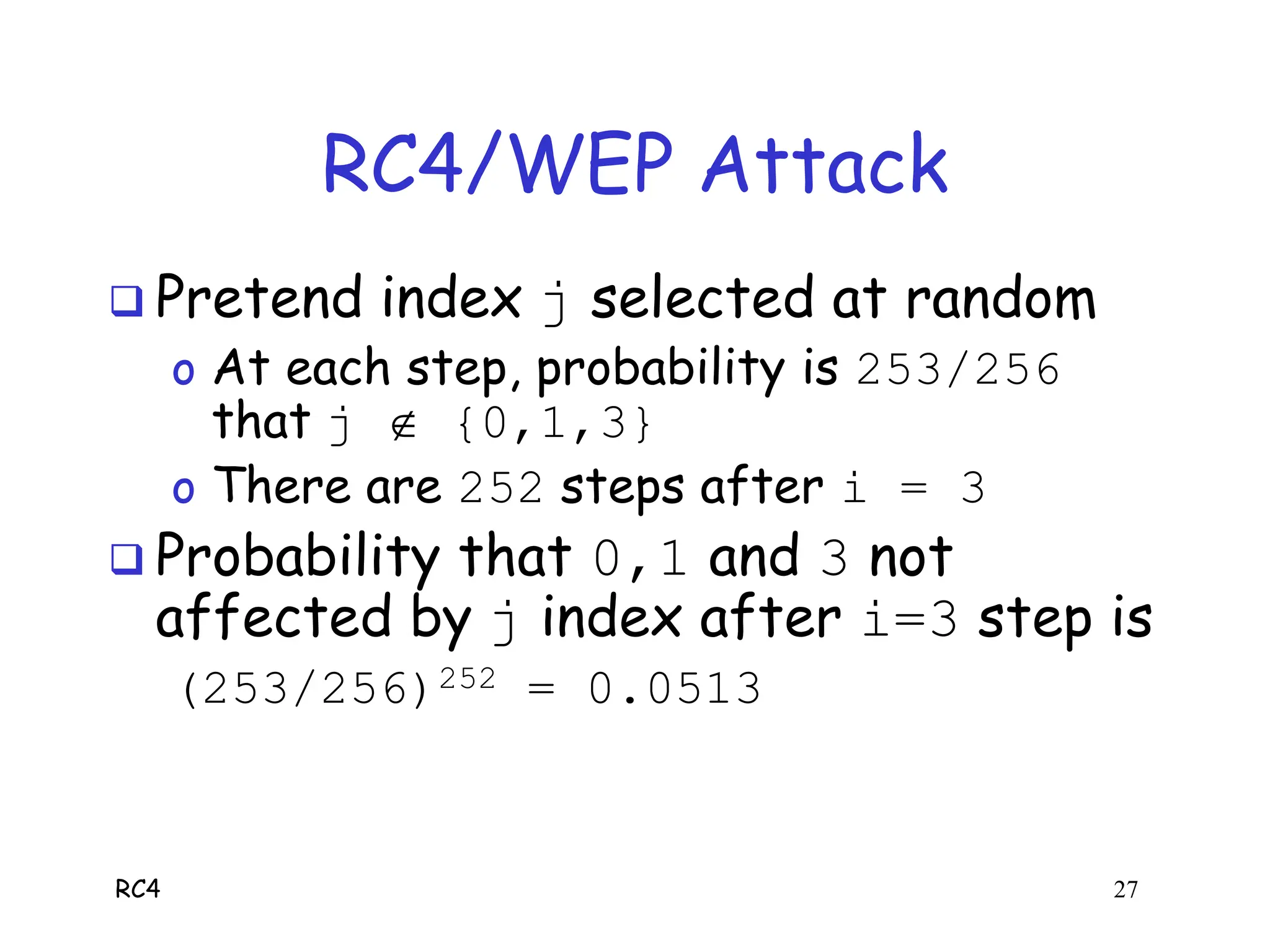
 Pretend index j selected at random
o At each step, probability is 253/256
that j  {0,1,3}
o There are 252 steps after i = 3
 Probability that 0,1 and 3 not
affected by j index after i=3 step is
(253/256)252 = 0.0513
RC4 28
RC4/WEP Attack
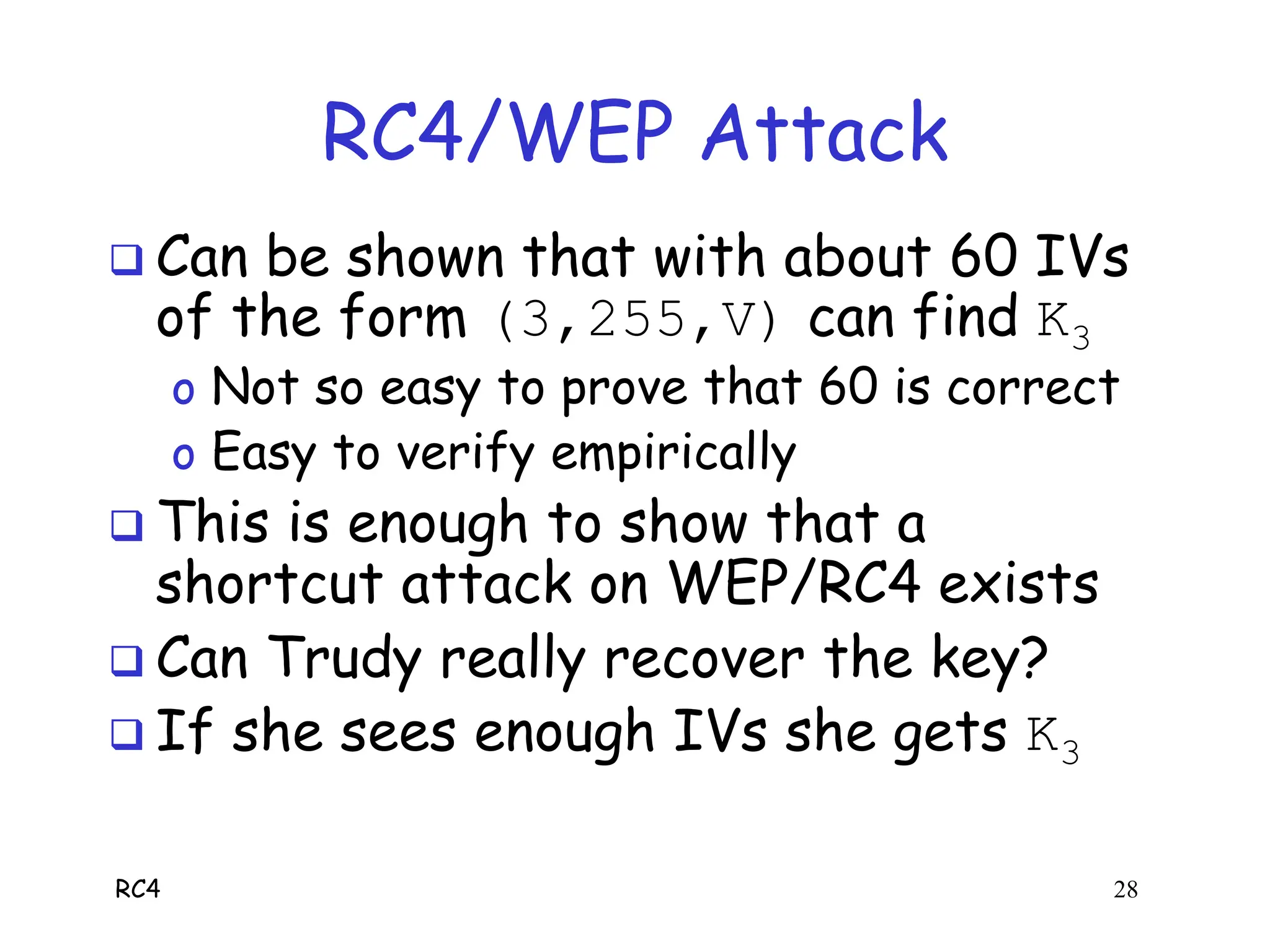
 Can be shown that with about 60 IVs
of the form (3,255,V) can find K3
o Not so easy to prove that 60 is correct
o Easy to verify empirically
 This is enough to show that a
shortcut attack on WEP/RC4 exists
 Can Trudy really recover the key?
 If she sees enough IVs she gets K3
RC4 29
RC4/WEP Attack
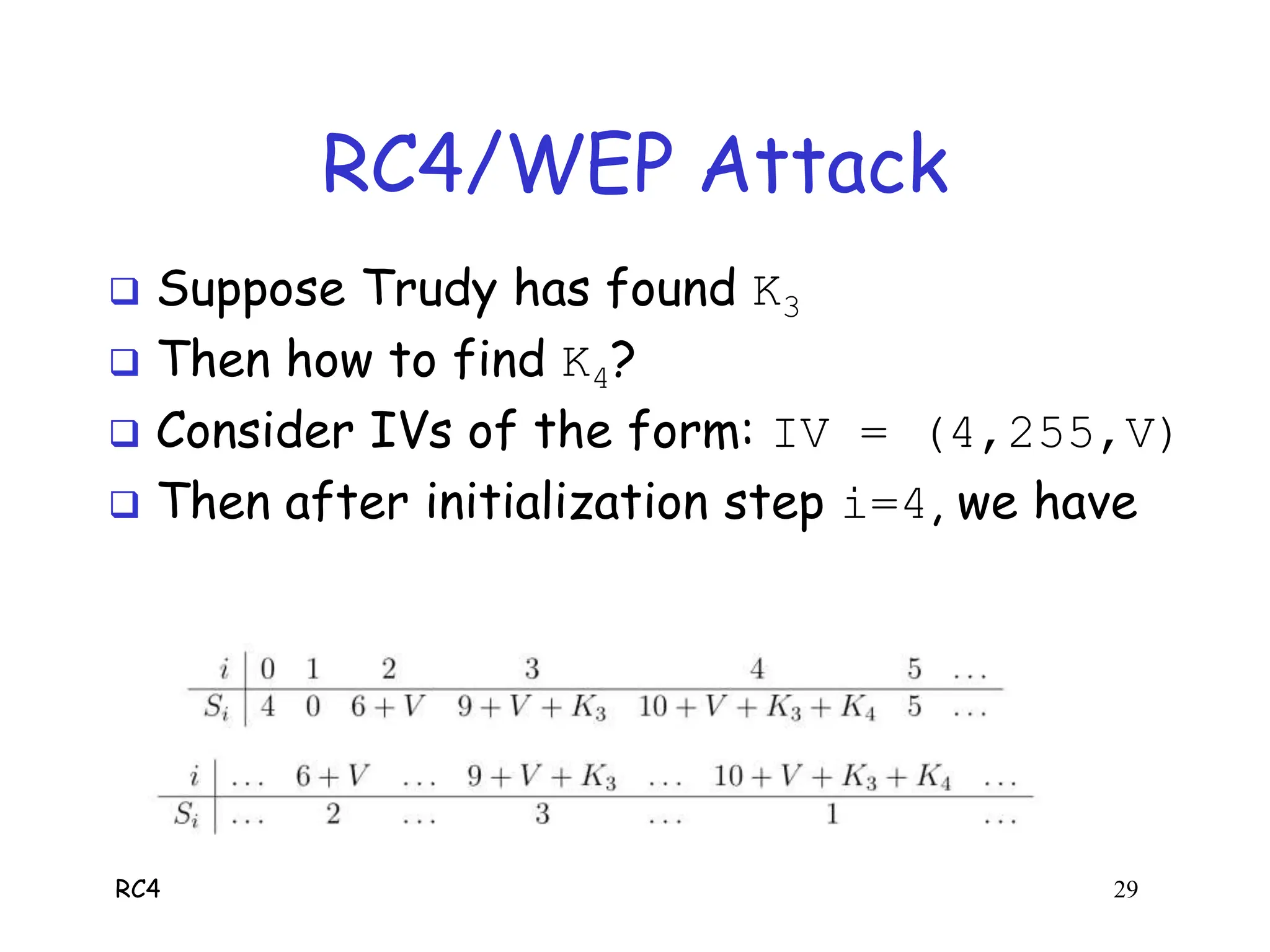
 Suppose Trudy has found K3
 Then how to find K4?
 Consider IVs of the form: IV = (4,255,V)
 Then after initialization step i=4, we have
RC4 30
RC4/WEP Attack
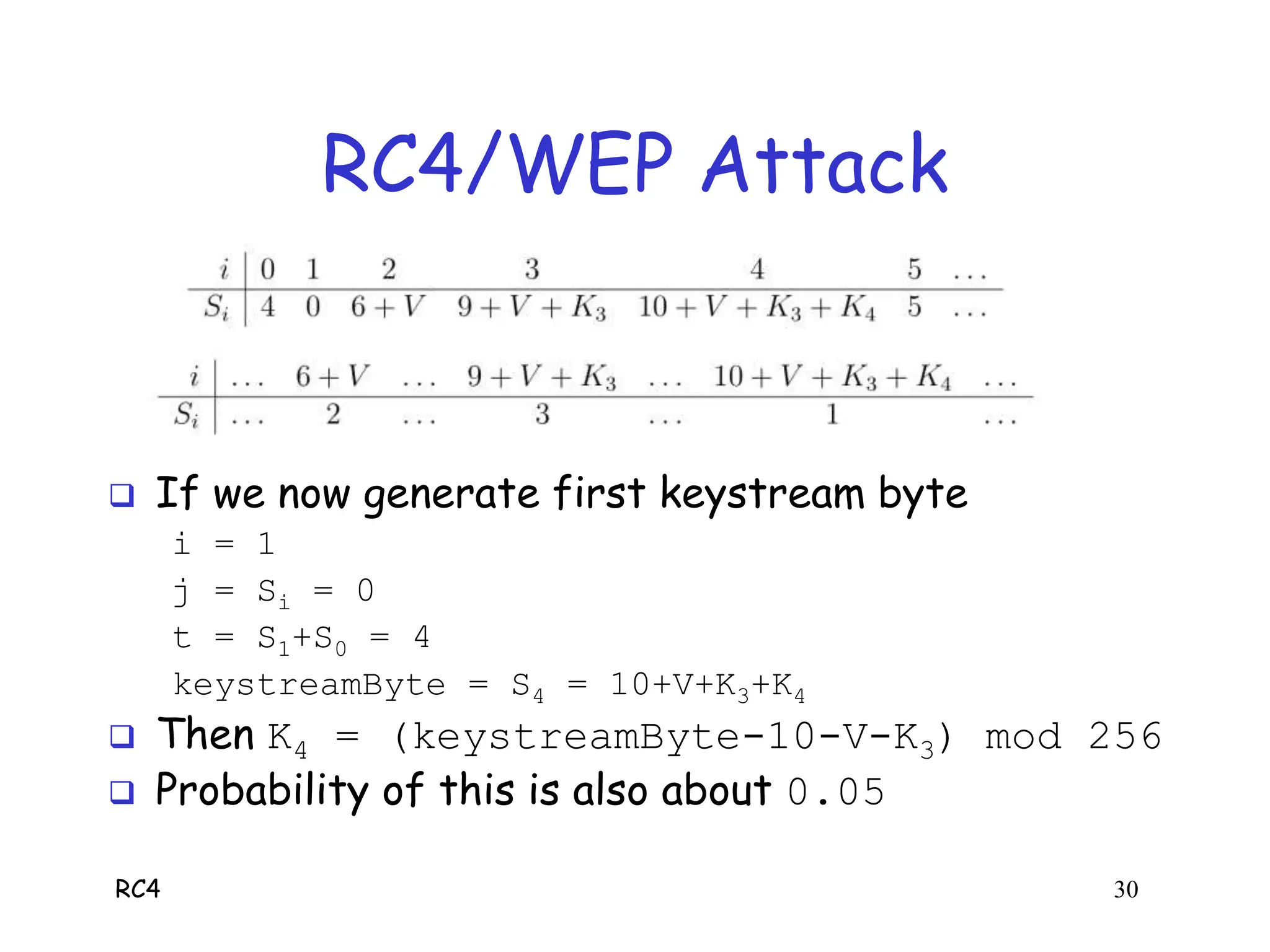
 If we now generate first keystream byte
i = 1
j = Si = 0
t = S1+S0 = 4
keystreamByte = S4 = 10+V+K3+K4
 Then K4 = (keystreamByte-10-V-K3) mod 256
 Probability of this is also about 0.05
RC4 31
RC4/WEP Attack
 If enough IVs are available
o And corresponding 1st keystreamBytes
are known
 Then Trudy can recover the key
o Finds K3 then K4 then K5 and so on…
 Get entire key, regardless of length!
RC4 32
RC4/WEP Attack
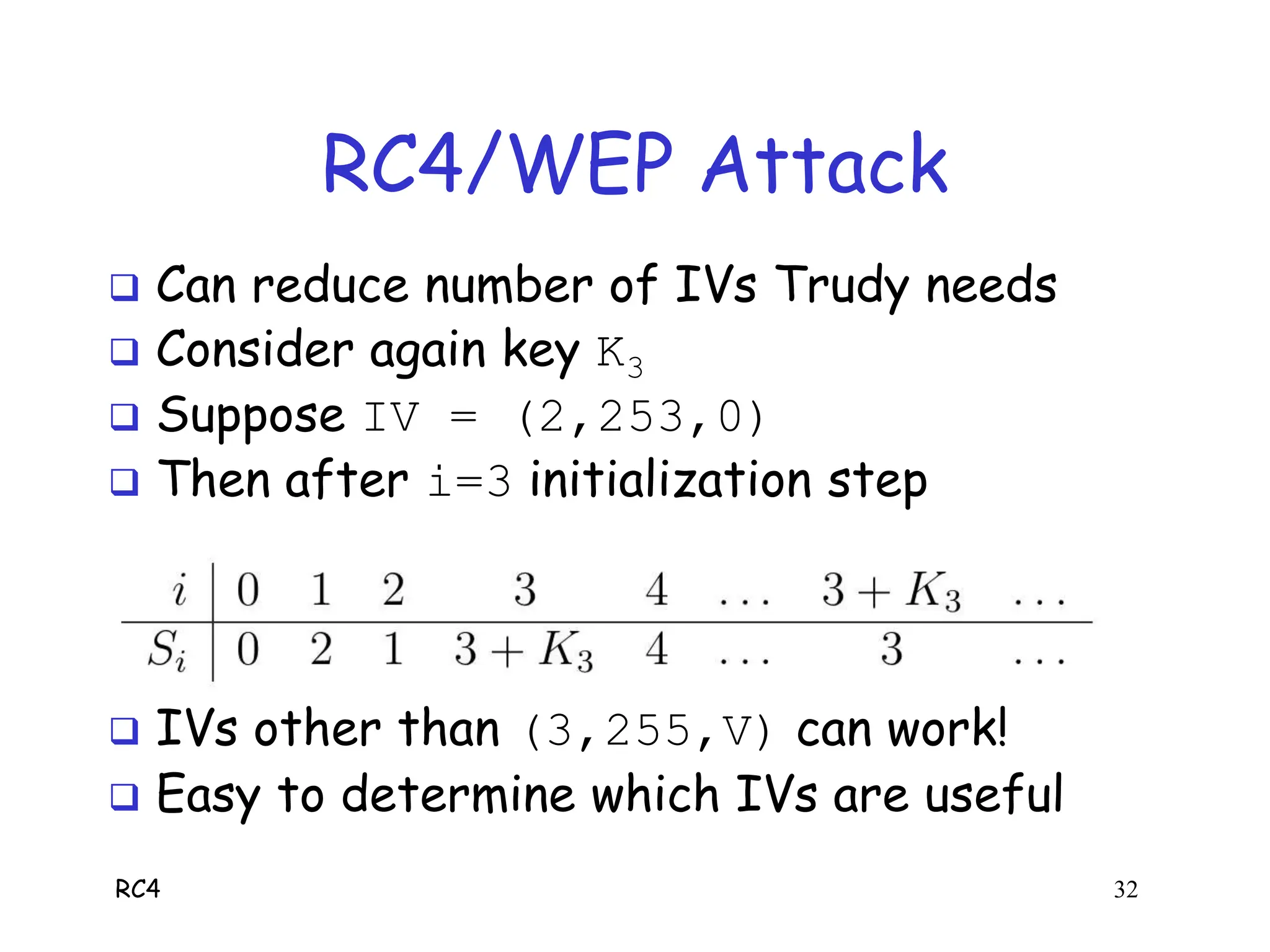
 Can reduce number of IVs Trudy needs
 Consider again key K3
 Suppose IV = (2,253,0)
 Then after i=3 initialization step
 IVs other than (3,255,V) can work!
 Easy to determine which IVs are useful
RC4 33
RC4/WEP Conclusions
 This attack is practical!
 This attack has been used to recover
keys from real WEP traffic
 How to prevent this attack?
o Discard first 256 bytes of keystream
 This attack on RC4 is just one of
many security flaws in WEP

Ron Rivest 4, Information and Network Security

  • 1.
  • 2.
    RC4 2 RC4  Inventedby Ron Rivest o “RC” is “Ron’s Code” or “Rivest Cipher”  A stream cipher  Generate keystream byte at a step o Efficient in software o Simple and elegant o Diffie: RC4 is “too good to be true”  Used lots of places: SSL, WEP, etc., etc.  Most popular stream cipher in existence
  • 3.
    RC4 3 RC4 Initialization Array key contains N bytes of key  Array S always has a permutation of 0,1,…,255 for i = 0 to 255 S[i] = i K[i] = key[i (mod N)] next i j = 0 for i = 0 to 255 j = (j + S[i] + K[i]) (mod 256) swap(S[i],S[j]) next i i = j = 0
  • 4.
    RC4 4 RC4 Keystream For each keystream byte, swap elements of array S and select a byte from the array: i = (i + 1) (mod 256) j = (j + S[i]) (mod 256) swap(S[i], S[j]) t = (S[i] + S[j]) (mod 256) keystreamByte = S[t]  Use keystream bytes like a one-time pad o XOR to encrypt or decrypt
  • 5.
    RC4 5 WEP  WEP== Wired Equivalent Privacy  The stated goal of WEP is to make wireless LAN as secure as a wired LAN  According to Tanenbaum: o “The 802.11 standard prescribes a data link-level security protocol called WEP (Wired Equivalent Privacy), which is designed to make the security of a wireless LAN as good as that of a wired LAN. Since the default for a wired LAN is no security at all, this goal is easy to achieve, and WEP achieves it as we shall see.”
  • 6.
    RC4 6 WEP  WiredEquivalent Privacy  WEP uses RC4 for confidentiality o Considered a strong cipher o But WEP introduces a subtle flaw  WEP uses CRC for “integrity” o Should have used a crypto hash instead o CRC is for error detection, not cryptographic integrity
  • 7.
    RC4 7 WEP IntegrityProblems  WEP “integrity” does not provide integrity o CRC is linear, so is stream cipher XOR o Can change ciphertext and CRC so that checksum remains correct o Such introduced errors go undetected o This requires no knowledge of the plaintext! o Even worse if plaintext is known  CRC does not provide a cryptographic integrity check! o CRC designed to detect random errors o Not designed to detect intelligent changes
  • 8.
    RC4 8 WEP Key WEP uses a long-term secret key: K  RC4 is a stream cipher, so each packet must be encrypted using a different key o Initialization Vector (IV) sent with packet o Sent in the clear (IV is not secret) o IV has similar purpose as “MI” in WWII ciphers  Actual RC4 key for packet is (IV,K) o That is, IV is pre-pended to K
  • 9.
    RC4 9 Initialization Vector“Issue”  WEP uses 24-bit (3 byte) IV o Each packet gets a new IV o RC4 packet key: IV pre-pended to long-term key, K  Long term key K seldom changes  If long-term key and IV are same, then same keystream is used o This is bad! o It is at least as bad as reuse of one-time pad
  • 10.
    RC4 10 Initialization Vector“Issue”  Assume 1500 byte packets, 11 Mbps link  Suppose IVs generated in sequence o Then 1500  8/(11  106)  224 = 18,000 seconds o Implies IV must repeat in about 5 hours  Suppose IVs generated at random o By birthday problem, some IV repeats in seconds  Again, repeated IV (with same K) is bad!
  • 11.
    RC4 11 WEP ActiveAttacks  WEP: “Swiss cheese” of security protocols  If Trudy can insert traffic and observe corresponding ciphertext o Then she will know keystream for that IV o And she can decrypt next msg that uses that IV  Spse Trudy knows destination IP address o She can change IP address in ciphertext o And modify CRC so it is correct o Then access point will decrypt and forward packet to the Trudy’s selected IP address! o Requires no knowledge of the key K!
  • 12.
    RC4 12 WEP CryptanalyticAttack  WEP data encrypted using RC4 o Packet key is IV and long-term key K o 3-byte IV is pre-pended to K o Packet key is (IV,K)  IV is sent in the clear (not secret) o New IV sent with every packet o Long-term key K seldom changes (maybe never)  Assume Trudy knows IVs and ciphertext  Trudy wants to find the key K
  • 13.
    RC4 13 RC4 inWEP  3-byte IV pre-pended to key  We denote the RC4 key bytes… o …as K0,K1,K2,K3,K4,K5,… o Where IV = (K0,K1,K2), which Trudy knows o Trudy wants to find K3,K4,K5,…  Given enough IVs, we show that Trudy can recover the long-term key o Regardless of the length of the key! o Provided Trudy knows first keystream byte o Known plaintext attack (1st byte of each packet)
  • 14.
    RC4 14 RC4 Initialization Recall that RC4 initialization is… Si = i for i = 0,1,2,…,255 j = 0 for i = 0 to 255 j = j + Si + Ki swap(Si,Sj) next i
  • 15.
    RC4 15 RC4/WEP Attack Attack due to Fluher, Mantin and Shamir  Trudy watches IVs until she sees 3-byte IV of the form: IV = (3,255,V)  Where V can be anything (Trudy knows V)  Then RC4 key for this packet is key = (3,255,V,K3,K4,K5,…)  Trudy wants to find (K3,K4,K5,…)
  • 16.
    RC4 16 RC4/WEP Attack IV = (3,255,V)  Key = (3,255,V,K3,K4,…)  Trudy knows K0 = 3, K1 = 255, K2 = V  Other Ki are long-term key o Which is unknown to Trudy  Recall RC4 initialization: first, set S to…
  • 17.
    RC4 17 RC4/WEP Attack IV = (3,255,V)  Key = (3,255,V,K3,K4,…)  RC4 initialization: let j = 0 then for i = 0 to 255 j = j + Si + Ki swap(Si,Sj) next i  At i = 0 step we have i = 0 j = j + S0 + K0 = 0 + 0 + 3 = 3 swap(Si,Sj) = swap(S0,S3)
  • 18.
    RC4 18 RC4/WEP Attack From previous slide…  At i = 0 step we have i = 0 j = j+S0+K0 = 0+0+3 = 3 swap(Si,Sj) = swap(S0,S3)  After this step, the table S is…
  • 19.
    RC4 19 RC4/WEP Attack IV = (3,255,V)  Key = (3,255,V,K3,K4,…)  Continuing, at i = 1 step i = 1 j = j+S1+K1 = 3+1+255 = 3 (mod 256) swap(Si,Sj)  After this step, the table S is…
  • 20.
    RC4 20 RC4/WEP Attack IV = (3,255,V)  Key = (3,255,V,K3,K4,…)  Continuing, at i = 2 step i = 2 j = j+S2+K2 = 3+2+V = 5+V swap(Si,Sj)  After this step, the table S is…
  • 21.
    RC4 21 RC4/WEP Attack IV = (3,255,V)  Key = (3,255,V,K3,K4,…)  Continuing, at i = 3 step i = 3 j = j+S3+K3 = 5+V+1+K3 = 6+V+K3 swap(Si,Sj)  Assuming 6+V+K3 > 5+V (mod 256), the table is  Otherwise 6+V+K3 will be to the left of 5+V
  • 22.
    RC4 22 RC4 Initialization Note that we have only considered the first 4 steps of initialization, i = 0,1,2,3 o In reality, there are 256 steps  For now, assume that initialization stops after i = 3 step  Then S is  Next, we consider RC4 keystream algorithm
  • 23.
    RC4 23 RC4 Keystream After initialization, let i = j = 0  Then for each keystream byte i = i+1 j = j+Si swap(Si,Sj) t = Si+Sj keystreamByte = St
  • 24.
    RC4 24 RC4/WEP Attack Suppose initialization stopped with  First keystream byte  Let i = j = 0  Then i = i+1 = 1 j = j+S1 = 0 t = Si+Sj = S1+S0 = 0+3 = 3 keystreamByte = St = S3 = 6+V+K3
  • 25.
    RC4 25 RC4/WEP Attack Note: keystreamByte = 6+V+K3  If keystreamByte is known, we can solve for K3 since K3 = (keystreamByte6V) mod 256  But initialization does not stop at i=3  So can this “attack” really work?
  • 26.
    RC4 26 RC4/WEP Attack After i=3 initialization step, S is  If elements at 0,1 and 3 not swapped in remaining initialization steps, attack works  For remaining initialization steps… o We have i = 4,5,6,… so index i will not affect anything at indices 0,1 or 3 o But what about index j?
  • 27.
    RC4 27 RC4/WEP Attack Pretend index j selected at random o At each step, probability is 253/256 that j  {0,1,3} o There are 252 steps after i = 3  Probability that 0,1 and 3 not affected by j index after i=3 step is (253/256)252 = 0.0513
  • 28.
    RC4 28 RC4/WEP Attack Can be shown that with about 60 IVs of the form (3,255,V) can find K3 o Not so easy to prove that 60 is correct o Easy to verify empirically  This is enough to show that a shortcut attack on WEP/RC4 exists  Can Trudy really recover the key?  If she sees enough IVs she gets K3
  • 29.
    RC4 29 RC4/WEP Attack Suppose Trudy has found K3  Then how to find K4?  Consider IVs of the form: IV = (4,255,V)  Then after initialization step i=4, we have
  • 30.
    RC4 30 RC4/WEP Attack If we now generate first keystream byte i = 1 j = Si = 0 t = S1+S0 = 4 keystreamByte = S4 = 10+V+K3+K4  Then K4 = (keystreamByte-10-V-K3) mod 256  Probability of this is also about 0.05
  • 31.
    RC4 31 RC4/WEP Attack If enough IVs are available o And corresponding 1st keystreamBytes are known  Then Trudy can recover the key o Finds K3 then K4 then K5 and so on…  Get entire key, regardless of length!
  • 32.
    RC4 32 RC4/WEP Attack Can reduce number of IVs Trudy needs  Consider again key K3  Suppose IV = (2,253,0)  Then after i=3 initialization step  IVs other than (3,255,V) can work!  Easy to determine which IVs are useful
  • 33.
    RC4 33 RC4/WEP Conclusions This attack is practical!  This attack has been used to recover keys from real WEP traffic  How to prevent this attack? o Discard first 256 bytes of keystream  This attack on RC4 is just one of many security flaws in WEP