Romanticism
   An artistic (literature, visual arts, music)
    and philosophical movement

   Began in Germany and England
      Europe
            America

   End of 1700s to mid-1800s
Romanticism
   Not necessarily what we think of when
    we hear the word ‘romantic’
      Romance = Adventure


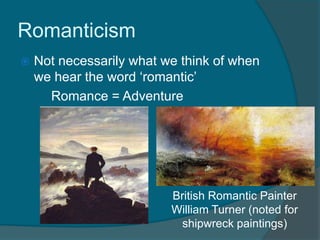
                          British Romantic Painter
                          William Turner (noted for
                           shipwreck paintings)
Sources of Inspiration
       Inner feelings and emotions
       Imagination
        Literature of
        the Middle Ages and
        the Orient (Eastern culture)
Romantic Attitudes (Interests)
   Idealistic
    -oriented toward the model, the perfect

   Mysterious and supernatural
    -reaction against logic, science, the mind

   Individual
    -concerned with the particular/specific
      rather than the general

   Imagination/creativity
    -sought to develop new forms of
      expression
Romantic Attitudes (Preferences)
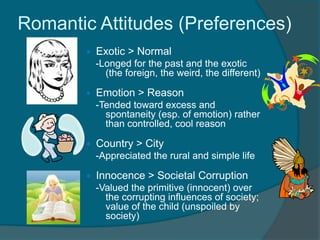
           Exotic > Normal
            -Longed for the past and the exotic
              (the foreign, the weird, the different)

           Emotion > Reason
            -Tended toward excess and
              spontaneity (esp. of emotion) rather
              than controlled, cool reason

           Country > City
            -Appreciated the rural and simple life

           Innocence > Societal Corruption
            -Valued the primitive (innocent) over
              the corrupting influences of society;
              value of the child (unspoiled by
              society)
Romantic Social Concerns
 Desired radical change
 Favored democracy over
  monarchy
 Concerned with the common
  people, the good of the
  individual
 Felt that nature
 should be untamed,
 wild (the first
  environmentalists)

Romanticism

  • 2.
    Romanticism  An artistic (literature, visual arts, music) and philosophical movement  Began in Germany and England Europe America  End of 1700s to mid-1800s
  • 3.
    Romanticism  Not necessarily what we think of when we hear the word ‘romantic’ Romance = Adventure British Romantic Painter William Turner (noted for shipwreck paintings)
  • 4.
    Sources of Inspiration  Inner feelings and emotions  Imagination  Literature of the Middle Ages and the Orient (Eastern culture)
  • 5.
    Romantic Attitudes (Interests)  Idealistic -oriented toward the model, the perfect  Mysterious and supernatural -reaction against logic, science, the mind  Individual -concerned with the particular/specific rather than the general  Imagination/creativity -sought to develop new forms of expression
  • 6.
    Romantic Attitudes (Preferences)  Exotic > Normal -Longed for the past and the exotic (the foreign, the weird, the different)  Emotion > Reason -Tended toward excess and spontaneity (esp. of emotion) rather than controlled, cool reason  Country > City -Appreciated the rural and simple life  Innocence > Societal Corruption -Valued the primitive (innocent) over the corrupting influences of society; value of the child (unspoiled by society)
  • 7.
    Romantic Social Concerns Desired radical change  Favored democracy over monarchy  Concerned with the common people, the good of the individual  Felt that nature should be untamed, wild (the first environmentalists)