Challenging Times for Coal
Impacts on medium-term pricing
Rodrigo Echeverri, Research Fellow
with
Berenice Garcia Tellez, Senior Research Analyst
April 14, 2015
2
KAPSARC in Brief…
KAPSARC
King Abdullah Petroleum Studies and Research
Center
 Independent, non-profit, research institution
 Focuses on energy economics, policy,
technology, and the environment
 Located in Riyadh
Mission
 Advance understanding of energy challenges
and opportunities
 Both domestically and globally
 Through high caliber research
 Build a platform for constructive dialogue
between stakeholders
To create future value and prosperity
to maximize societal benefit
3
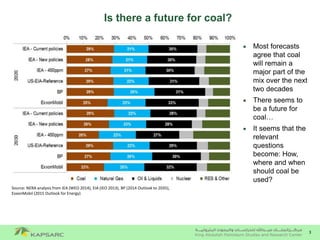
Is there a future for coal?
 Most forecasts
agree that coal
will remain a
major part of the
mix over the next
two decades
 There seems to
be a future for
coal…
 It seems that the
relevant
questions
become: How,
where and when
should coal be
used?
Source: NERA analysis from IEA (WEO 2014), EIA (IEO 2013), BP (2014 Outlook to 2035),
ExxonMobil (2015 Outlook for Energy)
4
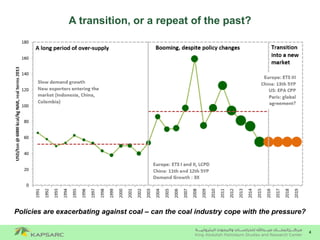
A transition, or a repeat of the past?
Policies are exacerbating against coal – can the coal industry cope with the pressure?
Part 1: Demand Drivers
6
Has the coal market run out of steam?
Coal market recovery not likely before 2017 - Even then, improvement might only be marginal…
Source: McCloskey, Salva, Argus Consulting, KAPSARC Analysis
(40)
(20)
-
20
40
60
80
100
120
140
160
0
200
400
600
800
1000
1200
2009 2010 2011 2012 2013 2014 2015E 2016E 2017E 2018E 2019E
Year-on-YearChange[Mt]/Newcastle
[$/t]
CoalDemand[Mt]
Seaborne Thermal Coal Market Demand
Year-on-Year Change Seaborne Coal Demand Newcastle price
7
Can India and ASEAN compensate
for the losses in China?
India and ASEAN show promise but have their own challenges…
Source: McCloskey, Salva, Argus Consulting, KAPSARC Analysis
-60
-50
-40
-30
-20
-10
0
10
20
30
40
2013 2014 2015E 2016E 2017E 2018E 2019E
Year-on-yearchange[Mt]
China
India
ASEAN
8
Sources: KAPSARC Analysis, NBS, IHS McCloskey
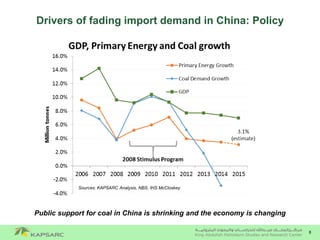
Drivers of fading import demand in China: Policy
Public support for coal in China is shrinking and the economy is changing
9
412 409
417 417 415
373
378
364
342 347
327
316 318
250
270
290
310
330
350
370
390
410
430
2000 2001 2002 2003 2004 2005 2006 2007 2008 2009 2010 2011 2012
gramsofcoalequivalent/
kWh
Subcritical
Supercritical
Ultra-Supercritical
Sources: IHS Cera, NBS and CEC data
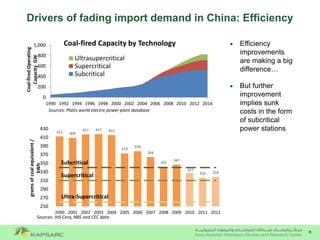
Drivers of fading import demand in China: Efficiency
 Efficiency
improvements
are making a big
difference…
 But further
improvement
implies sunk
costs in the form
of subcritical
power stations
0
200
400
600
800
1,000
1990 1992 1994 1996 1998 2000 2002 2004 2006 2008 2010 2012 2014
Coal-firedOperating
CapacityGW
Coal-fired Capacity by Technology
Ultrasupercritical
Supercritical
Subcritical
Sources: Platts world electric power plant database
10
-15
-10
-5
0
5
10
15
2013 2014 2015E 2016E 2017E 2018E 2019E
Year-on-yearchange[Mt]
Taiwan and HK
Japan/S.Korea
Europe
MENA
Americas
Demand: Japan, Korea, MENA and Europe
 Europe making
further attempts to
improve its ETS will
likely result in coal
being displaced in
the merit order
 Coal is still a good
alternative for Korea
and Japan due to
shortage of power
and challenges with
other sources of
energy
 Egypt and UAE
moving to build new
coal-fired capacity
Source: McCloskey, Salva, Argus Consulting, KAPSARC Analysis
11
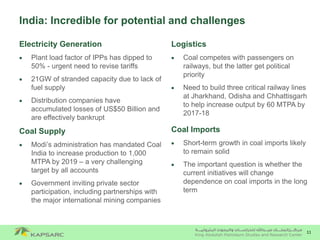
India: Incredible for potential and challenges
Electricity Generation
 Plant load factor of IPPs has dipped to
50% - urgent need to revise tariffs
 21GW of stranded capacity due to lack of
fuel supply
 Distribution companies have
accumulated losses of US$50 Billion and
are effectively bankrupt
Coal Supply
 Modi’s administration has mandated Coal
India to increase production to 1,000
MTPA by 2019 – a very challenging
target by all accounts
 Government inviting private sector
participation, including partnerships with
the major international mining companies
Logistics
 Coal competes with passengers on
railways, but the latter get political
priority
 Need to build three critical railway lines
at Jharkhand, Odisha and Chhattisgarh
to help increase output by 60 MTPA by
2017-18
Coal Imports
 Short-term growth in coal imports likely
to remain solid
 The important question is whether the
current initiatives will change
dependence on coal imports in the long
term
12
ASEAN: A stronghold for coal?
0
5
10
15
20
25
30
35
40
0
5
10
15
20
25
30
2014 2015 2016 2017 2018 2019
CoalDemand[Mt]
GenerationCapacity[GW] Malaysian fuel mix and coal demand
Coal Gas Hydro Coal demand
Source: Tanaga Nasional Berhad (TNB)
Philippines, Vietnam, Indonesia are also expanding their coal-fired capacity…
13
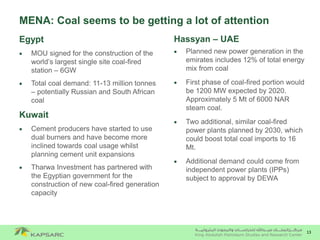
MENA: Coal seems to be getting a lot of attention
Hassyan – UAE
 Planned new power generation in the
emirates includes 12% of total energy
mix from coal
 First phase of coal-fired portion would
be 1200 MW expected by 2020.
Approximately 5 Mt of 6000 NAR
steam coal.
 Two additional, similar coal-fired
power plants planned by 2030, which
could boost total coal imports to 16
Mt.
 Additional demand could come from
independent power plants (IPPs)
subject to approval by DEWA
Egypt
 MOU signed for the construction of the
world’s largest single site coal-fired
station – 6GW
 Total coal demand: 11-13 million tonnes
– potentially Russian and South African
coal
Kuwait
 Cement producers have started to use
dual burners and have become more
inclined towards coal usage whilst
planning cement unit expansions
 Tharwa Investment has partnered with
the Egyptian government for the
construction of new coal-fired generation
capacity
Part 2: Supply Drivers
15
Supply: Who wins and who loses?
Indonesia has probably peaked, and the US is already retreating from the export
market. Colombia, Russia and Australia holding better than the rest.
Source: McCloskey, Salva, Argus Consulting, KAPSARC Analysis
0
50
100
150
200
250
300
0
50
100
150
200
250
300
350
400
450
2009 2010 2011 2012 2013 2014 2015 2016 2017 2018 2019
Other–[Mt]
Indonesia–[Mt]
Indonesia (LHS) Australia Steam (RHS) USA (RHS) Russia (RHS) Colombia (RHS)
16
Source: IEA (WEO,2014), Macquarie Bank ; KAPSARC Analysis
0
20
40
60
80
100
Indonesia South Africa Colombia Australia Russia
DollarspertonneFOB(nominal)
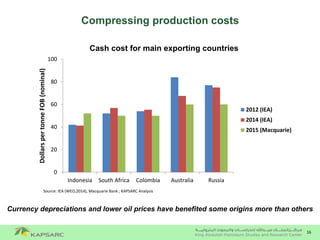
Cash cost for main exporting countries
2012 (IEA)
2014 (IEA)
2015 (Macquarie)
Compressing production costs
Currency depreciations and lower oil prices have benefited some origins more than others
17
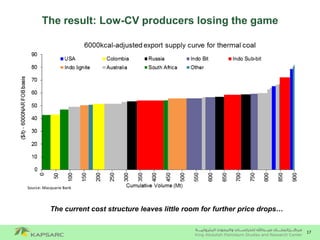
Source: Macquarie Bank
The result: Low-CV producers losing the game
The current cost structure leaves little room for further price drops…
18
 International Thermal Coal Prices likely to remain depressed over
the next three to five years
 China imports seem to have peaked, for now
 Fresh demand likely to benefit producers – but it will take time to
balance the market again
 Cash costs have benefited from currency depreciation and fuel
prices, but further improvement will be difficult
 Industry consolidation seems to be a necessity for some origins
Conclusions
Rodrigo - Flame - April 14 FINAL

Rodrigo - Flame - April 14 FINAL

  • 1.
    Challenging Times forCoal Impacts on medium-term pricing Rodrigo Echeverri, Research Fellow with Berenice Garcia Tellez, Senior Research Analyst April 14, 2015
  • 2.
    2 KAPSARC in Brief… KAPSARC KingAbdullah Petroleum Studies and Research Center  Independent, non-profit, research institution  Focuses on energy economics, policy, technology, and the environment  Located in Riyadh Mission  Advance understanding of energy challenges and opportunities  Both domestically and globally  Through high caliber research  Build a platform for constructive dialogue between stakeholders To create future value and prosperity to maximize societal benefit
  • 3.
    3 Is there afuture for coal?  Most forecasts agree that coal will remain a major part of the mix over the next two decades  There seems to be a future for coal…  It seems that the relevant questions become: How, where and when should coal be used? Source: NERA analysis from IEA (WEO 2014), EIA (IEO 2013), BP (2014 Outlook to 2035), ExxonMobil (2015 Outlook for Energy)
  • 4.
    4 A transition, ora repeat of the past? Policies are exacerbating against coal – can the coal industry cope with the pressure?
  • 5.
  • 6.
    6 Has the coalmarket run out of steam? Coal market recovery not likely before 2017 - Even then, improvement might only be marginal… Source: McCloskey, Salva, Argus Consulting, KAPSARC Analysis (40) (20) - 20 40 60 80 100 120 140 160 0 200 400 600 800 1000 1200 2009 2010 2011 2012 2013 2014 2015E 2016E 2017E 2018E 2019E Year-on-YearChange[Mt]/Newcastle [$/t] CoalDemand[Mt] Seaborne Thermal Coal Market Demand Year-on-Year Change Seaborne Coal Demand Newcastle price
  • 7.
    7 Can India andASEAN compensate for the losses in China? India and ASEAN show promise but have their own challenges… Source: McCloskey, Salva, Argus Consulting, KAPSARC Analysis -60 -50 -40 -30 -20 -10 0 10 20 30 40 2013 2014 2015E 2016E 2017E 2018E 2019E Year-on-yearchange[Mt] China India ASEAN
  • 8.
    8 Sources: KAPSARC Analysis,NBS, IHS McCloskey Drivers of fading import demand in China: Policy Public support for coal in China is shrinking and the economy is changing
  • 9.
    9 412 409 417 417415 373 378 364 342 347 327 316 318 250 270 290 310 330 350 370 390 410 430 2000 2001 2002 2003 2004 2005 2006 2007 2008 2009 2010 2011 2012 gramsofcoalequivalent/ kWh Subcritical Supercritical Ultra-Supercritical Sources: IHS Cera, NBS and CEC data Drivers of fading import demand in China: Efficiency  Efficiency improvements are making a big difference…  But further improvement implies sunk costs in the form of subcritical power stations 0 200 400 600 800 1,000 1990 1992 1994 1996 1998 2000 2002 2004 2006 2008 2010 2012 2014 Coal-firedOperating CapacityGW Coal-fired Capacity by Technology Ultrasupercritical Supercritical Subcritical Sources: Platts world electric power plant database
  • 10.
    10 -15 -10 -5 0 5 10 15 2013 2014 2015E2016E 2017E 2018E 2019E Year-on-yearchange[Mt] Taiwan and HK Japan/S.Korea Europe MENA Americas Demand: Japan, Korea, MENA and Europe  Europe making further attempts to improve its ETS will likely result in coal being displaced in the merit order  Coal is still a good alternative for Korea and Japan due to shortage of power and challenges with other sources of energy  Egypt and UAE moving to build new coal-fired capacity Source: McCloskey, Salva, Argus Consulting, KAPSARC Analysis
  • 11.
    11 India: Incredible forpotential and challenges Electricity Generation  Plant load factor of IPPs has dipped to 50% - urgent need to revise tariffs  21GW of stranded capacity due to lack of fuel supply  Distribution companies have accumulated losses of US$50 Billion and are effectively bankrupt Coal Supply  Modi’s administration has mandated Coal India to increase production to 1,000 MTPA by 2019 – a very challenging target by all accounts  Government inviting private sector participation, including partnerships with the major international mining companies Logistics  Coal competes with passengers on railways, but the latter get political priority  Need to build three critical railway lines at Jharkhand, Odisha and Chhattisgarh to help increase output by 60 MTPA by 2017-18 Coal Imports  Short-term growth in coal imports likely to remain solid  The important question is whether the current initiatives will change dependence on coal imports in the long term
  • 12.
    12 ASEAN: A strongholdfor coal? 0 5 10 15 20 25 30 35 40 0 5 10 15 20 25 30 2014 2015 2016 2017 2018 2019 CoalDemand[Mt] GenerationCapacity[GW] Malaysian fuel mix and coal demand Coal Gas Hydro Coal demand Source: Tanaga Nasional Berhad (TNB) Philippines, Vietnam, Indonesia are also expanding their coal-fired capacity…
  • 13.
    13 MENA: Coal seemsto be getting a lot of attention Hassyan – UAE  Planned new power generation in the emirates includes 12% of total energy mix from coal  First phase of coal-fired portion would be 1200 MW expected by 2020. Approximately 5 Mt of 6000 NAR steam coal.  Two additional, similar coal-fired power plants planned by 2030, which could boost total coal imports to 16 Mt.  Additional demand could come from independent power plants (IPPs) subject to approval by DEWA Egypt  MOU signed for the construction of the world’s largest single site coal-fired station – 6GW  Total coal demand: 11-13 million tonnes – potentially Russian and South African coal Kuwait  Cement producers have started to use dual burners and have become more inclined towards coal usage whilst planning cement unit expansions  Tharwa Investment has partnered with the Egyptian government for the construction of new coal-fired generation capacity
  • 14.
  • 15.
    15 Supply: Who winsand who loses? Indonesia has probably peaked, and the US is already retreating from the export market. Colombia, Russia and Australia holding better than the rest. Source: McCloskey, Salva, Argus Consulting, KAPSARC Analysis 0 50 100 150 200 250 300 0 50 100 150 200 250 300 350 400 450 2009 2010 2011 2012 2013 2014 2015 2016 2017 2018 2019 Other–[Mt] Indonesia–[Mt] Indonesia (LHS) Australia Steam (RHS) USA (RHS) Russia (RHS) Colombia (RHS)
  • 16.
    16 Source: IEA (WEO,2014),Macquarie Bank ; KAPSARC Analysis 0 20 40 60 80 100 Indonesia South Africa Colombia Australia Russia DollarspertonneFOB(nominal) Cash cost for main exporting countries 2012 (IEA) 2014 (IEA) 2015 (Macquarie) Compressing production costs Currency depreciations and lower oil prices have benefited some origins more than others
  • 17.
    17 Source: Macquarie Bank Theresult: Low-CV producers losing the game The current cost structure leaves little room for further price drops…
  • 18.
    18  International ThermalCoal Prices likely to remain depressed over the next three to five years  China imports seem to have peaked, for now  Fresh demand likely to benefit producers – but it will take time to balance the market again  Cash costs have benefited from currency depreciation and fuel prices, but further improvement will be difficult  Industry consolidation seems to be a necessity for some origins Conclusions

Editor's Notes

  • #5 + The size of the international market is likely to stall + Current price level is not different from 1991-2003 + But current pressure is not only coal-on-coal, but also policy-on-coal + The important point to understand the range of possible outcomes for the industry and their implication
  • #9 In the period 2006-2014, primary energy consumption grew, on average, four percentage points slower than GDP During 2009-2011, coal consumption grew at an unprecedented rate, as a result of the 2008 stimulus program After 2012, coal consumption growth started to decline much faster than the economy and primary energy consumption Lower economical growth, combined with the energy policies of the Chinese government seem to be limiting coal demand in China
  • #10 The proportion of higher-efficiency coal-fired power plants has increased in China This has resulted in an average improvement of 22% in power plant efficiency However, more than half of the coal-fired fleet is still older technology, but is not old enough to retire The sunk cost associated with this transition will be a significant challenge