Rahma Kasna
D621 13 303
STRESS
WHY STUDY STRESS IN
ROCK MECHANICS AND
ROCK ENGINEERING?
1. There is a pre-existing stress state in the ground and we need to
understand it, both directly and as the stress state applies to analysis
and design.
Reasons
2. Most engineering criteria are related to either the deformability or
the strength of the rock or rock mass and the analysis of these
subjects involves stresses.
3. Stress is not familiar: it is a tensor quantity and tensors are not
encountered in everyday life.
THE DIFFERENCE BETWEEN
SCALAR, VECTOR, AND
TENSOR
SCALAR
Scalar, Vector, and Tensor
A quantity with magnitude only. Examples of scalars are
temperature, time, and mass. They are described
completely by one value, e.g. degrees, seconds, and
kilograms.
VECTOR
TENSOR
a quantity with magnitude and direction. Examples of
vectors are force, velocity, and acceleration. They are
described specify both direction and magnitude.
A quantity with magnitude, direction and ’the plane under
consideration’. Examples of tensors are stress, strain,
permeability and moment of inertia.
TENSOR
“Tensors are abstract objects which can be described by arrays of
functions; each function of such an array is called a component.
Components are functions of the selected coordinates. Tensor
analysis offers at least the following advantages : physical concepts
requiring many functions to express are formulated easily; results
are translated easily to forms appropriate to any coordinate system;
physical concepts can be expressed without reference to any
particular coordinate system.” - from Tensors of Geophysics for
Mavericks and Mongrels, Hadsel, F., SEG Press.
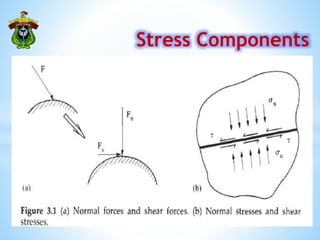
NORMAL STRESS COMPONENTS
AND SHEAR STRESS
COMPONENTS
Stress Components
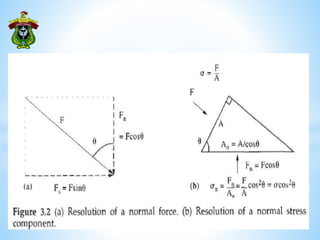
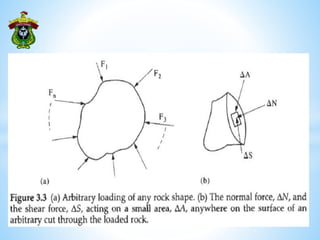
STRESS AS A POINT PROPERTY
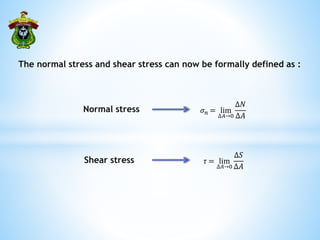
𝜎𝑛 = lim
∆𝐴→0
∆𝑁
∆𝐴
𝜏 = lim
∆𝐴→0
∆𝑆
∆𝐴
The normal stress and shear stress can now be formally defined as :
Normal stress
Shear stress
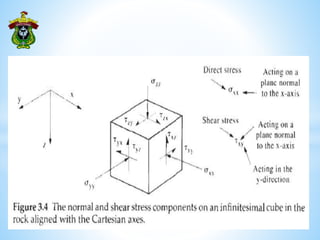
THE STRESS COMPONENTS ON
A SMALL CUBE WITHIN THE
ROCK
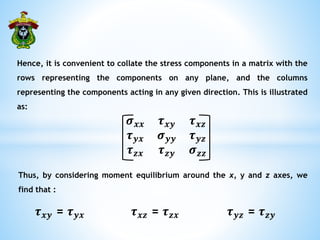
Hence, it is convenient to collate the stress components in a matrix with the
rows representing the components on any plane, and the columns
representing the components acting in any given direction. This is illustrated
as:
𝝈𝒙𝒙 𝝉𝒙𝒚 𝝉𝒙𝒛
𝝉𝒚𝒙 𝝈𝒚𝒚 𝝉𝒚𝒛
𝝉𝒛𝒙 𝝉𝒛𝒚 𝝈𝒛𝒛
Thus, by considering moment equilibrium around the x, y and z axes, we
find that :
𝝉𝒙𝒚 = 𝝉𝒚𝒙 𝝉𝒙𝒛 = 𝝉𝒛𝒙 𝝉𝒚𝒛 = 𝝉𝒛𝒚
From our final listing of the stress components in the matrix, it is clear that
the state of stress at a point is defined completely by six independent
components.
These are the three normal stress components and three shear stress
components, i.e. 𝝈𝒙𝒙 , 𝝈𝒚𝒚 , 𝝈𝒛𝒛 , 𝝉𝒙𝒚 , 𝝉𝒚𝒛 , and 𝝉𝒙𝒛.
The stress state at a point, which is a tensor quantity, requires six values.
THANK YOU!
REFERENCE
J. A. Hudson and J. P. Harrison. 1997. Engineering Rock Mechanics : An
Introduction to the Principles. London : Elsevier Science Ltd.
J. A. Hudson and J. P. Harrison. 2000. Engineering Rock Mechanics :
Illustrative worked examples. London : Elsevier Science Ltd.

Rock_Mechanics_Stress.pptx

  • 1.
  • 2.
    WHY STUDY STRESSIN ROCK MECHANICS AND ROCK ENGINEERING?
  • 3.
    1. There isa pre-existing stress state in the ground and we need to understand it, both directly and as the stress state applies to analysis and design. Reasons 2. Most engineering criteria are related to either the deformability or the strength of the rock or rock mass and the analysis of these subjects involves stresses. 3. Stress is not familiar: it is a tensor quantity and tensors are not encountered in everyday life.
  • 4.
  • 5.
    SCALAR Scalar, Vector, andTensor A quantity with magnitude only. Examples of scalars are temperature, time, and mass. They are described completely by one value, e.g. degrees, seconds, and kilograms. VECTOR TENSOR a quantity with magnitude and direction. Examples of vectors are force, velocity, and acceleration. They are described specify both direction and magnitude. A quantity with magnitude, direction and ’the plane under consideration’. Examples of tensors are stress, strain, permeability and moment of inertia.
  • 6.
    TENSOR “Tensors are abstractobjects which can be described by arrays of functions; each function of such an array is called a component. Components are functions of the selected coordinates. Tensor analysis offers at least the following advantages : physical concepts requiring many functions to express are formulated easily; results are translated easily to forms appropriate to any coordinate system; physical concepts can be expressed without reference to any particular coordinate system.” - from Tensors of Geophysics for Mavericks and Mongrels, Hadsel, F., SEG Press.
  • 7.
    NORMAL STRESS COMPONENTS ANDSHEAR STRESS COMPONENTS
  • 8.
  • 9.
    STRESS AS APOINT PROPERTY
  • 12.
    𝜎𝑛 = lim ∆𝐴→0 ∆𝑁 ∆𝐴 𝜏= lim ∆𝐴→0 ∆𝑆 ∆𝐴 The normal stress and shear stress can now be formally defined as : Normal stress Shear stress
  • 13.
    THE STRESS COMPONENTSON A SMALL CUBE WITHIN THE ROCK
  • 15.
    Hence, it isconvenient to collate the stress components in a matrix with the rows representing the components on any plane, and the columns representing the components acting in any given direction. This is illustrated as: 𝝈𝒙𝒙 𝝉𝒙𝒚 𝝉𝒙𝒛 𝝉𝒚𝒙 𝝈𝒚𝒚 𝝉𝒚𝒛 𝝉𝒛𝒙 𝝉𝒛𝒚 𝝈𝒛𝒛 Thus, by considering moment equilibrium around the x, y and z axes, we find that : 𝝉𝒙𝒚 = 𝝉𝒚𝒙 𝝉𝒙𝒛 = 𝝉𝒛𝒙 𝝉𝒚𝒛 = 𝝉𝒛𝒚
  • 16.
    From our finallisting of the stress components in the matrix, it is clear that the state of stress at a point is defined completely by six independent components. These are the three normal stress components and three shear stress components, i.e. 𝝈𝒙𝒙 , 𝝈𝒚𝒚 , 𝝈𝒛𝒛 , 𝝉𝒙𝒚 , 𝝉𝒚𝒛 , and 𝝉𝒙𝒛. The stress state at a point, which is a tensor quantity, requires six values.
  • 17.
  • 18.
    REFERENCE J. A. Hudsonand J. P. Harrison. 1997. Engineering Rock Mechanics : An Introduction to the Principles. London : Elsevier Science Ltd. J. A. Hudson and J. P. Harrison. 2000. Engineering Rock Mechanics : Illustrative worked examples. London : Elsevier Science Ltd.