A robot isa machine that follows a cycle:
Sense: It uses sensors to see the world.
Think: It uses code to decide what to do.
Act: It uses motors to move or make sound.
What Makes a Robot?
4.
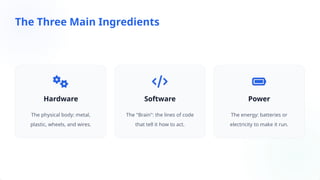
Hardware
The physical body:metal,
plastic, wheels, and wires.
Software
The "Brain": the lines of code
that tell it how to act.
Power
The energy: batteries or
electricity to make it run.
The Three Main Ingredients
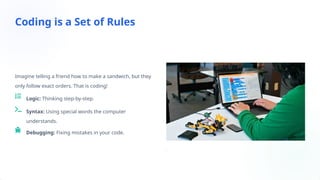
Imagine telling afriend how to make a sandwich, but they
only follow exact orders. That is coding!
Logic: Thinking step-by-step.
Syntax: Using special words the computer
understands.
Debugging: Fixing mistakes in your code.
Coding is a Set of Rules
7.
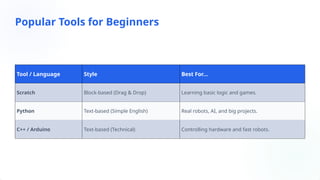
Tool / LanguageStyle Best For...
Scratch Block-based (Drag & Drop) Learning basic logic and games.
Python Text-based (Simple English) Real robots, AI, and big projects.
C++ / Arduino Text-based (Technical) Controlling hardware and fast robots.
Popular Tools for Beginners
8.
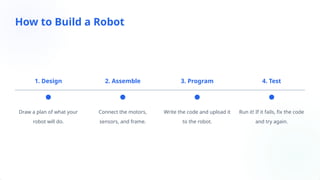
1. Design
Draw aplan of what your
robot will do.
2. Assemble
Connect the motors,
sensors, and frame.
3. Program
Write the code and upload it
to the robot.
4. Test
Run it! If it fails, fix the code
and try again.
How to Build a Robot
9.
Space Exploration: ExploringMars
where humans cannot go.
Manufacturing: Building cars and
electronics very fast.
In Our Homes: Smart helpers that
clean or help around the house.
Robots in the Real World
10.
Critical Thinking: Itteaches you how to break big problems into small steps.
Creativity: You can invent your own machine and make it move!
Future Careers: Most future jobs will need some coding or tech skills.
Collaboration: You get to work in teams to solve cool challenges.
Why Learn This Today?
11.
The Future ofAI & Robots
In the next few years, robots will become smarter with
AI (Artificial Intelligence).
They will learn from their mistakes and help us solve
world problems like climate change and healthcare.
Are you ready to build them?