the
RoboticsCalifornia Polytechnic State University
Outline of Robotics workshop
during summer
Session 1
Topics:
Lab safety, personal protective equipment (PPE), workspace
cleanliness, foreign object damage (FOD), lab etiquette, soldering,
printed circuit board (PCB) assembly, and cable assembly.
Description:
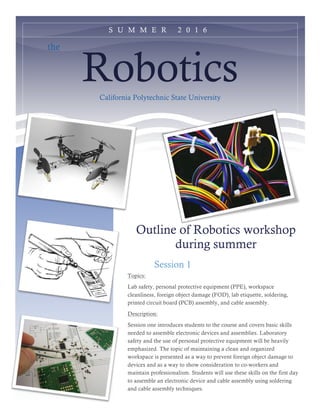
Session one introduces students to the course and covers basic skills
needed to assemble electronic devices and assemblies. Laboratory
safety and the use of personal protective equipment will be heavily
emphasized. The topic of maintaining a clean and organized
workspace is presented as a way to prevent foreign object damage to
devices and as a way to show consideration to co-workers and
maintain professionalism. Students will use these skills on the first day
to assemble an electronic device and cable assembly using soldering
and cable assembly techniques.
S U M M E R 2 0 1 6
2
THE LOREM IPSUMS SUMMER 2016
Contents
Topics:
Programing, algorithms, autonomous behavior.
Description:
Session four provides students with an introduction to the programing
interface of their quadrotors and a brief introduction/review of
programming concepts. Several useful algorithms for robotics will be
briefly discussed from a conceptual level. Students will run example
code on the quadrotors to get up and running, then modify that code to
perform a sequence of tasks. Students will be challenged to develop
code for simple autonomous behavior.
Topics:
Troubleshooting techniques, using digital multi-meters
(DMMs), using oscilloscopes, using test fixtures and
cables, following assembly instructions.
Description:
Session two provides students with a formal introduction to
troubleshooting techniques and the use of common laboratory
equipment such as DMMs and oscilloscopes. Students will be
introduced to the quadrotor hardware that they will use in this
course and will be required to follow assembly instructions to
build the quadrotor assembly. Students will perform the initial
configuration of firmware and software.
Session 3
Topics:
Testing, sensors, feedback and control.
Description:
Session three provides students with a basic introduction to sensors,
feedback and control. Students will complete the assembly and
configuration of the quadrotors, and perform the first test flight.
Session 2
Session 4
Topics:
Programing, sensor input, computer vision.
Description:
Session five continues the topic of programming to include the gathering of data from sensors and a camera. Students will be
briefly introduced to computer vision topics from a conceptual level. Students will run example code on the quadrotors to
gather data from sensors and to acquire images and perform computer vision tasks. Students will be encouraged to modify the
code and consider applications for these methods.
Session 5
3
THE LOREM IPSUMS SUMMER 2016
Contents
Session 6
Topics:
competition task
Description
Session six introduces the robotics competition task, including task objectives
and the judging/points system. Students will brainstorm in teams about how to
best meet the task requirements. Students may use and expand on all materials
in previous sessions, and are encouraged to research and develop their own
unique solutions.
Session 7
Topics:
Competition task, free lab.
Description:
Session seven consists of free lab time with instructor support.
Students will continue working in teams to develop their solution
to the competition challenge.
Session 8
Topics:
Competition task, free lab.
Description:
Session eight consists of free lab time with instructor support.
Students will continue working in teams to develop their
solution to the competition challenge. Students should
complete the development of their solution by the end of this
session and be ready to compete.
Sessions 9 & 10
Topics:
Competition task, dry run.
Description:
Session nine is the last session for teams to work on their robots.
Students should have a completed solution for the competition task. A dry
run of the competition will be held in order for students to identify any last
minute changes that need to be made.
On session ten, the robotics competition will be held and student teams
will compete

Robotics

  • 1.
    the RoboticsCalifornia Polytechnic StateUniversity Outline of Robotics workshop during summer Session 1 Topics: Lab safety, personal protective equipment (PPE), workspace cleanliness, foreign object damage (FOD), lab etiquette, soldering, printed circuit board (PCB) assembly, and cable assembly. Description: Session one introduces students to the course and covers basic skills needed to assemble electronic devices and assemblies. Laboratory safety and the use of personal protective equipment will be heavily emphasized. The topic of maintaining a clean and organized workspace is presented as a way to prevent foreign object damage to devices and as a way to show consideration to co-workers and maintain professionalism. Students will use these skills on the first day to assemble an electronic device and cable assembly using soldering and cable assembly techniques. S U M M E R 2 0 1 6
  • 2.
    2 THE LOREM IPSUMSSUMMER 2016 Contents Topics: Programing, algorithms, autonomous behavior. Description: Session four provides students with an introduction to the programing interface of their quadrotors and a brief introduction/review of programming concepts. Several useful algorithms for robotics will be briefly discussed from a conceptual level. Students will run example code on the quadrotors to get up and running, then modify that code to perform a sequence of tasks. Students will be challenged to develop code for simple autonomous behavior. Topics: Troubleshooting techniques, using digital multi-meters (DMMs), using oscilloscopes, using test fixtures and cables, following assembly instructions. Description: Session two provides students with a formal introduction to troubleshooting techniques and the use of common laboratory equipment such as DMMs and oscilloscopes. Students will be introduced to the quadrotor hardware that they will use in this course and will be required to follow assembly instructions to build the quadrotor assembly. Students will perform the initial configuration of firmware and software. Session 3 Topics: Testing, sensors, feedback and control. Description: Session three provides students with a basic introduction to sensors, feedback and control. Students will complete the assembly and configuration of the quadrotors, and perform the first test flight. Session 2 Session 4 Topics: Programing, sensor input, computer vision. Description: Session five continues the topic of programming to include the gathering of data from sensors and a camera. Students will be briefly introduced to computer vision topics from a conceptual level. Students will run example code on the quadrotors to gather data from sensors and to acquire images and perform computer vision tasks. Students will be encouraged to modify the code and consider applications for these methods. Session 5
  • 3.
    3 THE LOREM IPSUMSSUMMER 2016 Contents Session 6 Topics: competition task Description Session six introduces the robotics competition task, including task objectives and the judging/points system. Students will brainstorm in teams about how to best meet the task requirements. Students may use and expand on all materials in previous sessions, and are encouraged to research and develop their own unique solutions. Session 7 Topics: Competition task, free lab. Description: Session seven consists of free lab time with instructor support. Students will continue working in teams to develop their solution to the competition challenge. Session 8 Topics: Competition task, free lab. Description: Session eight consists of free lab time with instructor support. Students will continue working in teams to develop their solution to the competition challenge. Students should complete the development of their solution by the end of this session and be ready to compete. Sessions 9 & 10 Topics: Competition task, dry run. Description: Session nine is the last session for teams to work on their robots. Students should have a completed solution for the competition task. A dry run of the competition will be held in order for students to identify any last minute changes that need to be made. On session ten, the robotics competition will be held and student teams will compete