Energy
                                     Engineering
                                     Workforce
                                     Development
Re-Energize the Americas
2012
Session 2B: Regional Capacities in
                                         Nate Robinson, P.E.
Advanced Energy Engineering          Center for Space Exploration
Research and Development             Technology Research – UTEP
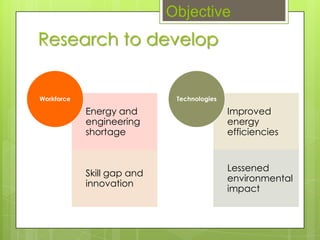
Objective
Research to develop


Workforce                    Technologies

            Energy and                      Improved
            engineering                     energy
            shortage                        efficiencies


                                            Lessened
            Skill gap and
                                            environmental
            innovation
                                            impact
Industry needs
    Impending               Retirements
       ⌂ > 50% of current workers will be eligible to retire or
       will leave for other reasons in the next five to ten years.
       ⌂ Nearly 49 percent of employees who operate gas
       and coal-fired generation will be eligible to leave
       (CEWD report, 2010)


    Shrinking           Labor Pool, Knowledge and Skill Gaps
       ⌂ Projected in the next 20 years, there will be virtually
       no growth in the “prime age workforce” (those
       between the ages of 25 and 54)
       ⌂ Growth in the labor force will probably be sought
       from older workers, immigrants, and other
       underutilized labor pools¥
¥ The Aspen Institute, Domestic Strategy Group. Grow Faster Together or Grow Slowly Apart. How will America
Work in the 21st Century. p 11.
Industry needs
   Increasing Energy Demand
    ⌂ Between 2008 and 2035, demand for petroleum and
    other liquid fuels will increase by 26.9 million barrels a
    day, consumption of natural gas is forecast to rise 52
    percent, to 169 trillion cubic feet.£

   Increasing Concern on Environmental Impact
    ⌂ Energy-related emissions of carbon dioxide will rise 43
    percent, to 43.2 billion metric tons, from 2008 to 2035.£


   Economic Growth
    ⌂ Two-thirds of America’s economic growth in the 1990s
    resulted from the introduction of new technologies;
    sufficient supplies of affordable energy are needed for
    every sector of the economy. ¤
 £ Energy Information Administration, 2011; ¤ Bureau of Economic Analysis, Gross-Domestic-Product-By-
Industry Accounts, 2010
Industry needs

   Transition to a low carbon economy
       Transformation changes in energy
        production, conversion, and utilization sciences and
        engineering
       Clean, affordable and abundant energy for a carbon
        constrained future
       Climate sustainability is the new paradigm of energy
        engineering


   Future energy and climate R& D challenges are
    complex
       Need for significant R&D across discipline boundaries
National needs
   Cutting the dropout rate by half would yield over $45 billion
   annually in additional federal tax revenues… and $319 billion
   for the economy.
                ~ Columbia University (2009), Alliance for Excellent Education (2008)


1/3 of U.S. manufacturing
companies stated they are
suffering from some level of                 Typical college graduate paid over
skills shortage.                             100% more in federal income taxes
~People and profitability: A time for        and about 82% more in total
change (2009)                                federal, state, and local taxes than the
                                             typical high school graduate.
   Almost half US population
   does not know that electrons         ~ Trends in Higher Education (2005)
   are smaller than atoms..
   and only about half is aware that dinosaurs and humans never coexisted.
      NSB, 2010, Appendix Table 7-10; National Science Board
      (NSB), Science and Engineering Indicators 2002
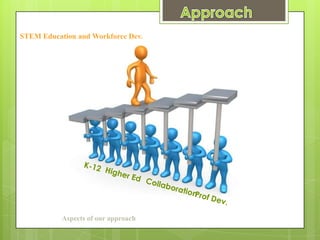
STEM Education and Workforce Dev.


           Aspects of our approach
Education
  Deliver effective technical
  content with diverse delivery
  methods,    mix   theoretical
  learning with application
                                  Human Resource
  and hands-on learning, to       Development
  include research and projects     Provide
  where      able.    Structure     paths, opportunities, inspirati
  programs,     content    and      on and support toward STEM
  research to meet the skill        degrees and careers for K-
  needs      of     future          doctoral.    Utilize    a
  employers, with emphasis          growing, diverse population
  on energy, aerospace and          to  tap    underserved and
  engineering needs                 underrepresented groups in
                                    STEM. Develop an industry-
                                    ready      workforce   with
                                    technical and professional
                                    competencies       through
                                    professional   development
                                    programs, and industry best
                                    practices.
Research and Technical Development
  Use research opportunities to deliver quality results that are
  modern and progressively relevant while adopting
  industry best practices in design, build and test. Utilize
  research as a recruitment and retention tool.


Sustainability and Growth
  Maintain fluid, efficient operations in administration and
  management support by diversified funding. Ensure visibility
  and consistent tracking of results and benefits. Development
  and maintain effective partnerships. Build capacity and
  infrastructure.
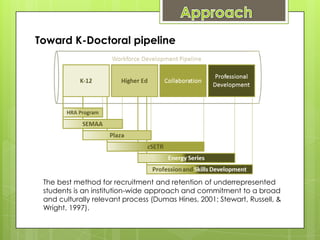
Toward K-Doctoral pipeline


 The best method for recruitment and retention of underrepresented
 students is an institution-wide approach and commitment to a broad
 and culturally relevant process (Dumas Hines, 2001; Stewart, Russell, &
 Wright, 1997).
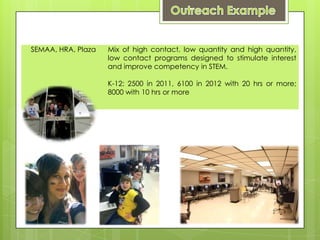
SEMAA, HRA, Plaza   Mix of high contact, low quantity and high quantity,
                    low contact programs designed to stimulate interest
                    and improve competency in STEM.

                    K-12: 2500 in 2011, 6100 in 2012 with 20 hrs or more;
                    8000 with 10 hrs or more
Undergraduate - Doctoral research:

  Fossil
        energy
  CO2 sequestrations
  Renewable and alternative energy
  Climate change and climate modeling
  Energy systems dynamics
  Economics of energy systems
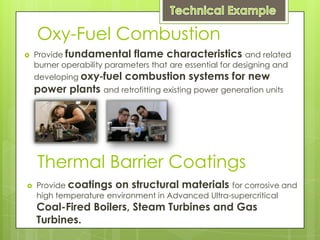
Oxy-Fuel Combustion
   Provide fundamental flame characteristics and related
    burner operability parameters that are essential for designing and
    developing oxy‐fuel    combustion systems for new
    power plants and retrofitting existing power generation units


    Thermal Barrier Coatings
   Provide coatings on structural materials for corrosive and
    high temperature environment in Advanced Ultra-supercritical
    Coal-Fired Boilers, Steam Turbines and Gas
    Turbines.
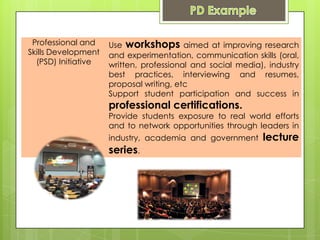
Professional and    Use workshops aimed at improving research
Skills Development   and experimentation, communication skills (oral,
  (PSD) Initiative   written, professional and social media), industry
                     best practices, interviewing and resumes,
                     proposal writing, etc
                     Support student participation and success in
                     professional certifications.
                     Provide students exposure to real world efforts
                     and to network opportunities through leaders in
                     industry, academia and government      lecture
                     series.
While logically (at least to us) this makes an effective, impactful
platform for STEM development, there has been insufficient time
and data to make statistical inferences on
correlation, impact, etc. Deficiencies toward this goal include:


  1. Need for comparative and equivalent data pre
     implementation for impact analysis
  2. Lack of engineering concepts in 6-12th grade
     curriculum (for both generating conceptual
     understanding, application, career perspectives and
     interest in S&E among K-12 students)
  3. Lack of social bonding and network programs
1. Industry ready, professional developed, well educated
  workforce
2. Ethnically diverse workforce
3. Improved recruitment, retention and performance of
  students in STEM higher ed., K-12
4. Closer collaboration between workforce generators
  (higher ed., ISDs, etc) and workforce employers
5. Research that provides pertinent, applicable
  data, technologies and solutions
2012 ReEnergize the Americas 2B: Nathanial Robinson

2012 ReEnergize the Americas 2B: Nathanial Robinson

  • 1.
    Energy Engineering Workforce Development Re-Energize the Americas 2012 Session 2B: Regional Capacities in Nate Robinson, P.E. Advanced Energy Engineering Center for Space Exploration Research and Development Technology Research – UTEP
  • 2.
    Objective Research to develop Workforce Technologies Energy and Improved engineering energy shortage efficiencies Lessened Skill gap and environmental innovation impact
  • 3.
    Industry needs  Impending Retirements ⌂ > 50% of current workers will be eligible to retire or will leave for other reasons in the next five to ten years. ⌂ Nearly 49 percent of employees who operate gas and coal-fired generation will be eligible to leave (CEWD report, 2010)  Shrinking Labor Pool, Knowledge and Skill Gaps ⌂ Projected in the next 20 years, there will be virtually no growth in the “prime age workforce” (those between the ages of 25 and 54) ⌂ Growth in the labor force will probably be sought from older workers, immigrants, and other underutilized labor pools¥ ¥ The Aspen Institute, Domestic Strategy Group. Grow Faster Together or Grow Slowly Apart. How will America Work in the 21st Century. p 11.
  • 4.
    Industry needs  Increasing Energy Demand ⌂ Between 2008 and 2035, demand for petroleum and other liquid fuels will increase by 26.9 million barrels a day, consumption of natural gas is forecast to rise 52 percent, to 169 trillion cubic feet.£  Increasing Concern on Environmental Impact ⌂ Energy-related emissions of carbon dioxide will rise 43 percent, to 43.2 billion metric tons, from 2008 to 2035.£  Economic Growth ⌂ Two-thirds of America’s economic growth in the 1990s resulted from the introduction of new technologies; sufficient supplies of affordable energy are needed for every sector of the economy. ¤ £ Energy Information Administration, 2011; ¤ Bureau of Economic Analysis, Gross-Domestic-Product-By- Industry Accounts, 2010
  • 5.
    Industry needs  Transition to a low carbon economy  Transformation changes in energy production, conversion, and utilization sciences and engineering  Clean, affordable and abundant energy for a carbon constrained future  Climate sustainability is the new paradigm of energy engineering  Future energy and climate R& D challenges are complex  Need for significant R&D across discipline boundaries
  • 6.
    National needs Cutting the dropout rate by half would yield over $45 billion annually in additional federal tax revenues… and $319 billion for the economy. ~ Columbia University (2009), Alliance for Excellent Education (2008) 1/3 of U.S. manufacturing companies stated they are suffering from some level of Typical college graduate paid over skills shortage. 100% more in federal income taxes ~People and profitability: A time for and about 82% more in total change (2009) federal, state, and local taxes than the typical high school graduate. Almost half US population does not know that electrons ~ Trends in Higher Education (2005) are smaller than atoms.. and only about half is aware that dinosaurs and humans never coexisted. NSB, 2010, Appendix Table 7-10; National Science Board (NSB), Science and Engineering Indicators 2002
  • 7.
    STEM Education andWorkforce Dev. Aspects of our approach
  • 8.
    Education Delivereffective technical content with diverse delivery methods, mix theoretical learning with application Human Resource and hands-on learning, to Development include research and projects Provide where able. Structure paths, opportunities, inspirati programs, content and on and support toward STEM research to meet the skill degrees and careers for K- needs of future doctoral. Utilize a employers, with emphasis growing, diverse population on energy, aerospace and to tap underserved and engineering needs underrepresented groups in STEM. Develop an industry- ready workforce with technical and professional competencies through professional development programs, and industry best practices.
  • 9.
    Research and TechnicalDevelopment Use research opportunities to deliver quality results that are modern and progressively relevant while adopting industry best practices in design, build and test. Utilize research as a recruitment and retention tool. Sustainability and Growth Maintain fluid, efficient operations in administration and management support by diversified funding. Ensure visibility and consistent tracking of results and benefits. Development and maintain effective partnerships. Build capacity and infrastructure.
  • 10.
    Toward K-Doctoral pipeline The best method for recruitment and retention of underrepresented students is an institution-wide approach and commitment to a broad and culturally relevant process (Dumas Hines, 2001; Stewart, Russell, & Wright, 1997).
  • 11.
    SEMAA, HRA, Plaza Mix of high contact, low quantity and high quantity, low contact programs designed to stimulate interest and improve competency in STEM. K-12: 2500 in 2011, 6100 in 2012 with 20 hrs or more; 8000 with 10 hrs or more
  • 12.
    Undergraduate - Doctoralresearch:  Fossil energy  CO2 sequestrations  Renewable and alternative energy  Climate change and climate modeling  Energy systems dynamics  Economics of energy systems
  • 13.
    Oxy-Fuel Combustion  Provide fundamental flame characteristics and related burner operability parameters that are essential for designing and developing oxy‐fuel combustion systems for new power plants and retrofitting existing power generation units Thermal Barrier Coatings  Provide coatings on structural materials for corrosive and high temperature environment in Advanced Ultra-supercritical Coal-Fired Boilers, Steam Turbines and Gas Turbines.
  • 14.
    Professional and Use workshops aimed at improving research Skills Development and experimentation, communication skills (oral, (PSD) Initiative written, professional and social media), industry best practices, interviewing and resumes, proposal writing, etc Support student participation and success in professional certifications. Provide students exposure to real world efforts and to network opportunities through leaders in industry, academia and government lecture series.
  • 15.
    While logically (atleast to us) this makes an effective, impactful platform for STEM development, there has been insufficient time and data to make statistical inferences on correlation, impact, etc. Deficiencies toward this goal include: 1. Need for comparative and equivalent data pre implementation for impact analysis 2. Lack of engineering concepts in 6-12th grade curriculum (for both generating conceptual understanding, application, career perspectives and interest in S&E among K-12 students) 3. Lack of social bonding and network programs
  • 16.
    1. Industry ready,professional developed, well educated workforce 2. Ethnically diverse workforce 3. Improved recruitment, retention and performance of students in STEM higher ed., K-12 4. Closer collaboration between workforce generators (higher ed., ISDs, etc) and workforce employers 5. Research that provides pertinent, applicable data, technologies and solutions

Editor's Notes

  • #14 - Flat flame, counter‐flow, and nozzle burners will be used to measure fundamental flame characteristics of CH4 (natural gas)/O2 and H2‐CO (syngas)/O2 combustion..Examples of syngas methods include steam reforming of natural gas, the gasification of coal, biomass, and in some types of waste-to-energy gasification facilities- Determining flame blowout and flashback limits of CH4/O2 and H2‐CO/O2 flames at different CO2 and O2 loadings and correlating them with the fundamental flame characteristics.