Career Advising for Students interested in STEM  Paul J. Kostek  IEEE-USA WOIS Conference 1 February  2010

STEM  Science, Technology, Engineering and Mathematics A universal call for increased enrollments must also address employment opportunity and the impact of a globalization on the technology workforce
Today’s Challenge Competition for talent  What steps are being taken to increase the numbers of students entering engineering? How is the current engineering workforce being utilized?  How will companies compete for talent, differentiate themselves and what impact will this have on business?  Where is the growth taking place outside the US and can we find ways to tap this?
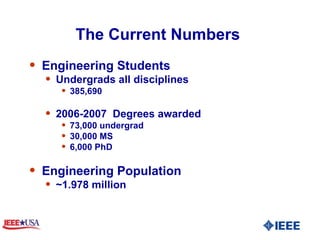
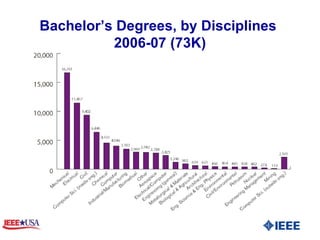
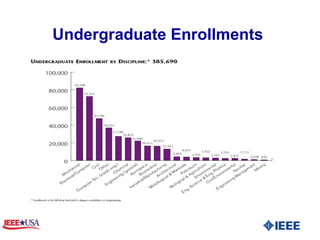
The Current Numbers  Engineering Students Undergrads all disciplines 385,690 2006-2007  Degrees awarded 73,000 undergrad 30,000 MS 6,000 PhD Engineering Population ~1.978 million
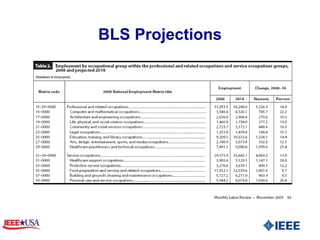
BLS Projections
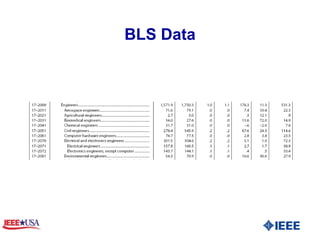
BLS Data
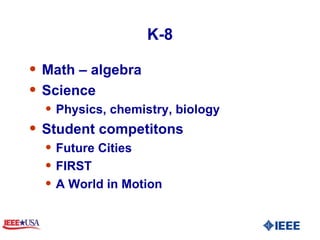
K-8 Math – algebra Science Physics, chemistry, biology Student competitons Future Cities FIRST A World in Motion
High School Math Calculus Physics Chemistry Foreign Language English Communications
What Students Need  Math & science are important as are good study skills Use your creativity and like designing things Like taking on big challenges and helping people solve problems Need good communications skill, teamwork and the ability to influence others
Educational  Opportunities  Certifications 3 months – 12 months  Industry driven – Cisco (CCNA), Microsoft (MCSE) Associate Degrees Types of jobs – network administrators/technician Bachelors Entry level for most engineering/high tech jobs ABET accreditation Graduate Specialized skills PhD R&D Academe
Bachelor’s Degrees, by Disciplines  2006-07 (73K)
Undergraduate Enrollments
What steps are being taken to increase the numbers of students entering engineering? K-12 initiatives Professional Societies Engineers in schools Job shadowing  IEEE-USA Future Cities  SAE Wheels in Motion  Trade Associations SIA Program to attract and retain undergrads Companies Intel Science Fair Siemens  Federal Government  COMPETES legislation (response to NAE Study- Rising Above the Gathering Storm)
Competing for Talent Industries Aerospace Computing (hardware and software) Web – based  Gaming Green Semiconductors Utilities Companies Google  Degrees growing in enrollments Bio-Med  Environmental / Civil Engineering
Where is the growth taking place outside the US and Competition for work India China Vietnam Russia Eastern European (Poland, Hungary)
The Current Population  The conversation,  whether in DC or Silicon Valley,  centers on the next generation  of engineers/scientists while seeming to forget there are over 1 million electrical engineers in the workforce. Where do they fit in? Are we utilizing our current population? Does retention matter? Does how we treat the current workforce impact the future workforce? Companies can now access engineers in Eastern Europe, Asia and India, what will the impact be for engineers here in the U.S.A.?  Do we need to graduate more engineers , the same, or less?
The 4 Generations  For the first time ever we have 4 generations in the workplace – WWII Baby Boomers Gen X Gen Y The challenge how to integrate these very different groups
Skills  The Challenge  For Engineers:  Identifying in-demand skills and positioning themselves to fill them through:  Training Applicable experience For Employers  Finding engineers with in-demand skills  Attracting/Retaining/ Training
The Skills Market Software  Java Web 2.0  Software as a service Virtualization IPv6 RF design Analog Design ASIC Nuclear
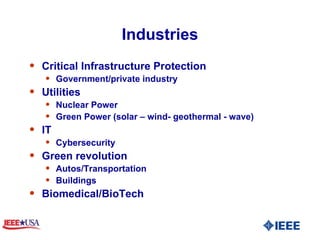
Industries Critical Infrastructure Protection Government/private industry Utilities  Nuclear Power Green Power (solar – wind- geothermal - wave) IT  Cybersecurity Green revolution Autos/Transportation  Buildings Biomedical/BioTech
Other Factors to Consider Productivity  Automation and tools  Skills  Training, gaining applicable experience and finding employment at appropriate level Impact of outsourcing and use of foreign temp labor
What About the Boomers? Working later, by choice or as a result of current economic situation  Large population that can be a resource to companies Options to consider –  Phased retirements Job sharing Telecommuting
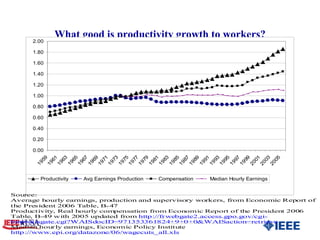
What good is productivity growth to workers?
Offshoring and the Long Term Impact on Engineers and Competitiveness Is offshoring the death knell for the engineering  profession in the U.S.?  Or will it lead to increased opportunities?  I believe the answer lies somewhere in between.  Offshoring will eliminate opportunities in some fields and industries, while opening up others.  The question is will we have trained people to take these positions and will they be positions people are interested in?  We shouldn’t presume that because positions are created that they will interest the current population.  How will we retrain and utilize engineers?  What incentives will be provided to the engineer to move into new fields and relocate?
Impact of In-Shoring We really don’t know the impact of  non – U.S. companies locating here.  How many U.S engineers are being employed? How many are bringing over their own employees – L1,  H-1B?  Could this lead to increased opportunity/challenges?
Competing in a Global Marketplace Doubling of global work force when China, India, x-Soviet join Human resource leapfrogging: developing countries invest in university education; multinationals spread modern technology    trade, offshoring, immigration Greater supply competition Shift in balance toward capital    More difficult for market forces to help workers  Source: Richard Freeman
Opportunities Technologies Software Semiconductors Sensors  Industries Power Telecom Defense and Homeland Security In-sourcing Semiconductor Automotive Applications
Realities of Competing in a Global Market The $800 engineer  A Russian engineer with 25 years experience vs a U.S. engineer with 25 years experience and a 96K salary If the work doesn’t involve national security or local customer interface – who gets the job?
Differentiating Yourself - Engineers Skills are not enough, engineers need to have:  Business knowledge New business models  Understand the customer’s needs Learn how to apply skills in new areas
New Ways of Thinking for Engineers  Technology: What are the key emerging technologies and how are they being used inside and outside your industry, company and region to create proprietary advantage? Business Models: Are there new business models emerging that you can adopt or adapt to deliver radical improvements in the way you and others do business? Will these improvements drive profitable growth by creating  proprietary advantages in the way you do business? Can you expand not just “your share of market” but also “your share of wallet” by adding new business models – for example – if you currently have a product business, can you add information, services or solutions?  Can you expand into adjacent businesses by either taking over activities that use to be done by someone else in your industry, expanding into new markets, or adding new products?  Source: Lynda Applegate Jump Starting Innovation HBR 9/24/07
Differentiating Yourself - Employers How do your differentiate your company from others?  What makes your company the one to work for? Money? Technology?  Flexibility?  Making a difference?  The “It” factor?
Legislative Reponse Legislative solutions to limit or prohibit offshoring will not succeed, however there will be a need to develop incentives for retraining and hiring of engineers.  The U.S. also has challenges when looking into having a population of engineers to work for the Federal government (and states also) along with developing the next  generation of defense systems and maintaining today’s systems.
Legislative/Policy Changes COMPETES – Focus is on STEM, R&D, currently under consideration for renewal - 2010 Tax incentives for companies, why not individuals – training, relocation
What Others Think Succeeding in the Global Economy A New Policy Agenda for the American Worker – Authors: Aldonas/Lawrence/Slaughter – Sponsor The Financial Services Forum  Calls for a new policy agenda with innovations to facilitate adjustment by workers, communities and firms
Adjustment Policies - Individuals Combine Unemployment insurance and current Trade Adjustment Assistance program into a single Integrated Adjustment Assistance program Wage insurance Portability of health insurance  Assistance with geographic relocation or establishing a new business retraining
What’s Happened Before? 1989 NSF Future Scarcities of Engineers and Scientists  Lead to similar effort, but by 1991 the Peace Dividend had kicked-in and engineering unemployment grew to new records – surpassed by DotCom implosion New Economy of the 90’s – DotCom We’re still impacted by what happened during this period
Conclusion Students that are flexible and open to change will find success Companies that are willing to be as innovative in employment as they are in technology  Provide opportunities and encourage employees to take control of their careers and contribute to the success of the business
Thank You !
Resources Succeeding in the Global Economy available at: www.financialservicesforum.org IEEE-USA Website – ieeeusa.org EETimes www.eetimes.com The Offshoring of Engineering – National Academy of Engineering – www.national-academies.org  Michael T. Gibbons - Engineering by the Numbers – ASEE.org/colleges
Other Factors to Consider Salaries  We’re not seeing salaries for professionals climb at a rate that shows a shortage New Grads CS $53,000  (vs $60K in 2000) EE $51,000 Working professionals 20 year EE – $108K  (EE Times Salary Survey) w/avg increase 4%

Wois Feburary 2010

  • 1.
    Career Advising forStudents interested in STEM Paul J. Kostek IEEE-USA WOIS Conference 1 February 2010
  • 2.
    STEM Science,Technology, Engineering and Mathematics A universal call for increased enrollments must also address employment opportunity and the impact of a globalization on the technology workforce
  • 3.
    Today’s Challenge Competitionfor talent What steps are being taken to increase the numbers of students entering engineering? How is the current engineering workforce being utilized? How will companies compete for talent, differentiate themselves and what impact will this have on business? Where is the growth taking place outside the US and can we find ways to tap this?
  • 4.
    The Current Numbers Engineering Students Undergrads all disciplines 385,690 2006-2007 Degrees awarded 73,000 undergrad 30,000 MS 6,000 PhD Engineering Population ~1.978 million
  • 5.
  • 6.
  • 7.
    K-8 Math –algebra Science Physics, chemistry, biology Student competitons Future Cities FIRST A World in Motion
  • 8.
    High School MathCalculus Physics Chemistry Foreign Language English Communications
  • 9.
    What Students Need Math & science are important as are good study skills Use your creativity and like designing things Like taking on big challenges and helping people solve problems Need good communications skill, teamwork and the ability to influence others
  • 10.
    Educational Opportunities Certifications 3 months – 12 months Industry driven – Cisco (CCNA), Microsoft (MCSE) Associate Degrees Types of jobs – network administrators/technician Bachelors Entry level for most engineering/high tech jobs ABET accreditation Graduate Specialized skills PhD R&D Academe
  • 11.
    Bachelor’s Degrees, byDisciplines 2006-07 (73K)
  • 12.
  • 13.
    What steps arebeing taken to increase the numbers of students entering engineering? K-12 initiatives Professional Societies Engineers in schools Job shadowing IEEE-USA Future Cities SAE Wheels in Motion Trade Associations SIA Program to attract and retain undergrads Companies Intel Science Fair Siemens Federal Government COMPETES legislation (response to NAE Study- Rising Above the Gathering Storm)
  • 14.
    Competing for TalentIndustries Aerospace Computing (hardware and software) Web – based Gaming Green Semiconductors Utilities Companies Google Degrees growing in enrollments Bio-Med Environmental / Civil Engineering
  • 15.
    Where is thegrowth taking place outside the US and Competition for work India China Vietnam Russia Eastern European (Poland, Hungary)
  • 16.
    The Current Population The conversation, whether in DC or Silicon Valley, centers on the next generation of engineers/scientists while seeming to forget there are over 1 million electrical engineers in the workforce. Where do they fit in? Are we utilizing our current population? Does retention matter? Does how we treat the current workforce impact the future workforce? Companies can now access engineers in Eastern Europe, Asia and India, what will the impact be for engineers here in the U.S.A.? Do we need to graduate more engineers , the same, or less?
  • 17.
    The 4 Generations For the first time ever we have 4 generations in the workplace – WWII Baby Boomers Gen X Gen Y The challenge how to integrate these very different groups
  • 18.
    Skills TheChallenge For Engineers: Identifying in-demand skills and positioning themselves to fill them through: Training Applicable experience For Employers Finding engineers with in-demand skills Attracting/Retaining/ Training
  • 19.
    The Skills MarketSoftware Java Web 2.0 Software as a service Virtualization IPv6 RF design Analog Design ASIC Nuclear
  • 20.
    Industries Critical InfrastructureProtection Government/private industry Utilities Nuclear Power Green Power (solar – wind- geothermal - wave) IT Cybersecurity Green revolution Autos/Transportation Buildings Biomedical/BioTech
  • 21.
    Other Factors toConsider Productivity Automation and tools Skills Training, gaining applicable experience and finding employment at appropriate level Impact of outsourcing and use of foreign temp labor
  • 22.
    What About theBoomers? Working later, by choice or as a result of current economic situation Large population that can be a resource to companies Options to consider – Phased retirements Job sharing Telecommuting
  • 23.
    What good isproductivity growth to workers?
  • 24.
    Offshoring and theLong Term Impact on Engineers and Competitiveness Is offshoring the death knell for the engineering profession in the U.S.? Or will it lead to increased opportunities? I believe the answer lies somewhere in between. Offshoring will eliminate opportunities in some fields and industries, while opening up others. The question is will we have trained people to take these positions and will they be positions people are interested in? We shouldn’t presume that because positions are created that they will interest the current population. How will we retrain and utilize engineers? What incentives will be provided to the engineer to move into new fields and relocate?
  • 25.
    Impact of In-ShoringWe really don’t know the impact of non – U.S. companies locating here. How many U.S engineers are being employed? How many are bringing over their own employees – L1, H-1B? Could this lead to increased opportunity/challenges?
  • 26.
    Competing in aGlobal Marketplace Doubling of global work force when China, India, x-Soviet join Human resource leapfrogging: developing countries invest in university education; multinationals spread modern technology  trade, offshoring, immigration Greater supply competition Shift in balance toward capital  More difficult for market forces to help workers Source: Richard Freeman
  • 27.
    Opportunities Technologies SoftwareSemiconductors Sensors Industries Power Telecom Defense and Homeland Security In-sourcing Semiconductor Automotive Applications
  • 28.
    Realities of Competingin a Global Market The $800 engineer A Russian engineer with 25 years experience vs a U.S. engineer with 25 years experience and a 96K salary If the work doesn’t involve national security or local customer interface – who gets the job?
  • 29.
    Differentiating Yourself -Engineers Skills are not enough, engineers need to have: Business knowledge New business models Understand the customer’s needs Learn how to apply skills in new areas
  • 30.
    New Ways ofThinking for Engineers Technology: What are the key emerging technologies and how are they being used inside and outside your industry, company and region to create proprietary advantage? Business Models: Are there new business models emerging that you can adopt or adapt to deliver radical improvements in the way you and others do business? Will these improvements drive profitable growth by creating proprietary advantages in the way you do business? Can you expand not just “your share of market” but also “your share of wallet” by adding new business models – for example – if you currently have a product business, can you add information, services or solutions? Can you expand into adjacent businesses by either taking over activities that use to be done by someone else in your industry, expanding into new markets, or adding new products? Source: Lynda Applegate Jump Starting Innovation HBR 9/24/07
  • 31.
    Differentiating Yourself -Employers How do your differentiate your company from others? What makes your company the one to work for? Money? Technology? Flexibility? Making a difference? The “It” factor?
  • 32.
    Legislative Reponse Legislativesolutions to limit or prohibit offshoring will not succeed, however there will be a need to develop incentives for retraining and hiring of engineers. The U.S. also has challenges when looking into having a population of engineers to work for the Federal government (and states also) along with developing the next generation of defense systems and maintaining today’s systems.
  • 33.
    Legislative/Policy Changes COMPETES– Focus is on STEM, R&D, currently under consideration for renewal - 2010 Tax incentives for companies, why not individuals – training, relocation
  • 34.
    What Others ThinkSucceeding in the Global Economy A New Policy Agenda for the American Worker – Authors: Aldonas/Lawrence/Slaughter – Sponsor The Financial Services Forum Calls for a new policy agenda with innovations to facilitate adjustment by workers, communities and firms
  • 35.
    Adjustment Policies -Individuals Combine Unemployment insurance and current Trade Adjustment Assistance program into a single Integrated Adjustment Assistance program Wage insurance Portability of health insurance Assistance with geographic relocation or establishing a new business retraining
  • 36.
    What’s Happened Before?1989 NSF Future Scarcities of Engineers and Scientists Lead to similar effort, but by 1991 the Peace Dividend had kicked-in and engineering unemployment grew to new records – surpassed by DotCom implosion New Economy of the 90’s – DotCom We’re still impacted by what happened during this period
  • 37.
    Conclusion Students thatare flexible and open to change will find success Companies that are willing to be as innovative in employment as they are in technology Provide opportunities and encourage employees to take control of their careers and contribute to the success of the business
  • 38.
  • 39.
    Resources Succeeding inthe Global Economy available at: www.financialservicesforum.org IEEE-USA Website – ieeeusa.org EETimes www.eetimes.com The Offshoring of Engineering – National Academy of Engineering – www.national-academies.org Michael T. Gibbons - Engineering by the Numbers – ASEE.org/colleges
  • 40.
    Other Factors toConsider Salaries We’re not seeing salaries for professionals climb at a rate that shows a shortage New Grads CS $53,000 (vs $60K in 2000) EE $51,000 Working professionals 20 year EE – $108K (EE Times Salary Survey) w/avg increase 4%