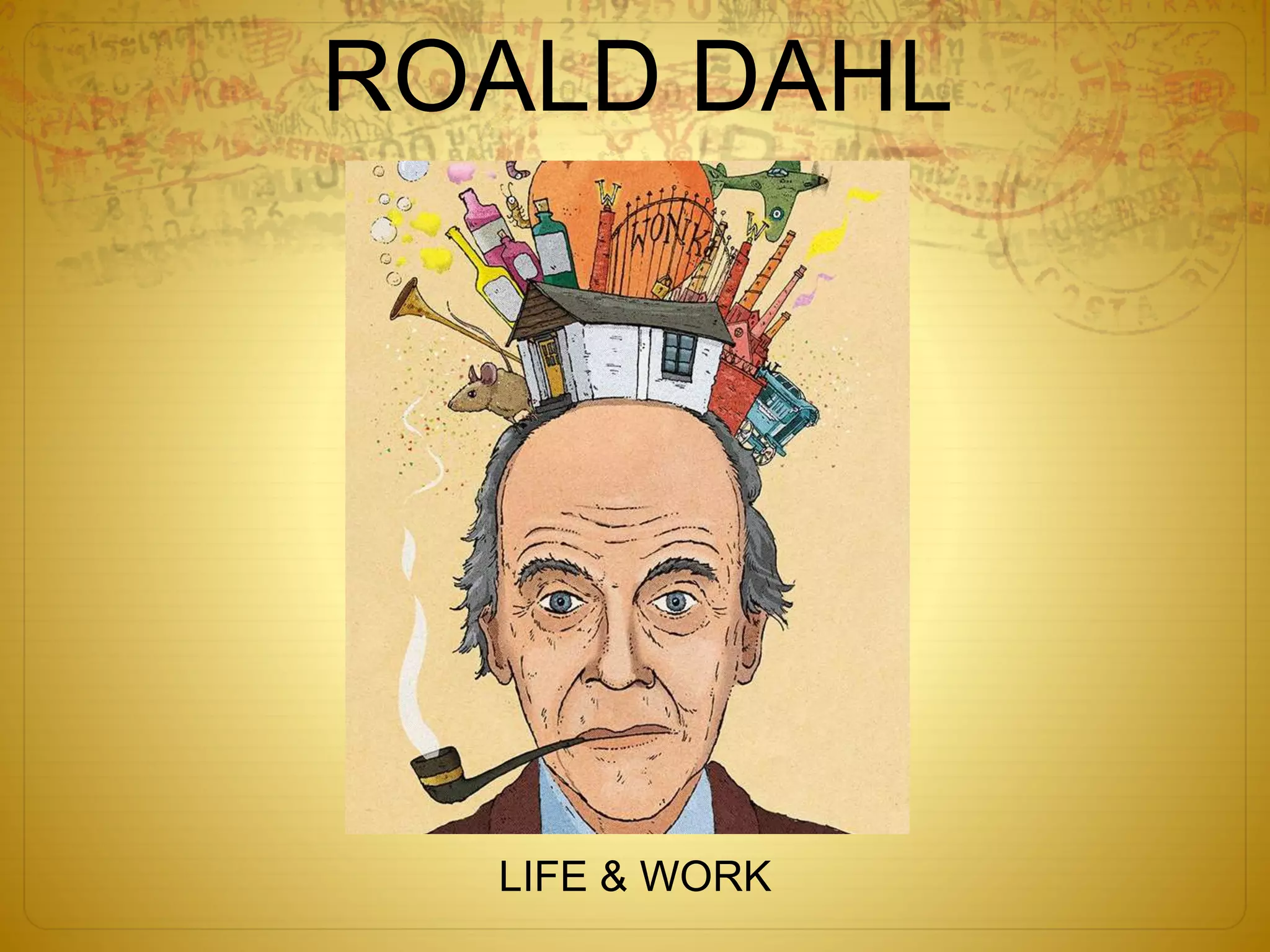
ROALD DAHL
LIFE & WORK
BIOGRAPHY
Roald Dahl’s parents were Norwegian (from Norway). As a child, he spent his
summer vacations visiting with his grandparents in Oslo (the capital of Norway).
When Dahl was four years old, his father died.
He received education at several schools (Llandaff Cathedral School, St. Peter's,
Repton) because he was transferred from one to another due to his behaviour (he
was quite mischievous). When he graduated from Repton, his mother wanted him
to go to University, but he refused. He just wanted to work for a company that would
send him to wonderful places like Africa or China.
 Name: Roald Dahl.
 Occupation: Writer / Author /
Screenwriter.
 Birth date: September 13, 1916.
 Place of birth: Llandaff, Cardiff, South
Wales, U.K.
 Death date: November 23, 1990, at the
age of 74. He suffered an unspecified
infection.
 Place of death: Oxford, England, UK.
BIOGRAPHY
Dahl worked in places like Canada (North
America) and Tanzania (Africa). In 1939, he
joined the Royal Air Force and, after training in
Nairobi, Kenya, he became a World War II
fighter pilot. One day, his plane crashed in
Alexandria, Egypt, and left him injuries in his
skull, spine and hip. Then, he was transferred to
Washington DC (the capital of the USA), where
he became an assistant air attaché.
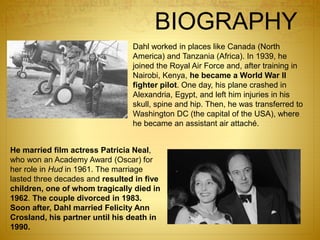
He married film actress Patricia Neal,
who won an Academy Award (Oscar) for
her role in Hud in 1961. The marriage
lasted three decades and resulted in five
children, one of whom tragically died in
1962. The couple divorced in 1983.
Soon after, Dahl married Felicity Ann
Crosland, his partner until his death in
1990.
CURIOSITIES
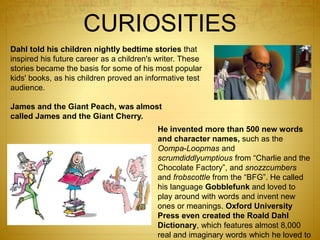
Dahl told his children nightly bedtime stories that
inspired his future career as a children's writer. These
stories became the basis for some of his most popular
kids' books, as his children proved an informative test
audience.
He invented more than 500 new words
and character names, such as the
Oompa-Loopmas and
scrumdiddlyumptious from “Charlie and the
Chocolate Factory”, and snozzcumbers
and frobscottle from the “BFG”. He called
his language Gobblefunk and loved to
play around with words and invent new
ones or meanings. Oxford University
Press even created the Roald Dahl
Dictionary, which features almost 8,000
real and imaginary words which he loved to
James and the Giant Peach, was almost
called James and the Giant Cherry.
CURIOSITIES
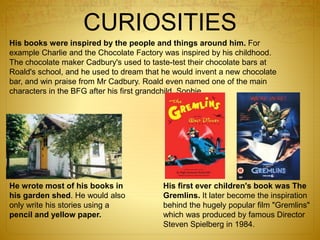
He wrote most of his books in
his garden shed. He would also
only write his stories using a
pencil and yellow paper.
His books were inspired by the people and things around him. For
example Charlie and the Chocolate Factory was inspired by his childhood.
The chocolate maker Cadbury's used to taste-test their chocolate bars at
Roald's school, and he used to dream that he would invent a new chocolate
bar, and win praise from Mr Cadbury. Roald even named one of the main
characters in the BFG after his first grandchild, Sophie.
His first ever children's book was The
Gremlins. It later become the inspiration
behind the hugely popular film "Gremlins"
which was produced by famous Director
Steven Spielberg in 1984.
CURIOSITIES
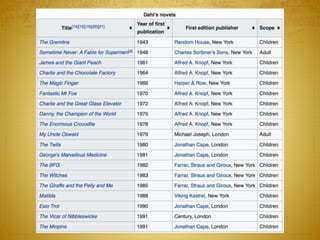
His books have sold more than 250
million copies worldwide. He wrote 19
novels.
Dahl's short stories are known for their unexpected endings, and his children's
books for their unsentimental, macabre, often darkly comic mood, featuring
villainous adult enemies of the child characters. Dahl's children's works are
usually told from the point of view of a child. They typically involve adult villains who
hate and mistreat children, and feature at least one "good" adult to counteract the
villain(s).[6] These stock characters are possibly a reference to the abuse that Dahl
stated that he experienced in the boarding schools he attended.
CHARLIE AND THE
CHOCOLATE FACTORY
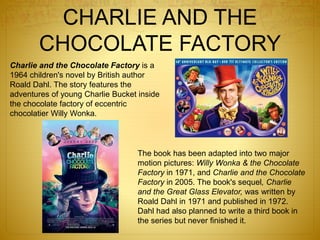
Charlie and the Chocolate Factory is a
1964 children's novel by British author
Roald Dahl. The story features the
adventures of young Charlie Bucket inside
the chocolate factory of eccentric
chocolatier Willy Wonka.
The book has been adapted into two major
motion pictures: Willy Wonka & the Chocolate
Factory in 1971, and Charlie and the Chocolate
Factory in 2005. The book's sequel, Charlie
and the Great Glass Elevator, was written by
Roald Dahl in 1971 and published in 1972.
Dahl had also planned to write a third book in
the series but never finished it.
CHARLIE AND THE
CHOCOLATE FACTORY
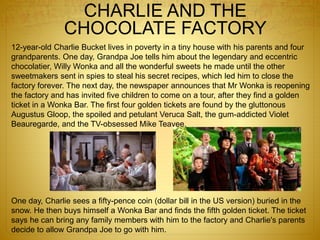
12-year-old Charlie Bucket lives in poverty in a tiny house with his parents and four
grandparents. One day, Grandpa Joe tells him about the legendary and eccentric
chocolatier, Willy Wonka and all the wonderful sweets he made until the other
sweetmakers sent in spies to steal his secret recipes, which led him to close the
factory forever. The next day, the newspaper announces that Mr Wonka is reopening
the factory and has invited five children to come on a tour, after they find a golden
ticket in a Wonka Bar. The first four golden tickets are found by the gluttonous
Augustus Gloop, the spoiled and petulant Veruca Salt, the gum-addicted Violet
Beauregarde, and the TV-obsessed Mike Teavee.
One day, Charlie sees a fifty-pence coin (dollar bill in the US version) buried in the
snow. He then buys himself a Wonka Bar and finds the fifth golden ticket. The ticket
says he can bring any family members with him to the factory and Charlie's parents
decide to allow Grandpa Joe to go with him.
CHARLIE AND THE
CHOCOLATE FACTORY
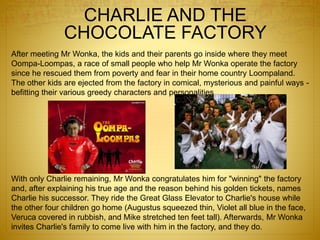
After meeting Mr Wonka, the kids and their parents go inside where they meet
Oompa-Loompas, a race of small people who help Mr Wonka operate the factory
since he rescued them from poverty and fear in their home country Loompaland.
The other kids are ejected from the factory in comical, mysterious and painful ways -
befitting their various greedy characters and personalities.
With only Charlie remaining, Mr Wonka congratulates him for "winning" the factory
and, after explaining his true age and the reason behind his golden tickets, names
Charlie his successor. They ride the Great Glass Elevator to Charlie's house while
the other four children go home (Augustus squeezed thin, Violet all blue in the face,
Veruca covered in rubbish, and Mike stretched ten feet tall). Afterwards, Mr Wonka
invites Charlie's family to come live with him in the factory, and they do.
CHARACTERS & PERSONALITIES
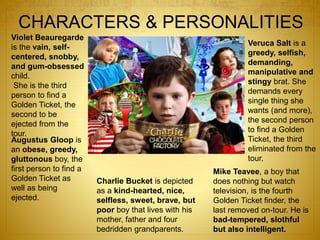
Augustus Gloop is
an obese, greedy,
gluttonous boy, the
first person to find a
Golden Ticket as
well as being
ejected.
Violet Beauregarde
is the vain, self-
centered, snobby,
and gum-obsessed
child.
She is the third
person to find a
Golden Ticket, the
second to be
ejected from the
tour.
Veruca Salt is a
greedy, selfish,
demanding,
manipulative and
stingy brat. She
demands every
single thing she
wants (and more),
the second person
to find a Golden
Ticket, the third
eliminated from the
tour.
Mike Teavee, a boy that
does nothing but watch
television, is the fourth
Golden Ticket finder, the
last removed on-tour. He is
bad-tempered, slothful
but also intelligent.
Charlie Bucket is depicted
as a kind-hearted, nice,
selfless, sweet, brave, but
poor boy that lives with his
mother, father and four
bedridden grandparents.
OTHER BOOKS
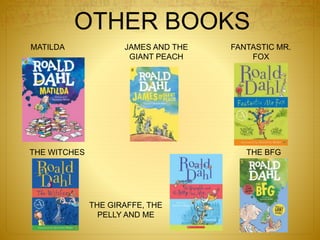
MATILDA
THE GIRAFFE, THE
PELLY AND ME
JAMES AND THE
GIANT PEACH
THE BFGTHE WITCHES
FANTASTIC MR.
FOX

Roald dahl

  • 1.
  • 2.
    BIOGRAPHY Roald Dahl’s parentswere Norwegian (from Norway). As a child, he spent his summer vacations visiting with his grandparents in Oslo (the capital of Norway). When Dahl was four years old, his father died. He received education at several schools (Llandaff Cathedral School, St. Peter's, Repton) because he was transferred from one to another due to his behaviour (he was quite mischievous). When he graduated from Repton, his mother wanted him to go to University, but he refused. He just wanted to work for a company that would send him to wonderful places like Africa or China.  Name: Roald Dahl.  Occupation: Writer / Author / Screenwriter.  Birth date: September 13, 1916.  Place of birth: Llandaff, Cardiff, South Wales, U.K.  Death date: November 23, 1990, at the age of 74. He suffered an unspecified infection.  Place of death: Oxford, England, UK.
  • 3.
    BIOGRAPHY Dahl worked inplaces like Canada (North America) and Tanzania (Africa). In 1939, he joined the Royal Air Force and, after training in Nairobi, Kenya, he became a World War II fighter pilot. One day, his plane crashed in Alexandria, Egypt, and left him injuries in his skull, spine and hip. Then, he was transferred to Washington DC (the capital of the USA), where he became an assistant air attaché. He married film actress Patricia Neal, who won an Academy Award (Oscar) for her role in Hud in 1961. The marriage lasted three decades and resulted in five children, one of whom tragically died in 1962. The couple divorced in 1983. Soon after, Dahl married Felicity Ann Crosland, his partner until his death in 1990.
  • 4.
    CURIOSITIES Dahl told hischildren nightly bedtime stories that inspired his future career as a children's writer. These stories became the basis for some of his most popular kids' books, as his children proved an informative test audience. He invented more than 500 new words and character names, such as the Oompa-Loopmas and scrumdiddlyumptious from “Charlie and the Chocolate Factory”, and snozzcumbers and frobscottle from the “BFG”. He called his language Gobblefunk and loved to play around with words and invent new ones or meanings. Oxford University Press even created the Roald Dahl Dictionary, which features almost 8,000 real and imaginary words which he loved to James and the Giant Peach, was almost called James and the Giant Cherry.
  • 5.
    CURIOSITIES He wrote mostof his books in his garden shed. He would also only write his stories using a pencil and yellow paper. His books were inspired by the people and things around him. For example Charlie and the Chocolate Factory was inspired by his childhood. The chocolate maker Cadbury's used to taste-test their chocolate bars at Roald's school, and he used to dream that he would invent a new chocolate bar, and win praise from Mr Cadbury. Roald even named one of the main characters in the BFG after his first grandchild, Sophie. His first ever children's book was The Gremlins. It later become the inspiration behind the hugely popular film "Gremlins" which was produced by famous Director Steven Spielberg in 1984.
  • 6.
    CURIOSITIES His books havesold more than 250 million copies worldwide. He wrote 19 novels. Dahl's short stories are known for their unexpected endings, and his children's books for their unsentimental, macabre, often darkly comic mood, featuring villainous adult enemies of the child characters. Dahl's children's works are usually told from the point of view of a child. They typically involve adult villains who hate and mistreat children, and feature at least one "good" adult to counteract the villain(s).[6] These stock characters are possibly a reference to the abuse that Dahl stated that he experienced in the boarding schools he attended.
  • 8.
    CHARLIE AND THE CHOCOLATEFACTORY Charlie and the Chocolate Factory is a 1964 children's novel by British author Roald Dahl. The story features the adventures of young Charlie Bucket inside the chocolate factory of eccentric chocolatier Willy Wonka. The book has been adapted into two major motion pictures: Willy Wonka & the Chocolate Factory in 1971, and Charlie and the Chocolate Factory in 2005. The book's sequel, Charlie and the Great Glass Elevator, was written by Roald Dahl in 1971 and published in 1972. Dahl had also planned to write a third book in the series but never finished it.
  • 9.
    CHARLIE AND THE CHOCOLATEFACTORY 12-year-old Charlie Bucket lives in poverty in a tiny house with his parents and four grandparents. One day, Grandpa Joe tells him about the legendary and eccentric chocolatier, Willy Wonka and all the wonderful sweets he made until the other sweetmakers sent in spies to steal his secret recipes, which led him to close the factory forever. The next day, the newspaper announces that Mr Wonka is reopening the factory and has invited five children to come on a tour, after they find a golden ticket in a Wonka Bar. The first four golden tickets are found by the gluttonous Augustus Gloop, the spoiled and petulant Veruca Salt, the gum-addicted Violet Beauregarde, and the TV-obsessed Mike Teavee. One day, Charlie sees a fifty-pence coin (dollar bill in the US version) buried in the snow. He then buys himself a Wonka Bar and finds the fifth golden ticket. The ticket says he can bring any family members with him to the factory and Charlie's parents decide to allow Grandpa Joe to go with him.
  • 10.
    CHARLIE AND THE CHOCOLATEFACTORY After meeting Mr Wonka, the kids and their parents go inside where they meet Oompa-Loompas, a race of small people who help Mr Wonka operate the factory since he rescued them from poverty and fear in their home country Loompaland. The other kids are ejected from the factory in comical, mysterious and painful ways - befitting their various greedy characters and personalities. With only Charlie remaining, Mr Wonka congratulates him for "winning" the factory and, after explaining his true age and the reason behind his golden tickets, names Charlie his successor. They ride the Great Glass Elevator to Charlie's house while the other four children go home (Augustus squeezed thin, Violet all blue in the face, Veruca covered in rubbish, and Mike stretched ten feet tall). Afterwards, Mr Wonka invites Charlie's family to come live with him in the factory, and they do.
  • 11.
    CHARACTERS & PERSONALITIES AugustusGloop is an obese, greedy, gluttonous boy, the first person to find a Golden Ticket as well as being ejected. Violet Beauregarde is the vain, self- centered, snobby, and gum-obsessed child. She is the third person to find a Golden Ticket, the second to be ejected from the tour. Veruca Salt is a greedy, selfish, demanding, manipulative and stingy brat. She demands every single thing she wants (and more), the second person to find a Golden Ticket, the third eliminated from the tour. Mike Teavee, a boy that does nothing but watch television, is the fourth Golden Ticket finder, the last removed on-tour. He is bad-tempered, slothful but also intelligent. Charlie Bucket is depicted as a kind-hearted, nice, selfless, sweet, brave, but poor boy that lives with his mother, father and four bedridden grandparents.
  • 12.
    OTHER BOOKS MATILDA THE GIRAFFE,THE PELLY AND ME JAMES AND THE GIANT PEACH THE BFGTHE WITCHES FANTASTIC MR. FOX