

BORN: June 27, 1880
BORN IN: Tuscumbia, Alabama, USA
FAMOUS: American Author & Educator
DISEASES AND DISABILITIES:
Visual Impairment
QUICK FACTS

 At the age of 19 months old she was
afflicted by an illness(scarlet
fever/meningitis) that left her blind and
deaf.
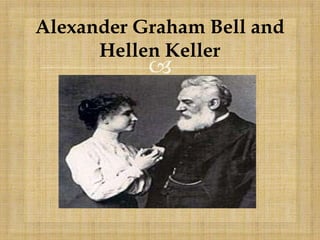
 When Helen was 6 years old, she was
examined by Alexander Graham Bell who
was the local expert on the problems of
children who are deaf.
EARLY LIFE

Alexander Graham Bell and
Hellen Keller

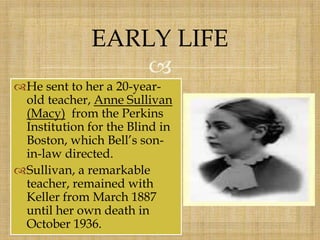
He sent to her a 20-year-
old teacher, Anne Sullivan
(Macy) from the Perkins
Institution for the Blind in
Boston, which Bell’s son-
in-law directed.
Sullivan, a remarkable
teacher, remained with
Keller from March 1887
until her own death in
October 1936.
EARLY LIFE

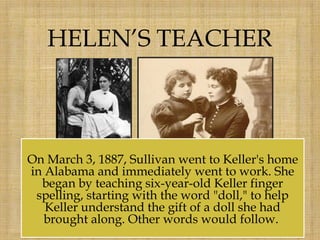
On March 3, 1887, Sullivan went to Keller's home
in Alabama and immediately went to work. She
began by teaching six-year-old Keller finger
spelling, starting with the word "doll," to help
Keller understand the gift of a doll she had
brought along. Other words would follow.
HELEN’S TEACHER

At first, Keller was curious, then defiant,
refusing to cooperate with Sullivan's
instruction. When Keller did cooperate,
Sullivan could tell that she wasn't making the
connection between the objects and the letters
spelled out in her hand.
Sullivan kept working at it, forcing Keller to go
through the regimen.
STRUGGLES DURING
STUDYING

As Keller's frustration grew, the tantrums
increased.
Finally, Sullivan demanded that she and
Keller be isolated from the rest of the family
for a time, so that Keller could concentrate
only on Sullivan's instruction. They moved
to a cottage on the plantation.
STRUGGLES DURING
STUDYING

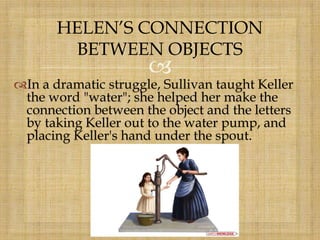
In a dramatic struggle, Sullivan taught Keller
the word "water"; she helped her make the
connection between the object and the letters
by taking Keller out to the water pump, and
placing Keller's hand under the spout.
HELEN’S CONNECTION
BETWEEN OBJECTS
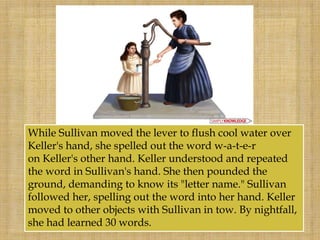
While Sullivan moved the lever to flush cool water over
Keller's hand, she spelled out the word w-a-t-e-r
on Keller's other hand. Keller understood and repeated
the word in Sullivan's hand. She then pounded the
ground, demanding to know its "letter name." Sullivan
followed her, spelling out the word into her hand. Keller
moved to other objects with Sullivan in tow. By nightfall,
she had learned 30 words.

In 1890, Keller began speech classes at
the Horace Mann School for the Deaf in
Boston. She would toil for 25 years to learn to
speak so that others could understand her.
From 1894 to 1896, Keller attended the Wright-
Humason School for the Deaf in New York
City. There, she worked on improving her
communication skills and studied regular
academic subjects.
EDUCATION

Around this time, Keller became determined
to attend college. In 1896, she attended the
Cambridge School for Young Ladies, a
preparatory school for women.
As her story became known to the general
public, Keller began to meet famous and
influential people. One of them was the
writer Mark Twain, who was very impressed
with her. They became friends. Twain
introduced her to his friend Henry H. Rogers,
a Standard Oil executive.
EDUCATION

Rogers was so impressed with Keller's talent,
drive and determination that he agreed to pay
for her to attend Radcliffe College. There, she
was accompanied by Sullivan, who sat by her
side to interpret lectures and texts. By this
time, Keller had mastered several methods of
communication, including touch-lip reading,
Braille, speech, typing and finger-spelling.
Keller graduated, cum laude, from Radcliffe
College in 1904, at the age of 24.
EDUCATION

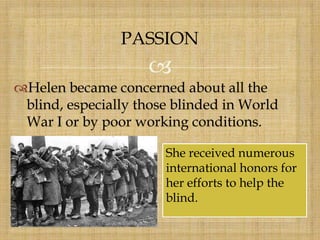
Helen became concerned about all the
blind, especially those blinded in World
War I or by poor working conditions.
PASSION
She received numerous
international honors for
her efforts to help the
blind.

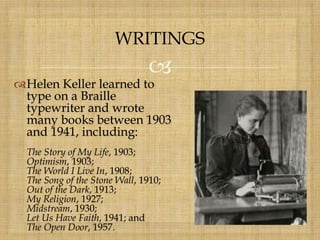
Helen Keller learned to
type on a Braille
typewriter and wrote
many books between 1903
and 1941, including:
The Story of My Life, 1903;
Optimism, 1903;
The World I Live In, 1908;
The Song of the Stone Wall, 1910;
Out of the Dark, 1913;
My Religion, 1927;
Midstream, 1930;
Let Us Have Faith, 1941; and
The Open Door, 1957.
WRITINGS

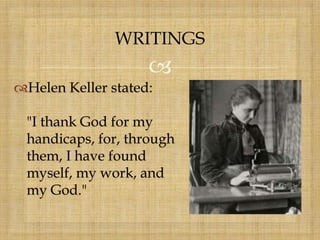
Helen Keller stated:
"I thank God for my
handicaps, for, through
them, I have found
myself, my work, and
my God."
WRITINGS
In the film documentary of her life, The
Unconquered, Helen Keller responded to
the question, "Can you see the world?":
"I can see, and that is why I can be so
happy, in what you call the dark, but
which to me is golden.
I can see a God-made world, not a man-
made world."

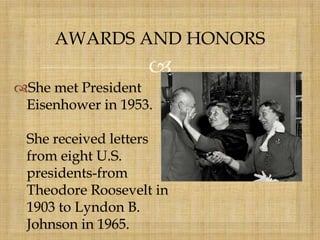
She met President
Eisenhower in 1953.
She received letters
from eight U.S.
presidents-from
Theodore Roosevelt in
1903 to Lyndon B.
Johnson in 1965.
AWARDS AND HONORS

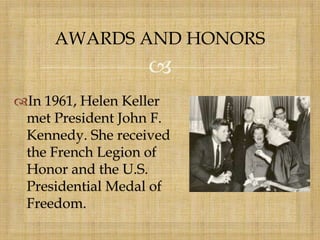
In 1961, Helen Keller
met President John F.
Kennedy. She received
the French Legion of
Honor and the U.S.
Presidential Medal of
Freedom.
AWARDS AND HONORS
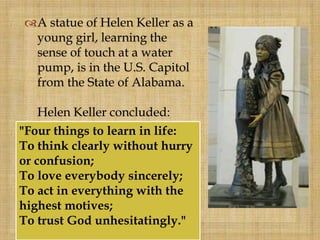
A statue of Helen Keller as a
young girl, learning the
sense of touch at a water
pump, is in the U.S. Capitol
from the State of Alabama.
Helen Keller concluded:
"Four things to learn in life:
To think clearly without hurry
or confusion;
To love everybody sincerely;
To act in everything with the
highest motives;
To trust God unhesitatingly."

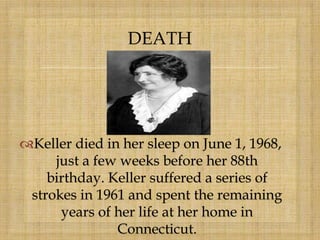
Keller died in her sleep on June 1, 1968,
just a few weeks before her 88th
birthday. Keller suffered a series of
strokes in 1961 and spent the remaining
years of her life at her home in
Connecticut.
DEATH
During her remarkable life, Keller stood
as a powerful example of how
determination, hard work, and
imagination can allow an individual to
triumph over adversity. By overcoming
difficult conditions with a great deal of
persistence, she grew into a respected
and world-renowned activist who
labored for the betterment of others.
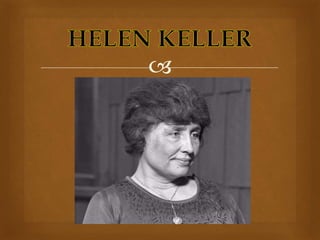
Helen keller

Helen keller

  • 1.
  • 2.
     BORN: June 27,1880 BORN IN: Tuscumbia, Alabama, USA FAMOUS: American Author & Educator DISEASES AND DISABILITIES: Visual Impairment QUICK FACTS
  • 3.
      At theage of 19 months old she was afflicted by an illness(scarlet fever/meningitis) that left her blind and deaf.  When Helen was 6 years old, she was examined by Alexander Graham Bell who was the local expert on the problems of children who are deaf. EARLY LIFE
  • 4.
     Alexander Graham Belland Hellen Keller
  • 5.
     He sent toher a 20-year- old teacher, Anne Sullivan (Macy) from the Perkins Institution for the Blind in Boston, which Bell’s son- in-law directed. Sullivan, a remarkable teacher, remained with Keller from March 1887 until her own death in October 1936. EARLY LIFE
  • 6.
     On March 3,1887, Sullivan went to Keller's home in Alabama and immediately went to work. She began by teaching six-year-old Keller finger spelling, starting with the word "doll," to help Keller understand the gift of a doll she had brought along. Other words would follow. HELEN’S TEACHER
  • 7.
     At first, Kellerwas curious, then defiant, refusing to cooperate with Sullivan's instruction. When Keller did cooperate, Sullivan could tell that she wasn't making the connection between the objects and the letters spelled out in her hand. Sullivan kept working at it, forcing Keller to go through the regimen. STRUGGLES DURING STUDYING
  • 8.
     As Keller's frustrationgrew, the tantrums increased. Finally, Sullivan demanded that she and Keller be isolated from the rest of the family for a time, so that Keller could concentrate only on Sullivan's instruction. They moved to a cottage on the plantation. STRUGGLES DURING STUDYING
  • 9.
     In a dramaticstruggle, Sullivan taught Keller the word "water"; she helped her make the connection between the object and the letters by taking Keller out to the water pump, and placing Keller's hand under the spout. HELEN’S CONNECTION BETWEEN OBJECTS
  • 10.
    While Sullivan movedthe lever to flush cool water over Keller's hand, she spelled out the word w-a-t-e-r on Keller's other hand. Keller understood and repeated the word in Sullivan's hand. She then pounded the ground, demanding to know its "letter name." Sullivan followed her, spelling out the word into her hand. Keller moved to other objects with Sullivan in tow. By nightfall, she had learned 30 words.
  • 11.
     In 1890, Kellerbegan speech classes at the Horace Mann School for the Deaf in Boston. She would toil for 25 years to learn to speak so that others could understand her. From 1894 to 1896, Keller attended the Wright- Humason School for the Deaf in New York City. There, she worked on improving her communication skills and studied regular academic subjects. EDUCATION
  • 12.
     Around this time,Keller became determined to attend college. In 1896, she attended the Cambridge School for Young Ladies, a preparatory school for women. As her story became known to the general public, Keller began to meet famous and influential people. One of them was the writer Mark Twain, who was very impressed with her. They became friends. Twain introduced her to his friend Henry H. Rogers, a Standard Oil executive. EDUCATION
  • 13.
     Rogers was soimpressed with Keller's talent, drive and determination that he agreed to pay for her to attend Radcliffe College. There, she was accompanied by Sullivan, who sat by her side to interpret lectures and texts. By this time, Keller had mastered several methods of communication, including touch-lip reading, Braille, speech, typing and finger-spelling. Keller graduated, cum laude, from Radcliffe College in 1904, at the age of 24. EDUCATION
  • 14.
     Helen became concernedabout all the blind, especially those blinded in World War I or by poor working conditions. PASSION She received numerous international honors for her efforts to help the blind.
  • 15.
     Helen Keller learnedto type on a Braille typewriter and wrote many books between 1903 and 1941, including: The Story of My Life, 1903; Optimism, 1903; The World I Live In, 1908; The Song of the Stone Wall, 1910; Out of the Dark, 1913; My Religion, 1927; Midstream, 1930; Let Us Have Faith, 1941; and The Open Door, 1957. WRITINGS
  • 16.
     Helen Keller stated: "Ithank God for my handicaps, for, through them, I have found myself, my work, and my God." WRITINGS
  • 17.
    In the filmdocumentary of her life, The Unconquered, Helen Keller responded to the question, "Can you see the world?": "I can see, and that is why I can be so happy, in what you call the dark, but which to me is golden. I can see a God-made world, not a man- made world."
  • 18.
     She met President Eisenhowerin 1953. She received letters from eight U.S. presidents-from Theodore Roosevelt in 1903 to Lyndon B. Johnson in 1965. AWARDS AND HONORS
  • 19.
     In 1961, HelenKeller met President John F. Kennedy. She received the French Legion of Honor and the U.S. Presidential Medal of Freedom. AWARDS AND HONORS
  • 20.
    A statue ofHelen Keller as a young girl, learning the sense of touch at a water pump, is in the U.S. Capitol from the State of Alabama. Helen Keller concluded: "Four things to learn in life: To think clearly without hurry or confusion; To love everybody sincerely; To act in everything with the highest motives; To trust God unhesitatingly."
  • 21.
     Keller died inher sleep on June 1, 1968, just a few weeks before her 88th birthday. Keller suffered a series of strokes in 1961 and spent the remaining years of her life at her home in Connecticut. DEATH
  • 22.
    During her remarkablelife, Keller stood as a powerful example of how determination, hard work, and imagination can allow an individual to triumph over adversity. By overcoming difficult conditions with a great deal of persistence, she grew into a respected and world-renowned activist who labored for the betterment of others.